Why?
Exam
Quals
NSF fellowship
NRSA fellowship
Post-doctoral fellowship
PI grants
A good way of thinking about science
WRITING A RESEARCH PROPOSAL
1) It must be hypothesis driven
2) It must be concise and focused
3) Supportive preliminary data
4) Spend most effort on the experimental plan
a) Restate the hypothesis
b) Present a rationale
c) Describe the research plan
d) Describe the methodology
e) Provide a rational plan for failure
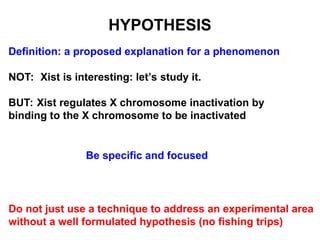
HYPOTHESIS
Definition: a proposed explanation for a phenomenon
NOT: Xist is interesting: let’s study it.
BUT: Xist regulates X chromosome inactivation by
binding to the X chromosome to be inactivated
Be specific and focused
Do not just use a technique to address an experimental area
without a well formulated hypothesis (no fishing trips)
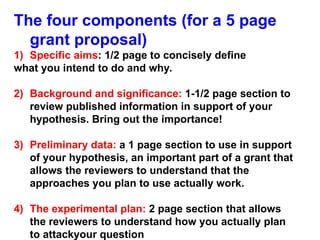
The four components (for a 5 page
grant proposal)
1) Specific aims: 1/2 page to concisely define
what you intend to do and why.
2) Background and significance: 1-1/2 page section to
review published information in support of your
hypothesis. Bring out the importance!
3) Preliminary data: a 1 page section to use in support
of your hypothesis, an important part of a grant that
allows the reviewers to understand that the
approaches you plan to use actually work.
4) The experimental plan: 2 page section that allows
the reviewers to understand how you actually plan
to attackyour question
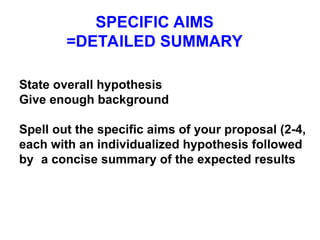
SPECIFIC AIMS
=DETAILED SUMMARY
State overall hypothesis
Give enough background
Spell out the specific aims of your proposal (2-4,
each with an individualized hypothesis followed
by a concise summary of the expected results
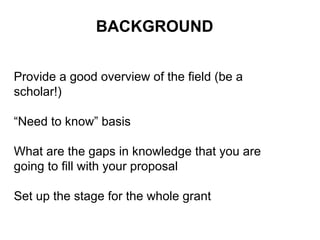
BACKGROUND
Provide a good overview of the field (be a
scholar!)
“Need to know” basis
What are the gaps in knowledge that you are
going to fill with your proposal
Set up the stage for the whole grant
PRELIMINARY DATA
Not always possible to have preliminary
data, but it helps a lot!
Examples:
Show that the technique has worked for a
related project
Data that show that the hypothesis is sound
What are you really going to do?
This section is the heart of the grant application
BUT, many people spend so
much time on the background and preliminary
data section that they run out of steam by the end
How many aims?
The aims should NOT be inter-dependent
on one another
Between 2 and 4 (generally 3)
Provide the outline for your experimental
approach as follows
1) Restate each specific aim at the beginning
of each section
2) Restate the hypothesis for the specific aim
3) Provide a rationale for the specific aim
4) Provide a detailed “plan” for the
experiments
5) What are the expected outcomes?
6) Be sure to include alternate plans if the
selected approach fails.
Grant Proposal writing in a professional context

  • 1.
    Why? Exam Quals NSF fellowship NRSA fellowship Post-doctoralfellowship PI grants A good way of thinking about science
  • 2.
    WRITING A RESEARCHPROPOSAL 1) It must be hypothesis driven 2) It must be concise and focused 3) Supportive preliminary data 4) Spend most effort on the experimental plan a) Restate the hypothesis b) Present a rationale c) Describe the research plan d) Describe the methodology e) Provide a rational plan for failure
  • 3.
    HYPOTHESIS Definition: a proposedexplanation for a phenomenon NOT: Xist is interesting: let’s study it. BUT: Xist regulates X chromosome inactivation by binding to the X chromosome to be inactivated Be specific and focused Do not just use a technique to address an experimental area without a well formulated hypothesis (no fishing trips)
  • 4.
    The four components(for a 5 page grant proposal) 1) Specific aims: 1/2 page to concisely define what you intend to do and why. 2) Background and significance: 1-1/2 page section to review published information in support of your hypothesis. Bring out the importance! 3) Preliminary data: a 1 page section to use in support of your hypothesis, an important part of a grant that allows the reviewers to understand that the approaches you plan to use actually work. 4) The experimental plan: 2 page section that allows the reviewers to understand how you actually plan to attackyour question
  • 5.
    SPECIFIC AIMS =DETAILED SUMMARY Stateoverall hypothesis Give enough background Spell out the specific aims of your proposal (2-4, each with an individualized hypothesis followed by a concise summary of the expected results
  • 6.
    BACKGROUND Provide a goodoverview of the field (be a scholar!) “Need to know” basis What are the gaps in knowledge that you are going to fill with your proposal Set up the stage for the whole grant
  • 7.
    PRELIMINARY DATA Not alwayspossible to have preliminary data, but it helps a lot! Examples: Show that the technique has worked for a related project Data that show that the hypothesis is sound
  • 8.
    What are youreally going to do? This section is the heart of the grant application BUT, many people spend so much time on the background and preliminary data section that they run out of steam by the end
  • 9.
    How many aims? Theaims should NOT be inter-dependent on one another Between 2 and 4 (generally 3)
  • 10.
    Provide the outlinefor your experimental approach as follows 1) Restate each specific aim at the beginning of each section 2) Restate the hypothesis for the specific aim 3) Provide a rationale for the specific aim 4) Provide a detailed “plan” for the experiments 5) What are the expected outcomes? 6) Be sure to include alternate plans if the selected approach fails.