Grammar PowerPoint Project
EITHER OR VERSUS NEITHER
NOR
• Either / or: is used in a sentence when referring to a choice
between two possibilities.
• Neither / nor: is used in a sentence in a negative context when
you want to say that two or more things are untrue.
Clarify
• Both ''neither'' and ''either'' must be followed by a preposition that is
consistent with the meaning and intent of these words.
• Since ''neither'' conveys a negative, it must be matched with the
negative preposition ''nor'' whenever it is used a sentence.
-Neither is never paired with “or.”
•Since ''either'' denotes a positive and conditional meaning, it must be
followed by the positive conditional preposition ''or'' in a sentence.
- Either is never paired with “nor.”
Singular or plural
When using either/or and neither/nor, note the following rules:
1. If both elements are singular, then the verb is singular too.
• Either the father or the mother has to attend the meeting. (Father
and mother are singular; so the verb has is singular too)
• Neither Leila nor Nancy is going to write the report. (Leila
and Nancy are singular; so the verb is is singular too)
2. However, if one of the elements is plural, then use a plural verb.
• Either Sue or the girls are going to prepare dinner tonight. (The girls
are plural; so the verb is plural too)
• Neither the teacher nor the students were in the classroom this
morning. (The students are plural; so the verb is plural too)
Not only/but also
• When “not only” is followed by “but also” (or simply “but”), make sure the
parts that follow each set of words are formatted the same way.
• “not only” is followed by “but also” (or “but”)
Example: He is not only a great swimmer, but also a great musician. (Good
because the sentence uses two noun clauses, which are underlined.)
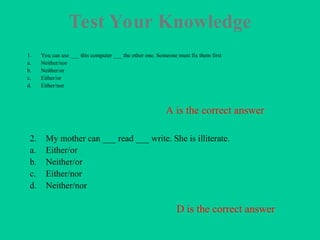
Test Your Knowledge
1. You can use ___ this computer ___ the other one. Someone must fix them first
a. Neither/nor
b. Neither/or
c. Either/or
d. Either/nor
2. My mother can ___ read ___ write. She is illiterate.
a. Either/or
b. Neither/or
c. Either/nor
d. Neither/nor
A is the correct answer
D is the correct answer
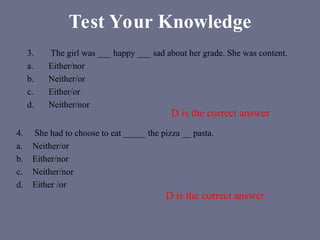
Test Your Knowledge
3. The girl was ___ happy ___ sad about her grade. She was content.
a. Either/nor
b. Neither/or
c. Either/or
d. Neither/nor
4. She had to choose to eat _____ the pizza __ pasta.
a. Neither/or
b. Either/nor
c. Neither/nor
d. Either /or
D is the correct answer

Grammar aspect: neither nor either or.ppt

  • 1.
    Grammar PowerPoint Project EITHEROR VERSUS NEITHER NOR
  • 2.
    • Either /or: is used in a sentence when referring to a choice between two possibilities. • Neither / nor: is used in a sentence in a negative context when you want to say that two or more things are untrue. Clarify • Both ''neither'' and ''either'' must be followed by a preposition that is consistent with the meaning and intent of these words. • Since ''neither'' conveys a negative, it must be matched with the negative preposition ''nor'' whenever it is used a sentence. -Neither is never paired with “or.” •Since ''either'' denotes a positive and conditional meaning, it must be followed by the positive conditional preposition ''or'' in a sentence. - Either is never paired with “nor.”
  • 3.
    Singular or plural Whenusing either/or and neither/nor, note the following rules: 1. If both elements are singular, then the verb is singular too. • Either the father or the mother has to attend the meeting. (Father and mother are singular; so the verb has is singular too) • Neither Leila nor Nancy is going to write the report. (Leila and Nancy are singular; so the verb is is singular too) 2. However, if one of the elements is plural, then use a plural verb. • Either Sue or the girls are going to prepare dinner tonight. (The girls are plural; so the verb is plural too) • Neither the teacher nor the students were in the classroom this morning. (The students are plural; so the verb is plural too)
  • 4.
    Not only/but also •When “not only” is followed by “but also” (or simply “but”), make sure the parts that follow each set of words are formatted the same way. • “not only” is followed by “but also” (or “but”) Example: He is not only a great swimmer, but also a great musician. (Good because the sentence uses two noun clauses, which are underlined.)
  • 5.
    Test Your Knowledge 1.You can use ___ this computer ___ the other one. Someone must fix them first a. Neither/nor b. Neither/or c. Either/or d. Either/nor 2. My mother can ___ read ___ write. She is illiterate. a. Either/or b. Neither/or c. Either/nor d. Neither/nor A is the correct answer D is the correct answer
  • 6.
    Test Your Knowledge 3.The girl was ___ happy ___ sad about her grade. She was content. a. Either/nor b. Neither/or c. Either/or d. Neither/nor 4. She had to choose to eat _____ the pizza __ pasta. a. Neither/or b. Either/nor c. Neither/nor d. Either /or D is the correct answer D is the correct answer