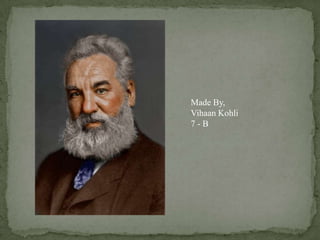
Alexander Graham Bell (March 3, 1847 – August
2, 1922) was an eminent scientist, inventor, engineer
and innovator who is credited with inventing the first
practical telephone.
Bell's father, grandfather, and brother had all been
associated with work on elocution and speech, and
both his mother and wife were deaf, profoundly
influencing Bell's life's work. His research on hearing
and speech further led him to experiment with hearing
devices which eventually culminated in Bell being
awarded the first US patent for the telephone in
1876. In retrospect, Bell considered his most famous
invention an intrusion on his real work as a scientist
and refused to have a telephone in his study.
Many other inventions marked Bell's later
life, including groundbreaking work in optical
telecommunications, hydrofoils and aeronautics. In
1888, Bell became one of the founding members of the
National Geographic Society. He has been described
as one of the most influential figures in human history.
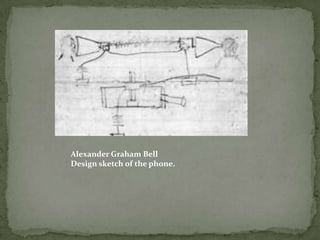
Alexander Graham Bell
Design sketch of the phone.
With the enormous technical and later financial success of his telephone
invention, Alexander Graham Bell's future was secure, and he was able to
arrange his life so that he could devote himself to his scientific interests.
Toward this end, in 1881, he used the $10,000 award for winning France's
Volta Prize to set up the Volta Laboratory in Washington, D.C. A believer in
scientific teamwork, Bell worked with two associates, his cousin Chichester
Bell and Charles Sumner Tainter, at the Volta Laboratory. Their experiments
soon produced such major improvements in Thomas Edison's phonograph that
it became commercially viable. After 1885, when he first visited Nova
Scotia, Bell set up another laboratory there at his estate, Beinn Bhreagh
(pronounced Ben Vreeah), near Baddeck, where he would assemble other
teams of bright young engineers to pursue new and exciting ideas.
Among one of his first innovations after the telephone
was the "photophone," a device that enabled sound to be
transmitted on a beam of light. Bell and his
assistant, Charles Sumner Tainter, developed the
photophone using a sensitive selenium crystal and a
mirror that would vibrate in response to a sound. In
1881, they successfully sent a photophone message over
200 yards from one building to another. Bell regarded the
photophone as "the greatest invention I have ever made;
greater than the telephone." Alexander Graham Bell's
invention reveals the principle upon which
today's laser and fibre optic communication systems are
founded, though it would take the development of several
modern technologies to realize it fully.
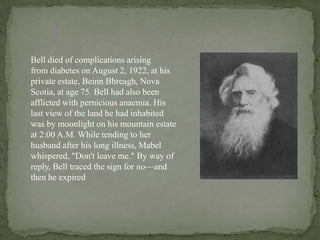
Bell died of complications arising
from diabetes on August 2, 1922, at his
private estate, Beinn Bhreagh, Nova
Scotia, at age 75. Bell had also been
afflicted with pernicious anaemia. His
last view of the land he had inhabited
was by moonlight on his mountain estate
at 2:00 A.M. While tending to her
husband after his long illness, Mabel
whispered, "Don't leave me." By way of
reply, Bell traced the sign for no—and
then he expired
Made By,
Vihaan Kohli
7-B

Graham bell

  • 2.
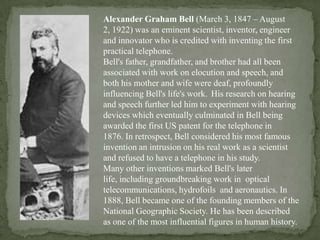
    Alexander Graham Bell(March 3, 1847 – August 2, 1922) was an eminent scientist, inventor, engineer and innovator who is credited with inventing the first practical telephone. Bell's father, grandfather, and brother had all been associated with work on elocution and speech, and both his mother and wife were deaf, profoundly influencing Bell's life's work. His research on hearing and speech further led him to experiment with hearing devices which eventually culminated in Bell being awarded the first US patent for the telephone in 1876. In retrospect, Bell considered his most famous invention an intrusion on his real work as a scientist and refused to have a telephone in his study. Many other inventions marked Bell's later life, including groundbreaking work in optical telecommunications, hydrofoils and aeronautics. In 1888, Bell became one of the founding members of the National Geographic Society. He has been described as one of the most influential figures in human history.
  • 3.
    Alexander Graham Bell Designsketch of the phone.
  • 4.
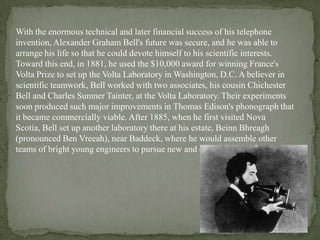
    With the enormoustechnical and later financial success of his telephone invention, Alexander Graham Bell's future was secure, and he was able to arrange his life so that he could devote himself to his scientific interests. Toward this end, in 1881, he used the $10,000 award for winning France's Volta Prize to set up the Volta Laboratory in Washington, D.C. A believer in scientific teamwork, Bell worked with two associates, his cousin Chichester Bell and Charles Sumner Tainter, at the Volta Laboratory. Their experiments soon produced such major improvements in Thomas Edison's phonograph that it became commercially viable. After 1885, when he first visited Nova Scotia, Bell set up another laboratory there at his estate, Beinn Bhreagh (pronounced Ben Vreeah), near Baddeck, where he would assemble other teams of bright young engineers to pursue new and exciting ideas.
  • 5.
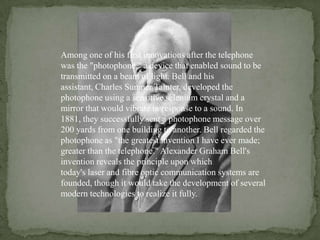
    Among one ofhis first innovations after the telephone was the "photophone," a device that enabled sound to be transmitted on a beam of light. Bell and his assistant, Charles Sumner Tainter, developed the photophone using a sensitive selenium crystal and a mirror that would vibrate in response to a sound. In 1881, they successfully sent a photophone message over 200 yards from one building to another. Bell regarded the photophone as "the greatest invention I have ever made; greater than the telephone." Alexander Graham Bell's invention reveals the principle upon which today's laser and fibre optic communication systems are founded, though it would take the development of several modern technologies to realize it fully.
  • 6.
    Bell died ofcomplications arising from diabetes on August 2, 1922, at his private estate, Beinn Bhreagh, Nova Scotia, at age 75. Bell had also been afflicted with pernicious anaemia. His last view of the land he had inhabited was by moonlight on his mountain estate at 2:00 A.M. While tending to her husband after his long illness, Mabel whispered, "Don't leave me." By way of reply, Bell traced the sign for no—and then he expired
  • 7.