A. Modern History
A time before the action of writing was developed is
______________.
B. Prehistory
C. Culture
D. Archeology
A. Modern History
A time before the action of writing was developed is
______________.
B. Prehistory
C. Culture
D. Archeology
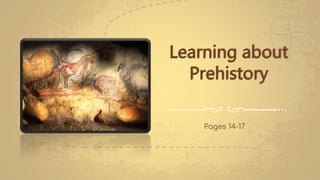
Learning about
Prehistory
Pages 14-17
Learning Outcomes
1. Analyze the differences in human lives before and after the
Paleolithic Period including the roles of people, the use of
evidence, and the day to day practice.
1. Discuss the key terms in the lesson and find out how early
humans survived, what tools they used, where they found
these tools and what exactly did they do to secure their
safety
Paleolithic: relating to or denoting the early phase of the Stone Age, lasting about 2.5 million
years, when primitive stone implements were used.
Table of Contents
01 Prehistory
02 Archeology and Anthropology
03 Evidence
04 The Paleolithic Era
Use of Stones
05
Use of Fire
06
Arts
07
Prehistory
01
Prehistory
What do people do to learn
about historic evolution?
Depend on documents and records
pictures of the past
No, written records
How do people then know their past you may
wonder?
● Since there were no written records, those
who delved into history depended in their
stories on archeological and biological
evidence.
● Archeologists and anthropologists used
their information to create postulates
about our early records.
Postulate: suggest or
assume the existence, fact,
or truth of (something) as a
basis for reasoning,
discussion, or belief.
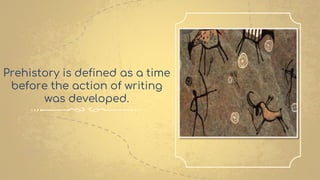
Prehistory is defined as a time
before the action of writing
was developed.
Archeology and Anthropology
02
Archeology vs. Anthropology
Archeology is the study of past lives through the
assumptions of what people have left behind.
Anthropology is known as the study | of human life and
culture. Culture is based on what people wear, the
way they organize their society, and their Morals.
Archeologists’ job is to study and examine
artifacts or objects made of human remains.
The range of the artifacts has no limits, It may be
as simple as art or as dangerous as weapons.
Other artifacts or objects may include buildings
made by people. These factors help enhance their
studies.
Archeology
Anthropologists use artifacts and
human fossils to form a picture of
man’s daily life.
Fossils are rock-like remains that
originate from biological
organisms.
Anthropology
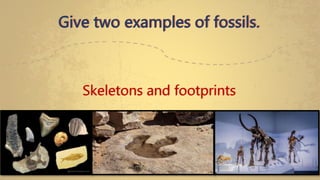
Give two examples of fossils.
Skeletons and footprints
Evidence
03
Evidence
Radiocarbon
Archeologists Seek to uncover fossil remains of early
humans. Such remains include ancient cities and burial
grounds.
Radiocarbon dating determines the age of the artifacts
and fossils for no more than 50,000 years.
Radiocarbon dating is a method that provides objective age estimates
for carbon-based materials that originated from living organisms.
Evidence
Thermoluminescence
Scientists previously used several elements in their
observations. For objects dating back to 200,000 years, they
depended on thermoluminescence, a form of luminescence
that is exhibited by certain crystalline materials, such as
some minerals, when previously absorbed energy from
electromagnetic radiation or other ionizing radiation is re
emitted as light upon heating of the material.
Materials that have
accumulated energy over
time will emit light when
exposed to high heat.
Thermoluminescence is a
form of radioactive dating.
Measuring accumulated
radiation over time.
Evidence
Analyzing DNA
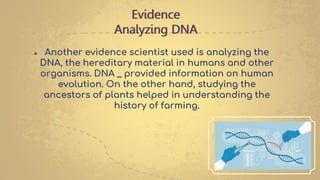
● Another evidence scientist used is analyzing the
DNA, the hereditary material in humans and other
organisms. DNA _ provided information on human
evolution. On the other hand, studying the
ancestors of plants helped in understanding the
history of farming.
The Paleolithic Era
04
The Paleolithic Era
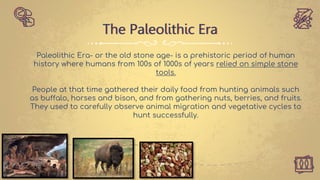
Paleolithic Era- or the old stone age- is a prehistoric period of human
history where humans from 100s of 1000s of years relied on simple stone
tools.
People at that time gathered their daily food from hunting animals such
as buffalo, horses and bison, and from gathering nuts, berries, and fruits.
They used to carefully observe animal migration and vegetative cycles to
hunt successfully.
Paleolithic people
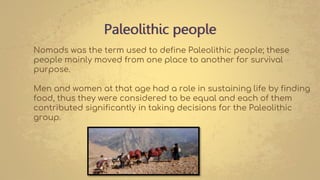
Nomads was the term used to define Paleolithic people; these
people mainly moved from one place to another for survival
purpose.
Men and women at that age had a role in sustaining life by finding
food, thus they were considered to be equal and each of them
contributed significantly in taking decisions for the Paleolithic
group.
Hints to Remember
Paleolithic a Greek word that
means old stone.
Hunting depended on careful observation of
animal behavior patterns.
Ice Age between 100,000 B.C. and 8000 B.C. posed
a threat on human life and humans had to find
ways to survive.
Hints to Remember
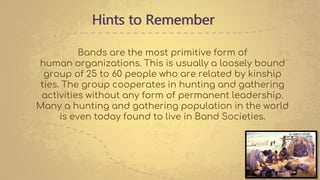
Bands are the most primitive form of
human organizations. This is usually a loosely bound
group of 25 to 60 people who are related by kinship
ties. The group cooperates in hunting and gathering
activities without any form of permanent leadership.
Many a hunting and gathering population in the world
is even today found to live in Band Societies.
Use of Stones
05
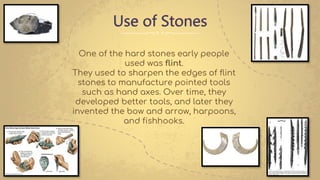
Use of Stones
One of the hard stones early people
used was flint.
They used to sharpen the edges of flint
stones to manufacture pointed tools
such as hand axes. Over time, they
developed better tools, and later they
invented the bow and arrow, harpoons,
and fishhooks.
Use of Fire
06
Use of Fire
Paleolithic people used fire as a heat
source for cooking and warmth
especially while moving to colder areas.
Fire kept people safe by keeping wild
animals away. Fire also helped them
during the Ice Age, where sheets of ice
covered huge areas in Europe, North
America, and Asia.
Arts
07
Arts
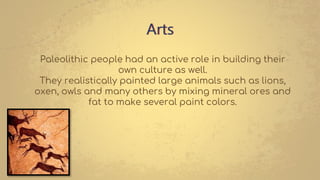
Paleolithic people had an active role in building their
own culture as well.
They realistically painted large animals such as lions,
oxen, owls and many others by mixing mineral ores and
fat to make several paint colors.
Question 1:
If written records were not available in prehistory, how
did people discover about the old ages?
Since there were no written records, those who delved
into history depended in their stories on
archeological and biological evidence.
Question 2:
How does the work of archeologists and
anthropologists differ?
Archeologists study and examine artifacts while
anthropologists use artifacts and human fossil to
describe human life.
Question 3:
What does the term Band Society refer to?
A Band Society consists of a group of people that are
loosely bound together. It consists of 25 to 60
members who are related by kinship ties.
Question 4:
What was the Paleolithic Era, and what were its
special characteristics?
The Paleolithic Era also known as the Stone Age was a
period in history were people relied on simple stone
tools.
Question 5:
What means did people during this era
use in order to survive?
Its people, the Nomads, used to hunt animals for
survival. They depended on flint stone and fire. Both
men and women had equal roles and they both
supported the life of the family.
What are the 3 pre
historic periods in
order?
Homework
CREDITS: This presentation template was created by Slidesgo,
including icons by Flaticon and infographics & images by Freepik.
Good Luck!
Please keep this slide for attribution.
Ms. Basma


Grade 9 Lesson 1.pptx

  • 1.
    A. Modern History Atime before the action of writing was developed is ______________. B. Prehistory C. Culture D. Archeology
  • 2.
    A. Modern History Atime before the action of writing was developed is ______________. B. Prehistory C. Culture D. Archeology
  • 3.
  • 4.
    Learning Outcomes 1. Analyzethe differences in human lives before and after the Paleolithic Period including the roles of people, the use of evidence, and the day to day practice. 1. Discuss the key terms in the lesson and find out how early humans survived, what tools they used, where they found these tools and what exactly did they do to secure their safety Paleolithic: relating to or denoting the early phase of the Stone Age, lasting about 2.5 million years, when primitive stone implements were used.
  • 5.
    Table of Contents 01Prehistory 02 Archeology and Anthropology 03 Evidence 04 The Paleolithic Era Use of Stones 05 Use of Fire 06 Arts 07
  • 6.
  • 7.
    Prehistory What do peopledo to learn about historic evolution? Depend on documents and records pictures of the past No, written records
  • 8.
    How do peoplethen know their past you may wonder? ● Since there were no written records, those who delved into history depended in their stories on archeological and biological evidence. ● Archeologists and anthropologists used their information to create postulates about our early records. Postulate: suggest or assume the existence, fact, or truth of (something) as a basis for reasoning, discussion, or belief.
  • 9.
    Prehistory is definedas a time before the action of writing was developed.
  • 10.
  • 11.
    Archeology vs. Anthropology Archeologyis the study of past lives through the assumptions of what people have left behind. Anthropology is known as the study | of human life and culture. Culture is based on what people wear, the way they organize their society, and their Morals.
  • 12.
    Archeologists’ job isto study and examine artifacts or objects made of human remains. The range of the artifacts has no limits, It may be as simple as art or as dangerous as weapons. Other artifacts or objects may include buildings made by people. These factors help enhance their studies. Archeology
  • 13.
    Anthropologists use artifactsand human fossils to form a picture of man’s daily life. Fossils are rock-like remains that originate from biological organisms. Anthropology
  • 14.
    Give two examplesof fossils.
  • 15.
    Give two examplesof fossils. Skeletons and footprints
  • 16.
  • 17.
    Evidence Radiocarbon Archeologists Seek touncover fossil remains of early humans. Such remains include ancient cities and burial grounds. Radiocarbon dating determines the age of the artifacts and fossils for no more than 50,000 years. Radiocarbon dating is a method that provides objective age estimates for carbon-based materials that originated from living organisms.
  • 18.
    Evidence Thermoluminescence Scientists previously usedseveral elements in their observations. For objects dating back to 200,000 years, they depended on thermoluminescence, a form of luminescence that is exhibited by certain crystalline materials, such as some minerals, when previously absorbed energy from electromagnetic radiation or other ionizing radiation is re emitted as light upon heating of the material. Materials that have accumulated energy over time will emit light when exposed to high heat. Thermoluminescence is a form of radioactive dating. Measuring accumulated radiation over time.
  • 19.
    Evidence Analyzing DNA ● Anotherevidence scientist used is analyzing the DNA, the hereditary material in humans and other organisms. DNA _ provided information on human evolution. On the other hand, studying the ancestors of plants helped in understanding the history of farming.
  • 20.
  • 21.
    The Paleolithic Era PaleolithicEra- or the old stone age- is a prehistoric period of human history where humans from 100s of 1000s of years relied on simple stone tools. People at that time gathered their daily food from hunting animals such as buffalo, horses and bison, and from gathering nuts, berries, and fruits. They used to carefully observe animal migration and vegetative cycles to hunt successfully.
  • 22.
    Paleolithic people Nomads wasthe term used to define Paleolithic people; these people mainly moved from one place to another for survival purpose. Men and women at that age had a role in sustaining life by finding food, thus they were considered to be equal and each of them contributed significantly in taking decisions for the Paleolithic group.
  • 23.
    Hints to Remember Paleolithica Greek word that means old stone. Hunting depended on careful observation of animal behavior patterns. Ice Age between 100,000 B.C. and 8000 B.C. posed a threat on human life and humans had to find ways to survive.
  • 24.
    Hints to Remember Bandsare the most primitive form of human organizations. This is usually a loosely bound group of 25 to 60 people who are related by kinship ties. The group cooperates in hunting and gathering activities without any form of permanent leadership. Many a hunting and gathering population in the world is even today found to live in Band Societies.
  • 25.
  • 26.
    Use of Stones Oneof the hard stones early people used was flint. They used to sharpen the edges of flint stones to manufacture pointed tools such as hand axes. Over time, they developed better tools, and later they invented the bow and arrow, harpoons, and fishhooks.
  • 27.
  • 28.
    Use of Fire Paleolithicpeople used fire as a heat source for cooking and warmth especially while moving to colder areas. Fire kept people safe by keeping wild animals away. Fire also helped them during the Ice Age, where sheets of ice covered huge areas in Europe, North America, and Asia.
  • 29.
  • 30.
    Arts Paleolithic people hadan active role in building their own culture as well. They realistically painted large animals such as lions, oxen, owls and many others by mixing mineral ores and fat to make several paint colors.
  • 31.
    Question 1: If writtenrecords were not available in prehistory, how did people discover about the old ages? Since there were no written records, those who delved into history depended in their stories on archeological and biological evidence.
  • 32.
    Question 2: How doesthe work of archeologists and anthropologists differ? Archeologists study and examine artifacts while anthropologists use artifacts and human fossil to describe human life.
  • 33.
    Question 3: What doesthe term Band Society refer to? A Band Society consists of a group of people that are loosely bound together. It consists of 25 to 60 members who are related by kinship ties.
  • 34.
    Question 4: What wasthe Paleolithic Era, and what were its special characteristics? The Paleolithic Era also known as the Stone Age was a period in history were people relied on simple stone tools.
  • 35.
    Question 5: What meansdid people during this era use in order to survive? Its people, the Nomads, used to hunt animals for survival. They depended on flint stone and fire. Both men and women had equal roles and they both supported the life of the family.
  • 36.
    What are the3 pre historic periods in order? Homework
  • 37.
    CREDITS: This presentationtemplate was created by Slidesgo, including icons by Flaticon and infographics & images by Freepik. Good Luck! Please keep this slide for attribution. Ms. Basma