Forms and Style in Writing Essay
Prepared by : Yssa Vienne C. Juan
02/11/18
 Process information mentioned in the
text listened to;
 Determine the intentions of speakers by
focusing on their unique verbal and non-
verbal cues; and
 Give and follow instructions and
directions.
Objectives:
Style
Is a unique way of expressing ideas
or special approach employed by a
writer.
Word choices and Sentence
structure are important elements of
style.
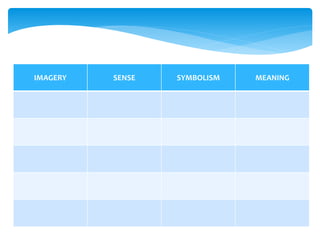
IMAGERY SENSE SYMBOLISM MEANING
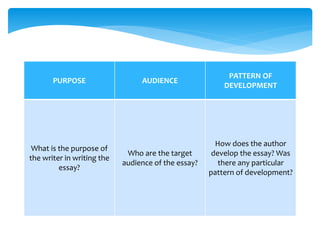
PURPOSE AUDIENCE
PATTERN OF
DEVELOPMENT
What is the purpose of
the writer in writing the
essay?
Who are the target
audience of the essay?
How does the author
develop the essay? Was
there any particular
pattern of development?
Different Forms of Essay
 Effectively writing different types of essays has
become critical to academic success. Essay writing
is a common school assignment, a part of
standardized tests, and a requirement on college
applications. Often on tests, choosing the correct
type of essay to write in response to a writing
prompt is key to getting the question right. Clearly,
students can’t afford to remain confused about
types of essays.
 In a narrative essay, the writer tells a story about a real-life
experience.
 While telling a story may sound easy to do, the narrative essay
challenges students to think and write about themselves.
 When writing a narrative essay, writers should try to involve
the reader by making the story as vivid as possible. The fact
that narrative essays are usually written in the first person
helps engage the reader.
 “I” sentences give readers a feeling of being part of the story.
A well-crafted narrative essay will also build towards drawing a
conclusion or making a personal statement.
1. Narrative Essays: Telling a Story
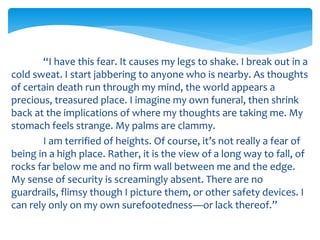
“I have this fear. It causes my legs to shake. I break out in a
cold sweat. I start jabbering to anyone who is nearby. As thoughts
of certain death run through my mind, the world appears a
precious, treasured place. I imagine my own funeral, then shrink
back at the implications of where my thoughts are taking me. My
stomach feels strange. My palms are clammy.
I am terrified of heights. Of course, it’s not really a fear of
being in a high place. Rather, it is the view of a long way to fall, of
rocks far below me and no firm wall between me and the edge.
My sense of security is screamingly absent. There are no
guardrails, flimsy though I picture them, or other safety devices. I
can rely only on my own surefootedness—or lack thereof.”
2. Descriptive Essays: Painting a
Picture
 Descriptive essay paints a picture with words.
 A writer might describe a person, place, object, or even
memory of special significance. However, this type of essay is
not description for description’s sake.
 The descriptive essay strives to communicate a deeper
meaning through the description.
 In a descriptive essay, the writer should show, not tell,
through the use of colorful words and sensory details. The
best descriptive essays appeal to the reader’s emotions, with
a result that is highly evocative.
The door is white, with some scratches at the bottom
from my pug scraping it with her claws. My pug scratches
the door when she wants to come into my room. The door
handle is brown and metal. At the complete bottom of the
door is a rubber flap, which I do not know the reason why it
is there. The room is about three lengths of my arm span,
including the closet.
The floor in my room is wooden, and it creaks when
stepped on. However, I do have one white, plush carpet
approximately in the middle of the floor. It is rather clean-
looking, considering it is white and that it is not washed
regularly.
3. Expository Essays: Just the Facts
 The expository essay is an informative piece of writing that
presents a balanced analysis of a topic.
 In an expository essay, the writer explains or defines a topic,
using facts, statistics, and examples.
 Expository writing encompasses a wide range of essay
variations, such as the comparison and contrast essay, the
cause and effect essay, and the “how to” or process essay.
Because expository essays are based on facts and not
personal feelings, writers don’t reveal their emotions or write
in the first person.
Though Christianity is the largest religion currently,
Islam may overtake this position in the next 50 years.
Despite bad press, with Islam being associated with
terrorism and ultra-conservationism, the most reliable
studies have determined that Islam will continue to grow at
breakneck speed.
The main reasons for Islam’s exceptional growth is
that Muslims in general give birth to more children than
participants of other major religions do; Islam has more
people at the age for giving birth than any other religious
group; more than a third of Muslims live in areas of the world
where the population expected to be the fastest growing;
and religion switching is not expected to hinder Islam like it
will for Christianity.
4. Persuasive Essays: Convince Me
 Persuasive essays convince the reader to accept the
writer’s point of view or recommendation.
 The writer must build a case using facts and logic, as
well as examples, expert opinion, and sound
reasoning.
 The writer should present all sides of the argument,
but must be able to communicate clearly and without
equivocation why a certain position is correct.
Learning foreign languages is extremely beneficial for
personal development. Not only does it allow you to better
understand other cultures and mentalities, but it also
enriches your personality with new outlooks, makes you
more open-minded—which is extremely valuable nowadays.
Besides, speaking at least one foreign language can
significantly improve your travelling experience, help you
make new friends from abroad, and start business or
romantic relationships. In addition, professionals who speak
foreign languages are more valued by their companies, and
often get a chance to work in different countries. Tomáš
Garrigue Masaryk used to say, “As many languages you
speak, as many times you are a human being,” and it is
definitely true.
The end 
Forms of an
Essay
Prepared by: Yssa Vienne C. Juan
02/12/18
Question 1 of 3
The goal of this type of _____ writing is to explain an idea or
concept while incorporating details for support.
 Descriptive
 Narrative
 Persuasive
 Expository
Instructions: Choose an answer and hit 'next'. You
will receive your score and answers at the end.
Question 2 of 3
 The ‘I Am a Filipino' is an example of which of the following
writing styles?
 Persuasive
 Expository
 Narrative
 Descriptive
Instructions: Choose an answer and hit 'next'. You
will receive your score and answers at the end.
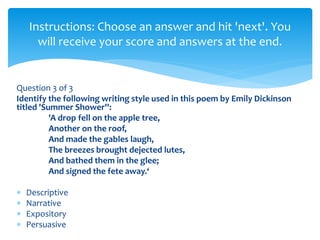
Question 3 of 3
Identify the following writing style used in this poem by Emily Dickinson
titled 'Summer Shower'':
'A drop fell on the apple tree,
Another on the roof,
And made the gables laugh,
The breezes brought dejected lutes,
And bathed them in the glee;
And signed the fete away.‘
 Descriptive
 Narrative
 Expository
 Persuasive
Instructions: Choose an answer and hit 'next'. You
will receive your score and answers at the end.
4 Writing Styles
Writing for Your Audience
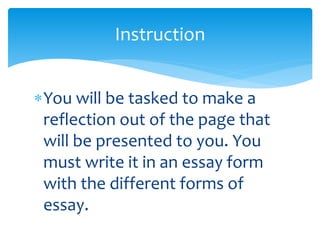
You will be tasked to make a
reflection out of the page that
will be presented to you. You
must write it in an essay form
with the different forms of
essay.
Instruction
The end 
Functions of
Modals
Prepared by : Yssa Vienne C. Juan
02/13/18
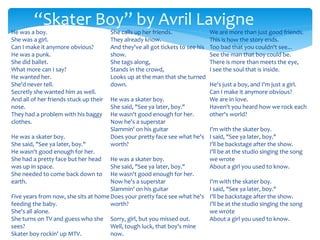
He was a boy.
She was a girl.
Can I make it anymore obvious?
He was a punk.
She did ballet.
What more can I say?
He wanted her.
She'd never tell.
Secretly she wanted him as well.
And all of her friends stuck up their
nose.
They had a problem with his baggy
clothes.
He was a skater boy.
She said, "See ya later, boy."
He wasn't good enough for her.
She had a pretty face but her head
was up in space.
She needed to come back down to
earth.
Five years from now, she sits at home
feeding the baby.
She's all alone.
She turns on TV and guess who she
sees?
Skater boy rockin' up MTV.
She calls up her friends.
They already know.
And they've all got tickets to see his
show.
She tags along,
Stands in the crowd,
Looks up at the man that she turned
down.
He was a skater boy.
She said, "See ya later, boy."
He wasn't good enough for her.
Now he's a superstar
Slammin' on his guitar
Does your pretty face see what he's
worth?
He was a skater boy.
She said, "See ya later, boy."
He wasn't good enough for her.
Now he's a superstar
Slammin' on his guitar
Does your pretty face see what he's
worth?
Sorry, girl, but you missed out.
Well, tough luck, that boy's mine
now.
We are more than just good friends.
This is how the story ends.
Too bad that you couldn't see...
See the man that boy could be.
There is more than meets the eye,
I see the soul that is inside.
He's just a boy, and I'm just a girl.
Can I make it anymore obvious?
We are in love.
Haven't you heard how we rock each
other's world?
I'm with the skater boy.
I said, "See ya later, boy."
I'll be backstage after the show.
I'll be at the studio singing the song
we wrote
About a girl you used to know.
I'm with the skater boy.
I said, "See ya later, boy."
I'll be backstage after the show.
I'll be at the studio singing the song
we wrote
About a girl you used to know.
“Skater Boy” by Avril Lavigne
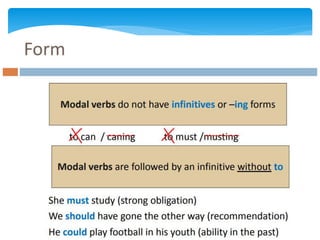
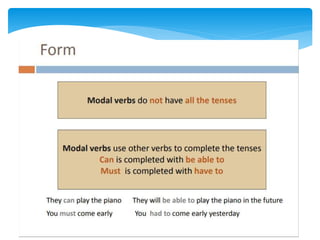
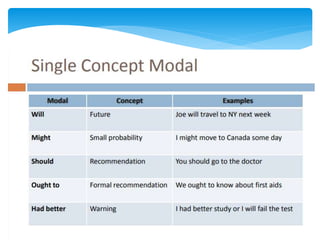
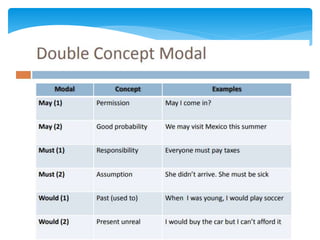
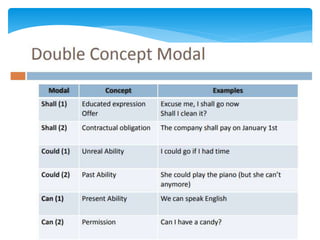
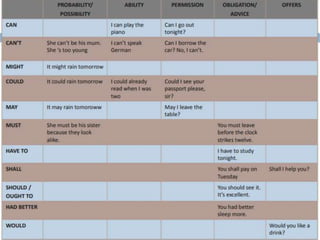
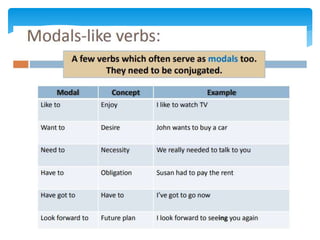
 Or known as ‘modal auxiliaries’ are helping verbs.
 Some quick rules about modals follow:
 Always accompanied by other verbs;
 Are never conjugated; and
 Are followed by the simple form of the verb.
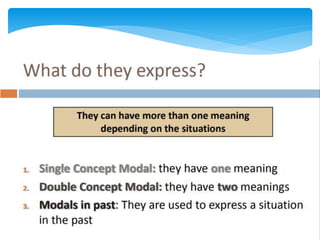
 Are used to convey many different kinds of meaning.
Most modals have more than one meaning.
Modals
 Ability
 Possibility
 Probability
 Permission
 Advisability
 Necessity
 Requesting Assistance
 Making Conclusions
 Giving Instructions
 Making Suggestions
 Showing Preference
 Making Offers
 Making Promises or
Predictions
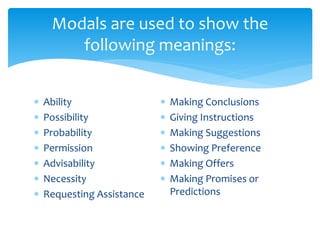
Modals are used to show the
following meanings:
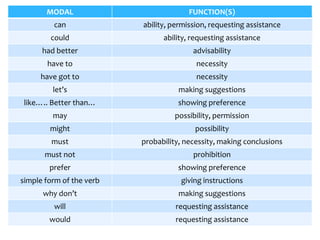
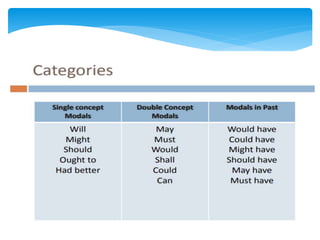
MODAL FUNCTION(S)
can ability, permission, requesting assistance
could ability, requesting assistance
had better advisability
have to necessity
have got to necessity
let’s making suggestions
like….. Better than… showing preference
may possibility, permission
might possibility
must probability, necessity, making conclusions
must not prohibition
prefer showing preference
simple form of the verb giving instructions
why don’t making suggestions
will requesting assistance
would requesting assistance
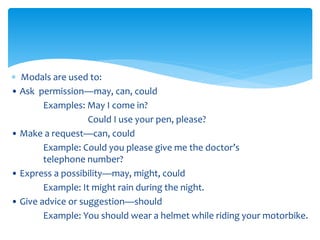
 Modals are used to:
• Ask permission—may, can, could
Examples: May I come in?
Could I use your pen, please?
• Make a request—can, could
Example: Could you please give me the doctor’s
telephone number?
• Express a possibility—may, might, could
Example: It might rain during the night.
• Give advice or suggestion—should
Example: You should wear a helmet while riding your motorbike.
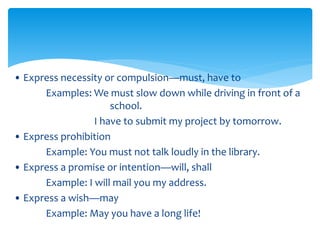
• Express necessity or compulsion—must, have to
Examples: We must slow down while driving in front of a
school.
I have to submit my project by tomorrow.
• Express prohibition
Example: You must not talk loudly in the library.
• Express a promise or intention—will, shall
Example: I will mail you my address.
• Express a wish—may
Example: May you have a long life!
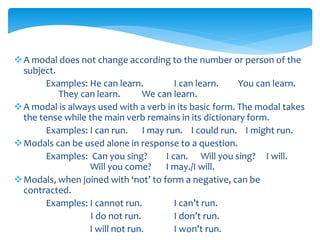
A modal does not change according to the number or person of the
subject.
Examples: He can learn. I can learn. You can learn.
They can learn. We can learn.
A modal is always used with a verb in its basic form. The modal takes
the tense while the main verb remains in its dictionary form.
Examples: I can run. I may run. I could run. I might run.
Modals can be used alone in response to a question.
Examples: Can you sing? I can. Will you sing? I will.
Will you come? I may./I will.
Modals, when joined with ‘not’ to form a negative, can be
contracted.
Examples: I cannot run. I can’t run.
I do not run. I don’t run.
I will not run. I won’t run.
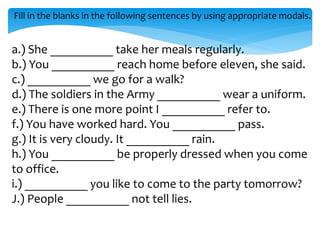
Fill in the blanks in the following sentences by using appropriate modals.
a.) She __________ take her meals regularly.
b.) You __________ reach home before eleven, she said.
c.) __________ we go for a walk?
d.) The soldiers in the Army __________ wear a uniform.
e.) There is one more point I __________ refer to.
f.) You have worked hard. You __________ pass.
g.) It is very cloudy. It __________ rain.
h.) You __________ be properly dressed when you come
to office.
i.) __________ you like to come to the party tomorrow?
J.) People __________ not tell lies.
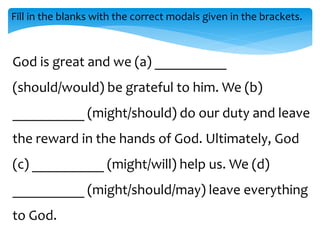
Fill in the blanks with the correct modals given in the brackets.
God is great and we (a) __________
(should/would) be grateful to him. We (b)
__________ (might/should) do our duty and leave
the reward in the hands of God. Ultimately, God
(c) __________ (might/will) help us. We (d)
__________ (might/should/may) leave everything
to God.
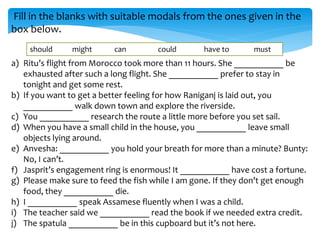
Fill in the blanks with suitable modals from the ones given in the
box below.
a) Ritu’s flight from Morocco took more than 11 hours. She ___________ be
exhausted after such a long flight. She ___________ prefer to stay in
tonight and get some rest.
b) If you want to get a better feeling for how Raniganj is laid out, you
___________ walk down town and explore the riverside.
c) You ___________ research the route a little more before you set sail.
d) When you have a small child in the house, you ___________ leave small
objects lying around.
e) Anvesha: ___________ you hold your breath for more than a minute? Bunty:
No, I can’t.
f) Jasprit’s engagement ring is enormous! It ___________ have cost a fortune.
g) Please make sure to feed the fish while I am gone. If they don’t get enough
food, they ___________ die.
h) I ___________ speak Assamese fluently when I was a child.
i) The teacher said we ___________ read the book if we needed extra credit.
j) The spatula ___________ be in this cupboard but it’s not here.
should might can could have to must
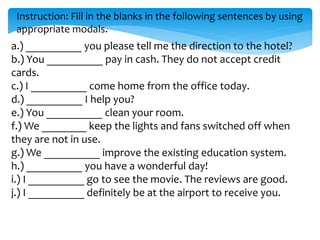
Instruction: Fill in the blanks in the following sentences by using
appropriate modals.
a.) __________ you please tell me the direction to the hotel?
b.) You __________ pay in cash. They do not accept credit
cards.
c.) I __________ come home from the office today.
d.) __________ I help you?
e.) You __________ clean your room.
f.) We ________ keep the lights and fans switched off when
they are not in use.
g.) We __________ improve the existing education system.
h.) __________ you have a wonderful day!
i.) I __________ go to see the movie. The reviews are good.
j.) I __________ definitely be at the airport to receive you.
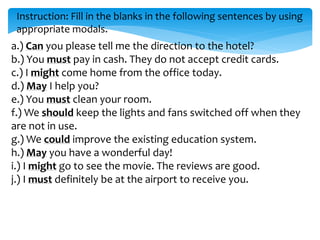
Instruction: Fill in the blanks in the following sentences by using
appropriate modals.
a.) Can you please tell me the direction to the hotel?
b.) You must pay in cash. They do not accept credit cards.
c.) I might come home from the office today.
d.) May I help you?
e.) You must clean your room.
f.) We should keep the lights and fans switched off when they
are not in use.
g.) We could improve the existing education system.
h.) May you have a wonderful day!
i.) I might go to see the movie. The reviews are good.
j.) I must definitely be at the airport to receive you.
The end
Completing/Rewriting
Sentences Using
Modals
Prepared by: Yssa Vienne C. Juan
02/14/18
 Distinguish between and among a capsule
biography, biographical sketch and feature article;
 Explain how the elements specific to a genre
contribute to the theme of a particular literary
selection;
 Determine the intentions of speakers by focusing
on their unique verbal and non-verbal cues; and
 Give and follow instructions and directions.
Objectives:
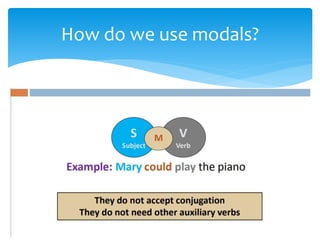
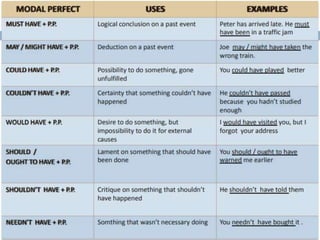
How do we use modals?
Practice:
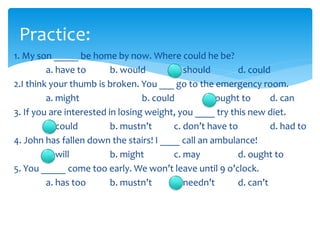
1. My son _____ be home by now. Where could he be?
a. have to b. would c. should d. could
2.I think your thumb is broken. You ___ go to the emergency room.
a. might b. could c. ought to d. can
3. If you are interested in losing weight, you ____ try this new diet.
a. could b. mustn’t c. don’t have to d. had to
4. John has fallen down the stairs! I ____ call an ambulance!
a. will b. might c. may d. ought to
5. You _____ come too early. We won’t leave until 9 o’clock.
a. has too b. mustn’t c. needn’t d. can’t
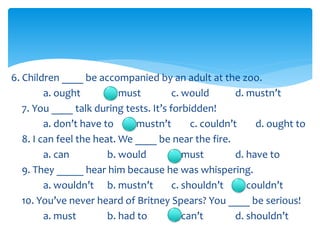
6. Children ____ be accompanied by an adult at the zoo.
a. ought b. must c. would d. mustn’t
7. You ____ talk during tests. It’s forbidden!
a. don’t have to b. mustn’t c. couldn’t d. ought to
8. I can feel the heat. We ____ be near the fire.
a. can b. would c. must d. have to
9. They _____ hear him because he was whispering.
a. wouldn’t b. mustn’t c. shouldn’t d. couldn’t
10. You’ve never heard of Britney Spears? You ____ be serious!
a. must b. had to c. can’t d. shouldn’t
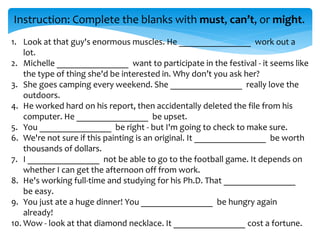
Instruction: Complete the blanks with must, can’t, or might.
1. Look at that guy's enormous muscles. He ________________ work out a
lot.
2. Michelle ________________ want to participate in the festival - it seems like
the type of thing she'd be interested in. Why don’t you ask her?
3. She goes camping every weekend. She ________________ really love the
outdoors.
4. He worked hard on his report, then accidentally deleted the file from his
computer. He ________________ be upset.
5. You ________________ be right - but I'm going to check to make sure.
6. We're not sure if this painting is an original. It ________________ be worth
thousands of dollars.
7. I ________________ not be able to go to the football game. It depends on
whether I can get the afternoon off from work.
8. He's working full-time and studying for his Ph.D. That ________________
be easy.
9. You just ate a huge dinner! You ________________ be hungry again
already!
10. Wow - look at that diamond necklace. It ________________ cost a fortune.
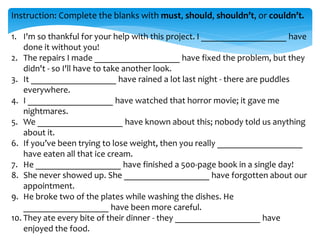
Instruction: Complete the blanks with must, should, shouldn’t, or couldn’t.
1. I'm so thankful for your help with this project. I ___________________ have
done it without you!
2. The repairs I made ___________________ have fixed the problem, but they
didn't - so I'll have to take another look.
3. It ___________________ have rained a lot last night - there are puddles
everywhere.
4. I ___________________ have watched that horror movie; it gave me
nightmares.
5. We ___________________ have known about this; nobody told us anything
about it.
6. If you’ve been trying to lose weight, then you really ___________________
have eaten all that ice cream.
7. He ___________________ have finished a 500-page book in a single day!
8. She never showed up. She ___________________ have forgotten about our
appointment.
9. He broke two of the plates while washing the dishes. He
___________________ have been more careful.
10. They ate every bite of their dinner - they ___________________ have
enjoyed the food.
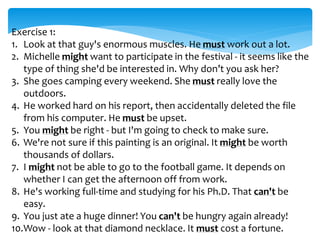
Exercise 1:
1. Look at that guy's enormous muscles. He must work out a lot.
2. Michelle might want to participate in the festival - it seems like the
type of thing she'd be interested in. Why don’t you ask her?
3. She goes camping every weekend. She must really love the
outdoors.
4. He worked hard on his report, then accidentally deleted the file
from his computer. He must be upset.
5. You might be right - but I'm going to check to make sure.
6. We're not sure if this painting is an original. It might be worth
thousands of dollars.
7. I might not be able to go to the football game. It depends on
whether I can get the afternoon off from work.
8. He's working full-time and studying for his Ph.D. That can't be
easy.
9. You just ate a huge dinner! You can't be hungry again already!
10.Wow - look at that diamond necklace. It must cost a fortune.
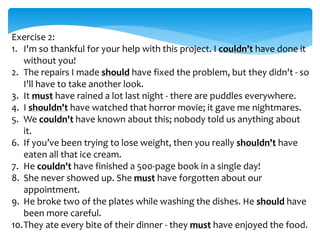
Exercise 2:
1. I'm so thankful for your help with this project. I couldn't have done it
without you!
2. The repairs I made should have fixed the problem, but they didn't - so
I'll have to take another look.
3. It must have rained a lot last night - there are puddles everywhere.
4. I shouldn't have watched that horror movie; it gave me nightmares.
5. We couldn't have known about this; nobody told us anything about
it.
6. If you’ve been trying to lose weight, then you really shouldn't have
eaten all that ice cream.
7. He couldn't have finished a 500-page book in a single day!
8. She never showed up. She must have forgotten about our
appointment.
9. He broke two of the plates while washing the dishes. He should have
been more careful.
10.They ate every bite of their dinner - they must have enjoyed the food.
Enhancement Learning
Prepared by : Yssa Vienne C. Juan
02/15/18
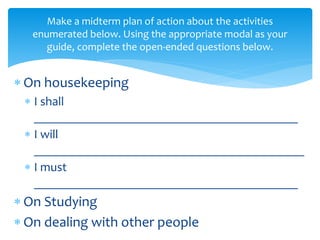
Make a midterm plan of action about the activities
enumerated below. Using the appropriate modal as your
guide, complete the open-ended questions below.
 On housekeeping
 I shall
__________________________________________
 I will
___________________________________________
 I must
__________________________________________
 On Studying
 On dealing with other people
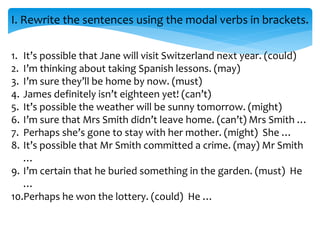
I. Rewrite the sentences using the modal verbs in brackets.
1. It’s possible that Jane will visit Switzerland next year. (could)
2. I’m thinking about taking Spanish lessons. (may)
3. I’m sure they’ll be home by now. (must)
4. James definitely isn’t eighteen yet! (can’t)
5. It’s possible the weather will be sunny tomorrow. (might)
6. I’m sure that Mrs Smith didn’t leave home. (can’t) Mrs Smith …
7. Perhaps she’s gone to stay with her mother. (might) She …
8. It’s possible that Mr Smith committed a crime. (may) Mr Smith
…
9. I’m certain that he buried something in the garden. (must) He
…
10.Perhaps he won the lottery. (could) He …
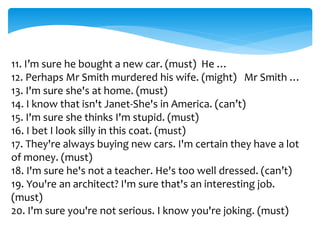
11. I’m sure he bought a new car. (must) He …
12. Perhaps Mr Smith murdered his wife. (might) Mr Smith …
13. I'm sure she's at home. (must)
14. I know that isn't Janet-She's in America. (can’t)
15. I'm sure she thinks I'm stupid. (must)
16. I bet I look silly in this coat. (must)
17. They're always buying new cars. I'm certain they have a lot
of money. (must)
18. I'm sure he's not a teacher. He's too well dressed. (can’t)
19. You're an architect? I'm sure that's an interesting job.
(must)
20. I'm sure you're not serious. I know you're joking. (must)
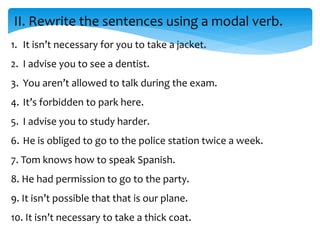
II. Rewrite the sentences using a modal verb.
1. It isn’t necessary for you to take a jacket.
2. I advise you to see a dentist.
3. You aren’t allowed to talk during the exam.
4. It’s forbidden to park here.
5. I advise you to study harder.
6. He is obliged to go to the police station twice a week.
7. Tom knows how to speak Spanish.
8. He had permission to go to the party.
9. It isn’t possible that that is our plane.
10. It isn’t necessary to take a thick coat.
I. Rewrite the sentences using the modal verbs in
brackets.
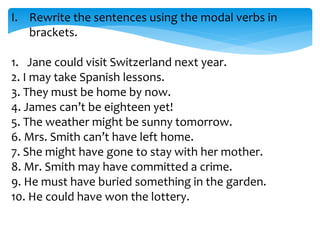
1. Jane could visit Switzerland next year.
2. I may take Spanish lessons.
3. They must be home by now.
4. James can’t be eighteen yet!
5. The weather might be sunny tomorrow.
6. Mrs. Smith can’t have left home.
7. She might have gone to stay with her mother.
8. Mr. Smith may have committed a crime.
9. He must have buried something in the garden.
10. He could have won the lottery.
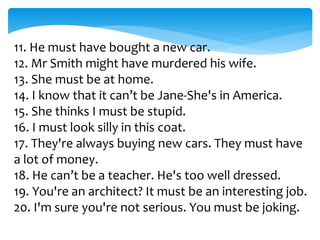
11. He must have bought a new car.
12. Mr Smith might have murdered his wife.
13. She must be at home.
14. I know that it can’t be Jane-She's in America.
15. She thinks I must be stupid.
16. I must look silly in this coat.
17. They're always buying new cars. They must have
a lot of money.
18. He can’t be a teacher. He's too well dressed.
19. You're an architect? It must be an interesting job.
20. I'm sure you're not serious. You must be joking.
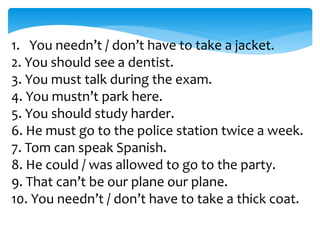
1. You needn’t / don’t have to take a jacket.
2. You should see a dentist.
3. You must talk during the exam.
4. You mustn’t park here.
5. You should study harder.
6. He must go to the police station twice a week.
7. Tom can speak Spanish.
8. He could / was allowed to go to the party.
9. That can’t be our plane our plane.
10. You needn’t / don’t have to take a thick coat.
The end 

Grade 7 english.pptx

  • 1.
    Forms and Stylein Writing Essay Prepared by : Yssa Vienne C. Juan 02/11/18
  • 2.
     Process informationmentioned in the text listened to;  Determine the intentions of speakers by focusing on their unique verbal and non- verbal cues; and  Give and follow instructions and directions. Objectives:
  • 3.
    Style Is a uniqueway of expressing ideas or special approach employed by a writer. Word choices and Sentence structure are important elements of style.
  • 4.
  • 5.
    PURPOSE AUDIENCE PATTERN OF DEVELOPMENT Whatis the purpose of the writer in writing the essay? Who are the target audience of the essay? How does the author develop the essay? Was there any particular pattern of development?
  • 6.
    Different Forms ofEssay  Effectively writing different types of essays has become critical to academic success. Essay writing is a common school assignment, a part of standardized tests, and a requirement on college applications. Often on tests, choosing the correct type of essay to write in response to a writing prompt is key to getting the question right. Clearly, students can’t afford to remain confused about types of essays.
  • 7.
     In anarrative essay, the writer tells a story about a real-life experience.  While telling a story may sound easy to do, the narrative essay challenges students to think and write about themselves.  When writing a narrative essay, writers should try to involve the reader by making the story as vivid as possible. The fact that narrative essays are usually written in the first person helps engage the reader.  “I” sentences give readers a feeling of being part of the story. A well-crafted narrative essay will also build towards drawing a conclusion or making a personal statement. 1. Narrative Essays: Telling a Story
  • 8.
    “I have thisfear. It causes my legs to shake. I break out in a cold sweat. I start jabbering to anyone who is nearby. As thoughts of certain death run through my mind, the world appears a precious, treasured place. I imagine my own funeral, then shrink back at the implications of where my thoughts are taking me. My stomach feels strange. My palms are clammy. I am terrified of heights. Of course, it’s not really a fear of being in a high place. Rather, it is the view of a long way to fall, of rocks far below me and no firm wall between me and the edge. My sense of security is screamingly absent. There are no guardrails, flimsy though I picture them, or other safety devices. I can rely only on my own surefootedness—or lack thereof.”
  • 9.
    2. Descriptive Essays:Painting a Picture  Descriptive essay paints a picture with words.  A writer might describe a person, place, object, or even memory of special significance. However, this type of essay is not description for description’s sake.  The descriptive essay strives to communicate a deeper meaning through the description.  In a descriptive essay, the writer should show, not tell, through the use of colorful words and sensory details. The best descriptive essays appeal to the reader’s emotions, with a result that is highly evocative.
  • 10.
    The door iswhite, with some scratches at the bottom from my pug scraping it with her claws. My pug scratches the door when she wants to come into my room. The door handle is brown and metal. At the complete bottom of the door is a rubber flap, which I do not know the reason why it is there. The room is about three lengths of my arm span, including the closet. The floor in my room is wooden, and it creaks when stepped on. However, I do have one white, plush carpet approximately in the middle of the floor. It is rather clean- looking, considering it is white and that it is not washed regularly.
  • 11.
    3. Expository Essays:Just the Facts  The expository essay is an informative piece of writing that presents a balanced analysis of a topic.  In an expository essay, the writer explains or defines a topic, using facts, statistics, and examples.  Expository writing encompasses a wide range of essay variations, such as the comparison and contrast essay, the cause and effect essay, and the “how to” or process essay. Because expository essays are based on facts and not personal feelings, writers don’t reveal their emotions or write in the first person.
  • 12.
    Though Christianity isthe largest religion currently, Islam may overtake this position in the next 50 years. Despite bad press, with Islam being associated with terrorism and ultra-conservationism, the most reliable studies have determined that Islam will continue to grow at breakneck speed. The main reasons for Islam’s exceptional growth is that Muslims in general give birth to more children than participants of other major religions do; Islam has more people at the age for giving birth than any other religious group; more than a third of Muslims live in areas of the world where the population expected to be the fastest growing; and religion switching is not expected to hinder Islam like it will for Christianity.
  • 13.
    4. Persuasive Essays:Convince Me  Persuasive essays convince the reader to accept the writer’s point of view or recommendation.  The writer must build a case using facts and logic, as well as examples, expert opinion, and sound reasoning.  The writer should present all sides of the argument, but must be able to communicate clearly and without equivocation why a certain position is correct.
  • 14.
    Learning foreign languagesis extremely beneficial for personal development. Not only does it allow you to better understand other cultures and mentalities, but it also enriches your personality with new outlooks, makes you more open-minded—which is extremely valuable nowadays. Besides, speaking at least one foreign language can significantly improve your travelling experience, help you make new friends from abroad, and start business or romantic relationships. In addition, professionals who speak foreign languages are more valued by their companies, and often get a chance to work in different countries. Tomáš Garrigue Masaryk used to say, “As many languages you speak, as many times you are a human being,” and it is definitely true.
  • 15.
  • 16.
    Forms of an Essay Preparedby: Yssa Vienne C. Juan 02/12/18
  • 17.
    Question 1 of3 The goal of this type of _____ writing is to explain an idea or concept while incorporating details for support.  Descriptive  Narrative  Persuasive  Expository Instructions: Choose an answer and hit 'next'. You will receive your score and answers at the end.
  • 18.
    Question 2 of3  The ‘I Am a Filipino' is an example of which of the following writing styles?  Persuasive  Expository  Narrative  Descriptive Instructions: Choose an answer and hit 'next'. You will receive your score and answers at the end.
  • 19.
    Question 3 of3 Identify the following writing style used in this poem by Emily Dickinson titled 'Summer Shower'': 'A drop fell on the apple tree, Another on the roof, And made the gables laugh, The breezes brought dejected lutes, And bathed them in the glee; And signed the fete away.‘  Descriptive  Narrative  Expository  Persuasive Instructions: Choose an answer and hit 'next'. You will receive your score and answers at the end.
  • 20.
  • 21.
  • 22.
    You will betasked to make a reflection out of the page that will be presented to you. You must write it in an essay form with the different forms of essay. Instruction
  • 24.
  • 25.
    Functions of Modals Prepared by: Yssa Vienne C. Juan 02/13/18
  • 26.
    He was aboy. She was a girl. Can I make it anymore obvious? He was a punk. She did ballet. What more can I say? He wanted her. She'd never tell. Secretly she wanted him as well. And all of her friends stuck up their nose. They had a problem with his baggy clothes. He was a skater boy. She said, "See ya later, boy." He wasn't good enough for her. She had a pretty face but her head was up in space. She needed to come back down to earth. Five years from now, she sits at home feeding the baby. She's all alone. She turns on TV and guess who she sees? Skater boy rockin' up MTV. She calls up her friends. They already know. And they've all got tickets to see his show. She tags along, Stands in the crowd, Looks up at the man that she turned down. He was a skater boy. She said, "See ya later, boy." He wasn't good enough for her. Now he's a superstar Slammin' on his guitar Does your pretty face see what he's worth? He was a skater boy. She said, "See ya later, boy." He wasn't good enough for her. Now he's a superstar Slammin' on his guitar Does your pretty face see what he's worth? Sorry, girl, but you missed out. Well, tough luck, that boy's mine now. We are more than just good friends. This is how the story ends. Too bad that you couldn't see... See the man that boy could be. There is more than meets the eye, I see the soul that is inside. He's just a boy, and I'm just a girl. Can I make it anymore obvious? We are in love. Haven't you heard how we rock each other's world? I'm with the skater boy. I said, "See ya later, boy." I'll be backstage after the show. I'll be at the studio singing the song we wrote About a girl you used to know. I'm with the skater boy. I said, "See ya later, boy." I'll be backstage after the show. I'll be at the studio singing the song we wrote About a girl you used to know. “Skater Boy” by Avril Lavigne
  • 27.
     Or knownas ‘modal auxiliaries’ are helping verbs.  Some quick rules about modals follow:  Always accompanied by other verbs;  Are never conjugated; and  Are followed by the simple form of the verb.  Are used to convey many different kinds of meaning. Most modals have more than one meaning. Modals
  • 28.
     Ability  Possibility Probability  Permission  Advisability  Necessity  Requesting Assistance  Making Conclusions  Giving Instructions  Making Suggestions  Showing Preference  Making Offers  Making Promises or Predictions Modals are used to show the following meanings:
  • 29.
    MODAL FUNCTION(S) can ability,permission, requesting assistance could ability, requesting assistance had better advisability have to necessity have got to necessity let’s making suggestions like….. Better than… showing preference may possibility, permission might possibility must probability, necessity, making conclusions must not prohibition prefer showing preference simple form of the verb giving instructions why don’t making suggestions will requesting assistance would requesting assistance
  • 30.
     Modals areused to: • Ask permission—may, can, could Examples: May I come in? Could I use your pen, please? • Make a request—can, could Example: Could you please give me the doctor’s telephone number? • Express a possibility—may, might, could Example: It might rain during the night. • Give advice or suggestion—should Example: You should wear a helmet while riding your motorbike.
  • 31.
    • Express necessityor compulsion—must, have to Examples: We must slow down while driving in front of a school. I have to submit my project by tomorrow. • Express prohibition Example: You must not talk loudly in the library. • Express a promise or intention—will, shall Example: I will mail you my address. • Express a wish—may Example: May you have a long life!
  • 32.
    A modal doesnot change according to the number or person of the subject. Examples: He can learn. I can learn. You can learn. They can learn. We can learn. A modal is always used with a verb in its basic form. The modal takes the tense while the main verb remains in its dictionary form. Examples: I can run. I may run. I could run. I might run. Modals can be used alone in response to a question. Examples: Can you sing? I can. Will you sing? I will. Will you come? I may./I will. Modals, when joined with ‘not’ to form a negative, can be contracted. Examples: I cannot run. I can’t run. I do not run. I don’t run. I will not run. I won’t run.
  • 33.
    Fill in theblanks in the following sentences by using appropriate modals. a.) She __________ take her meals regularly. b.) You __________ reach home before eleven, she said. c.) __________ we go for a walk? d.) The soldiers in the Army __________ wear a uniform. e.) There is one more point I __________ refer to. f.) You have worked hard. You __________ pass. g.) It is very cloudy. It __________ rain. h.) You __________ be properly dressed when you come to office. i.) __________ you like to come to the party tomorrow? J.) People __________ not tell lies.
  • 34.
    Fill in theblanks with the correct modals given in the brackets. God is great and we (a) __________ (should/would) be grateful to him. We (b) __________ (might/should) do our duty and leave the reward in the hands of God. Ultimately, God (c) __________ (might/will) help us. We (d) __________ (might/should/may) leave everything to God.
  • 35.
    Fill in theblanks with suitable modals from the ones given in the box below. a) Ritu’s flight from Morocco took more than 11 hours. She ___________ be exhausted after such a long flight. She ___________ prefer to stay in tonight and get some rest. b) If you want to get a better feeling for how Raniganj is laid out, you ___________ walk down town and explore the riverside. c) You ___________ research the route a little more before you set sail. d) When you have a small child in the house, you ___________ leave small objects lying around. e) Anvesha: ___________ you hold your breath for more than a minute? Bunty: No, I can’t. f) Jasprit’s engagement ring is enormous! It ___________ have cost a fortune. g) Please make sure to feed the fish while I am gone. If they don’t get enough food, they ___________ die. h) I ___________ speak Assamese fluently when I was a child. i) The teacher said we ___________ read the book if we needed extra credit. j) The spatula ___________ be in this cupboard but it’s not here. should might can could have to must
  • 36.
    Instruction: Fill inthe blanks in the following sentences by using appropriate modals. a.) __________ you please tell me the direction to the hotel? b.) You __________ pay in cash. They do not accept credit cards. c.) I __________ come home from the office today. d.) __________ I help you? e.) You __________ clean your room. f.) We ________ keep the lights and fans switched off when they are not in use. g.) We __________ improve the existing education system. h.) __________ you have a wonderful day! i.) I __________ go to see the movie. The reviews are good. j.) I __________ definitely be at the airport to receive you.
  • 37.
    Instruction: Fill inthe blanks in the following sentences by using appropriate modals. a.) Can you please tell me the direction to the hotel? b.) You must pay in cash. They do not accept credit cards. c.) I might come home from the office today. d.) May I help you? e.) You must clean your room. f.) We should keep the lights and fans switched off when they are not in use. g.) We could improve the existing education system. h.) May you have a wonderful day! i.) I might go to see the movie. The reviews are good. j.) I must definitely be at the airport to receive you.
  • 38.
  • 39.
  • 40.
     Distinguish betweenand among a capsule biography, biographical sketch and feature article;  Explain how the elements specific to a genre contribute to the theme of a particular literary selection;  Determine the intentions of speakers by focusing on their unique verbal and non-verbal cues; and  Give and follow instructions and directions. Objectives:
  • 41.
    How do weuse modals?
  • 54.
    Practice: 1. My son_____ be home by now. Where could he be? a. have to b. would c. should d. could 2.I think your thumb is broken. You ___ go to the emergency room. a. might b. could c. ought to d. can 3. If you are interested in losing weight, you ____ try this new diet. a. could b. mustn’t c. don’t have to d. had to 4. John has fallen down the stairs! I ____ call an ambulance! a. will b. might c. may d. ought to 5. You _____ come too early. We won’t leave until 9 o’clock. a. has too b. mustn’t c. needn’t d. can’t
  • 55.
    6. Children ____be accompanied by an adult at the zoo. a. ought b. must c. would d. mustn’t 7. You ____ talk during tests. It’s forbidden! a. don’t have to b. mustn’t c. couldn’t d. ought to 8. I can feel the heat. We ____ be near the fire. a. can b. would c. must d. have to 9. They _____ hear him because he was whispering. a. wouldn’t b. mustn’t c. shouldn’t d. couldn’t 10. You’ve never heard of Britney Spears? You ____ be serious! a. must b. had to c. can’t d. shouldn’t
  • 56.
    Instruction: Complete theblanks with must, can’t, or might. 1. Look at that guy's enormous muscles. He ________________ work out a lot. 2. Michelle ________________ want to participate in the festival - it seems like the type of thing she'd be interested in. Why don’t you ask her? 3. She goes camping every weekend. She ________________ really love the outdoors. 4. He worked hard on his report, then accidentally deleted the file from his computer. He ________________ be upset. 5. You ________________ be right - but I'm going to check to make sure. 6. We're not sure if this painting is an original. It ________________ be worth thousands of dollars. 7. I ________________ not be able to go to the football game. It depends on whether I can get the afternoon off from work. 8. He's working full-time and studying for his Ph.D. That ________________ be easy. 9. You just ate a huge dinner! You ________________ be hungry again already! 10. Wow - look at that diamond necklace. It ________________ cost a fortune.
  • 57.
    Instruction: Complete theblanks with must, should, shouldn’t, or couldn’t. 1. I'm so thankful for your help with this project. I ___________________ have done it without you! 2. The repairs I made ___________________ have fixed the problem, but they didn't - so I'll have to take another look. 3. It ___________________ have rained a lot last night - there are puddles everywhere. 4. I ___________________ have watched that horror movie; it gave me nightmares. 5. We ___________________ have known about this; nobody told us anything about it. 6. If you’ve been trying to lose weight, then you really ___________________ have eaten all that ice cream. 7. He ___________________ have finished a 500-page book in a single day! 8. She never showed up. She ___________________ have forgotten about our appointment. 9. He broke two of the plates while washing the dishes. He ___________________ have been more careful. 10. They ate every bite of their dinner - they ___________________ have enjoyed the food.
  • 58.
    Exercise 1: 1. Lookat that guy's enormous muscles. He must work out a lot. 2. Michelle might want to participate in the festival - it seems like the type of thing she'd be interested in. Why don’t you ask her? 3. She goes camping every weekend. She must really love the outdoors. 4. He worked hard on his report, then accidentally deleted the file from his computer. He must be upset. 5. You might be right - but I'm going to check to make sure. 6. We're not sure if this painting is an original. It might be worth thousands of dollars. 7. I might not be able to go to the football game. It depends on whether I can get the afternoon off from work. 8. He's working full-time and studying for his Ph.D. That can't be easy. 9. You just ate a huge dinner! You can't be hungry again already! 10.Wow - look at that diamond necklace. It must cost a fortune.
  • 59.
    Exercise 2: 1. I'mso thankful for your help with this project. I couldn't have done it without you! 2. The repairs I made should have fixed the problem, but they didn't - so I'll have to take another look. 3. It must have rained a lot last night - there are puddles everywhere. 4. I shouldn't have watched that horror movie; it gave me nightmares. 5. We couldn't have known about this; nobody told us anything about it. 6. If you’ve been trying to lose weight, then you really shouldn't have eaten all that ice cream. 7. He couldn't have finished a 500-page book in a single day! 8. She never showed up. She must have forgotten about our appointment. 9. He broke two of the plates while washing the dishes. He should have been more careful. 10.They ate every bite of their dinner - they must have enjoyed the food.
  • 60.
    Enhancement Learning Prepared by: Yssa Vienne C. Juan 02/15/18
  • 61.
    Make a midtermplan of action about the activities enumerated below. Using the appropriate modal as your guide, complete the open-ended questions below.  On housekeeping  I shall __________________________________________  I will ___________________________________________  I must __________________________________________  On Studying  On dealing with other people
  • 62.
    I. Rewrite thesentences using the modal verbs in brackets. 1. It’s possible that Jane will visit Switzerland next year. (could) 2. I’m thinking about taking Spanish lessons. (may) 3. I’m sure they’ll be home by now. (must) 4. James definitely isn’t eighteen yet! (can’t) 5. It’s possible the weather will be sunny tomorrow. (might) 6. I’m sure that Mrs Smith didn’t leave home. (can’t) Mrs Smith … 7. Perhaps she’s gone to stay with her mother. (might) She … 8. It’s possible that Mr Smith committed a crime. (may) Mr Smith … 9. I’m certain that he buried something in the garden. (must) He … 10.Perhaps he won the lottery. (could) He …
  • 63.
    11. I’m surehe bought a new car. (must) He … 12. Perhaps Mr Smith murdered his wife. (might) Mr Smith … 13. I'm sure she's at home. (must) 14. I know that isn't Janet-She's in America. (can’t) 15. I'm sure she thinks I'm stupid. (must) 16. I bet I look silly in this coat. (must) 17. They're always buying new cars. I'm certain they have a lot of money. (must) 18. I'm sure he's not a teacher. He's too well dressed. (can’t) 19. You're an architect? I'm sure that's an interesting job. (must) 20. I'm sure you're not serious. I know you're joking. (must)
  • 64.
    II. Rewrite thesentences using a modal verb. 1. It isn’t necessary for you to take a jacket. 2. I advise you to see a dentist. 3. You aren’t allowed to talk during the exam. 4. It’s forbidden to park here. 5. I advise you to study harder. 6. He is obliged to go to the police station twice a week. 7. Tom knows how to speak Spanish. 8. He had permission to go to the party. 9. It isn’t possible that that is our plane. 10. It isn’t necessary to take a thick coat.
  • 65.
    I. Rewrite thesentences using the modal verbs in brackets. 1. Jane could visit Switzerland next year. 2. I may take Spanish lessons. 3. They must be home by now. 4. James can’t be eighteen yet! 5. The weather might be sunny tomorrow. 6. Mrs. Smith can’t have left home. 7. She might have gone to stay with her mother. 8. Mr. Smith may have committed a crime. 9. He must have buried something in the garden. 10. He could have won the lottery.
  • 66.
    11. He musthave bought a new car. 12. Mr Smith might have murdered his wife. 13. She must be at home. 14. I know that it can’t be Jane-She's in America. 15. She thinks I must be stupid. 16. I must look silly in this coat. 17. They're always buying new cars. They must have a lot of money. 18. He can’t be a teacher. He's too well dressed. 19. You're an architect? It must be an interesting job. 20. I'm sure you're not serious. You must be joking.
  • 67.
    1. You needn’t/ don’t have to take a jacket. 2. You should see a dentist. 3. You must talk during the exam. 4. You mustn’t park here. 5. You should study harder. 6. He must go to the police station twice a week. 7. Tom can speak Spanish. 8. He could / was allowed to go to the party. 9. That can’t be our plane our plane. 10. You needn’t / don’t have to take a thick coat.
  • 68.