Parts and Functions of
Musculo-skeletal System
Maylene Morales- Tubig
M.Kalaw Memorial School
Have you observed how
houses are built?
What will the construction
worker do first?
How will you compare that to
the human body?
Is there a framework that
provides structure to the human
body?
What do you call this framework?
Activity # 1
Connect the cut out pictures of
the human skeletal system
Skeleton Dance
https://www.youtube.com/watch?v=e54m6XOpRgU
Label the parts ( Group Work )
“What is the purpose of
the human skeleton?”
The skeletal system is made up of
many bones, 206 to be exact. Bones
help to shape your body and protect
your organs, such as your heart, brain,
and lungs, from damage. If you didn't
have bones in your body, you would
look like a bowl full of Jello, because
there would be nothing holding you
up.The framework of your body is
made up of rigid and strong materials
called bones.
Activity #1:
Examining Bone
Structure
Locate the part of the
your framework as I say
its name.
What are the two division of the
skeletal system?
What is the difference between
compact bone & spongy bone?
Why is bone marrow important?
Activity #2:
Observing Movements of Joints
Problem:
What are the different kinds of
joints? https://www.youtube.com/watch?v=2rUzWx9P7cA
Safety Tips:
1. Be careful in moving your body parts,
especially your neck and backbone.
2. Do not allow other persons to pull or twist
your arm.
Mix and Match!
Parts and functions of
Skeletal System (group work)
Your group will be provided
with parts(green) and
function (yellow) written in
metacards
Why should bones be
strong?
Bones support our
body and allow us
move.
How will you take care
of your bones?
1.Eat calcium-rich foods
2. prevent from falls and other
accidents that could injure the
bones especially when playing.
4.Get vitamin D through sunlight,
Your body produces vitamin D naturally when
it’s directly exposed to sunlight. Besides getting
vitamin D through sunlight, you can also get it
through certain foods and supplements to ensure
adequate levels of the vitamin in your blood.
Vitamin D has several important functions.
Perhaps the most vital are regulating the
absorption of calcium and phosphorus, and
facilitating normal immune system function.
Getting a sufficient amount of vitamin D is
important for normal growth and development of
bones and teeth, as well as improved resistance
against certain diseases.
TRIVIA:
Bones are alive. They
are made of living cells
capable of growing
and repairing
themselves.
Our bones are in fact alive! Our bones are made up of hard
stuff that gives them the strength they need, and many
living cells. These cells are what help our bones to grow
and repair themselves if damaged. The cells in our bones
rely on blood to keep them alive, just as many other cells in
our body do. Did you know that our blood is what brings
food and oxygen to our bone cells and takes away the
things that our bone cells don't need? If our bones were
not alive, a broken bone would stay broken for the rest of
our life, because there would be nothing alive to fix it.
Luckily our bones are very alive and have the ability to
repair breaks and fractures in no time! When we break a
bone, our blood clots in the break to form a bridge, or to
close up the break.
What are the ideas did you learn in
the lesson?
What are the parts and functions of
the skeletal system?
Describe the potential consequences
if all bone tissues in humans were
made of spongy bones & no compact
bones.
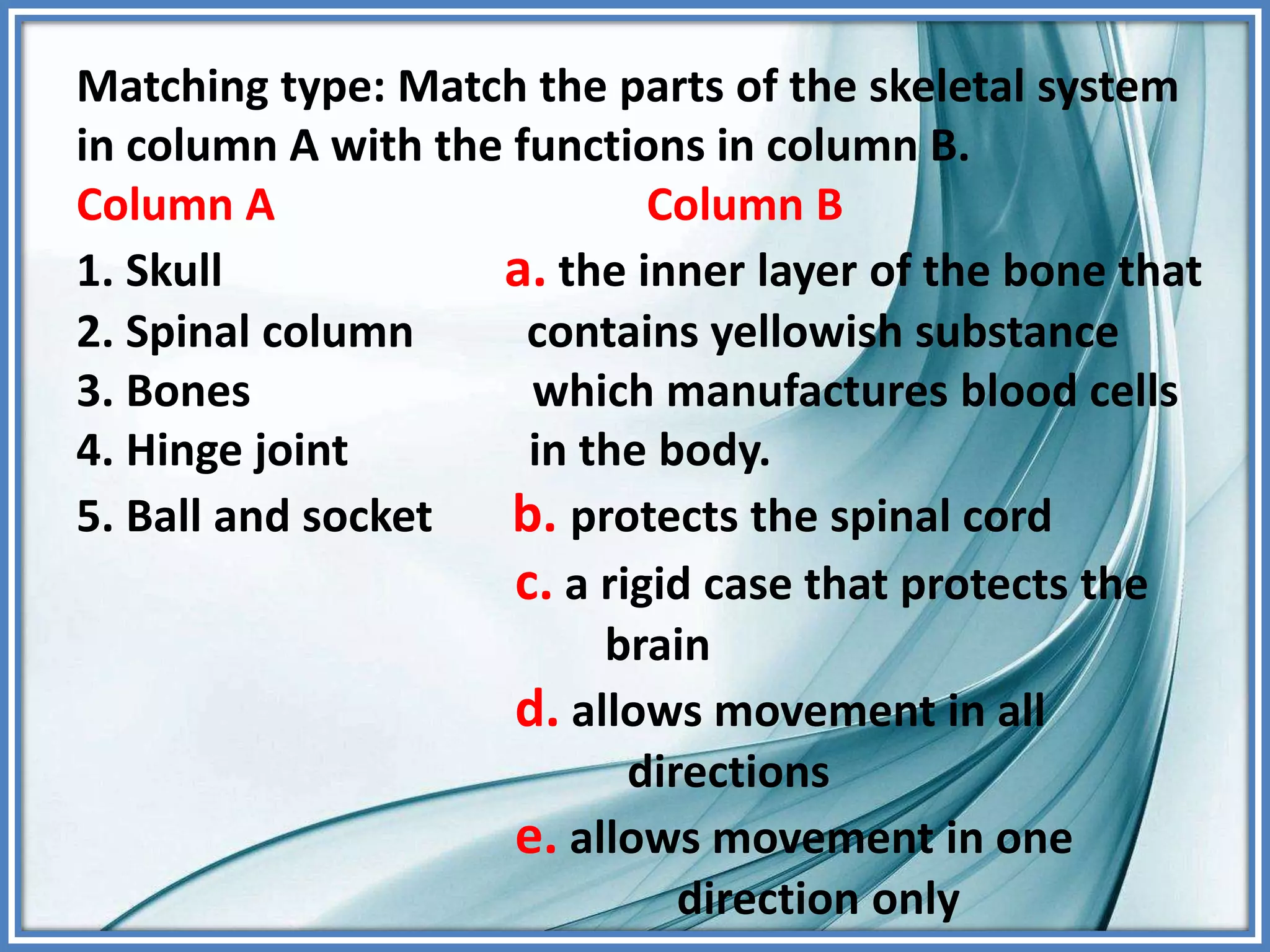
Matching type: Match the parts of the skeletal system
in column A with the functions in column B.
Column A Column B
1. Skull a. the inner layer of the bone that
2. Spinal column contains yellowish substance
3. Bones which manufactures blood cells
4. Hinge joint in the body.
5. Ball and socket b. protects the spinal cord
c. a rigid case that protects the
brain
d. allows movement in all
directions
e. allows movement in one
direction only
How will you take
care of your bones?
Grade 6 PPT_Science_Q2_W1_Day 1.pptx

Grade 6 PPT_Science_Q2_W1_Day 1.pptx

  • 1.
    Parts and Functionsof Musculo-skeletal System Maylene Morales- Tubig M.Kalaw Memorial School
  • 2.
    Have you observedhow houses are built?
  • 3.
    What will theconstruction worker do first? How will you compare that to the human body? Is there a framework that provides structure to the human body? What do you call this framework?
  • 4.
    Activity # 1 Connectthe cut out pictures of the human skeletal system
  • 5.
  • 6.
    Label the parts( Group Work )
  • 7.
    “What is thepurpose of the human skeleton?”
  • 8.
    The skeletal systemis made up of many bones, 206 to be exact. Bones help to shape your body and protect your organs, such as your heart, brain, and lungs, from damage. If you didn't have bones in your body, you would look like a bowl full of Jello, because there would be nothing holding you up.The framework of your body is made up of rigid and strong materials called bones.
  • 9.
    Activity #1: Examining Bone Structure Locatethe part of the your framework as I say its name.
  • 11.
    What are thetwo division of the skeletal system?
  • 14.
    What is thedifference between compact bone & spongy bone?
  • 15.
    Why is bonemarrow important?
  • 16.
    Activity #2: Observing Movementsof Joints Problem: What are the different kinds of joints? https://www.youtube.com/watch?v=2rUzWx9P7cA Safety Tips: 1. Be careful in moving your body parts, especially your neck and backbone. 2. Do not allow other persons to pull or twist your arm.
  • 17.
    Mix and Match! Partsand functions of Skeletal System (group work) Your group will be provided with parts(green) and function (yellow) written in metacards
  • 18.
    Why should bonesbe strong? Bones support our body and allow us move.
  • 19.
    How will youtake care of your bones? 1.Eat calcium-rich foods
  • 20.
    2. prevent fromfalls and other accidents that could injure the bones especially when playing.
  • 22.
    4.Get vitamin Dthrough sunlight,
  • 23.
    Your body producesvitamin D naturally when it’s directly exposed to sunlight. Besides getting vitamin D through sunlight, you can also get it through certain foods and supplements to ensure adequate levels of the vitamin in your blood. Vitamin D has several important functions. Perhaps the most vital are regulating the absorption of calcium and phosphorus, and facilitating normal immune system function. Getting a sufficient amount of vitamin D is important for normal growth and development of bones and teeth, as well as improved resistance against certain diseases.
  • 24.
    TRIVIA: Bones are alive.They are made of living cells capable of growing and repairing themselves.
  • 25.
    Our bones arein fact alive! Our bones are made up of hard stuff that gives them the strength they need, and many living cells. These cells are what help our bones to grow and repair themselves if damaged. The cells in our bones rely on blood to keep them alive, just as many other cells in our body do. Did you know that our blood is what brings food and oxygen to our bone cells and takes away the things that our bone cells don't need? If our bones were not alive, a broken bone would stay broken for the rest of our life, because there would be nothing alive to fix it. Luckily our bones are very alive and have the ability to repair breaks and fractures in no time! When we break a bone, our blood clots in the break to form a bridge, or to close up the break.
  • 26.
    What are theideas did you learn in the lesson? What are the parts and functions of the skeletal system? Describe the potential consequences if all bone tissues in humans were made of spongy bones & no compact bones.
  • 27.
    Matching type: Matchthe parts of the skeletal system in column A with the functions in column B. Column A Column B 1. Skull a. the inner layer of the bone that 2. Spinal column contains yellowish substance 3. Bones which manufactures blood cells 4. Hinge joint in the body. 5. Ball and socket b. protects the spinal cord c. a rigid case that protects the brain d. allows movement in all directions e. allows movement in one direction only
  • 28.
    How will youtake care of your bones?