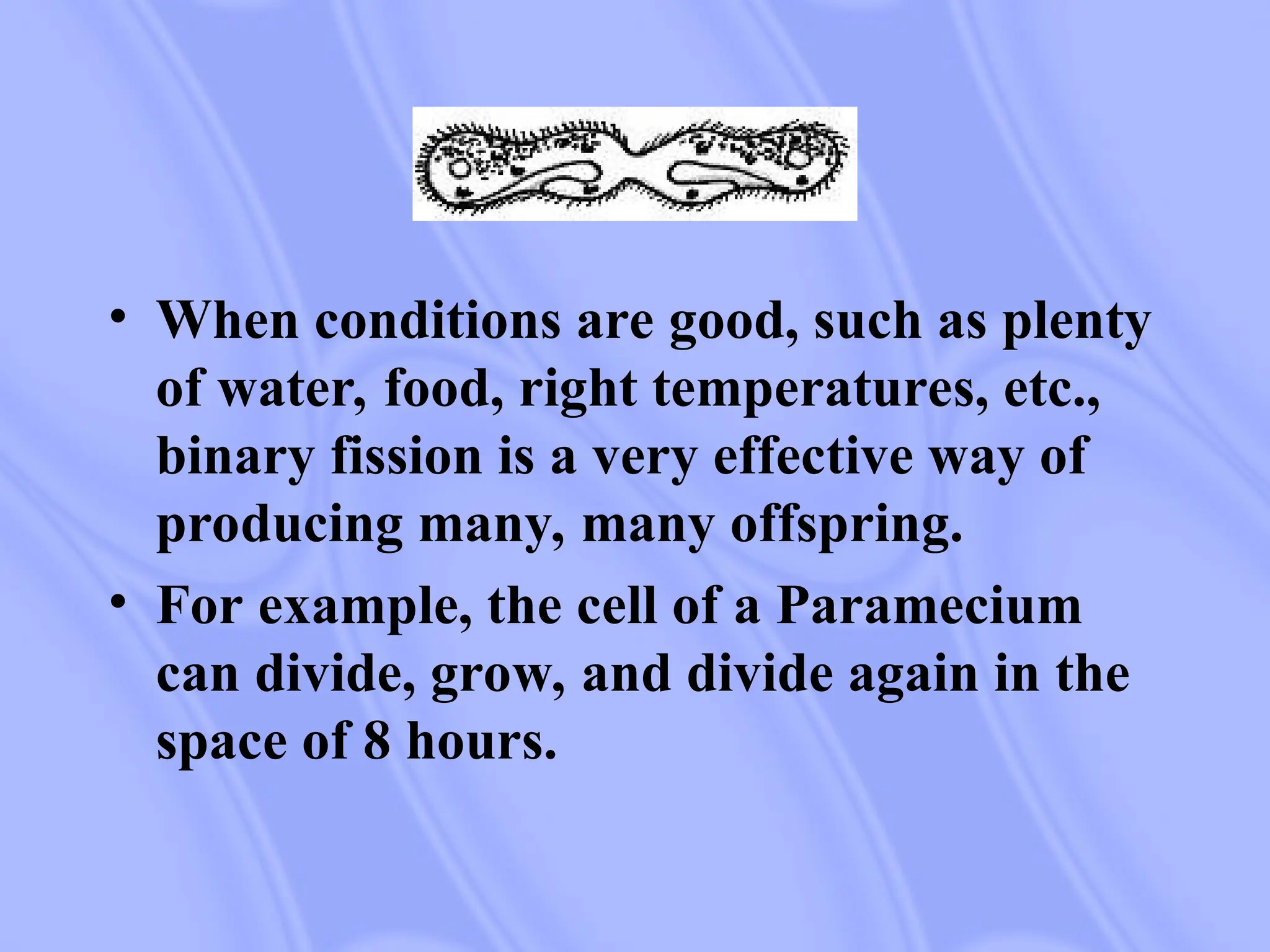
• When conditionsare good, such as plenty
of water, food, right temperatures, etc.,
binary fission is a very effective way of
producing many, many offspring.
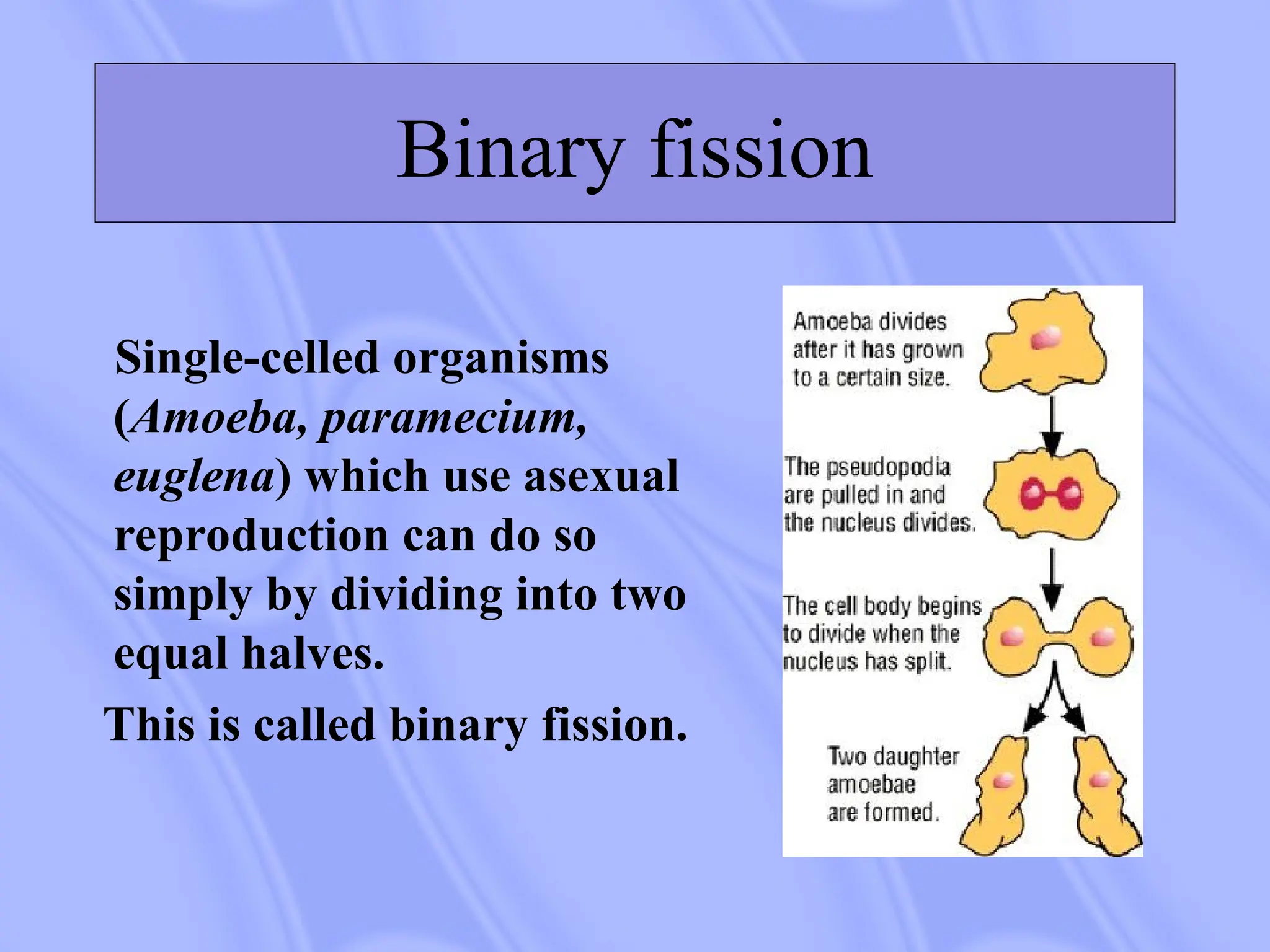
• For example, the cell of a Paramecium
can divide, grow, and divide again in the
space of 8 hours.
7.
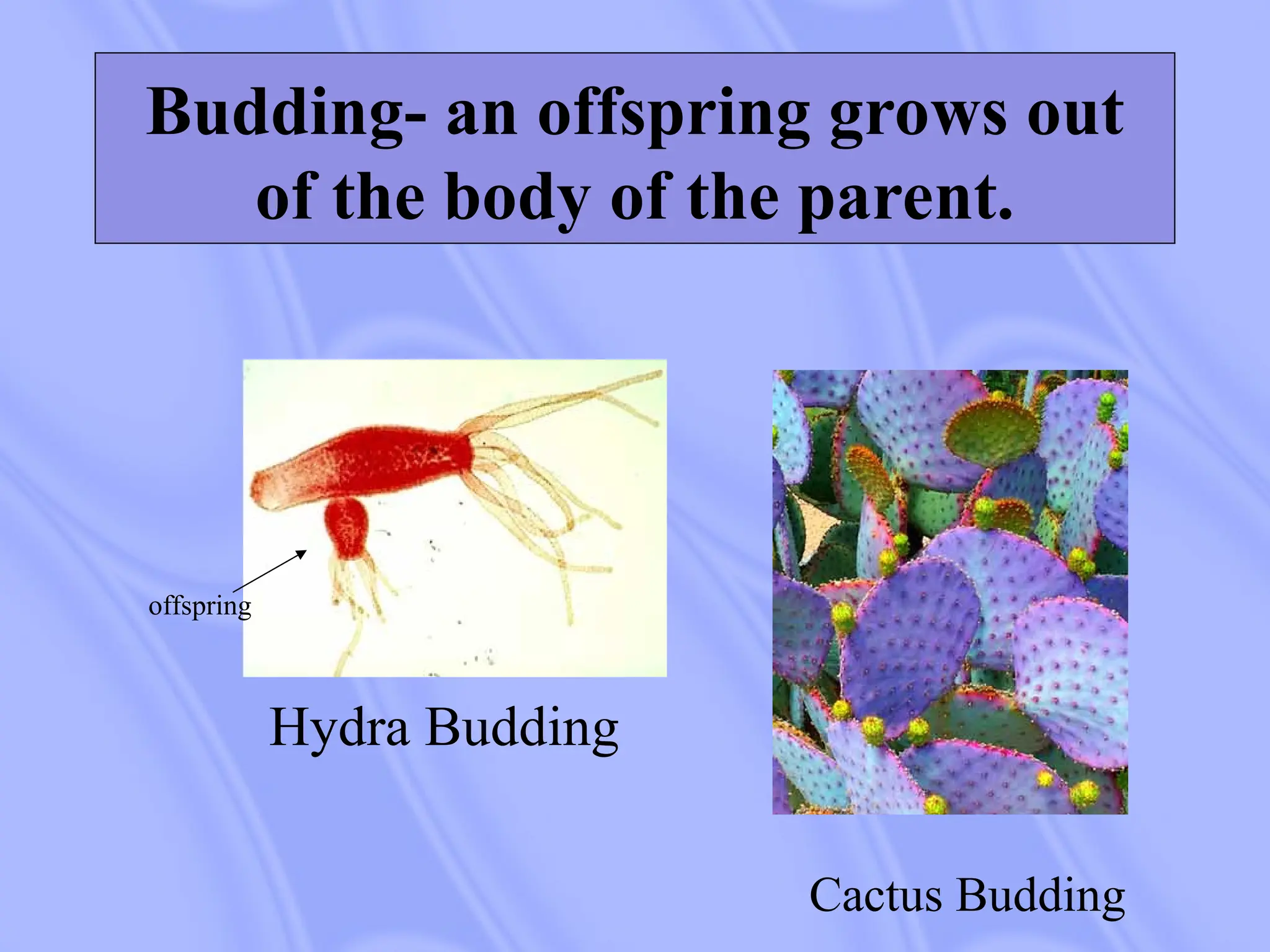
Budding- an offspringgrows out
of the body of the parent.
Hydra Budding
offspring
Cactus Budding
8.
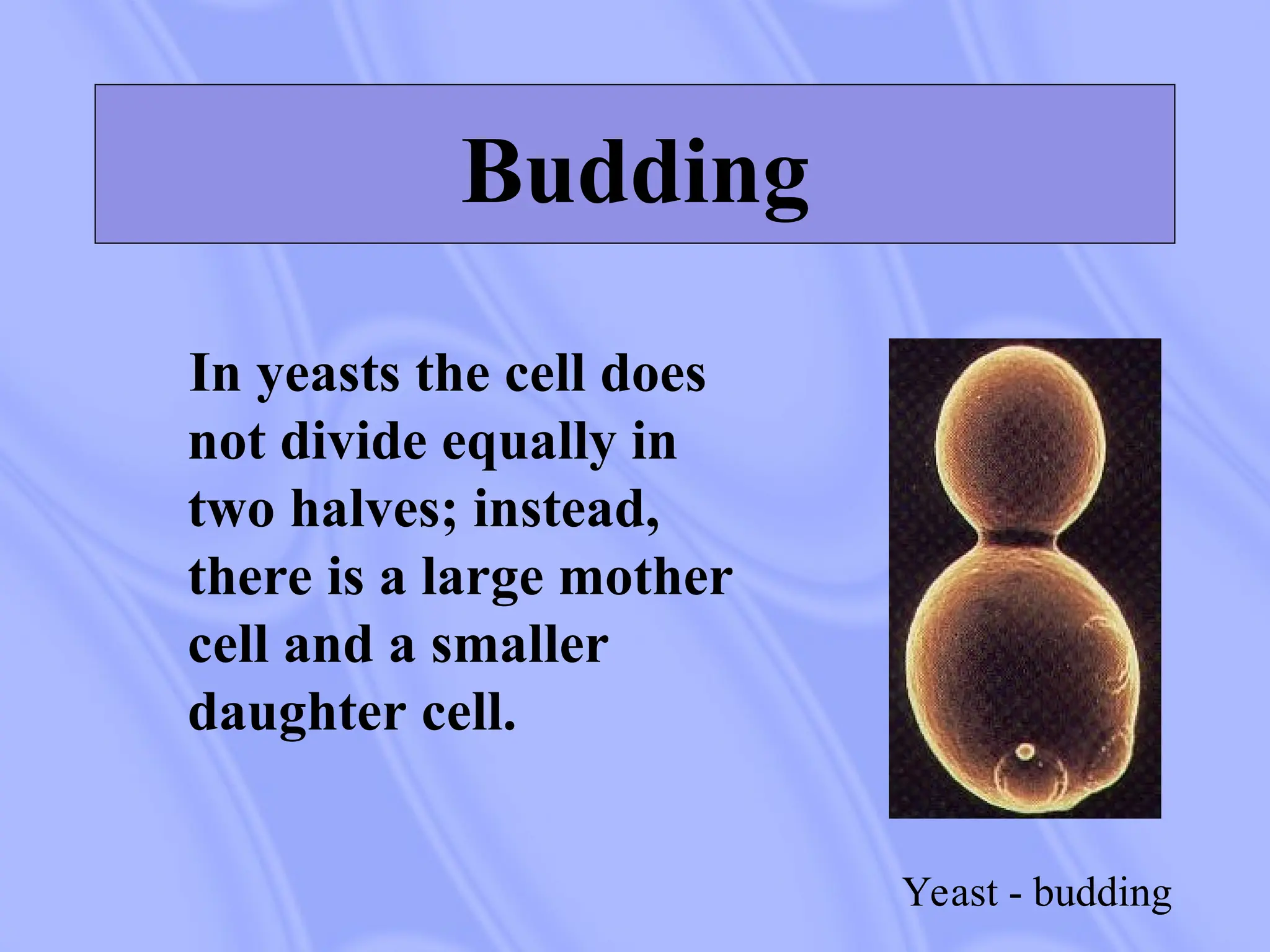
Yeast - budding
Budding
Inyeasts the cell does
not divide equally in
two halves; instead,
there is a large mother
cell and a smaller
daughter cell.
9.
Fragmentation
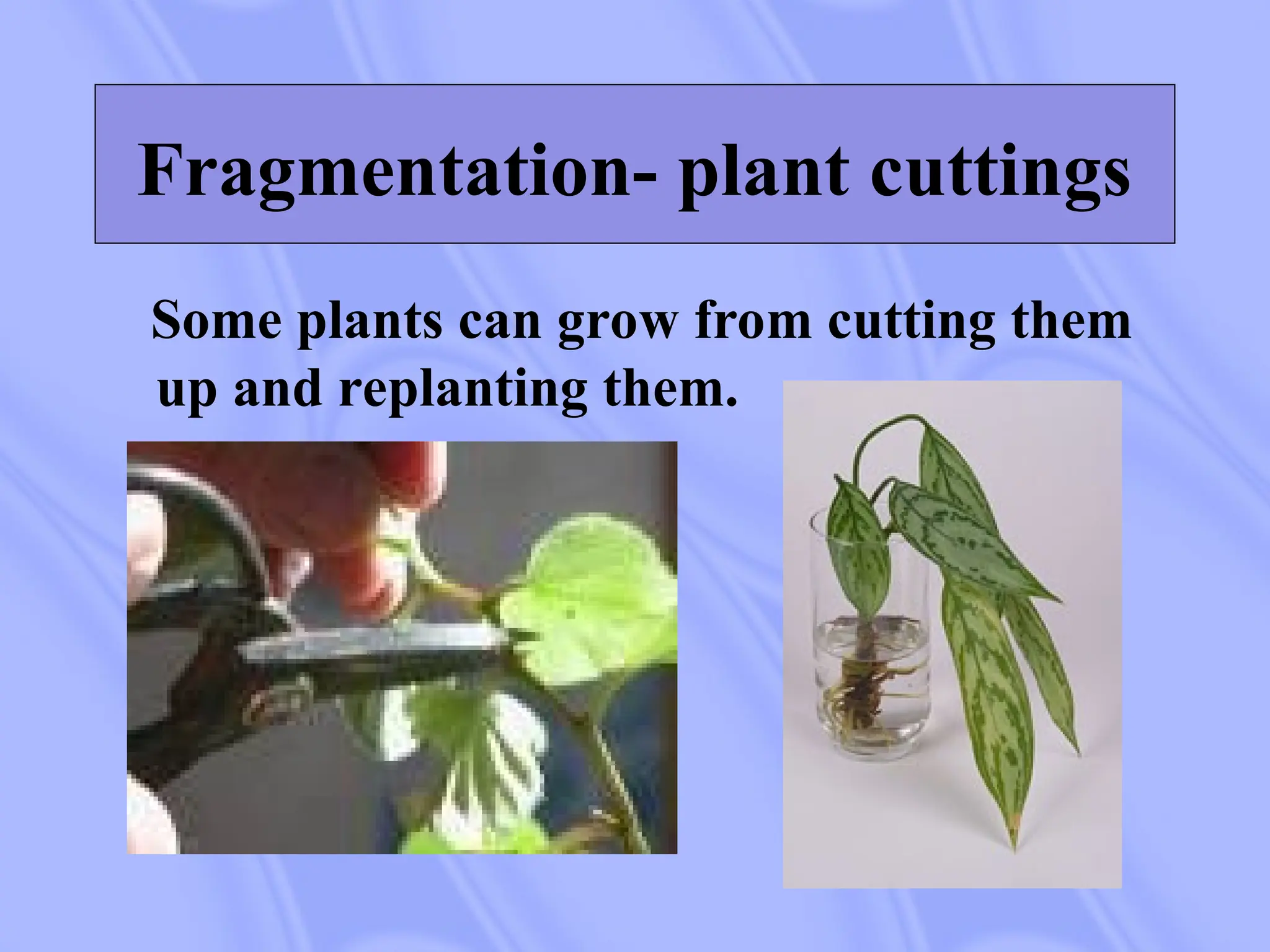
In this form,the body of the parent breaks
into distinct pieces, each of which can
produce an offspring.
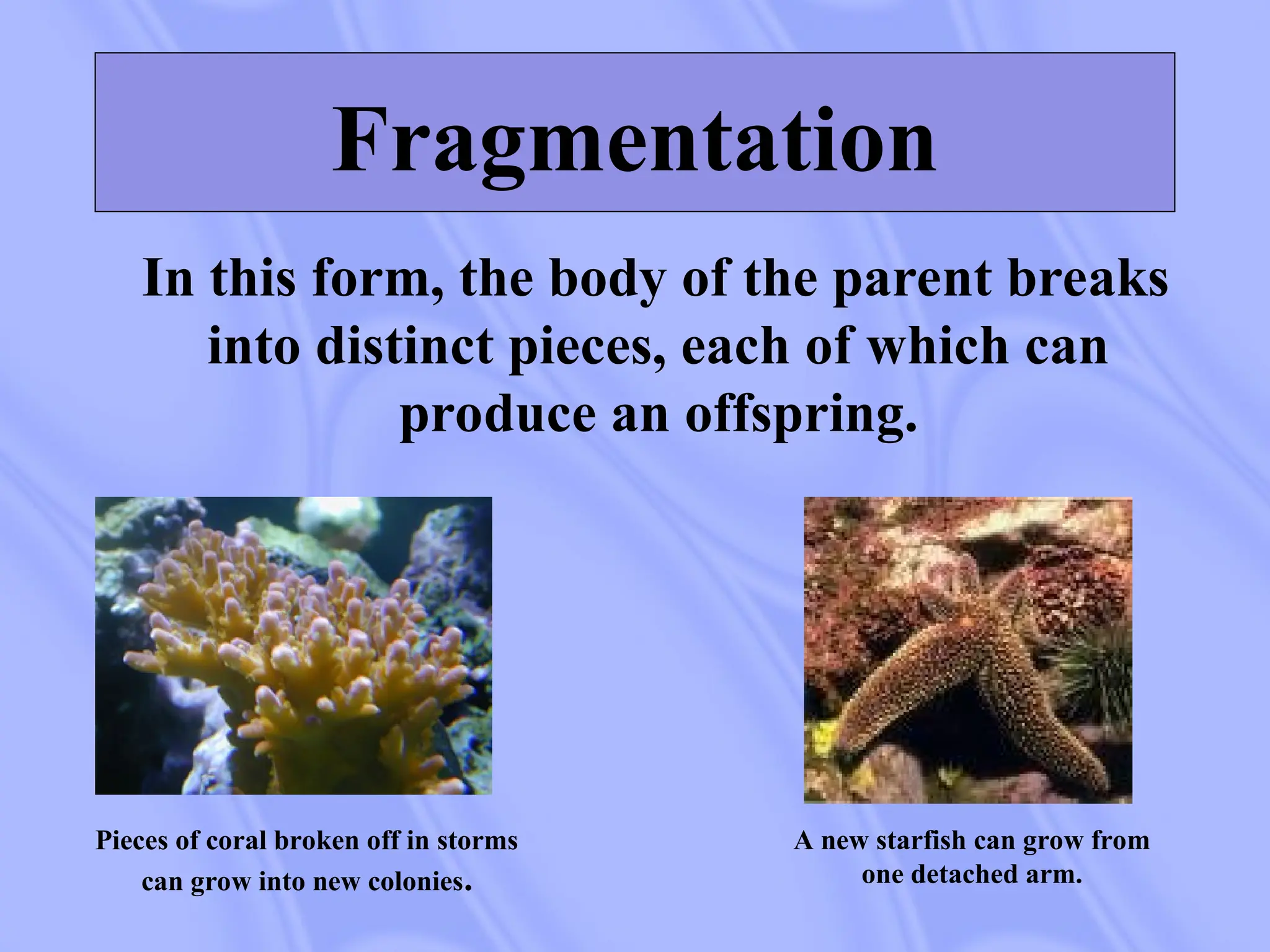
Pieces of coral broken off in storms
can grow into new colonies.
A new starfish can grow from
one detached arm.
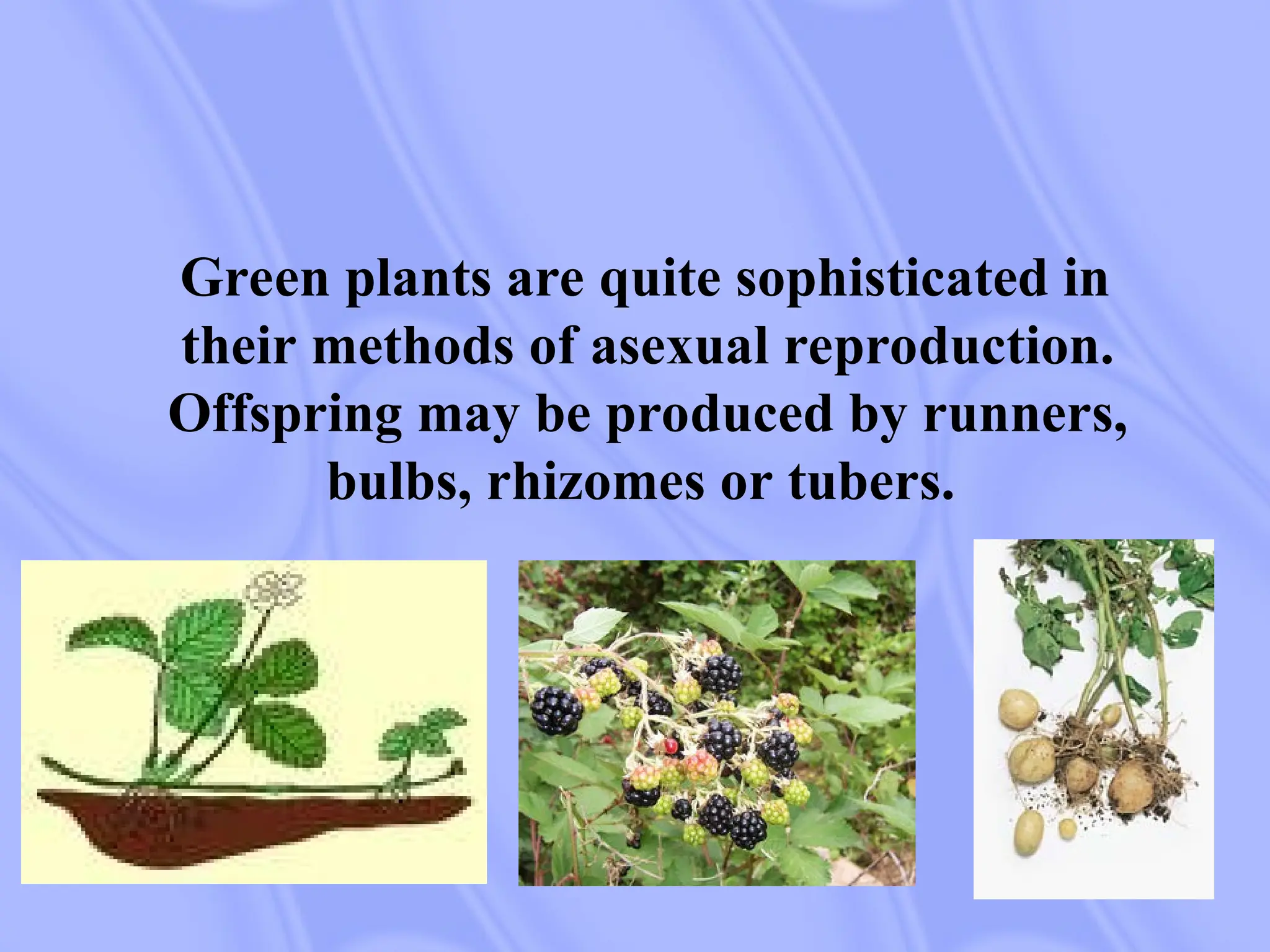
Green plants arequite sophisticated in
their methods of asexual reproduction.
Offspring may be produced by runners,
bulbs, rhizomes or tubers.
12.
Parthenogenesis
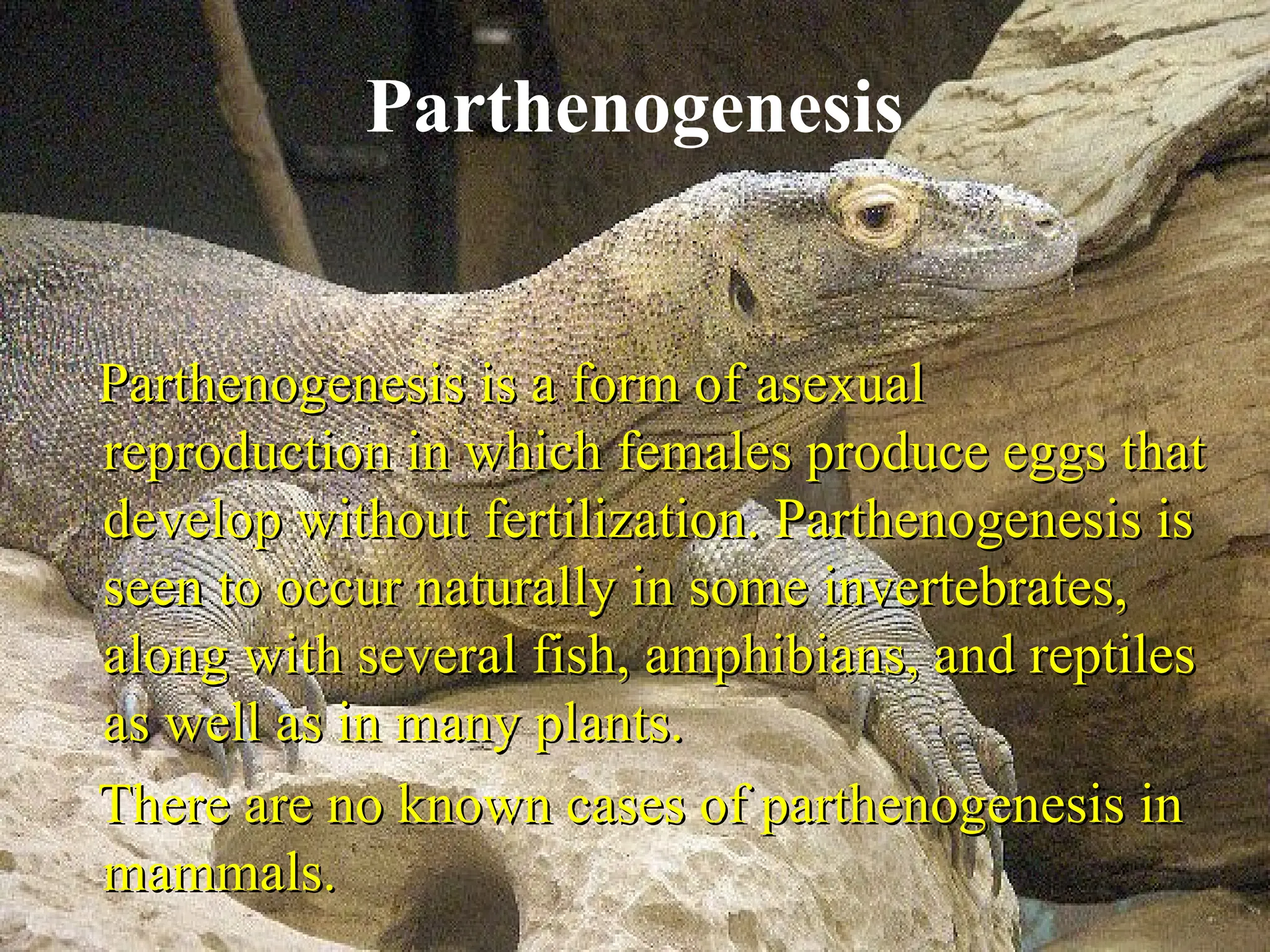
Parthenogenesis is aform of asexual
Parthenogenesis is a form of asexual
reproduction in which females produce eggs that
reproduction in which females produce eggs that
develop without fertilization. Parthenogenesis is
develop without fertilization. Parthenogenesis is
seen to occur naturally in some invertebrates,
seen to occur naturally in some invertebrates,
along with several fish, amphibians, and reptiles
along with several fish, amphibians, and reptiles
as well as in many plants.
as well as in many plants.
There are no known cases of parthenogenesis in
There are no known cases of parthenogenesis in
mammals.
mammals.
13.
What is sexualreproduction?
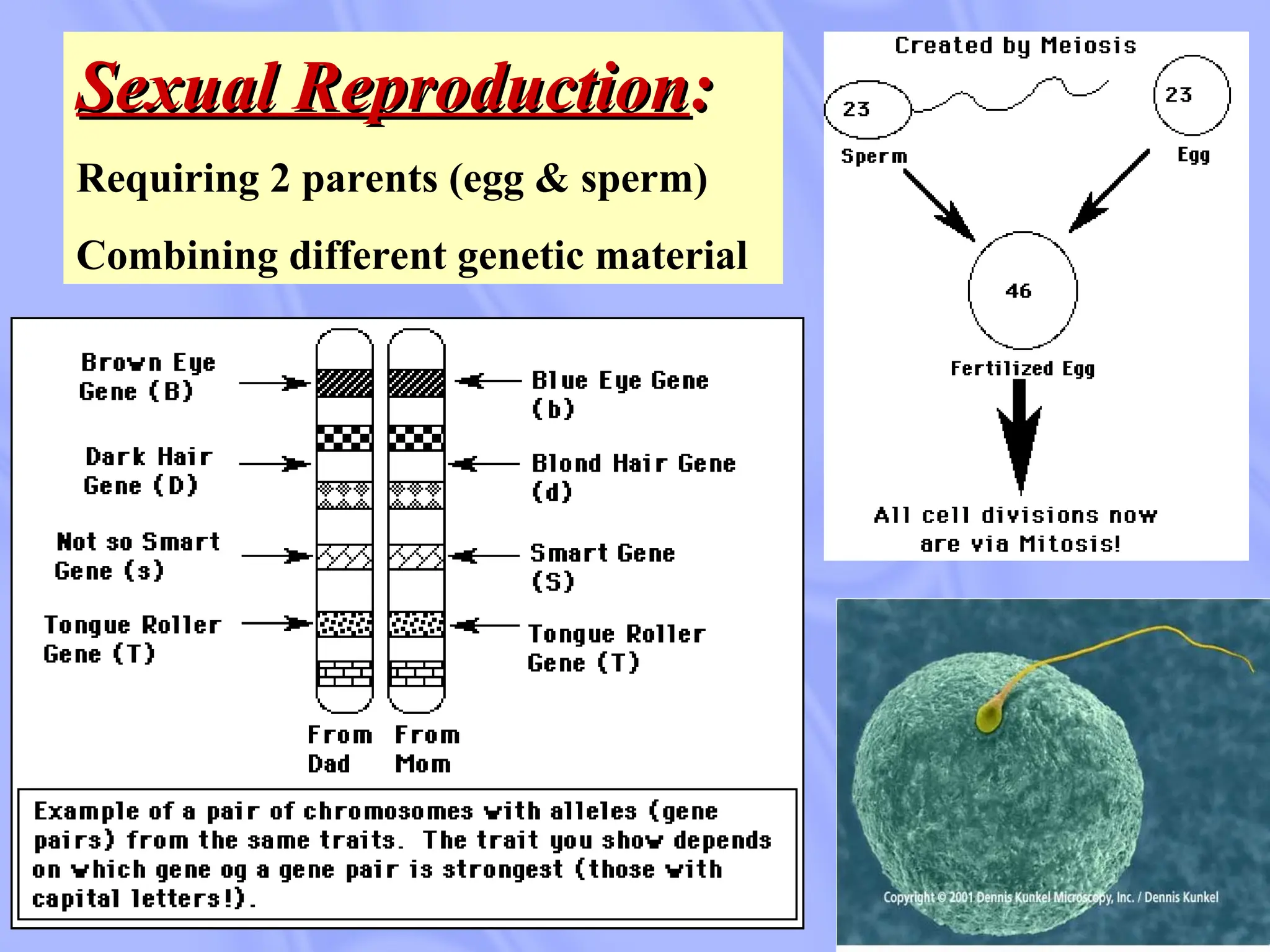
• Requiring 2 parents
– male and female (egg & sperm)
• The egg and sperm join (zygote) to form an
entirely new organism
• Offspring are different from the parent
organism because
Methods of sexualreproduction:
Pollination
External Fertilization
Internal Fertilization
16.
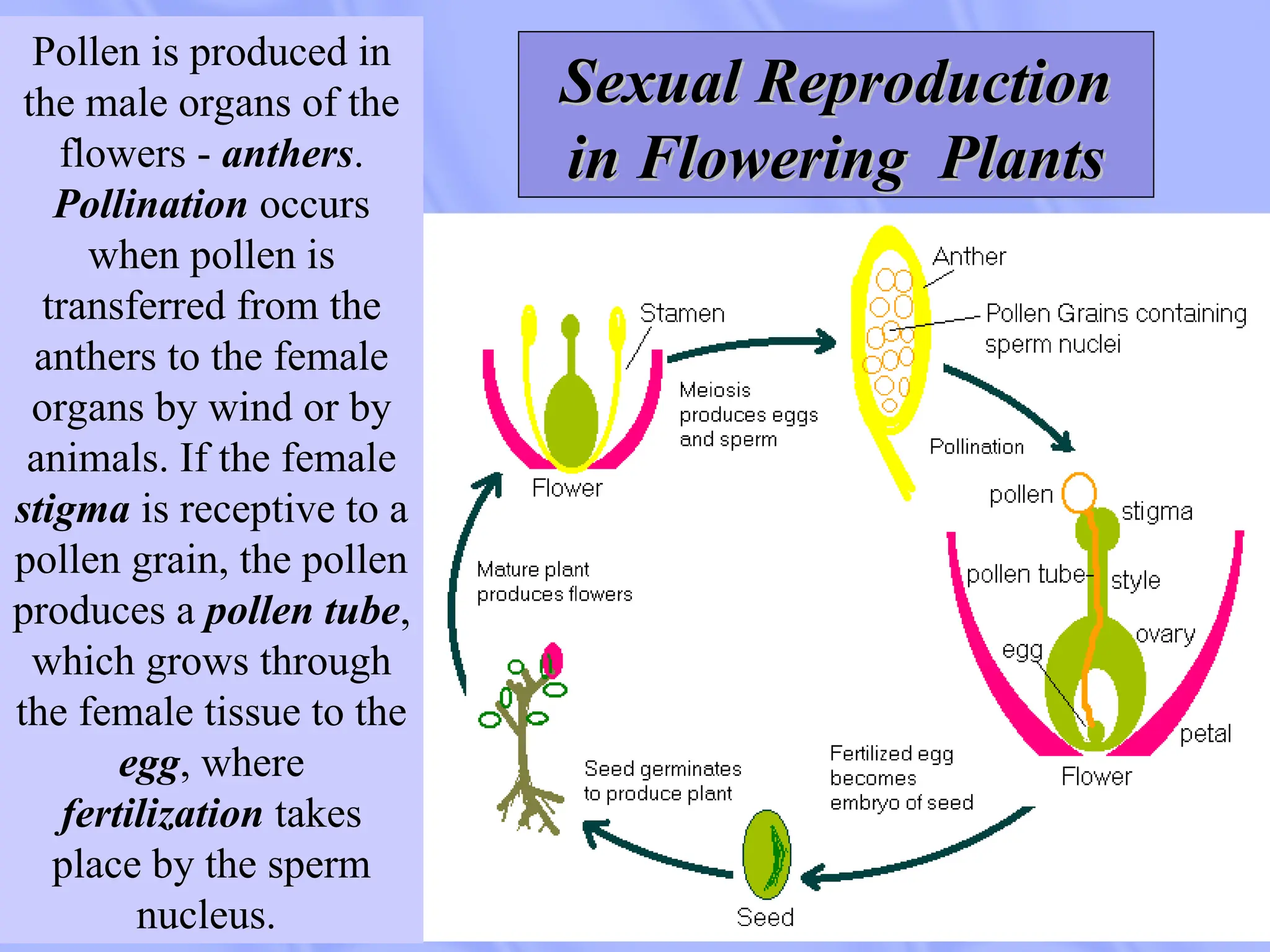
Pollen is producedin
the male organs of the
flowers - anthers.
Pollination occurs
when pollen is
transferred from the
anthers to the female
organs by wind or by
animals. If the female
stigma is receptive to a
pollen grain, the pollen
produces a pollen tube,
which grows through
the female tissue to the
egg, where
fertilization takes
place by the sperm
nucleus.
Sexual Reproduction
Sexual Reproduction
in Flowering Plants
in Flowering Plants
17.
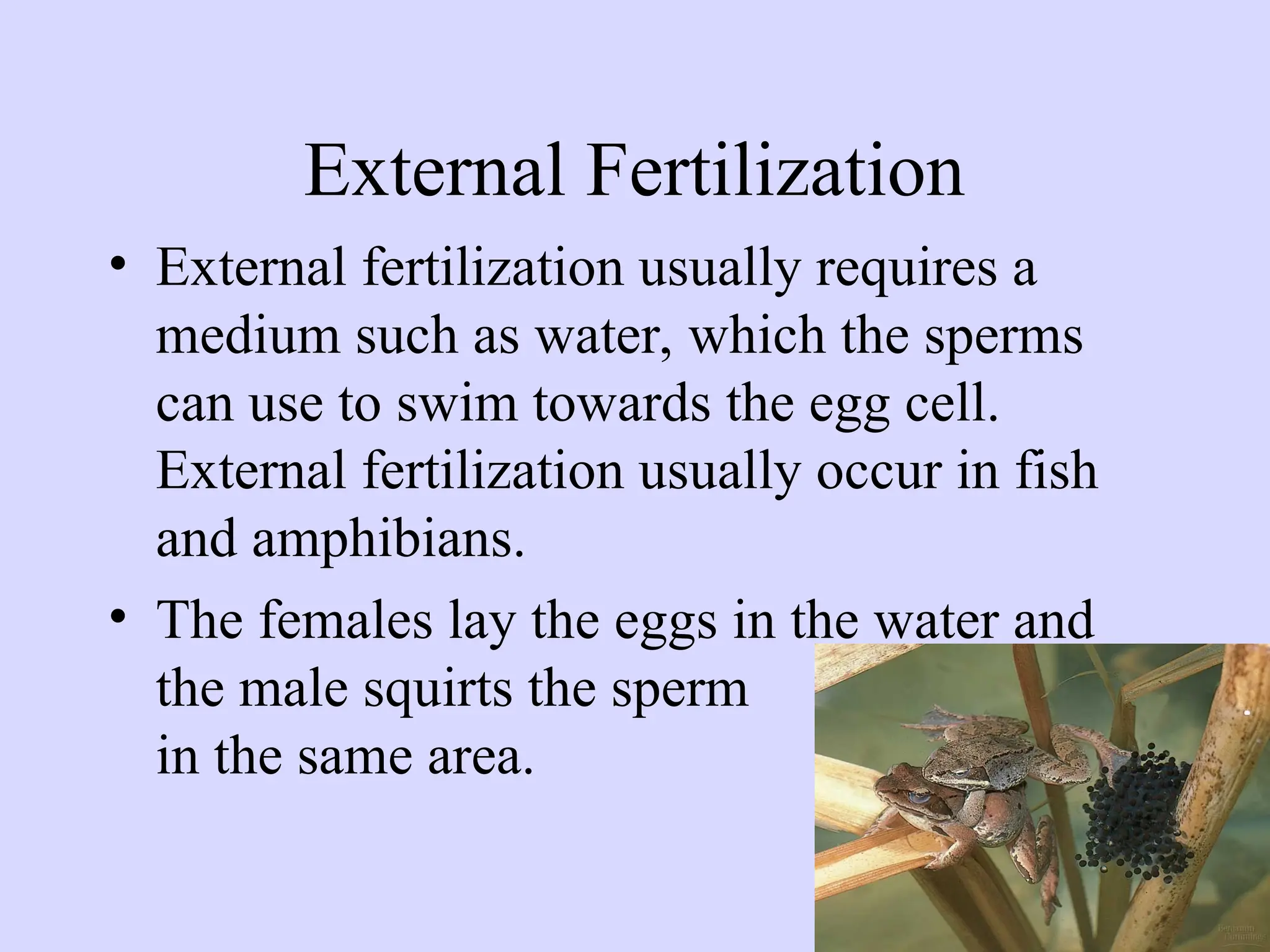
External Fertilization
• Externalfertilization usually requires a
medium such as water, which the sperms
can use to swim towards the egg cell.
External fertilization usually occur in fish
and amphibians.
• The females lay the eggs in the water and
the male squirts the sperm
in the same area.
18.
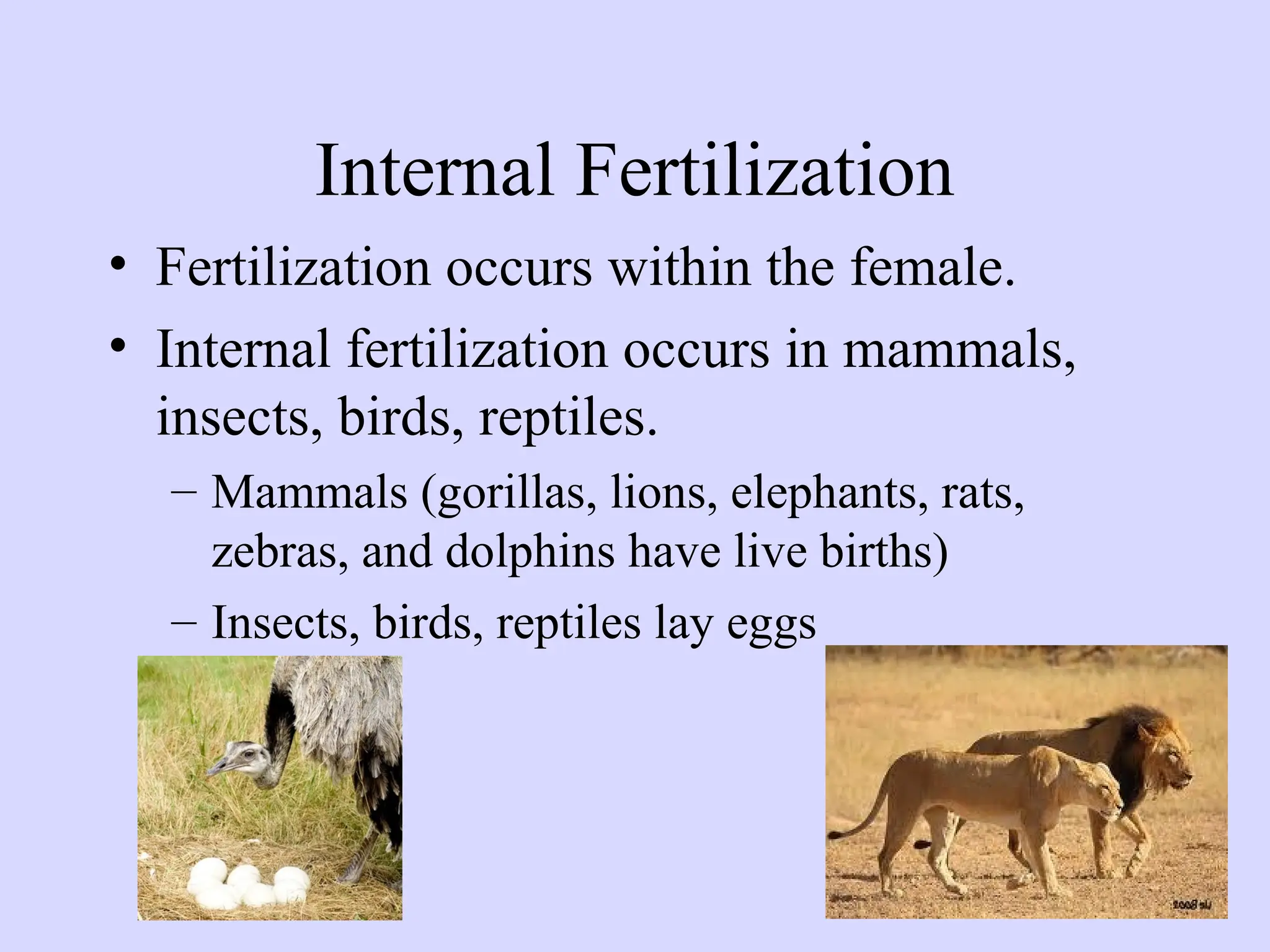
Internal Fertilization
• Fertilizationoccurs within the female.
• Internal fertilization occurs in mammals,
insects, birds, reptiles.
– Mammals (gorillas, lions, elephants, rats,
zebras, and dolphins have live births)
– Insects, birds, reptiles lay eggs
19.
Sexual Reproduction
• Sexualreproduction produces a greater
chance of variation within a species than
asexual reproduction would.
• This variation improves the chances that a
species will adapt to his environment and
survive.
20.
Sexual vs. AsexualReproduction
• Asexual reproduction results in offspring
that are genetically identical to the parent
organism.
• Sexual reproduction results in offspring that
are genetically different from the parent
organisms.


![[DSC Europe 25] Bassam Maharmeh - Artificial Intelligence: Opportunities and ...](https://cdn.slidesharecdn.com/ss_thumbnails/thhfmr2fqpawzj7hsjpg-5-251211083048-2c23204f-thumbnail.jpg?width=640&height=640&fit=bounds)

![[DSC Europe 25] Dobrica Cosic - Savings by the Second: How Dynamic Pricing an...](https://cdn.slidesharecdn.com/ss_thumbnails/znp09f3smtqz3w2sq6wn-1-dobrica-cosic-savings-by-the-second-how-dynamic-pricing-and-smart-data-are-bu-251208151905-26e6f41e-thumbnail.jpg?width=640&height=640&fit=bounds)
![[DSC Europe 25] Marko Krstic - Understanding the AI Threat Landscape - Risks,...](https://cdn.slidesharecdn.com/ss_thumbnails/tiyim1ins5jvbrvzpzla-2-251209104645-c69d3553-thumbnail.jpg?width=640&height=640&fit=bounds)
![[DSC Europe 25] Debmalya Biswas - Agentification: the art of transforming man...](https://cdn.slidesharecdn.com/ss_thumbnails/r5azlggvtqiaiiusrqdr-4-251212103249-5a12c89b-thumbnail.jpg?width=640&height=640&fit=bounds)


![[DSC Europe 25] Dragana Ilic - AI for Big Data in Astronomy.pptx](https://cdn.slidesharecdn.com/ss_thumbnails/8palya86qaatvjhva1ms-2-dragana-ilic-ai-ilic-251208151906-652b819c-thumbnail.jpg?width=640&height=640&fit=bounds)

![[DSC Europe 25] Miodrag Pesovic & Vladislav Radonjic - Federated Data Archite...](https://cdn.slidesharecdn.com/ss_thumbnails/gsbe3y5it5uhndi4e08e-1-251212103249-f1008e0c-thumbnail.jpg?width=640&height=640&fit=bounds)
![[DSC Europe 25] Nikolay Burlutskiy - Best Practices for Building Enterprise M...](https://cdn.slidesharecdn.com/ss_thumbnails/uirvaiuvq8y1w8hzd9tx-7-251212103249-2619edb4-thumbnail.jpg?width=640&height=640&fit=bounds)


