Let’s Stimulate Our Brain!
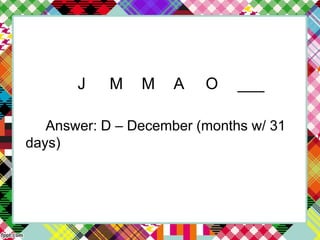
J M M A O ___
Answer: D – December (months w/ 31
days)
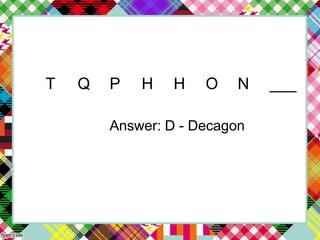
T Q P H H O N ___
Answer: D - Decagon
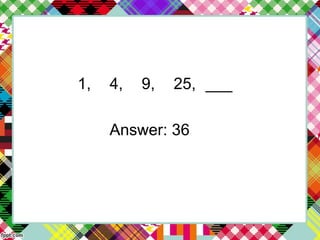
1, 4, 9, 25, ___
Answer: 36
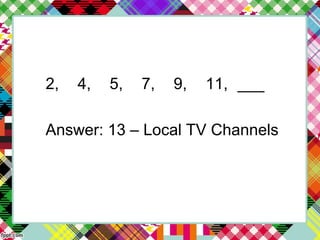
2, 4, 5, 7, 9, 11, ___
Answer: 13 – Local TV Channels
R O Y G B I ___
Answer: V
1, 3, 5, 7, 9, 11, 13, 15, ___
Answer: 17
1, 9, 25, 49, 81, ___
Answer: 121
A B C E F G ___
Answer: I
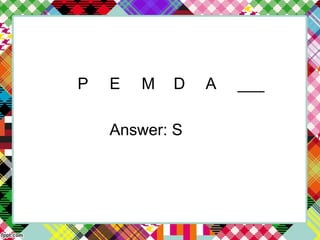
P E M D A ___
Answer: S
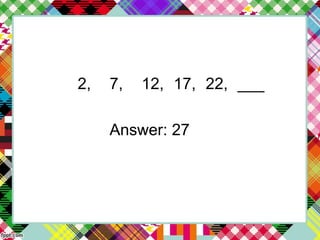
2, 7, 12, 17, 22, ___
Answer: 27
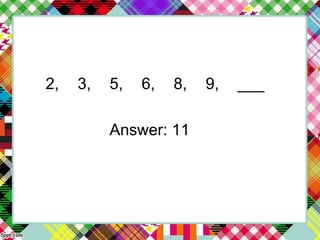
2, 3, 5, 6, 8, 9, ___
Answer: 11
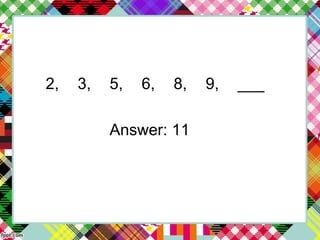
2, 3, 5, 6, 8, 9, ___
Answer: 11
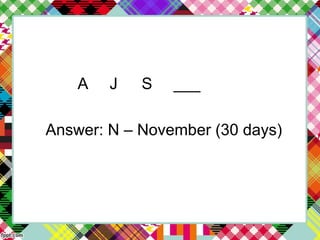
A J S ___
Answer: N – November (30 days)
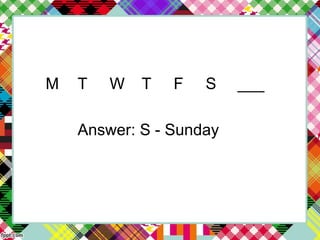
M T W T F S ___
Answer: S - Sunday
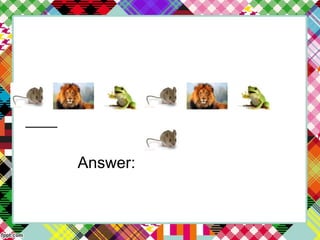
____
Answer:
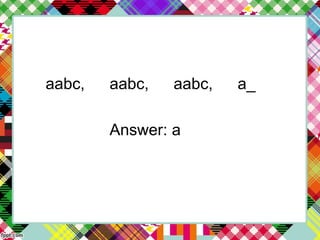
aabc, aabc, aabc, a_
Answer: a
Arithmetic Sequence
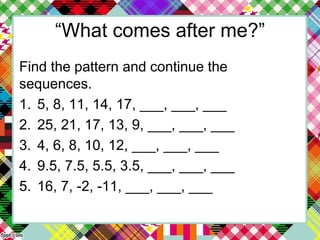
“What comes after me?”
Find the pattern and continue the
sequences.
1. 5, 8, 11, 14, 17, ___, ___, ___
2. 25, 21, 17, 13, 9, ___, ___, ___
3. 4, 6, 8, 10, 12, ___, ___, ___
4. 9.5, 7.5, 5.5, 3.5, ___, ___, ___
5. 16, 7, -2, -11, ___, ___, ___
Let’s Investigate
1. How do you find the activity?
2. What do you observed in the given
exercises?
3. How did you arrived at your answer?
4. Were you able to find the pattern for each
sequence?
5. What mathematical skills or principles did
you use to recognize the pattern and to
get the next number?
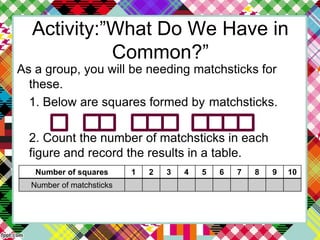
Activity:”What Do We Have in
Common?”
As a group, you will be needing matchsticks for
these.
1. Below are squares formed by matchsticks.
2. Count the number of matchsticks in each
figure and record the results in a table.
Number of squares 1 2 3 4 5 6 7 8 9 10
Number of matchsticks
Analysis
1. Is there a pattern in the number of
matchsticks? If there is, describe it.
2. How is each term (number of
matchsticks) found?
3. What is the difference between any two
consecutive terms?
4. How was the activity?
5. What new thing did you learn from the
activity?
Arithmetic Sequence
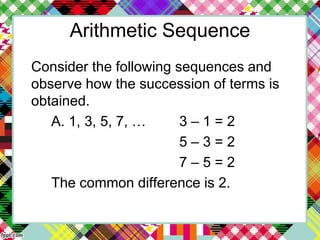
Consider the following sequences and
observe how the succession of terms is
obtained.
A. 1, 3, 5, 7, … 3 – 1 = 2
5 – 3 = 2
7 – 5 = 2
The common difference is 2.
Arithmetic Sequence
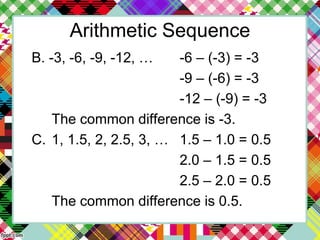
B. -3, -6, -9, -12, … -6 – (-3) = -3
-9 – (-6) = -3
-12 – (-9) = -3
The common difference is -3.
C. 1, 1.5, 2, 2.5, 3, … 1.5 – 1.0 = 0.5
2.0 – 1.5 = 0.5
2.5 – 2.0 = 0.5
The common difference is 0.5.
Arithmetic Sequence
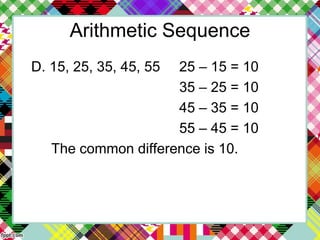
D. 15, 25, 35, 45, 55 25 – 15 = 10
35 – 25 = 10
45 – 35 = 10
55 – 45 = 10
The common difference is 10.
Arithmetic Sequence
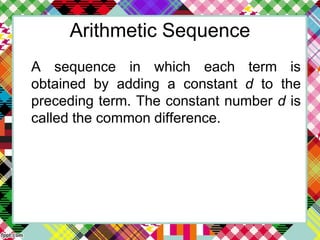
A sequence in which each term is
obtained by adding a constant d to the
preceding term. The constant number d is
called the common difference.
Arithmetic Sequence
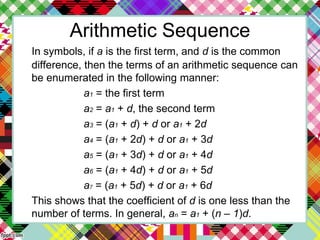
In symbols, if a is the first term, and d is the common
difference, then the terms of an arithmetic sequence can
be enumerated in the following manner:
a1 = the first term
a2 = a1 + d, the second term
a3 = (a1 + d) + d or a1 + 2d
a4 = (a1 + 2d) + d or a1 + 3d
a5 = (a1 + 3d) + d or a1 + 4d
a6 = (a1 + 4d) + d or a1 + 5d
a7 = (a1 + 5d) + d or a1 + 6d
This shows that the coefficient of d is one less than the
number of terms. In general, an = a1 + (n – 1)d.
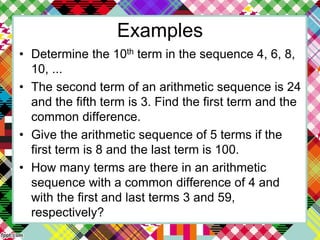
Examples
• Determine the 10th term in the sequence 4, 6, 8,
10, ...
• The second term of an arithmetic sequence is 24
and the fifth term is 3. Find the first term and the
common difference.
• Give the arithmetic sequence of 5 terms if the
first term is 8 and the last term is 100.
• How many terms are there in an arithmetic
sequence with a common difference of 4 and
with the first and last terms 3 and 59,
respectively?
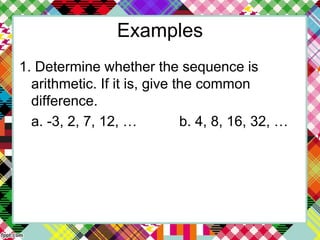
Examples
1. Determine whether the sequence is
arithmetic. If it is, give the common
difference.
a. -3, 2, 7, 12, … b. 4, 8, 16, 32, …
Application
Answer Learning Task 2 A and B on p. 10
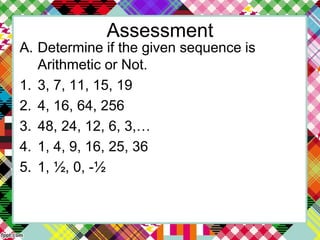
Assessment
A. Determine if the given sequence is
Arithmetic or Not.
1. 3, 7, 11, 15, 19
2. 4, 16, 64, 256
3. 48, 24, 12, 6, 3,…
4. 1, 4, 9, 16, 25, 36
5. 1, ½, 0, -½
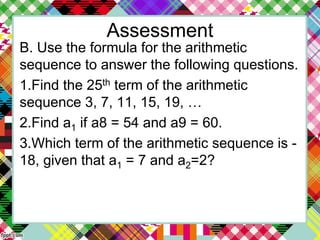
Assessment
B. Use the formula for the arithmetic
sequence to answer the following questions.
1.Find the 25th term of the arithmetic
sequence 3, 7, 11, 15, 19, …
2.Find a1 if a8 = 54 and a9 = 60.
3.Which term of the arithmetic sequence is -
18, given that a1 = 7 and a2=2?
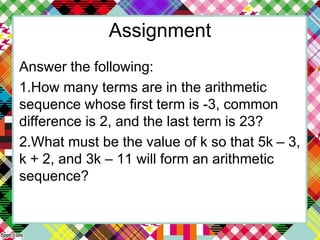
Assignment
Answer the following:
1.How many terms are in the arithmetic
sequence whose first term is -3, common
difference is 2, and the last term is 23?
2.What must be the value of k so that 5k – 3,
k + 2, and 3k – 11 will form an arithmetic
sequence?

Grade 10 Lesson About Arithmetic Sequence

  • 1.
  • 2.
    J M MA O ___ Answer: D – December (months w/ 31 days)
  • 3.
    T Q PH H O N ___ Answer: D - Decagon
  • 4.
    1, 4, 9,25, ___ Answer: 36
  • 5.
    2, 4, 5,7, 9, 11, ___ Answer: 13 – Local TV Channels
  • 6.
    R O YG B I ___ Answer: V
  • 7.
    1, 3, 5,7, 9, 11, 13, 15, ___ Answer: 17
  • 8.
    1, 9, 25,49, 81, ___ Answer: 121
  • 9.
    A B CE F G ___ Answer: I
  • 10.
    P E MD A ___ Answer: S
  • 11.
    2, 7, 12,17, 22, ___ Answer: 27
  • 12.
    2, 3, 5,6, 8, 9, ___ Answer: 11
  • 13.
    2, 3, 5,6, 8, 9, ___ Answer: 11
  • 14.
    A J S___ Answer: N – November (30 days)
  • 15.
    M T WT F S ___ Answer: S - Sunday
  • 16.
  • 17.
    aabc, aabc, aabc,a_ Answer: a
  • 18.
  • 19.
    “What comes afterme?” Find the pattern and continue the sequences. 1. 5, 8, 11, 14, 17, ___, ___, ___ 2. 25, 21, 17, 13, 9, ___, ___, ___ 3. 4, 6, 8, 10, 12, ___, ___, ___ 4. 9.5, 7.5, 5.5, 3.5, ___, ___, ___ 5. 16, 7, -2, -11, ___, ___, ___
  • 20.
    Let’s Investigate 1. Howdo you find the activity? 2. What do you observed in the given exercises? 3. How did you arrived at your answer? 4. Were you able to find the pattern for each sequence? 5. What mathematical skills or principles did you use to recognize the pattern and to get the next number?
  • 21.
    Activity:”What Do WeHave in Common?” As a group, you will be needing matchsticks for these. 1. Below are squares formed by matchsticks. 2. Count the number of matchsticks in each figure and record the results in a table. Number of squares 1 2 3 4 5 6 7 8 9 10 Number of matchsticks
  • 22.
    Analysis 1. Is therea pattern in the number of matchsticks? If there is, describe it. 2. How is each term (number of matchsticks) found? 3. What is the difference between any two consecutive terms? 4. How was the activity? 5. What new thing did you learn from the activity?
  • 23.
    Arithmetic Sequence Consider thefollowing sequences and observe how the succession of terms is obtained. A. 1, 3, 5, 7, … 3 – 1 = 2 5 – 3 = 2 7 – 5 = 2 The common difference is 2.
  • 24.
    Arithmetic Sequence B. -3,-6, -9, -12, … -6 – (-3) = -3 -9 – (-6) = -3 -12 – (-9) = -3 The common difference is -3. C. 1, 1.5, 2, 2.5, 3, … 1.5 – 1.0 = 0.5 2.0 – 1.5 = 0.5 2.5 – 2.0 = 0.5 The common difference is 0.5.
  • 25.
    Arithmetic Sequence D. 15,25, 35, 45, 55 25 – 15 = 10 35 – 25 = 10 45 – 35 = 10 55 – 45 = 10 The common difference is 10.
  • 26.
    Arithmetic Sequence A sequencein which each term is obtained by adding a constant d to the preceding term. The constant number d is called the common difference.
  • 27.
    Arithmetic Sequence In symbols,if a is the first term, and d is the common difference, then the terms of an arithmetic sequence can be enumerated in the following manner: a1 = the first term a2 = a1 + d, the second term a3 = (a1 + d) + d or a1 + 2d a4 = (a1 + 2d) + d or a1 + 3d a5 = (a1 + 3d) + d or a1 + 4d a6 = (a1 + 4d) + d or a1 + 5d a7 = (a1 + 5d) + d or a1 + 6d This shows that the coefficient of d is one less than the number of terms. In general, an = a1 + (n – 1)d.
  • 28.
    Examples • Determine the10th term in the sequence 4, 6, 8, 10, ... • The second term of an arithmetic sequence is 24 and the fifth term is 3. Find the first term and the common difference. • Give the arithmetic sequence of 5 terms if the first term is 8 and the last term is 100. • How many terms are there in an arithmetic sequence with a common difference of 4 and with the first and last terms 3 and 59, respectively?
  • 29.
    Examples 1. Determine whetherthe sequence is arithmetic. If it is, give the common difference. a. -3, 2, 7, 12, … b. 4, 8, 16, 32, …
  • 30.
  • 31.
    Assessment A. Determine ifthe given sequence is Arithmetic or Not. 1. 3, 7, 11, 15, 19 2. 4, 16, 64, 256 3. 48, 24, 12, 6, 3,… 4. 1, 4, 9, 16, 25, 36 5. 1, ½, 0, -½
  • 32.
    Assessment B. Use theformula for the arithmetic sequence to answer the following questions. 1.Find the 25th term of the arithmetic sequence 3, 7, 11, 15, 19, … 2.Find a1 if a8 = 54 and a9 = 60. 3.Which term of the arithmetic sequence is - 18, given that a1 = 7 and a2=2?
  • 33.
    Assignment Answer the following: 1.Howmany terms are in the arithmetic sequence whose first term is -3, common difference is 2, and the last term is 23? 2.What must be the value of k so that 5k – 3, k + 2, and 3k – 11 will form an arithmetic sequence?

Editor's Notes

  • #2 I will show you series of letters or numbers with pattern. All you have to do is to guess the next letter or number to complete the pattern. The group with the highest accumulated score will be considered as the winner.