GRADE 1 – QUARTER
3
WEEK 1 – DAY 1
• Illustrate subtraction of numbers
with minuends up to 10 using
concrete and pictorial models; and
• Describe the result of “taking
away” some objects to the number
of objects in a set.
Preliminary Activities:
Ask the students:
Can you count
from 1 up to 100?
Good Job!
Today, we are going to learn how to
illustrate subtraction involving
numbers from 1 up to 10 using
concrete and pictorial models and
describe subtraction as “taking
away” or finding the number of
objects left.
Unlocking of Difficulties:
 taken away
 removed
 left
 take away
TAKING
AWAY
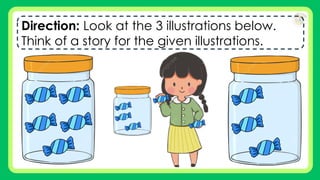
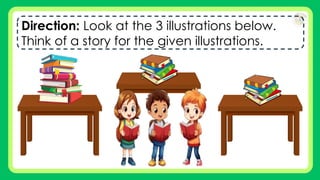
Direction: Look at the 3 illustrations below.
Think of a story for the given illustrations.
Good Job!
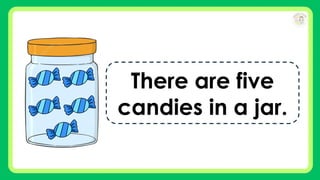
There are five
candies in a jar.
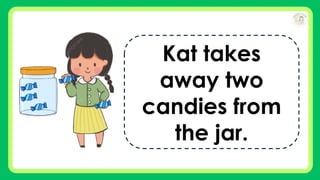
Kat takes
away two
candies from
the jar.
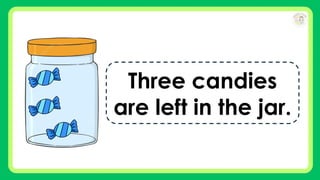
Three candies
are left in the jar.
Direction: Look at the 3 illustrations below.
Think of a story for the given illustrations.
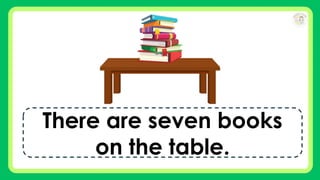
There are seven books
on the table.
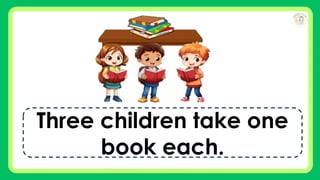
Three children take one
book each.
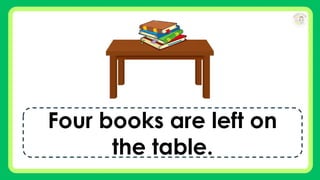
Four books are left on
the table.
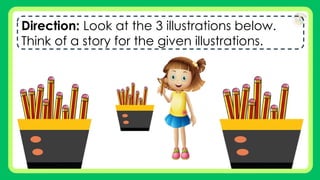
Direction: Look at the 3 illustrations below.
Think of a story for the given illustrations.
There are nine pencils in
a box.
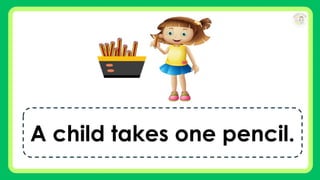
A child takes one pencil.
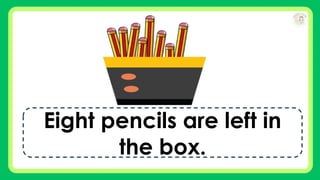
Eight pencils are left in
the box.
Direction: I will tell you stories and a
question is asked after each story.
There are six pens on
the table. Two pens
are taken away. How
many pens are left on
the table?
Ask:
What do you do
when you take
away objects?
Ask:
How many would
be left if two pens
were taken away
from the six pens?
Ask:
How would you
answer the
question in the
story?
Good Job!
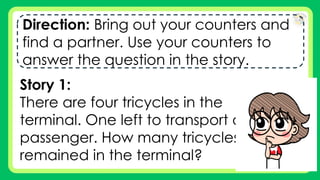
Direction: Bring out your counters and
find a partner. Use your counters to
answer the question in the story.
Story 1:
There are four tricycles in the
terminal. One left to transport a
passenger. How many tricycles
remained in the terminal?
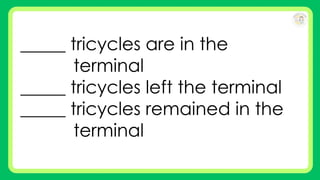
_____ tricycles are in the
terminal
_____ tricycles left the terminal
_____ tricycles remained in the
terminal
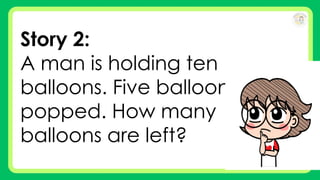
Story 2:
A man is holding ten
balloons. Five balloons
popped. How many
balloons are left?
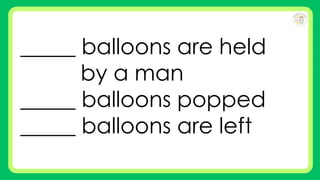
_____ balloons are held
by a man
_____ balloons popped
_____ balloons are left
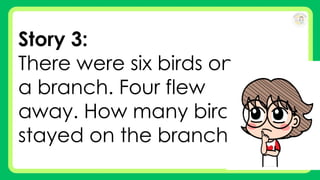
Story 3:
There were six birds on
a branch. Four flew
away. How many birds
stayed on the branch?
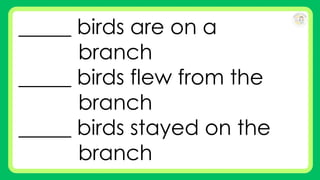
_____ birds are on a
branch
_____ birds flew from the
branch
_____ birds stayed on the
branch
Good Job!
Ask:
What did you do to
tell the number of
tricycles that
remained?
Ask:
What did you do to
tell the number of
balloons left?
Ask:
What did you do to
tell the number of
birds that stayed
on the branch?
Ask:
How did you know
the number of
counters left?
Ask:
What happened to
the number of
objects when you
removed some of
them?
Good Job!
Remember:
Direction: Answer the question:
Ask:
What happens to the
number of objects in a set
when some of the
items are taken away?
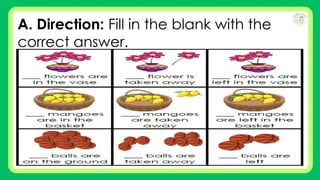
A. Direction: Fill in the blank with the
correct answer.
B. Direction:
Write the
number of
objects left.
GRADE 1 – QUARTER
3
WEEK 1 – DAY 2
• Describe subtraction as taking
away; and
• Write a number sentence to
represent subtraction
Preliminary Activities:
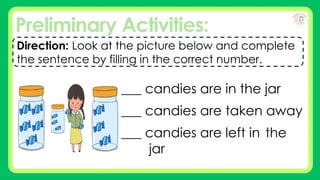
Direction: Look at the picture below and complete
the sentence by filling in the correct number.
___ candies are in the jar
___ candies are taken away
___ candies are left in the
jar
Good Job!
Today, we are going to
Illustrate subtraction of numbers
with minuends up to 10 using
concrete and pictorial models
and write each situation into
subtraction sentence.
Unlocking of Difficulties:
 taken away
 removed
 left
 minuend
 subtrahend
 difference
 minus
 equals
 subtraction
 take away
WRITING
SUBTRACTION
NUMBER
SENTENCES
The story is about the three candies
left in the jar after two candies are
taken away from five candies. The
story can be stated using subtraction
number sentence 5 – 2 = 3. We can
read this subtraction number
sentence as “five minus two equals
three”.
Ask:
What does 5
represent?
Ask:
What does 2
represent?
Ask:
What does 3
represent?
Good Job!
We do subtraction to know how
many objects are left when we
take away some objects from a
set of objects. It is also possible to
use subtraction to know how
many objects are taken away
from a set.
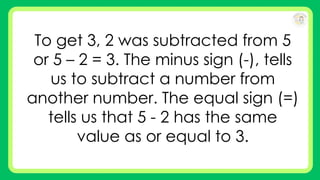
To get 3, 2 was subtracted from 5
or 5 – 2 = 3. The minus sign (-), tells
us to subtract a number from
another number. The equal sign (=)
tells us that 5 - 2 has the same
value as or equal to 3.
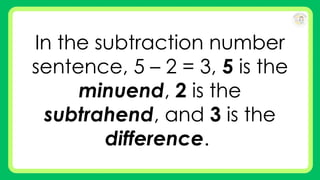
In the subtraction number
sentence, 5 – 2 = 3, 5 is the
minuend, 2 is the
subtrahend, and 3 is the
difference.
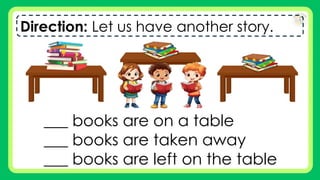
Direction: Let us have another story.
___ books are on a table
___ books are taken away
___ books are left on the table
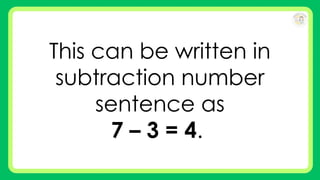
This can be written in
subtraction number
sentence as
7 – 3 = 4.
Ask:
What each
number in the
subtraction
sentence tells us?
Good Job!
In the subtraction sentence 7 – 3 =
4, 7, the number of books before
taking away anything, is the
minuend; 3, the number of books
taken away is the subtrahend; and
4 the number of books left, is the
difference.
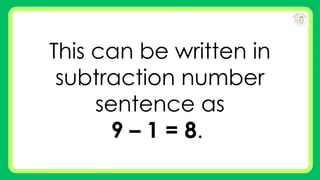
Direction: Let us have the last story.
___ pencils are in a box
___ pencil is taken away
___ pencils are left in the box
This can be written in
subtraction number
sentence as
9 – 1 = 8.
Ask:
What each
number in the
subtraction
sentence
represents?
Good Job!
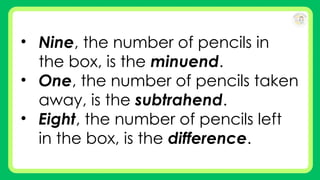
• Nine, the number of pencils in
the box, is the minuend.
• One, the number of pencils taken
away, is the subtrahend.
• Eight, the number of pencils left
in the box, is the difference.
Ask:
What is a
minuend?
Ask:
What is a
subtrahend?
Ask:
What is the
difference?
Good Job!
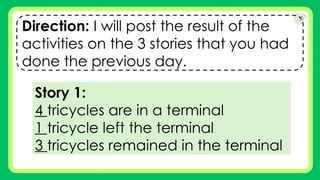
Direction: I will post the result of the
activities on the 3 stories that you had
done the previous day.
Story 1:
4 tricycles are in a terminal
1 tricycle left the terminal
3 tricycles remained in the terminal
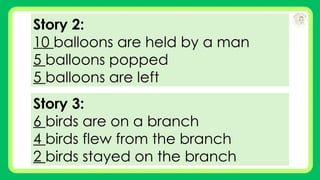
Story 2:
10 balloons are held by a man
5 balloons popped
5 balloons are left
Story 3:
6 birds are on a branch
4 birds flew from the branch
2 birds stayed on the branch
Think-Pair-Share:
Directions:
1. Let the learners work in pairs.
2. Let them write each story into a subtraction number
sentence. They should be able to explain their
answers.
3. When they are done with the activity, have a post-
activity discussion. Have them read the subtraction
number sentences.
4. Ask the learners to identify the minuend, subtrahend,
and difference in each number sentence.cc
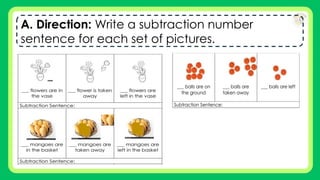
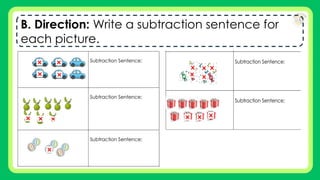
A. Direction: Write a subtraction number
sentence for each set of pictures.
B. Direction: Write a subtraction sentence for
each picture.
Good Job!
Remember:
Direction: Answer the question:
Ask:
Can you read the
subtraction sentence,
5 – 4 = 1 ?
Remember:
Direction: Answer the question:
Ask:
What does this
subtraction number
sentence tell you?
Remember:
Direction: Answer the question:
Ask:
What do you call this
process?
Remember:
Direction: Answer the question:
Ask:
What is
subtraction?
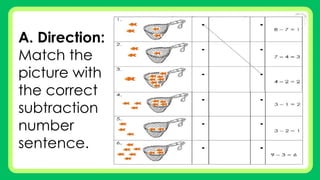
A. Direction:
Match the
picture with
the correct
subtraction
number
sentence.
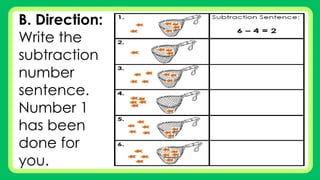
B. Direction:
Write the
subtraction
number
sentence.
Number 1
has been
done for
you.
GRADE 1 – QUARTER
3
WEEK 1 – DAY 3
• Subtract numbers with
minuends up to 10.
Preliminary Activities:
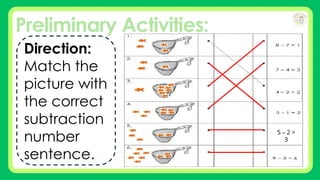
Direction:
Match the
picture with
the correct
subtraction
number
sentence.
5 – 2 =
3
Preliminary Activities:
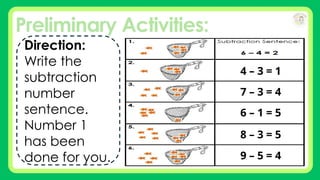
Direction:
Write the
subtraction
number
sentence.
Number 1
has been
done for you.
4 – 3 = 1
7 – 3 = 4
6 – 1 = 5
8 – 3 = 5
9 – 5 = 4
Good Job!
Ask:
What is a
subtraction?
Ask:
What do we
get when we
subtract?
Good Job!
Today, we are going to
subtract numbers with
minuends up to 10.
Unlocking of Difficulties:
 taken away
 removed
 left
 minuend
 subtrahend
 difference
 minus
 equals
 subtraction
 take away
FINDING
THE
DIFFERENCE
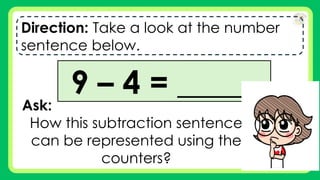
Direction: Take a look at the number
sentence below.
9 – 4 = _____
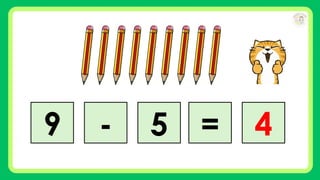
Ask:
How this subtraction sentence
can be represented using the
counters?
9 - 5 = 4
Good Job!
Bring out your counters
and your show me board.
Let us find the difference
in each subtraction
sentence.
ARE YOU READY?
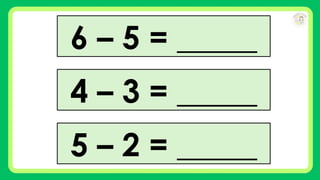
6 – 5 = _____
4 – 3 = _____
5 – 2 = _____
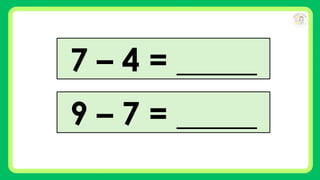
7 – 4 = _____
9 – 7 = _____
Good Job!
Ask:
How did you find
the difference in
each number
sentence?
Ask:
Did all of you use
counters? For those
who did not use
counters, how did
you find the
difference?
Good Job!
Group Activity:
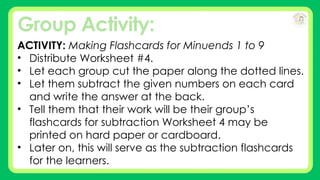
ACTIVITY: Making Flashcards for Minuends 1 to 9
• Distribute Worksheet #4.
• Let each group cut the paper along the dotted lines.
• Let them subtract the given numbers on each card
and write the answer at the back.
• Tell them that their work will be their group’s
flashcards for subtraction Worksheet 4 may be
printed on hard paper or cardboard.
• Later on, this will serve as the subtraction flashcards
for the learners.
Group Activity:
ACTIVITY: Making Flashcards for Minuends 1 to 9
• When they are done with their tasks, collect all
their flashcards and check the answers.
• Learners may use these flashcards in their
activity or during their break to practice
subtraction.
Good Job!
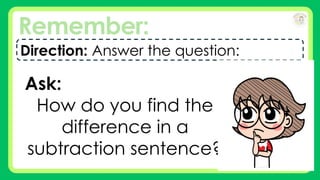
Remember:
Direction: Answer the question:
Ask:
How do you find the
difference in a
subtraction sentence?
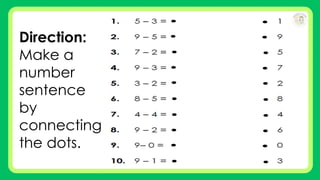
Direction:
Make a
number
sentence
by
connecting
the dots.
GRADE 1 – QUARTER
3
WEEK 1 – DAY 4
• Illustrate subtraction of numbers
with minuends of 10 by using
number bonds; and
• To relate decomposing and
composing numbers to
subtraction.
Preliminary Activities:
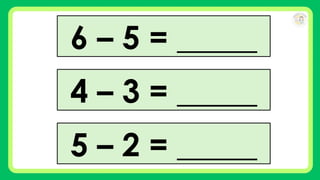
Direction: Let us try answering the
following.
7 – 4 = _____
9 – 7 = _____
6 – 5 = _____
4 – 3 = _____
5 – 2 = _____
Good Job!
Today, we are going to
illustrate subtraction of
numbers with minuends of 10
and relate it to decomposing
and composing numbers.
Unlocking of Difficulties:
 minuend
 subtrahend
 difference
 minus
 equals
SUBTRACTING
NUMBERS
WITH
MINUENDS
UP TO 10
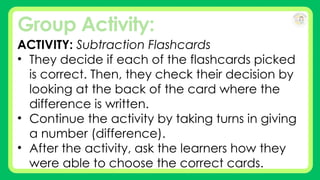
Group Activity:
ACTIVITY: Subtraction Flashcards
• Form a circle.
• Put the flashcards in the center with the
number phrase shown (the answer should be
at the back, not shown).
• One member of the group gives a number
(difference). The other members of the group
pick a flashcard having the given difference.
Group Activity:
ACTIVITY: Subtraction Flashcards
• They decide if each of the flashcards picked
is correct. Then, they check their decision by
looking at the back of the card where the
difference is written.
• Continue the activity by taking turns in giving
a number (difference).
• After the activity, ask the learners how they
were able to choose the correct cards.
Good Job!
Ask:
How you were
able to choose
the correct
cards?
Good Job!
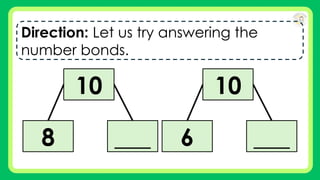
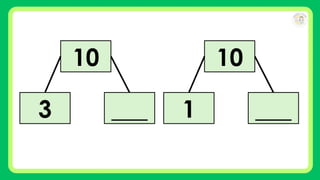
Direction: Let us try answering the
number bonds.
10
8 ___
10
6 ___
10
3 ___
10
1 ___
Ask:
How you got
the missing
numbers?
Ask:
Can subtraction
be used to find
the missing
numbers? How?
Good Job!
Now, I will write the number sentences.

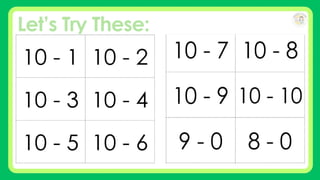
10 – 8 = 2
10 – 3 = 7
10 – 6 = 4
10 – 1 = 9
We can also use the number
bonds, which have been
introduced in one of our
previous lessons, to find the
difference.
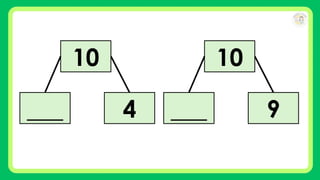
Ask:
How about if the
missing number is in
the first box, do you
think subtraction
can still be used?
10
___ 2
10
___ 7
10
___ 4
10
___ 9
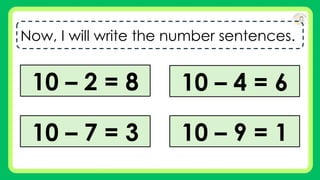
Now, I will write the number sentences.

10 – 2 = 8
10 – 7 = 3
10 – 4 = 6
10 – 9 = 1
Good Job!
Ask:
How about if one of
the numbers below
10 is zero, what
would be the
other number?
Ask:
How do you write it
as a subtraction
sentence?
Ask:
What does it
mean?
Ask:
Can number bonds
be used to find
difference?
Ask:
How can the
number bonds be
used to find the
difference?
Ask:
Why is it
possible?
Good Job!
Let’s Try These:
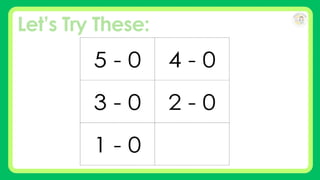
Let’s Try These:
Remember:
Direction: Answer the question:
Ask:
How can we use
number bonds to find
the difference?
A. Direction: Subtract.
B. Direction: Encircle the letter of
the correct answer.
GRADE 1 – QUARTER
3
WEEK 1 – DAY 5
CATCH UP FRIDAY
CATCH
UP
FRIDAY
End of Week 1

GRADE-1-Q3-MATH-WEEK-3.pptx-Mathematics for Grade 1