Briana Preslar
Sales + Marketing Coordinator
(800) 819-9785
briana@livestories.com
Got Data Doubt?
How to Handle Uncertainty in Data
Who am I?
- Attained two Bachelor's degrees from the University of Washington for
Medical Anthropology / Global Health + Evolutionary Biology
- As the sales and marketing coordinator I interact with clients who build resources
around public data regularly.
- Content creator for LiveStatistics resource page: https://www.livestories.com/statistics
(This contains data about your community at a national, state, county, and city level)
Briana Preslar
Sales + Marketing Coordinator
(800) 819-9785
briana@livestories.com
Today We Will:
● Learn to identify and handle
- Doubt in the numbers
- Doubt in the analysis
● Identify danger areas in large public data sets
● Address the Margin of Error
The Numbers SEE IT AROUND YOUThe Analysis Doubt in Public Data The Margin of Error
The Numbers SEE IT AROUND YOUThe Analysis The Margin of Error Doubt in Public Data
- Doubt in the numbers
- Suppressed data
Learn to identify and handle:
- Doubt in the analysis
- Working with
estimates
The Numbers SEE IT AROUND YOUThe Analysis The Margin of Error Doubt in Public Data
- Doubt in the numbers
- Suppressed data
Learn to identify and handle:
- Doubt in the analysis
- Working with
estimates
The Numbers The Analysis Doubt in Public DataThe Analysis
Suppressed Data
Areas where data may be suppressed:
- Death data
For Privacy—if # of deaths is > 10 in surveyed location
For Accuracy—if # of deaths is > 20 / 100,000 people
The Numbers The Analysis The Margin of Error Doubt in Public DataThe Analysis
The Numbers SEE IT AROUND YOUThe Analysis The Margin of Error Doubt in Public DataThe Analysis
Suppressed Data
Areas where data may be suppressed:
- Death data
For Privacy—if # of deaths is > 10 in surveyed location
For Accuracy—if # of deaths is > 20 / 100,000 people
- Population Data
For Privacy—if you choose to look at too narrow of a segment of people (in
other terms too specific a group) the data may be suppressed.
The Numbers The AnalysisThe Analysis
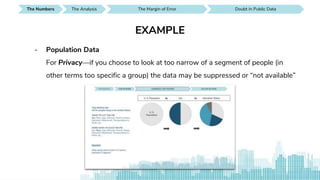
EXAMPLE
- Population Data
For Privacy—if you choose to look at too narrow of a segment of people (in
other terms too specific a group) the data may be suppressed or “not available”
The Numbers SEE IT AROUND YOUThe Analysis The Margin of Error Doubt in Public DataThe Analysis
The Numbers SEE IT AROUND YOUThe Analysis The Margin of Error Doubt in Public Data
- Doubt in the numbers
- Suppressed data
Learn to identify and handle:
- Doubt in the analysis
- Working with
estimates
The Numbers SEE IT AROUND YOUThe Analysis Doubt in Public DataThe Analysis
- Estimates are used in many public data sets
- Estimates carry doubt with them
Working with Estimates
Doubt in Public Data Doubt in Public DataThe Margin of Error
The Numbers SEE IT AROUND YOUThe Analysis Doubt in Public DataThe Analysis
- Estimates are used in many public data sets
- Estimates carry doubt with them
Working with Estimates
SEE IT AROUND YOUDoubt in Public Data SEE IT AROUND YOUDoubt in Public DataThe Margin of Error
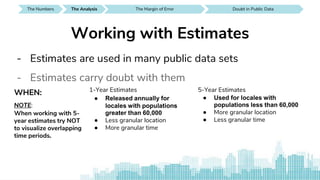
WHEN:
NOTE:
When working with 5-
year estimates try NOT
to visualize overlapping
time periods.
1-Year Estimates
● Released annually for
locales with populations
greater than 60,000
● Less granular location
● More granular time
5-Year Estimates
● Used for locales with
populations less than 60,000
● More granular location
● Less granular time
The Numbers SEE IT AROUND YOUThe Analysis Doubt in Public DataThe Analysis
- Estimates are used in many public data sets
- Estimates carry doubt with them
Working with Estimates
SEE IT AROUND YOUDoubt in Public Data SEE IT AROUND YOUDoubt in Public DataThe Margin of Error
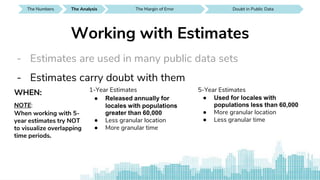
WHEN:
NOTE:
When working with 5-
year estimates try NOT
to visualize overlapping
time periods.
1-Year Estimates
● Released annually for
locales with populations
greater than 60,000
● Less granular location
● More granular time
5-Year Estimates
● Used for locales with
populations less than 60,000
● More granular location
● Less granular time
The Numbers SEE IT AROUND YOUThe Analysis Doubt in Public DataThe Analysis
- Estimates carry doubt with them
SEE IT AROUND YOUDoubt in Public Data SEE IT AROUND YOUDoubt in Public DataThe Margin of Error
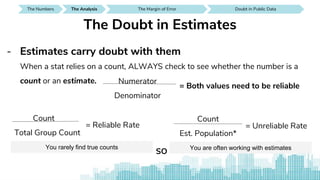
The Doubt in Estimates
Count
Total Group Count
When a stat relies on a count, ALWAYS check to see whether the number is a
count or an estimate.
Count
Est. Population*
= Reliable Rate = Unreliable Rate
Numerator
Denominator
= Both values need to be reliable
You rarely find true counts You are often working with estimates
SO
The Numbers SEE IT AROUND YOUThe Analysis Doubt in Public DataThe Analysis SEE IT AROUND YOUDoubt in Public Data SEE IT AROUND YOUDoubt in Public DataThe Margin of Error
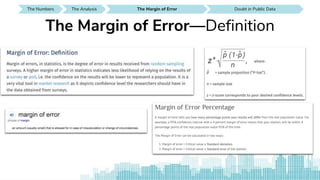
The Margin of Error—Definition
The Numbers SEE IT AROUND YOUThe Analysis Doubt in Public DataThe Analysis
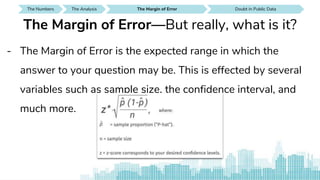
- The Margin of Error is the expected range in which the
answer to your question may be. This is effected by several
variables such as sample size, the confidence interval, and
much more.
SEE IT AROUND YOUDoubt in Public Data SEE IT AROUND YOUDoubt in Public DataThe Margin of Error
The Margin of Error—But really, what is it?
The Numbers SEE IT AROUND YOUThe Analysis Doubt in Public DataThe Analysis SEE IT AROUND YOUDoubt in Public Data SEE IT AROUND YOUDoubt in Public DataThe Margin of Error
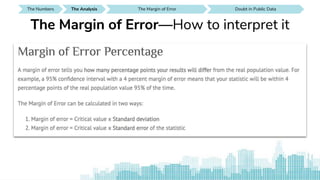
The Margin of Error—How to interpret itThe Margin of Error—How to interpret it
The Numbers SEE IT AROUND YOUThe Analysis Doubt in Public DataThe Analysis SEE IT AROUND YOUDoubt in Public Data SEE IT AROUND YOUDoubt in Public DataThe Margin of Error
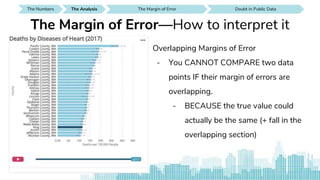
The Margin of Error—How to interpret it
Overlapping Margins of Error
- You CANNOT COMPARE two data
points IF their margin of errors are
overlapping.
- BECAUSE the true value could
actually be the same (+ fall in the
overlapping section)
The Numbers SEE IT AROUND YOUThe Analysis Doubt in Public DataThe Analysis SEE IT AROUND YOUDoubt in Public Data SEE IT AROUND YOUDoubt in Public DataThe Margin of Error
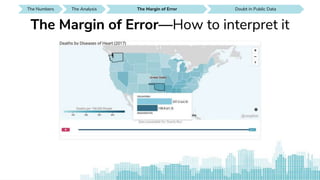
The Margin of Error—How to interpret itThe Margin of Error—How to interpret it
The Numbers SEE IT AROUND YOUThe Analysis Doubt in Public DataThe Analysis SEE IT AROUND YOUDoubt in Public Data SEE IT AROUND YOUDoubt in Public DataThe Margin of Error
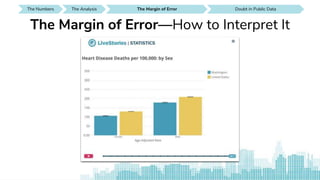
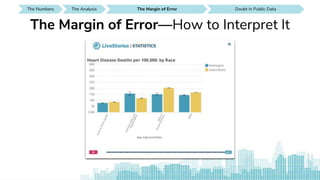
The Margin of Error—How to Interpret It
The Numbers SEE IT AROUND YOUThe Analysis Doubt in Public DataThe Analysis SEE IT AROUND YOUDoubt in Public Data SEE IT AROUND YOUDoubt in Public DataThe Margin of Error
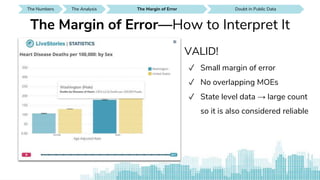
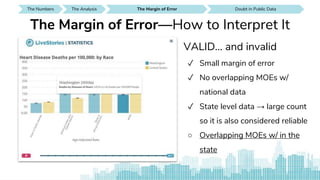
The Margin of Error—How to Interpret It
VALID!
✓ Small margin of error
✓ No overlapping MOEs
✓ State level data → large count
so it is also considered reliable
The Numbers SEE IT AROUND YOUThe Analysis Doubt in Public DataThe Analysis SEE IT AROUND YOUDoubt in Public Data SEE IT AROUND YOUDoubt in Public DataThe Margin of Error
The Margin of Error—How to Interpret It
The Numbers SEE IT AROUND YOUThe Analysis Doubt in Public DataThe Analysis SEE IT AROUND YOUDoubt in Public Data SEE IT AROUND YOUDoubt in Public DataThe Margin of Error
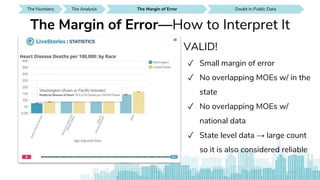
The Margin of Error—How to Interpret It
VALID!
✓ Small margin of error
✓ No overlapping MOEs w/ in the
state
✓ No overlapping MOEs w/
national data
✓ State level data → large count
so it is also considered reliable
The Numbers SEE IT AROUND YOUThe Analysis Doubt in Public DataThe Analysis SEE IT AROUND YOUDoubt in Public Data SEE IT AROUND YOUDoubt in Public DataThe Margin of Error
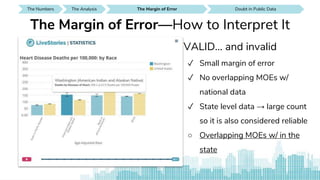
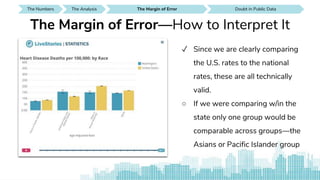
The Margin of Error—How to Interpret It
VALID… and invalid
✓ Small margin of error
✓ No overlapping MOEs w/
national data
✓ State level data → large count
so it is also considered reliable
○ Overlapping MOEs w/ in the
state
The Numbers SEE IT AROUND YOUThe Analysis Doubt in Public DataThe Analysis SEE IT AROUND YOUDoubt in Public Data SEE IT AROUND YOUDoubt in Public DataThe Margin of Error
The Margin of Error—How to Interpret It
VALID… and invalid
✓ Small margin of error
✓ No overlapping MOEs w/
national data
✓ State level data → large count
so it is also considered reliable
○ Overlapping MOEs w/ in the
state
The Numbers SEE IT AROUND YOUThe Analysis Doubt in Public DataThe Analysis SEE IT AROUND YOUDoubt in Public Data SEE IT AROUND YOUDoubt in Public DataThe Margin of Error
The Margin of Error—How to Interpret It
VALID… and invalid
✓ Small margin of error
✓ No overlapping MOEs w/
national data
✓ State level data → large count
so it is also considered reliable
○ Overlapping MOEs w/ in the
state
The Numbers SEE IT AROUND YOUThe Analysis Doubt in Public DataThe Analysis SEE IT AROUND YOUDoubt in Public Data SEE IT AROUND YOUDoubt in Public DataThe Margin of Error
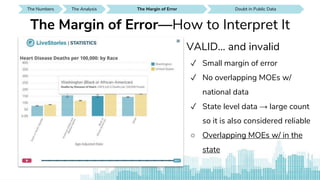
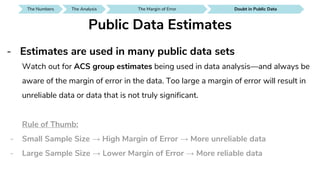
The Margin of Error—How to Interpret It
✓ Since we are clearly comparing
the U.S. rates to the national
rates, these are all technically
valid.
○ If we were comparing w/in the
state only one group would be
comparable across groups—the
Asians or Pacific Islander group
The Numbers SEE IT AROUND YOUThe Analysis Doubt in Public DataThe Analysis
- Estimates are used in many public data sets
SEE IT AROUND YOUDoubt in Public Data SEE IT AROUND YOUDoubt in Public DataThe Margin of Error
Public Data Estimates
Watch out for ACS group estimates being used in data analysis—and always be
aware of the margin of error in the data. Too large a margin of error will result in
unreliable data or data that is not truly significant.
Rule of Thumb:
- Small Sample Size → High Margin of Error → More unreliable data
- Large Sample Size → Lower Margin of Error → More reliable data
The Numbers SEE IT AROUND YOUThe Analysis Doubt in Public DataThe Analysis
- Estimates are used in many public data sets
SEE IT AROUND YOUDoubt in Public Data SEE IT AROUND YOUDoubt in Public DataThe Margin of Error
Public Data Estimates
Watch out for ACS group estimates being used in data analysis—and always be
aware of the margin of error in the data. Too large a margin of error will result in
unreliable data or data that is not truly significant.
Rule of Thumb:
- Small Sample Size → High Margin of Error → More unreliable data
- Large Sample Size → Lower Margin of Error → More reliable data
The Numbers SEE IT AROUND YOUThe Analysis Doubt in Public DataThe Analysis
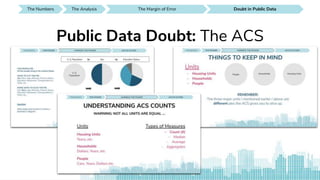
Public Data Doubt: The ACS
SEE IT AROUND YOUDoubt in Public DataThe Margin of Error SEE IT AROUND YOUDoubt in Public Data SEE IT AROUND YOUDoubt in Public DataThe Margin of Error
The Numbers SEE IT AROUND YOUThe Analysis Doubt in Public DataThe Analysis SEE IT AROUND YOUDoubt in Public DataThe Margin of Error SEE IT AROUND YOUDoubt in Public Data SEE IT AROUND YOUDoubt in Public DataThe Margin of ErrorThe Numbers SEE IT AROUND YOUThe Analysis Doubt in Public DataThe Analysis
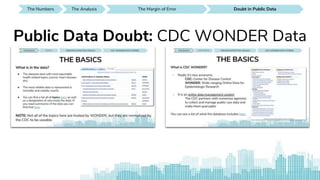
Public Data Doubt: CDC WONDER Data
SEE IT AROUND YOUDoubt in Public DataThe Margin of Error SEE IT AROUND YOUDoubt in Public Data SEE IT AROUND YOUDoubt in Public DataThe Margin of Error
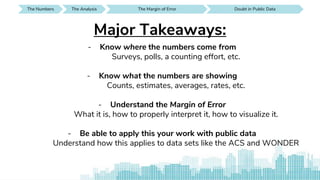
Major Takeaways:
- Know where the numbers come from
Surveys, polls, a counting effort, etc.
- Know what the numbers are showing
Counts, estimates, averages, rates, etc.
- Understand the Margin of Error
What it is, how to properly interpret it, how to visualize it.
- Be able to apply this your work with public data
Understand how this applies to data sets like the ACS and WONDER
The Numbers SEE IT AROUND YOUThe Analysis Doubt in Public DataThe Analysis SEE IT AROUND YOUDoubt in Public DataThe Margin of Error SEE IT AROUND YOUDoubt in Public Data SEE IT AROUND YOUDoubt in Public DataThe Margin of Error
Resources We Find Helpful
The United States Census Bureau - Home Page
The United States Census Bureau - Data Suppression
Page
CDC WONDER FAQ - Includes answers on
suppressed numbers
Margin of Error Definitions are linked to images on
slides
See Data About Your Community:
LiveStories.com/Statistics
The Numbers SEE IT AROUND YOUThe Analysis Doubt in Public DataThe Analysis SEE IT AROUND YOUDoubt in Public DataThe Margin of Error SEE IT AROUND YOUDoubt in Public Data SEE IT AROUND YOUDoubt in Public DataThe Margin of Error
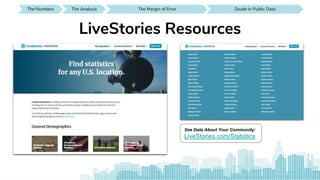
LiveStories Resources
See Data About Your Community:
LiveStories.com/Statistics
The Numbers SEE IT AROUND YOUThe Analysis Doubt in Public DataThe Analysis SEE IT AROUND YOUDoubt in Public DataThe Margin of Error SEE IT AROUND YOUDoubt in Public Data SEE IT AROUND YOUDoubt in Public DataThe Margin of Error
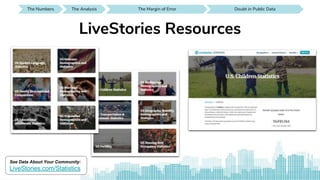
LiveStories Resources
See Data About Your Community:
LiveStories.com/Statistics
Submit your thoughts!
- Look out for link to our next webinar:
Fighting Disease with Data:
Combating Opioid Addiction in Your Community
- For more info email us at Info@livestories.com
- Submit your questions to us now using the chat window!
Briana Preslar
Sales + Marketing Coordinator
(800)819-9785
briana@livestories.com

Got data doubt? How to handle uncertainty in data

  • 1.
    Briana Preslar Sales +Marketing Coordinator (800) 819-9785 briana@livestories.com Got Data Doubt? How to Handle Uncertainty in Data
  • 2.
    Who am I? -Attained two Bachelor's degrees from the University of Washington for Medical Anthropology / Global Health + Evolutionary Biology - As the sales and marketing coordinator I interact with clients who build resources around public data regularly. - Content creator for LiveStatistics resource page: https://www.livestories.com/statistics (This contains data about your community at a national, state, county, and city level) Briana Preslar Sales + Marketing Coordinator (800) 819-9785 briana@livestories.com
  • 3.
    Today We Will: ●Learn to identify and handle - Doubt in the numbers - Doubt in the analysis ● Identify danger areas in large public data sets ● Address the Margin of Error The Numbers SEE IT AROUND YOUThe Analysis Doubt in Public Data The Margin of Error
  • 4.
    The Numbers SEEIT AROUND YOUThe Analysis The Margin of Error Doubt in Public Data - Doubt in the numbers - Suppressed data Learn to identify and handle: - Doubt in the analysis - Working with estimates
  • 5.
    The Numbers SEEIT AROUND YOUThe Analysis The Margin of Error Doubt in Public Data - Doubt in the numbers - Suppressed data Learn to identify and handle: - Doubt in the analysis - Working with estimates
  • 6.
    The Numbers TheAnalysis Doubt in Public DataThe Analysis Suppressed Data Areas where data may be suppressed: - Death data For Privacy—if # of deaths is > 10 in surveyed location For Accuracy—if # of deaths is > 20 / 100,000 people The Numbers The Analysis The Margin of Error Doubt in Public DataThe Analysis
  • 7.
    The Numbers SEEIT AROUND YOUThe Analysis The Margin of Error Doubt in Public DataThe Analysis Suppressed Data Areas where data may be suppressed: - Death data For Privacy—if # of deaths is > 10 in surveyed location For Accuracy—if # of deaths is > 20 / 100,000 people - Population Data For Privacy—if you choose to look at too narrow of a segment of people (in other terms too specific a group) the data may be suppressed.
  • 8.
    The Numbers TheAnalysisThe Analysis EXAMPLE - Population Data For Privacy—if you choose to look at too narrow of a segment of people (in other terms too specific a group) the data may be suppressed or “not available” The Numbers SEE IT AROUND YOUThe Analysis The Margin of Error Doubt in Public DataThe Analysis
  • 9.
    The Numbers SEEIT AROUND YOUThe Analysis The Margin of Error Doubt in Public Data - Doubt in the numbers - Suppressed data Learn to identify and handle: - Doubt in the analysis - Working with estimates
  • 10.
    The Numbers SEEIT AROUND YOUThe Analysis Doubt in Public DataThe Analysis - Estimates are used in many public data sets - Estimates carry doubt with them Working with Estimates Doubt in Public Data Doubt in Public DataThe Margin of Error
  • 11.
    The Numbers SEEIT AROUND YOUThe Analysis Doubt in Public DataThe Analysis - Estimates are used in many public data sets - Estimates carry doubt with them Working with Estimates SEE IT AROUND YOUDoubt in Public Data SEE IT AROUND YOUDoubt in Public DataThe Margin of Error WHEN: NOTE: When working with 5- year estimates try NOT to visualize overlapping time periods. 1-Year Estimates ● Released annually for locales with populations greater than 60,000 ● Less granular location ● More granular time 5-Year Estimates ● Used for locales with populations less than 60,000 ● More granular location ● Less granular time
  • 12.
    The Numbers SEEIT AROUND YOUThe Analysis Doubt in Public DataThe Analysis - Estimates are used in many public data sets - Estimates carry doubt with them Working with Estimates SEE IT AROUND YOUDoubt in Public Data SEE IT AROUND YOUDoubt in Public DataThe Margin of Error WHEN: NOTE: When working with 5- year estimates try NOT to visualize overlapping time periods. 1-Year Estimates ● Released annually for locales with populations greater than 60,000 ● Less granular location ● More granular time 5-Year Estimates ● Used for locales with populations less than 60,000 ● More granular location ● Less granular time
  • 13.
    The Numbers SEEIT AROUND YOUThe Analysis Doubt in Public DataThe Analysis - Estimates carry doubt with them SEE IT AROUND YOUDoubt in Public Data SEE IT AROUND YOUDoubt in Public DataThe Margin of Error The Doubt in Estimates Count Total Group Count When a stat relies on a count, ALWAYS check to see whether the number is a count or an estimate. Count Est. Population* = Reliable Rate = Unreliable Rate Numerator Denominator = Both values need to be reliable You rarely find true counts You are often working with estimates SO
  • 14.
    The Numbers SEEIT AROUND YOUThe Analysis Doubt in Public DataThe Analysis SEE IT AROUND YOUDoubt in Public Data SEE IT AROUND YOUDoubt in Public DataThe Margin of Error The Margin of Error—Definition
  • 15.
    The Numbers SEEIT AROUND YOUThe Analysis Doubt in Public DataThe Analysis - The Margin of Error is the expected range in which the answer to your question may be. This is effected by several variables such as sample size, the confidence interval, and much more. SEE IT AROUND YOUDoubt in Public Data SEE IT AROUND YOUDoubt in Public DataThe Margin of Error The Margin of Error—But really, what is it?
  • 16.
    The Numbers SEEIT AROUND YOUThe Analysis Doubt in Public DataThe Analysis SEE IT AROUND YOUDoubt in Public Data SEE IT AROUND YOUDoubt in Public DataThe Margin of Error The Margin of Error—How to interpret itThe Margin of Error—How to interpret it
  • 17.
    The Numbers SEEIT AROUND YOUThe Analysis Doubt in Public DataThe Analysis SEE IT AROUND YOUDoubt in Public Data SEE IT AROUND YOUDoubt in Public DataThe Margin of Error The Margin of Error—How to interpret it Overlapping Margins of Error - You CANNOT COMPARE two data points IF their margin of errors are overlapping. - BECAUSE the true value could actually be the same (+ fall in the overlapping section)
  • 18.
    The Numbers SEEIT AROUND YOUThe Analysis Doubt in Public DataThe Analysis SEE IT AROUND YOUDoubt in Public Data SEE IT AROUND YOUDoubt in Public DataThe Margin of Error The Margin of Error—How to interpret itThe Margin of Error—How to interpret it
  • 19.
    The Numbers SEEIT AROUND YOUThe Analysis Doubt in Public DataThe Analysis SEE IT AROUND YOUDoubt in Public Data SEE IT AROUND YOUDoubt in Public DataThe Margin of Error The Margin of Error—How to Interpret It
  • 20.
    The Numbers SEEIT AROUND YOUThe Analysis Doubt in Public DataThe Analysis SEE IT AROUND YOUDoubt in Public Data SEE IT AROUND YOUDoubt in Public DataThe Margin of Error The Margin of Error—How to Interpret It VALID! ✓ Small margin of error ✓ No overlapping MOEs ✓ State level data → large count so it is also considered reliable
  • 21.
    The Numbers SEEIT AROUND YOUThe Analysis Doubt in Public DataThe Analysis SEE IT AROUND YOUDoubt in Public Data SEE IT AROUND YOUDoubt in Public DataThe Margin of Error The Margin of Error—How to Interpret It
  • 22.
    The Numbers SEEIT AROUND YOUThe Analysis Doubt in Public DataThe Analysis SEE IT AROUND YOUDoubt in Public Data SEE IT AROUND YOUDoubt in Public DataThe Margin of Error The Margin of Error—How to Interpret It VALID! ✓ Small margin of error ✓ No overlapping MOEs w/ in the state ✓ No overlapping MOEs w/ national data ✓ State level data → large count so it is also considered reliable
  • 23.
    The Numbers SEEIT AROUND YOUThe Analysis Doubt in Public DataThe Analysis SEE IT AROUND YOUDoubt in Public Data SEE IT AROUND YOUDoubt in Public DataThe Margin of Error The Margin of Error—How to Interpret It VALID… and invalid ✓ Small margin of error ✓ No overlapping MOEs w/ national data ✓ State level data → large count so it is also considered reliable ○ Overlapping MOEs w/ in the state
  • 24.
    The Numbers SEEIT AROUND YOUThe Analysis Doubt in Public DataThe Analysis SEE IT AROUND YOUDoubt in Public Data SEE IT AROUND YOUDoubt in Public DataThe Margin of Error The Margin of Error—How to Interpret It VALID… and invalid ✓ Small margin of error ✓ No overlapping MOEs w/ national data ✓ State level data → large count so it is also considered reliable ○ Overlapping MOEs w/ in the state
  • 25.
    The Numbers SEEIT AROUND YOUThe Analysis Doubt in Public DataThe Analysis SEE IT AROUND YOUDoubt in Public Data SEE IT AROUND YOUDoubt in Public DataThe Margin of Error The Margin of Error—How to Interpret It VALID… and invalid ✓ Small margin of error ✓ No overlapping MOEs w/ national data ✓ State level data → large count so it is also considered reliable ○ Overlapping MOEs w/ in the state
  • 26.
    The Numbers SEEIT AROUND YOUThe Analysis Doubt in Public DataThe Analysis SEE IT AROUND YOUDoubt in Public Data SEE IT AROUND YOUDoubt in Public DataThe Margin of Error The Margin of Error—How to Interpret It ✓ Since we are clearly comparing the U.S. rates to the national rates, these are all technically valid. ○ If we were comparing w/in the state only one group would be comparable across groups—the Asians or Pacific Islander group
  • 27.
    The Numbers SEEIT AROUND YOUThe Analysis Doubt in Public DataThe Analysis - Estimates are used in many public data sets SEE IT AROUND YOUDoubt in Public Data SEE IT AROUND YOUDoubt in Public DataThe Margin of Error Public Data Estimates Watch out for ACS group estimates being used in data analysis—and always be aware of the margin of error in the data. Too large a margin of error will result in unreliable data or data that is not truly significant. Rule of Thumb: - Small Sample Size → High Margin of Error → More unreliable data - Large Sample Size → Lower Margin of Error → More reliable data
  • 28.
    The Numbers SEEIT AROUND YOUThe Analysis Doubt in Public DataThe Analysis - Estimates are used in many public data sets SEE IT AROUND YOUDoubt in Public Data SEE IT AROUND YOUDoubt in Public DataThe Margin of Error Public Data Estimates Watch out for ACS group estimates being used in data analysis—and always be aware of the margin of error in the data. Too large a margin of error will result in unreliable data or data that is not truly significant. Rule of Thumb: - Small Sample Size → High Margin of Error → More unreliable data - Large Sample Size → Lower Margin of Error → More reliable data
  • 29.
    The Numbers SEEIT AROUND YOUThe Analysis Doubt in Public DataThe Analysis Public Data Doubt: The ACS SEE IT AROUND YOUDoubt in Public DataThe Margin of Error SEE IT AROUND YOUDoubt in Public Data SEE IT AROUND YOUDoubt in Public DataThe Margin of Error
  • 30.
    The Numbers SEEIT AROUND YOUThe Analysis Doubt in Public DataThe Analysis SEE IT AROUND YOUDoubt in Public DataThe Margin of Error SEE IT AROUND YOUDoubt in Public Data SEE IT AROUND YOUDoubt in Public DataThe Margin of ErrorThe Numbers SEE IT AROUND YOUThe Analysis Doubt in Public DataThe Analysis Public Data Doubt: CDC WONDER Data SEE IT AROUND YOUDoubt in Public DataThe Margin of Error SEE IT AROUND YOUDoubt in Public Data SEE IT AROUND YOUDoubt in Public DataThe Margin of Error
  • 31.
    Major Takeaways: - Knowwhere the numbers come from Surveys, polls, a counting effort, etc. - Know what the numbers are showing Counts, estimates, averages, rates, etc. - Understand the Margin of Error What it is, how to properly interpret it, how to visualize it. - Be able to apply this your work with public data Understand how this applies to data sets like the ACS and WONDER The Numbers SEE IT AROUND YOUThe Analysis Doubt in Public DataThe Analysis SEE IT AROUND YOUDoubt in Public DataThe Margin of Error SEE IT AROUND YOUDoubt in Public Data SEE IT AROUND YOUDoubt in Public DataThe Margin of Error
  • 32.
    Resources We FindHelpful The United States Census Bureau - Home Page The United States Census Bureau - Data Suppression Page CDC WONDER FAQ - Includes answers on suppressed numbers Margin of Error Definitions are linked to images on slides See Data About Your Community: LiveStories.com/Statistics The Numbers SEE IT AROUND YOUThe Analysis Doubt in Public DataThe Analysis SEE IT AROUND YOUDoubt in Public DataThe Margin of Error SEE IT AROUND YOUDoubt in Public Data SEE IT AROUND YOUDoubt in Public DataThe Margin of Error
  • 33.
    LiveStories Resources See DataAbout Your Community: LiveStories.com/Statistics The Numbers SEE IT AROUND YOUThe Analysis Doubt in Public DataThe Analysis SEE IT AROUND YOUDoubt in Public DataThe Margin of Error SEE IT AROUND YOUDoubt in Public Data SEE IT AROUND YOUDoubt in Public DataThe Margin of Error
  • 34.
    The Numbers SEEIT AROUND YOUThe Analysis Doubt in Public DataThe Analysis SEE IT AROUND YOUDoubt in Public DataThe Margin of Error SEE IT AROUND YOUDoubt in Public Data SEE IT AROUND YOUDoubt in Public DataThe Margin of Error LiveStories Resources See Data About Your Community: LiveStories.com/Statistics
  • 35.
    Submit your thoughts! -Look out for link to our next webinar: Fighting Disease with Data: Combating Opioid Addiction in Your Community - For more info email us at Info@livestories.com - Submit your questions to us now using the chat window! Briana Preslar Sales + Marketing Coordinator (800)819-9785 briana@livestories.com

Editor's Notes

  • #2 Hello everyone and thank you for joining us today! A little background on us: We believe that technology can be and should be used to enable local governments and community focused organizations to work more efficiently, and ultimately to increase citizen and community engagement. We work with local governments to help them make more out of the data they work with, as well as provide them tools and resources to help visualize and explain the data in a more effective way.
  • #35 Make people go to LiveStats page