Our whole universe was in a hot, dense state; then more than fourteen billion years ago expansion started – wait - The earth began to


                                                                                                                                                                                                                                                                                                                                         Cool, the autotropes began to drool, Neanderthals developed tools; we built a wall (we built the pyramids)! Math, science, history; unraveling the mystery that all started with the big bang!
Cool, the autotropes began to drool, Neanderthals developed tools; we built a wall (we built the pyramids)! Math, science, history; unraveling the mystery that all started with the big bang!


                                                                                                                                                                                                                 A Study of Relationships and Communication
                                                                                                                                                                                                                    Within a Self-Selected Family Scenario

                                                                                                                                                                                                                                                 By Serena Gosbee

                                                                                                                                                                                                                               Based on The Big Bang Theory
                                                                                                                                                                                                                              AChuck Lorre television program
                                                                                                                                                                                                                                Seasons One through Three


                                                                                                                                                                                                 Our whole universe was in a hot, dense state; then more than fourteen billion years ago expansion started – wait - The earth began to
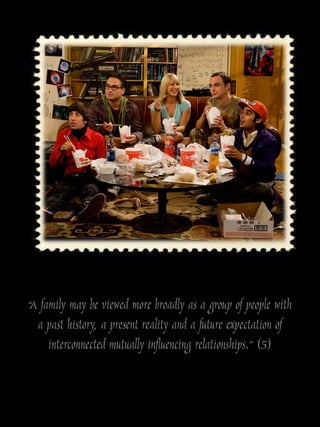
“A family may be viewed more broadly as a group of people with
  a past history, a present reality and a future expectation of
     interconnected mutually influencing relationships.” (5)
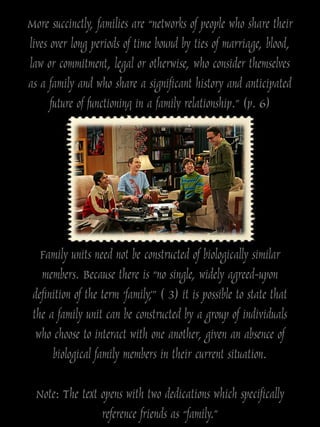
More succinctly, families are “networks of people who share their
lives over long periods of time bound by ties of marriage, blood,
law or commitment, legal or otherwise, who consider themselves
as a family and who share a significant history and anticipated
      future of functioning in a family relationship.” (p. 6)


   Family units need not be constructed of biologically similar
   members. Because there is “no single, widely agreed-upon
 definition of the term „family,‟” ( 3) it is possible to state that
 the a family unit can be constructed by a group of individuals
  who choose to interact with one another, given an absence of
      biological family members in their current situation.

  Note: The text opens with two dedications which specifically
                 reference friends as “family.”
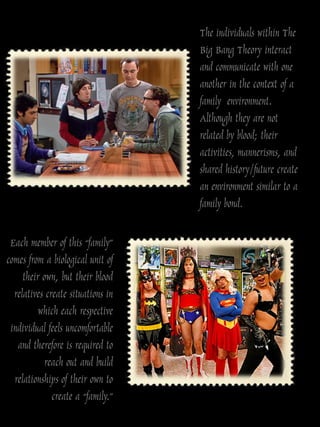
The individuals within The
                                   Big Bang Theory interact
                                   and communicate with one
                                   another in the context of a
                                   family environment.
                                   Although they are not
                                   related by blood; their
                                   activities, mannerisms, and
                                   shared history/future create
                                   an environment similar to a
                                   family bond.

 Each member of this “family”
comes from a biological unit of
     their own, but their blood
  relatives create situations in
          which each respective
 individual feels uncomfortable
   and therefore is required to
            reach out and build
  relationships of their own to
              create a “family.”
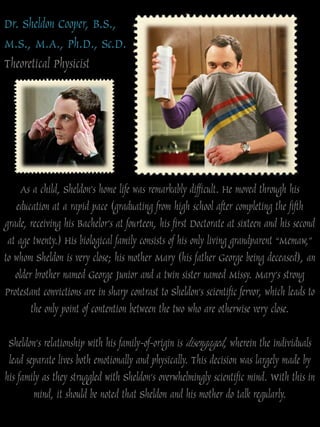
Dr. Sheldon Cooper, B.S.,
M.S., M.A., Ph.D., Sc.D.
Theoretical Physicist


     As a child, Sheldon‟s home life was remarkably difficult. He moved through his
   education at a rapid pace (graduating from high school after completing the fifth
grade, receiving his Bachelor‟s at fourteen, his first Doctorate at sixteen and his second
 at age twenty.) His biological family consists of his only living grandparent “Memaw,”
to whom Sheldon is very close; his mother Mary (his father George being deceased), an
   older brother named George Junior and a twin sister named Missy. Mary‟s strong
Protestant convictions are in sharp contrast to Sheldon‟s scientific fervor, which leads to
        the only point of contention between the two who are otherwise very close.

 Sheldon‟s relationship with his family-of-origin is disengaged, wherein the individuals
 lead separate lives both emotionally and physically. This decision was largely made by
his family as they struggled with Sheldon‟s overwhelmingly scientific mind. With this in
        mind, it should be noted that Sheldon and his mother do talk regularly.
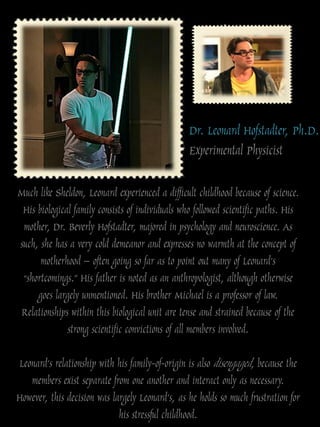
Dr. Leonard Hofstadter, Ph.D.
                                                 Experimental Physicist

Much like Sheldon, Leonard experienced a difficult childhood because of science.
 His biological family consists of individuals who followed scientific paths. His
 mother, Dr. Beverly Hofstadter, majored in psychology and neuroscience. As
such, she has a very cold demeanor and expresses no warmth at the concept of
      motherhood – often going so far as to point out many of Leonard‟s
 “shortcomings.” His father is noted as an anthropologist, although otherwise
     goes largely unmentioned. His brother Michael is a professor of law.
 Relationships within this biological unit are tense and strained because of the
              strong scientific convictions of all members involved.

Leonard‟s relationship with his family-of-origin is also disengaged, because the
   members exist separate from one another and interact only as necessary.
However, this decision was largely Leonard‟s, as he holds so much frustration for
                             his stressful childhood.
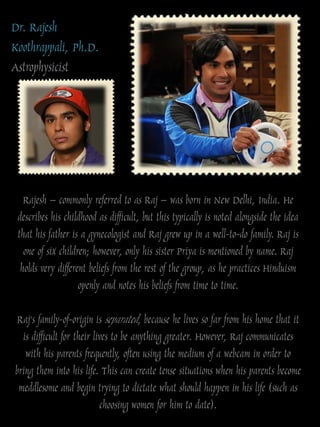
Dr. Rajesh
Koothrappali, Ph.D.
Astrophysicist


   Rajesh – commonly referred to as Raj – was born in New Delhi, India. He
 describes his childhood as difficult, but this typically is noted alongside the idea
 that his father is a gynecologist and Raj grew up in a well-to-do family. Raj is
   one of six children; however, only his sister Priya is mentioned by name. Raj
  holds very different beliefs from the rest of the group, as he practices Hinduism
                    openly and notes his beliefs from time to time.

 Raj‟s family-of-origin is separated, because he lives so far from his home that it
  is difficult for their lives to be anything greater. However, Raj communicates
   with his parents frequently, often using the medium of a webcam in order to
bring them into his life. This can create tense situations when his parents become
 meddlesome and begin trying to dictate what should happen in his life (such as
                           choosing women for him to date).
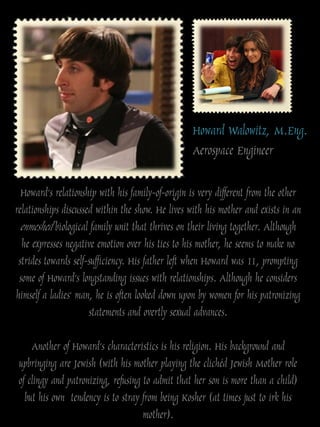
Howard Walowitz, M.Eng.
                                                  Aerospace Engineer

  Howard‟s relationship with his family-of-origin is very different from the other
relationships discussed within the show. He lives with his mother and exists in an
  enmeshed biological family unit that thrives on their living together. Although
  he expresses negative emotion over his ties to his mother, he seems to make no
 strides towards self-sufficiency. His father left when Howard was 11, prompting
 some of Howard‟s longstanding issues with relationships. Although he considers
himself a ladies' man, he is often looked down upon by women for his patronizing
                      statements and overtly sexual advances.

     Another of Howard‟s characteristics is his religion. His background and
 upbringing are Jewish (with his mother playing the clichéd Jewish Mother role
 of clingy and patronizing, refusing to admit that her son is more than a child)
   but his own tendency is to stray from being Kosher (at times just to irk his
                                     mother).
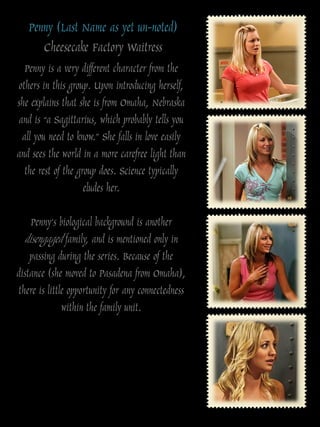
Penny (Last Name as yet un-noted)
      Cheesecake Factory Waitress
  Penny is a very different character from the
others in this group. Upon introducing herself,
she explains that she is from Omaha, Nebraska
and is “a Sagittarius, which probably tells you
 all you need to know.” She falls in love easily
and sees the world in a more carefree light than
  the rest of the group does. Science typically
                    eludes her.

    Penny‟s biological background is another
  disengaged family, and is mentioned only in
    passing during the series. Because of the
distance (she moved to Pasadena from Omaha),
there is little opportunity for any connectedness
              within the family unit.
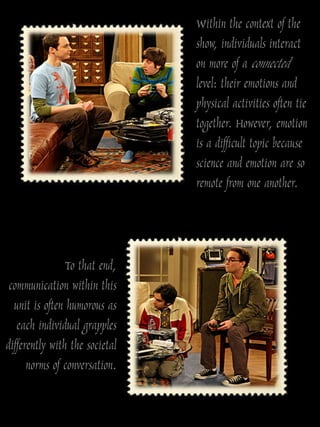
Within the context of the
                                show, individuals interact
                                on more of a connected
                                level: their emotions and
                                physical activities often tie
                                together. However, emotion
                                is a difficult topic because
                                science and emotion are so
                                remote from one another.


                To that end,
 communication within this
  unit is often humorous as
   each individual grapples
differently with the societal
      norms of conversation.
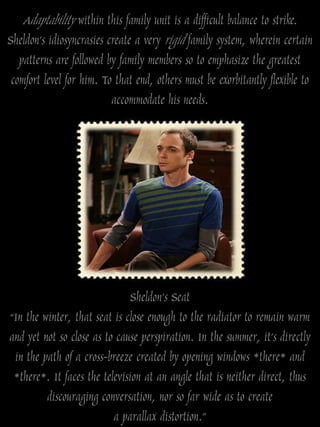
Adaptability within this family unit is a difficult balance to strike.
Sheldon‟s idiosyncrasies create a very rigid family system, wherein certain
  patterns are followed by family members so to emphasize the greatest
comfort level for him. To that end, others must be exorbitantly flexible to
                         accommodate his needs.


                              Sheldon’s Seat
“In the winter, that seat is close enough to the radiator to remain warm
and yet not so close as to cause perspiration. In the summer, it’s directly
 in the path of a cross-breeze created by opening windows *there* and
 *there*. It faces the television at an angle that is neither direct, thus
         discouraging conversation, nor so far wide as to create
                          a parallax distortion.”
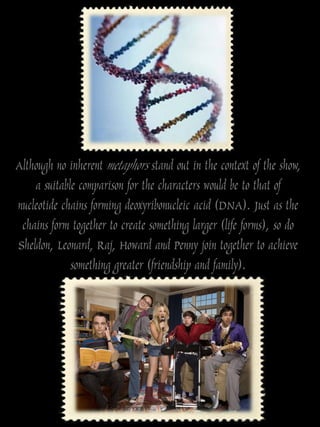
Although no inherent metaphors stand out in the context of the show,
    a suitable comparison for the characters would be to that of
nucleotide chains forming deoxyribonucleic acid (DNA). Just as the
 chains form together to create something larger (life forms), so do
Sheldon, Leonard, Raj, Howard and Penny join together to achieve
             something greater (friendship and family).
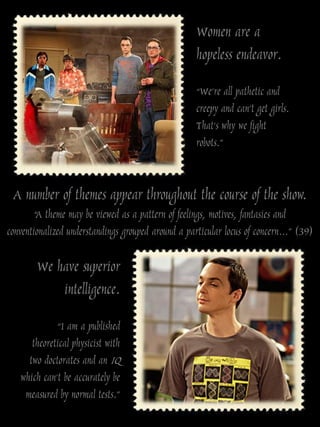
Women are a
                                                   hopeless endeavor.
                                                   “We're all pathetic and
                                                   creepy and can't get girls.
                                                   That's why we fight
                                                   robots.”


 A number of themes appear throughout the course of the show.
        “A theme may be viewed as a pattern of feelings, motives, fantasies and
conventionalized understandings grouped around a particular locus of concern…” (39)

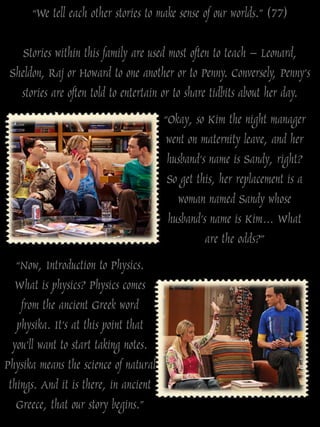
        We have superior
            intelligence.
             “I am a published
      theoretical physicist with
     two doctorates and an IQ
   which can't be accurately be
    measured by normal tests.”
“Within any system, the parts are so interrelated as
         to be dependent on each other for their functioning.”
                                (59)

             Within this dynamic, interdependence is key.


                              Sheldon depends on others for transportation


Howard and Raj are co-dependent for attention


                               Penny is depended upon for “real world” applications


  Penny depends on Leonard and Sheldon for
                  support
Dialectical tensions arise in any familial situation. Struggles
 over autonomy versus connection, closed- versus openness and
 predictability versus novelty all can create tense situations in
which members must carefully “negotiate and renegotiate what it
       means to be in a functioning relationship.” (75)


 Within this family unit, dialectical tensions often arise when
    Sheldon fails to understand a common nuance of socially
 acceptable behavior, and one of the others needs to explain it.

Leonard: “You know what, you’ve convinced me, maybe tonight
we should sneak in and shampoo her carpet.”
Sheldon: “You don’t think that crosses a line?”
Leonard: “Yes! For God’s sake, Sheldon, do I have to hold up a
sarcasm sign every time I open my mouth?”
“We tell each other stories to make sense of our worlds.” (77)

    Stories within this family are used most often to teach – Leonard,
 Sheldon, Raj or Howard to one another or to Penny. Conversely, Penny‟s
   stories are often told to entertain or to share tidbits about her day.
                                       “Okay, so Kim the night manager
                                        went on maternity leave, and her
                                        husband’s name is Sandy, right?
                                        So get this, her replacement is a
                                          woman named Sandy whose
                                        husband’s name is Kim… What
                                                 are the odds?”
   “Now, Introduction to Physics.
  What is physics? Physics comes
    from the ancient Greek word
   physika. It’s at this point that
  you’ll want to start taking notes.
Physika means the science of natural
 things. And it is there, in ancient
   Greece, that our story begins.”
“And now, as promised, the tangent.
  „Sheldon and the Hell Hound,‟ or
    „How I Lost My Hot Dogs.‟”
Communication Patterns emerge as a “shared understanding of what
communication means and what kinds of communication are appropriate in
                      various situations.” (85)


      “[Giving birthday gifts] is a non-optional social convention.”


     “I‟m at a loss. If you like, you can review my daily log of social
          interactions and see if there‟s a blunder I overlooked.”
“What exactly does that
                                           expression mean, „friends with
                                           benefits‟? Does he provide her
                                              with health insurance?”


“I have something to announce, but
out of respect for convention, I will
 wait for you to finish your current
conversation. What are you talking
               about?”


                                        “I assume you‟re not referring to
                                        digestive regularity? Because I‟ve
                                        come to learn that such inquiries
                                        are inappropriate.”
“Secret keeping is a complicated
                                       endeavor. One has to be
                                       concerned not only about what
                                       one says, but about facial
                                       expression, autonomic reflexes…
                                       when I try to deceive, I myself
                                       have more nervous tics than a
                                       lyme disease research facility.”

  “Secrets involve information that is purposefully hidden or concealed
                 by one or more family members.” (91)


Sheldon: “If this is about the
night the heat went out, there‟s
nothing to be embarrassed
about.”
Raj: “It‟s not about that.”
Howard: “And we agreed to
never speak of [that] again.”
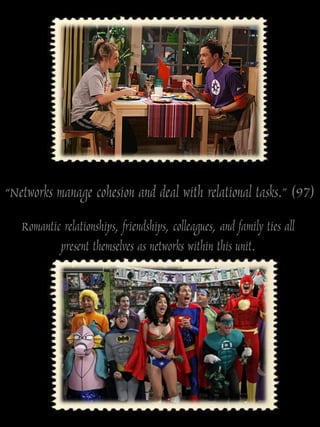
“Networks manage cohesion and deal with relational tasks.” (97)
   Romantic relationships, friendships, colleagues, and family ties all
           present themselves as networks within this unit.
Penny: “Yeah, [his mother] wants me to take him
           shopping for sheets and towels.”
          Leonard: “I was going to do that.”
       Penny: “Oh, well, then you, you do it.”
 Leonard: “No, I don‟t want to do it. You can do it.”
     Penny: “Okay, you can take him for shoes.”
         Leonard: “I just took him for shoes.”
Penny: “Well, all I know is he says they hurt his feet.”
Leonard: “Fine. I‟ll take him for shoes next Saturday.”
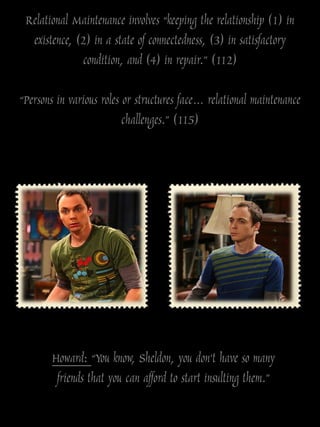
Relational Maintenance involves “keeping the relationship (1) in
  existence, (2) in a state of connectedness, (3) in satisfactory
              condition, and (4) in repair.” (112)

“Persons in various roles or structures face… relational maintenance
                          challenges.” (115)


       Howard: “You know, Sheldon, you don‟t have so many
        friends that you can afford to start insulting them.”
“Rituals are not just pleasurable routine
 events; rather, rituals serve central ongoing
maintenance and relational functions.” (120)
“What am I supposed to do, eat French toast on a
Monday? Now, that would be impossible.”


“…let‟s go over the morning schedule. I use the
bathroom from 7 to 7:20 - plan your ablutions and
bodily functions accordingly. “


“You can‟t go out, it‟s Halo night.”


“Every Saturday since we have lived in this
apartment, I have awakened at 6:15, poured myself a
bowl of cereal, added a quarter cup of 2% milk, sat
on this end of this couch, turned on BBC America
and watched Doctor Who.”
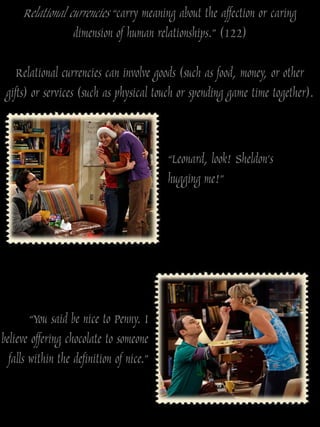
Relational currencies “carry meaning about the affection or caring
                   dimension of human relationships.” (122)

    Relational currencies can involve goods (such as food, money, or other
 gifts) or services (such as physical touch or spending game time together).


                                          “Leonard, look! Sheldon‟s
                                          hugging me!”


        “You said be nice to Penny. I
believe offering chocolate to someone
  falls within the definition of nice.”
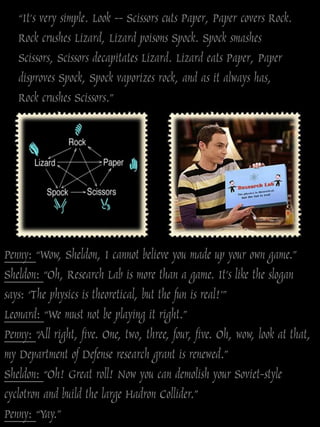
“It's very simple. Look -- Scissors cuts Paper, Paper covers Rock.
   Rock crushes Lizard, Lizard poisons Spock. Spock smashes
   Scissors, Scissors decapitates Lizard. Lizard eats Paper, Paper
   disproves Spock, Spock vaporizes rock, and as it always has,
   Rock crushes Scissors.”


Penny: “Wow, Sheldon, I cannot believe you made up your own game.”
Sheldon: “Oh, Research Lab is more than a game. It‟s like the slogan
says: „The physics is theoretical, but the fun is real!‟”
Leonard: “We must not be playing it right.”
Penny: “All right, five. One, two, three, four, five. Oh, wow, look at that,
my Department of Defense research grant is renewed.”
Sheldon: “Oh! Great roll! Now you can demolish your Soviet-style
cyclotron and build the large Hadron Collider.”
Penny: “Yay.”
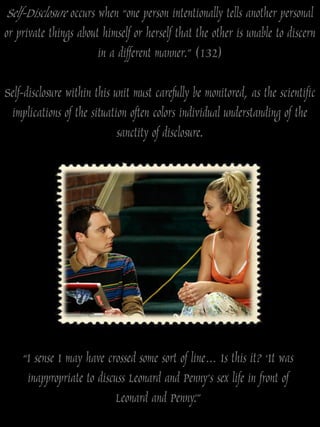
Self-Disclosure occurs when “one person intentionally tells another personal
or private things about himself or herself that the other is unable to discern
                       in a different manner.” (132)

Self-disclosure within this unit must carefully be monitored, as the scientific
 implications of the situation often colors individual understanding of the
                             sanctity of disclosure.


    “I sense I may have crossed some sort of line… Is this it? „It was
     inappropriate to discuss Leonard and Penny‟s sex life in front of
                          Leonard and Penny.‟”
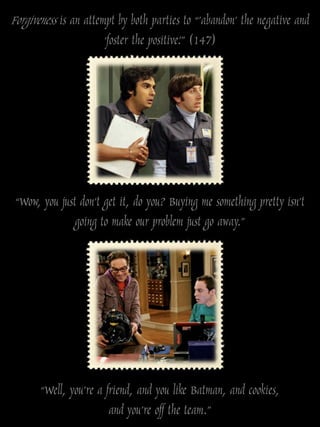
Forgiveness is an attempt by both parties to “‟abandon‟ the negative and
                      „foster the positive.‟” (147)


 “Wow, you just don‟t get it, do you? Buying me something pretty isn‟t
               going to make our problem just go away.”


       “Well, you‟re a friend, and you like Batman, and cookies,
                        and you‟re off the team.”
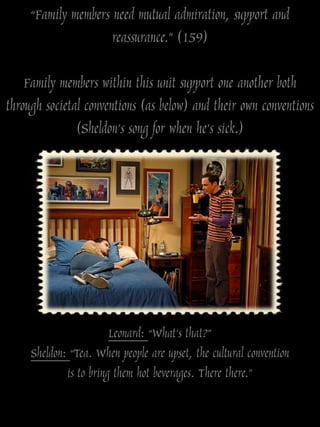
“Family members need mutual admiration, support and
                     reassurance.” (159)

    Family members within this unit support one another both
through societal conventions (as below) and their own conventions
               (Sheldon‟s song for when he‟s sick.)


                        Leonard: “What‟s that?”
     Sheldon: “Tea. When people are upset, the cultural convention
             is to bring them hot beverages. There there.”
Soft Kitty
                   Warm Kitty
                   Little ball of fur


    Happy Kitty
    Sleepy Kitty
Purr, Purr, Purr
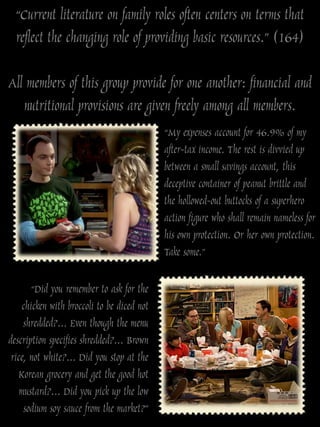
“Current literature on family roles often centers on terms that
  reflect the changing role of providing basic resources.” (164)

All members of this group provide for one another: financial and
   nutritional provisions are given freely among all members.
                                            “My expenses account for 46.9% of my
                                            after-tax income. The rest is divvied up
                                            between a small savings account, this
                                            deceptive container of peanut brittle and
                                            the hollowed-out buttocks of a superhero
                                            action figure who shall remain nameless for
                                            his own protection. Or her own protection.
                                            Take some.”

       “Did you remember to ask for the
    chicken with broccoli to be diced not
     shredded?... Even though the menu
description specifies shredded?... Brown
 rice, not white?... Did you stop at the
   Korean grocery and get the good hot
    mustard?... Did you pick up the low
     sodium soy sauce from the market?”
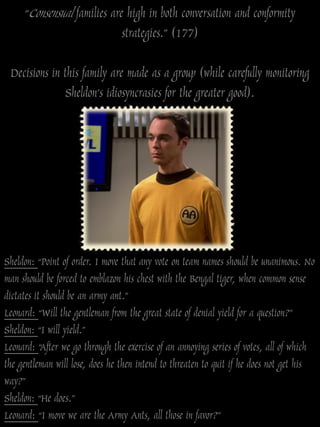
“Consensual families are high in both conversation and conformity
                             strategies.” (177)

 Decisions in this family are made as a group (while carefully monitoring
               Sheldon‟s idiosyncrasies for the greater good).


Sheldon: “Point of order. I move that any vote on team names should be unanimous. No
man should be forced to emblazon his chest with the Bengal tiger, when common sense
dictates it should be an army ant.”
Leonard: “Will the gentleman from the great state of denial yield for a question?”
Sheldon: “I will yield.”
Leonard: “After we go through the exercise of an annoying series of votes, all of which
the gentleman will lose, does he then intend to threaten to quit if he does not get his
way?”
Sheldon: “He does.”
Leonard: “I move we are the Army Ants, all those in favor?”
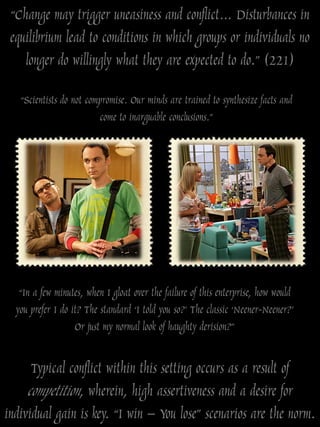
“Change may trigger uneasiness and conflict… Disturbances in
 equilibrium lead to conditions in which groups or individuals no
    longer do willingly what they are expected to do.” (221)

   “Scientists do not compromise. Our minds are trained to synthesize facts and
                         come to inarguable conclusions.”


   “In a few minutes, when I gloat over the failure of this enterprise, how would
  you prefer I do it? The standard „I told you so?‟ The classic „Neener-Neener?‟
                   Or just my normal look of haughty derision?”

      Typical conflict within this setting occurs as a result of
     competition, wherein, high assertiveness and a desire for
individual gain is key. “I win – You lose” scenarios are the norm.
Another idiosyncrasy of Sheldon‟s is his aversion to conflict. Although he
can handle “good natured ribbing,” a shouting match typically reduces him
          to passive-aggressive attempts to dispel the situation.
                                               Leonard: “Are you listening to yourself?
                                               Do you know how childish you sound
                                               right now?”
                                               Penny: “Oh, now I‟m a child? Well, at
                                               least I‟m not an idiot anymore!”
                                               Leonard: “The two aren‟t mutually
                                               exclusive!”
                                               Penny: “Oh, you are such a… What the
                                               hell is he doing?”
                                               Leonard: “He‟s drowning us out. He
                                               doesn‟t like fighting.”
“Stop it, both of you! All this fighting, I
   might as well be back with my parents!
       „Damn it, George, I told you if you
 didn‟t quit drinkin‟ I‟d leave you!‟ „Well,
 I guess that makes you a liar, ‟cause I‟m
 drunk as hell and you‟re still here!‟ „Stop
 yelling! You‟re making Sheldon cry!‟ „I‟ll
tell you what‟s making Sheldon cry! That
            I let you name him Sheldon!‟”
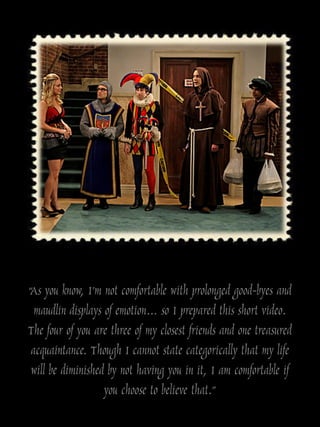
“As you know, I‟m not comfortable with prolonged good-byes and
  maudlin displays of emotion… so I prepared this short video.
The four of you are three of my closest friends and one treasured
 acquaintance. Though I cannot state categorically that my life
 will be diminished by not having you in it, I am comfortable if
                   you choose to believe that.”
BIBLIOGRAPHY

Textual References:

Galvin, K. M., Brommel, B. J., & Bylund, C. L. (1986).
         Family communication: cohesion and change (7th
         ed.). Glenview, Ill. : Scott, Foresman.

Series Quotations:

Veloso, B. (n.d.). Big Bang Theory Transcripts. Big Bang
          Theory Transcripts. Retrieved April 7, 2011, from
          http://bigbangtrans.wordpress.com/

Images:

Google Images. (n.d.). Google Images. Retrieved April 7,
         2011, from http://images.google.com

Gosbee_332_FamilyCollage

  • 1.
    Our whole universewas in a hot, dense state; then more than fourteen billion years ago expansion started – wait - The earth began to Cool, the autotropes began to drool, Neanderthals developed tools; we built a wall (we built the pyramids)! Math, science, history; unraveling the mystery that all started with the big bang! Cool, the autotropes began to drool, Neanderthals developed tools; we built a wall (we built the pyramids)! Math, science, history; unraveling the mystery that all started with the big bang! A Study of Relationships and Communication Within a Self-Selected Family Scenario By Serena Gosbee Based on The Big Bang Theory AChuck Lorre television program Seasons One through Three Our whole universe was in a hot, dense state; then more than fourteen billion years ago expansion started – wait - The earth began to
  • 2.
    “A family maybe viewed more broadly as a group of people with a past history, a present reality and a future expectation of interconnected mutually influencing relationships.” (5)
  • 3.
    More succinctly, familiesare “networks of people who share their lives over long periods of time bound by ties of marriage, blood, law or commitment, legal or otherwise, who consider themselves as a family and who share a significant history and anticipated future of functioning in a family relationship.” (p. 6) Family units need not be constructed of biologically similar members. Because there is “no single, widely agreed-upon definition of the term „family,‟” ( 3) it is possible to state that the a family unit can be constructed by a group of individuals who choose to interact with one another, given an absence of biological family members in their current situation. Note: The text opens with two dedications which specifically reference friends as “family.”
  • 4.
    The individuals withinThe Big Bang Theory interact and communicate with one another in the context of a family environment. Although they are not related by blood; their activities, mannerisms, and shared history/future create an environment similar to a family bond. Each member of this “family” comes from a biological unit of their own, but their blood relatives create situations in which each respective individual feels uncomfortable and therefore is required to reach out and build relationships of their own to create a “family.”
  • 5.
    Dr. Sheldon Cooper,B.S., M.S., M.A., Ph.D., Sc.D. Theoretical Physicist As a child, Sheldon‟s home life was remarkably difficult. He moved through his education at a rapid pace (graduating from high school after completing the fifth grade, receiving his Bachelor‟s at fourteen, his first Doctorate at sixteen and his second at age twenty.) His biological family consists of his only living grandparent “Memaw,” to whom Sheldon is very close; his mother Mary (his father George being deceased), an older brother named George Junior and a twin sister named Missy. Mary‟s strong Protestant convictions are in sharp contrast to Sheldon‟s scientific fervor, which leads to the only point of contention between the two who are otherwise very close. Sheldon‟s relationship with his family-of-origin is disengaged, wherein the individuals lead separate lives both emotionally and physically. This decision was largely made by his family as they struggled with Sheldon‟s overwhelmingly scientific mind. With this in mind, it should be noted that Sheldon and his mother do talk regularly.
  • 6.
    Dr. Leonard Hofstadter,Ph.D. Experimental Physicist Much like Sheldon, Leonard experienced a difficult childhood because of science. His biological family consists of individuals who followed scientific paths. His mother, Dr. Beverly Hofstadter, majored in psychology and neuroscience. As such, she has a very cold demeanor and expresses no warmth at the concept of motherhood – often going so far as to point out many of Leonard‟s “shortcomings.” His father is noted as an anthropologist, although otherwise goes largely unmentioned. His brother Michael is a professor of law. Relationships within this biological unit are tense and strained because of the strong scientific convictions of all members involved. Leonard‟s relationship with his family-of-origin is also disengaged, because the members exist separate from one another and interact only as necessary. However, this decision was largely Leonard‟s, as he holds so much frustration for his stressful childhood.
  • 7.
    Dr. Rajesh Koothrappali, Ph.D. Astrophysicist Rajesh – commonly referred to as Raj – was born in New Delhi, India. He describes his childhood as difficult, but this typically is noted alongside the idea that his father is a gynecologist and Raj grew up in a well-to-do family. Raj is one of six children; however, only his sister Priya is mentioned by name. Raj holds very different beliefs from the rest of the group, as he practices Hinduism openly and notes his beliefs from time to time. Raj‟s family-of-origin is separated, because he lives so far from his home that it is difficult for their lives to be anything greater. However, Raj communicates with his parents frequently, often using the medium of a webcam in order to bring them into his life. This can create tense situations when his parents become meddlesome and begin trying to dictate what should happen in his life (such as choosing women for him to date).
  • 8.
    Howard Walowitz, M.Eng. Aerospace Engineer Howard‟s relationship with his family-of-origin is very different from the other relationships discussed within the show. He lives with his mother and exists in an enmeshed biological family unit that thrives on their living together. Although he expresses negative emotion over his ties to his mother, he seems to make no strides towards self-sufficiency. His father left when Howard was 11, prompting some of Howard‟s longstanding issues with relationships. Although he considers himself a ladies' man, he is often looked down upon by women for his patronizing statements and overtly sexual advances. Another of Howard‟s characteristics is his religion. His background and upbringing are Jewish (with his mother playing the clichéd Jewish Mother role of clingy and patronizing, refusing to admit that her son is more than a child) but his own tendency is to stray from being Kosher (at times just to irk his mother).
  • 9.
    Penny (Last Nameas yet un-noted) Cheesecake Factory Waitress Penny is a very different character from the others in this group. Upon introducing herself, she explains that she is from Omaha, Nebraska and is “a Sagittarius, which probably tells you all you need to know.” She falls in love easily and sees the world in a more carefree light than the rest of the group does. Science typically eludes her. Penny‟s biological background is another disengaged family, and is mentioned only in passing during the series. Because of the distance (she moved to Pasadena from Omaha), there is little opportunity for any connectedness within the family unit.
  • 10.
    Within the contextof the show, individuals interact on more of a connected level: their emotions and physical activities often tie together. However, emotion is a difficult topic because science and emotion are so remote from one another. To that end, communication within this unit is often humorous as each individual grapples differently with the societal norms of conversation.
  • 11.
    Adaptability within thisfamily unit is a difficult balance to strike. Sheldon‟s idiosyncrasies create a very rigid family system, wherein certain patterns are followed by family members so to emphasize the greatest comfort level for him. To that end, others must be exorbitantly flexible to accommodate his needs. Sheldon’s Seat “In the winter, that seat is close enough to the radiator to remain warm and yet not so close as to cause perspiration. In the summer, it’s directly in the path of a cross-breeze created by opening windows *there* and *there*. It faces the television at an angle that is neither direct, thus discouraging conversation, nor so far wide as to create a parallax distortion.”
  • 12.
    Although no inherentmetaphors stand out in the context of the show, a suitable comparison for the characters would be to that of nucleotide chains forming deoxyribonucleic acid (DNA). Just as the chains form together to create something larger (life forms), so do Sheldon, Leonard, Raj, Howard and Penny join together to achieve something greater (friendship and family).
  • 13.
    Women are a hopeless endeavor. “We're all pathetic and creepy and can't get girls. That's why we fight robots.” A number of themes appear throughout the course of the show. “A theme may be viewed as a pattern of feelings, motives, fantasies and conventionalized understandings grouped around a particular locus of concern…” (39) We have superior intelligence. “I am a published theoretical physicist with two doctorates and an IQ which can't be accurately be measured by normal tests.”
  • 14.
    “Within any system,the parts are so interrelated as to be dependent on each other for their functioning.” (59) Within this dynamic, interdependence is key. Sheldon depends on others for transportation Howard and Raj are co-dependent for attention Penny is depended upon for “real world” applications Penny depends on Leonard and Sheldon for support
  • 15.
    Dialectical tensions arisein any familial situation. Struggles over autonomy versus connection, closed- versus openness and predictability versus novelty all can create tense situations in which members must carefully “negotiate and renegotiate what it means to be in a functioning relationship.” (75) Within this family unit, dialectical tensions often arise when Sheldon fails to understand a common nuance of socially acceptable behavior, and one of the others needs to explain it. Leonard: “You know what, you’ve convinced me, maybe tonight we should sneak in and shampoo her carpet.” Sheldon: “You don’t think that crosses a line?” Leonard: “Yes! For God’s sake, Sheldon, do I have to hold up a sarcasm sign every time I open my mouth?”
  • 16.
    “We tell eachother stories to make sense of our worlds.” (77) Stories within this family are used most often to teach – Leonard, Sheldon, Raj or Howard to one another or to Penny. Conversely, Penny‟s stories are often told to entertain or to share tidbits about her day. “Okay, so Kim the night manager went on maternity leave, and her husband’s name is Sandy, right? So get this, her replacement is a woman named Sandy whose husband’s name is Kim… What are the odds?” “Now, Introduction to Physics. What is physics? Physics comes from the ancient Greek word physika. It’s at this point that you’ll want to start taking notes. Physika means the science of natural things. And it is there, in ancient Greece, that our story begins.”
  • 17.
    “And now, aspromised, the tangent. „Sheldon and the Hell Hound,‟ or „How I Lost My Hot Dogs.‟”
  • 18.
    Communication Patterns emergeas a “shared understanding of what communication means and what kinds of communication are appropriate in various situations.” (85) “[Giving birthday gifts] is a non-optional social convention.” “I‟m at a loss. If you like, you can review my daily log of social interactions and see if there‟s a blunder I overlooked.”
  • 19.
    “What exactly doesthat expression mean, „friends with benefits‟? Does he provide her with health insurance?” “I have something to announce, but out of respect for convention, I will wait for you to finish your current conversation. What are you talking about?” “I assume you‟re not referring to digestive regularity? Because I‟ve come to learn that such inquiries are inappropriate.”
  • 20.
    “Secret keeping isa complicated endeavor. One has to be concerned not only about what one says, but about facial expression, autonomic reflexes… when I try to deceive, I myself have more nervous tics than a lyme disease research facility.” “Secrets involve information that is purposefully hidden or concealed by one or more family members.” (91) Sheldon: “If this is about the night the heat went out, there‟s nothing to be embarrassed about.” Raj: “It‟s not about that.” Howard: “And we agreed to never speak of [that] again.”
  • 21.
    “Networks manage cohesionand deal with relational tasks.” (97) Romantic relationships, friendships, colleagues, and family ties all present themselves as networks within this unit.
  • 22.
    Penny: “Yeah, [hismother] wants me to take him shopping for sheets and towels.” Leonard: “I was going to do that.” Penny: “Oh, well, then you, you do it.” Leonard: “No, I don‟t want to do it. You can do it.” Penny: “Okay, you can take him for shoes.” Leonard: “I just took him for shoes.” Penny: “Well, all I know is he says they hurt his feet.” Leonard: “Fine. I‟ll take him for shoes next Saturday.”
  • 23.
    Relational Maintenance involves“keeping the relationship (1) in existence, (2) in a state of connectedness, (3) in satisfactory condition, and (4) in repair.” (112) “Persons in various roles or structures face… relational maintenance challenges.” (115) Howard: “You know, Sheldon, you don‟t have so many friends that you can afford to start insulting them.”
  • 24.
    “Rituals are notjust pleasurable routine events; rather, rituals serve central ongoing maintenance and relational functions.” (120) “What am I supposed to do, eat French toast on a Monday? Now, that would be impossible.” “…let‟s go over the morning schedule. I use the bathroom from 7 to 7:20 - plan your ablutions and bodily functions accordingly. “ “You can‟t go out, it‟s Halo night.” “Every Saturday since we have lived in this apartment, I have awakened at 6:15, poured myself a bowl of cereal, added a quarter cup of 2% milk, sat on this end of this couch, turned on BBC America and watched Doctor Who.”
  • 25.
    Relational currencies “carrymeaning about the affection or caring dimension of human relationships.” (122) Relational currencies can involve goods (such as food, money, or other gifts) or services (such as physical touch or spending game time together). “Leonard, look! Sheldon‟s hugging me!” “You said be nice to Penny. I believe offering chocolate to someone falls within the definition of nice.”
  • 26.
    “It's very simple.Look -- Scissors cuts Paper, Paper covers Rock. Rock crushes Lizard, Lizard poisons Spock. Spock smashes Scissors, Scissors decapitates Lizard. Lizard eats Paper, Paper disproves Spock, Spock vaporizes rock, and as it always has, Rock crushes Scissors.” Penny: “Wow, Sheldon, I cannot believe you made up your own game.” Sheldon: “Oh, Research Lab is more than a game. It‟s like the slogan says: „The physics is theoretical, but the fun is real!‟” Leonard: “We must not be playing it right.” Penny: “All right, five. One, two, three, four, five. Oh, wow, look at that, my Department of Defense research grant is renewed.” Sheldon: “Oh! Great roll! Now you can demolish your Soviet-style cyclotron and build the large Hadron Collider.” Penny: “Yay.”
  • 27.
    Self-Disclosure occurs when“one person intentionally tells another personal or private things about himself or herself that the other is unable to discern in a different manner.” (132) Self-disclosure within this unit must carefully be monitored, as the scientific implications of the situation often colors individual understanding of the sanctity of disclosure. “I sense I may have crossed some sort of line… Is this it? „It was inappropriate to discuss Leonard and Penny‟s sex life in front of Leonard and Penny.‟”
  • 28.
    Forgiveness is anattempt by both parties to “‟abandon‟ the negative and „foster the positive.‟” (147) “Wow, you just don‟t get it, do you? Buying me something pretty isn‟t going to make our problem just go away.” “Well, you‟re a friend, and you like Batman, and cookies, and you‟re off the team.”
  • 29.
    “Family members needmutual admiration, support and reassurance.” (159) Family members within this unit support one another both through societal conventions (as below) and their own conventions (Sheldon‟s song for when he‟s sick.) Leonard: “What‟s that?” Sheldon: “Tea. When people are upset, the cultural convention is to bring them hot beverages. There there.”
  • 30.
    Soft Kitty Warm Kitty Little ball of fur Happy Kitty Sleepy Kitty Purr, Purr, Purr
  • 31.
    “Current literature onfamily roles often centers on terms that reflect the changing role of providing basic resources.” (164) All members of this group provide for one another: financial and nutritional provisions are given freely among all members. “My expenses account for 46.9% of my after-tax income. The rest is divvied up between a small savings account, this deceptive container of peanut brittle and the hollowed-out buttocks of a superhero action figure who shall remain nameless for his own protection. Or her own protection. Take some.” “Did you remember to ask for the chicken with broccoli to be diced not shredded?... Even though the menu description specifies shredded?... Brown rice, not white?... Did you stop at the Korean grocery and get the good hot mustard?... Did you pick up the low sodium soy sauce from the market?”
  • 32.
    “Consensual families arehigh in both conversation and conformity strategies.” (177) Decisions in this family are made as a group (while carefully monitoring Sheldon‟s idiosyncrasies for the greater good). Sheldon: “Point of order. I move that any vote on team names should be unanimous. No man should be forced to emblazon his chest with the Bengal tiger, when common sense dictates it should be an army ant.” Leonard: “Will the gentleman from the great state of denial yield for a question?” Sheldon: “I will yield.” Leonard: “After we go through the exercise of an annoying series of votes, all of which the gentleman will lose, does he then intend to threaten to quit if he does not get his way?” Sheldon: “He does.” Leonard: “I move we are the Army Ants, all those in favor?”
  • 33.
    “Change may triggeruneasiness and conflict… Disturbances in equilibrium lead to conditions in which groups or individuals no longer do willingly what they are expected to do.” (221) “Scientists do not compromise. Our minds are trained to synthesize facts and come to inarguable conclusions.” “In a few minutes, when I gloat over the failure of this enterprise, how would you prefer I do it? The standard „I told you so?‟ The classic „Neener-Neener?‟ Or just my normal look of haughty derision?” Typical conflict within this setting occurs as a result of competition, wherein, high assertiveness and a desire for individual gain is key. “I win – You lose” scenarios are the norm.
  • 34.
    Another idiosyncrasy ofSheldon‟s is his aversion to conflict. Although he can handle “good natured ribbing,” a shouting match typically reduces him to passive-aggressive attempts to dispel the situation. Leonard: “Are you listening to yourself? Do you know how childish you sound right now?” Penny: “Oh, now I‟m a child? Well, at least I‟m not an idiot anymore!” Leonard: “The two aren‟t mutually exclusive!” Penny: “Oh, you are such a… What the hell is he doing?” Leonard: “He‟s drowning us out. He doesn‟t like fighting.” “Stop it, both of you! All this fighting, I might as well be back with my parents! „Damn it, George, I told you if you didn‟t quit drinkin‟ I‟d leave you!‟ „Well, I guess that makes you a liar, ‟cause I‟m drunk as hell and you‟re still here!‟ „Stop yelling! You‟re making Sheldon cry!‟ „I‟ll tell you what‟s making Sheldon cry! That I let you name him Sheldon!‟”
  • 35.
    “As you know,I‟m not comfortable with prolonged good-byes and maudlin displays of emotion… so I prepared this short video. The four of you are three of my closest friends and one treasured acquaintance. Though I cannot state categorically that my life will be diminished by not having you in it, I am comfortable if you choose to believe that.”
  • 36.
    BIBLIOGRAPHY Textual References: Galvin, K.M., Brommel, B. J., & Bylund, C. L. (1986). Family communication: cohesion and change (7th ed.). Glenview, Ill. : Scott, Foresman. Series Quotations: Veloso, B. (n.d.). Big Bang Theory Transcripts. Big Bang Theory Transcripts. Retrieved April 7, 2011, from http://bigbangtrans.wordpress.com/ Images: Google Images. (n.d.). Google Images. Retrieved April 7, 2011, from http://images.google.com