1

        Cross-disciplinary challenges in
         Open Source Software (OSS)


       GoOpen 2010 conference attn/ Friprogsenteret
                   19-20 April 2010
                  Aker brygge, Oslo

            Reidar Conradi, Daniela S. Cruzes
    Department of Computer and Information Science (IDI)
                NTNU, NO-7491 Trondheim

      http://www.idi.ntnu.no/grupper/su/oss/goopen-rc-20apr10.ppt
               conradi@idi.ntnu.no, dcruzes@idi.ntnu.no


                                   20.04.2010


         X-discipllnarity in OSS; GoOpen, 20 Apr. 2010
2


                          Table of contents
    1. IDI and NTNU: who, what, …

    2. Software reuse and CBSE: the precursors

    3. The Open Source Software (OSS) phenomenon

    4. OSS selection: no formal classification, so situated

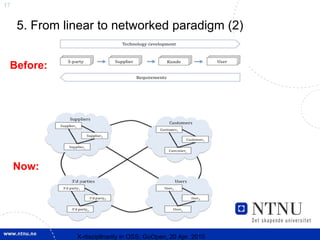
    5. OSS project work flow: from linear to networked

    6. OSS: leads to Open Innovation

    7. OSS summary on X-disciplinarity

                                           20.04.2010


                 X-discipllnarity in OSS; GoOpen, 20 Apr. 2010
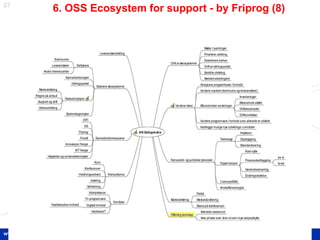
3


        1. IDI Department at NTNU
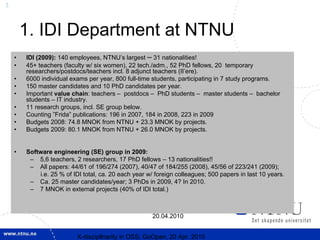
    •   IDI (2009): 140 employees, NTNU’s largest – 31 nationalities!
    •   45+ teachers (faculty w/ six women), 22 tech./adm., 52 PhD fellows, 20 temporary
        researchers/postdocs/teachers incl. 8 adjunct teachers (II’ere).
    •   6000 individual exams per year, 800 full-time students, participating in 7 study programs.
    •   150 master candidates and 10 PhD candidates per year.
    •   Important value chain: teachers – postdocs – PhD students – master students – bachelor
        students – IT industry.
    •   11 research groups, incl. SE group below.
    •   Counting ”Frida” publications: 196 in 2007, 184 in 2008, 223 in 2009
    •   Budgets 2008: 74.8 MNOK from NTNU + 23.3 MNOK by projects.
    •   Budgets 2009: 80.1 MNOK from NTNU + 26.0 MNOK by projects.


    •   Software engineering (SE) group in 2009:
         – 5,6 teachers, 2 researchers, 17 PhD fellows – 13 nationalities!!
         – All papers: 44/61 of 196/274 (2007), 40/47 of 184/255 (2008), 45/56 of 223/241 (2009);
            i.e. 25 % of IDI total, ca. 20 each year w/ foreign colleagues; 500 papers in last 10 years.
         – Ca. 25 master candidates/year; 3 PhDs in 2009, 4? In 2010.
         – 7 MNOK in external projects (40% of IDI total.)


                                                      20.04.2010


                           X-discipllnarity in OSS; GoOpen, 20 Apr. 2010
4


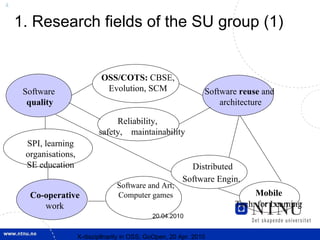
    1. Research fields of the SU group (1)


                              OSS/COTS: CBSE,
     Software                  Evolution, SCM                     Software reuse and
      quality                                                         architecture

                                  Reliability,
                             safety, maintainability
     SPI, learning
     organisations,
     SE education                                            Distributed
                                                           Software Engin.
                                   Software and Art;
      Co-operative                 Computer games                             Mobile
         work                                                            Tech. for Learning
                                                20.04.2010


                      X-discipllnarity in OSS; GoOpen, 20 Apr. 2010
5


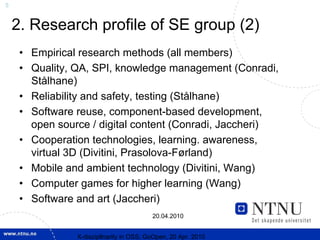
    2. Research profile of SE group (2)
     • Empirical research methods (all members)
     • Quality, QA, SPI, knowledge management (Conradi,
       Stålhane)
     • Reliability and safety, testing (Stålhane)
     • Software reuse, component-based development,
       open source / digital content (Conradi, Jaccheri)
     • Cooperation technologies, learning. awareness,
       virtual 3D (Divitini, Prasolova-Førland)
     • Mobile and ambient technology (Divitini, Wang)
     • Computer games for higher learning (Wang)
     • Software and art (Jaccheri)
                                          20.04.2010


                X-discipllnarity in OSS; GoOpen, 20 Apr. 2010
6


        2. Classic software reuse inside companies (1)

    •    Software reuse: assets - like class libraries in internal repositories
    •    Develop “for” reuse: make generalized assets / components
    •    Develop “with” reuse: CBSE, using these assets
    •    Advantages of CBSE, either with internal or external OTS components:
          –   Cheaper, earlier, better, … software
          –   Spread novel work practices & software architectures, leading to standardization
          –   Re-user communities for experience mgmt/support
          –   I.e. software development gets ”modernized”
    •    Mainly cross-disciplinary obstacles: price/licensing, ROI,
         (re)negotiate requirements, unclear responsibility, “not-invented-here”,
         company policies.
    •    Now OSS: massive global reuse - over half million software
         components.
                                                   20.04.2010


                         X-discipllnarity in OSS; GoOpen, 20 Apr. 2010
7


     3. The OSS phenomenon (1)
    • OSS: “software compliant with one of the licences of
      Free Software Foundation (1985) or Open Source
      Initiative (1998).
    • OSS recently: a benign “tsunami”; enabled by
      Internet and massive investments by companies.
    • Cross-disciplinary of “social computing” and normal
      SW development: distributed, peer reviews, iterative.
    • Based on launched OSS projects, each with an open
      community of involved persons.
    • Many licensing models: Strict GPL (contagious
      “copyleft”) vs. generous BSD (any after use is allowed).

                                          20.04.2010


                X-discipllnarity in OSS; GoOpen, 20 Apr. 2010
8


        3. The OSS phenomenon (2)
    • OSS: changing the whole paradigm of software
      development and associated economic patterns and
      interactions – by cooperative, distributed innovation.
    •   Norwegian software-intensive companies and public institutions
        must undergo this economic and cultural revolution:
        – novel Innovation Models: new products and services
        – novel Business Models: make money on these
    •   Need professional partnership communities to establish and
        evolve their needed software, itself being OSS.
    •   Move away from “unpredictable” volonteers working for free.
    •   OSS: adopted by private and public policy makers: e.g., IBM and
        Sun Microsystems, IKT-Norge, …, Skattedirektoratet, KS, …
    •   St.meld. 17 (2006/2007) by Norwegian Government recommends
        OSS and open standards.
    •   www.FriProg.no competence center. Also www.FriNett.no (NFR).
                                               20.04.2010


                     X-discipllnarity in OSS; GoOpen, 20 Apr. 2010
9


        3. OSS: origin and now (3)
    •   1650?: free flow of ideas begins in emerging scientific community.
    •   1967-1977: DoD/DARPA’s development of Arpanet / Internet TCP/IP
        protocols -- open and distributed work, anti-authoritarian “counter culture”.
    •   1978-85: Openness spreads via Univ.Berkeley’s adaptation of Unix, with
        built-in Internet protocols and generous BSD licenses with all source provided.
    •   1985: Free Software Foundation: by Richard Stallman from MIT AI Lab;
        ideological ”CopyLeft”-inspired licenses.
    •   1998: Open Software Initiative: by Eric Raymond from IT industry in US,
        pragmatic BSD-inspired licenses. ”The Cathedral and the Bazaar”:
    •   2000: FLOSS = FSF +OSI; IFIP WG2.13 uses OSS as common denominator.
    •   2005: Social computing and creative commons for knowledge work –
        standardized formats for “zero-cost” digital information, the world is ”flat”.
    •   2008: 1,5 billion Internet users, 3 billion w/ mobile phones.
    •   2009: Ex. Wikipedia: 55 mill. “gratis” personhours.

                                                 20.04.2010


                       X-discipllnarity in OSS; GoOpen, 20 Apr. 2010
10


         3. OSS facts and challenges (4)
     Facts:
     •   Ex. Over 50% of Norwegian companies use OSS to make new software, 16%
         are community members, 6% have themselves “gone open”.
         Ex. eZ has had 2.3 mill. downloads, over 100 plugins made by community.
         Ex. Adobe Acrobat similarly over 500 mill. downloads.
     •   OTS = COTS and OSS : many similarities, mostly used as black box.
     •   Over 30 portals with domain-specific COTS/OSS software.
     Three X-disciplinary Challenges:
     •   Situated selection of promising components, generated ontologies.
     •   New ways of cooperation and sharing: new work organization.
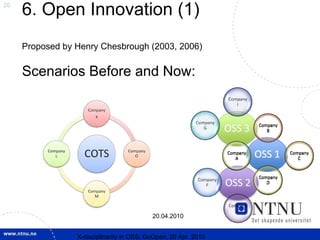
     •   Innovation model: combine N technologies into marketable product.
         & Business model: making money of this!
          –   Apache: open and shared source supported by a cooperative foundation (“IBM”); separate
              payable services.
          –   eZ: dual model with free previous version, payable current version plus services and support.


                                                       20.04.2010


                            X-discipllnarity in OSS; GoOpen, 20 Apr. 2010
11


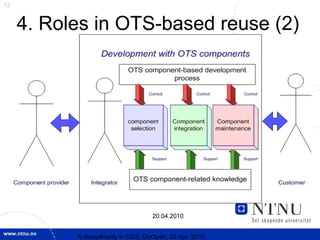
         4. “Ladder” of OSS roles (1)
     •   OSS (component) provider: Leads a “gone-open” software project, ex. Linus
         Thorvald w/ Linux
     •   OSS co-developer or participant: assists the provider in more technical work
         – the OSS “idea” of joint, altruistic work
     •   OSS advanced integrator: reports error reports and change requests for new
         features, sometimes changing the code.
     •   OSS integrator: makes new software system by re-using OSS
         software/components, makes use of OSS CASE tools (Eclipse, SVN) and
         techniques.
     •   OSS customer: specifies and finances new software, later published as OSS?
     •   OSS user: may download “free” (not open) binary software on a private
         computer, e.g. Acrobat.

     •   OSS skills: technical, commercial, organizational, creative, …
                                                 20.04.2010


                       X-discipllnarity in OSS; GoOpen, 20 Apr. 2010
12


     4. Roles in OTS-based reuse (2)


     •   From forthcoming paper by Jingyue Li et al., IEEE Software 2008


                                                 20.04.2010


                       X-discipllnarity in OSS; GoOpen, 20 Apr. 2010
13


          4.OSS selection by Integrator (3)
     1.   Elicit and formulate requirements, R.
     2.   Check if some colleagues have something to recommend?
     3.   Else: Seek OSS match for R.
     4.   Ex. there is a product P that solves 90% of your R now, plus 500++%
          you never thought of. What to do? Develop own P’ from scratch (6-24
          months), modify P, or just settle with P? – Or don’t even bother with
          an explicit R; just “fish” for something that might lead to interesting Ps.

     OSS component selection more general:
     1. Search after some Cs on the net that matches R, using e.g. Google.
     2. Evaluate the most relevant Cs – download hottest 4-6 candidates.
     3. Choose the most suitable C (“first fit”) – a risky decision with
        considerable time pressure, lack of info and uncertainties.
                                                20.04.2010


                      X-discipllnarity in OSS; GoOpen, 20 Apr. 2010
14


       4.Component classification (4)
     1. Next idea: annotate components with keywords (meta-data)
        according to a (formal) classification scheme or ontology. Four
        basic kinds of meta-data:
         1.   Functional attributes – try automate ontology build-up/evolution and annotation?
         2.   Quality attributes – uncertain and diverse info!
         3.   Platform attributes – simple in theory
         4.   Policy attributes – tricky?
     2. Apply semantic search tool with weights (web 2.0), a la Facebook.
     3. Sorry, does not work! – both practical and theoretical hinders.

     Rather “situated selection”:
     1. You will know about relevant Cs and own R-intentions in a gradual
        and mutual learning process. Renegotiate R? Reuse selection and
        classification experiences, use wikis? Later evolution of R and Cs?
                                                   20.04.2010


                         X-discipllnarity in OSS; GoOpen, 20 Apr. 2010
15


         4.OSS and ontologies (5)
     •   Ontologies: exciting field, but heavily oversold by AI and linguistics.
     •   Basic problem to have one agreed-upon ontology, due to different and
         irreconcilable world views [Bowker99]:
          – Ex. book as an IPR, information carrier, investment object, art, fuel, weapon, book
            shelf entry, slide projector fundament, …
          – Ex. Homosexuality as a (curable) “decease”, “democracy” in previous DDR, …
          – Ex. NIH medical taxonomy has 1.8 million terms – to be used consistently!
          – Ex. Misleading “tag“ classification of newspaper articles by journalists.
          – Ex. Management Quarterly recently refuses keywords on submitted papers.
     •   To avoid not finding some “textual” object: 1) Have automatically
         generated taxonomies; or 2) Let powerful search engines chew
         through all text in (software) components.
     •   In all this - better support and pragmatic experience needed.


                                                  20.04.2010


                        X-discipllnarity in OSS; GoOpen, 20 Apr. 2010
16


       5. SE project organization and OSS (1)
     Ex. Several process dimensions
     • BP: an organization’s Business Process (e.g. hospital activities), staffed with
        Users (e.g. nurses, doctors, patients, bureaucrats).
     • ISP: IS Process (e.g. patient journaling) as part of BP.
     • Responsible Customer hires SE team to provide new/revised software for its
        users in a SE Project (PA) context.
     • Project team has internal SE development process (Scrum, Waterfall, …),
        lead by a Project Manager with many software developers / OSS Integrators.
     • Incremental project execution: Coop. management and negotiation
        processes between BP/ISP and SE to (re)define R and implement these.

     New cooperation and participation processes by clusters of companies:
     • Integrator in PA finds relevant OSS middleware C-ab from Project PB and PC,
       and inversely. So organizations become (mutually) dependent on each other.
     • Many projects must renegotiate requirements to benefit from new OSS.
     • Companies must participate to influence further upgrades of relevant OSS.
                                                20.04.2010


                      X-discipllnarity in OSS; GoOpen, 20 Apr. 2010
17


     5. From linear to networked paradigm (2)


 Before:


     Now:


                                         20.04.2010


               X-discipllnarity in OSS; GoOpen, 20 Apr. 2010
18


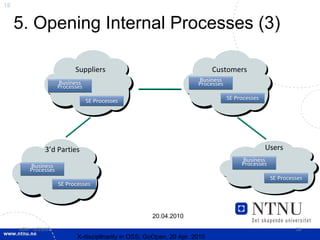
     5. Opening Internal Processes (3)

                           Suppliers                                        Customers
                     Business                                         Business 
                     Processes                                        Processes

                                 SE Processes                                     SE Processes


               3’d Parties                                                                       Users
                                                                                       Business 
         Business                                                                      Processes
         Processes
                                                                                                   SE Processes
                     SE Processes


                                                      20.04.2010

     VON ‐ 3/23/01                                                                                          18
                            X-discipllnarity in OSS; GoOpen, 20 Apr. 2010
19


     5. Networked development actors (4)

 Emerging network paradigm for OSS affects:
 • Long-term vs. short-term planning,
 • Cross-company cooperation: negotiation vs. dictate,
 • Control mechanisms: many risky parts,
 • (Open) Innovation: new combinations, spin-offs, …
 • Legal: IPRs and licensing,
 • Economical: business models,
 • Marketing: close to development,
 • …
 •   See [Ayala09] [Hauge2010] [Lindman09].
                                             20.04.2010


                   X-discipllnarity in OSS; GoOpen, 20 Apr. 2010
20
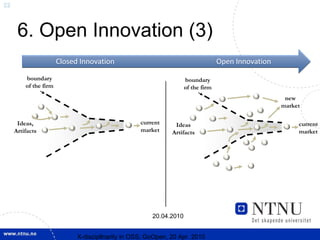
     6. Open Innovation (1)
     Proposed by Henry Chesbrough (2003, 2006)

     Scenarios Before and Now:


                                           20.04.2010


                 X-discipllnarity in OSS; GoOpen, 20 Apr. 2010
21


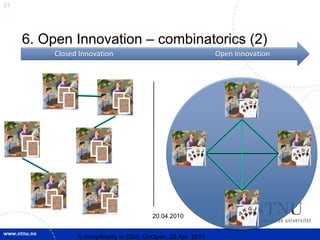
     6. Open Innovation – combinatorics (2)
          Closed Innovation                                     Open Innovation


                                          20.04.2010


                X-discipllnarity in OSS; GoOpen, 20 Apr. 2010
22


      6. Open Innovation (3)
                       Closed Innovation                                          Open Innovation

         boundary                                                   boundary
         of the firm                                                of the firm
                                                                                                     new
                                                                                                    market

      Ideas,                                       current     Ideas                                     current
     Artifacts                                     market     Artifacts                                  market


                                                       20.04.2010


                             X-discipllnarity in OSS; GoOpen, 20 Apr. 2010
23


       6. Novel Innovation Models (4)

     • Traditional innovation models: based on the “egoistic”
       protection of Intellectual Property, i.e. cannot capture
       value from OSS for companies. So your cards lie with
       “face down” and contents hidden, as a private and short-
       term sub-optimalization.
     • Novel innovation models leave your cards “face open” and
       contents acessible for everyone. This paradoxical altruism
       promotes maximum combinatorics and future innovation,
       by a public and long-term exchange for societies and
       companies to reap the full benefits of OSS:
     • The guidelines for revised development processes from
       “private investment” to “collectively action” hardly
       exist.                   20.04.2010


                X-discipllnarity in OSS; GoOpen, 20 Apr. 2010
24


     6. Novel Innovation Models (5)
     •   Several issues need to be addressed:
         – How to succeed in attracting co-developers when “going open”?
         – How can traditional (i.e. paid software development by software
           companies), coexist and even amplify the benefits for both the “old” and
           “new” work mode?
         – So rely less on classic OSS idealism, rather refine and commercialize more
           cooperative work modes.

     •   Learning ecosystem to systematize the (meta-) services that
         might be needed (by Friprog, next slide):
         –   How to establish such an ecosystem? Roles?
         –   How to build competence?
         –   How to offer legal or economic advise?
         –   How to make decisions about changes in old vs. new systems?
         –   How to build and maintain expert communities?
         –   How to manage experience bases (avoid the “white elephants”)?
         –   Practically: if (most of) the code is shared and “free”, where is the profit
             coming from?

                                              20.04.2010


                    X-discipllnarity in OSS; GoOpen, 20 Apr. 2010
25

          6. OSS Business Models (6)
     • In general, to enter in the OSS field, companies
       have to manage Intellectual Property (IP) differently
       and to innovate more:

                                                     Sale/
           Revenues                               divestiture
                                                                     New revenues
                                                   Spin-off

                                                   License

                              Own market         Own market
                               revenue            revenue
                 0
                                                 Internal and
                                                   external
                                Internal         development
                              development            costs           Cost and time savings
                                  costs                                 from leveraging
                                                                     external development

              Costs
                                               20.04.2010
                                                                                         [Chesbrough2006]
                     X-discipllnarity in OSS; GoOpen, 20 Apr. 2010
26


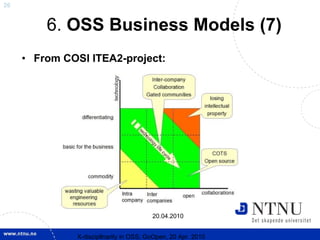
         6. OSS Business Models (7)
     • From COSI ITEA2-project:


                                         20.04.2010


               X-discipllnarity in OSS; GoOpen, 20 Apr. 2010
27
     6. OSS Ecosystem for support - by Friprog (8)


                                   20.04.2010


         X-discipllnarity in OSS; GoOpen, 20 Apr. 2010
28


       7. Future R&D and cooperation (1)

       How to succeed with OSS?

     • Experience to NTNU from industry-related research
        – What should we focus on in future research?
     • Experience to you from theory-driven research at NTNU
        – How to validate in practice?
     • Experience to NTNU about our education
        – What should students know about OSS?


                                               20.04.2010

                                                                     28
                     X-discipllnarity in OSS; GoOpen, 20 Apr. 2010
29

     7. Ex. NTNU Resources (2)
     • Software engineering group (SU in Norwegian)
        –   publications, student reports, and courses
        –   www.idi.ntnu.no/grupper/su/ (SU group homepage)
        –   www.idi.ntnu.no/grupper/su/publ/INT-PUBL.php3 (publ. list)
        –   www.idi.ntnu.no/grupper/su/oss/ (SU on OSS)
     • Wiki on open source research at NTNU
        – http://research.idi.ntnu.no/oss
     • The ITEA2 COSI Project (2006-2008)
        – Norwegian partner IKT-Norge w/ subcontrcator NTNU
        – http://www.itea-cosi.org/
     • The Nordic OSS Network, Nordisk råd (2009-2012)
        – Seven partners incl. NTNU, coord. by Bjørn Lundell at U. Skøvde
        – http://www.??.his.se

                                              20.04.2010


                    X-discipllnarity in OSS; GoOpen, 20 Apr. 2010
30

     7. Possible NTNU Resources (3)
     • NFR-VERDIKT proposal by R. Conradi, Daniela S.
       Cruzes (both NTNU), and Tonje Osmundsen (NTNU
       Samfunns-forskning (Eds.): “Maintaining Software
       Systems with an evolving network of open source
       providers (MAIN-SOFT), 25. Nov. 2009.
     • NFR-SFI proposal by SINTEF, UiO, NTNU (Dybå,
       Sjøberg, Conradi) + 14 partners: Research in SE
       (RISE) - on agile methods, OSS, application
       portfolio complexity. 21 April 2010.

     • Revised education plans
        – National research school
        – International master in OSS
                                             20.04.2010


                   X-discipllnarity in OSS; GoOpen, 20 Apr. 2010
31


     7. References (4)
     •   [Ayala09] C. Ayala, Ø. Hauge, R. Conradi, X. Franch, et al.: ”Challenges Using
         the OSS Component Marketplace in the Industry”, Proc. OSS'09.
     •   [Bowker99] Geoffrey C. Bowker and Susan Leigh Star: ”Sorting Things Out -
         Classification and Its Consequences”, MIT Press, Boston, USA, Oct. 1999, 389
         pages, ISBN 978-0-262-02461-7.
     •   [Browning2008] L. D. Browning, Alf Steinar Sætre, K. Stephens and J.-O.
         Sørnes: ”Information and Communication Technologies in Action: Linking
         Theory and Narratives of Practice”. New York: Routledge, 2008.
     •   [Chesbrough2003] Henry W. Chesbrough: OPEN Innovation: The new
         imperative for creating and profiting from technology, Harvard Business School
         Press, 2003.
     •   [Chesbrough2003a] Henry W. Chesbrough: “The era of open innovation”, MIT
         Sloan Management Review, 44(3):35-41 (2003).
     •   [Chesbrough2006] Henry W. Chesbrough: OPEN Business Models – How to
         Thrive in the New Innovation Landscape, Harvard Business School Press, 2006.
     •   [Hauge2010] Ø. Hauge, D. Cruzes, R. Conradi et al.:"Risks and Risk Mitigation
         in Open Source Software Adoption", Proc. OSS'2010.
     •   [Lindman09] J. Lindman et al.: “Beyond the Business Model: Incentives for
         Organizations to Publish Software Source Code”, Proc. OSS'2009.

                                              20.04.2010


                    X-discipllnarity in OSS; GoOpen, 20 Apr. 2010

GoOpen 2010: Reidar Conradi

  • 1.
    1 Cross-disciplinary challenges in Open Source Software (OSS) GoOpen 2010 conference attn/ Friprogsenteret 19-20 April 2010 Aker brygge, Oslo Reidar Conradi, Daniela S. Cruzes Department of Computer and Information Science (IDI) NTNU, NO-7491 Trondheim http://www.idi.ntnu.no/grupper/su/oss/goopen-rc-20apr10.ppt conradi@idi.ntnu.no, dcruzes@idi.ntnu.no 20.04.2010 X-discipllnarity in OSS; GoOpen, 20 Apr. 2010
  • 2.
    2 Table of contents 1. IDI and NTNU: who, what, … 2. Software reuse and CBSE: the precursors 3. The Open Source Software (OSS) phenomenon 4. OSS selection: no formal classification, so situated 5. OSS project work flow: from linear to networked 6. OSS: leads to Open Innovation 7. OSS summary on X-disciplinarity 20.04.2010 X-discipllnarity in OSS; GoOpen, 20 Apr. 2010
  • 3.
    3 1. IDI Department at NTNU • IDI (2009): 140 employees, NTNU’s largest – 31 nationalities! • 45+ teachers (faculty w/ six women), 22 tech./adm., 52 PhD fellows, 20 temporary researchers/postdocs/teachers incl. 8 adjunct teachers (II’ere). • 6000 individual exams per year, 800 full-time students, participating in 7 study programs. • 150 master candidates and 10 PhD candidates per year. • Important value chain: teachers – postdocs – PhD students – master students – bachelor students – IT industry. • 11 research groups, incl. SE group below. • Counting ”Frida” publications: 196 in 2007, 184 in 2008, 223 in 2009 • Budgets 2008: 74.8 MNOK from NTNU + 23.3 MNOK by projects. • Budgets 2009: 80.1 MNOK from NTNU + 26.0 MNOK by projects. • Software engineering (SE) group in 2009: – 5,6 teachers, 2 researchers, 17 PhD fellows – 13 nationalities!! – All papers: 44/61 of 196/274 (2007), 40/47 of 184/255 (2008), 45/56 of 223/241 (2009); i.e. 25 % of IDI total, ca. 20 each year w/ foreign colleagues; 500 papers in last 10 years. – Ca. 25 master candidates/year; 3 PhDs in 2009, 4? In 2010. – 7 MNOK in external projects (40% of IDI total.) 20.04.2010 X-discipllnarity in OSS; GoOpen, 20 Apr. 2010
  • 4.
    4 1. Research fields of the SU group (1) OSS/COTS: CBSE, Software Evolution, SCM Software reuse and quality architecture Reliability, safety, maintainability SPI, learning organisations, SE education Distributed Software Engin. Software and Art; Co-operative Computer games Mobile work Tech. for Learning 20.04.2010 X-discipllnarity in OSS; GoOpen, 20 Apr. 2010
  • 5.
    5 2. Research profile of SE group (2) • Empirical research methods (all members) • Quality, QA, SPI, knowledge management (Conradi, Stålhane) • Reliability and safety, testing (Stålhane) • Software reuse, component-based development, open source / digital content (Conradi, Jaccheri) • Cooperation technologies, learning. awareness, virtual 3D (Divitini, Prasolova-Førland) • Mobile and ambient technology (Divitini, Wang) • Computer games for higher learning (Wang) • Software and art (Jaccheri) 20.04.2010 X-discipllnarity in OSS; GoOpen, 20 Apr. 2010
  • 6.
    6 2. Classic software reuse inside companies (1) • Software reuse: assets - like class libraries in internal repositories • Develop “for” reuse: make generalized assets / components • Develop “with” reuse: CBSE, using these assets • Advantages of CBSE, either with internal or external OTS components: – Cheaper, earlier, better, … software – Spread novel work practices & software architectures, leading to standardization – Re-user communities for experience mgmt/support – I.e. software development gets ”modernized” • Mainly cross-disciplinary obstacles: price/licensing, ROI, (re)negotiate requirements, unclear responsibility, “not-invented-here”, company policies. • Now OSS: massive global reuse - over half million software components. 20.04.2010 X-discipllnarity in OSS; GoOpen, 20 Apr. 2010
  • 7.
    7 3. The OSS phenomenon (1) • OSS: “software compliant with one of the licences of Free Software Foundation (1985) or Open Source Initiative (1998). • OSS recently: a benign “tsunami”; enabled by Internet and massive investments by companies. • Cross-disciplinary of “social computing” and normal SW development: distributed, peer reviews, iterative. • Based on launched OSS projects, each with an open community of involved persons. • Many licensing models: Strict GPL (contagious “copyleft”) vs. generous BSD (any after use is allowed). 20.04.2010 X-discipllnarity in OSS; GoOpen, 20 Apr. 2010
  • 8.
    8 3. The OSS phenomenon (2) • OSS: changing the whole paradigm of software development and associated economic patterns and interactions – by cooperative, distributed innovation. • Norwegian software-intensive companies and public institutions must undergo this economic and cultural revolution: – novel Innovation Models: new products and services – novel Business Models: make money on these • Need professional partnership communities to establish and evolve their needed software, itself being OSS. • Move away from “unpredictable” volonteers working for free. • OSS: adopted by private and public policy makers: e.g., IBM and Sun Microsystems, IKT-Norge, …, Skattedirektoratet, KS, … • St.meld. 17 (2006/2007) by Norwegian Government recommends OSS and open standards. • www.FriProg.no competence center. Also www.FriNett.no (NFR). 20.04.2010 X-discipllnarity in OSS; GoOpen, 20 Apr. 2010
  • 9.
    9 3. OSS: origin and now (3) • 1650?: free flow of ideas begins in emerging scientific community. • 1967-1977: DoD/DARPA’s development of Arpanet / Internet TCP/IP protocols -- open and distributed work, anti-authoritarian “counter culture”. • 1978-85: Openness spreads via Univ.Berkeley’s adaptation of Unix, with built-in Internet protocols and generous BSD licenses with all source provided. • 1985: Free Software Foundation: by Richard Stallman from MIT AI Lab; ideological ”CopyLeft”-inspired licenses. • 1998: Open Software Initiative: by Eric Raymond from IT industry in US, pragmatic BSD-inspired licenses. ”The Cathedral and the Bazaar”: • 2000: FLOSS = FSF +OSI; IFIP WG2.13 uses OSS as common denominator. • 2005: Social computing and creative commons for knowledge work – standardized formats for “zero-cost” digital information, the world is ”flat”. • 2008: 1,5 billion Internet users, 3 billion w/ mobile phones. • 2009: Ex. Wikipedia: 55 mill. “gratis” personhours. 20.04.2010 X-discipllnarity in OSS; GoOpen, 20 Apr. 2010
  • 10.
    10 3. OSS facts and challenges (4) Facts: • Ex. Over 50% of Norwegian companies use OSS to make new software, 16% are community members, 6% have themselves “gone open”. Ex. eZ has had 2.3 mill. downloads, over 100 plugins made by community. Ex. Adobe Acrobat similarly over 500 mill. downloads. • OTS = COTS and OSS : many similarities, mostly used as black box. • Over 30 portals with domain-specific COTS/OSS software. Three X-disciplinary Challenges: • Situated selection of promising components, generated ontologies. • New ways of cooperation and sharing: new work organization. • Innovation model: combine N technologies into marketable product. & Business model: making money of this! – Apache: open and shared source supported by a cooperative foundation (“IBM”); separate payable services. – eZ: dual model with free previous version, payable current version plus services and support. 20.04.2010 X-discipllnarity in OSS; GoOpen, 20 Apr. 2010
  • 11.
    11 4. “Ladder” of OSS roles (1) • OSS (component) provider: Leads a “gone-open” software project, ex. Linus Thorvald w/ Linux • OSS co-developer or participant: assists the provider in more technical work – the OSS “idea” of joint, altruistic work • OSS advanced integrator: reports error reports and change requests for new features, sometimes changing the code. • OSS integrator: makes new software system by re-using OSS software/components, makes use of OSS CASE tools (Eclipse, SVN) and techniques. • OSS customer: specifies and finances new software, later published as OSS? • OSS user: may download “free” (not open) binary software on a private computer, e.g. Acrobat. • OSS skills: technical, commercial, organizational, creative, … 20.04.2010 X-discipllnarity in OSS; GoOpen, 20 Apr. 2010
  • 12.
    12 4. Roles in OTS-based reuse (2) • From forthcoming paper by Jingyue Li et al., IEEE Software 2008 20.04.2010 X-discipllnarity in OSS; GoOpen, 20 Apr. 2010
  • 13.
    13 4.OSS selection by Integrator (3) 1. Elicit and formulate requirements, R. 2. Check if some colleagues have something to recommend? 3. Else: Seek OSS match for R. 4. Ex. there is a product P that solves 90% of your R now, plus 500++% you never thought of. What to do? Develop own P’ from scratch (6-24 months), modify P, or just settle with P? – Or don’t even bother with an explicit R; just “fish” for something that might lead to interesting Ps. OSS component selection more general: 1. Search after some Cs on the net that matches R, using e.g. Google. 2. Evaluate the most relevant Cs – download hottest 4-6 candidates. 3. Choose the most suitable C (“first fit”) – a risky decision with considerable time pressure, lack of info and uncertainties. 20.04.2010 X-discipllnarity in OSS; GoOpen, 20 Apr. 2010
  • 14.
    14 4.Component classification (4) 1. Next idea: annotate components with keywords (meta-data) according to a (formal) classification scheme or ontology. Four basic kinds of meta-data: 1. Functional attributes – try automate ontology build-up/evolution and annotation? 2. Quality attributes – uncertain and diverse info! 3. Platform attributes – simple in theory 4. Policy attributes – tricky? 2. Apply semantic search tool with weights (web 2.0), a la Facebook. 3. Sorry, does not work! – both practical and theoretical hinders. Rather “situated selection”: 1. You will know about relevant Cs and own R-intentions in a gradual and mutual learning process. Renegotiate R? Reuse selection and classification experiences, use wikis? Later evolution of R and Cs? 20.04.2010 X-discipllnarity in OSS; GoOpen, 20 Apr. 2010
  • 15.
    15 4.OSS and ontologies (5) • Ontologies: exciting field, but heavily oversold by AI and linguistics. • Basic problem to have one agreed-upon ontology, due to different and irreconcilable world views [Bowker99]: – Ex. book as an IPR, information carrier, investment object, art, fuel, weapon, book shelf entry, slide projector fundament, … – Ex. Homosexuality as a (curable) “decease”, “democracy” in previous DDR, … – Ex. NIH medical taxonomy has 1.8 million terms – to be used consistently! – Ex. Misleading “tag“ classification of newspaper articles by journalists. – Ex. Management Quarterly recently refuses keywords on submitted papers. • To avoid not finding some “textual” object: 1) Have automatically generated taxonomies; or 2) Let powerful search engines chew through all text in (software) components. • In all this - better support and pragmatic experience needed. 20.04.2010 X-discipllnarity in OSS; GoOpen, 20 Apr. 2010
  • 16.
    16 5. SE project organization and OSS (1) Ex. Several process dimensions • BP: an organization’s Business Process (e.g. hospital activities), staffed with Users (e.g. nurses, doctors, patients, bureaucrats). • ISP: IS Process (e.g. patient journaling) as part of BP. • Responsible Customer hires SE team to provide new/revised software for its users in a SE Project (PA) context. • Project team has internal SE development process (Scrum, Waterfall, …), lead by a Project Manager with many software developers / OSS Integrators. • Incremental project execution: Coop. management and negotiation processes between BP/ISP and SE to (re)define R and implement these. New cooperation and participation processes by clusters of companies: • Integrator in PA finds relevant OSS middleware C-ab from Project PB and PC, and inversely. So organizations become (mutually) dependent on each other. • Many projects must renegotiate requirements to benefit from new OSS. • Companies must participate to influence further upgrades of relevant OSS. 20.04.2010 X-discipllnarity in OSS; GoOpen, 20 Apr. 2010
  • 17.
    17 5. From linear to networked paradigm (2) Before: Now: 20.04.2010 X-discipllnarity in OSS; GoOpen, 20 Apr. 2010
  • 18.
    18 5. Opening Internal Processes (3) Suppliers Customers Business  Business  Processes Processes SE Processes SE Processes 3’d Parties Users Business  Business  Processes Processes SE Processes SE Processes 20.04.2010 VON ‐ 3/23/01 18 X-discipllnarity in OSS; GoOpen, 20 Apr. 2010
  • 19.
    19 5. Networked development actors (4) Emerging network paradigm for OSS affects: • Long-term vs. short-term planning, • Cross-company cooperation: negotiation vs. dictate, • Control mechanisms: many risky parts, • (Open) Innovation: new combinations, spin-offs, … • Legal: IPRs and licensing, • Economical: business models, • Marketing: close to development, • … • See [Ayala09] [Hauge2010] [Lindman09]. 20.04.2010 X-discipllnarity in OSS; GoOpen, 20 Apr. 2010
  • 20.
    20 6. Open Innovation (1) Proposed by Henry Chesbrough (2003, 2006) Scenarios Before and Now: 20.04.2010 X-discipllnarity in OSS; GoOpen, 20 Apr. 2010
  • 21.
    21 6. Open Innovation – combinatorics (2) Closed Innovation  Open Innovation 20.04.2010 X-discipllnarity in OSS; GoOpen, 20 Apr. 2010
  • 22.
    22 6. Open Innovation (3) Closed Innovation  Open Innovation boundary boundary of the firm of the firm new market Ideas, current Ideas current Artifacts market Artifacts market 20.04.2010 X-discipllnarity in OSS; GoOpen, 20 Apr. 2010
  • 23.
    23 6. Novel Innovation Models (4) • Traditional innovation models: based on the “egoistic” protection of Intellectual Property, i.e. cannot capture value from OSS for companies. So your cards lie with “face down” and contents hidden, as a private and short- term sub-optimalization. • Novel innovation models leave your cards “face open” and contents acessible for everyone. This paradoxical altruism promotes maximum combinatorics and future innovation, by a public and long-term exchange for societies and companies to reap the full benefits of OSS: • The guidelines for revised development processes from “private investment” to “collectively action” hardly exist. 20.04.2010 X-discipllnarity in OSS; GoOpen, 20 Apr. 2010
  • 24.
    24 6. Novel Innovation Models (5) • Several issues need to be addressed: – How to succeed in attracting co-developers when “going open”? – How can traditional (i.e. paid software development by software companies), coexist and even amplify the benefits for both the “old” and “new” work mode? – So rely less on classic OSS idealism, rather refine and commercialize more cooperative work modes. • Learning ecosystem to systematize the (meta-) services that might be needed (by Friprog, next slide): – How to establish such an ecosystem? Roles? – How to build competence? – How to offer legal or economic advise? – How to make decisions about changes in old vs. new systems? – How to build and maintain expert communities? – How to manage experience bases (avoid the “white elephants”)? – Practically: if (most of) the code is shared and “free”, where is the profit coming from? 20.04.2010 X-discipllnarity in OSS; GoOpen, 20 Apr. 2010
  • 25.
    25 6. OSS Business Models (6) • In general, to enter in the OSS field, companies have to manage Intellectual Property (IP) differently and to innovate more: Sale/ Revenues divestiture New revenues Spin-off License Own market Own market revenue revenue 0 Internal and external Internal development development costs Cost and time savings costs from leveraging external development Costs 20.04.2010 [Chesbrough2006] X-discipllnarity in OSS; GoOpen, 20 Apr. 2010
  • 26.
    26 6. OSS Business Models (7) • From COSI ITEA2-project: 20.04.2010 X-discipllnarity in OSS; GoOpen, 20 Apr. 2010
  • 27.
    27 6. OSS Ecosystem for support - by Friprog (8) 20.04.2010 X-discipllnarity in OSS; GoOpen, 20 Apr. 2010
  • 28.
    28 7. Future R&D and cooperation (1) How to succeed with OSS? • Experience to NTNU from industry-related research – What should we focus on in future research? • Experience to you from theory-driven research at NTNU – How to validate in practice? • Experience to NTNU about our education – What should students know about OSS? 20.04.2010 28 X-discipllnarity in OSS; GoOpen, 20 Apr. 2010
  • 29.
    29 7. Ex. NTNU Resources (2) • Software engineering group (SU in Norwegian) – publications, student reports, and courses – www.idi.ntnu.no/grupper/su/ (SU group homepage) – www.idi.ntnu.no/grupper/su/publ/INT-PUBL.php3 (publ. list) – www.idi.ntnu.no/grupper/su/oss/ (SU on OSS) • Wiki on open source research at NTNU – http://research.idi.ntnu.no/oss • The ITEA2 COSI Project (2006-2008) – Norwegian partner IKT-Norge w/ subcontrcator NTNU – http://www.itea-cosi.org/ • The Nordic OSS Network, Nordisk råd (2009-2012) – Seven partners incl. NTNU, coord. by Bjørn Lundell at U. Skøvde – http://www.??.his.se 20.04.2010 X-discipllnarity in OSS; GoOpen, 20 Apr. 2010
  • 30.
    30 7. Possible NTNU Resources (3) • NFR-VERDIKT proposal by R. Conradi, Daniela S. Cruzes (both NTNU), and Tonje Osmundsen (NTNU Samfunns-forskning (Eds.): “Maintaining Software Systems with an evolving network of open source providers (MAIN-SOFT), 25. Nov. 2009. • NFR-SFI proposal by SINTEF, UiO, NTNU (Dybå, Sjøberg, Conradi) + 14 partners: Research in SE (RISE) - on agile methods, OSS, application portfolio complexity. 21 April 2010. • Revised education plans – National research school – International master in OSS 20.04.2010 X-discipllnarity in OSS; GoOpen, 20 Apr. 2010
  • 31.
    31 7. References (4) • [Ayala09] C. Ayala, Ø. Hauge, R. Conradi, X. Franch, et al.: ”Challenges Using the OSS Component Marketplace in the Industry”, Proc. OSS'09. • [Bowker99] Geoffrey C. Bowker and Susan Leigh Star: ”Sorting Things Out - Classification and Its Consequences”, MIT Press, Boston, USA, Oct. 1999, 389 pages, ISBN 978-0-262-02461-7. • [Browning2008] L. D. Browning, Alf Steinar Sætre, K. Stephens and J.-O. Sørnes: ”Information and Communication Technologies in Action: Linking Theory and Narratives of Practice”. New York: Routledge, 2008. • [Chesbrough2003] Henry W. Chesbrough: OPEN Innovation: The new imperative for creating and profiting from technology, Harvard Business School Press, 2003. • [Chesbrough2003a] Henry W. Chesbrough: “The era of open innovation”, MIT Sloan Management Review, 44(3):35-41 (2003). • [Chesbrough2006] Henry W. Chesbrough: OPEN Business Models – How to Thrive in the New Innovation Landscape, Harvard Business School Press, 2006. • [Hauge2010] Ø. Hauge, D. Cruzes, R. Conradi et al.:"Risks and Risk Mitigation in Open Source Software Adoption", Proc. OSS'2010. • [Lindman09] J. Lindman et al.: “Beyond the Business Model: Incentives for Organizations to Publish Software Source Code”, Proc. OSS'2009. 20.04.2010 X-discipllnarity in OSS; GoOpen, 20 Apr. 2010