GOOGLE
PANDA
The "Farmer" Update
Initially launched in 2011 to target "content
farming", the Google panda update
reduces the ranking of low-quality
content websites and provide improved
rankings for high quality sites.
It has been frequently cited as an update
from which it is hard to recover.
INTRODUCTION
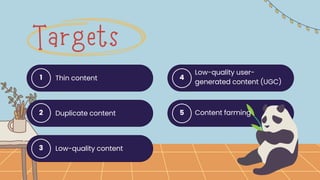
Targets
1 Thin content
2 Duplicate content
3 Low-quality content
4
Content farming
5
Low-quality user-
generated content (UGC)
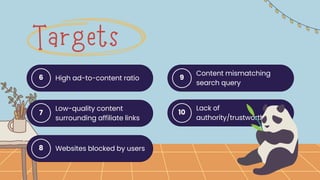
Targets
6 High ad-to-content ratio
7
Low-quality content
surrounding affiliate links
8 Websites blocked by users
9
Content mismatching
search query
10
Lack of
authority/trustworthiness
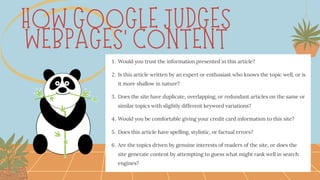
HOW GOOGLE JUDGES
WEBPAGES' CONTENT
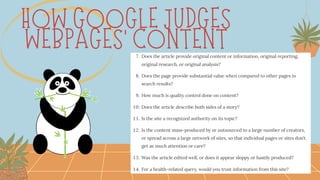
HOW GOOGLE JUDGES
WEBPAGES' CONTENT
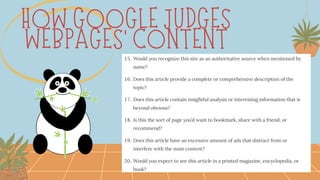
HOW GOOGLE JUDGES
WEBPAGES' CONTENT
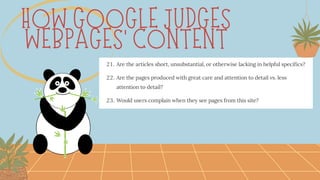
HOW GOOGLE JUDGES
WEBPAGES' CONTENT
Abandoning content farming practices
Overhauling website content for quality,
usefulness, relevance, trustworthiness and
authority
Revising the ad/content or affiliate/content ratio so
that pages are not dominated by ads or affiliate
links
Ensuring that the content of a given page is a
relevant match to a user’s query
Removing or overhauling duplicate content
Careful vetting and editing of user-generated
content and ensuring that it is original, error-free
and useful to readers, where applicable
Using the Robots noindex,nofollow command to
block the indexing of duplicate or near-duplicate
internal website content or other problematic
elements
"Take a fresh look and basically ask
yourself, ‘How compelling is my
site?’ We’re looking for high quality.
We’re looking for something where
you land on it, you’re really happy,
the sort of thing where you wanna
tell your friends about it and come
back to it, bookmark it. It’s just
incredibly useful."
HOW TO RECOVER FROM
PANDA?
~Google's Matt Cutts in 2012
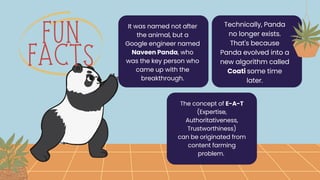
FUN
FACTS
It was named not after
the animal, but a
Google engineer named
Naveen Panda, who
was the key person who
came up with the
breakthrough.
The concept of E-A-T
(Expertise,
Authoritativeness,
Trustworthiness)
can be originated from
content farming
problem.
Technically, Panda
no longer exists.
That's because
Panda evolved into a
new algorithm called
Coati some time
later.
Thank You

Google Panda.pdf

  • 1.
  • 2.
    Initially launched in2011 to target "content farming", the Google panda update reduces the ranking of low-quality content websites and provide improved rankings for high quality sites. It has been frequently cited as an update from which it is hard to recover. INTRODUCTION
  • 3.
    Targets 1 Thin content 2Duplicate content 3 Low-quality content 4 Content farming 5 Low-quality user- generated content (UGC)
  • 4.
    Targets 6 High ad-to-contentratio 7 Low-quality content surrounding affiliate links 8 Websites blocked by users 9 Content mismatching search query 10 Lack of authority/trustworthiness
  • 5.
  • 6.
  • 7.
  • 8.
  • 9.
    Abandoning content farmingpractices Overhauling website content for quality, usefulness, relevance, trustworthiness and authority Revising the ad/content or affiliate/content ratio so that pages are not dominated by ads or affiliate links Ensuring that the content of a given page is a relevant match to a user’s query Removing or overhauling duplicate content Careful vetting and editing of user-generated content and ensuring that it is original, error-free and useful to readers, where applicable Using the Robots noindex,nofollow command to block the indexing of duplicate or near-duplicate internal website content or other problematic elements "Take a fresh look and basically ask yourself, ‘How compelling is my site?’ We’re looking for high quality. We’re looking for something where you land on it, you’re really happy, the sort of thing where you wanna tell your friends about it and come back to it, bookmark it. It’s just incredibly useful." HOW TO RECOVER FROM PANDA? ~Google's Matt Cutts in 2012
  • 10.
    FUN FACTS It was namednot after the animal, but a Google engineer named Naveen Panda, who was the key person who came up with the breakthrough. The concept of E-A-T (Expertise, Authoritativeness, Trustworthiness) can be originated from content farming problem. Technically, Panda no longer exists. That's because Panda evolved into a new algorithm called Coati some time later.
  • 11.