Google. Friend or Foe? Myth, Math, Models in the Age of Anxiety
Hi.Thanks for attending.
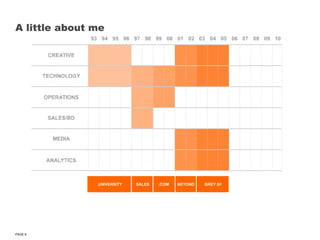
A little about me
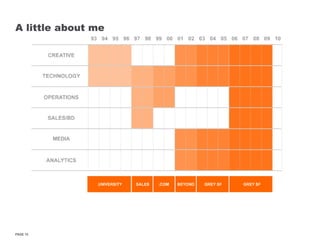
A little about me
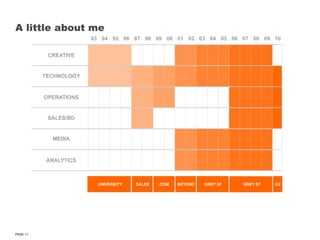
A little about me
A little about me
A little about me
A little about me
A little about me
A little about me
GOOGLE. Friend or Foe? Myth, Math, Models in the Age of Anxiety
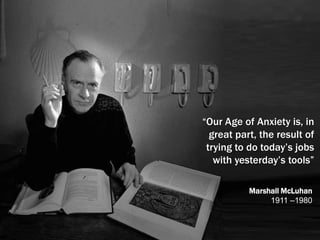
“Our Age of Anxiety is, in great part, the result of trying to do today’s jobs with yesterday’s tools”Marshall McLuhan1911 –1980
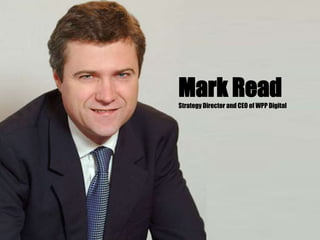
tMark ReadStrategy Director and CEO of WPP Digital
Win
FUN FACTS
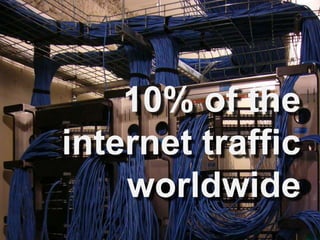
10% of the internet traffic worldwide
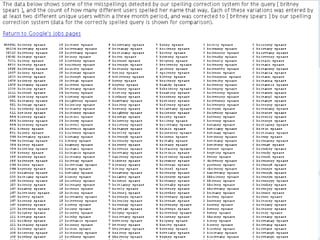
http://www.google.com/jobs/britney.html
I K1A1B
To organize the world’s information and make it universally accessible and useful.
39
So …how does Google actually work?
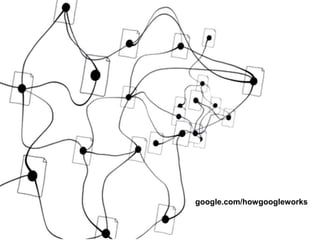
google.com/howgoogleworks
PageRank™Larry PageCo-Founder & President, Products
SEO
SEO?SEO?
Quit itQuit it.
SEO Quick tips1. Forget about meta tags2. Link shaping doesn’t work3. De-optimization is as valuable as optimization
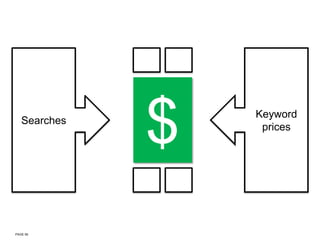
SearchesKeywordprices$
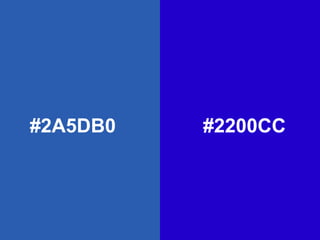
#2A5DB0#2200CC
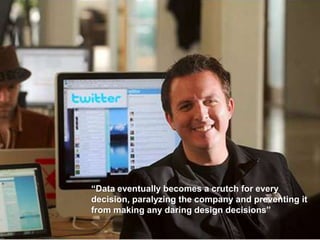
“Data eventually becomes a crutch for every decision, paralyzing the company and preventing it from making any daring design decisions”
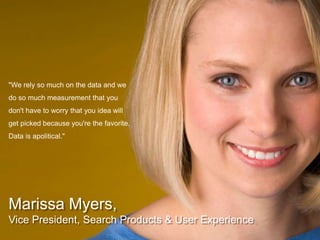
"We rely so much on the data and we do so much measurement that you don't have to worry that you idea will get picked because you're the favorite. Data is apolitical."Marissa Myers,Vice President, Search Products & User Experience
The news is still big. It's the newspapers that got small.Roger Ebert, November 26, 2008	http://blogs.suntimes.com/ebert/2008/11/death_to_film_critics_long_liv.html
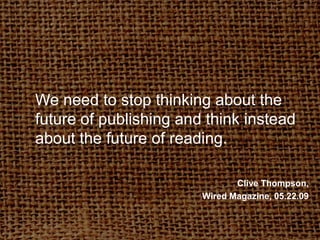
We need to stop thinking about the future of publishing and think instead about the future of reading.Clive Thompson, Wired Magazine, 05.22.09
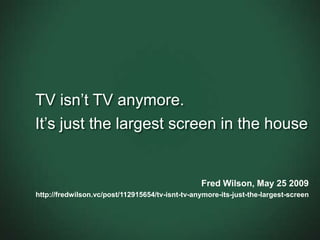
TV isn’t TV anymore. It’s just the largest screen in the houseFred Wilson, May 25 2009http://fredwilson.vc/post/112915654/tv-isnt-tv-anymore-its-just-the-largest-screen
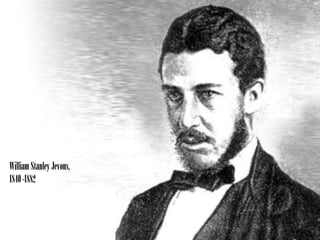
William Stanley Jevons, 1840 -1882
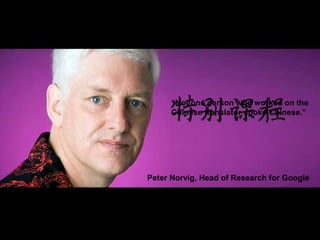
“Not one person who worked on the Chinese translator spoke Chinese.”Peter Norvig, Head of Research for Google
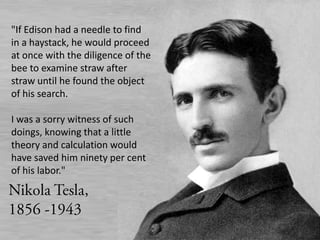
"If Edison had a needle to find in a haystack, he would proceed at once with the diligence of the bee to examine straw after straw until he found the object of his search.I was a sorry witness of such doings, knowing that a little theory and calculation would have saved him ninety per cent of his labor."Nikola Tesla, 1856 -1943
What about the future?
JuniperMX960
We are Google’s products
RMCSCxPVEC
DSP RTB
What can we learn from Google?
A/BMVT
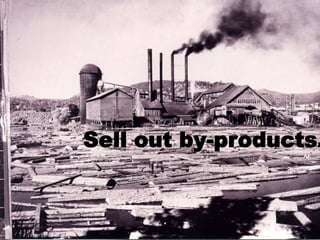
Sell out by-products.
Topics I didn’t get to…
The role of personalized search and why Facebook think they have an edge. Will only popular content become popular?
Google and Behavioral Economics. How Google is taking advantages of its audience’s cognitive biases and how they make decisions. Or rather how Google isn’t doing this.
Splinternet – will our infatuation with “apps” and proprietary social networks break Google and return us to a curated web and new walled gardens. AOL anybody?
http://del.icio.us/msanders/googlehttp://delicious.com/msanders/google
NEXT….
INFLUENCEWhy everything we know is wrong and why Malcolm Gladwell may well be responsible. How correlation is not causation and why we’re chasing a cult of influencers who don’t really exist.
mark.sanders@agentsilverfox.com@msanders

Google. Friend or Foe?

Editor's Notes

  • #2 Welcome.In my best American accent my name is “MaaaaRrrk”. I’ll be your English voice today.
  • #3 This is the San Francisco office. I’ve asked everyone to dress in black and we’re all casually smoking in the conference room.
  • #4 We release that you have many options for your presentation needs. We appreciate you choosing this one.
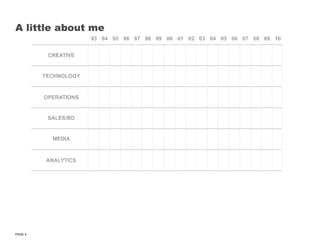
  • #5 A little about me.
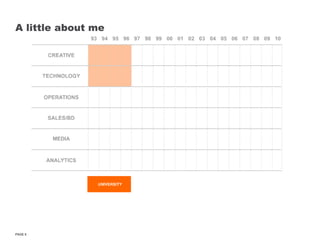
  • #6 I went to Art school in England. Yes. It’s four years. We take our Fine Art degrees very seriously over there. Started as a painter and ended up making films.

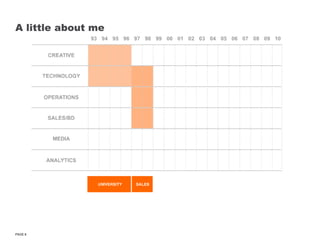
  • #7 Arrive in the US in 96 and sold computer hardware.
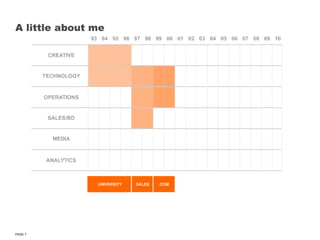
  • #8 Ran the operations and delivery division of a pacific rim dot com with a friend from school and started programming out of necessity.
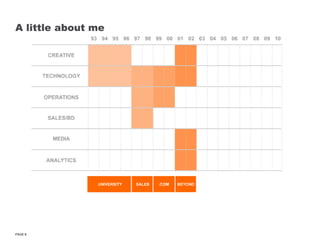
  • #9 Started in the ad business in 2000 Beyond Interactive and started their Creative and technology practice here on the west coast. Beyond was an almost pure play digital media shop and that was my education in the ad world.
  • #10 Beyond bought by Mediacom, bought by Grey. Became Lead technologist working with media, Analytics, and Creative. Spent a lot of time on the ad serving relationship and working with the pubs.
  • #11 Became Digital Strategist at Grey West. Worked for Grey for nine years before moving to G2 last summer.

  • #12 Lead the Digital Delivery group and have a pseudo Account role when I’m not coaxing new clients into the office.
  • #13 If Mike Dennelly can quote beckets Waiting for Godot I can make reference to WH Auden’s eclogue form “Age of Anxiety”A man's quest to find substance and identity in a shifting and increasingly industrialized world. But that’s just one take.
  • #14 Patron saint of Google.Google is eating our lunch. Going straight to our customers or to the small business who might one day become our customers and either servicing them with their own sales people or giving them tools to do all their lead gen, sales and advertising themselves.
  • #15 And that was the message that Mark Reed brought us. We had a WPP digital day a few years ago. Sounds fun? Cotton candy and fare ground rides. No. Meet and greet of companies WPP has invested in – Visible technologies Live world and spotrunner. Spotrunner that could create media plans out of thin air for you. Mark travels the world educating older members of the WPP companies about new technology and social networks. Board of Directors meeting in Palo Alto a couple of years ago.My questions was If Google is such a great idea. Why isn’t everyone doing it? Why aren’t we taking a more Google like approach. It seems to be working. I wouldn’t call it an argument but I made sure not to tell him who I was.
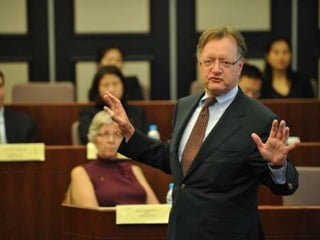
  • #16 Sir martin wrote a section in the annual report titled Friend or foe? Back in 2006. “You have these schizophrenic relationships and you have to figure out what’s going on. “Professor Quelch – don’t Google his name. Board of Directors of WPP for 20 years. Harvard Business School study called Google in China. Published April 22nd 2010. I can share if anyone’s interested.
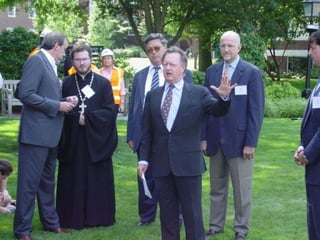
  • #17 The net of it was that Google is arrogant. Google will lose out in China. Google expected China to come round and play ball. They didn’t. They’re a young company and they are making a lot of mistakes. Not sure where this was taken but I love the priest and the construction worker attendees.
  • #18 We went through the letters Google published and deconstructed the language in an interactive class room setting. Be careful of standing on his left side. He kept whacking a poor woman in the side the face.
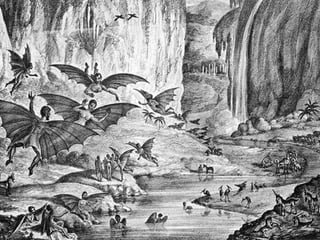
  • #20 Google- it’s like a secretive fairy tale place that everyone has heard about but no one has a lot of real information about. People make up their own myths about how it operates and what it’s intentions are. Like this illustration from the stories of Richard Adams Locke in 1835. Powerful telescopes have seen the inhabitants of the moon. Winged men and fire wielding bipedal beavers.
  • #21 Or Google is a future panacea that will help us reach a utopia. I pitched Reliant Energy, a de regulated energy company , in Houston just about the time of the Waste Management win. When we hippy Californians presented messaging around energy conservation they brought up, in there minds, the self evident fact that “This energy shortage is temporary. Google find a solution.”
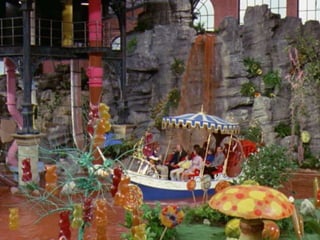
  • #22 When I visited the Google campus for the first time I thought that the extremely colorful and playful décor reminded me of Willy Wonka’s Chocolate factory.
  • #23 Staffed by super intelligent members of Star Fleet Academy.
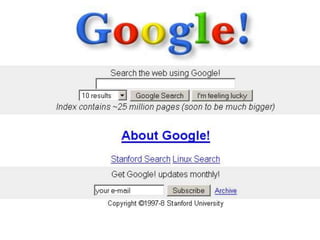
  • #25 The company was founded by Larry Page, March 26th, 1973 Aries, and Sergey MikhaylovichBrin son of an economist born August 21, 1973 Leo, at Stanford. google.com was registered on September 15, 1997. previously called ‘Backrub’. Based in Mountain view California. Company went public August 19, 2004. Last earnings call for q2 2010 $6.82 billion, which is an increase of 24% year-over-year.
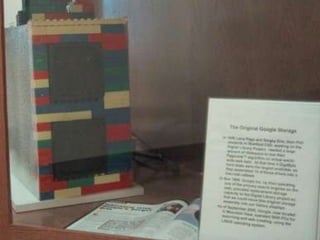
  • #26 First core server made of Lego. Cheap, fun, willy wonkaish.
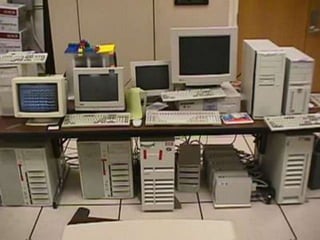
  • #27 This is Google in 1999. All on one table.
  • #28 100 billion videos served this year. YouTube sells ads on fewer than 10 percent of its videos. How does it break even? Peering relationships
  • #30 593 altogether. No idea what that’s about.
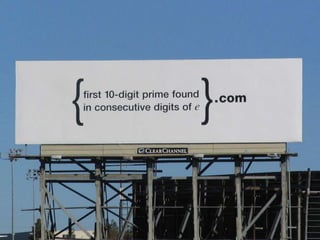
  • #31 This is my favorite Jobs posting. You solve the math equation and you get the phone number of their Engineering recruiter.
  • #33 Have your genome sequenced at home. Sounds like the future today. Created Anne Wojcicki -wife to Sergey.
  • #34 This is my wife. She’s Portuguese. Mitochondrial sequencing. Member of the haplo group K1a1b. Shared by large portion of the Ashkenazi group.
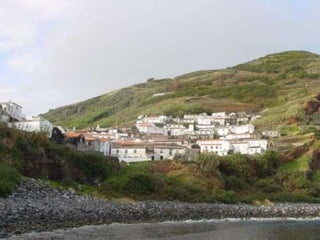
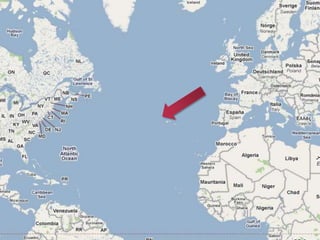
  • #35 Her family is from Corvo. The smallest and remotest of the Azorean islands in the middle of the Atlantic ocean. The Tatooine of Europe.
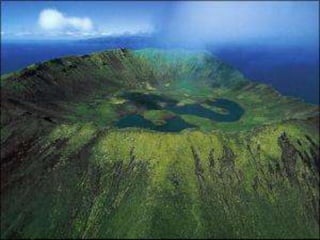
  • #36 Home to one village of 350 people and an extinct volcano.
  • #37 Some say the last vestiges of Atlantis that sunk beneath the waves.
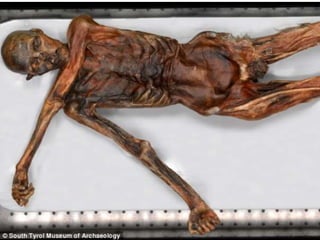
  • #38 Otzi. 5,300 year old preserved Scandinavian. Same sub haplo group. I never ran a background check on Elizabeth when I married her but I’m making up for it by going back six millennia.Why am I telling you this? Hopefully to make a more entertaining presentation but also to give a background to Google's mission statement.
  • #39 That’s a big task. That’s their mission statement. What’s their plan once they’ve accomplished this?
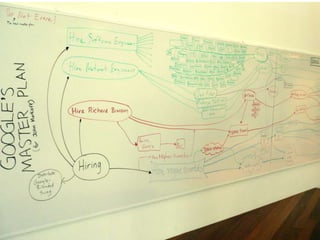
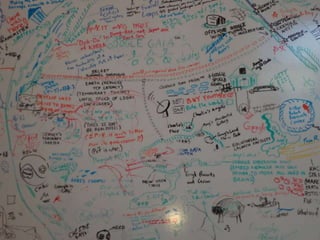
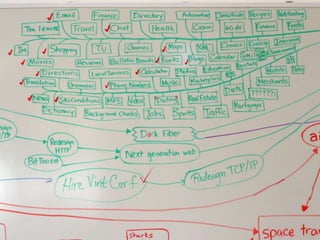
  • #40 The real master plan – top left
  • #41 Offshore wind. Recently purchased $38.8 million dollars in two wind farms in North Dakota. Offshore server farms on ocean going bargesSecret tunnel through the earth. Haven’t seen that one yet.
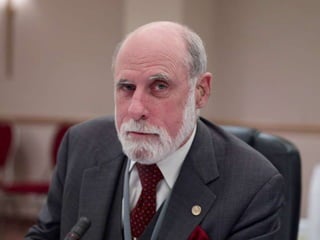
  • #42 Dark fiber. Bought lots of that. Look at the check marks. Hire Vint Cerf. Do you that guy?
  • #43 Father of the internet. Look at him. Talk about an impressive figure.
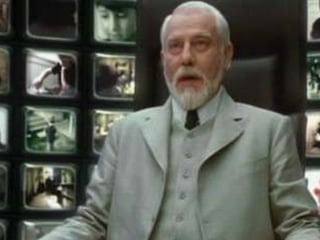
  • #44 Helmut Bakaitis - the “Architect” from the Matrix: Reloaded. Coincidence?
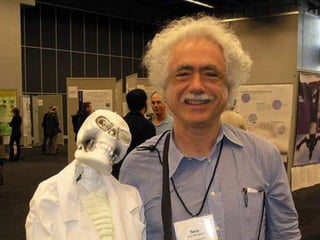
  • #45 Terry Winograd, philospher
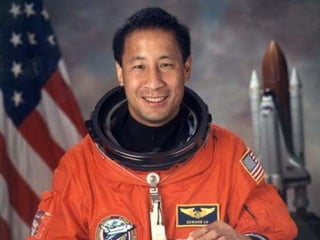
  • #46 Ed Lu, astronaut
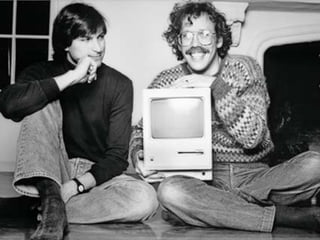
  • #47 Andy Hertzfeld, apple . Co-Creator of some of the first personal computers in the world.
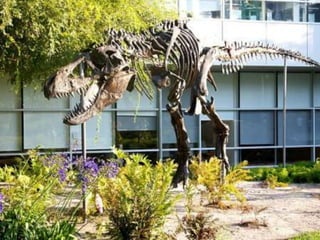
  • #48 Oh .. And a dinosaur. His name is Stan.
  • #50 Based on links. Backrub – the original name referred to referencing other science papers in academic research. The more valuable a research paper was the more likely it was quoted in another published work. By looking at the most reference you get an idea of the valuable work. No one wants to reference a paper that isn’t credible. References or links became a currency that could be measured and indexed. The same happened for links to web sites. Links from highly ranked sites improve the ranking of the sites that they link to.
  • #51 This process was trademarked Page Rank. Not in reference to web pages – as I thought for the longest time – but after Larry Page, Google’s co founder.
  • #52 So. SEO. This is what I’m sure we get closest to in our every day lives. Search Engine Optimization.
  • #53 This just in from Google …
  • #54 Avoid tricks intended to improve search engine rankings. A good rule of thumb is whether you'd feel comfortable explaining what you've done to a website that competes with you. Another useful test is to ask, "Does this help my users? Would I do this if search engines didn't exist?"
  • #55 Tune out if this is not your thing.Meta tags – they don’t appear. Too easy to game.Link shaping - rel no follow doesn’t help you counter relevance of internal links. Its an illusion.Your site can appear in search results for keywords it doesn’t contain if it contains enough content that is found on other sites that do contain those terms.
  • #56 Creating content to meet demand. $1 billion valuation. Associated Content purchased by Yahoo.
  • #57 Created a marketplace to create minimally valuable content fastest. Google doesn’t like this. Think Mahalo or About.com.Google wants to look at authentic proxies for value and delivery content that is relevant and appropriate to searches.
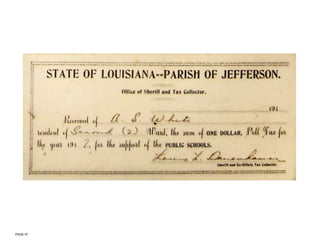
  • #58 Currently there are over 200 signals or attributes that assign value to results over and above inbound links. Age of site, depth, organizational structure. How someone searches for links they find valuable, typos entered before finding accurate results. Think about taxation. How does a government map appropriate taxation to citizens? What are the signals to attribute value that can be measured and indexed? This is a Poll card. If you can vote you can be counted as a wage earning adult. That’s a signal to capture to inform tax collection.
  • #59 Being Alive and over 18 or then 21 is a crude corollary. Here’s a more granular one. Window taxes was a way of associating income with taxes. You own a house with more windows – you pay more. People used to try and game the system and brick up windows – hence the term daylight robbery.
  • #60 Bricking up windows? We’ll tax bricks. Smaller more accurate unites of measurement to tax property and income. The brick tax was introduced in Great Britain in 1784, during the reign of King George III, to help pay for the wars in the American Colonies. It didn’t do us much good.
  • #61 Let’s go up the value chain. Bricks and windows are liable to be affected by industrial and economic errors. How about taxing class and status. There was a tax introduced in parliament in 1795 which taxed both wigs and wig powderPeter the Great of Russia 1705 levied a tax on beardsWays of looking at data and extracting meaning to support actionable results.
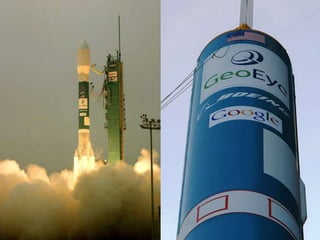
  • #62 How do you produce more valuable results? Get more data. Launched at 11:50am Saturday September 6th. 41 cm resolution. Boom. Google in space. Take that Thunderbirds.
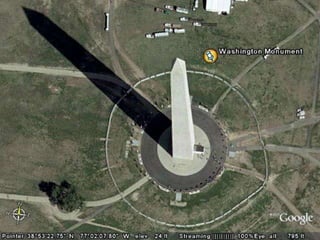
  • #63 Take the data and look at the clues you can derive from it. Distil data into intellegence. Averted vision is the “art of seeing distant objects by looking to their periphery." Adrian Stoica at NASA’s Jet Propulsion Laboratory published a paper about aerial intelligence gathering. By measuring the length of someone's shadow you could identify who they are. Digital Pen traces.You think that this is far fetched but those Google Street view cars that are shooting pictures of our homes while they’re not sniffing your wi-fi are shooting lasers off the larger buildings in your neighborhoods to better model Google Earth. Once you’ve captured all that data and extracted meaning how do you apply it? By Testing.
  • #64 Google needed a new link on one of it’s product. What color would be most effective. 40 distinct shades. Test ‘em all!
  • #65 Doug Bowman quit Google over such a data driven corporate culture. This highlights an intrinsic part of Google's culture. - Data
  • #66 This makes for a very flat org structure. Only one manager for every 40 employees. Fast decisions and optimum iteration. It means you can look objectively at a lot of previously accepted points of view and challenge conventional wisdom. Why? Because the data says you can.
  • #67 Look at the fundamental changes that are happening to our media industry
  • #68 eBooks
  • #69 Video. If you watch Mad Men streaming NetFlix, Lost on Hulu and Local news on Digital Cable stations on you TV. When looking at share and ratings points in the household does Nielsen count that as one TV or three?
  • #70 There is a paradox. When you increase the efficiency of an industrial process and you need less raw material than before consumption of that raw material should go down. William Stanley Jevons wrote in 1865 a book The Coal Question. In it, Jevons observed that England's consumption of coal soared after James Watt introduced his coal-fired steam engine, which greatly improved the efficiency of Thomas Newcomen's earlier design.Why pay more for your raw material is you can get more value for less money? Why because you can. You can translate one efficiency into other sources of value.
  • #71 Translation powered by Google. Peter Norvig, head of research made this bragging statement. Why? Because of efficiencies brought about by smart people and scale.
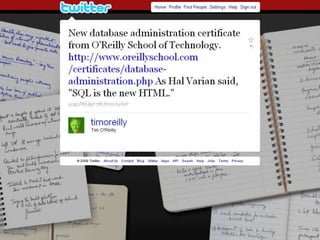
  • #72 Hal Varian. Not an engineer. The Chief Economist.
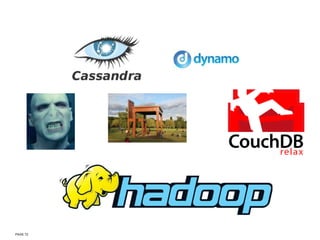
  • #73 How is Google forming these new points of view? By creating new tools to understand big data. Reinventing what a database is. Probably the biggest revolution in modern digital society and it’s almost invisible to people. The petabyte age is here. Cassandra – she who entangles men. Blessed to tell the future but cursed that no one would believe her.
  • #74 Tesla inventor of AC electric current, pain rays and wireless Electricity.
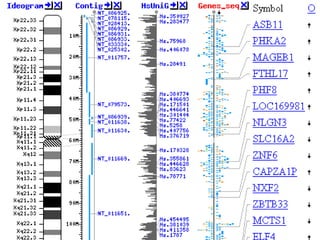
  • #75 Tools to look at big data is transforming a variety of sciences. In the same way microscopes and telescopes gave us a new way to look at the world tools for investigating data is giving us a new “macroscope” to understand the world around us that exists beyond our visual capability of understanding it. Bionformatics. Taking a biological question and making a database question. We have a lot of tools to solve database questions.
  • #76 Ad words prediction market. Can tell what’s going to be popular and valued keywords six months in advance.
  • #77 How did Google do all of this revolutionary stuff. By failing. A lot. Just so don’t think that all of this is breathless future telling.
  • #79  John Perry Barlow, in his essay "Death From Above"Over the last 30 years, the American CEO Corps has included an astonishingly large percentage of men who piloted bombers during World War II. For some reason not so difficult to guess, dropping explosives on people from commanding heights served as a great place to develop a world view compatible with the management of a large post-war corporation.
  • #80 Routers from Juniper Networks such as this MX960 will soon include Feeva'szipcode tracking software, assuming ISPs want it. Click on a link and the webserver will receive your zip code plus four in the invisible header that your request includes.
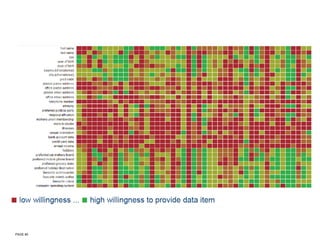
  • #81 Sharing their operating system was defined as personal as credit card numbers. Sören Preibusch. University of Cambridge. Consumers privacy decision-making.
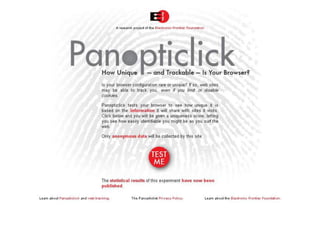
  • #82 Able to tell who you are on a unique basis according to contextual heuristics. Fonts you have installed, your browser type, where you’re browsing from versions of flash you’re using etc. Even sites you’ve visited that weren’t tagged.
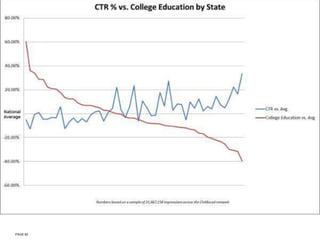
  • #83 Danah Boyd. Social Research Analyst with Microsoft. Are we marginalizing and taking advantage of the poor? Are these the targets we want to cultivate? 8% of internet users account for 85%
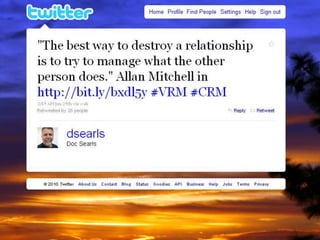
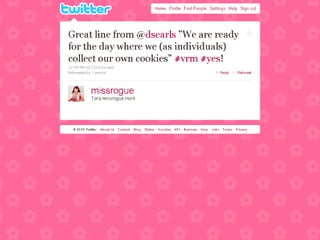
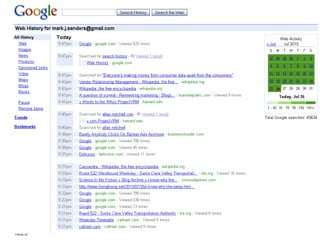
  • #84 Doc Searles, a co author of Cluetrain manifesto. A corner stone of modern relationship marketing. Allan Mitchell writing in Brand republic June 27th.
  • #86 VRMBuy side economics. Reimagining the demand side and supply side markets to improve efficiency. Don’t worry. This isn’t code for socialism. Consumers managing their vendors rather than vendors managing their customers
  • #87 “Everyone’s making money from consumer data apart from the consumers”
  • #88 Google allows us pretty transparent access to our data and even to extract all our data and take it somewhere else. But to do what with it?
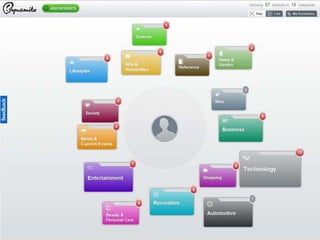
  • #89 This is Bynamite. A browser extension that allows us to see how ad networks see us.Instead of opting out of all cookies. Selectively choose what to opt into. Amazon UK already allows you sell your buying habits for cash.Mint lets you aggregate your purchase data and allow select access to advertisers or RedBeacon that allows you to create your own personal RFPs for services. Charlene Li – the personal CPM
  • #90 PowerEye. A program to allow users to opt out of behavioral targeting as a result of congressional investigation into internet privacy concerns. We already see feedback mechanisms as features of publishers offerings.CPE – Cost per Engagement. Chris Anderson. There is no hard science for an Attention Economy apart from search keyword trading markets. To do Economics you need to be able to put one number in and get another number out and do it in a fungible way.
  • #91 A demand-side platform (DSP) is a media technology platform that powers automated digital media buying and the unification of data for targeting, optimization and reporting. RTB is Real Time Bidding. Imagine a stock market of audiences being bought and sold using automated systems. We won’t have media departments we’ll have trading desks. Tranches of aggregated attention debt bought and sold in international currencies. Who needs remnant inventory and ad hoc make goods. We have sub prime media now.
  • #92 What could possibly go wrong?
  • #94 Google despite being a company created and run by engineers has a very well defined sense of theater. Broad gestures in business by changing centuries old legislation regarding book publishing to philanthropy and even global political relations as we see in China. But Google is also challenged when it comes to it’s branding. What is Google. In their ads for commercial services. What does it really mean to go Google.
  • #95 What does Google want to be? Google doesn’t have to decide. Agencies do.
  • #96 Data is self evident. We need to factor data into everyone of our decision making processes and recommendations. Not just A/B tests but MVT. Not just opinions but models. Make use of the tools at our command.
  • #97 Cross discipline. Advertising and interactive Design company out of Chicago.
  • #98 Willamette mill decided to sell their by products. The sawdust and pulp to create paper turned waste into revenue. 37 Signals took this to heart. How can me monetize and merchandise the product of our process. Publish our code libraries, share and productize our learnings. Working with media vendors to create new ad vehicles and customer experiences. We used to call this “Publisher solutions” we’d create new inventory and even develop whole new audiences to monetize for our clients.
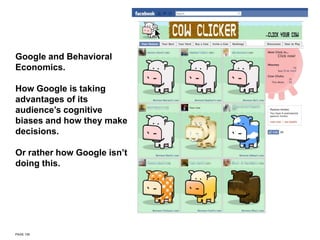
  • #101 Ian Bogost. Cow Clicker is a Facebook game about Facebook games. It's partly a satire, and partly a playable theory of today's social games, and partly an earnest example of that genre. You get a cow. You can click on it. In six hours, you can click it again. Clicking earns you clicks. You can buy custom "premium" cows through micropayments (the Cow Clicker currency is called "mooney"), and you can buy your way out of the time delay by spending it. You can publish feed stories about clicking your cow, and you can click friends' cow clicks in their feed stories. Cow Clicker is Facebook games distilled to their essence.
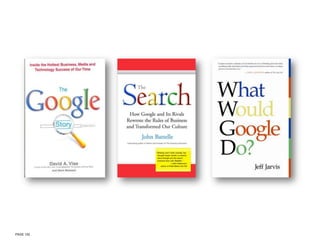
  • #103 Google story. A good history if a little overly romantic. Search – the first and most pragmatic history by John Battelle. Great insight into the cast of characters that history doesn’t remember and the deals they made. My favorite – EEGD by Jeff Jarvis. How to take Google’s approach and reinvent everything around us from insurance to airlines to the newspapers to education. Check him out in This Week in Google podcast Every Wednesday on the Twit network.
  • #104 Read my other sources here.
  • #105 My next presentation I’ve been writing…