1
Good and effective
Governance in EBMOs
Employers’Activities Programme
Effective Employers’ and Business Organizations
2
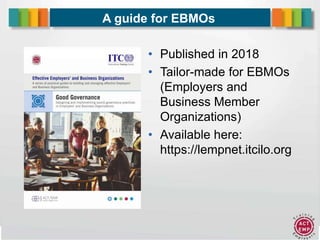
A guide for EBMOs
• Published in 2018
• Tailor-made for EBMOs
(Employers and
Business Member
Organizations)
• Available here:
https://lempnet.itcilo.org
3
What is governance?
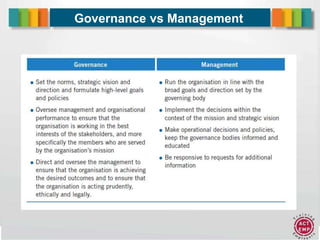
• Governance must be distinguished from Management
• In an EBMO, there is a clear difference between the
Board’s responsibilities (governance) and those of the
Chief Executive Officer (management).
• Governance is the responsibility of the elected
representatives of the membership who comprise the
Board. The Chairperson of the Board(also known as
the President of the EBMO) is ultimately responsible
for good governance and for ensuring that the
boundaries between governance and management
are respected and maintained.
• In other words, Governance determines the “What?”
(what the EBMO does and what it should become in
the future), while management determines the “How?”
(how the EBMO will attain those goals and
aspirations).
4
Governance vs Management
5
Basic Principles of Governance
There are three elements to good
governance, namely the requirements for
1. independence
2. clarity
3. transparency
6
1. Independence
Independence from states/government means:
• The EBMO is a non-aligned, apolitical
organization;
• It does not depend on state funding for its
functioning.
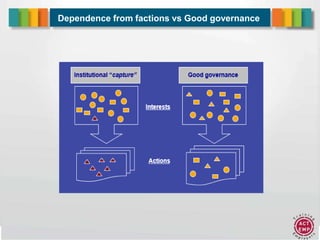
Independence from factions or particular
interests groups means:
• The EBMO has a large and inclusive
membership;
• All interests are dealt with in a balanced way.
7
Dependence from factions vs Good governance
8
2. Clarity
• Where there is a lack of clarity, there is
room for discretion to be exercised which
gives rise to the perception that the EBMO
is not acting consistently – or worse, that it
is acting improperly.
9
2. Clarity
Ways to ensure clarity:
• Founding documents are adopted and up-to-date;
• Conflicts are resolved in a transparent way;
• Fee setting mechanisms are enshrined in the founding
documents which are publicly available;
• Consequences of non-payment of fees are clear and
applied consistently;
• Procedures for elections and mandates for elected
functions are written down and respected;
• Terms for office and procedures of removal from office
are written down and applied;
• Balanced reflection of diversity is sought;
• Compliance is given the highest priority.
10
3. Transparency
• Corruption – including bribery and
extortion – has been increasingly identified
by the business community as the biggest
contributor to lack of good governance,
leading in turn to low investment and
stymied economic growth.
• EBMOs have a responsibility to fight
corruption at national level through
advocacy initiatives and to ensure good
governance in their own organization
11
3. Transparency
Ways to ensure transparency:
• Leading by example: systems supporting good
governance must be in place and any breach must
be acted upon immediately in a open manner;
• Code of Ethics for staff and Board members: to
raise awareness and foster ownership at all levels
of the values of integrity, honesty and loyalty to the
organization;
• Encouraging and Educating Members: providing
support and guidance to members companies and
their employees on how to address cases of
bribery, extortion or other corrupt practices.
12
Checklist
• Is your EBMO’s Constitution up
to standard?
• Are rules on the composition and
functioning of your institutions
(Board of directors, Committees
etc.) clear and consistent?
• Have a look at the available tools
on good governance on
http://lempnet.itcilo.org
13
To remember
• Good governance is a key element of the
credibility of an EBMO & it is critical for its
ability to attract and serve members;
• EBMOs have different instruments to
ensure good governance (Constitution;
Boards and Committees; Management
and secretariat etc.) – periodic reviews
should be carried out;
• If good governance is a priority, resources
need to be allocated.
14
For further information, please contact:
Programme for Employers’ Activities
E-mail: actempturin@itcilo.org
Phone: +39 011 693 6590
http://lempnet.itcilo.org
We are a solid and reliable partner in the delivery of training for
Business Member Organizations and we look forward to assist you
in the implementation of your training needs

Good Governance PPT.pptx

  • 1.
    1 Good and effective Governancein EBMOs Employers’Activities Programme Effective Employers’ and Business Organizations
  • 2.
    2 A guide forEBMOs • Published in 2018 • Tailor-made for EBMOs (Employers and Business Member Organizations) • Available here: https://lempnet.itcilo.org
  • 3.
    3 What is governance? •Governance must be distinguished from Management • In an EBMO, there is a clear difference between the Board’s responsibilities (governance) and those of the Chief Executive Officer (management). • Governance is the responsibility of the elected representatives of the membership who comprise the Board. The Chairperson of the Board(also known as the President of the EBMO) is ultimately responsible for good governance and for ensuring that the boundaries between governance and management are respected and maintained. • In other words, Governance determines the “What?” (what the EBMO does and what it should become in the future), while management determines the “How?” (how the EBMO will attain those goals and aspirations).
  • 4.
  • 5.
    5 Basic Principles ofGovernance There are three elements to good governance, namely the requirements for 1. independence 2. clarity 3. transparency
  • 6.
    6 1. Independence Independence fromstates/government means: • The EBMO is a non-aligned, apolitical organization; • It does not depend on state funding for its functioning. Independence from factions or particular interests groups means: • The EBMO has a large and inclusive membership; • All interests are dealt with in a balanced way.
  • 7.
    7 Dependence from factionsvs Good governance
  • 8.
    8 2. Clarity • Wherethere is a lack of clarity, there is room for discretion to be exercised which gives rise to the perception that the EBMO is not acting consistently – or worse, that it is acting improperly.
  • 9.
    9 2. Clarity Ways toensure clarity: • Founding documents are adopted and up-to-date; • Conflicts are resolved in a transparent way; • Fee setting mechanisms are enshrined in the founding documents which are publicly available; • Consequences of non-payment of fees are clear and applied consistently; • Procedures for elections and mandates for elected functions are written down and respected; • Terms for office and procedures of removal from office are written down and applied; • Balanced reflection of diversity is sought; • Compliance is given the highest priority.
  • 10.
    10 3. Transparency • Corruption– including bribery and extortion – has been increasingly identified by the business community as the biggest contributor to lack of good governance, leading in turn to low investment and stymied economic growth. • EBMOs have a responsibility to fight corruption at national level through advocacy initiatives and to ensure good governance in their own organization
  • 11.
    11 3. Transparency Ways toensure transparency: • Leading by example: systems supporting good governance must be in place and any breach must be acted upon immediately in a open manner; • Code of Ethics for staff and Board members: to raise awareness and foster ownership at all levels of the values of integrity, honesty and loyalty to the organization; • Encouraging and Educating Members: providing support and guidance to members companies and their employees on how to address cases of bribery, extortion or other corrupt practices.
  • 12.
    12 Checklist • Is yourEBMO’s Constitution up to standard? • Are rules on the composition and functioning of your institutions (Board of directors, Committees etc.) clear and consistent? • Have a look at the available tools on good governance on http://lempnet.itcilo.org
  • 13.
    13 To remember • Goodgovernance is a key element of the credibility of an EBMO & it is critical for its ability to attract and serve members; • EBMOs have different instruments to ensure good governance (Constitution; Boards and Committees; Management and secretariat etc.) – periodic reviews should be carried out; • If good governance is a priority, resources need to be allocated.
  • 14.
    14 For further information,please contact: Programme for Employers’ Activities E-mail: actempturin@itcilo.org Phone: +39 011 693 6590 http://lempnet.itcilo.org We are a solid and reliable partner in the delivery of training for Business Member Organizations and we look forward to assist you in the implementation of your training needs