GOLDCLASSES
2016
Find out more about
our exciting subject
areas, and experience
what it’s like to study
at university level
gold.ac.uk/goldclasses
3
At Goldsmiths, University of
London we offer a range of
subject-based masterclasses
that give Year 12 students
the opportunity to gain an
in-depth understanding of
teaching and learning at
university level.
Developed and delivered
by leading academic staff,
Goldclasses aim to stimulate
enquiry, broaden knowledge
of the subject area, and
introduce students to a
wider network of academics,
undergraduate students
and peers.
Sessions run from March
to July in the following
subject areas:
Anthropology
Art
Arts Management
Chinese Studies
Computing
Criminology
Design
Economics
Educational Studies
English
History
History of Art
Management
Media & Communications
Music
Politics
Psychology
Sociology
Social Work
Theatre & Performance
Therapeutic Studies
Visual Cultures
Some masterclasses relate
closely to the school
curriculum, enabling
students to enhance their
current studies. Others
introduce new topics
studied at university level,
exposing students to
subjects beyond the post-16
secondary syllabus. They
are not revision lectures,
but academic sessions
that include:
−− Stimulating lectures or
workshops delivered by
Goldsmiths academics
−− The opportunity to
discuss the topic and
ask questions
−− An introduction to the
university admissions
process
−− The opportunity to hear
about life as a Goldsmiths
student from a current
undergraduate
Anthropology
Anthropology in the 21st Century
(and how we got like this)
Lecturer: Dr Gavin Weston
18 March, 2pm-3.30pm
Location: Professor Stuart Hall Building,
Room 326
OR
28 June, 10.30am-12midday
Location: Richard Hoggart Building,
Room 137a
This masterclass will give you a brief
history of social anthropology and
an overview of the discipline in the
contemporary world. We will explore
the shifts from classical ethnography
of villages in ‘exotic’ locations to newer
forms of anthropology at home, in
cities and online, and how these all
revolve around the central idea of
ethnographic research. We will look
at examples of ethnography from
around the world to reflect upon the
amazing breadth of anthropologists’
research interests.
Art
Fine Art and History of Art: Making,
Thinking, Writing and All Points
In Between
Lecturer: Marion Coutts
23 March, 2pm-3.30pm
Location: Professor Stuart Hall Building,
Room LG02
You are a new student on Fine Art and
History of Art. What does week one
in the studio feel like? Not like school.
Not much like Foundation either. Using
your own ideas as a starting point, this
session will imaginatively engage with
the idea of student-centred learning
from the start. We will think about
how we learn, look at practical and
theoretical ways of progressing ideas,
and discuss change and risk to explore
what contemporary art and visual
culture might mean to you.
ArtsManagement
Arts Management: Creating the
Possibility of Creation
Lecturer: Dr Victoria Alexander
10 March, 10.30am-12midday
Location: Richard Hoggart Building,
Room 143
OR
29 June, 2pm-3.30pm
Location: Richard Hoggart Building,
Room 137a
The cultural and creative sector is one
of the quickest-growing sectors in the
UK and across the world, providing
jobs for millions of people. Some of
those people are artists or ‘creatives’;
however, creativity cannot happen in
a vacuum. In order for projects to be
realised, a whole range of activities
from planning to funding need to
be in place. Supporting creativity
is a fundamentally creative act in
itself. Popular music gigs, classical
music concerts, theatre shows, art
exhibitions, dance performances, film
festivals, street festivals and every
imaginable artistic event happen
because someone produces them,
and the art world would not function
without someone to arrange for ticket
or object sales, fundraising, audience
development and other crucial
activities. This masterclass introduces
key concepts of arts management, and
INTRODUCTION
Find out more
School or college groups
and individuals can
make a booking request
at www.gold.ac.uk/
goldclasses or by emailing
goldclass@gold.ac.uk
Feel free to get in touch if
you have any questions; we
look forward to welcoming
you to the Goldsmiths
campus soon!
4 5
explains why it is such an exciting and
growing field. Through case studies of
real arts organisations, you will develop
and engage with planning and problem
solving skills that could be the first step
in a successful career in which you
create the possibility of creation.
Computing
Creative Programming
Lecturer: Dr Marco Gillies
9 March, 3pm-5pm
Location: Richard Hoggart Building,
Room 306
This masterclass will introduce
you to the way we teach computer
programming at Goldsmiths: a way that
emphasises your independence and
creativity by working with graphics,
interaction and sound from the
very beginning.
Graphics and Sound
Lecturer: Dr Simon Katan
23 March, 3pm-5pm
Location: Richard Hoggart Building,
Room 306
This masterclass helps you get started
creating real-time graphics and sound
for web, desktop and mobile devices.
Based on our hugely popular online
and undergraduate courses, you will
be shown how to start drawing and
controlling sound, and begin to handle
computer interaction for web design,
mobile app development, gaming,
music and the arts.
Being an Entrepreneur in the
Digital Age
Lecturer: Dr James Ohene-Djan
29 June, 3pm-5pm
Location: Richard Hoggart Building,
Room 306
The UK’s Tech City, based in
Shoreditch, is now one of the major
world centres for start-up companies.
Whether it’s e-retailing, gaming, social
media or electronic commerce, the UK
has a flourishing business computing
and entrepreneurial community.
This session aims to introduce you
to some of the key activities and
processes involved in creating a new
start-up internet business. During
the masterclass you will work on
developing a new internet start-up.
Create an idea for a new mobile
internet business; perform a SWOT
analysis; propose a brand and its
values; develop a revenue model;
create a storyboard for your business
pitch; record a video elevator pitch.
ChineseStudies
Confucius Institute: Mandarin
for Beginners
Lecturers: Maria Thomas, Peipei Yang &
Tian Yiyun
11 March, 10.30am-12midday
Location: Richard Hoggart Building,
Room 352
OR
5 July, 2pm-3.30pm
Location: Professor Stuart Hall Building,
Room 305
This will be a Mandarin masterclass
for beginners, consisting of a sample
lecture and two workshops – Chinese
paper-cutting and a Chinese dance
demonstration. In the sample lecture,
you will be given an understanding
of the unique writing system of the
language, and learn some useful
daily expressions.
Criminology
Criminology and ‘The Riots’
Lecturer: Dr Alex Rhys-Taylor
4 March, 10.30am-12midday
Location: Richard Hoggart Building,
Room 143
Following the famous riots that
spread across British cities in 2011,
Boris Johnson, the mayor of London,
warned of the dangers of trying to find
‘sociological explanations’ for these
crimes. At the same time, the home
secretary assured us ‘the only cause of
a crime is a criminal’. Taking issue with
these soundbites, this lecture argues
for the vital importance of sociology
and criminology – firstly, explaining
the circumstances out of which urban
crises arise, and secondly, explaining
why influential leaders speak and think
about these crimes in the way that
they do. It concludes by arguing that
critical criminology can play a vital part
in shaping the ways in which we think
about ‘deviance’ in European cities
and subsequently in delivering a more
just society.
Design
Design at Goldsmiths: An Introduction
to Theory and Practice
Lecturer: Tearlach Byford-Flockhart
10 March, 2pm-3.30pm
Location: Richard Hoggart Building,
Room 143
OR
20 June, 2pm-3.30pm
Location: Richard Hoggart Building,
Room 342
Join us for an interactive and hands-
on workshop, showcasing how
theory and practice are combined in
the Goldsmiths BA Design degree.
Materials will be provided for you to
design and fabricate the front cover
of a zine that summarises something
important to you. Our aim is to
understand how simply cutting things
up can help us start to develop ideas
without the use of drawing or building.
At the end of the session we will share
the work – which students will be able
to take home with them – and explore
the theory and messages that are
reflected by the products.
6 7
Economics
Why Are Some Countries Richer Than
Others? Questions and Answers from
Economics and Other Social Sciences
Lecturers: Dr Ivano Cardinale &
Dr Constantinos Repapis
8 March, 10.30am-12midday
Location: Richard Hoggart Building,
Room 256
OR
30 June, 10.30am-12midday
Location: Richard Hoggart Building,
Room 137
In this lecture we ask one of the most
important questions in economics:
why are some countries richer than
others? We will discuss the answers
that different economists have given,
and how other social sciences can
contribute to the debate. The lecture
will give us the chance to talk about
what it is like to study economics
at university and what is distinctive
about economics at Goldsmiths: that
you will not only master the tools of
economics, but also understand the
broader social, historical and political
context of the discipline.
EducationalStudies
What is a Researcher?
Lecturer: Dr Anna Carlile
4 March, 2pm-3.30pm
Location: Richard Hoggart Building,
Room 143
OR
29 June, 10.30am-12midday
Location: Richard Hoggart Building,
Room 143
In this masterclass you will find out
which university degrees and careers
require research skills and learn how to
conduct qualitative research. We will
be trying out a few research skills, in
the session, including active listening,
interviewing, and interview note taking.
Most importantly, we will be working
on discovering what students think
we researchers should be finding out
about. We will therefore be asking:
what is important to you, in your family,
your neighbourhood, your school,
and your world?
English&
ComparativeLiterature
All This Stench: Corpses in the
Literature of the Great War
Lecturer: Dr Frank Krause
4 March, 2pm-3.30pm
Location: Richard Hoggart Building,
Room 142
Many soldiers of the Great War were
regularly exposed to the smell of dead
bodies; in literature, the combatants’
disturbing experience of close
proximity to corpses is often presented
as a threat to the self’s boundaries,
or as a deprivation of indispensable
burial rites. This lecture will focus on
the lesser-known literary method of
charging the stench of decomposition
with symbolic meaning supposed to
reveal the cultural significance
of death in war.
Reading the American Landscape:
Robert Frost’s ‘Birches’
Lecturer: Dr Gail McDonald
20 June, 10.30am-12midday
Location: Richard Hoggart Building,
Room 137
The snowy New England landscape
is an exemplary site for American
modernism’s re-thinking of
Romanticism. Using Robert Frost’s
‘Birches’ as an example, the lecture will
consider how 20th-century views of
nature diverge from those of English
Romantic poets such as Coleridge and
American Transcendentalists such
as Emerson. A copy of ‘Birches’ will
be provided.
History
Corporate Raiders, Corporate Empire?
The Origins of British Rule in India
Lecturer: Dr Erica Wald
4 March, 10.30am-12midday
Location: Richard Hoggart Building,
Room 137
This masterclass examines the fierce
competition between rival trading
companies – the Portuguese, Dutch
and the English East India Companies
between the 17th and early 19th
centuries. This corporate rivalry
eventually resulted in the British
gaining an imperial foothold in India.
From these roots, the second British
Empire was born. How did the East
India Company rule and expand during
this period? This lecture analyses
imperial rivalries and explores how the
Company came to rule what would
become the ‘jewel’ in the crown of
Britain’s empire.
The Great Catastrophe: Germany and
Austria-Hungary in the First World War
Lecturer: Dr Alexander Watson
21 June, 2pm-3.30pm
Location: Richard Hoggart Building,
Room 300a
This masterclass looks at the First
World War from Germany’s and
Austria-Hungary’s perspectives. It
examines why these states’ peoples
followed their leaders to war in 1914
and why they endured over four
years of conflict. From Lviv in the
east to Lorraine in the west, societies
underwent total mobilisation. They
faced mortal threat. Terrifying Russian
invasions ravaged their border
provinces. A ruthless British naval
‘starvation blockade’ isolated them
from the world and contributed
to the deaths of a million Central
European civilians.
Management
Institute of Management
Studies: Entrepreneurs as
Entrepreneurial Processes
Lecturer: Dr Rachel Doern
2 March, 10.30am-12midday
Location: Richard Hoggart Building,
Room 300a
OR
27 June, 10.30am-12midday
Location: Richard Hoggart Building,
Room 137a
This interactive workshop introduces
you to the field of entrepreneurship
and its role and importance in society,
and explores the reasons why people
become entrepreneurs. The session
will also provide a great opportunity to
8 9
hear more about management
courses, meet current students,
talk to members of academic staff
and hear more about Goldsmiths.
Media&Communications
Media as Cultural Industries
Lecturer: Dr Gholam Khiabany
7 March, 10.30am-12midday
Location: Ben Pimlott Lecture Theatre
This session considers how media
is organised and paid for, looking at
specific features of cultural products
and the consequences of such features
for cultural industries. It explores how
these broad structures influence our
access to the media, the form and
content that media takes, and how we
think about what media is ‘for’. The
session aims to engage with these
questions and concerns:
−− How many different ways are there
to make a product pay?
−− Is the price of profitability the end of
innovation and individual creativity?
−− Is there an inevitable tension
between the pursuit of business
goals and the public interest?
−− Are there any aspects of the
contemporary media that cannot
be explained by the conditions
of production?
Race, Representation and the Media
Lecturer: Dr Anamik Saha
20 June, 10.30am-12midday
Location: Professor Stuart Hall Building,
Room 326
This lecture will look at the
representation of race in the British
media. Focusing mostly on television,
we will look at the way that black and
Asian people have been represented
historically, in a range of genres – from
news stories to comedy sitcoms. In
the main part of the session we will
analyse and discuss contemporary
representations of black and Asian
people, thinking about how they might
challenge or reinforce stereotypes
about minorities. The session
aims to demonstrate the value of
academic enquiry into issues of media
representation, making a case for why
we need to take the media seriously
when trying to understand social
attitudes to race and ethnicity.
Music
Hearing Film: Cinema Soundtracks
and the Goldsmiths Aesthetic
Lecturer: Dr Holly Rogers
11 March, 2pm-3.30pm
Location: Richard Hoggart Building,
Room 150
OR
27 June, 2pm-3.30pm
Location: Richard Hoggart Building,
Room 143
When watching a major Hollywood
blockbuster, we are often so engrossed
in the action that we fail to hear
the soundtrack that underpins it.
And yet this ‘inaudible’ music can
fundamentally change how we read
a film. These unheard soundtracks
have prompted a debate that has
raged for 30 years: is the music
there simply to cover up awkward
silences in the cinema? Or is it there
to disguise editing and temporal
jumps in the image? Some have even
claimed that soundtrack appeals to our
subconscious, causing us to ‘regress’
into a state more susceptible to the
onscreen fantasy. In this lecture, we will
consider how the relationship between
music and image can determine our
reading of a film, and will see how
and why the study of audio visual
media is at the heart of the Goldsmiths
music degree.
Politics
Politics, Controversy and Equality: An
Introduction to Politics at Goldsmiths
Lecturers: Dr Paul Gunn &
Professor Saul Newman
15 March, 2pm-3.30pm
Location: Richard Hoggart Building,
Room 342
In this masterclass we introduce you
to two types of politics: first, the act
of practising politics by studying it;
second, one of the most ubiquitous
political questions in human life – the
issue of equality. These topics will be
presented via two mini lectures, which
will give you a chance to consider the
value of a politics degree, to challenge
and question the speakers, and,
ultimately, to form a stronger and more
nuanced understanding of politics.
Politics, Ideology and the
Conservatives: An Introduction
to Politics at Goldsmiths
Lecturers: Dr Simon Griffiths &
Dr Paul Gunn
21 June, 10.30-12midday
Location: Whitehead Building,
Ian Gulland Lecture Theatre
In this masterclass, we introduce you
to two types of politics: first, the act
of practising politics by studying it;
and second, the power politics of the
Cameron government. These topics
will be presented by way of two mini-
lectures, which will give students
a chance to consider the value of
a politics degree, to challenge and
question the speakers, and, ultimately,
to form a stronger and more nuanced
understanding of politics.
Psychology
Psychology of Ghosts, Hauntings
and Magic
Lecturers: Professor Chris French &
Dr Gustav Kuhn
2 March, 2pm-3.30pm
Location: Whitehead Building,
Ian Gulland Lecture Theatre
OR
27 June, 2pm-3.30pm
Location: Whitehead Building,
Ian Gulland Lecture Theatre
Opinion polls repeatedly show
relatively high levels of belief in
ghosts, and a sizeable minority of the
population claim to have personally
encountered a ghost. Professor French
will consider a number of factors that
may lead people to claim that they
have experienced a ghost even though
they may not in fact have done so.
Dr Kuhn will discuss how magicians
exploit limitations in our cognition
to distort our visual perception.
10 11
Sociology
‘British Values’ and the Sociology
of Racism in the 21st Century
Lecturer: Dr Brett St Louis
27 June, 10.30-12midday
Location: Professor Stuart Hall Building,
Room 326
During the latter half of the 20th
century many sociologists have argued
that racism has assumed more subtle
forms. These newer expressions of
racism are said to be less predicated
on biological notions of ‘superior’
and ‘inferior’ races and increasingly
reliant on replacement terms such
as ‘culture’ and ‘difference’. Within
British governmental discourse, for
example, a values deficit is identified
as emerging from ‘cultural diversity’
and ‘faith communities’, evidenced
in general terms by the ‘failure of
multiculturalism’. This lecture will
ask whether we are now witnessing
both a ‘softening’ and ‘hardening’ of
racist discourse during the early 21st
century and discuss the sociological
implications for understanding
racism within contemporary
multicultural Britain.
SocialWork
History of Social Work
Lecturer: Tom Henri
14 March, 10.30am-12midday
Location: Professor Stuart Hall Building,
Room 305
This lecture will locate social work
within the contexts of five historical
moments. Social work is positioned
at these moments in their respective
welfare regimes, and specifically
concerns the management and
regulation of ‘the social’.
Relating Practice and Theory
in Social Work
Lecturer: Adi Staempfli
24 June, 10.30am-12midday
Location: Professor Stuart Hall Building,
Room 305
This lecture considers how theory
and practice can be connected. We
would like to consider what Schön calls
the ‘swampy’ ground of professional
practice. Social work intervenes
between individuals and society where
social problems arise. These situations
are as unique as the individuals and
their interests.
Applied Social Science, Community
and Youth Work
Lecturer: Susan Westman
8 March, 2pm-3.30pm
Location: Professor Stuart Hall Building,
Room 314
This masterclass will offer a short and
practical overview of the rewards and
challenges of following a career in
community or youth work. It will outline
some of what you would study on the
BA Applied Social Science, Community
Development and Youth Work degree,
the kind of placement opportunities
that students undertake, varying areas
of study that are offered, and possible
career paths for graduates from this
successful and popular programme.
It will also explore why community and
youth work can be such a rewarding
and fulfilling career in the 21st century.
Theatre&Performance
Developing the Performance Vision
Lecturer: Dr Fiona Graham
3 March, 2pm-3pm
Location: Richard Hoggart Building,
Room 143
This session will investigate how visual
art can inspire theatre making. You will
explore the devising process – working
from images produced by a visual
artist – then collaborate to develop
a collective performance vision and
compose a short scene. Please attend
wearing comfortable clothes for
practical work!
Fathers and Daughters: Maternal
Absence and Paternal Misogyny
in Shakespeare’s ‘The Tempest’
Lecturer: Dr Deirdre Osborne
24 June, 10.30am-12midday
Location: Richard Hoggart Building,
Room 142
First written and performed in a
period of anxieties regarding lineage
and inheritance (from Elizabeth I to
James I), plays from this period are
noticeable for the absence of any
living mothers as they foreground the
relationships between aristocratic
fathers and their female heirs. Join
us to explore the play and this topic
further, by considering a key passage
from ‘The Tempest’.
TherapeuticStudies
BA Psychosocial Studies
Lecturer: Dr Elena Gil Rodriguez
14 March, 10.30am-12midday
Location: Richard Hoggart Building,
Room 300
This lecture will provide an overview
of this novel and innovative degree,
and offers the chance to experience a
taster of the teaching available in year
one of the programme in the form of
a session on one of the foundation
topics that are covered: ‘Locating
psychotherapy and counselling in
their historical context’.
VisualCultures
More Than Meat Joy: Happenings and
Performance from Recent Art History
Lecturer: Dr Simon O’Sullivan
3 March, 10.30am-12midday
Location: Richard Hoggart Building,
Room 350
OR
21 June, 10.30am-12midday
Location: Professor Stuart Hall Building,
Room 322
This masterclass will focus on exciting
revolutionary art moments and
movements from the 1960s. From Allan
Kaprow’s Happenings and Carolee
Schneemann’s Performance creating
the scene, to Joseph Beuys inheriting
it, this crucial era of recent art history
will be considered.
Goldsmiths, University of London
New Cross, London SE14 6NW
www.gold.ac.uk/goldclasses
goldclass@gold.ac.uk
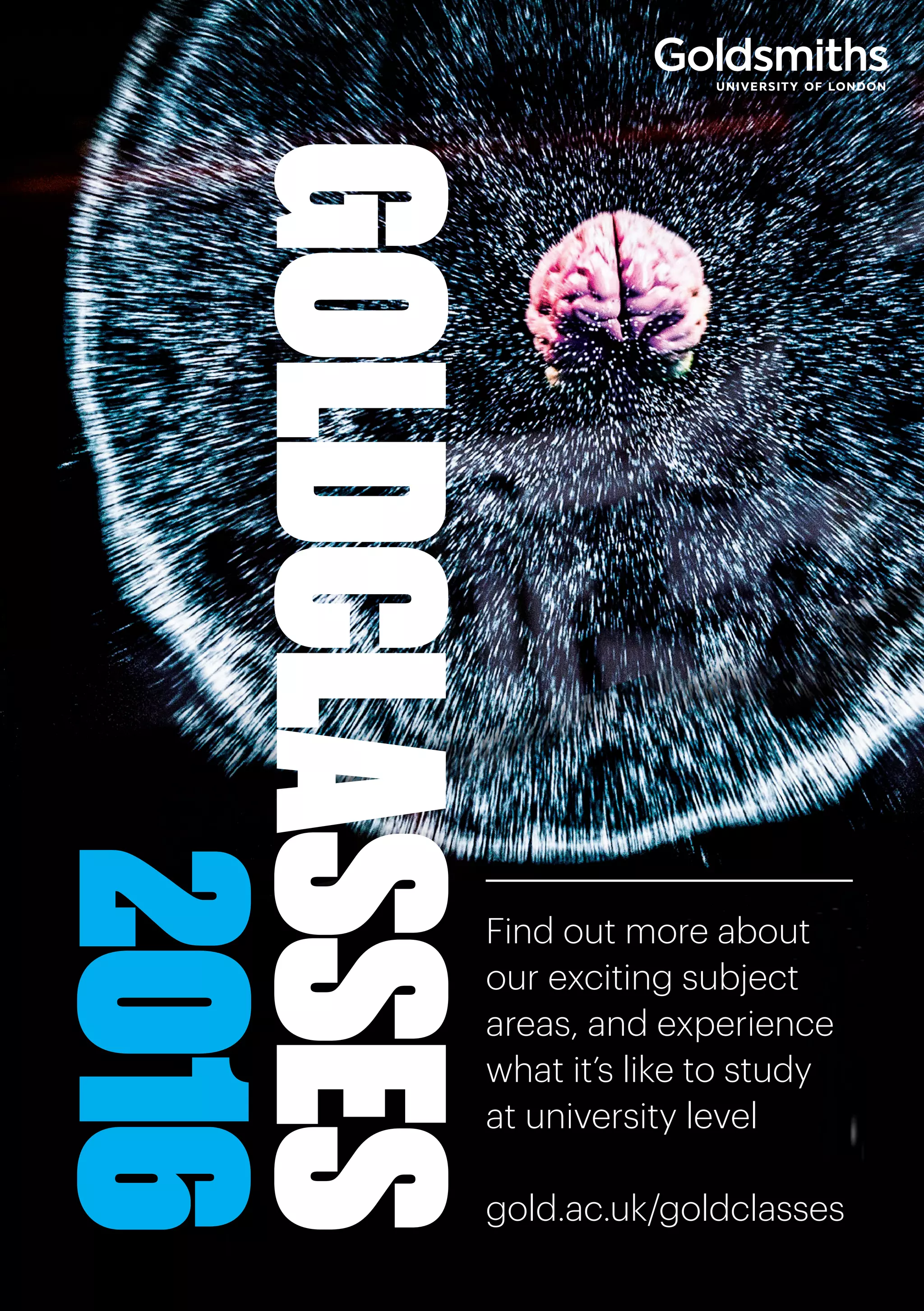
Cover image: student work from the
Goldsmiths undergraduate Media and
Communications animation degree show

Goldsmiths - Goldclass programme 2016

  • 1.
    GOLDCLASSES 2016 Find out moreabout our exciting subject areas, and experience what it’s like to study at university level gold.ac.uk/goldclasses
  • 2.
    3 At Goldsmiths, Universityof London we offer a range of subject-based masterclasses that give Year 12 students the opportunity to gain an in-depth understanding of teaching and learning at university level. Developed and delivered by leading academic staff, Goldclasses aim to stimulate enquiry, broaden knowledge of the subject area, and introduce students to a wider network of academics, undergraduate students and peers. Sessions run from March to July in the following subject areas: Anthropology Art Arts Management Chinese Studies Computing Criminology Design Economics Educational Studies English History History of Art Management Media & Communications Music Politics Psychology Sociology Social Work Theatre & Performance Therapeutic Studies Visual Cultures Some masterclasses relate closely to the school curriculum, enabling students to enhance their current studies. Others introduce new topics studied at university level, exposing students to subjects beyond the post-16 secondary syllabus. They are not revision lectures, but academic sessions that include: −− Stimulating lectures or workshops delivered by Goldsmiths academics −− The opportunity to discuss the topic and ask questions −− An introduction to the university admissions process −− The opportunity to hear about life as a Goldsmiths student from a current undergraduate Anthropology Anthropology in the 21st Century (and how we got like this) Lecturer: Dr Gavin Weston 18 March, 2pm-3.30pm Location: Professor Stuart Hall Building, Room 326 OR 28 June, 10.30am-12midday Location: Richard Hoggart Building, Room 137a This masterclass will give you a brief history of social anthropology and an overview of the discipline in the contemporary world. We will explore the shifts from classical ethnography of villages in ‘exotic’ locations to newer forms of anthropology at home, in cities and online, and how these all revolve around the central idea of ethnographic research. We will look at examples of ethnography from around the world to reflect upon the amazing breadth of anthropologists’ research interests. Art Fine Art and History of Art: Making, Thinking, Writing and All Points In Between Lecturer: Marion Coutts 23 March, 2pm-3.30pm Location: Professor Stuart Hall Building, Room LG02 You are a new student on Fine Art and History of Art. What does week one in the studio feel like? Not like school. Not much like Foundation either. Using your own ideas as a starting point, this session will imaginatively engage with the idea of student-centred learning from the start. We will think about how we learn, look at practical and theoretical ways of progressing ideas, and discuss change and risk to explore what contemporary art and visual culture might mean to you. ArtsManagement Arts Management: Creating the Possibility of Creation Lecturer: Dr Victoria Alexander 10 March, 10.30am-12midday Location: Richard Hoggart Building, Room 143 OR 29 June, 2pm-3.30pm Location: Richard Hoggart Building, Room 137a The cultural and creative sector is one of the quickest-growing sectors in the UK and across the world, providing jobs for millions of people. Some of those people are artists or ‘creatives’; however, creativity cannot happen in a vacuum. In order for projects to be realised, a whole range of activities from planning to funding need to be in place. Supporting creativity is a fundamentally creative act in itself. Popular music gigs, classical music concerts, theatre shows, art exhibitions, dance performances, film festivals, street festivals and every imaginable artistic event happen because someone produces them, and the art world would not function without someone to arrange for ticket or object sales, fundraising, audience development and other crucial activities. This masterclass introduces key concepts of arts management, and INTRODUCTION Find out more School or college groups and individuals can make a booking request at www.gold.ac.uk/ goldclasses or by emailing goldclass@gold.ac.uk Feel free to get in touch if you have any questions; we look forward to welcoming you to the Goldsmiths campus soon!
  • 3.
    4 5 explains whyit is such an exciting and growing field. Through case studies of real arts organisations, you will develop and engage with planning and problem solving skills that could be the first step in a successful career in which you create the possibility of creation. Computing Creative Programming Lecturer: Dr Marco Gillies 9 March, 3pm-5pm Location: Richard Hoggart Building, Room 306 This masterclass will introduce you to the way we teach computer programming at Goldsmiths: a way that emphasises your independence and creativity by working with graphics, interaction and sound from the very beginning. Graphics and Sound Lecturer: Dr Simon Katan 23 March, 3pm-5pm Location: Richard Hoggart Building, Room 306 This masterclass helps you get started creating real-time graphics and sound for web, desktop and mobile devices. Based on our hugely popular online and undergraduate courses, you will be shown how to start drawing and controlling sound, and begin to handle computer interaction for web design, mobile app development, gaming, music and the arts. Being an Entrepreneur in the Digital Age Lecturer: Dr James Ohene-Djan 29 June, 3pm-5pm Location: Richard Hoggart Building, Room 306 The UK’s Tech City, based in Shoreditch, is now one of the major world centres for start-up companies. Whether it’s e-retailing, gaming, social media or electronic commerce, the UK has a flourishing business computing and entrepreneurial community. This session aims to introduce you to some of the key activities and processes involved in creating a new start-up internet business. During the masterclass you will work on developing a new internet start-up. Create an idea for a new mobile internet business; perform a SWOT analysis; propose a brand and its values; develop a revenue model; create a storyboard for your business pitch; record a video elevator pitch. ChineseStudies Confucius Institute: Mandarin for Beginners Lecturers: Maria Thomas, Peipei Yang & Tian Yiyun 11 March, 10.30am-12midday Location: Richard Hoggart Building, Room 352 OR 5 July, 2pm-3.30pm Location: Professor Stuart Hall Building, Room 305 This will be a Mandarin masterclass for beginners, consisting of a sample lecture and two workshops – Chinese paper-cutting and a Chinese dance demonstration. In the sample lecture, you will be given an understanding of the unique writing system of the language, and learn some useful daily expressions. Criminology Criminology and ‘The Riots’ Lecturer: Dr Alex Rhys-Taylor 4 March, 10.30am-12midday Location: Richard Hoggart Building, Room 143 Following the famous riots that spread across British cities in 2011, Boris Johnson, the mayor of London, warned of the dangers of trying to find ‘sociological explanations’ for these crimes. At the same time, the home secretary assured us ‘the only cause of a crime is a criminal’. Taking issue with these soundbites, this lecture argues for the vital importance of sociology and criminology – firstly, explaining the circumstances out of which urban crises arise, and secondly, explaining why influential leaders speak and think about these crimes in the way that they do. It concludes by arguing that critical criminology can play a vital part in shaping the ways in which we think about ‘deviance’ in European cities and subsequently in delivering a more just society. Design Design at Goldsmiths: An Introduction to Theory and Practice Lecturer: Tearlach Byford-Flockhart 10 March, 2pm-3.30pm Location: Richard Hoggart Building, Room 143 OR 20 June, 2pm-3.30pm Location: Richard Hoggart Building, Room 342 Join us for an interactive and hands- on workshop, showcasing how theory and practice are combined in the Goldsmiths BA Design degree. Materials will be provided for you to design and fabricate the front cover of a zine that summarises something important to you. Our aim is to understand how simply cutting things up can help us start to develop ideas without the use of drawing or building. At the end of the session we will share the work – which students will be able to take home with them – and explore the theory and messages that are reflected by the products.
  • 4.
    6 7 Economics Why AreSome Countries Richer Than Others? Questions and Answers from Economics and Other Social Sciences Lecturers: Dr Ivano Cardinale & Dr Constantinos Repapis 8 March, 10.30am-12midday Location: Richard Hoggart Building, Room 256 OR 30 June, 10.30am-12midday Location: Richard Hoggart Building, Room 137 In this lecture we ask one of the most important questions in economics: why are some countries richer than others? We will discuss the answers that different economists have given, and how other social sciences can contribute to the debate. The lecture will give us the chance to talk about what it is like to study economics at university and what is distinctive about economics at Goldsmiths: that you will not only master the tools of economics, but also understand the broader social, historical and political context of the discipline. EducationalStudies What is a Researcher? Lecturer: Dr Anna Carlile 4 March, 2pm-3.30pm Location: Richard Hoggart Building, Room 143 OR 29 June, 10.30am-12midday Location: Richard Hoggart Building, Room 143 In this masterclass you will find out which university degrees and careers require research skills and learn how to conduct qualitative research. We will be trying out a few research skills, in the session, including active listening, interviewing, and interview note taking. Most importantly, we will be working on discovering what students think we researchers should be finding out about. We will therefore be asking: what is important to you, in your family, your neighbourhood, your school, and your world? English& ComparativeLiterature All This Stench: Corpses in the Literature of the Great War Lecturer: Dr Frank Krause 4 March, 2pm-3.30pm Location: Richard Hoggart Building, Room 142 Many soldiers of the Great War were regularly exposed to the smell of dead bodies; in literature, the combatants’ disturbing experience of close proximity to corpses is often presented as a threat to the self’s boundaries, or as a deprivation of indispensable burial rites. This lecture will focus on the lesser-known literary method of charging the stench of decomposition with symbolic meaning supposed to reveal the cultural significance of death in war. Reading the American Landscape: Robert Frost’s ‘Birches’ Lecturer: Dr Gail McDonald 20 June, 10.30am-12midday Location: Richard Hoggart Building, Room 137 The snowy New England landscape is an exemplary site for American modernism’s re-thinking of Romanticism. Using Robert Frost’s ‘Birches’ as an example, the lecture will consider how 20th-century views of nature diverge from those of English Romantic poets such as Coleridge and American Transcendentalists such as Emerson. A copy of ‘Birches’ will be provided. History Corporate Raiders, Corporate Empire? The Origins of British Rule in India Lecturer: Dr Erica Wald 4 March, 10.30am-12midday Location: Richard Hoggart Building, Room 137 This masterclass examines the fierce competition between rival trading companies – the Portuguese, Dutch and the English East India Companies between the 17th and early 19th centuries. This corporate rivalry eventually resulted in the British gaining an imperial foothold in India. From these roots, the second British Empire was born. How did the East India Company rule and expand during this period? This lecture analyses imperial rivalries and explores how the Company came to rule what would become the ‘jewel’ in the crown of Britain’s empire. The Great Catastrophe: Germany and Austria-Hungary in the First World War Lecturer: Dr Alexander Watson 21 June, 2pm-3.30pm Location: Richard Hoggart Building, Room 300a This masterclass looks at the First World War from Germany’s and Austria-Hungary’s perspectives. It examines why these states’ peoples followed their leaders to war in 1914 and why they endured over four years of conflict. From Lviv in the east to Lorraine in the west, societies underwent total mobilisation. They faced mortal threat. Terrifying Russian invasions ravaged their border provinces. A ruthless British naval ‘starvation blockade’ isolated them from the world and contributed to the deaths of a million Central European civilians. Management Institute of Management Studies: Entrepreneurs as Entrepreneurial Processes Lecturer: Dr Rachel Doern 2 March, 10.30am-12midday Location: Richard Hoggart Building, Room 300a OR 27 June, 10.30am-12midday Location: Richard Hoggart Building, Room 137a This interactive workshop introduces you to the field of entrepreneurship and its role and importance in society, and explores the reasons why people become entrepreneurs. The session will also provide a great opportunity to
  • 5.
    8 9 hear moreabout management courses, meet current students, talk to members of academic staff and hear more about Goldsmiths. Media&Communications Media as Cultural Industries Lecturer: Dr Gholam Khiabany 7 March, 10.30am-12midday Location: Ben Pimlott Lecture Theatre This session considers how media is organised and paid for, looking at specific features of cultural products and the consequences of such features for cultural industries. It explores how these broad structures influence our access to the media, the form and content that media takes, and how we think about what media is ‘for’. The session aims to engage with these questions and concerns: −− How many different ways are there to make a product pay? −− Is the price of profitability the end of innovation and individual creativity? −− Is there an inevitable tension between the pursuit of business goals and the public interest? −− Are there any aspects of the contemporary media that cannot be explained by the conditions of production? Race, Representation and the Media Lecturer: Dr Anamik Saha 20 June, 10.30am-12midday Location: Professor Stuart Hall Building, Room 326 This lecture will look at the representation of race in the British media. Focusing mostly on television, we will look at the way that black and Asian people have been represented historically, in a range of genres – from news stories to comedy sitcoms. In the main part of the session we will analyse and discuss contemporary representations of black and Asian people, thinking about how they might challenge or reinforce stereotypes about minorities. The session aims to demonstrate the value of academic enquiry into issues of media representation, making a case for why we need to take the media seriously when trying to understand social attitudes to race and ethnicity. Music Hearing Film: Cinema Soundtracks and the Goldsmiths Aesthetic Lecturer: Dr Holly Rogers 11 March, 2pm-3.30pm Location: Richard Hoggart Building, Room 150 OR 27 June, 2pm-3.30pm Location: Richard Hoggart Building, Room 143 When watching a major Hollywood blockbuster, we are often so engrossed in the action that we fail to hear the soundtrack that underpins it. And yet this ‘inaudible’ music can fundamentally change how we read a film. These unheard soundtracks have prompted a debate that has raged for 30 years: is the music there simply to cover up awkward silences in the cinema? Or is it there to disguise editing and temporal jumps in the image? Some have even claimed that soundtrack appeals to our subconscious, causing us to ‘regress’ into a state more susceptible to the onscreen fantasy. In this lecture, we will consider how the relationship between music and image can determine our reading of a film, and will see how and why the study of audio visual media is at the heart of the Goldsmiths music degree. Politics Politics, Controversy and Equality: An Introduction to Politics at Goldsmiths Lecturers: Dr Paul Gunn & Professor Saul Newman 15 March, 2pm-3.30pm Location: Richard Hoggart Building, Room 342 In this masterclass we introduce you to two types of politics: first, the act of practising politics by studying it; second, one of the most ubiquitous political questions in human life – the issue of equality. These topics will be presented via two mini lectures, which will give you a chance to consider the value of a politics degree, to challenge and question the speakers, and, ultimately, to form a stronger and more nuanced understanding of politics. Politics, Ideology and the Conservatives: An Introduction to Politics at Goldsmiths Lecturers: Dr Simon Griffiths & Dr Paul Gunn 21 June, 10.30-12midday Location: Whitehead Building, Ian Gulland Lecture Theatre In this masterclass, we introduce you to two types of politics: first, the act of practising politics by studying it; and second, the power politics of the Cameron government. These topics will be presented by way of two mini- lectures, which will give students a chance to consider the value of a politics degree, to challenge and question the speakers, and, ultimately, to form a stronger and more nuanced understanding of politics. Psychology Psychology of Ghosts, Hauntings and Magic Lecturers: Professor Chris French & Dr Gustav Kuhn 2 March, 2pm-3.30pm Location: Whitehead Building, Ian Gulland Lecture Theatre OR 27 June, 2pm-3.30pm Location: Whitehead Building, Ian Gulland Lecture Theatre Opinion polls repeatedly show relatively high levels of belief in ghosts, and a sizeable minority of the population claim to have personally encountered a ghost. Professor French will consider a number of factors that may lead people to claim that they have experienced a ghost even though they may not in fact have done so. Dr Kuhn will discuss how magicians exploit limitations in our cognition to distort our visual perception.
  • 6.
    10 11 Sociology ‘British Values’and the Sociology of Racism in the 21st Century Lecturer: Dr Brett St Louis 27 June, 10.30-12midday Location: Professor Stuart Hall Building, Room 326 During the latter half of the 20th century many sociologists have argued that racism has assumed more subtle forms. These newer expressions of racism are said to be less predicated on biological notions of ‘superior’ and ‘inferior’ races and increasingly reliant on replacement terms such as ‘culture’ and ‘difference’. Within British governmental discourse, for example, a values deficit is identified as emerging from ‘cultural diversity’ and ‘faith communities’, evidenced in general terms by the ‘failure of multiculturalism’. This lecture will ask whether we are now witnessing both a ‘softening’ and ‘hardening’ of racist discourse during the early 21st century and discuss the sociological implications for understanding racism within contemporary multicultural Britain. SocialWork History of Social Work Lecturer: Tom Henri 14 March, 10.30am-12midday Location: Professor Stuart Hall Building, Room 305 This lecture will locate social work within the contexts of five historical moments. Social work is positioned at these moments in their respective welfare regimes, and specifically concerns the management and regulation of ‘the social’. Relating Practice and Theory in Social Work Lecturer: Adi Staempfli 24 June, 10.30am-12midday Location: Professor Stuart Hall Building, Room 305 This lecture considers how theory and practice can be connected. We would like to consider what Schön calls the ‘swampy’ ground of professional practice. Social work intervenes between individuals and society where social problems arise. These situations are as unique as the individuals and their interests. Applied Social Science, Community and Youth Work Lecturer: Susan Westman 8 March, 2pm-3.30pm Location: Professor Stuart Hall Building, Room 314 This masterclass will offer a short and practical overview of the rewards and challenges of following a career in community or youth work. It will outline some of what you would study on the BA Applied Social Science, Community Development and Youth Work degree, the kind of placement opportunities that students undertake, varying areas of study that are offered, and possible career paths for graduates from this successful and popular programme. It will also explore why community and youth work can be such a rewarding and fulfilling career in the 21st century. Theatre&Performance Developing the Performance Vision Lecturer: Dr Fiona Graham 3 March, 2pm-3pm Location: Richard Hoggart Building, Room 143 This session will investigate how visual art can inspire theatre making. You will explore the devising process – working from images produced by a visual artist – then collaborate to develop a collective performance vision and compose a short scene. Please attend wearing comfortable clothes for practical work! Fathers and Daughters: Maternal Absence and Paternal Misogyny in Shakespeare’s ‘The Tempest’ Lecturer: Dr Deirdre Osborne 24 June, 10.30am-12midday Location: Richard Hoggart Building, Room 142 First written and performed in a period of anxieties regarding lineage and inheritance (from Elizabeth I to James I), plays from this period are noticeable for the absence of any living mothers as they foreground the relationships between aristocratic fathers and their female heirs. Join us to explore the play and this topic further, by considering a key passage from ‘The Tempest’. TherapeuticStudies BA Psychosocial Studies Lecturer: Dr Elena Gil Rodriguez 14 March, 10.30am-12midday Location: Richard Hoggart Building, Room 300 This lecture will provide an overview of this novel and innovative degree, and offers the chance to experience a taster of the teaching available in year one of the programme in the form of a session on one of the foundation topics that are covered: ‘Locating psychotherapy and counselling in their historical context’. VisualCultures More Than Meat Joy: Happenings and Performance from Recent Art History Lecturer: Dr Simon O’Sullivan 3 March, 10.30am-12midday Location: Richard Hoggart Building, Room 350 OR 21 June, 10.30am-12midday Location: Professor Stuart Hall Building, Room 322 This masterclass will focus on exciting revolutionary art moments and movements from the 1960s. From Allan Kaprow’s Happenings and Carolee Schneemann’s Performance creating the scene, to Joseph Beuys inheriting it, this crucial era of recent art history will be considered.
  • 7.
    Goldsmiths, University ofLondon New Cross, London SE14 6NW www.gold.ac.uk/goldclasses goldclass@gold.ac.uk Cover image: student work from the Goldsmiths undergraduate Media and Communications animation degree show