Students and list number:
Stephany Bocourt, 11°
Nailimar Adan, 16°
Nicole Colinas, 35°
Hillary Chirinos, 36°
Diana Vásquez, 45°
Year: 4to
Section: “B”
Date: 3/02/2024
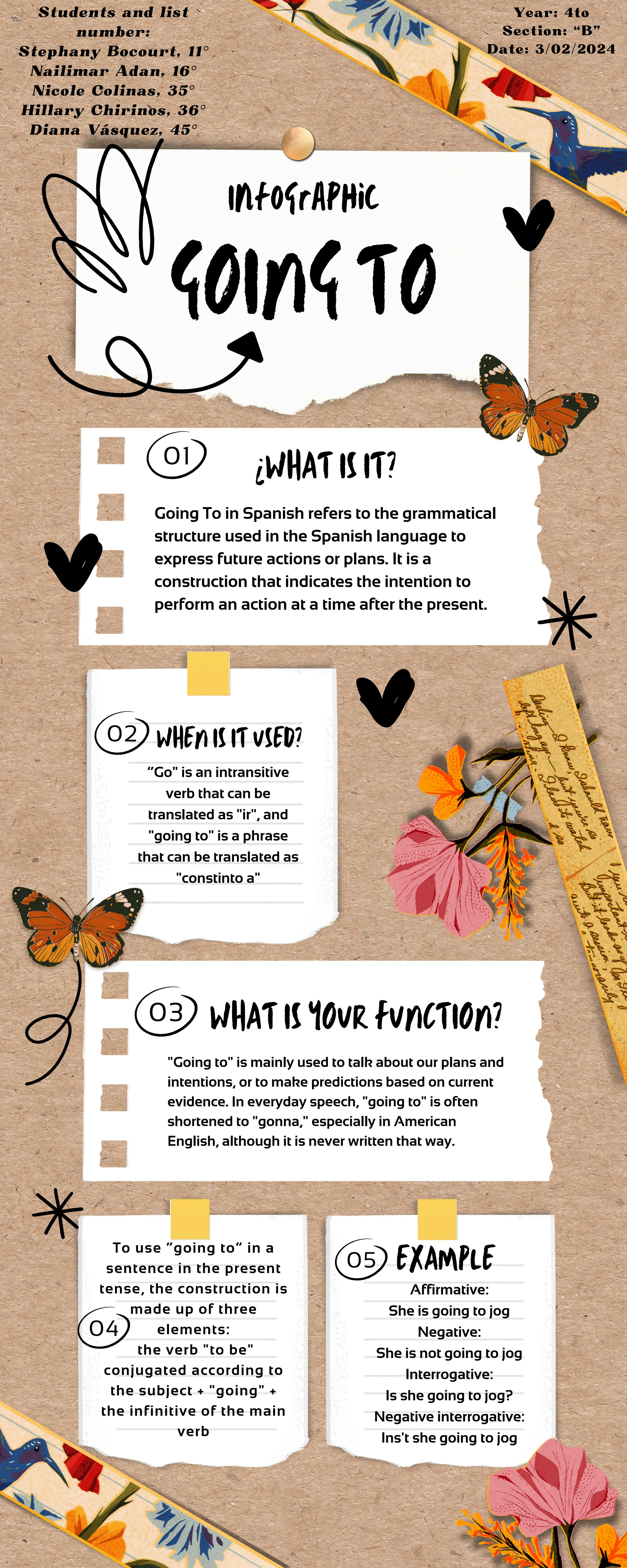
03
01
02
04
Affirmative:
She is going to jog
Negative:
She is not going to jog
Interrogative:
Is she going to jog?
Negative interrogative:
Ins't she going to jog
05
Infographic
GOING TO
Going To in Spanish refers to the grammatical
structure used in the Spanish language to
express future actions or plans. It is a
construction that indicates the intention to
perform an action at a time after the present.
¿WHAT IS IT?
"Going to" is mainly used to talk about our plans and
intentions, or to make predictions based on current
evidence. In everyday speech, "going to" is often
shortened to "gonna," especially in American
English, although it is never written that way.
WHAT IS YOUR FUNCTION?
“Go" is an intransitive
verb that can be
translated as "ir", and
"going to" is a phrase
that can be translated as
"constinto a"
WHEN IS IT USED?
EXAMPLE
To use “going to” in a
sentence in the present
tense, the construction is
made up of three
elements:
the verb "to be"
conjugated according to
the subject + "going" +
the infinitive of the main
verb
Students and list
number:
Stephany Bocourt, 11°
Nailimar Adan, 16°
Nicole Colinas, 35°
Hillary Chirinos, 36°
Diana Vásquez, 45°
Year: 4to
Section: “B”
Date: 3/02/2024
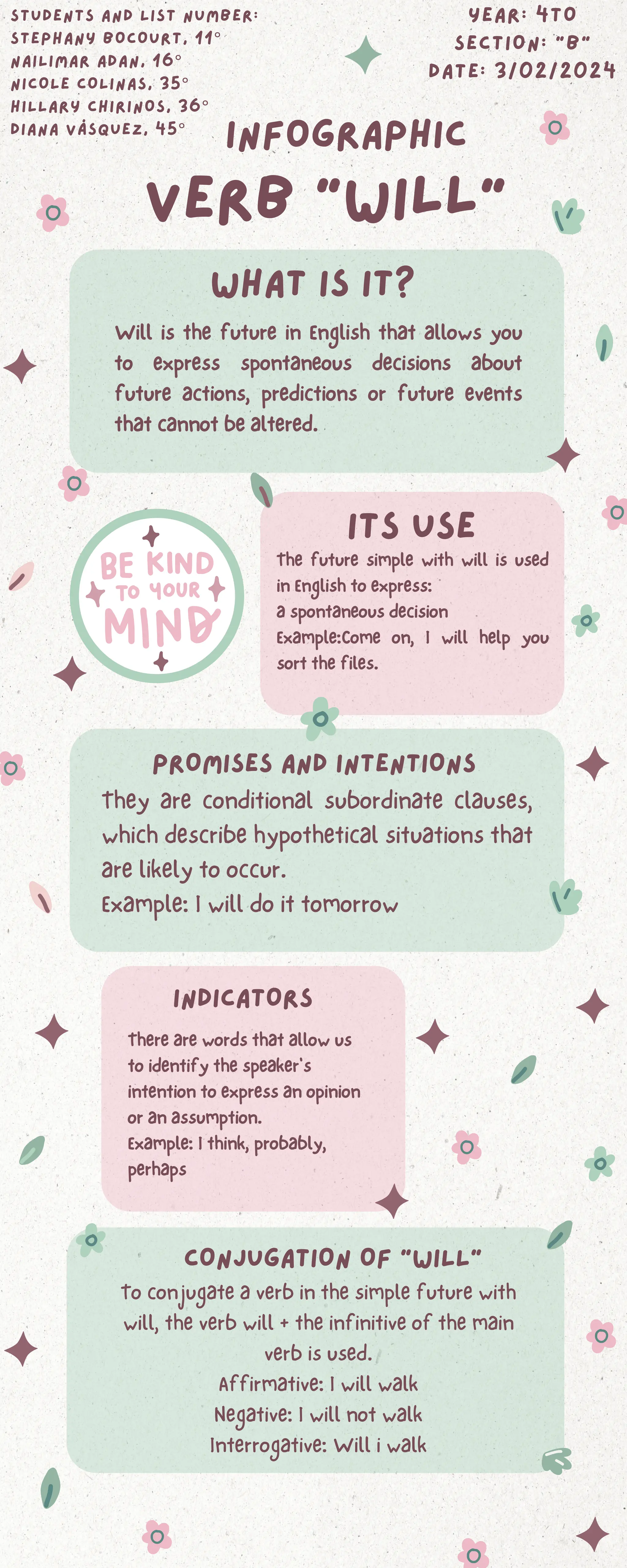
To conjugate a verb in the simple future with
will, the verb will + the infinitive of the main
verb is used.
Affirmative: I will walk
Negative: I will not walk
Interrogative: Will i walk
WHAT IS IT?
Will is the future in English that allows you
to express spontaneous decisions about
future actions, predictions or future events
that cannot be altered.
There are words that allow us
to identify the speaker's
intention to express an opinion
or an assumption.
Example: I think, probably,
perhaps
INDICATORS
The future simple with will is used
in English to express:
a spontaneous decision
Example:Come on, I will help you
sort the files.
ITS USE
CONJUGATION OF "WILL"
Verb “Will”
PROMISES AND INTENTIONS
They are conditional subordinate clauses,
which describe hypothetical situations that
are likely to occur.
Example: I will do it tomorrow
Infographic
STUDENTS AND LIST NUMBER:
STEPHANY BOCOURT, 11°
NAILIMAR ADAN, 16°
NICOLE COLINAS, 35°
HILLARY CHIRINOS, 36°
DIANA VÁSQUEZ, 45°
YEAR: 4TO
SECTION: “B”
DATE: 3/02/2024
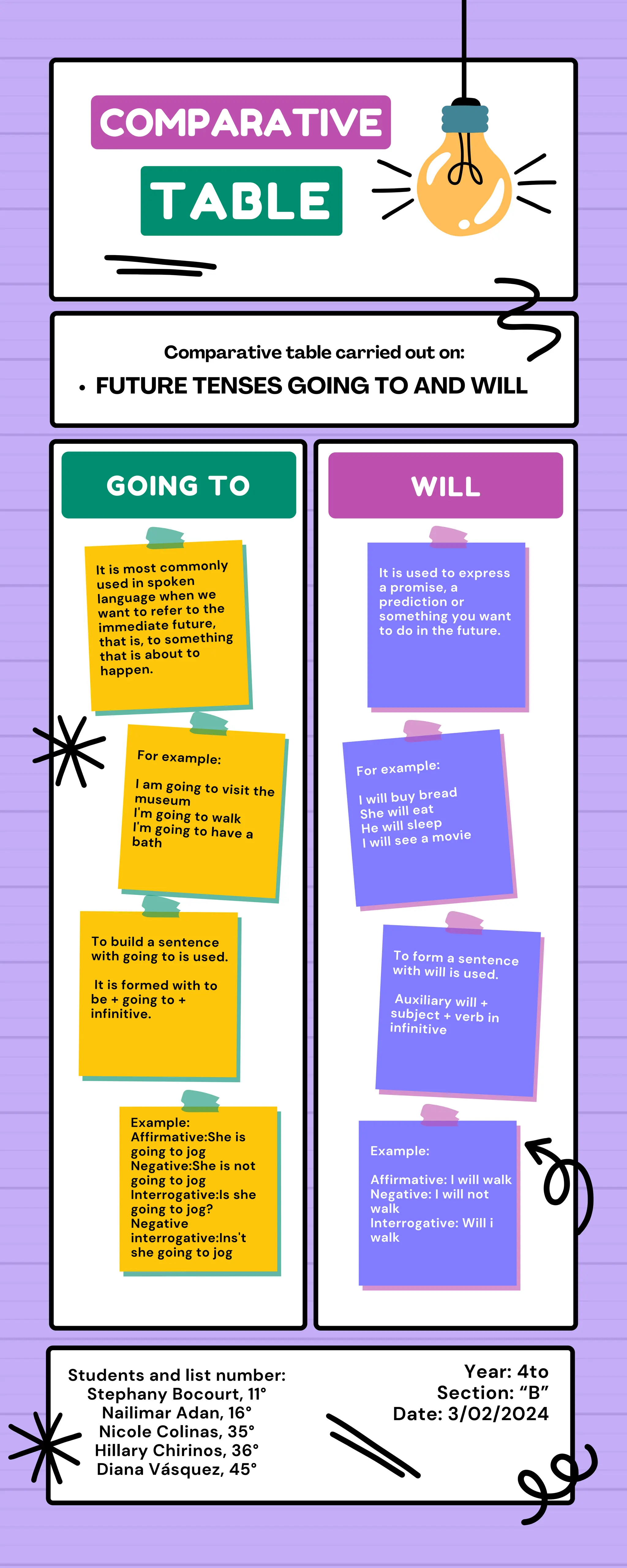
COMPARATIVE
TABLE
GOING TO WILL
Comparative table carried out on:
FUTURE TENSES GOING TO AND WILL
It is used to express
a promise, a
prediction or
something you want
to do in the future.
For example:
I will buy bread
She will eat
He will sleep
I will see a movie
To form a sentence
with will is used.
Auxiliary will +
subject + verb in
infinitive
Example:
Affirmative: I will walk
Negative: I will not
walk
Interrogative: Will i
walk
It is most commonly
used in spoken
language when we
want to refer to the
immediate future,
that is, to something
that is about to
happen.
For example:
I am going to visit the
museum
I'm going to walk
I'm going to have a
bath
To build a sentence
with going to is used.
It is formed with to
be + going to +
infinitive.
Example:
Affirmative:She is
going to jog
Negative:She is not
going to jog
Interrogative:Is she
going to jog?
Negative
interrogative:Ins't
she going to jog
Students and list number:
Stephany Bocourt, 11°
Nailimar Adan, 16°
Nicole Colinas, 35°
Hillary Chirinos, 36°
Diana Vásquez, 45°
Year: 4to
Section: “B”
Date: 3/02/2024

Going to and Will.pdf

  • 1.
    Students and listnumber: Stephany Bocourt, 11° Nailimar Adan, 16° Nicole Colinas, 35° Hillary Chirinos, 36° Diana Vásquez, 45° Year: 4to Section: “B” Date: 3/02/2024
  • 2.
    03 01 02 04 Affirmative: She is goingto jog Negative: She is not going to jog Interrogative: Is she going to jog? Negative interrogative: Ins't she going to jog 05 Infographic GOING TO Going To in Spanish refers to the grammatical structure used in the Spanish language to express future actions or plans. It is a construction that indicates the intention to perform an action at a time after the present. ¿WHAT IS IT? "Going to" is mainly used to talk about our plans and intentions, or to make predictions based on current evidence. In everyday speech, "going to" is often shortened to "gonna," especially in American English, although it is never written that way. WHAT IS YOUR FUNCTION? “Go" is an intransitive verb that can be translated as "ir", and "going to" is a phrase that can be translated as "constinto a" WHEN IS IT USED? EXAMPLE To use “going to” in a sentence in the present tense, the construction is made up of three elements: the verb "to be" conjugated according to the subject + "going" + the infinitive of the main verb Students and list number: Stephany Bocourt, 11° Nailimar Adan, 16° Nicole Colinas, 35° Hillary Chirinos, 36° Diana Vásquez, 45° Year: 4to Section: “B” Date: 3/02/2024
  • 3.
    To conjugate averb in the simple future with will, the verb will + the infinitive of the main verb is used. Affirmative: I will walk Negative: I will not walk Interrogative: Will i walk WHAT IS IT? Will is the future in English that allows you to express spontaneous decisions about future actions, predictions or future events that cannot be altered. There are words that allow us to identify the speaker's intention to express an opinion or an assumption. Example: I think, probably, perhaps INDICATORS The future simple with will is used in English to express: a spontaneous decision Example:Come on, I will help you sort the files. ITS USE CONJUGATION OF "WILL" Verb “Will” PROMISES AND INTENTIONS They are conditional subordinate clauses, which describe hypothetical situations that are likely to occur. Example: I will do it tomorrow Infographic STUDENTS AND LIST NUMBER: STEPHANY BOCOURT, 11° NAILIMAR ADAN, 16° NICOLE COLINAS, 35° HILLARY CHIRINOS, 36° DIANA VÁSQUEZ, 45° YEAR: 4TO SECTION: “B” DATE: 3/02/2024
  • 4.
    COMPARATIVE TABLE GOING TO WILL Comparativetable carried out on: FUTURE TENSES GOING TO AND WILL It is used to express a promise, a prediction or something you want to do in the future. For example: I will buy bread She will eat He will sleep I will see a movie To form a sentence with will is used. Auxiliary will + subject + verb in infinitive Example: Affirmative: I will walk Negative: I will not walk Interrogative: Will i walk It is most commonly used in spoken language when we want to refer to the immediate future, that is, to something that is about to happen. For example: I am going to visit the museum I'm going to walk I'm going to have a bath To build a sentence with going to is used. It is formed with to be + going to + infinitive. Example: Affirmative:She is going to jog Negative:She is not going to jog Interrogative:Is she going to jog? Negative interrogative:Ins't she going to jog Students and list number: Stephany Bocourt, 11° Nailimar Adan, 16° Nicole Colinas, 35° Hillary Chirinos, 36° Diana Vásquez, 45° Year: 4to Section: “B” Date: 3/02/2024