GROUP MEMBERS:
• M.SOHAIB
• ABDUL REHMAN
• SUBHAN GHAZI
GOALS & KNOWLEDGE
REQUIREMENTS FOR
SOCIAL SERVICE
SOCIAL SERVICE
Social service refers to activities or actions that aim to help and
support individuals or communities in need. It can take many
forms, such as volunteering, charitable giving, community
service, and advocacy
GOAL
The primary goal of social service is to improve the well-being
of individuals and communities in need. This can involve
providing various forms of assistance, such as material
resources, emotional support, or advocacy. The aim of social
service is to empower people to lead better lives, regardless of
their backgrounds or circumstances.
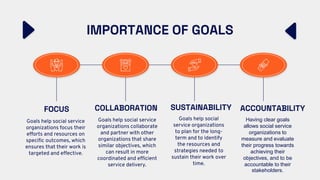
IMPORTANCE OF GOALS
FOCUS
Goals help social service
organizations focus their
efforts and resources on
specific outcomes, which
ensures that their work is
targeted and effective.
COLLABORATION
Goals help social service
organizations collaborate
and partner with other
organizations that share
similar objectives, which
can result in more
coordinated and efficient
service delivery.
SUSTAINABILITY
Goals help social
service organizations
to plan for the long-
term and to identify
the resources and
strategies needed to
sustain their work over
time.
ACCOUNTABILITY
Having clear goals
allows social service
organizations to
measure and evaluate
their progress towards
achieving their
objectives, and to be
accountable to their
stakeholders.
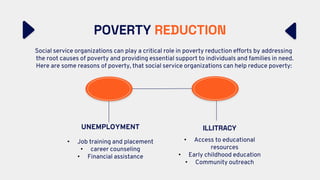
POVERTY REDUCTION
UNEMPLOYMENT
• Job training and placement
• career counseling
• Financial assistance
ILLITRACY
• Access to educational
resources
• Early childhood education
• Community outreach
Social service organizations can play a critical role in poverty reduction efforts by addressing
the root causes of poverty and providing essential support to individuals and families in need.
Here are some reasons of poverty, that social service organizations can help reduce poverty:
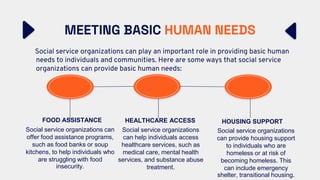
MEETING BASIC HUMAN NEEDS
FOOD ASSISTANCE
Social service organizations can
offer food assistance programs,
such as food banks or soup
kitchens, to help individuals who
are struggling with food
insecurity.
HEALTHCARE ACCESS
Social service organizations
can help individuals access
healthcare services, such as
medical care, mental health
services, and substance abuse
treatment.
HOUSING SUPPORT
Social service organizations
can provide housing support
to individuals who are
homeless or at risk of
becoming homeless. This
can include emergency
shelter, transitional housing.
Social service organizations can play an important role in providing basic human
needs to individuals and communities. Here are some ways that social service
organizations can provide basic human needs:
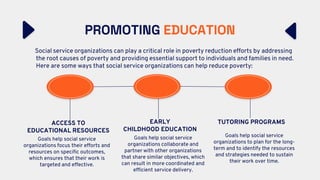
PROMOTING EDUCATION
ACCESS TO
EDUCATIONAL RESOURCES
Goals help social service
organizations focus their efforts and
resources on specific outcomes,
which ensures that their work is
targeted and effective.
EARLY
CHILDHOOD EDUCATION
Goals help social service
organizations collaborate and
partner with other organizations
that share similar objectives, which
can result in more coordinated and
efficient service delivery.
TUTORING PROGRAMS
Goals help social service
organizations to plan for the long-
term and to identify the resources
and strategies needed to sustain
their work over time.
Social service organizations can play a critical role in poverty reduction efforts by addressing
the root causes of poverty and providing essential support to individuals and families in need.
Here are some ways that social service organizations can help reduce poverty:
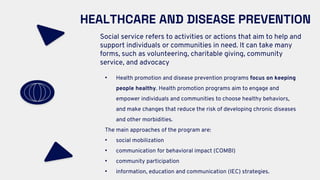
HEALTHCARE AND DISEASE PREVENTION
Social service refers to activities or actions that aim to help and
support individuals or communities in need. It can take many
forms, such as volunteering, charitable giving, community
service, and advocacy
• Health promotion and disease prevention programs focus on keeping
people healthy. Health promotion programs aim to engage and
empower individuals and communities to choose healthy behaviors,
and make changes that reduce the risk of developing chronic diseases
and other morbidities.
The main approaches of the program are:
• social mobilization
• communication for behavioral impact (COMBI)
• community participation
• information, education and communication (IEC) strategies.
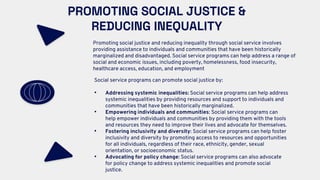
PROMOTING SOCIAL JUSTICE &
REDUCING INEQUALITY
Promoting social justice and reducing inequality through social service involves
providing assistance to individuals and communities that have been historically
marginalized and disadvantaged. Social service programs can help address a range of
social and economic issues, including poverty, homelessness, food insecurity,
healthcare access, education, and employment
Social service programs can promote social justice by:
• Addressing systemic inequalities: Social service programs can help address
systemic inequalities by providing resources and support to individuals and
communities that have been historically marginalized.
• Empowering individuals and communities: Social service programs can
help empower individuals and communities by providing them with the tools
and resources they need to improve their lives and advocate for themselves.
• Fostering inclusivity and diversity: Social service programs can help foster
inclusivity and diversity by promoting access to resources and opportunities
for all individuals, regardless of their race, ethnicity, gender, sexual
orientation, or socioeconomic status.
• Advocating for policy change: Social service programs can also advocate
for policy change to address systemic inequalities and promote social
justice.
BUILDING STRONG AND
SUPPORTIVE COMMUNITIES
Building strong and supportive communities through social service involves creating and
sustaining networks of people who work together to address common challenges and
promote well-being. Social service programs can play a key role in fostering community
building and strengthening social connections by providing resources and opportunities for
individuals to come together, share their experiences, and work collaboratively towards
common goals.
Here are some ways that social service programs can help build strong and
supportive communities:
• Providing opportunities for social interaction: Social service programs can
provide opportunities for people to connect with others who share similar
interests or experiences. For example, community centers may offer programs
for seniors to socialize or for youth to engage in after-school activities.
• Promoting volunteerism and civic engagement: Social service programs can
encourage community members to get involved in volunteer opportunities or
civic engagement activities. This can help build a sense of community and
collective responsibility.
• Offering resources for community development: Social service programs can
offer resources for community development, such as support for local
businesses or neighborhood improvement projects. These programs can help
bring people together around common goals and contribute to the overall well-
being of the community.
KNOWLEDGE REQUIREMENTS
FOR SOCIAL SERVICES
Knowledge is the most important part of social work.
Social workers must have strong grip on following key
points to achieve the goals
HUMAN DEVELOPMENT AND BEHAVIOR
• Social service professionals should have a
comprehensive understanding of human development
and behavior across the lifespan, including the effects
of trauma, mental health disorders, addiction, and other
factors that impact well-being.
• Social workers need to understand how individuals,
families, and communities interact and how social
problems emerge and are maintained.
ADVOCACY AND SOCIAL JUSTICE:
. Social service professionals should be knowledgeable about the
political, economic, and social systems that impact their clients, and
work to advocate for social justice and systemic change.
.Social service professionals should have a solid understanding of
research and evaluation methods to ensure that programs and services
are evidence-based and effective.
. Social work promotes social justice and empowers clients and
communities through advocacy.. You help individuals, families and
communities by advocating for them specifically, but also for social
justice through the advocacy of new programs, revision of outdated
policies and expansions of underserving programs.
CASE MANAGEMENT AND COMMUNICATION
• Social workers should have strong case management skills,
including the ability to coordinate services, advocate for
society, and navigate complex service systems.
• Social workers should have excellent communication skills,
including the ability to listen actively, express empathy, and
build rapport with society. They should also be able to
communicate effectively with colleagues, other professionals,
and community stakeholders.
SOCIAL AND CULTURAL DIVERSITY
• A deep understanding of the impact of culture, race, ethnicity,
gender, socioeconomic status, and other factors on individuals,
families, and communities is essential to effectively serving
diverse populations.
• Social workers must be able to work effectively with individuals
from diverse backgrounds and understand the role that culture
plays in shaping society experiences and perspectives
• Social diversity is all of the ways that people within a single
culture are set apart from each other. Elements of social diversity
can include ethnicity, lifestyle, religion, language, tastes and
preferences. We should remove this culture.
KNOWLEDGE OF SOCIAL ISSUES
AND POLICIES
• Social workers should have a strong grasp of social issues,
such as poverty, homelessness, mental health, substance
abuse, child welfare, and domestic violence. They should
also understand how these issues intersect and affect
different populations.
• Social workers should have a deep understanding of the
principles and practices of social work also need to be
knowledgeable about the policies and programs that are in
place to address social problems work
SOCIAL WELFARE POLICIES
AND ASSESSMENT
• Understanding the social welfare policies and programs that
exist at the local, state, and federal levels is essential for
identifying resources and support for clients.
• Knowledge of a range of assessment and intervention
strategies is essential to help clients achieve their goals and
improve their overall well-being.
NGO ICON PACK

Goals and Knowledge requirements for social service

  • 1.
    GROUP MEMBERS: • M.SOHAIB •ABDUL REHMAN • SUBHAN GHAZI GOALS & KNOWLEDGE REQUIREMENTS FOR SOCIAL SERVICE
  • 2.
    SOCIAL SERVICE Social servicerefers to activities or actions that aim to help and support individuals or communities in need. It can take many forms, such as volunteering, charitable giving, community service, and advocacy GOAL The primary goal of social service is to improve the well-being of individuals and communities in need. This can involve providing various forms of assistance, such as material resources, emotional support, or advocacy. The aim of social service is to empower people to lead better lives, regardless of their backgrounds or circumstances.
  • 3.
    IMPORTANCE OF GOALS FOCUS Goalshelp social service organizations focus their efforts and resources on specific outcomes, which ensures that their work is targeted and effective. COLLABORATION Goals help social service organizations collaborate and partner with other organizations that share similar objectives, which can result in more coordinated and efficient service delivery. SUSTAINABILITY Goals help social service organizations to plan for the long- term and to identify the resources and strategies needed to sustain their work over time. ACCOUNTABILITY Having clear goals allows social service organizations to measure and evaluate their progress towards achieving their objectives, and to be accountable to their stakeholders.
  • 4.
    POVERTY REDUCTION UNEMPLOYMENT • Jobtraining and placement • career counseling • Financial assistance ILLITRACY • Access to educational resources • Early childhood education • Community outreach Social service organizations can play a critical role in poverty reduction efforts by addressing the root causes of poverty and providing essential support to individuals and families in need. Here are some reasons of poverty, that social service organizations can help reduce poverty:
  • 5.
    MEETING BASIC HUMANNEEDS FOOD ASSISTANCE Social service organizations can offer food assistance programs, such as food banks or soup kitchens, to help individuals who are struggling with food insecurity. HEALTHCARE ACCESS Social service organizations can help individuals access healthcare services, such as medical care, mental health services, and substance abuse treatment. HOUSING SUPPORT Social service organizations can provide housing support to individuals who are homeless or at risk of becoming homeless. This can include emergency shelter, transitional housing. Social service organizations can play an important role in providing basic human needs to individuals and communities. Here are some ways that social service organizations can provide basic human needs:
  • 6.
    PROMOTING EDUCATION ACCESS TO EDUCATIONALRESOURCES Goals help social service organizations focus their efforts and resources on specific outcomes, which ensures that their work is targeted and effective. EARLY CHILDHOOD EDUCATION Goals help social service organizations collaborate and partner with other organizations that share similar objectives, which can result in more coordinated and efficient service delivery. TUTORING PROGRAMS Goals help social service organizations to plan for the long- term and to identify the resources and strategies needed to sustain their work over time. Social service organizations can play a critical role in poverty reduction efforts by addressing the root causes of poverty and providing essential support to individuals and families in need. Here are some ways that social service organizations can help reduce poverty:
  • 7.
    HEALTHCARE AND DISEASEPREVENTION Social service refers to activities or actions that aim to help and support individuals or communities in need. It can take many forms, such as volunteering, charitable giving, community service, and advocacy • Health promotion and disease prevention programs focus on keeping people healthy. Health promotion programs aim to engage and empower individuals and communities to choose healthy behaviors, and make changes that reduce the risk of developing chronic diseases and other morbidities. The main approaches of the program are: • social mobilization • communication for behavioral impact (COMBI) • community participation • information, education and communication (IEC) strategies.
  • 8.
    PROMOTING SOCIAL JUSTICE& REDUCING INEQUALITY Promoting social justice and reducing inequality through social service involves providing assistance to individuals and communities that have been historically marginalized and disadvantaged. Social service programs can help address a range of social and economic issues, including poverty, homelessness, food insecurity, healthcare access, education, and employment Social service programs can promote social justice by: • Addressing systemic inequalities: Social service programs can help address systemic inequalities by providing resources and support to individuals and communities that have been historically marginalized. • Empowering individuals and communities: Social service programs can help empower individuals and communities by providing them with the tools and resources they need to improve their lives and advocate for themselves. • Fostering inclusivity and diversity: Social service programs can help foster inclusivity and diversity by promoting access to resources and opportunities for all individuals, regardless of their race, ethnicity, gender, sexual orientation, or socioeconomic status. • Advocating for policy change: Social service programs can also advocate for policy change to address systemic inequalities and promote social justice.
  • 9.
    BUILDING STRONG AND SUPPORTIVECOMMUNITIES Building strong and supportive communities through social service involves creating and sustaining networks of people who work together to address common challenges and promote well-being. Social service programs can play a key role in fostering community building and strengthening social connections by providing resources and opportunities for individuals to come together, share their experiences, and work collaboratively towards common goals. Here are some ways that social service programs can help build strong and supportive communities: • Providing opportunities for social interaction: Social service programs can provide opportunities for people to connect with others who share similar interests or experiences. For example, community centers may offer programs for seniors to socialize or for youth to engage in after-school activities. • Promoting volunteerism and civic engagement: Social service programs can encourage community members to get involved in volunteer opportunities or civic engagement activities. This can help build a sense of community and collective responsibility. • Offering resources for community development: Social service programs can offer resources for community development, such as support for local businesses or neighborhood improvement projects. These programs can help bring people together around common goals and contribute to the overall well- being of the community.
  • 10.
    KNOWLEDGE REQUIREMENTS FOR SOCIALSERVICES Knowledge is the most important part of social work. Social workers must have strong grip on following key points to achieve the goals
  • 11.
    HUMAN DEVELOPMENT ANDBEHAVIOR • Social service professionals should have a comprehensive understanding of human development and behavior across the lifespan, including the effects of trauma, mental health disorders, addiction, and other factors that impact well-being. • Social workers need to understand how individuals, families, and communities interact and how social problems emerge and are maintained.
  • 12.
    ADVOCACY AND SOCIALJUSTICE: . Social service professionals should be knowledgeable about the political, economic, and social systems that impact their clients, and work to advocate for social justice and systemic change. .Social service professionals should have a solid understanding of research and evaluation methods to ensure that programs and services are evidence-based and effective. . Social work promotes social justice and empowers clients and communities through advocacy.. You help individuals, families and communities by advocating for them specifically, but also for social justice through the advocacy of new programs, revision of outdated policies and expansions of underserving programs.
  • 13.
    CASE MANAGEMENT ANDCOMMUNICATION • Social workers should have strong case management skills, including the ability to coordinate services, advocate for society, and navigate complex service systems. • Social workers should have excellent communication skills, including the ability to listen actively, express empathy, and build rapport with society. They should also be able to communicate effectively with colleagues, other professionals, and community stakeholders.
  • 14.
    SOCIAL AND CULTURALDIVERSITY • A deep understanding of the impact of culture, race, ethnicity, gender, socioeconomic status, and other factors on individuals, families, and communities is essential to effectively serving diverse populations. • Social workers must be able to work effectively with individuals from diverse backgrounds and understand the role that culture plays in shaping society experiences and perspectives • Social diversity is all of the ways that people within a single culture are set apart from each other. Elements of social diversity can include ethnicity, lifestyle, religion, language, tastes and preferences. We should remove this culture.
  • 15.
    KNOWLEDGE OF SOCIALISSUES AND POLICIES • Social workers should have a strong grasp of social issues, such as poverty, homelessness, mental health, substance abuse, child welfare, and domestic violence. They should also understand how these issues intersect and affect different populations. • Social workers should have a deep understanding of the principles and practices of social work also need to be knowledgeable about the policies and programs that are in place to address social problems work
  • 16.
    SOCIAL WELFARE POLICIES ANDASSESSMENT • Understanding the social welfare policies and programs that exist at the local, state, and federal levels is essential for identifying resources and support for clients. • Knowledge of a range of assessment and intervention strategies is essential to help clients achieve their goals and improve their overall well-being.
  • 17.