GNFC (ANILINE) (1) process for manufacturing and use
1.
GOVERNMENT ENGINEERING COLLEGE,VALSAD
BRANCH: CHEMICAL ENGINEERING DEPARTMENT
Academic Year: 2025, Semester- 8
INDUSTRIAL INTERNSHIP
AT
ATUL LTD, VALSAD
Prepared By: Patel Jenil Shailesh, 220193105019
Guided By: Prof. D. D. Dhimmar
2.
CONTENT
• INTRODUCTION
• COMPANYOVERVIEW
• PRODUCTS
• APPLICATIONS
• MANUFACTURING PROCESS
• RAW MATERIALS & ITS PROPERTIES
• REACTIONS
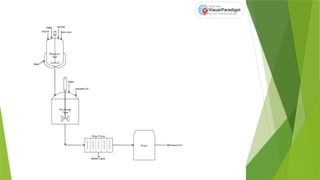
• BLOCK DIAGRAM
• VARIOUS UNIT OPERATIONS & PROCESSES
3.
INTRODUCTION
COMPANY OVERVIEW
TheAtul limited is integrated Chemical industry founded by Kasturbhai Lalbhai on 5th
September, 1947 in Valsad. The company manufactures 900 products and over 400
formulations and owns 140 retail brands. It serves 4000 customers belonging to 30 diverse
industries and has establish subsidiary companies in the US, the UK, the UAE, China, and
Brazil to serve its customers. The first manufacturing site of company in Atul, Gujarat
spread over 1250 acres. The company has registered office in Ahmedabad and head office
at Atul, both in Gujarat.
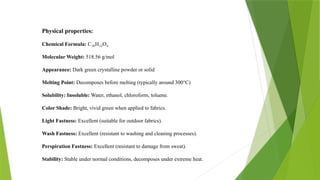
Physical properties:
Chemical Formula:C H O
₃₆ ₂₂ ₄
Molecular Weight: 518.56 g/mol
Appearance: Dark green crystalline powder or solid
Melting Point: Decomposes before melting (typically around 300°C)
Solubility: Insoluble: Water, ethanol, chloroform, toluene.
Color Shade: Bright, vivid green when applied to fabrics.
Light Fastness: Excellent (suitable for outdoor fabrics).
Wash Fastness: Excellent (resistant to washing and cleaning processes).
Perspiration Fastness: Excellent (resistant to damage from sweat).
Stability: Stable under normal conditions, decomposes under extreme heat.
7.
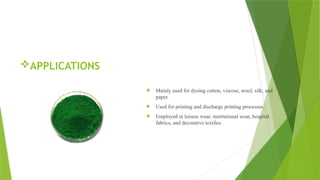
APPLICATIONS
Mainly usedfor dyeing cotton, viscose, wool, silk, and
paper.
Used for printing and discharge printing processes.
Employed in leisure wear, institutional wear, hospital
fabrics, and decorative textiles.
8.
MANUFACTURING PROCESS
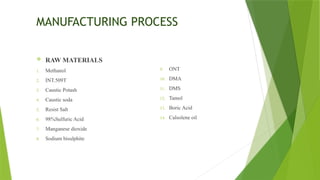
RAWMATERIALS
1. Methanol
2. INT.509T
3. Caustic Potash
4. Caustic soda
5. Resist Salt
6. 98%Sulfuric Acid
7. Manganese dioxide
8. Sodium bisulphite
9. ONT
10. DMA
11. DMS
12. Tamol
13. Boric Acid
14. Calsolene oil
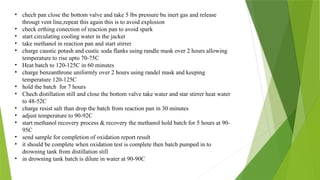
• chech panclose the bottom valve and take 5 lbs pressure bu inert gas and release
througt vent line,repeat this again this is to avoid explosion
• check erthing conection of reaction pan to avoid spark
• start circulating cooling water in the jacket
• take methanol in reaction pan and start stirrer
• charge caustic potash and custic soda flanks using randle mask over 2 hours allowing
temperature to rise upto 70-75C
• Heat batch to 120-125C in 60 minutes
• charge benzanthrone uniformly over 2 hours using randel mask and keeping
temperature 120-125C
• hold the batch for 7 hours
• Chech distillation still and close the bottom valve take water and star stirrer heat water
to 48-52C
• charge resist salt than drop the batch from reaction pan in 30 minutes
• adjust temperature to 90-92C
• start methanol recovery process & recovery the methanol hold batch for 5 hours at 90-
95C
• send sample for completion of oxidation report result
• it should be complete when oxidation test is complete then batch pumped in to
drowning tank from distillation still
• in drowning tank batch is dilute in water at 90-90C
12.
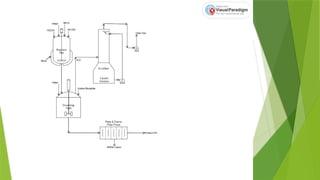
• Acidity PreparationDirectly in Reaction Pan Check Reaction pan.
• Charge H2SO4 From M.V IN The Reaction Pan.
• Start stirrer and circulate brine in jacket.
• Charge water from M.V. keeping Temperature below 60C stir 30 minutes and send
sample for % Acidity and continue cooling up to 20C
• If result is ok.Cool reaction mass up to 6-8C.
• Charge MnO2 in 1 hour at 6-8C and stir for 15 minutes.
• Charge INT.835 pdr. uniformaly in 10-12 hours below 24C.
• Hold the batch for 2 hours at 20-22C.
• Send sample for present of INT.835 is present add extra 25kg MnO2.
• Stir for 1 hour and resample INT.835 must be absent, if sample ok blow batch to
drowning Tank.
• Check Drowning Tank. Charge water and start stirrer.
• Charge sodium bisulphite pdr. and stir for 1 hour.
• Blow the batch from reaction pan to drowning tank in 1 hour record temperature.
• Hold batch for s hours and send sample to Lab for
• 1.Excess of SO2
• 2.Appearancer of wetcake
• When test is ok Heat the batch to boiling temperature.
• Hold the batch for 2 hours at boling temperature.
• Filter batch in press.
• Air dry for 1 hour then load in dryer and dry the batch in oven.
14.
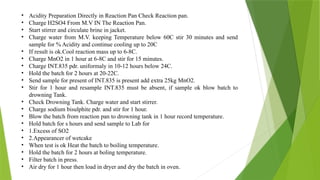
• charge freshONT from storage to reaction pan
• stir for 15 minutes than add DMA to the reaction pan
• send sample for % DMA and % water content adjust % DMA 7.0 TO 7.5 by adding DMA
from storage
• close reaction pan manhole and heat to 95-100C
• charge 16,17-Dihydroxy dibenzanthrone wet cake and soda ash through small manhole door
uniformly maintaining temperature 108-115C over 6 to 8 hours
• send sample for % water content present record temperature and height
• receive batch from reaction pan to other reaction pan
• close manhole door and start stirrer and heat batch to 170-175C in 1-2 hours using IP stream
in coil
• dehydrate the batch for 1 hours at 170-175C
• add DMS to the reaction maintaining temperature 170-175C
• hold the batch for 6 hours at 170-175C
• cool batch to 90-95C in 2 hours
• charge ONT in another reaction pan start stirrer and raise temperature to 100-106C before
using for wash in ANFD
• blow the batch from second reaction pan to ANFD give inert gas pressure on ANFD and
continue to suck the mother liquor from slurry
• after fully sucking of mother liquor, give previously heated ONT wash from reaction pan to
ANFD
15.
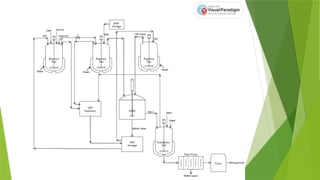
• make reslurryin ANFD by down the stirrer for 10-15 minutes
• take the stirrer upward and start the inert gas pressure to suck ONT wash completely
• test the completion of washing of ANFD, if not ok than arrange for another ONT wash
• if ok than process for distillation
• check distillation still it should be clean and empty charge water and start stirrer
• charge TAMOL
• discharge solvent cake from ANFD to distillation still
• close the charging door of still, set all system for distillation and start steam distillation,
collect the distillate in receiver
• after completion of distillation check presence of ONT manually, if distillation is not over
than start it again
• if distillation is over than filter it
17.
• Check reactionpan and charge 98% H2SO4 start stirrer and circulate brine in jacket
• add water from the storage maintaining temperature below 50C and stir for 30 minutes
• send sample for acid strength, continue cooling up to 20C
• charge boric acid powder, charge 16,17-dimethoxy Dibenzanthrone in 9-10 hours
maintaining temperature 20-24C
• stair for 4 hours maintaining temperature 20-24C
• sand sample for shade test
• check drowning tank and charge water
• charge calsolene oil star sirrer
• drop the batch from reaction pan to the drowning tank stir for 30mintues
• dilute the batch in water than filter the batch
• when filtration is over air dry for 1 hour.
18.
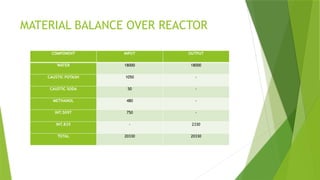
MATERIAL BALANCE OVERREACTOR
COMPONENT INPUT OUTPUT
WATER 18000 18000
CAUSTIC POTASH 1050 -
CAUSTIC SODA 50 -
METHANOL 480 -
INT.509T 750 -
INT.835 - 2330
TOTAL 20330 20330
19.
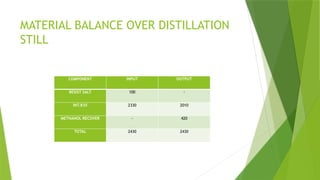
MATERIAL BALANCE OVERDISTILLATION
STILL
COMPONENT INPUT OUTPUT
RESIST SALT 100 -
INT.835 2330 2010
METHANOL RECOVER - 420
TOTAL 2430 2430
20.
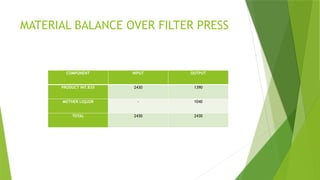
MATERIAL BALANCE OVERFILTER PRESS
COMPONENT INPUT OUTPUT
PRODUCT INT.835 2430 1390
MOTHER LIQUOR - 1040
TOTAL 2430 2430