PROFESSIONALISM IN A DIGITAL AGEBradley H Crotty, M.D.Research Fellow in MedicineHarvard Medical School Graduate Medical Student Education Orientation, June 2011Please email me at bcrotty @ bidmc.harvard.edu if you would be interested in presenting this slide deck.© 2011 Bradley Crotty
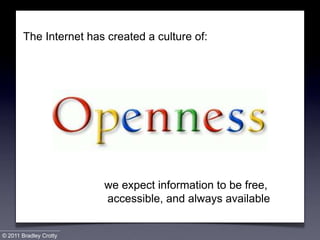
The Internet has created a culture of:                         we expect information to be free,                           accessible, and always available© 2011 Bradley Crotty
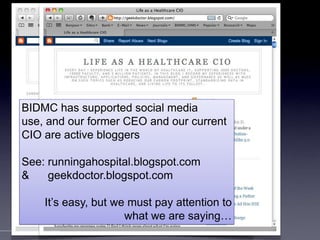
BIDMC has supported social media use, and our former CEO and our current CIO are active bloggersSee: runningahospital.blogspot.com&      geekdoctor.blogspot.comIt’s easy, but we must pay attention to what we are saying…
Creating a standard for conduct by healthcare workers in a connected world that maintains confidentiality, honesty, and trust in the medical profession. 
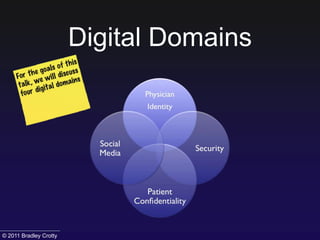
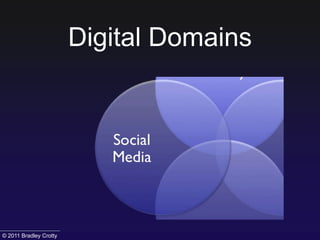
Digital Domains© 2011 Bradley Crotty
Do you have… a social networking account?
 a professional homepage? Have you recently…adjusted privacy settings for social networks?
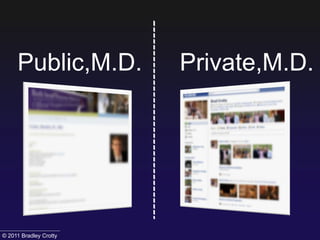
searched for yourself online?Public,M.D. Private,M.D.© 2011 Bradley Crotty
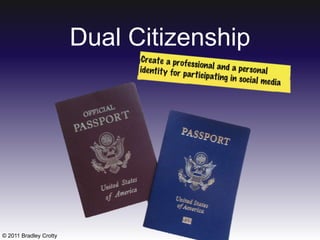
Dual Citizenship© 2011 Bradley Crotty
Social NetworkingUtilize privacy settings to their fullest
Be thoughtful about your representation
Be exquisitely cautious to respect patient confidentiality and other sensitive information.
Remember that it is nearly impossible to delete once posted© 2011 Bradley Crotty
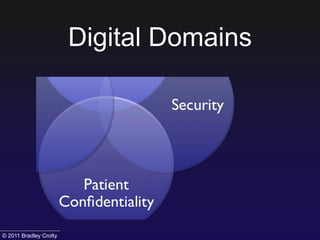
Digital Domains© 2011 Bradley Crotty
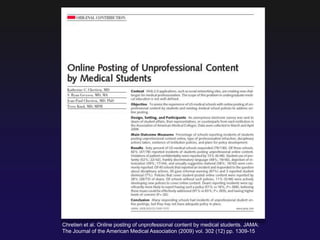
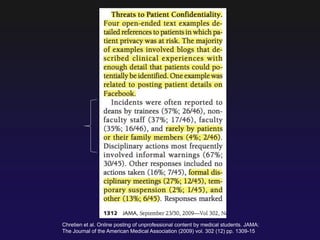
Chretien et al. Online posting of unprofessional content by medical students. JAMA: The Journal of the American Medical Association (2009) vol. 302 (12) pp. 1309-15
© 2011 Bradley Crotty
Social MediaConsider how you identify yourself
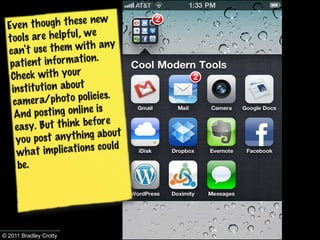
Be careful about patient representation

GME 2011 Professionalism Online

  • 1.
    PROFESSIONALISM IN ADIGITAL AGEBradley H Crotty, M.D.Research Fellow in MedicineHarvard Medical School Graduate Medical Student Education Orientation, June 2011Please email me at bcrotty @ bidmc.harvard.edu if you would be interested in presenting this slide deck.© 2011 Bradley Crotty
  • 2.
    The Internet hascreated a culture of: we expect information to be free, accessible, and always available© 2011 Bradley Crotty
  • 3.
    BIDMC has supportedsocial media use, and our former CEO and our current CIO are active bloggersSee: runningahospital.blogspot.com& geekdoctor.blogspot.comIt’s easy, but we must pay attention to what we are saying…
  • 4.
    Creating a standardfor conduct by healthcare workers in a connected world that maintains confidentiality, honesty, and trust in the medical profession. 
  • 5.
  • 6.
    Do you have…a social networking account?
  • 7.
    a professionalhomepage? Have you recently…adjusted privacy settings for social networks?
  • 8.
    searched for yourselfonline?Public,M.D. Private,M.D.© 2011 Bradley Crotty
  • 9.
  • 10.
    Social NetworkingUtilize privacysettings to their fullest
  • 11.
    Be thoughtful aboutyour representation
  • 12.
    Be exquisitely cautiousto respect patient confidentiality and other sensitive information.
  • 13.
    Remember that itis nearly impossible to delete once posted© 2011 Bradley Crotty
  • 14.
  • 15.
    Chretien et al.Online posting of unprofessional content by medical students. JAMA: The Journal of the American Medical Association (2009) vol. 302 (12) pp. 1309-15
  • 16.
    Chretien et al.Online posting of unprofessional content by medical students. JAMA: The Journal of the American Medical Association (2009) vol. 302 (12) pp. 1309-15
  • 17.
  • 18.
    Social MediaConsider howyou identify yourself
  • 19.
    Be careful aboutpatient representation