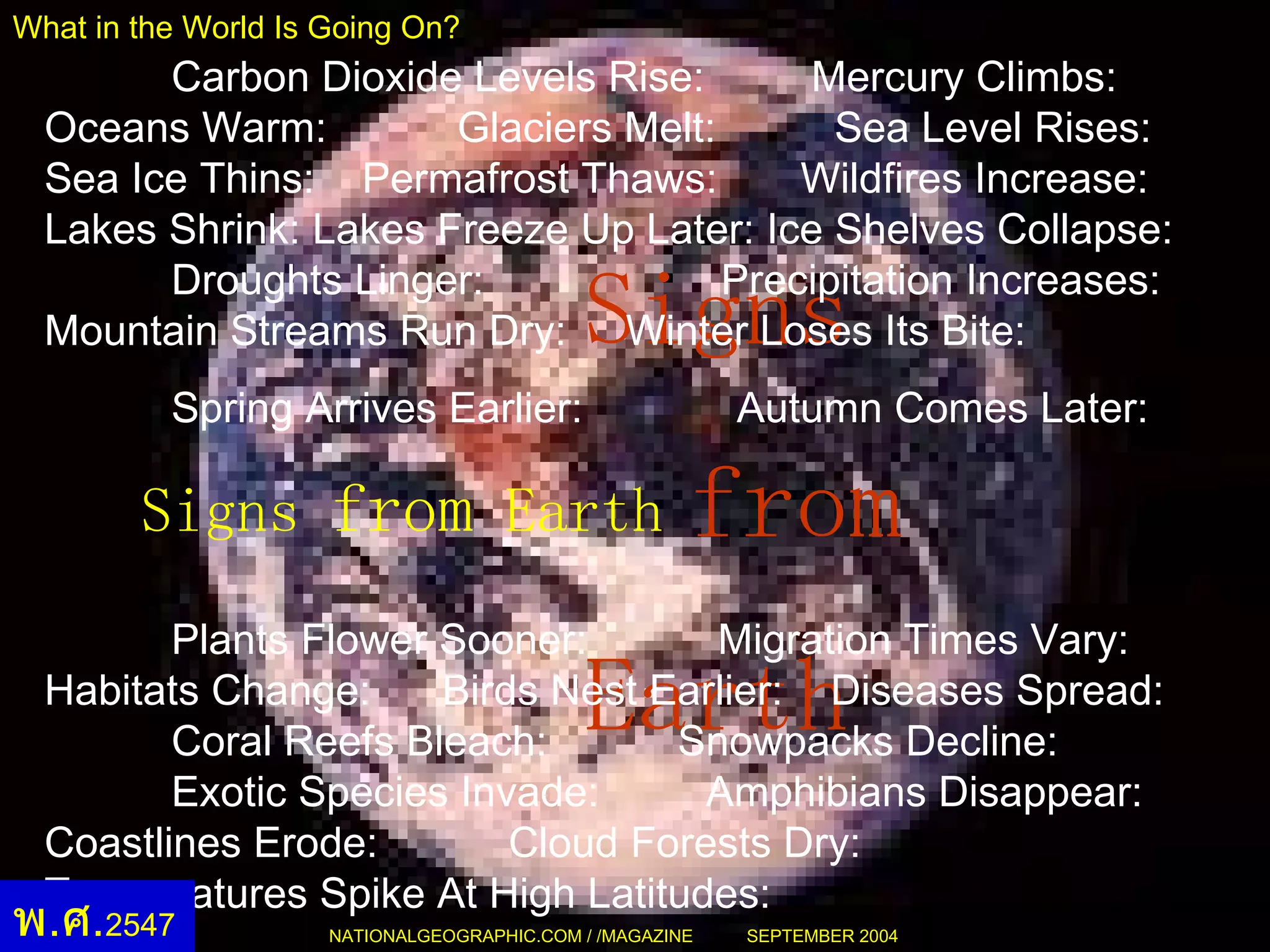
What in the World Is Going On? NATIONALGEOGRAPHIC.COM / /MAGAZINE  SEPTEMBER 2004 Signs from Earth Carbon Dioxide Levels Rise:  Mercury Climbs: Oceans Warm:  Glaciers Melt:  Sea Level Rises:  Sea Ice Thins:  Permafrost Thaws:  Wildfires Increase: Lakes Shrink: Lakes Freeze Up Later: Ice Shelves Collapse:  Droughts Linger:  Precipitation Increases: Mountain Streams Run Dry:  Winter Loses Its Bite:  Spring Arrives Earlier:  Autumn Comes Later:  Plants Flower Sooner:  Migration Times Vary:  Habitats Change:  Birds Nest Earlier:  Diseases Spread:  Coral Reefs Bleach:  Snowpacks Decline:  Exotic Species Invade:  Amphibians Disappear:  Coastlines Erode:  Cloud Forests Dry:    Temperatures Spike At High Latitudes: Signs  from  Earth พ . ศ . 2547
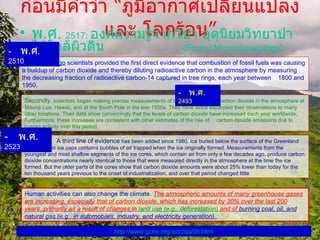
ก่อนมีคำว่า  “ ภูมิอากาศเปลี่ยนแปลง และ โลกร้อน ” พ . ศ .   2517:   องค์ความรู้จากวิชา อุตุนิยมวิทยาป่าไม้ใกล้ผิวดิน   (Forest Microclimatology)   จาก  PSU Human activities can also change the climate .  The atmospheric amounts of many greenhouse gases are increasing, especially that of carbon dioxide, which has increased by 30% over the last 200 years, primarily as a result of changes in  land use  ( e . g . , deforestation )   and of  burning coal, oil, and natural gas  ( e . g . , in automobiles, industry, and electricity generation ).  Forty years ago  scientists provided the first direct evidence that combustion of fossil fuels was causing a buildup of carbon dioxide and thereby diluting radioactive carbon in the atmosphere by measuring the decreasing fraction of radioactive carbon-14 captured in tree rings, each year between  1800 and 1950 .     พ . ศ .  2510 Secondly , scientists began making precise measurements of the total amount of carbon dioxide in the atmosphere at Mauna Loa, Hawaii, and at the South Pole in the late 1950s .  They have since expanded their observations to many other locations .  Their data show convincingly that the levels of carbon dioxide have increased each year worldwide .  Furthermore, these increases are consistent with other estimates of the rise of  carbon dioxide emissions due to human activity over this period .  A third line of evidence  has been added since 1980 .  Ice buried below the surface of the Greenland and Antarctic ice caps contains bubbles of air trapped when the ice originally formed .  Measurements from the youngest and most shallow segments of the ice cores, which contain air from only a few decades ago, produce carbon dioxide concentrations nearly identical to those that were measured directly in the atmosphere at the time the ice formed. But the older parts of the cores show that carbon dioxide amounts were about 25% lower than today for the ten thousand years previous to the onset of industrialization, and over that period changed little     พ . ศ .   2493    พ . ศ .   2523 http :// www . gcrio . org / ipcc / qa / 05 . html
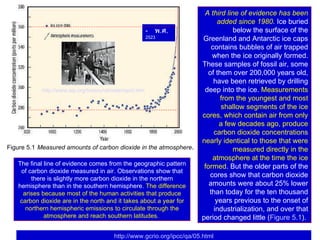
Figure 5.1   Measured amounts of carbon dioxide in the atmosphere .   A third line of evidence has been added since 1980 .   Ice buried below the surface of the Greenland and Antarctic ice caps contains bubbles of air trapped when the ice originally formed .  These samples of fossil air, some of them over 200,000 years old, have been retrieved by drilling deep into the ice .  Measurements from the youngest and most shallow segments of the ice cores, which contain air from only a few decades ago, produce carbon dioxide concentrations nearly identical to those that were measured directly in the atmosphere at the time the ice formed .  But the older parts of the cores show that carbon dioxide amounts were about 25% lower than today for the ten thousand years previous to the onset of industrialization, and over that period changed little  ( Figure 5.1 ).  The final line of evidence comes from the geographic pattern of carbon dioxide measured in air .  Observations show that there is slightly more carbon dioxide in the northern hemisphere than in the southern hemisphere .   The difference arises because most of the human activities that produce carbon dioxide are in the north and it takes about a year for northern hemispheric emissions to circulate through the atmosphere and reach southern latitudes .  http :// www . gcrio . org / ipcc / qa / 05 . html    พ . ศ .   2523 http://www.aip.org/history/climate/rapid.htm
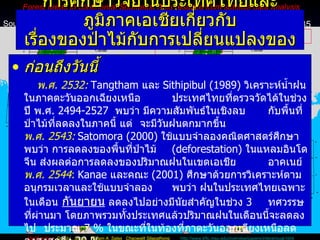
การศึกษาวิจัยในประเทศไทยและภูมิภาคเอเชีย เกี่ยวกับ เรื่องของ ป่า ไม้กับการเปลี่ยนแปลงของสภาวะอากาศ ก่อนถึงวันนี้ พ . ศ .  2532:   Tangtham  และ  Sithipibul (1989)  วิเคราะห์น้ำฝนในภาคตะวันออกเฉียงเหนือ ประเทศไทยที่ตรวจวัดได้ในช่วงปี  พ . ศ .  2494-2527  พบว่า มีความสัมพันธ์ในเชิงลบ  กับพื้นที่ป่าไม้ที่ลดลงในภาคนี้ แต่ จะมีวันฝนตกมากขึ้น  พ . ศ .  2543:   Satomora (2000)  ใช้แบบจำลองคณิตศาสตร์ศึกษาพบว่า การลดลงของพื้นที่ป่าไม้  (deforestation)  ในแหลมอินโดจีน ส่งผลต่อการลดลงของปริมาณฝนในเขตเอเชีย อาคเนย์ พ . ศ .  2544 :   Kanae  และคณะ  (2001)  ศึกษาด้วยการวิเคราะห์ตามอนุกรมเวลาและใช้แบบจำลอง  พบว่า ฝนในประเทศไทยเฉพาะในเดือน   กันยายน  ลดลงไปอย่างมีนัยสำคัญในช่วง  3  ทศวรรษที่ผ่านมา โดยภาพรวมทั้งประเทศแล้วปริมาณฝนในเดือนนี้จะลดลงไป ประมาณ  7 %  ในขณะที่ในท้องที่ภาตะวันออกเฉียงเหนือลดลงสูงสุดถึง  29 % Southeast Asia Forest Cover  -  1973 Southeast Asia Forest Cover  -  1985 Modified from:   David L. Skole  William A. Salas  Chaowalit Silapathong   http :// www . trfic . msu . edu / overview / papers / interannual . html 5.25 Mha Forest areas in continental Southeast Asia resulted from satellite data analysis Mha=Million hectares 22.56 Mha 48.71 Mha 18.28 Mha 19.92 Mha 3.98 Mha 16.74 Mha 44.82 Mha 16.15 Mha 16.52 Mha 114.70 Mha 98.21 Mha ก่อนถึงวันนี้
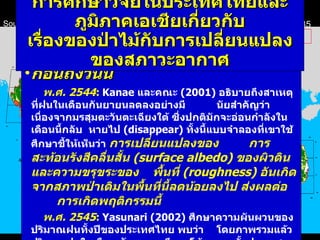
ก่อนถึงวันนี้   พ . ศ .  2544 :   Kanae  และคณะ  (2001)  อธิบายถึงสาเหตุที่ฝนในเดือนกันยายนลดลงอย่างมี นัยสำคัญว่า เนื่องจากมรสุมตะวันตะเฉียงใต้ ซึ่งปกติมักจะอ่อนกำลังในเดือนนี้กลับ หายไป  (disappear)  ทั้งนี้แบบจำลองที่เขาใช้ศึกษาชี้ให้เห็นว่า   การเปลี่ยนแปลงของ การสะท้อนรังสีคลื่นสั้น  (surface albedo)  ของผิวดินและความขรุขระของ พื้นที่  (roughness)  อันเกิดจากสภาพป่าเดิมในพื้นที่นี้ลดน้อยลงไป ส่งผลต่อ การเกิดพฤติกรรมนี้   พ . ศ .  2545 :   Yasunari (2002)  ศึกษาความผันผวนของปริมาณฝนทั้งปีของประเทศไทย พบว่า  โดยภาพรวมแล้ว ปริมาณฝนในเดือน  กันยายน  มีแนวโน้มลดลงทั้งประเทศอย่างชัดเจน นับตั้งแต่ปี ค . ศ .1950  เป็นต้นมา แต่ไม่ส่งผลต่อปริมาณฝนในเดือนกรกฎาคม - สิงหาคม  อันเป็นช่วงที่ลมมรสุมตะวันตกเฉียงใต้ยังพัดแรงอยู่ การศึกษาวิจัยในประเทศไทยและภูมิภาคเอเชีย เกี่ยวกับ เรื่องของ ป่า ไม้กับการเปลี่ยนแปลงของสภาวะอากาศ Southeast Asia Forest Cover  -  1973 Southeast Asia Forest Cover  -  1985 Modified from:   David L. Skole  William A. Salas  Chaowalit Silapathong   http :// www . trfic . msu . edu / overview / papers / interannual . html 5.25 Mha Forest areas in continental Southeast Asia resulted from satellite data analysis Mha=Million hectares 22.56 Mha 48.71 Mha 18.28 Mha 19.92 Mha 3.98 Mha 16.74 Mha 44.82 Mha 16.15 Mha 16.52 Mha 114.70 Mha 98.21 Mha ก่อนถึงวันนี้
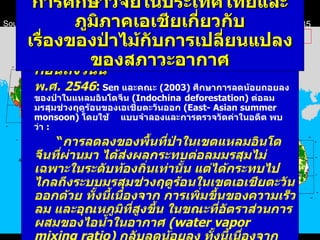
ก่อนถึงวันนี้ พ . ศ .  2546 :   Sen  และคณะ  (2003)  ศึกษาการลดน้อยถอยลงของป่าในแหลมอินโดจีน  (Indochina  deforestation)  ต่อลมมรสุมช่วงฤดูร้อนของเอเชียตะวันออก  (East- Asian summer monsoon)  โดยใช้ แบบจำลองและการตรวจวัดค่าในอดีต พบว่า  : “ การลดลงของพื้นที่ป่าในเขตแหลมอินโดจีนที่ผ่านมา ได้ส่งผลกระทบต่อลมมรสุมไม่เฉพาะในระดับท้องถิ่นเท่านั้น แต่ได้กระทบไปไกลถึงระบบมรสุมช่วงฤดูร้อนในเขตเอเชียตะวันออกด้วย ทั้งนี้เนื่องจาก การเพิ่มขึ้นของความเร็วลม และอุณหภูมิที่สูงขึ้น ในขณะที่อัตราส่วนการผสมของไอน้ำในอากาศ  (water vapor mixing ratio)  กลับลดน้อยลง ทั้งนี้เนื่องจาก ความหนาแน่นของ ไอน้ำในอากาศที่ระดับความสูง ณ ความดันอากาศ  850  มิลลิบาร์ ( ประมาณ  1  กม .   เหนือ ผิวดิน )  บริเวณป่าที่ถูกทำลาย ลด น้อยลงไป ” การศึกษาวิจัยในประเทศไทยและภูมิภาคเอเชีย เกี่ยวกับ เรื่องของ ป่า ไม้กับการเปลี่ยนแปลงของสภาวะอากาศ Southeast Asia Forest Cover  -  1973 Southeast Asia Forest Cover  -  1985 Modified from:   David L. Skole  William A. Salas  Chaowalit Silapathong   http :// www . trfic . msu . edu / overview / papers / interannual . html 5.25 Mha Forest areas in continental Southeast Asia resulted from satellite data analysis Mha=Million hectares 22.56 Mha 48.71 Mha 18.28 Mha 19.92 Mha 3.98 Mha 16.74 Mha 44.82 Mha 16.15 Mha 16.52 Mha 114.70 Mha 98.21 Mha ก่อนถึงวันนี้
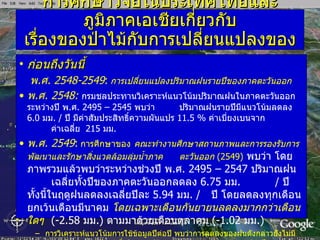
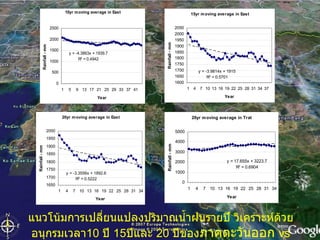
การศึกษาวิจัยในประเทศไทยและภูมิภาคเอเชีย เกี่ยวกับ เรื่องของ ป่า ไม้กับการเปลี่ยนแปลงของสภาวะอากาศ ก่อนถึงวันนี้   พ . ศ .  2548-2549 :   การเปลี่ยนแปลงปริมาณฝนรายปีของภาคตะวันออก พ . ศ .  2548:  กรมชลประทานวิเคราะห์แนวโน้มปริมาณฝนในภาคตะวันออกระหว่างปี พ . ศ .  2495 – 2545  พบว่า ปริมาณฝนรายปีมีแนวโน้มลดลง  6.0  มม . /  ปี มีค่าสัมประสิทธิ์ความผันแปร  11.5  %   ค่าเบี่ยงเบนจาก ค่าเฉลี่ย  215  มม . พ . ศ .  2549 :   การศึกษาของ   คณะทำงานศึกษาสถานภาพและการรองรับการพัฒนาและรักษาสิ่งแวดล้อมลุ่มน้ำภาค ตะวันออก   ( 2549)   พบว่า โดยภาพรวมแล้วพบว่าระหว่างช่วงปี พ . ศ .  2495 – 2547  ปริมาณฝน เฉลี่ยทั้งปีของภาคตะวันออกลดลง  6.75  มม .  /  ปี ทั้งนี้ในฤดูฝนลดลงเฉลี่ยปีละ  5.94  มม . /  ปี โดยลดลงทุกเดือนยกเว้นเดือนมีนาคม   โดยเฉพาะเดือนกันยายนลดลงมากกว่าเดือนใดๆ   ( -2.58  มม . )  ตามมาด้วยเดือนตุลาคม  ( -1.02  มม . )  การวิเคราะห์แนวโน้มการใช้ข้อมูลปีต่อปี พบว่าการลดลงของฝนดังกล่าวยังไม่มีนัยสำคัญทางสถิติ แต่เมื่อวิเคราะห์ด้วยอนุกรมเวลา  10, 15  และ  20  ปี การลดลงของฝนเฉลี่ยทั้งปีมีนัยสำคัญทางสถิติ
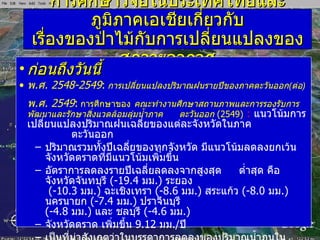
การศึกษาวิจัยในประเทศไทยและภูมิภาคเอเชีย เกี่ยวกับ เรื่องของ ป่า ไม้กับการเปลี่ยนแปลงของสภาวะอากาศ ก่อนถึงวันนี้ พ . ศ .  2548-2549 :   การเปลี่ยนแปลงปริมาณฝนรายปีของภาคตะวันออก ( ต่อ )   พ . ศ .  2549 :   การศึกษาของ   คณะทำงานศึกษาสถานภาพและการรองรับการพัฒนาและรักษาสิ่งแวดล้อมลุ่มน้ำภาค ตะวันออก   ( 2549)  :  แนวโน้มการเปลี่ยนแปลงปริมาณฝนเฉลี่ยของแต่ละจังหวัดในภาค     ตะวันออก ปริมาณรวมทั้งปีเฉลี่ยของทุกจังหวัด มีแนวโน้มลดลงยกเว้นจังหวัดตราดที่มีแนวโน้มเพิ่มขึ้น อัตราการลดลงรายปีเฉลี่ยลดลงจากสูงสุด    ต่ำสุด คือจังหวัดจันทบุรี  ( -19.4  มม .)  ระยอง   ( -10.3  มม .)  ฉะเชิงเทรา  ( -8.6  มม .)  สระแก้ว  ( -8.0  มม .)  นครนายก  ( -7.4  มม .)  ปราจีนบุรี  ( -4.8  มม .)  และ ชลบุรี  ( -4.6  มม .)  จังหวัดตราด เพิ่มขึ้น  9.12  มม ./ ปี เป็นที่น่าสังเกตว่าในบรรดาการลดลงของปริมาณน้ำฦนในเดือนต่างๆ นั้น อัตราการลดลงมากที่สุด เกิดขึ้นในเดือน  “ กันยายน หรือ ตุลาคม ”  แม้แต่ในจังหวัดตราด ซึ่งมีฝนทั้งปีเพิ่มขึ้น ก็มีฝนตกลดลงใน  2   เดือนดังกล่าว
แนวโน้มการเปลี่ยนแปลงปริมาณน้ำฝนรายปี วิเคราะห์ด้วยอนุกรมเวลา 10  ปี  15 ปีและ  20  ปีของ ภาคตะวันออก   vs  จ . ตราด
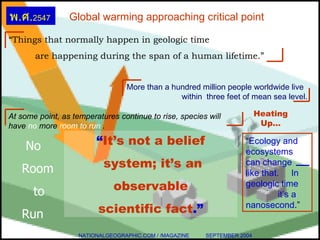
Global warming approaching critical point “ It’s not a belief system; it’s an observable  scientific fact .” No  Room  to  Run NATIONALGEOGRAPHIC.COM / /MAGAZINE  SEPTEMBER 2004 Heating Up… “ Things that normally happen in geologic time are happening during the span of a human lifetime.” More than a hundred million people worldwide live    within  three feet of mean sea level. At some point, as temperatures continue to rise, species will have  no  more  room to run   . “ Ecology and ecosystems can change  like that.  In geologic time  it’s a nanosecond .” พ . ศ . 2547
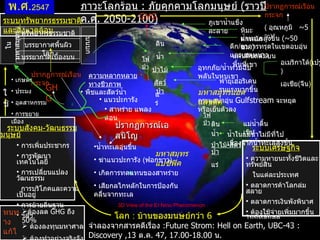
ภาวะโลกร้อน  :  ภัยคุกคามโลกมนุษย์  ( ราวปี ค . ศ .  2050-2100)   ระบบสังคม - วัฒนธรรมมนุษย์ การเพิ่มประชากร การพัฒนาเทคโนโลยี การเปลี่ยนแปลงวัฒนธรรม  การบริโภคและความเป็นอยู่ การย้ายถิ่นฐาน ฯลฯ ระบบเศรษฐกิจ ความหายนะทั้งชีวิตและทรัพย์สิน  ในแต่ละประเทศ ตลาดการค้าโลกล่มสลาย ตลาดการเงินพังพินาศ ต้องใช้จ่ายเพิ่มมากขึ้นไม่มีที่สิ้นสุด ประเทศร่ำรวยจะถลำสู่ความยากจน ระบบทรัพยากรธรรมชาติและสิ่งแวดล้อม ทรัพยากรธรรมชาติ บรรยากาศพื้นผิวโลก บรรยากาศเบื้องบน ในมหาสมุทร บนบก ภูเขาน้ำแข็งละลาย หิมะตกหนัก GHG ปรากฏการณ์เรือนกระจก (  อุณหภูมิ  ~5  ๐ c ) น้ำทะเลสูงขึ้น  ( ~50  ซม .) ดิน น้ำ ป่าไม้ สัตว์ป่า แร่ ตึก / อาคารทรุดในเขตอบอุ่นและเขตหนาว แผ่นดินถล่มบนพื้นที่เขา อุทกภัย / น้ำท่วมฉับพลันในหุบเขา พายุเฮอริเคนรุนแรงมากขึ้น ความหลากหลายทางชีวภาพ กระแสน้ำอุ่น  Gulfstream   จะหยุดหรือเย็นตัวลง มหาสมุทรแปซิฟิค น้ำทะเลอุ่นขึ้น ฆ่าแนวปะการัง  ( ฟอกขาว ) เกิดการทดแทนของสาหร่าย เสียกลไกหลักในการป้องกัน คลื่นจากทะเล มหาสมุทรแอตแลนติค ดิน น้ำ ป่าไม้ - สัตว์ป่า แร่ แม่น้ำตื้นเขิน น้ำในแม่น้ำไม่มีที่ไปเนื่องจากน้ำทะเลสูงขึ้น อเมริกาใต้ ( เปรู ) เอเชีย ( จีน ) ปรากฏการณ์เรือนกระจก โลก  :   บ้านของมนุษย์กว่า  6   พันล้านคน ใช้ ต้องลด  GHG  ถึง  50%   ต้องลงทุนมหาศาล ต้องทำอย่างจริงจัง ณ บัดนี้ หนทางแก้ไข   : ปรากฏการณ์เอลนิโญ พืชและสัตว์น้ำ แนวปะการัง สาหร่าย แพลงตอน GHG เกษตร ประมง อุตสาหกรรม การขยายเมือง ไฟป่า ไฟป่า 3D View of the EI Nino Phenomenon จำลองจากสารคดีเรื่อง  :Future Strom: Hell on Earth, UBC-43 : Discovery ,13  ต . ค . 47, 17.00-18.00  น .    สงวนลิขสิทธิ์  นิพนธ์  ตั้งธรรม ภาค วิชา อนุรักษวิทยา คณะวนศาสตร์ มหาวิทยาลัยเกษตรศาสตร์ พ . ศ . 2547
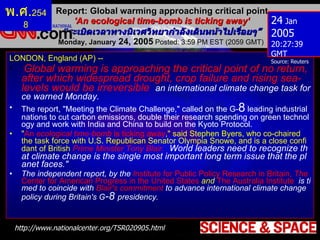
Report: Global warming approaching critical point 'An ecological time-bomb is ticking away‘ “ ระเบิดเวลาทางนิเวศวิทยากำลังเดินหน้าไปเรื่อยๆ ” Monday, January  24, 2005  Posted: 3:59 PM EST (2059 GMT)  http :// www . nationalcenter . org / TSR020905 . html 24  Jan  2005  20:27:39 GMT Source: Reuters พ . ศ . 2548 LONDON, England (AP) -- Global warming is approaching the critical point of no return, after which widespread drought, crop failure and rising sea-levels would be irreversible ,  an international climate change task force warned Monday. The report, "Meeting the Climate Challenge," called on the G- 8  leading industrial nations to cut carbon emissions, double their research spending on green technology and work with India and China to build on the Kyoto Protocol. " An  ecological time-bomb  is ticking away ," said Stephen Byers, who co-chaired the task force with U.S. Republican Senator Olympia Snowe, and is a close confidant of British   Prime Minister Tony Blair.  " World leaders need to recognize that climate change is the single most important long term issue that the planet faces." The independent report, by the   I nstitute for Public Policy Research in Britain,   T he   Center for American Progress in the United States   and  The Australia Institute ,  is timed to coincide with  Blair's commitment  to advance international climate change policy during Britain's G -8  presidency.
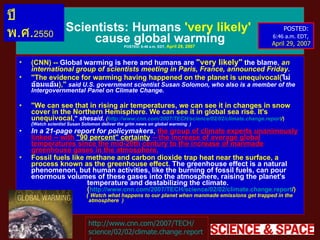
Scientists :  Humans  'very likely'   cause global warming POSTED :  6:46 a . m .  EDT,  April 29, 2007   ( CNN ) --  Global warming is here and humans are  " very likely "   the blame ,  an international group of scientists meeting in Paris, France, announced Friday .   " The evidence for warming having happened on the planet is unequivocal( ไม่อ้อมแอ้ม ) , "  said U . S .  government scientist Susan Solomon, who also is a member of the Intergovernmental Panel on Climate Change .  " We can see that in rising air temperatures, we can see it in changes in snow cover in the Northern Hemisphere .  We can see it in global sea rise .  It's unequivocal, "   shesaid .   ( http :// www . cnn . com / 2007 / TECH / science / 02/02 / climate . change . report / )  ( Watch scientist Susan Solomon deliver the grim news on global warming  )   In a 21-page report for policymakers ,  the group of climate experts unanimously linked  --  with  " 90 percent "  certainty   --  the increase of average global temperatures since the mid-20th century to the increase of manmade greenhouse gases in the atmosphere . Fossil fuels like methane and carbon dioxide trap heat near the surface, a process known as the greenhouse effect .  The greenhouse effect is a natural phenomenon, but human activities, like the burning of fossil fuels, can pour enormous volumes of these gases into the atmosphere, raising the planet's    temperature and destabilizing the climate .    ( http :// www . cnn . com / 2007 / TECH / science / 02/02 / climate . change . report / )    (  Watch what happens to our planet when manmade emissions get trapped in the    atmosphere   )   http :// www . cnn . com / 2007 / TECH / science / 02/02 / climate . change . report / POSTED :  6:46 a . m .  EDT,   April 29, 2007 ปี พ . ศ . 2550
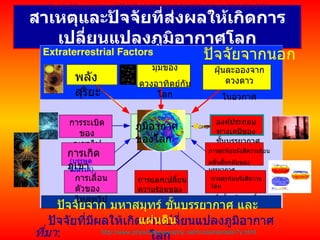
สาเหตุและปัจจัยที่ส่งผลให้เกิดการเปลี่ยนแปลงภูมิอากาศโลก ปัจจัยที่มีผลให้เกิดการเปลี่ยนแปลงภูมิอากาศโลก PhysicalGeography.net | FUNDAMENTALS OF PHYSICAL GEOGRAPHY   http://www.physicalgeography.net/fundamentals/7y.html พลังสุริยะ การระเบิดของภูเขาไฟ องค์ประกอบทางเคมีของชั้นบรรยากาศ การสะท้อนรังสีความร้อน คลื่นสั้นกลับของบรรยากาศ การสะท้อนรังสีความร้อน คลื่นสั้นกลับของพื้นผิวโลก มุมของ ดวงอาทิตย์กับโลก การแลกเปลี่ยนความร้อนของมหาสมุทร์ ปัจจัยจากนอกโลก ปัจจัยจาก มหาสมุทร์ ชั้นบรรยากาศ และ แผ่นดิน ที่มา :   ดัดแปลงจาก ฝุ่นละอองจากดวงดาว ในอวกาศ การเลื่อนตัวของไหล่ทวีป การเกิดภูเขา ( บรรพตรังสรรค์ ) GHG ภูมิอากาศของโลก
การเสียสมดุลของพลังงานความร้อนของโลก ( Earth's Energy Out of Balance )  Global  Climate Animations การเสียสมดุลของพลังงานความร้อนของโลกจนถึงปัจจุบันถือได้ว่าอยู่ในระดับสูงตามมาตรฐานของประวัติศาสตร์โลก ทั้งนี้พอยกเป็นตัวอย่างได้ว่า   “ การเสียสมดุลพลังงานความร้อนของโลกเพียง  1   วัตต์ - ปี ต่อ ตารางเมตร ติดต่อกันตลอด  10,000   ปีที่ผ่านมา จะมีพลังงานความร้อนมากพอที่จะละลายน้ำแข็งได้จนทำให้ระดับน้ำทะเลสูงขึ้นถึง  1   กิโลเมตร  ( ถ้ามีน้ำแข็งที่จะให้ละลายได้มากถึงขนาดนั้น )  หรือ จะเพิ่มอุณหภูมิของมหาสมุทร์ในชั้น   thermocline   [ the boundary layer between the warm surface waters and the deep ocean ]   ได้มากกว่า  100°C” . รังสีคลื่นสั้น รังสีคลื่นยาว รังสีความร้อนสุทธิ พลังงานความร้อนเผาดินและอากาศ ( พลังงานความร้อนสุทธิที่โลกได้รับ ) พลังงานความร้อนเผาน้ำ พลังงานความร้อนที่ถูกเก็บกักไว้ NASA GISS :  Research News : Earth's Energy Out of Balance   NASA  -  Scientists Confirm  Earth's Energy  Is  Out of Balance http :// geography . uoregon . edu / envchange / clim_animations /
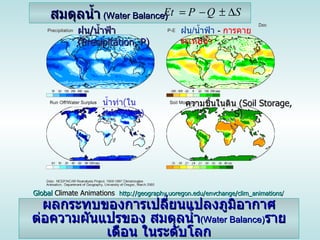
สมดุลน้ำ   ( Water Balance) ฝน / น้ำฟ้า  ( Precipitation, P) ความชื้นในดิน  ( Soil Storage, S) น้ำท่า ( ในลำธาร ) , Q) ฝน / น้ำฟ้า   -   การคายระเหยน้ำ ผลกระทบของการเปลี่ยนแปลงภูมิอากาศ ต่อความผันแปรของ  สมดุลน้ำ ( Water Balance) รายเดือน  ในระดับโลก Global  Climate Animations   http :// geography . uoregon . edu / envchange / clim_animations /
ที่มา :  :   นิธิ เอียวศรีวงศ์ : ภาวะฉุกเฉินของประชาชน  วันที่  10   กรกฎาคม พ . ศ .  2549   ปีที่  29   ฉบับที่  10348   หน้า   6   โศกนาฏกรรมทำนองนี้เกิดซ้ำแล้วซ้ำอีกในทุกพื้นที่ซึ่งประสบภัยธรรมชาติ ไม่ว่าขนาดเล็กหรือใหญ่ น้ำท่วมใหญ่ที่บ้านกรูดเมื่อปีกลาย และน้ำท่วมใหญ่กับดินถล่มที่อุตรดิตถ์ในปีนี้ ,  ฯลฯ  .................... บัดนี้ความเห็นทางวิทยาศาสตร์ค่อนข้างสอดคล้องกันแล้วว่า ความเปลี่ยนแปลงด้านภูมิอากาศของโลกทำให้อุบัติภัยทางธรรมชาติมีแนวโน้มจะเกิดถี่ขึ้นและรุนแรงขึ้น   ฉะนั้นสังคมไทยจึงกำลังก้าวเข้าสู่ยุคภัยพิบัติระดับโลก   โดยไม่มีวิธีจัดการกับผลของมันอย่างมีประสิทธิภาพและเป็นธรรม ถึงเวลาที่เราควรคิดเรื่องนี้อย่างจริงจังว่าจะปรับปรุงความสามารถในภาครัฐและเอกชน เพื่อการบูรณะฟื้นฟูภัยพิบัติอย่างไร
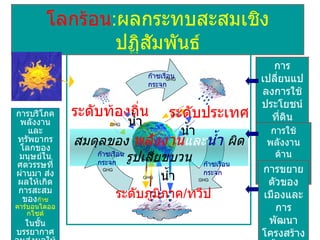
โลกร้อน : ผลกระทบสะสมเชิงปฏิสัมพันธ์ การเปลี่ยนแปลงการใช้ประโยชน์ที่ดิน การใช้พลังงาน ด้านอุตสาหกรรม การขยายตัวของเมืองและการพัฒนาโครงสร้างพื้นฐาน การบริโภคพลังงานและทรัพยากรโลกของมนุษย์ในศตวรรษที่ผ่านมา ส่ง ผลให้เกิดการสะสมของ ก๊าซ คาร์บอนไดออกไซด์ ในชั้นบรรยากาศ จนส่งผลให้เกิดภาวะเรือนกระจกที่เข้าขั้นวิกฤติ  ระดับภูมิภาค / ทวีป GHG ระดับประเทศ ระดับท้องถิ่น GHG GHG สมดุลของ  พลังงาน และ น้ำ  ผิดรูปเสียขบวน GHG GHG GHG ก๊าซเรือนกระจก ก๊าซเรือนกระจก ก๊าซเรือนกระจก น้ำ น้ำ น้ำ
คณะกรรมการนานาชาติติดตามตรวจสอบและประเมินผลกระทบการเปลี่ยนแปลงสภาพภูมิอากาศ (IPCC)   : รายงานการประเมินผลครั้งที่ ๔ ปี พ . ศ .  ๒๕๕๐ IPCC  Fourth  Assessment  Report  Climate  Change  2007 Climate  Change  Impacts, Adaptation  and  Vulnerability
ผลกระทบที่พบเห็นได้ในขณะนี้  (Impact Observable Now) ลักษณะอากาศที่มีผลต่อการเปลี่ยนแปลงในระบบกายภาพ และชีวภาพ  (physical and biological system) ที่ชัดเจนที่สุดคือการเพิ่มขึ้นของอุณหภูมิอันเกิดจาก  GHG  (High Confidence, HC= มีความมั่นใจในระดับสูง ) ผลกระทบจากการเปลี่ยนแปลงสภาพภูมิอากาศที่ทำให้อุณหภูมิสูงขึ้นได้ส่งผลแล้วต่อ / กระบวนการทางอุทกวิทยา ,   ทรัพยากรน้ำ ,  มหาสมุทร ,  และ  ชายฝั่งทะเล  (HC) มีหลักฐานมากขึ้นว่าการเปลี่ยนแปลงสภาพภูมิอากาศได้ส่งผลกระทบต่อระบบธรรมชาติของสิ่งมีชีวิตบนบก  (terrestrial natural biological systems)  ระบบนิเวศมหาสมุทร และ แหล่งน้ำจืด  (HC) ผลกระทบต่อการเกษตร และสุขภาพมนุษย์ก็พบบ้างแล้ว แต่ยังมีความมั่นใจในระดับปานกลาง  เนื่องจากมีการปรับตัวรองรับเรื่องนี้กันบ้างแล้ว  (Medium Confidence, MC  =   มีความมั่นใจในระปานกลาง )
มี หลักฐานปรากฏจากการตรวจวัดลักษณะลมฟ้าอากาศหลายแห่งในทวีปเอเชีย พบว่า ภูมิอากาศมีการเปลี่ยนแปลงอย่างเด่นชัดและอากาศร้อนขึ้นอย่างมีนัยสำคัญ (  distinct and significant warming )  ในทศวรรษที่ผ่านมา และพบว่าปริมาณน้ำฝนทั้งปีลดลงในหลายสถานีตรวจวัด  การลดลงของปริมาณน้ำฝนนี้เกิดขึ้นต่อเนื่องกันมาตั้งแต่ปี ค . ศ . 1970  และเริ่มมีนัยสำคัญตั้งแต่ปี ค .  ศ . 1990 มีหลักฐานการเพิ่มขึ้นทั้งความรุนแรงและความถี่  ( intensity and frequency )  ของการเกิดปรากฏการณ์ลักษณะอากาศที่รุนแรง เช่น คลื่นความร้อน  ( heat wave )  พายุโซนร้อน  ( tropical cyclones )  ช่วงแล้งที่ยาวนานขึ้น ,  ฝนตกหนักรุนแรง  ( intense rainfall )  ทอร์นาโด  ( tornadoes )  การถล่มของหิมะ พายุฟ้าคะนอง และพายุฝุ่น เกิดขึ้นในภูมิภาคนี้นับตั้งแต่ปี ค . ศ . 1990  เป็นต้นมา ผลสรุป จากการศึกษาในภูมิภาคเอเชีย เพื่อประโยชน์ในการบริหารจัดการ
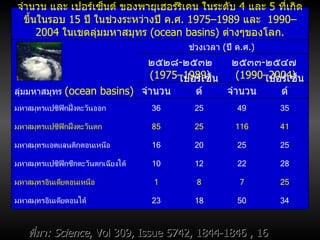
ที่มา :  Science , Vol 309, Issue 5742, 1844-1846 , 16 September 2005  จำนวน และ เปอร์เซ็นต์   ของพายุเฮอร์ริเคน ในระดับ  4  และ  5  ที่เกิดขึ้นในรอบ  15  ปี ในช่วงระหว่างปี ค . ศ .  1975–1989   และ  1990–2004  ในเขตลุ่มมหาสมุทร  ( ocean basins )  ต่างๆของโลก .   ช่วงเวลา  ( ปี ค . ศ .)   ๒๕๒๘ - ๒๕๓๒ (1975–1989) ๒๕๓๓ - ๒๕๔๗   (1990–2004) ลุ่มมหาสมุทร  ( ocean basins )  จำนวน เปอร์เซ็นต์ จำนวน เปอร์เซ็นต์ มหาสมุทรแปซิฟิกฝั่งตะวันออก 36 25 49 35 มหาสมุทรแปซิฟิกฝั่งตะวันตก 85 25 116 41 มหาสมุทรแอตแลนติกตอนเหนือ 16 20 25 25 มหาสมุทรแปซิฟิกซีกตะวันตกเฉียงใต้ 10 12 22 28 มหาสมุทรอินเดียตอนเหนือ 1 8 7 25 มหาสมุทรอินเดียตอนใต้ 23 18 50 34
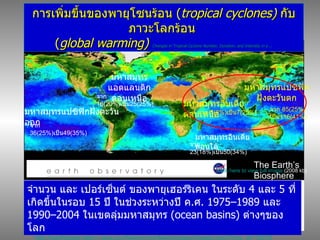
http :// earthobservatory . nasa . gov / Newsroom / NewImages / images . php3?img_id = 10278 Click here to view full image  (2008 kb)  มหาสมุทรแปซิฟิก ฝั่งตะวันตก มหาสมุทรอินเดีย ตอนเหนือ มหาสมุทรแอตแลนติก ตอนเหนือ มหาสมุทรแปซิฟิกฝั่งตะวันออก มหาสมุทรอินเดียตอนใต้ จำนวน และ เปอร์เซ็นต์   ของพายุเฮอร์ริเคน ในระดับ  4  และ  5  ที่เกิดขึ้นในรอบ  15  ปี ในช่วงระหว่างปี ค . ศ .  1975–1989   และ  1990–2004  ในเขตลุ่มมหาสมุทร  ( ocean basins )  ต่างๆของโลก จาก  36(25%) เป็น 49(35%) The Earth’s Biosphere  จาก  16(20%) เป็น 25(25%) จาก  1(8%) เป็น 7(25%) จาก  23(18%) เป็น 50(34%) จาก  85(25%) เป็น 116(41%) การเพิ่มขึ้นของพายุโซนร้อน  ( tropical cyclones)   กับ ภาวะโลกร้อน  ( global warming)  Changes in  Tropical Cyclone  Number, Duration, and Intensity in a  ...
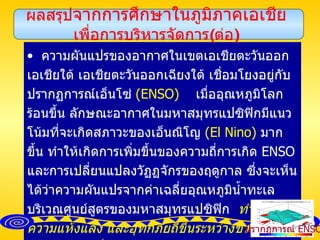
ความผันแปรของอากาศในเขตเอเชียตะวันออก เอเชียใต้ เอเชียตะวันออกเฉียงใต้ เชื่อมโยงอยู่กับปรากฏการณ์เอ็นโซ่  ( ENSO )   เมื่ออุณหภูมิโลกร้อนขึ้น ลักษณะอากาศในมหาสมุทรแปซิฟิกมีแนวโน้มที่จะเกิดสภาวะของเอ็นณิโญ  ( El Nino )   มากขึ้น ทำให้เกิดการเพิ่มขึ้นของความถี่การเกิด  ENSO   และการเปลี่ยนแปลงวัฏฏจักรของฤดูกาล ซึ่งจะเห็นได้ว่าความผันแปรจากค่าเฉลี่ยอุณหภูมิน้ำทะเลบริเวณศูนย์สูตรของมหาสมุทรแปซิฟิก  ทำให้เกิดความแห้งแล้ง และอุทกภัยถี่ขึ้นระหว่างช่วงฤดูร้อนของประเทศที่อยู่ทางตะวันออก  ทางใต้  และทางตะวันออกเฉียงใต้ของทวีปเอเชีย   จึงพอกล่าวได้ว่าในอนาคตเหตุการณ์ที่เกิดขึ้นแล้วนี้จะทวีความรุนแรงมากขึ้น ผลสรุป จากการศึกษาในภูมิภาคเอเชีย เพื่อการบริหารจัดการ ( ต่อ ) ปรากฏการณ์  ENSO
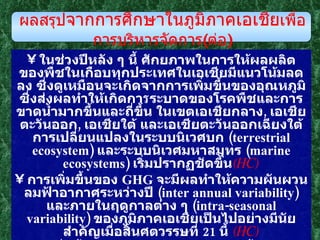
ในช่วงปีหลัง ๆ นี้ ศักยภาพในการให้ผลผลิตของพืชในเกือบทุกประเทศในเอเชียมีแนวโน้มลดลง ซึ่งดูเหมือนจะเกิดจากการเพิ่มขึ้นของอุณหภูมิ ซึ่งส่งผลทำให้เกิดกา ร ระบาดของโรคพืชและการขาดน้ำมากขึ้นและถี่ขึ้น ในเขตเอเชียกลาง ,  เอเชียตะวันออก ,  เอเชียใต้ และเอเชียตะวันออกเฉียงใต้ การเปลี่ยนแปลงในระบบนิเวศบก  ( terrestrial ecosystem )  และระบบนิเวศมหาสมุทร  ( marine ecosystems )  เริ่มปรากฏชัดขึ้น ( HC ) การเพิ่มขึ้นของ  GHG  จะมีผลทำให้ความผันผวนลมฟ้าอากาศระหว่างปี  ( inter annual   variability )  และภายในฤดูกาลต่าง ๆ  ( intra-seasonal variability )  ของภูมิภาคเอเชียเป็นไปอย่างมีนัยสำคัญเมื่อสิ้นศตวรรษที่  21  นี้  ( HC ) การเพิ่มขึ้นของอุณหภูมิจะทำให้ระดับน้ำทะเลสูงขึ้น มีพายุหมุนรุนแรงขึ้น  ( intense cyclonic variability )  คลื่นและลมในทะเลสูงมากขึ้น ทำให้เกิดภัยพิบัติต่อพื้นที่ชายฝั่งในเขตเอเชียตะวันตก เอเชียใต้ และเอเชียตะวันออกเฉียงใต้มากยิ่งขึ้น  ( HC ) ผลสรุป จากการศึกษาในภูมิภาคเอเชีย เพื่อการบริหารจัดการ ( ต่อ )
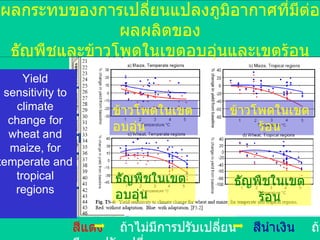
ผลกระทบของการเปลี่ยนแปลงภูมิอากาศที่มีต่อผลผลิตของ ธัญพืชและข้าวโพดในเขตอบอุ่นและเขตร้อน ธัญพืชในเขตอบอุ่น ข้าวโพดในเขตอบอุ่น ข้าวโพดในเขตร้อน ธัญพืชในเขตร้อน สีแดง   ถ้าไม่มีการปรับเปลี่ยน  สีนำเงิน   ถ้ามีการปรับเปลี่ยน  Yield sensitivity to climate change for wheat and maize, for temperate and tropical regions
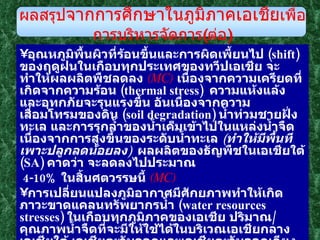
อุณหภูมิพื้นผิวที่ร้อนขึ้นและการผิดเพี้ยนไป  ( shift )  ของฤดูฝนในเกือบทุกประเทศของทวีปเอเชีย จะทำให้ผลผลิตพืชลดลง  ( MC )   เนื่องจากความเครียดที่เกิดจากความร้อน  ( thermal stress )  ความแห้งแล้งและอุทกภัยจะรุนแรงขึ้น อันเนื่องจากความเสื่อมโทรมของดิน  ( soil degradation )  น้ำท่วมชายฝั่งทะเล และการรุกล้ำของน้ำเค็มเข้าไปในแหล่งน้ำจืด เนื่องจากการสูงขึ้นของระดับน้ำทะเล  ( ทำให้มีพื้นทีเพาะปลูกลดน้อยลง )   ผลผลิตของธัญพืชในเอเชียใต้  ( SA )  คาดว่า จะลดลงไปประมาณ 4-10 %  ในสิ้นศตวรรษนี้  ( MC )  การเปลี่ยนแปลงภูมิอากาศมีศักยภาพทำให้เกิดภาวะขาดแคลนทรัพยากรน้ำ  ( water resources stresses )  ในเกือบทุกภูมิภาคของเอเชีย ปริมาณ / คุณภาพน้ำจืดที่จะมีให้ใช้ได้ในบริเวณเอเชียกลาง เอเชียใต้ เอเชียตะวันออกและเอเชียตะวันออกเฉียงใต้  ( SEA )  คาดว่า จะได้รับการกระทบกระเทือนมากขึ้น และทำให้เกิดความยากลำบากแก่ฅนนับพันล้าน  ( billion people )  ในราว ๆ ปี ค . ศ . 2050  ( HC )   อุณหภูมิที่เพิ่มขึ้นในเอเชีย จะทำให้ธารน้ำแข็ง  ( glaciers )  บนเทือกเขาหิมาลัยลดน้อยถอยลง  ( MC )  ดังนั้นการรู้จักใช้น้ำอย่างมีประสิทธิภาพในด้านการชลประทาน และ การเปลี่ยนแปลงการบริหารจัดการน้ำชลประทานจะเป็นสิ่งที่จำเป็นอย่างยิ่ง ผลสรุป จากการศึกษาในภูมิภาคเอเชีย เพื่อการบริหารจัดการ ( ต่อ )
การจับปลาเกินกำลังการผลิต ทั้งในทะเลและบนบกในเกือบทุกประเทศของเอเชียตะวันออก เอเชียใต้ และ เอเชียตะวันออกเฉียงใต้ ทำให้ทรัพยากรสัตว์น้ำลดลงอย่างกรวดเร็วดังที่ทราบกันมาแล้ว  การเปลี่ยนแปลงทิศทางและความเร็วของกระแสน้ำ อุณหภูมิของน้ำ ความเค็มของน้ำทะเล ความรุนแรง  ( strength )  ของการคลุกเคล้าขึ้นและลงระหว่างผิวน้ำและน้ำทะเลที่อยู่ลึกลงไปในมหาสมุทรแปซิฟิกฝั่งตะวันตก และมหาสมุทรอินเดียตอนเหนือจะเพิ่มมากขึ้น ทั้งเนื่องจากอุณหภูมิและระดับน้ำทะเลที่เพิ่มขึ้นจะเป็นผลทำให้ผลผลิตของปลาในเอเชียลดน้อยลง  ( HC )     การท่วมของน้ำทะเลบริเวณชายฝั่งจะทำให้อุตสาหกรรมสัตว์น้ำของเอเชียได้รับความเสียหาย  ( HC ) ผลสรุป จากการศึกษาในภูมิภาคเอเชีย เพื่อการบริหารจัดการ ( ต่อ )
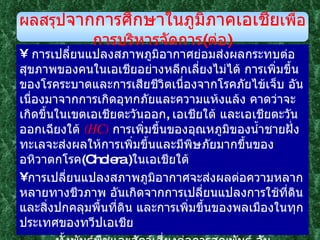
การเปลี่ยนแปลงสภาพภูมิอากาศย่อมส่งผลกระทบต่อสุขภาพของคนในเอเชียอย่างหลีกเลี่ยงไม่ได้ การเพิ่มขึ้นของโรคระบาดและการเสียชีวิตเนื่องจากโรคภัยไข้เจ็บ อันเนื่องมาจากการเกิดอุทกภัยและความแห้งแล้ง คาดว่าจะเกิดขึ้นในเขตเอเชียตะวันออก ,  เอเชียใต้ และเอเชียตะวันออกเฉียงใต้  ( HC )   การเพิ่มขึ้นของอุณหภูมิของน้ำชายฝั่งทะเลจะส่งผลให้การเพิ่มขึ้นและมีพิษภัยมากขึ้นของอหิวาตกโรค ( Cholera  ) ในเอเชียใต้ การเปลี่ยนแปลงสภาพภูมิอากาศจะส่งผลต่อความหลากหลายทางชีวภาพ อันเกิดจากการเปลี่ยนแปลงการใช้ที่ดินและสิ่งปกคลุมพื้นที่ดิน และการเพิ่มขึ้นของพลเมืองในทุกประเทศของทวีปเอเชีย    ทั้งพันธุ์พืชและสัตว์เสี่ยงต่อการสูญพันธุ์ อันเนื่องจากถิ่นที่อยู่อาศัยอยู่กระจัดกระจาย  ( habitat fragmentation ) มากขึ้น  ( MC )   การถูกคุกคามในเสถียรภาพทางนิเวศ  ( ecological stability )  ของพื้นที่ชุ่มน้ำ ป่าโกงกาง และปะการังในเอเชียจะเพิ่มมากขึ้น ผลสรุป จากการศึกษาในภูมิภาคเอเชีย เพื่อการบริหารจัดการ ( ต่อ )
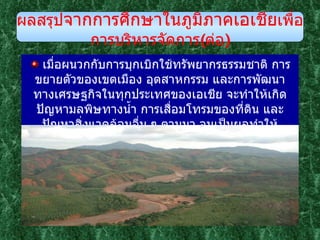
เมื่อผนวกกับการบุกเบิกใช้ทรัพยากรธรรมชาติ การขยายตัวของเขตเมือง อุตสาหกรรม และการพัฒนาทางเศรษฐกิจในทุกประเทศของเอเชีย จะทำให้เกิดปัญหามลพิษทางน้ำ การเสื่อมโทรมของที่ดิน และปัญหาสิ่งแวดล้อมอื่น ๆ ตามมา จนเป็นผลทำให้คุณภาพชีวิตของคนในทวีปนี้ต่ำลงอย่างแน่นอน ผลสรุป จากการศึกษาในภูมิภาคเอเชีย เพื่อการบริหารจัดการ ( ต่อ )
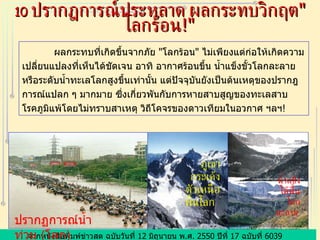
ผลกระทบที่เกิดขึ้นจากภัย  " โลกร้อน "  ไม่เพียงแต่ก่อให้เกิดความเปลี่ยนแปลงที่เห็นได้ชัดเจน อาทิ อากาศร้อนขึ้น น้ำแข็งขั้วโลกละลาย หรือระดับน้ำทะเลโลกสูงขึ้นเท่านั้น แต่ปัจจุบันยังเป็นต้นเหตุของปรากฎการณ์แปลก ๆ มากมาย ซึ่งเกี่ยวพันกับการหายสาบสูญของทะเลสาบ โรคภูมิแพ้โดยไม่ทราบสาเหตุ วิถีโคจรของดาวเทียมในอวกาศ ฯลฯ !  10   ปรากฎการณ์ประหลาด ผลกระทบวิกฤต " โลกร้อน !" จากหนังสือพิมพ์ข่าวสด ฉบับวันที่  12   มิถุนายน พ . ศ .  2550   ปีที่  17   ฉบับที่  6039   ภูเขากระเด้งตัวเหนือพื้นโลก  น้ำแข็งใต้พื้นโลกละลาย  ปรากฏการณ์น้ำท่วม  ( โลก )
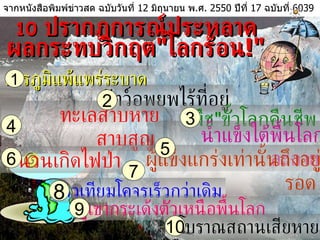
10   ปรากฎการณ์ประหลาด ผลกระทบวิกฤต " โลกร้อน !" จากหนังสือพิมพ์ข่าวสด ฉบับวันที่  12   มิถุนายน พ . ศ .  2550   ปีที่  17   ฉบับที่  6039   สารภูมิแพ้แพร่ระบาด  1 สัตว์อพยพไร้ที่อยู่ " พืช " ขั้วโลกคืนชีพ ทะเลสาบหายสาบสูญ  น้ำแข็งใต้พื้นโลกละลาย  ชนวนเกิดไฟป่า ผู้แข็งแกร่งเท่านั้นถึงอยู่รอด  ดาวเทียมโคจรเร็วกว่าเดิม  ภูเขากระเด้งตัวเหนือพื้นโลก  โบราณสถานเสียหาย  2 3 4 5 6 7 8 9 10
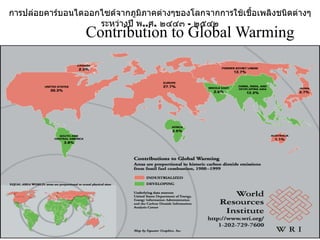
Contribution to Global Warming การปล่อยคาร์บอนไดออกไซด์จากภูมิภาคต่างๆของโลกจากการใช้เชื้อเพลิงชนิดต่างๆ   ระหว่างปี   พ .. ศ .   ๒๔๔๓   -   ๒๕๔๒
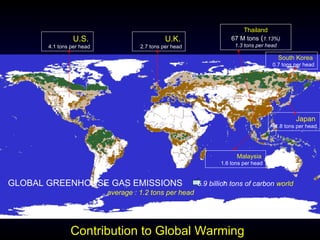
Thailand 67 M tons  ( 1.13%) 1.3 tons per head South Korea   0.7 tons per head U . S .   4.1 tons per head U . K .     2.7 tons per head Japan   1.8 tons per head Malaysia    1.6 tons per head GLOBAL GREENHOUSE GAS EMISSIONS  5.9 billion tons of carbon  world average : 1.2 tons   per head Contribution to Global Warming
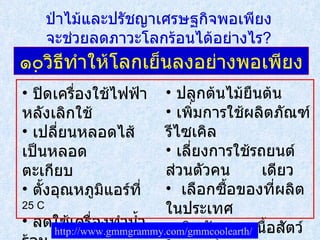
๑๐วิธีทำให้โลกเย็นลงอย่างพอเพียง ปิดเครื่องใช้ไฟฟ้าหลังเลิกใช้  เปลี่ยนหลอดไส้เป็นหลอด  ตะเกียบ ตั้งอุณหภูมิแอร์ที่  25 C ลดใช้เครื่องทำน้ำร้อน ติดฉนวนกันความร้อนใน บ้าน ปลูกต้นไม้ยืนต้น เพิ่มการใช้ผลิตภัณฑ์รีไซเคิล เลี่ยงการใช้รถยนต์ส่วนตัวคน เดียว เลือกซื้อของที่ผลิตในประเทศ กินผักแทนเนื้อสัตว์ให้มากขึ้น http :// www . gmmgrammy . com / gmmcoolearth /   ป่าไม้และปรัชญาเศรษฐกิจพอเพียง จะช่วยลดภาวะโลกร้อนได้อย่างไร ?
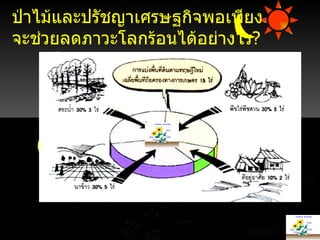
CO 2 CO 2 CO 2 CO 2 CO 2 O 2 O 2 O 2 O 2 O 2 ป่าไม้และปรัชญาเศรษฐกิจพอเพียง จะช่วยลดภาวะโลกร้อนได้อย่างไร ?
  ประเทศไทยได้ให้สัตยาบันในพิธีสารเกียวโต เมื่อวันที่  28  สิงหาคม  2545 เป็นประเทศภาคีที่  89  และมีผลบังคับใน  90  วัน คือวันที่  26  พฤศจิกายน  2545  ขณะที่   พิธีสารเกียวโต   มีผลบังคับเมื่อวันที่  16  กุมภาพันธ์  2548 ด้านป่าไม้ที่เกี่ยวข้องกับเรื่อง การใช้ประโยชน์ที่ดิน การเปลี่ยนแปลงการใช้ประโยชน์ที่ดินและการป่าไม้  (Land use, Land-use Change and Forestry, LULUCF)  โดย กลไก  CDM   สามารถดำเนินการได้โดยการปลูกป่าเพื่อขาย  “ คาร์บอนเครดิต ”  ซึ่งการปลูกป่ามี  2  แบบ คือ  การปลูกป่าใหม่  (Reforestation)  และ  การปลูกป่าในพื้นที่ที่ไม่มีป่ามาก่อนช่วง  50  ปี  (Afforestation)  การดำเนินการสามารถดำเนินการเป็นโครงการขนาดใหญ่ หรือ การปลูกป่าตามโครงการขนาดเล็ก ไม่เกิน  8,000  ตันคาร์บอนไดออกไซด์ต่อปี ก็ได้ พิธีสารเกียวโต   (Kyoto Protocol) กลไกการพัฒนาที่สะอาด (Clean Development Mechanism,   CDM )
COMMITTEE ON FORESTRY Item 9 of the Provisional Agenda FIFTEENTH SESSION Rome, Italy, 12-16 March 2001 CLIMATE CHANGE  AND THE  KYOTO PROTOCOL : KEY FORESTRY-RELATED ISSUES Secretariat Note http://www.fao.org/forestry/fop/fopw/Climate/climate-e.asp THAILAND  RULES OUT FOREST PROJECTS UNDER    CARBON CREDIT SCHEME Thailand   will not accept projects involving reforestation and afforestation in exchange for carbon credits under the  Kyoto Protocol's  c lean  d evelopment  m echanism  (CDM).     http://www.bangkokpost.com/News/09Dec2003_news18.html PROVISIONS RELEVANT TO FORESTRY IN THE LEGAL FRAMEWORK While the  UNFCCC  mentions forestry only briefly, the  Kyoto Protocol  deals explicitly with forestry:  Article 2   mentions   that  Annex I Parties  shall implement and/or further elaborate policies and measures .... such as ....  promotion of sustainable forest management practices,  afforestation and reforestation THE INTERNATIONAL CLIMATE-RELATED NEGOTIATIONS The UN Framework Convention on Climate Change (UNFCCC)   adopted in 1992  ( อนุสัญญาสหประชาชาติว่าด้วยการเปลี่ยนแปลงสภาพภูมิอากาศ )
“ เรา ”  รู้เขารู้เราในเรื่อง   “ ป่าไม้กับการบรรเทาปัญหาโลกร้อน ”  มากน้อยเพียงไร ? องค์ความรู้เรื่องสมดุลของคาร์บอน (Carbon budget) ในป่าชนิดต่างๆของประเทศไทย   ? อุทยานแห่งชาติแต่ละแห่งมีส่วนในเรื่องการบรรเทาโลกร้อนได้มากน้อยเพียงไร ? ป่าสงวน ป่าอนุรักษ์ รูปแบบต่างๆของเรา มีส่วนในเรื่องนี้อย่างไร ? สวนป่าแต่ละแห่งแต่ละชนิด มีศักยภาพในเรื่องการเก็บกักและการปลดปล่อยคาร์บอนไดออกไซด์ มากน้อยเพียงใด ?  สวนป่าที่มีอยู่แล้วจะ ขายคาร์บอนเครดิต ได้หรื่อไม่ ? จะปลูกกันที่ไหน พันธุ์ไม้ชนิดใด   ที่คิดว่าจะเหมาะสมในเรื่องนี้ ? แรงจูงใจที่ประเทศพัฒนา จะให้ผู้ปลูกป่าสำหรับ  “ เครดิตปล่อยมลภาวะ ”  จะคุ้มค่าหรือไม่ ?   อย่างไร ?  ข้อตกลงโลกร้อนใหม่   “ Asia-Pacific Partnership on Clean Development  and  Climate   Change ... ”   มีอะไรบ้าง ?   เราจะต้องทำอะไรกันอีกบ้าง   ?  http://www.dfat.gov.au/environment/climate/ap6 /
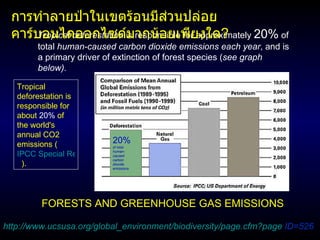
Tropical deforestation  is responsible for approximately  20%  of total  human-caused carbon dioxide emissions each year , and is a primary driver of extinction of forest species ( see graph below).   http://www.ucsusa.org/global_environment/biodiversity/page.cfm?page  ID=526 FORESTS AND GREENHOUSE GAS EMISSIONS การทำลายป่าในเขตร้อนมีส่วนปล่อยคาร์บอนไดออกไซด์มากน้อยเพียงใด ? 20%  of total  human-caused carbon dioxide emissions Tropical deforestation is responsible for about  20%  of the world's annual CO 2  emissions  ( IPCC Special Report on LULUCF (2000)     ).
Frequent Questions   1. What is terrestrial carbon sequestration? 2. Why are agricultural and forestry sequestration activities important? 3. Which agricultural and forestry practices sequester carbon? 4. How much carbon can agricultural and forestry practices sequester? 5. How well can carbon sequestration be measured? 6. How much carbon sequestration occurs in the U.S.? 7. What is the potential for additional sequestration to offset greenhouse gas emissions? 8. Do sequestration practices affect greenhouse gases other than CO2? 9. What are the other environmental effects of sequestration practices? 10. How could carbon sequestration be affected by climate change? 11. How do sequestration activities compare with greenhouse gas reductions in other sectors? 12. Are there other means of storing carbon beyond agricultural and forestry activities?  Carbon Sequestration in Agriculture and Forestry   http :// www . epa . gov / sequestration / faq . html
ความรู้เรื่องป่าไม้กับการบรรเทาปัญหาโลกร้อน Effects of sequestration practices on the other environment Practices that aim to reduce carbon losses and increase sequestration generally enhance the quality of soil, water, air and wildlife habitat .  Tree planting that restores fuller forest cover may not only sequester carbon but could improve habitat suitability for wildlife .  Preserving threatened tropical forests may avoid losses in both carbon and biodiversity, absent any  leakage  effects .  And reducing soil erosion through tree planting or soil conservation measures can sequester carbon and improve water quality by reducing nutrient runoff .  In certain cases, there may be tradeoffs between carbon objectives and environmental quality .  Replacing diverse ecosystems with single - species timber plantations may generate greater carbon accumulation, but could result in less biodiversity, at least at the scale of the plantation .   For more information on some of the broader environmental effects of sequestration visit the  Co-benefits  section of this Web site . http :// www . epa . gov / sequestration / faq . html
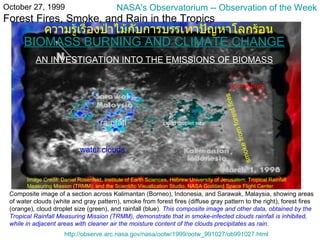
October 27, 1999 Forest Fires, Smoke, and Rain in the Tropics Composite image of a section across Kalimantan  ( Borneo ) , Indonesia, and Sarawak, Malaysia, showing areas of water clouds  ( white and gray pattern ) , smoke from forest fires  ( diffuse gray pattern to the right ) , forest fires  ( orange ) , cloud droplet size  ( green ) , and rainfall  ( blue ).  This composite image and other data, obtained by the Tropical Rainfall Measuring Mission  ( TRMM ) , demonstrate that in smoke - infected clouds rainfall is inhibited, while in adjacent areas with cleaner air the moisture content of the clouds precipitates as rain . water clouds smoke from forest fires forest fires cloud droplet size rainfall NASA's Observatorium  --  Observation of the Week http :// observe . arc . nasa . gov / nasa / ootw / 1999 / ootw_991027 / ob991027 . html Image Credit :  Daniel Rosenfeld, Institute of Earth Sciences, Hebrew University of Jerusalem; Tropical Rainfall Measuring Mission  ( TRMM ) ; and the Scientific Visualization Studio, NASA Goddard Space Flight Center . BIOMASS BURNING AND CLIMATE CHANGE AN INVESTIGATION INTO THE EMISSIONS OF BIOMASS ความรู้เรื่องป่าไม้กับการบรรเทาปัญหาโลกร้อน
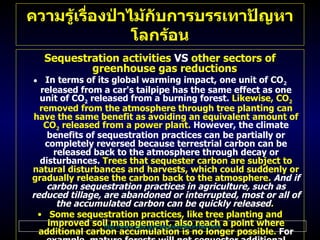
Effect of climate change on carbon sequestration   According to a National Academy of Sciences 2001 report,  " Greenhouse gases are accumulating in the Earth's atmosphere as a result of human activities, causing surface air temperatures and subsurface ocean temperatures to rise ."  In addition to temperature, human - induced climate change may also affect growing seasons, precipitation and the frequency and severity of extreme weather events, such as fire .  These changes can influence forests, farming and the health of ecosystems, and thus carbon sequestration . Some argue that rising CO 2  levels will enhance sequestration above normal rates due to a fertilization effect .  However, the concurrent changes in temperature and precipitation, along with local nutrient availability and harmful air pollutants, complicate this view .  Furthermore, recent studies of pine forests fumigated with elevated CO 2  levels have shown that this fertilization effect may only be short - lived  ( Schlesinger and Lichter 2001; Oren et al .  2001 ).  Current projections of business - as - usual U . S .  sequestration rates under various climate change scenarios show both increases and decreases in carbon storage depending on various assumptions .  To date, few analyses of the potential for additional sequestration over time have considered the future effects of climate change . ความรู้เรื่องป่าไม้กับการบรรเทาปัญหาโลกร้อน http :// www . epa . gov / sequestration / faq . html
Sequestration activities  VS  other sectors of greenhouse gas reductions   In terms of its global warming impact, one unit of CO 2   released from a car's tailpipe has the same effect as one unit of CO 2  released from a burning forest .  Likewise, CO 2   removed from the atmosphere through tree planting can have the same benefit as avoiding an equivalent amount of CO 2  released from a power plant .   However, the climate benefits of sequestration practices can be partially or completely reversed because terrestrial carbon can be released back to the atmosphere through decay or disturbances .  Trees that sequester carbon are subject to natural disturbances and harvests, which could suddenly or gradually release the carbon back to the atmosphere .   And if carbon sequestration practices in agriculture, such as reduced tillage, are abandoned or interrupted, most or all of the accumulated carbon can be quickly released .  Some sequestration practices, like tree planting and improved soil management, also reach a point where additional carbon accumulation is no longer possible .   For example, mature forests will not sequester additional carbon after the trees have fully grown .  At this point, however, the mature trees or practices still need to be sustained to maintain the level of accumulated carbon .  Addressing the issues of reversibility  ( or duration )  and carbon saturation is important if sequestration benefits are to be compared to other greenhouse gas reductions . For more information on how the  duration  issue might be addressed for carbon sequestration projects, visit the  Project Analysis  section of this Web site . ความรู้เรื่องป่าไม้กับการบรรเทาปัญหาโลกร้อน http :// www . epa . gov / sequestration / faq . html
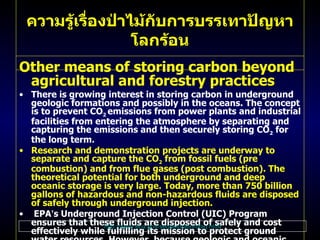
Other means of storing carbon beyond agricultural and forestry practices   There is growing interest in storing carbon in underground geologic formations and possibly in the oceans .  The concept is to prevent CO 2   emissions from power plants and industrial facilities from entering the atmosphere by separating and capturing the emissions and then securely storing CO 2  for the long term .  Research and demonstration projects are underway to separate and capture the CO 2  from fossil fuels  ( pre combustion )  and from flue gases  ( post combustion ).  The theoretical potential for both underground and deep oceanic storage is very large .  Today, more than 750 billion gallons of hazardous and non - hazardous fluids are disposed of safely through underground injection . EPA ’ s Underground Injection Control  ( UIC )  Program ensures that these fluids are disposed of safely and cost effectively while fulfilling its mission to protect ground water resources .  However, because geologic and oceanic sequestration are emerging climate mitigation optionskey issues still need to be addressed, including the costs, energy requirements, long - term effectiveness, and ecological consequences, especially for oceanic storage . For more information on these options and EPA ’ s UIC program, visit  DOE ’ s Office of Science ,     Office of Fossil Energy ,     National Energy Technology Laboratory ,    and EPA ’ s  Office of Ground Water and Drinking Water .  ความรู้เรื่องป่าไม้กับการบรรเทาปัญหาโลกร้อน http :// www . epa . gov / sequestration / faq . html
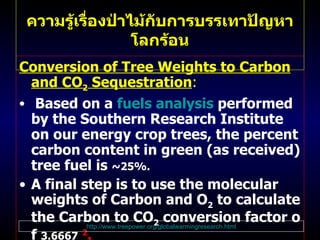
Conversion of Tree Weights to Carbon and CO 2  Sequestration : Based on a  fuels analysis  performed by the Southern Research Institute on our energy crop trees, the percent carbon content in green (as received) tree fuel is  ~25%.   A final step is to use the molecular weights of Carbon and O 2  to calculate the Carbon to CO 2  conversion factor of  3.6667   2 .   2   The molecular weight of Carbon to CO 2  ( C  +  O 2  =  CO 2 )  equals 12 lbs .  of carbon  +  32 lbs .  of O 2   =  44 lbs .  of CO 2 .  Dividing 44 lbs .  of CO 2  by 12 lbs .  of Carbon, results in a Carbon to CO 2  conversion factor of 3.6667 .  ความรู้เรื่องป่าไม้กับการบรรเทาปัญหาโลกร้อน http :// www . treepower . org / globalwarmingresearch . html
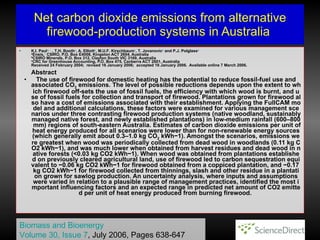
Net carbon dioxide emissions from alternative firewood - production systems in Australia  K . I .  Paul a ,    ,    , T . H .  Booth a , A .  Elliott b , M . U . F .  Kirschbaum c , T .  Jovanovic a  and P . J .  Polglase a   a Ensis, 1  CSIRO, P.O. Box E4008, Kingston ACT 2604, Australia b CSIRO Minerals, P . O .  Box 312, Clayton South VIC 3169, Australia c CRC for Greenhouse Accounting, P.O. Box 475, Canberra ACT 2601, Australia  Received 24 February 2004;  revised 16 January 2006;  accepted 16 January 2006 .   Available online 7 March 2006 .    Abstract   The use of firewood for domestic heating has the potential to reduce fossil-fuel use and associated CO 2  emissions. The level of possible reductions depends upon the extent to which firewood off-sets the use of fossil fuels, the efficiency with which wood is burnt, and use of fossil fuels for collection and transport of firewood. Plantations grown for firewood also have a cost of emissions associated with their establishment. Applying the FullCAM model and additional calculations, these factors were examined for various management scenarios under three contrasting firewood production systems (native woodland, sustainably managed native forest, and newly established plantations) in low-medium rainfall (600–800 mm) regions of south-eastern Australia. Estimates of carbon dioxide emissions per unit of heat energy produced for all scenarios were lower than for non-renewable energy sources (which generally emit about 0.3–1.0 kg CO 2  kWh −1 ). Amongst the scenarios, emissions were greatest when wood was periodically collected from dead wood in woodlands (0.11 kg CO 2  kWh −1 ), and was much lower when obtained from harvest residues and dead wood in native forests (<0.03 kg CO 2  kWh −1 ). When wood was obtained from plantations established on previously cleared agricultural land, use of firewood led to carbon sequestration equivalent to −0.06 kg CO 2  kWh −1  for firewood obtained from a coppiced plantation, and −0.17 kg CO 2  kWh −1  for firewood collected from thinnings, slash and other residue in a plantation grown for sawlog production. An uncertainty analysis, where inputs and assumptions were varied in relation to a plausible range of management practices, identified the most important influencing factors and an expected range in predicted net amount of CO 2  emitted per unit of heat energy produced from burning firewood.  Biomass and Bioenergy   Volume 30, Issue 7 , July 2006, Pages 638-647
ThaiFlux Colloquium 2006 31 st  October 2006  08.50-17.00 Princess Sirindhorn International Center for Research,   Development and Tecnnology Transfer. Kasetsart University at Bangken, Bangkok Gas and Energy Fluxes in Ecosystems, Thailand
The 1 st  ThaiFlux Colloquium  October 31, 2006
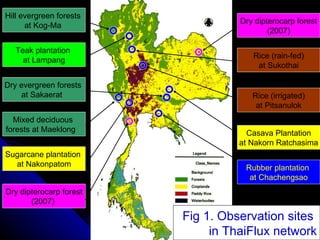
Rubber plantation  at Chachengsao Dry dipterocarp forest (2007) Hill evergreen forests  at Kog-Ma  Dry evergreen forests  at Sakaerat  Mixed deciduous  forests at Maeklong  Rice (rain-fed) at Sukothai Rice (irrigated) at Pitsanulok Teak plantation  at Lampang Casava Plantation at  Nakorn Ratchasima Dry dipterocarp forest (2007)  Sugarcane plantation  at Nakonpatom Fig 1. Observation sites  in ThaiFlux network
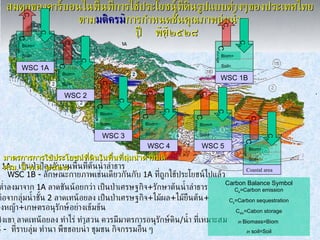
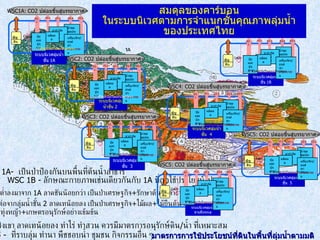
สมดุลของคาร์บอนในพื้นที่การใช้ประโยชน์ที่ดินรูปแบบต่างๆของประเทศไทยตาม มติครม การกำหนดชั้นคุณภาพลุ่มน้ำ ปีพศ๒๕๒๘ WSC 1A-  เป็นป่าป้องกันบนพื้นที่ต้นน้ำลำธาร WSC 1B -  ลักษณะกายภาพเช่นเดียวกันกับ  1A  ที่ถูกใช้ประโยชน์ไปแล้ว WSC 3 -  ต่อจากลุ่มน้ำชั้น  2  ลาดเทน้อยลง เป็นป่าเศรษฐกิจ + ไม้ผล + ไม้ยืนต้น + ทุ่งหญ้า + เกษตรอนุรักษ์อย่างเข้มข้น  WSC 4 -  เชิงเขา ลาดเทน้อยลง ทำไร่ ทำสวน ควรมีมาตรการอนุรักษ์ดิน / น้ำ ที่เหมาะสม WSC 5 -  ที่ราบลุ่ม ทำนา พืชชอบน้ำ ชุมชน กิจกรรมอื่น ๆ WSC 2 -  ต่ำลงมาจาก  1A  ลาดชันน้อยกว่า เป็นป่าเศรษฐกิจ + รักษาต้นน้ำลำธาร Carbon Balance Symbol C e =Carbon emission C s =Carbon sequestration C sto =Cabon storage in  Biomass=Biom  in  soil=Soil C e C s C storage Biom= Soil= C e C s C storage Biom= Soil= C e C s C storage Biom= Soil= C e C s C storage Biom= Soil= C e C s C storage Biom= Soil= C e C s C storage Biom= Soil= มาตรการการใช้ประโยชน์ที่ดินในพื้นที่ลุ่มน้ำตามมติ ครม .  ปี พ . ศ .  ๒๕๒๘ C e C s C storage Biom= Soil= WSC 1A WSC 1B WSC 2 WSC 3 WSC 4 WSC 5 Coastal area
มาตรการการใช้ประโยชน์ที่ดินในพื้นที่ลุ่มน้ำตามมติ ครม .  ปี พ . ศ .  ๒๕๒๘ ระบบนิเวศลุ่มน้ำชั้น  1A พืช ดิน WSC1A: CO2  ปล่อยขึ้นสู่บรรยากาศ = X3.1 X3.2 X3.5 X3.3 X3.4 น้ำชลชลประทาน ยากำจัดวัชพืชวัชพืช ผลิตผล ปุ๋ยและปูนขาว เครื่องจักร / ยนต์ ทำเกษตรกรรม C  ที่ใส่เข้าไปในระบบในรูปของ C   ที่เก็บไว้ใน ระบบนิเวศลุ่มน้ำชั้น   2   พืช ดิน WSC2: CO2  ปล่อยขึ้นสู่บรรยากาศ = X3.1 X3.2 X3.5 X3.3 X3.4 น้ำชลชลประทาน ยากำจัดวัชพืชวัชพืช ผลิตผล ปุ๋ยและปูนขาว เครื่องจักร / ยนต์ ทำเกษตรกรรม C  ที่ใส่เข้าไปในระบบในรูปของ C   ที่เก็บไว้ใน ระบบนิเวศลุ่มน้ำชั้น  3 พืช ดิน WSC3: CO2  ปล่อยขึ้นสู่บรรยากาศ = X3.1 X3.2 X3.5 X3.3 X3.4 น้ำชลชลประทาน ยากำจัดวัชพืชวัชพืช ผลิตผล ปุ๋ยและปูนขาว เครื่องจักร / ยนต์ ทำเกษตรกรรม C  ที่ใส่เข้าไปในระบบในรูปของ C   ที่เก็บไว้ใน ระบบนิเวศลุ่มน้ำชั้น  1B พืช ดิน WSC1B: CO2  ปล่อยขึ้นสู่บรรยากาศ = X3.1 X3.2 X3.5 X3.3 X3.4 น้ำชลชลประทาน ยากำจัดวัชพืชวัชพืช ผลิตผล ปุ๋ยและปูนขาว เครื่องจักร / ยนต์ ทำเกษตรกรรม C  ที่ใส่เข้าไปในระบบในรูปของ C   ที่เก็บไว้ใน ระบบนิเวศลุ่มน้ำชั้น  4 พืช ดิน WSC4: CO2  ปล่อยขึ้นสู่บรรยากาศ = X3.1 X3.2 X3.5 X3.3 X3.4 น้ำชลชลประทาน ยากำจัดวัชพืชวัชพืช ผลิตผล ปุ๋ยและปูนขาว เครื่องจักร / ยนต์ ทำเกษตรกรรม C  ที่ใส่เข้าไปในระบบในรูปของ C   ที่เก็บไว้ใน ระบบนิเวศลุ่มน้ำชั้น  5 พืช ดิน WSC5: CO2  ปล่อยขึ้นสู่บรรยากาศ = X3.1 X3.2 X3.5 X3.3 X3.4 น้ำชลชลประทาน ยากำจัดวัชพืชวัชพืช ผลิตผล ปุ๋ยและปูนขาว เครื่องจักร / ยนต์ ทำเกษตรกรรม C  ที่ใส่เข้าไปในระบบในรูปของ C   ที่เก็บไว้ใน สมดุลของคาร์บอน ในระบบนิเวศตามการจำแนกชั้นคุณภาพลุ่มน้ำของประเทศไทย WSC 1A-  เป็นป่าป้องกันบนพื้นที่ต้นน้ำลำธาร WSC 1B -  ลักษณะกายภาพเช่นเดียวกันกับ  1A  ที่ถูกใช้ประโยชน์ไปแล้ว WSC 3 -  ต่อจากลุ่มน้ำชั้น  2  ลาดเทน้อยลง เป็นป่าเศรษฐกิจ + ไม้ผล + ไม้ยืนต้น + ทุ่งหญ้า + เกษตรอนุรักษ์อย่างเข้มข้น  WSC 4 -  เชิงเขา ลาดเทน้อยลง ทำไร่ ทำสวน ควรมีมาตรการอนุรักษ์ดิน / น้ำ ที่เหมาะสม WSC 5 -  ที่ราบลุ่ม ทำนา พืชชอบน้ำ ชุมชน กิจกรรมอื่น ๆ WSC 2 -  ต่ำลงมาจาก  1A  ลาดชันน้อยกว่า เป็นป่าเศรษฐกิจ + รักษาต้นน้ำลำธาร ระบบนิเวศลุ่มน้ำชายฝั่งทะเล พืช ดิน WSC5: CO2  ปล่อยขึ้นสู่บรรยากาศ = X3.1 X3.2 X3.5 X3.3 X3.4 น้ำชลชลประทาน ยากำจัดวัชพืชวัชพืช ผลิตผล ปุ๋ยและปูนขาว เครื่องจักร / ยนต์ ทำเกษตรกรรม C  ที่ใส่เข้าไปในระบบในรูปของ C   ที่เก็บไว้ใน
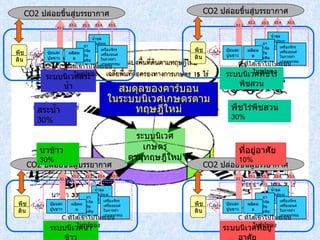
สระน้ำ   30% นาข้าว  30% พืชไร่พืชสวน   30% ที่อยู่อาศัย  10% ระบบนิเวศเกษตร ตามทฤษฎีใหม่ สมดุลของคาร์บอน ในระบบนิเวศเกษตรตามทฤษฎีใหม่ ระบบนิเวศสระน้ำ พืช ดิน CO2  ปล่อยขึ้นสู่บรรยากาศ X3.1 X3.2 X3.5 X3.3 X3.4 น้ำชลชลประทาน ยากำจัดวัชวัชพืช ผลิตผล ปุ๋ยและปูนขาว เครื่องจักรเครื่องยนต์ ในการทำเกษตรกรรม C  ที่ใส่เข้าไปในระบบในรูปของ C   ที่เก็บไว้ใน ระบบนิเวศพืชไร่พืชสวน พืช ดิน CO2  ปล่อยขึ้นสู่บรรยากาศ X3.1 X3.2 X3.5 X3.3 X3.4 น้ำชลชลประทาน ยากำจัดวัชวัชพืช ผลิตผล ปุ๋ยและปูนขาว เครื่องจักรเครื่องยนต์ ในการทำเกษตรกรรม C  ที่ใส่เข้าไปในระบบในรูปของ C   ที่เก็บไว้ใน ระบบนิเวศที่อยู่อาศัย พืช ดิน CO2  ปล่อยขึ้นสู่บรรยากาศ X3.1 X3.2 X3.5 X3.3 X3.4 น้ำชลชลประทาน ยากำจัดวัชวัชพืช ผลิตผล ปุ๋ยและปูนขาว เครื่องจักรเครื่องยนต์ ในการทำเกษตรกรรม C  ที่ใส่เข้าไปในระบบในรูปของ C   ที่เก็บไว้ใน ระบบนิเวศนาข้าว พืช ดิน CO2  ปล่อยขึ้นสู่บรรยากาศ X3.1 X3.2 X3.5 X3.3 X3.4 น้ำชลชลประทาน ยากำจัดวัชวัชพืช ผลิตผล ปุ๋ยและปูนขาว เครื่องจักรเครื่องยนต์ ในการทำเกษตรกรรม C  ที่ใส่เข้าไปในระบบในรูปของ C   ที่เก็บไว้ใน
Research , Development  and Technology Transfer Research Development Technology Transfer to Whom:-  Land Users? ThaiFlux + AsiaFlux + GlobalFlux
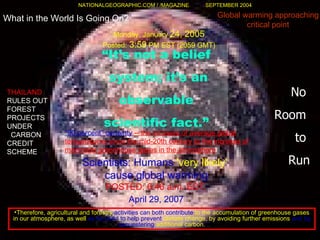
What in the World Is Going On? “ It’s not a belief system; it’s an observable  scientific fact.” No  Room  to  Run Global warming approaching critical point NATIONALGEOGRAPHIC.COM / /MAGAZINE  SEPTEMBER 2004 Scientists :  Humans   'very likely'   cause global warming POSTED :  6:46 a . m .  EDT,   April 29, 2007   Monday, January  24, 2005   Posted:  3:59  PM EST (2059 GMT)  &quot; 90 percent &quot;  certainty   --  the increase of average global temperatures since the mid-20th century to the increase of manmade greenhouse gases in the atmosphere THAILAND   RULES OUT FOREST PROJECTS UNDER    CARBON CREDIT SCHEME Therefore, agricultural and forestry  activities can both contribute  to the accumulation of greenhouse gases in our atmosphere, as well  as be used to help prevent  climate change, by avoiding further emissions  and by sequestering  additional carbon .

Globalworming

  • 1.
    What in theWorld Is Going On? NATIONALGEOGRAPHIC.COM / /MAGAZINE SEPTEMBER 2004 Signs from Earth Carbon Dioxide Levels Rise: Mercury Climbs: Oceans Warm: Glaciers Melt: Sea Level Rises: Sea Ice Thins: Permafrost Thaws: Wildfires Increase: Lakes Shrink: Lakes Freeze Up Later: Ice Shelves Collapse: Droughts Linger: Precipitation Increases: Mountain Streams Run Dry: Winter Loses Its Bite: Spring Arrives Earlier: Autumn Comes Later: Plants Flower Sooner: Migration Times Vary: Habitats Change: Birds Nest Earlier: Diseases Spread: Coral Reefs Bleach: Snowpacks Decline: Exotic Species Invade: Amphibians Disappear: Coastlines Erode: Cloud Forests Dry: Temperatures Spike At High Latitudes: Signs from Earth พ . ศ . 2547
  • 2.
    ก่อนมีคำว่า “ภูมิอากาศเปลี่ยนแปลง และ โลกร้อน ” พ . ศ . 2517: องค์ความรู้จากวิชา อุตุนิยมวิทยาป่าไม้ใกล้ผิวดิน (Forest Microclimatology) จาก PSU Human activities can also change the climate . The atmospheric amounts of many greenhouse gases are increasing, especially that of carbon dioxide, which has increased by 30% over the last 200 years, primarily as a result of changes in land use ( e . g . , deforestation ) and of burning coal, oil, and natural gas ( e . g . , in automobiles, industry, and electricity generation ). Forty years ago scientists provided the first direct evidence that combustion of fossil fuels was causing a buildup of carbon dioxide and thereby diluting radioactive carbon in the atmosphere by measuring the decreasing fraction of radioactive carbon-14 captured in tree rings, each year between 1800 and 1950 .  พ . ศ . 2510 Secondly , scientists began making precise measurements of the total amount of carbon dioxide in the atmosphere at Mauna Loa, Hawaii, and at the South Pole in the late 1950s . They have since expanded their observations to many other locations . Their data show convincingly that the levels of carbon dioxide have increased each year worldwide . Furthermore, these increases are consistent with other estimates of the rise of carbon dioxide emissions due to human activity over this period . A third line of evidence has been added since 1980 . Ice buried below the surface of the Greenland and Antarctic ice caps contains bubbles of air trapped when the ice originally formed . Measurements from the youngest and most shallow segments of the ice cores, which contain air from only a few decades ago, produce carbon dioxide concentrations nearly identical to those that were measured directly in the atmosphere at the time the ice formed. But the older parts of the cores show that carbon dioxide amounts were about 25% lower than today for the ten thousand years previous to the onset of industrialization, and over that period changed little  พ . ศ . 2493  พ . ศ . 2523 http :// www . gcrio . org / ipcc / qa / 05 . html
  • 3.
    Figure 5.1 Measured amounts of carbon dioxide in the atmosphere . A third line of evidence has been added since 1980 . Ice buried below the surface of the Greenland and Antarctic ice caps contains bubbles of air trapped when the ice originally formed . These samples of fossil air, some of them over 200,000 years old, have been retrieved by drilling deep into the ice . Measurements from the youngest and most shallow segments of the ice cores, which contain air from only a few decades ago, produce carbon dioxide concentrations nearly identical to those that were measured directly in the atmosphere at the time the ice formed . But the older parts of the cores show that carbon dioxide amounts were about 25% lower than today for the ten thousand years previous to the onset of industrialization, and over that period changed little ( Figure 5.1 ). The final line of evidence comes from the geographic pattern of carbon dioxide measured in air . Observations show that there is slightly more carbon dioxide in the northern hemisphere than in the southern hemisphere . The difference arises because most of the human activities that produce carbon dioxide are in the north and it takes about a year for northern hemispheric emissions to circulate through the atmosphere and reach southern latitudes . http :// www . gcrio . org / ipcc / qa / 05 . html  พ . ศ . 2523 http://www.aip.org/history/climate/rapid.htm
  • 4.
    การศึกษาวิจัยในประเทศไทยและภูมิภาคเอเชีย เกี่ยวกับ เรื่องของป่า ไม้กับการเปลี่ยนแปลงของสภาวะอากาศ ก่อนถึงวันนี้ พ . ศ . 2532: Tangtham และ Sithipibul (1989) วิเคราะห์น้ำฝนในภาคตะวันออกเฉียงเหนือ ประเทศไทยที่ตรวจวัดได้ในช่วงปี พ . ศ . 2494-2527 พบว่า มีความสัมพันธ์ในเชิงลบ กับพื้นที่ป่าไม้ที่ลดลงในภาคนี้ แต่ จะมีวันฝนตกมากขึ้น พ . ศ . 2543: Satomora (2000) ใช้แบบจำลองคณิตศาสตร์ศึกษาพบว่า การลดลงของพื้นที่ป่าไม้ (deforestation) ในแหลมอินโดจีน ส่งผลต่อการลดลงของปริมาณฝนในเขตเอเชีย อาคเนย์ พ . ศ . 2544 : Kanae และคณะ (2001) ศึกษาด้วยการวิเคราะห์ตามอนุกรมเวลาและใช้แบบจำลอง พบว่า ฝนในประเทศไทยเฉพาะในเดือน กันยายน ลดลงไปอย่างมีนัยสำคัญในช่วง 3 ทศวรรษที่ผ่านมา โดยภาพรวมทั้งประเทศแล้วปริมาณฝนในเดือนนี้จะลดลงไป ประมาณ 7 % ในขณะที่ในท้องที่ภาตะวันออกเฉียงเหนือลดลงสูงสุดถึง 29 % Southeast Asia Forest Cover - 1973 Southeast Asia Forest Cover - 1985 Modified from: David L. Skole William A. Salas Chaowalit Silapathong http :// www . trfic . msu . edu / overview / papers / interannual . html 5.25 Mha Forest areas in continental Southeast Asia resulted from satellite data analysis Mha=Million hectares 22.56 Mha 48.71 Mha 18.28 Mha 19.92 Mha 3.98 Mha 16.74 Mha 44.82 Mha 16.15 Mha 16.52 Mha 114.70 Mha 98.21 Mha ก่อนถึงวันนี้
  • 5.
    ก่อนถึงวันนี้ พ . ศ . 2544 : Kanae และคณะ (2001) อธิบายถึงสาเหตุที่ฝนในเดือนกันยายนลดลงอย่างมี นัยสำคัญว่า เนื่องจากมรสุมตะวันตะเฉียงใต้ ซึ่งปกติมักจะอ่อนกำลังในเดือนนี้กลับ หายไป (disappear) ทั้งนี้แบบจำลองที่เขาใช้ศึกษาชี้ให้เห็นว่า การเปลี่ยนแปลงของ การสะท้อนรังสีคลื่นสั้น (surface albedo) ของผิวดินและความขรุขระของ พื้นที่ (roughness) อันเกิดจากสภาพป่าเดิมในพื้นที่นี้ลดน้อยลงไป ส่งผลต่อ การเกิดพฤติกรรมนี้ พ . ศ . 2545 : Yasunari (2002) ศึกษาความผันผวนของปริมาณฝนทั้งปีของประเทศไทย พบว่า โดยภาพรวมแล้ว ปริมาณฝนในเดือน กันยายน มีแนวโน้มลดลงทั้งประเทศอย่างชัดเจน นับตั้งแต่ปี ค . ศ .1950 เป็นต้นมา แต่ไม่ส่งผลต่อปริมาณฝนในเดือนกรกฎาคม - สิงหาคม อันเป็นช่วงที่ลมมรสุมตะวันตกเฉียงใต้ยังพัดแรงอยู่ การศึกษาวิจัยในประเทศไทยและภูมิภาคเอเชีย เกี่ยวกับ เรื่องของ ป่า ไม้กับการเปลี่ยนแปลงของสภาวะอากาศ Southeast Asia Forest Cover - 1973 Southeast Asia Forest Cover - 1985 Modified from: David L. Skole William A. Salas Chaowalit Silapathong http :// www . trfic . msu . edu / overview / papers / interannual . html 5.25 Mha Forest areas in continental Southeast Asia resulted from satellite data analysis Mha=Million hectares 22.56 Mha 48.71 Mha 18.28 Mha 19.92 Mha 3.98 Mha 16.74 Mha 44.82 Mha 16.15 Mha 16.52 Mha 114.70 Mha 98.21 Mha ก่อนถึงวันนี้
  • 6.
    ก่อนถึงวันนี้ พ .ศ . 2546 : Sen และคณะ (2003) ศึกษาการลดน้อยถอยลงของป่าในแหลมอินโดจีน (Indochina deforestation) ต่อลมมรสุมช่วงฤดูร้อนของเอเชียตะวันออก (East- Asian summer monsoon) โดยใช้ แบบจำลองและการตรวจวัดค่าในอดีต พบว่า : “ การลดลงของพื้นที่ป่าในเขตแหลมอินโดจีนที่ผ่านมา ได้ส่งผลกระทบต่อลมมรสุมไม่เฉพาะในระดับท้องถิ่นเท่านั้น แต่ได้กระทบไปไกลถึงระบบมรสุมช่วงฤดูร้อนในเขตเอเชียตะวันออกด้วย ทั้งนี้เนื่องจาก การเพิ่มขึ้นของความเร็วลม และอุณหภูมิที่สูงขึ้น ในขณะที่อัตราส่วนการผสมของไอน้ำในอากาศ (water vapor mixing ratio) กลับลดน้อยลง ทั้งนี้เนื่องจาก ความหนาแน่นของ ไอน้ำในอากาศที่ระดับความสูง ณ ความดันอากาศ 850 มิลลิบาร์ ( ประมาณ 1 กม . เหนือ ผิวดิน ) บริเวณป่าที่ถูกทำลาย ลด น้อยลงไป ” การศึกษาวิจัยในประเทศไทยและภูมิภาคเอเชีย เกี่ยวกับ เรื่องของ ป่า ไม้กับการเปลี่ยนแปลงของสภาวะอากาศ Southeast Asia Forest Cover - 1973 Southeast Asia Forest Cover - 1985 Modified from: David L. Skole William A. Salas Chaowalit Silapathong http :// www . trfic . msu . edu / overview / papers / interannual . html 5.25 Mha Forest areas in continental Southeast Asia resulted from satellite data analysis Mha=Million hectares 22.56 Mha 48.71 Mha 18.28 Mha 19.92 Mha 3.98 Mha 16.74 Mha 44.82 Mha 16.15 Mha 16.52 Mha 114.70 Mha 98.21 Mha ก่อนถึงวันนี้
  • 7.
    การศึกษาวิจัยในประเทศไทยและภูมิภาคเอเชีย เกี่ยวกับ เรื่องของป่า ไม้กับการเปลี่ยนแปลงของสภาวะอากาศ ก่อนถึงวันนี้ พ . ศ . 2548-2549 : การเปลี่ยนแปลงปริมาณฝนรายปีของภาคตะวันออก พ . ศ . 2548: กรมชลประทานวิเคราะห์แนวโน้มปริมาณฝนในภาคตะวันออกระหว่างปี พ . ศ . 2495 – 2545 พบว่า ปริมาณฝนรายปีมีแนวโน้มลดลง 6.0 มม . / ปี มีค่าสัมประสิทธิ์ความผันแปร 11.5 % ค่าเบี่ยงเบนจาก ค่าเฉลี่ย 215 มม . พ . ศ . 2549 : การศึกษาของ คณะทำงานศึกษาสถานภาพและการรองรับการพัฒนาและรักษาสิ่งแวดล้อมลุ่มน้ำภาค ตะวันออก ( 2549) พบว่า โดยภาพรวมแล้วพบว่าระหว่างช่วงปี พ . ศ . 2495 – 2547 ปริมาณฝน เฉลี่ยทั้งปีของภาคตะวันออกลดลง 6.75 มม . / ปี ทั้งนี้ในฤดูฝนลดลงเฉลี่ยปีละ 5.94 มม . / ปี โดยลดลงทุกเดือนยกเว้นเดือนมีนาคม โดยเฉพาะเดือนกันยายนลดลงมากกว่าเดือนใดๆ ( -2.58 มม . ) ตามมาด้วยเดือนตุลาคม ( -1.02 มม . ) การวิเคราะห์แนวโน้มการใช้ข้อมูลปีต่อปี พบว่าการลดลงของฝนดังกล่าวยังไม่มีนัยสำคัญทางสถิติ แต่เมื่อวิเคราะห์ด้วยอนุกรมเวลา 10, 15 และ 20 ปี การลดลงของฝนเฉลี่ยทั้งปีมีนัยสำคัญทางสถิติ
  • 8.
    การศึกษาวิจัยในประเทศไทยและภูมิภาคเอเชีย เกี่ยวกับ เรื่องของป่า ไม้กับการเปลี่ยนแปลงของสภาวะอากาศ ก่อนถึงวันนี้ พ . ศ . 2548-2549 : การเปลี่ยนแปลงปริมาณฝนรายปีของภาคตะวันออก ( ต่อ ) พ . ศ . 2549 : การศึกษาของ คณะทำงานศึกษาสถานภาพและการรองรับการพัฒนาและรักษาสิ่งแวดล้อมลุ่มน้ำภาค ตะวันออก ( 2549) : แนวโน้มการเปลี่ยนแปลงปริมาณฝนเฉลี่ยของแต่ละจังหวัดในภาค ตะวันออก ปริมาณรวมทั้งปีเฉลี่ยของทุกจังหวัด มีแนวโน้มลดลงยกเว้นจังหวัดตราดที่มีแนวโน้มเพิ่มขึ้น อัตราการลดลงรายปีเฉลี่ยลดลงจากสูงสุด  ต่ำสุด คือจังหวัดจันทบุรี ( -19.4 มม .) ระยอง ( -10.3 มม .) ฉะเชิงเทรา ( -8.6 มม .) สระแก้ว ( -8.0 มม .) นครนายก ( -7.4 มม .) ปราจีนบุรี ( -4.8 มม .) และ ชลบุรี ( -4.6 มม .) จังหวัดตราด เพิ่มขึ้น 9.12 มม ./ ปี เป็นที่น่าสังเกตว่าในบรรดาการลดลงของปริมาณน้ำฦนในเดือนต่างๆ นั้น อัตราการลดลงมากที่สุด เกิดขึ้นในเดือน “ กันยายน หรือ ตุลาคม ” แม้แต่ในจังหวัดตราด ซึ่งมีฝนทั้งปีเพิ่มขึ้น ก็มีฝนตกลดลงใน 2 เดือนดังกล่าว
  • 9.
  • 10.
    Global warming approachingcritical point “ It’s not a belief system; it’s an observable scientific fact .” No Room to Run NATIONALGEOGRAPHIC.COM / /MAGAZINE SEPTEMBER 2004 Heating Up… “ Things that normally happen in geologic time are happening during the span of a human lifetime.” More than a hundred million people worldwide live within three feet of mean sea level. At some point, as temperatures continue to rise, species will have no more room to run . “ Ecology and ecosystems can change like that. In geologic time it’s a nanosecond .” พ . ศ . 2547
  • 11.
    ภาวะโลกร้อน : ภัยคุกคามโลกมนุษย์ ( ราวปี ค . ศ . 2050-2100) ระบบสังคม - วัฒนธรรมมนุษย์ การเพิ่มประชากร การพัฒนาเทคโนโลยี การเปลี่ยนแปลงวัฒนธรรม การบริโภคและความเป็นอยู่ การย้ายถิ่นฐาน ฯลฯ ระบบเศรษฐกิจ ความหายนะทั้งชีวิตและทรัพย์สิน ในแต่ละประเทศ ตลาดการค้าโลกล่มสลาย ตลาดการเงินพังพินาศ ต้องใช้จ่ายเพิ่มมากขึ้นไม่มีที่สิ้นสุด ประเทศร่ำรวยจะถลำสู่ความยากจน ระบบทรัพยากรธรรมชาติและสิ่งแวดล้อม ทรัพยากรธรรมชาติ บรรยากาศพื้นผิวโลก บรรยากาศเบื้องบน ในมหาสมุทร บนบก ภูเขาน้ำแข็งละลาย หิมะตกหนัก GHG ปรากฏการณ์เรือนกระจก ( อุณหภูมิ ~5 ๐ c ) น้ำทะเลสูงขึ้น ( ~50 ซม .) ดิน น้ำ ป่าไม้ สัตว์ป่า แร่ ตึก / อาคารทรุดในเขตอบอุ่นและเขตหนาว แผ่นดินถล่มบนพื้นที่เขา อุทกภัย / น้ำท่วมฉับพลันในหุบเขา พายุเฮอริเคนรุนแรงมากขึ้น ความหลากหลายทางชีวภาพ กระแสน้ำอุ่น Gulfstream จะหยุดหรือเย็นตัวลง มหาสมุทรแปซิฟิค น้ำทะเลอุ่นขึ้น ฆ่าแนวปะการัง ( ฟอกขาว ) เกิดการทดแทนของสาหร่าย เสียกลไกหลักในการป้องกัน คลื่นจากทะเล มหาสมุทรแอตแลนติค ดิน น้ำ ป่าไม้ - สัตว์ป่า แร่ แม่น้ำตื้นเขิน น้ำในแม่น้ำไม่มีที่ไปเนื่องจากน้ำทะเลสูงขึ้น อเมริกาใต้ ( เปรู ) เอเชีย ( จีน ) ปรากฏการณ์เรือนกระจก โลก : บ้านของมนุษย์กว่า 6 พันล้านคน ใช้ ต้องลด GHG ถึง 50% ต้องลงทุนมหาศาล ต้องทำอย่างจริงจัง ณ บัดนี้ หนทางแก้ไข : ปรากฏการณ์เอลนิโญ พืชและสัตว์น้ำ แนวปะการัง สาหร่าย แพลงตอน GHG เกษตร ประมง อุตสาหกรรม การขยายเมือง ไฟป่า ไฟป่า 3D View of the EI Nino Phenomenon จำลองจากสารคดีเรื่อง :Future Strom: Hell on Earth, UBC-43 : Discovery ,13 ต . ค . 47, 17.00-18.00 น .  สงวนลิขสิทธิ์ นิพนธ์ ตั้งธรรม ภาค วิชา อนุรักษวิทยา คณะวนศาสตร์ มหาวิทยาลัยเกษตรศาสตร์ พ . ศ . 2547
  • 12.
    Report: Global warmingapproaching critical point 'An ecological time-bomb is ticking away‘ “ ระเบิดเวลาทางนิเวศวิทยากำลังเดินหน้าไปเรื่อยๆ ” Monday, January 24, 2005 Posted: 3:59 PM EST (2059 GMT) http :// www . nationalcenter . org / TSR020905 . html 24 Jan 2005 20:27:39 GMT Source: Reuters พ . ศ . 2548 LONDON, England (AP) -- Global warming is approaching the critical point of no return, after which widespread drought, crop failure and rising sea-levels would be irreversible , an international climate change task force warned Monday. The report, &quot;Meeting the Climate Challenge,&quot; called on the G- 8 leading industrial nations to cut carbon emissions, double their research spending on green technology and work with India and China to build on the Kyoto Protocol. &quot; An ecological time-bomb is ticking away ,&quot; said Stephen Byers, who co-chaired the task force with U.S. Republican Senator Olympia Snowe, and is a close confidant of British Prime Minister Tony Blair. &quot; World leaders need to recognize that climate change is the single most important long term issue that the planet faces.&quot; The independent report, by the I nstitute for Public Policy Research in Britain, T he Center for American Progress in the United States and The Australia Institute , is timed to coincide with Blair's commitment to advance international climate change policy during Britain's G -8 presidency.
  • 13.
    Scientists : Humans 'very likely' cause global warming POSTED : 6:46 a . m . EDT, April 29, 2007 ( CNN ) -- Global warming is here and humans are &quot; very likely &quot; the blame , an international group of scientists meeting in Paris, France, announced Friday . &quot; The evidence for warming having happened on the planet is unequivocal( ไม่อ้อมแอ้ม ) , &quot; said U . S . government scientist Susan Solomon, who also is a member of the Intergovernmental Panel on Climate Change . &quot; We can see that in rising air temperatures, we can see it in changes in snow cover in the Northern Hemisphere . We can see it in global sea rise . It's unequivocal, &quot; shesaid . ( http :// www . cnn . com / 2007 / TECH / science / 02/02 / climate . change . report / ) ( Watch scientist Susan Solomon deliver the grim news on global warming ) In a 21-page report for policymakers , the group of climate experts unanimously linked -- with &quot; 90 percent &quot; certainty -- the increase of average global temperatures since the mid-20th century to the increase of manmade greenhouse gases in the atmosphere . Fossil fuels like methane and carbon dioxide trap heat near the surface, a process known as the greenhouse effect . The greenhouse effect is a natural phenomenon, but human activities, like the burning of fossil fuels, can pour enormous volumes of these gases into the atmosphere, raising the planet's temperature and destabilizing the climate . ( http :// www . cnn . com / 2007 / TECH / science / 02/02 / climate . change . report / ) ( Watch what happens to our planet when manmade emissions get trapped in the atmosphere ) http :// www . cnn . com / 2007 / TECH / science / 02/02 / climate . change . report / POSTED : 6:46 a . m . EDT, April 29, 2007 ปี พ . ศ . 2550
  • 14.
    สาเหตุและปัจจัยที่ส่งผลให้เกิดการเปลี่ยนแปลงภูมิอากาศโลก ปัจจัยที่มีผลให้เกิดการเปลี่ยนแปลงภูมิอากาศโลก PhysicalGeography.net| FUNDAMENTALS OF PHYSICAL GEOGRAPHY http://www.physicalgeography.net/fundamentals/7y.html พลังสุริยะ การระเบิดของภูเขาไฟ องค์ประกอบทางเคมีของชั้นบรรยากาศ การสะท้อนรังสีความร้อน คลื่นสั้นกลับของบรรยากาศ การสะท้อนรังสีความร้อน คลื่นสั้นกลับของพื้นผิวโลก มุมของ ดวงอาทิตย์กับโลก การแลกเปลี่ยนความร้อนของมหาสมุทร์ ปัจจัยจากนอกโลก ปัจจัยจาก มหาสมุทร์ ชั้นบรรยากาศ และ แผ่นดิน ที่มา : ดัดแปลงจาก ฝุ่นละอองจากดวงดาว ในอวกาศ การเลื่อนตัวของไหล่ทวีป การเกิดภูเขา ( บรรพตรังสรรค์ ) GHG ภูมิอากาศของโลก
  • 15.
    การเสียสมดุลของพลังงานความร้อนของโลก ( Earth'sEnergy Out of Balance ) Global Climate Animations การเสียสมดุลของพลังงานความร้อนของโลกจนถึงปัจจุบันถือได้ว่าอยู่ในระดับสูงตามมาตรฐานของประวัติศาสตร์โลก ทั้งนี้พอยกเป็นตัวอย่างได้ว่า “ การเสียสมดุลพลังงานความร้อนของโลกเพียง 1 วัตต์ - ปี ต่อ ตารางเมตร ติดต่อกันตลอด 10,000 ปีที่ผ่านมา จะมีพลังงานความร้อนมากพอที่จะละลายน้ำแข็งได้จนทำให้ระดับน้ำทะเลสูงขึ้นถึง 1 กิโลเมตร ( ถ้ามีน้ำแข็งที่จะให้ละลายได้มากถึงขนาดนั้น ) หรือ จะเพิ่มอุณหภูมิของมหาสมุทร์ในชั้น thermocline [ the boundary layer between the warm surface waters and the deep ocean ] ได้มากกว่า 100°C” . รังสีคลื่นสั้น รังสีคลื่นยาว รังสีความร้อนสุทธิ พลังงานความร้อนเผาดินและอากาศ ( พลังงานความร้อนสุทธิที่โลกได้รับ ) พลังงานความร้อนเผาน้ำ พลังงานความร้อนที่ถูกเก็บกักไว้ NASA GISS : Research News : Earth's Energy Out of Balance NASA - Scientists Confirm Earth's Energy Is Out of Balance http :// geography . uoregon . edu / envchange / clim_animations /
  • 16.
    สมดุลน้ำ ( Water Balance) ฝน / น้ำฟ้า ( Precipitation, P) ความชื้นในดิน ( Soil Storage, S) น้ำท่า ( ในลำธาร ) , Q) ฝน / น้ำฟ้า - การคายระเหยน้ำ ผลกระทบของการเปลี่ยนแปลงภูมิอากาศ ต่อความผันแปรของ สมดุลน้ำ ( Water Balance) รายเดือน ในระดับโลก Global Climate Animations http :// geography . uoregon . edu / envchange / clim_animations /
  • 17.
    ที่มา : : นิธิ เอียวศรีวงศ์ : ภาวะฉุกเฉินของประชาชน วันที่ 10 กรกฎาคม พ . ศ . 2549 ปีที่ 29 ฉบับที่ 10348 หน้า 6 โศกนาฏกรรมทำนองนี้เกิดซ้ำแล้วซ้ำอีกในทุกพื้นที่ซึ่งประสบภัยธรรมชาติ ไม่ว่าขนาดเล็กหรือใหญ่ น้ำท่วมใหญ่ที่บ้านกรูดเมื่อปีกลาย และน้ำท่วมใหญ่กับดินถล่มที่อุตรดิตถ์ในปีนี้ , ฯลฯ .................... บัดนี้ความเห็นทางวิทยาศาสตร์ค่อนข้างสอดคล้องกันแล้วว่า ความเปลี่ยนแปลงด้านภูมิอากาศของโลกทำให้อุบัติภัยทางธรรมชาติมีแนวโน้มจะเกิดถี่ขึ้นและรุนแรงขึ้น ฉะนั้นสังคมไทยจึงกำลังก้าวเข้าสู่ยุคภัยพิบัติระดับโลก โดยไม่มีวิธีจัดการกับผลของมันอย่างมีประสิทธิภาพและเป็นธรรม ถึงเวลาที่เราควรคิดเรื่องนี้อย่างจริงจังว่าจะปรับปรุงความสามารถในภาครัฐและเอกชน เพื่อการบูรณะฟื้นฟูภัยพิบัติอย่างไร
  • 18.
    โลกร้อน : ผลกระทบสะสมเชิงปฏิสัมพันธ์การเปลี่ยนแปลงการใช้ประโยชน์ที่ดิน การใช้พลังงาน ด้านอุตสาหกรรม การขยายตัวของเมืองและการพัฒนาโครงสร้างพื้นฐาน การบริโภคพลังงานและทรัพยากรโลกของมนุษย์ในศตวรรษที่ผ่านมา ส่ง ผลให้เกิดการสะสมของ ก๊าซ คาร์บอนไดออกไซด์ ในชั้นบรรยากาศ จนส่งผลให้เกิดภาวะเรือนกระจกที่เข้าขั้นวิกฤติ ระดับภูมิภาค / ทวีป GHG ระดับประเทศ ระดับท้องถิ่น GHG GHG สมดุลของ พลังงาน และ น้ำ ผิดรูปเสียขบวน GHG GHG GHG ก๊าซเรือนกระจก ก๊าซเรือนกระจก ก๊าซเรือนกระจก น้ำ น้ำ น้ำ
  • 19.
    คณะกรรมการนานาชาติติดตามตรวจสอบและประเมินผลกระทบการเปลี่ยนแปลงสภาพภูมิอากาศ (IPCC) : รายงานการประเมินผลครั้งที่ ๔ ปี พ . ศ . ๒๕๕๐ IPCC Fourth Assessment Report Climate Change 2007 Climate Change Impacts, Adaptation and Vulnerability
  • 20.
    ผลกระทบที่พบเห็นได้ในขณะนี้ (ImpactObservable Now) ลักษณะอากาศที่มีผลต่อการเปลี่ยนแปลงในระบบกายภาพ และชีวภาพ (physical and biological system) ที่ชัดเจนที่สุดคือการเพิ่มขึ้นของอุณหภูมิอันเกิดจาก GHG (High Confidence, HC= มีความมั่นใจในระดับสูง ) ผลกระทบจากการเปลี่ยนแปลงสภาพภูมิอากาศที่ทำให้อุณหภูมิสูงขึ้นได้ส่งผลแล้วต่อ / กระบวนการทางอุทกวิทยา , ทรัพยากรน้ำ , มหาสมุทร , และ ชายฝั่งทะเล (HC) มีหลักฐานมากขึ้นว่าการเปลี่ยนแปลงสภาพภูมิอากาศได้ส่งผลกระทบต่อระบบธรรมชาติของสิ่งมีชีวิตบนบก (terrestrial natural biological systems) ระบบนิเวศมหาสมุทร และ แหล่งน้ำจืด (HC) ผลกระทบต่อการเกษตร และสุขภาพมนุษย์ก็พบบ้างแล้ว แต่ยังมีความมั่นใจในระดับปานกลาง เนื่องจากมีการปรับตัวรองรับเรื่องนี้กันบ้างแล้ว (Medium Confidence, MC = มีความมั่นใจในระปานกลาง )
  • 21.
    มี หลักฐานปรากฏจากการตรวจวัดลักษณะลมฟ้าอากาศหลายแห่งในทวีปเอเชีย พบว่าภูมิอากาศมีการเปลี่ยนแปลงอย่างเด่นชัดและอากาศร้อนขึ้นอย่างมีนัยสำคัญ ( distinct and significant warming ) ในทศวรรษที่ผ่านมา และพบว่าปริมาณน้ำฝนทั้งปีลดลงในหลายสถานีตรวจวัด การลดลงของปริมาณน้ำฝนนี้เกิดขึ้นต่อเนื่องกันมาตั้งแต่ปี ค . ศ . 1970 และเริ่มมีนัยสำคัญตั้งแต่ปี ค . ศ . 1990 มีหลักฐานการเพิ่มขึ้นทั้งความรุนแรงและความถี่ ( intensity and frequency ) ของการเกิดปรากฏการณ์ลักษณะอากาศที่รุนแรง เช่น คลื่นความร้อน ( heat wave ) พายุโซนร้อน ( tropical cyclones ) ช่วงแล้งที่ยาวนานขึ้น , ฝนตกหนักรุนแรง ( intense rainfall ) ทอร์นาโด ( tornadoes ) การถล่มของหิมะ พายุฟ้าคะนอง และพายุฝุ่น เกิดขึ้นในภูมิภาคนี้นับตั้งแต่ปี ค . ศ . 1990 เป็นต้นมา ผลสรุป จากการศึกษาในภูมิภาคเอเชีย เพื่อประโยชน์ในการบริหารจัดการ
  • 22.
    ที่มา : Science , Vol 309, Issue 5742, 1844-1846 , 16 September 2005 จำนวน และ เปอร์เซ็นต์ ของพายุเฮอร์ริเคน ในระดับ 4 และ 5 ที่เกิดขึ้นในรอบ 15 ปี ในช่วงระหว่างปี ค . ศ . 1975–1989 และ 1990–2004 ในเขตลุ่มมหาสมุทร ( ocean basins ) ต่างๆของโลก .   ช่วงเวลา ( ปี ค . ศ .) ๒๕๒๘ - ๒๕๓๒ (1975–1989) ๒๕๓๓ - ๒๕๔๗ (1990–2004) ลุ่มมหาสมุทร ( ocean basins ) จำนวน เปอร์เซ็นต์ จำนวน เปอร์เซ็นต์ มหาสมุทรแปซิฟิกฝั่งตะวันออก 36 25 49 35 มหาสมุทรแปซิฟิกฝั่งตะวันตก 85 25 116 41 มหาสมุทรแอตแลนติกตอนเหนือ 16 20 25 25 มหาสมุทรแปซิฟิกซีกตะวันตกเฉียงใต้ 10 12 22 28 มหาสมุทรอินเดียตอนเหนือ 1 8 7 25 มหาสมุทรอินเดียตอนใต้ 23 18 50 34
  • 23.
    http :// earthobservatory. nasa . gov / Newsroom / NewImages / images . php3?img_id = 10278 Click here to view full image (2008 kb) มหาสมุทรแปซิฟิก ฝั่งตะวันตก มหาสมุทรอินเดีย ตอนเหนือ มหาสมุทรแอตแลนติก ตอนเหนือ มหาสมุทรแปซิฟิกฝั่งตะวันออก มหาสมุทรอินเดียตอนใต้ จำนวน และ เปอร์เซ็นต์ ของพายุเฮอร์ริเคน ในระดับ 4 และ 5 ที่เกิดขึ้นในรอบ 15 ปี ในช่วงระหว่างปี ค . ศ . 1975–1989 และ 1990–2004 ในเขตลุ่มมหาสมุทร ( ocean basins ) ต่างๆของโลก จาก 36(25%) เป็น 49(35%) The Earth’s Biosphere จาก 16(20%) เป็น 25(25%) จาก 1(8%) เป็น 7(25%) จาก 23(18%) เป็น 50(34%) จาก 85(25%) เป็น 116(41%) การเพิ่มขึ้นของพายุโซนร้อน ( tropical cyclones) กับ ภาวะโลกร้อน ( global warming) Changes in Tropical Cyclone Number, Duration, and Intensity in a ...
  • 24.
    ความผันแปรของอากาศในเขตเอเชียตะวันออก เอเชียใต้ เอเชียตะวันออกเฉียงใต้เชื่อมโยงอยู่กับปรากฏการณ์เอ็นโซ่ ( ENSO ) เมื่ออุณหภูมิโลกร้อนขึ้น ลักษณะอากาศในมหาสมุทรแปซิฟิกมีแนวโน้มที่จะเกิดสภาวะของเอ็นณิโญ ( El Nino ) มากขึ้น ทำให้เกิดการเพิ่มขึ้นของความถี่การเกิด ENSO และการเปลี่ยนแปลงวัฏฏจักรของฤดูกาล ซึ่งจะเห็นได้ว่าความผันแปรจากค่าเฉลี่ยอุณหภูมิน้ำทะเลบริเวณศูนย์สูตรของมหาสมุทรแปซิฟิก ทำให้เกิดความแห้งแล้ง และอุทกภัยถี่ขึ้นระหว่างช่วงฤดูร้อนของประเทศที่อยู่ทางตะวันออก ทางใต้ และทางตะวันออกเฉียงใต้ของทวีปเอเชีย จึงพอกล่าวได้ว่าในอนาคตเหตุการณ์ที่เกิดขึ้นแล้วนี้จะทวีความรุนแรงมากขึ้น ผลสรุป จากการศึกษาในภูมิภาคเอเชีย เพื่อการบริหารจัดการ ( ต่อ ) ปรากฏการณ์ ENSO
  • 25.
    ในช่วงปีหลัง ๆ นี้ศักยภาพในการให้ผลผลิตของพืชในเกือบทุกประเทศในเอเชียมีแนวโน้มลดลง ซึ่งดูเหมือนจะเกิดจากการเพิ่มขึ้นของอุณหภูมิ ซึ่งส่งผลทำให้เกิดกา ร ระบาดของโรคพืชและการขาดน้ำมากขึ้นและถี่ขึ้น ในเขตเอเชียกลาง , เอเชียตะวันออก , เอเชียใต้ และเอเชียตะวันออกเฉียงใต้ การเปลี่ยนแปลงในระบบนิเวศบก ( terrestrial ecosystem ) และระบบนิเวศมหาสมุทร ( marine ecosystems ) เริ่มปรากฏชัดขึ้น ( HC ) การเพิ่มขึ้นของ GHG จะมีผลทำให้ความผันผวนลมฟ้าอากาศระหว่างปี ( inter annual variability ) และภายในฤดูกาลต่าง ๆ ( intra-seasonal variability ) ของภูมิภาคเอเชียเป็นไปอย่างมีนัยสำคัญเมื่อสิ้นศตวรรษที่ 21 นี้ ( HC ) การเพิ่มขึ้นของอุณหภูมิจะทำให้ระดับน้ำทะเลสูงขึ้น มีพายุหมุนรุนแรงขึ้น ( intense cyclonic variability ) คลื่นและลมในทะเลสูงมากขึ้น ทำให้เกิดภัยพิบัติต่อพื้นที่ชายฝั่งในเขตเอเชียตะวันตก เอเชียใต้ และเอเชียตะวันออกเฉียงใต้มากยิ่งขึ้น ( HC ) ผลสรุป จากการศึกษาในภูมิภาคเอเชีย เพื่อการบริหารจัดการ ( ต่อ )
  • 26.
    ผลกระทบของการเปลี่ยนแปลงภูมิอากาศที่มีต่อผลผลิตของ ธัญพืชและข้าวโพดในเขตอบอุ่นและเขตร้อน ธัญพืชในเขตอบอุ่นข้าวโพดในเขตอบอุ่น ข้าวโพดในเขตร้อน ธัญพืชในเขตร้อน สีแดง ถ้าไม่มีการปรับเปลี่ยน สีนำเงิน ถ้ามีการปรับเปลี่ยน Yield sensitivity to climate change for wheat and maize, for temperate and tropical regions
  • 27.
    อุณหภูมิพื้นผิวที่ร้อนขึ้นและการผิดเพี้ยนไป (shift ) ของฤดูฝนในเกือบทุกประเทศของทวีปเอเชีย จะทำให้ผลผลิตพืชลดลง ( MC ) เนื่องจากความเครียดที่เกิดจากความร้อน ( thermal stress ) ความแห้งแล้งและอุทกภัยจะรุนแรงขึ้น อันเนื่องจากความเสื่อมโทรมของดิน ( soil degradation ) น้ำท่วมชายฝั่งทะเล และการรุกล้ำของน้ำเค็มเข้าไปในแหล่งน้ำจืด เนื่องจากการสูงขึ้นของระดับน้ำทะเล ( ทำให้มีพื้นทีเพาะปลูกลดน้อยลง ) ผลผลิตของธัญพืชในเอเชียใต้ ( SA ) คาดว่า จะลดลงไปประมาณ 4-10 % ในสิ้นศตวรรษนี้ ( MC ) การเปลี่ยนแปลงภูมิอากาศมีศักยภาพทำให้เกิดภาวะขาดแคลนทรัพยากรน้ำ ( water resources stresses ) ในเกือบทุกภูมิภาคของเอเชีย ปริมาณ / คุณภาพน้ำจืดที่จะมีให้ใช้ได้ในบริเวณเอเชียกลาง เอเชียใต้ เอเชียตะวันออกและเอเชียตะวันออกเฉียงใต้ ( SEA ) คาดว่า จะได้รับการกระทบกระเทือนมากขึ้น และทำให้เกิดความยากลำบากแก่ฅนนับพันล้าน ( billion people ) ในราว ๆ ปี ค . ศ . 2050 ( HC ) อุณหภูมิที่เพิ่มขึ้นในเอเชีย จะทำให้ธารน้ำแข็ง ( glaciers ) บนเทือกเขาหิมาลัยลดน้อยถอยลง ( MC ) ดังนั้นการรู้จักใช้น้ำอย่างมีประสิทธิภาพในด้านการชลประทาน และ การเปลี่ยนแปลงการบริหารจัดการน้ำชลประทานจะเป็นสิ่งที่จำเป็นอย่างยิ่ง ผลสรุป จากการศึกษาในภูมิภาคเอเชีย เพื่อการบริหารจัดการ ( ต่อ )
  • 28.
    การจับปลาเกินกำลังการผลิต ทั้งในทะเลและบนบกในเกือบทุกประเทศของเอเชียตะวันออก เอเชียใต้และ เอเชียตะวันออกเฉียงใต้ ทำให้ทรัพยากรสัตว์น้ำลดลงอย่างกรวดเร็วดังที่ทราบกันมาแล้ว การเปลี่ยนแปลงทิศทางและความเร็วของกระแสน้ำ อุณหภูมิของน้ำ ความเค็มของน้ำทะเล ความรุนแรง ( strength ) ของการคลุกเคล้าขึ้นและลงระหว่างผิวน้ำและน้ำทะเลที่อยู่ลึกลงไปในมหาสมุทรแปซิฟิกฝั่งตะวันตก และมหาสมุทรอินเดียตอนเหนือจะเพิ่มมากขึ้น ทั้งเนื่องจากอุณหภูมิและระดับน้ำทะเลที่เพิ่มขึ้นจะเป็นผลทำให้ผลผลิตของปลาในเอเชียลดน้อยลง ( HC ) การท่วมของน้ำทะเลบริเวณชายฝั่งจะทำให้อุตสาหกรรมสัตว์น้ำของเอเชียได้รับความเสียหาย ( HC ) ผลสรุป จากการศึกษาในภูมิภาคเอเชีย เพื่อการบริหารจัดการ ( ต่อ )
  • 29.
    การเปลี่ยนแปลงสภาพภูมิอากาศย่อมส่งผลกระทบต่อสุขภาพของคนในเอเชียอย่างหลีกเลี่ยงไม่ได้ การเพิ่มขึ้นของโรคระบาดและการเสียชีวิตเนื่องจากโรคภัยไข้เจ็บ อันเนื่องมาจากการเกิดอุทกภัยและความแห้งแล้งคาดว่าจะเกิดขึ้นในเขตเอเชียตะวันออก , เอเชียใต้ และเอเชียตะวันออกเฉียงใต้ ( HC ) การเพิ่มขึ้นของอุณหภูมิของน้ำชายฝั่งทะเลจะส่งผลให้การเพิ่มขึ้นและมีพิษภัยมากขึ้นของอหิวาตกโรค ( Cholera ) ในเอเชียใต้ การเปลี่ยนแปลงสภาพภูมิอากาศจะส่งผลต่อความหลากหลายทางชีวภาพ อันเกิดจากการเปลี่ยนแปลงการใช้ที่ดินและสิ่งปกคลุมพื้นที่ดิน และการเพิ่มขึ้นของพลเมืองในทุกประเทศของทวีปเอเชีย ทั้งพันธุ์พืชและสัตว์เสี่ยงต่อการสูญพันธุ์ อันเนื่องจากถิ่นที่อยู่อาศัยอยู่กระจัดกระจาย ( habitat fragmentation ) มากขึ้น ( MC ) การถูกคุกคามในเสถียรภาพทางนิเวศ ( ecological stability ) ของพื้นที่ชุ่มน้ำ ป่าโกงกาง และปะการังในเอเชียจะเพิ่มมากขึ้น ผลสรุป จากการศึกษาในภูมิภาคเอเชีย เพื่อการบริหารจัดการ ( ต่อ )
  • 30.
    เมื่อผนวกกับการบุกเบิกใช้ทรัพยากรธรรมชาติ การขยายตัวของเขตเมือง อุตสาหกรรมและการพัฒนาทางเศรษฐกิจในทุกประเทศของเอเชีย จะทำให้เกิดปัญหามลพิษทางน้ำ การเสื่อมโทรมของที่ดิน และปัญหาสิ่งแวดล้อมอื่น ๆ ตามมา จนเป็นผลทำให้คุณภาพชีวิตของคนในทวีปนี้ต่ำลงอย่างแน่นอน ผลสรุป จากการศึกษาในภูมิภาคเอเชีย เพื่อการบริหารจัดการ ( ต่อ )
  • 31.
    ผลกระทบที่เกิดขึ้นจากภัย &quot;โลกร้อน &quot; ไม่เพียงแต่ก่อให้เกิดความเปลี่ยนแปลงที่เห็นได้ชัดเจน อาทิ อากาศร้อนขึ้น น้ำแข็งขั้วโลกละลาย หรือระดับน้ำทะเลโลกสูงขึ้นเท่านั้น แต่ปัจจุบันยังเป็นต้นเหตุของปรากฎการณ์แปลก ๆ มากมาย ซึ่งเกี่ยวพันกับการหายสาบสูญของทะเลสาบ โรคภูมิแพ้โดยไม่ทราบสาเหตุ วิถีโคจรของดาวเทียมในอวกาศ ฯลฯ ! 10 ปรากฎการณ์ประหลาด ผลกระทบวิกฤต &quot; โลกร้อน !&quot; จากหนังสือพิมพ์ข่าวสด ฉบับวันที่ 12 มิถุนายน พ . ศ . 2550 ปีที่ 17 ฉบับที่ 6039 ภูเขากระเด้งตัวเหนือพื้นโลก น้ำแข็งใต้พื้นโลกละลาย ปรากฏการณ์น้ำท่วม ( โลก )
  • 32.
    10 ปรากฎการณ์ประหลาด ผลกระทบวิกฤต &quot; โลกร้อน !&quot; จากหนังสือพิมพ์ข่าวสด ฉบับวันที่ 12 มิถุนายน พ . ศ . 2550 ปีที่ 17 ฉบับที่ 6039 สารภูมิแพ้แพร่ระบาด 1 สัตว์อพยพไร้ที่อยู่ &quot; พืช &quot; ขั้วโลกคืนชีพ ทะเลสาบหายสาบสูญ น้ำแข็งใต้พื้นโลกละลาย ชนวนเกิดไฟป่า ผู้แข็งแกร่งเท่านั้นถึงอยู่รอด ดาวเทียมโคจรเร็วกว่าเดิม ภูเขากระเด้งตัวเหนือพื้นโลก โบราณสถานเสียหาย 2 3 4 5 6 7 8 9 10
  • 33.
    Contribution to GlobalWarming การปล่อยคาร์บอนไดออกไซด์จากภูมิภาคต่างๆของโลกจากการใช้เชื้อเพลิงชนิดต่างๆ ระหว่างปี พ .. ศ . ๒๔๔๓ - ๒๕๔๒
  • 34.
    Thailand 67 Mtons ( 1.13%) 1.3 tons per head South Korea 0.7 tons per head U . S . 4.1 tons per head U . K . 2.7 tons per head Japan 1.8 tons per head Malaysia 1.6 tons per head GLOBAL GREENHOUSE GAS EMISSIONS 5.9 billion tons of carbon world average : 1.2 tons per head Contribution to Global Warming
  • 35.
    ๑๐วิธีทำให้โลกเย็นลงอย่างพอเพียง ปิดเครื่องใช้ไฟฟ้าหลังเลิกใช้ เปลี่ยนหลอดไส้เป็นหลอด ตะเกียบ ตั้งอุณหภูมิแอร์ที่ 25 C ลดใช้เครื่องทำน้ำร้อน ติดฉนวนกันความร้อนใน บ้าน ปลูกต้นไม้ยืนต้น เพิ่มการใช้ผลิตภัณฑ์รีไซเคิล เลี่ยงการใช้รถยนต์ส่วนตัวคน เดียว เลือกซื้อของที่ผลิตในประเทศ กินผักแทนเนื้อสัตว์ให้มากขึ้น http :// www . gmmgrammy . com / gmmcoolearth / ป่าไม้และปรัชญาเศรษฐกิจพอเพียง จะช่วยลดภาวะโลกร้อนได้อย่างไร ?
  • 36.
    CO 2 CO2 CO 2 CO 2 CO 2 O 2 O 2 O 2 O 2 O 2 ป่าไม้และปรัชญาเศรษฐกิจพอเพียง จะช่วยลดภาวะโลกร้อนได้อย่างไร ?
  • 37.
    ประเทศไทยได้ให้สัตยาบันในพิธีสารเกียวโตเมื่อวันที่ 28 สิงหาคม 2545 เป็นประเทศภาคีที่ 89 และมีผลบังคับใน 90 วัน คือวันที่ 26 พฤศจิกายน 2545 ขณะที่ พิธีสารเกียวโต มีผลบังคับเมื่อวันที่ 16 กุมภาพันธ์ 2548 ด้านป่าไม้ที่เกี่ยวข้องกับเรื่อง การใช้ประโยชน์ที่ดิน การเปลี่ยนแปลงการใช้ประโยชน์ที่ดินและการป่าไม้ (Land use, Land-use Change and Forestry, LULUCF) โดย กลไก CDM สามารถดำเนินการได้โดยการปลูกป่าเพื่อขาย “ คาร์บอนเครดิต ” ซึ่งการปลูกป่ามี 2 แบบ คือ การปลูกป่าใหม่ (Reforestation) และ การปลูกป่าในพื้นที่ที่ไม่มีป่ามาก่อนช่วง 50 ปี (Afforestation) การดำเนินการสามารถดำเนินการเป็นโครงการขนาดใหญ่ หรือ การปลูกป่าตามโครงการขนาดเล็ก ไม่เกิน 8,000 ตันคาร์บอนไดออกไซด์ต่อปี ก็ได้ พิธีสารเกียวโต (Kyoto Protocol) กลไกการพัฒนาที่สะอาด (Clean Development Mechanism, CDM )
  • 38.
    COMMITTEE ON FORESTRYItem 9 of the Provisional Agenda FIFTEENTH SESSION Rome, Italy, 12-16 March 2001 CLIMATE CHANGE AND THE KYOTO PROTOCOL : KEY FORESTRY-RELATED ISSUES Secretariat Note http://www.fao.org/forestry/fop/fopw/Climate/climate-e.asp THAILAND RULES OUT FOREST PROJECTS UNDER CARBON CREDIT SCHEME Thailand will not accept projects involving reforestation and afforestation in exchange for carbon credits under the Kyoto Protocol's c lean d evelopment m echanism (CDM). http://www.bangkokpost.com/News/09Dec2003_news18.html PROVISIONS RELEVANT TO FORESTRY IN THE LEGAL FRAMEWORK While the UNFCCC mentions forestry only briefly, the Kyoto Protocol deals explicitly with forestry: Article 2 mentions that Annex I Parties shall implement and/or further elaborate policies and measures .... such as .... promotion of sustainable forest management practices, afforestation and reforestation THE INTERNATIONAL CLIMATE-RELATED NEGOTIATIONS The UN Framework Convention on Climate Change (UNFCCC) adopted in 1992 ( อนุสัญญาสหประชาชาติว่าด้วยการเปลี่ยนแปลงสภาพภูมิอากาศ )
  • 39.
    “ เรา ” รู้เขารู้เราในเรื่อง “ ป่าไม้กับการบรรเทาปัญหาโลกร้อน ” มากน้อยเพียงไร ? องค์ความรู้เรื่องสมดุลของคาร์บอน (Carbon budget) ในป่าชนิดต่างๆของประเทศไทย ? อุทยานแห่งชาติแต่ละแห่งมีส่วนในเรื่องการบรรเทาโลกร้อนได้มากน้อยเพียงไร ? ป่าสงวน ป่าอนุรักษ์ รูปแบบต่างๆของเรา มีส่วนในเรื่องนี้อย่างไร ? สวนป่าแต่ละแห่งแต่ละชนิด มีศักยภาพในเรื่องการเก็บกักและการปลดปล่อยคาร์บอนไดออกไซด์ มากน้อยเพียงใด ? สวนป่าที่มีอยู่แล้วจะ ขายคาร์บอนเครดิต ได้หรื่อไม่ ? จะปลูกกันที่ไหน พันธุ์ไม้ชนิดใด ที่คิดว่าจะเหมาะสมในเรื่องนี้ ? แรงจูงใจที่ประเทศพัฒนา จะให้ผู้ปลูกป่าสำหรับ “ เครดิตปล่อยมลภาวะ ” จะคุ้มค่าหรือไม่ ? อย่างไร ? ข้อตกลงโลกร้อนใหม่ “ Asia-Pacific Partnership on Clean Development and Climate Change ... ” มีอะไรบ้าง ? เราจะต้องทำอะไรกันอีกบ้าง ? http://www.dfat.gov.au/environment/climate/ap6 /
  • 40.
    Tropical deforestation is responsible for approximately 20% of total human-caused carbon dioxide emissions each year , and is a primary driver of extinction of forest species ( see graph below). http://www.ucsusa.org/global_environment/biodiversity/page.cfm?page ID=526 FORESTS AND GREENHOUSE GAS EMISSIONS การทำลายป่าในเขตร้อนมีส่วนปล่อยคาร์บอนไดออกไซด์มากน้อยเพียงใด ? 20% of total human-caused carbon dioxide emissions Tropical deforestation is responsible for about 20% of the world's annual CO 2 emissions ( IPCC Special Report on LULUCF (2000) ).
  • 41.
    Frequent Questions 1. What is terrestrial carbon sequestration? 2. Why are agricultural and forestry sequestration activities important? 3. Which agricultural and forestry practices sequester carbon? 4. How much carbon can agricultural and forestry practices sequester? 5. How well can carbon sequestration be measured? 6. How much carbon sequestration occurs in the U.S.? 7. What is the potential for additional sequestration to offset greenhouse gas emissions? 8. Do sequestration practices affect greenhouse gases other than CO2? 9. What are the other environmental effects of sequestration practices? 10. How could carbon sequestration be affected by climate change? 11. How do sequestration activities compare with greenhouse gas reductions in other sectors? 12. Are there other means of storing carbon beyond agricultural and forestry activities? Carbon Sequestration in Agriculture and Forestry http :// www . epa . gov / sequestration / faq . html
  • 42.
    ความรู้เรื่องป่าไม้กับการบรรเทาปัญหาโลกร้อน Effects ofsequestration practices on the other environment Practices that aim to reduce carbon losses and increase sequestration generally enhance the quality of soil, water, air and wildlife habitat . Tree planting that restores fuller forest cover may not only sequester carbon but could improve habitat suitability for wildlife . Preserving threatened tropical forests may avoid losses in both carbon and biodiversity, absent any leakage effects . And reducing soil erosion through tree planting or soil conservation measures can sequester carbon and improve water quality by reducing nutrient runoff . In certain cases, there may be tradeoffs between carbon objectives and environmental quality . Replacing diverse ecosystems with single - species timber plantations may generate greater carbon accumulation, but could result in less biodiversity, at least at the scale of the plantation . For more information on some of the broader environmental effects of sequestration visit the Co-benefits section of this Web site . http :// www . epa . gov / sequestration / faq . html
  • 43.
    October 27, 1999Forest Fires, Smoke, and Rain in the Tropics Composite image of a section across Kalimantan ( Borneo ) , Indonesia, and Sarawak, Malaysia, showing areas of water clouds ( white and gray pattern ) , smoke from forest fires ( diffuse gray pattern to the right ) , forest fires ( orange ) , cloud droplet size ( green ) , and rainfall ( blue ). This composite image and other data, obtained by the Tropical Rainfall Measuring Mission ( TRMM ) , demonstrate that in smoke - infected clouds rainfall is inhibited, while in adjacent areas with cleaner air the moisture content of the clouds precipitates as rain . water clouds smoke from forest fires forest fires cloud droplet size rainfall NASA's Observatorium -- Observation of the Week http :// observe . arc . nasa . gov / nasa / ootw / 1999 / ootw_991027 / ob991027 . html Image Credit : Daniel Rosenfeld, Institute of Earth Sciences, Hebrew University of Jerusalem; Tropical Rainfall Measuring Mission ( TRMM ) ; and the Scientific Visualization Studio, NASA Goddard Space Flight Center . BIOMASS BURNING AND CLIMATE CHANGE AN INVESTIGATION INTO THE EMISSIONS OF BIOMASS ความรู้เรื่องป่าไม้กับการบรรเทาปัญหาโลกร้อน
  • 44.
    Effect of climatechange on carbon sequestration According to a National Academy of Sciences 2001 report, &quot; Greenhouse gases are accumulating in the Earth's atmosphere as a result of human activities, causing surface air temperatures and subsurface ocean temperatures to rise .&quot; In addition to temperature, human - induced climate change may also affect growing seasons, precipitation and the frequency and severity of extreme weather events, such as fire . These changes can influence forests, farming and the health of ecosystems, and thus carbon sequestration . Some argue that rising CO 2 levels will enhance sequestration above normal rates due to a fertilization effect . However, the concurrent changes in temperature and precipitation, along with local nutrient availability and harmful air pollutants, complicate this view . Furthermore, recent studies of pine forests fumigated with elevated CO 2 levels have shown that this fertilization effect may only be short - lived ( Schlesinger and Lichter 2001; Oren et al . 2001 ). Current projections of business - as - usual U . S . sequestration rates under various climate change scenarios show both increases and decreases in carbon storage depending on various assumptions . To date, few analyses of the potential for additional sequestration over time have considered the future effects of climate change . ความรู้เรื่องป่าไม้กับการบรรเทาปัญหาโลกร้อน http :// www . epa . gov / sequestration / faq . html
  • 45.
    Sequestration activities VS other sectors of greenhouse gas reductions In terms of its global warming impact, one unit of CO 2 released from a car's tailpipe has the same effect as one unit of CO 2 released from a burning forest . Likewise, CO 2 removed from the atmosphere through tree planting can have the same benefit as avoiding an equivalent amount of CO 2 released from a power plant . However, the climate benefits of sequestration practices can be partially or completely reversed because terrestrial carbon can be released back to the atmosphere through decay or disturbances . Trees that sequester carbon are subject to natural disturbances and harvests, which could suddenly or gradually release the carbon back to the atmosphere . And if carbon sequestration practices in agriculture, such as reduced tillage, are abandoned or interrupted, most or all of the accumulated carbon can be quickly released . Some sequestration practices, like tree planting and improved soil management, also reach a point where additional carbon accumulation is no longer possible . For example, mature forests will not sequester additional carbon after the trees have fully grown . At this point, however, the mature trees or practices still need to be sustained to maintain the level of accumulated carbon . Addressing the issues of reversibility ( or duration ) and carbon saturation is important if sequestration benefits are to be compared to other greenhouse gas reductions . For more information on how the duration issue might be addressed for carbon sequestration projects, visit the Project Analysis section of this Web site . ความรู้เรื่องป่าไม้กับการบรรเทาปัญหาโลกร้อน http :// www . epa . gov / sequestration / faq . html
  • 46.
    Other means ofstoring carbon beyond agricultural and forestry practices There is growing interest in storing carbon in underground geologic formations and possibly in the oceans . The concept is to prevent CO 2 emissions from power plants and industrial facilities from entering the atmosphere by separating and capturing the emissions and then securely storing CO 2 for the long term . Research and demonstration projects are underway to separate and capture the CO 2 from fossil fuels ( pre combustion ) and from flue gases ( post combustion ). The theoretical potential for both underground and deep oceanic storage is very large . Today, more than 750 billion gallons of hazardous and non - hazardous fluids are disposed of safely through underground injection . EPA ’ s Underground Injection Control ( UIC ) Program ensures that these fluids are disposed of safely and cost effectively while fulfilling its mission to protect ground water resources . However, because geologic and oceanic sequestration are emerging climate mitigation optionskey issues still need to be addressed, including the costs, energy requirements, long - term effectiveness, and ecological consequences, especially for oceanic storage . For more information on these options and EPA ’ s UIC program, visit DOE ’ s Office of Science , Office of Fossil Energy , National Energy Technology Laboratory , and EPA ’ s Office of Ground Water and Drinking Water . ความรู้เรื่องป่าไม้กับการบรรเทาปัญหาโลกร้อน http :// www . epa . gov / sequestration / faq . html
  • 47.
    Conversion of TreeWeights to Carbon and CO 2 Sequestration : Based on a fuels analysis performed by the Southern Research Institute on our energy crop trees, the percent carbon content in green (as received) tree fuel is ~25%. A final step is to use the molecular weights of Carbon and O 2 to calculate the Carbon to CO 2 conversion factor of 3.6667 2 . 2 The molecular weight of Carbon to CO 2 ( C + O 2 = CO 2 ) equals 12 lbs . of carbon + 32 lbs . of O 2 = 44 lbs . of CO 2 . Dividing 44 lbs . of CO 2 by 12 lbs . of Carbon, results in a Carbon to CO 2 conversion factor of 3.6667 . ความรู้เรื่องป่าไม้กับการบรรเทาปัญหาโลกร้อน http :// www . treepower . org / globalwarmingresearch . html
  • 48.
    Net carbon dioxideemissions from alternative firewood - production systems in Australia K . I . Paul a , , , T . H . Booth a , A . Elliott b , M . U . F . Kirschbaum c , T . Jovanovic a and P . J . Polglase a a Ensis, 1 CSIRO, P.O. Box E4008, Kingston ACT 2604, Australia b CSIRO Minerals, P . O . Box 312, Clayton South VIC 3169, Australia c CRC for Greenhouse Accounting, P.O. Box 475, Canberra ACT 2601, Australia Received 24 February 2004;  revised 16 January 2006;  accepted 16 January 2006 .   Available online 7 March 2006 . Abstract The use of firewood for domestic heating has the potential to reduce fossil-fuel use and associated CO 2 emissions. The level of possible reductions depends upon the extent to which firewood off-sets the use of fossil fuels, the efficiency with which wood is burnt, and use of fossil fuels for collection and transport of firewood. Plantations grown for firewood also have a cost of emissions associated with their establishment. Applying the FullCAM model and additional calculations, these factors were examined for various management scenarios under three contrasting firewood production systems (native woodland, sustainably managed native forest, and newly established plantations) in low-medium rainfall (600–800 mm) regions of south-eastern Australia. Estimates of carbon dioxide emissions per unit of heat energy produced for all scenarios were lower than for non-renewable energy sources (which generally emit about 0.3–1.0 kg CO 2  kWh −1 ). Amongst the scenarios, emissions were greatest when wood was periodically collected from dead wood in woodlands (0.11 kg CO 2  kWh −1 ), and was much lower when obtained from harvest residues and dead wood in native forests (<0.03 kg CO 2  kWh −1 ). When wood was obtained from plantations established on previously cleared agricultural land, use of firewood led to carbon sequestration equivalent to −0.06 kg CO 2  kWh −1 for firewood obtained from a coppiced plantation, and −0.17 kg CO 2  kWh −1 for firewood collected from thinnings, slash and other residue in a plantation grown for sawlog production. An uncertainty analysis, where inputs and assumptions were varied in relation to a plausible range of management practices, identified the most important influencing factors and an expected range in predicted net amount of CO 2 emitted per unit of heat energy produced from burning firewood. Biomass and Bioenergy Volume 30, Issue 7 , July 2006, Pages 638-647
  • 49.
    ThaiFlux Colloquium 200631 st October 2006 08.50-17.00 Princess Sirindhorn International Center for Research, Development and Tecnnology Transfer. Kasetsart University at Bangken, Bangkok Gas and Energy Fluxes in Ecosystems, Thailand
  • 50.
    The 1 st ThaiFlux Colloquium October 31, 2006
  • 51.
    Rubber plantation at Chachengsao Dry dipterocarp forest (2007) Hill evergreen forests at Kog-Ma Dry evergreen forests at Sakaerat Mixed deciduous forests at Maeklong Rice (rain-fed) at Sukothai Rice (irrigated) at Pitsanulok Teak plantation at Lampang Casava Plantation at Nakorn Ratchasima Dry dipterocarp forest (2007) Sugarcane plantation at Nakonpatom Fig 1. Observation sites in ThaiFlux network
  • 52.
    สมดุลของคาร์บอนในพื้นที่การใช้ประโยชน์ที่ดินรูปแบบต่างๆของประเทศไทยตาม มติครม การกำหนดชั้นคุณภาพลุ่มน้ำปีพศ๒๕๒๘ WSC 1A- เป็นป่าป้องกันบนพื้นที่ต้นน้ำลำธาร WSC 1B - ลักษณะกายภาพเช่นเดียวกันกับ 1A ที่ถูกใช้ประโยชน์ไปแล้ว WSC 3 - ต่อจากลุ่มน้ำชั้น 2 ลาดเทน้อยลง เป็นป่าเศรษฐกิจ + ไม้ผล + ไม้ยืนต้น + ทุ่งหญ้า + เกษตรอนุรักษ์อย่างเข้มข้น WSC 4 - เชิงเขา ลาดเทน้อยลง ทำไร่ ทำสวน ควรมีมาตรการอนุรักษ์ดิน / น้ำ ที่เหมาะสม WSC 5 - ที่ราบลุ่ม ทำนา พืชชอบน้ำ ชุมชน กิจกรรมอื่น ๆ WSC 2 - ต่ำลงมาจาก 1A ลาดชันน้อยกว่า เป็นป่าเศรษฐกิจ + รักษาต้นน้ำลำธาร Carbon Balance Symbol C e =Carbon emission C s =Carbon sequestration C sto =Cabon storage in Biomass=Biom in soil=Soil C e C s C storage Biom= Soil= C e C s C storage Biom= Soil= C e C s C storage Biom= Soil= C e C s C storage Biom= Soil= C e C s C storage Biom= Soil= C e C s C storage Biom= Soil= มาตรการการใช้ประโยชน์ที่ดินในพื้นที่ลุ่มน้ำตามมติ ครม . ปี พ . ศ . ๒๕๒๘ C e C s C storage Biom= Soil= WSC 1A WSC 1B WSC 2 WSC 3 WSC 4 WSC 5 Coastal area
  • 53.
    มาตรการการใช้ประโยชน์ที่ดินในพื้นที่ลุ่มน้ำตามมติ ครม . ปี พ . ศ . ๒๕๒๘ ระบบนิเวศลุ่มน้ำชั้น 1A พืช ดิน WSC1A: CO2 ปล่อยขึ้นสู่บรรยากาศ = X3.1 X3.2 X3.5 X3.3 X3.4 น้ำชลชลประทาน ยากำจัดวัชพืชวัชพืช ผลิตผล ปุ๋ยและปูนขาว เครื่องจักร / ยนต์ ทำเกษตรกรรม C ที่ใส่เข้าไปในระบบในรูปของ C ที่เก็บไว้ใน ระบบนิเวศลุ่มน้ำชั้น 2 พืช ดิน WSC2: CO2 ปล่อยขึ้นสู่บรรยากาศ = X3.1 X3.2 X3.5 X3.3 X3.4 น้ำชลชลประทาน ยากำจัดวัชพืชวัชพืช ผลิตผล ปุ๋ยและปูนขาว เครื่องจักร / ยนต์ ทำเกษตรกรรม C ที่ใส่เข้าไปในระบบในรูปของ C ที่เก็บไว้ใน ระบบนิเวศลุ่มน้ำชั้น 3 พืช ดิน WSC3: CO2 ปล่อยขึ้นสู่บรรยากาศ = X3.1 X3.2 X3.5 X3.3 X3.4 น้ำชลชลประทาน ยากำจัดวัชพืชวัชพืช ผลิตผล ปุ๋ยและปูนขาว เครื่องจักร / ยนต์ ทำเกษตรกรรม C ที่ใส่เข้าไปในระบบในรูปของ C ที่เก็บไว้ใน ระบบนิเวศลุ่มน้ำชั้น 1B พืช ดิน WSC1B: CO2 ปล่อยขึ้นสู่บรรยากาศ = X3.1 X3.2 X3.5 X3.3 X3.4 น้ำชลชลประทาน ยากำจัดวัชพืชวัชพืช ผลิตผล ปุ๋ยและปูนขาว เครื่องจักร / ยนต์ ทำเกษตรกรรม C ที่ใส่เข้าไปในระบบในรูปของ C ที่เก็บไว้ใน ระบบนิเวศลุ่มน้ำชั้น 4 พืช ดิน WSC4: CO2 ปล่อยขึ้นสู่บรรยากาศ = X3.1 X3.2 X3.5 X3.3 X3.4 น้ำชลชลประทาน ยากำจัดวัชพืชวัชพืช ผลิตผล ปุ๋ยและปูนขาว เครื่องจักร / ยนต์ ทำเกษตรกรรม C ที่ใส่เข้าไปในระบบในรูปของ C ที่เก็บไว้ใน ระบบนิเวศลุ่มน้ำชั้น 5 พืช ดิน WSC5: CO2 ปล่อยขึ้นสู่บรรยากาศ = X3.1 X3.2 X3.5 X3.3 X3.4 น้ำชลชลประทาน ยากำจัดวัชพืชวัชพืช ผลิตผล ปุ๋ยและปูนขาว เครื่องจักร / ยนต์ ทำเกษตรกรรม C ที่ใส่เข้าไปในระบบในรูปของ C ที่เก็บไว้ใน สมดุลของคาร์บอน ในระบบนิเวศตามการจำแนกชั้นคุณภาพลุ่มน้ำของประเทศไทย WSC 1A- เป็นป่าป้องกันบนพื้นที่ต้นน้ำลำธาร WSC 1B - ลักษณะกายภาพเช่นเดียวกันกับ 1A ที่ถูกใช้ประโยชน์ไปแล้ว WSC 3 - ต่อจากลุ่มน้ำชั้น 2 ลาดเทน้อยลง เป็นป่าเศรษฐกิจ + ไม้ผล + ไม้ยืนต้น + ทุ่งหญ้า + เกษตรอนุรักษ์อย่างเข้มข้น WSC 4 - เชิงเขา ลาดเทน้อยลง ทำไร่ ทำสวน ควรมีมาตรการอนุรักษ์ดิน / น้ำ ที่เหมาะสม WSC 5 - ที่ราบลุ่ม ทำนา พืชชอบน้ำ ชุมชน กิจกรรมอื่น ๆ WSC 2 - ต่ำลงมาจาก 1A ลาดชันน้อยกว่า เป็นป่าเศรษฐกิจ + รักษาต้นน้ำลำธาร ระบบนิเวศลุ่มน้ำชายฝั่งทะเล พืช ดิน WSC5: CO2 ปล่อยขึ้นสู่บรรยากาศ = X3.1 X3.2 X3.5 X3.3 X3.4 น้ำชลชลประทาน ยากำจัดวัชพืชวัชพืช ผลิตผล ปุ๋ยและปูนขาว เครื่องจักร / ยนต์ ทำเกษตรกรรม C ที่ใส่เข้าไปในระบบในรูปของ C ที่เก็บไว้ใน
  • 54.
    สระน้ำ 30% นาข้าว 30% พืชไร่พืชสวน 30% ที่อยู่อาศัย 10% ระบบนิเวศเกษตร ตามทฤษฎีใหม่ สมดุลของคาร์บอน ในระบบนิเวศเกษตรตามทฤษฎีใหม่ ระบบนิเวศสระน้ำ พืช ดิน CO2 ปล่อยขึ้นสู่บรรยากาศ X3.1 X3.2 X3.5 X3.3 X3.4 น้ำชลชลประทาน ยากำจัดวัชวัชพืช ผลิตผล ปุ๋ยและปูนขาว เครื่องจักรเครื่องยนต์ ในการทำเกษตรกรรม C ที่ใส่เข้าไปในระบบในรูปของ C ที่เก็บไว้ใน ระบบนิเวศพืชไร่พืชสวน พืช ดิน CO2 ปล่อยขึ้นสู่บรรยากาศ X3.1 X3.2 X3.5 X3.3 X3.4 น้ำชลชลประทาน ยากำจัดวัชวัชพืช ผลิตผล ปุ๋ยและปูนขาว เครื่องจักรเครื่องยนต์ ในการทำเกษตรกรรม C ที่ใส่เข้าไปในระบบในรูปของ C ที่เก็บไว้ใน ระบบนิเวศที่อยู่อาศัย พืช ดิน CO2 ปล่อยขึ้นสู่บรรยากาศ X3.1 X3.2 X3.5 X3.3 X3.4 น้ำชลชลประทาน ยากำจัดวัชวัชพืช ผลิตผล ปุ๋ยและปูนขาว เครื่องจักรเครื่องยนต์ ในการทำเกษตรกรรม C ที่ใส่เข้าไปในระบบในรูปของ C ที่เก็บไว้ใน ระบบนิเวศนาข้าว พืช ดิน CO2 ปล่อยขึ้นสู่บรรยากาศ X3.1 X3.2 X3.5 X3.3 X3.4 น้ำชลชลประทาน ยากำจัดวัชวัชพืช ผลิตผล ปุ๋ยและปูนขาว เครื่องจักรเครื่องยนต์ ในการทำเกษตรกรรม C ที่ใส่เข้าไปในระบบในรูปของ C ที่เก็บไว้ใน
  • 55.
    Research , Development and Technology Transfer Research Development Technology Transfer to Whom:- Land Users? ThaiFlux + AsiaFlux + GlobalFlux
  • 56.
    What in theWorld Is Going On? “ It’s not a belief system; it’s an observable scientific fact.” No Room to Run Global warming approaching critical point NATIONALGEOGRAPHIC.COM / /MAGAZINE SEPTEMBER 2004 Scientists : Humans 'very likely' cause global warming POSTED : 6:46 a . m . EDT, April 29, 2007 Monday, January 24, 2005 Posted: 3:59 PM EST (2059 GMT) &quot; 90 percent &quot; certainty -- the increase of average global temperatures since the mid-20th century to the increase of manmade greenhouse gases in the atmosphere THAILAND RULES OUT FOREST PROJECTS UNDER CARBON CREDIT SCHEME Therefore, agricultural and forestry activities can both contribute to the accumulation of greenhouse gases in our atmosphere, as well as be used to help prevent climate change, by avoiding further emissions and by sequestering additional carbon .