April 7, 2016
Global “Russians”
2© 2016 Egon Zehnder
We started with Questions posed by our Clients
 Who are those talented managers with international
experience and global mind-set originally coming from
our region (Russia & CIS)?
 Where are they? How many? What makes “Russian”
executives successful?
A Typical Answer would have been:
 The pool of “Russian” candidates with international experience
exists but it is very limited
We decided we can do better that and started a more
systematic research in 2015 focusing on:
 ~Director level and above
 Multinational companies primarily in consumer space
 Located primarily in Europe, USA and Asia
 People who mostly started their careers in 1990s
3© 2016 Egon Zehnder
 ~ 1,000
executives
 50+ countries on
all continents
 100+
international
companies
 Concentrated in
consumer
companies
From few talented individuals to a generation of global
talent within 25 years
4© 2016 Egon Zehnder
Now we have Global “Russians” Talent Map
 ~ 1,000 executives
 Working in 50 countries on all continents
 In 100+ international companies across all key market sectors: FMCG, retail, services, pharma
and life sciences, telecommunications and technology, banking and financial services and
industrial companies
 Our focus group - top 35 multinational consumer companies – represent ~50% of all executives.
We expect that the consumer sector will remain the key focus area for some time.
 Great news on Diversity: female and male talent is equally represented (literally, 50/50 split)
 Global “Russians” are well represented across all functional areas: GM level, Commercial,
Marketing, Supply Chain, Finance, HR as well as such more specialized areas as R&D, HSE etc.
 We are only in the beginning of mapping out Global “Russian” talent. Our estimate is that for a
wider range of global and international companies across industries (e.g. Fortune 500 etc.) the
research could yield much higher numbers.
This is still Work in Progress
5© 2016 Egon Zehnder
Key Findings (1/2)
We interviewed 25 HR Directors of multinational FMCG and pharma companies in
Russia and internationally plus Russian executives who have been or still are on
international assignments and/or pursuing international corporate careers
 All companies confirm that there are active global international
assignments/mobility programs in which Russia participates. In many companies
international mobility is part of standard performance and development
assessment cycle
 All companies declare and recognize importance of developing Russian executives
as global talent BUT not all companies have done it in a systematic and
consistent manner and invested locally and globally into creating a pipeline of
Russian executives on international assignments
 Details of such programs vary significantly from very well structured and
active for the last 15 years to ad hoc arrangements with Russian executives
participating only in the last 2-3 years
 Repatriation of Russian executives is the biggest challenge – need longer term
planning of a next career step
6© 2016 Egon Zehnder
Key Findings (2/2)
 “Russian” talent remains significantly underrepresented at corporate level
relative to the size of the Russian business
 Companies do not set specific representation targets (and they shouldn’t) but at
least half of companies we spoke to recognize the need for talent from core
emerging markets, including Russia, to be better represented at regional and
corporate levels
 On average, male/female split is 50/50 but for some international companies
female executives constitute up to 80% of Russian talent on assignments
 Attitude to Russian executives in HQs can range from perception of “stars” and
“can walk on water” to “not being good enough” and “exotic”; in many
cases changing that perception and sending first executives on international
mobility programs takes time
Russian executives need to recognize the fact that
they are part of the global talent market and that
they compete globally
7© 2016 Egon Zehnder
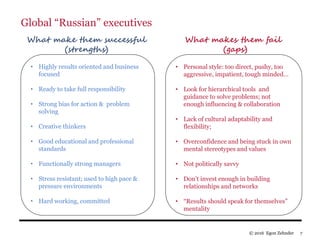
Global “Russian” executives
• Highly results oriented and business
focused
• Ready to take full responsibility
• Strong bias for action & problem
solving
• Creative thinkers
• Good educational and professional
standards
• Functionally strong managers
• Stress resistant; used to high pace &
pressure environments
• Hard working, committed
• Personal style: too direct, pushy, too
aggressive, impatient, tough minded…
• Look for hierarchical tools and
guidance to solve problems; not
enough influencing & collaboration
• Lack of cultural adaptability and
flexibility;
• Overconfidence and being stuck in own
mental stereotypes and values
• Not politically savvy
• Don’t invest enough in building
relationships and networks
• “Results should speak for themselves”
mentality
What make them successful
(strengths)
What makes them fail
(gaps)
8© 2016 Egon Zehnder
Success Factors & Key Learnings (1/2)
 Having a clear purpose & commitment from the individual and the company
 Stable and mature families/partners
 Planning international assignments early and planning next steps after expatriation
far in advance
 Cultural adaptability training
 Strong support of the receiving side (business, HR)
 Mentorship and coaching from senior executives
 Emotional and psychological support (professional, a personal buddy, a shoulder to
cry on)
 Adaptability, flexibility and learning agility are critical for individuals
9© 2016 Egon Zehnder
Success Factors & Key Learnings (2/2)
 Executives need to learn to go easy on themselves, not pushing themselves over the
edge proving their worth on international assignments, some burn out
 Taking care of families & relocation issues (moving, accommodation, schools etc.)
 Global Russians are lucrative targets for the market, so need to offer longer-term
prospects internally
 International assignments have become more attractive in the last years, partly due
to economic downturn, people are much more interested and open to the idea
 Companies need to be earlier in their messaging that successful corporate careers
involve international mobility
 “Russian” executives need to accept that they are competing on a global scale with
top talent from all over the world and
What got you here, won’t get you there!
10© 2016 Egon Zehnder
Definitions & Disclaimers
 Our purpose is not to create divisions but to highlight the story of an emergence of
a GENERATION of modern managers coming originally from our part of the world
and becoming global talent in the last 25 years.
 We use the term “Russians” only in terms of convenience and neither in
ethnic/national or limiting geographical context: it can be Russian citizens of
various nationalities as well as people coming from a wider region once known as
the USSR (could as well be global “Ukrainians”, “Georgians”, “Kazakhs”, “Tatars”…
etc.)
 Some executives might have dual citizenships by now or become citizens of other
countries.
 By GLOBAL we mean executives who spent a considerable amount of time living,
studying and working abroad, who pursue international careers and are already in
or are likely to take higher level above-country regional and global roles in major
international companies. Most importantly, these are individuals who are open to
the world and international careers. They might at some point come back to Russia
and/or become global talent with only historical ties to the region.
11© 2016 Egon Zehnder
Egon Zehnder in Russia, CIS & in the world
Moscow Office
Egon Zehnder
Khelbny. 19А
121069
Moscow
tel +7 495 916 54 38
fax +7 495 916 54 37
www.egonzehnder.com

Global "Russians"

  • 1.
    April 7, 2016 Global“Russians”
  • 2.
    2© 2016 EgonZehnder We started with Questions posed by our Clients  Who are those talented managers with international experience and global mind-set originally coming from our region (Russia & CIS)?  Where are they? How many? What makes “Russian” executives successful? A Typical Answer would have been:  The pool of “Russian” candidates with international experience exists but it is very limited We decided we can do better that and started a more systematic research in 2015 focusing on:  ~Director level and above  Multinational companies primarily in consumer space  Located primarily in Europe, USA and Asia  People who mostly started their careers in 1990s
  • 3.
    3© 2016 EgonZehnder  ~ 1,000 executives  50+ countries on all continents  100+ international companies  Concentrated in consumer companies From few talented individuals to a generation of global talent within 25 years
  • 4.
    4© 2016 EgonZehnder Now we have Global “Russians” Talent Map  ~ 1,000 executives  Working in 50 countries on all continents  In 100+ international companies across all key market sectors: FMCG, retail, services, pharma and life sciences, telecommunications and technology, banking and financial services and industrial companies  Our focus group - top 35 multinational consumer companies – represent ~50% of all executives. We expect that the consumer sector will remain the key focus area for some time.  Great news on Diversity: female and male talent is equally represented (literally, 50/50 split)  Global “Russians” are well represented across all functional areas: GM level, Commercial, Marketing, Supply Chain, Finance, HR as well as such more specialized areas as R&D, HSE etc.  We are only in the beginning of mapping out Global “Russian” talent. Our estimate is that for a wider range of global and international companies across industries (e.g. Fortune 500 etc.) the research could yield much higher numbers. This is still Work in Progress
  • 5.
    5© 2016 EgonZehnder Key Findings (1/2) We interviewed 25 HR Directors of multinational FMCG and pharma companies in Russia and internationally plus Russian executives who have been or still are on international assignments and/or pursuing international corporate careers  All companies confirm that there are active global international assignments/mobility programs in which Russia participates. In many companies international mobility is part of standard performance and development assessment cycle  All companies declare and recognize importance of developing Russian executives as global talent BUT not all companies have done it in a systematic and consistent manner and invested locally and globally into creating a pipeline of Russian executives on international assignments  Details of such programs vary significantly from very well structured and active for the last 15 years to ad hoc arrangements with Russian executives participating only in the last 2-3 years  Repatriation of Russian executives is the biggest challenge – need longer term planning of a next career step
  • 6.
    6© 2016 EgonZehnder Key Findings (2/2)  “Russian” talent remains significantly underrepresented at corporate level relative to the size of the Russian business  Companies do not set specific representation targets (and they shouldn’t) but at least half of companies we spoke to recognize the need for talent from core emerging markets, including Russia, to be better represented at regional and corporate levels  On average, male/female split is 50/50 but for some international companies female executives constitute up to 80% of Russian talent on assignments  Attitude to Russian executives in HQs can range from perception of “stars” and “can walk on water” to “not being good enough” and “exotic”; in many cases changing that perception and sending first executives on international mobility programs takes time Russian executives need to recognize the fact that they are part of the global talent market and that they compete globally
  • 7.
    7© 2016 EgonZehnder Global “Russian” executives • Highly results oriented and business focused • Ready to take full responsibility • Strong bias for action & problem solving • Creative thinkers • Good educational and professional standards • Functionally strong managers • Stress resistant; used to high pace & pressure environments • Hard working, committed • Personal style: too direct, pushy, too aggressive, impatient, tough minded… • Look for hierarchical tools and guidance to solve problems; not enough influencing & collaboration • Lack of cultural adaptability and flexibility; • Overconfidence and being stuck in own mental stereotypes and values • Not politically savvy • Don’t invest enough in building relationships and networks • “Results should speak for themselves” mentality What make them successful (strengths) What makes them fail (gaps)
  • 8.
    8© 2016 EgonZehnder Success Factors & Key Learnings (1/2)  Having a clear purpose & commitment from the individual and the company  Stable and mature families/partners  Planning international assignments early and planning next steps after expatriation far in advance  Cultural adaptability training  Strong support of the receiving side (business, HR)  Mentorship and coaching from senior executives  Emotional and psychological support (professional, a personal buddy, a shoulder to cry on)  Adaptability, flexibility and learning agility are critical for individuals
  • 9.
    9© 2016 EgonZehnder Success Factors & Key Learnings (2/2)  Executives need to learn to go easy on themselves, not pushing themselves over the edge proving their worth on international assignments, some burn out  Taking care of families & relocation issues (moving, accommodation, schools etc.)  Global Russians are lucrative targets for the market, so need to offer longer-term prospects internally  International assignments have become more attractive in the last years, partly due to economic downturn, people are much more interested and open to the idea  Companies need to be earlier in their messaging that successful corporate careers involve international mobility  “Russian” executives need to accept that they are competing on a global scale with top talent from all over the world and What got you here, won’t get you there!
  • 10.
    10© 2016 EgonZehnder Definitions & Disclaimers  Our purpose is not to create divisions but to highlight the story of an emergence of a GENERATION of modern managers coming originally from our part of the world and becoming global talent in the last 25 years.  We use the term “Russians” only in terms of convenience and neither in ethnic/national or limiting geographical context: it can be Russian citizens of various nationalities as well as people coming from a wider region once known as the USSR (could as well be global “Ukrainians”, “Georgians”, “Kazakhs”, “Tatars”… etc.)  Some executives might have dual citizenships by now or become citizens of other countries.  By GLOBAL we mean executives who spent a considerable amount of time living, studying and working abroad, who pursue international careers and are already in or are likely to take higher level above-country regional and global roles in major international companies. Most importantly, these are individuals who are open to the world and international careers. They might at some point come back to Russia and/or become global talent with only historical ties to the region.
  • 11.
    11© 2016 EgonZehnder Egon Zehnder in Russia, CIS & in the world Moscow Office Egon Zehnder Khelbny. 19А 121069 Moscow tel +7 495 916 54 38 fax +7 495 916 54 37 www.egonzehnder.com