Satellites and Receivers
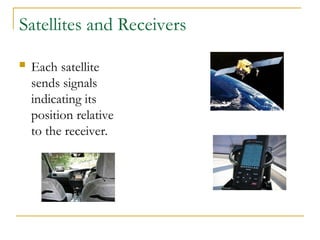
Each satellite
sends signals
indicating its
position relative
to the receiver.
3.
Satellites in orbit
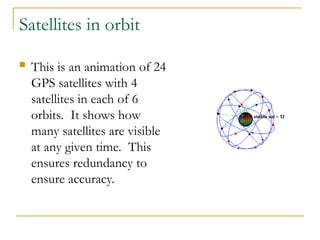
This is an animation of 24
GPS satellites with 4
satellites in each of 6
orbits. It shows how
many satellites are visible
at any given time. This
ensures redundancy to
ensure accuracy.
4.
The mathematics ofGPS
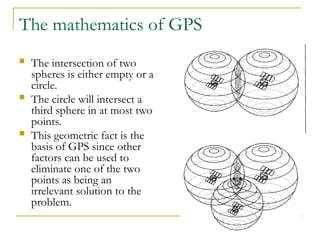
The intersection of two
spheres is either empty or a
circle.
The circle will intersect a
third sphere in at most two
points.
This geometric fact is the
basis of GPS since other
factors can be used to
eliminate one of the two
points as being an
irrelevant solution to the
problem.
5.
Satellites and signals
Each satellite of the network sends a signal indicating
its position and the time of the transmission of the
signal.
Since signals travel at the speed of light, the receiver can
determine the radial distance of the satellite from the
receiver.
Many think that the receivers transmit information to
the satellites, whereas in reality, it is the other way
around.
The receiver then uses basic math to determine its
position.
6.
Spheres
If thereceiver is R units away from satellite A, then
the receiver lies on a sphere of radius R centered at
A.
A suitably positioned second satellite B can be used
to determine another sphere, and the intersection of
these two spheres determines a circle.
A third satellite can be used to narrow the position
to two points, and finally, a fourth, not coplanar
with the other three, can be used to pinpoint the
position of the receiver.
7.
GPS errors
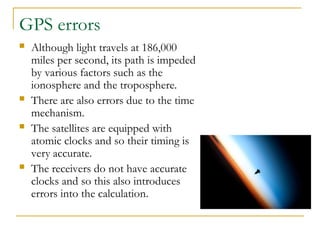
Althoughlight travels at 186,000
miles per second, its path is impeded
by various factors such as the
ionosphere and the troposphere.
There are also errors due to the time
mechanism.
The satellites are equipped with
atomic clocks and so their timing is
very accurate.
The receivers do not have accurate
clocks and so this also introduces
errors into the calculation.
8.
Hyperbolas and errors
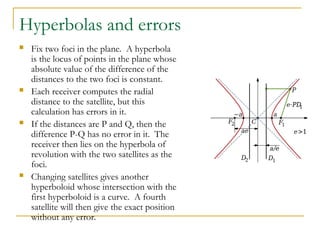
Fix two foci in the plane. A hyperbola
is the locus of points in the plane whose
absolute value of the difference of the
distances to the two foci is constant.
Each receiver computes the radial
distance to the satellite, but this
calculation has errors in it.
If the distances are P and Q, then the
difference P-Q has no error in it. The
receiver then lies on the hyperbola of
revolution with the two satellites as the
foci.
Changing satellites gives another
hyperboloid whose intersection with the
first hyperboloid is a curve. A fourth
satellite will then give the exact position
without any error.
9.
Other errors
Signaltransmission errors and
noisy channels.
Relativistic errors due to
gravitational fields.
Signal delays due to atmospheric
disturbance.



![GPS[Global Positioning System]](https://cdn.slidesharecdn.com/ss_thumbnails/globalpositioningsystem-130707095218-phpapp02-thumbnail.jpg?width=640&height=640&fit=bounds)


![제 23회 보아즈(BOAZ) 빅데이터 컨퍼런스 - [MBOAX] : ABSA를 활용한 소비자 반응 분석 기반 운영 효율화 대시보드 설계](https://cdn.slidesharecdn.com/ss_thumbnails/3-1boaz23rdconferencemboax-260203102709-9d519923-thumbnail.jpg?width=640&height=640&fit=bounds)


