MASTER IN BUSINESS ADMINISTRATION
COURSE GUIDE
Course No.:
Descriptive Title: Global Economics
Professor: ROVILYN K. DAGONDON, DBA
Email Address: rovi_katalbas@yahoo.com
Contact Numbers: 09198165839/09064296968
I. OVERVIEW OF THE COURSE
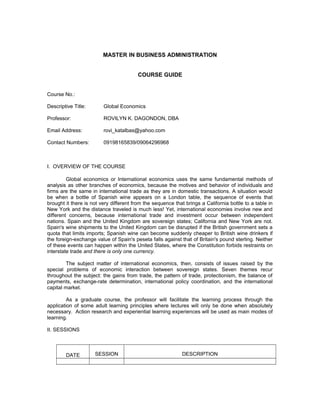
Global economics or International economics uses the same fundamental methods of
analysis as other branches of economics, because the motives and behavior of individuals and
firms are the same in international trade as they are in domestic transactions. A situation would
be when a bottle of Spanish wine appears on a London table, the sequence of events that
brought it there is not very different from the sequence that brings a California bottle to a table in
New York and the distance traveled is much less! Yet, international economies involve new and
different concerns, because international trade and investment occur between independent
nations. Spain and the United Kingdom are sovereign states; California and New York are not.
Spain's wine shipments to the United Kingdom can be disrupted if the British government sets a
quota that limits imports; Spanish wine can become suddenly cheaper to British wine drinkers if
the foreign-exchange value of Spain's peseta falls against that of Britain's pound sterling. Neither
of these events can happen within the United States, where the Constitution forbids restraints on
interstate trade and there is only one currency.
The subject matter of international economics, then, consists of issues raised by the
special problems of economic interaction between sovereign states. Seven themes recur
throughout the subject: the gains from trade, the pattern of trade, protectionism, the balance of
payments, exchange-rate determination, international policy coordination, and the international
capital market.
As a graduate course, the professor will facilitate the learning process through the
application of some adult learning principles where lectures will only be done when absolutely
necessary. Action research and experiential learning experiences will be used as main modes of
learning.
II. SESSIONS
DATE SESSION DESCRIPTION
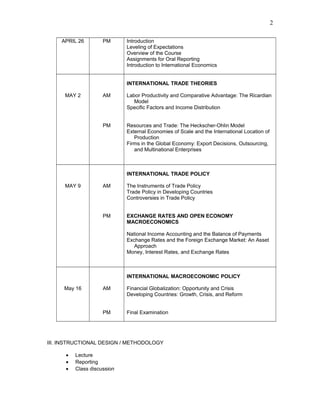
APRIL 26 PM Introduction
Leveling of Expectations
Overview of the Course
Assignments for Oral Reporting
Introduction to International Economics
MAY 2 AM
PM
INTERNATIONAL TRADE THEORIES
Labor Productivity and Comparative Advantage: The Ricardian
Model
Specific Factors and Income Distribution
Resources and Trade: The Heckscher-Ohlin Model
External Economies of Scale and the International Location of
Production
Firms in the Global Economy: Export Decisions, Outsourcing,
and Multinational Enterprises
MAY 9 AM
PM
INTERNATIONAL TRADE POLICY
The Instruments of Trade Policy
Trade Policy in Developing Countries
Controversies in Trade Policy
EXCHANGE RATES AND OPEN ECONOMY
MACROECONOMICS
National Income Accounting and the Balance of Payments
Exchange Rates and the Foreign Exchange Market: An Asset
Approach
Money, Interest Rates, and Exchange Rates
May 16 AM
PM
INTERNATIONAL MACROECONOMIC POLICY
Financial Globalization: Opportunity and Crisis
Developing Countries: Growth, Crisis, and Reform
Final Examination
III. INSTRUCTIONAL DESIGN / METHODOLOGY
• Lecture
• Reporting
• Class discussion
2
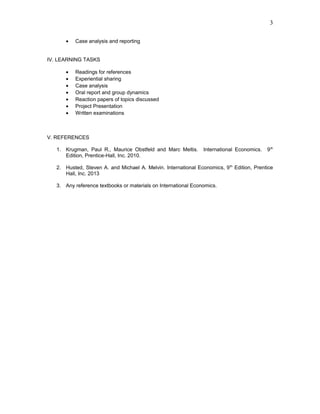
• Case analysis and reporting
IV. LEARNING TASKS
• Readings for references
• Experiential sharing
• Case analysis
• Oral report and group dynamics
• Reaction papers of topics discussed
• Project Presentation
• Written examinations
V. REFERENCES
1. Krugman, Paul R., Maurice Obstfeld and Marc Meltis. International Economics. 9th
Edition, Prentice-Hall, Inc. 2010.
2. Husted, Steven A. and Michael A. Melvin. International Economics, 9th
Edition, Prentice
Hall, Inc. 2013
3. Any reference textbooks or materials on International Economics.
3

Global econ course outline

  • 1.
    MASTER IN BUSINESSADMINISTRATION COURSE GUIDE Course No.: Descriptive Title: Global Economics Professor: ROVILYN K. DAGONDON, DBA Email Address: rovi_katalbas@yahoo.com Contact Numbers: 09198165839/09064296968 I. OVERVIEW OF THE COURSE Global economics or International economics uses the same fundamental methods of analysis as other branches of economics, because the motives and behavior of individuals and firms are the same in international trade as they are in domestic transactions. A situation would be when a bottle of Spanish wine appears on a London table, the sequence of events that brought it there is not very different from the sequence that brings a California bottle to a table in New York and the distance traveled is much less! Yet, international economies involve new and different concerns, because international trade and investment occur between independent nations. Spain and the United Kingdom are sovereign states; California and New York are not. Spain's wine shipments to the United Kingdom can be disrupted if the British government sets a quota that limits imports; Spanish wine can become suddenly cheaper to British wine drinkers if the foreign-exchange value of Spain's peseta falls against that of Britain's pound sterling. Neither of these events can happen within the United States, where the Constitution forbids restraints on interstate trade and there is only one currency. The subject matter of international economics, then, consists of issues raised by the special problems of economic interaction between sovereign states. Seven themes recur throughout the subject: the gains from trade, the pattern of trade, protectionism, the balance of payments, exchange-rate determination, international policy coordination, and the international capital market. As a graduate course, the professor will facilitate the learning process through the application of some adult learning principles where lectures will only be done when absolutely necessary. Action research and experiential learning experiences will be used as main modes of learning. II. SESSIONS DATE SESSION DESCRIPTION
  • 2.
    APRIL 26 PMIntroduction Leveling of Expectations Overview of the Course Assignments for Oral Reporting Introduction to International Economics MAY 2 AM PM INTERNATIONAL TRADE THEORIES Labor Productivity and Comparative Advantage: The Ricardian Model Specific Factors and Income Distribution Resources and Trade: The Heckscher-Ohlin Model External Economies of Scale and the International Location of Production Firms in the Global Economy: Export Decisions, Outsourcing, and Multinational Enterprises MAY 9 AM PM INTERNATIONAL TRADE POLICY The Instruments of Trade Policy Trade Policy in Developing Countries Controversies in Trade Policy EXCHANGE RATES AND OPEN ECONOMY MACROECONOMICS National Income Accounting and the Balance of Payments Exchange Rates and the Foreign Exchange Market: An Asset Approach Money, Interest Rates, and Exchange Rates May 16 AM PM INTERNATIONAL MACROECONOMIC POLICY Financial Globalization: Opportunity and Crisis Developing Countries: Growth, Crisis, and Reform Final Examination III. INSTRUCTIONAL DESIGN / METHODOLOGY • Lecture • Reporting • Class discussion 2
  • 3.
    • Case analysisand reporting IV. LEARNING TASKS • Readings for references • Experiential sharing • Case analysis • Oral report and group dynamics • Reaction papers of topics discussed • Project Presentation • Written examinations V. REFERENCES 1. Krugman, Paul R., Maurice Obstfeld and Marc Meltis. International Economics. 9th Edition, Prentice-Hall, Inc. 2010. 2. Husted, Steven A. and Michael A. Melvin. International Economics, 9th Edition, Prentice Hall, Inc. 2013 3. Any reference textbooks or materials on International Economics. 3