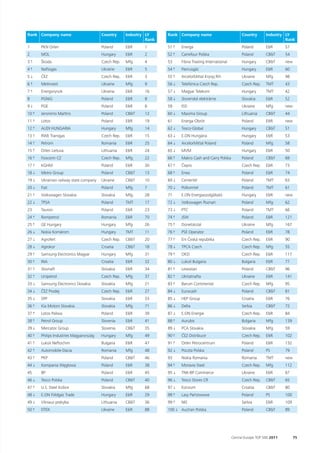
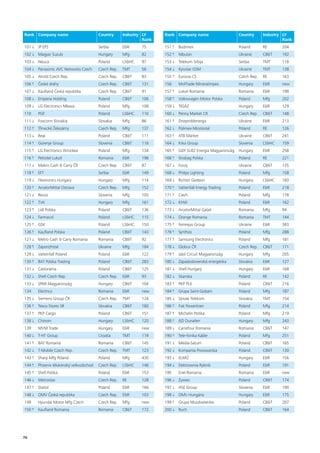
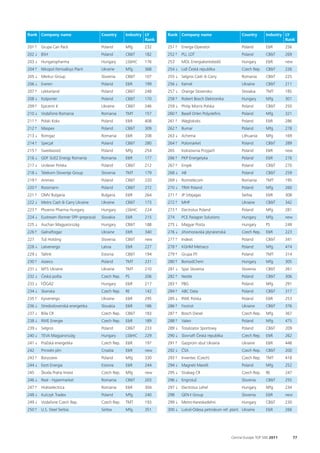
Central Europe
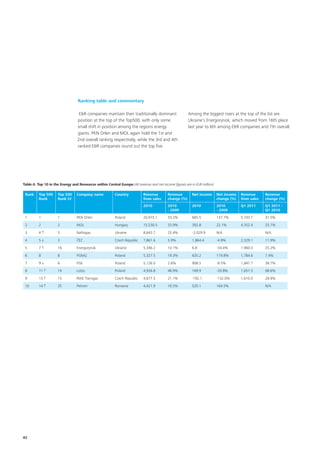
2011
The game changers
of 2011 in Central
Europe are Growth,
Performance and
Innovation.
It gives me great pleasure to welcome you to
                          the 2011 Deloitte CE Top 500 ranking and report.
                          It provides an “at a glance” overview of the whole
                          Central European region and is full of rich content
                          and insight for you to use and return to whenever
                          you need it. I would also like to acknowledge and
                          thank Rzeczpospolita for their continued support and
                          cooperation with the ranking.

                          This year’s analysis of Central Europe’s leading 500
                          companies sees a business community across 18
                          countries and seven main industries united by one
                          factor: concerns about revenue growth.

                          After three years of downturn and fragile recovery,
                          characterised by cost-cutting that has left little
                          corporate ‘fat’, the focus now is on increasing revenues.
                          And the question is: how?

                          It makes little difference whether companies are from
                          those economies showing some signs of recovery, like
                          Poland, the Czech Republic and Slovakia, or from
                          those such as Romania, Hungary and Croatia whose
                          economies are still struggling to recover. They face
                          the same issues: consumers are limiting their spending;
                          businesses are keeping a tight rein on costs; and
                          slowing Western economies are threatening export
                          opportunities.

                          This year, in interviews we carried out with 72
                          senior business executives from across the region,
                          the importance of having sound growth, performance
                          and innovation strategies was a constantly recurring
                          theme. These, they felt, are the powerful “game
                          changers” that every business will need as they chart
                          the way ahead through continuing difficult times.

                          Developments on the CE and global markets, where we
Michael J. Barrington
                          see renewed uncertainty, would indicate that competi-
Chief Executive Officer
                          tiveness and efficiency, both at micro and macro levels,
Deloitte Central Europe
                          are key elements of success. Innovation is the most
                          critical element of competiveness in developing and
                          developed economies. I believe that 2011 will be seen
                          as the year when innovative responses to changes in
                          demand, financing conditions and the operational
                          environment truly became the “new norm”.

                          I am confident that, whatever challenges lie ahead,
                          Central European companies will successfully create
                          some great new opportunities to generate growth,
                          making this year’s report a cause, if not for celebration,
                          then certainly for optimism.
Ranking overview
Foreword                     7

Ranking Insights             8

The 5 major findings        15

Overview of the leaders     23

Upwardly mobile companies   26


                                 Ranking
The region’s leading
companies have
the will and expertise
to recover from even
the deepest of crises.


6
This report is published at a time when the likelihood
                              of a double-dip recession is increasing in developed
                              economies across the world, driven by factors including
                              slow Western growth figures, concerns about public
                              debt levels and the crisis facing the euro.

                              It is therefore possible that we might in the future come
                              to see 2010 as a moment when the world paused to
                              draw breath after the crisis of 2008 and 2009, before
                              a return to renewed difficulties in 2011 and beyond.

                              The performance of the Central European region’s
                              leading companies during this period, however, was
                              highly encouraging, with an 11% average growth
                              in revenues across the region in 2010, a strong
                              contrast with the nearly 12% average fall in revenues
                              experienced in 2009. It only remains to be seen whether
                              this increase was a temporary recovery or an indication
                              of a longer term return to growth.

                              Such a performance shows that the region’s leading
                              companies have the will and the operational and
                              strategic expertise to support a recovery from even
                              the deepest of crises. These strengths continue to
                              be important assets across the region in this time of
                              continued uncertain growth and economic concern.


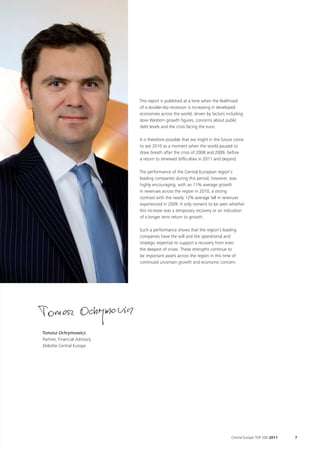
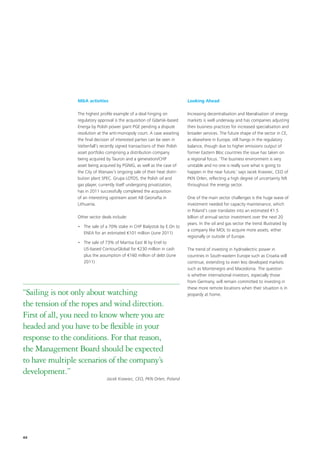
Tomasz Ochrymowicz
Partner, Financial Advisory
Deloitte Central Europe


                                                                                Central Europe TOP 500 2011   7
Ranking Insights


      Even the most cursory glance at the list of this year’s      Amongst the remaining three highest “jumpers”,
      10 largest companies in the CE Top 500 ranking               Ukrainian iron ore producer Ferrexpo moved from
      reveals that there has been little change in order since     383 in 2009 to 175 on the back of a 109.8% revenue
      last year’s report.                                          increase, while Polish fuel exporter Polski Koks took
                                                                   advantage of sliding Chinese coke exports to grow
      This year, as then, shows a top 10 dominated by              revenues by 94.2% and move from 408 to 211. See
      the region’s oil&gas and power companies, which              page 26 of this report for details on the ranking’s
      occupy seven places between them including numbers           biggest “jumpers”.
      one (PKN) and two (MOL), both of whose revenues
      rose by just over a third. One of the only three             The trends at play in 2010
      exceptions is Skoda, which rose to third place, having
      slipped to fourth in 2009 following a 12% slide in its       The last year has seen companies and countries across
      revenues. This year, however, the Czech automotive           Central Europe fighting to overcome the continuing
      company started to see the benefits of its new growth        impact of 2008’s global economic slowdown.
      strategy which has helped it achieve a 22.4% growth in
      revenues. Its profits also increased more than twofold.
                                                                   “The severe downturn in
      One faller in this year’s top 10 was another Czech
      company, the state-owned CEZ, which fell from third to
                                                                   economic activity experienced
      fifth place due to a revenue increase of 5.9%, lower than    in 2009 was replaced by
      those companies around it in the ranking. CEZ, which
      remains the region’s most valuable company by capitali-      a more positive upswing
      sation, is currently focused on increasing the efficiency
      and cost-effectiveness of its key power generation
                                                                   toward economic growth
      operations. The furthest faller in the top 10, however,      in 2010. Some countries in
      was Polish power company PGE, which slipped from
      sixth to ninth on the back of a revenue increase of 2.6%
                                                                   the CEE region benefited
      as it simplified its operations and focused on modernising   from the ongoing strength of
      its conventional power-generation capabilities.
                                                                   German exports, which was
      The only new entrant, Polish/Portuguese retailer             also related to strong growth
      Jeronimo Martins Dystrybucja (whose revenues rose by
      30.3%), can be expected to move up the table even            in fast growing economies like
      further in years to come as it implements an intensive
      store-opening programme. For fuller details on the top
                                                                   China or Brazil.”
      10, please see page 23 of this report.
                                                                                    Luděk Niedermayer, Lead Economist,
                                                                                                Deloitte Czech Republic
      Those making the biggest move

      This year’s report features for the first time a special     Some countries have been more successful than
      focus on those 20 companies that have moved                  others. Strengthening GDP growth over the last year
      furthest up the Top 500 ranking since 2010. Heading          in Poland, the Czech Republic and Slovakia has not
      this category is Sharp Manufacturing Poland, which           been matched in other countries such as Croatia,
      according to its President Nobuo Harada successfully         Romania and Bulgaria. And following the recent
      leveraged the sales opportunities afforded by                announcement of flat-lining figures in Germany and
      the 2010 World Cup finals to grow its 2010 revenues          France, the twin powerhouses of the Eurozone, there
      by 65% and move from place 430 in 2009 to 143.               continues to be a mixed picture for the 18 Central
                                                                   European countries featured in the 2011 edition of
                                                                   the CE Top 500.


8
That said, indications of improving business confidence                               Companies performing well – globally and locally
have been visible during the last year across the region,
as tracked in Deloitte’s Business Sentiment Index                                     Western European and US companies improved results
and Private Equity Confidence Survey. Both surveys                                    in 2010 versus 2009. In the US, of the 232 companies
track the sentiments and opinions of business leaders                                 on the Standard and Poor’s 500 index that reported
across the region and from within the Private Equity                                  earnings by early August 2011, net income had risen
community on a number of issues affecting their                                       by 18% in the year to the second quarter. In Western
businesses. Their responses in the latest editions                                    Europe, meanwhile, earnings were up by 15% in
reflected a return to a more positive outlook. This                                   the 139 Euro Stoxx 600 firms that had reported at
followed a positive upswing towards economic growth                                   the same time.
in 2010 following the downturn of 2009. It also
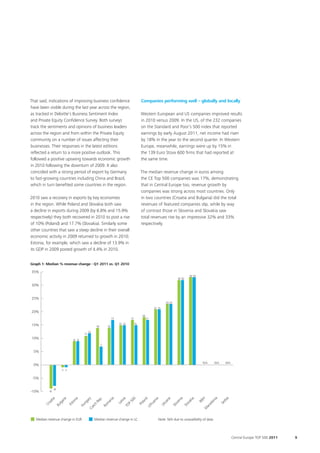
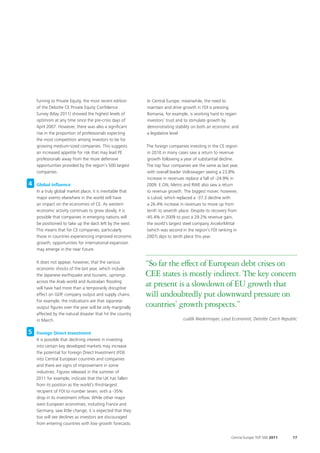
coincided with a strong period of export by Germany                                   The median revenue change in euros among
to fast-growing countries including China and Brazil,                                 the CE Top 500 companies was 17%, demonstrating
which in turn benefited some countries in the region.                                 that in Central Europe too, revenue growth by
                                                                                      companies was strong across most countries. Only
2010 saw a recovery in exports by key economies                                       in two countries (Croatia and Bulgaria) did the total
in the region. While Poland and Slovakia both saw                                     revenues of featured companies slip, while by way
a decline in exports during 2009 (by 6.8% and 15.9%                                   of contrast those in Slovenia and Slovakia saw
respectively) they both recovered in 2010 to post a rise                              total revenues rise by an impressive 32% and 33%
of 10% (Poland) and 17.7% (Slovakia). Similarly some                                  respectively.
other countries that saw a steep decline in their overall
economic activity in 2009 returned to growth in 2010;
Estonia, for example, which saw a decline of 13.9% in
its GDP in 2009 posted growth of 4.4% in 2010.


Graph 1: Median % revenue change - Q1 2011 vs. Q1 2010

35%
                                                                                                                           33 33
                                                                                                                   32 32

30%


25%
                                                                                                         23 23
                                                                                                 21 21
20%
                                                                                       18
                                                             17            17               17

15%                                                                15 15        15
                                               14       14
                                         12
                                    11
10%                          9 9
                                                    7

  5%

                                                                                                                                     N/A      N/A       N/A
  0%
                     -1 -1

 -5%

                -8
-10%       -9
                                            ia


                                                                                                                    nia


                                                                                                                                           H


                                                                                                                                          ia


                                                                                                                                                        ia
               tia


               ria

              nia


                                             y

                                           p.


                                                                          a

                                                                        00


                                                                                              d

                                                                                             ia

                                                                                                         ine


                                                                                                                           kia
                                          ar


                                                                       tvi


                                                                                          lan


                                                                                                                                        B&
                                         an


                                                                                                                                        on


                                                                                                                                                      rb
                                                                                           an
                                         Re
           lga
            oa


                                                                    P5


                                                                                                                         va
                                                                                                                  ve
            to


                                                                                                       ra
                                        ng


                                                                     La


                                                                                                                                                    Se
                                        m


                                                                                                                                      ed
                                                                                        hu
                                                                                        Po


                                                                                                     Uk
         Cr


                                                                                                                      Slo
                                                                                                               Slo
         Es


                                       h
        Bu


                                      Hu


                                                                  TO
                                     Ro
                                     ec


                                                                                                                                    ac
                                                                                     Lit
                                   Cz


                                                                                                                                   M


   Median revenue change in EUR               Median revenue change in LC                           Note: N/A due to unavailibility of data


                                                                                                                                                              Central Europe TOP 500 2011   9
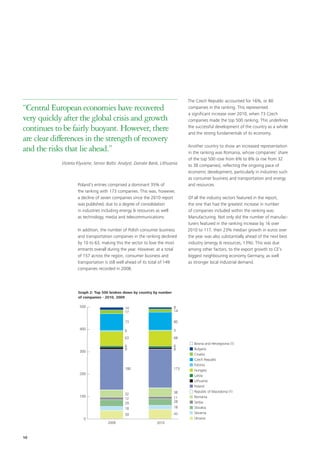
The Czech Republic accounted for 16%, or 80
“Central European economies have recovered                                      companies in the ranking. This represented
                                                                                a significant increase over 2010, when 73 Czech
very quickly after the global crisis and growth                                 companies made the top 500 ranking. This underlines
continues to be fairly buoyant. However, there                                  the successful development of the country as a whole
                                                                                and the strong fundamentals of its economy.
are clear differences in the strength of recovery
and the risks that lie ahead.”                                                  Another country to show an increased representation
                                                                                in the ranking was Romania, whose companies’ share
                                                                                of the top 500 rose from 6% to 8% (a rise from 32
             Violeta Klyviene, Senior Baltic Analyst, Danske Bank, Lithuania    to 38 companies), reflecting the ongoing pace of
                                                                                economic development, particularly in industries such
                                                                                as consumer business and transportation and energy
                     Poland’s entries comprised a dominant 35% of               and resources.
                     the ranking with 173 companies. This was, however,
                     a decline of seven companies since the 2010 report         Of all the industry sectors featured in the report,
                     was published, due to a degree of consolidation            the one that had the greatest increase in number
                     in industries including energy & resources as well         of companies included within the ranking was
                     as technology, media and telecommunications.               Manufacturing. Not only did the number of manufac-
                                                                                turers featured in the ranking increase by 16 over
                     In addition, the number of Polish consumer business        2010 to 117, their 23% median growth in euros over
                     and transportation companies in the ranking declined       the year was also substantially ahead of the next best
                     by 10 to 63, making this the sector to lose the most       industry (energy & resources, 13%). This was due
                     entrants overall during the year. However, at a total      among other factors, to the export growth to CE’s
                     of 157 across the region, consumer business and            biggest neighbouring economy Germany, as well
                     transportation is still well ahead of its total of 149     as stronger local industrial demand.
                     companies recorded in 2008.


                     Graph 2: Top 500 broken down by country by number
                     of companies - 2010, 2009

                      500                      14                         8
                                               17                         14

                                               73                         80
                      400                      6                          3

                                               63                         68
                                                                                   Bosnia and Herzegovina (1)
                                               6                          6
                                               9                          8        Bulgaria
                      300
                                                                                   Croatia
                                                                                   Czech Republic
                                                                                   Estonia
                                               180                        173      Hungary
                      200                                                          Latvia
                                                                                   Lithuania
                                                                                   Poland
                                                                          38       Republic of Macedonia (1)
                                               32
                      100                                                 11       Romania
                                               12
                                               29                         28       Serbia
                                               18                         18       Slovakia
                                               39                         43       Slovenia
                        0                                                          Ukraine
                                      2009                      2010


10
80%                                                                                                                     80%


60%                                                                                                                     60%


40%                                                                                                                     40%


20%                                                                                                                     20%


0%                                                                                                                        0%

Graph 3: Top 500 broken down by industry by                                                                             Graph 4: Top 500 broken down by industry by
number of companies - 2010, 2009                                                                                        revenues


500                                                                                                                     100%
                                                                    39                                                                           8%                       7%
                                   43                                                                                                                                     1%
                                                                    11                                                                           2%
                                   15                                                                                                            1%                       1%
                                                                    5
                                   4

400                                                                                                                     80%                                               23%
                                                                                                                                                 22%
                                   101                              117


                                                                                                                                                 3%                       3%
                                   21                               23
300                                                                                                                     60%


                                   147                              148                                                                                                   40%
                                                                                        Technology, Media and                                    39%
200                                                                                     Telecommunications              40%
                                                                                        Real Estate
                                                                                        Public Sector
                                                                                        Manufacturing
100                                                                                                                     20%
                                   169                                                  Life Sciences and Health Care
                                                                    157                                                                          26%
                                                                                        Energy and Resources                                                              24%
                                                                                        Consumer Business and
  0                                                                                     Transportation                    0%
                    2009                               2010                                                                             2009                       2010

      Note: Public sector includes postal services, national, local or municipal governments


Graph 5: Median revenue change - annual, 2010 vs. 2009


                                                              23%         Manufacturing
                                                     17%

                                               13%                        Energy and Resources
                                         10%

                                           11%                            TOP 500
                                   7%

                                    8%                                    Life Sciences and Health Care
                               6%

                                    8%                                    Consumer Business and Transportation
                         3%

                              5%                                          Real Estate
                  0%

                     2%                                                   Public Sector
         -2%

                    1%                                                    Technology, Media and Telecommunications
         -2%

      -5%      0%        5%         10%        15%    20%     25%

  Median revenue change in LC
  Median revenue change in EUR


                                                                                                                                            Central Europe TOP 500 2011    11
Value by capitalisation

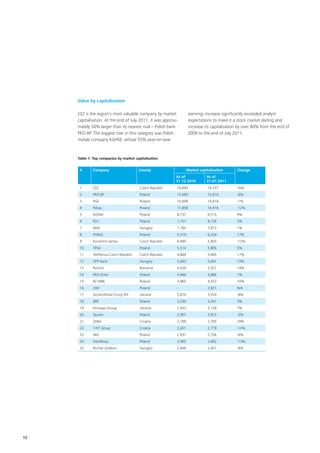
     CEZ is the region’s most valuable company by market            earnings increase significantly exceeded analyst
     capitalisation. At the end of July 2011, it was approxi-       expectations to make it a stock market darling and
     mately 50% larger than its nearest rival – Polish bank         increase its capitalisation by over 80% from the end of
     PKO BP. The biggest riser in this category was Polish          2009 to the end of July 2011.
     metals company KGHM, whose 55% year-on-year


     Table 1: Top companies by market capitalisation


      #      Company                     County                     Market capitalisation     Change
                                                            As of              As of
                                                            31.12.2010         31.07.2011
      1      ČEZ                         Czech Republic     16,693              19,337        16%
      2      PKO BP                      Poland             13,683              12,810        -6%
      3      PGE                         Poland             10,949              10,816        -1%
      4      Pekao                       Poland             11,858              10,416        -12%
      5      KGHM                        Poland             8,737               9,515         9%
      6      PZU                         Poland             7,751               8,156         5%
      7      MOL                         Hungary            7,795               7,873         1%
      8      PGNiG                       Poland             5,319               6,234         17%
      9      Komerční banka              Czech Republic     6,680               5,903         -12%
      10     TPSA                        Poland             5,514               5,805         5%
      11     Telefónica Czech Republic   Czech Republic     4,869               5,695         17%
      12     OTP Bank                    Hungary            5,043               5,691         13%
      13     Petrom                      Romania            4,429               5,027         14%
      14     PKN Orlen                   Poland             4,946               4,986         1%
      15     BZ WBK                      Poland             3,965               4,353         10%
      16     JSW                         Poland             -                   3,921         N/A
      17     ArcelorMittal Kryvyj Rih    Ukraine            3,874               3,554         -8%
      18     BRE                         Poland             3,230               3,341         3%
      19     Ferrexpo Group              Ukraine            2,933               3,129         7%
      20     Tauron                      Poland             2,907               2,813         -3%
      21     ZABA                        Croatia            2,169               2,795         29%
      22     T-HT Group                  Croatia            3,201               2,779         -13%
      23     ING                         Poland             2,937               2,756         -6%
      24     Handlowy                    Poland             3,085               2,682         -13%
      25     Richter Gedeon              Hungary            2,846               2,607         -8%


12
Company ownership

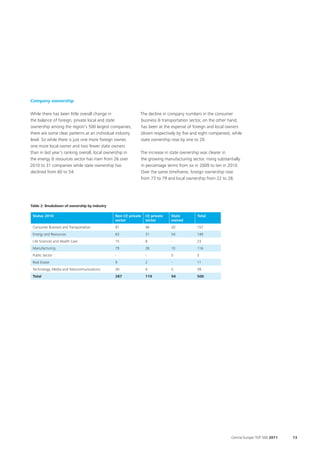
While there has been little overall change in              The decline in company numbers in the consumer
the balance of foreign, private local and state            business & transportation sector, on the other hand,
ownership among the region’s 500 largest companies,        has been at the expense of foreign and local owners
there are some clear patterns at an individual industry    (down respectively by five and eight companies), while
level. So while there is just one more foreign owner,      state ownership rose by one to 20.
one more local owner and two fewer state owners
than in last year’s ranking overall, local ownership in    The increase in state ownership was clearer in
the energy & resources sector has risen from 26 over       the growing manufacturing sector, rising substantially
2010 to 31 companies while state ownership has             in percentage terms from six in 2009 to ten in 2010.
declined from 60 to 54.                                    Over the same timeframe, foreign ownership rose
                                                           from 73 to 79 and local ownership from 22 to 28.


Table 2: Breakdown of ownership by industry

 Status 2010                                  Non CE private   CE private   State        Total
                                              sector           sector       owned
 Consumer Business and Transportation         91               46           20           157
 Energy and Resources                         63               31           54           149
 Life Sciences and Health Care                15               8            -            23
 Manufacturing                                79               28           10           116
 Public Sector                                -                -            5            5
 Real Estate                                  9                2            -            11
 Technology, Media and Telecommunications     30               4            5            39
 Total                                        287              119          94           500


                                                                                                            Central Europe TOP 500 2011   13
Growth
     What do senior executives in Central Europe
     consider to be most important for their
     organisation to grow?
     1. The highest proportion of senior executives
        responded that “acquiring new customers” is
        the most important factor.
     2. Increasing revenue with current customers; and
     3. Expansion of product/service portfolios.

     The most significant secondary priority for senior
     executives was the development of new sales
     channels.


14
The 5 major findings


This latest report must be viewed in the context           In other words, it would be unwise to presume that
of renewed fears of a double dip recession                 the recent trong performance of Central Europe’s
as developed countries across the world fail to            top 500 companies means an end to the region’s
deliver the GDP growth for which governments               economic woes. While developing this report,
and markets are looking. Just as companies across          Deloitte identified five key trends at play and which
the western world have successfully reduced their          will continue to have an effect on the CE region’s
debt levels through effective cost-cutting measures,       performance over the next 12 to 24 months.
so governments are becoming increasingly mired in
the mesh of burgeoning austerity measures.             1   Rising commodity prices
                                                           The first of these is commodity prices. In
                                                           Central Europe, most of the largest companies
                                                           in the region and in individual countries are
“Over the medium-term                                      the former state-owned power companies.
                                                           The prices that they and their western counterparts
economic growth in                                         charge for their services have seen significant
the Central European                                       increases (the overall revenues of CE’s energy &
                                                           resources companies increased by 13% in euros
region will decelerate                                     during the year and manufacturing by 23%).

due to the need for fiscal                                 So this upward trend in power prices is at the heart
tightening and expected                                    of the growth experienced over the last 12
                                                           months by many companies at or near the top
slowdown in external                                       of this year’s ranking. Ironically, however, it also
demand. The risks to                                       contains the seeds of slower future growth
                                                           among companies large and small across the CE
the baseline forecast scenario                             region and further afield. As commodity prices

appears to be balanced.                                    continue to soar, they are already placing pressure
                                                           on the profit margins of businesses that have
Positive risks related to                                  already achieved the “easy wins” in reducing their
                                                           costs. Indeed, the most recent Deloitte survey of
an improved confidence                                     CFO sentiment in the UK demonstrates a strong
could cause stronger                                       expectation that growth will slow over the next
                                                           year as increases in costs outpace their revenues
than-expected investment                                   during the next year. We believe we can expect
growth, while downside                                     to see a similar sentiment from CFOs in Central
                                                           Europe in the near future.
risks relate to a slow
reduction in unemployment                                  A second risk arising from high commodity prices
                                                           is their impact on inflation. Any move by central
and more negative external                                 banks to adapt monetary policy through increasing
                                                           interest rates will damage companies’ growth
outlook. Global growth                                     prospects through a reduced ability to borrow and
will take an extra hit from                                invest in growth capital.

the recent financial shock,                                It is expected that the current commodity “super

but still we do not expect                                 cycle” will continue to fuel ongoing increases in
                                                           the costs of power and other commodities for
a new recession.”                                          a further two to three years.

            Violeta Klyviene, Senior Baltic Analyst,
                           Danske Bank, Lithuania


                                                                                                          Central Europe TOP 500 2011   15
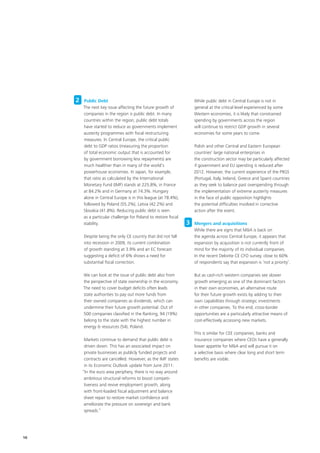
2   Public Debt                                                  While public debt in Central Europe is not in
         The next key issue affecting the future growth of            general at the critical level experienced by some
         companies in the region is public debt. In many              Western economies, it is likely that constrained
         countries within the region, public debt totals              spending by governments across the region
         have started to reduce as governments implement              will continue to restrict GDP growth in several
         austerity programmes with fiscal restructuring               economies for some years to come.
         measures. In Central Europe, the critical public
         debt to GDP ratios (measuring the proportion                 Polish and other Central and Eastern European
         of total economic output that is accounted for               countries’ large national enterprises in
         by government borrowing less repayments) are                 the construction sector may be particularly affected
         much healthier than in many of the world’s                   if government and EU spending is reduced after
         powerhouse economies. In Japan, for example,                 2012. However, the current experience of the PIIGS
         that ratio as calculated by the International                (Portugal, Italy, Ireland, Greece and Spain) countries
         Monetary Fund (IMF) stands at 225.8%, in France              as they seek to balance past overspending through
         at 84.2% and in Germany at 74.3%. Hungary                    the implementation of extreme austerity measures
         alone in Central Europe is in this league (at 78.4%),        in the face of public opposition highlights
         followed by Poland (55.2%), Latvia (42.2%) and               the potential difficulties involved in corrective
         Slovakia (41.8%). Reducing public debt is seen               action after the event.
         as a particular challenge for Poland to restore fiscal
         stability.                                               3   Mergers and acquisitions
                                                                      While there are signs that M&A is back on
         Despite being the only CE country that did not fall          the agenda across Central Europe, it appears that
         into recession in 2009, its current combination              expansion by acquisition is not currently front of
         of growth standing at 3.9% and an EC forecast                mind for the majority of its individual companies.
         suggesting a deficit of 6% shows a need for                  In the recent Deloitte CE CFO survey, close to 60%
         substantial fiscal correction.                               of respondents say that expansion is ‘not a priority’.

         We can look at the issue of public debt also from            But as cash-rich western companies see slower
         the perspective of state ownership in the economy.           growth emerging as one of the dominant factors
         The need to cover budget deficits often leads                in their own economies, an alternative route
         state authorities to pay out more funds from                 for their future growth exists by adding to their
         their owned companies as dividends, which can                own capabilities through strategic investments
         undermine their future growth potential. Out of              in other companies. To this end, cross-border
         500 companies classified in the Ranking, 94 (19%)            opportunities are a particularly attractive means of
         belong to the state with the highest number in               cost-effectively accessing new markets.
         energy & resources (54), Poland.
                                                                      This is similar for CEE companies, banks and
          Markets continue to demand that public debt is              insurance companies where CEOs have a generally
          driven down. This has an associated impact on               lower appetite for M&A and will pursue it on
          private businesses as publicly funded projects and          a selective basis where clear long and short term
          contracts are cancelled. However, as the IMF states         benefits are visible.
          in its Economic Outlook update from June 2011:
         “In the euro area periphery, there is no way around
          ambitious structural reforms to boost competi-
          tiveness and revive employment growth, along
          with front-loaded fiscal adjustment and balance
          sheet repair to restore market confidence and
          ameliorate the pressure on sovereign and bank
          spreads.”


16
Turning to Private Equity, the most recent edition      In Central Europe, meanwhile, the need to
    of the Deloitte CE Private Equity Confidence            maintain and drive growth in FDI is pressing.
    Survey (May 2011) showed the highest levels of          Romania, for example, is working hard to regain
    optimism at any time since the pre-crisis days of       investors’ trust and to stimulate growth by
    April 2007. However, there was also a significant       demonstrating stability on both an economic and
    rise in the proportion of professionals expecting       a legislative level.
    the most competition among investors to be for
    growing medium-sized companies. This suggests           The foreign companies investing in the CE region
    an increased appetite for risk that may lead PE          in 2010 in many cases saw a return to revenue
    professionals away from the more defensive               growth following a year of substantial decline.
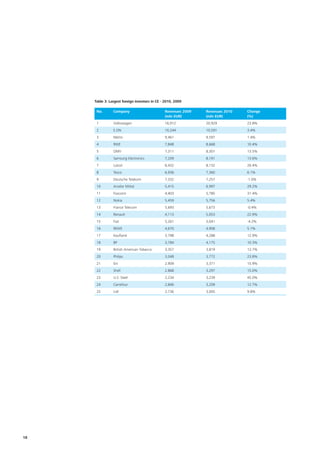
    opportunities provided by the region’s 500 largest      The top four companies are the same as last year,
    companies.                                               with overall leader Volkswagen seeing a 23.8%
                                                             increase in revenues replace a fall of -24.9% in
4   Global influence                                        2009. E.ON, Metro and RWE also saw a return
    In a truly global market place, it is inevitable that    to revenue growth. The biggest mover, however,
    major events elsewhere in the world will have            is Lukoil, which replaced a -37.3 decline with
    an impact on the economies of CE. As western             a 26.4% increase in revenues to move up from
    economic activity continues to grow slowly, it is        tenth to seventh place. Despite its recovery from
    possible that companies in emerging nations will        -45.4% in 2009 to post a 29.2% revenue gain,
    be positioned to take up the slack left by the west.     the world’s largest steel company ArcelorMittal
    This means that for CE companies, particularly           (which was second in the region’s FDI ranking in
    those in countries experiencing improved economic       2007) slips to tenth place this year.
    growth, opportunities for international expansion
    may emerge in the near future.

    It does not appear, however, that the various
    economic shocks of the last year, which include
                                                            “So far the effect of European debt crises on
    the Japanese earthquake and tsunami, uprisings          CEE states is mostly indirect. The key concern
    across the Arab world and Australian flooding
    will have had more than a temporarily disruptive
                                                            at present is a slowdown of EU growth that
    effect on GDP, company output and supply chains.        will undoubtedly put downward pressure on
    For example, the indications are that Japanese
    output figures over the year will be only marginally    countries’ growth prospects.”
    affected by the natural disaster that hit the country
    in March.                                                                   Luděk Niedermayer, Lead Economist, Deloitte Czech Republic


5   Foreign Direct Investment
    It is possible that declining interest in investing
    into certain key developed markets may increase
    the potential for Foreign Direct Investment (FDI)
    into Central European countries and companies
    and there are signs of improvement in some
    industries. Figures released in the summer of
    2011 for example, indicate that the UK has fallen
    from its position as the world’s third-largest
    recipient of FDI to number seven, with a -35%
    drop in its investment inflow. While other major
    west European economies, including France and
    Germany, saw little change, it is expected that they
    too will see declines as investors are discouraged
    from entering countries with low growth forecasts.


                                                                                                          Central Europe TOP 500 2011   17
Table 3: Largest foreign investors in CE - 2010, 2009

      No.       Company                        Revenues 2009   Revenues 2010   Change
                                               (mln EUR)       (mln EUR)       (%)
      1         Volkswagen                     16,912          20,929          23.8%
      2         E.ON                           10,244          10,591          3.4%
      3         Metro                          9,461           9,597           1.4%
      4         RWE                            7,848           8,668           10.4%
      5         OMV                            7,311           8,301           13.5%
      6         Samsung Electronics            7,209           8,191           13.6%
      7         Lukoil                         6,432           8,132           26.4%
      8         Tesco                          6,936           7,360           6.1%
      9         Deutsche Telekom               7,332           7,257           -1.0%
      10        Arcelor Mittal                 5,415           6,997           29.2%
      11        Foxconn                        4,403           5,785           31.4%
      12        Nokia                          5,459           5,756           5.4%
      13        France Telecom                 5,693           5,673           -0.4%
      14        Renault                        4,113           5,053           22.9%
      15        Fiat                           5,261           5,041           -4.2%
      16        REWE                           4,670           4,908           5.1%
      17        Kaufland                       3,798           4,288           12.9%
      18        BP                             3,784           4,175           10.3%
      19        British American Tobacco       3,357           3,819           13.7%
      20        Philips                        3,048           3,772           23.8%
      21        Eni                            2,909           3,371           15.9%
      22        Shell                          2,868           3,297           15.0%
      23        U.S. Steel                     2,234           3,239           45.0%
      24        Carrefour                      2,846           3,209           12.7%
      25        Lidl                           2,736           3,005           9.8%


18
Graph 6: The percentage of companies with revenue increase vs. decrease - 2010 vs. 2009 by country


100%
100%                                             1                        1                                 1                     3                     4
                                    7                                                                                                                                          7
                                                                                                            10
                                                 18                                                                                        27                      22
                                                                                   33                                            26
 80%
 80%                    38                                             34                      38
                                36                                                                                                                      39
                                                                                                                                                                   11

 60%
 60%

                                                           100
                                                                                                                                                                               93
 40%
 40%                                             81                                                         90
                                                                                                                                 71
                        63                                             65
                                57                                                 67          63                                                                  67
                                                                                                                                           73          57
 20%
 20%
                                                                                                                                                                                      Increase
            N/A                                                                                                                                                                       Decrease
                                                                                                                       N/A
  0%
  0%                                                                                                                                                                                  No change
            .


                       ia


                               tia


                                             ic


                                                           a


                                                                      y


                                                                               ia


                                                                                               ia


                                                                                                          d


                                                                                                                      ia


                                                                                                                                 ia


                                                                                                                                       ia


                                                                                                                                                  kia


                                                                                                                                                                   a


                                                                                                                                                                             e
            rz


                                                                  ar
                                                       ni


                                                                                                                                                               ni


                                                                                                                                                                            in
                                                                                                         an
                                         bl
                    ar


                                                                              tv


                                                                                          an


                                                                                                                  on


                                                                                                                             an


                                                                                                                                      rb
        He


                               oa


                                                                                                                                                 va
                                                      to


                                                                                                                                                              ve


                                                                                                                                                                         ra
                                                                  ng
                                        pu


                                                                              La
                   lg


                                                                                                                                      Se
                                                                                                        l
                                                                                         hu


                                                                                                                             m
                                                                                                     Po


                                                                                                                  ed


                                                                                                                                                                        Uk
                             Cr


                                                                                                                                                Slo
                                                      Es


                                                                                                                                                             Slo
                  Bu


                                                                 Hu
        d


                                        Re


                                                                                                                           Ro
                                                                                        Lit


                                                                                                                 ac
     an


                                                                                                              M
                                    h
   ia


                                ec


                                                                                                          of
  sn


                               Cz
Bo


                                                                                                         ic
                                                                                                      bl
                                                                                                     pu
                                                                                                    Re


Graph 7: The percentage of companies with revenue increase vs. decrease - 2010 vs. 2009 by industry


100%               3                         2                        4                         1
                                                                                                9
                                         15                           13
                  24                                                                                                                        27
 80%
                                                                                                                        40
                                                                                                                                                                        49

 60%
                                                                                                                                                                                      Increase
                                                                                               90                                                                                     Decrease
 40%                                                                                                                                                                                  No change
                                         84                           83
                  73                                                                                                                        73
                                                                                                                        60                                              51
 20%


  0%
                   tio s


                                  ur nd


                                                                  Ca d


                                                                                                 g


                                                                                                                        or


                                                                                                                                          ct nd


                                                                                                                                                                      tio nd
                 ta es


                                                                h an


                                                                                               in


                                                                                                                       ct
                      n


                                       s


                                                                    re


                                                                                                                                              n


                                                                                                                                                                         ns
                                so y a


                                                                                                                                       tru e a


                                                                                                                                                                   ica a a
               or sin


                                                                                              ur
                                    ce


                                                                                                                                            io
                                                                                                                      Se
                                                             alt es


                                                                                          ct
                              Re erg


                                                                                                                                     ns tat


                                                                                                                                                                 un di
             sp Bu


                                                           He ienc


                                                                                                                  ic
                                                                                           a


                                                                                                                                                               m Me
                                                                                        uf


                                                                                                                                  Co l Es
                                                                                                                  bl
                               En
           an r
         Tr e


                                                                                    an


                                                                                                                 Pu
                                                            Sc
       d um


                                                                                                                                                            om y,
                                                                                                                                     a
                                                                                   M


                                                                                                                                  Re


                                                                                                                                                         lec log
                                                           e
     an ons


                                                       Lif


                                                                                                                                                      Te no
       C


                                                                                                                                                         ch
                                                                                                                                                      Te


                                                                                                                                                              Central Europe TOP 500 2011         19
Graph 8: The percentage of companies with revenue
     increase vs. decrease

                       2.0                          0
     100%

                      19.2                        20.4
     80%


     60%


     40%              78.8                        79.6


     20%
                                                                   Increase
                                                                   Decrease
       0%                                                          No change

                  2010 vs. 2009            Q1 2011 vs. Q1 2010


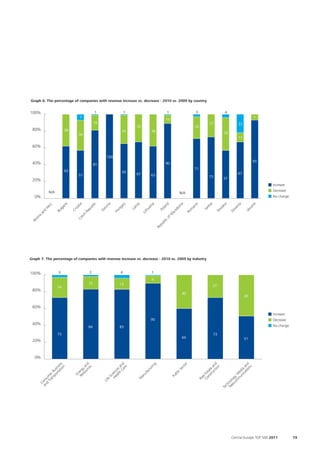
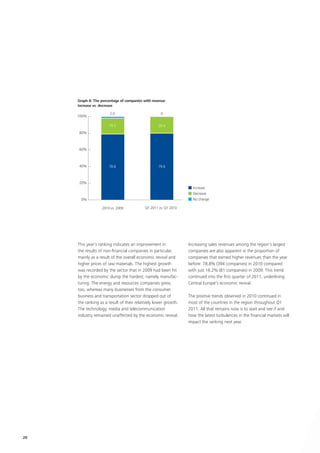
     This year’s ranking indicates an improvement in             Increasing sales revenues among the region’s largest
     the results of non-financial companies in particular,       companies are also apparent in the proportion of
     mainly as a result of the overall economic revival and      companies that earned higher revenues than the year
     higher prices of raw materials. The highest growth          before: 78.8% (394 companies) in 2010 compared
     was recorded by the sector that in 2009 had been hit        with just 16.2% (81 companies) in 2009. This trend
     by the economic slump the hardest, namely manufac-          continued into the first quarter of 2011, underlining
     turing. The energy and resources companies grew,            Central Europe’s economic revival.
     too, whereas many businesses from the consumer
     business and transportation sector dropped out of           The positive trends observed in 2010 continued in
     the ranking as a result of their relatively lower growth.   most of the countries in the region throughout Q1
     The technology, media and telecommunication                 2011. All that remains now is to wait and see if and
     industry remained unaffected by the economic revival.       how the latest turbulences in the financial markets will
                                                                 impact the ranking next year.


20
Central Europe TOP 500 2011   21
Performance
     What are your organisation’s priorities in
     the next 12 months in order to improve
     performance?

     Responses focused on the belief that the key drivers
     of performance are:
     1. Growing revenues
     2. Focus on improving profitability
     3. Cutting and managing costs


22
Overview of the leaders
The Top 10
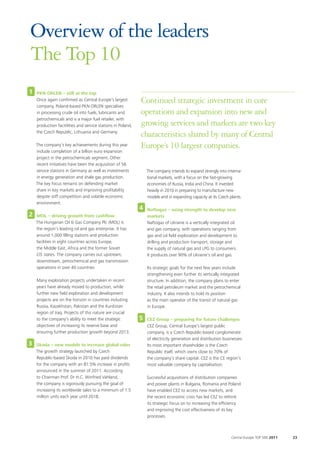
1   PKN ORLEN – still at the top
    Once again confirmed as Central Europe’s largest          Continued strategic investment in core
    company, Poland-based PKN ORLEN specialises
    in processing crude oil into fuels, lubricants and        operations and expansion into new and
    petrochemicals and is a major fuel retailer, with
    production facitilities and service stations in Poland,   growing services and markets are two key
    the Czech Republic, Lithuania and Germany.
                                                              characteristics shared by many of Central
    The company’s key achievements during this year           Europe’s 10 largest companies.
    include completion of a billion euro expansion
    project in the petrochemicals segment. Other
    recent initiatives have been the acquisition of 56
    service stations in Germany as well as investments            The company intends to expand strongly into interna-
    in energy generation and shale gas production.                tional markets, with a focus on the fast-growing
    The key focus remains on defending market                     economies of Russia, India and China. It invested
    share in key markets and improving profitability              heavily in 2010 in preparing to manufacture new
    despite stiff competition and volatile economic               models and in expanding capacity at its Czech plants.
    environment.
                                                              4   Naftogaz – using strength to develop new
2   MOL – driving growth from cashflow                            markets
    The Hungarian Oil & Gas Company Plc (MOL) is                  Naftogaz of Ukraine is a vertically integrated oil
    the region’s leading oil and gas enterprise. It has           and gas company, with operations ranging from
    around 1,000 filling stations and production                  gas and oil field exploration and development to
    facilities in eight countries across Europe,                  drilling and production transport, storage and
    the Middle East, Africa and the former Soviet                 the supply of natural gas and LPG to consumers.
    CIS states. The company carries out upstream,                 It produces over 90% of Ukraine’s oil and gas.
    downstream, petrochemical and gas transmission
    operations in over 40 countries.                              Its strategic goals for the next few years include
                                                                  strengthening even further its vertically integrated
    Many exploration projects undertaken in recent                structure. In addition, the company plans to enter
    years have already moved to production, while                 the retail petroleum market and the petrochemical
    further new field exploration and development                 industry. It also intends to hold its position
    projects are on the horizon in countries including            as the main operator of the transit of natural gas
    Russia, Kazakhstan, Pakistan and the Kurdistan                in Europe.
    region of Iraq. Projects of this nature are crucial
    to the company’s ability to meet the strategic            5   CEZ Group – preparing for future challenges
    objectives of increasing its reserve base and                 CEZ Group, Central Europe’s largest public
    ensuring further production growth beyond 2013.               company, is a Czech Republic-based conglomerate
                                                                  of electricity generation and distribution businesses.
3   Skoda – new models to increase global sales                   Its most important shareholder is the Czech
    The growth strategy launched by Czech                         Republic itself, which owns close to 70% of
    Republic-based Skoda in 2010 has paid dividends               the company’s share capital. CEZ is the CE region’s
    for the company with an 81.5% increase in profits             most valuable company by capitalisation.
    announced in the summer of 2011. According
    to Chairman Prof. Dr H.C. Winfried Vahland,                   Successful acquisitions of distribution companies
    the company is vigorously pursuing the goal of                and power plants in Bulgaria, Romania and Poland
    increasing its worldwide sales to a minimum of 1.5            have enabled CEZ to access new markets, and
    million units each year until 2018.                           the recent economic crisis has led CEZ to rethink
                                                                  its strategic focus on to increasing the efficiency
                                                                  and improving the cost effectiveness of its key
                                                                  processes.


                                                                                                                 Central Europe TOP 500 2011   23
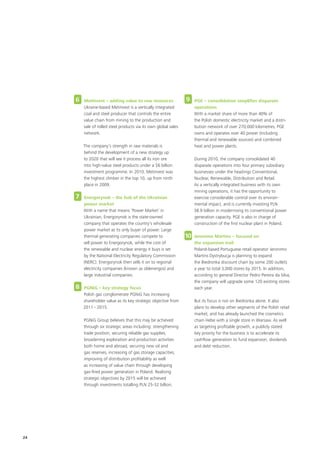
6   Metinvest – adding value to raw resources                9    PGE – consolidation simplifies disparate
         Ukraine-based Metinvest is a vertically integrated            operations
         coal and steel producer that controls the entire              With a market share of more than 40% of
         value chain from mining to the production and                 the Polish domestic electricity market and a distri-
         sale of rolled steel products via its own global sales        bution network of over 270,000 kilometres, PGE
         network.                                                      owns and operates over 40 power (including
                                                                       thermal and renewable sources) and combined
         The company’s strength in raw materials is                    heat and power plants.
         behind the development of a new strategy up
         to 2020 that will see it process all its iron ore             During 2010, the company consolidated 40
         into high-value steel products under a $6 billion             disparate operations into four primary subsidiary
         investment programme. In 2010, Metinvest was                  businesses under the headings Conventional,
         the highest climber in the top 10, up from ninth              Nuclear, Renewable, Distribution and Retail.
         place in 2009.                                                As a vertically integrated business with its own
                                                                       mining operations, it has the opportunity to
     7   Energorynok – the hub of the Ukrainian                        exercise considerable control over its environ-
         power market                                                  mental impact, and is currently investing PLN
         With a name that means ‘Power Market’ in                      38.9 billion in modernising its conventional power
         Ukrainian, Energorynok is the state-owned                     generation capacity. PGE is also in charge of
         company that operates the country’s wholesale                 construction of the first nuclear plant in Poland.
         power market as its only buyer of power. Large
         thermal generating companies compete to                  10   Jeronimo Martins – focused on
         sell power to Energorynok, while the cost of                  the expansion trail
         the renewable and nuclear energy it buys is set               Poland-based Portuguese retail operator Jeronimo
         by the National Electricity Regulatory Commission             Martins Dystrybucja is planning to expand
         (NERC). Energorynok then sells it on to regional              the Biedronka discount chain by some 200 outlets
         electricity companies (known as oblenergos) and               a year to total 3,000 stores by 2015. In addition,
         large industrial companies.                                   according to general Director Pedro Pereira da Silva,
                                                                       the company will upgrade some 120 existing stores
     8   PGNiG – key strategy focus                                    each year.
         Polish gas conglomerate PGNiG has increasing
         shareholder value as its key strategic objective from         But its focus is not on Biedronka alone. It also
         2011 - 2015.                                                  plans to develop other segments of the Polish retail
                                                                       market, and has already launched the cosmetics
         PGNiG Group believes that this may be achieved                chain Hebe with a single store in Warsaw. As well
         through six strategic areas including: strengthening          as targeting profitable growth, a publicly stated
         trade position, securing reliable gas supplies,               key priority for the business is to accelerate its
         broadening exploration and production activities              cashflow generation to fund expansion, dividends
         both home and abroad, securing new oil and                    and debt reduction.
         gas reserves, increasing of gas storage capacities,
         improving of distribution profitability as well
         as increasing of value chain through developing
         gas-fired power generation in Poland. Realising
         strategic objectives by 2015 will be achieved
         through investments totalling PLN 25-32 billion.


24
Talent
Managing talent was critical for companies to
succeed during and after the financial crisis.
Executives interviewed viewed the top 3 priorities as:
1. Strengthening staff development and training
2. Performance management processes
3. Reward and recognition of top performers


                                                                          Industries


                                            Central Europe TOP 500 2011    25
Upwardly mobile companies
The top 20 “jumpers”
                                                                          4   KGHM is one of the world’s largest producers
The 20 Central European companies that                                        of copper and silver. In the year’s second quarter
                                                                              it achieved a 57% year-on-year increase in earnings
have made the largest leap up the Top 500                                     to PLN2.36 billion, a full 10% ahead of analyst

ranking in 2011 are clustered in Poland,                                      expectations and leading to better than expected
                                                                              full-year results.
Ukraine and the Czech Republic, with                                      5   The Nikopol Ferroalloy Plant is Ukraine’s
Hungary and Slovenia contributing one                                         largest manufacturer of silicon manganese
                                                                              and ferromanganese. The company is meeting
entry each. While several are subsidiaries of                                 consumer demand through product and process

major global parent organisations, many are                                   innovation including more cost-effective and
                                                                              secure freight transport.
local organisations, emphasising the region’s                             6   Ukraine’s Gazprom sbut Ukraina successfully
strengths in natural resources businesses such                                maintained growth in its gas marketing business
                                                                              during 2010 to help its production indicators
as energy and metals.                                                         recover steadily to pre-crisis levels. Export opportu-
                                                                              nities during the year were boosted by the recovery
                                                                              in the macro-economic environment and other
                                                                              regions.
               1   According to Nobuo Harada, President of                7   With close to 800 employees, BAT Polska (British
                   Sharp Manufacturing Poland, “We experienced
                                                                              American Tobacco Polska) is Poland’s largest
                   very high demand during the year thanks to
                                                                              cigarette manufacturer with brands including
                   the 2010 Football World Cup and to our reputation
                                                                              Pall Mall, Lucky Strike, Golden American, Viceroy,
                   as a reliable manufacturer with highly competent
                                                                              Kent and Vogue. The company sells around 30%
                   employees. These qualities will serve us well as we
                                                                              of its total production in Poland and exports
                   seek continued dynamic growth in the face of
                                                                              the remainder to 14 mainly European markets.
                   a declining LCD TV market in Europe.”

               2                                                          8   Slovenian Steel Group SIJ is a major exporter
                   Iron ore producer Ferrexpo, which operates in
                                                                              to markets in the EU and North America, and is
                   Ukraine, bases its growth and ability to deliver
                                                                              pursuing an active and accelerating investment
                   stakeholder value on its low cost-base, significant
                                                                              strategy to develop its global business. This is
                   reserves and established infrastructure. Its future
                                                                              building on the growth achieved in 2010 thanks
                   focus is on investments in production facilities and
                                                                              to recovery of the German economy, particularly
                   logistics to reduce the risks of cost inflation and
                                                                              in the automotive and and energy engineering
                   fluctuation.
                                                                              industries.

               3   Polski Koks is Poland’s largest exporter of            9   The Czech subsidiary of Taiwan’s Inventec
                   coking coal and Poland is world-leader in coke
                                                                              company is part of a global business targeting
                   exports, having taken over from China in 2009.
                                                                              a 30% increase in its annual revenues, based
                   According to the company’s annual report, 2010
                                                                              on its established strength in notebook PCs and
                   saw a substantial increase in exports as demand
                                                                              increasing diversification into mobile devices
                   increased from the steel industry.
                                                                              including smartphones, smart tablets and smart
                                                                              books.


26
10   Ferona, the Czech Republic’s largest wholesaler             16   The Maspex Wadowice Group achieved sales
     of metallurgical products saw a strong return to                 revenues in 2010 of some $828 million, placing
     profit in 2010, posting a surplus of Kc 200 million              it among Poland’s leading food producers. Over
     following a Kc 1.5 billion loss the previous year.               the last two decades, the company has achieved
     This was based on a 15% increase in sales to                     growth through strategic acquisitions. Today,
     Kc 13.2 billion thanks to stable demand during                   foreign sales account for around 35% of its
     the first half of the year.                                      turnover.

11   Poland-based Impex Metal is implementing                    17   BASF opened two new Polish production
     plans to expand its value further by restructuring               facilities in late 2010, adding around 100
     and modernising its assets to focus on the most                  jobs to the company’s existing 250-strong
     promising segments within the metals sector, such                Polish workforce in an investment worth ZL40
     as copper and aluminium.                                         million. One of the units will produce dry mortar
                                                                      for the construction industry and the other
12   Ukrainian filling station operator PAT Galnaftogaz               polyurethane systems for the construction,
     saw its profits more than double in 2010                         automotive and refrigeration industries. Both
     as it successfully increased its sales and cut its costs.        facilities will primarily target the domestic
     Its publicly stated strategic goals are to cement                marketplace.
     its position among the country’s three leading
     operators while improving the effectiveness and             18   Hungary’s GDF SUEZ Energia Magyarorszag
     quality of its core product, services and systems.               company’s 200 million euro investment in its
                                                                      Dunamenti power plant is designed to enhance
13   Poland-based Synthos, which also has a major                     the country’s energy security through increasing
     presence in the Czech Republic, is Europe’s                      its total installed electricity production by close
     second-largest synthetic rubber and polystyrene                  to 20%. Its use of the latest technologies will also
     producer. According to analysis by Erste Bank,                   significantly reduce the plant’s environmental
     the company could be poised to increase utilisation              impact, particularly its CO2 emissions.
     of its rubber production capacity from 84% in
     2009 to an annual average of 93% between 2010               19   Ukraine’s Donetskstal Metallurgical plant
     and 2014.                                                        has completed a comprehensive restructuring
                                                                      of its debt totalling $820 million. According to
14   Poland’s Petrotank is planning to maintain current               the company, this strengthens its competitive
     levels of crude oil throughput, processing efficiency,           position and creates a sturdy financial foundation
     sales and market share in the face of strong                     that will allow it to focus on its strategic goals.
     competition and pressure on its retail margins.
                                                                 20   Foxtrot Household Appliances, one of Ukraine’s
15   Polish dairy company SM Mlekovita regards                        leading vendors of audio, video and other
     maintaining its position as domestic market                      appliances, signed a co-operative contract with
     leader as one of its key strategic objectives. It is             the Dutch Euronics International Group. This is
     also focused on boosting its exports, particularly               part of the company’s substantial expansion plans,
     to the Czech Republic where it is targeting 10%                  which include increasing its net goods turnover by
     growth and a doubling of its product range.                      50% and a major store-opening programme.


                                                                                                                   Central Europe TOP 500 2011   27
Industry Insights
Financial Services                         32

Energy and Resources                       40

Manufacturing                              45

Technology, Media and Telecommunications   49

Consumer Business and Transportation       54

Real Estate and Construction               59

Life Sciences and Health Care              66


                                                Industries
                                                Industries
Across the region,
companies that are
able to best adapt to
changes in demand,
financing conditions
and the operational
environment will
perform most
strongly.


30
We spoke with a number of Deloitte professionals
                                       and business leaders from across Central Europe who
                                       provided insights to seven key industries in the region.
                                       These in-depth conversations reveal a region of two
                                       halves. Northern economies such as Poland, the Czech
                                       Republic and Slovakia are among the healthiest in
                                       Europe and are experiencing increases in local consumer
                                       demand that will fuel growth in sectors including retail
                                       and construction. Countries in the south of the region
                                       and non-consumer intensive industries, meanwhile,
                                       are on a very different path: any growth that is to be
                                       achieved will depend on export, and is inextricably
                                       linked to the economic performance of Western
                                       European countries, especially Germany.

                                       Across the region, companies that are able to best
                                       adapt to changes in demand, financing conditions and
                                       the operational environment will perform most strongly.
                                       This will not be easy. Most companies in the region
                                       have already achieved major efficiency gains through
                                       cost-cutting following the global financial crisis. Now
                                       it remains to be seen whether they will be able to
                                       overcome the key challenges they face in sourcing new
                                       revenue growth opportunities following three years of
                                       slow growth.

                                       Looking ahead, we see the need to innovate as key
                                       to the survival of firms across several industries. These
                                       specifically include financial services and technology,
                                       media and telecommunications, where already
                                       ultra-competitive markets are becoming saturated.
                                       Only the most innovative and desirable products and
                                       services will stand out in a regional marketplace where
                                       expectations of a return to the ‘normal’ conditions of
                                       the past, have been all but dispelled.
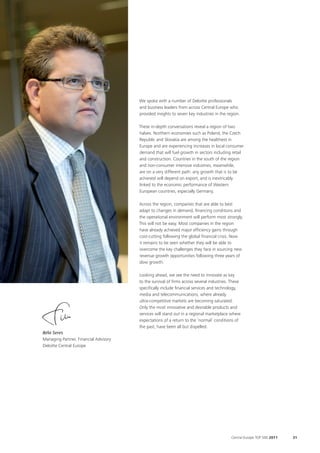
Béla Seres
Managing Partner, Financial Advisory
Deloitte Central Europe


                                                                                          Central Europe TOP 500 2011   31
Financial Services


                    “Using people and technology to drive innovation            Furthermore, there is no guarantee that business
                     is the key to growing revenues for Central                 confidence will rise anytime soon. Stalling growth
                     Europe’s financial institutions. Otherwise revenues        in Germany and France is coinciding with a fall in
                     and market share will shrink.”                             confidence in the UK , while uncertainties continue
                                                                                over the long-term future of the EU.
                    Some three years after the collapse of Lehman
                    Bros, organisations in Central Europe’s Financial           The importance of Western Europe as an export market
                    Services industry (FSI) continue to face a number of        means that any decline in growth or confidence there
                    competitive, technological, cultural and regulatory         will have an impact on CE as a whole.
                    challenges as they struggle to move on from a period
                    of slow growth and depressed markets.                       Adding to the challenges is the fact that the CE
                                                                                banking industry is heavily polarised in many countries,
                     Recent “stress tests” undertaken on some of                being typically dominated by three to five large banks
                     the region’s biggest financial players suggest that they   with a second tier made up of a number of smaller
                     are largely in good shape to meet these challenges,        organisations.
                     with the liquidity and capital they need to prosper.

                    Threats to growth                                           “The banking and insurance
                    That is not to say, however, that all FSI institutions
                                                                                sectors in Croatia are
                    in all CE countries will still be here in five or even      relatively saturated. Such
                    two years’ time, due to the potential for takeovers
                    of domestic or foreign assets by larger foreign-            environment does not
                    owned institutions, leading to sector consolidation
                    as the leading players strengthen their positions.
                                                                                favor smaller institutions
                    Trends are also underway that may see certain               and could jeopardize their
                    organisations opt to leave the region. These include
                    a low interest rate environment that for some years
                                                                                business models.”
                    has been pushing down banking revenues and
                                                                                                  Ivan Fabijanćić, Assistant Director,
                    limiting growth in certain countries’ financial services
                                                                                        Financial Advisory Services, Deloitte Croatia
                    sectors. In addition, the typical Central European
                    consumer remains financially stressed and without
                    the confidence to take on any further borrowing.
                                                                                In some “overbanked” markets, including Croatia,
                                                                                the Czech Republic and Slovakia, this structure is
                                                                                a primary cause of saturation which is already making
“The impact of the financial crisis has                                         the business model for smaller players questionable.
caused problems in servicing loans for many                                     This may ultimately cause a number of the foreign
                                                                                groups that own members of that second tier to
companies, making it imperative that banks                                      consider selling their central European assets and
and other lenders now need to restructure and                                   withdrawing from the region. After all, why should
                                                                                they be content with a lowly ranking in a compara-
refinance their debt portfolios.”                                               tively small country where the loans and insurance
                                                                                markets are already mature?
         Nada Suđić, Partner, Business Advisory Services, Deloitte Serbia
                                                                                This will also create opportunities for new entrants
                                                                                or companies on the expansion trail to acquire
                                                                                businesses in these markets. Indeed, there is significant
                                                                                potential for organisations from other industries, such
                                                                                as the telco and brokerage sectors, to enter the market
                                                                                to provide mobile banking and insurance solutions.


32
Innovation is the key                                        For as banks increasingly recognise the lower costs
                                                             involved in leveraging existing customers rather than
What form should action take? There is a broad               attracting new ones, they are seeking new means
consensus among the region’s banks and insurers that         of retaining their older “traditional” customers and
innovation will be the key to future prosperity and in       opportunities to develop their loyalty and value.
some cases, the survival of the region’s FSI players.
                                                             This is a significant move away from the business
Before focusing on product innovation, many                  model of the past, in which revenues were derived
established institutions need to spend heavily on            through transactions fees and banks were largely
updating their systems to improve their data analytics       content to see customers “churn” from one provider
and gain a single, holistic view of each customer, so        to the next. Today, therefore, banks are making
enabling increased value to be created through cross-        investments in quality to improve customer loyalty
selling opportunities. In many institutions, customers       at the same as reducing risk through more robust
with more than one product are currently regarded            approaches to credit process design and operational
as more than one person, thereby preventing such             excellence.
cross-selling opportunities.
                                                             Despite the challenges they face, there are
Addressing this situation is key to increasing               significant opportunities for CE players to accelerate
revenues. For banks, a primary focus is to make up           the execution of such strategies through building
for the decreases in revenues from deposits that             on the experience of their more developed Western
they have experienced since 2008, and to address             counterparts to develop new communication and
those limitations on lending revenues that result            distribution channels. Their advantage, in fact, is that
from a stricter risk approach. In addition, internet         they can avoid some of the ‘blind alleys’ that the initial
and mobile banking are also depressing transaction           pioneers encountered.
fee levels and restricting the revenues available from
single products. The only way for banks to increase          Regulatory change
revenues per customer, therefore, is to increase
the number of products that individuals use.                 Another source of potential competitive advantage
                                                             is regulatory compliance; with forthcoming changes
Relationship banking                                         arising from new directives including Basel III, MiFiD
                                                             II, Solvency II and FATCA (the new US Foreign Account
For some institutions, there are also cultural barriers to   Tax Compliance Act), those companies that adapt and
innovation that need to be addressed. These sometimes        innovate rapidly to comply will glean clear benefits
relate to the length of service of key employees, who        from early compliance, such as a lack of disruption to
are often reluctant to change. For this reason, a number     their operations when the new rules come into force.
of banks and insurers are creating development or
incubator teams made up of young employees with
a brief to create products for more sophisticated
customer groups using online and mobile technology           “The financial industry in Croatia is likely to
platforms and distribution channels. These could in
time form the core of a new generation of financial          remain stable and largely focused on challenges
institutions, offering more buyer-driven product             arising from changes in regulatory compliance
portfolios to meet the emerging needs of younger,
more savvy and connected customers.                          environment (Basel III, IFRS 9, Solvency II,
This focus on the needs of emerging customers
                                                             IFRS 4 etc.).”
effectively means that a shift is underway as a dual
                                                                                    Ivan Fabijanćić, Assistant Director, Financial Advisory Services,
focus emerges on the customer of the future while
                                                                                                                                    Deloitte Croatia
simultaneously seeking to generate more from existing
customers.


                                                                                                                Central Europe TOP 500 2011       33
In certain countries, the biggest challenge under           Leveraging human capital
     Basel III will be to meet the expected new liquidity
     ratios, in particular the net stable funding ratio. This
     is because the mortgage portfolios of many banks            “A key priority for us is to
     in the region, often sold in foreign currencies, are
     usually funded by local deposits, so increasing
                                                                 strengthen our leadership
     liquidity risks. Unlike in Western Europe, the use of       pipeline through the early
     long-term instruments such as debentures to fund
     such portfolios is restricted. Under FATCA, due to          identification and development
     come into effect in January 2013, financial institutions    of our next generation of
     will have to enter an agreement with the US IRS to
     report information on their American account holders,       leaders.”
     creating an additional reporting process to manage
     potential risks associated with compliance. This will                     Luigi Lovaglio, CEO, Bank PeKaO, Poland
     require significant system and process changes among
     financial institutions.
                                                                 In the immediate aftermath of the financial crisis,
     In some CE countries there is a view that                   companies across the region including banks
     burgeoning EU regulation is in fact “softer touch”          and insurers needed to ensure that their talent
     than the domestic frameworks it replaces. There             management strategies effectively put the right
     is therefore an expectation that a release from             people in the right place, now and into the future.
     the shackles of over-restrictive regulation will generate   This has now evolved further, and there is a shared
     a new wave of product innovation.                           appreciation among the region’s financial services
                                                                 institutions that a better trained and rewarded
     Institutions will need to be careful, however. As they      workforce, led by the best available management,
     work to resolve legacy issues while introducing new         is the key to growth and improved performance in
     products and services, there will be a need for tight       an uncertain future.
     operational expenditure management at a time when
     costs could spiral out of control. This is particularly     There is therefore widespread agreement that
     true following a period of intensive concentration          the HR function is becoming increasingly important
     on cost-reduction; once the brakes are off there is         to ongoing competitive strategies. Training and
     a danger of overcompensation.                               development initiatives are seen as fundamental
                                                                 requirements, with succession-planning, reward and
                                                                 performance management programmes increasingly
                                                                 recognised as top priorities for the region’s institutions.
                                                                 This is a significant shift from the time when reducing
                                                                 employee headcount was the overriding priority for
                                                                 many.

                                                                 But as the FSI landscape shakes out over the years to
                                                                 come, expect to see change. There will be winners
                                                                 and losers, and those that emerge ahead will be
                                                                 the ones that innovate best across many areas.
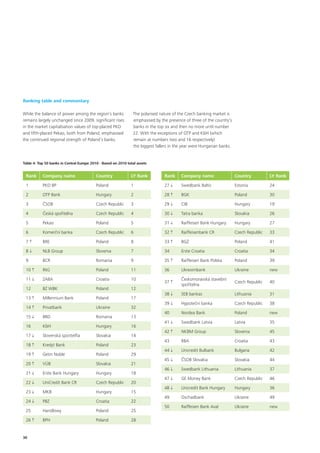
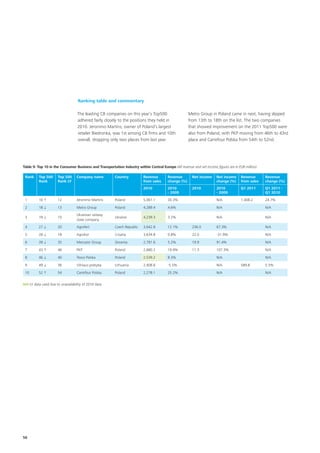
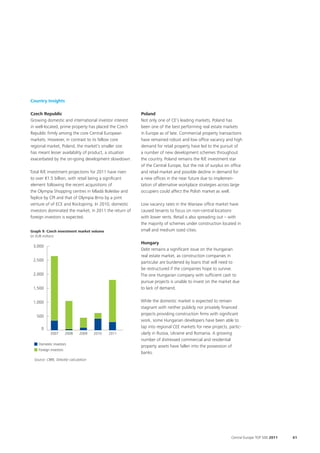
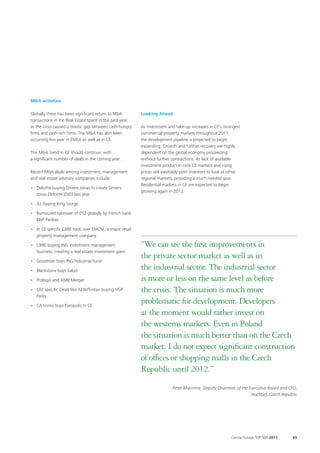
                                                                 These areas will comprise product portfolio and
                                                                 sales channels, structure and systems, culture and
                                                                 agility, people and management. The challenges are
                                                                 demanding – but the rewards will be great for those
                                                                 that get it right.


34
Country Insights                                            Romania
                                                            In Romania, the priority today is to build external
Hungary                                                     investors’ confidence in the health of the national
                                                            economy. Foreign Direct Investment, historically
                                                            the country’s primary source of growth, has fallen off
“Authority and responsibility                               sharply in recent years; Romania’s success to date in
                                                            abiding by its IMF agreement is sending the right signals
have been largely taken back                                and there is hope that the domestic financial services
from the Hungarian banks                                    industry is set to gain by supporting new investments.
                                                            However, any ability to grow will also be dictated by
by their mother companies                                   the banks’ ability to manage bad debts and the risks

as they seek to centralise what                             associated with lending in a volatile environment.

they can.”
                                                            “Romanian financial institutions have put the last
                    András Fülöp, Partner in Charge,
        Financial Advisory Services, Deloitte Hungary       three years of crisis to good use – they have
                                                            improved their ability to tell between good and
Growth is not on the agenda for Hungary, for                bad business, to identify opportunities and to
example, where the focus remains on efficiency and
performance as parent companies remove executive
                                                            find more innovative and safe financing options.
authority from local management teams. A key                However, there is still room for improvement and
challenge facing the country’s financial institutions is
summed up in a report from the Hungarian National           the current financial environment will not allow
Bank showing that 76% of private sector transactions
are carried out in cash. There are however opportu-
                                                            any complacency.”
nities for new market entrants, which unhindered
                                                                                            Andrei Burz-Pinzaru, Partner, Legal, Deloitte Romania
by legacy issues, could concentrate on building trust
among consumers and corporates.

Poland                                                      Croatia
In Poland, the picture is very different: stable domestic   In Croatia, it is expected that the financial services
and foreign demand for goods and services are               industry will remain largely stable despite limited
driving growth and there is an expectation that             growth prospects arising from a high level of
companies will need to invest in new capacity to            indebtedness at all levels of society. There is also
meet their obligations. Revenue growth is the top           a focus on responding to the demands of a new
priority for the country’s banks, some of which would       regulatory regime and minimising the costs involved
not be averse to making strategic acquisitions given        with compliance. The insurance sector is set to
the appropriate rationale and valuation.                    remain driven by non-life business, as the slow pace
                                                            of economic recovery continues to hold back any
According to Violeta Klyviene, Danske Bank, Lithuania,      improvements in the life sector.
in the Polish economy we would expect growth to
start moderating in the coming quarters and into
2012, given only slight signs of slowing activity
in global manufacturing. Polish monetary policy
tightening has already been initiated and the likely
tightening of fiscal policy may occur later this year. We
therefore expect Polish growth to be slightly over 4%
for 2011 as a whole and well below 4% in 2012.


                                                                                                               Central Europe TOP 500 2011    35
Ranking table and commentary

While the balance of power among the region’s banks             The polarised nature of the Czech banking market is
remains largely unchanged since 2009, significant rises         emphasised by the presence of three of the country’s
in the market capitalisation values of top-placed PKO           banks in the top six and then no more until number
and fifth-placed Pekao, both from Poland, emphasised            22. With the exceptions of OTP and K&H (which
the continued regional strength of Poland’s banks.              remain at numbers two and 16 respectively)
                                                                the biggest fallers in the year were Hungarian banks.


Table 4: Top 50 banks in Central Europe 2010 - Based on 2010 total assets


 Rank      Company name                    Country             LY Rank          Rank     Company name                   Country          LY Rank

 1         PKO BP                          Poland              1                27 ↓     Swedbank Baltic                Estonia          24

 2         OTP Bank                        Hungary             2                28 ↑     BGK                            Poland           30

 3         ČSOB                            Czech Republic      3                29 ↓     CIB                            Hungary          19

 4         Česká spořitelna                Czech Republic      4                30 ↓     Tatra banka                    Slovakia         26

 5         Pekao                           Poland              5                31 ↓     Raiffeisen Bank Hungary        Hungary          27

 6         Komerční banka                  Czech Republic      6                32 ↑     Raiffeisenbank CR              Czech Republic   33

 7↑        BRE                             Poland              8                33 ↑     BGŻ                            Poland           41

 8↓        NLB Group                       Slovenia            7                34       Erste Croatia                  Croatia          34

 9         BCR                             Romania             9                35 ↑     Raiffeisen Bank Polska         Poland           39

 10 ↑      ING                             Poland              11               36       Ukreximbank                    Ukraine          new

 11 ↓      ZABA                            Croatia             10                        Českomoravská stavební
                                                                                37 ↑                                    Czech Republic   40
                                                                                         spořitelna
 12        BZ WBK                          Poland              12
                                                                                38 ↓     SEB bankas                     Lithuania        31
 13 ↑      Millennium Bank                 Poland              17
                                                                                39 ↓     Hypoteční banka                Czech Republic   38
 14 ↑      Privatbank                      Ukraine             32
                                                                                40       Nordea Bank                    Poland           new
 15 ↓      BRD                             Romania             13
                                                                                41 ↓     Swedbank Latvia                Latvia           35
 16        K&H                             Hungary             16
                                                                                42 ↑     NKBM Group                     Slovenia         45
 17 ↓      Slovenská sporiteľňa            Slovakia            14
                                                                                43       RBA                            Croatia          43
 18 ↑      Kredyt Bank                     Poland              23
                                                                                44 ↓     Unicredit Bulbank              Bulgaria         42
 19 ↑      Getin Noble                     Poland              29
                                                                                45 ↓     ČSOB Slovakia                  Slovakia         44
 20 ↑      VÚB                             Slovakia            21
                                                                                46 ↓     Swedbank Lithuania             Lithuania        37
 21 ↓      Erste Bank Hungary              Hungary             18
                                                                                47 ↓     GE Money Bank                  Czech Republic   46
 22 ↓      UniCredit Bank CR               Czech Republic      20
                                                                                48 ↓     Unicredit Bank Hungary         Hungary          36
 23 ↓      MKB                             Hungary             15
                                                                                49       Oschadbank                     Ukraine          49
 24 ↓      PBZ                             Croatia             22
                                                                                50       Raiffeisen Bank Aval           Ukraine          new
 25        Handlowy                        Poland              25

 26 ↑      BPH                             Poland              28


36
The most noticeable trend during the year is                   The biggest jumper, however, is Nordea Polska, which
the strengthening grip of Polish insurers on the upper         moves 13 places from 25th to 12th.
echelons of the industry in Central Europe, with both
STU Ergo Hestia and Aviva Polska climbing upwards
within the top ten.


Table 5: Top 50 insurance companies in Central Europe 2010 - Based on 2010 gross written premium


 Rank      Company name                  Country              LY Rank            Rank     Company name                   Country                 LY Rank

 1         PZU                           Poland               1                  26 ↓     ING Hungary                    Hungary                 24

 2         Česká Pojišťovna              Czech Republic       2                  27 ↑     InterRisk                      Poland                  38

 3         Kooperativa pojišťovna        Czech Republic       3                           Adriatic Slovenica
                                                                                 28 ↑                                    Slovenia                29
                                                                                          Zavarovalna Družba
 4         Warta                         Poland               4
                                                                                 29 ↓     Zavarovalnica Maribor          Slovenia                26
 5         Zavarovalnica Triglav         Slovenia             5
                                                                                 30 ↑     Astra                          Romania                 35
 6         Allianz Polska                Poland               6
                                                                                 31       ČPP                            Czech Republic          31
 7         Allianz Hungaria              Hungary              7
                                                                                 32 ↑     AXA Polska                     Poland                  41
 8↑        STU Ergo Hestia               Poland               10
                                                                                 33 ↓     Allianz-Tiriac                 Romania                 21
 9↑        Aviva Polska                  Poland               11
                                                                                 34       HDI Polska                     Poland                  34
           Allianz - Slovenská
 10 ↓                                    Slovakia             9
           poisťovňa                                                             35 ↓     Vzajemna                       Slovenia                30

 11 ↓      ING Polska                    Poland               8                  36       Lietuvos draudimas             Lithuania               new

 12 ↑      Nordea Polska                 Poland               25                 37 ↓     Omniasig                       Romania                 28

 13 ↓      Generali Providencia          Hungary              12                 38 ↓     ING Životní pojišťovna         Czech Republic          32

 14 ↓      Kooperativa Slovakia          Slovakia             13                 39 ↑     Compensa TU                    Poland                  40

 15 ↑      Uniqa Polska                  Poland               16                 40 ↓     Uniqa Hungary                  Hungary                 36

 16 ↓      Croatia osiguranje            Croatia              15                 41 ↓     Uniqa pojišťovna               Czech Republic          39

 17 ↓      Generali Polska               Poland               14                 42 ↓     Generali Slovensko             Slovakia                33

 18 ↓      Allianz pojišťovna            Czech Republic       17                 43 ↑     Aegon Polska                   Poland                  44

 19 ↓      ČSOB Pojišťovna               Czech Republic       18                 44       Groupama                       Romania                 new

           Pojišťovna České                                                      45 ↑     Komunálna poisťovňa            Slovakia                46
 20 ↑                                    Czech Republic       27
           spořitelny
                                                                                 46       Europa                         Poland                  new
 21 ↑      Komerční pojišťovna           Czech Republic       37
                                                                                 47 ↓     Euroherc osiguranje            Croatia                 45
 22 ↓      Generali Pojišťovna           Czech Republic       20
                                                                                 48       Allianz Zagreb                 Croatia                 48
 23 ↓      Groupama                      Hungary              22
                                                                                 49 ↓     Dunav Osiguranje               Serbia                  42
 24 ↓      Amplico Life                  Poland               19
                                                                                 50       ING Asigurari                  Romania                 new
 25 ↓      Aegon Hungary                 Hungary              23


                                                                                                                   Central Europe TOP 500 2011         37
“A key distinguishing characteristic for                “Constantly improving the quality of
      companies is their ability first to spot                our customer service is a key factor
      opportunities and emerging trends,                     in our future development, and we
      and then to convert them rapidly into                  work consistently to modernise our
      marketable services that generate                       offer and our image. This is driven by
      a return.”                                             innovation, which as well as enhancing
                                                              service quality also enables us to
     “Innovations are constrained with                        reduce operating costs.”
     today’s market sentiment but also
     with current regulatory regime within                   “We place particular emphasis in
      banking and other financial industry,                   developing the competencies of our
     i.e. innovation wave will likely emerge                  employees on improving management
      upon country’s addition in EU.”                        leadership skills and on identifying
                                                              and motivating those people with
                      Ivan Fabijanćić, Assistant Director,   the greatest potential.”
            Financial Advisory Services, Deloitte Croatia

                                                                     Zbigniew Jagiello, PKO Bank Polski, Poland


     “We expect that the improvement                         “One can no longer avoid risk and
      on the labour market will effectively                   stay in business. However, risk can
      support retail lending.”                                be properly assessed and managed,
           Cezary Stypułkowski, CEO, BRE Bank, Poland
                                                              and the ability to manage risk will be
                                                             what distinguishes between successful
                                                              and unsuccessful Financial Services
                                                             Industry players.”

                                                             “The current economic environment
                                                             is in itself the best innovation driver.
                                                              Companies across all industries face
                                                             the same challenge – ‘Innovate or die!’”

                                                                            Andrei Burz-Pinzaru, Partner, Legal,
                                                                                             Deloitte Romania


38
M&A activities

The last year has been a relatively active period for     The insurance sector too is showing a similar pattern
M&A in the CE region. Smaller transactions were           to banking, albeit on a smaller scale and with
driven by large European players such as Allianz          something of a time lag. Here too, international
and Dexia seeking to rationalise their portfolio or       players are rationalising their presence in the region,
as a reaction to EU regulations (as in the case of        while the largest are waiting for entry points to
WestLB).                                                  emerge in Poland.

Larger deals were mainly focused on Poland, which         Looking Ahead
proved particularly attractive thanks to its relatively
strong economic performance and large market size.        Whatever the short-term challenges and priorities they
Some of Europe’s largest banking groups were already      face, the region’s most successful banks and insurance
investigating Polish opportunities before the crisis,     companies will be those that continue to invest in
but a lack of available large targets prevented any       understanding their customers and most critically in
significant deals at the time. Now, though, interna-      how their buying habits will change in the future. No
tional investors facing difficulties in their domestic    financial services business model is sustainable without
markets or regulatory pressures are once again turning    such an understanding, for it will increasingly be
to Polish assets.                                         the lynchpin around which these companies’ cultures
                                                          will revolve.


“While our primary focus is                               These players will increasingly understand the need
                                                          to be distinctive in terms of their image, their product
on organic growth through                                 portfolio and their routes to market. Achieving this

increasing revenues, we                                   will require innovative management of the manner of
                                                          change; but gradually the character of all institutions
may also consider growth                                  will change entirely as long-term employees retire to
                                                          be replaced by a generation focused on meeting more
through acquisition provided                              complex and sophisticated financial expectations.
the rationale and valuation
                                                           So, in the immediate future expect to see banks and
match our criteria.”                                       insurance companies take on a kind of short-term
                                                          “split personality”. On the one hand, there will be
               Luigi Lovaglio, CEO, Bank PeKaO, Poland     a focus on maximising the opportunities represented
                                                           by their diminishing pool of “traditional” customers.
                                                           At the same time, they will also concentrate on
Buyers participating in smaller deals tended to be         meeting the needs of the new generations of
local investors recognising an opportunity to take         connected, mobile and tech-savvy consumers.
advantage of current uncertainties in the banking
sector to enter the market with a more focused or
innovative strategy than the current incumbents.

Consolidation is expected in most markets, but this
is currently being slowed down by concerns about
the asset side of banking balance sheets. In addition,
larger players are currently playing a waiting game,
using their economies of scale to force smaller market
players either out of the market or potentially to
change their strategies to focus on niche markets.


                                                                                                             Central Europe TOP 500 2011   39
Energy and Resources


       In the energy market carbon dioxide is very much in          in 2010, followed in the oil and gas sector by Hungary’s
       the air, most notably as an issue dividing the EU and        MOL with over €15 billion. In the power and utilities
       some of its New Member States in Central Europe.             sector the Czech company ČEZ has maintained its
      According to Wojciech Hann, Regional Energy                   long-time leadership position with over €7.8 billion
       Partner for Financial Advisory Services in Deloitte,         in revenues followed by Polish PGE with €5.3 billion. In
       the allocations of CO2 emission permits announced in         the mining subsector, Polish copper giant KGHM led
       early August represent a clear threat to lead to a hike      with €4.3 billion in revenues in 2010. This was followed
       in electricity prices. ‘The preliminary allocations are      by coal miners Kompania Weglowa €2.6 billion, newly
       approximately half of what was requested,’ Hann says.        listed JSW €1.8 billion and the Czech coal giant OKD
      ‘This is a sector where if the regulatory framework is        with €1.7 billion.
       not everything, then it’s a lot.’
                                                                    In the meantime companies have a number of avenues
      The other major factor for the industry is the potential      to explore. Renewable energy sources such as wind,
      effect of another economic contraction on regional            solar and hydroelectric farms have become a growing
      energy use. ‘If we are entering the second dip in             feature of the sector landscape. ‘Renewables will see
      the macro economy, obviously electricity consumption          the greatest amount of innovation – currently the field
      follows GDP growth in all CE countries and there would        is wide open for new entrants staking their claims.
      be a drop in demand,’ Hann says.                              Wind and biomass are likely to prove most attractive in
                                                                    Croatia,’ says Ivica Krešić, Director, Financial Advisory
      Consulting Partner and Energy and Resources Industry          Services, Deloitte Croatia, adding that the country
      Leader in Deloitte Poland, Piotr Sokolowski, adds that        still has significant hydro potential to be developed
      carbon emissions regulation is the major driver of future     as well. Carbon capture and storage (CCS) is another
      growth or future collapse in the sector. ‘Everyone is         potential response to the emissions issue, yet Deloitte’s
      waiting to see what the European regulations will be,         Sokolowski says the huge capital investments required
      and then here in Poland, what the Polish regulations          will prove prohibitive without government support.
      will be,’ Sokolowski says.
                                                                    Innovation is also a key in the pursuit of clean coal
      The regulatory uncertainty, coupled with current              technologies and unconventional gas sources. Tauron’s
      concerns over the state of the global economy, have           Lubera cites the company’s cooperation with univer-
      made it difficult for energy companies to carry out           sities and research institutes to develop clean-coal
      the kind of large-scale investments necessary to pursue       technologies. PKN Orlen, Poland’s largest refiner, having
      expansion and maintenance strategies, especially in           secured eight licenses for the exploration of shale
      countries like Poland, where coal-powered plants              and tight gas has been aggressively searching out
      generate over 90% of the country’s electric power.            unconventional gas sources. Polish oil and gas company
                                                                    PGNiG is launching commercial mining in Norway
      For Dariusz Lubera, CEO at Tauron Polska Energia,             but on its home market will be focusing on shale gas
      feasible regulatory objectives are not only vital to          prospecting and prospecting in deep underground
      the industry but to the ability to supply sufficient          geological structures. ‘We also intend to extend our
      electrical power. ‘Implementation of the current              involvement in the power sector, which should prepare
      provisions of the package has already led to uncertainty      us for the opening of the gas market in Poland,’ says
      of investment in coal energy. The price for an assigned       Michal Szubski, CEO of PGNiG.
      amount unit cannot be predicted which, considering
      lack of new investment in coal energy, can lead to            Although shale gas extraction is mostly focused in
      a power deficit in the electrical power system.’              Poland there are a number of CE countries getting in
                                                                    on the act, including Hungary, Romania and with early
       In spite of the uncertainties the sector fared well in       stage research on deposits taking place in the Czech
      general with an annual median revenue change of 13%           Republic as well. To make shale extraction cost
      being second to only manufacturing across the whole           effective and efficient will require significant techno-
      of CE. PKN Orlen has solidified its position as the largest   logical advances, a feature which companies active in
      regional energy company, increasing revenues by               the practice have stressed is an on-going priority of their
      an impressive 33% to almost €21 billion                       research and development.


40
Country Insights

Poland                                                       Ukraine
The integration of regional gas markets is proceeding,      The cost of modernizing the power supply is a major
with Polish natural gas pipeline operator Gaz System         obstacle throughout CE, though perhaps nowhere
announcing an interconnector with Czech company              more so than in Ukraine, which has lagged behind in
Net4Gas that will open in September 2011. Increasing         keeping its power generation efficient and up-to-date.
interconnection capabilities between countries will         ‘Recent studies by some of the investment banks
vastly increase opportunities to import power. There         estimate that thermal power plants in Ukraine operate
are projections that Gaz System will further establish       at only 35-40% capacity because of their age and
links with German, Slovak and Lithuanian gas                 technology. Investment is needed across the sector
operators over the coming years.                             to build new coal and gas power blocks with new
                                                             technology that is more efficient, and to upgrade
Slovakia                                                     the distribution network to include smart metering,
Foreign demand is key says Oszkár Világi, General            and better quality transmission infrastructure to
Director and Chairman of Slovnaft, the country’s             reduce leakage from the system,’ says Justin Bancroft,
largest refiner. ‘From an external point of view, we         Partner in Deloitte Ukraine.
consider continuous demand from foreign markets
the most important growth driver, where we export           Hungary
70% of our production,’ Világi says.                        High level talks have taken place to have Hungary’s
                                                            electricity grid connected to the integrated electricity
Government reductions of solar subsidies passed July 1      market of the Czech Republic and Slovakia sometime
have led to a rush by investors to finish construction of   by the middle of 2012. This would be the next step in
solar power plants. According to figures in Bloomberg,      the creation of a single CE electricity market, putting
as many as 514 companies have requested official            the region in the forefront of the EU’s long-term goal
permission to operate solar generators in 2011              of creating a single European electricity market.
compared to 299 in 2010.


                                                                                                              Central Europe TOP 500 2011   41
Ranking table and commentary

                                   E&R companies maintain their traditionally dominant                  Among the biggest risers at the top of the list are
                                  position at the top of the Top500, with only some                     Ukraine’s Energorynok, which moved from 16th place
                                  small shift in position among the regions energy                      last year to 6th among E&R companies and 7th overall.
                                  giants. PKN Orlen and MOL again hold the 1st and
                                  2nd overall ranking respectively, while the 3rd and 4th
                                  ranked E&R companies round out the top five.


Table 6: Top 10 in the Energy and Resources within Central Europe (All revenue and net income figures are in EUR million)

 Rank     Top 500     Top 500     Company name            Country           Revenue        Revenue         Net income       Net income   Revenue      Revenue
          Rank        Rank LY                                               from sales     change (%)                       change (%)   from sales   change (%)
                                                                            2010           2010            2010             2010         Q1 2011      Q1 2011 -
                                                                                           - 2009                           - 2009                    Q1 2010
 1        1           1           PKN Orlen               Poland            20,915.1       33.2%           665.5            137.7%       5,743.7      31.5%

 2        2           2           MOL                     Hungary           15,530.5       33.9%           392.8            22.1%        4,352.4      33.7%

 3        4↑          5           Naftogas                Ukraine           8,643.7        25.4%           -2,029.9         N/A                       N/A

 4        5↓          3           ČEZ                     Czech Republic    7,861.6        5.9%            1,864.4          -4.9%        2,329.1      11.9%

 5        7↑          16          Energorynok             Ukraine           5,346.2        10.1%           6.8              -34.4%       1,960.0      25.2%

 6        8           8           PGNiG                   Poland            5,327.5        19.3%           635.2            119.8%       1,784.6      7.4%

 7        9↓          6           PGE                     Poland            5,126.0        2.6%            908.5            -8.5%        1,847.7      38.7%

 8        11 ↑        19          Lotos                   Poland            4,926.8        48.9%           169.9            -20.8%       1,651.5      68.6%

 9        13 ↑        15          RWE Transgas            Czech Republic    4,677.5        21.1%           -192.1           -132.0%      1,610.0      28.9%

 10       14 ↑        25          Petrom                  Romania           4,421.9        16.5%           520.1            164.5%                    N/A


42
“In order to be able to manage                             “Investors don’t want to invest in
 a company in this turbulent                                a business where their partner is
 environment one has to learn how to                        unreliable or not interested in growth.”
 adopt unconventional solutions and
 how to respond to change. In other                            Justin Bancroft, Partner, Audit, Deloitte Ukraine
words, those businesses that are able
to adapt to the changing environment
 and extended periods of economic
 slowdown will succeed in the long                         “Unfortunately, the provisions of
 run.”                                                     the Act on the scheme for greenhouse
             Jacek Krawiec, CEO, PKN Orlen, Poland         gas emission allowance trading are
                                                            not clear and transparent. The biggest
                                                           interpretation problems are related
                                                           to installations which will be part of
“We expect that the growth of gas
                                                           the system only from 2013 and which
infrastructure is bound to intensify
                                                            plan to file motions for emission
the competition and during the nearest
                                                            allowances free of charge.”
 months we will need to adjust to
the new circumstances of a more                            Dariusz Lubera, CEO, Tauron Polska Energia, Poland
liberalised market.”
                Michal Szubski, CEO, PGNIG, Poland


“The ability to successfully navigate
the current maze of regulations,
 permits and particular interests in
 order to bring projects to the bankable
 stage will be key. There are indications
that there will be a significant
lightening of the regulatory burden
in 2012, which should enable easier
 project development and result in
 more investment.”
    Ivica Krešić, Director, Financial Advisory Services,
                                       Deloitte Croatia


                                                                                                         Central Europe TOP 500 2011   43
M&A activities                                              Looking Ahead

                 The highest profile example of a deal hinging on            Increasing decentralisation and liberalisation of energy
                 regulatory approval is the acquisition of Gdańsk-based      markets is well underway and has companies adjusting
                 Energa by Polish power giant PGE pending a dispute          their business practices for increased specialisation and
                 resolution at the anti-monopoly court. A case awaiting      broader services. The future shape of the sector in CE,
                 the final decision of interested parties can be seen in     as elsewhere in Europe, still hangs in the regulatory
                 Vattenfall’s recently signed transactions of their Polish   balance, though due to higher emissions output of
                 asset portfolio comprising a distribution company           former Eastern Bloc countries the issue has taken on
                 being acquired by Tauron and a generation/CHP               a regional focus. ‘The business environment is very
                 asset being acquired by PGNIG, as well as the case of       unstable and no one is really sure what is going to
                 the City of Warsaw’s ongoing sale of their heat distri-     happen in the near future,’ says Jacek Krawiec, CEO of
                 bution plant SPEC. Grupa LOTOS, the Polish oil and          PKN Orlen, reflecting a high degree of uncertainty felt
                 gas player, currently itself undergoing privatization,      throughout the energy sector.
                 has in 2011 successfully completed the acquisition
                 of an interesting upstream asset AB Geonafta in             One of the main sector challenges is the huge wave of
                 Lithuania.                                                  investment needed for capacity maintenance, which
                                                                             in Poland’s case translates into an estimated €1.5
                 Other sector deals include:                                 billion of annual sector investment over the next 20
                                                                             years. In the oil and gas sector the trend illustrated by
                 • The sale of a 70% stake in CHP Bialystok by E.On to
                                                                             a company like MOL to acquire more assets, either
                   ENEA for an estimated €101 million (June 2011)
                                                                             regionally or outside of Europe.
                 • The sale of 73% of Maritsa East III by Enel to
                   US-based ContourGlobal for €230 million in cash           The trend of investing in hydroelectric power in
                   plus the assumption of €160 million of debt (June         countries in South-eastern Europe such as Croatia will
                   2011)                                                     continue, extending to even less developed markets
                                                                             such as Montenegro and Macedonia. The question
                                                                             is whether international investors, especially those
                                                                             from Germany, will remain committed to investing in
                                                                             these more remote locations when their situation is in
“Sailing is not only about watching                                          jeopardy at home.

the tension of the ropes and wind direction.
First of all, you need to know where you are
headed and you have to be flexible in your
response to the conditions. For that reason,
the Management Board should be expected
to have multiple scenarios of the company’s
development.”
                                 Jacek Krawiec, CEO, PKN Orlen, Poland


44
Manufacturing


Manufacturing at the forefront of innovation

As the countries of Central Europe (CE) continue on          The core elements necessary to taking on a larger R&D
their transition from efficiency-driven to knowledge-        role can already be found in the region: a large pool
based economies, the manufacturing sector needs to           of talent and education systems with a strong track
adjust its approach to avoid being left behind and to        record in science and technology. Yet the initiative
tap into the tremendous potential available in their         needs to be taken by manufacturers to harness these
home markets. The days of CE manufacturing relying           features and turn CE into the manufacturing R&D hub
on the easy advantages of lower labour costs and             it is capable of becoming.
proximity to Western Europe have passed through
an evolution that the financial crisis only brought to       Concrete steps that can be taken to achieve this
a quicker conclusion.                                        goal include better cooperation with universities
                                                             as well as initiatives to equip graduating students
To achieve success in the current economic and               with the skills required to pursue innovation in
increasingly globalised environment, manufacturing           the manufacturing sector. Speed and flexibility need
in CE has to shift its emphasis to take advantage            to be stressed so that companies can respond faster
of its skilled and well-educated workforce. Of               to the changing needs and demands of customers
course developing talent requires foresight as well          and the overall market. ‘It’s more important to have
as investment and if CE manufacturing companies              the product on the market quicker than competitors
want to differentiate themselves from the growing            rather than cheaper, though the cost vs. time
international competition the time to make those             equation always has to be carefully balanced,’ Pánek
investments is now.                                          says.

Among the reasons why companies should increase               Pánek adds that it is not only customers that have
their efforts at differentiation is the fact that manufac-    to be convinced of CE manufacturers’ expanded
turing costs across the region have reached their             capabilities, but chiefly their parent companies.
low point. Add to this the fact that many companies          “Regional companies will not be given this respon-
are underinvested and undermanaged in Research                sibility. They have to take it by showing they can
& Development (R&D) and that they need to attract             do it faster, better, and at lower cost.”
as well as develop new talent, and it is clear that
manufacturers need to position themselves at                 This process will not happen overnight but it is time
the forefront of innovation.                                 for regional manufacturers to start making their case
                                                             that they can take on R&D work just as effectively
‘CE manufacturers should position themselves                 and at a lower cost than their parent companies and
 as capable of taking on more responsibility so they are     Western European counterparts.
 not one day in a situation where parent companies
 leave the region because of cheaper wages/lower
 cost of labour elsewhere. CE’s added value is
 the brainpower to do R&D,’ says Bronislav Pánek,
 Partner at Deloitte in the Czech Republic.


                                                                                                              Central Europe TOP 500 2011   45
Country Insights

                                  Hungary                                                                Romania
                                  German auto manufacturer Audi laid the foundation                      In August, automotive system and component supplier
                                  stone for the expansion of its plant in Győr on                        Cooper Standard announced plans to establish a new
                                  July 7. Investment in the plant will total over €900                   manufacturing facility in Craiova, Romania. The site
                                  million and the number of employees following                          will house the company’s manufacturing operations
                                  the expansion should reach 2,100. The expansion                        and offices and will eventually employ 150 people.
                                  will comprise a new press shop, as well as plans                       The new location will support Ford automotive
                                  for a body shop, paint shop and assembly line.                         manufacturing as well as producing sealing and fluid
                                  The annual output capacity will expand to 125,000                      handling products. Regionally, the American company
                                  vehicles as of 2013, with the first cars being ready in                also has operations in Poland and the Czech Republic.
                                  the autumn of 2012.
                                                                                                         Ranking table and commentary
                                  Daimler AG is proceeding with the construction
                                  of its EUR 800 million Mercedes plant in Hungary                       The movement of manufacturing companies in
                                  as scheduled, the company will employ 2,000 people                     the leading positions of the Top500 was more varied
                                  by the end of 2011. The first car for sale will roll                   than in most other industries. Auto maker Škoda
                                  out of the factory in the first quarter of 2012. Up                    moved from the 4th spot to 3rd in this year’s overall
                                  to February Mercedes-Benz hired 720 Hungarian                          ranking while Poland’s Fiat experienced a significant
                                  workers and it will have as many as 2,000 by the end                   drop from 7th in 2010 to 20th this year. Ukraine
                                  of the year, 1,700 of which are planned to be locals.                  Metinvest jumped the highest in the top 10 from 9th
                                  After its launch, the plant will provide nearly 10,000                 to 6th this year. One of the most dramatic rises was
                                  jobs.                                                                  also an automotive manufacturer, with Kia Motors
                                                                                                         Slovakia moving from 71st to 36th place.


Table 7: Top 10 in the Manufacturing within Central Europe (All revenue and net income figures are in EUR million)

 Rank     Top 500     Top 500     Company name            Country           Revenue         Revenue        Net income   Net income   Revenue      Revenue
          Rank        Rank LY                                               from sales      change (%)                  change (%)   from sales   change (%)
                                                                            2010            2010           2010         2010         Q1 2011      Q1 2011 -
                                                                                            - 2009                      - 2009                    Q1 2010
 1        3↑          4           Škoda                   Czech Republic    8,698.1         22.4%          349.5        166.9%       2,689.7      32.8%

 2        6↑          9           Metinvest               Ukraine           7,057.2         59.8%          730.0        -0.2%                     N/A

 3        12 ↑        14          Audi Hungaria           Hungary           4,758.1         23.0%          591.8        103.2%                    N/A

 4        16 ↑        22          Foxconn CZ              Czech Republic    4,358.6         37.7%          15.1         -23.9%                    N/A

 5        20 ↓        7           Fiat                    Poland            4,107.0         -9.1%          -20.5        -110.8%      1,123.0      -5.2%

 6        21 ↑        28          Volkswagen Slovakia     Slovakia          4,040.0         37.2%          75.2         32.6%                     N/A

 7        25 ↑        26          GE Hungary              Hungary           3,667.4         21.8%          585.1        -47.3%                    N/A
                                  Samsung Electronics
 8        29 ↑        31                                  Hungary           3,568.4         28.0%          13.4         -90.1%                    N/A
                                  Magyar
 9        32 ↑        37          Unipetrol               Czech Republic    3,398.8         33.4%          37.0         N/A          946.7        35.9%
                                  Samsung Electronics
 10       33 ↓        21                                  Slovakia          3,250.0         2.6%           118.1        -50.2%                    N/A
                                  Slovakia


46
“In many countries universities do not              “Support of public transport, either
 produce enough skilled people who are               direct with governmental support in
 ready to join manufacturing companies               each country, or indirect, through
(in engineer, design, construction)                 taxation and prices of fuel, environ-
 at the end of their education – gap                 mental pressures, will be vital to
 between what is being taught in                     manufacturing growth in the near
 university and required to work in                 term.”
industry.”
                                                    “We can see the first improvements in
“Remove the administrative burden                   the private sector market as well as in
 from an organisation that is lean and              the industrial sector. The industrial
 smart with a good motivation system                 sector is more or less on the same
 and you will be able to innovate                   level as before the crisis. The situation
 cheaper and more efficiently: signifi-             is much more problematic for
 cantly increase power of R&D, shorten               development. Developers at
the item, achieve a better result.”                 the moment would rather invest on
                                                    the westerns markets. Even in Poland
            Bronislav Pánek, Partner, Consulting,
                        Deloitte Czech Republic
                                                    the situation is much better than on
                                                    the Czech market. I do not expect
                                                     significant construction of offices or
                                                     shopping malls in the Czech Republic
                                                     until 2012.”
                                                           Pavel Pachovský, CEO, Iveco Czech Republic


                                                                                               Central Europe TOP 500 2011   47
M&A activities                                              Looking Ahead

     A significant revival of M&A activity in diverse            • Manufacturing will come under increasing pressure
     segments of the CE manufacturing sector took place,           from the rising costs of raw materials, energy and
     with a 50% increase in M&A transactions in 2010 over          wages. Companies that manage to streamline their
     2009. The transaction flow continued through the first        processes, cut costs, remove waste, and create
     half of 2011, with a significant number of smaller            efficiencies will have the long-term advantage.
     businesses going up for sale.
                                                                 • The speed at which markets will change will
                                                                   increase in the future. Manufacturing companies’
     Transactions tended to be cross-border and undertaken
                                                                   flexibility and ability to adapt to such change will be
     by strategic investors in order to enter new markets,
                                                                   very fundamental to their success in the future.
     diversify their portfolio or strengthen their global
     footprint.                                                  • Most CE countries are manufacturing for export
                                                                   because their internal markets are not big enough.
     Distressed disposals became less common although              The success of CE manufacturing companies is still
     there were significant exceptions. At the top of the list     strongly linked to production in Western Europe.
     was China’s Wanhua Industrial Group’s acquisition of
     a minority stake in the Hungarian based plastic raw
     materials business BorsodChem. Wanhua subsequently
     exercised its call option for the remaining 58% equity
     interest for €1,230m in February 2011 from private
     equity funds Permira and Vienna Capital Partners.

     Financial investors realised 1/3 of the deals in
     the manufacturing sector, the largest being
     acquisitions of non-core assets from corporates that
     had reviewed their strategies. These deals include IK
     Investment Partners acquiring 99% shares of Poland
     based fruit products manufacturer Agros Nova for
     €245 million and Advent International agreeing to
     acquire Provimi Pet Food for an enterprise value of
     €188 million.

     Several regional industry players acquired peers to
     strengthen their market position, realize synergies
     and increase production capacity. Notable examples
     include the listed Polish metallurgy firm, Alchemia
     and their acquisition of both the steel pipe plant of
     ISD Huta Czestochowa and pipe rolling company
     Przedsiebiorstwo Walcownia Rur RUREXPOL. There
     was also acquisition of MMK Illicha steel producer by
     Metinvest. Other examples include Zaklady Azotowe
     Pulawy’s investment in fertilizers and chemicals
     producer Gdanskie Zaklady Nawozow Fosforowych
     Fosfory.


48
Technology, Media and
Telecommunications
Technology, Media and Telecommunications (TMT)              Media – The CE media landscape is currently
covers three segments that share many points of             undergoing a broad transformation caused by
intersection but have equally distinct areas of speciali-   the increasing penetration of digital TV in households
sation. Reflecting global trends, Central European (CE)     throughout the region. Growing digital TV use
telecommunications companies are going through              presents a threat to cable operators, particularly
a phase of consolidation, with smaller operators            among their lower-income customer base, who
merging to form more competitive companies.                 will start to gain free access to channels that cable
The rapidly growing potential of CE-based software          operators charge for. Cable operators will have to
development is a major opportunity for the regional         provide even more premium channels to differentiate
technology sector, while the transition to digital TV in    themselves from the free digital offerings.
CE is changing the media landscape.
                                                             Going digital and the increase in high definition
Telecommunications – Faced with the limits of                television also opens up new financial opportunities.
an expanding customer base in a highly saturated            ‘In Romania, one of the key challenges is likely to be
market, telecom operators in CE are facing a process         how to increase revenues. Over the last two years,
of industry consolidation that could redraw the sector       television has been affected by the decreasing trend of
map. The greatest momentum for consolidation is              budgets from the advertisers. The steady migration to
coming from market players too small to compete              high definition should provide significant opportunities
with the dominant operators on their own. Merging            for up-selling to premium television subscribers,’ says
with other telecom companies improves a company’s           Ahmed Hassan, TMT Leader for Deloitte in the Balkans.
market position and allows it to provide a larger
variety of services to an expanded customer base.           Technology – The migration of software
One place where this trend is not welcome though            development from developed countries to less
is among anti-monopoly authorities, who see                 developed countries represents a tremendous
it as a reduction in competition. One could argue,          opportunity for the CE tech sector. Though software
however, that consolidation of weaker players actually      development is nothing new in CE, there is increasing
strengthens the level of competition in the market.         potential to take on more of the high-level software
                                                            design work. This trend has been greatly accelerated
Innovation in the sector has changed immensely              by the availability of high-speed data transmission and
since the rise of mobile phone use in the 90s, with         cloud computing, allowing development teams to
niche services now being offered almost entirely by         collaborate from diverse locations across the globe.
smaller start-ups. Big players, with significant revenue
streams coming from traditional products, rarely            A methodology such as Agile software development,
experiment with niche services and do not push them         which requires constant step-by-step collaboration
until they get popular, thus letting smaller players        between software developers and users, demands
test the waters first. Exceptions include services that     constant interaction and puts CE countries at
can not be launched without already having a large          a distinct advantage over locations in Asia due to
customer base.                                              the fact that it is in the same or similar time zones
                                                            as their European parent companies. Add to this
                                                            the cultural similarities so helpful to a successful
                                                            collaborative process and the availability of a growing,
                                                            skilled IT labour force and the recent decisions
                                                            such as Cadbury’s to outsource its digital platform
                                                            supporting consumer engagement activities to
                                                            a Moldovan and Romanian based company may prove
                                                            to be increasingly common.


                                                                                                              Central Europe TOP 500 2011   49
Country Insights

                 Poland                                                         The new topic involves utilising stored information
                 The €4.5bn acquisition of Poland’s second-largest              effectively to gain a competitive edge – both for
                 mobile phone operator Polkomtel in June 2011 was               business analysis and simulation purposes – and
                 the first transaction of this size in CE where a media         to supply information to the ‘consumption site’ on
                 player acquired a telecom company.                             mobile equipment. The topic also entails finding
                                                                                a method for storing and handling large volumes of
                 The end of a shareholders’ conflict at PTC (Polska             data while maintaining the cost vs. benefit balance.
                 Telefonia Cyfrowa) was followed by its rebranding of
                 Era to T-Mobile.                                               Hungary
                                                                                At the beginning of August, Hungarian communi-
                  Digital television is finally taking off with a rising part   cations authorities announced a tender allowing
                  of the population being covered by broadcasting of            a fourth mobile operator in the 900 megahertz
                  a digital TV signal.                                          frequency. The current operators on the market are
                                                                                local units of Deutsche Telekom (Magyar Telekom
                 Czech Republic                                                 Nyrt), of Norway’s Telenor and of the UK’s Vodafone
                 In view of industry conditions and competition,                Group. Registrations are expected by Oct. 20, with
                 telecommunication companies are consolidating their            the tender closing on Dec. 12.
                 infrastructure in order to reduce their own service
                 provision costs. They are seeking to differentiate             Romania
                 themselves through content and by shifting towards             In Romania overall turnover within the IT&C sector
                 client project supplies outside the framework of               exceeded € 8.8 billion last year, 6% more compared
                 standard telco services.                                       to 2009 and 3.3% less compared to 2008, according
                                                                                to a study developed by the Institute for Computer
                 Generally, it is clear that most entities in IT have           Science (ITC). The hardware and electronic equipment
                 succeeded in achieving the basic task and have built           sectors were the primary influences on the positive
                 more or less sufficient ERP solutions – no significant         results of the IT&C turnover, according to the study.
                 changes should be expected (without any additional             They registered a growth rate of 16% in 2009 and
                 impulses such as mergers, etc).                                43% in 2010 mostly due to exports by the Nokia
                                                                                platform that added in the last two years over € 1
                                                                                billion to the sector turnover in the last two years.

                                                                                The number of subscribers to high speed mobile
“Companies which embrace convergence and                                        internet services increased in the second half of
                                                                                last year by 380,000, up to 2.23 million clients,
add value to their services by using comple-                                    according to data released by the National Authority
mentary industries will maintain or increase                                    of Management and Regulation in Communications
                                                                                (ANCOM). On the fixed line internet market,
their market share. Two major technological                                     the number of users increased by 90,000, up to 3

drivers – powerful portable devices such                                        million. At the end of 2010, the broadband Internet
                                                                                penetration rate was 14% per 100 inhabitants and
as smartphones and availability of high speed                                   36.8% per 100 households.

connectivity - are transforming the industry and                                More than 90 percent of Romania’s 3,600 white
creating new sources of revenue.”                                               spaces will be connected to the internet by 2015 at
                                                                                the latest, according to the Romanian Minister of
               Ahmed Hassan, Partner in Charge, Audit, Deloitte Balkans         Communications and Information Society Valerian
                                                                                Vreme.


50
Ranking table and commentary

The telecom sector represented in the Top500, with                    Polish Telecom (TPSA) remains the highest ranked
the exception of a few players, has experienced                       TMT company for another year, in spite of dropping
shrinking revenues partly due to the ongoing and                      from the 17th to the 22nd spot in the Top500. Polish
intense competition in the region’s saturated markets                 telecom companies make up four of the top seven
and partly due to the overall global crisis-driven                    TMT companies in the list, with Centertel, Polkomtel
attitude of their customers. This is particularly visible             and PTC rounding out the list.
in the case of leaders of the TMT industry in Central
Europe, large well-established incumbents in both                     The performance of smaller players was clearly
fixed and mobile sectors like TPSA in Poland, Magyar                  better, at least taking into consideration their top line
Telekom in Hungary, Telefónica in Czech Republic and                  numbers, which can be explained by either aggressive
numerous mobile operators belonging to T-Mobile,                      growth strategies resulting from their late entry to
Orange, Vodafone and others. The 16 telecom                           the market (Play in Poland, Cosmote in Romania) or
operators ranked in the top half of the Top500 list                   consolidation processes that let smaller operators
are classified lower than last year by an average                     achieve a sufficient scale of operations.
of 23 positions which demonstrates the relative
weakness of the TMT industry vis-à-vis other industries.
It should be noted that even if some of the operators
demonstrated increased euro revenues in 2010
compared to 2009 (i.e. Polish operators), it is an effect
of more favourable exchange rates as their revenues
expressed in local currencies for the most part
decreased.


Table 8: Top 10 in the TMT within Central Europe (All revenue and net income figures are in EUR million)

 Rank      Top 500      Top 500     Company name           Country           Revenue        Revenue        Net income   Net income      Revenue       Revenue
           Rank         Rank LY                                              from sales     change (%)                  change (%)      from sales    change (%)
                                                                             2010           2010           2010         2010            Q1 2011       Q1 2011 -
                                                                                            - 2009                      - 2009                        Q1 2010
 1         22 ↓         17          TPSA                   Poland            3,934.1        2.8%           20.3         -93.3%          944.6         -2.6%

 2         26 ↓         11          Nokia Komárom          Hungary           3,649.9        -8.1%          111.2        -28.2%                        N/A
                                    Telefónica Czech
 3         56 ↓         43                                 Czech Republic    2,202.6        -2.8%          485.5        10.0%           528.9         -1.0%
                                    Republic
 4         57 ↓         42          Magyar Telekom         Hungary           2,202.3        -4.1%          279.5        1.0%            526.9         -3.8%

 5         69 ↓         63          Centertel              Poland            1,930.4        7.9%                        N/A                           N/A

 6         70 ↓         61          Polkomtel              Poland            1,920.8        6.9%           277.6        23.0%           446.1         -2.8%

 7         73 ↓         66          PTC                    Poland            1,838.7        4.3%           355.5        9.7%            439.6         -0.1%

 8         92           new         Nokia Romania          Romania           1,606.3        56.4%                       N/A                           N/A
                                    Panasonic AVC
 9         104 ↓        56                                 Czech Republic    1,522.4        4.5%                        N/A                           N/A
                                    Networks Czech
 10        135 ↓        124         Siemens Group ČR       Czech Republic    1,180.7        4.1%           123.7        N/A                           N/A


      LY data used due to unavailability of 2010 data


                                                                                                                              Central Europe TOP 500 2011          51
“We are positive that high living standards               “Clearly it’s the demand for faster access
      can be reached in Ukraine only on                        to information that is driving industry
      the condition that innovative communi-                   innovation. Clients are seeking on-line
      cation technologies, services and solutions               services more and more and they don’t
      are integrated in every field of business                want to be limited at work or in their
      activity and everyday life. Furthermore,                  free time. On-line conferences, films,
     widespread innovations in society helps                    music, books, parking tickets, travel
      develop innovative thinking, which is                    tickets, tickets to other events, all
      a key factor for national economic growth                these are clear examples that will be
      and the integration of Ukraine into                       supplemented by new services.”
      the global economy and open network
      society of the future.”                                     Ivan Lužica, Partner, Consulting, Deloitte Slovakia

                     Vasiliy Latsanych, CEO, MTS Ukraine
                                                               “I think we’re on the threshold of a new
                                                                era. Both business and commercial
     “TP Group wants to be the leader in all                    sectors, will be more and more
      key telecom market segments (fixed-line
                                                               virtual. Essentially this means that
      and mobile services, broadband Internet),
                                                                the application vendors will be less and
      and win a significant position in the TV
      segment. We hope to benefit from                          less tied to a particular type of terminal
      the development of ICT and machine-to-                    equipment and the user will be able
      machine services in the business services                 to run an application on any type of
      segment. At the same time, the Group                      computing device.”
      is focusing on cost cutting through
      synergies from strategic partnerships,                                           Zdeněk Křížek, Partner, Audit,
      and optimisation of our processes and                                                  Deloitte Czech Republic
      distribution channels, among others,’
     Maciej Witucki, Chairman & CEO of                         “When you talk about digital TV you
     Telekomunikacja Polska S.A.”                               are talking about a long-term game. Its
                                                                development will take years and will
                         Maciej Witucki, Chairman & CEO,        be exposed to strong competition from
                     Telekomunikacja Polska S.A., Poland        more flexible cable and satellite offerings.”

     “The main TMT drivers in Pannon                            Dariusz Nachyla, Partner, Consulting, Deloitte Poland
     Adria will be consumer services
     that are related to fixed and mobile                      “For us talent management means
      broadband, mobile applications, digital                   advancing the personal development
     television, m-commerce as well as new                      of our middle management as well
      business services related to connec-                      as the know-how of our technical
     tivity and cloud computing. These                          experts. It’s a process where we aim to
     will generate revenue for TMT players                      recognize, develop in order to retain
     that they are currently losing with                       the talent that will keep our company
     the decline of traditional services.”                      highly competitive.”

       Dejan Ljuština, Director, Business Advisory Services,            Ranko Ilić, Director of the Strategy Function,
                                          Deloitte Croatia                                    Telekom Srbija, Serbia


52
M&A activities                                            Looking Ahead

• TMT was among the sectors worst-hit by                  • In the next 12 month there will be a constant
  the financial crisis because it is traditionally          increase in demand for data highways, in terms
  highly leveraged. Some pre-crisis regional TMT            of exchanging and sharing data. New channels
  companies (media and telecoms in specific) were           of communications will be built as well as new
  highly geared, taking on enormous debt / leverage         applications created to allow connection to
  burdens. The financial crisis hit them very hard.         the data source needed without being concerned
                                                            where the data is stored and also to connect no
• Do not expect M&A activity to return to previous
                                                            matter where we are, when we connect or through
  levels. It was a very hot sector in the 2001-09
                                                            which device (computer, phone, TV, car computer).
  period, but is not very attractive to acquisitions in
  the current business climate.                           • Telecom innovation may be spread out among
                                                            a growing field of small start-up companies but
• In order for the situation to change, fundamentals
                                                            the demand for new ideas will generate significant
  would need to improve: better spending, more
                                                            momentum going forward. New start-ups will
  revenue, cheaper financing, none of which are
                                                            come in even bigger numbers. There is a large
  happening yet.
                                                            pipeline of new initiatives.
• Telco companies are under tremendous pressure:
                                                          • Cellular broadband will increasingly revolve around
  cannot increase prices despite growing volume,
                                                            specific uses and users, and focus on these could
  constantly cut operating expenses, carry huge
                                                            help boost margins and reduce the gap between
  burdens of debt. Not one component of this
                                                            volumes carried and revenue generated.
  equation is improving yet.
                                                          • Mobile data’s appeal as an alternative to fixed
• Media companies are struggling with questioning
                                                            broadband may recede if the equivalent fixed
  of traditional model of media: advertising revenues
                                                            broadband offer is cheaper and/or offers higher
  collapsed in 2009 and are not returning, publishers
                                                            performance. The number of households that
  can not increase content revenue because they are
                                                            have cut their fixed connectivity cord may reduce
  competing with free online content. Circulations
                                                            as some formerly mobile-only households revert to
  are shrinking.
                                                            fixed lines for broadband and voice access.

                                                          • Television technology shows continuous
                                                            improvement. The growing penetration of large
                                                            flat-panel televisions should increase the visual
                                                            impact of programming and advertising. Also 3D
                                                            technology may provide an additional revenue
                                                            stream in the medium to long term.


                                                                                                          Central Europe TOP 500 2011   53
Consumer Business
and Transportation
      “Think globally, act locally” is the slogan for environ-   Convenience and proximity are clearly factors of
       mental activism, but for Consumer Business                growing importance for consumers, and companies
       companies active in Central Europe (CE) it is necessary   such as Tesco are adopting growth strategies that
       to think locally as well. One of the key indicators of    incorporate this priority. At the end of 2010 Tesco
       success for international players entering the growing    announced a Central and Eastern European expansion
       but competitive markets of the region is the degree       aiming to nearly double the company’s selling
       to which they have been able to adapt to local tastes     space in the region over the following five years.
       and sensitivities.                                        The expansion involves an emphasis on 2,000 – 4,000
                                                                 square metres small-format stores as well as the even
      ‘Transplanting the developed western model to              smaller format Express stores. Tesco has a proven track
       developing/emerging markets does not entirely             record of success on CE markets such as the Czech
       work. Emerging markets may be 70-80% similar but          Republic in advancing a multi-format strategy that
       companies still need to find the 20-30% that’s unique     offers low-cost and localized products.
       to local tastes,’ says Aaron Martin, Director, Deloitte
       Consulting.                                               Many CE retail markets are split between expanding
                                                                 international players and local companies.
      Foremost among these local sensitivities is price          The challenge for local companies is to protect their
      sensitivity, and the companies that have been able to      existing market share by picking up on the trends and
      respond to local markets’ demand for lower prices          innovation brought in by foreign competition. This
      have done so through a series of cost reductions.          is all the more difficult as local players do not have
      These include shaving costs by lightening the supply       a comparable marketing budget to the multinationals.
      chain as well as reducing company headcount.
      Sourcing local products is another way for retailers
      to respond to customer demand and maintain lower
      prices. For companies expanding through M&As
      a thorough and efficient integration is necessary
      as many such companies are being run in a separate,
      decentralized manner.

      Retailers also help their case by being able to offer
      intangible benefits to customers such as Fair trade,
      recycled and low footprint products without adding
      any additional cost. Streamlining and making the sales
      process more convenient by using technology as well
      as improving levels of service are other means of
      attracting more customers.


54
Country Insights

Czech Republic                                           Ukraine
At the end of 2010 Tesco acquired a Czech portfolio      Increasing global demand for food due to a rising
of 81 Žabka convenience stores together with 47          population offers significant opportunities for
Koruna-brand supermarkets from private equity            the Ukrainian Food, Beverage & Agriculture sector.
firm Penta Investments for €39.58 million. The deal      Productivity improvement is crucial as arable land per
illustrated the UK retailer’s broad regional expansion   capita continues to decrease (0.5ha in 1950 to 0.2ha
strategy that maintains a strong focus on small-format   in 2010).
stores as a means of attracting both new customers
in larger markets as well as entering new catchment      Biofuel production continues to compete for farmland.
areas. The transaction was approved by Czech             Current mandated biofuel demand is projected
anti-monopoly authorities in March 2011.                 to increase from 14million tons in 2009 to 90
                                                         million tons by 2022. Agricultural firm Mironovskiy
 Poland                                                  Hlebproduct (MHP) is an example of a company taking
 In February, private equity firm Mid Europa Partners    an innovative approach and growing its market share
 purchased Polish convenience store chain Zabka          and export opportunities.
 Polska from Penta Investments for the reported
 amount of around €400 million. Zabka Polska has over    Hungary
2,400 convenience stores across the country along        According to a survey by Hungarian company
 with over 50 small-format Freshmarket stores.           Webshop Experts, online retail in Hungary is expected
- Tesco is engaged in its own Polish retail expansion    to rise by 30% in 2011. Since 2008 when online retail
 plans, with plans to open 80 stores by the end          was €275 million, sales have nearly doubled, with
 of 2011 to add to its 370 already on the market.        2010 earnings reaching over €500 million. Visitors at
The investment in the expansion is estimated at          price comparison portals tripled in 2010 as Hungarian
 around $360 million.                                    shoppers become more accustomed to shopping
                                                         online. Online payment remains less common though.
                                                         The poll estimates that only 30% of online shoppers
                                                         make their payments online.


                                                                                                          Central Europe TOP 500 2011   55
Ranking table and commentary

                                     The leading CB companies on this year’s Top500                    Metro Group in Poland came in next, having slipped
                                     adhered fairly closely to the positions they held in              from 13th to 18th on the list. The two companies
                                     2010. Jeronimo Martins, owner of Poland’s largest                 that showed improvement on the 2011 Top500 were
                                     retailer Biedronka, was 1st among CB firms and 10th               also from Poland, with PKP moving from 46th to 43rd
                                     overall, dropping only two places from last year.                 place and Carrefour Polska from 54th to 52nd.


Table 9: Top 10 in the Consumer Business and Transportation Industry within Central Europe (All revenue and net income figures are in EUR million)

 Rank      Top 500      Top 500     Company name         Country           Revenue        Revenue        Net income     Net income      Revenue      Revenue
           Rank         Rank LY                                            from sales     change (%)                    change (%)      from sales   change (%)
                                                                           2010           2010           2010           2010            Q1 2011      Q1 2011 -
                                                                                          - 2009                        - 2009                       Q1 2010
 1         10 ↑         12          Jeronimo Martins     Poland            5,061.1        30.3%                         N/A             1,408.2      24.7%

 2         18 ↓         13          Metro Group          Poland            4,289.4        4.6%                          N/A                          N/A
                                    Ukrainian railway
 3         19 ↓         10                               Ukraine           4,239.3        3.2%                          N/A                          N/A
                                    state company
 4         27 ↓         20          Agrofert             Czech Republic    3,642.8        12.1%          236.0          67.3%                        N/A

 5         28 ↓         18          Agrokor              Croatia           3,634.8        0.8%           22.0           -31.9%                       N/A

 6         39 ↓         35          Mercator Group       Slovenia          2,781.6        5.2%           19.9           91.4%                        N/A

 7         43 ↑         46          PKP                  Poland            2,680.2        19.9%          11.3           107.3%                       N/A

 8         46 ↓         40          Tesco Polska         Poland            2,539.2        8.3%                          N/A                          N/A

 9         49 ↓         36          Vilniaus prekyba     Lithuania         2,408.6        -5.5%                         N/A             589.8        5.5%

 10        52 ↑         54          Carrefour Polska     Poland            2,278.1        25.2%                         N/A                          N/A


      LY data used due to unavailability of 2010 data


56
“Agrokor believes that investing                         “Increased trust in e-commerce is one
in new technologies, tightening                           of the key drivers for our company over
the cooperation with the agricultural                    the following 12 months.”
 sector as a substitute for imports
 as well as opening new farms and                                           Irinel Burloiu, Marketing Director;
 enlarging the existing ones will                                    Irina Biță, HR Director, eMag, Romania

generate further growth. The company
 has also invested in the enlargement of
its retail floor space, which is another                 “Successful companies are the ones that
 sector where the growth is expected.”                    have a comprehensive understanding
                                                          of the food value chain -from the crop
       Ljerka Puljić, Senior Executive Vice President,   to the retail - clearly identifying where
          Strategic Business Groups and Marketing,       values are generated and where there
                       Agrokor Corporation, Croatia       are bottlenecks.”

                                                           Mykhaylo Melnyk, Partner, Audit, Deloitte Ukraine
“Commodity prices, which have been
 rising on the market lately, represent
the key factor in our company’s short                    “We are waiting for the final
term growth. Beyond this we are                           agricultural strategy (EU 2014
 focused on improving our overall                         directive) and do not have much
 efficiency and pursuing acquisitions                    influence on the future. This will be
that suit our strategic goals.”                          the main driver.”
           Vladimir Gavrić, CFO, MK Group, Serbia                            Géza Búvár, CEO, Kite, Hungary


                                                                                                        Central Europe TOP 500 2011   57
M&A activities                                           Looking Ahead

     • As in a number of other industries, there is a clear   Drivers of consumer business growth are likely to be
       North/South divide                                     systemic industry drivers and not macroeconomic
                                                              drivers. These include rising incomes, the increasing
     • The northern countries (PL, CZ, SK) have much
                                                              penetration of western tastes and sustainability.
       healthier consumer markets: consumer spending
                                                              Companies must find a way to adapt more sustain-
       is growing, unemployment rates are much lower
                                                              ability initiatives and communicate them to consumers.
       than in the South, disposable income is healthy and
                                                              Service is another factor gaining importance, and
       growing, households are not overleveraged (there
                                                              companies that can meet all these criteria in the next
       has not been a huge borrowing/mortgage boom
                                                              12-24 months without passing on the cost to
       as in other markets), construction is ongoing, banks
                                                              consumers will be the winners.
       are lending to both consumers and corporates.
       The sector there has been boosted by high market
                                                              The expansion of smaller-format retail chains by
       valuations in recent CB transactions
                                                              major international players will continue to increase
     • In the southern countries of CE there is a worse       the pressure on smaller local retailers, even in markets
       situation for consumer spending; companies’            such as Poland’s where small retailers make up a fairly
       outlooks are much weaker, deals are either not         large proportion (approximately 40%) of the country’s
       happening or happening at much more depressed          food retail market.
       valuations

     • Consumer industries are very much following
       the trends in the overall health of the economy

     • Deals driven primarily by private equity. Corporate
       acquisitions have not rebounded since the 2009
       crisis.


58
Real Estate and Construction


Post-recession sentiment

The single word ‘recovery’ hardly describes the varied,      Key business drivers of real estate market in
multi-tiered process taking place throughout CE              the Central Europe for the next few years are:
economies and their real estate markets. If anything,
                                                             • Existing surplus on the real estate market, in several
the post-crisis landscape has seen an even further
                                                               cities this surplus would be balanced next 2-4 years
widening of the gap between different countries
and regions, the primary and secondary markets,              • Post-recession trauma of potential customers,
along with differences between public and private              mainly on the residential market
sector real estate opportunities. Though investors
                                                             • Chronic cost-cutting approach of tenants,
and developers are turning their sights to CE again
                                                               expansion strategies were replaced with stabilizing
the combination of risk-aversion and a premium
                                                               strategies
on quality has put the focus on well-located, prime
properties in the region’s most stable markets such          • Developers have found that creativity, innovation
as Poland and the Czech Republic.                              and green initiatives would help them to survive
                                                               today ice-age on the R/E markets, new R/E
Business and consumer confidence are also key                  development formats and schemes have appeared
to recovery reaching full speed. Having passed                 on the market. Speculative development strategy
through their retrenchment and cost-cutting stages             was replaced with sustainable development
companies active in CE are beginning to implement              strategy
more measured growth strategies than those pursued
before the crisis. This is vital for a commercial property
sector that has vastly improved throughout most of
CE in the last 12 months. The return of investment in
                                                             “We see creativity and innovation as a long term
core CE markets has been a welcome sign, but is still        goal. We study trends and changes in society,
accompanied by a shortage of new development that
is not expected to pick up significantly until 2012.         for instance electricity consumption, because
Consumers’ willingness to spend is a necessary step
in the recovery of the still struggling CE residential
                                                             those trends are important to predict where
market. Although residential markets differ across CE        the industry will go in the future. Therefore
even the best positioned markets are not expected to
return to growth until the end of 2012 at the earliest.
                                                             we have developed expertise in some highly
Public sector construction is similarly stalled until        exclusive markets such as marinas, wind farms,
better economic conditions will allow greater
government spending.                                         nuclear power plants and airports.”
                                                                              Peter Maronna, Deputy Chairman of the Executive Board and CFO,
Real Estate                                                                                                          Hochtief, Czech Republic


The imbalanced state of recovery across countries
has made the ability to adapt to changing market             Other niche real estate markets that offer opportunity
conditions more crucial than ever for companies              include those for nursing homes and student housing.
aiming to ride out present uncertainties and be              While western markets have seen a lot of activity
positioned to catch the next wave. No longer able to         in these niche sectors in recent years they remain
rely on ever-rising prices, companies need to be more        underdeveloped in CE and so offer considerable
creative in development opportunities for profit and         opportunity for companies looking for areas of
growth.                                                      growth. But it will take some time to adapt customers`
                                                             habits on these new R/E formats.


                                                                                                              Central Europe TOP 500 2011   59
Construction Industry

     Construction industry was affected not only by decline    Challenges remain, not least the perception and
     of private investors and customers, but also by fiscal    often reality that innovation does not originate in CE
     problems of governments in the Central Europe. It led     but is an international export. ‘In the construction
     to significant fall in both private and public demand.    sector, innovation such as new technologies mostly
     Construction might be a traditional bricks and mortar     comes from abroad. There is not an environment for
     industry where technical innovation plays a lesser role   the development of new technologies in the Czech
     than it does in many other industries, but innovation     Republic,’ says Petr Čížek, CEO of Swietelsky in
     is also a means of increasing productivity and            the Czech Republic.
     finding the best available opportunities for growth.
     If the financial crisis has proven anything it is that    In spite of continuing economic uncertainty and its
     real estate firms need to be more flexible and quick      hampering of some areas of market recovery it is clear
     to adapt to changing market conditions in order to        that there is a very broad consensus of long-term
     achieve long-term success.                                optimism in the prospects of CE real estate. For
                                                               companies active in the region it is not a question
                                                               of if, but when. Determining the answer to that
                                                               question will be the key to identifying and harnessing
                                                               the market trends of the future.


60
Country Insights

Czech Republic                                          Poland
Growing domestic and international investor interest    Not only one of CE’s leading markets, Poland has
in well-located, prime property has placed the Czech    been one of the best performing real estate markets
Republic firmly among the core Central European         in Europe as of late. Commercial property transactions
markets. However, in contrast to its fellow core        have remained robust and low office vacancy and high
regional market, Poland, the market’s smaller size      demand for retail property have led to the pursuit of
has meant lesser availability of product, a situation   a number of new development schemes throughout
exacerbated by the on-going development slowdown.       the country. Poland remains the R/E investment star
                                                        of the Central Europe, but the risk of surplus on office
Total R/E investment projections for 2011 have risen    and retail market and possible decline in demand for
to over €1.5 billion, with retail being a significant   a new offices in the near future due to implemen-
element following the recent acquisitions of            tation of alternative workplace strategies across large
the Olympia Shopping centres in Mladá Boleslav and      occupiers could affect the Polish market as well.
Teplice by CPI and that of Olympia Brno by a joint
venture of of ECE and Rockspring. In 2010, domestic     Low vacancy rates in the Warsaw office market have
investors dominated the market, in 2011 the return of   caused tenants to focus on non-central locations
foreign investors is expected.                          with lower rents. Retail is also spreading out – with
                                                        the majority of schemes under construction located in
Graph 9: Czech investment market volume                 small and medium sized cities.
(in EUR million)
                                                        Hungary
 3,000
                                                        Debt remains a significant issue on the Hungarian
                                                        real estate market, as construction companies in
 2,500                                                  particular are burdened by loans that will need to
                                                        be restructured if the companies hope to survive.
 2,000                                                  The one Hungarian company with sufficient cash to
                                                        pursue projects is unable to invest on the market due
 1,500                                                  to lack of demand.


 1,000                                                  While the domestic market is expected to remain
                                                        stagnant with neither publicly nor privately financed
                                                        projects providing construction firms with significant
   500
                                                        work, some Hungarian developers have been able to
      0                                                 tap into regional CEE markets for new projects, partic-
            2007        2008   2009    2010   2011      ularly in Russia, Ukraine and Romania. A growing
                                                        number of distressed commercial and residential
    Domestic investors
                                                        property assets have fallen into the possession of
    Foreign investors
                                                        banks.
  Source: CBRE, Deloitte calculation


                                                                                                         Central Europe TOP 500 2011   61
Slovakia                                                  Romania
     The Slovak real estate market was one of the most         The country’s office market continues to have a high
     dynamic markets in Europe before economic recession       vacancy rate at above 16% yet pre-lease deals are
     affected the country as a whole region. The Slovak        being signed for the first time since mid-2010, which
     market has seen little activity in 2011 in either         is a positive indicator that activity is beginning to pick
     development or leasing, though there is some new          up. Much of the development pipeline and recent
     office space coming to the market later this year and     lease deals involve projects delayed from 2010.
     early in 2012.
                                                               Romanian retail has also seen a thaw in previously
     Slovak developers have been increasingly active on        frozen projects as international retailers are again
     the Czech and Polish markets in finding new projects      looking at expanding their presence in the country’s
     to undertake.                                             larger regional towns. Retail growth will come at
                                                               the expense of non-performing shopping centres.
     The country’s industrial market has seen significant      Croatia – The market has been characterised by
     recovery this year and its vacancy rate has dropped       considerable stagnancy in development in leasing
     below 3%, the lowest rate in Central Europe. Slovak       though there are indications that the pipeline is
     Investment and Trade Development Agency (SARIO)           beginning to increase somewhat. New office space
     has had a succesful first half of 2011. Compared          will likely add to what is now a fairly low vacancy rate.
     with the first half of 2010, SARIO managed to attract     The on-going weakness of the country’s economy. In
     more foreign investments to Slovakia, during the first    which recovery is not expected to occur until next year
     half of 2011 SARIO executed investment projects           at the earliest, has prevented significant activity from
     with a total volume of 259.5 million Euros which          taking place in its real estate sector.
     will probably create over 1500 new jobs in Slovakia,
     over the same period last year SARIO completed 8
     projects with a total value of 35.22 million Euros and
     which resulted in the creation of approximately 500
     new jobs. The sector was given its biggest boost by
     CPI’s € 73 million acquisition of an car-logistics area
     in the Slovak town of Lozorno outside of the capital,
     Bratislava. The transaction was the largest Slovak real
     estate deal since 2007.


62
Ranking table and commentary

The Czech Republic’s Metrostav is the top ranked                       the other top ranked regional real estate companies
construction company in the CE Top500 although                         that fell on this year’s list. Risers in 2011 included
it dropped from 128th to 146th place. Skanska,                         Poland’s Budimex, which shot up from 204th to 151st
Strabag CR and Polimex-Mostostal were among                            place, as well as Eurovia CS and Strabag Polska.


Table 10: Top 10 in the Real Estate Industry within Central Europe (All revenue and net income figures are in EUR million)

 Rank      Top 500      Top 500     Company name           Country           Revenue         Revenue        Net income       Net income      Revenue       Revenue
           Rank         Rank LY                                              from sales      change (%)                      change (%)      from sales    change (%)
                                                                             2010            2010           2010             2010            Q1 2011       Q1 2011 -
                                                                                             - 2009                          - 2009                        Q1 2010
 1         146 ↓        128         Metrostav              Czech Republic    1,118.9         4.2%           25.3             -22.1%          164.3         -11.2%

 2         151 ↑        204         Budimex                Poland            1,109.1         45.9%          67.0             67.0%           202.1         39.8%

 3         155 ↑        163         Eurovia CS             Czech Republic    1,090.4         17.6%          51.8             58.7%           119.9         15.8%

 4         162 ↓        126         Polimex-Mostostal      Poland            1,041.6         2.5%           27.9             -46.1%          222.8         15.3%

 5         166 ↑        221         Strabag Polska         Poland            1,006.2         38.5%          48.7             11.9%                         N/A

 6         182 ↓        142         Skanska Polska         Poland            944.8           36.0%          53.0             89.1%                         N/A

 7         234 ↓        142         Skanska CR             Czech Republic    800.2           -23.5%         30.2             -45.2%                        N/A

 8         294 ↓        247         Strabag CR             Czech Republic    662.0           4.5%                            N/A                           N/A

 9         412 ↓        316         ŽPSV                   Czech Republic    479.8           -14.7%         6.2              -54.6%          5.4           -13.6%

 10        444 ↓        273         Mostostal Warszawa     Poland            452.0           7.6%           11.4             -64.5%          96.6          8.9%


      LY data used due to unavailability of 2010 data


                                                                                                                                   Central Europe TOP 500 2011          63
“It seems that private demand in                       “Innovation is a source of both
     the field of civil engineering is back                  competitive advantage and extra
      on the same level as before the crisis.                revenue. At present, we are in
     We plan to keep focusing on foreign                    the stage of selecting a new, innovative
      developers coming to the Czech                        IT system to include the entirety of
     Republic. However the situation is                      our business activity: production
      different in public sector demand.                     management, broadly defined sales
     I assumed that the recovery in demand                   planning, production, transport,
     will come in 2012, but now it is                        purchases and the entire logistic
      already clear that this prediction will                chain. Additionally, the system should
      fail.”                                                include high storage warehouses, full
                                                             electronic integration with banks, fleet
          Petr Čížek, CEO, Swietelsky CZ, Czech Republic     management, maintenance and broad
                                                             approach to workflow.”
                                                                   Henryk Siodmok, CEO, Atlas Group, Poland

     “Due to the situation in
     the construction and development
      market, we do not expect significant
     growth in the next 12 months. We will                  “The short term prospect of
      consider it a success if we maintain                  the Hungarian property industry
      our current level of performance and                  is generally negative according to
      profit.”                                              the market players. The level of new
                                                             construction is below last year’s and
               Jiří Bělohlav, President, Metrostav Group,    real estate developers have put new
                                          Czech Republic     projects on hold. The few new office
                                                             developments involve build to suit
                                                             arrangements.”

                                                                        Attila Kövesdy, Partner in Charge, Tax,
                                                                                             Deloitte Hungary


64
M&A activities

Globally there has been significant return to M&A        Looking Ahead
transactions in the Real Estate space in the past year
as the crisis caused a drastic gap between cash-hungry   As investment and take-up increases in CE’s strongest
firms and cash-rich firms. The M&A has also been         commercial property markets throughout 2011
occurring this year in EMEA as well as in CE.            the development pipeline is projected to begin
                                                         expanding. Growth and further recovery are highly
The M&A trend in CE should continue, with                dependent on the global economy proceeding
a significant number of deals in the coming year.        without further contractions. As lack of available
                                                         investment product in core CE markets and rising
Recent M&A deals among investment, management            prices will inevitably push investors to look at other
and real estate advisory companies include:              regional markets, providing a much needed spur.
                                                         Residential markets in CE are expected to begin
• Deloitte buying Drivers Jonas to create Drivers
                                                         growing again in 2012.
  Jonas Deloitte (DJD) last year

• JLL buying King Sturge

• Rumoured takeover of DTZ globally by French bank
  BNP Paribas

• In CE specific CBRE took over EMCM, a major retail
  property management company

• CBRE buying ING investment management                  “We can see the first improvements in
  business, creating a real estate investment giant

• Goodman buys ING Industrial Fund
                                                         the private sector market as well as in
• Blackstone buys Valad
                                                         the industrial sector. The industrial sector
• Prologis and AMB Merger                                is more or less on the same level as before
• CEE specific Deals like AEW/Tristan buying VGP         the crisis. The situation is much more
  Parks

• CA Immo buys Europolis in CE
                                                         problematic for development. Developers
                                                         at the moment would rather invest on
                                                         the westerns markets. Even in Poland
                                                         the situation is much better than on the Czech
                                                         market. I do not expect significant construction
                                                         of offices or shopping malls in the Czech
                                                         Republic until 2012.”
                                                                          Peter Maronna, Deputy Chairman of the Executive Board and CFO,
                                                                                                                 Hochtief, Czech Republic


                                                                                                          Central Europe TOP 500 2011   65
Life Sciences and Health Care


                                                                                         These governmental changes are in some cases
“In a business environment, where tight                                                  both sweeping and game-changing. In Hungary,
                                                                                         for example, the aim is reduce the country’s drug
concerns are imposed on public healthcare                                                bill by some 450 million euros by 2013, while

spending, growth will mainly come from                                                   the Czech government has announced plans to
                                                                                         increase co-payments by patients and to accelerate
new drugs which the companies will place                                                 the introduction of non-branded generic drugs into
                                                                                         the market place.
on the market or new treatments of difficult
diseases that will become available to patients.”                                        In Bulgaria, meanwhile, new measures announced to
                                                                                         promote greater efficiency in the health sector include
                                                                                         changes to the system used to set the price of drugs,
     Janez Skrubej, Assistant Director, Financial Advisory Services, Deloitte Slovenia
                                                                                         which manufacturers believe will be used to drive
                                                                                         prices down.

                             The number of Life Sciences and Healthcare                  In such an environment, growth will mainly come
                             companies appearing in the CE Top 500 ranking has           from the development and introduction of new
                             increased steadily since 2008, from 19 to today’s           drugs, particularly those with the potential to
                             total of 23. With seven companies each, Hungary and         become lucrative brands, and treatments targeting
                             Poland are the countries with most leading companies        specific diseases. While patients are willing to pay for
                             in the sector, followed by the Czech Republic which         treatments that they regard as necessary, there is still
                             has four.                                                   a lack of confidence in many markets to drive up sales
                                                                                         in food supplements and other non-urgent purchases.
                             With a global reputation for the quality of their
                             scientific research, such countries provide a natural       Business performance is increasingly being driven by
                             regional focus for the industry, which perhaps more         the ability to invest in the research and development
                             than any other is driven by innovation in the continual     that ultimately leads to the launch of new products
                             search for new, more effective and competitively            and services. Those manufacturers that have a strong
                             priced drugs.                                               pipeline of new products or a portfolio of drugs
                                                                                         that are hard to replace due to consumer loyalty
                             The political environment across the region, however,       within the local market are likely to outperform their
                             is the single dominating factor that does most to           competition. In addition, companies are focused on
                             dictate the issues faced by the region’s life science       achieving heightened cost-efficiency and enhanced
                             companies. A major regional priority is healthcare          staff effectiveness, through ongoing training activities
                             reform, with governments in countries including             and by linking performance measurement directly to
                             Bulgaria, Slovakia, Slovenia, Hungary and the Czech         the reward system.
                             Republic taking action to contain rising drug costs
                             in the public sector. This means that life science and      In an increasingly price-sensitive market, strengthening
                             healthcare companies seeking improved revenues and          competition is a key driver of innovation and helps
                             growth are facing a raft of major challenges, which         to provide the impetus for reducing the development
                             place greater emphasis than ever on the importance          and manufacturing costs of new and existing drugs.
                             of commercialisation, technology transfer and               Indeed, in an environment where manufacturers are
                             licensing.                                                  experiencing increasing pressure on their margins,
                                                                                         such innovation is essential for their continued
                                                                                         competitiveness.


66
There is a sense in the Central European life sciences                Czech Republic
industry that government policy, combined with                        In the Czech Republic, a forthcoming two-stage rise in
a continued lack of consumer confidence is in danger                  the rate of VAT that is due to be implemented in 2012
of leading to a period of relative stagnation. However,               and 2013 will see a rise in the retail price of drugs.
those companies that consistently monitor the wider
business environment and use such external influences                 Romania
to help foster innovation throughout their organi-                    One country which saw healthy growth in its regional
sation will ultimately benefit by being able to adapt                 drug market in 2010 was Romania, although this
their business models and so continue to improve their                growth is expected to slow in 2011 as a result of
competitiveness.                                                      limitations on public healthcare spending.

Country Insights                                                      Ranking table and commentary

Hungary                                                               With a 28% rise in revenue over 2009, GSK is
In Hungary, a number of manufacturers have warned                     the sector’s biggest riser, from sixth to fourth in 2010.
that continued healthcare reforms by the state may                    This gives Poland a clean sweep of the region’s top
lead to their reducing investment levels and even                     four life science companies by revenue.
leaving the market.
                                                                      It is noticeable that the largest rises in revenues are
Due to the recent unfavorable changes in                              among the biggest companies, suggesting their
the reimbursement of pharmaceuticals and taxation                     enhanced ability to innovate.
of pharmaceutical manufacturers, a number of market
players in Hungary have warned that these changes
and the debates on planned healthcare reforms by
the state may lead to their reducing investment levels.


Table 11: Top 10 in the Life Sciences & Health Care Industry within Central Europe (All revenue and net income figures are in EUR million)

 Rank     Top 500     Top 500     Company name            Country           Revenue         Revenue         Net income     Net income        Revenue      Revenue
          Rank        Rank LY                                               from sales      change (%)                     change (%)        from sales   change (%)
                                                                            2010            2010            2010           2010              Q1 2011      Q1 2011 -
                                                                                            - 2009                         - 2009                         Q1 2010
 1        103 ↓       97          Neuca                   Poland            1,535.0         18.1%           9.3            2.4%              448.3        12.1%

 2        110         110         PGF                     Poland            1,450.8         15.7%           16.2           11.2%             425.3        21.8%

 3        124 ↓       115         Farmacol                Poland            1,277.1         7.6%            17.8           8.4%              333.0        -2.6%

 4        125 ↑       150         GSK                     Poland            1,266.7         28.0%                          N/A                            N/A

 5        138 ↓       120         Chinoin                 Hungary           1,159.7         0.1%            122.2          6.9%                           N/A
                                  Phoenix lékárenský
 6        144 ↑       146                                 Czech Republic    1,123.5         11.7%           8.7            17.8%                          N/A
                                  velkoobchod
 7        164 ↓       159         Krka Group              Slovenia          1,010.0         6.0%            172.4          -0.1%                          N/A

 8        169 ↓       160         Richter Gedeon          Hungary           994.7           4.4%            233.5          28.6%             261.9        11.1%

 9        203 ↓       176         Hungaropharma           Hungary           897.8           4.9%            -5.5           N/A                            N/A
                                  Phoenix Pharma
 10       223 ↑       224                                 Hungary           827.1           8.7%            15.8           22.0%                          N/A
                                  Hungary


                                                                                                                                 Central Europe TOP 500 2011           67
“Investing in innovation to develop new
      products and services is our greatest
      priority over the next 12 months –
      the pharmaceutical industry cannot
      survive without innovation.”

     “We cannot foresee any significant
     growth over the next year – we believe
      that stagnation is coming.”

                      Laszlo Szabo, CEO, Teva, Hungary


     “The innovation in the industry is
      driven by new innovative drugs and
      medical procedures. Their development
      is the result of increasing competition,
     which drives the prices and consequently
      the margins down. New business models
      in the distribution sector, like open
      store formats of the pharmacies, will be
      developed as a response to new market
      conditions.”

     “The pharmaceutical manufacturers
     with strong pipeline of new products
      and those hard to replace, due to brand
      recognition or other factors, will do
     well. Also, the companies that constantly
      monitor the business environment
     will be better prepared to change their
      business model if needed.”
                        Janez Skrubej, Assistant Director,
           Financial Advisory Services, Deloitte Slovenia


68
M&A activities                                             Looking Ahead

Over the last two years, strategic and private equity      A number of major strategic investors such as Synlab,
(PE) investors have both remained active in the Central    Fresenius and Euromedic are set to become highly
European Life Sciences and Healthcare sector.              acquisitive in the near future, helping to further
                                                           change the structure of Central Europe’s Life Sciences
Two landmark deals characterise activities in              and Healthcare market place.
the pharmaceutical manufacturing segment. These
were the acquisition of Lithuanian generic producer        However, it is the continuing actions of governments
Sanitas by Valeant (who also took over Poland’s            throughout the region as they battle to reduce public
EMO-FARM in 2009) and the takeover of Nepentes             spending that will continue to have the greatest
by Sanofi-Aventis. Global players continued to             impact on the health and shape of the industry across
strengthen their position in the generic pharmaceu-        Central Europe.
ticals market through acquisitions and agreements.
The high-growth potential of the biosimilars segment       There are new opportunities arising for private health
also led to a number of transactions.                      insurance services, but the form these take in particular
                                                           countries will also be highly dependent on the future
Deals in the pharmaceutical distribution sector,           development of domestic health insurance laws. Those
meanwhile, included major strategic investors              countries where consumer spending remains under
improving their regional coverage through cross-           pressure are also likely to see growth in experimen-
border transactions. And in the health care services       tation with new retail business models, including
segment, a recent prominent deal saw International         open-store formats in pharmaceutical distribution.
Dialysis Centers being sold off by Euromedic to global
dialysis company Fresenius.

The private clinic sector, meanwhile, has seen recent
major transactions undertaken by Mid-Europa
Partners and PPF. Other PE funds including PinBridge,
Advent, Resource Partners and Apex have also made
acquisitions in this sector, as well as in specialised
services such as eye surgery, elderly care provision and
in-vitro fertilisation.


                                                                                                             Central Europe TOP 500 2011   69
Methodology


     The Central Europe Top 500 ranking is compiled based         Revenue calculation
     on consolidated company revenues for the fiscal
     year ending 2010. The rankings is based on revenues          Revenue has been calculated in Euros at the relevant
     reported by a particular legal entity operating in Central   average exchange rates for 2009, 2010, and the first
     Europe.                                                      quarters of 2010 and 2011. The revenue for subsidiaries
                                                                  of large groups has been shown separately for those
     The ranking groups companies by industry and country.        subsidiaries which operate in different industries, subsid-
     We also display the ranking of the 25 largest Central        iaries or countries than the consolidating entity and are
     European companies by market capitalisation as of            large enough to enter the list on their own.
     July 2011 and a list of the major foreign investors in
     the region.                                                  In our research, we also examined companies from
                                                                  Albania, Moldova and Kosovo. However they have
     Deloitte has sourced the information by individually         not entered the Top 500 list due to their relatively low
     approaching the companies themselves, from publicly          revenues.
     available sources and estimates based on a comparison
     with last years’ results and our research.                   Data gathered from public sources has not been
                                                                  confirmed by representatives of the companies
     We have ranked banks and insurance companies by total        themselves. Deloitte is not responsible for the accuracy
     assets and gross written premium respectively. The gross     or correction of third party data gathered from public
     written premium of insurance companies includes both         sources or provided by the company.
     premiums from life and non-life operations, despite
     the fact that in certain areas these companies operate       The revenue for subsidiaries of large groups has been
     as separate legal entities.                                  shown separately for those subsidiaries, which operate
                                                                  in different industries, subindustries or countries than
     The list of major foreign investors in the region is         the consolidating entity and are large enough to enter
     made up of aggregated revenues of those Top 500              the list on their own.
     companies controlled by investors. These figures are
     only approximate, as they do not include, inter alia,        Deloitte ranking does not include holding structures or
     intra-group sales and it is possible that they also do not   other types of business conglomerates with subsidiaries
     contain the revenues of all subsidiaries in the region.      operating in various industries and different markets,
                                                                  trade strategies and separate management and whose
     Missing data                                                 consolidation on holding (conglomerate level) is rather
                                                                  a total sum of sales incomes of the subsidiaries acting in
     In cases where revenue for the fiscal year 2010 was not      the relevant industries and markets. We do not present
     available, we used the reported 2009 revenue in local        companies with several business units, out of which
     currency as a proxy for 2010.                                none can be treated as the main one, investment funds,
                                                                  leasing companies or other financial services companies,
     The list does not include companies that were invited        which are not banks or insurance companies.
     to participate in the ranking, but who informed us
     in writing or verbally that they would not be taking         Russia/Belarus
     part this year. This situation regards four entities from
     Bulgaria and two from Ukraine.                               For the purposes of this analysis, our ranking includes
                                                                  companies in Central and Eastern European countries
     The list reflects structural changes in Central European     with the exception of Russia and Belarus.
     economies such as acquisitions, splits, or liquidations of
     companies. A significant change to the list of companies     In both cases we were unable to find reliable data that
     as compared to last year is consolidation of the entities    could be used in the rankings. The size of the Russian
     operating within large energy groups, which had              economy and some of its major companies also makes
     previously been listed separately (e.g. entities belonging   industry and country comparisons difficult.
     to the Tauron Group or Rompetrol).


70
Thought leadership


              Central Europe CFO Survey
              www.deloitte.com/cecfo
              The Deloitte Central Europe CFO Survey provides the Central European business community with
              an objective overview of some of the factors at play in driving the region’s businesses’ forward.
              As the first edition of a rolling bi-annual survey, it will also contribute over time to an evolving source of
              knowledge and insight to the changing dynamics of the Central European business landscape.


              Technology Fast 50
              www.deloitte.com/fast50ce
              In Central Europe, Deloitte launched its first Technology Fast 50 ranking in 2000. The programme draws
              attention to Central Europe’s significant expertise in the technology sector. Fast 50 award winners are
              selected by Deloitte’s Central Europe Financial Advisory Services division, which is responsible for raising
              capital and finding strategic partners for emerging companies and working as advisors to private equity
              and venture capital funds. The competition is open to companies from Albania, Bosnia & Herzegovina,
              Bulgaria, Croatia, Czech Republic, Estonia, Hungary, Latvia, Lithuania, Macedonia, Moldova, Poland,
              Romania, Serbia, Montenegro, Slovakia and Slovenia.

              Business Sentiment Index
              www.deloitte.com/bsi
              The BSI is a research-based analysis of the opinions of senior executives on a number of important
              business-related issues. The executives who participate in the Business Sentiment Index represent some of
              the largest companies within six countries of Central Europe: Croatia, Czech Republic, Hungary, Poland,
              Romania and Slovakia. The Index is published regularly in order to provide up-to-date information on
              the latest views and sentiments across Central Europe.


              Investing in Central Europe
              www.deloitte.com/investince
              The key drivers for investors making cross-border direct investments are usually either to gain access
              to new and growing markets, or to reduce costs. The countries of Central Europe (“CE”) score highly
              on both. The countries of the CE region comprised in this publication include Bulgaria, Czech Republic,
              Hungary, Poland, Romania and Slovakia.


              Global Economic Outlook – Q3 2011
              www.deloitte.com/globaleconomicoutlook
              The latest issue of the Global Economic Outlook examines the major areas of uncertainty in the global
              economy, including the crisis in the Eurozone, the future path of monetary and fiscal policy in the United
              States, and the fight against inflation in emerging markets.


More information on our recent publications can be found at www.deloitte.com
                                                                                                     Central Europe TOP 500 2011   71
Contacts


Client service responsibilities are a key element
of our partner’s roles. Their commitment to
quality and integrity in leading client service
teams, helps deliver excellence to our clients.

Function leaders              CE Top 500 project team        Industry experts that contributed

Audit                         Financial Advisory team        Croatia                                  Real Estate
Gavin Flook                   Tomasz Ochrymowicz             Energy & Resources                       Diana Radl Rogerova
+48 22 511 0896               +48 22 5110 456                Ivica Krešić                             Partner, Audit
gflook@deloittece.com         tochrymowicz@deloittece.com    Director, Financial Advisory             +420 246 042 572
                                                             +385 1 2351 935                          drogerova@deloittece.com
Tax                           Patryk Darowski                ikresic@deloittece.com
Jaroslav Škvrna               +48 22 5110 411                                                         Technology, Media & Telecomm.
+420 246 042 636              pdarowski@deloittece.com       Financial Services Industry              Zdenek Krizek
jskvrna@deloittece.com                                       Ivan Fabijančić                          Partner, Enterprise Risk Services
                              Artur Galbarczyk               Assistant Director, Financial Advisory   +420 246 042 677
Consulting                    +48 22 5110 526                +385 1 2351 936                          zkrizek@deloittece.com
Eric Olcott                   agalbarczyk@deloittece.com     ifabijancic@deloittece.com
+385 1 2351 945                                                                                       Hungary
eolcott@deloittece.com        Clients & Markets              Technology, Media & Telecomm.            Financial Services Industry
                              Matthew Howell                 Dejan Ljuština                           András Fülöp
Financial Advisory            +420 234 078 558               Director, Business Advisory Services     Partner in Charge, Financial Advisory
Béla Seres                    mathowell@deloittece.com       +385 1 2352 100                          +36 1 428 6937
+36 1 423 6936                                               dljustina@deloittece.com                 afulop@deloittece.com
bseres@deloittece.com         Anne Charlesworth
                              +420 246 042 195               Czech Republic                           Lajos Antal
Enterprise Risk Services      acharlesworth@deloittece.com   Cross industries                         Partner, Security&Privacy
Zbigniew Szczerbetka                                         Ludek Niedermayer                        +36 1 428 6402
+48 22 5110 799                                              Director, Consulting                     Iantal@deloittece.com
zszczerbetka@deloittece.com                                  +420 246 042 667
                                                             lniedermayer@deloittece.com              Péter Szép
                                                                                                      Partner, Business Advisory Services
                                                             Financial Services Industry              +36 1 428 6967
                                                             Peter Wright                             pszep@deloittece.com
                                                             Partner, Tax
                                                             +420 246 042 888                         Energy & Resources
                                                             pewright@deloittece.com                  Gábor Gion
                                                                                                      CEO, Deloitte Hungary
                                                             Manufacturing                            +36 1 428 6827
                                                             Bronislav Panek                          ggion@deloittece.com
                                                             Partner, Consulting
                                                             +420 246 042 264                         Real Estate
                                                             bpanek@deloittece.com                    Attila Kövesdy
                                                                                                      Partner in Charge, Tax
                                                                                                      +36 1 428 6728
                                                                                                      akovesdy@deloittece.com


72
Tamás Horváth                         Linas Galvelė                            Public Sector                          Technology, Media & Telecomm.
Partner in Charge, Audit              Assistant Director, Financial Advisory   George Mucibabici                      Ivan Lužica
+36 1 428 6852                        +370 5 255 30 22                         Chairman                               Partner, Consulting & Enterprise Risk
thorvath@deloittece.com               lgalvele@deloittece.com                  +40 21 2075 255                        Services
                                                                               gmucibabici@deloittece.com             +421 2 582 49 266
Technology, Media & Telecomm.         Poland                                                                          iluzica@deloittece.com
Kornél Bodor                          Energy & Resources                       Technology, Media & Telecomm.
Partner, Audit                        Wojciech Hann                            Ahmed Hassan                           Slovenia
+36 1 428 6866                        Partner, Financial Advisory,             Partner in Charge, Audit               Life Sciences & Health Care
kbodor@deloittece.com                 Regional industry leader                 +40 21 2075 260                        Janez Škrubej
                                      +48 22 5110 026                          ahhassan@deloittece.com                Assistant Director, Financial Advisory
Péter Szép                            whann@deloittece.com                                                            +386 1 307 28 11
Partner, Business Advisory Services                                            Financial Services Industry            jskrubej@deloittece.com
+36 1 428 6967                        Piotr Sokołowski                         Andrei Burz-Pinzaru
pszep@deloittece.com                  Partner, Audit, Country industry         Partner, Legal                         Ukraine
                                      leader                                   +40 21 2075 205                        Clients & Industries Leader
Latvia                                +48 22 5110 054                          aburzpinzaru@deloittece.com            Vladimir Vakht
Financial Services Industry           psokolowski@deloittece.com                                                      Managing Partner, Audit
Roberts Stugis                                                                 Serbia                                 +380 444 909 000 x2687
Partner, Audit                        Financial Services Industry              Financial Services Industry            vvakht@deloitte.ua
+371 6 70704100                       Zbigniew Szczerbetka                     Nada Suđić
rstugis@deloittece.com                Partner, Enterprise Risk Services        Partner, Business Advisory Services    Consumer Business
                                      +48 22 5110 799                          +381 11 3812 113                       Mykhaylo Melnyk
Igor Rodin                            zszczerbetka@deloittece.com              nsudjic@deloittece.com                 Partner, Audit
Partner, Tax                                                                                                          +380 444 909 000 x8601
+371 6 7074100                        Real Estate                              Slovakia                               mmelnyk@deloitte.ua
irodin@deloittece.com                 Maciej Krasoń                            Marián Hudák
                                      Partner, Audit                           Country leader                         Energy & Resources
Technology, Media &                   +48 22 5110 360                          +421 2 582 49 211                      Artur Ohadzhanyan
Telecommunications                    mkrason@deloittece.com                   mhudak@deloittece.com                  Partner, Financial Advisory
Raimonds Kulbergs                                                                                                     +380 444 909 000 x3618
Director, Consulting Services         Technology, Media & Telecomm.            Cross industries                       aohadzhanyan@deloitte.ua
+371 6 7074100                        Dariusz Nachyla                          Vladimír Masár
rkulbergs@deloittece.com              Partner, Consulting                      Chairman                               Justin Bancroft
                                      +48 22 5110 631                          +421 2 582 49 133                      Partner, Audit
Lithuania                             dnachyla@deloittece.com                  vmasar@deloittece.com                  +380 444 909 000 x8660
Tim Mahon                                                                                                             jbancroft@deloitte.ua
Country leader                        Romania                                  Financial Services Industry
+370 5 255 30 02                      Maksim Caslli                            Zuzana Letková
tmahon@deloittece.com                 OMP                                      Partner, Audit
                                      +40 21 2075 217                          +421 2 582 49 210
                                      mcaslli@deloittece.com                   zletkova@deloittece.com


                                                                                                                     Central Europe TOP 500 2011          73
Appendix:
CE Top 500 ranking
Rank Company name                        Country      Industry LY     Rank Company name                           Country       Industry LY
                                                               Rank                                                                      Rank
1      PKN Orlen                         Poland       E&R     1       51 ↑   Energa                               Poland        E&R       57
2      MOL                               Hungary      E&R     2       52 ↑   Carrefour Polska                     Poland        CB&T      54
3↑     Škoda                             Czech Rep.   Mfg     4       53     Fibria Trading International         Hungary       CB&T      new
4↑     Naftogas                          Ukraine      E&R     5       54 ↑   Panrusgáz                            Hungary       E&R       60
5↓     ČEZ                               Czech Rep.   E&R     3       55 ↑   ArcelorMittal Kryvyj Rih             Ukraine       Mfg       98
6↑     Metinvest                         Ukraine      Mfg     9       56 ↓   Telefónica Czech Rep.                Czech Rep.    TMT       43
7↑     Energorynok                       Ukraine      E&R     16      57 ↓   Magyar Telekom                       Hungary       TMT       42
8      PGNiG                             Poland       E&R     8       58 ↓   Slovenské elektrárne                 Slovakia      E&R       52
9↓     PGE                               Poland       E&R     6       59     ISD                                  Ukraine       Mfg       new
10 ↑   Jeronimo Martins                  Poland       CB&T    12      60 ↓   Maxima Group                         Lithuania     CB&T      44
11 ↑   Lotos                             Poland       E&R     19      61     Energa-Obrót                         Poland        E&R       new
12 ↑   AUDI HUNGARIA                     Hungary      Mfg     14      62 ↓   Tesco-Global                         Hungary       CB&T      51
13 ↑   RWE Transgas                      Czech Rep.   E&R     15      63 ↓   E.ON Hungária                        Hungary       E&R       53
14 ↑   Petrom                            Romania      E&R     25      64 ↓   ArcelorMittal Poland                 Poland        Mfg       58
15 ↑   Orlen Lietuva                     Lithuania    E&R     24      65 ↓   MVM                                  Hungary       E&R       50
16 ↑   Foxconn CZ                        Czech Rep.   Mfg     22      66 ↑   Makro Cash and Carry Polska          Poland        CB&T      69
17 ↑   KGHM                              Poland       E&R     30      67 ↑   Čepro                                Czech Rep.    E&R       73
18 ↓   Metro Group                       Poland       CB&T    13      68 ↑   Enea                                 Poland        E&R       74
19 ↓   Ukrainian railway state company   Ukraine      CB&T    10      69 ↓   Centertel                            Poland        TMT       63
20 ↓   Fiat                              Poland       Mfg     7       70 ↓   Polkomtel                            Poland        TMT       61
21 ↑   Volkswagen Slovakia               Slovakia     Mfg     28      71     E.ON Energiaszolgáltató              Hungary       E&R       new
22 ↓   TPSA                              Poland       TMT     17      72 ↓   Volkswagen Poznań                    Poland        Mfg       62
23     Tauron                            Poland       E&R     23      73 ↓   PTC                                  Poland        TMT       66
24 ↑   Rompetrol                         Romania      E&R     70      74 ↑   JSW                                  Poland        E&R       121
25 ↑   GE Hungary                        Hungary      Mfg     26      75 ↑   Donetskstal                          Ukraine       Mfg       167
26 ↓   Nokia Komárom                     Hungary      TMT     11      76 ↑   PSE Operator                         Poland        E&R       78
27 ↓   Agrofert                          Czech Rep.   CB&T    20      77 ↑   Eni Česká republika                  Czech Rep.    E&R       90
28 ↓   Agrokor                           Croatia      CB&T    18      78 ↓   TPCA Czech                           Czech Rep.    Mfg       55
29 ↑   Samsung Electronics Magyar        Hungary      Mfg     31      79 ↑   OKD                                  Czech Rep.    E&R       117
30 ↑   INA                               Croatia      E&R     32      80 ↓   Lukoil Bulgaria                      Bulgaria      E&R       77
31 ↑   Slovnaft                          Slovakia     E&R     34      81 ↑   Lewiatan                             Poland        CB&T      96
32 ↑   Unipetrol                         Czech Rep.   Mfg     37      82 ↑   Ukrtatnafta                          Ukraine       E&R       141
33 ↓   Samsung Electronics Slovakia      Slovakia     Mfg     21      83 ↑   Barum Continental                    Czech Rep.    Mfg       95
34 ↓   ČEZ Prodej                        Czech Rep.   E&R     27      84 ↓   Eurocash                             Poland        CB&T      81
35 ↓   SPP                               Slovakia     E&R     33      85 ↓   HEP Group                            Croatia       E&R       76
36 ↑   Kia Motors Slovakia               Slovakia     Mfg     71      86 ↓   Delta                                Serbia        CB&T      72
37 ↑   Lotos Paliwa                      Poland       E&R     39      87 ↓   E.ON Energie                         Czech Rep.    E&R       84
38 ↑   Petrol Group                      Slovenia     E&R     41      88 ↑   Aurubis                              Bulgaria      Mfg       139
39 ↓   Mercator Group                    Slovenia     CB&T    35      89 ↓   PCA Slovakia                         Slovakia      Mfg       59
40 ↑   Philips Industries Magyarország   Hungary      Mfg     49      90 ↑   ČEZ Distribuce                       Czech Rep.    E&R       102
41 ↑   Lukoil Neftochim                  Bulgaria     E&R     47      91 ↑   Orlen Petrocentrum                   Poland        E&R       132
42 ↑   Automobile-Dacia                  Romania      Mfg     48      92 ↓   Poczta Polska                        Poland        PS        79
43 ↑   PKP                               Poland       CB&T    46      93     Nokia Romania                        Romania       TMT       new
44 ↓   Kompania Węglowa                  Poland       E&R     38      94 ↑   Moravia Steel                        Czech Rep.    Mfg       112
45     BP                                Poland       E&R     45      95 ↓   TNK-BP Commerce                      Ukraine       E&R       67
46 ↓   Tesco Polska                      Poland       CB&T    40      96 ↓   Tesco Stores CR                      Czech Rep.    CB&T      65
47 ↑   U.S. Steel Košice                 Slovakia     Mfg     68      97 ↓   Konzum                               Croatia       CB&T      80
48 ↓   E.ON Földgáz Trade                Hungary      E&R     29      98 ↑   Lasy Państwowe                       Poland        PS        100
49 ↓   Vilniaus prekyba                  Lithuania    CB&T    36      99 ↑   NIS                                  Serbia        E&R       109
50 ↑   DTEK                              Ukraine      E&R     88      100 ↓ Auchan Polska                         Poland        CB&T      89


                                                                                                            Central Europe TOP 500 2011         75
Rank Company name                      Country      Industry LY     Rank Company name                     Country      Industry LY
                                                             Rank                                                               Rank
101 ↓ JP EPS                           Serbia       E&R     75      151 ↑ Budimex                         Poland       RE      204
102 ↓ Magyar Suzuki                    Hungary      Mfg     82      152 ↑ Nibulon                         Ukraine      CB&T    192
103 ↓ Neuca                            Poland       LS&HC   97      153 ↓ Telekom Srbija                  Serbia       TMT     118
104 ↓ Panasonic AVC Networks Czech     Czech Rep.   TMT     56      154 ↓ Kyivstar GSM                    Ukraine      TMT     138
105 ↓ Ahold Czech Rep.                 Czech Rep.   CB&T    83      155 ↑ Eurovia CS                      Czech Rep.   RE      163
106 ↑ České dráhy                      Czech Rep.   CB&T    131     156    MolTrade-Mineralimpex          Hungary      E&R     new
107 ↓ Kaufland Česká republika         Czech Rep.   CB&T    91      157 ↑ Lukoil Romania                  Romania      E&R     198
108 ↓ Emperia Holding                  Poland       CB&T    106     158 ↑ Volkswagen Motor Polska         Poland       Mfg     202
109 ↓ LG Electronics Mława             Poland       Mfg     108     159 ↓ TIGÁZ                           Hungary      E&R     129
110    PGF                             Poland       LS&HC   110     160 ↓ Penny Market CR                 Czech Rep.   CB&T    148
111 ↓ Foxconn Slovakia                 Slovakia     Mfg     86      161 ↑ Dneproblenergo                  Ukraine      E&R     213
112 ↑ Třinecké Železárny               Czech Rep.   Mfg     137     162 ↓ Polimex-Mostostal               Poland       RE      126
113 ↓ Real                             Poland       CB&T    111     163 ↑ ATB Market                      Ukraine      CB&T    241
114 ↑ Gorenje Group                    Slovenia     CB&T    116     164 ↓ Krka Group                      Slovenia     LS&HC   159
115 ↑ LG Electronics Wrocław           Poland       Mfg     134     165 ↑ GDF SUEZ Energia Magyarország   Hungary      E&R     258
116 ↑ Petrotel Lukoil                  Romania      E&R     196     166 ↑ Strabag Polska                  Poland       RE      221
117 ↓ Makro Cash & Carry ČR            Czech Rep.   CB&T    87      167 ↓ Fozzy                           Ukraine      CB&T    135
118 ↑ EFT                              Serbia       E&R     149     168 ↓ Philips Lighting                Poland       Mfg     158
119 ↓ Flextronics Hungary              Hungary      Mfg     114     169 ↓ Richter Gedeon                  Hungary      LS&HC   160
120 ↑ ArcelorMittal Ostrava            Czech Rep.   Mfg     152     170 ↑ Vattenfall Energy Trading       Poland       E&R     218
121 ↓ Revoz                            Slovenia     Mfg     105     171 ↑ Ciech                           Poland       Mfg     178
122 ↑ TVK                              Hungary      Mfg     161     172 ↓ KHW                             Poland       E&R     162
123 ↑ Lidl Polska                      Poland       CB&T    136     173 ↓ ArcelorMittal Galati            Romania      Mfg     94
124 ↓ Farmacol                         Poland       LS&HC   115     174 ↓ Orange Romania                  Romania      TMT     144
125 ↑ GSK                              Poland       LS&HC   150     175 ↑ Ferrexpo Group                  Ukraine      E&R     383
126 ↑ Kaufland Polska                  Poland       CB&T    143     176 ↑ Synthos                         Poland       Mfg     288
127 ↓ Metro Cash & Carry Romania       Romania      CB&T    92      177 ↑ Samsung Electronics             Poland       Mfg     181
128 ↑ Zaporizhstal                     Ukraine      Mfg     184     178 ↓ Globus ČR                       Czech Rep.   CB&T    171
129 ↓ Vattenfall Poland                Poland       E&R     122     179 ↑ Jabil Circuit Magyarország      Hungary      Mfg     205
130 ↑ BAT Polska Trading               Poland       CB&T    283     180 ↓ Západoslovenská energetika      Slovakia     E&R     127
131 ↓ Castorama                        Poland       CB&T    125     181 ↓ Shell Hungary                   Hungary      E&R     168
132 ↓ Shell Czech Rep.                 Czech Rep.   E&R     93      182 ↓ Skanska                         Poland       RE      142
133 ↓ SPAR Magyarország                Hungary      CB&T    104     183 ↑ PKP PLK                         Poland       CB&T    216
134    Electrica                       Romania      E&R     new     184 ↑ Grupa Saint-Gobain              Poland       Mfg     187
135 ↓ Siemens Group ČR                 Czech Rep.   TMT     124     185 ↓ Slovak Telekom                  Slovakia     TMT     154
136 ↑ Tesco Stores SR                  Slovakia     CB&T    180     186 ↑ Fiat Powertrain                 Poland       Mfg     214
137 ↑ PKP Cargo                        Poland       CB&T    151     187 ↑ Michelin Polska                 Poland       Mfg     219
138 ↓ Chinoin                          Hungary      LS&HC   120     188 ↑ ISD Dunaferr                    Hungary      Mfg     243
139    MVM Trade                       Hungary      E&R     new     189 ↓ Carrefour Romania               Romania      CB&T    147
140 ↓ T-HT Group                       Croatia      TMT     119     190 ↑ Tele-fonika Kable               Poland       Mfg     251
141 ↑ BAT Romania                      Romania      CB&T    145     191 ↓ Media-Saturn                    Poland       CB&T    165
142 ↓ T-Mobile Czech Rep.              Czech Rep.   TMT     123     192 ↓ Kompania Piwowarska             Poland       CB&T    130
143 ↑ Sharp Mfg Poland                 Poland       Mfg     430     193 ↓ ELMŰ                            Hungary      E&R     156
144 ↑ Phoenix lékárenský velkoobchod   Czech Rep.   LS&HC   146     194 ↓ Elektrownia Rybnik              Poland       E&R     191
145 ↑ Shell Polska                     Poland       E&R     153     195    Enel Romania                   Romania      E&R     new
146 ↓ Metrostav                        Czech Rep.   RE      128     196 ↓ Żywiec                          Poland       CB&T    174
147 ↑ Statoil                          Poland       E&R     166     197 ↓ HSE Group                       Slovenia     E&R     190
148 ↓ OMV Česká republika              Czech Rep.   E&R     103     198 ↓ OMV Hungária                    Hungary      E&R     175
149    Hyundai Motor Mfg Czech         Czech Rep.   Mfg     new     199 ↑ Grupa Muszkieterów              Poland       CB&T    207
150 ↑ Kaufland Romania                 Romania      CB&T    172     200 ↓ Ruch                            Poland       CB&T    164


76
Rank Company name                      Country      Industry LY     Rank Company name                       Country       Industry LY
                                                             Rank                                                                  Rank
201 ↑ Grupa Can Pack                   Poland       Mfg     232     251 ↑ Energa-Operator                   Poland        E&R       256
202 ↓ BSH                              Poland       CB&T    182     252 ↑ PLL LOT                           Poland        CB&T      269
203 ↓ Hungaropharma                    Hungary      LS&HC   176     253    MOL Energiakereskedő             Hungary       E&R       new
204 ↑ Nikopol Ferroalloys Plant        Ukraine      Mfg     368     254 ↓ Lidl Česká republika              Czech Rep.    CB&T      226
205 ↓ Merkur Group                     Slovenia     CB&T    107     255 ↓ Selgros Cash & Carry              Romania       CB&T      225
206 ↓ Everen                           Poland       E&R     199     256 ↓ Kernel                            Ukraine       CB&T      211
207 ↑ Lekkerland                       Poland       CB&T    248     257 ↓ Orange Slovensko                  Slovakia      TMT       185
208 ↓ Kolporter                        Poland       CB&T    170     258 ↑ Robert Bosch Elektronika          Hungary       Mfg       301
209 ↑ Epicentr K                       Ukraine      CB&T    246     259 ↓ Philip Morris Polska              Poland        CB&T      250
210 ↓ Vodafone Romania                 Romania      TMT     157     260 ↑ Basell Orlen Polyolefins          Poland        Mfg       321
211 ↑ Polski Koks                      Poland       E&R     408     261 ↑ Węglokoks                         Poland        E&R       286
212 ↑ Maspex                           Poland       CB&T    309     262 ↑ Bumar                             Poland        Mfg       278
213 ↓ Romgaz                           Romania      E&R     208     263 ↓ Achema                            Lithuania     Mfg       169
214 ↑ Specjał                          Poland       CB&T    280     264 ↑ Polomarket                        Poland        CB&T      289
215 ↑ Swedwood                         Poland       Mfg     254     265    Koksownia Przyjaźń               Poland        E&R       new
216 ↓ GDF SUEZ Energy Romania          Romania      E&R     177     266 ↑ PKP Energetyka                    Poland        E&R       276
217 ↓ Unilever Polska                  Poland       CB&T    212     267 ↑ Empik                             Poland        CB&T      270
218 ↓ Telekom Slovenije Group          Slovenia     TMT     179     268 ↓ AB                                Poland        CB&T      259
219 ↑ Animex                           Poland       CB&T    220     269 ↓ Romtelecom                        Romania       TMT       195
220 ↑ Rossmann                         Poland       CB&T    272     270 ↓ TRW Poland                        Poland        Mfg       260
221 ↑ OMV Bulgaria                     Bulgaria     E&R     264     271 ↑ JP Srbijagas                      Serbia        E&R       308
222 ↓ Metro Cash & Carry Ukraine       Ukraine      CB&T    173     272 ↑ MHP                               Ukraine       CB&T      342
223 ↑ Phoenix Pharma Hungary           Hungary      LS&HC   224     273 ↑ Electrolux Poland                 Poland        Mfg       281
224 ↓ Eustream (former SPP–preprava)   Slovakia     E&R     215     274    PCE Paragon Solutions            Hungary       Mfg       new
225 ↓ Auchan Magyarország              Hungary      CB&T    188     275 ↓ Magyar Posta                      Hungary       PS        249
226 ↑ Galnaftogaz                      Ukraine      E&R     340     276 ↓ Jihomoravská plynárenská          Czech Rep.    E&R       223
227    Tuš Holding                     Slovenia     CB&T    new     277 ↑ Indesit                           Poland        CB&T      341
228 ↓ Latvenergo                       Latvia       E&R     227     278 ↑ KGHM Metraco                      Poland        Mfg       474
229 ↓ Tallink                          Estonia      CB&T    194     279 ↑ Grupa ITI                         Poland        TMT       314
230 ↑ Asseco                           Poland       TMT     231     280 ↑ BorsodChem                        Hungary       Mfg       305
231 ↓ MTS Ukraine                      Ukraine      TMT     210     281 ↓ Spar Slovenia                     Slovenia      CB&T      261
232 ↓ Česká pošta                      Czech Rep.   PS      206     282 ↑ Nestle                            Poland        CB&T      306
233 ↓ FŐGÁZ                            Hungary      E&R     217     283 ↑ PBG                               Poland        Mfg       291
234 ↓ Skanska                          Czech Rep.   RE      142     284 ↑ ABC Data                          Poland        CB&T      317
235 ↑ Kyivenergo                       Ukraine      E&R     295     285 ↓ RWE Polska                        Poland        E&R       253
236 ↓ Stredoslovenská energetika       Slovakia     E&R     186     286 ↑ Foxtrot                           Ukraine       CB&T      376
237 ↓ Billa CR                         Czech Rep.   CB&T    183     287 ↑ Bosch Diesel                      Czech Rep.    Mfg       367
238 ↓ RWE Energie                      Czech Rep.   E&R     189     288 ↑ Valeo                             Poland        Mfg       475
239 ↓ Selgros                          Poland       CB&T    233     289 ↓ Totalizator Sportowy              Poland        CB&T      209
240 ↓ TEVA Magyarország                Hungary      LS&HC   229     290 ↓ Slovnaft Česká republika          Czech Rep.    E&R       262
241 ↓ Pražská energetika               Czech Rep.   E&R     197     291 ↑ Gazprom sbut Ukraina              Ukraine       E&R       448
242    Prirodni plin                   Croatia      E&R     new     292 ↓ ČSA                               Czech Rep.    CB&T      200
243 ↑ Boryszew                         Poland       Mfg     330     293 ↑ Inventec (Czech)                  Czech Rep.    TMT       418
244 ↓ Eesti Energia                    Estonia      E&R     244     294 ↓ Magneti Marelli                   Poland        Mfg       252
245    Škoda Praha Invest              Czech Rep.   Mfg     new     295 ↓ Strabag CR                        Czech Rep.    RE        247
246 ↓ Real - Hypermarket               Romania      CB&T    203     296 ↓ Engrotuš                          Slovenia      CB&T      255
247 ↑ Hidroelectrica                   Romania      E&R     304     297 ↓ Electrolux Lehel                  Hungary       Mfg       234
248 ↓ Kulczyk Tradex                   Poland       Mfg     240     298    GEN-I Group                      Slovenia      E&R       new
249 ↓ Vodafone Czech Rep.              Czech Rep.   TMT     193     299 ↓ Metro-Kereskedelmi                Hungary       CB&T      230
250 ↑ U.S. Steel Serbia                Serbia       Mfg     351     300 ↓ Lukoil-Odesa petroleum ref. plant Ukraine       E&R       266


                                                                                                      Central Europe TOP 500 2011         77
Rank Company name                        Country      Industry LY     Rank Company name                      Country      Industry LY
                                                               Rank                                                                Rank
301    Dopravní podnik hl. m. Prahy      Czech Rep.   CB&T    new     351 ↓ Zagrebački Holding               Croatia      PS      287
302 ↑ Slovnaft Petrochemicals            Slovakia     E&R     373     352 ↓ Sokołów                          Poland       CB&T    271
303 ↓ Ukrtelecom                         Ukraine      TMT     267     353 ↓ ČD Cargo                         Czech Rep.   CB&T    346
304 ↑ Ferona                             Czech Rep.   CB&T    421     354 ↓ Toyota Motor Mfg                 Poland       Mfg     322
305 ↓ Philip Morris Magyarország         Hungary      CB&T    284     355 ↑ Pharmos                          Czech Rep.   LS&HC   374
306 ↑ MOL Romania                        Romania      E&R     400     356    Metalimex                       Czech Rep.   CB&T    new
307 ↓ Anwil                              Poland       Mfg     298     357 ↓ Rimi Latvia                      Latvia       CB&T    303
308    Sanofi-Aventis                    Hungary      LS&HC   new     358 ↓ Energokrak                       Poland       E&R     279
309 ↑ Atlant-M                           Ukraine      Mfg     326     359 ↓ Maxima Latvija                   Latvia       CB&T    307
310 ↑ E. Leclerc                         Poland       CB&T    331     360 ↑ OMV Slovenija                    Slovenia     E&R     380
311 ↑ Mlekpol                            Poland       CB&T    332     361 ↑ Mediplus Exim                    Romania      LS&HC   382
312 ↑ Mlekovita                          Poland       CB&T    411     362 ↓ Lek Group                        Slovenia     LS&HC   238
313    P4 (Play)                         Poland       TMT     new     363 ↑ Slovnaft Polska                  Poland       E&R     384
314    Gaz-System                        Poland       E&R     new     364    Lidl Magyarország               Hungary      CB&T    new
315 ↑ TVN                                Poland       TMT     357     365    Grup Servicii Petroliere        Romania      E&R     new
316 ↑ Elektrownia Kozienice              Poland       E&R     319     366 ↓ Dalkia Česká republika           Czech Rep.   E&R     362
317 ↓ Szerencsejáték                     Hungary      CB&T    311     367 ↓ International Paper Kwidzyń      Poland       Mfg     338
318 ↑ Roshen                             Ukraine      CB&T    372     368 ↓ Phoenix Zdravotnícke zásobovanie Slovakia     LS&HC   318
319 ↑ Benzina                            Czech Rep.   E&R     333     369 ↑ Polski Tytoń                     Poland       CB&T    403
320 ↓ Paksi Atomerőmű                    Hungary      E&R     310     370    HEP - Proizvodnja               Croatia      E&R     new
321 ↑ Impexmetal                         Poland       Mfg     434     371 ↑ Polska Żegluga Morska            Poland       CB&T    447
322 ↓ Transelectrica                     Romania      E&R     300     372 ↓ Alstom Power                     Poland       Mfg     366
323 ↑ Inter Cars                         Poland       CB&T    371     373 ↓ CEDC                             Poland       CB&T    133
324 ↓ ČEPS                               Czech Rep.   E&R     329     374 ↑ Centrenergo                      Ukraine      E&R     438
325    Zentiva International             Slovakia     LS&HC   new     375 ↑ BASF                             Poland       Mfg     471
326 ↓ Baltic International Trading       Estonia      E&R     290     376 ↓ Alliance Healthcare              Czech Rep.   LS&HC   354
327 ↓ Telenor Magyarország               Hungary      TMT     265     377 ↓ Celsa Huta Ostrowiec             Poland       Mfg     325
328 ↓ ČEZ Electro Bulgaria               Bulgaria     E&R     294     378 ↓ ACP Pharma                       Poland       LS&HC   355
329    Česká lékarnická                  Czech Rep.   LS&HC   new     379 ↓ Action                           Poland       CB&T    345
330 ↑ Elko                               Latvia       CB&T    390     380 ↓ EDF Démász                       Hungary      E&R     222
331 ↓ Kopex                              Poland       Mfg     328     381    PEGATRON Czech                  Czech Rep.   Mfg     new
332 ↓ Palink                             Lithuania    CB&T    296     382 ↑ Cargill A.T.Ukraine              Ukraine      CB&T    414
333 ↑ SIJ                                Slovenia     Mfg     476     383 ↑ LPP                              Poland       CB&T    387
334 ↑ Synthos Kralupy                    Czech Rep.   Mfg     363     384 ↓ Mercedes-Benz                    Poland       Mfg     401
335 ↓ Magyar Áramszolgáltató             Hungary      E&R     297     385 ↓ Geco Tabak                       Czech Rep.   CB&T    364
336 ↓ E.ON Gaz Romania                   Romania      E&R     285     386 ↓ Východoslovenská energetika      Slovakia     E&R     323
337 ↑ Żabka                              Poland       CB&T    361     387    SPAR CR                         Czech Rep.   CB&T    new
338 ↑ Johnson Controls Aut. Součástky    Czech Rep.   Mfg     344     388 ↑ Eni Hungaria                     Hungary      E&R     402
339 ↓ Cargill Polska                     Poland       CB&T    292     389 ↑ Netto                            Poland       CB&T    472
340    Lukoil Baltija                    Lithuania    E&R     new     390 ↓ Puławy                           Poland       Mfg     315
341 ↑ PetroTank                          Poland       E&R     446     391    Pražská plynárenská             Czech Rep.   E&R     new
342    BAT Magyarország                  Hungary      CB&T    new     392 ↓ Avon                             Poland       CB&T    391
343    Renault Industrie Roumanie        Romania      Mfg     new     393    Police                          Poland       Mfg     new
344 ↓ Plzeňský Prazdroj                  Czech Rep.   CB&T    299     394 ↑ Lietuvos dujos                   Lithuania    E&R     483
345    Arctic Paper                      Poland       Mfg     new     395 ↑ AmRest                           Poland       CB&T    388
346    E.ON Distribuce                   Czech Rep.   E&R     new     396    Philip Morris Ukraine           Ukraine      CB&T    new
347    Mondi Świecie                     Poland       Mfg     new     397    TCF Hungary                     Hungary      TMT     new
348 ↓ Česká společnost pro plat. karty   Czech Rep.   CB&T    324     398 ↓ Latvijas Gāze                    Latvia       E&R     378
349 ↑ Ferrero                            Poland       CB&T    420     399 ↑ Nokia Poland                     Poland       TMT     424
350 ↓ Mobiltel                           Bulgaria     TMT     277     400 ↑ Okta                             Rep. of Mac. E&R     445


78
Rank Company name                        Country      Industry LY     Rank Company name                         Country       Industry LY
                                                               Rank                                                                    Rank
401 ↓ Severomoravská plynárenská         Czech Rep.   E&R     385     451 ↓ Vipnet                              Croatia       TMT       356
402 ↑ CMC Zawiercie                      Poland       Mfg     433     452 ↓ Mercator-S                          Serbia        CB&T      419
403    Grupa Novartis                    Poland       LS&HC   new     453 ↑ Renault Polska                      Poland        Mfg       498
404 ↑ Michelin Hungária                  Hungary      Mfg     467     454 ↑ Schott Solar CR                     Czech Rep.    E&R       496
405 ↓ WIZZ Air Hungary                   Hungary      CB&T    365     455 ↓ Vítkovice                           Czech Rep.    Mfg       399
406 ↓ PKP Intercity                      Poland       CB&T    397     456 ↓ MAVIR                               Hungary       E&R       431
407 ↓ Elektrownia Połaniec               Poland       E&R     353     457 ↑ ALRO                                Romania       Mfg       473
408 ↑ Yugorosgaz                         Serbia       E&R     485     458 ↓ Anwim                               Poland        E&R       348
409 ↓ Podravka                           Croatia      CB&T    360     459    Interpipe NTRP                     Ukraine       Mfg       new
410 ↑ Škoda Auto Polska                  Poland       Mfg     417     460 ↓ Porsche Hungaria                    Hungary       Mfg       235
411 ↓ Philip Morris Romania              Romania      CB&T    337     461    Victoria Group                     Serbia        CB&T      new
412 ↓ ŽPSV                               Czech Rep.   RE      316     462 ↓ AGC Flat Glass Czech                Czech Rep.    Mfg       454
413 ↓ ACH                                Slovenia     CB&T    370     463    Imperial Tobacco Ukraine           Ukraine       CB&T      new
414 ↓ Kruszwica                          Poland       CB&T    379     464 ↓ OHL ŽS                              Czech Rep.    RE        343
415 ↓ Penny Market HU                    Hungary      CB&T    359     465 ↓ BAT Pécsi Dohánygyár                Hungary       CB&T      350
416    Azoty Tarnów                      Poland       Mfg     new     466 ↓ HŽ                                  Croatia       CB&T      358
417 ↑ Zakhidenergo                       Ukraine      E&R     437     467 ↓ Stalprodukt                         Poland        Mfg       463
418    Motor Sich                        Ukraine      Mfg     new     468 ↓ KITE                                Hungary       CB&T      369
419 ↓ Hrvatske željeznice                Croatia      CB&T    377     469    Železnice SR                       Slovakia      CB&T      new
420 ↑ Alcoa-Köfém                        Hungary      Mfg     444     470 ↑ Danone                              Poland        CB&T      489
421 ↓ Prosper                            Poland       LS&HC   392     471 ↓ Metro Cash & Carry Slovakia         Slovakia      CB&T      409
422 ↓ HEP-Operator                       Croatia      E&R     352     472 ↓ JP Elektroprivreda BIH              Bos. & Herz. E&R        406
423    OMV Slovensko                     Slovakia     E&R     new     473 ↓ Vertis                              Hungary       E&R       64
424 ↓ Esppol                             Poland       CB&T    334     474 ↓ EGIS                                Hungary       LS&HC     436
425 ↑ TZMO                               Poland       CB&T    439     475    JTI Mfg                            Romania       CB&T      new
426    Cosmote                           Romania      TMT     new     476 ↓ Billa Slovakia                      Slovakia      CB&T      462
427 ↑ Mondi SCP                          Slovakia     Mfg     428     477    Impol Group                        Slovenia      Mfg       new
428 ↓ CFR Calatori                       Romania      CB&T    375     478 ↑ LuK Savaria                         Hungary       Mfg       500
429 ↓ Import Volkswagen Group            Czech Rep.   Mfg     413     479 ↓ Kaufland Slovakia                   Slovakia      CB&T      335
430 ↓ Vodafone Magyarország              Hungary      TMT     339     480 ↑ Cimos Group                         Slovenia      Mfg       482
431 ↑ Lear Corporation Hungary           Hungary      Mfg     491     481    Cargill Agricultura                Romania       CB&T      new
432 ↓ Kronopol                           Poland       Mfg     429     482 ↓ RCS & RDS                           Romania       TMT       453
433 ↓ JTI Romania                        Romania      CB&T    423     483 ↓ Henkel                              Poland        CB&T      468
434    První energetická                 Czech Rep.   E&R     new     484 ↓ Coca-Cola HBC Romania               Romania       CB&T      407
435 ↓ PAK                                Poland       E&R     268     485 ↓ Sun Trade                           Ukraine       CB&T      415
436 ↓ Electrocentrale Bucuresti          Romania      E&R     410     486    Mercator-H                         Croatia       CB&T      new
437 ↓ Opel Southeast Europe              Hungary      Mfg     432     487    Kriukov car building works         Ukraine       Mfg       new
438 ↓ MÁV                                Hungary      CB&T    416     488    Lidl Slovakia                      Slovakia      CB&T      new
439 ↓ BTC (VIVACOM)                      Bulgaria     TMT     347     489    BAT Czech Rep.                     Czech Rep.    CB&T      new
440 ↓ Furshet                            Ukraine      CB&T    393     490    Zaporizhyaoblenergo                Ukraine       E&R       new
441    SE-CEE Schneider Electric         Hungary      E&R     new     491    Continental Automotive             Romania       Mfg       new
442    Paramo                            Czech Rep.   Mfg     new     492 ↓ Statoil Latvia                      Latvia        E&R       480
443 ↓ P&G Trading Ukraine                Ukraine      CB&T    302     493 ↓ Cosmo Bulgaria                      Bulgaria      TMT       398
444 ↓ Mostostal Warszawa                 Poland       RE      273     494 ↓ ABB                                 Poland        Mfg       484
445 ↓ Philip Morris CR                   Czech Rep.   CB&T    405     495 ↓ NET4GAS                             Czech Rep.    E&R       477
446 ↓ Severočeské doly                   Czech Rep.   E&R     427     496 ↓ Samsung Electronics LCD Slov.       Slovakia      Mfg       442
447 ↓ Slov. elektrizačná pren. sústava   Slovakia     E&R     404     497    Lietuvos geležinkeliai             Lithuania     CB&T      new
448 ↓ Black Red White                    Poland       Mfg     381     498    Tarkett                            Serbia        CB&T      new
449    Dębica                            Poland       Mfg     new     499 ↓ L'Oréal Polska                      Poland        CB&T      465
450    ZAK                               Poland       Mfg     new     500 ↓ Telewizja Polska                    Poland        TMT       464


                                                                                                          Central Europe TOP 500 2011         79
Deloitte provides audit, tax, consulting, and financial advisory services
to public and private clients spanning multiple industries.

With a globally- connected network of member firms in more 150
countries, Deloitte brings world-class capabilities and deep local
expertise to help clients succeed wherever they operate. Deloitte’s
170,000 professionals are committed to becoming the standard of
excellence.

Deloitte’s professionals are unified by a collaborative culture
that fosters integrity, outstanding value to markets and clients,
commitment to each other, and strength from cultural diversity. They
enjoy an environment of continuous learning, challenging experiences,
and enriching career opportunities. Deloitte’s professionals are
dedicated to strengthening corporate responsibility, building public
trust, and making a positive impact in their communities.


www.deloitte.com/cetop500


This publication contains general information only, and none of Deloitte Touche Tohmatsu Limited, any of its
member firms or any of the foregoing’s affiliates (collectively the “Deloitte Network”) are, by means of this
publication, rendering accounting, business, financial, investment, legal, tax, or other professional advice or
services.
 
This publication is not a substitute for such professional advice or services, nor should it be used as a basis
for any decision or action that may affect your finances or your business. Before making any decision or
taking any action that may affect your finances or your business, you should consult a qualified professional
adviser. No entity in the Deloitte Network shall be responsible for any loss whatsoever sustained by any
person who relies
on this publication.

***

“Deloitte” is the brand under which tens of thousands of dedicated professionals in independent firms
throughout the world collaborate to provide audit, consulting, financial advisory, risk management, and
tax services to selected clients. These firms are members of Deloitte Touche Tohmatsu Limited (DTTL),
a UK private company limited by guarantee. Each member firm provides services in a particular geographic
area and is subject to the laws and professional regulations of the particular country or countries in which
it operates. DTTL does not itself provide services to clients. DTTL and DTTL member firm are separate and
distinct legal entities, which cannot obligate the other entities. DTTL and each DTTL member firm are only
liable for their own acts or omissions, and not those of each other. Each of the member firms operates under
the names "Deloitte", "Deloitte & Touche", "Deloitte Touche Tohmatsu", or other related names. Each DTTL
member firm is structured differently in accordance with national laws, regulations, customary practice, and
other factors, and may secure the provision of professional services in their territories through subsidiaries,
affiliates, and/or other entities.
 
Deloitte Central Europe is a regional organization of entities organized under the umbrella of Deloitte
Central Europe Holdings Limited, the member firm in Central Europe of Deloitte Touche Tohmatsu Limited.
Services are provided by the subsidiaries and affiliates of Deloitte Central Europe Holdings Limited, which are
separate and independent legal entities. The subsidiaries and affiliates of Deloitte Central Europe Holdings
Limited are among the region’s leading professional services firms, providing services through more than
3400 people in more than 30 offices in 17 countries.
 
Deloitte provides audit, tax, consulting, and financial advisory services to public and private clients spanning
multiple industries. With a globally connected network of member firms in more than 150 countries,
Deloitte brings world-class capabilities and deep local expertise to help clients succeed wherever they
operate. Deloitte's approximately 170,000 professionals are committed to becoming the standard of
excellence.
 
© 2011 Deloitte Central Europe

Top 500 Central Europe 2011

  • 1.
  • 2.
    The game changers of 2011in Central Europe are Growth, Performance and Innovation.
  • 3.
    It gives me greatpleasure to welcome you to the 2011 Deloitte CE Top 500 ranking and report. It provides an “at a glance” overview of the whole Central European region and is full of rich content and insight for you to use and return to whenever you need it. I would also like to acknowledge and thank Rzeczpospolita for their continued support and cooperation with the ranking. This year’s analysis of Central Europe’s leading 500 companies sees a business community across 18 countries and seven main industries united by one factor: concerns about revenue growth. After three years of downturn and fragile recovery, characterised by cost-cutting that has left little corporate ‘fat’, the focus now is on increasing revenues. And the question is: how? It makes little difference whether companies are from those economies showing some signs of recovery, like Poland, the Czech Republic and Slovakia, or from those such as Romania, Hungary and Croatia whose economies are still struggling to recover. They face the same issues: consumers are limiting their spending; businesses are keeping a tight rein on costs; and slowing Western economies are threatening export opportunities. This year, in interviews we carried out with 72 senior business executives from across the region, the importance of having sound growth, performance and innovation strategies was a constantly recurring theme. These, they felt, are the powerful “game changers” that every business will need as they chart the way ahead through continuing difficult times. Developments on the CE and global markets, where we Michael J. Barrington see renewed uncertainty, would indicate that competi- Chief Executive Officer tiveness and efficiency, both at micro and macro levels, Deloitte Central Europe are key elements of success. Innovation is the most critical element of competiveness in developing and developed economies. I believe that 2011 will be seen as the year when innovative responses to changes in demand, financing conditions and the operational environment truly became the “new norm”. I am confident that, whatever challenges lie ahead, Central European companies will successfully create some great new opportunities to generate growth, making this year’s report a cause, if not for celebration, then certainly for optimism.
  • 4.
  • 5.
    Foreword 7 Ranking Insights 8 The 5 major findings 15 Overview of the leaders 23 Upwardly mobile companies 26 Ranking
  • 6.
    The region’s leading companies have the willand expertise to recover from even the deepest of crises. 6
  • 7.
    This report ispublished at a time when the likelihood of a double-dip recession is increasing in developed economies across the world, driven by factors including slow Western growth figures, concerns about public debt levels and the crisis facing the euro. It is therefore possible that we might in the future come to see 2010 as a moment when the world paused to draw breath after the crisis of 2008 and 2009, before a return to renewed difficulties in 2011 and beyond. The performance of the Central European region’s leading companies during this period, however, was highly encouraging, with an 11% average growth in revenues across the region in 2010, a strong contrast with the nearly 12% average fall in revenues experienced in 2009. It only remains to be seen whether this increase was a temporary recovery or an indication of a longer term return to growth. Such a performance shows that the region’s leading companies have the will and the operational and strategic expertise to support a recovery from even the deepest of crises. These strengths continue to be important assets across the region in this time of continued uncertain growth and economic concern. Tomasz Ochrymowicz Partner, Financial Advisory Deloitte Central Europe Central Europe TOP 500 2011 7
  • 8.
    Ranking Insights Even the most cursory glance at the list of this year’s Amongst the remaining three highest “jumpers”, 10 largest companies in the CE Top 500 ranking Ukrainian iron ore producer Ferrexpo moved from reveals that there has been little change in order since 383 in 2009 to 175 on the back of a 109.8% revenue last year’s report. increase, while Polish fuel exporter Polski Koks took advantage of sliding Chinese coke exports to grow This year, as then, shows a top 10 dominated by revenues by 94.2% and move from 408 to 211. See the region’s oil&gas and power companies, which page 26 of this report for details on the ranking’s occupy seven places between them including numbers biggest “jumpers”. one (PKN) and two (MOL), both of whose revenues rose by just over a third. One of the only three The trends at play in 2010 exceptions is Skoda, which rose to third place, having slipped to fourth in 2009 following a 12% slide in its The last year has seen companies and countries across revenues. This year, however, the Czech automotive Central Europe fighting to overcome the continuing company started to see the benefits of its new growth impact of 2008’s global economic slowdown. strategy which has helped it achieve a 22.4% growth in revenues. Its profits also increased more than twofold. “The severe downturn in One faller in this year’s top 10 was another Czech company, the state-owned CEZ, which fell from third to economic activity experienced fifth place due to a revenue increase of 5.9%, lower than in 2009 was replaced by those companies around it in the ranking. CEZ, which remains the region’s most valuable company by capitali- a more positive upswing sation, is currently focused on increasing the efficiency and cost-effectiveness of its key power generation toward economic growth operations. The furthest faller in the top 10, however, in 2010. Some countries in was Polish power company PGE, which slipped from sixth to ninth on the back of a revenue increase of 2.6% the CEE region benefited as it simplified its operations and focused on modernising from the ongoing strength of its conventional power-generation capabilities. German exports, which was The only new entrant, Polish/Portuguese retailer also related to strong growth Jeronimo Martins Dystrybucja (whose revenues rose by 30.3%), can be expected to move up the table even in fast growing economies like further in years to come as it implements an intensive store-opening programme. For fuller details on the top China or Brazil.” 10, please see page 23 of this report. Luděk Niedermayer, Lead Economist, Deloitte Czech Republic Those making the biggest move This year’s report features for the first time a special Some countries have been more successful than focus on those 20 companies that have moved others. Strengthening GDP growth over the last year furthest up the Top 500 ranking since 2010. Heading in Poland, the Czech Republic and Slovakia has not this category is Sharp Manufacturing Poland, which been matched in other countries such as Croatia, according to its President Nobuo Harada successfully Romania and Bulgaria. And following the recent leveraged the sales opportunities afforded by announcement of flat-lining figures in Germany and the 2010 World Cup finals to grow its 2010 revenues France, the twin powerhouses of the Eurozone, there by 65% and move from place 430 in 2009 to 143. continues to be a mixed picture for the 18 Central European countries featured in the 2011 edition of the CE Top 500. 8
  • 9.
    That said, indicationsof improving business confidence Companies performing well – globally and locally have been visible during the last year across the region, as tracked in Deloitte’s Business Sentiment Index Western European and US companies improved results and Private Equity Confidence Survey. Both surveys in 2010 versus 2009. In the US, of the 232 companies track the sentiments and opinions of business leaders on the Standard and Poor’s 500 index that reported across the region and from within the Private Equity earnings by early August 2011, net income had risen community on a number of issues affecting their by 18% in the year to the second quarter. In Western businesses. Their responses in the latest editions Europe, meanwhile, earnings were up by 15% in reflected a return to a more positive outlook. This the 139 Euro Stoxx 600 firms that had reported at followed a positive upswing towards economic growth the same time. in 2010 following the downturn of 2009. It also coincided with a strong period of export by Germany The median revenue change in euros among to fast-growing countries including China and Brazil, the CE Top 500 companies was 17%, demonstrating which in turn benefited some countries in the region. that in Central Europe too, revenue growth by companies was strong across most countries. Only 2010 saw a recovery in exports by key economies in two countries (Croatia and Bulgaria) did the total in the region. While Poland and Slovakia both saw revenues of featured companies slip, while by way a decline in exports during 2009 (by 6.8% and 15.9% of contrast those in Slovenia and Slovakia saw respectively) they both recovered in 2010 to post a rise total revenues rise by an impressive 32% and 33% of 10% (Poland) and 17.7% (Slovakia). Similarly some respectively. other countries that saw a steep decline in their overall economic activity in 2009 returned to growth in 2010; Estonia, for example, which saw a decline of 13.9% in its GDP in 2009 posted growth of 4.4% in 2010. Graph 1: Median % revenue change - Q1 2011 vs. Q1 2010 35% 33 33 32 32 30% 25% 23 23 21 21 20% 18 17 17 17 15% 15 15 15 14 14 12 11 10% 9 9 7 5% N/A N/A N/A 0% -1 -1 -5% -8 -10% -9 ia nia H ia ia tia ria nia y p. a 00 d ia ine kia ar tvi lan B& an on rb an Re lga oa P5 va ve to ra ng La Se m ed hu Po Uk Cr Slo Slo Es h Bu Hu TO Ro ec ac Lit Cz M Median revenue change in EUR Median revenue change in LC Note: N/A due to unavailibility of data Central Europe TOP 500 2011 9
  • 10.
    The Czech Republic accountedfor 16%, or 80 “Central European economies have recovered companies in the ranking. This represented a significant increase over 2010, when 73 Czech very quickly after the global crisis and growth companies made the top 500 ranking. This underlines continues to be fairly buoyant. However, there the successful development of the country as a whole and the strong fundamentals of its economy. are clear differences in the strength of recovery and the risks that lie ahead.” Another country to show an increased representation in the ranking was Romania, whose companies’ share of the top 500 rose from 6% to 8% (a rise from 32 Violeta Klyviene, Senior Baltic Analyst, Danske Bank, Lithuania to 38 companies), reflecting the ongoing pace of economic development, particularly in industries such as consumer business and transportation and energy Poland’s entries comprised a dominant 35% of and resources. the ranking with 173 companies. This was, however, a decline of seven companies since the 2010 report Of all the industry sectors featured in the report, was published, due to a degree of consolidation the one that had the greatest increase in number in industries including energy & resources as well of companies included within the ranking was as technology, media and telecommunications. Manufacturing. Not only did the number of manufac- turers featured in the ranking increase by 16 over In addition, the number of Polish consumer business 2010 to 117, their 23% median growth in euros over and transportation companies in the ranking declined the year was also substantially ahead of the next best by 10 to 63, making this the sector to lose the most industry (energy & resources, 13%). This was due entrants overall during the year. However, at a total among other factors, to the export growth to CE’s of 157 across the region, consumer business and biggest neighbouring economy Germany, as well transportation is still well ahead of its total of 149 as stronger local industrial demand. companies recorded in 2008. Graph 2: Top 500 broken down by country by number of companies - 2010, 2009 500 14 8 17 14 73 80 400 6 3 63 68 Bosnia and Herzegovina (1) 6 6 9 8 Bulgaria 300 Croatia Czech Republic Estonia 180 173 Hungary 200 Latvia Lithuania Poland 38 Republic of Macedonia (1) 32 100 11 Romania 12 29 28 Serbia 18 18 Slovakia 39 43 Slovenia 0 Ukraine 2009 2010 10
  • 11.
    80% 80% 60% 60% 40% 40% 20% 20% 0% 0% Graph 3: Top 500 broken down by industry by Graph 4: Top 500 broken down by industry by number of companies - 2010, 2009 revenues 500 100% 39 8% 7% 43 1% 11 2% 15 1% 1% 5 4 400 80% 23% 22% 101 117 3% 3% 21 23 300 60% 147 148 40% Technology, Media and 39% 200 Telecommunications 40% Real Estate Public Sector Manufacturing 100 20% 169 Life Sciences and Health Care 157 26% Energy and Resources 24% Consumer Business and 0 Transportation 0% 2009 2010 2009 2010 Note: Public sector includes postal services, national, local or municipal governments Graph 5: Median revenue change - annual, 2010 vs. 2009 23% Manufacturing 17% 13% Energy and Resources 10% 11% TOP 500 7% 8% Life Sciences and Health Care 6% 8% Consumer Business and Transportation 3% 5% Real Estate 0% 2% Public Sector -2% 1% Technology, Media and Telecommunications -2% -5% 0% 5% 10% 15% 20% 25% Median revenue change in LC Median revenue change in EUR Central Europe TOP 500 2011 11
  • 12.
    Value by capitalisation CEZ is the region’s most valuable company by market earnings increase significantly exceeded analyst capitalisation. At the end of July 2011, it was approxi- expectations to make it a stock market darling and mately 50% larger than its nearest rival – Polish bank increase its capitalisation by over 80% from the end of PKO BP. The biggest riser in this category was Polish 2009 to the end of July 2011. metals company KGHM, whose 55% year-on-year Table 1: Top companies by market capitalisation # Company County Market capitalisation Change As of As of 31.12.2010 31.07.2011 1 ČEZ Czech Republic 16,693 19,337 16% 2 PKO BP Poland 13,683 12,810 -6% 3 PGE Poland 10,949 10,816 -1% 4 Pekao Poland 11,858 10,416 -12% 5 KGHM Poland 8,737 9,515 9% 6 PZU Poland 7,751 8,156 5% 7 MOL Hungary 7,795 7,873 1% 8 PGNiG Poland 5,319 6,234 17% 9 Komerční banka Czech Republic 6,680 5,903 -12% 10 TPSA Poland 5,514 5,805 5% 11 Telefónica Czech Republic Czech Republic 4,869 5,695 17% 12 OTP Bank Hungary 5,043 5,691 13% 13 Petrom Romania 4,429 5,027 14% 14 PKN Orlen Poland 4,946 4,986 1% 15 BZ WBK Poland 3,965 4,353 10% 16 JSW Poland - 3,921 N/A 17 ArcelorMittal Kryvyj Rih Ukraine 3,874 3,554 -8% 18 BRE Poland 3,230 3,341 3% 19 Ferrexpo Group Ukraine 2,933 3,129 7% 20 Tauron Poland 2,907 2,813 -3% 21 ZABA Croatia 2,169 2,795 29% 22 T-HT Group Croatia 3,201 2,779 -13% 23 ING Poland 2,937 2,756 -6% 24 Handlowy Poland 3,085 2,682 -13% 25 Richter Gedeon Hungary 2,846 2,607 -8% 12
  • 13.
    Company ownership While therehas been little overall change in The decline in company numbers in the consumer the balance of foreign, private local and state business & transportation sector, on the other hand, ownership among the region’s 500 largest companies, has been at the expense of foreign and local owners there are some clear patterns at an individual industry (down respectively by five and eight companies), while level. So while there is just one more foreign owner, state ownership rose by one to 20. one more local owner and two fewer state owners than in last year’s ranking overall, local ownership in The increase in state ownership was clearer in the energy & resources sector has risen from 26 over the growing manufacturing sector, rising substantially 2010 to 31 companies while state ownership has in percentage terms from six in 2009 to ten in 2010. declined from 60 to 54. Over the same timeframe, foreign ownership rose from 73 to 79 and local ownership from 22 to 28. Table 2: Breakdown of ownership by industry Status 2010 Non CE private CE private State Total sector sector owned Consumer Business and Transportation 91 46 20 157 Energy and Resources 63 31 54 149 Life Sciences and Health Care 15 8 - 23 Manufacturing 79 28 10 116 Public Sector - - 5 5 Real Estate 9 2 - 11 Technology, Media and Telecommunications 30 4 5 39 Total 287 119 94 500 Central Europe TOP 500 2011 13
  • 14.
    Growth What do senior executives in Central Europe consider to be most important for their organisation to grow? 1. The highest proportion of senior executives responded that “acquiring new customers” is the most important factor. 2. Increasing revenue with current customers; and 3. Expansion of product/service portfolios. The most significant secondary priority for senior executives was the development of new sales channels. 14
  • 15.
    The 5 major findings Thislatest report must be viewed in the context In other words, it would be unwise to presume that of renewed fears of a double dip recession the recent trong performance of Central Europe’s as developed countries across the world fail to top 500 companies means an end to the region’s deliver the GDP growth for which governments economic woes. While developing this report, and markets are looking. Just as companies across Deloitte identified five key trends at play and which the western world have successfully reduced their will continue to have an effect on the CE region’s debt levels through effective cost-cutting measures, performance over the next 12 to 24 months. so governments are becoming increasingly mired in the mesh of burgeoning austerity measures. 1 Rising commodity prices The first of these is commodity prices. In Central Europe, most of the largest companies in the region and in individual countries are “Over the medium-term the former state-owned power companies. The prices that they and their western counterparts economic growth in charge for their services have seen significant the Central European increases (the overall revenues of CE’s energy & resources companies increased by 13% in euros region will decelerate during the year and manufacturing by 23%). due to the need for fiscal So this upward trend in power prices is at the heart tightening and expected of the growth experienced over the last 12 months by many companies at or near the top slowdown in external of this year’s ranking. Ironically, however, it also demand. The risks to contains the seeds of slower future growth among companies large and small across the CE the baseline forecast scenario region and further afield. As commodity prices appears to be balanced. continue to soar, they are already placing pressure on the profit margins of businesses that have Positive risks related to already achieved the “easy wins” in reducing their costs. Indeed, the most recent Deloitte survey of an improved confidence CFO sentiment in the UK demonstrates a strong could cause stronger expectation that growth will slow over the next year as increases in costs outpace their revenues than-expected investment during the next year. We believe we can expect growth, while downside to see a similar sentiment from CFOs in Central Europe in the near future. risks relate to a slow reduction in unemployment A second risk arising from high commodity prices is their impact on inflation. Any move by central and more negative external banks to adapt monetary policy through increasing interest rates will damage companies’ growth outlook. Global growth prospects through a reduced ability to borrow and will take an extra hit from invest in growth capital. the recent financial shock, It is expected that the current commodity “super but still we do not expect cycle” will continue to fuel ongoing increases in the costs of power and other commodities for a new recession.” a further two to three years. Violeta Klyviene, Senior Baltic Analyst, Danske Bank, Lithuania Central Europe TOP 500 2011 15
  • 16.
    2 Public Debt While public debt in Central Europe is not in The next key issue affecting the future growth of general at the critical level experienced by some companies in the region is public debt. In many Western economies, it is likely that constrained countries within the region, public debt totals spending by governments across the region have started to reduce as governments implement will continue to restrict GDP growth in several austerity programmes with fiscal restructuring economies for some years to come. measures. In Central Europe, the critical public debt to GDP ratios (measuring the proportion Polish and other Central and Eastern European of total economic output that is accounted for countries’ large national enterprises in by government borrowing less repayments) are the construction sector may be particularly affected much healthier than in many of the world’s if government and EU spending is reduced after powerhouse economies. In Japan, for example, 2012. However, the current experience of the PIIGS that ratio as calculated by the International (Portugal, Italy, Ireland, Greece and Spain) countries Monetary Fund (IMF) stands at 225.8%, in France as they seek to balance past overspending through at 84.2% and in Germany at 74.3%. Hungary the implementation of extreme austerity measures alone in Central Europe is in this league (at 78.4%), in the face of public opposition highlights followed by Poland (55.2%), Latvia (42.2%) and the potential difficulties involved in corrective Slovakia (41.8%). Reducing public debt is seen action after the event. as a particular challenge for Poland to restore fiscal stability. 3 Mergers and acquisitions While there are signs that M&A is back on Despite being the only CE country that did not fall the agenda across Central Europe, it appears that into recession in 2009, its current combination expansion by acquisition is not currently front of of growth standing at 3.9% and an EC forecast mind for the majority of its individual companies. suggesting a deficit of 6% shows a need for In the recent Deloitte CE CFO survey, close to 60% substantial fiscal correction. of respondents say that expansion is ‘not a priority’. We can look at the issue of public debt also from But as cash-rich western companies see slower the perspective of state ownership in the economy. growth emerging as one of the dominant factors The need to cover budget deficits often leads in their own economies, an alternative route state authorities to pay out more funds from for their future growth exists by adding to their their owned companies as dividends, which can own capabilities through strategic investments undermine their future growth potential. Out of in other companies. To this end, cross-border 500 companies classified in the Ranking, 94 (19%) opportunities are a particularly attractive means of belong to the state with the highest number in cost-effectively accessing new markets. energy & resources (54), Poland. This is similar for CEE companies, banks and Markets continue to demand that public debt is insurance companies where CEOs have a generally driven down. This has an associated impact on lower appetite for M&A and will pursue it on private businesses as publicly funded projects and a selective basis where clear long and short term contracts are cancelled. However, as the IMF states benefits are visible. in its Economic Outlook update from June 2011: “In the euro area periphery, there is no way around ambitious structural reforms to boost competi- tiveness and revive employment growth, along with front-loaded fiscal adjustment and balance sheet repair to restore market confidence and ameliorate the pressure on sovereign and bank spreads.” 16
  • 17.
    Turning to PrivateEquity, the most recent edition In Central Europe, meanwhile, the need to of the Deloitte CE Private Equity Confidence maintain and drive growth in FDI is pressing. Survey (May 2011) showed the highest levels of Romania, for example, is working hard to regain optimism at any time since the pre-crisis days of investors’ trust and to stimulate growth by April 2007. However, there was also a significant demonstrating stability on both an economic and rise in the proportion of professionals expecting a legislative level. the most competition among investors to be for growing medium-sized companies. This suggests The foreign companies investing in the CE region an increased appetite for risk that may lead PE in 2010 in many cases saw a return to revenue professionals away from the more defensive growth following a year of substantial decline. opportunities provided by the region’s 500 largest The top four companies are the same as last year, companies. with overall leader Volkswagen seeing a 23.8% increase in revenues replace a fall of -24.9% in 4 Global influence 2009. E.ON, Metro and RWE also saw a return In a truly global market place, it is inevitable that to revenue growth. The biggest mover, however, major events elsewhere in the world will have is Lukoil, which replaced a -37.3 decline with an impact on the economies of CE. As western a 26.4% increase in revenues to move up from economic activity continues to grow slowly, it is tenth to seventh place. Despite its recovery from possible that companies in emerging nations will -45.4% in 2009 to post a 29.2% revenue gain, be positioned to take up the slack left by the west. the world’s largest steel company ArcelorMittal This means that for CE companies, particularly (which was second in the region’s FDI ranking in those in countries experiencing improved economic 2007) slips to tenth place this year. growth, opportunities for international expansion may emerge in the near future. It does not appear, however, that the various economic shocks of the last year, which include “So far the effect of European debt crises on the Japanese earthquake and tsunami, uprisings CEE states is mostly indirect. The key concern across the Arab world and Australian flooding will have had more than a temporarily disruptive at present is a slowdown of EU growth that effect on GDP, company output and supply chains. will undoubtedly put downward pressure on For example, the indications are that Japanese output figures over the year will be only marginally countries’ growth prospects.” affected by the natural disaster that hit the country in March. Luděk Niedermayer, Lead Economist, Deloitte Czech Republic 5 Foreign Direct Investment It is possible that declining interest in investing into certain key developed markets may increase the potential for Foreign Direct Investment (FDI) into Central European countries and companies and there are signs of improvement in some industries. Figures released in the summer of 2011 for example, indicate that the UK has fallen from its position as the world’s third-largest recipient of FDI to number seven, with a -35% drop in its investment inflow. While other major west European economies, including France and Germany, saw little change, it is expected that they too will see declines as investors are discouraged from entering countries with low growth forecasts. Central Europe TOP 500 2011 17
  • 18.
    Table 3: Largestforeign investors in CE - 2010, 2009 No. Company Revenues 2009 Revenues 2010 Change (mln EUR) (mln EUR) (%) 1 Volkswagen 16,912 20,929 23.8% 2 E.ON 10,244 10,591 3.4% 3 Metro 9,461 9,597 1.4% 4 RWE 7,848 8,668 10.4% 5 OMV 7,311 8,301 13.5% 6 Samsung Electronics 7,209 8,191 13.6% 7 Lukoil 6,432 8,132 26.4% 8 Tesco 6,936 7,360 6.1% 9 Deutsche Telekom 7,332 7,257 -1.0% 10 Arcelor Mittal 5,415 6,997 29.2% 11 Foxconn 4,403 5,785 31.4% 12 Nokia 5,459 5,756 5.4% 13 France Telecom 5,693 5,673 -0.4% 14 Renault 4,113 5,053 22.9% 15 Fiat 5,261 5,041 -4.2% 16 REWE 4,670 4,908 5.1% 17 Kaufland 3,798 4,288 12.9% 18 BP 3,784 4,175 10.3% 19 British American Tobacco 3,357 3,819 13.7% 20 Philips 3,048 3,772 23.8% 21 Eni 2,909 3,371 15.9% 22 Shell 2,868 3,297 15.0% 23 U.S. Steel 2,234 3,239 45.0% 24 Carrefour 2,846 3,209 12.7% 25 Lidl 2,736 3,005 9.8% 18
  • 19.
    Graph 6: The percentageof companies with revenue increase vs. decrease - 2010 vs. 2009 by country 100% 100% 1 1 1 3 4 7 7 10 18 27 22 33 26 80% 80% 38 34 38 36 39 11 60% 60% 100 93 40% 40% 81 90 71 63 65 57 67 63 67 73 57 20% 20% Increase N/A Decrease N/A 0% 0% No change . ia tia ic a y ia ia d ia ia ia kia a e rz ar ni ni in an bl ar tv an on an rb He oa va to ve ra ng pu La lg Se l hu m Po ed Uk Cr Slo Es Slo Bu Hu d Re Ro Lit ac an M h ia ec of sn Cz Bo ic bl pu Re Graph 7: The percentage of companies with revenue increase vs. decrease - 2010 vs. 2009 by industry 100% 3 2 4 1 9 15 13 24 27 80% 40 49 60% Increase 90 Decrease 40% No change 84 83 73 73 60 51 20% 0% tio s ur nd Ca d g or ct nd tio nd ta es h an in ct n s re n ns so y a tru e a ica a a or sin ur ce io Se alt es ct Re erg ns tat un di sp Bu He ienc ic a m Me uf Co l Es bl En an r Tr e an Pu Sc d um om y, a M Re lec log e an ons Lif Te no C ch Te Central Europe TOP 500 2011 19
  • 20.
    Graph 8: The percentageof companies with revenue increase vs. decrease 2.0 0 100% 19.2 20.4 80% 60% 40% 78.8 79.6 20% Increase Decrease 0% No change 2010 vs. 2009 Q1 2011 vs. Q1 2010 This year’s ranking indicates an improvement in Increasing sales revenues among the region’s largest the results of non-financial companies in particular, companies are also apparent in the proportion of mainly as a result of the overall economic revival and companies that earned higher revenues than the year higher prices of raw materials. The highest growth before: 78.8% (394 companies) in 2010 compared was recorded by the sector that in 2009 had been hit with just 16.2% (81 companies) in 2009. This trend by the economic slump the hardest, namely manufac- continued into the first quarter of 2011, underlining turing. The energy and resources companies grew, Central Europe’s economic revival. too, whereas many businesses from the consumer business and transportation sector dropped out of The positive trends observed in 2010 continued in the ranking as a result of their relatively lower growth. most of the countries in the region throughout Q1 The technology, media and telecommunication 2011. All that remains now is to wait and see if and industry remained unaffected by the economic revival. how the latest turbulences in the financial markets will impact the ranking next year. 20
  • 21.
    Central Europe TOP500 2011 21
  • 22.
    Performance What are your organisation’s priorities in the next 12 months in order to improve performance? Responses focused on the belief that the key drivers of performance are: 1. Growing revenues 2. Focus on improving profitability 3. Cutting and managing costs 22
  • 23.
    Overview of the leaders The Top10 1 PKN ORLEN – still at the top Once again confirmed as Central Europe’s largest Continued strategic investment in core company, Poland-based PKN ORLEN specialises in processing crude oil into fuels, lubricants and operations and expansion into new and petrochemicals and is a major fuel retailer, with production facitilities and service stations in Poland, growing services and markets are two key the Czech Republic, Lithuania and Germany. characteristics shared by many of Central The company’s key achievements during this year Europe’s 10 largest companies. include completion of a billion euro expansion project in the petrochemicals segment. Other recent initiatives have been the acquisition of 56 service stations in Germany as well as investments The company intends to expand strongly into interna- in energy generation and shale gas production. tional markets, with a focus on the fast-growing The key focus remains on defending market economies of Russia, India and China. It invested share in key markets and improving profitability heavily in 2010 in preparing to manufacture new despite stiff competition and volatile economic models and in expanding capacity at its Czech plants. environment. 4 Naftogaz – using strength to develop new 2 MOL – driving growth from cashflow markets The Hungarian Oil & Gas Company Plc (MOL) is Naftogaz of Ukraine is a vertically integrated oil the region’s leading oil and gas enterprise. It has and gas company, with operations ranging from around 1,000 filling stations and production gas and oil field exploration and development to facilities in eight countries across Europe, drilling and production transport, storage and the Middle East, Africa and the former Soviet the supply of natural gas and LPG to consumers. CIS states. The company carries out upstream, It produces over 90% of Ukraine’s oil and gas. downstream, petrochemical and gas transmission operations in over 40 countries. Its strategic goals for the next few years include strengthening even further its vertically integrated Many exploration projects undertaken in recent structure. In addition, the company plans to enter years have already moved to production, while the retail petroleum market and the petrochemical further new field exploration and development industry. It also intends to hold its position projects are on the horizon in countries including as the main operator of the transit of natural gas Russia, Kazakhstan, Pakistan and the Kurdistan in Europe. region of Iraq. Projects of this nature are crucial to the company’s ability to meet the strategic 5 CEZ Group – preparing for future challenges objectives of increasing its reserve base and CEZ Group, Central Europe’s largest public ensuring further production growth beyond 2013. company, is a Czech Republic-based conglomerate of electricity generation and distribution businesses. 3 Skoda – new models to increase global sales Its most important shareholder is the Czech The growth strategy launched by Czech Republic itself, which owns close to 70% of Republic-based Skoda in 2010 has paid dividends the company’s share capital. CEZ is the CE region’s for the company with an 81.5% increase in profits most valuable company by capitalisation. announced in the summer of 2011. According to Chairman Prof. Dr H.C. Winfried Vahland, Successful acquisitions of distribution companies the company is vigorously pursuing the goal of and power plants in Bulgaria, Romania and Poland increasing its worldwide sales to a minimum of 1.5 have enabled CEZ to access new markets, and million units each year until 2018. the recent economic crisis has led CEZ to rethink its strategic focus on to increasing the efficiency and improving the cost effectiveness of its key processes. Central Europe TOP 500 2011 23
  • 24.
    6 Metinvest – adding value to raw resources 9 PGE – consolidation simplifies disparate Ukraine-based Metinvest is a vertically integrated operations coal and steel producer that controls the entire With a market share of more than 40% of value chain from mining to the production and the Polish domestic electricity market and a distri- sale of rolled steel products via its own global sales bution network of over 270,000 kilometres, PGE network. owns and operates over 40 power (including thermal and renewable sources) and combined The company’s strength in raw materials is heat and power plants. behind the development of a new strategy up to 2020 that will see it process all its iron ore During 2010, the company consolidated 40 into high-value steel products under a $6 billion disparate operations into four primary subsidiary investment programme. In 2010, Metinvest was businesses under the headings Conventional, the highest climber in the top 10, up from ninth Nuclear, Renewable, Distribution and Retail. place in 2009. As a vertically integrated business with its own mining operations, it has the opportunity to 7 Energorynok – the hub of the Ukrainian exercise considerable control over its environ- power market mental impact, and is currently investing PLN With a name that means ‘Power Market’ in 38.9 billion in modernising its conventional power Ukrainian, Energorynok is the state-owned generation capacity. PGE is also in charge of company that operates the country’s wholesale construction of the first nuclear plant in Poland. power market as its only buyer of power. Large thermal generating companies compete to 10 Jeronimo Martins – focused on sell power to Energorynok, while the cost of the expansion trail the renewable and nuclear energy it buys is set Poland-based Portuguese retail operator Jeronimo by the National Electricity Regulatory Commission Martins Dystrybucja is planning to expand (NERC). Energorynok then sells it on to regional the Biedronka discount chain by some 200 outlets electricity companies (known as oblenergos) and a year to total 3,000 stores by 2015. In addition, large industrial companies. according to general Director Pedro Pereira da Silva, the company will upgrade some 120 existing stores 8 PGNiG – key strategy focus each year. Polish gas conglomerate PGNiG has increasing shareholder value as its key strategic objective from But its focus is not on Biedronka alone. It also 2011 - 2015. plans to develop other segments of the Polish retail market, and has already launched the cosmetics PGNiG Group believes that this may be achieved chain Hebe with a single store in Warsaw. As well through six strategic areas including: strengthening as targeting profitable growth, a publicly stated trade position, securing reliable gas supplies, key priority for the business is to accelerate its broadening exploration and production activities cashflow generation to fund expansion, dividends both home and abroad, securing new oil and and debt reduction. gas reserves, increasing of gas storage capacities, improving of distribution profitability as well as increasing of value chain through developing gas-fired power generation in Poland. Realising strategic objectives by 2015 will be achieved through investments totalling PLN 25-32 billion. 24
  • 25.
    Talent Managing talent wascritical for companies to succeed during and after the financial crisis. Executives interviewed viewed the top 3 priorities as: 1. Strengthening staff development and training 2. Performance management processes 3. Reward and recognition of top performers Industries Central Europe TOP 500 2011 25
  • 26.
    Upwardly mobile companies The top20 “jumpers” 4 KGHM is one of the world’s largest producers The 20 Central European companies that of copper and silver. In the year’s second quarter it achieved a 57% year-on-year increase in earnings have made the largest leap up the Top 500 to PLN2.36 billion, a full 10% ahead of analyst ranking in 2011 are clustered in Poland, expectations and leading to better than expected full-year results. Ukraine and the Czech Republic, with 5 The Nikopol Ferroalloy Plant is Ukraine’s Hungary and Slovenia contributing one largest manufacturer of silicon manganese and ferromanganese. The company is meeting entry each. While several are subsidiaries of consumer demand through product and process major global parent organisations, many are innovation including more cost-effective and secure freight transport. local organisations, emphasising the region’s 6 Ukraine’s Gazprom sbut Ukraina successfully strengths in natural resources businesses such maintained growth in its gas marketing business during 2010 to help its production indicators as energy and metals. recover steadily to pre-crisis levels. Export opportu- nities during the year were boosted by the recovery in the macro-economic environment and other regions. 1 According to Nobuo Harada, President of 7 With close to 800 employees, BAT Polska (British Sharp Manufacturing Poland, “We experienced American Tobacco Polska) is Poland’s largest very high demand during the year thanks to cigarette manufacturer with brands including the 2010 Football World Cup and to our reputation Pall Mall, Lucky Strike, Golden American, Viceroy, as a reliable manufacturer with highly competent Kent and Vogue. The company sells around 30% employees. These qualities will serve us well as we of its total production in Poland and exports seek continued dynamic growth in the face of the remainder to 14 mainly European markets. a declining LCD TV market in Europe.” 2 8 Slovenian Steel Group SIJ is a major exporter Iron ore producer Ferrexpo, which operates in to markets in the EU and North America, and is Ukraine, bases its growth and ability to deliver pursuing an active and accelerating investment stakeholder value on its low cost-base, significant strategy to develop its global business. This is reserves and established infrastructure. Its future building on the growth achieved in 2010 thanks focus is on investments in production facilities and to recovery of the German economy, particularly logistics to reduce the risks of cost inflation and in the automotive and and energy engineering fluctuation. industries. 3 Polski Koks is Poland’s largest exporter of 9 The Czech subsidiary of Taiwan’s Inventec coking coal and Poland is world-leader in coke company is part of a global business targeting exports, having taken over from China in 2009. a 30% increase in its annual revenues, based According to the company’s annual report, 2010 on its established strength in notebook PCs and saw a substantial increase in exports as demand increasing diversification into mobile devices increased from the steel industry. including smartphones, smart tablets and smart books. 26
  • 27.
    10 Ferona, the Czech Republic’s largest wholesaler 16 The Maspex Wadowice Group achieved sales of metallurgical products saw a strong return to revenues in 2010 of some $828 million, placing profit in 2010, posting a surplus of Kc 200 million it among Poland’s leading food producers. Over following a Kc 1.5 billion loss the previous year. the last two decades, the company has achieved This was based on a 15% increase in sales to growth through strategic acquisitions. Today, Kc 13.2 billion thanks to stable demand during foreign sales account for around 35% of its the first half of the year. turnover. 11 Poland-based Impex Metal is implementing 17 BASF opened two new Polish production plans to expand its value further by restructuring facilities in late 2010, adding around 100 and modernising its assets to focus on the most jobs to the company’s existing 250-strong promising segments within the metals sector, such Polish workforce in an investment worth ZL40 as copper and aluminium. million. One of the units will produce dry mortar for the construction industry and the other 12 Ukrainian filling station operator PAT Galnaftogaz polyurethane systems for the construction, saw its profits more than double in 2010 automotive and refrigeration industries. Both as it successfully increased its sales and cut its costs. facilities will primarily target the domestic Its publicly stated strategic goals are to cement marketplace. its position among the country’s three leading operators while improving the effectiveness and 18 Hungary’s GDF SUEZ Energia Magyarorszag quality of its core product, services and systems. company’s 200 million euro investment in its Dunamenti power plant is designed to enhance 13 Poland-based Synthos, which also has a major the country’s energy security through increasing presence in the Czech Republic, is Europe’s its total installed electricity production by close second-largest synthetic rubber and polystyrene to 20%. Its use of the latest technologies will also producer. According to analysis by Erste Bank, significantly reduce the plant’s environmental the company could be poised to increase utilisation impact, particularly its CO2 emissions. of its rubber production capacity from 84% in 2009 to an annual average of 93% between 2010 19 Ukraine’s Donetskstal Metallurgical plant and 2014. has completed a comprehensive restructuring of its debt totalling $820 million. According to 14 Poland’s Petrotank is planning to maintain current the company, this strengthens its competitive levels of crude oil throughput, processing efficiency, position and creates a sturdy financial foundation sales and market share in the face of strong that will allow it to focus on its strategic goals. competition and pressure on its retail margins. 20 Foxtrot Household Appliances, one of Ukraine’s 15 Polish dairy company SM Mlekovita regards leading vendors of audio, video and other maintaining its position as domestic market appliances, signed a co-operative contract with leader as one of its key strategic objectives. It is the Dutch Euronics International Group. This is also focused on boosting its exports, particularly part of the company’s substantial expansion plans, to the Czech Republic where it is targeting 10% which include increasing its net goods turnover by growth and a doubling of its product range. 50% and a major store-opening programme. Central Europe TOP 500 2011 27
  • 28.
  • 29.
    Financial Services 32 Energy and Resources 40 Manufacturing 45 Technology, Media and Telecommunications 49 Consumer Business and Transportation 54 Real Estate and Construction 59 Life Sciences and Health Care 66 Industries Industries
  • 30.
    Across the region, companies thatare able to best adapt to changes in demand, financing conditions and the operational environment will perform most strongly. 30
  • 31.
    We spoke witha number of Deloitte professionals and business leaders from across Central Europe who provided insights to seven key industries in the region. These in-depth conversations reveal a region of two halves. Northern economies such as Poland, the Czech Republic and Slovakia are among the healthiest in Europe and are experiencing increases in local consumer demand that will fuel growth in sectors including retail and construction. Countries in the south of the region and non-consumer intensive industries, meanwhile, are on a very different path: any growth that is to be achieved will depend on export, and is inextricably linked to the economic performance of Western European countries, especially Germany. Across the region, companies that are able to best adapt to changes in demand, financing conditions and the operational environment will perform most strongly. This will not be easy. Most companies in the region have already achieved major efficiency gains through cost-cutting following the global financial crisis. Now it remains to be seen whether they will be able to overcome the key challenges they face in sourcing new revenue growth opportunities following three years of slow growth. Looking ahead, we see the need to innovate as key to the survival of firms across several industries. These specifically include financial services and technology, media and telecommunications, where already ultra-competitive markets are becoming saturated. Only the most innovative and desirable products and services will stand out in a regional marketplace where expectations of a return to the ‘normal’ conditions of the past, have been all but dispelled. Béla Seres Managing Partner, Financial Advisory Deloitte Central Europe Central Europe TOP 500 2011 31
  • 32.
    Financial Services “Using people and technology to drive innovation Furthermore, there is no guarantee that business is the key to growing revenues for Central confidence will rise anytime soon. Stalling growth Europe’s financial institutions. Otherwise revenues in Germany and France is coinciding with a fall in and market share will shrink.” confidence in the UK , while uncertainties continue over the long-term future of the EU. Some three years after the collapse of Lehman Bros, organisations in Central Europe’s Financial The importance of Western Europe as an export market Services industry (FSI) continue to face a number of means that any decline in growth or confidence there competitive, technological, cultural and regulatory will have an impact on CE as a whole. challenges as they struggle to move on from a period of slow growth and depressed markets. Adding to the challenges is the fact that the CE banking industry is heavily polarised in many countries, Recent “stress tests” undertaken on some of being typically dominated by three to five large banks the region’s biggest financial players suggest that they with a second tier made up of a number of smaller are largely in good shape to meet these challenges, organisations. with the liquidity and capital they need to prosper. Threats to growth “The banking and insurance That is not to say, however, that all FSI institutions sectors in Croatia are in all CE countries will still be here in five or even relatively saturated. Such two years’ time, due to the potential for takeovers of domestic or foreign assets by larger foreign- environment does not owned institutions, leading to sector consolidation as the leading players strengthen their positions. favor smaller institutions Trends are also underway that may see certain and could jeopardize their organisations opt to leave the region. These include a low interest rate environment that for some years business models.” has been pushing down banking revenues and Ivan Fabijanćić, Assistant Director, limiting growth in certain countries’ financial services Financial Advisory Services, Deloitte Croatia sectors. In addition, the typical Central European consumer remains financially stressed and without the confidence to take on any further borrowing. In some “overbanked” markets, including Croatia, the Czech Republic and Slovakia, this structure is a primary cause of saturation which is already making “The impact of the financial crisis has the business model for smaller players questionable. caused problems in servicing loans for many This may ultimately cause a number of the foreign groups that own members of that second tier to companies, making it imperative that banks consider selling their central European assets and and other lenders now need to restructure and withdrawing from the region. After all, why should they be content with a lowly ranking in a compara- refinance their debt portfolios.” tively small country where the loans and insurance markets are already mature? Nada Suđić, Partner, Business Advisory Services, Deloitte Serbia This will also create opportunities for new entrants or companies on the expansion trail to acquire businesses in these markets. Indeed, there is significant potential for organisations from other industries, such as the telco and brokerage sectors, to enter the market to provide mobile banking and insurance solutions. 32
  • 33.
    Innovation is the key For as banks increasingly recognise the lower costs involved in leveraging existing customers rather than What form should action take? There is a broad attracting new ones, they are seeking new means consensus among the region’s banks and insurers that of retaining their older “traditional” customers and innovation will be the key to future prosperity and in opportunities to develop their loyalty and value. some cases, the survival of the region’s FSI players. This is a significant move away from the business Before focusing on product innovation, many model of the past, in which revenues were derived established institutions need to spend heavily on through transactions fees and banks were largely updating their systems to improve their data analytics content to see customers “churn” from one provider and gain a single, holistic view of each customer, so to the next. Today, therefore, banks are making enabling increased value to be created through cross- investments in quality to improve customer loyalty selling opportunities. In many institutions, customers at the same as reducing risk through more robust with more than one product are currently regarded approaches to credit process design and operational as more than one person, thereby preventing such excellence. cross-selling opportunities. Despite the challenges they face, there are Addressing this situation is key to increasing significant opportunities for CE players to accelerate revenues. For banks, a primary focus is to make up the execution of such strategies through building for the decreases in revenues from deposits that on the experience of their more developed Western they have experienced since 2008, and to address counterparts to develop new communication and those limitations on lending revenues that result distribution channels. Their advantage, in fact, is that from a stricter risk approach. In addition, internet they can avoid some of the ‘blind alleys’ that the initial and mobile banking are also depressing transaction pioneers encountered. fee levels and restricting the revenues available from single products. The only way for banks to increase Regulatory change revenues per customer, therefore, is to increase the number of products that individuals use. Another source of potential competitive advantage is regulatory compliance; with forthcoming changes Relationship banking arising from new directives including Basel III, MiFiD II, Solvency II and FATCA (the new US Foreign Account For some institutions, there are also cultural barriers to Tax Compliance Act), those companies that adapt and innovation that need to be addressed. These sometimes innovate rapidly to comply will glean clear benefits relate to the length of service of key employees, who from early compliance, such as a lack of disruption to are often reluctant to change. For this reason, a number their operations when the new rules come into force. of banks and insurers are creating development or incubator teams made up of young employees with a brief to create products for more sophisticated customer groups using online and mobile technology “The financial industry in Croatia is likely to platforms and distribution channels. These could in time form the core of a new generation of financial remain stable and largely focused on challenges institutions, offering more buyer-driven product arising from changes in regulatory compliance portfolios to meet the emerging needs of younger, more savvy and connected customers. environment (Basel III, IFRS 9, Solvency II, This focus on the needs of emerging customers IFRS 4 etc.).” effectively means that a shift is underway as a dual Ivan Fabijanćić, Assistant Director, Financial Advisory Services, focus emerges on the customer of the future while Deloitte Croatia simultaneously seeking to generate more from existing customers. Central Europe TOP 500 2011 33
  • 34.
    In certain countries,the biggest challenge under Leveraging human capital Basel III will be to meet the expected new liquidity ratios, in particular the net stable funding ratio. This is because the mortgage portfolios of many banks “A key priority for us is to in the region, often sold in foreign currencies, are usually funded by local deposits, so increasing strengthen our leadership liquidity risks. Unlike in Western Europe, the use of pipeline through the early long-term instruments such as debentures to fund such portfolios is restricted. Under FATCA, due to identification and development come into effect in January 2013, financial institutions of our next generation of will have to enter an agreement with the US IRS to report information on their American account holders, leaders.” creating an additional reporting process to manage potential risks associated with compliance. This will Luigi Lovaglio, CEO, Bank PeKaO, Poland require significant system and process changes among financial institutions. In the immediate aftermath of the financial crisis, In some CE countries there is a view that companies across the region including banks burgeoning EU regulation is in fact “softer touch” and insurers needed to ensure that their talent than the domestic frameworks it replaces. There management strategies effectively put the right is therefore an expectation that a release from people in the right place, now and into the future. the shackles of over-restrictive regulation will generate This has now evolved further, and there is a shared a new wave of product innovation. appreciation among the region’s financial services institutions that a better trained and rewarded Institutions will need to be careful, however. As they workforce, led by the best available management, work to resolve legacy issues while introducing new is the key to growth and improved performance in products and services, there will be a need for tight an uncertain future. operational expenditure management at a time when costs could spiral out of control. This is particularly There is therefore widespread agreement that true following a period of intensive concentration the HR function is becoming increasingly important on cost-reduction; once the brakes are off there is to ongoing competitive strategies. Training and a danger of overcompensation. development initiatives are seen as fundamental requirements, with succession-planning, reward and performance management programmes increasingly recognised as top priorities for the region’s institutions. This is a significant shift from the time when reducing employee headcount was the overriding priority for many. But as the FSI landscape shakes out over the years to come, expect to see change. There will be winners and losers, and those that emerge ahead will be the ones that innovate best across many areas. These areas will comprise product portfolio and sales channels, structure and systems, culture and agility, people and management. The challenges are demanding – but the rewards will be great for those that get it right. 34
  • 35.
    Country Insights Romania In Romania, the priority today is to build external Hungary investors’ confidence in the health of the national economy. Foreign Direct Investment, historically the country’s primary source of growth, has fallen off “Authority and responsibility sharply in recent years; Romania’s success to date in abiding by its IMF agreement is sending the right signals have been largely taken back and there is hope that the domestic financial services from the Hungarian banks industry is set to gain by supporting new investments. However, any ability to grow will also be dictated by by their mother companies the banks’ ability to manage bad debts and the risks as they seek to centralise what associated with lending in a volatile environment. they can.” “Romanian financial institutions have put the last András Fülöp, Partner in Charge, Financial Advisory Services, Deloitte Hungary three years of crisis to good use – they have improved their ability to tell between good and Growth is not on the agenda for Hungary, for bad business, to identify opportunities and to example, where the focus remains on efficiency and performance as parent companies remove executive find more innovative and safe financing options. authority from local management teams. A key However, there is still room for improvement and challenge facing the country’s financial institutions is summed up in a report from the Hungarian National the current financial environment will not allow Bank showing that 76% of private sector transactions are carried out in cash. There are however opportu- any complacency.” nities for new market entrants, which unhindered Andrei Burz-Pinzaru, Partner, Legal, Deloitte Romania by legacy issues, could concentrate on building trust among consumers and corporates. Poland Croatia In Poland, the picture is very different: stable domestic In Croatia, it is expected that the financial services and foreign demand for goods and services are industry will remain largely stable despite limited driving growth and there is an expectation that growth prospects arising from a high level of companies will need to invest in new capacity to indebtedness at all levels of society. There is also meet their obligations. Revenue growth is the top a focus on responding to the demands of a new priority for the country’s banks, some of which would regulatory regime and minimising the costs involved not be averse to making strategic acquisitions given with compliance. The insurance sector is set to the appropriate rationale and valuation. remain driven by non-life business, as the slow pace of economic recovery continues to hold back any According to Violeta Klyviene, Danske Bank, Lithuania, improvements in the life sector. in the Polish economy we would expect growth to start moderating in the coming quarters and into 2012, given only slight signs of slowing activity in global manufacturing. Polish monetary policy tightening has already been initiated and the likely tightening of fiscal policy may occur later this year. We therefore expect Polish growth to be slightly over 4% for 2011 as a whole and well below 4% in 2012. Central Europe TOP 500 2011 35
  • 36.
    Ranking table andcommentary While the balance of power among the region’s banks The polarised nature of the Czech banking market is remains largely unchanged since 2009, significant rises emphasised by the presence of three of the country’s in the market capitalisation values of top-placed PKO banks in the top six and then no more until number and fifth-placed Pekao, both from Poland, emphasised 22. With the exceptions of OTP and K&H (which the continued regional strength of Poland’s banks. remain at numbers two and 16 respectively) the biggest fallers in the year were Hungarian banks. Table 4: Top 50 banks in Central Europe 2010 - Based on 2010 total assets Rank Company name Country LY Rank Rank Company name Country LY Rank 1 PKO BP Poland 1 27 ↓ Swedbank Baltic Estonia 24 2 OTP Bank Hungary 2 28 ↑ BGK Poland 30 3 ČSOB Czech Republic 3 29 ↓ CIB Hungary 19 4 Česká spořitelna Czech Republic 4 30 ↓ Tatra banka Slovakia 26 5 Pekao Poland 5 31 ↓ Raiffeisen Bank Hungary Hungary 27 6 Komerční banka Czech Republic 6 32 ↑ Raiffeisenbank CR Czech Republic 33 7↑ BRE Poland 8 33 ↑ BGŻ Poland 41 8↓ NLB Group Slovenia 7 34 Erste Croatia Croatia 34 9 BCR Romania 9 35 ↑ Raiffeisen Bank Polska Poland 39 10 ↑ ING Poland 11 36 Ukreximbank Ukraine new 11 ↓ ZABA Croatia 10 Českomoravská stavební 37 ↑ Czech Republic 40 spořitelna 12 BZ WBK Poland 12 38 ↓ SEB bankas Lithuania 31 13 ↑ Millennium Bank Poland 17 39 ↓ Hypoteční banka Czech Republic 38 14 ↑ Privatbank Ukraine 32 40 Nordea Bank Poland new 15 ↓ BRD Romania 13 41 ↓ Swedbank Latvia Latvia 35 16 K&H Hungary 16 42 ↑ NKBM Group Slovenia 45 17 ↓ Slovenská sporiteľňa Slovakia 14 43 RBA Croatia 43 18 ↑ Kredyt Bank Poland 23 44 ↓ Unicredit Bulbank Bulgaria 42 19 ↑ Getin Noble Poland 29 45 ↓ ČSOB Slovakia Slovakia 44 20 ↑ VÚB Slovakia 21 46 ↓ Swedbank Lithuania Lithuania 37 21 ↓ Erste Bank Hungary Hungary 18 47 ↓ GE Money Bank Czech Republic 46 22 ↓ UniCredit Bank CR Czech Republic 20 48 ↓ Unicredit Bank Hungary Hungary 36 23 ↓ MKB Hungary 15 49 Oschadbank Ukraine 49 24 ↓ PBZ Croatia 22 50 Raiffeisen Bank Aval Ukraine new 25 Handlowy Poland 25 26 ↑ BPH Poland 28 36
  • 37.
    The most noticeable trendduring the year is The biggest jumper, however, is Nordea Polska, which the strengthening grip of Polish insurers on the upper moves 13 places from 25th to 12th. echelons of the industry in Central Europe, with both STU Ergo Hestia and Aviva Polska climbing upwards within the top ten. Table 5: Top 50 insurance companies in Central Europe 2010 - Based on 2010 gross written premium Rank Company name Country LY Rank Rank Company name Country LY Rank 1 PZU Poland 1 26 ↓ ING Hungary Hungary 24 2 Česká Pojišťovna Czech Republic 2 27 ↑ InterRisk Poland 38 3 Kooperativa pojišťovna Czech Republic 3 Adriatic Slovenica 28 ↑ Slovenia 29 Zavarovalna Družba 4 Warta Poland 4 29 ↓ Zavarovalnica Maribor Slovenia 26 5 Zavarovalnica Triglav Slovenia 5 30 ↑ Astra Romania 35 6 Allianz Polska Poland 6 31 ČPP Czech Republic 31 7 Allianz Hungaria Hungary 7 32 ↑ AXA Polska Poland 41 8↑ STU Ergo Hestia Poland 10 33 ↓ Allianz-Tiriac Romania 21 9↑ Aviva Polska Poland 11 34 HDI Polska Poland 34 Allianz - Slovenská 10 ↓ Slovakia 9 poisťovňa 35 ↓ Vzajemna Slovenia 30 11 ↓ ING Polska Poland 8 36 Lietuvos draudimas Lithuania new 12 ↑ Nordea Polska Poland 25 37 ↓ Omniasig Romania 28 13 ↓ Generali Providencia Hungary 12 38 ↓ ING Životní pojišťovna Czech Republic 32 14 ↓ Kooperativa Slovakia Slovakia 13 39 ↑ Compensa TU Poland 40 15 ↑ Uniqa Polska Poland 16 40 ↓ Uniqa Hungary Hungary 36 16 ↓ Croatia osiguranje Croatia 15 41 ↓ Uniqa pojišťovna Czech Republic 39 17 ↓ Generali Polska Poland 14 42 ↓ Generali Slovensko Slovakia 33 18 ↓ Allianz pojišťovna Czech Republic 17 43 ↑ Aegon Polska Poland 44 19 ↓ ČSOB Pojišťovna Czech Republic 18 44 Groupama Romania new Pojišťovna České 45 ↑ Komunálna poisťovňa Slovakia 46 20 ↑ Czech Republic 27 spořitelny 46 Europa Poland new 21 ↑ Komerční pojišťovna Czech Republic 37 47 ↓ Euroherc osiguranje Croatia 45 22 ↓ Generali Pojišťovna Czech Republic 20 48 Allianz Zagreb Croatia 48 23 ↓ Groupama Hungary 22 49 ↓ Dunav Osiguranje Serbia 42 24 ↓ Amplico Life Poland 19 50 ING Asigurari Romania new 25 ↓ Aegon Hungary Hungary 23 Central Europe TOP 500 2011 37
  • 38.
    “A key distinguishing characteristicfor “Constantly improving the quality of companies is their ability first to spot our customer service is a key factor opportunities and emerging trends, in our future development, and we and then to convert them rapidly into work consistently to modernise our marketable services that generate offer and our image. This is driven by a return.” innovation, which as well as enhancing service quality also enables us to “Innovations are constrained with reduce operating costs.” today’s market sentiment but also with current regulatory regime within “We place particular emphasis in banking and other financial industry, developing the competencies of our i.e. innovation wave will likely emerge employees on improving management upon country’s addition in EU.” leadership skills and on identifying and motivating those people with Ivan Fabijanćić, Assistant Director, the greatest potential.” Financial Advisory Services, Deloitte Croatia Zbigniew Jagiello, PKO Bank Polski, Poland “We expect that the improvement “One can no longer avoid risk and on the labour market will effectively stay in business. However, risk can support retail lending.” be properly assessed and managed, Cezary Stypułkowski, CEO, BRE Bank, Poland and the ability to manage risk will be what distinguishes between successful and unsuccessful Financial Services Industry players.” “The current economic environment is in itself the best innovation driver. Companies across all industries face the same challenge – ‘Innovate or die!’” Andrei Burz-Pinzaru, Partner, Legal, Deloitte Romania 38
  • 39.
    M&A activities The last yearhas been a relatively active period for The insurance sector too is showing a similar pattern M&A in the CE region. Smaller transactions were to banking, albeit on a smaller scale and with driven by large European players such as Allianz something of a time lag. Here too, international and Dexia seeking to rationalise their portfolio or players are rationalising their presence in the region, as a reaction to EU regulations (as in the case of while the largest are waiting for entry points to WestLB). emerge in Poland. Larger deals were mainly focused on Poland, which Looking Ahead proved particularly attractive thanks to its relatively strong economic performance and large market size. Whatever the short-term challenges and priorities they Some of Europe’s largest banking groups were already face, the region’s most successful banks and insurance investigating Polish opportunities before the crisis, companies will be those that continue to invest in but a lack of available large targets prevented any understanding their customers and most critically in significant deals at the time. Now, though, interna- how their buying habits will change in the future. No tional investors facing difficulties in their domestic financial services business model is sustainable without markets or regulatory pressures are once again turning such an understanding, for it will increasingly be to Polish assets. the lynchpin around which these companies’ cultures will revolve. “While our primary focus is These players will increasingly understand the need to be distinctive in terms of their image, their product on organic growth through portfolio and their routes to market. Achieving this increasing revenues, we will require innovative management of the manner of change; but gradually the character of all institutions may also consider growth will change entirely as long-term employees retire to be replaced by a generation focused on meeting more through acquisition provided complex and sophisticated financial expectations. the rationale and valuation So, in the immediate future expect to see banks and match our criteria.” insurance companies take on a kind of short-term “split personality”. On the one hand, there will be Luigi Lovaglio, CEO, Bank PeKaO, Poland a focus on maximising the opportunities represented by their diminishing pool of “traditional” customers. At the same time, they will also concentrate on Buyers participating in smaller deals tended to be meeting the needs of the new generations of local investors recognising an opportunity to take connected, mobile and tech-savvy consumers. advantage of current uncertainties in the banking sector to enter the market with a more focused or innovative strategy than the current incumbents. Consolidation is expected in most markets, but this is currently being slowed down by concerns about the asset side of banking balance sheets. In addition, larger players are currently playing a waiting game, using their economies of scale to force smaller market players either out of the market or potentially to change their strategies to focus on niche markets. Central Europe TOP 500 2011 39
  • 40.
    Energy and Resources In the energy market carbon dioxide is very much in in 2010, followed in the oil and gas sector by Hungary’s the air, most notably as an issue dividing the EU and MOL with over €15 billion. In the power and utilities some of its New Member States in Central Europe. sector the Czech company ČEZ has maintained its According to Wojciech Hann, Regional Energy long-time leadership position with over €7.8 billion Partner for Financial Advisory Services in Deloitte, in revenues followed by Polish PGE with €5.3 billion. In the allocations of CO2 emission permits announced in the mining subsector, Polish copper giant KGHM led early August represent a clear threat to lead to a hike with €4.3 billion in revenues in 2010. This was followed in electricity prices. ‘The preliminary allocations are by coal miners Kompania Weglowa €2.6 billion, newly approximately half of what was requested,’ Hann says. listed JSW €1.8 billion and the Czech coal giant OKD ‘This is a sector where if the regulatory framework is with €1.7 billion. not everything, then it’s a lot.’ In the meantime companies have a number of avenues The other major factor for the industry is the potential to explore. Renewable energy sources such as wind, effect of another economic contraction on regional solar and hydroelectric farms have become a growing energy use. ‘If we are entering the second dip in feature of the sector landscape. ‘Renewables will see the macro economy, obviously electricity consumption the greatest amount of innovation – currently the field follows GDP growth in all CE countries and there would is wide open for new entrants staking their claims. be a drop in demand,’ Hann says. Wind and biomass are likely to prove most attractive in Croatia,’ says Ivica Krešić, Director, Financial Advisory Consulting Partner and Energy and Resources Industry Services, Deloitte Croatia, adding that the country Leader in Deloitte Poland, Piotr Sokolowski, adds that still has significant hydro potential to be developed carbon emissions regulation is the major driver of future as well. Carbon capture and storage (CCS) is another growth or future collapse in the sector. ‘Everyone is potential response to the emissions issue, yet Deloitte’s waiting to see what the European regulations will be, Sokolowski says the huge capital investments required and then here in Poland, what the Polish regulations will prove prohibitive without government support. will be,’ Sokolowski says. Innovation is also a key in the pursuit of clean coal The regulatory uncertainty, coupled with current technologies and unconventional gas sources. Tauron’s concerns over the state of the global economy, have Lubera cites the company’s cooperation with univer- made it difficult for energy companies to carry out sities and research institutes to develop clean-coal the kind of large-scale investments necessary to pursue technologies. PKN Orlen, Poland’s largest refiner, having expansion and maintenance strategies, especially in secured eight licenses for the exploration of shale countries like Poland, where coal-powered plants and tight gas has been aggressively searching out generate over 90% of the country’s electric power. unconventional gas sources. Polish oil and gas company PGNiG is launching commercial mining in Norway For Dariusz Lubera, CEO at Tauron Polska Energia, but on its home market will be focusing on shale gas feasible regulatory objectives are not only vital to prospecting and prospecting in deep underground the industry but to the ability to supply sufficient geological structures. ‘We also intend to extend our electrical power. ‘Implementation of the current involvement in the power sector, which should prepare provisions of the package has already led to uncertainty us for the opening of the gas market in Poland,’ says of investment in coal energy. The price for an assigned Michal Szubski, CEO of PGNiG. amount unit cannot be predicted which, considering lack of new investment in coal energy, can lead to Although shale gas extraction is mostly focused in a power deficit in the electrical power system.’ Poland there are a number of CE countries getting in on the act, including Hungary, Romania and with early In spite of the uncertainties the sector fared well in stage research on deposits taking place in the Czech general with an annual median revenue change of 13% Republic as well. To make shale extraction cost being second to only manufacturing across the whole effective and efficient will require significant techno- of CE. PKN Orlen has solidified its position as the largest logical advances, a feature which companies active in regional energy company, increasing revenues by the practice have stressed is an on-going priority of their an impressive 33% to almost €21 billion research and development. 40
  • 41.
    Country Insights Poland Ukraine The integration of regional gas markets is proceeding, The cost of modernizing the power supply is a major with Polish natural gas pipeline operator Gaz System obstacle throughout CE, though perhaps nowhere announcing an interconnector with Czech company more so than in Ukraine, which has lagged behind in Net4Gas that will open in September 2011. Increasing keeping its power generation efficient and up-to-date. interconnection capabilities between countries will ‘Recent studies by some of the investment banks vastly increase opportunities to import power. There estimate that thermal power plants in Ukraine operate are projections that Gaz System will further establish at only 35-40% capacity because of their age and links with German, Slovak and Lithuanian gas technology. Investment is needed across the sector operators over the coming years. to build new coal and gas power blocks with new technology that is more efficient, and to upgrade Slovakia the distribution network to include smart metering, Foreign demand is key says Oszkár Világi, General and better quality transmission infrastructure to Director and Chairman of Slovnaft, the country’s reduce leakage from the system,’ says Justin Bancroft, largest refiner. ‘From an external point of view, we Partner in Deloitte Ukraine. consider continuous demand from foreign markets the most important growth driver, where we export Hungary 70% of our production,’ Világi says. High level talks have taken place to have Hungary’s electricity grid connected to the integrated electricity Government reductions of solar subsidies passed July 1 market of the Czech Republic and Slovakia sometime have led to a rush by investors to finish construction of by the middle of 2012. This would be the next step in solar power plants. According to figures in Bloomberg, the creation of a single CE electricity market, putting as many as 514 companies have requested official the region in the forefront of the EU’s long-term goal permission to operate solar generators in 2011 of creating a single European electricity market. compared to 299 in 2010. Central Europe TOP 500 2011 41
  • 42.
    Ranking table andcommentary E&R companies maintain their traditionally dominant Among the biggest risers at the top of the list are position at the top of the Top500, with only some Ukraine’s Energorynok, which moved from 16th place small shift in position among the regions energy last year to 6th among E&R companies and 7th overall. giants. PKN Orlen and MOL again hold the 1st and 2nd overall ranking respectively, while the 3rd and 4th ranked E&R companies round out the top five. Table 6: Top 10 in the Energy and Resources within Central Europe (All revenue and net income figures are in EUR million) Rank Top 500 Top 500 Company name Country Revenue Revenue Net income Net income Revenue Revenue Rank Rank LY from sales change (%) change (%) from sales change (%) 2010 2010 2010 2010 Q1 2011 Q1 2011 - - 2009 - 2009 Q1 2010 1 1 1 PKN Orlen Poland 20,915.1 33.2% 665.5 137.7% 5,743.7 31.5% 2 2 2 MOL Hungary 15,530.5 33.9% 392.8 22.1% 4,352.4 33.7% 3 4↑ 5 Naftogas Ukraine 8,643.7 25.4% -2,029.9 N/A N/A 4 5↓ 3 ČEZ Czech Republic 7,861.6 5.9% 1,864.4 -4.9% 2,329.1 11.9% 5 7↑ 16 Energorynok Ukraine 5,346.2 10.1% 6.8 -34.4% 1,960.0 25.2% 6 8 8 PGNiG Poland 5,327.5 19.3% 635.2 119.8% 1,784.6 7.4% 7 9↓ 6 PGE Poland 5,126.0 2.6% 908.5 -8.5% 1,847.7 38.7% 8 11 ↑ 19 Lotos Poland 4,926.8 48.9% 169.9 -20.8% 1,651.5 68.6% 9 13 ↑ 15 RWE Transgas Czech Republic 4,677.5 21.1% -192.1 -132.0% 1,610.0 28.9% 10 14 ↑ 25 Petrom Romania 4,421.9 16.5% 520.1 164.5% N/A 42
  • 43.
    “In order tobe able to manage “Investors don’t want to invest in a company in this turbulent a business where their partner is environment one has to learn how to unreliable or not interested in growth.” adopt unconventional solutions and how to respond to change. In other Justin Bancroft, Partner, Audit, Deloitte Ukraine words, those businesses that are able to adapt to the changing environment and extended periods of economic slowdown will succeed in the long “Unfortunately, the provisions of run.” the Act on the scheme for greenhouse Jacek Krawiec, CEO, PKN Orlen, Poland gas emission allowance trading are not clear and transparent. The biggest interpretation problems are related to installations which will be part of “We expect that the growth of gas the system only from 2013 and which infrastructure is bound to intensify plan to file motions for emission the competition and during the nearest allowances free of charge.” months we will need to adjust to the new circumstances of a more Dariusz Lubera, CEO, Tauron Polska Energia, Poland liberalised market.” Michal Szubski, CEO, PGNIG, Poland “The ability to successfully navigate the current maze of regulations, permits and particular interests in order to bring projects to the bankable stage will be key. There are indications that there will be a significant lightening of the regulatory burden in 2012, which should enable easier project development and result in more investment.” Ivica Krešić, Director, Financial Advisory Services, Deloitte Croatia Central Europe TOP 500 2011 43
  • 44.
    M&A activities Looking Ahead The highest profile example of a deal hinging on Increasing decentralisation and liberalisation of energy regulatory approval is the acquisition of Gdańsk-based markets is well underway and has companies adjusting Energa by Polish power giant PGE pending a dispute their business practices for increased specialisation and resolution at the anti-monopoly court. A case awaiting broader services. The future shape of the sector in CE, the final decision of interested parties can be seen in as elsewhere in Europe, still hangs in the regulatory Vattenfall’s recently signed transactions of their Polish balance, though due to higher emissions output of asset portfolio comprising a distribution company former Eastern Bloc countries the issue has taken on being acquired by Tauron and a generation/CHP a regional focus. ‘The business environment is very asset being acquired by PGNIG, as well as the case of unstable and no one is really sure what is going to the City of Warsaw’s ongoing sale of their heat distri- happen in the near future,’ says Jacek Krawiec, CEO of bution plant SPEC. Grupa LOTOS, the Polish oil and PKN Orlen, reflecting a high degree of uncertainty felt gas player, currently itself undergoing privatization, throughout the energy sector. has in 2011 successfully completed the acquisition of an interesting upstream asset AB Geonafta in One of the main sector challenges is the huge wave of Lithuania. investment needed for capacity maintenance, which in Poland’s case translates into an estimated €1.5 Other sector deals include: billion of annual sector investment over the next 20 years. In the oil and gas sector the trend illustrated by • The sale of a 70% stake in CHP Bialystok by E.On to a company like MOL to acquire more assets, either ENEA for an estimated €101 million (June 2011) regionally or outside of Europe. • The sale of 73% of Maritsa East III by Enel to US-based ContourGlobal for €230 million in cash The trend of investing in hydroelectric power in plus the assumption of €160 million of debt (June countries in South-eastern Europe such as Croatia will 2011) continue, extending to even less developed markets such as Montenegro and Macedonia. The question is whether international investors, especially those from Germany, will remain committed to investing in these more remote locations when their situation is in “Sailing is not only about watching jeopardy at home. the tension of the ropes and wind direction. First of all, you need to know where you are headed and you have to be flexible in your response to the conditions. For that reason, the Management Board should be expected to have multiple scenarios of the company’s development.” Jacek Krawiec, CEO, PKN Orlen, Poland 44
  • 45.
    Manufacturing Manufacturing at the forefrontof innovation As the countries of Central Europe (CE) continue on The core elements necessary to taking on a larger R&D their transition from efficiency-driven to knowledge- role can already be found in the region: a large pool based economies, the manufacturing sector needs to of talent and education systems with a strong track adjust its approach to avoid being left behind and to record in science and technology. Yet the initiative tap into the tremendous potential available in their needs to be taken by manufacturers to harness these home markets. The days of CE manufacturing relying features and turn CE into the manufacturing R&D hub on the easy advantages of lower labour costs and it is capable of becoming. proximity to Western Europe have passed through an evolution that the financial crisis only brought to Concrete steps that can be taken to achieve this a quicker conclusion. goal include better cooperation with universities as well as initiatives to equip graduating students To achieve success in the current economic and with the skills required to pursue innovation in increasingly globalised environment, manufacturing the manufacturing sector. Speed and flexibility need in CE has to shift its emphasis to take advantage to be stressed so that companies can respond faster of its skilled and well-educated workforce. Of to the changing needs and demands of customers course developing talent requires foresight as well and the overall market. ‘It’s more important to have as investment and if CE manufacturing companies the product on the market quicker than competitors want to differentiate themselves from the growing rather than cheaper, though the cost vs. time international competition the time to make those equation always has to be carefully balanced,’ Pánek investments is now. says. Among the reasons why companies should increase Pánek adds that it is not only customers that have their efforts at differentiation is the fact that manufac- to be convinced of CE manufacturers’ expanded turing costs across the region have reached their capabilities, but chiefly their parent companies. low point. Add to this the fact that many companies “Regional companies will not be given this respon- are underinvested and undermanaged in Research sibility. They have to take it by showing they can & Development (R&D) and that they need to attract do it faster, better, and at lower cost.” as well as develop new talent, and it is clear that manufacturers need to position themselves at This process will not happen overnight but it is time the forefront of innovation. for regional manufacturers to start making their case that they can take on R&D work just as effectively ‘CE manufacturers should position themselves and at a lower cost than their parent companies and as capable of taking on more responsibility so they are Western European counterparts. not one day in a situation where parent companies leave the region because of cheaper wages/lower cost of labour elsewhere. CE’s added value is the brainpower to do R&D,’ says Bronislav Pánek, Partner at Deloitte in the Czech Republic. Central Europe TOP 500 2011 45
  • 46.
    Country Insights Hungary Romania German auto manufacturer Audi laid the foundation In August, automotive system and component supplier stone for the expansion of its plant in Győr on Cooper Standard announced plans to establish a new July 7. Investment in the plant will total over €900 manufacturing facility in Craiova, Romania. The site million and the number of employees following will house the company’s manufacturing operations the expansion should reach 2,100. The expansion and offices and will eventually employ 150 people. will comprise a new press shop, as well as plans The new location will support Ford automotive for a body shop, paint shop and assembly line. manufacturing as well as producing sealing and fluid The annual output capacity will expand to 125,000 handling products. Regionally, the American company vehicles as of 2013, with the first cars being ready in also has operations in Poland and the Czech Republic. the autumn of 2012. Ranking table and commentary Daimler AG is proceeding with the construction of its EUR 800 million Mercedes plant in Hungary The movement of manufacturing companies in as scheduled, the company will employ 2,000 people the leading positions of the Top500 was more varied by the end of 2011. The first car for sale will roll than in most other industries. Auto maker Škoda out of the factory in the first quarter of 2012. Up moved from the 4th spot to 3rd in this year’s overall to February Mercedes-Benz hired 720 Hungarian ranking while Poland’s Fiat experienced a significant workers and it will have as many as 2,000 by the end drop from 7th in 2010 to 20th this year. Ukraine of the year, 1,700 of which are planned to be locals. Metinvest jumped the highest in the top 10 from 9th After its launch, the plant will provide nearly 10,000 to 6th this year. One of the most dramatic rises was jobs. also an automotive manufacturer, with Kia Motors Slovakia moving from 71st to 36th place. Table 7: Top 10 in the Manufacturing within Central Europe (All revenue and net income figures are in EUR million) Rank Top 500 Top 500 Company name Country Revenue Revenue Net income Net income Revenue Revenue Rank Rank LY from sales change (%) change (%) from sales change (%) 2010 2010 2010 2010 Q1 2011 Q1 2011 - - 2009 - 2009 Q1 2010 1 3↑ 4 Škoda Czech Republic 8,698.1 22.4% 349.5 166.9% 2,689.7 32.8% 2 6↑ 9 Metinvest Ukraine 7,057.2 59.8% 730.0 -0.2% N/A 3 12 ↑ 14 Audi Hungaria Hungary 4,758.1 23.0% 591.8 103.2% N/A 4 16 ↑ 22 Foxconn CZ Czech Republic 4,358.6 37.7% 15.1 -23.9% N/A 5 20 ↓ 7 Fiat Poland 4,107.0 -9.1% -20.5 -110.8% 1,123.0 -5.2% 6 21 ↑ 28 Volkswagen Slovakia Slovakia 4,040.0 37.2% 75.2 32.6% N/A 7 25 ↑ 26 GE Hungary Hungary 3,667.4 21.8% 585.1 -47.3% N/A Samsung Electronics 8 29 ↑ 31 Hungary 3,568.4 28.0% 13.4 -90.1% N/A Magyar 9 32 ↑ 37 Unipetrol Czech Republic 3,398.8 33.4% 37.0 N/A 946.7 35.9% Samsung Electronics 10 33 ↓ 21 Slovakia 3,250.0 2.6% 118.1 -50.2% N/A Slovakia 46
  • 47.
    “In many countriesuniversities do not “Support of public transport, either produce enough skilled people who are direct with governmental support in ready to join manufacturing companies each country, or indirect, through (in engineer, design, construction) taxation and prices of fuel, environ- at the end of their education – gap mental pressures, will be vital to between what is being taught in manufacturing growth in the near university and required to work in term.” industry.” “We can see the first improvements in “Remove the administrative burden the private sector market as well as in from an organisation that is lean and the industrial sector. The industrial smart with a good motivation system sector is more or less on the same and you will be able to innovate level as before the crisis. The situation cheaper and more efficiently: signifi- is much more problematic for cantly increase power of R&D, shorten development. Developers at the item, achieve a better result.” the moment would rather invest on the westerns markets. Even in Poland Bronislav Pánek, Partner, Consulting, Deloitte Czech Republic the situation is much better than on the Czech market. I do not expect significant construction of offices or shopping malls in the Czech Republic until 2012.” Pavel Pachovský, CEO, Iveco Czech Republic Central Europe TOP 500 2011 47
  • 48.
    M&A activities Looking Ahead A significant revival of M&A activity in diverse • Manufacturing will come under increasing pressure segments of the CE manufacturing sector took place, from the rising costs of raw materials, energy and with a 50% increase in M&A transactions in 2010 over wages. Companies that manage to streamline their 2009. The transaction flow continued through the first processes, cut costs, remove waste, and create half of 2011, with a significant number of smaller efficiencies will have the long-term advantage. businesses going up for sale. • The speed at which markets will change will increase in the future. Manufacturing companies’ Transactions tended to be cross-border and undertaken flexibility and ability to adapt to such change will be by strategic investors in order to enter new markets, very fundamental to their success in the future. diversify their portfolio or strengthen their global footprint. • Most CE countries are manufacturing for export because their internal markets are not big enough. Distressed disposals became less common although The success of CE manufacturing companies is still there were significant exceptions. At the top of the list strongly linked to production in Western Europe. was China’s Wanhua Industrial Group’s acquisition of a minority stake in the Hungarian based plastic raw materials business BorsodChem. Wanhua subsequently exercised its call option for the remaining 58% equity interest for €1,230m in February 2011 from private equity funds Permira and Vienna Capital Partners. Financial investors realised 1/3 of the deals in the manufacturing sector, the largest being acquisitions of non-core assets from corporates that had reviewed their strategies. These deals include IK Investment Partners acquiring 99% shares of Poland based fruit products manufacturer Agros Nova for €245 million and Advent International agreeing to acquire Provimi Pet Food for an enterprise value of €188 million. Several regional industry players acquired peers to strengthen their market position, realize synergies and increase production capacity. Notable examples include the listed Polish metallurgy firm, Alchemia and their acquisition of both the steel pipe plant of ISD Huta Czestochowa and pipe rolling company Przedsiebiorstwo Walcownia Rur RUREXPOL. There was also acquisition of MMK Illicha steel producer by Metinvest. Other examples include Zaklady Azotowe Pulawy’s investment in fertilizers and chemicals producer Gdanskie Zaklady Nawozow Fosforowych Fosfory. 48
  • 49.
    Technology, Media and Telecommunications Technology,Media and Telecommunications (TMT) Media – The CE media landscape is currently covers three segments that share many points of undergoing a broad transformation caused by intersection but have equally distinct areas of speciali- the increasing penetration of digital TV in households sation. Reflecting global trends, Central European (CE) throughout the region. Growing digital TV use telecommunications companies are going through presents a threat to cable operators, particularly a phase of consolidation, with smaller operators among their lower-income customer base, who merging to form more competitive companies. will start to gain free access to channels that cable The rapidly growing potential of CE-based software operators charge for. Cable operators will have to development is a major opportunity for the regional provide even more premium channels to differentiate technology sector, while the transition to digital TV in themselves from the free digital offerings. CE is changing the media landscape. Going digital and the increase in high definition Telecommunications – Faced with the limits of television also opens up new financial opportunities. an expanding customer base in a highly saturated ‘In Romania, one of the key challenges is likely to be market, telecom operators in CE are facing a process how to increase revenues. Over the last two years, of industry consolidation that could redraw the sector television has been affected by the decreasing trend of map. The greatest momentum for consolidation is budgets from the advertisers. The steady migration to coming from market players too small to compete high definition should provide significant opportunities with the dominant operators on their own. Merging for up-selling to premium television subscribers,’ says with other telecom companies improves a company’s Ahmed Hassan, TMT Leader for Deloitte in the Balkans. market position and allows it to provide a larger variety of services to an expanded customer base. Technology – The migration of software One place where this trend is not welcome though development from developed countries to less is among anti-monopoly authorities, who see developed countries represents a tremendous it as a reduction in competition. One could argue, opportunity for the CE tech sector. Though software however, that consolidation of weaker players actually development is nothing new in CE, there is increasing strengthens the level of competition in the market. potential to take on more of the high-level software design work. This trend has been greatly accelerated Innovation in the sector has changed immensely by the availability of high-speed data transmission and since the rise of mobile phone use in the 90s, with cloud computing, allowing development teams to niche services now being offered almost entirely by collaborate from diverse locations across the globe. smaller start-ups. Big players, with significant revenue streams coming from traditional products, rarely A methodology such as Agile software development, experiment with niche services and do not push them which requires constant step-by-step collaboration until they get popular, thus letting smaller players between software developers and users, demands test the waters first. Exceptions include services that constant interaction and puts CE countries at can not be launched without already having a large a distinct advantage over locations in Asia due to customer base. the fact that it is in the same or similar time zones as their European parent companies. Add to this the cultural similarities so helpful to a successful collaborative process and the availability of a growing, skilled IT labour force and the recent decisions such as Cadbury’s to outsource its digital platform supporting consumer engagement activities to a Moldovan and Romanian based company may prove to be increasingly common. Central Europe TOP 500 2011 49
  • 50.
    Country Insights Poland The new topic involves utilising stored information The €4.5bn acquisition of Poland’s second-largest effectively to gain a competitive edge – both for mobile phone operator Polkomtel in June 2011 was business analysis and simulation purposes – and the first transaction of this size in CE where a media to supply information to the ‘consumption site’ on player acquired a telecom company. mobile equipment. The topic also entails finding a method for storing and handling large volumes of The end of a shareholders’ conflict at PTC (Polska data while maintaining the cost vs. benefit balance. Telefonia Cyfrowa) was followed by its rebranding of Era to T-Mobile. Hungary At the beginning of August, Hungarian communi- Digital television is finally taking off with a rising part cations authorities announced a tender allowing of the population being covered by broadcasting of a fourth mobile operator in the 900 megahertz a digital TV signal. frequency. The current operators on the market are local units of Deutsche Telekom (Magyar Telekom Czech Republic Nyrt), of Norway’s Telenor and of the UK’s Vodafone In view of industry conditions and competition, Group. Registrations are expected by Oct. 20, with telecommunication companies are consolidating their the tender closing on Dec. 12. infrastructure in order to reduce their own service provision costs. They are seeking to differentiate Romania themselves through content and by shifting towards In Romania overall turnover within the IT&C sector client project supplies outside the framework of exceeded € 8.8 billion last year, 6% more compared standard telco services. to 2009 and 3.3% less compared to 2008, according to a study developed by the Institute for Computer Generally, it is clear that most entities in IT have Science (ITC). The hardware and electronic equipment succeeded in achieving the basic task and have built sectors were the primary influences on the positive more or less sufficient ERP solutions – no significant results of the IT&C turnover, according to the study. changes should be expected (without any additional They registered a growth rate of 16% in 2009 and impulses such as mergers, etc). 43% in 2010 mostly due to exports by the Nokia platform that added in the last two years over € 1 billion to the sector turnover in the last two years. The number of subscribers to high speed mobile “Companies which embrace convergence and internet services increased in the second half of last year by 380,000, up to 2.23 million clients, add value to their services by using comple- according to data released by the National Authority mentary industries will maintain or increase of Management and Regulation in Communications (ANCOM). On the fixed line internet market, their market share. Two major technological the number of users increased by 90,000, up to 3 drivers – powerful portable devices such million. At the end of 2010, the broadband Internet penetration rate was 14% per 100 inhabitants and as smartphones and availability of high speed 36.8% per 100 households. connectivity - are transforming the industry and More than 90 percent of Romania’s 3,600 white creating new sources of revenue.” spaces will be connected to the internet by 2015 at the latest, according to the Romanian Minister of Ahmed Hassan, Partner in Charge, Audit, Deloitte Balkans Communications and Information Society Valerian Vreme. 50
  • 51.
    Ranking table andcommentary The telecom sector represented in the Top500, with Polish Telecom (TPSA) remains the highest ranked the exception of a few players, has experienced TMT company for another year, in spite of dropping shrinking revenues partly due to the ongoing and from the 17th to the 22nd spot in the Top500. Polish intense competition in the region’s saturated markets telecom companies make up four of the top seven and partly due to the overall global crisis-driven TMT companies in the list, with Centertel, Polkomtel attitude of their customers. This is particularly visible and PTC rounding out the list. in the case of leaders of the TMT industry in Central Europe, large well-established incumbents in both The performance of smaller players was clearly fixed and mobile sectors like TPSA in Poland, Magyar better, at least taking into consideration their top line Telekom in Hungary, Telefónica in Czech Republic and numbers, which can be explained by either aggressive numerous mobile operators belonging to T-Mobile, growth strategies resulting from their late entry to Orange, Vodafone and others. The 16 telecom the market (Play in Poland, Cosmote in Romania) or operators ranked in the top half of the Top500 list consolidation processes that let smaller operators are classified lower than last year by an average achieve a sufficient scale of operations. of 23 positions which demonstrates the relative weakness of the TMT industry vis-à-vis other industries. It should be noted that even if some of the operators demonstrated increased euro revenues in 2010 compared to 2009 (i.e. Polish operators), it is an effect of more favourable exchange rates as their revenues expressed in local currencies for the most part decreased. Table 8: Top 10 in the TMT within Central Europe (All revenue and net income figures are in EUR million) Rank Top 500 Top 500 Company name Country Revenue Revenue Net income Net income Revenue Revenue Rank Rank LY from sales change (%) change (%) from sales change (%) 2010 2010 2010 2010 Q1 2011 Q1 2011 - - 2009 - 2009 Q1 2010 1 22 ↓ 17 TPSA Poland 3,934.1 2.8% 20.3 -93.3% 944.6 -2.6% 2 26 ↓ 11 Nokia Komárom Hungary 3,649.9 -8.1% 111.2 -28.2% N/A Telefónica Czech 3 56 ↓ 43 Czech Republic 2,202.6 -2.8% 485.5 10.0% 528.9 -1.0% Republic 4 57 ↓ 42 Magyar Telekom Hungary 2,202.3 -4.1% 279.5 1.0% 526.9 -3.8% 5 69 ↓ 63 Centertel Poland 1,930.4 7.9% N/A N/A 6 70 ↓ 61 Polkomtel Poland 1,920.8 6.9% 277.6 23.0% 446.1 -2.8% 7 73 ↓ 66 PTC Poland 1,838.7 4.3% 355.5 9.7% 439.6 -0.1% 8 92 new Nokia Romania Romania 1,606.3 56.4% N/A N/A Panasonic AVC 9 104 ↓ 56 Czech Republic 1,522.4 4.5% N/A N/A Networks Czech 10 135 ↓ 124 Siemens Group ČR Czech Republic 1,180.7 4.1% 123.7 N/A N/A LY data used due to unavailability of 2010 data Central Europe TOP 500 2011 51
  • 52.
    “We are positivethat high living standards “Clearly it’s the demand for faster access can be reached in Ukraine only on to information that is driving industry the condition that innovative communi- innovation. Clients are seeking on-line cation technologies, services and solutions services more and more and they don’t are integrated in every field of business want to be limited at work or in their activity and everyday life. Furthermore, free time. On-line conferences, films, widespread innovations in society helps music, books, parking tickets, travel develop innovative thinking, which is tickets, tickets to other events, all a key factor for national economic growth these are clear examples that will be and the integration of Ukraine into supplemented by new services.” the global economy and open network society of the future.” Ivan Lužica, Partner, Consulting, Deloitte Slovakia Vasiliy Latsanych, CEO, MTS Ukraine “I think we’re on the threshold of a new era. Both business and commercial “TP Group wants to be the leader in all sectors, will be more and more key telecom market segments (fixed-line virtual. Essentially this means that and mobile services, broadband Internet), the application vendors will be less and and win a significant position in the TV segment. We hope to benefit from less tied to a particular type of terminal the development of ICT and machine-to- equipment and the user will be able machine services in the business services to run an application on any type of segment. At the same time, the Group computing device.” is focusing on cost cutting through synergies from strategic partnerships, Zdeněk Křížek, Partner, Audit, and optimisation of our processes and Deloitte Czech Republic distribution channels, among others,’ Maciej Witucki, Chairman & CEO of “When you talk about digital TV you Telekomunikacja Polska S.A.” are talking about a long-term game. Its development will take years and will Maciej Witucki, Chairman & CEO, be exposed to strong competition from Telekomunikacja Polska S.A., Poland more flexible cable and satellite offerings.” “The main TMT drivers in Pannon Dariusz Nachyla, Partner, Consulting, Deloitte Poland Adria will be consumer services that are related to fixed and mobile “For us talent management means broadband, mobile applications, digital advancing the personal development television, m-commerce as well as new of our middle management as well business services related to connec- as the know-how of our technical tivity and cloud computing. These experts. It’s a process where we aim to will generate revenue for TMT players recognize, develop in order to retain that they are currently losing with the talent that will keep our company the decline of traditional services.” highly competitive.” Dejan Ljuština, Director, Business Advisory Services, Ranko Ilić, Director of the Strategy Function, Deloitte Croatia Telekom Srbija, Serbia 52
  • 53.
    M&A activities Looking Ahead • TMT was among the sectors worst-hit by • In the next 12 month there will be a constant the financial crisis because it is traditionally increase in demand for data highways, in terms highly leveraged. Some pre-crisis regional TMT of exchanging and sharing data. New channels companies (media and telecoms in specific) were of communications will be built as well as new highly geared, taking on enormous debt / leverage applications created to allow connection to burdens. The financial crisis hit them very hard. the data source needed without being concerned where the data is stored and also to connect no • Do not expect M&A activity to return to previous matter where we are, when we connect or through levels. It was a very hot sector in the 2001-09 which device (computer, phone, TV, car computer). period, but is not very attractive to acquisitions in the current business climate. • Telecom innovation may be spread out among a growing field of small start-up companies but • In order for the situation to change, fundamentals the demand for new ideas will generate significant would need to improve: better spending, more momentum going forward. New start-ups will revenue, cheaper financing, none of which are come in even bigger numbers. There is a large happening yet. pipeline of new initiatives. • Telco companies are under tremendous pressure: • Cellular broadband will increasingly revolve around cannot increase prices despite growing volume, specific uses and users, and focus on these could constantly cut operating expenses, carry huge help boost margins and reduce the gap between burdens of debt. Not one component of this volumes carried and revenue generated. equation is improving yet. • Mobile data’s appeal as an alternative to fixed • Media companies are struggling with questioning broadband may recede if the equivalent fixed of traditional model of media: advertising revenues broadband offer is cheaper and/or offers higher collapsed in 2009 and are not returning, publishers performance. The number of households that can not increase content revenue because they are have cut their fixed connectivity cord may reduce competing with free online content. Circulations as some formerly mobile-only households revert to are shrinking. fixed lines for broadband and voice access. • Television technology shows continuous improvement. The growing penetration of large flat-panel televisions should increase the visual impact of programming and advertising. Also 3D technology may provide an additional revenue stream in the medium to long term. Central Europe TOP 500 2011 53
  • 54.
    Consumer Business and Transportation “Think globally, act locally” is the slogan for environ- Convenience and proximity are clearly factors of mental activism, but for Consumer Business growing importance for consumers, and companies companies active in Central Europe (CE) it is necessary such as Tesco are adopting growth strategies that to think locally as well. One of the key indicators of incorporate this priority. At the end of 2010 Tesco success for international players entering the growing announced a Central and Eastern European expansion but competitive markets of the region is the degree aiming to nearly double the company’s selling to which they have been able to adapt to local tastes space in the region over the following five years. and sensitivities. The expansion involves an emphasis on 2,000 – 4,000 square metres small-format stores as well as the even ‘Transplanting the developed western model to smaller format Express stores. Tesco has a proven track developing/emerging markets does not entirely record of success on CE markets such as the Czech work. Emerging markets may be 70-80% similar but Republic in advancing a multi-format strategy that companies still need to find the 20-30% that’s unique offers low-cost and localized products. to local tastes,’ says Aaron Martin, Director, Deloitte Consulting. Many CE retail markets are split between expanding international players and local companies. Foremost among these local sensitivities is price The challenge for local companies is to protect their sensitivity, and the companies that have been able to existing market share by picking up on the trends and respond to local markets’ demand for lower prices innovation brought in by foreign competition. This have done so through a series of cost reductions. is all the more difficult as local players do not have These include shaving costs by lightening the supply a comparable marketing budget to the multinationals. chain as well as reducing company headcount. Sourcing local products is another way for retailers to respond to customer demand and maintain lower prices. For companies expanding through M&As a thorough and efficient integration is necessary as many such companies are being run in a separate, decentralized manner. Retailers also help their case by being able to offer intangible benefits to customers such as Fair trade, recycled and low footprint products without adding any additional cost. Streamlining and making the sales process more convenient by using technology as well as improving levels of service are other means of attracting more customers. 54
  • 55.
    Country Insights Czech Republic Ukraine At the end of 2010 Tesco acquired a Czech portfolio Increasing global demand for food due to a rising of 81 Žabka convenience stores together with 47 population offers significant opportunities for Koruna-brand supermarkets from private equity the Ukrainian Food, Beverage & Agriculture sector. firm Penta Investments for €39.58 million. The deal Productivity improvement is crucial as arable land per illustrated the UK retailer’s broad regional expansion capita continues to decrease (0.5ha in 1950 to 0.2ha strategy that maintains a strong focus on small-format in 2010). stores as a means of attracting both new customers in larger markets as well as entering new catchment Biofuel production continues to compete for farmland. areas. The transaction was approved by Czech Current mandated biofuel demand is projected anti-monopoly authorities in March 2011. to increase from 14million tons in 2009 to 90 million tons by 2022. Agricultural firm Mironovskiy Poland Hlebproduct (MHP) is an example of a company taking In February, private equity firm Mid Europa Partners an innovative approach and growing its market share purchased Polish convenience store chain Zabka and export opportunities. Polska from Penta Investments for the reported amount of around €400 million. Zabka Polska has over Hungary 2,400 convenience stores across the country along According to a survey by Hungarian company with over 50 small-format Freshmarket stores. Webshop Experts, online retail in Hungary is expected - Tesco is engaged in its own Polish retail expansion to rise by 30% in 2011. Since 2008 when online retail plans, with plans to open 80 stores by the end was €275 million, sales have nearly doubled, with of 2011 to add to its 370 already on the market. 2010 earnings reaching over €500 million. Visitors at The investment in the expansion is estimated at price comparison portals tripled in 2010 as Hungarian around $360 million. shoppers become more accustomed to shopping online. Online payment remains less common though. The poll estimates that only 30% of online shoppers make their payments online. Central Europe TOP 500 2011 55
  • 56.
    Ranking table andcommentary The leading CB companies on this year’s Top500 Metro Group in Poland came in next, having slipped adhered fairly closely to the positions they held in from 13th to 18th on the list. The two companies 2010. Jeronimo Martins, owner of Poland’s largest that showed improvement on the 2011 Top500 were retailer Biedronka, was 1st among CB firms and 10th also from Poland, with PKP moving from 46th to 43rd overall, dropping only two places from last year. place and Carrefour Polska from 54th to 52nd. Table 9: Top 10 in the Consumer Business and Transportation Industry within Central Europe (All revenue and net income figures are in EUR million) Rank Top 500 Top 500 Company name Country Revenue Revenue Net income Net income Revenue Revenue Rank Rank LY from sales change (%) change (%) from sales change (%) 2010 2010 2010 2010 Q1 2011 Q1 2011 - - 2009 - 2009 Q1 2010 1 10 ↑ 12 Jeronimo Martins Poland 5,061.1 30.3% N/A 1,408.2 24.7% 2 18 ↓ 13 Metro Group Poland 4,289.4 4.6% N/A N/A Ukrainian railway 3 19 ↓ 10 Ukraine 4,239.3 3.2% N/A N/A state company 4 27 ↓ 20 Agrofert Czech Republic 3,642.8 12.1% 236.0 67.3% N/A 5 28 ↓ 18 Agrokor Croatia 3,634.8 0.8% 22.0 -31.9% N/A 6 39 ↓ 35 Mercator Group Slovenia 2,781.6 5.2% 19.9 91.4% N/A 7 43 ↑ 46 PKP Poland 2,680.2 19.9% 11.3 107.3% N/A 8 46 ↓ 40 Tesco Polska Poland 2,539.2 8.3% N/A N/A 9 49 ↓ 36 Vilniaus prekyba Lithuania 2,408.6 -5.5% N/A 589.8 5.5% 10 52 ↑ 54 Carrefour Polska Poland 2,278.1 25.2% N/A N/A LY data used due to unavailability of 2010 data 56
  • 57.
    “Agrokor believes thatinvesting “Increased trust in e-commerce is one in new technologies, tightening of the key drivers for our company over the cooperation with the agricultural the following 12 months.” sector as a substitute for imports as well as opening new farms and Irinel Burloiu, Marketing Director; enlarging the existing ones will Irina Biță, HR Director, eMag, Romania generate further growth. The company has also invested in the enlargement of its retail floor space, which is another “Successful companies are the ones that sector where the growth is expected.” have a comprehensive understanding of the food value chain -from the crop Ljerka Puljić, Senior Executive Vice President, to the retail - clearly identifying where Strategic Business Groups and Marketing, values are generated and where there Agrokor Corporation, Croatia are bottlenecks.” Mykhaylo Melnyk, Partner, Audit, Deloitte Ukraine “Commodity prices, which have been rising on the market lately, represent the key factor in our company’s short “We are waiting for the final term growth. Beyond this we are agricultural strategy (EU 2014 focused on improving our overall directive) and do not have much efficiency and pursuing acquisitions influence on the future. This will be that suit our strategic goals.” the main driver.” Vladimir Gavrić, CFO, MK Group, Serbia Géza Búvár, CEO, Kite, Hungary Central Europe TOP 500 2011 57
  • 58.
    M&A activities Looking Ahead • As in a number of other industries, there is a clear Drivers of consumer business growth are likely to be North/South divide systemic industry drivers and not macroeconomic drivers. These include rising incomes, the increasing • The northern countries (PL, CZ, SK) have much penetration of western tastes and sustainability. healthier consumer markets: consumer spending Companies must find a way to adapt more sustain- is growing, unemployment rates are much lower ability initiatives and communicate them to consumers. than in the South, disposable income is healthy and Service is another factor gaining importance, and growing, households are not overleveraged (there companies that can meet all these criteria in the next has not been a huge borrowing/mortgage boom 12-24 months without passing on the cost to as in other markets), construction is ongoing, banks consumers will be the winners. are lending to both consumers and corporates. The sector there has been boosted by high market The expansion of smaller-format retail chains by valuations in recent CB transactions major international players will continue to increase • In the southern countries of CE there is a worse the pressure on smaller local retailers, even in markets situation for consumer spending; companies’ such as Poland’s where small retailers make up a fairly outlooks are much weaker, deals are either not large proportion (approximately 40%) of the country’s happening or happening at much more depressed food retail market. valuations • Consumer industries are very much following the trends in the overall health of the economy • Deals driven primarily by private equity. Corporate acquisitions have not rebounded since the 2009 crisis. 58
  • 59.
    Real Estate andConstruction Post-recession sentiment The single word ‘recovery’ hardly describes the varied, Key business drivers of real estate market in multi-tiered process taking place throughout CE the Central Europe for the next few years are: economies and their real estate markets. If anything, • Existing surplus on the real estate market, in several the post-crisis landscape has seen an even further cities this surplus would be balanced next 2-4 years widening of the gap between different countries and regions, the primary and secondary markets, • Post-recession trauma of potential customers, along with differences between public and private mainly on the residential market sector real estate opportunities. Though investors • Chronic cost-cutting approach of tenants, and developers are turning their sights to CE again expansion strategies were replaced with stabilizing the combination of risk-aversion and a premium strategies on quality has put the focus on well-located, prime properties in the region’s most stable markets such • Developers have found that creativity, innovation as Poland and the Czech Republic. and green initiatives would help them to survive today ice-age on the R/E markets, new R/E Business and consumer confidence are also key development formats and schemes have appeared to recovery reaching full speed. Having passed on the market. Speculative development strategy through their retrenchment and cost-cutting stages was replaced with sustainable development companies active in CE are beginning to implement strategy more measured growth strategies than those pursued before the crisis. This is vital for a commercial property sector that has vastly improved throughout most of CE in the last 12 months. The return of investment in “We see creativity and innovation as a long term core CE markets has been a welcome sign, but is still goal. We study trends and changes in society, accompanied by a shortage of new development that is not expected to pick up significantly until 2012. for instance electricity consumption, because Consumers’ willingness to spend is a necessary step in the recovery of the still struggling CE residential those trends are important to predict where market. Although residential markets differ across CE the industry will go in the future. Therefore even the best positioned markets are not expected to return to growth until the end of 2012 at the earliest. we have developed expertise in some highly Public sector construction is similarly stalled until exclusive markets such as marinas, wind farms, better economic conditions will allow greater government spending. nuclear power plants and airports.” Peter Maronna, Deputy Chairman of the Executive Board and CFO, Real Estate Hochtief, Czech Republic The imbalanced state of recovery across countries has made the ability to adapt to changing market Other niche real estate markets that offer opportunity conditions more crucial than ever for companies include those for nursing homes and student housing. aiming to ride out present uncertainties and be While western markets have seen a lot of activity positioned to catch the next wave. No longer able to in these niche sectors in recent years they remain rely on ever-rising prices, companies need to be more underdeveloped in CE and so offer considerable creative in development opportunities for profit and opportunity for companies looking for areas of growth. growth. But it will take some time to adapt customers` habits on these new R/E formats. Central Europe TOP 500 2011 59
  • 60.
    Construction Industry Construction industry was affected not only by decline Challenges remain, not least the perception and of private investors and customers, but also by fiscal often reality that innovation does not originate in CE problems of governments in the Central Europe. It led but is an international export. ‘In the construction to significant fall in both private and public demand. sector, innovation such as new technologies mostly Construction might be a traditional bricks and mortar comes from abroad. There is not an environment for industry where technical innovation plays a lesser role the development of new technologies in the Czech than it does in many other industries, but innovation Republic,’ says Petr Čížek, CEO of Swietelsky in is also a means of increasing productivity and the Czech Republic. finding the best available opportunities for growth. If the financial crisis has proven anything it is that In spite of continuing economic uncertainty and its real estate firms need to be more flexible and quick hampering of some areas of market recovery it is clear to adapt to changing market conditions in order to that there is a very broad consensus of long-term achieve long-term success. optimism in the prospects of CE real estate. For companies active in the region it is not a question of if, but when. Determining the answer to that question will be the key to identifying and harnessing the market trends of the future. 60
  • 61.
    Country Insights Czech Republic Poland Growing domestic and international investor interest Not only one of CE’s leading markets, Poland has in well-located, prime property has placed the Czech been one of the best performing real estate markets Republic firmly among the core Central European in Europe as of late. Commercial property transactions markets. However, in contrast to its fellow core have remained robust and low office vacancy and high regional market, Poland, the market’s smaller size demand for retail property have led to the pursuit of has meant lesser availability of product, a situation a number of new development schemes throughout exacerbated by the on-going development slowdown. the country. Poland remains the R/E investment star of the Central Europe, but the risk of surplus on office Total R/E investment projections for 2011 have risen and retail market and possible decline in demand for to over €1.5 billion, with retail being a significant a new offices in the near future due to implemen- element following the recent acquisitions of tation of alternative workplace strategies across large the Olympia Shopping centres in Mladá Boleslav and occupiers could affect the Polish market as well. Teplice by CPI and that of Olympia Brno by a joint venture of of ECE and Rockspring. In 2010, domestic Low vacancy rates in the Warsaw office market have investors dominated the market, in 2011 the return of caused tenants to focus on non-central locations foreign investors is expected. with lower rents. Retail is also spreading out – with the majority of schemes under construction located in Graph 9: Czech investment market volume small and medium sized cities. (in EUR million) Hungary 3,000 Debt remains a significant issue on the Hungarian real estate market, as construction companies in 2,500 particular are burdened by loans that will need to be restructured if the companies hope to survive. 2,000 The one Hungarian company with sufficient cash to pursue projects is unable to invest on the market due 1,500 to lack of demand. 1,000 While the domestic market is expected to remain stagnant with neither publicly nor privately financed projects providing construction firms with significant 500 work, some Hungarian developers have been able to 0 tap into regional CEE markets for new projects, partic- 2007 2008 2009 2010 2011 ularly in Russia, Ukraine and Romania. A growing number of distressed commercial and residential Domestic investors property assets have fallen into the possession of Foreign investors banks. Source: CBRE, Deloitte calculation Central Europe TOP 500 2011 61
  • 62.
    Slovakia Romania The Slovak real estate market was one of the most The country’s office market continues to have a high dynamic markets in Europe before economic recession vacancy rate at above 16% yet pre-lease deals are affected the country as a whole region. The Slovak being signed for the first time since mid-2010, which market has seen little activity in 2011 in either is a positive indicator that activity is beginning to pick development or leasing, though there is some new up. Much of the development pipeline and recent office space coming to the market later this year and lease deals involve projects delayed from 2010. early in 2012. Romanian retail has also seen a thaw in previously Slovak developers have been increasingly active on frozen projects as international retailers are again the Czech and Polish markets in finding new projects looking at expanding their presence in the country’s to undertake. larger regional towns. Retail growth will come at the expense of non-performing shopping centres. The country’s industrial market has seen significant Croatia – The market has been characterised by recovery this year and its vacancy rate has dropped considerable stagnancy in development in leasing below 3%, the lowest rate in Central Europe. Slovak though there are indications that the pipeline is Investment and Trade Development Agency (SARIO) beginning to increase somewhat. New office space has had a succesful first half of 2011. Compared will likely add to what is now a fairly low vacancy rate. with the first half of 2010, SARIO managed to attract The on-going weakness of the country’s economy. In more foreign investments to Slovakia, during the first which recovery is not expected to occur until next year half of 2011 SARIO executed investment projects at the earliest, has prevented significant activity from with a total volume of 259.5 million Euros which taking place in its real estate sector. will probably create over 1500 new jobs in Slovakia, over the same period last year SARIO completed 8 projects with a total value of 35.22 million Euros and which resulted in the creation of approximately 500 new jobs. The sector was given its biggest boost by CPI’s € 73 million acquisition of an car-logistics area in the Slovak town of Lozorno outside of the capital, Bratislava. The transaction was the largest Slovak real estate deal since 2007. 62
  • 63.
    Ranking table andcommentary The Czech Republic’s Metrostav is the top ranked the other top ranked regional real estate companies construction company in the CE Top500 although that fell on this year’s list. Risers in 2011 included it dropped from 128th to 146th place. Skanska, Poland’s Budimex, which shot up from 204th to 151st Strabag CR and Polimex-Mostostal were among place, as well as Eurovia CS and Strabag Polska. Table 10: Top 10 in the Real Estate Industry within Central Europe (All revenue and net income figures are in EUR million) Rank Top 500 Top 500 Company name Country Revenue Revenue Net income Net income Revenue Revenue Rank Rank LY from sales change (%) change (%) from sales change (%) 2010 2010 2010 2010 Q1 2011 Q1 2011 - - 2009 - 2009 Q1 2010 1 146 ↓ 128 Metrostav Czech Republic 1,118.9 4.2% 25.3 -22.1% 164.3 -11.2% 2 151 ↑ 204 Budimex Poland 1,109.1 45.9% 67.0 67.0% 202.1 39.8% 3 155 ↑ 163 Eurovia CS Czech Republic 1,090.4 17.6% 51.8 58.7% 119.9 15.8% 4 162 ↓ 126 Polimex-Mostostal Poland 1,041.6 2.5% 27.9 -46.1% 222.8 15.3% 5 166 ↑ 221 Strabag Polska Poland 1,006.2 38.5% 48.7 11.9% N/A 6 182 ↓ 142 Skanska Polska Poland 944.8 36.0% 53.0 89.1% N/A 7 234 ↓ 142 Skanska CR Czech Republic 800.2 -23.5% 30.2 -45.2% N/A 8 294 ↓ 247 Strabag CR Czech Republic 662.0 4.5% N/A N/A 9 412 ↓ 316 ŽPSV Czech Republic 479.8 -14.7% 6.2 -54.6% 5.4 -13.6% 10 444 ↓ 273 Mostostal Warszawa Poland 452.0 7.6% 11.4 -64.5% 96.6 8.9% LY data used due to unavailability of 2010 data Central Europe TOP 500 2011 63
  • 64.
    “It seems that privatedemand in “Innovation is a source of both the field of civil engineering is back competitive advantage and extra on the same level as before the crisis. revenue. At present, we are in We plan to keep focusing on foreign the stage of selecting a new, innovative developers coming to the Czech IT system to include the entirety of Republic. However the situation is our business activity: production different in public sector demand. management, broadly defined sales I assumed that the recovery in demand planning, production, transport, will come in 2012, but now it is purchases and the entire logistic already clear that this prediction will chain. Additionally, the system should fail.” include high storage warehouses, full electronic integration with banks, fleet Petr Čížek, CEO, Swietelsky CZ, Czech Republic management, maintenance and broad approach to workflow.” Henryk Siodmok, CEO, Atlas Group, Poland “Due to the situation in the construction and development market, we do not expect significant growth in the next 12 months. We will “The short term prospect of consider it a success if we maintain the Hungarian property industry our current level of performance and is generally negative according to profit.” the market players. The level of new construction is below last year’s and Jiří Bělohlav, President, Metrostav Group, real estate developers have put new Czech Republic projects on hold. The few new office developments involve build to suit arrangements.” Attila Kövesdy, Partner in Charge, Tax, Deloitte Hungary 64
  • 65.
    M&A activities Globally therehas been significant return to M&A Looking Ahead transactions in the Real Estate space in the past year as the crisis caused a drastic gap between cash-hungry As investment and take-up increases in CE’s strongest firms and cash-rich firms. The M&A has also been commercial property markets throughout 2011 occurring this year in EMEA as well as in CE. the development pipeline is projected to begin expanding. Growth and further recovery are highly The M&A trend in CE should continue, with dependent on the global economy proceeding a significant number of deals in the coming year. without further contractions. As lack of available investment product in core CE markets and rising Recent M&A deals among investment, management prices will inevitably push investors to look at other and real estate advisory companies include: regional markets, providing a much needed spur. Residential markets in CE are expected to begin • Deloitte buying Drivers Jonas to create Drivers growing again in 2012. Jonas Deloitte (DJD) last year • JLL buying King Sturge • Rumoured takeover of DTZ globally by French bank BNP Paribas • In CE specific CBRE took over EMCM, a major retail property management company • CBRE buying ING investment management “We can see the first improvements in business, creating a real estate investment giant • Goodman buys ING Industrial Fund the private sector market as well as in • Blackstone buys Valad the industrial sector. The industrial sector • Prologis and AMB Merger is more or less on the same level as before • CEE specific Deals like AEW/Tristan buying VGP the crisis. The situation is much more Parks • CA Immo buys Europolis in CE problematic for development. Developers at the moment would rather invest on the westerns markets. Even in Poland the situation is much better than on the Czech market. I do not expect significant construction of offices or shopping malls in the Czech Republic until 2012.” Peter Maronna, Deputy Chairman of the Executive Board and CFO, Hochtief, Czech Republic Central Europe TOP 500 2011 65
  • 66.
    Life Sciences andHealth Care These governmental changes are in some cases “In a business environment, where tight both sweeping and game-changing. In Hungary, for example, the aim is reduce the country’s drug concerns are imposed on public healthcare bill by some 450 million euros by 2013, while spending, growth will mainly come from the Czech government has announced plans to increase co-payments by patients and to accelerate new drugs which the companies will place the introduction of non-branded generic drugs into the market place. on the market or new treatments of difficult diseases that will become available to patients.” In Bulgaria, meanwhile, new measures announced to promote greater efficiency in the health sector include changes to the system used to set the price of drugs, Janez Skrubej, Assistant Director, Financial Advisory Services, Deloitte Slovenia which manufacturers believe will be used to drive prices down. The number of Life Sciences and Healthcare In such an environment, growth will mainly come companies appearing in the CE Top 500 ranking has from the development and introduction of new increased steadily since 2008, from 19 to today’s drugs, particularly those with the potential to total of 23. With seven companies each, Hungary and become lucrative brands, and treatments targeting Poland are the countries with most leading companies specific diseases. While patients are willing to pay for in the sector, followed by the Czech Republic which treatments that they regard as necessary, there is still has four. a lack of confidence in many markets to drive up sales in food supplements and other non-urgent purchases. With a global reputation for the quality of their scientific research, such countries provide a natural Business performance is increasingly being driven by regional focus for the industry, which perhaps more the ability to invest in the research and development than any other is driven by innovation in the continual that ultimately leads to the launch of new products search for new, more effective and competitively and services. Those manufacturers that have a strong priced drugs. pipeline of new products or a portfolio of drugs that are hard to replace due to consumer loyalty The political environment across the region, however, within the local market are likely to outperform their is the single dominating factor that does most to competition. In addition, companies are focused on dictate the issues faced by the region’s life science achieving heightened cost-efficiency and enhanced companies. A major regional priority is healthcare staff effectiveness, through ongoing training activities reform, with governments in countries including and by linking performance measurement directly to Bulgaria, Slovakia, Slovenia, Hungary and the Czech the reward system. Republic taking action to contain rising drug costs in the public sector. This means that life science and In an increasingly price-sensitive market, strengthening healthcare companies seeking improved revenues and competition is a key driver of innovation and helps growth are facing a raft of major challenges, which to provide the impetus for reducing the development place greater emphasis than ever on the importance and manufacturing costs of new and existing drugs. of commercialisation, technology transfer and Indeed, in an environment where manufacturers are licensing. experiencing increasing pressure on their margins, such innovation is essential for their continued competitiveness. 66
  • 67.
    There is a sensein the Central European life sciences Czech Republic industry that government policy, combined with In the Czech Republic, a forthcoming two-stage rise in a continued lack of consumer confidence is in danger the rate of VAT that is due to be implemented in 2012 of leading to a period of relative stagnation. However, and 2013 will see a rise in the retail price of drugs. those companies that consistently monitor the wider business environment and use such external influences Romania to help foster innovation throughout their organi- One country which saw healthy growth in its regional sation will ultimately benefit by being able to adapt drug market in 2010 was Romania, although this their business models and so continue to improve their growth is expected to slow in 2011 as a result of competitiveness. limitations on public healthcare spending. Country Insights Ranking table and commentary Hungary With a 28% rise in revenue over 2009, GSK is In Hungary, a number of manufacturers have warned the sector’s biggest riser, from sixth to fourth in 2010. that continued healthcare reforms by the state may This gives Poland a clean sweep of the region’s top lead to their reducing investment levels and even four life science companies by revenue. leaving the market. It is noticeable that the largest rises in revenues are Due to the recent unfavorable changes in among the biggest companies, suggesting their the reimbursement of pharmaceuticals and taxation enhanced ability to innovate. of pharmaceutical manufacturers, a number of market players in Hungary have warned that these changes and the debates on planned healthcare reforms by the state may lead to their reducing investment levels. Table 11: Top 10 in the Life Sciences & Health Care Industry within Central Europe (All revenue and net income figures are in EUR million) Rank Top 500 Top 500 Company name Country Revenue Revenue Net income Net income Revenue Revenue Rank Rank LY from sales change (%) change (%) from sales change (%) 2010 2010 2010 2010 Q1 2011 Q1 2011 - - 2009 - 2009 Q1 2010 1 103 ↓ 97 Neuca Poland 1,535.0 18.1% 9.3 2.4% 448.3 12.1% 2 110 110 PGF Poland 1,450.8 15.7% 16.2 11.2% 425.3 21.8% 3 124 ↓ 115 Farmacol Poland 1,277.1 7.6% 17.8 8.4% 333.0 -2.6% 4 125 ↑ 150 GSK Poland 1,266.7 28.0% N/A N/A 5 138 ↓ 120 Chinoin Hungary 1,159.7 0.1% 122.2 6.9% N/A Phoenix lékárenský 6 144 ↑ 146 Czech Republic 1,123.5 11.7% 8.7 17.8% N/A velkoobchod 7 164 ↓ 159 Krka Group Slovenia 1,010.0 6.0% 172.4 -0.1% N/A 8 169 ↓ 160 Richter Gedeon Hungary 994.7 4.4% 233.5 28.6% 261.9 11.1% 9 203 ↓ 176 Hungaropharma Hungary 897.8 4.9% -5.5 N/A N/A Phoenix Pharma 10 223 ↑ 224 Hungary 827.1 8.7% 15.8 22.0% N/A Hungary Central Europe TOP 500 2011 67
  • 68.
    “Investing in innovationto develop new products and services is our greatest priority over the next 12 months – the pharmaceutical industry cannot survive without innovation.” “We cannot foresee any significant growth over the next year – we believe that stagnation is coming.” Laszlo Szabo, CEO, Teva, Hungary “The innovation in the industry is driven by new innovative drugs and medical procedures. Their development is the result of increasing competition, which drives the prices and consequently the margins down. New business models in the distribution sector, like open store formats of the pharmacies, will be developed as a response to new market conditions.” “The pharmaceutical manufacturers with strong pipeline of new products and those hard to replace, due to brand recognition or other factors, will do well. Also, the companies that constantly monitor the business environment will be better prepared to change their business model if needed.” Janez Skrubej, Assistant Director, Financial Advisory Services, Deloitte Slovenia 68
  • 69.
    M&A activities Looking Ahead Over the last two years, strategic and private equity A number of major strategic investors such as Synlab, (PE) investors have both remained active in the Central Fresenius and Euromedic are set to become highly European Life Sciences and Healthcare sector. acquisitive in the near future, helping to further change the structure of Central Europe’s Life Sciences Two landmark deals characterise activities in and Healthcare market place. the pharmaceutical manufacturing segment. These were the acquisition of Lithuanian generic producer However, it is the continuing actions of governments Sanitas by Valeant (who also took over Poland’s throughout the region as they battle to reduce public EMO-FARM in 2009) and the takeover of Nepentes spending that will continue to have the greatest by Sanofi-Aventis. Global players continued to impact on the health and shape of the industry across strengthen their position in the generic pharmaceu- Central Europe. ticals market through acquisitions and agreements. The high-growth potential of the biosimilars segment There are new opportunities arising for private health also led to a number of transactions. insurance services, but the form these take in particular countries will also be highly dependent on the future Deals in the pharmaceutical distribution sector, development of domestic health insurance laws. Those meanwhile, included major strategic investors countries where consumer spending remains under improving their regional coverage through cross- pressure are also likely to see growth in experimen- border transactions. And in the health care services tation with new retail business models, including segment, a recent prominent deal saw International open-store formats in pharmaceutical distribution. Dialysis Centers being sold off by Euromedic to global dialysis company Fresenius. The private clinic sector, meanwhile, has seen recent major transactions undertaken by Mid-Europa Partners and PPF. Other PE funds including PinBridge, Advent, Resource Partners and Apex have also made acquisitions in this sector, as well as in specialised services such as eye surgery, elderly care provision and in-vitro fertilisation. Central Europe TOP 500 2011 69
  • 70.
    Methodology The Central Europe Top 500 ranking is compiled based Revenue calculation on consolidated company revenues for the fiscal year ending 2010. The rankings is based on revenues Revenue has been calculated in Euros at the relevant reported by a particular legal entity operating in Central average exchange rates for 2009, 2010, and the first Europe. quarters of 2010 and 2011. The revenue for subsidiaries of large groups has been shown separately for those The ranking groups companies by industry and country. subsidiaries which operate in different industries, subsid- We also display the ranking of the 25 largest Central iaries or countries than the consolidating entity and are European companies by market capitalisation as of large enough to enter the list on their own. July 2011 and a list of the major foreign investors in the region. In our research, we also examined companies from Albania, Moldova and Kosovo. However they have Deloitte has sourced the information by individually not entered the Top 500 list due to their relatively low approaching the companies themselves, from publicly revenues. available sources and estimates based on a comparison with last years’ results and our research. Data gathered from public sources has not been confirmed by representatives of the companies We have ranked banks and insurance companies by total themselves. Deloitte is not responsible for the accuracy assets and gross written premium respectively. The gross or correction of third party data gathered from public written premium of insurance companies includes both sources or provided by the company. premiums from life and non-life operations, despite the fact that in certain areas these companies operate The revenue for subsidiaries of large groups has been as separate legal entities. shown separately for those subsidiaries, which operate in different industries, subindustries or countries than The list of major foreign investors in the region is the consolidating entity and are large enough to enter made up of aggregated revenues of those Top 500 the list on their own. companies controlled by investors. These figures are only approximate, as they do not include, inter alia, Deloitte ranking does not include holding structures or intra-group sales and it is possible that they also do not other types of business conglomerates with subsidiaries contain the revenues of all subsidiaries in the region. operating in various industries and different markets, trade strategies and separate management and whose Missing data consolidation on holding (conglomerate level) is rather a total sum of sales incomes of the subsidiaries acting in In cases where revenue for the fiscal year 2010 was not the relevant industries and markets. We do not present available, we used the reported 2009 revenue in local companies with several business units, out of which currency as a proxy for 2010. none can be treated as the main one, investment funds, leasing companies or other financial services companies, The list does not include companies that were invited which are not banks or insurance companies. to participate in the ranking, but who informed us in writing or verbally that they would not be taking Russia/Belarus part this year. This situation regards four entities from Bulgaria and two from Ukraine. For the purposes of this analysis, our ranking includes companies in Central and Eastern European countries The list reflects structural changes in Central European with the exception of Russia and Belarus. economies such as acquisitions, splits, or liquidations of companies. A significant change to the list of companies In both cases we were unable to find reliable data that as compared to last year is consolidation of the entities could be used in the rankings. The size of the Russian operating within large energy groups, which had economy and some of its major companies also makes previously been listed separately (e.g. entities belonging industry and country comparisons difficult. to the Tauron Group or Rompetrol). 70

  • 71.
    Thought leadership Central Europe CFO Survey www.deloitte.com/cecfo The Deloitte Central Europe CFO Survey provides the Central European business community with an objective overview of some of the factors at play in driving the region’s businesses’ forward. As the first edition of a rolling bi-annual survey, it will also contribute over time to an evolving source of knowledge and insight to the changing dynamics of the Central European business landscape. Technology Fast 50 www.deloitte.com/fast50ce In Central Europe, Deloitte launched its first Technology Fast 50 ranking in 2000. The programme draws attention to Central Europe’s significant expertise in the technology sector. Fast 50 award winners are selected by Deloitte’s Central Europe Financial Advisory Services division, which is responsible for raising capital and finding strategic partners for emerging companies and working as advisors to private equity and venture capital funds. The competition is open to companies from Albania, Bosnia & Herzegovina, Bulgaria, Croatia, Czech Republic, Estonia, Hungary, Latvia, Lithuania, Macedonia, Moldova, Poland, Romania, Serbia, Montenegro, Slovakia and Slovenia. Business Sentiment Index www.deloitte.com/bsi The BSI is a research-based analysis of the opinions of senior executives on a number of important business-related issues. The executives who participate in the Business Sentiment Index represent some of the largest companies within six countries of Central Europe: Croatia, Czech Republic, Hungary, Poland, Romania and Slovakia. The Index is published regularly in order to provide up-to-date information on the latest views and sentiments across Central Europe. Investing in Central Europe www.deloitte.com/investince The key drivers for investors making cross-border direct investments are usually either to gain access to new and growing markets, or to reduce costs. The countries of Central Europe (“CE”) score highly on both. The countries of the CE region comprised in this publication include Bulgaria, Czech Republic, Hungary, Poland, Romania and Slovakia. Global Economic Outlook – Q3 2011 www.deloitte.com/globaleconomicoutlook The latest issue of the Global Economic Outlook examines the major areas of uncertainty in the global economy, including the crisis in the Eurozone, the future path of monetary and fiscal policy in the United States, and the fight against inflation in emerging markets. More information on our recent publications can be found at www.deloitte.com Central Europe TOP 500 2011 71
  • 72.
    Contacts Client service responsibilitiesare a key element of our partner’s roles. Their commitment to quality and integrity in leading client service teams, helps deliver excellence to our clients. Function leaders CE Top 500 project team Industry experts that contributed Audit Financial Advisory team Croatia Real Estate Gavin Flook Tomasz Ochrymowicz Energy & Resources Diana Radl Rogerova +48 22 511 0896 +48 22 5110 456 Ivica Krešić Partner, Audit gflook@deloittece.com tochrymowicz@deloittece.com Director, Financial Advisory +420 246 042 572 +385 1 2351 935 drogerova@deloittece.com Tax Patryk Darowski ikresic@deloittece.com Jaroslav Škvrna +48 22 5110 411 Technology, Media & Telecomm. +420 246 042 636 pdarowski@deloittece.com Financial Services Industry Zdenek Krizek jskvrna@deloittece.com Ivan Fabijančić Partner, Enterprise Risk Services Artur Galbarczyk Assistant Director, Financial Advisory +420 246 042 677 Consulting +48 22 5110 526 +385 1 2351 936 zkrizek@deloittece.com Eric Olcott agalbarczyk@deloittece.com ifabijancic@deloittece.com +385 1 2351 945 Hungary eolcott@deloittece.com Clients & Markets Technology, Media & Telecomm. Financial Services Industry Matthew Howell Dejan Ljuština András Fülöp Financial Advisory +420 234 078 558 Director, Business Advisory Services Partner in Charge, Financial Advisory Béla Seres mathowell@deloittece.com +385 1 2352 100 +36 1 428 6937 +36 1 423 6936 dljustina@deloittece.com afulop@deloittece.com bseres@deloittece.com Anne Charlesworth +420 246 042 195 Czech Republic Lajos Antal Enterprise Risk Services acharlesworth@deloittece.com Cross industries Partner, Security&Privacy Zbigniew Szczerbetka Ludek Niedermayer +36 1 428 6402 +48 22 5110 799 Director, Consulting Iantal@deloittece.com zszczerbetka@deloittece.com +420 246 042 667 lniedermayer@deloittece.com Péter Szép Partner, Business Advisory Services Financial Services Industry +36 1 428 6967 Peter Wright pszep@deloittece.com Partner, Tax +420 246 042 888 Energy & Resources pewright@deloittece.com Gábor Gion CEO, Deloitte Hungary Manufacturing +36 1 428 6827 Bronislav Panek ggion@deloittece.com Partner, Consulting +420 246 042 264 Real Estate bpanek@deloittece.com Attila Kövesdy Partner in Charge, Tax +36 1 428 6728 akovesdy@deloittece.com 72
  • 73.
    Tamás Horváth Linas Galvelė Public Sector Technology, Media & Telecomm. Partner in Charge, Audit Assistant Director, Financial Advisory George Mucibabici Ivan Lužica +36 1 428 6852 +370 5 255 30 22 Chairman Partner, Consulting & Enterprise Risk thorvath@deloittece.com lgalvele@deloittece.com +40 21 2075 255 Services gmucibabici@deloittece.com +421 2 582 49 266 Technology, Media & Telecomm. Poland iluzica@deloittece.com Kornél Bodor Energy & Resources Technology, Media & Telecomm. Partner, Audit Wojciech Hann Ahmed Hassan Slovenia +36 1 428 6866 Partner, Financial Advisory, Partner in Charge, Audit Life Sciences & Health Care kbodor@deloittece.com Regional industry leader +40 21 2075 260 Janez Škrubej +48 22 5110 026 ahhassan@deloittece.com Assistant Director, Financial Advisory Péter Szép whann@deloittece.com +386 1 307 28 11 Partner, Business Advisory Services Financial Services Industry jskrubej@deloittece.com +36 1 428 6967 Piotr Sokołowski Andrei Burz-Pinzaru pszep@deloittece.com Partner, Audit, Country industry Partner, Legal Ukraine leader +40 21 2075 205 Clients & Industries Leader Latvia +48 22 5110 054 aburzpinzaru@deloittece.com Vladimir Vakht Financial Services Industry psokolowski@deloittece.com Managing Partner, Audit Roberts Stugis Serbia +380 444 909 000 x2687 Partner, Audit Financial Services Industry Financial Services Industry vvakht@deloitte.ua +371 6 70704100 Zbigniew Szczerbetka Nada Suđić rstugis@deloittece.com Partner, Enterprise Risk Services Partner, Business Advisory Services Consumer Business +48 22 5110 799 +381 11 3812 113 Mykhaylo Melnyk Igor Rodin zszczerbetka@deloittece.com nsudjic@deloittece.com Partner, Audit Partner, Tax +380 444 909 000 x8601 +371 6 7074100 Real Estate Slovakia mmelnyk@deloitte.ua irodin@deloittece.com Maciej Krasoń Marián Hudák Partner, Audit Country leader Energy & Resources Technology, Media & +48 22 5110 360 +421 2 582 49 211 Artur Ohadzhanyan Telecommunications mkrason@deloittece.com mhudak@deloittece.com Partner, Financial Advisory Raimonds Kulbergs +380 444 909 000 x3618 Director, Consulting Services Technology, Media & Telecomm. Cross industries aohadzhanyan@deloitte.ua +371 6 7074100 Dariusz Nachyla Vladimír Masár rkulbergs@deloittece.com Partner, Consulting Chairman Justin Bancroft +48 22 5110 631 +421 2 582 49 133 Partner, Audit Lithuania dnachyla@deloittece.com vmasar@deloittece.com +380 444 909 000 x8660 Tim Mahon jbancroft@deloitte.ua Country leader Romania Financial Services Industry +370 5 255 30 02 Maksim Caslli Zuzana Letková tmahon@deloittece.com OMP Partner, Audit +40 21 2075 217 +421 2 582 49 210 mcaslli@deloittece.com zletkova@deloittece.com Central Europe TOP 500 2011 73
  • 74.
  • 75.
    Rank Company name Country Industry LY Rank Company name Country Industry LY Rank Rank 1 PKN Orlen Poland E&R 1 51 ↑ Energa Poland E&R 57 2 MOL Hungary E&R 2 52 ↑ Carrefour Polska Poland CB&T 54 3↑ Škoda Czech Rep. Mfg 4 53 Fibria Trading International Hungary CB&T new 4↑ Naftogas Ukraine E&R 5 54 ↑ Panrusgáz Hungary E&R 60 5↓ ČEZ Czech Rep. E&R 3 55 ↑ ArcelorMittal Kryvyj Rih Ukraine Mfg 98 6↑ Metinvest Ukraine Mfg 9 56 ↓ Telefónica Czech Rep. Czech Rep. TMT 43 7↑ Energorynok Ukraine E&R 16 57 ↓ Magyar Telekom Hungary TMT 42 8 PGNiG Poland E&R 8 58 ↓ Slovenské elektrárne Slovakia E&R 52 9↓ PGE Poland E&R 6 59 ISD Ukraine Mfg new 10 ↑ Jeronimo Martins Poland CB&T 12 60 ↓ Maxima Group Lithuania CB&T 44 11 ↑ Lotos Poland E&R 19 61 Energa-Obrót Poland E&R new 12 ↑ AUDI HUNGARIA Hungary Mfg 14 62 ↓ Tesco-Global Hungary CB&T 51 13 ↑ RWE Transgas Czech Rep. E&R 15 63 ↓ E.ON Hungária Hungary E&R 53 14 ↑ Petrom Romania E&R 25 64 ↓ ArcelorMittal Poland Poland Mfg 58 15 ↑ Orlen Lietuva Lithuania E&R 24 65 ↓ MVM Hungary E&R 50 16 ↑ Foxconn CZ Czech Rep. Mfg 22 66 ↑ Makro Cash and Carry Polska Poland CB&T 69 17 ↑ KGHM Poland E&R 30 67 ↑ Čepro Czech Rep. E&R 73 18 ↓ Metro Group Poland CB&T 13 68 ↑ Enea Poland E&R 74 19 ↓ Ukrainian railway state company Ukraine CB&T 10 69 ↓ Centertel Poland TMT 63 20 ↓ Fiat Poland Mfg 7 70 ↓ Polkomtel Poland TMT 61 21 ↑ Volkswagen Slovakia Slovakia Mfg 28 71 E.ON Energiaszolgáltató Hungary E&R new 22 ↓ TPSA Poland TMT 17 72 ↓ Volkswagen Poznań Poland Mfg 62 23 Tauron Poland E&R 23 73 ↓ PTC Poland TMT 66 24 ↑ Rompetrol Romania E&R 70 74 ↑ JSW Poland E&R 121 25 ↑ GE Hungary Hungary Mfg 26 75 ↑ Donetskstal Ukraine Mfg 167 26 ↓ Nokia Komárom Hungary TMT 11 76 ↑ PSE Operator Poland E&R 78 27 ↓ Agrofert Czech Rep. CB&T 20 77 ↑ Eni Česká republika Czech Rep. E&R 90 28 ↓ Agrokor Croatia CB&T 18 78 ↓ TPCA Czech Czech Rep. Mfg 55 29 ↑ Samsung Electronics Magyar Hungary Mfg 31 79 ↑ OKD Czech Rep. E&R 117 30 ↑ INA Croatia E&R 32 80 ↓ Lukoil Bulgaria Bulgaria E&R 77 31 ↑ Slovnaft Slovakia E&R 34 81 ↑ Lewiatan Poland CB&T 96 32 ↑ Unipetrol Czech Rep. Mfg 37 82 ↑ Ukrtatnafta Ukraine E&R 141 33 ↓ Samsung Electronics Slovakia Slovakia Mfg 21 83 ↑ Barum Continental Czech Rep. Mfg 95 34 ↓ ČEZ Prodej Czech Rep. E&R 27 84 ↓ Eurocash Poland CB&T 81 35 ↓ SPP Slovakia E&R 33 85 ↓ HEP Group Croatia E&R 76 36 ↑ Kia Motors Slovakia Slovakia Mfg 71 86 ↓ Delta Serbia CB&T 72 37 ↑ Lotos Paliwa Poland E&R 39 87 ↓ E.ON Energie Czech Rep. E&R 84 38 ↑ Petrol Group Slovenia E&R 41 88 ↑ Aurubis Bulgaria Mfg 139 39 ↓ Mercator Group Slovenia CB&T 35 89 ↓ PCA Slovakia Slovakia Mfg 59 40 ↑ Philips Industries Magyarország Hungary Mfg 49 90 ↑ ČEZ Distribuce Czech Rep. E&R 102 41 ↑ Lukoil Neftochim Bulgaria E&R 47 91 ↑ Orlen Petrocentrum Poland E&R 132 42 ↑ Automobile-Dacia Romania Mfg 48 92 ↓ Poczta Polska Poland PS 79 43 ↑ PKP Poland CB&T 46 93 Nokia Romania Romania TMT new 44 ↓ Kompania Węglowa Poland E&R 38 94 ↑ Moravia Steel Czech Rep. Mfg 112 45 BP Poland E&R 45 95 ↓ TNK-BP Commerce Ukraine E&R 67 46 ↓ Tesco Polska Poland CB&T 40 96 ↓ Tesco Stores CR Czech Rep. CB&T 65 47 ↑ U.S. Steel Košice Slovakia Mfg 68 97 ↓ Konzum Croatia CB&T 80 48 ↓ E.ON Földgáz Trade Hungary E&R 29 98 ↑ Lasy Państwowe Poland PS 100 49 ↓ Vilniaus prekyba Lithuania CB&T 36 99 ↑ NIS Serbia E&R 109 50 ↑ DTEK Ukraine E&R 88 100 ↓ Auchan Polska Poland CB&T 89 Central Europe TOP 500 2011 75
  • 76.
    Rank Company name Country Industry LY Rank Company name Country Industry LY Rank Rank 101 ↓ JP EPS Serbia E&R 75 151 ↑ Budimex Poland RE 204 102 ↓ Magyar Suzuki Hungary Mfg 82 152 ↑ Nibulon Ukraine CB&T 192 103 ↓ Neuca Poland LS&HC 97 153 ↓ Telekom Srbija Serbia TMT 118 104 ↓ Panasonic AVC Networks Czech Czech Rep. TMT 56 154 ↓ Kyivstar GSM Ukraine TMT 138 105 ↓ Ahold Czech Rep. Czech Rep. CB&T 83 155 ↑ Eurovia CS Czech Rep. RE 163 106 ↑ České dráhy Czech Rep. CB&T 131 156 MolTrade-Mineralimpex Hungary E&R new 107 ↓ Kaufland Česká republika Czech Rep. CB&T 91 157 ↑ Lukoil Romania Romania E&R 198 108 ↓ Emperia Holding Poland CB&T 106 158 ↑ Volkswagen Motor Polska Poland Mfg 202 109 ↓ LG Electronics Mława Poland Mfg 108 159 ↓ TIGÁZ Hungary E&R 129 110 PGF Poland LS&HC 110 160 ↓ Penny Market CR Czech Rep. CB&T 148 111 ↓ Foxconn Slovakia Slovakia Mfg 86 161 ↑ Dneproblenergo Ukraine E&R 213 112 ↑ Třinecké Železárny Czech Rep. Mfg 137 162 ↓ Polimex-Mostostal Poland RE 126 113 ↓ Real Poland CB&T 111 163 ↑ ATB Market Ukraine CB&T 241 114 ↑ Gorenje Group Slovenia CB&T 116 164 ↓ Krka Group Slovenia LS&HC 159 115 ↑ LG Electronics Wrocław Poland Mfg 134 165 ↑ GDF SUEZ Energia Magyarország Hungary E&R 258 116 ↑ Petrotel Lukoil Romania E&R 196 166 ↑ Strabag Polska Poland RE 221 117 ↓ Makro Cash & Carry ČR Czech Rep. CB&T 87 167 ↓ Fozzy Ukraine CB&T 135 118 ↑ EFT Serbia E&R 149 168 ↓ Philips Lighting Poland Mfg 158 119 ↓ Flextronics Hungary Hungary Mfg 114 169 ↓ Richter Gedeon Hungary LS&HC 160 120 ↑ ArcelorMittal Ostrava Czech Rep. Mfg 152 170 ↑ Vattenfall Energy Trading Poland E&R 218 121 ↓ Revoz Slovenia Mfg 105 171 ↑ Ciech Poland Mfg 178 122 ↑ TVK Hungary Mfg 161 172 ↓ KHW Poland E&R 162 123 ↑ Lidl Polska Poland CB&T 136 173 ↓ ArcelorMittal Galati Romania Mfg 94 124 ↓ Farmacol Poland LS&HC 115 174 ↓ Orange Romania Romania TMT 144 125 ↑ GSK Poland LS&HC 150 175 ↑ Ferrexpo Group Ukraine E&R 383 126 ↑ Kaufland Polska Poland CB&T 143 176 ↑ Synthos Poland Mfg 288 127 ↓ Metro Cash & Carry Romania Romania CB&T 92 177 ↑ Samsung Electronics Poland Mfg 181 128 ↑ Zaporizhstal Ukraine Mfg 184 178 ↓ Globus ČR Czech Rep. CB&T 171 129 ↓ Vattenfall Poland Poland E&R 122 179 ↑ Jabil Circuit Magyarország Hungary Mfg 205 130 ↑ BAT Polska Trading Poland CB&T 283 180 ↓ Západoslovenská energetika Slovakia E&R 127 131 ↓ Castorama Poland CB&T 125 181 ↓ Shell Hungary Hungary E&R 168 132 ↓ Shell Czech Rep. Czech Rep. E&R 93 182 ↓ Skanska Poland RE 142 133 ↓ SPAR Magyarország Hungary CB&T 104 183 ↑ PKP PLK Poland CB&T 216 134 Electrica Romania E&R new 184 ↑ Grupa Saint-Gobain Poland Mfg 187 135 ↓ Siemens Group ČR Czech Rep. TMT 124 185 ↓ Slovak Telekom Slovakia TMT 154 136 ↑ Tesco Stores SR Slovakia CB&T 180 186 ↑ Fiat Powertrain Poland Mfg 214 137 ↑ PKP Cargo Poland CB&T 151 187 ↑ Michelin Polska Poland Mfg 219 138 ↓ Chinoin Hungary LS&HC 120 188 ↑ ISD Dunaferr Hungary Mfg 243 139 MVM Trade Hungary E&R new 189 ↓ Carrefour Romania Romania CB&T 147 140 ↓ T-HT Group Croatia TMT 119 190 ↑ Tele-fonika Kable Poland Mfg 251 141 ↑ BAT Romania Romania CB&T 145 191 ↓ Media-Saturn Poland CB&T 165 142 ↓ T-Mobile Czech Rep. Czech Rep. TMT 123 192 ↓ Kompania Piwowarska Poland CB&T 130 143 ↑ Sharp Mfg Poland Poland Mfg 430 193 ↓ ELMŰ Hungary E&R 156 144 ↑ Phoenix lékárenský velkoobchod Czech Rep. LS&HC 146 194 ↓ Elektrownia Rybnik Poland E&R 191 145 ↑ Shell Polska Poland E&R 153 195 Enel Romania Romania E&R new 146 ↓ Metrostav Czech Rep. RE 128 196 ↓ Żywiec Poland CB&T 174 147 ↑ Statoil Poland E&R 166 197 ↓ HSE Group Slovenia E&R 190 148 ↓ OMV Česká republika Czech Rep. E&R 103 198 ↓ OMV Hungária Hungary E&R 175 149 Hyundai Motor Mfg Czech Czech Rep. Mfg new 199 ↑ Grupa Muszkieterów Poland CB&T 207 150 ↑ Kaufland Romania Romania CB&T 172 200 ↓ Ruch Poland CB&T 164 76
  • 77.
    Rank Company name Country Industry LY Rank Company name Country Industry LY Rank Rank 201 ↑ Grupa Can Pack Poland Mfg 232 251 ↑ Energa-Operator Poland E&R 256 202 ↓ BSH Poland CB&T 182 252 ↑ PLL LOT Poland CB&T 269 203 ↓ Hungaropharma Hungary LS&HC 176 253 MOL Energiakereskedő Hungary E&R new 204 ↑ Nikopol Ferroalloys Plant Ukraine Mfg 368 254 ↓ Lidl Česká republika Czech Rep. CB&T 226 205 ↓ Merkur Group Slovenia CB&T 107 255 ↓ Selgros Cash & Carry Romania CB&T 225 206 ↓ Everen Poland E&R 199 256 ↓ Kernel Ukraine CB&T 211 207 ↑ Lekkerland Poland CB&T 248 257 ↓ Orange Slovensko Slovakia TMT 185 208 ↓ Kolporter Poland CB&T 170 258 ↑ Robert Bosch Elektronika Hungary Mfg 301 209 ↑ Epicentr K Ukraine CB&T 246 259 ↓ Philip Morris Polska Poland CB&T 250 210 ↓ Vodafone Romania Romania TMT 157 260 ↑ Basell Orlen Polyolefins Poland Mfg 321 211 ↑ Polski Koks Poland E&R 408 261 ↑ Węglokoks Poland E&R 286 212 ↑ Maspex Poland CB&T 309 262 ↑ Bumar Poland Mfg 278 213 ↓ Romgaz Romania E&R 208 263 ↓ Achema Lithuania Mfg 169 214 ↑ Specjał Poland CB&T 280 264 ↑ Polomarket Poland CB&T 289 215 ↑ Swedwood Poland Mfg 254 265 Koksownia Przyjaźń Poland E&R new 216 ↓ GDF SUEZ Energy Romania Romania E&R 177 266 ↑ PKP Energetyka Poland E&R 276 217 ↓ Unilever Polska Poland CB&T 212 267 ↑ Empik Poland CB&T 270 218 ↓ Telekom Slovenije Group Slovenia TMT 179 268 ↓ AB Poland CB&T 259 219 ↑ Animex Poland CB&T 220 269 ↓ Romtelecom Romania TMT 195 220 ↑ Rossmann Poland CB&T 272 270 ↓ TRW Poland Poland Mfg 260 221 ↑ OMV Bulgaria Bulgaria E&R 264 271 ↑ JP Srbijagas Serbia E&R 308 222 ↓ Metro Cash & Carry Ukraine Ukraine CB&T 173 272 ↑ MHP Ukraine CB&T 342 223 ↑ Phoenix Pharma Hungary Hungary LS&HC 224 273 ↑ Electrolux Poland Poland Mfg 281 224 ↓ Eustream (former SPP–preprava) Slovakia E&R 215 274 PCE Paragon Solutions Hungary Mfg new 225 ↓ Auchan Magyarország Hungary CB&T 188 275 ↓ Magyar Posta Hungary PS 249 226 ↑ Galnaftogaz Ukraine E&R 340 276 ↓ Jihomoravská plynárenská Czech Rep. E&R 223 227 Tuš Holding Slovenia CB&T new 277 ↑ Indesit Poland CB&T 341 228 ↓ Latvenergo Latvia E&R 227 278 ↑ KGHM Metraco Poland Mfg 474 229 ↓ Tallink Estonia CB&T 194 279 ↑ Grupa ITI Poland TMT 314 230 ↑ Asseco Poland TMT 231 280 ↑ BorsodChem Hungary Mfg 305 231 ↓ MTS Ukraine Ukraine TMT 210 281 ↓ Spar Slovenia Slovenia CB&T 261 232 ↓ Česká pošta Czech Rep. PS 206 282 ↑ Nestle Poland CB&T 306 233 ↓ FŐGÁZ Hungary E&R 217 283 ↑ PBG Poland Mfg 291 234 ↓ Skanska Czech Rep. RE 142 284 ↑ ABC Data Poland CB&T 317 235 ↑ Kyivenergo Ukraine E&R 295 285 ↓ RWE Polska Poland E&R 253 236 ↓ Stredoslovenská energetika Slovakia E&R 186 286 ↑ Foxtrot Ukraine CB&T 376 237 ↓ Billa CR Czech Rep. CB&T 183 287 ↑ Bosch Diesel Czech Rep. Mfg 367 238 ↓ RWE Energie Czech Rep. E&R 189 288 ↑ Valeo Poland Mfg 475 239 ↓ Selgros Poland CB&T 233 289 ↓ Totalizator Sportowy Poland CB&T 209 240 ↓ TEVA Magyarország Hungary LS&HC 229 290 ↓ Slovnaft Česká republika Czech Rep. E&R 262 241 ↓ Pražská energetika Czech Rep. E&R 197 291 ↑ Gazprom sbut Ukraina Ukraine E&R 448 242 Prirodni plin Croatia E&R new 292 ↓ ČSA Czech Rep. CB&T 200 243 ↑ Boryszew Poland Mfg 330 293 ↑ Inventec (Czech) Czech Rep. TMT 418 244 ↓ Eesti Energia Estonia E&R 244 294 ↓ Magneti Marelli Poland Mfg 252 245 Škoda Praha Invest Czech Rep. Mfg new 295 ↓ Strabag CR Czech Rep. RE 247 246 ↓ Real - Hypermarket Romania CB&T 203 296 ↓ Engrotuš Slovenia CB&T 255 247 ↑ Hidroelectrica Romania E&R 304 297 ↓ Electrolux Lehel Hungary Mfg 234 248 ↓ Kulczyk Tradex Poland Mfg 240 298 GEN-I Group Slovenia E&R new 249 ↓ Vodafone Czech Rep. Czech Rep. TMT 193 299 ↓ Metro-Kereskedelmi Hungary CB&T 230 250 ↑ U.S. Steel Serbia Serbia Mfg 351 300 ↓ Lukoil-Odesa petroleum ref. plant Ukraine E&R 266 Central Europe TOP 500 2011 77
  • 78.
    Rank Company name Country Industry LY Rank Company name Country Industry LY Rank Rank 301 Dopravní podnik hl. m. Prahy Czech Rep. CB&T new 351 ↓ Zagrebački Holding Croatia PS 287 302 ↑ Slovnaft Petrochemicals Slovakia E&R 373 352 ↓ Sokołów Poland CB&T 271 303 ↓ Ukrtelecom Ukraine TMT 267 353 ↓ ČD Cargo Czech Rep. CB&T 346 304 ↑ Ferona Czech Rep. CB&T 421 354 ↓ Toyota Motor Mfg Poland Mfg 322 305 ↓ Philip Morris Magyarország Hungary CB&T 284 355 ↑ Pharmos Czech Rep. LS&HC 374 306 ↑ MOL Romania Romania E&R 400 356 Metalimex Czech Rep. CB&T new 307 ↓ Anwil Poland Mfg 298 357 ↓ Rimi Latvia Latvia CB&T 303 308 Sanofi-Aventis Hungary LS&HC new 358 ↓ Energokrak Poland E&R 279 309 ↑ Atlant-M Ukraine Mfg 326 359 ↓ Maxima Latvija Latvia CB&T 307 310 ↑ E. Leclerc Poland CB&T 331 360 ↑ OMV Slovenija Slovenia E&R 380 311 ↑ Mlekpol Poland CB&T 332 361 ↑ Mediplus Exim Romania LS&HC 382 312 ↑ Mlekovita Poland CB&T 411 362 ↓ Lek Group Slovenia LS&HC 238 313 P4 (Play) Poland TMT new 363 ↑ Slovnaft Polska Poland E&R 384 314 Gaz-System Poland E&R new 364 Lidl Magyarország Hungary CB&T new 315 ↑ TVN Poland TMT 357 365 Grup Servicii Petroliere Romania E&R new 316 ↑ Elektrownia Kozienice Poland E&R 319 366 ↓ Dalkia Česká republika Czech Rep. E&R 362 317 ↓ Szerencsejáték Hungary CB&T 311 367 ↓ International Paper Kwidzyń Poland Mfg 338 318 ↑ Roshen Ukraine CB&T 372 368 ↓ Phoenix Zdravotnícke zásobovanie Slovakia LS&HC 318 319 ↑ Benzina Czech Rep. E&R 333 369 ↑ Polski Tytoń Poland CB&T 403 320 ↓ Paksi Atomerőmű Hungary E&R 310 370 HEP - Proizvodnja Croatia E&R new 321 ↑ Impexmetal Poland Mfg 434 371 ↑ Polska Żegluga Morska Poland CB&T 447 322 ↓ Transelectrica Romania E&R 300 372 ↓ Alstom Power Poland Mfg 366 323 ↑ Inter Cars Poland CB&T 371 373 ↓ CEDC Poland CB&T 133 324 ↓ ČEPS Czech Rep. E&R 329 374 ↑ Centrenergo Ukraine E&R 438 325 Zentiva International Slovakia LS&HC new 375 ↑ BASF Poland Mfg 471 326 ↓ Baltic International Trading Estonia E&R 290 376 ↓ Alliance Healthcare Czech Rep. LS&HC 354 327 ↓ Telenor Magyarország Hungary TMT 265 377 ↓ Celsa Huta Ostrowiec Poland Mfg 325 328 ↓ ČEZ Electro Bulgaria Bulgaria E&R 294 378 ↓ ACP Pharma Poland LS&HC 355 329 Česká lékarnická Czech Rep. LS&HC new 379 ↓ Action Poland CB&T 345 330 ↑ Elko Latvia CB&T 390 380 ↓ EDF Démász Hungary E&R 222 331 ↓ Kopex Poland Mfg 328 381 PEGATRON Czech Czech Rep. Mfg new 332 ↓ Palink Lithuania CB&T 296 382 ↑ Cargill A.T.Ukraine Ukraine CB&T 414 333 ↑ SIJ Slovenia Mfg 476 383 ↑ LPP Poland CB&T 387 334 ↑ Synthos Kralupy Czech Rep. Mfg 363 384 ↓ Mercedes-Benz Poland Mfg 401 335 ↓ Magyar Áramszolgáltató Hungary E&R 297 385 ↓ Geco Tabak Czech Rep. CB&T 364 336 ↓ E.ON Gaz Romania Romania E&R 285 386 ↓ Východoslovenská energetika Slovakia E&R 323 337 ↑ Żabka Poland CB&T 361 387 SPAR CR Czech Rep. CB&T new 338 ↑ Johnson Controls Aut. Součástky Czech Rep. Mfg 344 388 ↑ Eni Hungaria Hungary E&R 402 339 ↓ Cargill Polska Poland CB&T 292 389 ↑ Netto Poland CB&T 472 340 Lukoil Baltija Lithuania E&R new 390 ↓ Puławy Poland Mfg 315 341 ↑ PetroTank Poland E&R 446 391 Pražská plynárenská Czech Rep. E&R new 342 BAT Magyarország Hungary CB&T new 392 ↓ Avon Poland CB&T 391 343 Renault Industrie Roumanie Romania Mfg new 393 Police Poland Mfg new 344 ↓ Plzeňský Prazdroj Czech Rep. CB&T 299 394 ↑ Lietuvos dujos Lithuania E&R 483 345 Arctic Paper Poland Mfg new 395 ↑ AmRest Poland CB&T 388 346 E.ON Distribuce Czech Rep. E&R new 396 Philip Morris Ukraine Ukraine CB&T new 347 Mondi Świecie Poland Mfg new 397 TCF Hungary Hungary TMT new 348 ↓ Česká společnost pro plat. karty Czech Rep. CB&T 324 398 ↓ Latvijas Gāze Latvia E&R 378 349 ↑ Ferrero Poland CB&T 420 399 ↑ Nokia Poland Poland TMT 424 350 ↓ Mobiltel Bulgaria TMT 277 400 ↑ Okta Rep. of Mac. E&R 445 78
  • 79.
    Rank Company name Country Industry LY Rank Company name Country Industry LY Rank Rank 401 ↓ Severomoravská plynárenská Czech Rep. E&R 385 451 ↓ Vipnet Croatia TMT 356 402 ↑ CMC Zawiercie Poland Mfg 433 452 ↓ Mercator-S Serbia CB&T 419 403 Grupa Novartis Poland LS&HC new 453 ↑ Renault Polska Poland Mfg 498 404 ↑ Michelin Hungária Hungary Mfg 467 454 ↑ Schott Solar CR Czech Rep. E&R 496 405 ↓ WIZZ Air Hungary Hungary CB&T 365 455 ↓ Vítkovice Czech Rep. Mfg 399 406 ↓ PKP Intercity Poland CB&T 397 456 ↓ MAVIR Hungary E&R 431 407 ↓ Elektrownia Połaniec Poland E&R 353 457 ↑ ALRO Romania Mfg 473 408 ↑ Yugorosgaz Serbia E&R 485 458 ↓ Anwim Poland E&R 348 409 ↓ Podravka Croatia CB&T 360 459 Interpipe NTRP Ukraine Mfg new 410 ↑ Škoda Auto Polska Poland Mfg 417 460 ↓ Porsche Hungaria Hungary Mfg 235 411 ↓ Philip Morris Romania Romania CB&T 337 461 Victoria Group Serbia CB&T new 412 ↓ ŽPSV Czech Rep. RE 316 462 ↓ AGC Flat Glass Czech Czech Rep. Mfg 454 413 ↓ ACH Slovenia CB&T 370 463 Imperial Tobacco Ukraine Ukraine CB&T new 414 ↓ Kruszwica Poland CB&T 379 464 ↓ OHL ŽS Czech Rep. RE 343 415 ↓ Penny Market HU Hungary CB&T 359 465 ↓ BAT Pécsi Dohánygyár Hungary CB&T 350 416 Azoty Tarnów Poland Mfg new 466 ↓ HŽ Croatia CB&T 358 417 ↑ Zakhidenergo Ukraine E&R 437 467 ↓ Stalprodukt Poland Mfg 463 418 Motor Sich Ukraine Mfg new 468 ↓ KITE Hungary CB&T 369 419 ↓ Hrvatske željeznice Croatia CB&T 377 469 Železnice SR Slovakia CB&T new 420 ↑ Alcoa-Köfém Hungary Mfg 444 470 ↑ Danone Poland CB&T 489 421 ↓ Prosper Poland LS&HC 392 471 ↓ Metro Cash & Carry Slovakia Slovakia CB&T 409 422 ↓ HEP-Operator Croatia E&R 352 472 ↓ JP Elektroprivreda BIH Bos. & Herz. E&R 406 423 OMV Slovensko Slovakia E&R new 473 ↓ Vertis Hungary E&R 64 424 ↓ Esppol Poland CB&T 334 474 ↓ EGIS Hungary LS&HC 436 425 ↑ TZMO Poland CB&T 439 475 JTI Mfg Romania CB&T new 426 Cosmote Romania TMT new 476 ↓ Billa Slovakia Slovakia CB&T 462 427 ↑ Mondi SCP Slovakia Mfg 428 477 Impol Group Slovenia Mfg new 428 ↓ CFR Calatori Romania CB&T 375 478 ↑ LuK Savaria Hungary Mfg 500 429 ↓ Import Volkswagen Group Czech Rep. Mfg 413 479 ↓ Kaufland Slovakia Slovakia CB&T 335 430 ↓ Vodafone Magyarország Hungary TMT 339 480 ↑ Cimos Group Slovenia Mfg 482 431 ↑ Lear Corporation Hungary Hungary Mfg 491 481 Cargill Agricultura Romania CB&T new 432 ↓ Kronopol Poland Mfg 429 482 ↓ RCS & RDS Romania TMT 453 433 ↓ JTI Romania Romania CB&T 423 483 ↓ Henkel Poland CB&T 468 434 První energetická Czech Rep. E&R new 484 ↓ Coca-Cola HBC Romania Romania CB&T 407 435 ↓ PAK Poland E&R 268 485 ↓ Sun Trade Ukraine CB&T 415 436 ↓ Electrocentrale Bucuresti Romania E&R 410 486 Mercator-H Croatia CB&T new 437 ↓ Opel Southeast Europe Hungary Mfg 432 487 Kriukov car building works Ukraine Mfg new 438 ↓ MÁV Hungary CB&T 416 488 Lidl Slovakia Slovakia CB&T new 439 ↓ BTC (VIVACOM) Bulgaria TMT 347 489 BAT Czech Rep. Czech Rep. CB&T new 440 ↓ Furshet Ukraine CB&T 393 490 Zaporizhyaoblenergo Ukraine E&R new 441 SE-CEE Schneider Electric Hungary E&R new 491 Continental Automotive Romania Mfg new 442 Paramo Czech Rep. Mfg new 492 ↓ Statoil Latvia Latvia E&R 480 443 ↓ P&G Trading Ukraine Ukraine CB&T 302 493 ↓ Cosmo Bulgaria Bulgaria TMT 398 444 ↓ Mostostal Warszawa Poland RE 273 494 ↓ ABB Poland Mfg 484 445 ↓ Philip Morris CR Czech Rep. CB&T 405 495 ↓ NET4GAS Czech Rep. E&R 477 446 ↓ Severočeské doly Czech Rep. E&R 427 496 ↓ Samsung Electronics LCD Slov. Slovakia Mfg 442 447 ↓ Slov. elektrizačná pren. sústava Slovakia E&R 404 497 Lietuvos geležinkeliai Lithuania CB&T new 448 ↓ Black Red White Poland Mfg 381 498 Tarkett Serbia CB&T new 449 Dębica Poland Mfg new 499 ↓ L'Oréal Polska Poland CB&T 465 450 ZAK Poland Mfg new 500 ↓ Telewizja Polska Poland TMT 464 Central Europe TOP 500 2011 79
  • 80.
    Deloitte provides audit,tax, consulting, and financial advisory services to public and private clients spanning multiple industries. With a globally- connected network of member firms in more 150 countries, Deloitte brings world-class capabilities and deep local expertise to help clients succeed wherever they operate. Deloitte’s 170,000 professionals are committed to becoming the standard of excellence. Deloitte’s professionals are unified by a collaborative culture that fosters integrity, outstanding value to markets and clients, commitment to each other, and strength from cultural diversity. They enjoy an environment of continuous learning, challenging experiences, and enriching career opportunities. Deloitte’s professionals are dedicated to strengthening corporate responsibility, building public trust, and making a positive impact in their communities. www.deloitte.com/cetop500   This publication contains general information only, and none of Deloitte Touche Tohmatsu Limited, any of its member firms or any of the foregoing’s affiliates (collectively the “Deloitte Network”) are, by means of this publication, rendering accounting, business, financial, investment, legal, tax, or other professional advice or services.   This publication is not a substitute for such professional advice or services, nor should it be used as a basis for any decision or action that may affect your finances or your business. Before making any decision or taking any action that may affect your finances or your business, you should consult a qualified professional adviser. No entity in the Deloitte Network shall be responsible for any loss whatsoever sustained by any person who relies on this publication. *** “Deloitte” is the brand under which tens of thousands of dedicated professionals in independent firms throughout the world collaborate to provide audit, consulting, financial advisory, risk management, and tax services to selected clients. These firms are members of Deloitte Touche Tohmatsu Limited (DTTL), a UK private company limited by guarantee. Each member firm provides services in a particular geographic area and is subject to the laws and professional regulations of the particular country or countries in which it operates. DTTL does not itself provide services to clients. DTTL and DTTL member firm are separate and distinct legal entities, which cannot obligate the other entities. DTTL and each DTTL member firm are only liable for their own acts or omissions, and not those of each other. Each of the member firms operates under the names "Deloitte", "Deloitte & Touche", "Deloitte Touche Tohmatsu", or other related names. Each DTTL member firm is structured differently in accordance with national laws, regulations, customary practice, and other factors, and may secure the provision of professional services in their territories through subsidiaries, affiliates, and/or other entities.   Deloitte Central Europe is a regional organization of entities organized under the umbrella of Deloitte Central Europe Holdings Limited, the member firm in Central Europe of Deloitte Touche Tohmatsu Limited. Services are provided by the subsidiaries and affiliates of Deloitte Central Europe Holdings Limited, which are separate and independent legal entities. The subsidiaries and affiliates of Deloitte Central Europe Holdings Limited are among the region’s leading professional services firms, providing services through more than 3400 people in more than 30 offices in 17 countries.   Deloitte provides audit, tax, consulting, and financial advisory services to public and private clients spanning multiple industries. With a globally connected network of member firms in more than 150 countries, Deloitte brings world-class capabilities and deep local expertise to help clients succeed wherever they operate. Deloitte's approximately 170,000 professionals are committed to becoming the standard of excellence.   © 2011 Deloitte Central Europe