A Decade of German Support
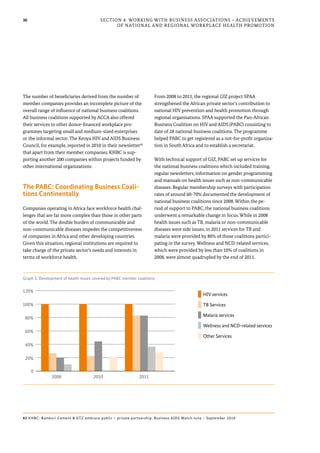
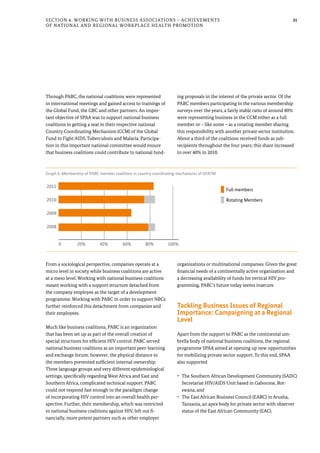
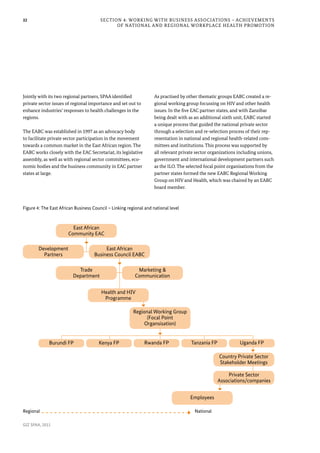
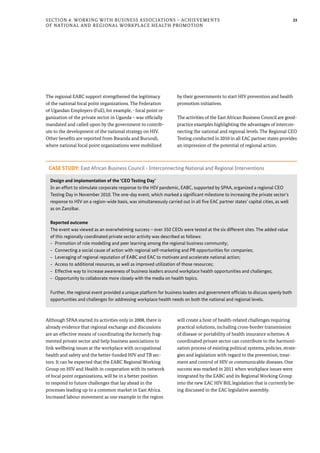
for Workplace Health
Concepts – Results – Lessons Learned
Unter
Published by:
2 table of contents
List of Abbreviations and Acronyms	 3
Executive Summary	 4
SECTION 1:
Introduction	6
The Private Sector as a Development Partner	 6
German Support of Business Health Engagement	 9
SECTION 2:
A HealthyWorkforce as a Development Objective	 10
Understanding, Learning - and Adapting the Approach	 10
The Basics of HIV Workplace Programmes	 11
Targeting Small and Medium-Sized Enterprises: AWiSA	 12
From HIV to Comprehensive Employee Wellbeing	 13
Using Established Structures - Integrated Health Management	 14
SECTION 3:
Working with Companies - Results of a Decade of HIVWorkplace Programmes	 16
Measuring Progress and Impact	 16
Portfolio of Workplace Programmes Supported by GDC	 17
Key Indicators of HIV Workplace Programmes	 20
Impact of GDC HIV Workplace Programmes	 22
Achievements and Challenges of HIV-Centered PPPs	 27
SECTION 4:
Working with Business Associations –Achievements of National and Regional Workplace
Health Promotion	 28
Business Coalitions: Advocates and Service Providers	 28
The PABC: Coordinating Business Coalitions Continentally	 30
Tackling Business Issues of Regional Importance: Campaigning at a Regional Level	 31
Supporting Employee Health in Industries	 34
Lessons Learned from Working with Business Associations	 35
SECTION 5:
Conclusion and Outlook – Private Sector as a Future Partner in Workplace Health Development	 42
ANNEX 1: Bibliography	 38
ANNEX 2: List of Reviewed Projects	 39
Table of Contents
3List of Abbreviations and Acronyms
List of Abbreviations and Acronyms
ACCA	AIDS Control in Companies in Africa
AIDS	Acquired Immunodeficiency Syndrome
AMICAALL	Alliance of Mayors and Municipal Leaders 	
	 on HIV/AIDS in Africa
ART	Antiretroviral Therapy
ARV 	Antiretroviral Drugs
AWiSA	AIDS Prevention & Health Promotion 		
	 Workplace Programmes in Southern Africa
BOHS	Basic Occupational Health Service
BMZ	Bundesministerium für wirtschaftliche 		
	 Zusammenarbeit und Entwicklung
	 (German Federal Ministry for Economic
	Cooperation and Development)
CCM	Country Coordinating Mechanism of the 		
	 Global Fund
CEO	Chief Executive Officer
CSR	Corporate Social Responsibility
DED	Deutscher Entwicklungsdienst (German 		
	Development Service, now GIZ)
DEG	Deutsche Investitions- und Entwicklungs-
	 gesellschaft mbH
EABC	East African Business Council
EAC	East African Community
EWP	Employee Wellbeing Programme
FP	Focal Point
GBC	 Global Business Coalition on Health
GDC	 German Development Cooperation
GDP	 Gross Domestic Product
GFTAM	 Global Fund to Fight AIDS, Tuberculosis
	 and Malaria
GHI	 Global Health Initiative
GIZ	 Gesellschaft für Internationale
	 Zusammenarbeit GmbH
GTZ	 Gesellschaft für Technische Zusammen-
	 arbeit GmbH, now GIZ
HCT	 HIV counselling and testing
HIV	 Human Immunodeficiency Virus
IAS	International AIDS Society
ILO	International Labour Organisation
InWEnt	Internationale Weiterbildung und
	Entwicklung GmbH (Capacity Building
	International), now GIZ
KAPB	 Knowledge, Attitude, Practice and
	Behaviour survey
M&E	Monitoring and Evaluation
NCD	Non-communicable diseases
OSH	Occupational Safety and Health
PABC	 Pan-African Business Coalition on HIV and 	
	AIDS
PMTCT	 Preventing Mother-to-Child Transmission 	
	 [of HIV]
PPP	 Public Private Partnership
REC	Regional Economic Community
SADC	Southern African Development
	Community
SME	Small and medium-sized company
SPAA	Support of the Private Sector in Africa to 		
	 fight AIDS
STD or STI	Sexually Transmitted Disease or Infection
TB	Tuberculosis
UNAIDS	 Joint United Nations Programme on HIV 		
	 and AIDS
UNGASS		United Nations General Assembly Special 		
	Session
WHO	 World Health Organisation
WPP	 Workplace Programme
4
Since the end of the 1990s, German Development Coop-
eration (GDC), with funding from the German Federal
Ministry of Economic Cooperation and Development
(BMZ), has been contributing both considerable resources
and technical know-how to programme development and
implementation around workplace health improvement.
Starting out with company collaborations in the frame-
work of public private partnerships (PPP), GDC developed
an approach for workplace HIV management that was
exemplary to many other initiatives to come. In the last
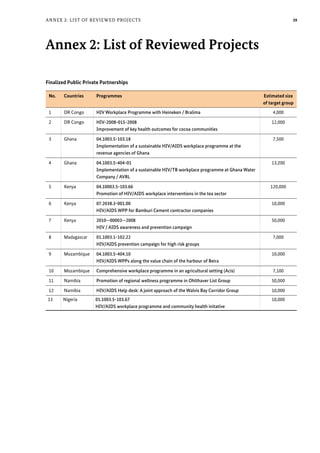
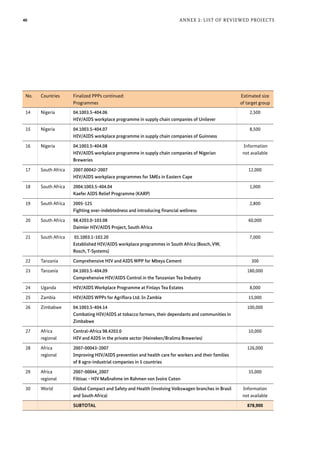
decade, 49 projects and programmes with a workplace
focus were conducted, 46 of them direct partnership
contracts with companies reaching more than 1.9 mil-
lion employees of both large and small enterprises. These
projects proved very cost-effective, costing about 5.5 Eu-
ros of German public funding per capita on prevention,
treatment and care. There was an almost fifty-fifty divi-
sion of support between large enterprises and small and
medium-sized companies combined. The 30 completed
projects included in this evaluation reported considerable
improvement around the following core indicators:
•	 Company HIV management: 95% of the programmes
measuring this management indicator reported that
their partner companies introduced an HIV workplace
policy as a basic precondition of HIV management.
•	 Risk management: Of those programmes measuring
HIV counselling and testing (HCT) as an instrument to
manage personal risk, 79% reported an increased uptake
of HCT among employees.
•	 Stigma and discrimination management: 77% of those
programmes following up on knowledge level and mis-
beliefs reported decreases in misbeliefs and increases in
knowledge.
Most PPPs went beyond the companies’ own workforces
to benefit communities and supply chain companies. And
equally important – they served as learning incubators
for generating new ideas and approaches, which could
then be adapted to other company and country contexts.
Due to the short duration of PPPs, long-term impact
monitoring remains under the auspices of the partnering
companies. A kind of “Alumni” PPP network and a harmo-
nized indicator framework could contribute to improved,
long-term follow-up of achievements, successes and chal-
lenges. The AWiSA Network, which functions as an online
interactive information exchange platform1
on workplace
interventions , could serve this purpose.
GDC continued to re-design its approach to fit companies’
needs. The earlier HIV-only programmes were extended,
first, to malaria and TB, and later, to other diseases and
mentally distressing factors, such as over-indebtedness
of employees. These further efforts eventually lead to
the promotion of comprehensive Employee Wellbeing
Programmes (EWP). In order to respond to the important
factor of sustainability, first steps were made towards inte-
grating health into traditional structures of occupational
safety and health (OSH). Guidelines on integrated health
management were developed jointly with the transport
industry in Southern Africa and the hotel industry in the
region of the East African Community (EAC).
In addition to working with companies directly, GDC
also supported national and regional support structures
of the private sector. The regional programme ACCA
(AIDS Control in Companies in Africa) partnered with
national business coalitions in six countries. Its successor
programme SPAA (Support of the Private Sector in Africa
to Fight AIDS) worked with a continental umbrella body
of national business coalitions called Pan-African Busi-
ness Coalition on HIV and AIDS (PABC) as well as the East
African Business Council (EABC) and the AIDS Unit of
the Southern African Development Community (SADC)
Secretariat.
This more system-related approach operated at a meso
level of society and used business associations to multiply
investments in capacity development. Advocacy, training
and information thus reached a greater number of com-
panies and access of business to funding sources for HIV
programmes was improved; however, calculating the im-
pact of these meso-level efforts on employees and workers
remains challenging, due to the indirect contact of busi-
ness coalitions and associations with the intended target
group, namely a company’s workforce. Regional-level
experiences revealed that the best results are achieved if
dynamic and mutually beneficial partnerships between
Executive Summary
Executive Summary
1 http://www.awisa-network.net/
5
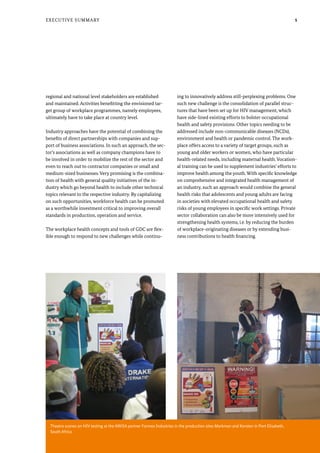
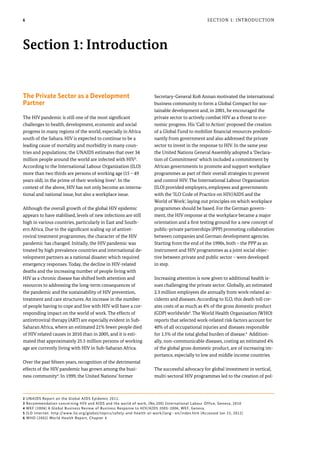
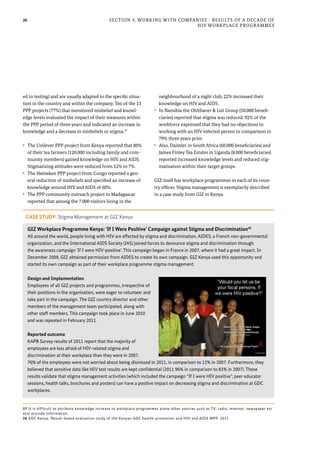
Theatre scenes on HIV testing at the AWiSA partner Formex Industries in the production sites Markman and Korsten in Port Elisabeth,
South Africa
Executive Summary
regional and national level stakeholders are established
and maintained. Activities benefitting the envisioned tar-
get group of workplace programmes, namely employees,
ultimately have to take place at country level.
Industry approaches have the potential of combining the
benefits of direct partnerships with companies and sup-
port of business associations. In such an approach, the sec-
tor’s associations as well as company champions have to
be involved in order to mobilize the rest of the sector and
even to reach out to contractor companies or small and
medium-sized businesses. Very promising is the combina-
tion of health with general quality initiatives of the in-
dustry which go beyond health to include other technical
topics relevant to the respective industry. By capitalizing
on such opportunities, workforce health can be promoted
as a worthwhile investment critical to improving overall
standards in production, operation and service.
The workplace health concepts and tools of GDC are flex-
ible enough to respond to new challenges while continu-
ing to innovatively address still-perplexing problems. One
such new challenge is the consolidation of parallel struc-
tures that have been set up for HIV management, which
have side-lined existing efforts to bolster occupational
health and safety provisions. Other topics needing to be
addressed include non-communicable diseases (NCDs),
environment and health or pandemic control. The work-
place offers access to a variety of target groups, such as
young and older workers or women, who have particular
health-related needs, including maternal health. Vocation-
al training can be used to supplement industries’ efforts to
improve health among the youth. With specific knowledge
on comprehensive and integrated health management of
an industry, such an approach would combine the general
health risks that adolescents and young adults are facing
in societies with elevated occupational health and safety
risks of young employees in specific work settings. Private
sector collaboration can also be more intensively used for
strengthening health systems, i.e. by reducing the burden
of workplace-originating diseases or by extending busi-
ness contributions to health financing.
6
The Private Sector as a Development
Partner
The HIV pandemic is still one of the most significant
challenges to health, development, economic and social
progress in many regions of the world, especially in Africa
south of the Sahara. HIV is expected to continue to be a
leading cause of mortality and morbidity in many coun-
tries and populations; the UNAIDS estimates that over 34
million people around the world are infected with HIV2
.
According to the International Labour Organization (ILO)
more than two thirds are persons of working age (15 – 49
years old), in the prime of their working lives3
. In the
context of the above, HIV has not only become an interna-
tional and national issue, but also a workplace issue.
Although the overall growth of the global HIV epidemic
appears to have stabilised, levels of new infections are still
high in various countries, particularly in East and South-
ern Africa. Due to the significant scaling up of antiret-
roviral treatment programmes, the character of the HIV
pandemic has changed. Initially, the HIV pandemic was
treated by high prevalence countries and international de-
velopment partners as a national disaster which required
emergency responses. Today, the decline in HIV-related
deaths and the increasing number of people living with
HIV as a chronic disease has shifted both attention and
resources to addressing the long-term consequences of
the pandemic and the sustainability of HIV prevention,
treatment and care structures. An increase in the number
of people having to cope and live with HIV will have a cor-
responding impact on the world of work. The effects of
antiretroviral therapy (ART) are especially evident in Sub-
Saharan Africa, where an estimated 21% fewer people died
of HIV related causes in 2010 than in 2005, and it is esti-
mated that approximately 25.5 million persons of working
age are currently living with HIV in Sub-Saharan Africa.
Over the past fifteen years, recognition of the detrimental
effects of the HIV pandemic has grown among the busi-
ness community4
. In 1999, the United Nations’ former
Secretary-General Kofi Annan motivated the international
business community to form a Global Compact for sus-
tainable development and, in 2001, he encouraged the
private sector to actively combat HIV as a threat to eco-
nomic progress. His ‘Call to Action’ proposed the creation
of a Global Fund to mobilize financial resources predomi-
nantly from government and also addressed the private
sector to invest in the response to HIV. In the same year
the United Nations General Assembly adopted a ‘Declara-
tion of Commitment’ which included a commitment by
African governments to promote and support workplace
programmes as part of their overall strategies to prevent
and control HIV. The International Labour Organisation
(ILO) provided employers, employees and governments
with the ‘ILO Code of Practice on HIV/AIDS and the
World of Work’, laying out principles on which workplace
programmes should be based. For the German govern-
ment, the HIV response at the workplace became a major
orientation and a first testing ground for a new concept of
public-private partnerships (PPP) promoting collaboration
between companies and German development agencies.
Starting from the end of the 1990s, both – the PPP as an
instrument and HIV programmes as a joint social objec-
tive between private and public sector – were developed
in step.
Increasing attention is now given to additional health is-
sues challenging the private sector. Globally, an estimated
2.3 million employees die annually from work-related ac-
cidents and diseases. According to ILO, this death toll cre-
ates costs of as much as 4% of the gross domestic product
(GDP) worldwide5
. The World Health Organisation (WHO)
reports that selected work-related risk factors account for
40% of all occupational injuries and diseases responsible
for 1.5% of the total global burden of disease.6
Addition-
ally, non-communicable diseases, costing an estimated 4%
of the global gross domestic product, are of increasing im-
portance, especially to low and middle income countries.
The successful advocacy for global investment in vertical,
multi-sectoral HIV programmes led to the creation of pol-
Section 1: Introduction
2 UNAIDS Report on the Global AIDS Epidemic 2011.
3 Recommendation concerning HIV and AIDS and the world of work, (No.200) International Labour Office, Geneva, 2010
4 WEF (2006) A Global Business Review of Business Response to HIV/AIDS 2005-2006, WEF, Geneva.
5 ILO internet: http://www.ilo.org/global/topics/safety-and-health-at-work/lang--en/index.htm (Accessed Jan 23, 2012)
6 WHO (2002) World Health Report, Chapter 4
7Section 1: Introduction
icy, logistics and service structures which often by-passed
existing health management provisions of a country. This
was also the case at the workplace. Traditional institutions
concerned with promotion and safe-guarding of occupa-
tional safety and health (OSH) were side-lined in the at-
tempt to motivate companies around HIV-centred action.
Companies’ contributions ranged from HIV workplace
programmes as part of their social responsibility activities
to business-oriented systemic interventions that make use
of companies’ core competences and leadership influence.
The public sector, which is the biggest employer in coun-
tries with high HIV prevalence rates, responded as well. As
a consequence of the AMICAALL Declaration on HIV and
AIDS (1997)7
and the World Bank Local Government and
HIV/AIDS Initiative (2003),8
the public sector intensified
its efforts to implement HIV workplace programmes in
governmental institutions at all levels. Since 2003, it is also
a policy of the German Federal Ministry for Economic
Cooperation and Development (BMZ) that all German
Development Cooperation (GDC) programmes and
projects mainstream HIV9
in countries with generalized
epidemics 10
.
The workplace has enormous potential as a setting for
improving the health of the adult and, to a lesser extent,
adolescent populations. Health promotion at the work-
place is a public health approach that was developed
about 25 years ago and announced by the WHO11
in their
Ottawa Charter. In such a setting, health promotion is un-
derstood as a positive interaction of physical, mental and
social wellbeing at the workplace. Occupational health is
an integrated part of this approach, where the workplace
is seen as highly relevant for people’s health and safety. In
workplace settings, where people spend a large propor-
tion of their lives, a variety of interventions can be imple-
mented to prevent illnesses and occupational injuries. It
is also a place where employees can acquire knowledge
to adopt healthy behaviours even outside the working
environment. Health promotion at the workplace includes
strategies and measures focussing on HIV- related initia-
tives, responses to other infectious diseases as well as the
assessment of individual risk factors for chronic non-
communicable diseases such as smoking, unhealthy diet,
physical inactivity, alcohol abuse or stress. Furthermore,
it includes strategies and measures influencing the work
environment, mental health, social protection, financial
wellness, and corporate culture. By promoting health at
work, it is expected that the health potential and wellbeing
of employees, their families and their home communities
can be improved. Health as a holistic concept is also sup-
ported by the WHO.
Additionally, the WHO has long-promoted the well-estab-
lished fact that a healthy workforce in a healthy workplace
also means a healthy business12
. Accordingly, business ef-
forts towards comprehensive health promotion and safety
at work are directly relevant to competitive factors, such
as the management of direct costs and the pursuit of new
business opportunities. Contributing to the wellbeing of
employees is more than corporate social responsibility in
action; it is a strategy for risk management, value creation,
and generating competitive advantage.
A decade of involvement in the implementation of HIV
workplace programmes (WPPs) in development coopera-
tion has provided ample time and opportunities to test
new ideas, to understand HIV in the context of workplace
health more generally and to assess the capacities and ca-
pabilities of companies to manage workplace health. It has
been a dynamic decade which has necessitated periodical
adjustments in approaches, concepts and even objectives,
including the broadening of our scope from managing
HIV in the workplace to a more comprehensive manage-
ment of workforce health. In section one, an overview is
given of German support in the form of public private
7 Alliance of Mayors and Municipal Leaders on HIV/AIDS in Africa (AMICAALL): Abidjan Declaration on HIV/AIDS, 1997
8 World Bank Local Government and HIV/AIDS initiative: Local Government Responses to HIV/AIDS. A Handbook to support Local
Government Authorities at the Municipal Level, 2003
9 Mainstreaming HIV/AIDS is “a process that enables organisations to address the causes and effects of AIDS in an effective and sustai-
ned manner, both through their usual work and within their workplace” (Definition provided by UNAIDS 2005).
10 In a generalized epidemic, HIV is firmly established in the general population e.g. in Kenya with an HIV prevalence rate of 7,4% (2008:
Kenya AIDS Indicator Survey)
11 WHO 1086: Ottawa Charter for Health Promotion (21 November 1986
12 WHO 2010: Healthy workplaces: A model for action. 2010: www.who.int/occupational_health/healthy_workplaces/en/
8
partnerships and programmes for workplace interven-
tions. In section two, the text takes a deeper look into
the concept of workplace programmes, summarizing the
experiences acquired and the conceptual adaptations
that were derived from the lessons learned. Section three
analyses the results that were reported from the various
public private partnerships and programmes conducted
at company level. Section five draws attention to the work
conducted jointly with business associations, looking
at achievements of partnerships with national business
coalitions, regional private sector bodies and industry as-
sociations. Based on the findings of the preceding sections,
section five highlights the major milestones and provides
an initial picture of the potential for expanding interven-
tions to promote health at the workplace.
German Support of Business Health
Engagement
The involvement of the formal economy in combatting
HIV, especially in sub-Saharan African countries facing
major epidemic challenges, is seen as a key strategy in the
fight against the epidemic13
. The German Federal Govern-
ment initially supported WPPs on HIV initiated by inter-
national companies in South Africa in the late nineties of
the last century. German Development Cooperation, in
general, and GTZ14
, DED15
and InWEnt16
(now all merged
into GIZ17
) and DEG,18
in particular, got involved in these
efforts early on through development partnerships, such
as the Public Private Partnership (PPP) initiative of the
BMZ.19
The GDC supported selected companies in most
of the Sub-Saharan countries but also in Brazil, China and
Ukraine within the PPP framework. A total of 46 PPPs
focusing on workplace programmes were established
between 1999 and 2011. Forty of those partnerships were
funded out of the PPP funds established by the German
government; the remaining six PPPs were conducted with
funds from programmes such as AWiSA and ACCA. The
overall German contribution for these PPPs sums up to
about 10.5 million Euros (36%); the private sector contrib-
uted a corresponding sum of 18.7 million Euros (64%). A
number of smaller PPPs were integrated in health pro-
grammes of GDC in various countries, especially in Africa.
These PPPs were not included in this analysis.
In 2002, the BMZ commissioned GTZ to set up the re-
gional project “AIDS Control in Companies in Africa
(ACCA)” (2002 – 2007) with the purpose of further promot-
ing the private sector response to HIV on the continent.
The workplace experiences gained with multinational
companies in South Africa were used as a blueprint for the
roll-out of HIV WPPs, especially among smaller national
enterprises in other African countries. Besides advising
individual companies on the design and implementation
of HIV WPPs, ACCA soon expanded its support to national
business coalitions against HIV, which first emerged in
2002 as service providers and advocates for companies
willing to address the challenges of HIV. This process was
supported by the World Bank and other national and in-
ternational organizations such as UNAIDS, and the World
Economic Forum. The BMZ invested 5.2 million Euros in
the two phases of the ACCA project lasting from early 2002
to end of 2008.
A second GDC programme called “AIDS Prevention and
Health Promotion Workplace Programmes in South-
ern Africa (AWiSA)”20
started around the same time as
ACCA and is still on-going. The former DED and InWEnt
jointly developed trainings and an advisory concept to
Section 1: Introduction
13 The private sector response as described in this document focus on initiatives of the formal sector that have the economic potential to
tackle HIV and AIDS at the workplace. The informal economy, with approximately 70% of the potential working population in developing
countries (World Bank 2010: Shadow economies all over the world), needs to be addressed through other approaches.
14 Deutsche Gesellschaft für Technische Zusammenarbeit (GTZ)
15 Deutscher Entwicklungsdienst (DED)
16 Internationale Weiterbildung und Entwicklung (InWEnt)
17 On 01.01.2011, Deutsche Gesellschaft für Internationale Zusammenarbeit GmbH (GIZ) was established through a merger of
Deutscher Entwicklungsdienst (DED), Deutsche Gesellschaft für Technische Zusammenarbeit (GTZ) and Internationale Weiterbildung und
Entwicklung (InWEnt).
18 Deutsche Entwicklungsgesellschaft (DEG); http://www.deginvest.de/
19 More information on the PPP initiative and its guidelines can be found under www.giz.de or www.developpp.de
20 AWiSA started in 2003 as a strategic partnership project of the DED and InWEnt and is now part of GIZ supporting projects in South
Africa, Malawi, Mozambique, Namibia, Zambia and Tanzania.
9
assist small companies as well as non-governmental and
governmental organisations in implementing workplace
interventions and activities to mitigate the impact of
HIV. AWiSA’s current project phase will end in 2012. The
various phases of AWiSA between 2003 and 2012 were fi-
nanced with 4.3 million Euros.
Starting in 2008, the regional programme “Support of the
Private Sector in Africa to fight AIDS (SPAA)” followed
the ACCA project. It aimed at strengthening the regional
support of private sector responses to HIV by engaging
regional economic communities (RECs), business associa-
tions, industries and business coalitions as advocates and
service providers. Specifically, the programme worked
with industries to develop standards and guidelines on
employee health management that integrated HIV and TB
measures. The programme collaborated with the East Afri-
can Business Council (EABC), the Southern African Devel-
opment Community (SADC) and the Pan-African Business
Coalition on HIV/AIDS (PABC). It was funded with 3.0
million Euros over a time period beginning in 2008 to the
end of 2011.
Section 1: Introduction
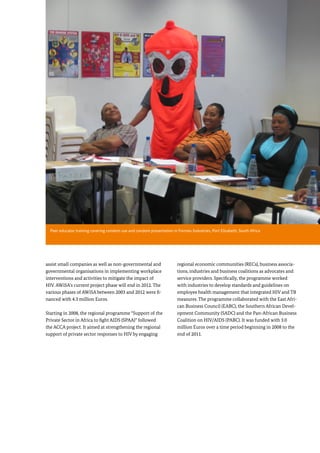
Peer educator training covering condom use and condom presentation in Formex Industries, Port Elizabeth, South Africa
10
Understanding, Learning - and Adapting
the Approach
Since more than a decade, GDC has continually adapted its
comprehensive WPP approaches with the aim of optimiz-
ing and tailoring their design for the private and public
sectors.
Initially, it was GDC’s main objective to support private
sector organizations, raise awareness, mitigate the impact
of HIV and, thereby, create an economic and social cli-
mate more conducive to business and industry. Over the
course of the decade, the WPP approach was broadened
from HIV-only workplace initiatives to employee wellbe-
ing and an integration of HIV and TB management into
the framework of traditional OSH. A wealth of data from
private sector organizations demonstrates that, in the long
term, companies that promote and protect workers’ health
are among the most successful and competitive, and also
enjoy better retention rates for their employees.
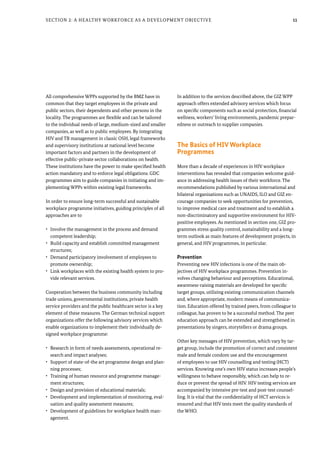
The results of the continuing development process of
the GIZ workplace programme approach is captured in
Figure 1.
Section 2: A Healthy Workforce as a Development Objective
Section 2: A Healthy Workforce as a
Development Objective
Figure 1: Continuing development of the workplace programme approach
21 Goetzel et al, 2008, Workplace Health Promotion. Policy Recommendations that Encourage Employers to Support Health Improvement
Programs for their Workers. Washington, Partnership for Prevention
GIZ SPAA, 2011
Company engagement for a healthy workforce
INTEGRATIONOutreach
Financial wellness
Mental and social wellbeing
Promotion of general health
Prevention, care and treatment in general
Social security
HIV and AIDS
workplace
programmes
Malaria and TB
prevention and
management
Expansion
Occupationalsafetyandhealth
Contractor companies
(supply chain) and
communities
11
All comprehensive WPPs supported by the BMZ have in
common that they target employees in the private and
public sectors, their dependents and other persons in the
locality. The programmes are flexible and can be tailored
to the individual needs of large, medium-sized and smaller
companies, as well as to public employees. By integrating
HIV and TB management in classic OSH, legal frameworks
and supervisory institutions at national level become
important factors and partners in the development of
effective public-private sector collaborations on health.
These institutions have the power to make specified health
action mandatory and to enforce legal obligations. GDC
programmes aim to guide companies in initiating and im-
plementing WPPs within existing legal frameworks.
In order to ensure long-term successful and sustainable
workplace programme initiatives, guiding principles of all
approaches are to
•	 Involve the management in the process and demand
competent leadership;
•	 Build capacity and establish committed management
structures;
•	 Demand participatory involvement of employees to
promote ownership;
•	 Link workplaces with the existing health system to pro-
vide relevant services.
Cooperation between the business community including
trade unions, governmental institutions, private health
service providers and the public healthcare sector is a key
element of these measures. The German technical support
organizations offer the following advisory services which
enable organizations to implement their individually de-
signed workplace programme:
•	 Research in form of needs assessments, operational re-
search and impact analyses;
•	 Support of state-of-the art programme design and plan-
ning processes;
•	 Training of human resource and programme manage-
ment structures;
•	 Design and provision of educational materials;
•	 Development and implementation of monitoring, eval-
uation and quality assessment measures;
•	 Development of guidelines for workplace health man-
agement.
In addition to the services described above, the GIZ WPP
approach offers extended advisory services which focus
on specific components such as social protection, financial
wellness, workers’ living environments, pandemic prepar-
edness or outreach to supplier companies.
The Basics of HIV Workplace
Programmes
More than a decade of experiences in HIV workplace
interventions has revealed that companies welcome guid-
ance in addressing health issues of their workforce. The
recommendations published by various international and
bilateral organisations such as UNAIDS, ILO and GIZ en-
courage companies to seek opportunities for prevention,
to improve medical care and treatment and to establish a
non-discriminatory and supportive environment for HIV-
positive employees. As mentioned in section one, GIZ pro-
grammes stress quality control, sustainability and a long-
term outlook as main features of development projects, in
general, and HIV programmes, in particular.
Prevention
Preventing new HIV infections is one of the main ob-
jectives of HIV workplace programmes. Prevention in-
volves changing behaviour and perceptions. Educational,
awareness-raising materials are developed for specific
target groups, utilizing existing communication channels
and, where appropriate, modern means of communica-
tion. Education offered by trained peers, from colleague to
colleague, has proven to be a successful method. The peer
education approach can be extended and strengthened in
presentations by singers, storytellers or drama groups.
Other key messages of HIV prevention, which vary by tar-
get group, include the promotion of correct and consistent
male and female condom use and the encouragement
of employees to use HIV counselling and testing (HCT)
services. Knowing one’s own HIV status increases people’s
willingness to behave responsibly, which can help to re-
duce or prevent the spread of HIV. HIV testing services are
accompanied by intensive pre-test and post-test counsel-
ling. It is vital that the confidentiality of HCT services is
ensured and that HIV tests meet the quality standards of
the WHO.
Section 2: A Healthy Workforce as a Development Objective
12 Section 2: A Healthy Workforce as a Development Objective
Medical care and treatment
Combating HIV starts with supplying medical services at
an early stage. There is a wide variety of corporate medical
services. Some workplaces have set up in-house treatment
services with a doctor, while others offer only first aid
in their health facility. Some enterprises cooperate with
nearby private or public health facilities.
The focal area of effective HIV care is the provision of
anti-retroviral therapy (ART) as a treatment option to
restore the health of HIV infected people. ART can also
reduce stigma around HIV. HIV-positive pregnant women
and their babies receive special ARV treatment to inhibit
the transmission of the virus during labour, delivery and
breastfeeding (PMTCT – Preventing Mother to Child
Transmission). Other focal areas in health care are risk
reduction through treatment of sexually transmitted dis-
eases (STDs), as there is a strong link between STDs and
HIV, and treatment of opportunistic infections and dis-
eases such as TB.
Human resource management
In most cases, a company’s or public institution’s hu-
man resources department is closely involved in plan-
ning, implementing and monitoring the HIV workplace
programme. It usually hosts the HIV coordinator or focal
person and is the interface between workforce and man-
agement in the form of a multi-sectoral HIV team. The
team drafts an HIV workplace policy that clarifies the
rights and duties of employees and management concern-
ing HIV. In general, the policy affirms non-discrimination
and confidentiality to HIV-positive employees and defines
the components of the workplace programme. To ensure
the successful implementation of the policy it is of utmost
importance that the document is widely communicated
and accepted by all stakeholders including managers, em-
ployees and employee representatives. The policy should
be regularly reviewed and modified to accommodate
changing circumstances.
Outreach to contractor companies and neighbouring
communities
Since companies are involved in the communities where
they operate in a number of ways, activities within the
community and partnerships with other stakeholders
and institutions are a natural option for comprehensive
corporate social responsibility (CSR) strategies. Such in-
volvement can also target HIV prevention or other health
promotion. It contributes to equity in societies where
being formally employed is a privilege and an advantage,
considering the huge size of the informal sector in devel-
oping economies. Various organisations such as the World
Bank, the International Labour Organisation (ILO) and
the Global Fund to Fight AIDS, Tuberculosis and Malaria
(GFTAM) offer funds to support company outreach activi-
ties. Most PPPs supported by GDC also targeted popula-
tion groups beyond the company workforce.
A special form of community outreach is undertaken by
larger and often multinational companies. They support
small and medium sized enterprises (SME) in their sup-
ply chain to tackle HIV. SMEs employ 50 – 70% of Africa’s
formally employed workforce and are the economic back-
bone of Africa. Outreach activities effectively scale up a
company’s response to HIV. Through the “Supply Chain”
approach men and women working in SMEs gain access
to the services they need to protect themselves from HIV.
Small and medium enterprises face the same effects of the
epidemic, but do not have the adequate resources to im-
plement comprehensive WPPs.
Targeting Small and Medium-Sized
Enterprises: AWiSA
Small and medium-sized enterprises play a key role in
reducing poverty and achieving the Millennium Devel-
opment Goals (MDGs) in African countries22
. Most of the
SMEs face several difficulties regarding workplace HIV
management, such as lack of funds and dedicated human
resources. Moreover, the struggle to stay in business affects
SMEs more than their larger counterparts and can make
HIV-related services for employees a low priority23
.
22 African Guarantee Fund for Small and Medium-sized enterprises: www.afdb.org/en/topics-and-sectors/initiatives-partnerships/
23 Rosen, S.M. et..al. 2006: The private sector and HIV/AIDS in Africa. Boston. Center of International Health and Development with the
Kenya Medical Research Center
13Section 2: A Healthy Workforce as a Development Objective
With a focus on small and medium sized businesses,
the AIDS Prevention and Health Promotion Workplace
Programmes in Southern Africa (AWiSA) started out as a
cooperation between the former DED and InWEnt (now
GIZ). The aim of the programme is to reduce the socio-
economic impact of the HIV epidemic in the most affected
areas in the SADC region. AWiSA provides HIV training
in order to mitigate the negative impacts of the epidemic.
Through their activities AWiSA creates awareness for
the problem of HIV in workplaces. Furthermore the pro-
gramme supports the implementation of workplace pro-
grammes and policies in small and medium enterprises.
AWiSA is a regional project with advisors currently work-
ing in Malawi, Mozambique, South Africa and Zambia. To
further promote regional exchange of information and
experience, an internet-based platform functioning as a
Community of Practice in sub-Saharan Africa has been
established called AWiSA-Network24
.
From HIV to Comprehensive Employee
Wellbeing
Experience has shown that a workforce may lose interest
in a programme solely focussing on HIV. The repetition
of messages leads to fatigue, especially given that a vast
majority of formal sector employees are HIV negative. In
order to react to changing workforce trends and also to
tackle other diseases influencing the wellbeing of employ-
ees, partnership companies of GDC such as Ohlthaver &
List in Namibia, or multinationals such as Daimler, VW
and Unilever started to broaden the content of their mes-
sages, moving away from solely addressing HIV, tuberculo-
sis and sexually transmitted diseases. The most advanced
companies now provide information and services on
wellbeing in general, including such elements as nutrition,
alcohol and drug abuse, exercise, financial wellness and
benefit schemes.
Benefit schemes
Low income countries such as most sub-Saharan coun-
tries face an acute shortage of funds to cope with the
multiple burden of HIV, other communicable diseases (e.g.
Malaria), maternal and child health issues, and the rise of
non-communicable diseases (e.g. diabetes and hyperten-
sion). This is combined with heavy reliance on direct, out-
of-pocket payments (e.g. user fees) to raise domestic funds
for health. In many cases, these direct payments prevent
access to treatment services or impose severe financial
stress on households. Out-of-pocket payments lead to
inefficiency and inequity in health care provision - people
who can pay are being served, while people who cannot
pay are being under-served25
. Through PPPs companies
are encouraged to contribute to sustainable health financ-
ing. In some PPP projects (e.g. Kenya, Tanzania and Ghana)
companies enabled the enrolment of HIV infected people
in national care and treatment programmes, or financed
the payment of insurance premiums for employees in na-
tional and private health insurance schemes.
Financial wellness
Fighting excessive indebtedness and introducing com-
prehensive debt counselling are the main focus areas of
financial wellness components of workplace programmes
(e.g. projects in South Africa, Kenya and Ghana). A survey
has shown that excessive indebtedness is a major chal-
lenge for sustained wellbeing of South African families26
.
Families supplement their income by loans to meet the
daily survival needs resulting in a viscous cycle of debt, as
they are not able to repay the loans. Excessive debts have a
detrimental effect on the mental wellbeing of individuals
leading to diseases like depression or substance abuse. The
AIDS Prevention and Health Promotion Workplace
Programmes in Southern Africa (AWiSA)
-- Sensitise managers and stakeholders to the imple-
mentation of HIV workplace programmes and policies
-- Train facilitators to carry out workshops and seminars
-- Train focal persons in carrying out workplace pro-
grammes in their organisations
-- Support the implementation of the initialised work-
place programmes
-- Apply monitoring and evaluation instruments.
24 www.awisa-network.net
25 RWHO 2010: Health Systems Financing. The path to universal coverage; The World Health Report 2010
26 GIZ 2008: Employee financial wellness: A corporate social responsibility.
14
risk of over-indebtedness and inadequate retirement or
pension fund building is higher among employees facing
increasing health expenditures due to HIV.
Employee wellbeing programme (EWP)
Taking into consideration the experiences of recent years,
the employee wellbeing programme (EWP) was devel-
oped to cover all workplace programme components and
features described above. The EWP approach tackles the
employee’s entire wellbeing. It aims at improving health,
social protection and financial wellness of the employees
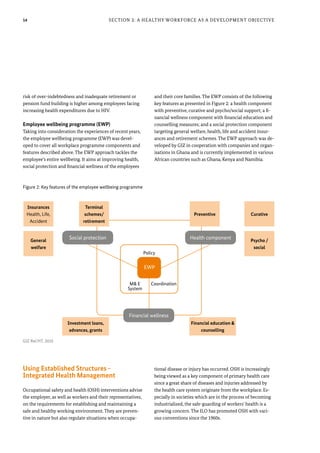
and their core families. The EWP consists of the following
key features as presented in Figure 2: a health component
with preventive, curative and psycho/social support; a fi-
nancial wellness component with financial education and
counselling measures; and a social protection component
targeting general welfare, health, life and accident insur-
ances and retirement schemes. The EWP approach was de-
veloped by GIZ in cooperation with companies and organ-
isations in Ghana and is currently implemented in various
African countries such as Ghana, Kenya and Namibia.
Section 2: A Healthy Workforce as a Development Objective
Figure 2: Key features of the employee wellbeing programme
GIZ ReCHT, 2010
Using Established Structures -
Integrated Health Management
Occupational safety and health (OSH) interventions advise
the employer, as well as workers and their representatives,
on the requirements for establishing and maintaining a
safe and healthy working environment. They are preven-
tive in nature but also regulate situations when occupa-
tional disease or injury has occurred. OSH is increasingly
being viewed as a key component of primary health care
since a great share of diseases and injuries addressed by
the health care system originate from the workplace. Es-
pecially in societies which are in the process of becoming
industrialized, the safe-guarding of workers’ health is a
growing concern. The ILO has promoted OSH with vari-
ous conventions since the 1960s.
Social protection Health component
Financial wellness
EWP
Policy
CoordinationM& E
System
Insurances
Health, Life,
Accident
General
welfare
Terminal
schemes/
retirement
Investment loans,
advances, grants
Financial education &
counselling
Preventive Curative
Psycho /
social
15Section 2: A Healthy Workforce as a Development Objective
Figure 3: Options for integrating HIV and TB management into existing OSH structures
GIZ SPAA, 2011
The parallel funding of HIV prevention and mitigation
has created parallel structures in the workplace. Existing
structures governing OSH were side-lined in the develop-
ment of HIV policies and instruments. Integrated health
management is now correcting this error by linking all
health issues in the workplace and by integrating HIV and
TB management into the wider and already established
context of OSH. This view is shared by various multi-
national companies such as Volkswagen, Unilever and
Daimler.
Classic OSH structures which are mandatory for compa-
nies of a certain size in many countries provide a variety
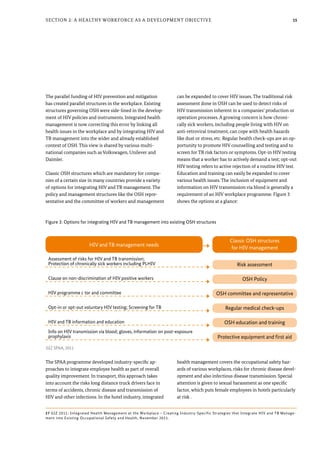
of options for integrating HIV and TB management. The
policy and management structures like the OSH repre-
sentative and the committee of workers and management
The SPAA programme developed industry-specific ap-
proaches to integrate employee health as part of overall
quality improvement. In transport, this approach takes
into account the risks long distance truck drivers face in
terms of accidents, chronic disease and transmission of
HIV and other infections. In the hotel industry, integrated
can be expanded to cover HIV issues. The traditional risk
assessment done in OSH can be used to detect risks of
HIV transmission inherent in a companies’ production or
operation processes. A growing concern is how chroni-
cally sick workers, including people living with HIV on
anti-retroviral treatment, can cope with health hazards
like dust or stress, etc. Regular health check-ups are an op-
portunity to promote HIV counselling and testing and to
screen for TB risk factors or symptoms. Opt-in HIV testing
means that a worker has to actively demand a test; opt-out
HIV testing refers to active rejection of a routine HIV test.
Education and training can easily be expanded to cover
various health issues. The inclusion of equipment and
information on HIV transmission via blood is generally a
requirement of an HIV workplace programme. Figure 3
shows the options at a glance:
health management covers the occupational safety haz-
ards of various workplaces, risks for chronic disease devel-
opment and also infectious disease transmission. Special
attention is given to sexual harassment as one specific
factor, which puts female employees in hotels particularly
at risk .
27 GIZ 2011: Integrated Health Management at the Workplace – Creating Industry-Specific Strategies that Integrate HIV and TB Manage-
ment into Existing Occupational Safety and Health, November 2011.
Risk assessment
OSH Policy
OSH committee and representative
Regular medical check-­ups
OSH education and training
Protective equipment and first aid
Classic OSH structures
for HIV management
HIV and TB management needs
Assessment of risks for HIV and TB transmission;
Protection of chronically sick workers including PLHIV
Clause on non-­discrimination of HIV positive workers
HIV programme c tor and committee
Opt-­in or opt-­out voluntary HIV testing; Screening for TB
HIV and TB information and education
Info on HIV transmission via blood; gloves, information on post-­exposure
prophylaxis
16 Section 3: Working with Companies - Results of a Decade of
HIV Workplace Programmes
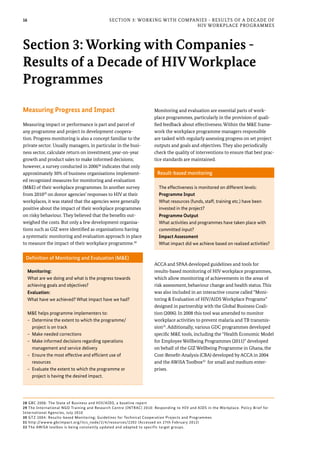
Measuring Progress and Impact
Measuring impact or performance is part and parcel of
any programme and project in development coopera-
tion. Progress monitoring is also a concept familiar to the
private sector. Usually managers, in particular in the busi-
ness sector, calculate return on investment, year-on-year
growth and product sales to make informed decisions;
however, a survey conducted in 200628
indicates that only
approximately 30% of business organisations implement-
ed recognized measures for monitoring and evaluation
(M&E) of their workplace programmes. In another survey
from 201029
on donor agencies’ responses to HIV at their
workplaces, it was stated that the agencies were generally
positive about the impact of their workplace programmes
on risky behaviour. They believed that the benefits out-
weighed the costs. But only a few development organisa-
tions such as GIZ were identified as organisations having
a systematic monitoring and evaluation approach in place
to measure the impact of their workplace programme.30
Monitoring and evaluation are essential parts of work-
place programmes, particularly in the provision of quali-
fied feedback about effectiveness. Within the M&E frame-
work the workplace programme managers responsible
are tasked with regularly assessing progress on set project
outputs and goals and objectives. They also periodically
check the quality of interventions to ensure that best prac-
tice standards are maintained.
ACCA and SPAA developed guidelines and tools for
results-based monitoring of HIV workplace programmes,
which allow monitoring of achievements in the areas of
risk assessment, behaviour change and health status. This
was also included in an interactive course called “Moni-
toring & Evaluation of HIV/AIDS Workplace Programs”
designed in partnership with the Global Business Coali-
tion (2006). In 2008 this tool was amended to monitor
workplace activities to prevent malaria and TB transmis-
sion31
. Additionally, various GDC programmes developed
specific M&E tools, including the “Health Economic Model
for Employee Wellbeing Programmes (2011)” developed
on behalf of the GIZ Wellbeing Programme in Ghana, the
Cost-Benefit-Analysis (CBA) developed by ACCA in 2004
and the AWiSA Toolbox32
for small and medium enter-
prises.
Section 3: Working with Companies -
Results of a Decade of HIV Workplace
Programmes
Definition of Monitoring and Evaluation (M&E)
Monitoring:
What are we doing and what is the progress towards
achieving goals and objectives?
Evaluation:
What have we achieved? What impact have we had?
M&E helps programme implementers to:
-- Determine the extent to which the programme/
project is on track
-- Make needed corrections
-- Make informed decisions regarding operations
management and service delivery
-- Ensure the most effective and efficient use of
resources
-- Evaluate the extent to which the programme or
project is having the desired impact.
Result-based monitoring
The effectiveness is monitored on different levels:
Programme Input
What resources (funds, staff, training etc.) have been
invested in the project?
Programme Output
What activities and programmes have taken place with
committed input?
Impact Assessment
What impact did we achieve based on realized activities?
28 GBC 2006: The State of Business and HIV/AIDS, a baseline report
29 The International NGO Training and Research Centre (INTRAC) 2010: Responding to HIV and AIDS in the Workplace. Policy Brief for
International Agencies, July 2010
30 GTZ 2004: Results-based Monitoring; Guidelines for Technical Cooperation Projects and Programmes
31 http://wwww.gbcimpact.org/itcs_node/2/4/resources/2202 (Accessed on 27th February 2012)
32 The AWiSA toolbox is being constantly updated and adapted to specific target groups.
17Section 3: Working with Companies - Results of a Decade of
HIV Workplace Programmes
In an effort to gain a better understanding on the impact
achieved by the various PPPs, the following chapter first
briefly outlines the profile of all PPPs supported by GDC
on health at the workplace. It then looks more closely at
key indicators and results reported by those PPPs that
were finalized until mid-2011.
Portfolio of Workplace Programmes
Supported by GDC
Since 2002, GIZ and DEG have conducted 49 programmes
and projects targeting workplace health on behalf of
the BMZ. Forty-six of those were direct public private
partnerships with companies and three were regional
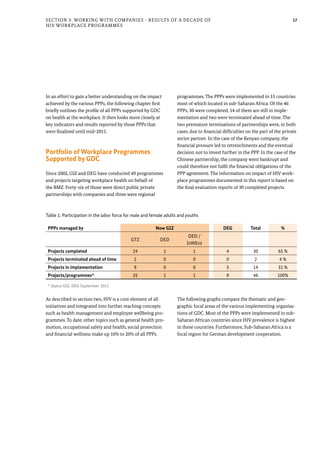
programmes. The PPPs were implemented in 15 countries
most of which located in sub-Saharan Africa. Of the 46
PPPs, 30 were completed, 14 of them are still in imple-
mentation and two were terminated ahead of time. The
two premature terminations of partnerships were, in both
cases, due to financial difficulties on the part of the private
sector partner. In the case of the Kenyan company, the
financial pressure led to retrenchments and the eventual
decision not to invest further in the PPP. In the case of the
Chinese partnership, the company went bankrupt and
could therefore not fulfil the financial obligations of the
PPP agreement. The information on impact of HIV work-
place programmes documented in this report is based on
the final evaluation reports of 30 completed projects.
As described in section two, HIV is a core element of all
initiatives and integrated into further reaching concepts
such as health management and employee wellbeing pro-
grammes. To date, other topics such as general health pro-
motion, occupational safety and health, social protection
and financial wellness make up 10% to 20% of all PPPs.
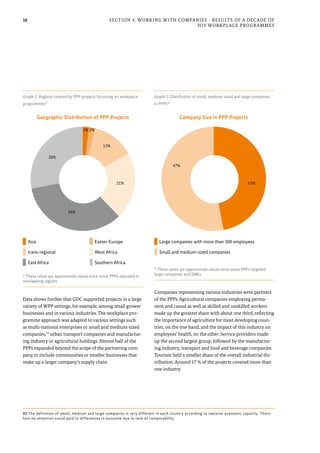
The following graphs compare the thematic and geo-
graphic focal areas of the various implementing organisa-
tions of GDC. Most of the PPPs were implemented in sub-
Saharan African countries since HIV prevalence is highest
in these countries. Furthermore, Sub-Saharan Africa is a
focal region for German development cooperation.
PPPs managed by Now GIZ DEG Total %
GTZ DED
DED /
InWEnt
Projects completed 24 1 1 4 30 65 %
Projects terminated ahead of time 2 0 0 0 2 4 %
Projects in implementation 9 0 0 5 14 31 %
Projects/programmes* 35 1 1 9 46 100%
* Status GIZ, DEG September 2011
Table 1: Participation in the labor force for male and female adults and youths
18 Section 3: Working with Companies - Results of a Decade of
HIV Workplace Programmes
Data shows further that GDC supported projects in a large
variety of WPP settings, for example, among small grower
businesses and in various industries. The workplace pro-
gramme approach was adapted to various settings such
as multi-national enterprises or small and medium-sized
companies,33
urban transport companies and manufactur-
ing industry or agricultural holdings. Almost half of the
PPPs expanded beyond the scope of the partnering com-
pany to include communities or smaller businesses that
make up a larger company’s supply chain.
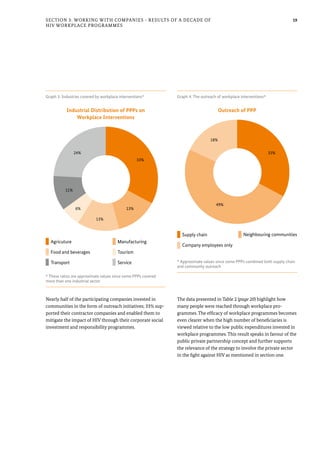
Companies representing various industries were partners
of the PPPs. Agricultural companies employing perma-
nent and casual as well as skilled and unskilled workers
made up the greatest share with about one third, reflecting
the importance of agriculture for most developing coun-
tries, on the one hand, and the impact of this industry on
employees’ health, on the other. Service providers made
up the second largest group, followed by the manufactur-
ing industry, transport and food and beverage companies.
Tourism held a smaller share of the overall industrial dis-
tribution. Around 17 % of the projects covered more than
one industry.
Graph 1: Regions covered by PPP projects focussing on workplace
programmes*
Asia
East Africa
Easter-Europe
trans-regional West Africa
Southern Africa
* These ratios are approximate values since some PPPs operated in
overlapping regions
2% 2%
13%
34%
28%
21%
Graph 2: Distribution of small, medium-sized and large companies
in PPPs*
Large companies with more than 300 employees
Small and medium-sized companies
* These ratios are approximate values since some PPPs targeted
large companies and SMEs
47%
53%
33 The definition of small, medium and large companies is very different in each country according to national economic capacity. There-
fore no attention could paid to differences in outcome due to lack of comparability.
Geographic Distribution of PPP Projects Company Size in PPP Projects
19Section 3: Working with Companies - Results of a Decade of
HIV Workplace Programmes
Nearly half of the participating companies invested in
communities in the form of outreach initiatives; 33% sup-
ported their contractor companies and enabled them to
mitigate the impact of HIV through their corporate social
investment and responsibility programmes.
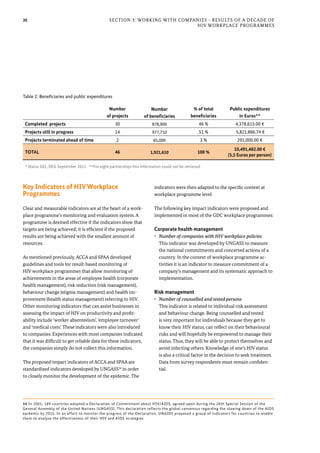
The data presented in Table 2 (page 20) highlight how
many people were reached through workplace pro-
grammes. The efficacy of workplace programmes becomes
even clearer when the high number of beneficiaries is
viewed relative to the low public expenditures invested in
workplace programmes. This result speaks in favour of the
public private partnership concept and further supports
the relevance of the strategy to involve the private sector
in the fight against HIV as mentioned in section one.
Graph 3: Industries covered by workplace interventions* Graph 4: The outreach of workplace interventions*
Agricuture
Transport
Manufacturing
Food and beverages Tourism
Service
Supply chain Neighbouring communities
Company employees only
* These ratios are approximate values since some PPPs covered
more than one industrial sector
* Approximate values since some PPPs combined both supply chain
and community outreach
11%
6%
49%
33%
33%
13%
24%
18%
13%
Industrial Distribution of PPPs on
Workplace Interventions
Outreach of PPP
20 Section 3: Working with Companies - Results of a Decade of
HIV Workplace Programmes
Key Indicators of HIV Workplace
Programmes
Clear and measurable indicators are at the heart of a work-
place programme’s monitoring and evaluation system. A
programme is deemed effective if the indicators show that
targets are being achieved; it is efficient if the proposed
results are being achieved with the smallest amount of
resources.
As mentioned previously, ACCA and SPAA developed
guidelines and tools for result-based monitoring of
HIV workplace programmes that allow monitoring of
achievements in the areas of employee health (corporate
health management), risk reduction (risk management),
behaviour change (stigma management) and health im-
provement (health status management) referring to HIV.
Other monitoring indicators that can assist businesses in
assessing the impact of HIV on productivity and profit-
ability include ‘worker absenteeism’, ‘employee turnover’
and ‘medical costs’. These indicators were also introduced
to companies. Experiences with most companies indicated
that it was difficult to get reliable data for these indicators;
the companies simply do not collect this information.
The proposed impact indicators of ACCA and SPAA are
standardized indicators developed by UNGASS34
in order
to closely monitor the development of the epidemic. The
indicators were then adapted to the specific context at
workplace programme level.
The following key impact indicators were proposed and
implemented in most of the GDC workplace programmes:
Corporate health management
•	 Number of companies with HIV workplace policies
This indicator was developed by UNGASS to measure
the national commitments and concerted actions of a
country. In the context of workplace programme ac-
tivities it is an indicator to measure commitment of a
company’s management and its systematic approach to
implementation.
Risk management
•	 Number of counselled and tested persons
This indicator is related to individual risk assessment
and behaviour change. Being counselled and tested
is very important for individuals because they get to
know their HIV status, can reflect on their behavioural
risks and will hopefully be empowered to manage their
status. Thus, they will be able to protect themselves and
avoid infecting others. Knowledge of one’s HIV status
is also a critical factor in the decision to seek treatment.
Data from survey respondents must remain confiden-
tial.
Number
of projects
Number
of beneficiaries
% of total
beneficiaries
Public expenditures
in Euros**
Completed projects 30 878,900 46 % 4,378,615.00 €
Projects still in progress 14 977,710 51 % 5,821,866.74 €
Projects terminated ahead of time 2 65,000 3 % 291,000.00 €
TOTAL 46 1,921,610 100 %
10,491,482.00 €
(5,5 Euros per person)
* Status GIZ, DEG September 2011 **For eight partnerships this information could not be retrieved
Table 2: Beneficiaries and public expenditures
34 In 2001, 189 countries adopted a Declaration of Commitment about HIV/AIDS, agreed upon during the 26th Special Session of the
General Assembly of the United Nations (UNGASS). This declaration reflects the global consensus regarding the slowing down of the AIDS
epidemic by 2015. In an effort to monitor the progress of the Declaration, UNAIDS proposed a group of indicators for countries to enable
them to analyse the effectiveness of their HIV and AIDS strategies.
21Section 3: Working with Companies - Results of a Decade of
HIV Workplace Programmes
HIV-related knowledge and stigma management
•	 Occurrence of misbeliefs, stigma and level of knowledge
with regard to HIV and AIDS
Dispelling misconceptions around possible modes of
HIV transmission is as important as providing correct
information about actual modes of HIV transmission.
The belief that a healthy-looking person cannot be
infected with HIV is a common misconception that
can result in unprotected sexual intercourse with in-
fected partners. The belief that HIV can be transmitted
through sharing food only reinforces the stigma faced
by people living with HIV. In the context of a workplace
programme, this indicator is particularly useful for
measuring knowledge. Knowledge is seen as one factor
influencing behaviour change. In addition, investigating
knowledge levels helps to define the content of health
education.
Health status management
•	 Incidence of sexually transmitted infections (STI) and/or
tuberculosis infections
This indicator specifies the rate of new infections (in-
cidence) of STIs and/or TB and, therefore, measures
changes in the health status of the target group.
There is a strong link between STIs and HIV. The pres-
ence of an untreated STI – such as herpes or gonorrhoea
– increases the risk of HIV transmission. Unprotected
sexual practices that expose a partner to the risk of STI
transmission also put that partner at risk of contracting
HIV.
Tuberculosis is a leading cause of morbidity and mortal-
ity in people living with HIV, including those on ART.
Intensified TB case-finding and access to quality diagno-
sis and treatment of TB in accordance with internation-
al and national guidelines is essential for improving the
quality and longevity of people living with HIV. Ideally,
the indicator also measures what percentage of HIV-
positive TB cases access appropriate treatment.
•	 Number of employees with medical aid cover
This indicator is useful in assessing the extent of equal
access of employees and their core families to health
services. It is based on the assumption that the necessity
of direct out-of-pocket payment of health system user
fees can constitute a barrier to equal access for poor and
vulnerable groups and can impose severe financial stress
on people seeking treatment. Employees with medical
aid cover generally have better access to health system
support, which, again, is assumed to have a positive im-
pact on health status.
The primary measurement tools and data sources of rec-
ommended impact indicators are described in Table 3.
M & E Tools and Instruments at the Workplace
-- Behavioural surveys on knowledge, attitude, practices
and behaviour (KAPB);
-- Confidential client and patient tracking systems to
obtain information on HCT uptake and numbers of TB
and STD cases;
-- Programme monitoring reports to obtain information on
the policy status;
-- Tailored surveys that identify the medical aid coverage
of employees and their families.
Table 3: Overview of data sources for monitoring and
evaluation of workplace programmes
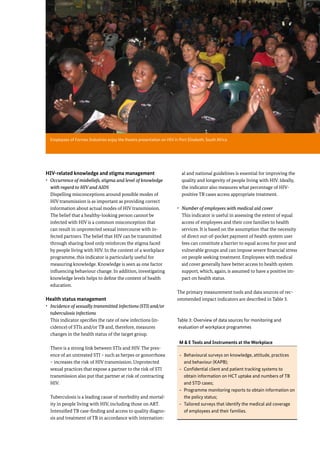
Employees of Formex Industries enjoy the theatre presentation on HIV in Port Elisabeth, South Africa
22 Section 3: Working with Companies - Results of a Decade of
HIV Workplace Programmes
Impact of GDC HIV Workplace
Programmes
In the context of GDC, public private partnerships target
innovative approaches and, therefore, provide seed fund-
ing for testing of concepts and implementation of new
initiatives that go beyond a company’s core business. The
objective of the PPP is to provide initial support for activi-
ties of broader societal value which can then be sustained
by the company alone. To understand the informative val-
ue of the data presented on the following pages and tables,
it is important to remember that companies that collabo-
rate with GDC within the PPP framework benefit from
technical and financial assistance only for a short period
of time, generally lasting between two and three years. On
account of this, the most important impact the PPP con-
cept can have is to establish long-term oriented workplace
programmes with well-adapted and implemented policies
tackling HIV. The short duration of the PPPs does not al-
low for the evaluation of the long-term effectiveness or
efficiency of implemented workplace programme initia-
tives on the part of GDC – the onus lies with the company
to ensure future monitoring and evaluation of WPPs.
Using the key indicators to assess short-term impacts of
the 30 completed and documented projects, interesting
insights and noteworthy developments were revealed.
The general overview on the frequency of use of the key
impact indicators (Table 3) is helpful, as it informs which
activities of the companies concerning HIV were seen
as most productive with regard to leveraging resources
and achieving workplace programme objectives. Most
companies focused on human resource management and
behaviour change initiatives in the form of risk and stigma
management. Monitoring of indicator performance was
focused, accordingly.
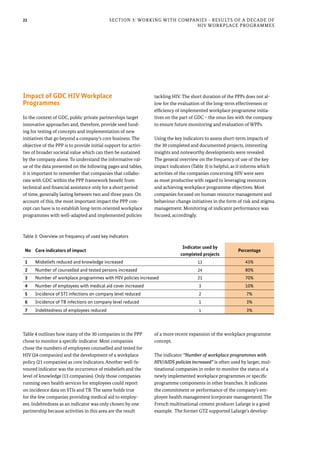
No Core indicators of impact
Indicator used by
completed projects
Percentage
1 Misbeliefs reduced and knowledge increased 13 43%
2 Number of counselled and tested persons increased 24 80%
3 Number of workplace programmes with HIV policies increased 21 70%
4 Number of employees with medical aid cover increased 3 10%
5 Incidence of STI infections on company level reduced 2 7%
6 Incidence of TB infections on company level reduced 1 3%
7 Indebtedness of employees reduced 1 3%
Table 3: Overview on frequency of used key indicators
Table 4 outlines how many of the 30 companies in the PPP
chose to monitor a specific indicator. Most companies
chose the numbers of employees counselled and tested for
HIV (24 companies) and the development of a workplace
policy (21 companies) as core indicators. Another well-fa-
voured indicator was the occurrence of misbeliefs and the
level of knowledge (13 companies). Only those companies
running own health services for employees could report
on incidence data on STIs and TB. The same holds true
for the few companies providing medical aid to employ-
ees. Indebtedness as an indicator was only chosen by one
partnership because activities in this area are the result
of a more recent expansion of the workplace programme
concept.
The indicator “Number of workplace programmes with
HIV/AIDS policies increased” is often used by larger, mul-
tinational companies in order to monitor the status of a
newly implemented workplace programmes or specific
programme components in other branches. It indicates
the commitment or performance of the company’s em-
ployee health management (corporate management). The
French multinational cement producer Lafarge is a good
example. The former GTZ supported Lafarge’s develop-
23Section 3: Working with Companies - Results of a Decade of
HIV Workplace Programmes
ment of a well-monitored workplace programme in vari-
ous African countries. After the initial conceptualization
of workplace activities for employees, the PPPs focused
on community outreach and supply chain involvement.
The Lafarge “road map” monitoring system, as well as the
company’s strict reporting enforcement, can be seen as
exemplary. More information is provided in the case study
below.
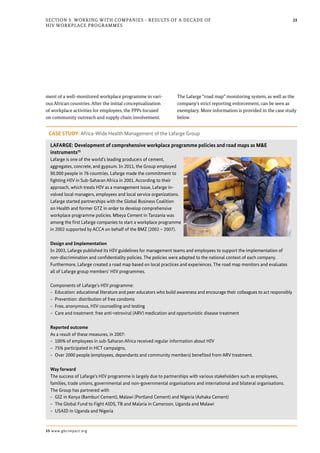
CASE STUDY: Africa-Wide Health Management of the Lafarge Group
LAFARGE: Development of comprehensive workplace programme policies and road maps as M&E
instruments35
Lafarge is one of the world’s leading producers of cement,
aggregates, concrete, and gypsum. In 2011, the Group employed
90.000 people in 76 countries. Lafarge made the commitment to
fighting HIV in Sub-Saharan Africa in 2001. According to their
approach, which treats HIV as a management issue, Lafarge in-
volved local managers, employees and local service organizations.
Lafarge started partnerships with the Global Business Coalition
on Health and former GTZ in order to develop comprehensive
workplace programme policies. Mbeya Cement in Tanzania was
among the first Lafarge companies to start a workplace programme
in 2002 supported by ACCA on behalf of the BMZ (2002 – 2007).
Design and Implementation
In 2003, Lafarge published its HIV guidelines for management teams and employees to support the implementation of
non-discrimination and confidentiality policies. The policies were adapted to the national context of each company.
Furthermore, Lafarge created a road map based on local practices and experiences. The road map monitors and evaluates
all of Lafarge group members’ HIV programmes.
Components of Lafarge’s HIV programme:
-- Education: educational literature and peer educators who build awareness and encourage their colleagues to act responsibly
-- Prevention: distribution of free condoms
-- Free, anonymous, HIV counselling and testing
-- Care and treatment: free anti-retroviral (ARV) medication and opportunistic disease treatment
Reported outcome
As a result of these measures, in 2007:
-- 100% of employees in sub-Saharan Africa received regular information about HIV
-- 75% participated in HCT campaigns,
-- Over 2000 people (employees, dependants and community members) benefited from ARV treatment.
Way forward
The success of Lafarge’s HIV programme is largely due to partnerships with various stakeholders such as employees,
families, trade unions, governmental and non-governmental organisations and international and bilateral organisations.
The Group has partnered with
-- GIZ in Kenya (Bamburi Cement), Malawi (Portland Cement) and Nigeria (Ashaka Cement)
-- The Global Fund to Fight AIDS, TB and Malaria in Cameroon, Uganda and Malawi
-- USAID in Uganda and Nigeria
35 www.gbcimpact.org
24 Section 3: Working with Companies - Results of a Decade of
HIV Workplace Programmes
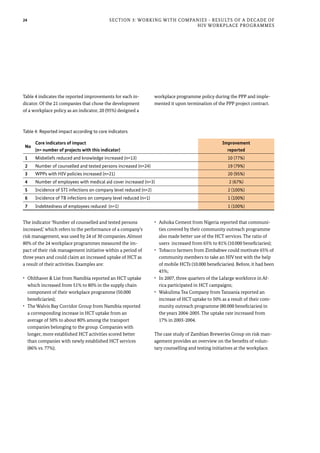
Table 4 indicates the reported improvements for each in-
dicator. Of the 21 companies that chose the development
of a workplace policy as an indicator, 20 (95%) designed a
workplace programme policy during the PPP and imple-
mented it upon termination of the PPP project contract.
No
Core indicators of impact
(n= number of projects with this indicator)
Improvement
reported
1 Misbeliefs reduced and knowledge increased (n=13) 10 (77%)
2 Number of counselled and tested persons increased (n=24) 19 (79%)
3 WPPs with HIV policies increased (n=21) 20 (95%)
4 Number of employees with medical aid cover increased (n=3) 2 (67%)
5 Incidence of STI infections on company level reduced (n=2) 2 (100%)
6 Incidence of TB infections on company level reduced (n=1) 1 (100%)
7 Indebtedness of employees reduced (n=1) 1 (100%)
Table 4: Reported impact according to core indicators
The indicator ‘Number of counselled and tested persons
increased,’ which refers to the performance of a company’s
risk management, was used by 24 of 30 companies. Almost
80% of the 24 workplace programmes measured the im-
pact of their risk management initiative within a period of
three years and could claim an increased uptake of HCT as
a result of their activities. Examples are:
•	 Ohlthaver & List from Namibia reported an HCT uptake
which increased from 51% to 80% in the supply chain
component of their workplace programme (50.000
beneficiaries);
•	 The Walvis Bay Corridor Group from Namibia reported
a corresponding increase in HCT uptake from an
average of 50% to about 80% among the transport
companies belonging to the group. Companies with
longer, more established HCT activities scored better
than companies with newly established HCT services
(86% vs. 77%);
•	 Ashoka Cement from Nigeria reported that communi-
ties covered by their community outreach programme
also made better use of the HCT services. The ratio of
users increased from 65% to 81% (10.000 beneficiaries);
•	 Tobacco farmers from Zimbabwe could motivate 65% of
community members to take an HIV test with the help
of mobile HCTs (10.000 beneficiaries). Before, it had been
45%;
•	 In 2007, three quarters of the Lafarge workforce in Af-
rica participated in HCT campaigns;
•	 Wakulima Tea Company from Tanzania reported an
increase of HCT uptake to 50% as a result of their com-
munity outreach programme (80.000 beneficiaries) in
the years 2004-2005. The uptake rate increased from
17% in 2003-2004.
The case study of Zambian Breweries Group on risk man-
agement provides an overview on the benefits of volun-
tary counselling and testing initiatives at the workplace.
25Section 3: Working with Companies - Results of a Decade of
HIV Workplace Programmes
Thirteen of 30 companies (40%) conducted special surveys
in order to get information on the outcome of their pre-
ventive initiatives. These surveys also serve the purpose
of informing HIV programme managers about education
needs and the remaining level of stigma in the company.
Common KAPB survey questions are related to knowledge
(e.g. transmission of HIV or misconceptions concerning
HIV), attitude (e.g. questions concerning stigma), practice
(e.g. usage of condoms) and behaviour (e.g. questions relat-
CASE STUDY: Risk management at Zambian Breweries Group
Zambian Breweries Group: HCT at the centre of a workplace HIV programme36
The Zambian Breweries Group has three production plants. The core business is the manufacture of beer and carbonated
soft drinks. In 2006, the company had a workforce of 790 permanent and seasonal employees. The majority of the work-
ers are male. The Zambian Breweries Group started its first HIV workplace programme at the beginning of 2000, when
the company recognized that certain factors inherent in the operations made the company vulnerable to the impact of the
epidemic.
Design and Implementation
Zambian Breweries commissioned a needs assessment which resulted in the formulation of a HIV workplace policy and
programme with the following components
-- HIV prevention with peer education, sensitization sessions and condom distribution
-- Risk management with HCT promotion and the setup of an HCT centre
-- Health management with provision of curative services and free medication such as ARVs
An HCT centre was opened in 2004 and accompanied by HCT campaigns (“know your status”). The managers were the first
to be tested at the launch of the HCT centre. Peer educators were encouraged to be tested so that they could promote the
service. Confidentiality was emphasised from the very beginning.
Reported outcome
After two years, 80% of employees knew their status. The peer educators identified the following benefits of the HCT
initiative:
-- Knowledge of one’s status frees the mind and removes fear and apprehension;
-- HCT is an entry point to access treatment, care and support;
-- HCT helps those who are HIV negative to stay that way, and those who are HIV positive to seek care and support to
protect others;
-- HCT enhances HIV awareness and reduces stigma and discrimination;
-- HCT facilitates referrals to service providers;
Lessons learned
Discrimination and stigma by employees and colleagues were recognised as tough challenges, as well as self-denial
amongst infected employees. It is of utmost importance that HCT services and campaigns around knowing one’s status
reduce HIV-related fear, stigma and discrimination. Further, it is important that the management is involved, but also the
family and the community in order to increase acceptance of HCT and eliminate prejudice, stigma and discrimination.
36 Zambia Workplace AIDS Partnership: Good Practices in Zambian Workplaces. 2006 (supported by AWiSA among others)
26 Section 3: Working with Companies - Results of a Decade of
HIV Workplace Programmes
ed to testing) and are usually adapted to the specific situa-
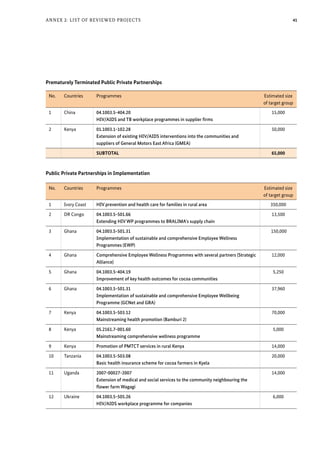
tion in the country and within the company. Ten of the 13
PPP projects (77%) that monitored misbelief and knowl-
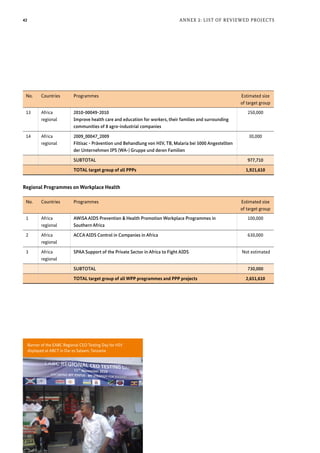
edge levels evaluated the impact of their measures within
the PPP period of three years and indicated an increase in
knowledge and a decrease in misbeliefs or stigma.37
•	 The Unilever PPP project from Kenya reported that 80%
of their tea farmers (120.000 including family and com-
munity members) gained knowledge on HIV and AIDS.
Stigmatizing attitudes were reduced from 12% to 7%.
•	 The Heineken PPP project from Congo reported a gen-
eral reduction of misbeliefs and specified an increase of
knowledge around HIV and AIDS of 60%.
•	 The PPP community outreach project in Madagascar
reported that among the 7.000 visitors living in the
neighbourhood of a night club, 22% increased their
knowledge on HIV and AIDS.
•	 In Namibia the Ohlthaver & List Group (50.000 benefi-
ciaries) reported that stigma was reduced. 92% of the
workforce expressed that they had no objections to
working with an HIV infected person in comparison to
79% three years prior.
•	 Also, Daimler in South Africa (60.000 beneficiaries) and
James Finley Tea Estates in Uganda (8.000 beneficiaries)
reported increased knowledge levels and reduced stig-
matisation within their target groups.
GIZ itself has workplace programmes in each of its coun-
try offices. Stigma management is exemplarily described
in a case study from GIZ in Kenya.
37 It is difficult to attribute knowledge increase to workplace programmes alone other sources such as TV, radio, internet, newspaper etc
also provide information.
38 GDC Kenya: Result-based evaluation study of the Kenyan GDC health-promotion and HIV and AIDS WPP. 2011
CASE STUDY: Stigma Management at GIZ Kenya
GIZ Workplace Programme Kenya: ‘If I Were Positive’ Campaign against Stigma and Discrimination38
All around the world, people living with HIV are affected by stigma and discrimination. AIDES, a French non-governmental
organization, and the International AIDS Society (IAS) joined forces to denounce stigma and discrimination through
the awareness campaign ‘If I were HIV-positive’. This campaign began in France in 2007, where it had a great impact. In
December 2009, GIZ obtained permission from AIDES to create its own campaign. GIZ Kenya used this opportunity and
started its own campaign as part of their workplace programme stigma management.
Design and Implementation
Employees of all GIZ projects and programmes, irrespective of
their positions in the organisation, were eager to volunteer and
take part in the campaign. The GIZ country director and other
members of the management team participated, along with
other staff members. This campaign took place in June 2010
and was repeated in February 2011.
Reported outcome
KAPB Survey results of 2011 report that the majority of
employees are less afraid of HIV-related stigma and
discrimination at their workplace than they were in 2007.
76% of the employees were not worried about being dismissed in 2011, in comparison to 12% in 2007. Furthermore, they
believed that sensitive data like HIV test results are kept confidential (2011 96% in comparison to 83% in 2007). These
results validate that stigma management activities (which included the campaign “If I were HIV positive”, peer educator
sessions, health talks, brochures and posters) can have a positive impact on decreasing stigma and discrimination at GDC
workplaces.
27Section 3: Working with Companies - Results of a Decade of
HIV Workplace Programmes
Achievements and Challenges of
HIV-Centered PPPs
One major advantage of PPPs with companies is the direct
access it affords to employees and their families. With an
investment of 5.5 Euros per person, German Development
Cooperation reached 1.9 million people, mainly in the
African regions. There was an almost fifty-fifty division of
support between large enterprises and small and medium-
sized companies combined. This is especially noteworthy
given the fact that it is much more difficult to meet the
specific needs of SMEs than those of large enterprises.
Considerable improvement of monitored core indicators
was reported. Of those programmes measuring the policy
indicator, 95% reported progress; of those measuring the
number of persons who were HIV-tested, 79% reported an
increased uptake; and of those following up on knowledge
level and misbeliefs, 77% reported decreases in misbeliefs
and increases in knowledge.
The majority of PPPs included outreach activities to com-
munities and suppliers of companies; however, the PPP
framework is still being used as a basis to develop the
concept further, to experiment with new ideas and ap-
proaches and to develop blueprints of activities that can
be adapted to other contexts.
A major short-coming of PPPs is their short duration, usu-
ally lasting between two to three years. This short project
cycle creates a challenge with regard to long-term moni-
toring. While the PPP framework encourages the collec-
tion of baseline data, it runs the risk that project managers
will lose access to the respective company target groups
after the PPP has ended. It is then up to the company to
continue with the monitoring practices established by
the PPP. Thus, the data presented here only provides the
short-term results of GDC-funded PPPs.
It is expected that the companies will continue evaluating
their workplace activities even after termination of the
PPP contract. Further, information on the impact of im-
plemented initiatives is sometimes provided by national
business coalitions. In South Africa, for example, the South
African Business Coalition on HIV and AIDS (SABCOA)
created a website in cooperation with the national health
information system initiative on where companies can
publish their HIV testing results39
.
The homepages of companies are another source of im-
pact data on workplace programmes. Many multinational
enterprises (e.g. Volkswagen, Daimler, Heineken and
Unilever) and national companies (e.g. Olthaver & List
from Namibia) publish the results of their workplace pro-
grammes on the internet.
Nonetheless, a kind of “Alumni” PPP network would be
favourable to long-term impact monitoring. This would
allow for the possibility of a follow-up assessment even af-
ter a PPP has ended. In addition, GDC partnerships in HIV
control and health with companies would benefit from
a harmonized monitoring framework with comparable
indicators and monitoring procedures in every PPP. The
limited number of indicators could still reflect a variety of
programme components reflecting the requirements of
various companies. Such a framework, however, will cer-
tainly require negotiated agreements with companies so as
to sufficiently meet their needs and expectations.
39 www.bizwell.co.za
An agricultural sector like coffee production as here in Zambia is
greatly influenced by global market developments
28
Business Coalitions: Advocates and
Service Providers
Business coalitions on HIV emerged about a decade ago as
a joint initiative of the World Bank, the Global Health Ini-
tiative of the World Economic Forum and UNAIDS, along-
side local private sector champions. The coalitions were
seen as an ideal platform to coordinate and facilitate the
private sector response to the epidemic. Within a decade,
four regional and more than 50 national business coali-
tions were formed mainly in Sub-Sahara Africa, South-
East Asia and the Caribbean.
Between 2002 and 2007 the regional GIZ project ACCA
supported national business coalitions in six African
countries40
in order to strengthen their organizational
structures and corresponding networks. ACCA also trained
business coalitions in order to build their capacity to
respond adequately to the demands and needs of their
member companies. This included getting involved in the
national HIV response and participating in national struc-
tures with access to global financing mechanisms, such as
the Global Fund against AIDS, Tuberculosis and Malaria.
Business coalitions offer tools and support processes that
help companies to effectively address HIV at the work-
place. Although some companies – in particular multi-
national enterprises – were already effectively addressing
HIV at the workplace, other companies were not aware
of the impact of HIV or did not know how to respond to
HIV. The business coalition model sought to support those
companies and to sensitize the business community in
general. The new concept was supported by various na-
tional employer and employee associations and in some
countries the government has been one of the key drivers
in the establishment of a national business coalition. The
coalitions were expected to represent the private sector
and to lobby for business interests and needs in relevant
national committees and institutions.
When the coalitions were first established, nearly all of
them had an HIV-only focus. In reaction to the diversified
needs of many companies in terms of workforce health,
most coalitions have since expanded to include services
addressing the impact of malaria and TB and promoting
the general wellbeing of employees. All partner organiza-
tions of ACCA offered the following types of services to
their member companies:
•	 Sensitization workshops for employees
In these usually in-house workshops, the employees are
informed about the main knowledge areas related to
HIV. Often the families were also invited to sensitiza-
tion meetings. Business coalitions serve as resources and
organizers of such sensitization meetings. Often, repre-
sentatives of the local health system are also invited to
create a continuous partnership between company and
health care providers.
•	 Management advisory forums and round table
discussions
Peer learning is a very powerful tool for helping to
convince top managers of the benefits of investing in
HIV workplace programmes and other health activities.
During round table discussion, managers’ share exam-
ples of well-established programmes, knowledge on HIV
is imparted and experiences are exchanged.
•	 Coordinator and peer education trainings
Most HIV workplace programmes are established with
a coordinator and a group of peer educators who teach
HIV basics to their co-workers. Coordinators and peer
educators attend trainings in which general programme
management issues or – in the case of peer educators
– a curriculum of regular information sessions for col-
leagues are discussed and practiced.
•	 Development and distribution of informational material
The workplace is a very specific environment for health
education. The educational materials must suit this
environment and should not interfere with company
operations. Peer education at the workplace, in particu-
lar, requires well-prepared education materials like the
“10-minute talks.” This set of 34 posters was first adapt-
ed from the South African context to the East African
context of Tanzania and then transferred and adapted
Section 4: Working with Business Associations – Achievements
of National and Regional Workplace Health Promotion
Section 4: Working with Business Asso-
ciations – Achievements of National and
Regional Workplace Health Promotion
40 Business Coalitions were supported by ACCA in Nigeria, Tanzania, Kenya, Namibia, Mozambique and Zambia.
29
to other countries like Malawi or Nigeria. Each poster
describes visually a piece of knowledge on HIV. On the
back of the poster, the peer educator is guided through
questions to ask, information to give and correct an-
swers to common misbeliefs.
•	 Condom distribution
Many business coalitions facilitate the distribution of
government or donor-funded condoms to companies.
•	 Operational surveys such as KAPB
Business coalitions support their members in establish-
ing a sound monitoring system for their activities. This
includes a situational analysis during the set-up phase
and common monitoring and evaluation tools such as
KAPB surveys.
The national business coalitions were a new structure in
traditional national systems of employer and employee
federations, councils, associations and chambers. They
tend to survive to a lesser extent on private sector fund-
ing or to a larger extent on donor agency resources. It is
a challenge for most of the coalitions to secure funding
for their organizational structures and planned activities,
in particular for those targeting small and medium sized
enterprises and the informal sector. Some coalitions have
developed into business development service providers,
offering their professional support against consultancy
fees. During the last three years, a consolidation process
took place during which some coalitions disappeared. In
most cases, their tasks were taken over by other national,
well-established employer organizations.
The value attributed to national business coalitions to the
fight against HIV is reflected by the number of supported
companies seen in Table 5. Global data indicates that busi-
ness coalitions, national employer organizations under the
umbrella of ILO and specialist non-governmental organi-
zations like the Global Business Coalition (GBC) supported
over a million companies in implementing local HIV
workplace programmes41
.
Most of the business coalitions supported by the ACCA
programme in six countries doubled the number of peo-
ple benefitting from their services between 2004 and 2007.
Data of 2010 published by the GBC shows a continuity of
this trend in Kenya and Mozambique, while in Namibia,
Nigeria and Zambia the membership development was
stagnating.
Section 4: Working with Business Associations – Achievements
of National and Regional Workplace Health Promotion
41 World Economic Forum: Business Coalitions Tackling AIDS. A Worldwide Review of the Global Health Initiative (World Economic
Forum) in cooperation with UNAIDS, World Bank and GTZ. 2008
No Country & business coalition
Number of supported companies
(members of the business coalition)
Beneficiaries
(staff + family members)
2004 2007 2010* 2004 2007
1 Kenya: Kenya HIV and AIDS Business Council (KHBC) 39 61 120 70.000 120.000
2 Mozambique: Commercial and Industrial
Organisation of Sofala (ACIS)
40 85 260 32.000 65.000
3 Namibia: Namibia Business Coalition on AIDS
(NABCOA)
44 80 60 25.500 50.000
4 Nigeria: Nigerian Business Coalition Against AIDS
(NIBUCCA)
18 39 35 10.000 30.000
5 Tanzania: AIDS Business Coalition Tanzania (ABCT) 24 67 73 36.000 80.000
6 Zambia: Zambian Business Coalition on HIV/AIDS
(ZBCA)
54 72 70 52.000 60.000
TOTAL 219 404 618 225.500 405.000
* Data published by the Global Business Coalition on Health (www.gbcimpact.org)
Table 5: Operating range of GIZ partner business coalitions
30
The number of beneficiaries derived from the number of
member companies provides an incomplete picture of the
overall range of influence of national business coalitions.
All business coalitions supported by ACCA also offered
their services to other donor-financed workplace pro-
grammes targeting small and medium-sized enterprises
or the informal sector. The Kenya HIV and AIDS Business
Council, for example, reported in 2010 in their newsletter42
that apart from their member companies, KHBC is sup-
porting another 200 companies within projects funded by
other international organizations.
The PABC: Coordinating Business Coali-
tions Continentally
Companies operating in Africa face workforce health chal-
lenges that are far more complex than those in other parts
of the world. The double burden of communicable and
non-communicable diseases impedes the competitiveness
of companies in Africa and other developing countries.
Given this situation, regional institutions are required to
take charge of the private sector’s needs and interests in
terms of workforce health.
From 2008 to 2011, the regional GIZ project SPAA
strengthened the African private sector’s contribution to
national HIV prevention and health promotion through
regional organisations. SPAA supported the Pan-African
Business Coalition on HIV and AIDS (PABC) consisting to
date of 28 national business coalitions. The programme
helped PABC to get registered as a not-for-profit organiza-
tion in South Africa and to establish a secretariat.
With technical support of GIZ, PABC set up services for
the national business coalitions which included training,
regular newsletters, information on gender programming
and manuals on health issues such as non-communicable
diseases. Regular membership surveys with participation
rates of around 60-70% documented the development of
national business coalitions since 2008. Within the pe-
riod of support to PABC, the national business coalitions
underwent a remarkable change in focus. While in 2008
health issues such as TB, malaria or non-communicable
diseases were side issues, in 2011 services for TB and
malaria were provided by 80% of those coalitions partici-
pating in the survey. Wellness and NCD-related services,
which were provided by less than 10% of coalitions in
2008, were almost quadrupled by the end of 2011.
Section 4: Working with Business Associations – Achievements
of National and Regional Workplace Health Promotion
42 KHBC: Bamburi Cement & GTZ embrace public – private partnership. Business AIDS Watch June – September 2010
Graph 5: Development of health issues covered by PABC member coalitions
Malaria services
Wellness and NCD-related services
120%
100%
80%
60%
40%
20%
0
Other Services
HIV services
TB Services
2008 2010 2011
31
Through PABC, the national coalitions were represented
in international meetings and gained access to trainings of
the Global Fund, the GBC and other partners. An impor-
tant objective of SPAA was to support national business
coalitions in getting a seat in their respective national
Country Coordinating Mechanism (CCM) of the Global
Fund to Fight AIDS, Tuberculosis and Malaria. Participa-
tion in this important national committee would ensure
that business coalitions could contribute to national fund-
ing proposals in the interest of the private sector. Of the
PABC members participating in the various membership
surveys over the years, a fairly stable ratio of around 80%
were representing business in the CCM either as a full
member or – like some – as a rotating member sharing
this responsibility with another private sector institution.
About a third of the coalitions received funds as sub-
recipients throughout the four years; this share increased
to over 40% in 2010.
Section 4: Working with Business Associations – Achievements
of National and Regional Workplace Health Promotion
From a sociological perspective, companies operate at a
micro level in society while business coalitions are active
at a meso level. Working with national business coalitions
meant working with a support structure detached from
the company employee as the target of a development
programme. Working with PABC in order to support NBCs
further reinforced this detachment from companies and
their employees.
Much like business coalitions, PABC is an organization
that has been set up as part of the overall creation of
special structures for efficient HIV control. PABC served
national business coalitions as an important peer-learning
and exchange forum; however, the physical distance to
the members prevented sufficient internal ownership.
Three language groups and very different epidemiological
settings, specifically regarding West Africa and East and
Southern Africa, complicated technical support. PABC
could not respond fast enough to the paradigm change
of incorporating HIV control into an overall health per-
spective. Further, their membership, which was restricted
to national business coalitions against HIV, left out fi-
nancially, more potent partners such as other employer
organizations or multinational companies. Given the great
financial needs of a continentally active organization and
a decreasing availability of funds for vertical HIV pro-
gramming, PABC’s future today seems insecure.
Tackling Business Issues of Regional
Importance: Campaigning at a Regional
Level
Apart from the support to PABC as the continental um-
brella body of national business coalitions, the regional
programme SPAA aimed at opening up new opportunities
for mobilizing private sector support. To this end, SPAA
also supported
•	 The Southern African Development Community (SADC)
Secretariat HIV/AIDS Unit based in Gaborone, Bot-
swana, and
•	 The East African Business Council (EABC) in Arusha,
Tanzania, an apex body for private sector with observer
status of the East African Community (EAC).
Graph 6: Membership of PABC member coalitions in country coordinating mechanisms of GFATM
2011
2010
2009
2008
Full members
Rotating Members
0	 20%	40%	60%	80%	100%
32
Regional National
Section 4: Working with Business Associations – Achievements
of National and Regional Workplace Health Promotion
Jointly with its two regional partners, SPAA identified
private sector issues of regional importance and set out to
enhance industries’ responses to health challenges in the
regions.
The EABC was established in 1997 as an advocacy body
to facilitate private sector participation in the movement
towards a common market in the East African region. The
EABC works closely with the EAC Secretariat, its legislative
assembly, as well as with regional sector committees, eco-
nomic bodies and the business community in EAC partner
states at large.
As practised by other thematic groups EABC created a re-
gional working group focussing on HIV and other health
issues. In the five EAC partner states, and with Zanzibar
being dealt with as an additional sixth unit, EABC started
a unique process that guided the national private sector
through a selection and re-selection process of their rep-
resentation in national and regional health-related com-
mittees and institutions. This process was supported by
all relevant private sector organizations including unions,
government and international development partners such
as the ILO. The selected focal point organisations from the
partner states formed the new EABC Regional Working
Group on HIV and Health, which was chaired by an EABC
board member.
GIZ SPAA, 2011
East African
Community EAC
Development
Partners
Trade
Department
Health and HIV
Programme
Regional Working Group
(Focal Point
Organsisation)
East African
Business Council EABC
Marketing &
Communication
Country Private Sector
Stakeholder Meetings
Private Sector
Associations/companies
Employees
Figure 4: The East African Business Council – Linking regional and national level
Burundi FP Kenya FP Rwanda FP Tanzania FP Uganda FP
33Section 4: Working with Business Associations – Achievements
of National and Regional Workplace Health Promotion
The regional EABC support strengthened the legitimacy
of the national focal point organizations. The Federation
of Ugandan Employers (FuE), for example, - focal point or-
ganization of the private sector in Uganda – was officially
mandated and called upon by the government to contrib-
ute to the development of the national strategy on HIV.
Other benefits are reported from Rwanda and Burundi,
where national focal point organizations were mobilized
by their governments to start HIV prevention and health
promotion initiatives.
The activities of the East African Business Council are good-
practice examples highlighting the advantages of intercon-
necting the national and regional levels. The Regional CEO
Testing conducted in 2010 in all EAC partner states provides
an impression of the potential of regional action.
CASE STUDY: East African Business Council - Interconnecting National and Regional Interventions
Design and implementation of the ‘CEO Testing Day’
In an effort to stimulate corporate response to the HIV pandemic, EABC, supported by SPAA, organized a regional CEO
Testing Day in November 2010. The one-day event, which marked a significant milestone to increasing the private sector’s
response to HIV on a region-wide basis, was simultaneously carried out in all five EAC partner states’ capital cities, as well
as on Zanzibar.
Reported outcome
The event was viewed as an overwhelming success – over 350 CEOs were tested at the six different sites. The added value
of this regionally coordinated private sector activity was described as follows:
-- Promotion of role modelling and peer learning among the regional business community;
-- Connecting a social cause of action with regional self-marketing and PR opportunities for companies;
-- Leveraging of regional reputation of EABC and EAC to motivate and accelerate national action;
-- Access to additional resources, as well as improved utilization of those resources;
-- Effective way to increase awareness of business leaders around workplace health opportunities and challenges;
-- Opportunity to collaborate more closely with the media on health topics.
Further, the regional event provided a unique platform for business leaders and government officials to discuss openly both
opportunities and challenges for addressing workplace health needs on both the national and regional levels.
Although SPAA started its activities only in 2008, there is
already evidence that regional exchange and discussions
are an effective means of coordinating the formerly frag-
mented private sector and help business associations to
link wellbeing issues at the workplace with occupational
health and safety and the better-funded HIV and TB sec-
tors. It can be expected that the EABC Regional Working
Group on HIV and Health in cooperation with its network
of focal point organizations, will be in a better position
to respond to future challenges that lay ahead in the
processes leading up to a common market in East Africa.
Increased labour movement as one example in the region
will create a host of health-related challenges requiring
practical solutions, including cross-border transmission
of disease or portability of health insurance schemes. A
coordinated private sector can contribute to the harmoni-
zation process of existing political systems, policies, strate-
gies and legislation with regard to the prevention, treat-
ment and control of HIV or communicable diseases. One
success was marked in 2011 when workplace issues were
integrated by the EABC and its Regional Working Group
into the new EAC HIV Bill, legislation that is currently be-
ing discussed in the EAC legislative assembly.
34 Section 4: Working with Business Associations – Achievements
of National and Regional Workplace Health Promotion
Supporting Employee Health in
Industries
In response to company demands, the SPAA programme
also adapted its approach to workplace health in coopera-
tion with its partners SADC and EABC. The project’s new
objective became the development of industry-specific
health standards and guidelines that integrate commu-
nicable diseases like HIV and TB, as well as non-commu-
nicable chronic ailments in the prevailing structures of
occupational safety and health. In a way, this was a kind
of return to an earlier approach to workplace health that
offered sufficient opportunities for comprehensive health
promotion, but which had been side-lined by HIV-only
management initiatives at the workplace in the past dec-
ade.
Legislation regulating OSH exists, to some extent, in most
countries and frequently falls within the responsibil-
ity of the ministry of labour. These laws and regulations
are binding to companies and ideally supervised by the
ministry. HIV policies are usually developed under the
responsibility of the ministry of health and a more or less
independent AIDS commission rarely includes require-
ments obligatory to the private sector. On the other side,
occupational injuries and diseases as well as chronic ail-
ments tend to incur visible costs, while HIV as a stigma-
tized disease remains to a large extent hidden from the
employer. The macroeconomic costs of occupational in-
juries and diseases are estimated to reach 4% of the global
gross national product43
. This is more profound than the
corresponding estimations for HIV and chronic disease.44
With the conservative estimation of 2.3 million deaths an-
nually among the working population worldwide, occupa-
tional injuries and diseases seem to be equally important
at the workplace as HIV.
There is very little data available on health in African in-
dustries, data which is required in order to calculate more
accurately the costs and benefits of preventive action and,
thus, provide more compelling arguments to company
managers and owners. Available data from more indus-
trialized countries are hardly applicable due to profound
differences in operations, burden of disease and culture;
however, many industries have national and even region-
ally-based associations. Clustering industries and provid-
ing them with regional representation is one of the goals
of the EABC. Selected regional industry clusters also exist
in Southern Africa. In Eastern Africa, SPAA and EABC col-
laborated with the hotel industry; in Southern Africa the
partnering industry of SADC and SPAA was transport.
Both industries had started to embark on self-regulating
quality initiatives aimed at improving operations and
services. In East Africa, the EAC introduced a star-based
accreditation system for accommodation establishments
and restaurants in 2009. In this system, employee health
was a small factor among bigger ones like services, room
quality, cleanliness and many more. In Southern Africa,
SADC set out to introduce a self-regulation scheme de-
signed specifically for the transport industry. Drivers’
health was one of four components of this scheme, the
other three being vehicle maintenance, vehicle loading
and operation processes. Both self-regulation schemes
promise benefits for accredited companies – better
marketing in the case of the hotel industry and easier
cross-border movement in the environment of transport.
Combining health with other topics of industry interest
increases the acceptance of investments in an economic
factor that is not one of the core ones in managers’ minds,
and which often requires external support due to missing
internal competences.
Based on company visits in several countries and inter-
views with employers, workers, government authorities
and other stakeholders, health standards were developed
which reflected the specifics of the two sectors. In trans-
port, detailed consideration was given to, among other
topics, safe work time and driving practices, risky sexual
behaviour, vaccination needs, healthy life style, and cross-
border medical treatment needs. In the hotel guidelines,
the decent work environment, gender-specific health
needs, prevention of sexual harassment, emergency pre-
paredness and access to health care received special atten-
tion.
43 ILO data published on the website www.ilo.int, accessed 30/01/2012
44 In the 2009 publication “The Changing HIV Landscape”, the World Bank reviewed its earlier estimated of HIV impact on various mac-
roeconomic factors. An annual reduction of GDP between 0.8% and 1.5% did not materialize.
35
Both guidelines were reviewed and agreed upon by the
respective industries. Since they are meant to facilitate
the self-regulating endeavours of the companies, industry
associations and the general quality initiatives will play
an important role in further implementation of the guide-
lines. The impact of the guidelines can only be evaluated
along the line. Baseline data are needed to assess the status
quo of employee health in the industries in order to moni-
tor changes and improvements.
Lessons Learned from Working with
Business Associations
In contrast to PPPs with companies, the impact of system-
relevant support of business associations is harder to
quantify. Business coalitions and employer organizations
are too far removed from companies’ workforces to al-
low for indicators like “HIV tested employees”. From the
experiences particularly of EABC it becomes clear that the
greatest achievements, for example, in influencing policy
frameworks, can be made if the connection between
regional and national level is dynamic and mutually ben-
eficial. In order to benefit workers, activities have to take
place at country and company level.
On the other hand, working with regional and national
business associations has the potential to multiply invest-
ment in capacity development. As seen from the ACCA
programme, training and information materials devel-
oped for business coalitions did benefit a large number of
companies. Guidelines for drivers’ health management de-
veloped and promoted by national and regional transport
associations in cooperation with the SPAA programme
will motivate not one but many companies in the sector
by promoting industry champions and positive incentives.
All programmes enhancing capacity regarding workers’
health via business institutions are recommended to have
tied links to country level and to companies.
Industry approaches actually combine the benefits of
direct PPPs and business association support. Industry as-
sociations and company champions have to be involved in
order to mobilize the rest of the sector and even to reach
out to contractor companies or small and medium-sized
businesses. A real innovation is the combination of health
with general quality initiatives of the industry. By using
such opportunities, workforce health can be promoted as
a worthwhile investment improving overall standards in
production, operation and service.
Section 3: Working with Companies - Results of a Decade of
HIV Workplace Programmes
Visitors at a rural health centre listening to HIV education in Tukuyu District, Tanzania
36
From the beginning of the last decade, German Develop-
ment Cooperation has been very influential regarding
workplace health. The agencies of the German Govern-
ment outlined and tested the components of an HIV
workplace programme in many national and multina-
tional companies. They extended services to other diseases
and workplace issues such as indebtedness within the
framework of the Employee Wellbeing Programme. They
also created in-country structures that facilitated the im-
plementation of HIV and other health-related workplace
programmes.
From the first PPPs to the most recent ones, GDC de-
veloped concepts, approaches and tools have been well-
received by other bilateral and international partners.
Organizations such as the International Red Cross or the
Belgium Development Cooperation turned to German
agencies in order to get advice and support for their own
endeavours in terms of workforce health. GIZ as one of
those agencies has been called upon to participate in vari-
ous international committees such as the Interagency Task
Team for Workplace Programmes under the leadership of
ILO or the jury for the annual award of the Global Busi-
ness Coalition on Health.
The cumulative experiences and knowledge gained so far
by the German Development Cooperation around private
sector endeavours in workplace health make it flexible
to respond to remaining and new challenges. Due to the
urgency that had been attached to the HIV epidemic
throughout the last three decades, many parallel struc-
tures have also been set up in private sector collaborations,
which usually side-lined existing occupational safety and
health structures in companies. A revitalization of interest
for other workplace health problems, accompanied by de-
creasing financial resources for HIV-only programmes, ne-
cessitates the consolidation of approaches that will force
a review of the existing structures, so as to identify which
ones are the most sustainable and promise the greatest
success.
Classic national control systems for occupational health
could be in the position to take over the task of promot-
ing the management of communicable and non-com-
municable diseases in addition to traditional safety and
health; however, the capacity of these systems will have
to be strengthened in collaboration with the private sec-
tor. Further, industry-specific guidelines for integrated
health management based on the idea of self-regulation
will complement such efforts. More industries can benefit
from the experience gained in terms of integrated work-
place health and safety management. This will also be an
ideal opportunity for strategic alliances with private sector
partners and governments. Taking into account the often
more advanced level of industrialization of Asian and
Latin-American countries and the on-going process of im-
proving workplace health and safety in many industries,
south-south and triangular collaboration models between
countries’ governments and companies may enhance
mutual learning and peer advice for African settings, in
particular.
Of great importance is the improvement of the data base
of health trends, especially in industries in Africa, but also
in other low and middle income countries. This is needed
to guide corporate, national and international investment
in workplace health. It would also be very useful to collect
data on prevalence and incidence of selected diseases from
bigger companies per industry. With these data, extrapola-
tions can be done to establish businesses’ health needs and
Section 5: Conclusion and Outlook – Private Sector as a
Future Partner in Workplace Health Development
Section 5: Conclusion and Outlook –
Private Sector as a Future Partner in
Workplace Health Development
Employees of Mbeya Cement prepare the
HIV testing campaign, Mbeya, Tanzania
Management of Mbeya Cement as role model
participating in HIV testing
Wall poster with HIV message at
Mbeya Cement
37
to support cost-benefit arguments that demonstrate how
workplace efforts to address healthcare needs can posi-
tively impact the profitability of a firm.
The workplace is an ideal setting for health promotion
aiming at specific target groups like ageing employees or
adolescents and young adults. Vocational training can be
used to supplement industries’ efforts to improve health
among the youth. Various development programmes in
education integrate health issues into teaching and learn-
ing in a vocational setting. With specific knowledge on
comprehensive and integrated health management of an
industry, these efforts can be scaled up. Such an approach
would combine the general health risks that adolescents
and young adults are facing in a society with the elevated
occupational health and safety risks of young employees
in specific work settings.
Reproductive health, especially maternal health, could
benefit from a similar approach. Industries employing
a large ratio of women can improve maternal health by
making working conditions more supportive of maternity
and women’s roles within families. Targeted health pro-
motion can address women’s health issues and contribute
to a better health education which can then benefit most
family members especially children.
Health is closely connected to environment and business.
Climate change is expected to pose new challenges to
workplaces, especially in countries located in the south-
ern hemisphere. Businesses themselves compromise the
health of communities due to industrial pollution – at the
cost of national health systems. Operation and produc-
tion processes are the major focus of social and ecological
standards and certificates. Health should be incorporated
as a criterion in these quality control instruments.
Further attention should also be given to companies’ con-
tributions to national health systems. Diseases originating
from the workplace create a burden to national systems.
Basic Occupational Health Services (BOHS) as a supple-
ment to primary health care could be co-financed by
companies benefitting bigger and smaller companies in a
community. Other potential areas of business support are
contributions to health financing and social security. Fur-
thermore, business can contribute significantly to an ef-
ficient and effective system for general pandemic prepar-
edness. The examples of community outreach document
how companies provide education, prevention and treat-
ment services beyond company premises. Such a service
provision may also be integrated in national emergency
planning regarding epidemics from new viruses.
A decade of collaboration with the private sector on HIV
control and other health issues has been both rewarding
and positive for German support to national and regional
HIV responses. A lot has been done and many more chal-
lenges need to be tackled. Business partners are invited to
share their innovative ideas and to benefit from decades
of experience of GDC in development contexts. For GDC,
the private sector will remain a highly valued partner for
public-private partnerships with common development
objectives.
Further support on workplace health is provided by:
GIZ- Regional Coordination Unit for HIV & TB
(giz-ReCHT) Accra / Ghana
Email: holger.till@giz.de
Section 5: Conclusion and Outlook – Private Sector as a
Future Partner in Workplace Health Development
Screening for HIV and other diseases at the
workplace in Ghana
National health insurance staff in Ghana offering HIV
testing and promoting insurance registration or renewal
HIV Coordinator explaining the procedures of
a KAPB survey in rural Tanzania
38
Alliance of Mayors and Municipal Leaders on HIV/AIDS
in Africa (AMICAALL), 1997: Abidjan Declaration on HIV/
AIDS, Abidjan
Deutsche Gesellschaft für Internationale Zusammenarbeit
(GIZ), 2011: Integrated Health Management at the Work-
place – Creating Industry-Specific Strategies that Integrate
HIV and TB Management into Existing Occupational
Safety and Health, Eschborn
Deutsche Gesellschaft für Technische Zusammenarbeit
(GTZ), 2008: Employee financial wellness: A corporate
social responsibility, Eschborn
Deutsche Gesellschaft für Technische Zusammenarbeit
(GTZ), 2004: Results-based Monitoring; Guidelines for
Technical Cooperation Projects and Programmes,
Eschborn
GDC Kenya, 2011: Result-based evaluation study of the
Kenyan GDC health-promotion and HIV and AIDS WPP,
Nairobi
Global Business Coalition (GBC), 2006: The State of
Business and HIV/AIDS, A baseline report, New York
Goetzel R Z, et al, 2008: Workplace Health Promotion:
Policy Recommendations that Encourage Employers to
Support Health Improvement Programs for their Workers,
Washington, Partnership for Prevention
International Labour Organization (ILO), 2010: Recom-
mendation concerning HIV and AIDS and the world of
work (No.200), Geneva
International Labour Organization (ILO), Internet:
http://www.ilo.org/global/topics/safety-and-health-at-
work/lang--en/index.htm (Accessed Jan 23, 2012)
International NGO Training and Research Centre
(INTRAC) 2010: Responding to HIV and AIDS in the Work-
place. Policy Brief for International Agencies, July 2010
Kenyan Health Business Coalition (KHBC), Bamburi
Cement & GTZ embrace public – private partnership.
Business AIDS Watch June – September 2010
Rosen, S.M. et. al. 2006: The private sector and HIV/AIDS
in Africa. Boston. Center of International Health and
Deve-lopment with the Kenya Medical Research Center
UNAIDS, 2011: Report on the Global AIDS Epidemic,
Geneva
World Bank, 2003: Local Government Responses to HIV/
AIDS. A Handbook to support Local Government Authori-
ties at the Municipal Level, Washington
World Bank, 2009: The Changing HIV Landscape,
Washington
World Bank, 2010: Shadow economies all over the world,
Washington
World Economic Forum (WEF), 2006: A Global Business
Review of Business Response to HIV/AIDS 2005-2006,
Geneva.
World Economic Forum (WEF) 2008: Business Coalitions
Tackling AIDS. A Worldwide Review of the Global Health
Initiative (World Economic Forum) in cooperation with
UNAIDS, World Bank and GTZ, Geneva
World Health Organization (WHO), 2002: World Health
Report – Reducing Risks, Promoting Healthy Life, Geneva
World Health Organization (WHO), 1986: Ottawa Charter
for Health Promotion, Geneva
World Health Organization (WHO), 2010: Healthy work-
places: A model for action, Geneva
World Health Organization (WHO), 2010: World Health
Report - Health Systems Financing. The path to universal
coverage, Geneva
Annex1: Bibliography
39Annex 2: List of Reviewed Projects
Annex 2: List of Reviewed Projects
No. Countries Programmes Estimated size
of target group
1 DR Congo HIV Workplace Programme with Heineken / Bralima 4,000
2 DR Congo HIV-2008-015-2008
Improvement of key health outcomes for cocoa communities
12,000
3 Ghana 04.1003.5-103.18
Implementation of a sustainable HIV/AIDS workplace programme at the
revenue agencies of Ghana
7,500
4 Ghana 04.1003.5-404-01
Implementation of a sustainable HIV/TB workplace programme at Ghana Water
Company / AVRL
13,200
5 Kenya 04.10003.5-103.66
Promotion of HIV/AIDS workplace interventions in the tea sector
120,000
6 Kenya 07.2038.3-001.00
HIV/AIDS WPP for Bamburi Cement contractor companies
10,000
7 Kenya 2010--00003--2008
HIV / AIDS awareness and prevention campaign
50,000
8 Madagascar 01.1003.1-102.22
HIV/AIDS prevention campaign for high risk groups
7,000
9 Mozambique 04.1003.5-404.10
HIV/AIDS WPPs along the value chain of the harbour of Beira
10,000
10 Mozambique Comprehensive workplace programme in an agricultural setting (Acis) 7,100
11 Namibia Promotion of regional wellness programme in Ohlthaver List Group 50,000
12 Namibia HIV/AIDS Help desk: A joint approach of the Walvis Bay Corridor Group 10,000
13 Nigeria 01.1003.5-103.67
HIV/AIDS workplace programme and community health initative
10,000
Finalized Public Private Partnerships
40 Annex 2: List of Reviewed Projects
No. Countries Finalized PPPs continued:
Programmes
Estimated size
of target group
14 Nigeria 04.1003.5-404.06
HIV/AIDS workplace programme in supply chain companies of Unilever
2,500
15 Nigeria 04.1003.5-404.07
HIV/AIDS workplace programme in supply chain companies of Guinness
8,500
16 Nigeria 04.1003.5-404.08
HIV/AIDS workplace programme in supply chain companies of Nigerian
Breweries
Information
not available
17 South Africa 2007.00042-2007
HIV/AIDS workplace programmes for SMEs in Eastern Cape
12,000
18 South Africa 2004.1003.5-404.04
Kaefer AIDS Relief Programme (KARP)
1,000
19 South Africa 2005-125
Fighting over-indebtedness and introducing financial wellness
2,800
20 South Africa 98.4203.0-103.08
Daimler HIV/AIDS Project, South Africa
60,000
21 South Africa 01.1003.1-102.20
Established HIV/AIDS workplace programmes in South Africa (Bosch, VW,
Rosch, T-Systems)
7,000
22 Tanzania Comprehensive HIV and AIDS WPP for Mbeya Cement 300
23 Tanzania 04.1003.5-404.09
Comprehensive HIV/AIDS Control in the Tanzanian Tea Industry
180,000
24 Uganda HIV/AIDS Workplace Programme at Finlays Tea Estates 8,000
25 Zambia HIV/AIDS WPPs for Agriflora Ltd. In Zambia 15,000
26 Zimbabwe 04.1003.5-404.14
Combating HIV/AIDS at tobacco farmers, their dependants and communities in
Zimbabwe
100,000
27 Africa
regional
Central-Africa 98.4203.0
HIV and AIDS in the private sector (Heineken/Bralima Breweries)
10,000
28 Africa
regional
2007-00043-2007
Improving HIV/AIDS prevention and health care for workers and their families
of 8 agro-industrial companies in 5 countries
126,000
29 Africa
regional
2007-00044_2007
Filtisac - HIV Maßnahme im Rahmen von Ivoire Coton
35,000
30 World Global Compact and Safety and Health (involving Volkswagen branches in Brasil
and South Africa)
Information
not available
SUBTOTAL 878,900
41Annex 2: List of Reviewed Projects
No. Countries Programmes Estimated size
of target group
1 China 04.1003.5-404.20
HIV/AIDS and TB workplace programmes in supplier firms
15,000
2 Kenya 01.1003.1-102.28
Extension of existing HIV/AIDS interventions into the communities and
suppliers of General Motors East Africa (GMEA)
50,000
SUBTOTAL 65,000
Prematurely Terminated Public Private Partnerships
Public Private Partnerships in Implementation
No. Countries Programmes Estimated size
of target group
1 Ivory Coast HIV prevention and health care for families in rural area 350,000
2 DR Congo 04.1003.5-501.66
Extending HIV WP programmes to BRALIMA's supply chain
13,500
3 Ghana 04.1003.5-501.31
Implementation of sustainable and comprehensive Employee Wellness
Programmes (EWP)
150,000
4 Ghana Comprehensive Employee Wellness Programmes with several partners (Strategic
Alliance)
12,000
5 Ghana 04.1003.5-404.19
Improvement of key health outcomes for cocoa communities
5,250
6 Ghana 04.1003.5-501.31
Implementation of sustainable and comprehensive Employee Wellbeing
Programme (GCNet and GRA)
37,960
7 Kenya 04.1003.5-503.12
Mainstreaming health promotion (Bamburi 2)
70,000
8 Kenya 05.2161.7-001.60
Mainstreaming comprehensive wellness programme
5,000
9 Kenya Promotion of PMTCT services in rural Kenya 14,000
10 Tanzania 04.1003.5-503.08
Basic health insurance scheme for cocoa farmers in Kyela
20,000
11 Uganda 2007-00027-2007
Extension of medical and social services to the community neighbouring the
flower farm Wagagi
14,000
12 Ukraine 04.1003.5-505.26
HIV/AIDS workplace programme for companies
6,000
42 Annex 2: List of Reviewed Projects
No. Countries Programmes Estimated size
of target group
13 Africa
regional
2010-00049-2010
Improve health care and education for workers, their families and surrounding
communities of 8 agro-industrial companies
250,000
14 Africa
regional
2009_00047_2009
Filtisac - Prävention und Behandlung von HIV, TB, Malaria bei 5000 Angestellten
der Unternehmen IPS (WA-) Gruppe und deren Familien
30,000
SUBTOTAL 977,710
TOTAL target group of all PPPs 1,921,610
Regional Programmes on Workplace Health
No. Countries Programmes Estimated size
of target group
1 Africa
regional
AWiSA AIDS Prevention & Health Promotion Workplace Programmes in
Southern Africa
100,000
2 Africa
regional
ACCA AIDS Control in Companies in Africa 630,000
3 Africa
regional
SPAA Support of the Private Sector in Africa to Fight AIDS Not estimated
SUBTOTAL 730,000
TOTAL target group of all WPP programmes and PPP projects 2,651,610
Banner of the EABC Regional CEO Testing Day for HIV
displayed at ABCT in Dar es Salaam, Tanzania
43
Published by
Deutsche Gesellschaft für
Internationale Zusammenarbeit (GIZ) GmbH
Regional project: Support of the Private Sector in Africa to Fight AIDS (SPAA)
Registered offices
Bonn and Eschborn
Friedrich-Ebert-Allee 40	 Dag-Hammarskjöld-Weg 1-5			
53113 Bonn, Germany	 65760 Eschborn, Germany			
T +49 228 44 60-0	 T +49 6196 79-0
F +49 228 44 60-17 66	 F +49 6196 79-1115
info@giz.de
www.giz.de
Authors and editors
Ute Papkalla, Angelika Pochanke-Alff
Design
Jeanette Geppert, Frankfurt
Printing
Offset-Druckerei Metzgerdruck
Photo credits
Title: Fair Trade Coffee Farmer © istockphoto /ranplett, p. 5 © GIZ / AWiSA Programme, p. 9 © GIZ / AWiSA Programme,
p. 21 © GIZ / AWiSA Programme, p. 23 © GIZ / Frank Terhorst, p. 26 © GIZ / GIZ Kenya, p. 27© GIZ / Ute Papkalla,
p. 35 © GIZ / Sabine Quick, p. 36 © GIZ / Frank Terhorst, p. 37 left and middle © GIZ / GIZ ReCHT Ghana,
p. 37 right © GIZ / Sabine Quick, p. 42 © GIZ / Lilian Awinja
As at
July 2012
GIZ is responsible for the content of this publication.
On behalf of
German Federal Ministry for Economic Development and Cooperation (BMZ);
Regional Development Policy Africa Division
Addresses of the BMZ offices
BMZ Bonn	 BMZ Berlin
Dahlmannstraße 4	 Stresemannstraße 94	
53113 Bonn, Germany	 10963 Berlin, Germany
T +49 228 99 535-0	 T +49 30 18 535-0						
F +49 228 99 535-3500	 F +49 30 18 535-2501
poststelle@bmz.bund.de
www.bmz.de
Imprint

GIZ_Decade_of_HIV_WPP

  • 1.
    A Decade ofGerman Support for Workplace Health Concepts – Results – Lessons Learned Unter Published by:
  • 2.
    2 table ofcontents List of Abbreviations and Acronyms 3 Executive Summary 4 SECTION 1: Introduction 6 The Private Sector as a Development Partner 6 German Support of Business Health Engagement 9 SECTION 2: A HealthyWorkforce as a Development Objective 10 Understanding, Learning - and Adapting the Approach 10 The Basics of HIV Workplace Programmes 11 Targeting Small and Medium-Sized Enterprises: AWiSA 12 From HIV to Comprehensive Employee Wellbeing 13 Using Established Structures - Integrated Health Management 14 SECTION 3: Working with Companies - Results of a Decade of HIVWorkplace Programmes 16 Measuring Progress and Impact 16 Portfolio of Workplace Programmes Supported by GDC 17 Key Indicators of HIV Workplace Programmes 20 Impact of GDC HIV Workplace Programmes 22 Achievements and Challenges of HIV-Centered PPPs 27 SECTION 4: Working with Business Associations –Achievements of National and Regional Workplace Health Promotion 28 Business Coalitions: Advocates and Service Providers 28 The PABC: Coordinating Business Coalitions Continentally 30 Tackling Business Issues of Regional Importance: Campaigning at a Regional Level 31 Supporting Employee Health in Industries 34 Lessons Learned from Working with Business Associations 35 SECTION 5: Conclusion and Outlook – Private Sector as a Future Partner in Workplace Health Development 42 ANNEX 1: Bibliography 38 ANNEX 2: List of Reviewed Projects 39 Table of Contents
  • 3.
    3List of Abbreviationsand Acronyms List of Abbreviations and Acronyms ACCA AIDS Control in Companies in Africa AIDS Acquired Immunodeficiency Syndrome AMICAALL Alliance of Mayors and Municipal Leaders on HIV/AIDS in Africa ART Antiretroviral Therapy ARV Antiretroviral Drugs AWiSA AIDS Prevention & Health Promotion Workplace Programmes in Southern Africa BOHS Basic Occupational Health Service BMZ Bundesministerium für wirtschaftliche Zusammenarbeit und Entwicklung (German Federal Ministry for Economic Cooperation and Development) CCM Country Coordinating Mechanism of the Global Fund CEO Chief Executive Officer CSR Corporate Social Responsibility DED Deutscher Entwicklungsdienst (German Development Service, now GIZ) DEG Deutsche Investitions- und Entwicklungs- gesellschaft mbH EABC East African Business Council EAC East African Community EWP Employee Wellbeing Programme FP Focal Point GBC Global Business Coalition on Health GDC German Development Cooperation GDP Gross Domestic Product GFTAM Global Fund to Fight AIDS, Tuberculosis and Malaria GHI Global Health Initiative GIZ Gesellschaft für Internationale Zusammenarbeit GmbH GTZ Gesellschaft für Technische Zusammen- arbeit GmbH, now GIZ HCT HIV counselling and testing HIV Human Immunodeficiency Virus IAS International AIDS Society ILO International Labour Organisation InWEnt Internationale Weiterbildung und Entwicklung GmbH (Capacity Building International), now GIZ KAPB Knowledge, Attitude, Practice and Behaviour survey M&E Monitoring and Evaluation NCD Non-communicable diseases OSH Occupational Safety and Health PABC Pan-African Business Coalition on HIV and AIDS PMTCT Preventing Mother-to-Child Transmission [of HIV] PPP Public Private Partnership REC Regional Economic Community SADC Southern African Development Community SME Small and medium-sized company SPAA Support of the Private Sector in Africa to fight AIDS STD or STI Sexually Transmitted Disease or Infection TB Tuberculosis UNAIDS Joint United Nations Programme on HIV and AIDS UNGASS United Nations General Assembly Special Session WHO World Health Organisation WPP Workplace Programme
  • 4.
    4 Since the endof the 1990s, German Development Coop- eration (GDC), with funding from the German Federal Ministry of Economic Cooperation and Development (BMZ), has been contributing both considerable resources and technical know-how to programme development and implementation around workplace health improvement. Starting out with company collaborations in the frame- work of public private partnerships (PPP), GDC developed an approach for workplace HIV management that was exemplary to many other initiatives to come. In the last decade, 49 projects and programmes with a workplace focus were conducted, 46 of them direct partnership contracts with companies reaching more than 1.9 mil- lion employees of both large and small enterprises. These projects proved very cost-effective, costing about 5.5 Eu- ros of German public funding per capita on prevention, treatment and care. There was an almost fifty-fifty divi- sion of support between large enterprises and small and medium-sized companies combined. The 30 completed projects included in this evaluation reported considerable improvement around the following core indicators: • Company HIV management: 95% of the programmes measuring this management indicator reported that their partner companies introduced an HIV workplace policy as a basic precondition of HIV management. • Risk management: Of those programmes measuring HIV counselling and testing (HCT) as an instrument to manage personal risk, 79% reported an increased uptake of HCT among employees. • Stigma and discrimination management: 77% of those programmes following up on knowledge level and mis- beliefs reported decreases in misbeliefs and increases in knowledge. Most PPPs went beyond the companies’ own workforces to benefit communities and supply chain companies. And equally important – they served as learning incubators for generating new ideas and approaches, which could then be adapted to other company and country contexts. Due to the short duration of PPPs, long-term impact monitoring remains under the auspices of the partnering companies. A kind of “Alumni” PPP network and a harmo- nized indicator framework could contribute to improved, long-term follow-up of achievements, successes and chal- lenges. The AWiSA Network, which functions as an online interactive information exchange platform1 on workplace interventions , could serve this purpose. GDC continued to re-design its approach to fit companies’ needs. The earlier HIV-only programmes were extended, first, to malaria and TB, and later, to other diseases and mentally distressing factors, such as over-indebtedness of employees. These further efforts eventually lead to the promotion of comprehensive Employee Wellbeing Programmes (EWP). In order to respond to the important factor of sustainability, first steps were made towards inte- grating health into traditional structures of occupational safety and health (OSH). Guidelines on integrated health management were developed jointly with the transport industry in Southern Africa and the hotel industry in the region of the East African Community (EAC). In addition to working with companies directly, GDC also supported national and regional support structures of the private sector. The regional programme ACCA (AIDS Control in Companies in Africa) partnered with national business coalitions in six countries. Its successor programme SPAA (Support of the Private Sector in Africa to Fight AIDS) worked with a continental umbrella body of national business coalitions called Pan-African Busi- ness Coalition on HIV and AIDS (PABC) as well as the East African Business Council (EABC) and the AIDS Unit of the Southern African Development Community (SADC) Secretariat. This more system-related approach operated at a meso level of society and used business associations to multiply investments in capacity development. Advocacy, training and information thus reached a greater number of com- panies and access of business to funding sources for HIV programmes was improved; however, calculating the im- pact of these meso-level efforts on employees and workers remains challenging, due to the indirect contact of busi- ness coalitions and associations with the intended target group, namely a company’s workforce. Regional-level experiences revealed that the best results are achieved if dynamic and mutually beneficial partnerships between Executive Summary Executive Summary 1 http://www.awisa-network.net/
  • 5.
    5 Theatre scenes onHIV testing at the AWiSA partner Formex Industries in the production sites Markman and Korsten in Port Elisabeth, South Africa Executive Summary regional and national level stakeholders are established and maintained. Activities benefitting the envisioned tar- get group of workplace programmes, namely employees, ultimately have to take place at country level. Industry approaches have the potential of combining the benefits of direct partnerships with companies and sup- port of business associations. In such an approach, the sec- tor’s associations as well as company champions have to be involved in order to mobilize the rest of the sector and even to reach out to contractor companies or small and medium-sized businesses. Very promising is the combina- tion of health with general quality initiatives of the in- dustry which go beyond health to include other technical topics relevant to the respective industry. By capitalizing on such opportunities, workforce health can be promoted as a worthwhile investment critical to improving overall standards in production, operation and service. The workplace health concepts and tools of GDC are flex- ible enough to respond to new challenges while continu- ing to innovatively address still-perplexing problems. One such new challenge is the consolidation of parallel struc- tures that have been set up for HIV management, which have side-lined existing efforts to bolster occupational health and safety provisions. Other topics needing to be addressed include non-communicable diseases (NCDs), environment and health or pandemic control. The work- place offers access to a variety of target groups, such as young and older workers or women, who have particular health-related needs, including maternal health. Vocation- al training can be used to supplement industries’ efforts to improve health among the youth. With specific knowledge on comprehensive and integrated health management of an industry, such an approach would combine the general health risks that adolescents and young adults are facing in societies with elevated occupational health and safety risks of young employees in specific work settings. Private sector collaboration can also be more intensively used for strengthening health systems, i.e. by reducing the burden of workplace-originating diseases or by extending busi- ness contributions to health financing.
  • 6.
    6 The Private Sectoras a Development Partner The HIV pandemic is still one of the most significant challenges to health, development, economic and social progress in many regions of the world, especially in Africa south of the Sahara. HIV is expected to continue to be a leading cause of mortality and morbidity in many coun- tries and populations; the UNAIDS estimates that over 34 million people around the world are infected with HIV2 . According to the International Labour Organization (ILO) more than two thirds are persons of working age (15 – 49 years old), in the prime of their working lives3 . In the context of the above, HIV has not only become an interna- tional and national issue, but also a workplace issue. Although the overall growth of the global HIV epidemic appears to have stabilised, levels of new infections are still high in various countries, particularly in East and South- ern Africa. Due to the significant scaling up of antiret- roviral treatment programmes, the character of the HIV pandemic has changed. Initially, the HIV pandemic was treated by high prevalence countries and international de- velopment partners as a national disaster which required emergency responses. Today, the decline in HIV-related deaths and the increasing number of people living with HIV as a chronic disease has shifted both attention and resources to addressing the long-term consequences of the pandemic and the sustainability of HIV prevention, treatment and care structures. An increase in the number of people having to cope and live with HIV will have a cor- responding impact on the world of work. The effects of antiretroviral therapy (ART) are especially evident in Sub- Saharan Africa, where an estimated 21% fewer people died of HIV related causes in 2010 than in 2005, and it is esti- mated that approximately 25.5 million persons of working age are currently living with HIV in Sub-Saharan Africa. Over the past fifteen years, recognition of the detrimental effects of the HIV pandemic has grown among the busi- ness community4 . In 1999, the United Nations’ former Secretary-General Kofi Annan motivated the international business community to form a Global Compact for sus- tainable development and, in 2001, he encouraged the private sector to actively combat HIV as a threat to eco- nomic progress. His ‘Call to Action’ proposed the creation of a Global Fund to mobilize financial resources predomi- nantly from government and also addressed the private sector to invest in the response to HIV. In the same year the United Nations General Assembly adopted a ‘Declara- tion of Commitment’ which included a commitment by African governments to promote and support workplace programmes as part of their overall strategies to prevent and control HIV. The International Labour Organisation (ILO) provided employers, employees and governments with the ‘ILO Code of Practice on HIV/AIDS and the World of Work’, laying out principles on which workplace programmes should be based. For the German govern- ment, the HIV response at the workplace became a major orientation and a first testing ground for a new concept of public-private partnerships (PPP) promoting collaboration between companies and German development agencies. Starting from the end of the 1990s, both – the PPP as an instrument and HIV programmes as a joint social objec- tive between private and public sector – were developed in step. Increasing attention is now given to additional health is- sues challenging the private sector. Globally, an estimated 2.3 million employees die annually from work-related ac- cidents and diseases. According to ILO, this death toll cre- ates costs of as much as 4% of the gross domestic product (GDP) worldwide5 . The World Health Organisation (WHO) reports that selected work-related risk factors account for 40% of all occupational injuries and diseases responsible for 1.5% of the total global burden of disease.6 Addition- ally, non-communicable diseases, costing an estimated 4% of the global gross domestic product, are of increasing im- portance, especially to low and middle income countries. The successful advocacy for global investment in vertical, multi-sectoral HIV programmes led to the creation of pol- Section 1: Introduction Section 1: Introduction 2 UNAIDS Report on the Global AIDS Epidemic 2011. 3 Recommendation concerning HIV and AIDS and the world of work, (No.200) International Labour Office, Geneva, 2010 4 WEF (2006) A Global Business Review of Business Response to HIV/AIDS 2005-2006, WEF, Geneva. 5 ILO internet: http://www.ilo.org/global/topics/safety-and-health-at-work/lang--en/index.htm (Accessed Jan 23, 2012) 6 WHO (2002) World Health Report, Chapter 4
  • 7.
    7Section 1: Introduction icy,logistics and service structures which often by-passed existing health management provisions of a country. This was also the case at the workplace. Traditional institutions concerned with promotion and safe-guarding of occupa- tional safety and health (OSH) were side-lined in the at- tempt to motivate companies around HIV-centred action. Companies’ contributions ranged from HIV workplace programmes as part of their social responsibility activities to business-oriented systemic interventions that make use of companies’ core competences and leadership influence. The public sector, which is the biggest employer in coun- tries with high HIV prevalence rates, responded as well. As a consequence of the AMICAALL Declaration on HIV and AIDS (1997)7 and the World Bank Local Government and HIV/AIDS Initiative (2003),8 the public sector intensified its efforts to implement HIV workplace programmes in governmental institutions at all levels. Since 2003, it is also a policy of the German Federal Ministry for Economic Cooperation and Development (BMZ) that all German Development Cooperation (GDC) programmes and projects mainstream HIV9 in countries with generalized epidemics 10 . The workplace has enormous potential as a setting for improving the health of the adult and, to a lesser extent, adolescent populations. Health promotion at the work- place is a public health approach that was developed about 25 years ago and announced by the WHO11 in their Ottawa Charter. In such a setting, health promotion is un- derstood as a positive interaction of physical, mental and social wellbeing at the workplace. Occupational health is an integrated part of this approach, where the workplace is seen as highly relevant for people’s health and safety. In workplace settings, where people spend a large propor- tion of their lives, a variety of interventions can be imple- mented to prevent illnesses and occupational injuries. It is also a place where employees can acquire knowledge to adopt healthy behaviours even outside the working environment. Health promotion at the workplace includes strategies and measures focussing on HIV- related initia- tives, responses to other infectious diseases as well as the assessment of individual risk factors for chronic non- communicable diseases such as smoking, unhealthy diet, physical inactivity, alcohol abuse or stress. Furthermore, it includes strategies and measures influencing the work environment, mental health, social protection, financial wellness, and corporate culture. By promoting health at work, it is expected that the health potential and wellbeing of employees, their families and their home communities can be improved. Health as a holistic concept is also sup- ported by the WHO. Additionally, the WHO has long-promoted the well-estab- lished fact that a healthy workforce in a healthy workplace also means a healthy business12 . Accordingly, business ef- forts towards comprehensive health promotion and safety at work are directly relevant to competitive factors, such as the management of direct costs and the pursuit of new business opportunities. Contributing to the wellbeing of employees is more than corporate social responsibility in action; it is a strategy for risk management, value creation, and generating competitive advantage. A decade of involvement in the implementation of HIV workplace programmes (WPPs) in development coopera- tion has provided ample time and opportunities to test new ideas, to understand HIV in the context of workplace health more generally and to assess the capacities and ca- pabilities of companies to manage workplace health. It has been a dynamic decade which has necessitated periodical adjustments in approaches, concepts and even objectives, including the broadening of our scope from managing HIV in the workplace to a more comprehensive manage- ment of workforce health. In section one, an overview is given of German support in the form of public private 7 Alliance of Mayors and Municipal Leaders on HIV/AIDS in Africa (AMICAALL): Abidjan Declaration on HIV/AIDS, 1997 8 World Bank Local Government and HIV/AIDS initiative: Local Government Responses to HIV/AIDS. A Handbook to support Local Government Authorities at the Municipal Level, 2003 9 Mainstreaming HIV/AIDS is “a process that enables organisations to address the causes and effects of AIDS in an effective and sustai- ned manner, both through their usual work and within their workplace” (Definition provided by UNAIDS 2005). 10 In a generalized epidemic, HIV is firmly established in the general population e.g. in Kenya with an HIV prevalence rate of 7,4% (2008: Kenya AIDS Indicator Survey) 11 WHO 1086: Ottawa Charter for Health Promotion (21 November 1986 12 WHO 2010: Healthy workplaces: A model for action. 2010: www.who.int/occupational_health/healthy_workplaces/en/
  • 8.
    8 partnerships and programmesfor workplace interven- tions. In section two, the text takes a deeper look into the concept of workplace programmes, summarizing the experiences acquired and the conceptual adaptations that were derived from the lessons learned. Section three analyses the results that were reported from the various public private partnerships and programmes conducted at company level. Section five draws attention to the work conducted jointly with business associations, looking at achievements of partnerships with national business coalitions, regional private sector bodies and industry as- sociations. Based on the findings of the preceding sections, section five highlights the major milestones and provides an initial picture of the potential for expanding interven- tions to promote health at the workplace. German Support of Business Health Engagement The involvement of the formal economy in combatting HIV, especially in sub-Saharan African countries facing major epidemic challenges, is seen as a key strategy in the fight against the epidemic13 . The German Federal Govern- ment initially supported WPPs on HIV initiated by inter- national companies in South Africa in the late nineties of the last century. German Development Cooperation, in general, and GTZ14 , DED15 and InWEnt16 (now all merged into GIZ17 ) and DEG,18 in particular, got involved in these efforts early on through development partnerships, such as the Public Private Partnership (PPP) initiative of the BMZ.19 The GDC supported selected companies in most of the Sub-Saharan countries but also in Brazil, China and Ukraine within the PPP framework. A total of 46 PPPs focusing on workplace programmes were established between 1999 and 2011. Forty of those partnerships were funded out of the PPP funds established by the German government; the remaining six PPPs were conducted with funds from programmes such as AWiSA and ACCA. The overall German contribution for these PPPs sums up to about 10.5 million Euros (36%); the private sector contrib- uted a corresponding sum of 18.7 million Euros (64%). A number of smaller PPPs were integrated in health pro- grammes of GDC in various countries, especially in Africa. These PPPs were not included in this analysis. In 2002, the BMZ commissioned GTZ to set up the re- gional project “AIDS Control in Companies in Africa (ACCA)” (2002 – 2007) with the purpose of further promot- ing the private sector response to HIV on the continent. The workplace experiences gained with multinational companies in South Africa were used as a blueprint for the roll-out of HIV WPPs, especially among smaller national enterprises in other African countries. Besides advising individual companies on the design and implementation of HIV WPPs, ACCA soon expanded its support to national business coalitions against HIV, which first emerged in 2002 as service providers and advocates for companies willing to address the challenges of HIV. This process was supported by the World Bank and other national and in- ternational organizations such as UNAIDS, and the World Economic Forum. The BMZ invested 5.2 million Euros in the two phases of the ACCA project lasting from early 2002 to end of 2008. A second GDC programme called “AIDS Prevention and Health Promotion Workplace Programmes in South- ern Africa (AWiSA)”20 started around the same time as ACCA and is still on-going. The former DED and InWEnt jointly developed trainings and an advisory concept to Section 1: Introduction 13 The private sector response as described in this document focus on initiatives of the formal sector that have the economic potential to tackle HIV and AIDS at the workplace. The informal economy, with approximately 70% of the potential working population in developing countries (World Bank 2010: Shadow economies all over the world), needs to be addressed through other approaches. 14 Deutsche Gesellschaft für Technische Zusammenarbeit (GTZ) 15 Deutscher Entwicklungsdienst (DED) 16 Internationale Weiterbildung und Entwicklung (InWEnt) 17 On 01.01.2011, Deutsche Gesellschaft für Internationale Zusammenarbeit GmbH (GIZ) was established through a merger of Deutscher Entwicklungsdienst (DED), Deutsche Gesellschaft für Technische Zusammenarbeit (GTZ) and Internationale Weiterbildung und Entwicklung (InWEnt). 18 Deutsche Entwicklungsgesellschaft (DEG); http://www.deginvest.de/ 19 More information on the PPP initiative and its guidelines can be found under www.giz.de or www.developpp.de 20 AWiSA started in 2003 as a strategic partnership project of the DED and InWEnt and is now part of GIZ supporting projects in South Africa, Malawi, Mozambique, Namibia, Zambia and Tanzania.
  • 9.
    9 assist small companiesas well as non-governmental and governmental organisations in implementing workplace interventions and activities to mitigate the impact of HIV. AWiSA’s current project phase will end in 2012. The various phases of AWiSA between 2003 and 2012 were fi- nanced with 4.3 million Euros. Starting in 2008, the regional programme “Support of the Private Sector in Africa to fight AIDS (SPAA)” followed the ACCA project. It aimed at strengthening the regional support of private sector responses to HIV by engaging regional economic communities (RECs), business associa- tions, industries and business coalitions as advocates and service providers. Specifically, the programme worked with industries to develop standards and guidelines on employee health management that integrated HIV and TB measures. The programme collaborated with the East Afri- can Business Council (EABC), the Southern African Devel- opment Community (SADC) and the Pan-African Business Coalition on HIV/AIDS (PABC). It was funded with 3.0 million Euros over a time period beginning in 2008 to the end of 2011. Section 1: Introduction Peer educator training covering condom use and condom presentation in Formex Industries, Port Elizabeth, South Africa
  • 10.
    10 Understanding, Learning -and Adapting the Approach Since more than a decade, GDC has continually adapted its comprehensive WPP approaches with the aim of optimiz- ing and tailoring their design for the private and public sectors. Initially, it was GDC’s main objective to support private sector organizations, raise awareness, mitigate the impact of HIV and, thereby, create an economic and social cli- mate more conducive to business and industry. Over the course of the decade, the WPP approach was broadened from HIV-only workplace initiatives to employee wellbe- ing and an integration of HIV and TB management into the framework of traditional OSH. A wealth of data from private sector organizations demonstrates that, in the long term, companies that promote and protect workers’ health are among the most successful and competitive, and also enjoy better retention rates for their employees. The results of the continuing development process of the GIZ workplace programme approach is captured in Figure 1. Section 2: A Healthy Workforce as a Development Objective Section 2: A Healthy Workforce as a Development Objective Figure 1: Continuing development of the workplace programme approach 21 Goetzel et al, 2008, Workplace Health Promotion. Policy Recommendations that Encourage Employers to Support Health Improvement Programs for their Workers. Washington, Partnership for Prevention GIZ SPAA, 2011 Company engagement for a healthy workforce INTEGRATIONOutreach Financial wellness Mental and social wellbeing Promotion of general health Prevention, care and treatment in general Social security HIV and AIDS workplace programmes Malaria and TB prevention and management Expansion Occupationalsafetyandhealth Contractor companies (supply chain) and communities
  • 11.
    11 All comprehensive WPPssupported by the BMZ have in common that they target employees in the private and public sectors, their dependents and other persons in the locality. The programmes are flexible and can be tailored to the individual needs of large, medium-sized and smaller companies, as well as to public employees. By integrating HIV and TB management in classic OSH, legal frameworks and supervisory institutions at national level become important factors and partners in the development of effective public-private sector collaborations on health. These institutions have the power to make specified health action mandatory and to enforce legal obligations. GDC programmes aim to guide companies in initiating and im- plementing WPPs within existing legal frameworks. In order to ensure long-term successful and sustainable workplace programme initiatives, guiding principles of all approaches are to • Involve the management in the process and demand competent leadership; • Build capacity and establish committed management structures; • Demand participatory involvement of employees to promote ownership; • Link workplaces with the existing health system to pro- vide relevant services. Cooperation between the business community including trade unions, governmental institutions, private health service providers and the public healthcare sector is a key element of these measures. The German technical support organizations offer the following advisory services which enable organizations to implement their individually de- signed workplace programme: • Research in form of needs assessments, operational re- search and impact analyses; • Support of state-of-the art programme design and plan- ning processes; • Training of human resource and programme manage- ment structures; • Design and provision of educational materials; • Development and implementation of monitoring, eval- uation and quality assessment measures; • Development of guidelines for workplace health man- agement. In addition to the services described above, the GIZ WPP approach offers extended advisory services which focus on specific components such as social protection, financial wellness, workers’ living environments, pandemic prepar- edness or outreach to supplier companies. The Basics of HIV Workplace Programmes More than a decade of experiences in HIV workplace interventions has revealed that companies welcome guid- ance in addressing health issues of their workforce. The recommendations published by various international and bilateral organisations such as UNAIDS, ILO and GIZ en- courage companies to seek opportunities for prevention, to improve medical care and treatment and to establish a non-discriminatory and supportive environment for HIV- positive employees. As mentioned in section one, GIZ pro- grammes stress quality control, sustainability and a long- term outlook as main features of development projects, in general, and HIV programmes, in particular. Prevention Preventing new HIV infections is one of the main ob- jectives of HIV workplace programmes. Prevention in- volves changing behaviour and perceptions. Educational, awareness-raising materials are developed for specific target groups, utilizing existing communication channels and, where appropriate, modern means of communica- tion. Education offered by trained peers, from colleague to colleague, has proven to be a successful method. The peer education approach can be extended and strengthened in presentations by singers, storytellers or drama groups. Other key messages of HIV prevention, which vary by tar- get group, include the promotion of correct and consistent male and female condom use and the encouragement of employees to use HIV counselling and testing (HCT) services. Knowing one’s own HIV status increases people’s willingness to behave responsibly, which can help to re- duce or prevent the spread of HIV. HIV testing services are accompanied by intensive pre-test and post-test counsel- ling. It is vital that the confidentiality of HCT services is ensured and that HIV tests meet the quality standards of the WHO. Section 2: A Healthy Workforce as a Development Objective
  • 12.
    12 Section 2:A Healthy Workforce as a Development Objective Medical care and treatment Combating HIV starts with supplying medical services at an early stage. There is a wide variety of corporate medical services. Some workplaces have set up in-house treatment services with a doctor, while others offer only first aid in their health facility. Some enterprises cooperate with nearby private or public health facilities. The focal area of effective HIV care is the provision of anti-retroviral therapy (ART) as a treatment option to restore the health of HIV infected people. ART can also reduce stigma around HIV. HIV-positive pregnant women and their babies receive special ARV treatment to inhibit the transmission of the virus during labour, delivery and breastfeeding (PMTCT – Preventing Mother to Child Transmission). Other focal areas in health care are risk reduction through treatment of sexually transmitted dis- eases (STDs), as there is a strong link between STDs and HIV, and treatment of opportunistic infections and dis- eases such as TB. Human resource management In most cases, a company’s or public institution’s hu- man resources department is closely involved in plan- ning, implementing and monitoring the HIV workplace programme. It usually hosts the HIV coordinator or focal person and is the interface between workforce and man- agement in the form of a multi-sectoral HIV team. The team drafts an HIV workplace policy that clarifies the rights and duties of employees and management concern- ing HIV. In general, the policy affirms non-discrimination and confidentiality to HIV-positive employees and defines the components of the workplace programme. To ensure the successful implementation of the policy it is of utmost importance that the document is widely communicated and accepted by all stakeholders including managers, em- ployees and employee representatives. The policy should be regularly reviewed and modified to accommodate changing circumstances. Outreach to contractor companies and neighbouring communities Since companies are involved in the communities where they operate in a number of ways, activities within the community and partnerships with other stakeholders and institutions are a natural option for comprehensive corporate social responsibility (CSR) strategies. Such in- volvement can also target HIV prevention or other health promotion. It contributes to equity in societies where being formally employed is a privilege and an advantage, considering the huge size of the informal sector in devel- oping economies. Various organisations such as the World Bank, the International Labour Organisation (ILO) and the Global Fund to Fight AIDS, Tuberculosis and Malaria (GFTAM) offer funds to support company outreach activi- ties. Most PPPs supported by GDC also targeted popula- tion groups beyond the company workforce. A special form of community outreach is undertaken by larger and often multinational companies. They support small and medium sized enterprises (SME) in their sup- ply chain to tackle HIV. SMEs employ 50 – 70% of Africa’s formally employed workforce and are the economic back- bone of Africa. Outreach activities effectively scale up a company’s response to HIV. Through the “Supply Chain” approach men and women working in SMEs gain access to the services they need to protect themselves from HIV. Small and medium enterprises face the same effects of the epidemic, but do not have the adequate resources to im- plement comprehensive WPPs. Targeting Small and Medium-Sized Enterprises: AWiSA Small and medium-sized enterprises play a key role in reducing poverty and achieving the Millennium Devel- opment Goals (MDGs) in African countries22 . Most of the SMEs face several difficulties regarding workplace HIV management, such as lack of funds and dedicated human resources. Moreover, the struggle to stay in business affects SMEs more than their larger counterparts and can make HIV-related services for employees a low priority23 . 22 African Guarantee Fund for Small and Medium-sized enterprises: www.afdb.org/en/topics-and-sectors/initiatives-partnerships/ 23 Rosen, S.M. et..al. 2006: The private sector and HIV/AIDS in Africa. Boston. Center of International Health and Development with the Kenya Medical Research Center
  • 13.
    13Section 2: AHealthy Workforce as a Development Objective With a focus on small and medium sized businesses, the AIDS Prevention and Health Promotion Workplace Programmes in Southern Africa (AWiSA) started out as a cooperation between the former DED and InWEnt (now GIZ). The aim of the programme is to reduce the socio- economic impact of the HIV epidemic in the most affected areas in the SADC region. AWiSA provides HIV training in order to mitigate the negative impacts of the epidemic. Through their activities AWiSA creates awareness for the problem of HIV in workplaces. Furthermore the pro- gramme supports the implementation of workplace pro- grammes and policies in small and medium enterprises. AWiSA is a regional project with advisors currently work- ing in Malawi, Mozambique, South Africa and Zambia. To further promote regional exchange of information and experience, an internet-based platform functioning as a Community of Practice in sub-Saharan Africa has been established called AWiSA-Network24 . From HIV to Comprehensive Employee Wellbeing Experience has shown that a workforce may lose interest in a programme solely focussing on HIV. The repetition of messages leads to fatigue, especially given that a vast majority of formal sector employees are HIV negative. In order to react to changing workforce trends and also to tackle other diseases influencing the wellbeing of employ- ees, partnership companies of GDC such as Ohlthaver & List in Namibia, or multinationals such as Daimler, VW and Unilever started to broaden the content of their mes- sages, moving away from solely addressing HIV, tuberculo- sis and sexually transmitted diseases. The most advanced companies now provide information and services on wellbeing in general, including such elements as nutrition, alcohol and drug abuse, exercise, financial wellness and benefit schemes. Benefit schemes Low income countries such as most sub-Saharan coun- tries face an acute shortage of funds to cope with the multiple burden of HIV, other communicable diseases (e.g. Malaria), maternal and child health issues, and the rise of non-communicable diseases (e.g. diabetes and hyperten- sion). This is combined with heavy reliance on direct, out- of-pocket payments (e.g. user fees) to raise domestic funds for health. In many cases, these direct payments prevent access to treatment services or impose severe financial stress on households. Out-of-pocket payments lead to inefficiency and inequity in health care provision - people who can pay are being served, while people who cannot pay are being under-served25 . Through PPPs companies are encouraged to contribute to sustainable health financ- ing. In some PPP projects (e.g. Kenya, Tanzania and Ghana) companies enabled the enrolment of HIV infected people in national care and treatment programmes, or financed the payment of insurance premiums for employees in na- tional and private health insurance schemes. Financial wellness Fighting excessive indebtedness and introducing com- prehensive debt counselling are the main focus areas of financial wellness components of workplace programmes (e.g. projects in South Africa, Kenya and Ghana). A survey has shown that excessive indebtedness is a major chal- lenge for sustained wellbeing of South African families26 . Families supplement their income by loans to meet the daily survival needs resulting in a viscous cycle of debt, as they are not able to repay the loans. Excessive debts have a detrimental effect on the mental wellbeing of individuals leading to diseases like depression or substance abuse. The AIDS Prevention and Health Promotion Workplace Programmes in Southern Africa (AWiSA) -- Sensitise managers and stakeholders to the imple- mentation of HIV workplace programmes and policies -- Train facilitators to carry out workshops and seminars -- Train focal persons in carrying out workplace pro- grammes in their organisations -- Support the implementation of the initialised work- place programmes -- Apply monitoring and evaluation instruments. 24 www.awisa-network.net 25 RWHO 2010: Health Systems Financing. The path to universal coverage; The World Health Report 2010 26 GIZ 2008: Employee financial wellness: A corporate social responsibility.
  • 14.
    14 risk of over-indebtednessand inadequate retirement or pension fund building is higher among employees facing increasing health expenditures due to HIV. Employee wellbeing programme (EWP) Taking into consideration the experiences of recent years, the employee wellbeing programme (EWP) was devel- oped to cover all workplace programme components and features described above. The EWP approach tackles the employee’s entire wellbeing. It aims at improving health, social protection and financial wellness of the employees and their core families. The EWP consists of the following key features as presented in Figure 2: a health component with preventive, curative and psycho/social support; a fi- nancial wellness component with financial education and counselling measures; and a social protection component targeting general welfare, health, life and accident insur- ances and retirement schemes. The EWP approach was de- veloped by GIZ in cooperation with companies and organ- isations in Ghana and is currently implemented in various African countries such as Ghana, Kenya and Namibia. Section 2: A Healthy Workforce as a Development Objective Figure 2: Key features of the employee wellbeing programme GIZ ReCHT, 2010 Using Established Structures - Integrated Health Management Occupational safety and health (OSH) interventions advise the employer, as well as workers and their representatives, on the requirements for establishing and maintaining a safe and healthy working environment. They are preven- tive in nature but also regulate situations when occupa- tional disease or injury has occurred. OSH is increasingly being viewed as a key component of primary health care since a great share of diseases and injuries addressed by the health care system originate from the workplace. Es- pecially in societies which are in the process of becoming industrialized, the safe-guarding of workers’ health is a growing concern. The ILO has promoted OSH with vari- ous conventions since the 1960s. Social protection Health component Financial wellness EWP Policy CoordinationM& E System Insurances Health, Life, Accident General welfare Terminal schemes/ retirement Investment loans, advances, grants Financial education & counselling Preventive Curative Psycho / social
  • 15.
    15Section 2: AHealthy Workforce as a Development Objective Figure 3: Options for integrating HIV and TB management into existing OSH structures GIZ SPAA, 2011 The parallel funding of HIV prevention and mitigation has created parallel structures in the workplace. Existing structures governing OSH were side-lined in the develop- ment of HIV policies and instruments. Integrated health management is now correcting this error by linking all health issues in the workplace and by integrating HIV and TB management into the wider and already established context of OSH. This view is shared by various multi- national companies such as Volkswagen, Unilever and Daimler. Classic OSH structures which are mandatory for compa- nies of a certain size in many countries provide a variety of options for integrating HIV and TB management. The policy and management structures like the OSH repre- sentative and the committee of workers and management The SPAA programme developed industry-specific ap- proaches to integrate employee health as part of overall quality improvement. In transport, this approach takes into account the risks long distance truck drivers face in terms of accidents, chronic disease and transmission of HIV and other infections. In the hotel industry, integrated can be expanded to cover HIV issues. The traditional risk assessment done in OSH can be used to detect risks of HIV transmission inherent in a companies’ production or operation processes. A growing concern is how chroni- cally sick workers, including people living with HIV on anti-retroviral treatment, can cope with health hazards like dust or stress, etc. Regular health check-ups are an op- portunity to promote HIV counselling and testing and to screen for TB risk factors or symptoms. Opt-in HIV testing means that a worker has to actively demand a test; opt-out HIV testing refers to active rejection of a routine HIV test. Education and training can easily be expanded to cover various health issues. The inclusion of equipment and information on HIV transmission via blood is generally a requirement of an HIV workplace programme. Figure 3 shows the options at a glance: health management covers the occupational safety haz- ards of various workplaces, risks for chronic disease devel- opment and also infectious disease transmission. Special attention is given to sexual harassment as one specific factor, which puts female employees in hotels particularly at risk . 27 GIZ 2011: Integrated Health Management at the Workplace – Creating Industry-Specific Strategies that Integrate HIV and TB Manage- ment into Existing Occupational Safety and Health, November 2011. Risk assessment OSH Policy OSH committee and representative Regular medical check-­ups OSH education and training Protective equipment and first aid Classic OSH structures for HIV management HIV and TB management needs Assessment of risks for HIV and TB transmission; Protection of chronically sick workers including PLHIV Clause on non-­discrimination of HIV positive workers HIV programme c tor and committee Opt-­in or opt-­out voluntary HIV testing; Screening for TB HIV and TB information and education Info on HIV transmission via blood; gloves, information on post-­exposure prophylaxis
  • 16.
    16 Section 3:Working with Companies - Results of a Decade of HIV Workplace Programmes Measuring Progress and Impact Measuring impact or performance is part and parcel of any programme and project in development coopera- tion. Progress monitoring is also a concept familiar to the private sector. Usually managers, in particular in the busi- ness sector, calculate return on investment, year-on-year growth and product sales to make informed decisions; however, a survey conducted in 200628 indicates that only approximately 30% of business organisations implement- ed recognized measures for monitoring and evaluation (M&E) of their workplace programmes. In another survey from 201029 on donor agencies’ responses to HIV at their workplaces, it was stated that the agencies were generally positive about the impact of their workplace programmes on risky behaviour. They believed that the benefits out- weighed the costs. But only a few development organisa- tions such as GIZ were identified as organisations having a systematic monitoring and evaluation approach in place to measure the impact of their workplace programme.30 Monitoring and evaluation are essential parts of work- place programmes, particularly in the provision of quali- fied feedback about effectiveness. Within the M&E frame- work the workplace programme managers responsible are tasked with regularly assessing progress on set project outputs and goals and objectives. They also periodically check the quality of interventions to ensure that best prac- tice standards are maintained. ACCA and SPAA developed guidelines and tools for results-based monitoring of HIV workplace programmes, which allow monitoring of achievements in the areas of risk assessment, behaviour change and health status. This was also included in an interactive course called “Moni- toring & Evaluation of HIV/AIDS Workplace Programs” designed in partnership with the Global Business Coali- tion (2006). In 2008 this tool was amended to monitor workplace activities to prevent malaria and TB transmis- sion31 . Additionally, various GDC programmes developed specific M&E tools, including the “Health Economic Model for Employee Wellbeing Programmes (2011)” developed on behalf of the GIZ Wellbeing Programme in Ghana, the Cost-Benefit-Analysis (CBA) developed by ACCA in 2004 and the AWiSA Toolbox32 for small and medium enter- prises. Section 3: Working with Companies - Results of a Decade of HIV Workplace Programmes Definition of Monitoring and Evaluation (M&E) Monitoring: What are we doing and what is the progress towards achieving goals and objectives? Evaluation: What have we achieved? What impact have we had? M&E helps programme implementers to: -- Determine the extent to which the programme/ project is on track -- Make needed corrections -- Make informed decisions regarding operations management and service delivery -- Ensure the most effective and efficient use of resources -- Evaluate the extent to which the programme or project is having the desired impact. Result-based monitoring The effectiveness is monitored on different levels: Programme Input What resources (funds, staff, training etc.) have been invested in the project? Programme Output What activities and programmes have taken place with committed input? Impact Assessment What impact did we achieve based on realized activities? 28 GBC 2006: The State of Business and HIV/AIDS, a baseline report 29 The International NGO Training and Research Centre (INTRAC) 2010: Responding to HIV and AIDS in the Workplace. Policy Brief for International Agencies, July 2010 30 GTZ 2004: Results-based Monitoring; Guidelines for Technical Cooperation Projects and Programmes 31 http://wwww.gbcimpact.org/itcs_node/2/4/resources/2202 (Accessed on 27th February 2012) 32 The AWiSA toolbox is being constantly updated and adapted to specific target groups.
  • 17.
    17Section 3: Workingwith Companies - Results of a Decade of HIV Workplace Programmes In an effort to gain a better understanding on the impact achieved by the various PPPs, the following chapter first briefly outlines the profile of all PPPs supported by GDC on health at the workplace. It then looks more closely at key indicators and results reported by those PPPs that were finalized until mid-2011. Portfolio of Workplace Programmes Supported by GDC Since 2002, GIZ and DEG have conducted 49 programmes and projects targeting workplace health on behalf of the BMZ. Forty-six of those were direct public private partnerships with companies and three were regional programmes. The PPPs were implemented in 15 countries most of which located in sub-Saharan Africa. Of the 46 PPPs, 30 were completed, 14 of them are still in imple- mentation and two were terminated ahead of time. The two premature terminations of partnerships were, in both cases, due to financial difficulties on the part of the private sector partner. In the case of the Kenyan company, the financial pressure led to retrenchments and the eventual decision not to invest further in the PPP. In the case of the Chinese partnership, the company went bankrupt and could therefore not fulfil the financial obligations of the PPP agreement. The information on impact of HIV work- place programmes documented in this report is based on the final evaluation reports of 30 completed projects. As described in section two, HIV is a core element of all initiatives and integrated into further reaching concepts such as health management and employee wellbeing pro- grammes. To date, other topics such as general health pro- motion, occupational safety and health, social protection and financial wellness make up 10% to 20% of all PPPs. The following graphs compare the thematic and geo- graphic focal areas of the various implementing organisa- tions of GDC. Most of the PPPs were implemented in sub- Saharan African countries since HIV prevalence is highest in these countries. Furthermore, Sub-Saharan Africa is a focal region for German development cooperation. PPPs managed by Now GIZ DEG Total % GTZ DED DED / InWEnt Projects completed 24 1 1 4 30 65 % Projects terminated ahead of time 2 0 0 0 2 4 % Projects in implementation 9 0 0 5 14 31 % Projects/programmes* 35 1 1 9 46 100% * Status GIZ, DEG September 2011 Table 1: Participation in the labor force for male and female adults and youths
  • 18.
    18 Section 3:Working with Companies - Results of a Decade of HIV Workplace Programmes Data shows further that GDC supported projects in a large variety of WPP settings, for example, among small grower businesses and in various industries. The workplace pro- gramme approach was adapted to various settings such as multi-national enterprises or small and medium-sized companies,33 urban transport companies and manufactur- ing industry or agricultural holdings. Almost half of the PPPs expanded beyond the scope of the partnering com- pany to include communities or smaller businesses that make up a larger company’s supply chain. Companies representing various industries were partners of the PPPs. Agricultural companies employing perma- nent and casual as well as skilled and unskilled workers made up the greatest share with about one third, reflecting the importance of agriculture for most developing coun- tries, on the one hand, and the impact of this industry on employees’ health, on the other. Service providers made up the second largest group, followed by the manufactur- ing industry, transport and food and beverage companies. Tourism held a smaller share of the overall industrial dis- tribution. Around 17 % of the projects covered more than one industry. Graph 1: Regions covered by PPP projects focussing on workplace programmes* Asia East Africa Easter-Europe trans-regional West Africa Southern Africa * These ratios are approximate values since some PPPs operated in overlapping regions 2% 2% 13% 34% 28% 21% Graph 2: Distribution of small, medium-sized and large companies in PPPs* Large companies with more than 300 employees Small and medium-sized companies * These ratios are approximate values since some PPPs targeted large companies and SMEs 47% 53% 33 The definition of small, medium and large companies is very different in each country according to national economic capacity. There- fore no attention could paid to differences in outcome due to lack of comparability. Geographic Distribution of PPP Projects Company Size in PPP Projects
  • 19.
    19Section 3: Workingwith Companies - Results of a Decade of HIV Workplace Programmes Nearly half of the participating companies invested in communities in the form of outreach initiatives; 33% sup- ported their contractor companies and enabled them to mitigate the impact of HIV through their corporate social investment and responsibility programmes. The data presented in Table 2 (page 20) highlight how many people were reached through workplace pro- grammes. The efficacy of workplace programmes becomes even clearer when the high number of beneficiaries is viewed relative to the low public expenditures invested in workplace programmes. This result speaks in favour of the public private partnership concept and further supports the relevance of the strategy to involve the private sector in the fight against HIV as mentioned in section one. Graph 3: Industries covered by workplace interventions* Graph 4: The outreach of workplace interventions* Agricuture Transport Manufacturing Food and beverages Tourism Service Supply chain Neighbouring communities Company employees only * These ratios are approximate values since some PPPs covered more than one industrial sector * Approximate values since some PPPs combined both supply chain and community outreach 11% 6% 49% 33% 33% 13% 24% 18% 13% Industrial Distribution of PPPs on Workplace Interventions Outreach of PPP
  • 20.
    20 Section 3:Working with Companies - Results of a Decade of HIV Workplace Programmes Key Indicators of HIV Workplace Programmes Clear and measurable indicators are at the heart of a work- place programme’s monitoring and evaluation system. A programme is deemed effective if the indicators show that targets are being achieved; it is efficient if the proposed results are being achieved with the smallest amount of resources. As mentioned previously, ACCA and SPAA developed guidelines and tools for result-based monitoring of HIV workplace programmes that allow monitoring of achievements in the areas of employee health (corporate health management), risk reduction (risk management), behaviour change (stigma management) and health im- provement (health status management) referring to HIV. Other monitoring indicators that can assist businesses in assessing the impact of HIV on productivity and profit- ability include ‘worker absenteeism’, ‘employee turnover’ and ‘medical costs’. These indicators were also introduced to companies. Experiences with most companies indicated that it was difficult to get reliable data for these indicators; the companies simply do not collect this information. The proposed impact indicators of ACCA and SPAA are standardized indicators developed by UNGASS34 in order to closely monitor the development of the epidemic. The indicators were then adapted to the specific context at workplace programme level. The following key impact indicators were proposed and implemented in most of the GDC workplace programmes: Corporate health management • Number of companies with HIV workplace policies This indicator was developed by UNGASS to measure the national commitments and concerted actions of a country. In the context of workplace programme ac- tivities it is an indicator to measure commitment of a company’s management and its systematic approach to implementation. Risk management • Number of counselled and tested persons This indicator is related to individual risk assessment and behaviour change. Being counselled and tested is very important for individuals because they get to know their HIV status, can reflect on their behavioural risks and will hopefully be empowered to manage their status. Thus, they will be able to protect themselves and avoid infecting others. Knowledge of one’s HIV status is also a critical factor in the decision to seek treatment. Data from survey respondents must remain confiden- tial. Number of projects Number of beneficiaries % of total beneficiaries Public expenditures in Euros** Completed projects 30 878,900 46 % 4,378,615.00 € Projects still in progress 14 977,710 51 % 5,821,866.74 € Projects terminated ahead of time 2 65,000 3 % 291,000.00 € TOTAL 46 1,921,610 100 % 10,491,482.00 € (5,5 Euros per person) * Status GIZ, DEG September 2011 **For eight partnerships this information could not be retrieved Table 2: Beneficiaries and public expenditures 34 In 2001, 189 countries adopted a Declaration of Commitment about HIV/AIDS, agreed upon during the 26th Special Session of the General Assembly of the United Nations (UNGASS). This declaration reflects the global consensus regarding the slowing down of the AIDS epidemic by 2015. In an effort to monitor the progress of the Declaration, UNAIDS proposed a group of indicators for countries to enable them to analyse the effectiveness of their HIV and AIDS strategies.
  • 21.
    21Section 3: Workingwith Companies - Results of a Decade of HIV Workplace Programmes HIV-related knowledge and stigma management • Occurrence of misbeliefs, stigma and level of knowledge with regard to HIV and AIDS Dispelling misconceptions around possible modes of HIV transmission is as important as providing correct information about actual modes of HIV transmission. The belief that a healthy-looking person cannot be infected with HIV is a common misconception that can result in unprotected sexual intercourse with in- fected partners. The belief that HIV can be transmitted through sharing food only reinforces the stigma faced by people living with HIV. In the context of a workplace programme, this indicator is particularly useful for measuring knowledge. Knowledge is seen as one factor influencing behaviour change. In addition, investigating knowledge levels helps to define the content of health education. Health status management • Incidence of sexually transmitted infections (STI) and/or tuberculosis infections This indicator specifies the rate of new infections (in- cidence) of STIs and/or TB and, therefore, measures changes in the health status of the target group. There is a strong link between STIs and HIV. The pres- ence of an untreated STI – such as herpes or gonorrhoea – increases the risk of HIV transmission. Unprotected sexual practices that expose a partner to the risk of STI transmission also put that partner at risk of contracting HIV. Tuberculosis is a leading cause of morbidity and mortal- ity in people living with HIV, including those on ART. Intensified TB case-finding and access to quality diagno- sis and treatment of TB in accordance with internation- al and national guidelines is essential for improving the quality and longevity of people living with HIV. Ideally, the indicator also measures what percentage of HIV- positive TB cases access appropriate treatment. • Number of employees with medical aid cover This indicator is useful in assessing the extent of equal access of employees and their core families to health services. It is based on the assumption that the necessity of direct out-of-pocket payment of health system user fees can constitute a barrier to equal access for poor and vulnerable groups and can impose severe financial stress on people seeking treatment. Employees with medical aid cover generally have better access to health system support, which, again, is assumed to have a positive im- pact on health status. The primary measurement tools and data sources of rec- ommended impact indicators are described in Table 3. M & E Tools and Instruments at the Workplace -- Behavioural surveys on knowledge, attitude, practices and behaviour (KAPB); -- Confidential client and patient tracking systems to obtain information on HCT uptake and numbers of TB and STD cases; -- Programme monitoring reports to obtain information on the policy status; -- Tailored surveys that identify the medical aid coverage of employees and their families. Table 3: Overview of data sources for monitoring and evaluation of workplace programmes Employees of Formex Industries enjoy the theatre presentation on HIV in Port Elisabeth, South Africa
  • 22.
    22 Section 3:Working with Companies - Results of a Decade of HIV Workplace Programmes Impact of GDC HIV Workplace Programmes In the context of GDC, public private partnerships target innovative approaches and, therefore, provide seed fund- ing for testing of concepts and implementation of new initiatives that go beyond a company’s core business. The objective of the PPP is to provide initial support for activi- ties of broader societal value which can then be sustained by the company alone. To understand the informative val- ue of the data presented on the following pages and tables, it is important to remember that companies that collabo- rate with GDC within the PPP framework benefit from technical and financial assistance only for a short period of time, generally lasting between two and three years. On account of this, the most important impact the PPP con- cept can have is to establish long-term oriented workplace programmes with well-adapted and implemented policies tackling HIV. The short duration of the PPPs does not al- low for the evaluation of the long-term effectiveness or efficiency of implemented workplace programme initia- tives on the part of GDC – the onus lies with the company to ensure future monitoring and evaluation of WPPs. Using the key indicators to assess short-term impacts of the 30 completed and documented projects, interesting insights and noteworthy developments were revealed. The general overview on the frequency of use of the key impact indicators (Table 3) is helpful, as it informs which activities of the companies concerning HIV were seen as most productive with regard to leveraging resources and achieving workplace programme objectives. Most companies focused on human resource management and behaviour change initiatives in the form of risk and stigma management. Monitoring of indicator performance was focused, accordingly. No Core indicators of impact Indicator used by completed projects Percentage 1 Misbeliefs reduced and knowledge increased 13 43% 2 Number of counselled and tested persons increased 24 80% 3 Number of workplace programmes with HIV policies increased 21 70% 4 Number of employees with medical aid cover increased 3 10% 5 Incidence of STI infections on company level reduced 2 7% 6 Incidence of TB infections on company level reduced 1 3% 7 Indebtedness of employees reduced 1 3% Table 3: Overview on frequency of used key indicators Table 4 outlines how many of the 30 companies in the PPP chose to monitor a specific indicator. Most companies chose the numbers of employees counselled and tested for HIV (24 companies) and the development of a workplace policy (21 companies) as core indicators. Another well-fa- voured indicator was the occurrence of misbeliefs and the level of knowledge (13 companies). Only those companies running own health services for employees could report on incidence data on STIs and TB. The same holds true for the few companies providing medical aid to employ- ees. Indebtedness as an indicator was only chosen by one partnership because activities in this area are the result of a more recent expansion of the workplace programme concept. The indicator “Number of workplace programmes with HIV/AIDS policies increased” is often used by larger, mul- tinational companies in order to monitor the status of a newly implemented workplace programmes or specific programme components in other branches. It indicates the commitment or performance of the company’s em- ployee health management (corporate management). The French multinational cement producer Lafarge is a good example. The former GTZ supported Lafarge’s develop-
  • 23.
    23Section 3: Workingwith Companies - Results of a Decade of HIV Workplace Programmes ment of a well-monitored workplace programme in vari- ous African countries. After the initial conceptualization of workplace activities for employees, the PPPs focused on community outreach and supply chain involvement. The Lafarge “road map” monitoring system, as well as the company’s strict reporting enforcement, can be seen as exemplary. More information is provided in the case study below. CASE STUDY: Africa-Wide Health Management of the Lafarge Group LAFARGE: Development of comprehensive workplace programme policies and road maps as M&E instruments35 Lafarge is one of the world’s leading producers of cement, aggregates, concrete, and gypsum. In 2011, the Group employed 90.000 people in 76 countries. Lafarge made the commitment to fighting HIV in Sub-Saharan Africa in 2001. According to their approach, which treats HIV as a management issue, Lafarge in- volved local managers, employees and local service organizations. Lafarge started partnerships with the Global Business Coalition on Health and former GTZ in order to develop comprehensive workplace programme policies. Mbeya Cement in Tanzania was among the first Lafarge companies to start a workplace programme in 2002 supported by ACCA on behalf of the BMZ (2002 – 2007). Design and Implementation In 2003, Lafarge published its HIV guidelines for management teams and employees to support the implementation of non-discrimination and confidentiality policies. The policies were adapted to the national context of each company. Furthermore, Lafarge created a road map based on local practices and experiences. The road map monitors and evaluates all of Lafarge group members’ HIV programmes. Components of Lafarge’s HIV programme: -- Education: educational literature and peer educators who build awareness and encourage their colleagues to act responsibly -- Prevention: distribution of free condoms -- Free, anonymous, HIV counselling and testing -- Care and treatment: free anti-retroviral (ARV) medication and opportunistic disease treatment Reported outcome As a result of these measures, in 2007: -- 100% of employees in sub-Saharan Africa received regular information about HIV -- 75% participated in HCT campaigns, -- Over 2000 people (employees, dependants and community members) benefited from ARV treatment. Way forward The success of Lafarge’s HIV programme is largely due to partnerships with various stakeholders such as employees, families, trade unions, governmental and non-governmental organisations and international and bilateral organisations. The Group has partnered with -- GIZ in Kenya (Bamburi Cement), Malawi (Portland Cement) and Nigeria (Ashaka Cement) -- The Global Fund to Fight AIDS, TB and Malaria in Cameroon, Uganda and Malawi -- USAID in Uganda and Nigeria 35 www.gbcimpact.org
  • 24.
    24 Section 3:Working with Companies - Results of a Decade of HIV Workplace Programmes Table 4 indicates the reported improvements for each in- dicator. Of the 21 companies that chose the development of a workplace policy as an indicator, 20 (95%) designed a workplace programme policy during the PPP and imple- mented it upon termination of the PPP project contract. No Core indicators of impact (n= number of projects with this indicator) Improvement reported 1 Misbeliefs reduced and knowledge increased (n=13) 10 (77%) 2 Number of counselled and tested persons increased (n=24) 19 (79%) 3 WPPs with HIV policies increased (n=21) 20 (95%) 4 Number of employees with medical aid cover increased (n=3) 2 (67%) 5 Incidence of STI infections on company level reduced (n=2) 2 (100%) 6 Incidence of TB infections on company level reduced (n=1) 1 (100%) 7 Indebtedness of employees reduced (n=1) 1 (100%) Table 4: Reported impact according to core indicators The indicator ‘Number of counselled and tested persons increased,’ which refers to the performance of a company’s risk management, was used by 24 of 30 companies. Almost 80% of the 24 workplace programmes measured the im- pact of their risk management initiative within a period of three years and could claim an increased uptake of HCT as a result of their activities. Examples are: • Ohlthaver & List from Namibia reported an HCT uptake which increased from 51% to 80% in the supply chain component of their workplace programme (50.000 beneficiaries); • The Walvis Bay Corridor Group from Namibia reported a corresponding increase in HCT uptake from an average of 50% to about 80% among the transport companies belonging to the group. Companies with longer, more established HCT activities scored better than companies with newly established HCT services (86% vs. 77%); • Ashoka Cement from Nigeria reported that communi- ties covered by their community outreach programme also made better use of the HCT services. The ratio of users increased from 65% to 81% (10.000 beneficiaries); • Tobacco farmers from Zimbabwe could motivate 65% of community members to take an HIV test with the help of mobile HCTs (10.000 beneficiaries). Before, it had been 45%; • In 2007, three quarters of the Lafarge workforce in Af- rica participated in HCT campaigns; • Wakulima Tea Company from Tanzania reported an increase of HCT uptake to 50% as a result of their com- munity outreach programme (80.000 beneficiaries) in the years 2004-2005. The uptake rate increased from 17% in 2003-2004. The case study of Zambian Breweries Group on risk man- agement provides an overview on the benefits of volun- tary counselling and testing initiatives at the workplace.
  • 25.
    25Section 3: Workingwith Companies - Results of a Decade of HIV Workplace Programmes Thirteen of 30 companies (40%) conducted special surveys in order to get information on the outcome of their pre- ventive initiatives. These surveys also serve the purpose of informing HIV programme managers about education needs and the remaining level of stigma in the company. Common KAPB survey questions are related to knowledge (e.g. transmission of HIV or misconceptions concerning HIV), attitude (e.g. questions concerning stigma), practice (e.g. usage of condoms) and behaviour (e.g. questions relat- CASE STUDY: Risk management at Zambian Breweries Group Zambian Breweries Group: HCT at the centre of a workplace HIV programme36 The Zambian Breweries Group has three production plants. The core business is the manufacture of beer and carbonated soft drinks. In 2006, the company had a workforce of 790 permanent and seasonal employees. The majority of the work- ers are male. The Zambian Breweries Group started its first HIV workplace programme at the beginning of 2000, when the company recognized that certain factors inherent in the operations made the company vulnerable to the impact of the epidemic. Design and Implementation Zambian Breweries commissioned a needs assessment which resulted in the formulation of a HIV workplace policy and programme with the following components -- HIV prevention with peer education, sensitization sessions and condom distribution -- Risk management with HCT promotion and the setup of an HCT centre -- Health management with provision of curative services and free medication such as ARVs An HCT centre was opened in 2004 and accompanied by HCT campaigns (“know your status”). The managers were the first to be tested at the launch of the HCT centre. Peer educators were encouraged to be tested so that they could promote the service. Confidentiality was emphasised from the very beginning. Reported outcome After two years, 80% of employees knew their status. The peer educators identified the following benefits of the HCT initiative: -- Knowledge of one’s status frees the mind and removes fear and apprehension; -- HCT is an entry point to access treatment, care and support; -- HCT helps those who are HIV negative to stay that way, and those who are HIV positive to seek care and support to protect others; -- HCT enhances HIV awareness and reduces stigma and discrimination; -- HCT facilitates referrals to service providers; Lessons learned Discrimination and stigma by employees and colleagues were recognised as tough challenges, as well as self-denial amongst infected employees. It is of utmost importance that HCT services and campaigns around knowing one’s status reduce HIV-related fear, stigma and discrimination. Further, it is important that the management is involved, but also the family and the community in order to increase acceptance of HCT and eliminate prejudice, stigma and discrimination. 36 Zambia Workplace AIDS Partnership: Good Practices in Zambian Workplaces. 2006 (supported by AWiSA among others)
  • 26.
    26 Section 3:Working with Companies - Results of a Decade of HIV Workplace Programmes ed to testing) and are usually adapted to the specific situa- tion in the country and within the company. Ten of the 13 PPP projects (77%) that monitored misbelief and knowl- edge levels evaluated the impact of their measures within the PPP period of three years and indicated an increase in knowledge and a decrease in misbeliefs or stigma.37 • The Unilever PPP project from Kenya reported that 80% of their tea farmers (120.000 including family and com- munity members) gained knowledge on HIV and AIDS. Stigmatizing attitudes were reduced from 12% to 7%. • The Heineken PPP project from Congo reported a gen- eral reduction of misbeliefs and specified an increase of knowledge around HIV and AIDS of 60%. • The PPP community outreach project in Madagascar reported that among the 7.000 visitors living in the neighbourhood of a night club, 22% increased their knowledge on HIV and AIDS. • In Namibia the Ohlthaver & List Group (50.000 benefi- ciaries) reported that stigma was reduced. 92% of the workforce expressed that they had no objections to working with an HIV infected person in comparison to 79% three years prior. • Also, Daimler in South Africa (60.000 beneficiaries) and James Finley Tea Estates in Uganda (8.000 beneficiaries) reported increased knowledge levels and reduced stig- matisation within their target groups. GIZ itself has workplace programmes in each of its coun- try offices. Stigma management is exemplarily described in a case study from GIZ in Kenya. 37 It is difficult to attribute knowledge increase to workplace programmes alone other sources such as TV, radio, internet, newspaper etc also provide information. 38 GDC Kenya: Result-based evaluation study of the Kenyan GDC health-promotion and HIV and AIDS WPP. 2011 CASE STUDY: Stigma Management at GIZ Kenya GIZ Workplace Programme Kenya: ‘If I Were Positive’ Campaign against Stigma and Discrimination38 All around the world, people living with HIV are affected by stigma and discrimination. AIDES, a French non-governmental organization, and the International AIDS Society (IAS) joined forces to denounce stigma and discrimination through the awareness campaign ‘If I were HIV-positive’. This campaign began in France in 2007, where it had a great impact. In December 2009, GIZ obtained permission from AIDES to create its own campaign. GIZ Kenya used this opportunity and started its own campaign as part of their workplace programme stigma management. Design and Implementation Employees of all GIZ projects and programmes, irrespective of their positions in the organisation, were eager to volunteer and take part in the campaign. The GIZ country director and other members of the management team participated, along with other staff members. This campaign took place in June 2010 and was repeated in February 2011. Reported outcome KAPB Survey results of 2011 report that the majority of employees are less afraid of HIV-related stigma and discrimination at their workplace than they were in 2007. 76% of the employees were not worried about being dismissed in 2011, in comparison to 12% in 2007. Furthermore, they believed that sensitive data like HIV test results are kept confidential (2011 96% in comparison to 83% in 2007). These results validate that stigma management activities (which included the campaign “If I were HIV positive”, peer educator sessions, health talks, brochures and posters) can have a positive impact on decreasing stigma and discrimination at GDC workplaces.
  • 27.
    27Section 3: Workingwith Companies - Results of a Decade of HIV Workplace Programmes Achievements and Challenges of HIV-Centered PPPs One major advantage of PPPs with companies is the direct access it affords to employees and their families. With an investment of 5.5 Euros per person, German Development Cooperation reached 1.9 million people, mainly in the African regions. There was an almost fifty-fifty division of support between large enterprises and small and medium- sized companies combined. This is especially noteworthy given the fact that it is much more difficult to meet the specific needs of SMEs than those of large enterprises. Considerable improvement of monitored core indicators was reported. Of those programmes measuring the policy indicator, 95% reported progress; of those measuring the number of persons who were HIV-tested, 79% reported an increased uptake; and of those following up on knowledge level and misbeliefs, 77% reported decreases in misbeliefs and increases in knowledge. The majority of PPPs included outreach activities to com- munities and suppliers of companies; however, the PPP framework is still being used as a basis to develop the concept further, to experiment with new ideas and ap- proaches and to develop blueprints of activities that can be adapted to other contexts. A major short-coming of PPPs is their short duration, usu- ally lasting between two to three years. This short project cycle creates a challenge with regard to long-term moni- toring. While the PPP framework encourages the collec- tion of baseline data, it runs the risk that project managers will lose access to the respective company target groups after the PPP has ended. It is then up to the company to continue with the monitoring practices established by the PPP. Thus, the data presented here only provides the short-term results of GDC-funded PPPs. It is expected that the companies will continue evaluating their workplace activities even after termination of the PPP contract. Further, information on the impact of im- plemented initiatives is sometimes provided by national business coalitions. In South Africa, for example, the South African Business Coalition on HIV and AIDS (SABCOA) created a website in cooperation with the national health information system initiative on where companies can publish their HIV testing results39 . The homepages of companies are another source of im- pact data on workplace programmes. Many multinational enterprises (e.g. Volkswagen, Daimler, Heineken and Unilever) and national companies (e.g. Olthaver & List from Namibia) publish the results of their workplace pro- grammes on the internet. Nonetheless, a kind of “Alumni” PPP network would be favourable to long-term impact monitoring. This would allow for the possibility of a follow-up assessment even af- ter a PPP has ended. In addition, GDC partnerships in HIV control and health with companies would benefit from a harmonized monitoring framework with comparable indicators and monitoring procedures in every PPP. The limited number of indicators could still reflect a variety of programme components reflecting the requirements of various companies. Such a framework, however, will cer- tainly require negotiated agreements with companies so as to sufficiently meet their needs and expectations. 39 www.bizwell.co.za An agricultural sector like coffee production as here in Zambia is greatly influenced by global market developments
  • 28.
    28 Business Coalitions: Advocatesand Service Providers Business coalitions on HIV emerged about a decade ago as a joint initiative of the World Bank, the Global Health Ini- tiative of the World Economic Forum and UNAIDS, along- side local private sector champions. The coalitions were seen as an ideal platform to coordinate and facilitate the private sector response to the epidemic. Within a decade, four regional and more than 50 national business coali- tions were formed mainly in Sub-Sahara Africa, South- East Asia and the Caribbean. Between 2002 and 2007 the regional GIZ project ACCA supported national business coalitions in six African countries40 in order to strengthen their organizational structures and corresponding networks. ACCA also trained business coalitions in order to build their capacity to respond adequately to the demands and needs of their member companies. This included getting involved in the national HIV response and participating in national struc- tures with access to global financing mechanisms, such as the Global Fund against AIDS, Tuberculosis and Malaria. Business coalitions offer tools and support processes that help companies to effectively address HIV at the work- place. Although some companies – in particular multi- national enterprises – were already effectively addressing HIV at the workplace, other companies were not aware of the impact of HIV or did not know how to respond to HIV. The business coalition model sought to support those companies and to sensitize the business community in general. The new concept was supported by various na- tional employer and employee associations and in some countries the government has been one of the key drivers in the establishment of a national business coalition. The coalitions were expected to represent the private sector and to lobby for business interests and needs in relevant national committees and institutions. When the coalitions were first established, nearly all of them had an HIV-only focus. In reaction to the diversified needs of many companies in terms of workforce health, most coalitions have since expanded to include services addressing the impact of malaria and TB and promoting the general wellbeing of employees. All partner organiza- tions of ACCA offered the following types of services to their member companies: • Sensitization workshops for employees In these usually in-house workshops, the employees are informed about the main knowledge areas related to HIV. Often the families were also invited to sensitiza- tion meetings. Business coalitions serve as resources and organizers of such sensitization meetings. Often, repre- sentatives of the local health system are also invited to create a continuous partnership between company and health care providers. • Management advisory forums and round table discussions Peer learning is a very powerful tool for helping to convince top managers of the benefits of investing in HIV workplace programmes and other health activities. During round table discussion, managers’ share exam- ples of well-established programmes, knowledge on HIV is imparted and experiences are exchanged. • Coordinator and peer education trainings Most HIV workplace programmes are established with a coordinator and a group of peer educators who teach HIV basics to their co-workers. Coordinators and peer educators attend trainings in which general programme management issues or – in the case of peer educators – a curriculum of regular information sessions for col- leagues are discussed and practiced. • Development and distribution of informational material The workplace is a very specific environment for health education. The educational materials must suit this environment and should not interfere with company operations. Peer education at the workplace, in particu- lar, requires well-prepared education materials like the “10-minute talks.” This set of 34 posters was first adapt- ed from the South African context to the East African context of Tanzania and then transferred and adapted Section 4: Working with Business Associations – Achievements of National and Regional Workplace Health Promotion Section 4: Working with Business Asso- ciations – Achievements of National and Regional Workplace Health Promotion 40 Business Coalitions were supported by ACCA in Nigeria, Tanzania, Kenya, Namibia, Mozambique and Zambia.
  • 29.
    29 to other countrieslike Malawi or Nigeria. Each poster describes visually a piece of knowledge on HIV. On the back of the poster, the peer educator is guided through questions to ask, information to give and correct an- swers to common misbeliefs. • Condom distribution Many business coalitions facilitate the distribution of government or donor-funded condoms to companies. • Operational surveys such as KAPB Business coalitions support their members in establish- ing a sound monitoring system for their activities. This includes a situational analysis during the set-up phase and common monitoring and evaluation tools such as KAPB surveys. The national business coalitions were a new structure in traditional national systems of employer and employee federations, councils, associations and chambers. They tend to survive to a lesser extent on private sector fund- ing or to a larger extent on donor agency resources. It is a challenge for most of the coalitions to secure funding for their organizational structures and planned activities, in particular for those targeting small and medium sized enterprises and the informal sector. Some coalitions have developed into business development service providers, offering their professional support against consultancy fees. During the last three years, a consolidation process took place during which some coalitions disappeared. In most cases, their tasks were taken over by other national, well-established employer organizations. The value attributed to national business coalitions to the fight against HIV is reflected by the number of supported companies seen in Table 5. Global data indicates that busi- ness coalitions, national employer organizations under the umbrella of ILO and specialist non-governmental organi- zations like the Global Business Coalition (GBC) supported over a million companies in implementing local HIV workplace programmes41 . Most of the business coalitions supported by the ACCA programme in six countries doubled the number of peo- ple benefitting from their services between 2004 and 2007. Data of 2010 published by the GBC shows a continuity of this trend in Kenya and Mozambique, while in Namibia, Nigeria and Zambia the membership development was stagnating. Section 4: Working with Business Associations – Achievements of National and Regional Workplace Health Promotion 41 World Economic Forum: Business Coalitions Tackling AIDS. A Worldwide Review of the Global Health Initiative (World Economic Forum) in cooperation with UNAIDS, World Bank and GTZ. 2008 No Country & business coalition Number of supported companies (members of the business coalition) Beneficiaries (staff + family members) 2004 2007 2010* 2004 2007 1 Kenya: Kenya HIV and AIDS Business Council (KHBC) 39 61 120 70.000 120.000 2 Mozambique: Commercial and Industrial Organisation of Sofala (ACIS) 40 85 260 32.000 65.000 3 Namibia: Namibia Business Coalition on AIDS (NABCOA) 44 80 60 25.500 50.000 4 Nigeria: Nigerian Business Coalition Against AIDS (NIBUCCA) 18 39 35 10.000 30.000 5 Tanzania: AIDS Business Coalition Tanzania (ABCT) 24 67 73 36.000 80.000 6 Zambia: Zambian Business Coalition on HIV/AIDS (ZBCA) 54 72 70 52.000 60.000 TOTAL 219 404 618 225.500 405.000 * Data published by the Global Business Coalition on Health (www.gbcimpact.org) Table 5: Operating range of GIZ partner business coalitions
  • 30.
    30 The number ofbeneficiaries derived from the number of member companies provides an incomplete picture of the overall range of influence of national business coalitions. All business coalitions supported by ACCA also offered their services to other donor-financed workplace pro- grammes targeting small and medium-sized enterprises or the informal sector. The Kenya HIV and AIDS Business Council, for example, reported in 2010 in their newsletter42 that apart from their member companies, KHBC is sup- porting another 200 companies within projects funded by other international organizations. The PABC: Coordinating Business Coali- tions Continentally Companies operating in Africa face workforce health chal- lenges that are far more complex than those in other parts of the world. The double burden of communicable and non-communicable diseases impedes the competitiveness of companies in Africa and other developing countries. Given this situation, regional institutions are required to take charge of the private sector’s needs and interests in terms of workforce health. From 2008 to 2011, the regional GIZ project SPAA strengthened the African private sector’s contribution to national HIV prevention and health promotion through regional organisations. SPAA supported the Pan-African Business Coalition on HIV and AIDS (PABC) consisting to date of 28 national business coalitions. The programme helped PABC to get registered as a not-for-profit organiza- tion in South Africa and to establish a secretariat. With technical support of GIZ, PABC set up services for the national business coalitions which included training, regular newsletters, information on gender programming and manuals on health issues such as non-communicable diseases. Regular membership surveys with participation rates of around 60-70% documented the development of national business coalitions since 2008. Within the pe- riod of support to PABC, the national business coalitions underwent a remarkable change in focus. While in 2008 health issues such as TB, malaria or non-communicable diseases were side issues, in 2011 services for TB and malaria were provided by 80% of those coalitions partici- pating in the survey. Wellness and NCD-related services, which were provided by less than 10% of coalitions in 2008, were almost quadrupled by the end of 2011. Section 4: Working with Business Associations – Achievements of National and Regional Workplace Health Promotion 42 KHBC: Bamburi Cement & GTZ embrace public – private partnership. Business AIDS Watch June – September 2010 Graph 5: Development of health issues covered by PABC member coalitions Malaria services Wellness and NCD-related services 120% 100% 80% 60% 40% 20% 0 Other Services HIV services TB Services 2008 2010 2011
  • 31.
    31 Through PABC, thenational coalitions were represented in international meetings and gained access to trainings of the Global Fund, the GBC and other partners. An impor- tant objective of SPAA was to support national business coalitions in getting a seat in their respective national Country Coordinating Mechanism (CCM) of the Global Fund to Fight AIDS, Tuberculosis and Malaria. Participa- tion in this important national committee would ensure that business coalitions could contribute to national fund- ing proposals in the interest of the private sector. Of the PABC members participating in the various membership surveys over the years, a fairly stable ratio of around 80% were representing business in the CCM either as a full member or – like some – as a rotating member sharing this responsibility with another private sector institution. About a third of the coalitions received funds as sub- recipients throughout the four years; this share increased to over 40% in 2010. Section 4: Working with Business Associations – Achievements of National and Regional Workplace Health Promotion From a sociological perspective, companies operate at a micro level in society while business coalitions are active at a meso level. Working with national business coalitions meant working with a support structure detached from the company employee as the target of a development programme. Working with PABC in order to support NBCs further reinforced this detachment from companies and their employees. Much like business coalitions, PABC is an organization that has been set up as part of the overall creation of special structures for efficient HIV control. PABC served national business coalitions as an important peer-learning and exchange forum; however, the physical distance to the members prevented sufficient internal ownership. Three language groups and very different epidemiological settings, specifically regarding West Africa and East and Southern Africa, complicated technical support. PABC could not respond fast enough to the paradigm change of incorporating HIV control into an overall health per- spective. Further, their membership, which was restricted to national business coalitions against HIV, left out fi- nancially, more potent partners such as other employer organizations or multinational companies. Given the great financial needs of a continentally active organization and a decreasing availability of funds for vertical HIV pro- gramming, PABC’s future today seems insecure. Tackling Business Issues of Regional Importance: Campaigning at a Regional Level Apart from the support to PABC as the continental um- brella body of national business coalitions, the regional programme SPAA aimed at opening up new opportunities for mobilizing private sector support. To this end, SPAA also supported • The Southern African Development Community (SADC) Secretariat HIV/AIDS Unit based in Gaborone, Bot- swana, and • The East African Business Council (EABC) in Arusha, Tanzania, an apex body for private sector with observer status of the East African Community (EAC). Graph 6: Membership of PABC member coalitions in country coordinating mechanisms of GFATM 2011 2010 2009 2008 Full members Rotating Members 0 20% 40% 60% 80% 100%
  • 32.
    32 Regional National Section 4:Working with Business Associations – Achievements of National and Regional Workplace Health Promotion Jointly with its two regional partners, SPAA identified private sector issues of regional importance and set out to enhance industries’ responses to health challenges in the regions. The EABC was established in 1997 as an advocacy body to facilitate private sector participation in the movement towards a common market in the East African region. The EABC works closely with the EAC Secretariat, its legislative assembly, as well as with regional sector committees, eco- nomic bodies and the business community in EAC partner states at large. As practised by other thematic groups EABC created a re- gional working group focussing on HIV and other health issues. In the five EAC partner states, and with Zanzibar being dealt with as an additional sixth unit, EABC started a unique process that guided the national private sector through a selection and re-selection process of their rep- resentation in national and regional health-related com- mittees and institutions. This process was supported by all relevant private sector organizations including unions, government and international development partners such as the ILO. The selected focal point organisations from the partner states formed the new EABC Regional Working Group on HIV and Health, which was chaired by an EABC board member. GIZ SPAA, 2011 East African Community EAC Development Partners Trade Department Health and HIV Programme Regional Working Group (Focal Point Organsisation) East African Business Council EABC Marketing & Communication Country Private Sector Stakeholder Meetings Private Sector Associations/companies Employees Figure 4: The East African Business Council – Linking regional and national level Burundi FP Kenya FP Rwanda FP Tanzania FP Uganda FP
  • 33.
    33Section 4: Workingwith Business Associations – Achievements of National and Regional Workplace Health Promotion The regional EABC support strengthened the legitimacy of the national focal point organizations. The Federation of Ugandan Employers (FuE), for example, - focal point or- ganization of the private sector in Uganda – was officially mandated and called upon by the government to contrib- ute to the development of the national strategy on HIV. Other benefits are reported from Rwanda and Burundi, where national focal point organizations were mobilized by their governments to start HIV prevention and health promotion initiatives. The activities of the East African Business Council are good- practice examples highlighting the advantages of intercon- necting the national and regional levels. The Regional CEO Testing conducted in 2010 in all EAC partner states provides an impression of the potential of regional action. CASE STUDY: East African Business Council - Interconnecting National and Regional Interventions Design and implementation of the ‘CEO Testing Day’ In an effort to stimulate corporate response to the HIV pandemic, EABC, supported by SPAA, organized a regional CEO Testing Day in November 2010. The one-day event, which marked a significant milestone to increasing the private sector’s response to HIV on a region-wide basis, was simultaneously carried out in all five EAC partner states’ capital cities, as well as on Zanzibar. Reported outcome The event was viewed as an overwhelming success – over 350 CEOs were tested at the six different sites. The added value of this regionally coordinated private sector activity was described as follows: -- Promotion of role modelling and peer learning among the regional business community; -- Connecting a social cause of action with regional self-marketing and PR opportunities for companies; -- Leveraging of regional reputation of EABC and EAC to motivate and accelerate national action; -- Access to additional resources, as well as improved utilization of those resources; -- Effective way to increase awareness of business leaders around workplace health opportunities and challenges; -- Opportunity to collaborate more closely with the media on health topics. Further, the regional event provided a unique platform for business leaders and government officials to discuss openly both opportunities and challenges for addressing workplace health needs on both the national and regional levels. Although SPAA started its activities only in 2008, there is already evidence that regional exchange and discussions are an effective means of coordinating the formerly frag- mented private sector and help business associations to link wellbeing issues at the workplace with occupational health and safety and the better-funded HIV and TB sec- tors. It can be expected that the EABC Regional Working Group on HIV and Health in cooperation with its network of focal point organizations, will be in a better position to respond to future challenges that lay ahead in the processes leading up to a common market in East Africa. Increased labour movement as one example in the region will create a host of health-related challenges requiring practical solutions, including cross-border transmission of disease or portability of health insurance schemes. A coordinated private sector can contribute to the harmoni- zation process of existing political systems, policies, strate- gies and legislation with regard to the prevention, treat- ment and control of HIV or communicable diseases. One success was marked in 2011 when workplace issues were integrated by the EABC and its Regional Working Group into the new EAC HIV Bill, legislation that is currently be- ing discussed in the EAC legislative assembly.
  • 34.
    34 Section 4:Working with Business Associations – Achievements of National and Regional Workplace Health Promotion Supporting Employee Health in Industries In response to company demands, the SPAA programme also adapted its approach to workplace health in coopera- tion with its partners SADC and EABC. The project’s new objective became the development of industry-specific health standards and guidelines that integrate commu- nicable diseases like HIV and TB, as well as non-commu- nicable chronic ailments in the prevailing structures of occupational safety and health. In a way, this was a kind of return to an earlier approach to workplace health that offered sufficient opportunities for comprehensive health promotion, but which had been side-lined by HIV-only management initiatives at the workplace in the past dec- ade. Legislation regulating OSH exists, to some extent, in most countries and frequently falls within the responsibil- ity of the ministry of labour. These laws and regulations are binding to companies and ideally supervised by the ministry. HIV policies are usually developed under the responsibility of the ministry of health and a more or less independent AIDS commission rarely includes require- ments obligatory to the private sector. On the other side, occupational injuries and diseases as well as chronic ail- ments tend to incur visible costs, while HIV as a stigma- tized disease remains to a large extent hidden from the employer. The macroeconomic costs of occupational in- juries and diseases are estimated to reach 4% of the global gross national product43 . This is more profound than the corresponding estimations for HIV and chronic disease.44 With the conservative estimation of 2.3 million deaths an- nually among the working population worldwide, occupa- tional injuries and diseases seem to be equally important at the workplace as HIV. There is very little data available on health in African in- dustries, data which is required in order to calculate more accurately the costs and benefits of preventive action and, thus, provide more compelling arguments to company managers and owners. Available data from more indus- trialized countries are hardly applicable due to profound differences in operations, burden of disease and culture; however, many industries have national and even region- ally-based associations. Clustering industries and provid- ing them with regional representation is one of the goals of the EABC. Selected regional industry clusters also exist in Southern Africa. In Eastern Africa, SPAA and EABC col- laborated with the hotel industry; in Southern Africa the partnering industry of SADC and SPAA was transport. Both industries had started to embark on self-regulating quality initiatives aimed at improving operations and services. In East Africa, the EAC introduced a star-based accreditation system for accommodation establishments and restaurants in 2009. In this system, employee health was a small factor among bigger ones like services, room quality, cleanliness and many more. In Southern Africa, SADC set out to introduce a self-regulation scheme de- signed specifically for the transport industry. Drivers’ health was one of four components of this scheme, the other three being vehicle maintenance, vehicle loading and operation processes. Both self-regulation schemes promise benefits for accredited companies – better marketing in the case of the hotel industry and easier cross-border movement in the environment of transport. Combining health with other topics of industry interest increases the acceptance of investments in an economic factor that is not one of the core ones in managers’ minds, and which often requires external support due to missing internal competences. Based on company visits in several countries and inter- views with employers, workers, government authorities and other stakeholders, health standards were developed which reflected the specifics of the two sectors. In trans- port, detailed consideration was given to, among other topics, safe work time and driving practices, risky sexual behaviour, vaccination needs, healthy life style, and cross- border medical treatment needs. In the hotel guidelines, the decent work environment, gender-specific health needs, prevention of sexual harassment, emergency pre- paredness and access to health care received special atten- tion. 43 ILO data published on the website www.ilo.int, accessed 30/01/2012 44 In the 2009 publication “The Changing HIV Landscape”, the World Bank reviewed its earlier estimated of HIV impact on various mac- roeconomic factors. An annual reduction of GDP between 0.8% and 1.5% did not materialize.
  • 35.
    35 Both guidelines werereviewed and agreed upon by the respective industries. Since they are meant to facilitate the self-regulating endeavours of the companies, industry associations and the general quality initiatives will play an important role in further implementation of the guide- lines. The impact of the guidelines can only be evaluated along the line. Baseline data are needed to assess the status quo of employee health in the industries in order to moni- tor changes and improvements. Lessons Learned from Working with Business Associations In contrast to PPPs with companies, the impact of system- relevant support of business associations is harder to quantify. Business coalitions and employer organizations are too far removed from companies’ workforces to al- low for indicators like “HIV tested employees”. From the experiences particularly of EABC it becomes clear that the greatest achievements, for example, in influencing policy frameworks, can be made if the connection between regional and national level is dynamic and mutually ben- eficial. In order to benefit workers, activities have to take place at country and company level. On the other hand, working with regional and national business associations has the potential to multiply invest- ment in capacity development. As seen from the ACCA programme, training and information materials devel- oped for business coalitions did benefit a large number of companies. Guidelines for drivers’ health management de- veloped and promoted by national and regional transport associations in cooperation with the SPAA programme will motivate not one but many companies in the sector by promoting industry champions and positive incentives. All programmes enhancing capacity regarding workers’ health via business institutions are recommended to have tied links to country level and to companies. Industry approaches actually combine the benefits of direct PPPs and business association support. Industry as- sociations and company champions have to be involved in order to mobilize the rest of the sector and even to reach out to contractor companies or small and medium-sized businesses. A real innovation is the combination of health with general quality initiatives of the industry. By using such opportunities, workforce health can be promoted as a worthwhile investment improving overall standards in production, operation and service. Section 3: Working with Companies - Results of a Decade of HIV Workplace Programmes Visitors at a rural health centre listening to HIV education in Tukuyu District, Tanzania
  • 36.
    36 From the beginningof the last decade, German Develop- ment Cooperation has been very influential regarding workplace health. The agencies of the German Govern- ment outlined and tested the components of an HIV workplace programme in many national and multina- tional companies. They extended services to other diseases and workplace issues such as indebtedness within the framework of the Employee Wellbeing Programme. They also created in-country structures that facilitated the im- plementation of HIV and other health-related workplace programmes. From the first PPPs to the most recent ones, GDC de- veloped concepts, approaches and tools have been well- received by other bilateral and international partners. Organizations such as the International Red Cross or the Belgium Development Cooperation turned to German agencies in order to get advice and support for their own endeavours in terms of workforce health. GIZ as one of those agencies has been called upon to participate in vari- ous international committees such as the Interagency Task Team for Workplace Programmes under the leadership of ILO or the jury for the annual award of the Global Busi- ness Coalition on Health. The cumulative experiences and knowledge gained so far by the German Development Cooperation around private sector endeavours in workplace health make it flexible to respond to remaining and new challenges. Due to the urgency that had been attached to the HIV epidemic throughout the last three decades, many parallel struc- tures have also been set up in private sector collaborations, which usually side-lined existing occupational safety and health structures in companies. A revitalization of interest for other workplace health problems, accompanied by de- creasing financial resources for HIV-only programmes, ne- cessitates the consolidation of approaches that will force a review of the existing structures, so as to identify which ones are the most sustainable and promise the greatest success. Classic national control systems for occupational health could be in the position to take over the task of promot- ing the management of communicable and non-com- municable diseases in addition to traditional safety and health; however, the capacity of these systems will have to be strengthened in collaboration with the private sec- tor. Further, industry-specific guidelines for integrated health management based on the idea of self-regulation will complement such efforts. More industries can benefit from the experience gained in terms of integrated work- place health and safety management. This will also be an ideal opportunity for strategic alliances with private sector partners and governments. Taking into account the often more advanced level of industrialization of Asian and Latin-American countries and the on-going process of im- proving workplace health and safety in many industries, south-south and triangular collaboration models between countries’ governments and companies may enhance mutual learning and peer advice for African settings, in particular. Of great importance is the improvement of the data base of health trends, especially in industries in Africa, but also in other low and middle income countries. This is needed to guide corporate, national and international investment in workplace health. It would also be very useful to collect data on prevalence and incidence of selected diseases from bigger companies per industry. With these data, extrapola- tions can be done to establish businesses’ health needs and Section 5: Conclusion and Outlook – Private Sector as a Future Partner in Workplace Health Development Section 5: Conclusion and Outlook – Private Sector as a Future Partner in Workplace Health Development Employees of Mbeya Cement prepare the HIV testing campaign, Mbeya, Tanzania Management of Mbeya Cement as role model participating in HIV testing Wall poster with HIV message at Mbeya Cement
  • 37.
    37 to support cost-benefitarguments that demonstrate how workplace efforts to address healthcare needs can posi- tively impact the profitability of a firm. The workplace is an ideal setting for health promotion aiming at specific target groups like ageing employees or adolescents and young adults. Vocational training can be used to supplement industries’ efforts to improve health among the youth. Various development programmes in education integrate health issues into teaching and learn- ing in a vocational setting. With specific knowledge on comprehensive and integrated health management of an industry, these efforts can be scaled up. Such an approach would combine the general health risks that adolescents and young adults are facing in a society with the elevated occupational health and safety risks of young employees in specific work settings. Reproductive health, especially maternal health, could benefit from a similar approach. Industries employing a large ratio of women can improve maternal health by making working conditions more supportive of maternity and women’s roles within families. Targeted health pro- motion can address women’s health issues and contribute to a better health education which can then benefit most family members especially children. Health is closely connected to environment and business. Climate change is expected to pose new challenges to workplaces, especially in countries located in the south- ern hemisphere. Businesses themselves compromise the health of communities due to industrial pollution – at the cost of national health systems. Operation and produc- tion processes are the major focus of social and ecological standards and certificates. Health should be incorporated as a criterion in these quality control instruments. Further attention should also be given to companies’ con- tributions to national health systems. Diseases originating from the workplace create a burden to national systems. Basic Occupational Health Services (BOHS) as a supple- ment to primary health care could be co-financed by companies benefitting bigger and smaller companies in a community. Other potential areas of business support are contributions to health financing and social security. Fur- thermore, business can contribute significantly to an ef- ficient and effective system for general pandemic prepar- edness. The examples of community outreach document how companies provide education, prevention and treat- ment services beyond company premises. Such a service provision may also be integrated in national emergency planning regarding epidemics from new viruses. A decade of collaboration with the private sector on HIV control and other health issues has been both rewarding and positive for German support to national and regional HIV responses. A lot has been done and many more chal- lenges need to be tackled. Business partners are invited to share their innovative ideas and to benefit from decades of experience of GDC in development contexts. For GDC, the private sector will remain a highly valued partner for public-private partnerships with common development objectives. Further support on workplace health is provided by: GIZ- Regional Coordination Unit for HIV & TB (giz-ReCHT) Accra / Ghana Email: holger.till@giz.de Section 5: Conclusion and Outlook – Private Sector as a Future Partner in Workplace Health Development Screening for HIV and other diseases at the workplace in Ghana National health insurance staff in Ghana offering HIV testing and promoting insurance registration or renewal HIV Coordinator explaining the procedures of a KAPB survey in rural Tanzania
  • 38.
    38 Alliance of Mayorsand Municipal Leaders on HIV/AIDS in Africa (AMICAALL), 1997: Abidjan Declaration on HIV/ AIDS, Abidjan Deutsche Gesellschaft für Internationale Zusammenarbeit (GIZ), 2011: Integrated Health Management at the Work- place – Creating Industry-Specific Strategies that Integrate HIV and TB Management into Existing Occupational Safety and Health, Eschborn Deutsche Gesellschaft für Technische Zusammenarbeit (GTZ), 2008: Employee financial wellness: A corporate social responsibility, Eschborn Deutsche Gesellschaft für Technische Zusammenarbeit (GTZ), 2004: Results-based Monitoring; Guidelines for Technical Cooperation Projects and Programmes, Eschborn GDC Kenya, 2011: Result-based evaluation study of the Kenyan GDC health-promotion and HIV and AIDS WPP, Nairobi Global Business Coalition (GBC), 2006: The State of Business and HIV/AIDS, A baseline report, New York Goetzel R Z, et al, 2008: Workplace Health Promotion: Policy Recommendations that Encourage Employers to Support Health Improvement Programs for their Workers, Washington, Partnership for Prevention International Labour Organization (ILO), 2010: Recom- mendation concerning HIV and AIDS and the world of work (No.200), Geneva International Labour Organization (ILO), Internet: http://www.ilo.org/global/topics/safety-and-health-at- work/lang--en/index.htm (Accessed Jan 23, 2012) International NGO Training and Research Centre (INTRAC) 2010: Responding to HIV and AIDS in the Work- place. Policy Brief for International Agencies, July 2010 Kenyan Health Business Coalition (KHBC), Bamburi Cement & GTZ embrace public – private partnership. Business AIDS Watch June – September 2010 Rosen, S.M. et. al. 2006: The private sector and HIV/AIDS in Africa. Boston. Center of International Health and Deve-lopment with the Kenya Medical Research Center UNAIDS, 2011: Report on the Global AIDS Epidemic, Geneva World Bank, 2003: Local Government Responses to HIV/ AIDS. A Handbook to support Local Government Authori- ties at the Municipal Level, Washington World Bank, 2009: The Changing HIV Landscape, Washington World Bank, 2010: Shadow economies all over the world, Washington World Economic Forum (WEF), 2006: A Global Business Review of Business Response to HIV/AIDS 2005-2006, Geneva. World Economic Forum (WEF) 2008: Business Coalitions Tackling AIDS. A Worldwide Review of the Global Health Initiative (World Economic Forum) in cooperation with UNAIDS, World Bank and GTZ, Geneva World Health Organization (WHO), 2002: World Health Report – Reducing Risks, Promoting Healthy Life, Geneva World Health Organization (WHO), 1986: Ottawa Charter for Health Promotion, Geneva World Health Organization (WHO), 2010: Healthy work- places: A model for action, Geneva World Health Organization (WHO), 2010: World Health Report - Health Systems Financing. The path to universal coverage, Geneva Annex1: Bibliography Annex1: Bibliography
  • 39.
    39Annex 2: Listof Reviewed Projects Annex 2: List of Reviewed Projects No. Countries Programmes Estimated size of target group 1 DR Congo HIV Workplace Programme with Heineken / Bralima 4,000 2 DR Congo HIV-2008-015-2008 Improvement of key health outcomes for cocoa communities 12,000 3 Ghana 04.1003.5-103.18 Implementation of a sustainable HIV/AIDS workplace programme at the revenue agencies of Ghana 7,500 4 Ghana 04.1003.5-404-01 Implementation of a sustainable HIV/TB workplace programme at Ghana Water Company / AVRL 13,200 5 Kenya 04.10003.5-103.66 Promotion of HIV/AIDS workplace interventions in the tea sector 120,000 6 Kenya 07.2038.3-001.00 HIV/AIDS WPP for Bamburi Cement contractor companies 10,000 7 Kenya 2010--00003--2008 HIV / AIDS awareness and prevention campaign 50,000 8 Madagascar 01.1003.1-102.22 HIV/AIDS prevention campaign for high risk groups 7,000 9 Mozambique 04.1003.5-404.10 HIV/AIDS WPPs along the value chain of the harbour of Beira 10,000 10 Mozambique Comprehensive workplace programme in an agricultural setting (Acis) 7,100 11 Namibia Promotion of regional wellness programme in Ohlthaver List Group 50,000 12 Namibia HIV/AIDS Help desk: A joint approach of the Walvis Bay Corridor Group 10,000 13 Nigeria 01.1003.5-103.67 HIV/AIDS workplace programme and community health initative 10,000 Finalized Public Private Partnerships
  • 40.
    40 Annex 2:List of Reviewed Projects No. Countries Finalized PPPs continued: Programmes Estimated size of target group 14 Nigeria 04.1003.5-404.06 HIV/AIDS workplace programme in supply chain companies of Unilever 2,500 15 Nigeria 04.1003.5-404.07 HIV/AIDS workplace programme in supply chain companies of Guinness 8,500 16 Nigeria 04.1003.5-404.08 HIV/AIDS workplace programme in supply chain companies of Nigerian Breweries Information not available 17 South Africa 2007.00042-2007 HIV/AIDS workplace programmes for SMEs in Eastern Cape 12,000 18 South Africa 2004.1003.5-404.04 Kaefer AIDS Relief Programme (KARP) 1,000 19 South Africa 2005-125 Fighting over-indebtedness and introducing financial wellness 2,800 20 South Africa 98.4203.0-103.08 Daimler HIV/AIDS Project, South Africa 60,000 21 South Africa 01.1003.1-102.20 Established HIV/AIDS workplace programmes in South Africa (Bosch, VW, Rosch, T-Systems) 7,000 22 Tanzania Comprehensive HIV and AIDS WPP for Mbeya Cement 300 23 Tanzania 04.1003.5-404.09 Comprehensive HIV/AIDS Control in the Tanzanian Tea Industry 180,000 24 Uganda HIV/AIDS Workplace Programme at Finlays Tea Estates 8,000 25 Zambia HIV/AIDS WPPs for Agriflora Ltd. In Zambia 15,000 26 Zimbabwe 04.1003.5-404.14 Combating HIV/AIDS at tobacco farmers, their dependants and communities in Zimbabwe 100,000 27 Africa regional Central-Africa 98.4203.0 HIV and AIDS in the private sector (Heineken/Bralima Breweries) 10,000 28 Africa regional 2007-00043-2007 Improving HIV/AIDS prevention and health care for workers and their families of 8 agro-industrial companies in 5 countries 126,000 29 Africa regional 2007-00044_2007 Filtisac - HIV Maßnahme im Rahmen von Ivoire Coton 35,000 30 World Global Compact and Safety and Health (involving Volkswagen branches in Brasil and South Africa) Information not available SUBTOTAL 878,900
  • 41.
    41Annex 2: Listof Reviewed Projects No. Countries Programmes Estimated size of target group 1 China 04.1003.5-404.20 HIV/AIDS and TB workplace programmes in supplier firms 15,000 2 Kenya 01.1003.1-102.28 Extension of existing HIV/AIDS interventions into the communities and suppliers of General Motors East Africa (GMEA) 50,000 SUBTOTAL 65,000 Prematurely Terminated Public Private Partnerships Public Private Partnerships in Implementation No. Countries Programmes Estimated size of target group 1 Ivory Coast HIV prevention and health care for families in rural area 350,000 2 DR Congo 04.1003.5-501.66 Extending HIV WP programmes to BRALIMA's supply chain 13,500 3 Ghana 04.1003.5-501.31 Implementation of sustainable and comprehensive Employee Wellness Programmes (EWP) 150,000 4 Ghana Comprehensive Employee Wellness Programmes with several partners (Strategic Alliance) 12,000 5 Ghana 04.1003.5-404.19 Improvement of key health outcomes for cocoa communities 5,250 6 Ghana 04.1003.5-501.31 Implementation of sustainable and comprehensive Employee Wellbeing Programme (GCNet and GRA) 37,960 7 Kenya 04.1003.5-503.12 Mainstreaming health promotion (Bamburi 2) 70,000 8 Kenya 05.2161.7-001.60 Mainstreaming comprehensive wellness programme 5,000 9 Kenya Promotion of PMTCT services in rural Kenya 14,000 10 Tanzania 04.1003.5-503.08 Basic health insurance scheme for cocoa farmers in Kyela 20,000 11 Uganda 2007-00027-2007 Extension of medical and social services to the community neighbouring the flower farm Wagagi 14,000 12 Ukraine 04.1003.5-505.26 HIV/AIDS workplace programme for companies 6,000
  • 42.
    42 Annex 2:List of Reviewed Projects No. Countries Programmes Estimated size of target group 13 Africa regional 2010-00049-2010 Improve health care and education for workers, their families and surrounding communities of 8 agro-industrial companies 250,000 14 Africa regional 2009_00047_2009 Filtisac - Prävention und Behandlung von HIV, TB, Malaria bei 5000 Angestellten der Unternehmen IPS (WA-) Gruppe und deren Familien 30,000 SUBTOTAL 977,710 TOTAL target group of all PPPs 1,921,610 Regional Programmes on Workplace Health No. Countries Programmes Estimated size of target group 1 Africa regional AWiSA AIDS Prevention & Health Promotion Workplace Programmes in Southern Africa 100,000 2 Africa regional ACCA AIDS Control in Companies in Africa 630,000 3 Africa regional SPAA Support of the Private Sector in Africa to Fight AIDS Not estimated SUBTOTAL 730,000 TOTAL target group of all WPP programmes and PPP projects 2,651,610 Banner of the EABC Regional CEO Testing Day for HIV displayed at ABCT in Dar es Salaam, Tanzania
  • 43.
  • 44.
    Published by Deutsche Gesellschaftfür Internationale Zusammenarbeit (GIZ) GmbH Regional project: Support of the Private Sector in Africa to Fight AIDS (SPAA) Registered offices Bonn and Eschborn Friedrich-Ebert-Allee 40 Dag-Hammarskjöld-Weg 1-5 53113 Bonn, Germany 65760 Eschborn, Germany T +49 228 44 60-0 T +49 6196 79-0 F +49 228 44 60-17 66 F +49 6196 79-1115 info@giz.de www.giz.de Authors and editors Ute Papkalla, Angelika Pochanke-Alff Design Jeanette Geppert, Frankfurt Printing Offset-Druckerei Metzgerdruck Photo credits Title: Fair Trade Coffee Farmer © istockphoto /ranplett, p. 5 © GIZ / AWiSA Programme, p. 9 © GIZ / AWiSA Programme, p. 21 © GIZ / AWiSA Programme, p. 23 © GIZ / Frank Terhorst, p. 26 © GIZ / GIZ Kenya, p. 27© GIZ / Ute Papkalla, p. 35 © GIZ / Sabine Quick, p. 36 © GIZ / Frank Terhorst, p. 37 left and middle © GIZ / GIZ ReCHT Ghana, p. 37 right © GIZ / Sabine Quick, p. 42 © GIZ / Lilian Awinja As at July 2012 GIZ is responsible for the content of this publication. On behalf of German Federal Ministry for Economic Development and Cooperation (BMZ); Regional Development Policy Africa Division Addresses of the BMZ offices BMZ Bonn BMZ Berlin Dahlmannstraße 4 Stresemannstraße 94 53113 Bonn, Germany 10963 Berlin, Germany T +49 228 99 535-0 T +49 30 18 535-0 F +49 228 99 535-3500 F +49 30 18 535-2501 poststelle@bmz.bund.de www.bmz.de Imprint