Sosa-García JO, Martínez-Aldana M, Puentes-Rosas E,
Pineda-Pérez D, Hernández-Santillán D
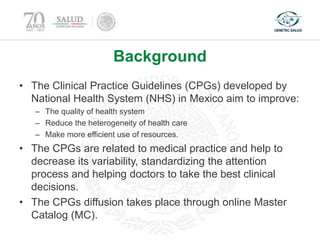
Background
• The Clinical Practice Guidelines (CPGs) developed by
National Health System (NHS) in Mexico aim to improve:
– The quality of health system
– Reduce the heterogeneity of health care
– Make more efficient use of resources.
• The CPGs are related to medical practice and help to
decrease its variability, standardizing the attention
process and helping doctors to take the best clinical
decisions.
• The CPGs diffusion takes place through online Master
Catalog (MC).
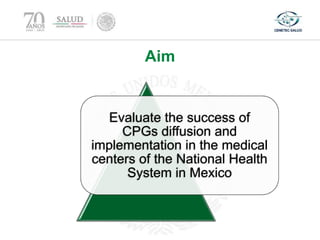
Aim
Evaluate the success of
CPGs diffusion and
implementation in the medical
centers of the National Health
System in Mexico
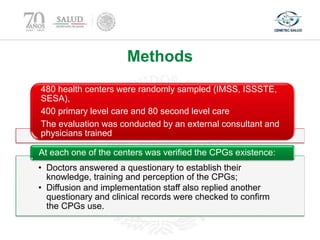
Methods
480 health centers were randomly sampled (IMSS, ISSSTE,
SESA),
400 primary level care and 80 second level care
The evaluation was conducted by an external consultant and
physicians trained
• Doctors answered a questionary to establish their
knowledge, training and perception of the CPGs;
• Diffusion and implementation staff also replied another
questionary and clinical records were checked to confirm
the CPGs use.
At each one of the centers was verified the CPGs existence:
Results
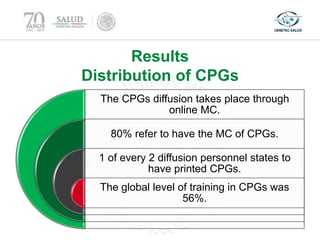
Distribution of CPGs
The CPGs diffusion takes place through
online MC.
80% refer to have the MC of CPGs.
1 of every 2 diffusion personnel states to
have printed CPGs.
The global level of training in CPGs was
56%.
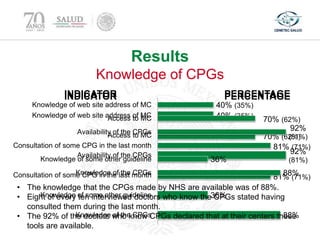
88%
36%
81% (71%)
92%
(81%)
70% (62%)
40% (35%)
Knowledge of the CPGs
Knowledge of some other guideline
Consultation of some CPG in the last month
Availability of the CPGs
Access to MC
Knowledge of web site address of MC
INDICATOR PERCENTAGE
Results
Knowledge of CPGs
Results
Perception of CPGs
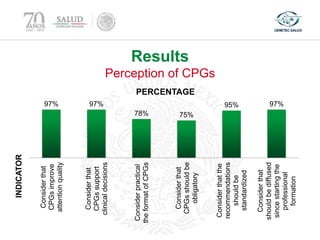
97% 97%
78% 75%
95% 97%
Considerthat
CPGsimprove
attentionquality
Considerthat
CPGssupport
clinicaldecisions
Considerpractical
theformatofCPGs
Considerthat
CPGsshouldbe
obligatory
Considerthatthe
recommendations
shouldbe
standardized
Considerthat
shouldbediffused
sincestartingthe
professional
formation
PERCENTAGE
INDICATOR
Results
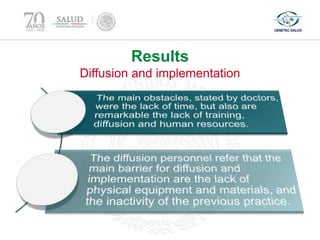
Diffusion and implementation
Results
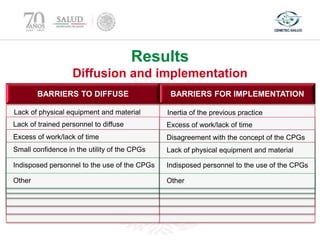
Diffusion and implementation
Lack of physical equipment and material
Lack of trained personnel to diffuse
Excess of work/lack of time
Small confidence in the utility of the CPGs
Indisposed personnel to the use of the CPGs
Other
Inertia of the previous practice
Excess of work/lack of time
Disagreement with the concept of the CPGs
Lack of physical equipment and material
Indisposed personnel to the use of the CPGs
Other
BARRIERS FOR IMPLEMENTATIONBARRIERS TO DIFFUSE
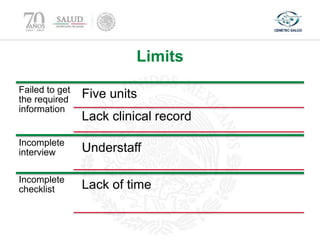
Limits
Failed to get
the required
information
Five units
Lack clinical record
Incomplete
interview Understaff
Incomplete
checklist Lack of time
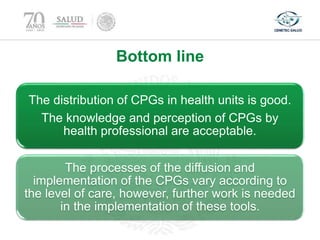
Bottom line
The distribution of CPGs in health units is good.
The knowledge and perception of CPGs by
health professional are acceptable.
The processes of the diffusion and
implementation of the CPGs vary according to
the level of care, however, further work is needed
in the implementation of these tools.
CENETEC-SALUD
THANKS
cenetec@salud.gob.mx
www.cenetec.salud.gob.mx
Cenetec-Salud
@cenetec

Assessing diffusion and Implementation of clinical practice guidelines in Mexico

  • 1.
    Sosa-García JO, Martínez-AldanaM, Puentes-Rosas E, Pineda-Pérez D, Hernández-Santillán D
  • 2.
    Background • The ClinicalPractice Guidelines (CPGs) developed by National Health System (NHS) in Mexico aim to improve: – The quality of health system – Reduce the heterogeneity of health care – Make more efficient use of resources. • The CPGs are related to medical practice and help to decrease its variability, standardizing the attention process and helping doctors to take the best clinical decisions. • The CPGs diffusion takes place through online Master Catalog (MC).
  • 3.
    Aim Evaluate the successof CPGs diffusion and implementation in the medical centers of the National Health System in Mexico
  • 4.
    Methods 480 health centerswere randomly sampled (IMSS, ISSSTE, SESA), 400 primary level care and 80 second level care The evaluation was conducted by an external consultant and physicians trained • Doctors answered a questionary to establish their knowledge, training and perception of the CPGs; • Diffusion and implementation staff also replied another questionary and clinical records were checked to confirm the CPGs use. At each one of the centers was verified the CPGs existence:
  • 5.
    Results Distribution of CPGs TheCPGs diffusion takes place through online MC. 80% refer to have the MC of CPGs. 1 of every 2 diffusion personnel states to have printed CPGs. The global level of training in CPGs was 56%.
  • 6.
    88% 36% 81% (71%) 92% (81%) 70% (62%) 40%(35%) Knowledge of the CPGs Knowledge of some other guideline Consultation of some CPG in the last month Availability of the CPGs Access to MC Knowledge of web site address of MC INDICATOR PERCENTAGE Results Knowledge of CPGs
  • 7.
    Results Perception of CPGs 97%97% 78% 75% 95% 97% Considerthat CPGsimprove attentionquality Considerthat CPGssupport clinicaldecisions Considerpractical theformatofCPGs Considerthat CPGsshouldbe obligatory Considerthatthe recommendations shouldbe standardized Considerthat shouldbediffused sincestartingthe professional formation PERCENTAGE INDICATOR
  • 8.
  • 9.
    Results Diffusion and implementation Lackof physical equipment and material Lack of trained personnel to diffuse Excess of work/lack of time Small confidence in the utility of the CPGs Indisposed personnel to the use of the CPGs Other Inertia of the previous practice Excess of work/lack of time Disagreement with the concept of the CPGs Lack of physical equipment and material Indisposed personnel to the use of the CPGs Other BARRIERS FOR IMPLEMENTATIONBARRIERS TO DIFFUSE
  • 10.
    Limits Failed to get therequired information Five units Lack clinical record Incomplete interview Understaff Incomplete checklist Lack of time
  • 11.
    Bottom line The distributionof CPGs in health units is good. The knowledge and perception of CPGs by health professional are acceptable. The processes of the diffusion and implementation of the CPGs vary according to the level of care, however, further work is needed in the implementation of these tools.
  • 12.