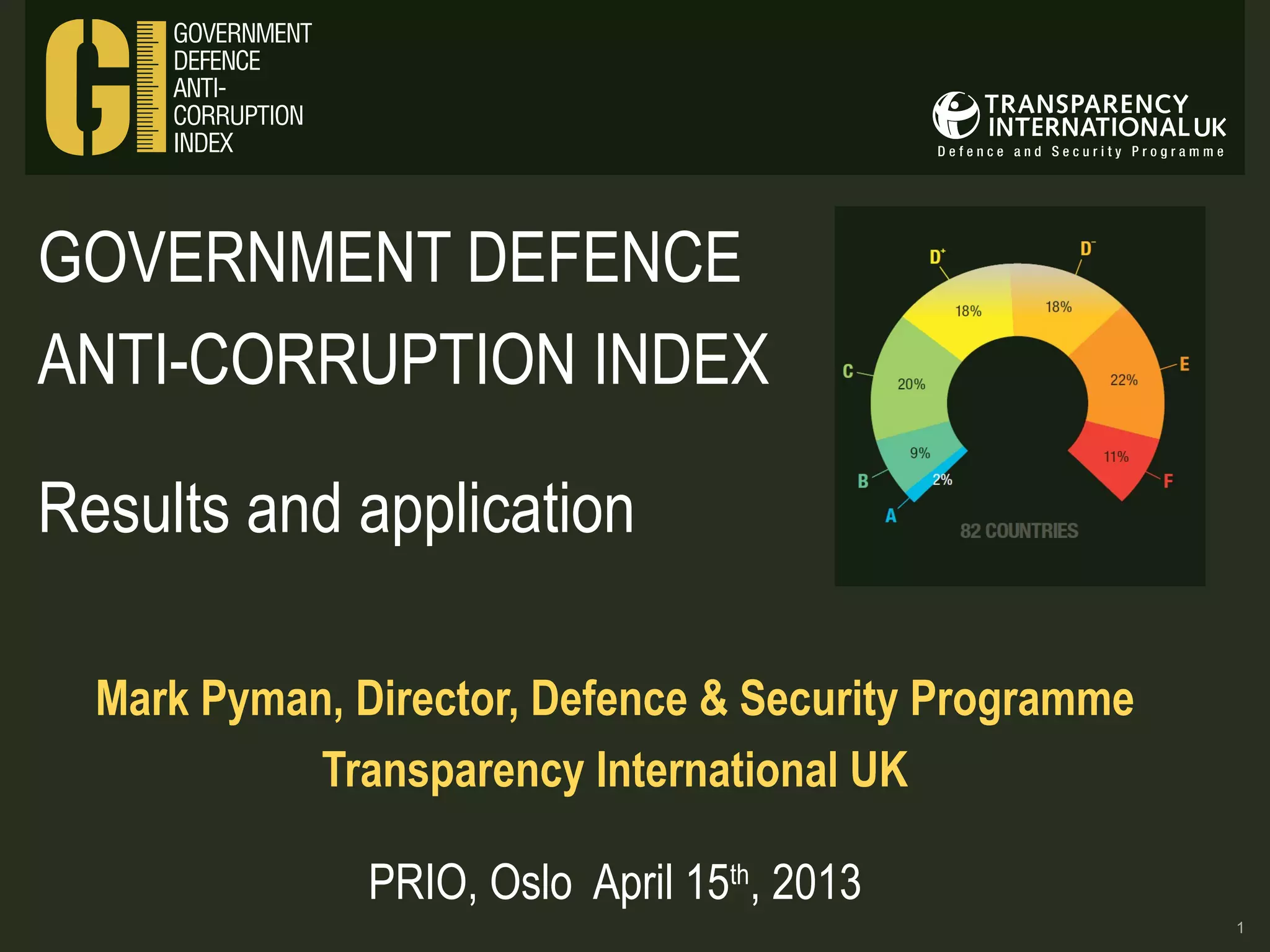
GOVERNMENT DEFENCE
ANTI-CORRUPTION INDEX
Results and application
Mark Pyman, Director, Defence & Security Programme
Transparency International UK
PRIO, Oslo April 15th, 2013
1
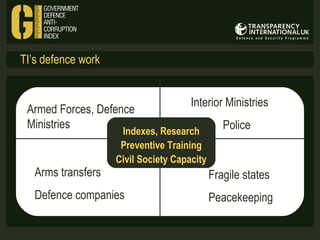
TI’s defence work

Armed Forces, Defence
Ministries

Arms transfers

Interior Ministries

Indexes, Research
Preventive Training
Civil Society Capacity

Defence companies

Police

Fragile states
Peacekeeping
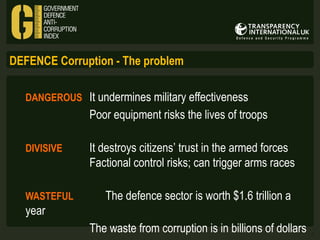
DEFENCE Corruption - The problem
DANGEROUS It undermines military effectiveness

Poor equipment risks the lives of troops
DIVISIVE

WASTEFUL

It destroys citizens’ trust in the armed forces
Factional control risks; can trigger arms races
The defence sector is worth $1.6 trillion a

year
The waste from corruption is in billions of dollars

3
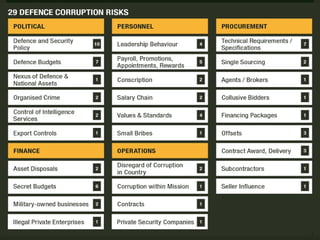
CORRUPTION RISKS IN DEFENCE

4
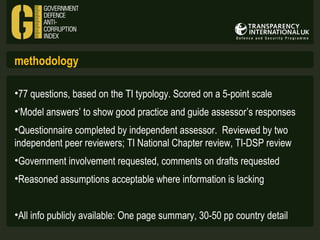
methodology
•77 questions, based on the TI typology. Scored on a 5-point scale
•‘Model answers’ to show good practice and guide assessor’s responses
•Questionnaire completed by independent assessor. Reviewed by two
independent peer reviewers; TI National Chapter review, TI-DSP review
•Government involvement requested, comments on drafts requested
•Reasoned assumptions acceptable where information is lacking
•All info publicly available: One page summary, 30-50 pp country detail
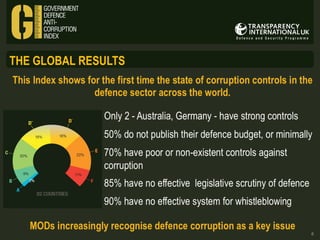
THE GLOBAL RESULTS

6
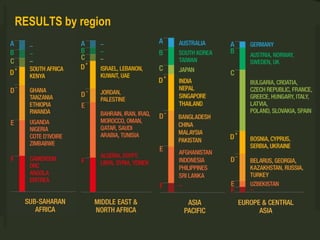
RESULTS by region
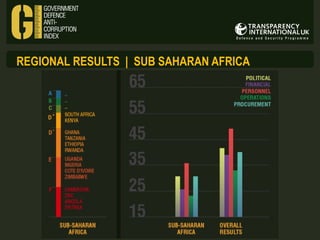
REGIONAL RESULTS | SUB-SAHARAN AFRICA
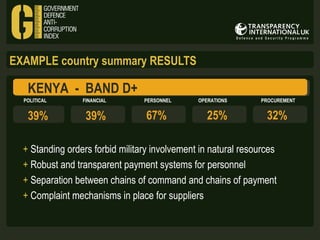
EXAMPLE country summary RESULTS

KENYA - BAND D+
POLITICAL

FINANCIAL

PERSONNEL

39%

39%

67%

OPERATIONS

25%

PROCUREMENT

32%

+ Standing orders forbid military involvement in natural resources
+ Robust and transparent payment systems for personnel
+ Separation between chains of command and chains of payment
+ Complaint mechanisms in place for suppliers
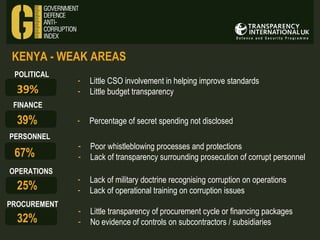
KENYA - WEAK AREAS
POLITICAL

39%

-

Little CSO involvement in helping improve standards
Little budget transparency

-

Percentage of secret spending not disclosed

-

Poor whistleblowing processes and protections
Lack of transparency surrounding prosecution of corrupt personnel

-

Lack of military doctrine recognising corruption on operations
Lack of operational training on corruption issues

-

Little transparency of procurement cycle or financing packages
No evidence of controls on subcontractors / subsidiaries

FINANCE

39%
PERSONNEL

67%
OPERATIONS

25%
PROCUREMENT

32%
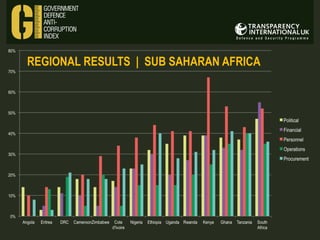
REGIONAL RESULTS | SUB SAHARAN AFRICA
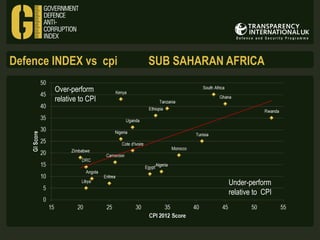
Defence INDEX vs cpi

SUB SAHARAN AFRICA

Over-perform
relative to CPI

Under-perform
relative to CPI
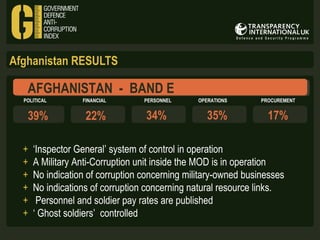
Afghanistan RESULTS

AFGHANISTAN - BAND E
POLITICAL

FINANCIAL

PERSONNEL

39%

22%

34%

+
+
+
+
+
+

OPERATIONS

35%

PROCUREMENT

17%

‘Inspector General’ system of control in operation
A Military Anti-Corruption unit inside the MOD is in operation
No indication of corruption concerning military-owned businesses
No indications of corruption concerning natural resource links.
Personnel and soldier pay rates are published
‘ Ghost soldiers’ controlled
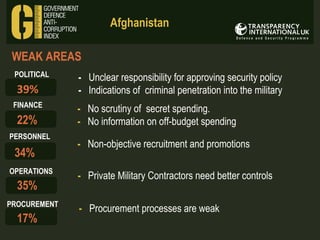
Afghanistan
WEAK AREAS
POLITICAL

39%
FINANCE

22%
PERSONNEL

34%
OPERATIONS

35%
PROCUREMENT

17%

- Unclear responsibility for approving security policy
- Indications of criminal penetration into the military
- No scrutiny of secret spending.
- No information on off-budget spending
- Non-objective recruitment and promotions
- Private Military Contractors need better controls
- Procurement processes are weak
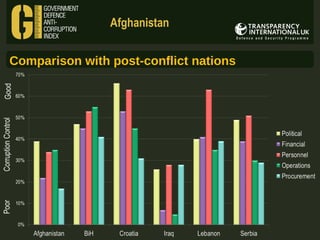
Afghanistan
Comparison with post-conflict nations
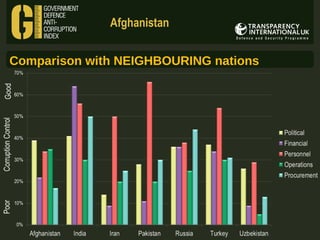
Afghanistan
Comparison with NEIGHBOURING nations
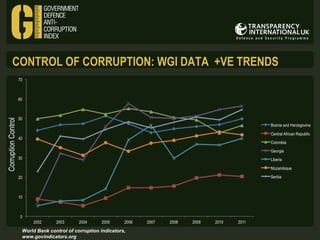
CONTROL OF CORRUPTION: WGI DATA +VE TRENDS

World Bank control of corruption indicators,
www.govindicators.org
MENA
THE REGION: RESULTS BY COUNTRY

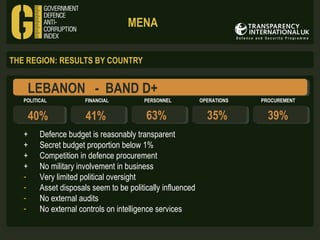
LEBANON - BAND D+
POLITICAL

40%
+
+
+
+
-

FINANCIAL

PERSONNEL

41%

63%

Defence budget is reasonably transparent
Secret budget proportion below 1%
Competition in defence procurement
No military involvement in business
Very limited political oversight
Asset disposals seem to be politically influenced
No external audits
No external controls on intelligence services

OPERATIONS

35%

PROCUREMENT

39%
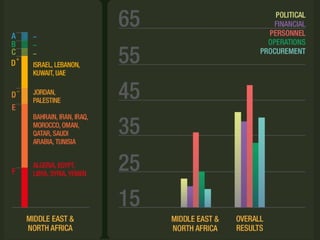
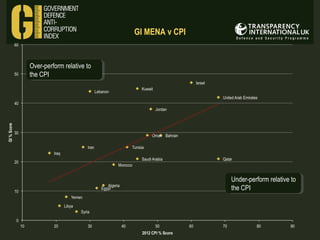
GI MENA v CPI

Over-perform relative to
the CPI

Under-perform relative to
the CPI
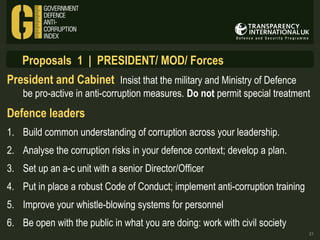
Proposals 1 | PRESIDENT/ MOD/ Forces
President and Cabinet Insist that the military and Ministry of Defence
be pro-active in anti-corruption measures. Do not permit special treatment

Defence leaders
1. Build common understanding of corruption across your leadership.
2. Analyse the corruption risks in your defence context; develop a plan.
3. Set up an a-c unit with a senior Director/Officer
4. Put in place a robust Code of Conduct; implement anti-corruption training
5. Improve your whistle-blowing systems for personnel
6. Be open with the public in what you are doing: work with civil society
21
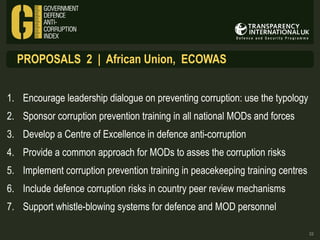
PROPOSALS 2 | African Union, ECOWAS
1. Encourage leadership dialogue on preventing corruption: use the typology
2. Sponsor corruption prevention training in all national MODs and forces
3. Develop a Centre of Excellence in defence anti-corruption
4. Provide a common approach for MODs to asses the corruption risks
5. Implement corruption prevention training in peacekeeping training centres
6. Include defence corruption risks in country peer review mechanisms
7. Support whistle-blowing systems for defence and MOD personnel
22
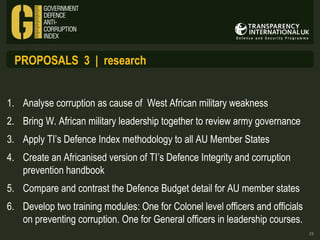
PROPOSALS 3 | research
1. Analyse corruption as cause of West African military weakness
2. Bring W. African military leadership together to review army governance
3. Apply TI’s Defence Index methodology to all AU Member States
4. Create an Africanised version of TI’s Defence Integrity and corruption
prevention handbook
5. Compare and contrast the Defence Budget detail for AU member states
6. Develop two training modules: One for Colonel level officers and officials
on preventing corruption. One for General officers in leadership courses.
23
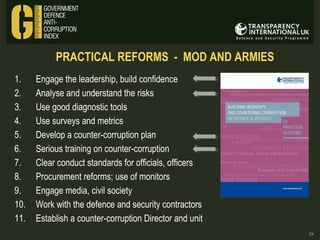
PRACTICAL REFORMS - MOD AND ARMIES
1.
2.
3.
4.
5.
6.
7.
8.
9.
10.
11.

Engage the leadership, build confidence
Analyse and understand the risks
Use good diagnostic tools
Use surveys and metrics
Develop a counter-corruption plan
Serious training on counter-corruption
Clear conduct standards for officials, officers
Procurement reforms; use of monitors
Engage media, civil society
Work with the defence and security contractors
Establish a counter-corruption Director and unit
24
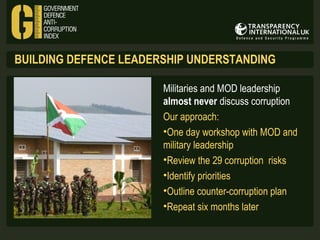
BUILDING DEFENCE LEADERSHIP UNDERSTANDING
Militaries and MOD leadership
almost never discuss corruption
Our approach:
•One day workshop with MOD and
military leadership
•Review the 29 corruption risks
•Identify priorities
•Outline counter-corruption plan
•Repeat six months later
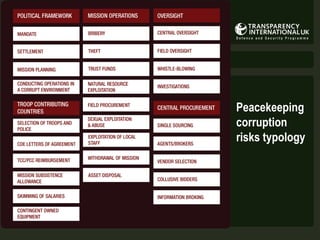
Peacekeeping
corruption
risks typology
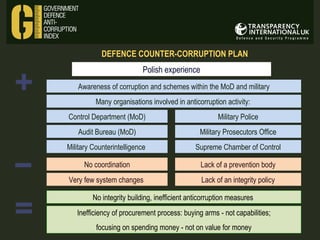
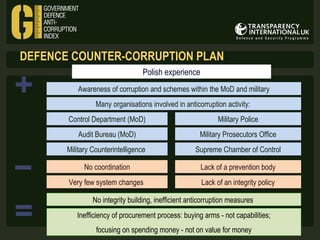
DEFENCE COUNTER-CORRUPTION PLAN

+

Polish experience
Awareness of corruption and schemes within the MoD and military
Many organisations involved in anticorruption activity:
Control Department (MoD)
Audit Bureau (MoD)

−
=

Military Police
Military Prosecutors Office

Military Counterintelligence

Supreme Chamber of Control

No coordination

Lack of a prevention body

Very few system changes

Lack of an integrity policy

No integrity building, inefficient anticorruption measures
Inefficiency of procurement process: buying arms - not capabilities;
focusing on spending money - not on value for money
DEFENCE COUNTER-CORRUPTION PLAN

+

Polish experience
Awareness of corruption and schemes within the MoD and military
Many organisations involved in anticorruption activity:
Control Department (MoD)
Audit Bureau (MoD)

−
=

Military Police
Military Prosecutors Office

Military Counterintelligence

Supreme Chamber of Control

No coordination

Lack of a prevention body

Very few system changes

Lack of an integrity policy

No integrity building, inefficient anticorruption measures
Inefficiency of procurement process: buying arms - not capabilities;
focusing on spending money - not on value for money
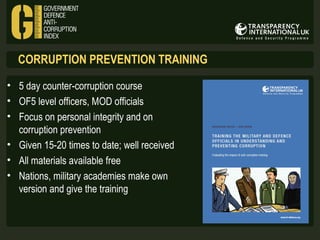
CORRUPTION PREVENTION TRAINING
• 5 day counter-corruption course
• OF5 level officers, MOD officials
• Focus on personal integrity and on
corruption prevention
• Given 15-20 times to date; well received
• All materials available free
• Nations, military academies make own
version and give the training
www.ti-defence.org
www.defenceindex.org
mark.pyman@transparency.org.uk

GI results and application: Presentation by Mark Pyman at PRIO

  • 1.
    GOVERNMENT DEFENCE ANTI-CORRUPTION INDEX Resultsand application Mark Pyman, Director, Defence & Security Programme Transparency International UK PRIO, Oslo April 15th, 2013 1
  • 2.
    TI’s defence work ArmedForces, Defence Ministries Arms transfers Interior Ministries Indexes, Research Preventive Training Civil Society Capacity Defence companies Police Fragile states Peacekeeping
  • 3.
    DEFENCE Corruption -The problem DANGEROUS It undermines military effectiveness Poor equipment risks the lives of troops DIVISIVE WASTEFUL It destroys citizens’ trust in the armed forces Factional control risks; can trigger arms races The defence sector is worth $1.6 trillion a year The waste from corruption is in billions of dollars 3
  • 4.
  • 5.
    methodology •77 questions, basedon the TI typology. Scored on a 5-point scale •‘Model answers’ to show good practice and guide assessor’s responses •Questionnaire completed by independent assessor. Reviewed by two independent peer reviewers; TI National Chapter review, TI-DSP review •Government involvement requested, comments on drafts requested •Reasoned assumptions acceptable where information is lacking •All info publicly available: One page summary, 30-50 pp country detail
  • 6.
  • 7.
    RESULTS by region REGIONALRESULTS | SUB-SAHARAN AFRICA
  • 8.
    EXAMPLE country summaryRESULTS KENYA - BAND D+ POLITICAL FINANCIAL PERSONNEL 39% 39% 67% OPERATIONS 25% PROCUREMENT 32% + Standing orders forbid military involvement in natural resources + Robust and transparent payment systems for personnel + Separation between chains of command and chains of payment + Complaint mechanisms in place for suppliers
  • 9.
    KENYA - WEAKAREAS POLITICAL 39% - Little CSO involvement in helping improve standards Little budget transparency - Percentage of secret spending not disclosed - Poor whistleblowing processes and protections Lack of transparency surrounding prosecution of corrupt personnel - Lack of military doctrine recognising corruption on operations Lack of operational training on corruption issues - Little transparency of procurement cycle or financing packages No evidence of controls on subcontractors / subsidiaries FINANCE 39% PERSONNEL 67% OPERATIONS 25% PROCUREMENT 32%
  • 10.
    REGIONAL RESULTS |SUB SAHARAN AFRICA
  • 11.
    REGIONAL RESULTS |SUB SAHARAN AFRICA
  • 12.
    Defence INDEX vscpi SUB SAHARAN AFRICA Over-perform relative to CPI Under-perform relative to CPI
  • 13.
    Afghanistan RESULTS AFGHANISTAN -BAND E POLITICAL FINANCIAL PERSONNEL 39% 22% 34% + + + + + + OPERATIONS 35% PROCUREMENT 17% ‘Inspector General’ system of control in operation A Military Anti-Corruption unit inside the MOD is in operation No indication of corruption concerning military-owned businesses No indications of corruption concerning natural resource links. Personnel and soldier pay rates are published ‘ Ghost soldiers’ controlled
  • 14.
    Afghanistan WEAK AREAS POLITICAL 39% FINANCE 22% PERSONNEL 34% OPERATIONS 35% PROCUREMENT 17% - Unclearresponsibility for approving security policy - Indications of criminal penetration into the military - No scrutiny of secret spending. - No information on off-budget spending - Non-objective recruitment and promotions - Private Military Contractors need better controls - Procurement processes are weak
  • 15.
  • 16.
  • 17.
    CONTROL OF CORRUPTION:WGI DATA +VE TRENDS World Bank control of corruption indicators, www.govindicators.org
  • 18.
    MENA THE REGION: RESULTSBY COUNTRY LEBANON - BAND D+ POLITICAL 40% + + + + - FINANCIAL PERSONNEL 41% 63% Defence budget is reasonably transparent Secret budget proportion below 1% Competition in defence procurement No military involvement in business Very limited political oversight Asset disposals seem to be politically influenced No external audits No external controls on intelligence services OPERATIONS 35% PROCUREMENT 39%
  • 20.
    GI MENA vCPI Over-perform relative to the CPI Under-perform relative to the CPI
  • 21.
    Proposals 1 |PRESIDENT/ MOD/ Forces President and Cabinet Insist that the military and Ministry of Defence be pro-active in anti-corruption measures. Do not permit special treatment Defence leaders 1. Build common understanding of corruption across your leadership. 2. Analyse the corruption risks in your defence context; develop a plan. 3. Set up an a-c unit with a senior Director/Officer 4. Put in place a robust Code of Conduct; implement anti-corruption training 5. Improve your whistle-blowing systems for personnel 6. Be open with the public in what you are doing: work with civil society 21
  • 22.
    PROPOSALS 2 |African Union, ECOWAS 1. Encourage leadership dialogue on preventing corruption: use the typology 2. Sponsor corruption prevention training in all national MODs and forces 3. Develop a Centre of Excellence in defence anti-corruption 4. Provide a common approach for MODs to asses the corruption risks 5. Implement corruption prevention training in peacekeeping training centres 6. Include defence corruption risks in country peer review mechanisms 7. Support whistle-blowing systems for defence and MOD personnel 22
  • 23.
    PROPOSALS 3 |research 1. Analyse corruption as cause of West African military weakness 2. Bring W. African military leadership together to review army governance 3. Apply TI’s Defence Index methodology to all AU Member States 4. Create an Africanised version of TI’s Defence Integrity and corruption prevention handbook 5. Compare and contrast the Defence Budget detail for AU member states 6. Develop two training modules: One for Colonel level officers and officials on preventing corruption. One for General officers in leadership courses. 23
  • 24.
    PRACTICAL REFORMS -MOD AND ARMIES 1. 2. 3. 4. 5. 6. 7. 8. 9. 10. 11. Engage the leadership, build confidence Analyse and understand the risks Use good diagnostic tools Use surveys and metrics Develop a counter-corruption plan Serious training on counter-corruption Clear conduct standards for officials, officers Procurement reforms; use of monitors Engage media, civil society Work with the defence and security contractors Establish a counter-corruption Director and unit 24
  • 25.
    BUILDING DEFENCE LEADERSHIPUNDERSTANDING Militaries and MOD leadership almost never discuss corruption Our approach: •One day workshop with MOD and military leadership •Review the 29 corruption risks •Identify priorities •Outline counter-corruption plan •Repeat six months later
  • 26.
  • 27.
    DEFENCE COUNTER-CORRUPTION PLAN + Polishexperience Awareness of corruption and schemes within the MoD and military Many organisations involved in anticorruption activity: Control Department (MoD) Audit Bureau (MoD) − = Military Police Military Prosecutors Office Military Counterintelligence Supreme Chamber of Control No coordination Lack of a prevention body Very few system changes Lack of an integrity policy No integrity building, inefficient anticorruption measures Inefficiency of procurement process: buying arms - not capabilities; focusing on spending money - not on value for money
  • 28.
    DEFENCE COUNTER-CORRUPTION PLAN + Polishexperience Awareness of corruption and schemes within the MoD and military Many organisations involved in anticorruption activity: Control Department (MoD) Audit Bureau (MoD) − = Military Police Military Prosecutors Office Military Counterintelligence Supreme Chamber of Control No coordination Lack of a prevention body Very few system changes Lack of an integrity policy No integrity building, inefficient anticorruption measures Inefficiency of procurement process: buying arms - not capabilities; focusing on spending money - not on value for money
  • 29.
    CORRUPTION PREVENTION TRAINING •5 day counter-corruption course • OF5 level officers, MOD officials • Focus on personal integrity and on corruption prevention • Given 15-20 times to date; well received • All materials available free • Nations, military academies make own version and give the training
  • 30.

Editor's Notes

  • #29 Moving on… No progress can be made without an anti-corruption plan. Some years ago we worked with the Polish armed forces, who have taken significant initiatives against corruption. This slide is their description of the point from which they started. On the positive side, there was awareness of corruption within the MOD, and many organisations with some responsibility for anti-corruption activity. On the other hand, there was no coordination, no focus on prevention, very few changes to the existing system and processes, and no focus on building integrity. The end result was: no strengthening of institutional capability and great inefficiency, especially in procurement. Their analysis of the corruption risks was that two of them were much more important than the others. Corruption in high-value procurement, and the engagement of senior officers in that corruption. Based on this analysis, they developed their plan and instituted, successfully, a number of changes.