Best practice and key themes in global human
      resource management: project report

                           24 November 2006


         Cambridge University: Philip Stiles and Jonathan Trevor

         Erasmus / Tilburg University: Jaap Paauwe and Elaine Farndale

         Cornell University: Patrick Wright and Shad Morris

         INSEAD: Guenter Stahl and Ingmar Bjorkman


                                                        Sponsored in full by


1 / 52
Contact details:

Dr. Philip Stiles
Judge Business School
University of Cambridge
T: 01223 339 700
E: p.stiles@jbs.cam.ac.uk

Dr. Jonathan Trevor
Judge Business School
University of Cambridge
T: 01223 339 700
E: jpt28@cam.ac.uk


2 / 52
Table of Contents
    i. HR practices................................................................................................................ 4
    ii. Employee relations...................................................................................................... 6
    iii. The HR function ........................................................................................................ 6
    iv. Knowledge management ............................................................................................. 7
    The study methodology ................................................................................................... 7
    Convergence .................................................................................................................. 7

2. TALENT MANAGEMENT .......................................................................................... 10
   Recruitment, selection, and succession planning .............................................................. 10
   Emphasis on global branding to attract top talent.............................................................. 12
   Strong commitment to training and development.............................................................. 13
   Multi-level approaches to talent retention ........................................................................ 15
   Talent management in emerging markets......................................................................... 17

3. PERFORMANCE MANAGEMENT ............................................................................... 19
    Global performance management ................................................................................... 19
    Management of potential ............................................................................................... 21

4. REWARD MANAGEMENT .......................................................................................... 23
    Performance contingent pay........................................................................................... 23
    Market benchmarking and positioning ............................................................................ 24
    Total rewards models .................................................................................................... 25
    Flexible benefits ........................................................................................................... 25

5. EMPLOYEE RELATIONS............................................................................................. 27
    Employee relations best practice..................................................................................... 27
    Trade union recognition................................................................................................. 29
    Direct communication channels...................................................................................... 30
    Fit between employee relations policy and corporate goals................................................ 31

6. ORGANISATIONAL CULTURE AND HRM.................................................................. 33
   Emphasis on attitudes and cultural fit in the selection process............................................ 33
   Secondary socialization and training ............................................................................... 34
   Rewarding employees for displaying shared values .......................................................... 36
   Alignment is critical...................................................................................................... 38

7. HR FUNCTIONAL EXCELLENCE................................................................................ 39
   The roles of corporate and subsidiary HR departments...................................................... 39
   Monitoring HR department effectiveness ........................................................................ 40
   HRM delivery mechanisms............................................................................................ 42

8. KNOWLEDGE MANAGEMENT................................................................................... 44
   Common human capital practices ................................................................................... 45
   Unique human capital practices ...................................................................................... 46
   Common social capital practices..................................................................................... 46
   Unique social capital practices ....................................................................................... 48
   Common organizational capital practices ........................................................................ 48
   Unique organizational capital practices ........................................................................... 49
   Geographic notes .......................................................................................................... 49

9. CONCLUSION ............................................................................................................ 51


3 / 52
1. PROJECT OVERVIEW

How do global organizations manage their people? Both executives and academics
believe that human capital management and investment is essential to the
competitiveness of firms, but there is a wide variation of opinion about how best these
complex organizational activities are implemented in practice. The work presented in
this report, conducted by the Global Human Resource Research Alliance (GHRRA) –
a team comprising researchers from the universities of Cambridge, Cornell,
Erasmus/Tilburg and INSEAD – reveals a number of innovative practices pioneered
by an outstanding group of international companies, a raft of leading or `best’
practices that are common across many companies, and certain practices that are
unique.

We have found the organizations which are performing well in terms of people
management combine strong discipline in human capital management with attention
to the importance of social capital – the building of relationships and networks within
the organization – and organizational capital – the structure and culture of the firm.
The reinforcing or multiplier effects of this combination creates inimitable conditions
for the management of people and drives more than just HR excellence but also
knowledge management, employee engagement and workforce adaptability.

As well as human resource practices and processes, our focus also turned to the role
of the HR function itself. We found this also varied in terms of its power and
influence and structure, but common to most of our companies was the HR function’s
role in setting global standards for HR practice, particularly in relation to
performance, resourcing and the development of a high potential cadre and in
managing the careers and rewards of the senior executive team.

In this section, we highlight the major themes to emerge from the study. We will look
the key findings from the areas of HR practices, employee relations, HR functional
excellence, and knowledge management within the HR community. We then explain
how the study was conducted, and conclude with our view on the issue of
convergence of HR practice and process across national cultures.

These areas will be mirrored in Part I of the report and given extensive detail from the
case companies supplemented by the findings in Part 2 of the report of a web based
survey of executive opinion in global organizations, within which we examined major
HR practices, including staffing, performance management, rewards, development,
and career management, HR delivery and knowledge and learning.

i. HR practices

In staffing, the importance of aligning individuals to the values of the company is
highlighted by the practice of values-based interviewing – where specific attention is
paid to identifying whether the individual’s attitudes will match the values of the
organization. In some companies, scanning for talent occurs even in the absence of a
specific vacancy. Talent inventories are used for both selection and succession
purposes, and the continuous process of developing a ‘talent pool’ - recruiting the best
people and assigning them roles rather than hiring specific individuals for specific
positions - are best practice. Sophisticated employee on-boarding practices with on-


4 / 52
line provision and buddy systems in place in a number of firms to welcome and induct
new members and active feedback sessions are provided to understand where the new
employee is in terms of their familiarity and development within the organization.

Employee referrals (the practice of existing staff recommending individuals to the
organisation) have become a common approach, reducing cost of recruitment and also
helping to ensure cultural fit.

In performance management, participative goal setting, with both work and
development goals, based generally around balanced scorecard initiatives, provide a
direct link to strategic objectives. Multiple inputs at the appraisal, with most 360
approaches now managed on-line are common for at least mid-level managers and
above, and with bi-annual formal reviews and constant informal feedback, often on a
daily basis, to ensure projects/workload is on track and to ensure adequate resources
are being given where appropriate. Developmental focus in the appraisal is a given.
The developmental and pay reviews are split in all cases, and the line of sight to
rewards is clear in most firms through the use of performance/potential matrices.
Forced ranking is in evidence in a number of companies, though was by no means the
norm whereas calibration of performance outcomes by central HR and senior
management ensuring a fair distribution is seen across most of the sample companies.

Rewards in nearly all cases were managed with both group and individual elements in
pay determination. The move to greater variable pay as a percentage of total
compensation is in evidence across companies in all geographies. In some companies,
vestiges of tenure-based pay remained but this was rare. For managerial staff,
companies have pay for performance and flexible benefits and in some cases,
employee equity ownership schemes, though in some cases ESOPs have been
discontinued as not generating sufficient motivation. For senior managers, long-term
incentive programs are in place across all companies. For collective bargaining
purposes, pay forums and trade union negotiation for annual pay rounds remain a
major part of the reward and employee relations landscape. Care is taken to balance
social and economic rewards; an emphasis on adherence to cultural norms with
recognition events, leadership visibility and symbolic ceremonies are highlighted.
Annual excellence awards and recognition schemes in general are the norm.

In development, the prevalence of coaching initiatives is evident, aligned typically to
transformational leadership initiatives aimed at instilling leadership qualities
throughout the firm. For high potentials, the provision of strategic projects of a short-
term nature, often international in scope, to assess potential, are common. A major
issue is to get the company’s `bench-strength’ up to acceptable levels, and for most
key roles, to have at least one individual who could step into the shoes of the
incumbent should the need arise.

The presence of academies (at country and at group level) and corporate universities
is prevalent, to co-ordinate learning and development. Self-managed learning through
on-line provision of content is also common. A number of organizations also spread
their reach towards linkages with academia in terms of industry partnerships for
innovation and for developmental experiences, such as international specialist
programs for high potential individuals.


5 / 52
ii. Employee relations

The organizations in our sample are from a variety of sectors but face similar
challenges, in particular; fast-paced environments, increasing customer sophistication,
the need for innovation and also the need for cost-efficiency. Though the companies
in our group are among the best in the world, they are not immune from downsizing,
restructuring, and we encountered issues of employee relations conflict, particularly
linked to concerns about headcount reduction and off-shoring practices, and the flip
side of commitment, work intensification and an employer- biased work-life balance.

Partnership arrangements between unions and management are common but a wide
variation in practice emerges, depending on whether the partnership is one of true
consultation or on a telling and informing basis. Centralised vs. localised bargaining
represents, in most cases, an uneasy balance, and the pervasiveness of HR practices
has not dislodged the need for IR.

In some countries, for example, Japan, Germany and the Netherlands, works councils
are the norm, and for these organizations, a centralized union strategy generally
coexists with local union relationships at divisional or business unit level. In some
companies, non-unionism is an integral part of the company strategy.

Employee voice is considered important in all companies, and examples of initiatives
include monthly management meetings, quarterly town hall meetings, the employee
satisfaction survey and suggestion schemes.

iii. The HR function

The companies in our sample have adopted similar forms of administrative HR
provision, such as shared services, HR intranets, self-service HR, and, to a lesser
extent, outsourced HR, all enabled by significant advances in administrative processes
and information-capture technology. These moves have been made in the interests of
efficiency gains and also for the purpose of enabling a smaller core of HR staff to
pursue more `strategic’ activity. For this strategic work, there are a number of
examples of HR as internal consultants, aiming to add value through thought
leadership, particularly around issues of change and also process expertise. The HR
director tends to be a member of the executive committee of the organization, which
is an important structural signifier for the value of HR. There is recognition in the
organizations that `change readiness’ in employees is important for the revitalisation
of the firm. Therefore the centrality of the HR function is crucial. Talent management
as an overarching concern, ensuring the linkages between component parts of staffing,
performance management and development are aligned, shows the importance of
managing the system of practices. The understanding of labour force demographics
and the implications for the talent pool is held to be crucial for long-term advantage
by many of the companies. The HR strategy looking at both short-term and long-term
trends is usually downstream from the business strategy, and one issue that
consistently emerges is the lack of real depth in viewing the long-term, particularly in
terms of labour market scanning.

The performance of the HR function is measured largely in terms of employee and
customer satisfaction feedback metrics. Financial indicators such as return on


6 / 52
investment for HR activities are also systematically used across the companies, but
are universally recognised as a limited measure of functional effectiveness. The
background of the HR function is increasingly for HR managers to have had line
experience.

iv. Knowledge management

How knowledge created and diffused is a subject of high importance in the sample
organizations. Surprisingly, there are few explicit attempts to develop knowledge
strategies. Where there are systematic attempts to manage knowledge within the
organization, it is based on electronic connectivity (intranets, knowledge-management
systems) allied to a communities of practice approach with incentives geared to
ensuring the sharing of information gathered from key clients. We saw few metrics in
place to assess whether knowledge was being captured and transferred. In other
formal structural terms, there are recognised meetings, for example, annual
conferences of senior managers, and regular (quarterly in some cases) gatherings face-
to-face of global HR personnel to facilitate knowledge sharing. Cross functional
working and decision-making structures were common. People exchange within
corporate HQ and businesses is also used, and so too benchmarking best practice,
though this is so only in a few companies on a formal basis. The development of
networks outside the organisation, through membership of industry clubs, consortia,
interlocking directorships, and integration of suppliers and customers into the design
and production processes adds depth to the knowledge-base.

The study methodology

Case studies

The research examined 19 companies in-depth, using interviews with multiple
members at different levels to tap into the ways that employees understand their
context and experience of HR and how they communicate that understanding among
themselves and to others. Interviews took place at corporate level, regional level and
country level. HR members were interviewed, and also a sample of senior managers
and line managers. Approximately 15-20 interviews per case were conducted. The
companies were selected on the basis of their international scope.

Survey

A second stage of research was a web-based survey. The total number of companies
taking part in this phase was 20 multinationals, with 263 participants responding in
total from three major geographic regions (Americas, Asia-Pacific, and EMEA –
Europe, Middle-East and Africa). The survey contained items on six key HR practice
areas (staffing, training and development, appraisal, rewards, employee relations and
leadership and succession), the HR delivery mechanisms (including the use and
effectiveness of outsourcing, shared services, web-based HR, off-shoring and on-
shoring), local leadership and knowledge management (for full details of the method
and sample in the survey, see section II)

Convergence


7 / 52
A major challenge for this work on international HR is to identify possible `best
practices' in light of certain organizational and societal contexts. We have been struck
by the convergence of practice across different national contexts and across different
industries / sectoral contexts. The similarity of approaches to the organization of HR
and HR practices across our companies indicates the similarity of the challenges and
demands on international business which prompt a similar response in HR design and
delivery. Also, the presence of a small number of excellent companies has generated
imitative behaviour, while the work of high profile consultancies has spread ideas and
common approaches to such issues as performance management, HR function design
and organization structure.

The core activities associated with high performance HR, for example, selective
recruitment, developmental appraisal, pay for performance, strong emphasis on
development, employee voice mechanisms, appeared throughout the sample.
However, there were often significant differences beneath this `architectural’ level of
practice. In collectivist cultures, the targeting of individuals through pay or
recognition initiatives is not pursued, rather group-based approaches are used, though
there are signs, particularly in our Japanese companies, that this is beginning to
weaken.

Employment legislation within particular countries, especially with regard to union
representation, remains a significant differentiator in terms of HR approach. Though
there is a trend towards the decentralisation of collective bargaining, the presence of
unions in countries such as the Netherlands, Germany and Japan remains strong and
determines to a large extent the nature of the employment relationship within
organizations.

A central issue for all companies in our sample is how to control the organization,
both in terms of HR function structure and also in terms of HR practice determination.
There is variation in terms of approach, with, for example, Oracle representing high
degree of centralisation with little local discretion, and SANYO allowing highly
autonomous local operations. A mid-way is represented by firms such as Rolls Royce
and BAE Systems, who actively promote HR process excellence, the design and
delivery of common processes, but with local ability to tailor these processes. IKEA
stands out in the sample with its culture-driven philosophy, with actual practices not
monitored or controlled from the centre overtly, but through the inculcation of strong
cultural and behavioural norms.’

Areas of global focus for most of the companies include senior management
development, high potential identification and development, and competency
frameworks to ensure consistency of staffing approaches, and common performance
management criteria. A key area is also the global brand and values of the company,
and how these drive the HR philosophy and delivery. We saw a number of examples
where companies have moved beyond the traditional rhetoric of values and culture to
put real substance and meaning into the employment contract. The integration of
values and cultural imperatives into the employment relationship is a major factor in
developing employee commitment, which in turn drives the recruitment and retention
of best talent.


8 / 52
The ways in which multinationals configure their human resource management and
transfer HR practice across businesses and overseas is a key element in the efficiency
and effectiveness of organizations. A number of issues are raised: what is the
relationship between corporate HQ and the region/country? What is required to
deliver a coherent and acceptable HR approach across a multinational? And how is
knowledge and learning transferred?

In this report, we examine these issues in more detail, giving highlights from the
major areas of the research. Running beneath this is the recognition that for HRM to
be effective, it is not enough to have strong practices and systems in place. There
must also be the commitment of key constituencies to engage with HR and make it
live. Senior managers and line managers must adopt and implement HR practice and
embed it within the organization. Such commitment will influence how aligned HR
can become both with strategy and with the links between individual HR practices.

The report first examines the major practice areas of talent and performance
management before broadening out to assess the key elements of employee relations,
organisational culture, HR functional excellence and knowledge management.


9 / 52
2. TALENT MANAGEMENT

Increasingly, companies view the ability to manage talent effectively as a strategic
priority, and there was a high degree of sophistication about this activity among the
companies in our sample. In all companies there are systems in place which identify
high potential individuals using clear sets of leadership competencies and validated
assessment instruments. These individuals are given a variety of developmental
activities, from training, coaching, mentoring, projects, and international assignments,
and they are placed on a talent inventory that matches prospective jobs to high
potential individuals. Companies have adopted multiple approaches to retain valued
talent, including financial incentives, personalized career plans, mentorship programs,
and flexible work arrangements, and they place great emphasis on diversity and work-
life balance in order to compete for the best talent and retain high potential
employees. In the following sections, we discuss a range of issues related to the
management of talent: recruitment and selection; global branding; training and
development; retention; and talent management in emerging markets.

Recruitment, selection, and succession planning

Recruitment practices in most companies follow a talent pool strategy where the
company first recruits the best people and then places them into positions rather than
trying to recruit specific people for specific positions. The companies in our sample
recruit talent through a variety of channels, including external job posting and direct
application through the internet, on-campus recruitment fairs, summer internship
programs, and so on. Companies are generally very selective in hiring, which requires
a large applicant pool from which to select and highly efficient and standardized
selection processes. For example, the fast-growing Indian information technology and
software giant Infosys, now the world’s leading IT outsourcing company, has
developed a robust rolling recruitment process that allowed the company to grow in
the last five years from about 10,000 to 66,000 people. In 2005, despite the increasing
competition for software engineers in India, Infosys received almost one and half
million job applications, tested about 160,000 candidates, and hired 15,000 – the top
1% of applicants. Given their keenness to recruit only the very best people and their
selectivity in hiring, Infosys and most other companies in the sample place great
emphasis on global branding to improve their attraction and position themselves as
employer of choice.

Most companies try to identify leadership talent early and have put systems in place
which identify high potential individuals using clear sets of leadership competencies
and validated assessment instruments. Potential is generally assessed using multiple
inputs, including performance evaluations, 360 degree feedback systems, and
assessment centre results. A smaller number of companies use standardized aptitude
tests or try to assess individuals’ personal values to determine the fit with the
company culture. Assessment of leadership potential usually entails grading
employees against a competency profile of successful leaders. IBM, for example,
conducted a comprehensive research effort to identify the characteristics that
distinguish outstanding business leaders inside the company. As a result, 11
leadership competencies unique to IBM were identified along with the behaviors that
demonstrate the competencies for all levels of management, including senior
executives. Some companies use externally benchmarked competency profiles. At

10 / 52
10
ABB, for example, the leadership development process begins with building a
competency profile of an individual manager, using a leadership competency profile
developed by a global executive search firm, and comparing this with the job profile
for that person. An individual development plan is then created to fill any gaps
identified. This is a separate process to that of performance appraisal and reward
discussions.

The continuous process of developing a ‘talent pool’ and the use of talent inventories
were best practice, used for both selection and succession purposes. For example,
Procter & Gamble’s Talent Development System holds names of 3,000 executives
along with details of their backgrounds so as to help identify the right person for the
right job. At ABB, the information gathered through the talent management program
is stored on a global IS tool which provides real-time management reporting facilities
based on the data stored. This enables both within country and between country
comparative data analysis. The tool is also used for storing appraisal, career plan and
development plan information and to record international assignments. The same tool
is used for succession planning, providing a global overview of the key management
positions, who holds them and who the potential successors are. Potential successors
are assessed both by their line manager and against an externally benchmarked
leadership competency profile. The profiles of the top 50 managers have been
compiled to construct a talent management portfolio of the top level of the company.
This provides a platform for comparing talent pools both internally and externally
against the benchmarks. Combined with an open job-posting system and external
scanning, the availability of a pool of high-potential candidates known by members of
the senior management team greatly facilitates succession planning.

In most companies, employees identified as ‘high potentials’ are included in
mentoring programs lead by senior managers and job rotation schemes to ensure the
opinion of more than one manager is gained on a person’s potential. How many of the
talented individuals identified through this process eventually make it on the high
potentials list, however, differs across companies. Most of the companies that we
studied seemed to have followed McKinsey’s suggestion that the group of ‘A players’
– the most talented individuals in whose recruitment, development and retention
companies should heavily invest – should be comprised of no more than 10-15
percent of managers or employees identified as having leadership potential. For
example, Unilever, the British-Dutch consumer products group, puts up to 15 percent
per management level on to the high potentials list each year, which means that these
people should move on to the next management level within five years. There is also a
separate list which recognizes people for sustained high performance, but who are not
appropriate to move to the next management level. This list can contain a maximum
of 10 percent of the population of staff. Some companies are even more selective.
Infosys, for example, tries to keep the number of high potentials small to avoid
inflated expectations that may lead to frustration, lack of productivity and ultimately
loss of talent. Only 500 (less than 1 percent) of the Indian information technology
firm’s 66,000 employees are designated as ‘high potentials’ and further grouped into
three tiers based on the expected time needed to transition to top management roles.
The creation of different talent pools (e.g., senior executive high potential pool;
specialist high potential pool; early career high potential pool), with different career
paths and leadership development strategies in place, was another best practice
identified in our study.

11 / 52
11
Emphasis on global branding to attract top talent

As competition for talent is heating up in many industries, companies are trying to
create a compelling “employee value proposition” and sharpen the way they market
themselves to recruits in order to attract the best talent. A strong focus on global
branding and the development of close ties with leading universities through
recruitment fairs, internships, and so on, to position the company as an employer of
choice emerged as a best HR practice in our study. For example, one of the reasons
why Infosys, the world’s leading IT outsourcing company, has grown so rapidly while
upholding the quality of the talent recruited is because of their excellent corporate
image and a culture based on principles highly valued by knowledge workers, such as
professional freedom, innovativeness and opportunities to learn.

Selectivity in recruiting and a strong emphasis on attitudes and cultural fit require not
only efficient and validated selection processes, but also a large applicant pool from
which to hire. Infosys is a case in point. In 2005, despite the increasing competition
for software engineers in India and worldwide, Infosys received almost one and half
million job applications, tested about 160,000 candidates, made offers to 21,000, and
hired 15,000 – the top 1% of applicants, not only in terms of ability and qualification
but also in terms of cultural fit. The way that Infosys has managed to increase hiring
so rapidly while upholding the quality of the talent recruited is through their their
excellent corporate image and a culture based on principles highly valued by
knowledge workers, such as professional freedom, openness, innovativeness and
opportunities to learn. Infosys has been taking several steps to improve its brand
attraction and to develop and sustain an appropriate talent pipeline. As a community
development effort, Infosys has initiated a program named “Catch them young”,
where school students are selected and trained for a month by Infosys and then
offered a project for 2 months within Infosys under the guidance of an Infoscion. In
rural areas the “Catch them young” program has conducted computer awareness
program in local language to build awareness on computer use and remove any fears
of high tech equipment amongst school children. Though not initially directed at
recruitment, the “Catch them young” program is considered an effective strategy for
enlarging the pool of IT-literate and Infosys-devoted students in India, which on the
long term may reduce the pressure for finding talented software engineers. As another
example, Infosys’s global internship program, InStep, attracts students from the best
universities across the globe and has branding as a primary intent. In 2005, it handled
over 8500 applications to select 69 interns of 22 nationalities to stay between 2-3
months. The branding is intended at increasing Infosys’s attractiveness to potential
candidates in other parts of the world besides India. Despite all these efforts, the
Infosys top management believes that the recruiting efforts are just sufficient for now
and that additional branding efforts and new initiatives are needed to expand and tap
into the worldwide talent pool.

A strong focus on global branding and the development of close ties with leading
universities through recruitment fairs, internships, etc., to position the company as an
employer of choice in order to attract the best talent emerged as a best HR practice in
our study. At Shell, for example, there exists one global branding for HR excellence
and two to three global practices or processes for all businesses. The brand consists of
pushing forward the notion of talent being Shell’s number one priority. The brands

12 / 52
12
and global practices are transmitted through the company’s IT systems. Each business
is to take the global brand and practice and apply them locally. In order to attract and
develop diverse talent, local Shell businesses work closely with governments and
universities in countries in which they operate to ensure that the countries’ engineers,
scientists, and managers are trained proficiently for possible recruitment.

Some companies see improved brand attraction as a welcome “side effect” of their
philanthropic activities. For example, GlaxoSmithKline, the pharmaceuticals giant
that has led the way in discount pricing for the poor, seeks to capitalise upon its
‘employment brand’ and excellent reputation with regular promotions within the press
and at key recruitment locations. Jean-Pierre Garnier, the CEO, stresses the
importance of GSK’s philanthropic activities in increasing the attractiveness of the
company among potential recruits and providing an inspiring mission to the
employees: “GSK is big in philanthropic undertakings; we spend a lot of money with
a very specific goal in mind, such as eradicating a disease. … [O]ur scientists, who
are often very idealistic, follow this like an adventure. It can make the difference
when they have to choose companies – they might pick us because of the effort we
make to provide drugs to the greatest number of people regardless of their economic
status”. Companies like GSK, IBM, Infosys or Rolls Royce consider their
‘employment brand’ to be a key asset in the recruitment of talent.

Strong commitment to training and development

If there is one thing the excellent companies that we studied have in common, it is
their strong commitment to leadership development. While all companies in the
sample commit significant resources to training and development, some do more than
others. IBM, for example, currently invests more than $700 million annually to
develop the knowledge and expertise of its workforce. Employees spend an estimated
16 million hours each year (about 50 hours per employee) in formal training – either
through online learning activities or in a traditional classroom setting.

The heavy emphasis on, and investment in, training and development is consistent
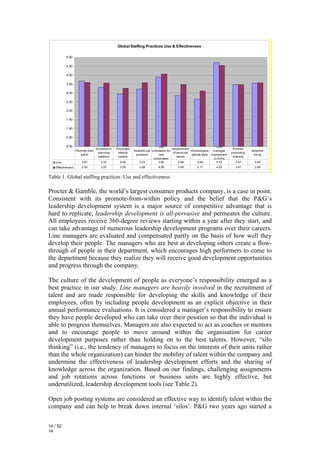
with a groom-from-within philosophy that many companies have adopted (see Table
1).


13 / 52
13
Global Staffing Practices Use & Effectiveness

           5.00

           4.50

           4.00

           3.50

           3.00

           2.50

           2.00

           1.50

           1.00

           0.50

           0.00                                                                Job                                       Line
                                   Succession   Employee                                  Assessment                                Policies
                    Promote from                            Realistic job orientation for              Knowledge/a     manager                  Selective
                                    planning     referral                                  of personal                             promoting
                       within                                previews          new                     ptitude tests involvement                 hiring
                                    systems      system                                       values                                diversity
                                                                           employees                                   in hiring
    Use                 3.67          3.32        2.95         3.23            3.90            2.86         2.68         4.72         3.47        3.56
    Effectiveness       3.59          3.57        3.26          3.58          4.06          3.48          3.11          4.55          3.47        3.58


Table 1. Global staffing practices: Use and effectiveness

Procter & Gamble, the world’s largest consumer products company, is a case in point.
Consistent with its promote-from-within policy and the belief that the P&G’s
leadership development system is a major source of competitive advantage that is
hard to replicate, leadership development is all-pervasive and permeates the culture.
All employees receive 360-degree reviews starting within a year after they start, and
can take advantage of numerous leadership development programs over their careers.
Line managers are evaluated and compensated partly on the basis of how well they
develop their people. The managers who are best at developing others create a flow-
through of people in their department, which encourages high performers to come to
the department because they realize they will receive good development opportunities
and progress through the company.

The culture of the development of people as everyone’s responsibility emerged as a
best practice in our study. Line managers are heavily involved in the recruitment of
talent and are made responsible for developing the skills and knowledge of their
employees, often by including people development as an explicit objective in their
annual performance evaluations. It is considered a manager’s responsibility to ensure
they have people developed who can take over their position so that the individual is
able to progress themselves. Managers are also expected to act as coaches or mentors
and to encourage people to move around within the organisation for career
development purposes rather than holding on to the best talents. However, “silo
thinking” (i.e., the tendency of managers to focus on the interests of their units rather
than the whole organization) can hinder the mobility of talent within the company and
undermine the effectiveness of leadership development efforts and the sharing of
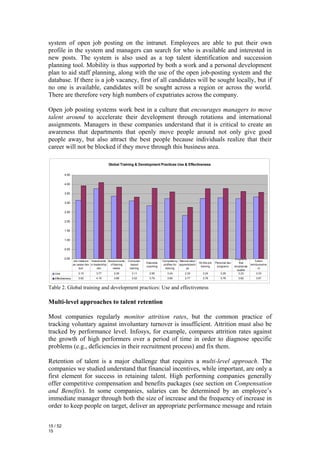
knowledge across the organization. Based on our findings, challenging assignments
and job rotations across functions or business units are highly effective, but
underutilized, leadership development tools (see Table 2).

Open job posting systems are considered an effective way to identify talent within the
company and can help to break down internal ‘silos’. P&G two years ago started a

14 / 52
14
system of open job posting on the intranet. Employees are able to put their own
profile in the system and managers can search for who is available and interested in
new posts. The system is also used as a top talent identification and succession
planning tool. Mobility is thus supported by both a work and a personal development
plan to aid staff planning, along with the use of the open job-posting system and the
database. If there is a job vacancy, first of all candidates will be sought locally, but if
no one is available, candidates will be sought across a region or across the world.
There are therefore very high numbers of expatriates across the company.

Open job posting systems work best in a culture that encourages managers to move
talent around to accelerate their development through rotations and international
assignments. Managers in these companies understand that it is critical to create an
awareness that departments that openly move people around not only give good
people away, but also attract the best people because individuals realize that their
career will not be blocked if they move through this business area.

                                             Global Training & Development Practices Use & Effectiveness

          4.50


          4.00


          3.50


          3.00


          2.50


          2.00


          1.50


          1.00


          0.50


          0.00                                                                                                                                 Programs
                   Job rotations Investments Assessments     Computer-               Competency Manual-labor                                                  Tuition
                                                                         Executive                                 On-the-job   Personal dev      that
                   as career dev in leadership of training     based                  profiles for apprenticeshi                                           reimburseme
                                                                         coaching                                   training     programs      emphasize
                        tool           dev       needs        training                 training         ps                                                      nt
                                                                                                                                                 quality
   Use                 3.15         3.77         3.36          3.11        2.85          3.24          2.33           3.24          3.29          3.23        3.33
   Effectiveness       3.92         4.10         3.86          3.32        3.79          3.60          2.77           3.76          3.78         3.62         3.57


Table 2. Global training and development practices: Use and effectiveness

Multi-level approaches to talent retention

Most companies regularly monitor attrition rates, but the common practice of
tracking voluntary against involuntary turnover is insufficient. Attrition must also be
tracked by performance level. Infosys, for example, compares attrition rates against
the growth of high performers over a period of time in order to diagnose specific
problems (e.g., deficiencies in their recruitment process) and fix them.

Retention of talent is a major challenge that requires a multi-level approach. The
companies we studied understand that financial incentives, while important, are only a
first element for success in retaining talent. High performing companies generally
offer competitive compensation and benefits packages (see section on Compensation
and Benefits). In some companies, salaries can be determined by an employee’s
immediate manager through both the size of increase and the frequency of increase in
order to keep people on target, deliver an appropriate performance message and retain


15 / 52
15
top performers. However, there seems to be agreement that financial incentives
cannot substitute for an exciting job, long-term career planning, and attention by
senior managers. Creating and delivering a compelling employee value proposition,
developing personalized career plans, and assigning senior-level managers as mentors
are considered effective ways to retain high potential employees. For example, P&G,
consistent with the company’s build-from-within policy and the significant
investments they make in the quality of their leadership development system, has
made retention a top priority. P&G emphasizes learning and growth opportunities,
internal mobility, and appropriate rewards in order to retain valued talent, with
schemes in place for: job rotation (within the same function but in different business
units/locations); broadening assignments (temporarily moving to a different function);
and career moves (permanently moving to a different function).

With the emergence of new attitudes about work and many employees expecting a
healthy balance between their personal and professional lives, an increasing number
of companies are offering flexible working arrangements in order to compete for the
best talent and to retain high potential employees. Accenture is a case in point.
Accenture’s work-life balance program, which was initially designed to address the
specific career challenges facing women but is now also open to men, includes
options such as flextime, job sharing, telecommuting, maternity/paternity leaves,
sabbaticals, and other arrangements to help employees achieve a better work-life
balance. Accenture significantly reduced the turnover rate among women through this
program and increased the number of female partners from less than 6% in 1999 to
over 10% in 2002.

Diversity programs designed to help attract, develop, retain, and promote diverse
talent are widely utilized by the companies in our sample. IBM is an example of a
company that has gone further than most others to leverage and enhance the skills of
talent within a diverse workforce. One of the first practices implemented was to build
diversity networks, which run across all employee constituencies and offer a variety
of perspectives on the issues that are local or unique to particular units. Diversity task
forces were also created, comprised of senior managers from various constituencies
including: African-Americans; gays, lesbians, and transgender individuals; people
with disabilities; and women. One result from these task forces was an initiative
known as “EXITE” (Exploring Interests in Technology and Engineering), aimed to
rectify a shortage in the talent pipeline of women in technology. The practice brings
together middle school girls located in different parts of the world (e.g., South Africa,
Scotland, Philippines, Chile, US, etc.) for a week in the summer to have fun and
introduce the girls to exciting new ways to learn about technology. After the girls
attend the camp they are assigned a female IBM engineer or scientist as a mentor for a
year. Not only does this practice ensure the future workforce pipeline for IBM, but it
also helps girls to make future contributions to their countries and the world. Another
practice that has come out of these task forces as well as a response to US regulation
is a company wide effort to make IBM, its products, and services accessible to people
with disabilities. This initiative created opportunities for students with disabilities to
get on-the-job experience and explore career options, and has helped IBM become an
employer of choice for people with disabilities. Our findings show that the number of
companies is growing that understand that an environment where everyone feels
comfortable and confident to contribute is a major advantage in the competition for
talent, and enables companies to recruit from the widest possible pool of talent.

16 / 52
16
Talent management in emerging markets

A central issue for many global corporations is how to manage talent in emerging
markets, such as India, China, and Eastern Europe. There seems to be agreement that
some degree of localization is required to comply with local regulations, cultural
norms, and so on, and that programs to develop a high quality local workforce and
groom local leaders should form part of a broader effort within the community. One
IBM executive, for instance, noted that their management development activities in
China need to be quite different from the practices used in the United States. She
stated, “we have really had to operate in a different mode than in a mature
environment like in the U.S.”. What this means is that while companies that have
adopted a global talent pool strategy need a globally standardized approach to the
selection, development and evaluation of talent, there are certain aspects that must be
locally adapted. The resulting tension between headquarters and the various
geographic regions in which a company operates is not always easy to reconcile. For
example, IBM’s performance management system, which was developed in the
Anglo-Saxon cultural context and is ‘non-negotiable’ (meaning that it is used
worldwide with only minor local adaptations), has created some difficulties in Asian
countries because there are a myriad cultural obstacles to Anglo-Saxon style
performance appraisal. However, in most other areas, there are principles upon which
Asia is given the flexibility to adapt. For example, even though IBM places strong
emphasis on diversity, gay and lesbian issues are not well accepted in Asia, and
hence, IBM does not have gay and lesbian policies there.

Consistent with IBM’s experiences, the accumulated research evidence suggests that
global corporations need a global template for performance management as well as
recruitment and development of talent, while allowing local subsidiaries to adapt that
template according to their circumstances, then monitoring the ways in which they do
this. Contrary to what some scholars believe, the resulting tension between global
strategy versus local HR imperatives is likely to remain acute as global corporations
(most notably, energy and petrochemicals companies) experience increasing pressure
to become local. Governments demand that they implement localization programs,
and they themselves are coming to recognize the business benefits, which include a
better understanding of local business environments, lower labor costs, the ability to
promote diversity and a meritocratic global culture, and the ability to source talent
from a wide range of geogragphic regions.

In order to attract and develop local talent, Shell, for example, works closely with
governments and universities in countries in which they operate to ensure that the
countries’ engineers, scientists, and managers are trained proficiently for possible
recruitment. In the future, Shell will likely rely less on expatriates to staff operations
in foreign countries and more on local employees. This helps to reduce costs and is
consistent with their goal of being in tune with the local environments in which they
operate. For instance, one local training and development initiative which was
successfully implemented in the Americas is a practice termed the ‘Incumbent
Worker Training’. The objective is to improve skill levels of local employees to make
them more attractive candidates for higher-level positions within the company. It can
also give them vital job mobility in the case of downsizing. This initiative continues
to be regional with certain senior officials hoping that it may become a globalized

17 / 52
17
practice. Similarly, in the Middle-East and Eastern Europe, company training and
development is the number one appeal for local engineers and craft workers. “Our
training and development is what makes us different,” said Eric Slotboom, Regional
HR Director for Middle East/Russia/CIS. “It’s not just how we design the processes,
but how we execute it. … the local people of our region recognize it.”

Many of the participating companies have built local talent pools, either composed
entirely of locals (but selected in accordance with a global leadership competency
profile) or chosen with the development of locals in mind. With demand for talent
outstripping supply in some parts of the world, most notably China, an increasingly
large number of companies recruit talented locals working or studying abroad and
bring them back to fill key positions. For example, in China the recent trend to hire
‘sea turtles’ – native Chinese who have been educated or worked in the West, and are
now coming home – has helped companies to alleviate the skills shortage in China.
However, this approach is likely to be effective only when combined with overseas
rotations. International assignments are important in providing locally recruited high
potential employees with an international perspective, exposure to the corporate
culture, and a network of contacts throughout the organization.
PriceWaterhouseCoopers, for example, recruits Chinese graduates in the US and
trains them for two or three years before sending them back to China. This example
illustrates that the companies that have done the best job of recruitment and
development may be most at risk from poaching. Personalized career plans and
assignment of senior-level executives as mentors can help promote loyalty among
local employees identified as high potentials. Also, global companies such as Shell,
IKEA, and GSK have come to realize that corporate programs to develop local leaders
must be part of a broader effort within the community. Our findings are consistent
with a recent McKinsey study that found that the companies most pleased with their
local workforce are those that are most sensitive to local issues and that support the
local communities, e.g., by supporting the education system or offer health assistance
in local communities. The result is not only a more harmonious relationship with local
stakeholders but also a more motivated and committed local work force.

The research findings show that the best companies have made talent management a
strategic priority and that there is a high degree of sophistication about this activity.
Yet, few of the HR professionals, senior executives and line-managers that we have
interviewed believe that their organizations have fully solved the talent-management
puzzle. Our study suggests a number of highly effective, but underutilized, practices
that can help companies attract, develop, and retain talent.


18 / 52
18
3. PERFORMANCE MANAGEMENT

The performance management system comprises the practices of objective setting,
appraisal and rewards and their integration. Performance is generally considered to be
a function of ability, work motivation, and opportunity. Underlying performance
management systems are assumptions about the psychological processes that drive
employee effort. Specifically, these concern the desirability of aligning employee
needs with organizational needs and ensuring that the setting of tasks will produce
valued outcomes for employees if successfully accomplished as well as contribution
to business objectives. In terms of social context, a fundamental principle of
performance management is the key decisions and the processes by which they are
made, are made equitably.

Performance management, which focuses on aligning the direction, intensity and
persistence of work effort into productive outcomes, is therefore at the heart of human
resource activity.

The major areas of performance management we examined within our companies
cover a wide range of issues, including goal level and goal commitment as drivers of
purposeful actions and work performance; the line of sight between evaluation of task
achievement, and the provision of rewards, and the nature and attractiveness of the
reward offer. The development of employees constitutes a further crucial issue in the
management of performance. In our sample, there were striking similarities in terms
of their overall architecture of the performance management system. But though the
design of the systems showed strong convergence, local delivery of practices revealed
differences reflecting national cultural and sectoral variations. In this section, we shall
take first objective setting and appraisal and then move on to the issue of reward
management.

Global performance management

The performance management process showed strong similarities in terms of overall
design of the processes across companies and countries. We witnessed a concerted
effort on the part of group HR to introduce and maintain global performance
standards, supported by global competencies both at foundational, managerial,
technical and leadership level, common evaluation processes, and common
approaches to rewards. Though in some companies such standards and processes were
at an early stage of development, nevertheless all companies were signed up to their
usage.

It was therefore difficult to find much in terms of distinctive local practices in the
countries where our sample companies operated. Certainly where national regulatory
systems varied, in particular with regard to union representation, there were
differences of approach, both in terms of wage determination and also with regard to
the managerial prerogative, the ability to flex the workforce in terms of performance,
and specifically, underperformance. Recognition schemes too, varied by national
culture, with collectivist cultures eschewing individual award schemes.

We expected that companies with a high degree of production/service integration
across countries would have a high degree of diffusion of host country HR practices,

19 / 52
19
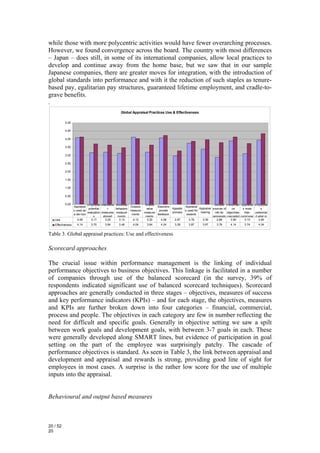
while those with more polycentric activities would have fewer overarching processes.
However, we found convergence across the board. The country with most differences
– Japan – does still, in some of its international companies, allow local practices to
develop and continue away from the home base, but we saw that in our sample
Japanese companies, there are greater moves for integration, with the introduction of
global standards into performance and with it the reduction of such staples as tenure-
based pay, egalitarian pay structures, guaranteed lifetime employment, and cradle-to-
grave benefits.
.
                                                    Global Appraisal Practices Use & Effectiveness

          5.00

          4.50

          4.00

          3.50

          3.00

          2.50

          2.00

          1.50

          1.00

          0.50

          0.00                Employee Standards Individual           Shared                                           Multiple Performan Appraisal Employee
                   Appraisal                                Outputs           Sessions           Appraisal
                               potential      +   behaviors            value             Appeals            Appraiser sources of     ce     s more      s
                   s used as                                measure            provide           s used for
                              evaluation measures measure             measure            process             training   info for objectives  than   understan
                   a dev tool                                ments            feedback            rewards
                                  s       aligned  ments               ments                                          appraisals cascaded once/year d what is
   Use                4.09       3.17       3.20    3.13      4.13      3.20     4.08      2.97     3.76       3.39       2.88      3.90     3.13     3.94
   Effectiveness     4.14      3.70      3.64      3.48      4.04      3.64     4.24      3.28      3.87      3.97      3.79      4.14      3.74      4.34


Table 3. Global appraisal practices: Use and effectiveness

Scorecard approaches

The crucial issue within performance management is the linking of individual
performance objectives to business objectives. This linkage is facilitated in a number
of companies through use of the balanced scorecard (in the survey, 39% of
respondents indicated significant use of balanced scorecard techniques). Scorecard
approaches are generally conducted in three stages – objectives, measures of success
and key performance indicators (KPIs) – and for each stage, the objectives, measures
and KPIs are further broken down into four categories – financial, commercial,
process and people. The objectives in each category are few in number reflecting the
need for difficult and specific goals. Generally in objective setting we saw a spilt
between work goals and development goals, with between 3-7 goals in each. These
were generally developed along SMART lines, but evidence of participation in goal
setting on the part of the employee was surprisingly patchy. The cascade of
performance objectives is standard. As seen in Table 3, the link between appraisal and
development and appraisal and rewards is strong, providing good line of sight for
employees in most cases. A surprise is the rather low score for the use of multiple
inputs into the appraisal.


Behavioural and output based measures


20 / 52
20
The management of performance in the organizations includes attention to skills,
knowledge, attitudes and behaviour, though interestingly, from the survey data, it
appears that output or results measurements dominate over individual behavioural
assessments, perhaps because of their greater accessibility and ease of assessment.
Global competency profiling is used in both organisational design (i.e. broad banding
and succession) and also in performance management. A number of companies use
competency profiles within performance reviews, each profile detailing both
standards of performance and also the necessary methods and competencies required
for desired performance. These competency profiles are now becoming global in
nature to ensure consistency of approach in terms of both selection criteria for
employees and also for performance assessment. The performance management
process was generally conducted using on-line mechanisms.

Frequency of evaluation

The frequency of evaluation varied. On average, formal evaluation was bi-annual, a
mid-term and an end-of-year appraisal, though in some firms, quarterly was the norm.
In project-based organisations, evaluation according to project timelines was
implemented. Though the norm for goal setting in recent reviews is for a participative
process, surprisingly we did not see much evidence that participation in goal-setting
was being followed within the companies. All companies had split the development
review from the pay review.

Where we viewed excellent practice was in the provision of informal feedback.
Companies with open-door and management by walking around principles, for
example, had cultures of managerial enthusiasm for encouraging feedback, with
skilled and frequent discussions concerning task and project progress. This was often
tied to the provision of coaching to ensure the day-to-day, week-to-week nature of
performance management.

Management of potential

In addition to performance, the measurement of potential is also crucial, and a number
of firms have a matrix of performance and potential in order to evaluate employees
and to map development and resource allocations as well as assigning share of pay
pot. In the survey, 40% of respondents claimed that they used employee potential
evaluations. Potential was generally assessed using multiple inputs, frequently 360
degree approaches, and smoothing of distributions made in collaboration between
senior management and the HR department.

In terms of the management of high potentials, this was a high priority for all HR
functions within our sample, and there was a high degree of sophistication about this
activity. In all companies there were systems in place which identified high potential
individuals using clear sets of leadership competencies and assessed using multiple
inputs. These individuals were given a variety of developmental activities, from
training, coaching, mentoring, projects, and secondments, and they were placed on a
talent inventory that matched prospective jobs to high potential individuals.

Case example: leading performance management inputs and measures


21 / 52
21
Startegic Planning Process: The first stage in the performance management process is detailed
 business planning. The business planning process is designed to elicit standardised performance and
 budgetary outputs from each of the business units, which are subsequently collated at a group level
 and provide accurate and timely data on individual business unit activity and overall (aggregated)
 corporate activity. The business planning process is divided into three main stages, the respective
 foci of each being (a) an assessment of current business unit performance against corporate
 objectives, (b) an evaluation of strategic options available to the business unit / group to further
 enhance value creation and (c) the development and refinement of detailed business plans with clear
 guidance for implementation and continuous improvement. Conducted throughout a six month mid-
 year period, the business planning process is critical to the assessment of current business capability
 and performance, and the establishment of corporate direction and strategy.

 Behavioural Performance Feedback: The behavioural performance feedback provides the
 individual with behavioural performance feedback, as defined by the five core leadership
 competencies, from superiors, colleagues and subordinates. The behaviour performance feedback
 provides the basis for part of the individuals’ performance assessment, and feeds directly into
 objective setting and personal development planning. It is incumbent upon the individual being
 assessed that they (a) nominate individuals to provide behavioural feedback, (b) complete a self
 assessment form, (c) support colleagues also undergoing behaviour performance assessment and (d)
 respond constructively to any and all feedback received. Behaviour performance is assessed against
 the five core competency, with each competency having four questions associated with it. Each
 question is scored on a five point likert scale e.g. 1 = very poor, 5 = very good.

 Employee Attitude Survey: [case study company] utilises an employee attitude survey to appraise
 the impact of leadership on individual and team performance. The survey takes the form of a
 ‘Census’ survey of all employees conducted once yearly, and a ‘snap shot’ of employee attitudes to
 specific issues, surveyed from a randomly selected employee population every other year. The main
 output from each survey, in addition to employee perceptions of practice, business conditions and the
 employment experience, is a quantitative score against each of the five competencies for each
 business unit management team, and the [case study company] senior leadership overall.

 Customer Feedback: In accordance with the emphasis placed upon customer relations as a core
 element of [case study company] competitive advantage, customer feedback is included within the
 performance management assessment process. Business units are given discretion to develop and use
 tools that best appraise customer opinion on the performance of [case study company] as a supplier
 of products and services. This information forms part of the qualitative input for the performance
 development review.

 Performance and Potential Review: The Performance and Potential Review is a one to one
 meeting between the individual and their line manager in which personal objectives are set, past
 objectives reviewed, development options reviewed and selected within the context of the
 individual’s career aspirations. The programme is a the main element of the performance assessment
 and objective setting, and is intended to provide the individual with clear and measurable objectives
 that are linked to business targets, clear feedback on performance and recommendation for personal
 development and growth against the five core competencies. Conducted over a period of three
 months, the performance and potential process is support by extensive guidance documentation and
 company intranet based resources.


22 / 52
22
4. REWARD MANAGEMENT

Excluding the blue collar employee population, pay within all of the case study
organisations fulfils two primary purposes. The first purpose is the attraction and
motivation of high calibre talent at all levels within the organisation. The second
purpose is the use of pay mechanisms to promote desirable employee behaviours.
The latter supports existing evidence for high performing organisations using pay
interventions as management tools with which to align employee interests to those of
the employer and financially interested stakeholders. In a departure from its
traditional role, this new emphasis of pay as a means of promoting organisational
performance for complementary behaviours renders the pay function as strategic.
Drawing upon the case study data, the following leading and innovative pay practices
were used to achieve fulfil the objectives of (a) the attraction and retention of key
talent and (b) the promotion of complementary and desirable employee behaviours
and effort.

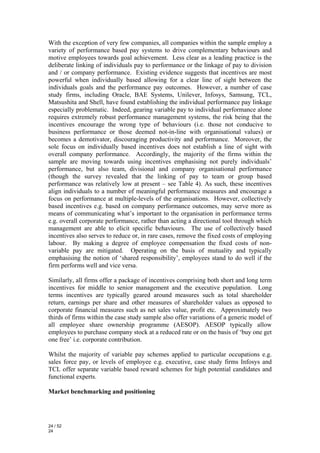
                                                                   Global Rewards Practices Use & Effectiveness

          4.50


          4.00


          3.50


          3.00


          2.50


          2.00


          1.50

          1.00


          0.50


          0.00                                                                                                 Pay dstngshd
                   Salary surveys   Intrnl evals     Increased      Pay tied to                                             Pay based on   Sig non-      Bonuses
                                                                                  Pay tied to    Pay tied to     between                                              Flex benefits
                    dtrmn extrnl     detrm intrl   comp for high       group                                                    orgztnl    financial   based on multi
                                                                                    tenure      competencies     low/high                                                 plan
                       equity          equity       performers     performance                                               performance   rewards       feedback
                                                                                                                performers
   Use                  3.98           3.73            4.01            2.94          2.20           3.25           3.30          3.38        2.48           2.04           2.09
   Effectiveness        4.06           3.92            4.24            3.40          2.08           3.56           3.76         3.58         3.33           2.89           3.10


Table 4. Global rewards practices: Use and effectiveness

Multiple pay interventions

All firms within the sample employ an array of pay interventions at all levels and
occupations within the white collar and managerial employee base. Each element of
pay, typically base pay, performance based pay such as a bonus, long term
performance based equity ownership and benefits, is geared to align the employee’s
interests, financial and professional, to those of the organisation. Base pay is typically
used as the cornerstone of the pay. Additional pay interventions, including short and
long terms incentives, are bundled with base pay and benefits as part of an overall
market competitive package. Oracle, BT and Siemens are good examples of the
overall trend in managerial pay towards the use of multiple interlinked pay
interventions.


Performance contingent pay


23 / 52
23
With the exception of very few companies, all companies within the sample employ a
variety of performance based pay systems to drive complementary behaviours and
motive employees towards goal achievement. Less clear as a leading practice is the
deliberate linking of individuals pay to performance or the linkage of pay to division
and / or company performance. Existing evidence suggests that incentives are most
powerful when individually based allowing for a clear line of sight between the
individuals goals and the performance pay outcomes. However, a number of case
study firms, including Oracle, BAE Systems, Unilever, Infosys, Samsung, TCL,
Matsushita and Shell, have found establishing the individual performance pay linkage
especially problematic. Indeed, gearing variable pay to individual performance alone
requires extremely robust performance management systems, the risk being that the
incentives encourage the wrong type of behaviours (i.e. those not conducive to
business performance or those deemed not-in-line with organisational values) or
becomes a demotivator, discouraging productivity and performance. Moreover, the
sole focus on individually based incentives does not establish a line of sight with
overall company performance. Accordingly, the majority of the firms within the
sample are moving towards using incentives emphasising not purely individuals’
performance, but also team, divisional and company organisational performance
(though the survey revealed that the linking of pay to team or group based
performance was relatively low at present – see Table 4). As such, these incentives
align individuals to a number of meaningful performance measures and encourage a
focus on performance at multiple-levels of the organisations. However, collectively
based incentives e.g. based on company performance outcomes, may serve more as
means of communicating what’s important to the organisation in performance terms
e.g. overall corporate performance, rather than acting a directional tool through which
management are able to elicit specific behaviours. The use of collectively based
incentives also serves to reduce or, in rare cases, remove the fixed costs of employing
labour. By making a degree of employee compensation the fixed costs of non-
variable pay are mitigated. Operating on the basis of mutuality and typically
emphasising the notion of ‘shared responsibility’, employees stand to do well if the
firm performs well and vice versa.

Similarly, all firms offer a package of incentives comprising both short and long term
incentives for middle to senior management and the executive population. Long
terms incentives are typically geared around measures such as total shareholder
return, earnings per share and other measures of shareholder values as opposed to
corporate financial measures such as net sales value, profit etc. Approximately two
thirds of firms within the case study sample also offer variations of a generic model of
all employee share ownership programme (AESOP). AESOP typically allow
employees to purchase company stock at a reduced rate or on the basis of ‘buy one get
one free’ i.e. corporate contribution.

Whilst the majority of variable pay schemes applied to particular occupations e.g.
sales force pay, or levels of employee e.g. executive, case study firms Infosys and
TCL offer separate variable based reward schemes for high potential candidates and
functional experts.

Market benchmarking and positioning


24 / 52
24
Where pay is not collectively bargained, as is the case for managerial grades in some
Western European and Japan for white collar and junior managerial grades, pay is in
all cases benchmarked against a defined labour market or industry peer group. Firms
within the sample choose to either typically benchmark specific measures of pay e.g.
base pay and bonus opportunity, or benchmark the employee’s package overall on the
basis of total cash compensation (all cash elements of the package combined) or total
remuneration (cash and the private market value of equivalent benefit purchase).
Depending upon the emphasis placed upon variable pay as a proportion of pay, the
majority of firms choose median competitive market pay for clerical and junior to
middle management grades and upper quartile market competitive pay for senior
management and executive levels.

Total rewards models

Approximately half of the organizations within the sample use a total rewards model
that is articulated in corporate communications as a cornerstone element of the overall
employment proposition. The total rewards model typically emphasise not only
financial rewards such as base pay, incentives and benefits, but also elements of the
employment proposition such as career advancement, learning and development
opportunities, stimulating work and the working environment. The underpinning
philosophy is that financial rewards are easily replicable by competing firms, the
inclusion of additional non-financial opportunities renders rewards relatively immune
from emulation. Moreover, the conscious bundling of both financial, development
and environmental elements of the employment package is recognition that such an
approach is needed in order to attract and develop top talent. In essence, financial
rewards alone are not enough.

These additional opportunities, however, requires that the organisation provide
centrally determined interventions e.g. development opportunities, where such
practices where largely locally determined in the past. It is also recognition that these
elements of the employment package are perceived to have the greatest value to
potential and existing employees, and the organisation therefore, when bundled and
coherently articulately. Whilst it has been noted that all firms within the sample use
multiple pay interventions, the degree to which these various individual interventions
are integrated into one coherent bundle of complementary measures, is not so
widespread.

Flexible benefits

A key element of most total rewards models', the use of flexible benefits is becoming
more and more widespread and reflects the move towards greater transparency of
benefit provision, economies of scale and cost effective benefit provision and, above
all, the injection of personal choice into employee pay and benefit provision.
Typically administered by a third party on behalf of the employer, flexible benefits
programmes typically comprise a series of benefits options offered in a ‘cafeteria
style’ format. Thus, eligible employees (which are typically all employees) are
provided with an array of benefits from which to choose and choice over the level of
chosen benefit they wish to receive. In all cases, case study firms offer a standard
level of benefit provision centred around core benefits such as pensions, ill-health and
death in service benefits.

25 / 52
25
In BT, Siemens and P&G, employees themselves choose the type and level of flexible
benefit they receive via a self completion e-form hosted on a dedicated flexible
benefits company intranet site. Again, the emphasis is on the individual taking
responsibility for his / her choice of benefits, the presumption being that the employee
will choose a combination of benefits that bets suit his or her lifestyle circumstances,
therefore the making benefits package offered that much more meaningful. By
outsourcing the flexible benefits management to dedicated firms, employers are able
to take advantage to the supplier’s expertise, efficiencies (i.e. economies of scales and
bulk purchaser agreements) and technology.

Line management takes a direct role in the design and determination of pay policy in
IKEA. Using reward to establish a line of sight between corporate objectives and
individuals’ goals and to reinforce a high performance working culture, management
within IKEA use pay very much as an HR tool. However, the emphasis on designing
reward systems that best fit the local context, necessitating the active and continued
involvement in the management of rewards – design and execution.


26 / 52
26
5. EMPLOYEE RELATIONS

In the field of employee relations (ER), there is potential for both convergence and
divergence of practices linked with the increasing degree of globalisation. From the
perspective of multinational companies, this raises issues such as how to adopt ER
‘best practice’ across national boundaries; how to handle different trade union
recognition patterns; what are the most effective methods of direct individual and
collective communication to and from employees; and how to create a fit between
employee relations policy and corporate goals and objectives. As companies continue
to span different national boundaries where ER traditions differ, questions arise as to
what approach should then be taken to employee relations in the host countries?
Equally, does the fact that companies operate across borders actually mean that
patterns of ER are changing? In general, employee relations practices are probably
the most difficult area of HRM to transfer across national boundaries because of tight
national regulations. It is also an area in which corporate executives may have strong
principled views, such as upholding the managerial ‘right to manage’ or a conviction
in the importance of ‘employee voice’. In the sections below, based on the results of
the study, we explore the specific areas of best practice in employee relations being
adopted by our flagship multinational companies, and look in detail at responses to
handling trade unions and employee communication, as well as considering how ER
practices are designed to fit with corporate objectives.

Employee relations best practice

Although the notion of what is ‘best practice’ can be disputed across national
boundaries due to the complexities of the national institutional context as described
above, there are certain approaches to employee relations which are becoming
accepted as good practice in academic and practitioner circles alike.

                                Global Employee Relations Practices Use & Effectiveness

           4.50


           4.00


           3.50


           3.00


           2.50


           2.00


           1.50


           1.00


           0.50


           0.00                                                                               Survey
                                            Consultatio Consultatio   Flexible      Alt.                  Direct     Policy on
                    No-layoff    Upward                                                       results                            Policy on
                                               n w/        n w/        work       dispute               participatio work/life
                     policy     info flow                                                   provided to                          equal opp
                                              unions employees        patterns   resolution             n of emps balance
                                                                                               emps
    Use               1.81        3.35         2.37        2.82        2.93         2.48        4.03       3.25        2.82        3.91
    Effectiveness     2.29        3.68         2.59        3.00        3.64        2.95        4.11        3.80        3.64        3.93


Table 5: Extent of usage of employee relations best practices amongst companies

27 / 52
27
Little     Moderate       Much
Formal no-layoff policy                                        75%         14%           11%
Upward information flow                                        20%         34%           46%
Union consultation about significant strategic                 55%         18%           27%
decisions
Consultation with employees through formal bodies               39%         24%           37%
Flexible work patterns                                          35%         34%           31%
Alternative dispute-resolution                                  52%         30%           18%
Results of employee surveys provided to employees                9%         16%           75%
Direct participation of employees                               22%         37%           41%
Policy on work/life balance                                     45%         25%           30%
Policy on equal opportunities                                   11%         16%           73%

          Table 5a: Extent of usage of employee relations best practices: percentages

As can be seen from Table 5 and 5a, the most widespread use is made of reporting
results of employee surveys back to the employees themselves, and of equal
opportunities policies. Table 6 shows that these practices are seen as very effective by
around three-quarters of the companies surveyed. Amongst the acknowledged best
practices, formal no-layoff policies are least popular and are not seen as effective.
This might be expected given the particularly turbulent time in many national
economies and a lack of ability to predict the future requirement for staffing in many
companies. What may be slightly more notable is the second least widely used best
practice: consultation with trade unions about significant strategic decisions. This is
seen as an ineffective practice by 44% of the companies surveyed (see Table 2). The
spread particularly of US MNCs across the globe has previously been identified as
encouraging a non-union approach to employee relations which appears very much to
be the case in the majority of the companies surveyed.

                                                             Not        Somewhat        Very
Formal no-layoff policy                                      60%          22%           18%
Upward information flow                                       8%          33%           59%
Union consultation about significant strategic               44%          27%           29%
decisions
Consultation with employees through formal bodies            31%          32%           37%
Flexible work patterns                                       12%          27%           61%
Alternative dispute-resolution                               31%          37%           32%
Results of employee surveys provided to employees             3%          19%           78%
Direct participation of employees                             9%          22%           69%
Policy on work/life balance                                  14%          24%           62%
Policy on equal opportunities                                 9%          20%           71%

   Table 5b: Effectiveness of employee relations best practices for managing people

Table 5b also shows that a number of practices are considered to be very effective,
such as work/life balance and equal employment opportunities policies, direct
participation of employees, as well as the feedback of employee survey results. These
practices are somewhat innovative, recent approaches, which are perceived to be more
effective than more established, traditional approaches such as consultation with trade

28 / 52
28
unions and other formal employee bodies. We might therefore conclude that in
MNCs, the pattern of employee relations is changing. This may be because trade
unions are mainly effective at the industry sector or national level, and so encounter
difficulties in dealing with organisations which transcend these boundaries. In the
following section we look in more detail at how companies are dealing with this
complex issue of how to approach collective employee representation.

Trade union recognition

Three approaches to employee relations were discernable amongst the companies
interviewed: unitarist, contingent and partnership. The unitarist approach, observed
clearly in four of the case companies (Samsung, Oracle, Infosys, P&G), involves
active non-unionism. The need to become unionised in these companies is being
replaced largely by extensive direct employee communications channels, such as
townhall meetings, newsletters, and intranet communications. However, P&G, for
example, does point out that where legislation requires trade union recognition, this is
the route that they will take, rather than an even more active anti-union stance taken,
for example, by the well know case of McDonalds.

P&G could actually be classified as taking a more contingent approach to employee
relations, however, in Siemens and ABB this contingent approach is more active as
there is no central policy on union recognition: unions are only recognised where
mandated by law. Siemens were also keen to point out the importance of having the
correct HR manager in place to match the ER culture within a subsidiary in order to
ensure relationships with trade unions are effective.

This is even truer of the case of the final approach to ER covered here: the partnership
approach. BAE Systems, Rolls Royce, BT, IKEA, and Unilever all described their
approach to ER as proactively and deliberately involving trade unions in management
decisions which impinge on employee working life. Matsushita in Japan also
emphasised the importance of developing a co-operative relationship with unions. In
this partnership approach, the key to success appears to be the creation of trust
relationships between management and trade unions. Examples of this relationship
working successfully were found in BT, ABB, and EDF.

The extent of trade union membership and the coverage of collective bargaining
agreements were explored in the online survey. The results shown in Table 6 show
very low percentages of membership density and CBA coverage, again supporting the
earlier finding that non-unionism or low representation is dominant. Where collective
agreements are in place, for all grades of employees these agreements are most
commonly made at country level (see Table 6).


                                 % employees           % employees
                                 member of a          covered by CBA
                                    union
                    Mean             20%                    36%
                    Median            5%                    20%
                    Mode              0%                     0%


29 / 52
29
Table 6: Trade union and collective bargaining agreement (CBA) coverage

                                        Plant             Country              Region            Corporate
                                                                                                   HQ
Manual/clerical staff                    22%                 57%                 10%               10%
Managerial/professional                  12%                 60%                 13%               14%
staff

    Table 7: Level of bargaining arrangements for employment terms and conditions

One company, IKEA, found its own innovative solution to the trade union
consultation and negotiation requirements being made of it in one particular host
country, the Netherlands. In 1992, IKEA Netherlands was being pressured to work
closer with trade unions, and at that time decided to establish its own workers
association, known as WIM (Werknemersvereniging IKEA Medewerkers), which is
not affiliated to the larger national trade union confederations. WIM currently has
2,200 members, compared with the main Dutch trade union FNV which has around
100 members in IKEA. IKEA negotiates the collective labour agreement with WIM
on a national level, determining the minimum terms and conditions for all IKEA
employees in the Netherlands.

The opportunities offered to companies of various approaches to employee relations
have been recognised by a few of the companies interviewed in this study. In
particular, the value of individuals participating in employee representative bodies is
seen as a good development exercise. For example, in Siemens, works councils are
viewed as an employee development tool for future management positions, and
indeed a number of current board members were once employee representatives in
these councils.

Other companies also recognise the importance of developing the skills of the
employee representatives themselves, to ensure that they are effective negotiation
partners. Shell provides union members with special training to improve their skills
and opportunities for mobility or promotion within the company. In Unilever in the
Netherlands, union and works council member training ensures the skills of the
negotiating partners. In addition, the company provides funds to the main trade union
to help increase membership levels to ensure the representativeness of this
compulsory negotiating body1.

Direct communication channels

Amongst the companies interviewed, there was evidence of the different direct
methods of employee communication being used, particularly those facilitated by
advanced information technologies. In particular, the following methods of
communication were most frequently mentioned:

           •   widespread use of intranet/bulletin boards (Oracle, Infosys, Rolls Royce,
               Siemens, TCL);
1
           Collective agreements negotiated with trade unions in the Netherlands apply to all employees
covered by the agreement irrespective of whether or not they are trade union members, hence there is
little motivation for employees to become members.

30 / 52
30
•   information and problem-solving meetings (Infosys, Siemens, P&G);
          •   printed magazines and newsletters (Siemens, TCL).

Another form of communication being used widely to gather employee feedback is
through satisfaction surveys or suggestion schemes:

          •   employee satisfaction surveys (Siemens, Infosys, EDF, TCL, IKEA,
              P&G);
          •   suggestion schemes (EDF, IKEA, P&G).

A couple of particularly innovative approaches to employee communication were
observed during company interviews and visits. In one division of Siemens, based in
the home country of Germany, information is provided to and fed back from
employees on a very regular basis: monthly through management meetings, weekly in
group meetings, daily in problem-solving meetings and constantly via on-line
systems. Information is displayed around the factory environment continuously
monitoring the achievement of targets at any one point in time. There is also a global
magazine distributed to all employees within the division to ensure cross-border
information sharing.

In a P&G plant in the Netherlands, as well as putting information about targets and
measures publicly visible around the factory, it has also been made clear that it is an
individual’s responsibility to be proactive about finding information if they need it.
There is a culture being developed in which everyone is both a trainer and a trainee,
and people are encouraged to share their learning. This was an initiative running at the
sites in the US, now being adopted at the European plant. The culture within the plant
is one of open sharing of information and continuous improvement. Ownership of
processes by all employees is encouraged, providing people with the necessary
information to be able to make decisions. For example, the cost of waste is made
clearly visible in tangible terms as part of a programme to eliminate waste completely.
This encourages appropriate employee behaviour, explaining both the reasons for
changes in policy and making clear the implications of not achieving the new waste
targets.

Fit between employee relations policy and corporate goals

The discussion so far has focussed on how employee relations activities can be
affected by home and host country effects. There are of course strategic choices to be
made by companies themselves as to what particular approach they want to adopt.
The most effective employee relations practices will be seen as legitimate and
accepted by employees, but will also be designed to support corporate strategy and
structure, have the commitment of line management, and be flexible enough to adapt
to constantly changing business environments.

In the online survey, companies were asked to what extent their ER policies and
practices met these three requirements. Somewhat surprisingly, only around half or
less of the companies surveyed, meet these requirements (see Table 8). 55% of
companies see their ER policies as being highly aligned with corporate strategy and
structure, but a third think this only somewhat being achieved. Line management
commitment to ER policies is also high in only 46% of organisations, with a further

31 / 52
31
41% believing that line management are only partially committed. The flexibility of
policies is also somewhat concerning: although 42% believe their policies are highly
flexible, a further 44% believe they have less flexibility to changing business needs.

               Strategic alignment      Line management               Flexibility of policies to
              with corporate strategy commitment to policies          meet shifting business
                    and culture                                              demands
Little                 10%                    13%                               13%
Somewhat               35%                    41%                               44%
Much                   55%                    46%                               42%

                 Table 8: Employee relations policies and practices

In summary, employee relations activities are a highly complex dimension of HRM
practice which requires very careful consideration of both the complex country and
company settings. Successful practice in the field varies from company to company,
but those most satisfied with employee relations policies are the companies that find
an appropriate fit between both home and host-country demands.


32 / 52
32
6. ORGANISATIONAL CULTURE AND HRM

The global corporations in our sample have adopted a variety of mechanisms and
tools for developing a strong culture that is aligned with the strategic goals of the
company. Most of these practices are in the domains of human resource management
and leadership. We found that high-performing companies have integrated their core
values into every HR-related process: how they attract, hire, and develop talent;
manage performance; compensate employees; and so on. The following methods for
developing and maintaining a strong culture were systematically used across the
excellent companies that we studied in North-America, Europe and Asia: focus on
attitudes and cultural fit in the selection process; emphasis on secondary socialization
and training; performance management and compensation & benefits systems built
around company core values; symbolic and values-based leadership.

Emphasis on attitudes and cultural fit in the selection process

While companies have traditionally focused on applicants’ academic credentials and
job-related skills in the selection process, many of the excellent companies within the
sample have expanded their definition of “the right people in the right place” to
include cultural fit as a key selection criterion. These companies try to assess
applicants’ personality and values to determine the fit with the corporate culture,
based on the assumption that formal qualification is not always an accurate predictor
of job performance and that skills are easier to train or change than personality traits,
attitudes and values.

Ikea, the world’s leading home furnishings retailer, is a case in point. Recruiting is
done largely through tools which focus on values and cultural fit rather than skills and
experience. A standard questionnaire, which explores a candidate’s values and beliefs,
is used for selection interviewing and for training and development. When people
apply internally for higher leadership positions, they are again assessed on their
personal and shared values to ensure consistency. At the most senior leadership level,
managers are encouraged to partake in ‘conscious leadership’, considering the
implications of how they see the world on others. The goal of this value-driven
recruitment and development system is to maintain and strengthen Ikea’s unique
culture and to preserve its core values.

A strong emphasis on cultural fit in the recruitment and selection process is by no
means unique to European companies. Oracle, for example, recruits managerial and
leadership staff through a combination of internal promotion, direct application, and
“head hunting”. Commercial awareness and good corporate governance are
considered premium amongst corporate values, and constitute key selection and
promotion criteria. Leading Japanese companies such as Sony and All Nippon
Airways (ANA) now also look for qualities other than narrow academic success and
will not, as in the past, let the level of university degree get in the way of hiring
someone made of the right stuff. ANA, for example, selects university graduates
through an extensive interview process. Out of about 8,000 candidates who applied in
the 2005 graduate recruitment round, ANA’s recruitment team interviewed 3,300 in
groups of five. The 500 of them who were judged sufficiently articulate about their
career goals were subjected to another group interview aimed at discovering their
commitment to ANA. The top 120 were invited to individual interviews that probed

33 / 52
33
their attitudes and values. The final 70 – from whom 40 were chosen – were each
interviewed in depth by three ANA staff including a member of the board. This
laborious process testifies to ANA’s desire to focus more on a candidate’s personality
and values than on narrow academic achievement.

The Indian information technology and software giant Infosys, now the world’s
leading IT outsourcing company, is another example of a company that illustrates this
emerging trend. Infosys is willing to trade off some immediate skills necessary for the
specific entry job for better cultural fit, the right attitudes, and the ability to learn.
Infosys does not look solely at software engineer graduates. Instead it defines “best”
candidate as the one who has good problem solving skills and “learnability” and
whose personality and values fit the Infosys culture. This broader definition allows
Infosys to greatly expand the pool of talent they will be attempting to tap into beyond
the limited boundaries of the available software engineers. Infosys believes that a
candidate with learnability who believes in Infosys’ core values such as fairness,
integrity, and responsiveness to customer needs has what it takes to be in the software
profession and handle its amazing pace. Infosys selects applicants based on the
consistency of their performance in college, through their analytical and aptitude
entrance test, and – as the final hurdle – an extensive interview process that focuses
on cultural fit and congruence with Infosys’ core values. An important part of the
interview process is to provide the candidate with culturally relevant information and
present a consistent picture of the values that are shared among “Infoscions”.

Although considered best practice by the companies in our sample, the findings of the
web-based survey reveal that assessment of individuals’ attitudes and values to
determine the fit with the company culture is a recruitment and selection strategy that
is still underutilized among global corporations.

Secondary socialization and training

The excellent companies that we studied used a variety of socialization mechanisms
to preserve their core values and organizational practices. The socialization process
begins with recruitment in that the organization is likely to select new members who
already have the “right” set of attitudes, beliefs, and values. Once the individual has
joined the organization, induction programs, apprenticeships, individual coaching by
the superior, training and development programs, and other socialization practices
ensure that the newcomer learns the values, expected behaviours, and social
knowledge that are necessary to become an effective and accepted member of the
organization.

The use of standardized induction programs, often accompanied by individualized
coaching or mentoring activities, was common practice among the companies within
the sample. Although socialization was considered important in all companies, a wide
variation in approaches and methods emerged, largely depending on the culture (both
national and corporate) of the organization. Because of the importance attached to
maintaining its distinctive corporate culture, at IKEA, for example, there is great
emphasis placed on introducing new employees to a store. There is a mentoring
system in place whereby every new employee is assigned a buddy to help them to get
to know the store. This method of induction is crucial as what people need to learn is
not clearly documented and is largely stored in people’s heads, so it is these people

34 / 52
34
who are needed to pass on their knowledge and experience of the corporate culture to
newcomers. This culture-based training is repeated every three years to ensure
reinforcement. At TCL, a leading producer of consumer electronics and one of the
fastest growing companies in China, the induction program for new employees has
three parts: orientation training, factory practices and on-the-job practices. Orientation
training includes the study of the corporate culture, work ethics, and rules and
regulations. In some divisions, military training (a practice widely used in Chinese
companies to inject discipline and obedience in rank and file employees) is a required
part of the orientation training. Each phase of the induction program contains an
evaluation of the employee and leads to the next phase.

We found that leading companies around the world extensively use training and
development not only as means of enhancing the skills and knowledge of their
employees but to manage and reinforce the company culture. Training is often
internal so as to socialize employees into the culture, and leadership development and
training programs are built around the company core values and business principles.
Some companies such as Samsung, the world’s second-largest semiconductor
company and fastest growing mobile phone maker, have specifically designed
training programs for inculcating core values, e.g., the “Shared Value Program”
consists of training on Samsung philosophy, values, management principles, and
employee ethics. This training is for all Samsung employees, including foreign
employees in Korea and overseas including expatriates. The objective of training
programs focused on corporate culture and shared values is not always to ensure
continuity of the culture but often to initiate culture change and transform the
organization. Samsung is a case in point. Several years ago the Samsung top
management came to realize that becoming a design-driven company would require
Samsung to shed its traditional Confucian culture with its emphasis on hierarchy and
seniority for a culture that promotes creativity, empowerment and open
communication. Samsung began to encourage its young designers to challenge their
superiors and share their creative ideas more freely. Also, Samsung hired top U.S.
design firms to teach its designers the skills and values of design innovation. It sent
many designers overseas to live and work in Western design studios. It opened its
own Innovative Design Lab of Samsung (IDS), an in-house school where designers
could study under experts from the Art Center College of Design in Pasadena,
California. It also created a new position, the chief design officer, allowing designers
to go to the top with their new ideas.

Another trend that emerged from our best practice study is the prevalence of corporate
universities, academies or “learning campuses”. During the 1990s leading companies
such as Alcatel, Novartis, Procter & Gamble, and Lufthansa established corporate
universities with the explicit purpose of reinforcing and perpetuating the corporate
culture; driving the future strategy of the organization; and managing and
implementing organizational change. One of the companies within our sample, EDF,
a leading British energy company, established a corporate university particularly for
organizational transformation goals, rather than individual development needs of its
managers. The primary roles of EDF’s corporate university are to create opportunities
for culture change; and to develop future leaders with the appropriate values to
change the organization. Corporate university activities include discussion forums,
dinners and e-learning rather than the more traditional training activities. Lufthansa,
the German flag-carrier and Star Alliance partner, is another example. The Lufthansa

35 / 52
35
School of Business was established with the explicit goal of fostering and developing
a high performance culture and achieving closer integration within the alliance.
According to Thomas Sattelberger, former Senior Vice President Executive Personnel
and Human Resource Development of Lufthansa, the main role of the Lufthansa
Business School is “to support inter-organisational learning of partner companies, to
build a strong alliance glue and network culture but most of all to create a shared
customer obsessed alliance spirit”. Thus, corporate universities do not only support
the development needs of people at various levels of the organization; they also serve
as a catalyst for organizational transformation and cultural change.

Rewarding employees for displaying shared values

Companies which are performing well in terms of people management tend to use
compensation and benefits programs not only as a means of rewarding employees, but
also as a mechanism to influence behaviour, gain commitment, and ensure tightness
of fit. For example, about two thirds of the companies within the case study sample
have adopted an all employee share ownership program. The philosophy behind
employee stock ownership plans is that “when employees are owners, they think and
act like owners”. By encouraging employees to purchase shares in the stock
ownership program, companies such as Procter & Gamble, ABB, and IBM garner a
high level of psychological commitment and “buy in” to the organization. Profit
sharing programs that require a significant stock purchase commitment, various forms
of individual and team incentives, and the use of non-monetary rewards (e.g.,
excellence awards, employee parties, etc.) serve essentially the same purpose – to
gain commitment and inculcate the company’s core values and business principles.

A clear trend that emerged from this study is that companies are increasingly
recognizing that new business models and changes in the market place will necessitate
the incorporation of ‘softer’, non-tangible and behavioural-based performance
measures within the objective setting and performance appraisal process. We found
that companies as diverse as Oracle, BAE Systems, Shell, KPMG, GlaxoSmithKline
or Matsushita actively promote a culture which values not only short-term financial
performance but also the intangible aspects of long term value creation, with an
emphasis not only on the what of performance targets, but also on the how – the
means by which those targets are best achieved. The desired competencies or value
adding behaviours extend to: the ability to see things others don’t; strong
communication that inspires and energizes others; translating the company vision into
action; inspiring trust and loyalty within the team; leading by example; acting in
socially responsible ways; and so on. This necessarily requires a subjective
assessment of performance against non-financial targets and measures, and
necessitates a significant overhaul of the existing performance management systems,
investment in line management capability and a change of line manager and employee
mindset in most companies.

Consistent with this trend, some companies have introduced what might be called a
“values-based” performance management system, which means that employees are
assessed not only on how well they perform but also on shared values, and they tie
compensation and benefits to it. To give one example, the performance management
system of Novartis, one of the largest pharmaceutical companies, combines two
dimensions: the extent to which individual performance objectives are achieved (the

36 / 52
36
what question) and the related values and behaviours required to deliver the results
(the how question). Thus, Novartis managers are assessed on and rewarded for shared
values, not just for meeting short-term performance targets. The combined ratings for
achieving targets and displaying shared values and behaviours are linked to managers’
variable pay. Like Novartis, many of the excellent companies that we studied have
come to realize that they must somehow balance priorities – the financial success of
the company with principles such as sustainability, compliance, or social
responsibility – and have adopted similar systems.

Another way to integrate core values in the performance management process and
link them to compensation and rewards is through the Balanced Scorecard. Shell, for
example, has made sustainable development an important aspect of the evaluation and
remuneration of senior staff. Since 1997, it has included environmental or social
metrics in the overall Shell scorecard. The scorecard defines how Shell appraises its
business performance and impacts the bonuses of all senior executives. The
environmental and social aspects of sustainable development currently account for
approximately a fifth of the Shell scorecard. The social measures of the scorecard
include: reputation and trust with the general public compared with competitors,
based on an annual “reputation tracker survey”; success in attracting and retaining
staff, which includes success in delivering Shell’s recruitment, diversity and training
targets. Shell is also integrating sustainable development more systematically into
leadership development, training and internal communications. The goal is for all
staff to understand the concept and its relevance to their jobs, and to have the skills
and enthusiasm they need to put sustainable development thinking into practice.

Symbolic and values-based leadership

Not all of the successful companies that we studied have highly visible and
charismatic leaders at the helm; some do (e.g., the CEOs of companies like Oracle,
IBM, and Infosys have appeared consistently in the Business Week and Financial
Times lists of the world’s most respected business leaders), but many don’t. However,
what the companies within the sample have in common is a top management team
that succeeded in developing a clear strategic intent and vision, as well as a strong
culture, built around a values system that provides direction and a sense of shared
identity and purpose.

IBM – a company widely known for its strong, almost cult-like culture – is a case in
point. The IBM culture, centered on the core beliefs of client service, innovation, and
personal responsibility, is inculcated and reinforced through what the CEO, Sam
Palmisano, has termed a “values-based” management system. In 2003, six months
into a top-to-bottom review of its management organization and culture, IBM held a
three-day discussion via the corporate intranet about the company’s core values. The
forum, dubbed ValuesJam, joined thousands of employees in a debate about the very
nature of the computer giant and what it stood for. Over the three days, an estimated
50,000 of IBM employees – including Sam Palmisano – checked out the discussion,
posting nearly 10,000 comments about the proposed new corporate values. According
to Palmisano, “a strong value system is crucial to bringing together and motivating a
workforce as large and diverse as ours has become. We have nearly one-third of a
million employees serving clients in 170 countries. … There’s no way to optimize
IBM through organizational structure or by management dictate, you have to

37 / 52
37
empower people while ensuring that they’re making the right calls the right way”. The
ValuesJam is an innovative practice pioneered by IBM that can help companies to
shape or change their corporate culture.

Although the focus of this study was not on leadership, another way to promote
shared values and to create a strong culture that we witnessed is through identification
with leaders. By continuously reinforcing cultural messages and deliberate role
modeling, senior executives are able to instill values in employees and align their
interests and actions with the strategic goals of the organization. To give one example,
the IKEA culture emphasizes efficiency and low cost which is not to be achieved on
the expense of quality or service. The firm founder, Ingvar Kamprad, believes that
“simplicity and common sense should characterize planning and strategic direction”,
and bureaucracy is fought at all levels in the organization. Ingvar Kamprad
personifies these values. Although ranked the world’s fourth richest man, he is
purported to drive a 15-year-old Volvo and always flies economy class, in part
because he wants to inspire his 90,000 employees to see the virtue of frugality:
“People say I am cheap and I don't mind if they do. But I am very proud to follow the
rules of our company.” Symbolic policies, such as only flying economy class and
staying at budget hotels, and employing mainly young executives made cost part of
the IKEA culture and have further inspired the influx of entrepreneurship into the
organization.

Alignment is critical

Our research shows that excellent companies consider their culture a source of
sustainable competitive advantage and make deliberate efforts to integrate their stated
core values and business principles into HR-related processes such as hiring methods,
induction programs, leadership development activities, performance management
system, compensation and benefits programs, and other HR activities. However, there
is substantial case study evidence to suggest that a strong culture can be a mixed
blessing for a company – it can become cult-like, rigid, and a barrier to change. A
strong culture is beneficial only if the company’s value system is linked to the
strategy and helps the company achieve key business goals such as lower costs,
innovation, responsiveness to customer needs, and so forth. Similarly, in order to be
effective the “best practices” documented in this report must be part of an integrated
system of complementary activities and closely linked to the strategic goals of the
organization. Implementing practices in isolation may not have much effect and can
actually be counterproductive. As we have learned from the excellent companies that
participated in this study, alignment is crucial.


38 / 52
38
7. HR FUNCTIONAL EXCELLENCE

The importance of achieving and measuring HR functional excellence in MNCs has
arisen from a number of significant pressures on the department, including evidence
to support the link between business performance and the quality of HRM practices; a
push for increased cost-effectiveness; and a belief in organizational myths such as not
being able to manage what you cannot measure. At the same time, there are critical
decisions to be made regarding the delivery of HRM, such as the balance between the
HR function’s responsibility for developing strategy and policies and line
management’s responsibility for implementation; whether to keep all HRM activities
in-house or whether to outsource; and the extent to which technology can play a
facilitating role in HRM delivery through the use of, for example, eHRM and shared
service centres. Therefore, we look here at some of the key themes to be explored
with regard to developments in the internationalisation of the HR department, and in
HR function excellence in MNCs in particular. In the sections below we address the
following questions:

1. What is the role of the HR department, especially the relationship between
   corporate and subsidiary HR functions?
2. How is the performance of the HR function monitored or controlled?
3. How do companies choose between different HR delivery mechanisms?

The roles of corporate and subsidiary HR departments

Based on evidence from the companies interviewed, the division of responsibilities
was most common in the following structure:
• Global HR: responsible for developing global strategy and policies including
   mandatory and advisory guidelines, focusing on senior management policies, and
   providing the infrastructure for group-wide HR communication;
• Regional/Divisional HR: provides translation and co-ordination of global activities
   for the specific area of concern;
• Country/Territory HR: translates policies further to coincide with the national
   context, as well as developing locally specific policies;
• Shared service centres: provide administrative support and specialist advice;
• Business unit level: local HR business partners provide advice, sometimes also
   administration services where no shared-service centre is present;
• Line management: providing local interpretation and implementation of HRM
   practices;
• Employees: end-users of self-service systems with personal responsibility for their
   own administration.

As discussed, there is the option available to companies as to whether to take a
centralised or decentralised approach to HRM strategy. We found examples of both
approaches working successfully amongst our case companies. In general, the more
common form of organising was to adopt an increasingly centralised model of global
HRM. This was in evidence in particular in Siemens, Unilever, ABB, IKEA, and
Shell. However, all of these companies also realised that local adaptations for HRM
priorities (business driven or mandated by legislation) were nevertheless essential.
What these companies were most keen to emphasise was the need for strong internal
alignment mechanisms to ensure an as integrated as possible approach to HRM across

39 / 52
39
national boundaries. At the other extreme, EDF, Infosys, TCL, and Matsushita are
examples of companies wishing to maintain a decentralised model of international
HR. This is largely related to their choice of corporate internationalisation strategy –
that of a multi-domestic approach to global organising.

Going beyond the centralisation/decentralisation discussion, one company in
particular, P&G, is aiming to achieve a truly global approach to HRM. The company
strives towards a single employment experience for all employees, no matter where
they are in the world. In line with this, the HR function itself is also structured in a
global manner, with global expertise groups (or Communities of Practice) established
to develop HRM strategy across national boundaries driven by business needs. One
criterion for achieving this, which was also observed in Rolls Royce and ABB for
example, is clear articulation of values and vision for the HR function. These
companies have taken the overarching corporate strategy, and have translated this
directly into HR terms to ensure tight strategic fit.

At the level of HR practitioners themselves, Shell and IBM are examples of
companies that also have innovative structures in place to develop global HR
capability. In Shell, use is made of an Experience Navigator program for HR function
career development. Shell HR employees found that in developing a career strategy,
they often became perplexed with both the many opportunities at hand and the
confusing marketing language some used to advertise jobs. In order to alleviate this
problem, senior officials created a database of job details that would give HR
employees a straightforward and clear approach to plan their careers. All Shell HR
career coaches are trained as experts in the Experience Navigator, and the program is
used in all coaching situations to help both generalists and specialists develop their
careers. Consequently, HR employees can map their current job, their desired job, and
all the experiences they will need to accomplish to reach their preferred position.

At IBM, all HR employees are prepared for leadership opportunities through the HR
Development Programme. The programme is composed of three modules of both e-
learning and in-class education. The first module educates HR employees on business
strategy and how HR in their particular division relates to the business area. The
second module instructs employees on HR competencies. The third module trains HR
employees in techniques that allow them to become HR consultants. In addition, all
new HR employees who come in with the standard entrance level rotate jobs and
duties during a five year period. Such programmes are seen as essential elements of
developing a world-class HR function.

Monitoring HR department effectiveness

The question still remains however, how a company knows when it has achieved
world-class HR function excellence. The clear answer is that the company of course
needs to be monitoring effectiveness. Systems of monitoring often employed by
companies include the benchmarking of HR costs, employee surveys, customer
surveys and customer feedback (as found, for example, in Oracle, IBM, Infosys, and
Siemens). However, at the same time, many case companies admitted that measuring
performance was a particularly hard task, and many were looking for innovative ideas
about how they should approach this.


40 / 52
40
Based on the online survey data, the most popular mechanism for monitoring HR
department performance is a formal employee climate survey, which is seen as very
effective by 81% of companies. Also popular is informal gathering of management
opinion which is again seen as effective by a majority of companies. Other methods
used are few and far between and range from formal metrics and surveys to informal
gathering of opinion (see Table 9).

                                                           In use          Very effective*
      Formal employee climate survey                        29%                  81%
      Informal gathering of management opinion              23%                  57%
      Collating a range of HR metrics                       11%                  65%
      Applying an HR balanced scorecard                     11%                  73%
      Formal customer satisfaction survey                    8%                  71%
      Informal gathering of employee opinion                5%                     -
      Monitoring the cost of HR activities                  3%                     -
      Formal survey of management opinion                    2%                    -
      Formal audit/review                                   1%                     -
      Other                                                 6%                     -

   Table 9: Most important mechanisms for monitoring HR department performance

* amongst those companies naming the practice as the most important (where data is missing, numbers
  are too small to give meaningful percentages).

Despite difficulties in this area of practice, some companies interviewed had come up
with innovative solutions. For example, IBM uses an HR scorecard to track and
measure initiatives in key areas of focus. To measure efforts in the area of workforce
optimisation, it compares total labour costs to revenue. In the area of people
development, it measures the number of people who have attended critical training
and development programmes. The HR department also directly tracks its functional
capability through HR hiring and attrition rates or attendance at HR training and
development programs. In addition, IBM also conducts an HR Customer Satisfaction
Survey twice a year to find out how well their customers believe they are doing in
supporting them. Less quantitative measures such as the extent of HR’s involvement
in key business decisions are also used to measure added value. Finally, external
recognition (such as awards for best company in training and diversity) helps
reinforce HR’s functional excellence.

At Infosys, success and performance is measured through process metrics that
measure numbers and the quality of service levels through employee or customer
satisfaction surveys. These regular appraisals of internal HR processes aim to
identifying problem areas and encourage a more process-driven organisation. HR is
also measured by looking at attrition rates, the growth of high performers over a
period of time, and employee morale and job satisfaction in order to help the company
diagnose specific problems and fix them.

In Siemens, an international benchmarking system has been established to make a
qualitative assessment of what is best practice, rather than using arithmetic metrics
such as ‘time to fill a vacant position’. The arithmetic metrics are considered less
comparable as they do not express anything of the country context in which the
department is operating. The qualitative assessment mechanism, designed in


41 / 52
41
conjunction with an external consultancy firm, includes 40 indicators in five areas of
HRM. Its use is voluntary; some countries participate in all of the indicators, some
only a few, and some none at all. The benchmarks are achieved by the consultancy
asking departments themed questions, ranking the responses based on the
consultancy’s own criteria for developing a sound approach to modern HR, and then
publishing the best practices in an area. Departments are then encouraged to contact
those departments ranked highest if they are not there themselves in order to learn
from them.

HRM delivery mechanisms

Turning our attention to how HRM is delivered within organisations, the widespread
impact of advanced information technology tools is most notable. Many companies,
including Oracle, Rolls Royce, Siemens, ABB, IKEA, Infosys, Samsung, Matsushita,
and Shell, described having fully accessible web-enabled databases with specific
systems particularly for performance management, talent management and open job
posting in place. Information technology was seen in particular as an important step in
the internationalisation process: it facilitates the standardisation of practices and
global policy design linked with a transnational internationalisation strategy (in
evidence particularly in ABB, Shell, Siemens, and IBM).

One of the significant issues in deciding on a method of HR delivery is cost
efficiency; companies are exploring how efficiency can be achieved particularly
through the in-sourcing of transactional, administrative HR activities (primarily at
country/regional level). BAE Systems, BT, Siemens, ABB, IKEA, TCL, IBM, and
Unilever have all set up some form of shared service centre to handle administrative
and sometimes also professional expertise services. These centres are largely intended
as contact points for line management to avoid the replication of HR activities at
multiple locations across the company. Some organisations, including Oracle, BAE
Systems, and Unilever, have also introduced employee self-service systems to allow
their employees direct access to programs for booking training, updating personal
details, managing their reward package, etc. At Samsung, the emphasis has been on
establishing a global HR data system to enable a true overview of employees
worldwide.

The influx of shared service centres and e-HRM highlights the importance of the
clarity of responsibilities for HRM divided between transformational, traditional and
transactional HR roles. Companies such as BT, BAE Systems, and Unilever have
focused on developing this clarity, and emphasise the importance of line management
rather than the HR department for implementation. A key criteria for success here is
ensuring feelings of ownership amongst line management. This point was highlighted
internally in a number of interviews, particularly in Oracle and BAE Systems. Indeed,
in ABB, Unilever, and IKEA the point was made even stronger: the key to HRM
success is line management commitment to practices and ensuring managers are
available and capable to carry out the required tasks.

P&G have gone one step further than setting up a shared service centre, and have
actually outsourced the administrative tasks of the HR function. This was described as
a difficult process and is not common in the market. The first stage was to ‘in-source’
administration services such as relocation, salary planning, travel expense accounting


42 / 52
42
and data management to a single site. This was then outsourced and is now run by
IBM. This created more time for HR in the business units to focus on being a true
business partner to line management, and thus making made the function more
strategically important. Now there is a strong Business Accounts structure, with the
business partner and employee champion role dominating HR activities. There are
currently P&G international employee services shared services centres, serviced by
IBM, in four countries around the world. The services operated include: payroll,
benefits administration, compensation planning, expatriate services, travel and
expense management, and HR data management. The aim of this outsourcing is to
improve services and reduce costs through process transformation, technology
integration and best practice sharing.

In contrast, in ABB in one country, the administration of one area of HRM
administration, that of international assignments, was outsourced from 2001 to 2004.
The company’s experience was that the outsourcing process sharpened decision-
making in the area due to the need to analyse the process closer. However, the
administration has since been brought back in-house because of major reorganisations
happening across the company and it was felt that the relevant know-how was
required in-house.

In the following tables (see Table 10 and 11), we can see the extent to which
companies are outsourcing or establishing shared service centres is very evenly split
between those adopting or ending these activities over the last five years. Only web-
based HRM is showing a real increase in its level of use. The effectiveness of all three
mechanisms of HR delivery are seen by around a quarter of respondents as
ineffective, around a third see them as somewhat effective, whilst close to four in ten
respondents viewing these delivery mechanisms as very effective.


                            Outsourcing        Shared Services       Web-based HRM
Increasingly less              31%                  32%                   19%
No change                      37%                  36%                   33%
Increasingly more              32%                  32%                   48%

          Table 10: Changes in HR delivery mechanisms over the last five years

                            Outsourcing        Shared Services       Web-based HRM
Not effective                  21%                  26%                   25%
Somewhat effective             34%                  31%                   33%
Very effective                 45%                  39%                   42%

                    Table 11: Effectiveness of HR delivery mechanisms

In summary, HR functional excellence combines individual level expertise with clear
roles to carry out within a professional HR function which is closely linked to
corporate goals and strategy. The mechanisms then chosen to deliver HRM across the
company are often designed around cost-efficiency, but are also supportive of HRM
strategy. The main challenge still facing MNCs and other organisations today,
however, is how to monitor HR function excellence and to learn from this and
improve performance for the future.


43 / 52
43
8. KNOWLEDGE MANAGEMENT

Most firms today associate information systems with knowledge management. If a
firm has a good system and process for entering and retrieving information
electronically, they argue, then it has a good knowledge management system. Though
linked and certainly vital to effective knowledge management, information systems
are nothing without appropriate incentive structures, people development programs,
personal relationships, and shared vision or goals. Within the HR function, effective
knowledge management of practices and systems is key to its value proposition of
being able to deliver HR practices and systems that are globally integrated, locally
sensitive, and comparatively innovative.

Traditionally, researchers and consultants have tried to warn organizations of the
obstacles they face in their knowledge management efforts. But very few studies
have looked at what organizations are actually doing to overcome these barriers in a
way that allows for both global efficiency and local innovation.

Within our participating companies, we took an in-depth look at how knowledge is
managed within the HR function. We examined practices and resources used to
improve learning. Across the companies we found many commonalities in how
knowledge is managed—from job rotations to complex IT systems. However, we
also found some rather interesting practices that companies are using that present
themselves as being quite unique to those companies in the study. We also found
considerable divergence in how knowledge is managed across regions and countries
even within the same company. We summarize our findings here to show which
specific practices converged and which were recognized as being unique and
innovative.

For simplicity in discussion, we have broken down the knowledge management
practices or systems into three theoretically related, but practically distinct categories:
human capital, social capital, and organizational capital. Human capital is the
knowledge, skills, and abilities of the individuals within the HR subsidiary. Social
capital is the relationships and interactions that exist between individuals or
subsidiaries. Organizational capital is the information systems and processes in place
to help the subsidiary capture and combine knowledge.

All three forms of intellectual capital help an organization to learn in different ways.
For example, human capital tends to foster more local experimentation and
knowledge creation. Social capital is seen more as an impetus for transferring and
sharing information across subsidiaries. And Organizational capital helps an
organization integrate and implement practices from other parts of the firm.
Nonetheless, each form of intellectual capital may both help and hinder other forms of
learning as well (See Table 12 for further detail).

Below, we first discuss the common practices used to invest in human capital, social
capital, and organizational capital (See Table 13). We then discuss any unique
practices identified from the companies in the study (See Table 14). Finally, we
discuss how organizations are dealing with the increasing tension of being globally
efficient locally responsive through their learning efforts.


44 / 52
44
Common human capital practices

We found wide convergence in how firms develop their employees’ knowledge,
skills, and abilities. For example, many of the companies have formal practices that
focus on external education programs. For example, one particular organization
developed a virtual university. Virtual University (VU) is an umbrella organisation
that brings together education, development and knowledge from across the company.
It uses established partnerships with education, academia and the wider business
community to ensure that the company is recognised as a leader in UK industry and a
forward thinker when it comes to capability and individual development. The VU
runs over 3,000 e-learning intranet based courses centred around leadership,
professional competencies and personal effectiveness. Supply of the e-courses is
either the company itself or third party providers including educational institutions.
All courses are subject to a yearly review and continuous improvement. All 100,000
employees, irrespective of role, business or geographical location, are encouraged to
use the VU as a learning and information resource. The VU webpage is the most
popular site on the company intranet, receiving on average 12,000 hits a day.

Such practices geared toward formalized training and partnering with educational
institutions allow the HR staff to gain a greater understanding of theories and the
profession of HR—expanding an individual’s ability to create practices new to the
organization. The other potential outcome of these practices is to train the HR
function to operate in a more evidence based manner, rather than relying on anecdotal
evidence about how to manage people (something we strongly sensed was needed
within HR). The downside of this practice is that it can be quite costly for companies
and may result in little return in terms of developing innovate practices.

Training and development programs are also widely and traditionally used to build the
skills and knowledge of the HR function. The danger here is that HR spends so much
of its time developing training programs for other parts of the firm that they may take
for granted that their own people are in constant need of training and development.
Some of the more recognized companies for their HR staff development showed that
this can actually be a time consuming and costly endeavor but can also produce
tremendous benefits in terms of building organizational leaders capable of not only
running HR but other aspects of the organization.

Another fairly common practice was to appoint boundary spanners or key contacts
who were responsible for delivering and gathering information from other HR units in
the firm. Often the spanners go from subsidiary to HQ, but are more and more going
to other peer HR units for knowledge. Sometimes these boundary spanners devote
only part of their time to this work while others will devote full time. Not only are the
boundary spanners helpful in going outside of their organization to local contacts for
novel and localized knowledge to help create local HR practices, but they are also
good at bringing in knowledge from other subsidiaries and helping their own
subsidiary to apply it. For example, within one organization a person is appointed
specifically to develop international networks within the HR community. The aim is
to draw up a list of all the HR people, their contact details and what skills and
experience they possess to help support business needs. However, such a practice can
be costly for the HR function as such people are often taken from other task oriented
work.

45 / 52
45
Finally, international assignment rotations is a common practice used to build the
knowledge and experience of HR members. In such circumstances companies build
generalist knowledge of not only HR issues but cultural issues and how they influence
an HR practice in a different country. Rotations are effective at helping to give
people the expertise to develop and implement HR practices, but they are also quite
costly to firms.

Unique human capital practices

One practice that seemed to be quite unique from what other companies was doing is
by creating expertise teams whose sole purpose is to develop new HR practices. As
one might imagine, putting together such teams requires a major commitment from
regional HR leaders and the organization as a whole. Such teams also run the risk of
developing practices that are not applicable to certain regions or countries. But if
local cautions are heeded, this practice has the potential to capitalize on expertise of
individuals in the company to share knowledge and experiment with new HR
practices to meet the needs of a dynamic employment environment.

These expertise teams are responsible for creating new knowledge in the areas of
talent management, remuneration and learning for the business partners (rather than
line managers or employees directly). There are four global Expertise Teams
(previously called Centers of Excellence) including a total of 40 people: talent
management; remuneration; organization development and learning; and HR systems.
While such teams can be found at the global level, this firm has found them to be
most effective at the regional level.

Common social capital practices

We also found a strong trend in how organizations develop their social networks and
interactions among employees. One practice geared toward the use of social capital in
sharing knowledge across borders was found in annual and semi-annual conferences
of the top HR professionals. Most every company has this form of social capital
going on where HR managers can get together on a regular basis and assess what is
going on in terms of global HR. Such meetings are necessary but wholly insufficient.
In our interviews we found that while top-level HR meetings for sharing knowledge
help push through a more standardized way of operating, they do not get at the hearts
and minds of the people actually running the local HR units. In fact, much of the
information exchanged at these meetings never gets down to the subordinate HR
groups.

One response to this top-level knowledge sharing is found throughout the companies
in our study as well. This is to hold monthly or quarterly regional and/or country
meetings. Here is where much of the nitty-gritty details are discussed on what
practices are best, what practices can help others, and what problems can be addressed
by another subunit who has had a similar problem in the past. While these meetings
are also useful for knowledge sharing, they both lack any strength in making sure the
shared practices are actually applied and integrated.


46 / 52
46
Another common practice is found through participation in academic groups and HR
societies. Such groups are primarily most helpful for networking and sharing ideas
with other companies. However, there is also some element of knowledge creation
that goes on where organizations can learn from the latest research of innovative and
cutting edge practices that might then be applied to their own organizations.
However, the difficulty here lies in the application of these practices. Often the
practices are transferred with different and difficult contexts, creating causal
ambiguity and application complexity for the recipient firm.

Finally, communities of practice are gaining ground in HR functions. Many are still
experimenting with the notion of communities of practice, while others have
developed full-scale communities supported by IT systems and incentive structures.
For example, one firm has built communities of practices (CoP) with the following
objectives:

     •    To build individual and organisational capabilities;
     •    to share and reapply knowledge within HRM, bringing together best practices
          across the company;
     •    to own the projects on the initiative calendar and work towards achieving the
          action plan set.

The priorities of the various CoPs are discussed internally and approved by the HR
Leadership team. Small task forces are then set up within a group to work on
particular policy issues, researching a topic both internally and externally to the
company. These teams report back to the CoP with suggestions, the CoP then decides
direction, and the HR Leadership team approves the final policy document. In
addition to the policy itself, the CoP also develops appropriate tools and deployment
materials such as leaflets and videos

The work of the CoPs has resulted in less difference between countries in HRM
policy, although variety in application does exist. Business units do not need to gather
information for every country in which they are based, but can rely on the CoP to
come up with a suitable baseline policy which can then be implemented with a local
spin where necessary. Ownership of the policy has also been created through the
multi-stakeholder nature of the CoP. There are also efficiency savings as previously
every HR team was inventing their own policies resulting many different solutions
and priorities. Equally, there is now a consistent employment experience for
employees across the company.

In one division, communities of practice have been set up supported by a web-based
tool which offers knowledge sharing topics. Individuals can enter information they
want to share as well as read what others have posted. Contact information is also
provided so that people can discuss things together further. People are rewarded for
participating with small gifts or dinner as a motivational gesture. There is also another
web-based system, which allows people to enter their own skills, so that people can
then search when they need expertise in a particular area. International meetings and
networking events also help to build a basis for contacts which can then be continued
via less personal methods such as email.


47 / 52
47
Again, CoP’s can be effective if done right, but very expensive and time consuming if
not done correctly. We would recommend that sufficient benchmarking top-
management support is needed to spearhead such practices. If successful, however,
CoP’s can help an organization create new practices, share practices across borders,
and even integrate those practices to some extent.

Unique social capital practices

We found some rather unique practices related to social capital. Such practices
proved to be more unique simply because they broke against what many companies
tended to do of turning inward for knowledge sharing. These unique practices
actually encouraged individuals to develop relationships with local and global clients,
businesses, etc. to develop ideas for new and innovative HR practices. Though time
consuming and potentially difficult with regards to information secrecy, such efforts
might actually give HR groups a competitive advantage by understanding how their
competitors, internal clients, and even non-related organizations operate. As stated by
one manager in one of the companies, knowledge management should help the HR
function connect the creators of knowledge with the consumers of knowledge who do
not communicate due to geographical dispersion or functional partitions. The goal is
to have virtual communities able to seamlessly exchange knowledge to aid various
productive functions.

Common organizational capital practices

The commonalities in organizational capital practices tend to hover around IT
systems. It was highly common for most organizations to have a centralized IS
knowledge management tool that could align the activities and practices of all the HR
sub-units. Within this global system, the complexity level ranged. Some companies
had extremely elaborate systems and some had very simple—with a few data bases
here and there. Some of the systems that were common included web space on the
intranet to share ideas. For example, with one company the HR Intranet contains a
‘best-practice’ toolbox, covering areas such as performance management, change
management , management audits and recruitment. A country can put its own best
practice on to the system, not judged by head office. This tool is available to both HR
and line managers.

Another tool is found in internal publications, newsletters, best practice manuals, and
experience databases. All these tools are helpful to organizations in applying and
capturing knowledge, but do little to promote the creation of ideas. Likewise, these
tools do not mean that a company will share ideas either. A knowledge sharing
culture has to be in place before any such systems can even be useful to the
organization.

Another concern is that as organizations turn to standardized IT systems for the
knowledge solutions, they add more complexity and hassle to the lives of the HR
members. Research by McKinsey & Company has shown that organizations that
have too complex of an information system are likely to perform more poorly than
those with a more simple system.


48 / 52
48
Unique organizational capital practices

Some of the more innovative practices we identified in companies consisted of
creating expert knowledge maps and HR webcasts. Webcasts acted as a cost effective
way to bring people together without having to have them in the same location. If
done right, webcasts can be effective tools with interactive powerpoints and media
that can make a meeting as personal as possible.

In reference to the expert knowledge map, one company decided that they wanted to
share best practice, but that there must be a qualitative assessment of what is a ‘best’
practice, rather than an arithmetic metric such as ‘time to fill a vacant position’. The
arithmetic metrics are considered less comparable as they do not express anything of
the context in which the department is operating. Once the best practices were
determined, departments were encouraged to contact those departments ranked
highest if they are not there themselves. Departments with good practice in a certain
area are also invited to present their ideas to others at Regional Council meetings.
Departments not scoring highly in an area are encouraged to improve performance
before the next meeting of the Regional Council. Although the best practices are
stored in a database, the most important information held is the contact details of the
person who can tell more about it.

Geographic notes

We saw a swing across the paradox of local innovation and global standardization.
Most of the companies were pushing more toward standardization, as the
globalization surge has left many local units unstable and inconsistent across the
company. However, many organizations are also seeing greater benefit in local
knowledge that will allow them to maintain a competitive advantage. Such thinking
tends to be geared more toward the strong push for being closer to the customer. In
the case of HR, this change has largely been facilitated by learning programs geared
to develop more strategic thinking among HR leaders located in the various field
locations.

In Asia, for instance, one geographical HR leader noted that management
development in China is going to need to be quite different from the programs used in
the U.S. She stated, “we have really had to operate in a really different mode than in
a mature environment like in the U.S.”. What this means is that while many aspects
of HR practices should be standardized, there are certain aspects that must be locally
adapted.

Another benefit from being more locally oriented is the amount of information on HR
practices that is shared across borders. For example, one HR manager reported that
her HR community was very well linked. Much of this sharing can be attributed to
the principles of being company and customer oriented no matter what central rules
might be broken. Another manager explained the situation in this manner: “the US is
not always the benchmark”. There are many new and innovative practices that come
from emerging markets and there is an equal amount of sharing back and forth.
Regions are turning to other regions for ideas on HR practices. This will ultimately
help companies maintain their global integration. Hence, we see a stronger tension
than ever before within the global firm. One is the pull from globalization and the

49 / 52
49
chaos it can create as companies rapidly enter and expand markets. The other is in the
need to constantly innovate in a dynamic environment where global competition is
stronger than ever before.


50 / 52
50
9. CONCLUSION

This research has sought to identify the ways in which multinational organizations
manage people in structures that are diverse in terms of geography, cultures and in
some cases, strategy. International expansion requires attention to both consistency of
approach and flexibility of use and the constant balancing between the need for global
standards on the one hand and local market sensitivity on the other was a feature of all
our organizations. We have highlighted innovative HR practices, how HR functional
excellence is sought, and how the knowledge and learning within HR are elicited and
developed within a sample of global organisations. Using a variety of methods, the
work overall has shed new light on how organisations manage people within and
across borders.

The centrality, of good people management was repeatedly stressed, and not just
among HR professionals, but at all levels of the organisation. In the area of HR
practices, we saw similar HR architecture across the companies, which gives support
to views on convergence. Rigorous recruitment and selection procedures; training and
development at all levels, developmental appraisal and performance-linked pay,.
flexible job design, reduced organisational hierarchies; team working; empowerment
and two way communications were common features. Considerable attention placed
on values-based employment practices and socialization mechanisms within the
organisations enabled prized outcomes of cultural fit of employees, commitment and
retention to be increased. In the HR function, excellence revolved around a small core
of strategically-enabled and talented managers supported by e-enabled HR provision
and shared service centres to deal with the core administrative processes. With
knowledge and learning, though knowledge capture and dissemination provokes a
centralizing tendency, it was clear that organizations are trying to focus on local
knowledge and ensuring there is not an HQ-centric view of the world.

The effectiveness of international HR is contingent upon the leveraging of human,
social, organizational capitals at all levels and sections of the global business. These
three capitals, which together come under the umbrella term `intellectual capital', are
essential to deliver and support business goals. However, as a function of organization
and as a corporate activity, intellectual capital effectiveness is dependent upon skills,
resourcing, relationships, informal and formal structures and processes and, perhaps
most significantly of all, the meaningful dissemination and capture of practice related
knowledge throughout the organization.

The implications of the study are that is not simply enough to adopt 'best practice', or
attempt to develop innovative practice in isolation, but organizations must ensure that
practice formulation and execution is (a) aligned with the business need at all levels,
corporately and locally, and (b) integrated not only with other HR / HC practices, but
with the human, social, organizational elements of the organization upon which its
effectiveness is dependent. The challenge for global HR functions is to develop the
necessary competencies and skills to leverage and broker relationships with disparate
line management to ensure that HR practices are aligned with the entire scope of the
global business. In all of the case firms, human capital effectiveness is rarely
achieved through corporate control or the mandating of practice adoption within the
organization, but rather through persuasion and positioning and the education of the
line of the value of human capital.

51 / 52
51
Increasingly, the trend within large decentralised multi-nationals is to centralise
responsibility for the design of human capital practice and decentralise responsibility
for implementation and long term management to line management. The most
common division of responsibility felt best suited to promoting alignment through the
organisation, globally and locally, is a multiple-stakeholder approach where senior
management, functional specialist and generalist line managers consult and deliberate
on a regular basis through formal networks dedicated to the formulation of best fit
practices.

A crucial element of managing people effectively depends on the sustained
engagement of line management. The management of human resources requires that
line managers effectively execute the disseminated policy and ‘own’ the process and
seek to ensure continuous improvement and alignment with the changing business
need at the level of the local organisation. However, experience at the local level
would suggest that often a lack of line engagement is responsible for the ineffectual
implementation and subsequent operationalisation of high performance work systems.

From our survey, we saw evidence in some areas of a gap between the use made of an
HR practice or process and its perceived effectiveness. This may indicate that a
difference between rhetoric and reality is present, which may be due to either faulty
operationalisation of the practice or a lack of expertise or the right attitude in
delivering it. Either way, tightening up is essential. A highly salient and positive fact
is that in none of the companies did we find a hint of complacency or the feeling that
they had hit on a `perfect' system. Constant attention to improvements in efficiency
and effectiveness marked the attitudes of all those we met.

More than any other factor, the challenges mentioned above and the ability of the firm
to derive value from either leading or innovative HR practices are determined by the
role, strength and quality of the organisation’s leadership. Leadership capability
therefore, is central to the effective management of human capital, be it leadership in
terms of policy determination at design or leadership in terms of the immediate
relationship with employee in line functions. It is quality of leadership that is
ultimately responsible for ensuring congruence between the various aspects of the
organisation, its environment, strategy and structures, and tactically reconciling the
inevitable but unforeseen tensions inherent within large complex organisations as they
arise.


52 / 52
52

Ghrra report

  • 1.
    Best practice andkey themes in global human resource management: project report 24 November 2006 Cambridge University: Philip Stiles and Jonathan Trevor Erasmus / Tilburg University: Jaap Paauwe and Elaine Farndale Cornell University: Patrick Wright and Shad Morris INSEAD: Guenter Stahl and Ingmar Bjorkman Sponsored in full by 1 / 52
  • 2.
    Contact details: Dr. PhilipStiles Judge Business School University of Cambridge T: 01223 339 700 E: p.stiles@jbs.cam.ac.uk Dr. Jonathan Trevor Judge Business School University of Cambridge T: 01223 339 700 E: jpt28@cam.ac.uk 2 / 52
  • 3.
    Table of Contents i. HR practices................................................................................................................ 4 ii. Employee relations...................................................................................................... 6 iii. The HR function ........................................................................................................ 6 iv. Knowledge management ............................................................................................. 7 The study methodology ................................................................................................... 7 Convergence .................................................................................................................. 7 2. TALENT MANAGEMENT .......................................................................................... 10 Recruitment, selection, and succession planning .............................................................. 10 Emphasis on global branding to attract top talent.............................................................. 12 Strong commitment to training and development.............................................................. 13 Multi-level approaches to talent retention ........................................................................ 15 Talent management in emerging markets......................................................................... 17 3. PERFORMANCE MANAGEMENT ............................................................................... 19 Global performance management ................................................................................... 19 Management of potential ............................................................................................... 21 4. REWARD MANAGEMENT .......................................................................................... 23 Performance contingent pay........................................................................................... 23 Market benchmarking and positioning ............................................................................ 24 Total rewards models .................................................................................................... 25 Flexible benefits ........................................................................................................... 25 5. EMPLOYEE RELATIONS............................................................................................. 27 Employee relations best practice..................................................................................... 27 Trade union recognition................................................................................................. 29 Direct communication channels...................................................................................... 30 Fit between employee relations policy and corporate goals................................................ 31 6. ORGANISATIONAL CULTURE AND HRM.................................................................. 33 Emphasis on attitudes and cultural fit in the selection process............................................ 33 Secondary socialization and training ............................................................................... 34 Rewarding employees for displaying shared values .......................................................... 36 Alignment is critical...................................................................................................... 38 7. HR FUNCTIONAL EXCELLENCE................................................................................ 39 The roles of corporate and subsidiary HR departments...................................................... 39 Monitoring HR department effectiveness ........................................................................ 40 HRM delivery mechanisms............................................................................................ 42 8. KNOWLEDGE MANAGEMENT................................................................................... 44 Common human capital practices ................................................................................... 45 Unique human capital practices ...................................................................................... 46 Common social capital practices..................................................................................... 46 Unique social capital practices ....................................................................................... 48 Common organizational capital practices ........................................................................ 48 Unique organizational capital practices ........................................................................... 49 Geographic notes .......................................................................................................... 49 9. CONCLUSION ............................................................................................................ 51 3 / 52
  • 4.
    1. PROJECT OVERVIEW Howdo global organizations manage their people? Both executives and academics believe that human capital management and investment is essential to the competitiveness of firms, but there is a wide variation of opinion about how best these complex organizational activities are implemented in practice. The work presented in this report, conducted by the Global Human Resource Research Alliance (GHRRA) – a team comprising researchers from the universities of Cambridge, Cornell, Erasmus/Tilburg and INSEAD – reveals a number of innovative practices pioneered by an outstanding group of international companies, a raft of leading or `best’ practices that are common across many companies, and certain practices that are unique. We have found the organizations which are performing well in terms of people management combine strong discipline in human capital management with attention to the importance of social capital – the building of relationships and networks within the organization – and organizational capital – the structure and culture of the firm. The reinforcing or multiplier effects of this combination creates inimitable conditions for the management of people and drives more than just HR excellence but also knowledge management, employee engagement and workforce adaptability. As well as human resource practices and processes, our focus also turned to the role of the HR function itself. We found this also varied in terms of its power and influence and structure, but common to most of our companies was the HR function’s role in setting global standards for HR practice, particularly in relation to performance, resourcing and the development of a high potential cadre and in managing the careers and rewards of the senior executive team. In this section, we highlight the major themes to emerge from the study. We will look the key findings from the areas of HR practices, employee relations, HR functional excellence, and knowledge management within the HR community. We then explain how the study was conducted, and conclude with our view on the issue of convergence of HR practice and process across national cultures. These areas will be mirrored in Part I of the report and given extensive detail from the case companies supplemented by the findings in Part 2 of the report of a web based survey of executive opinion in global organizations, within which we examined major HR practices, including staffing, performance management, rewards, development, and career management, HR delivery and knowledge and learning. i. HR practices In staffing, the importance of aligning individuals to the values of the company is highlighted by the practice of values-based interviewing – where specific attention is paid to identifying whether the individual’s attitudes will match the values of the organization. In some companies, scanning for talent occurs even in the absence of a specific vacancy. Talent inventories are used for both selection and succession purposes, and the continuous process of developing a ‘talent pool’ - recruiting the best people and assigning them roles rather than hiring specific individuals for specific positions - are best practice. Sophisticated employee on-boarding practices with on- 4 / 52
  • 5.
    line provision andbuddy systems in place in a number of firms to welcome and induct new members and active feedback sessions are provided to understand where the new employee is in terms of their familiarity and development within the organization. Employee referrals (the practice of existing staff recommending individuals to the organisation) have become a common approach, reducing cost of recruitment and also helping to ensure cultural fit. In performance management, participative goal setting, with both work and development goals, based generally around balanced scorecard initiatives, provide a direct link to strategic objectives. Multiple inputs at the appraisal, with most 360 approaches now managed on-line are common for at least mid-level managers and above, and with bi-annual formal reviews and constant informal feedback, often on a daily basis, to ensure projects/workload is on track and to ensure adequate resources are being given where appropriate. Developmental focus in the appraisal is a given. The developmental and pay reviews are split in all cases, and the line of sight to rewards is clear in most firms through the use of performance/potential matrices. Forced ranking is in evidence in a number of companies, though was by no means the norm whereas calibration of performance outcomes by central HR and senior management ensuring a fair distribution is seen across most of the sample companies. Rewards in nearly all cases were managed with both group and individual elements in pay determination. The move to greater variable pay as a percentage of total compensation is in evidence across companies in all geographies. In some companies, vestiges of tenure-based pay remained but this was rare. For managerial staff, companies have pay for performance and flexible benefits and in some cases, employee equity ownership schemes, though in some cases ESOPs have been discontinued as not generating sufficient motivation. For senior managers, long-term incentive programs are in place across all companies. For collective bargaining purposes, pay forums and trade union negotiation for annual pay rounds remain a major part of the reward and employee relations landscape. Care is taken to balance social and economic rewards; an emphasis on adherence to cultural norms with recognition events, leadership visibility and symbolic ceremonies are highlighted. Annual excellence awards and recognition schemes in general are the norm. In development, the prevalence of coaching initiatives is evident, aligned typically to transformational leadership initiatives aimed at instilling leadership qualities throughout the firm. For high potentials, the provision of strategic projects of a short- term nature, often international in scope, to assess potential, are common. A major issue is to get the company’s `bench-strength’ up to acceptable levels, and for most key roles, to have at least one individual who could step into the shoes of the incumbent should the need arise. The presence of academies (at country and at group level) and corporate universities is prevalent, to co-ordinate learning and development. Self-managed learning through on-line provision of content is also common. A number of organizations also spread their reach towards linkages with academia in terms of industry partnerships for innovation and for developmental experiences, such as international specialist programs for high potential individuals. 5 / 52
  • 6.
    ii. Employee relations Theorganizations in our sample are from a variety of sectors but face similar challenges, in particular; fast-paced environments, increasing customer sophistication, the need for innovation and also the need for cost-efficiency. Though the companies in our group are among the best in the world, they are not immune from downsizing, restructuring, and we encountered issues of employee relations conflict, particularly linked to concerns about headcount reduction and off-shoring practices, and the flip side of commitment, work intensification and an employer- biased work-life balance. Partnership arrangements between unions and management are common but a wide variation in practice emerges, depending on whether the partnership is one of true consultation or on a telling and informing basis. Centralised vs. localised bargaining represents, in most cases, an uneasy balance, and the pervasiveness of HR practices has not dislodged the need for IR. In some countries, for example, Japan, Germany and the Netherlands, works councils are the norm, and for these organizations, a centralized union strategy generally coexists with local union relationships at divisional or business unit level. In some companies, non-unionism is an integral part of the company strategy. Employee voice is considered important in all companies, and examples of initiatives include monthly management meetings, quarterly town hall meetings, the employee satisfaction survey and suggestion schemes. iii. The HR function The companies in our sample have adopted similar forms of administrative HR provision, such as shared services, HR intranets, self-service HR, and, to a lesser extent, outsourced HR, all enabled by significant advances in administrative processes and information-capture technology. These moves have been made in the interests of efficiency gains and also for the purpose of enabling a smaller core of HR staff to pursue more `strategic’ activity. For this strategic work, there are a number of examples of HR as internal consultants, aiming to add value through thought leadership, particularly around issues of change and also process expertise. The HR director tends to be a member of the executive committee of the organization, which is an important structural signifier for the value of HR. There is recognition in the organizations that `change readiness’ in employees is important for the revitalisation of the firm. Therefore the centrality of the HR function is crucial. Talent management as an overarching concern, ensuring the linkages between component parts of staffing, performance management and development are aligned, shows the importance of managing the system of practices. The understanding of labour force demographics and the implications for the talent pool is held to be crucial for long-term advantage by many of the companies. The HR strategy looking at both short-term and long-term trends is usually downstream from the business strategy, and one issue that consistently emerges is the lack of real depth in viewing the long-term, particularly in terms of labour market scanning. The performance of the HR function is measured largely in terms of employee and customer satisfaction feedback metrics. Financial indicators such as return on 6 / 52
  • 7.
    investment for HRactivities are also systematically used across the companies, but are universally recognised as a limited measure of functional effectiveness. The background of the HR function is increasingly for HR managers to have had line experience. iv. Knowledge management How knowledge created and diffused is a subject of high importance in the sample organizations. Surprisingly, there are few explicit attempts to develop knowledge strategies. Where there are systematic attempts to manage knowledge within the organization, it is based on electronic connectivity (intranets, knowledge-management systems) allied to a communities of practice approach with incentives geared to ensuring the sharing of information gathered from key clients. We saw few metrics in place to assess whether knowledge was being captured and transferred. In other formal structural terms, there are recognised meetings, for example, annual conferences of senior managers, and regular (quarterly in some cases) gatherings face- to-face of global HR personnel to facilitate knowledge sharing. Cross functional working and decision-making structures were common. People exchange within corporate HQ and businesses is also used, and so too benchmarking best practice, though this is so only in a few companies on a formal basis. The development of networks outside the organisation, through membership of industry clubs, consortia, interlocking directorships, and integration of suppliers and customers into the design and production processes adds depth to the knowledge-base. The study methodology Case studies The research examined 19 companies in-depth, using interviews with multiple members at different levels to tap into the ways that employees understand their context and experience of HR and how they communicate that understanding among themselves and to others. Interviews took place at corporate level, regional level and country level. HR members were interviewed, and also a sample of senior managers and line managers. Approximately 15-20 interviews per case were conducted. The companies were selected on the basis of their international scope. Survey A second stage of research was a web-based survey. The total number of companies taking part in this phase was 20 multinationals, with 263 participants responding in total from three major geographic regions (Americas, Asia-Pacific, and EMEA – Europe, Middle-East and Africa). The survey contained items on six key HR practice areas (staffing, training and development, appraisal, rewards, employee relations and leadership and succession), the HR delivery mechanisms (including the use and effectiveness of outsourcing, shared services, web-based HR, off-shoring and on- shoring), local leadership and knowledge management (for full details of the method and sample in the survey, see section II) Convergence 7 / 52
  • 8.
    A major challengefor this work on international HR is to identify possible `best practices' in light of certain organizational and societal contexts. We have been struck by the convergence of practice across different national contexts and across different industries / sectoral contexts. The similarity of approaches to the organization of HR and HR practices across our companies indicates the similarity of the challenges and demands on international business which prompt a similar response in HR design and delivery. Also, the presence of a small number of excellent companies has generated imitative behaviour, while the work of high profile consultancies has spread ideas and common approaches to such issues as performance management, HR function design and organization structure. The core activities associated with high performance HR, for example, selective recruitment, developmental appraisal, pay for performance, strong emphasis on development, employee voice mechanisms, appeared throughout the sample. However, there were often significant differences beneath this `architectural’ level of practice. In collectivist cultures, the targeting of individuals through pay or recognition initiatives is not pursued, rather group-based approaches are used, though there are signs, particularly in our Japanese companies, that this is beginning to weaken. Employment legislation within particular countries, especially with regard to union representation, remains a significant differentiator in terms of HR approach. Though there is a trend towards the decentralisation of collective bargaining, the presence of unions in countries such as the Netherlands, Germany and Japan remains strong and determines to a large extent the nature of the employment relationship within organizations. A central issue for all companies in our sample is how to control the organization, both in terms of HR function structure and also in terms of HR practice determination. There is variation in terms of approach, with, for example, Oracle representing high degree of centralisation with little local discretion, and SANYO allowing highly autonomous local operations. A mid-way is represented by firms such as Rolls Royce and BAE Systems, who actively promote HR process excellence, the design and delivery of common processes, but with local ability to tailor these processes. IKEA stands out in the sample with its culture-driven philosophy, with actual practices not monitored or controlled from the centre overtly, but through the inculcation of strong cultural and behavioural norms.’ Areas of global focus for most of the companies include senior management development, high potential identification and development, and competency frameworks to ensure consistency of staffing approaches, and common performance management criteria. A key area is also the global brand and values of the company, and how these drive the HR philosophy and delivery. We saw a number of examples where companies have moved beyond the traditional rhetoric of values and culture to put real substance and meaning into the employment contract. The integration of values and cultural imperatives into the employment relationship is a major factor in developing employee commitment, which in turn drives the recruitment and retention of best talent. 8 / 52
  • 9.
    The ways inwhich multinationals configure their human resource management and transfer HR practice across businesses and overseas is a key element in the efficiency and effectiveness of organizations. A number of issues are raised: what is the relationship between corporate HQ and the region/country? What is required to deliver a coherent and acceptable HR approach across a multinational? And how is knowledge and learning transferred? In this report, we examine these issues in more detail, giving highlights from the major areas of the research. Running beneath this is the recognition that for HRM to be effective, it is not enough to have strong practices and systems in place. There must also be the commitment of key constituencies to engage with HR and make it live. Senior managers and line managers must adopt and implement HR practice and embed it within the organization. Such commitment will influence how aligned HR can become both with strategy and with the links between individual HR practices. The report first examines the major practice areas of talent and performance management before broadening out to assess the key elements of employee relations, organisational culture, HR functional excellence and knowledge management. 9 / 52
  • 10.
    2. TALENT MANAGEMENT Increasingly,companies view the ability to manage talent effectively as a strategic priority, and there was a high degree of sophistication about this activity among the companies in our sample. In all companies there are systems in place which identify high potential individuals using clear sets of leadership competencies and validated assessment instruments. These individuals are given a variety of developmental activities, from training, coaching, mentoring, projects, and international assignments, and they are placed on a talent inventory that matches prospective jobs to high potential individuals. Companies have adopted multiple approaches to retain valued talent, including financial incentives, personalized career plans, mentorship programs, and flexible work arrangements, and they place great emphasis on diversity and work- life balance in order to compete for the best talent and retain high potential employees. In the following sections, we discuss a range of issues related to the management of talent: recruitment and selection; global branding; training and development; retention; and talent management in emerging markets. Recruitment, selection, and succession planning Recruitment practices in most companies follow a talent pool strategy where the company first recruits the best people and then places them into positions rather than trying to recruit specific people for specific positions. The companies in our sample recruit talent through a variety of channels, including external job posting and direct application through the internet, on-campus recruitment fairs, summer internship programs, and so on. Companies are generally very selective in hiring, which requires a large applicant pool from which to select and highly efficient and standardized selection processes. For example, the fast-growing Indian information technology and software giant Infosys, now the world’s leading IT outsourcing company, has developed a robust rolling recruitment process that allowed the company to grow in the last five years from about 10,000 to 66,000 people. In 2005, despite the increasing competition for software engineers in India, Infosys received almost one and half million job applications, tested about 160,000 candidates, and hired 15,000 – the top 1% of applicants. Given their keenness to recruit only the very best people and their selectivity in hiring, Infosys and most other companies in the sample place great emphasis on global branding to improve their attraction and position themselves as employer of choice. Most companies try to identify leadership talent early and have put systems in place which identify high potential individuals using clear sets of leadership competencies and validated assessment instruments. Potential is generally assessed using multiple inputs, including performance evaluations, 360 degree feedback systems, and assessment centre results. A smaller number of companies use standardized aptitude tests or try to assess individuals’ personal values to determine the fit with the company culture. Assessment of leadership potential usually entails grading employees against a competency profile of successful leaders. IBM, for example, conducted a comprehensive research effort to identify the characteristics that distinguish outstanding business leaders inside the company. As a result, 11 leadership competencies unique to IBM were identified along with the behaviors that demonstrate the competencies for all levels of management, including senior executives. Some companies use externally benchmarked competency profiles. At 10 / 52 10
  • 11.
    ABB, for example,the leadership development process begins with building a competency profile of an individual manager, using a leadership competency profile developed by a global executive search firm, and comparing this with the job profile for that person. An individual development plan is then created to fill any gaps identified. This is a separate process to that of performance appraisal and reward discussions. The continuous process of developing a ‘talent pool’ and the use of talent inventories were best practice, used for both selection and succession purposes. For example, Procter & Gamble’s Talent Development System holds names of 3,000 executives along with details of their backgrounds so as to help identify the right person for the right job. At ABB, the information gathered through the talent management program is stored on a global IS tool which provides real-time management reporting facilities based on the data stored. This enables both within country and between country comparative data analysis. The tool is also used for storing appraisal, career plan and development plan information and to record international assignments. The same tool is used for succession planning, providing a global overview of the key management positions, who holds them and who the potential successors are. Potential successors are assessed both by their line manager and against an externally benchmarked leadership competency profile. The profiles of the top 50 managers have been compiled to construct a talent management portfolio of the top level of the company. This provides a platform for comparing talent pools both internally and externally against the benchmarks. Combined with an open job-posting system and external scanning, the availability of a pool of high-potential candidates known by members of the senior management team greatly facilitates succession planning. In most companies, employees identified as ‘high potentials’ are included in mentoring programs lead by senior managers and job rotation schemes to ensure the opinion of more than one manager is gained on a person’s potential. How many of the talented individuals identified through this process eventually make it on the high potentials list, however, differs across companies. Most of the companies that we studied seemed to have followed McKinsey’s suggestion that the group of ‘A players’ – the most talented individuals in whose recruitment, development and retention companies should heavily invest – should be comprised of no more than 10-15 percent of managers or employees identified as having leadership potential. For example, Unilever, the British-Dutch consumer products group, puts up to 15 percent per management level on to the high potentials list each year, which means that these people should move on to the next management level within five years. There is also a separate list which recognizes people for sustained high performance, but who are not appropriate to move to the next management level. This list can contain a maximum of 10 percent of the population of staff. Some companies are even more selective. Infosys, for example, tries to keep the number of high potentials small to avoid inflated expectations that may lead to frustration, lack of productivity and ultimately loss of talent. Only 500 (less than 1 percent) of the Indian information technology firm’s 66,000 employees are designated as ‘high potentials’ and further grouped into three tiers based on the expected time needed to transition to top management roles. The creation of different talent pools (e.g., senior executive high potential pool; specialist high potential pool; early career high potential pool), with different career paths and leadership development strategies in place, was another best practice identified in our study. 11 / 52 11
  • 12.
    Emphasis on globalbranding to attract top talent As competition for talent is heating up in many industries, companies are trying to create a compelling “employee value proposition” and sharpen the way they market themselves to recruits in order to attract the best talent. A strong focus on global branding and the development of close ties with leading universities through recruitment fairs, internships, and so on, to position the company as an employer of choice emerged as a best HR practice in our study. For example, one of the reasons why Infosys, the world’s leading IT outsourcing company, has grown so rapidly while upholding the quality of the talent recruited is because of their excellent corporate image and a culture based on principles highly valued by knowledge workers, such as professional freedom, innovativeness and opportunities to learn. Selectivity in recruiting and a strong emphasis on attitudes and cultural fit require not only efficient and validated selection processes, but also a large applicant pool from which to hire. Infosys is a case in point. In 2005, despite the increasing competition for software engineers in India and worldwide, Infosys received almost one and half million job applications, tested about 160,000 candidates, made offers to 21,000, and hired 15,000 – the top 1% of applicants, not only in terms of ability and qualification but also in terms of cultural fit. The way that Infosys has managed to increase hiring so rapidly while upholding the quality of the talent recruited is through their their excellent corporate image and a culture based on principles highly valued by knowledge workers, such as professional freedom, openness, innovativeness and opportunities to learn. Infosys has been taking several steps to improve its brand attraction and to develop and sustain an appropriate talent pipeline. As a community development effort, Infosys has initiated a program named “Catch them young”, where school students are selected and trained for a month by Infosys and then offered a project for 2 months within Infosys under the guidance of an Infoscion. In rural areas the “Catch them young” program has conducted computer awareness program in local language to build awareness on computer use and remove any fears of high tech equipment amongst school children. Though not initially directed at recruitment, the “Catch them young” program is considered an effective strategy for enlarging the pool of IT-literate and Infosys-devoted students in India, which on the long term may reduce the pressure for finding talented software engineers. As another example, Infosys’s global internship program, InStep, attracts students from the best universities across the globe and has branding as a primary intent. In 2005, it handled over 8500 applications to select 69 interns of 22 nationalities to stay between 2-3 months. The branding is intended at increasing Infosys’s attractiveness to potential candidates in other parts of the world besides India. Despite all these efforts, the Infosys top management believes that the recruiting efforts are just sufficient for now and that additional branding efforts and new initiatives are needed to expand and tap into the worldwide talent pool. A strong focus on global branding and the development of close ties with leading universities through recruitment fairs, internships, etc., to position the company as an employer of choice in order to attract the best talent emerged as a best HR practice in our study. At Shell, for example, there exists one global branding for HR excellence and two to three global practices or processes for all businesses. The brand consists of pushing forward the notion of talent being Shell’s number one priority. The brands 12 / 52 12
  • 13.
    and global practicesare transmitted through the company’s IT systems. Each business is to take the global brand and practice and apply them locally. In order to attract and develop diverse talent, local Shell businesses work closely with governments and universities in countries in which they operate to ensure that the countries’ engineers, scientists, and managers are trained proficiently for possible recruitment. Some companies see improved brand attraction as a welcome “side effect” of their philanthropic activities. For example, GlaxoSmithKline, the pharmaceuticals giant that has led the way in discount pricing for the poor, seeks to capitalise upon its ‘employment brand’ and excellent reputation with regular promotions within the press and at key recruitment locations. Jean-Pierre Garnier, the CEO, stresses the importance of GSK’s philanthropic activities in increasing the attractiveness of the company among potential recruits and providing an inspiring mission to the employees: “GSK is big in philanthropic undertakings; we spend a lot of money with a very specific goal in mind, such as eradicating a disease. … [O]ur scientists, who are often very idealistic, follow this like an adventure. It can make the difference when they have to choose companies – they might pick us because of the effort we make to provide drugs to the greatest number of people regardless of their economic status”. Companies like GSK, IBM, Infosys or Rolls Royce consider their ‘employment brand’ to be a key asset in the recruitment of talent. Strong commitment to training and development If there is one thing the excellent companies that we studied have in common, it is their strong commitment to leadership development. While all companies in the sample commit significant resources to training and development, some do more than others. IBM, for example, currently invests more than $700 million annually to develop the knowledge and expertise of its workforce. Employees spend an estimated 16 million hours each year (about 50 hours per employee) in formal training – either through online learning activities or in a traditional classroom setting. The heavy emphasis on, and investment in, training and development is consistent with a groom-from-within philosophy that many companies have adopted (see Table 1). 13 / 52 13
  • 14.
    Global Staffing PracticesUse & Effectiveness 5.00 4.50 4.00 3.50 3.00 2.50 2.00 1.50 1.00 0.50 0.00 Job Line Succession Employee Assessment Policies Promote from Realistic job orientation for Knowledge/a manager Selective planning referral of personal promoting within previews new ptitude tests involvement hiring systems system values diversity employees in hiring Use 3.67 3.32 2.95 3.23 3.90 2.86 2.68 4.72 3.47 3.56 Effectiveness 3.59 3.57 3.26 3.58 4.06 3.48 3.11 4.55 3.47 3.58 Table 1. Global staffing practices: Use and effectiveness Procter & Gamble, the world’s largest consumer products company, is a case in point. Consistent with its promote-from-within policy and the belief that the P&G’s leadership development system is a major source of competitive advantage that is hard to replicate, leadership development is all-pervasive and permeates the culture. All employees receive 360-degree reviews starting within a year after they start, and can take advantage of numerous leadership development programs over their careers. Line managers are evaluated and compensated partly on the basis of how well they develop their people. The managers who are best at developing others create a flow- through of people in their department, which encourages high performers to come to the department because they realize they will receive good development opportunities and progress through the company. The culture of the development of people as everyone’s responsibility emerged as a best practice in our study. Line managers are heavily involved in the recruitment of talent and are made responsible for developing the skills and knowledge of their employees, often by including people development as an explicit objective in their annual performance evaluations. It is considered a manager’s responsibility to ensure they have people developed who can take over their position so that the individual is able to progress themselves. Managers are also expected to act as coaches or mentors and to encourage people to move around within the organisation for career development purposes rather than holding on to the best talents. However, “silo thinking” (i.e., the tendency of managers to focus on the interests of their units rather than the whole organization) can hinder the mobility of talent within the company and undermine the effectiveness of leadership development efforts and the sharing of knowledge across the organization. Based on our findings, challenging assignments and job rotations across functions or business units are highly effective, but underutilized, leadership development tools (see Table 2). Open job posting systems are considered an effective way to identify talent within the company and can help to break down internal ‘silos’. P&G two years ago started a 14 / 52 14
  • 15.
    system of openjob posting on the intranet. Employees are able to put their own profile in the system and managers can search for who is available and interested in new posts. The system is also used as a top talent identification and succession planning tool. Mobility is thus supported by both a work and a personal development plan to aid staff planning, along with the use of the open job-posting system and the database. If there is a job vacancy, first of all candidates will be sought locally, but if no one is available, candidates will be sought across a region or across the world. There are therefore very high numbers of expatriates across the company. Open job posting systems work best in a culture that encourages managers to move talent around to accelerate their development through rotations and international assignments. Managers in these companies understand that it is critical to create an awareness that departments that openly move people around not only give good people away, but also attract the best people because individuals realize that their career will not be blocked if they move through this business area. Global Training & Development Practices Use & Effectiveness 4.50 4.00 3.50 3.00 2.50 2.00 1.50 1.00 0.50 0.00 Programs Job rotations Investments Assessments Computer- Competency Manual-labor Tuition Executive On-the-job Personal dev that as career dev in leadership of training based profiles for apprenticeshi reimburseme coaching training programs emphasize tool dev needs training training ps nt quality Use 3.15 3.77 3.36 3.11 2.85 3.24 2.33 3.24 3.29 3.23 3.33 Effectiveness 3.92 4.10 3.86 3.32 3.79 3.60 2.77 3.76 3.78 3.62 3.57 Table 2. Global training and development practices: Use and effectiveness Multi-level approaches to talent retention Most companies regularly monitor attrition rates, but the common practice of tracking voluntary against involuntary turnover is insufficient. Attrition must also be tracked by performance level. Infosys, for example, compares attrition rates against the growth of high performers over a period of time in order to diagnose specific problems (e.g., deficiencies in their recruitment process) and fix them. Retention of talent is a major challenge that requires a multi-level approach. The companies we studied understand that financial incentives, while important, are only a first element for success in retaining talent. High performing companies generally offer competitive compensation and benefits packages (see section on Compensation and Benefits). In some companies, salaries can be determined by an employee’s immediate manager through both the size of increase and the frequency of increase in order to keep people on target, deliver an appropriate performance message and retain 15 / 52 15
  • 16.
    top performers. However,there seems to be agreement that financial incentives cannot substitute for an exciting job, long-term career planning, and attention by senior managers. Creating and delivering a compelling employee value proposition, developing personalized career plans, and assigning senior-level managers as mentors are considered effective ways to retain high potential employees. For example, P&G, consistent with the company’s build-from-within policy and the significant investments they make in the quality of their leadership development system, has made retention a top priority. P&G emphasizes learning and growth opportunities, internal mobility, and appropriate rewards in order to retain valued talent, with schemes in place for: job rotation (within the same function but in different business units/locations); broadening assignments (temporarily moving to a different function); and career moves (permanently moving to a different function). With the emergence of new attitudes about work and many employees expecting a healthy balance between their personal and professional lives, an increasing number of companies are offering flexible working arrangements in order to compete for the best talent and to retain high potential employees. Accenture is a case in point. Accenture’s work-life balance program, which was initially designed to address the specific career challenges facing women but is now also open to men, includes options such as flextime, job sharing, telecommuting, maternity/paternity leaves, sabbaticals, and other arrangements to help employees achieve a better work-life balance. Accenture significantly reduced the turnover rate among women through this program and increased the number of female partners from less than 6% in 1999 to over 10% in 2002. Diversity programs designed to help attract, develop, retain, and promote diverse talent are widely utilized by the companies in our sample. IBM is an example of a company that has gone further than most others to leverage and enhance the skills of talent within a diverse workforce. One of the first practices implemented was to build diversity networks, which run across all employee constituencies and offer a variety of perspectives on the issues that are local or unique to particular units. Diversity task forces were also created, comprised of senior managers from various constituencies including: African-Americans; gays, lesbians, and transgender individuals; people with disabilities; and women. One result from these task forces was an initiative known as “EXITE” (Exploring Interests in Technology and Engineering), aimed to rectify a shortage in the talent pipeline of women in technology. The practice brings together middle school girls located in different parts of the world (e.g., South Africa, Scotland, Philippines, Chile, US, etc.) for a week in the summer to have fun and introduce the girls to exciting new ways to learn about technology. After the girls attend the camp they are assigned a female IBM engineer or scientist as a mentor for a year. Not only does this practice ensure the future workforce pipeline for IBM, but it also helps girls to make future contributions to their countries and the world. Another practice that has come out of these task forces as well as a response to US regulation is a company wide effort to make IBM, its products, and services accessible to people with disabilities. This initiative created opportunities for students with disabilities to get on-the-job experience and explore career options, and has helped IBM become an employer of choice for people with disabilities. Our findings show that the number of companies is growing that understand that an environment where everyone feels comfortable and confident to contribute is a major advantage in the competition for talent, and enables companies to recruit from the widest possible pool of talent. 16 / 52 16
  • 17.
    Talent management inemerging markets A central issue for many global corporations is how to manage talent in emerging markets, such as India, China, and Eastern Europe. There seems to be agreement that some degree of localization is required to comply with local regulations, cultural norms, and so on, and that programs to develop a high quality local workforce and groom local leaders should form part of a broader effort within the community. One IBM executive, for instance, noted that their management development activities in China need to be quite different from the practices used in the United States. She stated, “we have really had to operate in a different mode than in a mature environment like in the U.S.”. What this means is that while companies that have adopted a global talent pool strategy need a globally standardized approach to the selection, development and evaluation of talent, there are certain aspects that must be locally adapted. The resulting tension between headquarters and the various geographic regions in which a company operates is not always easy to reconcile. For example, IBM’s performance management system, which was developed in the Anglo-Saxon cultural context and is ‘non-negotiable’ (meaning that it is used worldwide with only minor local adaptations), has created some difficulties in Asian countries because there are a myriad cultural obstacles to Anglo-Saxon style performance appraisal. However, in most other areas, there are principles upon which Asia is given the flexibility to adapt. For example, even though IBM places strong emphasis on diversity, gay and lesbian issues are not well accepted in Asia, and hence, IBM does not have gay and lesbian policies there. Consistent with IBM’s experiences, the accumulated research evidence suggests that global corporations need a global template for performance management as well as recruitment and development of talent, while allowing local subsidiaries to adapt that template according to their circumstances, then monitoring the ways in which they do this. Contrary to what some scholars believe, the resulting tension between global strategy versus local HR imperatives is likely to remain acute as global corporations (most notably, energy and petrochemicals companies) experience increasing pressure to become local. Governments demand that they implement localization programs, and they themselves are coming to recognize the business benefits, which include a better understanding of local business environments, lower labor costs, the ability to promote diversity and a meritocratic global culture, and the ability to source talent from a wide range of geogragphic regions. In order to attract and develop local talent, Shell, for example, works closely with governments and universities in countries in which they operate to ensure that the countries’ engineers, scientists, and managers are trained proficiently for possible recruitment. In the future, Shell will likely rely less on expatriates to staff operations in foreign countries and more on local employees. This helps to reduce costs and is consistent with their goal of being in tune with the local environments in which they operate. For instance, one local training and development initiative which was successfully implemented in the Americas is a practice termed the ‘Incumbent Worker Training’. The objective is to improve skill levels of local employees to make them more attractive candidates for higher-level positions within the company. It can also give them vital job mobility in the case of downsizing. This initiative continues to be regional with certain senior officials hoping that it may become a globalized 17 / 52 17
  • 18.
    practice. Similarly, inthe Middle-East and Eastern Europe, company training and development is the number one appeal for local engineers and craft workers. “Our training and development is what makes us different,” said Eric Slotboom, Regional HR Director for Middle East/Russia/CIS. “It’s not just how we design the processes, but how we execute it. … the local people of our region recognize it.” Many of the participating companies have built local talent pools, either composed entirely of locals (but selected in accordance with a global leadership competency profile) or chosen with the development of locals in mind. With demand for talent outstripping supply in some parts of the world, most notably China, an increasingly large number of companies recruit talented locals working or studying abroad and bring them back to fill key positions. For example, in China the recent trend to hire ‘sea turtles’ – native Chinese who have been educated or worked in the West, and are now coming home – has helped companies to alleviate the skills shortage in China. However, this approach is likely to be effective only when combined with overseas rotations. International assignments are important in providing locally recruited high potential employees with an international perspective, exposure to the corporate culture, and a network of contacts throughout the organization. PriceWaterhouseCoopers, for example, recruits Chinese graduates in the US and trains them for two or three years before sending them back to China. This example illustrates that the companies that have done the best job of recruitment and development may be most at risk from poaching. Personalized career plans and assignment of senior-level executives as mentors can help promote loyalty among local employees identified as high potentials. Also, global companies such as Shell, IKEA, and GSK have come to realize that corporate programs to develop local leaders must be part of a broader effort within the community. Our findings are consistent with a recent McKinsey study that found that the companies most pleased with their local workforce are those that are most sensitive to local issues and that support the local communities, e.g., by supporting the education system or offer health assistance in local communities. The result is not only a more harmonious relationship with local stakeholders but also a more motivated and committed local work force. The research findings show that the best companies have made talent management a strategic priority and that there is a high degree of sophistication about this activity. Yet, few of the HR professionals, senior executives and line-managers that we have interviewed believe that their organizations have fully solved the talent-management puzzle. Our study suggests a number of highly effective, but underutilized, practices that can help companies attract, develop, and retain talent. 18 / 52 18
  • 19.
    3. PERFORMANCE MANAGEMENT Theperformance management system comprises the practices of objective setting, appraisal and rewards and their integration. Performance is generally considered to be a function of ability, work motivation, and opportunity. Underlying performance management systems are assumptions about the psychological processes that drive employee effort. Specifically, these concern the desirability of aligning employee needs with organizational needs and ensuring that the setting of tasks will produce valued outcomes for employees if successfully accomplished as well as contribution to business objectives. In terms of social context, a fundamental principle of performance management is the key decisions and the processes by which they are made, are made equitably. Performance management, which focuses on aligning the direction, intensity and persistence of work effort into productive outcomes, is therefore at the heart of human resource activity. The major areas of performance management we examined within our companies cover a wide range of issues, including goal level and goal commitment as drivers of purposeful actions and work performance; the line of sight between evaluation of task achievement, and the provision of rewards, and the nature and attractiveness of the reward offer. The development of employees constitutes a further crucial issue in the management of performance. In our sample, there were striking similarities in terms of their overall architecture of the performance management system. But though the design of the systems showed strong convergence, local delivery of practices revealed differences reflecting national cultural and sectoral variations. In this section, we shall take first objective setting and appraisal and then move on to the issue of reward management. Global performance management The performance management process showed strong similarities in terms of overall design of the processes across companies and countries. We witnessed a concerted effort on the part of group HR to introduce and maintain global performance standards, supported by global competencies both at foundational, managerial, technical and leadership level, common evaluation processes, and common approaches to rewards. Though in some companies such standards and processes were at an early stage of development, nevertheless all companies were signed up to their usage. It was therefore difficult to find much in terms of distinctive local practices in the countries where our sample companies operated. Certainly where national regulatory systems varied, in particular with regard to union representation, there were differences of approach, both in terms of wage determination and also with regard to the managerial prerogative, the ability to flex the workforce in terms of performance, and specifically, underperformance. Recognition schemes too, varied by national culture, with collectivist cultures eschewing individual award schemes. We expected that companies with a high degree of production/service integration across countries would have a high degree of diffusion of host country HR practices, 19 / 52 19
  • 20.
    while those withmore polycentric activities would have fewer overarching processes. However, we found convergence across the board. The country with most differences – Japan – does still, in some of its international companies, allow local practices to develop and continue away from the home base, but we saw that in our sample Japanese companies, there are greater moves for integration, with the introduction of global standards into performance and with it the reduction of such staples as tenure- based pay, egalitarian pay structures, guaranteed lifetime employment, and cradle-to- grave benefits. . Global Appraisal Practices Use & Effectiveness 5.00 4.50 4.00 3.50 3.00 2.50 2.00 1.50 1.00 0.50 0.00 Employee Standards Individual Shared Multiple Performan Appraisal Employee Appraisal Outputs Sessions Appraisal potential + behaviors value Appeals Appraiser sources of ce s more s s used as measure provide s used for evaluation measures measure measure process training info for objectives than understan a dev tool ments feedback rewards s aligned ments ments appraisals cascaded once/year d what is Use 4.09 3.17 3.20 3.13 4.13 3.20 4.08 2.97 3.76 3.39 2.88 3.90 3.13 3.94 Effectiveness 4.14 3.70 3.64 3.48 4.04 3.64 4.24 3.28 3.87 3.97 3.79 4.14 3.74 4.34 Table 3. Global appraisal practices: Use and effectiveness Scorecard approaches The crucial issue within performance management is the linking of individual performance objectives to business objectives. This linkage is facilitated in a number of companies through use of the balanced scorecard (in the survey, 39% of respondents indicated significant use of balanced scorecard techniques). Scorecard approaches are generally conducted in three stages – objectives, measures of success and key performance indicators (KPIs) – and for each stage, the objectives, measures and KPIs are further broken down into four categories – financial, commercial, process and people. The objectives in each category are few in number reflecting the need for difficult and specific goals. Generally in objective setting we saw a spilt between work goals and development goals, with between 3-7 goals in each. These were generally developed along SMART lines, but evidence of participation in goal setting on the part of the employee was surprisingly patchy. The cascade of performance objectives is standard. As seen in Table 3, the link between appraisal and development and appraisal and rewards is strong, providing good line of sight for employees in most cases. A surprise is the rather low score for the use of multiple inputs into the appraisal. Behavioural and output based measures 20 / 52 20
  • 21.
    The management ofperformance in the organizations includes attention to skills, knowledge, attitudes and behaviour, though interestingly, from the survey data, it appears that output or results measurements dominate over individual behavioural assessments, perhaps because of their greater accessibility and ease of assessment. Global competency profiling is used in both organisational design (i.e. broad banding and succession) and also in performance management. A number of companies use competency profiles within performance reviews, each profile detailing both standards of performance and also the necessary methods and competencies required for desired performance. These competency profiles are now becoming global in nature to ensure consistency of approach in terms of both selection criteria for employees and also for performance assessment. The performance management process was generally conducted using on-line mechanisms. Frequency of evaluation The frequency of evaluation varied. On average, formal evaluation was bi-annual, a mid-term and an end-of-year appraisal, though in some firms, quarterly was the norm. In project-based organisations, evaluation according to project timelines was implemented. Though the norm for goal setting in recent reviews is for a participative process, surprisingly we did not see much evidence that participation in goal-setting was being followed within the companies. All companies had split the development review from the pay review. Where we viewed excellent practice was in the provision of informal feedback. Companies with open-door and management by walking around principles, for example, had cultures of managerial enthusiasm for encouraging feedback, with skilled and frequent discussions concerning task and project progress. This was often tied to the provision of coaching to ensure the day-to-day, week-to-week nature of performance management. Management of potential In addition to performance, the measurement of potential is also crucial, and a number of firms have a matrix of performance and potential in order to evaluate employees and to map development and resource allocations as well as assigning share of pay pot. In the survey, 40% of respondents claimed that they used employee potential evaluations. Potential was generally assessed using multiple inputs, frequently 360 degree approaches, and smoothing of distributions made in collaboration between senior management and the HR department. In terms of the management of high potentials, this was a high priority for all HR functions within our sample, and there was a high degree of sophistication about this activity. In all companies there were systems in place which identified high potential individuals using clear sets of leadership competencies and assessed using multiple inputs. These individuals were given a variety of developmental activities, from training, coaching, mentoring, projects, and secondments, and they were placed on a talent inventory that matched prospective jobs to high potential individuals. Case example: leading performance management inputs and measures 21 / 52 21
  • 22.
    Startegic Planning Process:The first stage in the performance management process is detailed business planning. The business planning process is designed to elicit standardised performance and budgetary outputs from each of the business units, which are subsequently collated at a group level and provide accurate and timely data on individual business unit activity and overall (aggregated) corporate activity. The business planning process is divided into three main stages, the respective foci of each being (a) an assessment of current business unit performance against corporate objectives, (b) an evaluation of strategic options available to the business unit / group to further enhance value creation and (c) the development and refinement of detailed business plans with clear guidance for implementation and continuous improvement. Conducted throughout a six month mid- year period, the business planning process is critical to the assessment of current business capability and performance, and the establishment of corporate direction and strategy. Behavioural Performance Feedback: The behavioural performance feedback provides the individual with behavioural performance feedback, as defined by the five core leadership competencies, from superiors, colleagues and subordinates. The behaviour performance feedback provides the basis for part of the individuals’ performance assessment, and feeds directly into objective setting and personal development planning. It is incumbent upon the individual being assessed that they (a) nominate individuals to provide behavioural feedback, (b) complete a self assessment form, (c) support colleagues also undergoing behaviour performance assessment and (d) respond constructively to any and all feedback received. Behaviour performance is assessed against the five core competency, with each competency having four questions associated with it. Each question is scored on a five point likert scale e.g. 1 = very poor, 5 = very good. Employee Attitude Survey: [case study company] utilises an employee attitude survey to appraise the impact of leadership on individual and team performance. The survey takes the form of a ‘Census’ survey of all employees conducted once yearly, and a ‘snap shot’ of employee attitudes to specific issues, surveyed from a randomly selected employee population every other year. The main output from each survey, in addition to employee perceptions of practice, business conditions and the employment experience, is a quantitative score against each of the five competencies for each business unit management team, and the [case study company] senior leadership overall. Customer Feedback: In accordance with the emphasis placed upon customer relations as a core element of [case study company] competitive advantage, customer feedback is included within the performance management assessment process. Business units are given discretion to develop and use tools that best appraise customer opinion on the performance of [case study company] as a supplier of products and services. This information forms part of the qualitative input for the performance development review. Performance and Potential Review: The Performance and Potential Review is a one to one meeting between the individual and their line manager in which personal objectives are set, past objectives reviewed, development options reviewed and selected within the context of the individual’s career aspirations. The programme is a the main element of the performance assessment and objective setting, and is intended to provide the individual with clear and measurable objectives that are linked to business targets, clear feedback on performance and recommendation for personal development and growth against the five core competencies. Conducted over a period of three months, the performance and potential process is support by extensive guidance documentation and company intranet based resources. 22 / 52 22
  • 23.
    4. REWARD MANAGEMENT Excludingthe blue collar employee population, pay within all of the case study organisations fulfils two primary purposes. The first purpose is the attraction and motivation of high calibre talent at all levels within the organisation. The second purpose is the use of pay mechanisms to promote desirable employee behaviours. The latter supports existing evidence for high performing organisations using pay interventions as management tools with which to align employee interests to those of the employer and financially interested stakeholders. In a departure from its traditional role, this new emphasis of pay as a means of promoting organisational performance for complementary behaviours renders the pay function as strategic. Drawing upon the case study data, the following leading and innovative pay practices were used to achieve fulfil the objectives of (a) the attraction and retention of key talent and (b) the promotion of complementary and desirable employee behaviours and effort. Global Rewards Practices Use & Effectiveness 4.50 4.00 3.50 3.00 2.50 2.00 1.50 1.00 0.50 0.00 Pay dstngshd Salary surveys Intrnl evals Increased Pay tied to Pay based on Sig non- Bonuses Pay tied to Pay tied to between Flex benefits dtrmn extrnl detrm intrl comp for high group orgztnl financial based on multi tenure competencies low/high plan equity equity performers performance performance rewards feedback performers Use 3.98 3.73 4.01 2.94 2.20 3.25 3.30 3.38 2.48 2.04 2.09 Effectiveness 4.06 3.92 4.24 3.40 2.08 3.56 3.76 3.58 3.33 2.89 3.10 Table 4. Global rewards practices: Use and effectiveness Multiple pay interventions All firms within the sample employ an array of pay interventions at all levels and occupations within the white collar and managerial employee base. Each element of pay, typically base pay, performance based pay such as a bonus, long term performance based equity ownership and benefits, is geared to align the employee’s interests, financial and professional, to those of the organisation. Base pay is typically used as the cornerstone of the pay. Additional pay interventions, including short and long terms incentives, are bundled with base pay and benefits as part of an overall market competitive package. Oracle, BT and Siemens are good examples of the overall trend in managerial pay towards the use of multiple interlinked pay interventions. Performance contingent pay 23 / 52 23
  • 24.
    With the exceptionof very few companies, all companies within the sample employ a variety of performance based pay systems to drive complementary behaviours and motive employees towards goal achievement. Less clear as a leading practice is the deliberate linking of individuals pay to performance or the linkage of pay to division and / or company performance. Existing evidence suggests that incentives are most powerful when individually based allowing for a clear line of sight between the individuals goals and the performance pay outcomes. However, a number of case study firms, including Oracle, BAE Systems, Unilever, Infosys, Samsung, TCL, Matsushita and Shell, have found establishing the individual performance pay linkage especially problematic. Indeed, gearing variable pay to individual performance alone requires extremely robust performance management systems, the risk being that the incentives encourage the wrong type of behaviours (i.e. those not conducive to business performance or those deemed not-in-line with organisational values) or becomes a demotivator, discouraging productivity and performance. Moreover, the sole focus on individually based incentives does not establish a line of sight with overall company performance. Accordingly, the majority of the firms within the sample are moving towards using incentives emphasising not purely individuals’ performance, but also team, divisional and company organisational performance (though the survey revealed that the linking of pay to team or group based performance was relatively low at present – see Table 4). As such, these incentives align individuals to a number of meaningful performance measures and encourage a focus on performance at multiple-levels of the organisations. However, collectively based incentives e.g. based on company performance outcomes, may serve more as means of communicating what’s important to the organisation in performance terms e.g. overall corporate performance, rather than acting a directional tool through which management are able to elicit specific behaviours. The use of collectively based incentives also serves to reduce or, in rare cases, remove the fixed costs of employing labour. By making a degree of employee compensation the fixed costs of non- variable pay are mitigated. Operating on the basis of mutuality and typically emphasising the notion of ‘shared responsibility’, employees stand to do well if the firm performs well and vice versa. Similarly, all firms offer a package of incentives comprising both short and long term incentives for middle to senior management and the executive population. Long terms incentives are typically geared around measures such as total shareholder return, earnings per share and other measures of shareholder values as opposed to corporate financial measures such as net sales value, profit etc. Approximately two thirds of firms within the case study sample also offer variations of a generic model of all employee share ownership programme (AESOP). AESOP typically allow employees to purchase company stock at a reduced rate or on the basis of ‘buy one get one free’ i.e. corporate contribution. Whilst the majority of variable pay schemes applied to particular occupations e.g. sales force pay, or levels of employee e.g. executive, case study firms Infosys and TCL offer separate variable based reward schemes for high potential candidates and functional experts. Market benchmarking and positioning 24 / 52 24
  • 25.
    Where pay isnot collectively bargained, as is the case for managerial grades in some Western European and Japan for white collar and junior managerial grades, pay is in all cases benchmarked against a defined labour market or industry peer group. Firms within the sample choose to either typically benchmark specific measures of pay e.g. base pay and bonus opportunity, or benchmark the employee’s package overall on the basis of total cash compensation (all cash elements of the package combined) or total remuneration (cash and the private market value of equivalent benefit purchase). Depending upon the emphasis placed upon variable pay as a proportion of pay, the majority of firms choose median competitive market pay for clerical and junior to middle management grades and upper quartile market competitive pay for senior management and executive levels. Total rewards models Approximately half of the organizations within the sample use a total rewards model that is articulated in corporate communications as a cornerstone element of the overall employment proposition. The total rewards model typically emphasise not only financial rewards such as base pay, incentives and benefits, but also elements of the employment proposition such as career advancement, learning and development opportunities, stimulating work and the working environment. The underpinning philosophy is that financial rewards are easily replicable by competing firms, the inclusion of additional non-financial opportunities renders rewards relatively immune from emulation. Moreover, the conscious bundling of both financial, development and environmental elements of the employment package is recognition that such an approach is needed in order to attract and develop top talent. In essence, financial rewards alone are not enough. These additional opportunities, however, requires that the organisation provide centrally determined interventions e.g. development opportunities, where such practices where largely locally determined in the past. It is also recognition that these elements of the employment package are perceived to have the greatest value to potential and existing employees, and the organisation therefore, when bundled and coherently articulately. Whilst it has been noted that all firms within the sample use multiple pay interventions, the degree to which these various individual interventions are integrated into one coherent bundle of complementary measures, is not so widespread. Flexible benefits A key element of most total rewards models', the use of flexible benefits is becoming more and more widespread and reflects the move towards greater transparency of benefit provision, economies of scale and cost effective benefit provision and, above all, the injection of personal choice into employee pay and benefit provision. Typically administered by a third party on behalf of the employer, flexible benefits programmes typically comprise a series of benefits options offered in a ‘cafeteria style’ format. Thus, eligible employees (which are typically all employees) are provided with an array of benefits from which to choose and choice over the level of chosen benefit they wish to receive. In all cases, case study firms offer a standard level of benefit provision centred around core benefits such as pensions, ill-health and death in service benefits. 25 / 52 25
  • 26.
    In BT, Siemensand P&G, employees themselves choose the type and level of flexible benefit they receive via a self completion e-form hosted on a dedicated flexible benefits company intranet site. Again, the emphasis is on the individual taking responsibility for his / her choice of benefits, the presumption being that the employee will choose a combination of benefits that bets suit his or her lifestyle circumstances, therefore the making benefits package offered that much more meaningful. By outsourcing the flexible benefits management to dedicated firms, employers are able to take advantage to the supplier’s expertise, efficiencies (i.e. economies of scales and bulk purchaser agreements) and technology. Line management takes a direct role in the design and determination of pay policy in IKEA. Using reward to establish a line of sight between corporate objectives and individuals’ goals and to reinforce a high performance working culture, management within IKEA use pay very much as an HR tool. However, the emphasis on designing reward systems that best fit the local context, necessitating the active and continued involvement in the management of rewards – design and execution. 26 / 52 26
  • 27.
    5. EMPLOYEE RELATIONS Inthe field of employee relations (ER), there is potential for both convergence and divergence of practices linked with the increasing degree of globalisation. From the perspective of multinational companies, this raises issues such as how to adopt ER ‘best practice’ across national boundaries; how to handle different trade union recognition patterns; what are the most effective methods of direct individual and collective communication to and from employees; and how to create a fit between employee relations policy and corporate goals and objectives. As companies continue to span different national boundaries where ER traditions differ, questions arise as to what approach should then be taken to employee relations in the host countries? Equally, does the fact that companies operate across borders actually mean that patterns of ER are changing? In general, employee relations practices are probably the most difficult area of HRM to transfer across national boundaries because of tight national regulations. It is also an area in which corporate executives may have strong principled views, such as upholding the managerial ‘right to manage’ or a conviction in the importance of ‘employee voice’. In the sections below, based on the results of the study, we explore the specific areas of best practice in employee relations being adopted by our flagship multinational companies, and look in detail at responses to handling trade unions and employee communication, as well as considering how ER practices are designed to fit with corporate objectives. Employee relations best practice Although the notion of what is ‘best practice’ can be disputed across national boundaries due to the complexities of the national institutional context as described above, there are certain approaches to employee relations which are becoming accepted as good practice in academic and practitioner circles alike. Global Employee Relations Practices Use & Effectiveness 4.50 4.00 3.50 3.00 2.50 2.00 1.50 1.00 0.50 0.00 Survey Consultatio Consultatio Flexible Alt. Direct Policy on No-layoff Upward results Policy on n w/ n w/ work dispute participatio work/life policy info flow provided to equal opp unions employees patterns resolution n of emps balance emps Use 1.81 3.35 2.37 2.82 2.93 2.48 4.03 3.25 2.82 3.91 Effectiveness 2.29 3.68 2.59 3.00 3.64 2.95 4.11 3.80 3.64 3.93 Table 5: Extent of usage of employee relations best practices amongst companies 27 / 52 27
  • 28.
    Little Moderate Much Formal no-layoff policy 75% 14% 11% Upward information flow 20% 34% 46% Union consultation about significant strategic 55% 18% 27% decisions Consultation with employees through formal bodies 39% 24% 37% Flexible work patterns 35% 34% 31% Alternative dispute-resolution 52% 30% 18% Results of employee surveys provided to employees 9% 16% 75% Direct participation of employees 22% 37% 41% Policy on work/life balance 45% 25% 30% Policy on equal opportunities 11% 16% 73% Table 5a: Extent of usage of employee relations best practices: percentages As can be seen from Table 5 and 5a, the most widespread use is made of reporting results of employee surveys back to the employees themselves, and of equal opportunities policies. Table 6 shows that these practices are seen as very effective by around three-quarters of the companies surveyed. Amongst the acknowledged best practices, formal no-layoff policies are least popular and are not seen as effective. This might be expected given the particularly turbulent time in many national economies and a lack of ability to predict the future requirement for staffing in many companies. What may be slightly more notable is the second least widely used best practice: consultation with trade unions about significant strategic decisions. This is seen as an ineffective practice by 44% of the companies surveyed (see Table 2). The spread particularly of US MNCs across the globe has previously been identified as encouraging a non-union approach to employee relations which appears very much to be the case in the majority of the companies surveyed. Not Somewhat Very Formal no-layoff policy 60% 22% 18% Upward information flow 8% 33% 59% Union consultation about significant strategic 44% 27% 29% decisions Consultation with employees through formal bodies 31% 32% 37% Flexible work patterns 12% 27% 61% Alternative dispute-resolution 31% 37% 32% Results of employee surveys provided to employees 3% 19% 78% Direct participation of employees 9% 22% 69% Policy on work/life balance 14% 24% 62% Policy on equal opportunities 9% 20% 71% Table 5b: Effectiveness of employee relations best practices for managing people Table 5b also shows that a number of practices are considered to be very effective, such as work/life balance and equal employment opportunities policies, direct participation of employees, as well as the feedback of employee survey results. These practices are somewhat innovative, recent approaches, which are perceived to be more effective than more established, traditional approaches such as consultation with trade 28 / 52 28
  • 29.
    unions and otherformal employee bodies. We might therefore conclude that in MNCs, the pattern of employee relations is changing. This may be because trade unions are mainly effective at the industry sector or national level, and so encounter difficulties in dealing with organisations which transcend these boundaries. In the following section we look in more detail at how companies are dealing with this complex issue of how to approach collective employee representation. Trade union recognition Three approaches to employee relations were discernable amongst the companies interviewed: unitarist, contingent and partnership. The unitarist approach, observed clearly in four of the case companies (Samsung, Oracle, Infosys, P&G), involves active non-unionism. The need to become unionised in these companies is being replaced largely by extensive direct employee communications channels, such as townhall meetings, newsletters, and intranet communications. However, P&G, for example, does point out that where legislation requires trade union recognition, this is the route that they will take, rather than an even more active anti-union stance taken, for example, by the well know case of McDonalds. P&G could actually be classified as taking a more contingent approach to employee relations, however, in Siemens and ABB this contingent approach is more active as there is no central policy on union recognition: unions are only recognised where mandated by law. Siemens were also keen to point out the importance of having the correct HR manager in place to match the ER culture within a subsidiary in order to ensure relationships with trade unions are effective. This is even truer of the case of the final approach to ER covered here: the partnership approach. BAE Systems, Rolls Royce, BT, IKEA, and Unilever all described their approach to ER as proactively and deliberately involving trade unions in management decisions which impinge on employee working life. Matsushita in Japan also emphasised the importance of developing a co-operative relationship with unions. In this partnership approach, the key to success appears to be the creation of trust relationships between management and trade unions. Examples of this relationship working successfully were found in BT, ABB, and EDF. The extent of trade union membership and the coverage of collective bargaining agreements were explored in the online survey. The results shown in Table 6 show very low percentages of membership density and CBA coverage, again supporting the earlier finding that non-unionism or low representation is dominant. Where collective agreements are in place, for all grades of employees these agreements are most commonly made at country level (see Table 6). % employees % employees member of a covered by CBA union Mean 20% 36% Median 5% 20% Mode 0% 0% 29 / 52 29
  • 30.
    Table 6: Tradeunion and collective bargaining agreement (CBA) coverage Plant Country Region Corporate HQ Manual/clerical staff 22% 57% 10% 10% Managerial/professional 12% 60% 13% 14% staff Table 7: Level of bargaining arrangements for employment terms and conditions One company, IKEA, found its own innovative solution to the trade union consultation and negotiation requirements being made of it in one particular host country, the Netherlands. In 1992, IKEA Netherlands was being pressured to work closer with trade unions, and at that time decided to establish its own workers association, known as WIM (Werknemersvereniging IKEA Medewerkers), which is not affiliated to the larger national trade union confederations. WIM currently has 2,200 members, compared with the main Dutch trade union FNV which has around 100 members in IKEA. IKEA negotiates the collective labour agreement with WIM on a national level, determining the minimum terms and conditions for all IKEA employees in the Netherlands. The opportunities offered to companies of various approaches to employee relations have been recognised by a few of the companies interviewed in this study. In particular, the value of individuals participating in employee representative bodies is seen as a good development exercise. For example, in Siemens, works councils are viewed as an employee development tool for future management positions, and indeed a number of current board members were once employee representatives in these councils. Other companies also recognise the importance of developing the skills of the employee representatives themselves, to ensure that they are effective negotiation partners. Shell provides union members with special training to improve their skills and opportunities for mobility or promotion within the company. In Unilever in the Netherlands, union and works council member training ensures the skills of the negotiating partners. In addition, the company provides funds to the main trade union to help increase membership levels to ensure the representativeness of this compulsory negotiating body1. Direct communication channels Amongst the companies interviewed, there was evidence of the different direct methods of employee communication being used, particularly those facilitated by advanced information technologies. In particular, the following methods of communication were most frequently mentioned: • widespread use of intranet/bulletin boards (Oracle, Infosys, Rolls Royce, Siemens, TCL); 1 Collective agreements negotiated with trade unions in the Netherlands apply to all employees covered by the agreement irrespective of whether or not they are trade union members, hence there is little motivation for employees to become members. 30 / 52 30
  • 31.
    information and problem-solving meetings (Infosys, Siemens, P&G); • printed magazines and newsletters (Siemens, TCL). Another form of communication being used widely to gather employee feedback is through satisfaction surveys or suggestion schemes: • employee satisfaction surveys (Siemens, Infosys, EDF, TCL, IKEA, P&G); • suggestion schemes (EDF, IKEA, P&G). A couple of particularly innovative approaches to employee communication were observed during company interviews and visits. In one division of Siemens, based in the home country of Germany, information is provided to and fed back from employees on a very regular basis: monthly through management meetings, weekly in group meetings, daily in problem-solving meetings and constantly via on-line systems. Information is displayed around the factory environment continuously monitoring the achievement of targets at any one point in time. There is also a global magazine distributed to all employees within the division to ensure cross-border information sharing. In a P&G plant in the Netherlands, as well as putting information about targets and measures publicly visible around the factory, it has also been made clear that it is an individual’s responsibility to be proactive about finding information if they need it. There is a culture being developed in which everyone is both a trainer and a trainee, and people are encouraged to share their learning. This was an initiative running at the sites in the US, now being adopted at the European plant. The culture within the plant is one of open sharing of information and continuous improvement. Ownership of processes by all employees is encouraged, providing people with the necessary information to be able to make decisions. For example, the cost of waste is made clearly visible in tangible terms as part of a programme to eliminate waste completely. This encourages appropriate employee behaviour, explaining both the reasons for changes in policy and making clear the implications of not achieving the new waste targets. Fit between employee relations policy and corporate goals The discussion so far has focussed on how employee relations activities can be affected by home and host country effects. There are of course strategic choices to be made by companies themselves as to what particular approach they want to adopt. The most effective employee relations practices will be seen as legitimate and accepted by employees, but will also be designed to support corporate strategy and structure, have the commitment of line management, and be flexible enough to adapt to constantly changing business environments. In the online survey, companies were asked to what extent their ER policies and practices met these three requirements. Somewhat surprisingly, only around half or less of the companies surveyed, meet these requirements (see Table 8). 55% of companies see their ER policies as being highly aligned with corporate strategy and structure, but a third think this only somewhat being achieved. Line management commitment to ER policies is also high in only 46% of organisations, with a further 31 / 52 31
  • 32.
    41% believing thatline management are only partially committed. The flexibility of policies is also somewhat concerning: although 42% believe their policies are highly flexible, a further 44% believe they have less flexibility to changing business needs. Strategic alignment Line management Flexibility of policies to with corporate strategy commitment to policies meet shifting business and culture demands Little 10% 13% 13% Somewhat 35% 41% 44% Much 55% 46% 42% Table 8: Employee relations policies and practices In summary, employee relations activities are a highly complex dimension of HRM practice which requires very careful consideration of both the complex country and company settings. Successful practice in the field varies from company to company, but those most satisfied with employee relations policies are the companies that find an appropriate fit between both home and host-country demands. 32 / 52 32
  • 33.
    6. ORGANISATIONAL CULTUREAND HRM The global corporations in our sample have adopted a variety of mechanisms and tools for developing a strong culture that is aligned with the strategic goals of the company. Most of these practices are in the domains of human resource management and leadership. We found that high-performing companies have integrated their core values into every HR-related process: how they attract, hire, and develop talent; manage performance; compensate employees; and so on. The following methods for developing and maintaining a strong culture were systematically used across the excellent companies that we studied in North-America, Europe and Asia: focus on attitudes and cultural fit in the selection process; emphasis on secondary socialization and training; performance management and compensation & benefits systems built around company core values; symbolic and values-based leadership. Emphasis on attitudes and cultural fit in the selection process While companies have traditionally focused on applicants’ academic credentials and job-related skills in the selection process, many of the excellent companies within the sample have expanded their definition of “the right people in the right place” to include cultural fit as a key selection criterion. These companies try to assess applicants’ personality and values to determine the fit with the corporate culture, based on the assumption that formal qualification is not always an accurate predictor of job performance and that skills are easier to train or change than personality traits, attitudes and values. Ikea, the world’s leading home furnishings retailer, is a case in point. Recruiting is done largely through tools which focus on values and cultural fit rather than skills and experience. A standard questionnaire, which explores a candidate’s values and beliefs, is used for selection interviewing and for training and development. When people apply internally for higher leadership positions, they are again assessed on their personal and shared values to ensure consistency. At the most senior leadership level, managers are encouraged to partake in ‘conscious leadership’, considering the implications of how they see the world on others. The goal of this value-driven recruitment and development system is to maintain and strengthen Ikea’s unique culture and to preserve its core values. A strong emphasis on cultural fit in the recruitment and selection process is by no means unique to European companies. Oracle, for example, recruits managerial and leadership staff through a combination of internal promotion, direct application, and “head hunting”. Commercial awareness and good corporate governance are considered premium amongst corporate values, and constitute key selection and promotion criteria. Leading Japanese companies such as Sony and All Nippon Airways (ANA) now also look for qualities other than narrow academic success and will not, as in the past, let the level of university degree get in the way of hiring someone made of the right stuff. ANA, for example, selects university graduates through an extensive interview process. Out of about 8,000 candidates who applied in the 2005 graduate recruitment round, ANA’s recruitment team interviewed 3,300 in groups of five. The 500 of them who were judged sufficiently articulate about their career goals were subjected to another group interview aimed at discovering their commitment to ANA. The top 120 were invited to individual interviews that probed 33 / 52 33
  • 34.
    their attitudes andvalues. The final 70 – from whom 40 were chosen – were each interviewed in depth by three ANA staff including a member of the board. This laborious process testifies to ANA’s desire to focus more on a candidate’s personality and values than on narrow academic achievement. The Indian information technology and software giant Infosys, now the world’s leading IT outsourcing company, is another example of a company that illustrates this emerging trend. Infosys is willing to trade off some immediate skills necessary for the specific entry job for better cultural fit, the right attitudes, and the ability to learn. Infosys does not look solely at software engineer graduates. Instead it defines “best” candidate as the one who has good problem solving skills and “learnability” and whose personality and values fit the Infosys culture. This broader definition allows Infosys to greatly expand the pool of talent they will be attempting to tap into beyond the limited boundaries of the available software engineers. Infosys believes that a candidate with learnability who believes in Infosys’ core values such as fairness, integrity, and responsiveness to customer needs has what it takes to be in the software profession and handle its amazing pace. Infosys selects applicants based on the consistency of their performance in college, through their analytical and aptitude entrance test, and – as the final hurdle – an extensive interview process that focuses on cultural fit and congruence with Infosys’ core values. An important part of the interview process is to provide the candidate with culturally relevant information and present a consistent picture of the values that are shared among “Infoscions”. Although considered best practice by the companies in our sample, the findings of the web-based survey reveal that assessment of individuals’ attitudes and values to determine the fit with the company culture is a recruitment and selection strategy that is still underutilized among global corporations. Secondary socialization and training The excellent companies that we studied used a variety of socialization mechanisms to preserve their core values and organizational practices. The socialization process begins with recruitment in that the organization is likely to select new members who already have the “right” set of attitudes, beliefs, and values. Once the individual has joined the organization, induction programs, apprenticeships, individual coaching by the superior, training and development programs, and other socialization practices ensure that the newcomer learns the values, expected behaviours, and social knowledge that are necessary to become an effective and accepted member of the organization. The use of standardized induction programs, often accompanied by individualized coaching or mentoring activities, was common practice among the companies within the sample. Although socialization was considered important in all companies, a wide variation in approaches and methods emerged, largely depending on the culture (both national and corporate) of the organization. Because of the importance attached to maintaining its distinctive corporate culture, at IKEA, for example, there is great emphasis placed on introducing new employees to a store. There is a mentoring system in place whereby every new employee is assigned a buddy to help them to get to know the store. This method of induction is crucial as what people need to learn is not clearly documented and is largely stored in people’s heads, so it is these people 34 / 52 34
  • 35.
    who are neededto pass on their knowledge and experience of the corporate culture to newcomers. This culture-based training is repeated every three years to ensure reinforcement. At TCL, a leading producer of consumer electronics and one of the fastest growing companies in China, the induction program for new employees has three parts: orientation training, factory practices and on-the-job practices. Orientation training includes the study of the corporate culture, work ethics, and rules and regulations. In some divisions, military training (a practice widely used in Chinese companies to inject discipline and obedience in rank and file employees) is a required part of the orientation training. Each phase of the induction program contains an evaluation of the employee and leads to the next phase. We found that leading companies around the world extensively use training and development not only as means of enhancing the skills and knowledge of their employees but to manage and reinforce the company culture. Training is often internal so as to socialize employees into the culture, and leadership development and training programs are built around the company core values and business principles. Some companies such as Samsung, the world’s second-largest semiconductor company and fastest growing mobile phone maker, have specifically designed training programs for inculcating core values, e.g., the “Shared Value Program” consists of training on Samsung philosophy, values, management principles, and employee ethics. This training is for all Samsung employees, including foreign employees in Korea and overseas including expatriates. The objective of training programs focused on corporate culture and shared values is not always to ensure continuity of the culture but often to initiate culture change and transform the organization. Samsung is a case in point. Several years ago the Samsung top management came to realize that becoming a design-driven company would require Samsung to shed its traditional Confucian culture with its emphasis on hierarchy and seniority for a culture that promotes creativity, empowerment and open communication. Samsung began to encourage its young designers to challenge their superiors and share their creative ideas more freely. Also, Samsung hired top U.S. design firms to teach its designers the skills and values of design innovation. It sent many designers overseas to live and work in Western design studios. It opened its own Innovative Design Lab of Samsung (IDS), an in-house school where designers could study under experts from the Art Center College of Design in Pasadena, California. It also created a new position, the chief design officer, allowing designers to go to the top with their new ideas. Another trend that emerged from our best practice study is the prevalence of corporate universities, academies or “learning campuses”. During the 1990s leading companies such as Alcatel, Novartis, Procter & Gamble, and Lufthansa established corporate universities with the explicit purpose of reinforcing and perpetuating the corporate culture; driving the future strategy of the organization; and managing and implementing organizational change. One of the companies within our sample, EDF, a leading British energy company, established a corporate university particularly for organizational transformation goals, rather than individual development needs of its managers. The primary roles of EDF’s corporate university are to create opportunities for culture change; and to develop future leaders with the appropriate values to change the organization. Corporate university activities include discussion forums, dinners and e-learning rather than the more traditional training activities. Lufthansa, the German flag-carrier and Star Alliance partner, is another example. The Lufthansa 35 / 52 35
  • 36.
    School of Businesswas established with the explicit goal of fostering and developing a high performance culture and achieving closer integration within the alliance. According to Thomas Sattelberger, former Senior Vice President Executive Personnel and Human Resource Development of Lufthansa, the main role of the Lufthansa Business School is “to support inter-organisational learning of partner companies, to build a strong alliance glue and network culture but most of all to create a shared customer obsessed alliance spirit”. Thus, corporate universities do not only support the development needs of people at various levels of the organization; they also serve as a catalyst for organizational transformation and cultural change. Rewarding employees for displaying shared values Companies which are performing well in terms of people management tend to use compensation and benefits programs not only as a means of rewarding employees, but also as a mechanism to influence behaviour, gain commitment, and ensure tightness of fit. For example, about two thirds of the companies within the case study sample have adopted an all employee share ownership program. The philosophy behind employee stock ownership plans is that “when employees are owners, they think and act like owners”. By encouraging employees to purchase shares in the stock ownership program, companies such as Procter & Gamble, ABB, and IBM garner a high level of psychological commitment and “buy in” to the organization. Profit sharing programs that require a significant stock purchase commitment, various forms of individual and team incentives, and the use of non-monetary rewards (e.g., excellence awards, employee parties, etc.) serve essentially the same purpose – to gain commitment and inculcate the company’s core values and business principles. A clear trend that emerged from this study is that companies are increasingly recognizing that new business models and changes in the market place will necessitate the incorporation of ‘softer’, non-tangible and behavioural-based performance measures within the objective setting and performance appraisal process. We found that companies as diverse as Oracle, BAE Systems, Shell, KPMG, GlaxoSmithKline or Matsushita actively promote a culture which values not only short-term financial performance but also the intangible aspects of long term value creation, with an emphasis not only on the what of performance targets, but also on the how – the means by which those targets are best achieved. The desired competencies or value adding behaviours extend to: the ability to see things others don’t; strong communication that inspires and energizes others; translating the company vision into action; inspiring trust and loyalty within the team; leading by example; acting in socially responsible ways; and so on. This necessarily requires a subjective assessment of performance against non-financial targets and measures, and necessitates a significant overhaul of the existing performance management systems, investment in line management capability and a change of line manager and employee mindset in most companies. Consistent with this trend, some companies have introduced what might be called a “values-based” performance management system, which means that employees are assessed not only on how well they perform but also on shared values, and they tie compensation and benefits to it. To give one example, the performance management system of Novartis, one of the largest pharmaceutical companies, combines two dimensions: the extent to which individual performance objectives are achieved (the 36 / 52 36
  • 37.
    what question) andthe related values and behaviours required to deliver the results (the how question). Thus, Novartis managers are assessed on and rewarded for shared values, not just for meeting short-term performance targets. The combined ratings for achieving targets and displaying shared values and behaviours are linked to managers’ variable pay. Like Novartis, many of the excellent companies that we studied have come to realize that they must somehow balance priorities – the financial success of the company with principles such as sustainability, compliance, or social responsibility – and have adopted similar systems. Another way to integrate core values in the performance management process and link them to compensation and rewards is through the Balanced Scorecard. Shell, for example, has made sustainable development an important aspect of the evaluation and remuneration of senior staff. Since 1997, it has included environmental or social metrics in the overall Shell scorecard. The scorecard defines how Shell appraises its business performance and impacts the bonuses of all senior executives. The environmental and social aspects of sustainable development currently account for approximately a fifth of the Shell scorecard. The social measures of the scorecard include: reputation and trust with the general public compared with competitors, based on an annual “reputation tracker survey”; success in attracting and retaining staff, which includes success in delivering Shell’s recruitment, diversity and training targets. Shell is also integrating sustainable development more systematically into leadership development, training and internal communications. The goal is for all staff to understand the concept and its relevance to their jobs, and to have the skills and enthusiasm they need to put sustainable development thinking into practice. Symbolic and values-based leadership Not all of the successful companies that we studied have highly visible and charismatic leaders at the helm; some do (e.g., the CEOs of companies like Oracle, IBM, and Infosys have appeared consistently in the Business Week and Financial Times lists of the world’s most respected business leaders), but many don’t. However, what the companies within the sample have in common is a top management team that succeeded in developing a clear strategic intent and vision, as well as a strong culture, built around a values system that provides direction and a sense of shared identity and purpose. IBM – a company widely known for its strong, almost cult-like culture – is a case in point. The IBM culture, centered on the core beliefs of client service, innovation, and personal responsibility, is inculcated and reinforced through what the CEO, Sam Palmisano, has termed a “values-based” management system. In 2003, six months into a top-to-bottom review of its management organization and culture, IBM held a three-day discussion via the corporate intranet about the company’s core values. The forum, dubbed ValuesJam, joined thousands of employees in a debate about the very nature of the computer giant and what it stood for. Over the three days, an estimated 50,000 of IBM employees – including Sam Palmisano – checked out the discussion, posting nearly 10,000 comments about the proposed new corporate values. According to Palmisano, “a strong value system is crucial to bringing together and motivating a workforce as large and diverse as ours has become. We have nearly one-third of a million employees serving clients in 170 countries. … There’s no way to optimize IBM through organizational structure or by management dictate, you have to 37 / 52 37
  • 38.
    empower people whileensuring that they’re making the right calls the right way”. The ValuesJam is an innovative practice pioneered by IBM that can help companies to shape or change their corporate culture. Although the focus of this study was not on leadership, another way to promote shared values and to create a strong culture that we witnessed is through identification with leaders. By continuously reinforcing cultural messages and deliberate role modeling, senior executives are able to instill values in employees and align their interests and actions with the strategic goals of the organization. To give one example, the IKEA culture emphasizes efficiency and low cost which is not to be achieved on the expense of quality or service. The firm founder, Ingvar Kamprad, believes that “simplicity and common sense should characterize planning and strategic direction”, and bureaucracy is fought at all levels in the organization. Ingvar Kamprad personifies these values. Although ranked the world’s fourth richest man, he is purported to drive a 15-year-old Volvo and always flies economy class, in part because he wants to inspire his 90,000 employees to see the virtue of frugality: “People say I am cheap and I don't mind if they do. But I am very proud to follow the rules of our company.” Symbolic policies, such as only flying economy class and staying at budget hotels, and employing mainly young executives made cost part of the IKEA culture and have further inspired the influx of entrepreneurship into the organization. Alignment is critical Our research shows that excellent companies consider their culture a source of sustainable competitive advantage and make deliberate efforts to integrate their stated core values and business principles into HR-related processes such as hiring methods, induction programs, leadership development activities, performance management system, compensation and benefits programs, and other HR activities. However, there is substantial case study evidence to suggest that a strong culture can be a mixed blessing for a company – it can become cult-like, rigid, and a barrier to change. A strong culture is beneficial only if the company’s value system is linked to the strategy and helps the company achieve key business goals such as lower costs, innovation, responsiveness to customer needs, and so forth. Similarly, in order to be effective the “best practices” documented in this report must be part of an integrated system of complementary activities and closely linked to the strategic goals of the organization. Implementing practices in isolation may not have much effect and can actually be counterproductive. As we have learned from the excellent companies that participated in this study, alignment is crucial. 38 / 52 38
  • 39.
    7. HR FUNCTIONALEXCELLENCE The importance of achieving and measuring HR functional excellence in MNCs has arisen from a number of significant pressures on the department, including evidence to support the link between business performance and the quality of HRM practices; a push for increased cost-effectiveness; and a belief in organizational myths such as not being able to manage what you cannot measure. At the same time, there are critical decisions to be made regarding the delivery of HRM, such as the balance between the HR function’s responsibility for developing strategy and policies and line management’s responsibility for implementation; whether to keep all HRM activities in-house or whether to outsource; and the extent to which technology can play a facilitating role in HRM delivery through the use of, for example, eHRM and shared service centres. Therefore, we look here at some of the key themes to be explored with regard to developments in the internationalisation of the HR department, and in HR function excellence in MNCs in particular. In the sections below we address the following questions: 1. What is the role of the HR department, especially the relationship between corporate and subsidiary HR functions? 2. How is the performance of the HR function monitored or controlled? 3. How do companies choose between different HR delivery mechanisms? The roles of corporate and subsidiary HR departments Based on evidence from the companies interviewed, the division of responsibilities was most common in the following structure: • Global HR: responsible for developing global strategy and policies including mandatory and advisory guidelines, focusing on senior management policies, and providing the infrastructure for group-wide HR communication; • Regional/Divisional HR: provides translation and co-ordination of global activities for the specific area of concern; • Country/Territory HR: translates policies further to coincide with the national context, as well as developing locally specific policies; • Shared service centres: provide administrative support and specialist advice; • Business unit level: local HR business partners provide advice, sometimes also administration services where no shared-service centre is present; • Line management: providing local interpretation and implementation of HRM practices; • Employees: end-users of self-service systems with personal responsibility for their own administration. As discussed, there is the option available to companies as to whether to take a centralised or decentralised approach to HRM strategy. We found examples of both approaches working successfully amongst our case companies. In general, the more common form of organising was to adopt an increasingly centralised model of global HRM. This was in evidence in particular in Siemens, Unilever, ABB, IKEA, and Shell. However, all of these companies also realised that local adaptations for HRM priorities (business driven or mandated by legislation) were nevertheless essential. What these companies were most keen to emphasise was the need for strong internal alignment mechanisms to ensure an as integrated as possible approach to HRM across 39 / 52 39
  • 40.
    national boundaries. Atthe other extreme, EDF, Infosys, TCL, and Matsushita are examples of companies wishing to maintain a decentralised model of international HR. This is largely related to their choice of corporate internationalisation strategy – that of a multi-domestic approach to global organising. Going beyond the centralisation/decentralisation discussion, one company in particular, P&G, is aiming to achieve a truly global approach to HRM. The company strives towards a single employment experience for all employees, no matter where they are in the world. In line with this, the HR function itself is also structured in a global manner, with global expertise groups (or Communities of Practice) established to develop HRM strategy across national boundaries driven by business needs. One criterion for achieving this, which was also observed in Rolls Royce and ABB for example, is clear articulation of values and vision for the HR function. These companies have taken the overarching corporate strategy, and have translated this directly into HR terms to ensure tight strategic fit. At the level of HR practitioners themselves, Shell and IBM are examples of companies that also have innovative structures in place to develop global HR capability. In Shell, use is made of an Experience Navigator program for HR function career development. Shell HR employees found that in developing a career strategy, they often became perplexed with both the many opportunities at hand and the confusing marketing language some used to advertise jobs. In order to alleviate this problem, senior officials created a database of job details that would give HR employees a straightforward and clear approach to plan their careers. All Shell HR career coaches are trained as experts in the Experience Navigator, and the program is used in all coaching situations to help both generalists and specialists develop their careers. Consequently, HR employees can map their current job, their desired job, and all the experiences they will need to accomplish to reach their preferred position. At IBM, all HR employees are prepared for leadership opportunities through the HR Development Programme. The programme is composed of three modules of both e- learning and in-class education. The first module educates HR employees on business strategy and how HR in their particular division relates to the business area. The second module instructs employees on HR competencies. The third module trains HR employees in techniques that allow them to become HR consultants. In addition, all new HR employees who come in with the standard entrance level rotate jobs and duties during a five year period. Such programmes are seen as essential elements of developing a world-class HR function. Monitoring HR department effectiveness The question still remains however, how a company knows when it has achieved world-class HR function excellence. The clear answer is that the company of course needs to be monitoring effectiveness. Systems of monitoring often employed by companies include the benchmarking of HR costs, employee surveys, customer surveys and customer feedback (as found, for example, in Oracle, IBM, Infosys, and Siemens). However, at the same time, many case companies admitted that measuring performance was a particularly hard task, and many were looking for innovative ideas about how they should approach this. 40 / 52 40
  • 41.
    Based on theonline survey data, the most popular mechanism for monitoring HR department performance is a formal employee climate survey, which is seen as very effective by 81% of companies. Also popular is informal gathering of management opinion which is again seen as effective by a majority of companies. Other methods used are few and far between and range from formal metrics and surveys to informal gathering of opinion (see Table 9). In use Very effective* Formal employee climate survey 29% 81% Informal gathering of management opinion 23% 57% Collating a range of HR metrics 11% 65% Applying an HR balanced scorecard 11% 73% Formal customer satisfaction survey 8% 71% Informal gathering of employee opinion 5% - Monitoring the cost of HR activities 3% - Formal survey of management opinion 2% - Formal audit/review 1% - Other 6% - Table 9: Most important mechanisms for monitoring HR department performance * amongst those companies naming the practice as the most important (where data is missing, numbers are too small to give meaningful percentages). Despite difficulties in this area of practice, some companies interviewed had come up with innovative solutions. For example, IBM uses an HR scorecard to track and measure initiatives in key areas of focus. To measure efforts in the area of workforce optimisation, it compares total labour costs to revenue. In the area of people development, it measures the number of people who have attended critical training and development programmes. The HR department also directly tracks its functional capability through HR hiring and attrition rates or attendance at HR training and development programs. In addition, IBM also conducts an HR Customer Satisfaction Survey twice a year to find out how well their customers believe they are doing in supporting them. Less quantitative measures such as the extent of HR’s involvement in key business decisions are also used to measure added value. Finally, external recognition (such as awards for best company in training and diversity) helps reinforce HR’s functional excellence. At Infosys, success and performance is measured through process metrics that measure numbers and the quality of service levels through employee or customer satisfaction surveys. These regular appraisals of internal HR processes aim to identifying problem areas and encourage a more process-driven organisation. HR is also measured by looking at attrition rates, the growth of high performers over a period of time, and employee morale and job satisfaction in order to help the company diagnose specific problems and fix them. In Siemens, an international benchmarking system has been established to make a qualitative assessment of what is best practice, rather than using arithmetic metrics such as ‘time to fill a vacant position’. The arithmetic metrics are considered less comparable as they do not express anything of the country context in which the department is operating. The qualitative assessment mechanism, designed in 41 / 52 41
  • 42.
    conjunction with anexternal consultancy firm, includes 40 indicators in five areas of HRM. Its use is voluntary; some countries participate in all of the indicators, some only a few, and some none at all. The benchmarks are achieved by the consultancy asking departments themed questions, ranking the responses based on the consultancy’s own criteria for developing a sound approach to modern HR, and then publishing the best practices in an area. Departments are then encouraged to contact those departments ranked highest if they are not there themselves in order to learn from them. HRM delivery mechanisms Turning our attention to how HRM is delivered within organisations, the widespread impact of advanced information technology tools is most notable. Many companies, including Oracle, Rolls Royce, Siemens, ABB, IKEA, Infosys, Samsung, Matsushita, and Shell, described having fully accessible web-enabled databases with specific systems particularly for performance management, talent management and open job posting in place. Information technology was seen in particular as an important step in the internationalisation process: it facilitates the standardisation of practices and global policy design linked with a transnational internationalisation strategy (in evidence particularly in ABB, Shell, Siemens, and IBM). One of the significant issues in deciding on a method of HR delivery is cost efficiency; companies are exploring how efficiency can be achieved particularly through the in-sourcing of transactional, administrative HR activities (primarily at country/regional level). BAE Systems, BT, Siemens, ABB, IKEA, TCL, IBM, and Unilever have all set up some form of shared service centre to handle administrative and sometimes also professional expertise services. These centres are largely intended as contact points for line management to avoid the replication of HR activities at multiple locations across the company. Some organisations, including Oracle, BAE Systems, and Unilever, have also introduced employee self-service systems to allow their employees direct access to programs for booking training, updating personal details, managing their reward package, etc. At Samsung, the emphasis has been on establishing a global HR data system to enable a true overview of employees worldwide. The influx of shared service centres and e-HRM highlights the importance of the clarity of responsibilities for HRM divided between transformational, traditional and transactional HR roles. Companies such as BT, BAE Systems, and Unilever have focused on developing this clarity, and emphasise the importance of line management rather than the HR department for implementation. A key criteria for success here is ensuring feelings of ownership amongst line management. This point was highlighted internally in a number of interviews, particularly in Oracle and BAE Systems. Indeed, in ABB, Unilever, and IKEA the point was made even stronger: the key to HRM success is line management commitment to practices and ensuring managers are available and capable to carry out the required tasks. P&G have gone one step further than setting up a shared service centre, and have actually outsourced the administrative tasks of the HR function. This was described as a difficult process and is not common in the market. The first stage was to ‘in-source’ administration services such as relocation, salary planning, travel expense accounting 42 / 52 42
  • 43.
    and data managementto a single site. This was then outsourced and is now run by IBM. This created more time for HR in the business units to focus on being a true business partner to line management, and thus making made the function more strategically important. Now there is a strong Business Accounts structure, with the business partner and employee champion role dominating HR activities. There are currently P&G international employee services shared services centres, serviced by IBM, in four countries around the world. The services operated include: payroll, benefits administration, compensation planning, expatriate services, travel and expense management, and HR data management. The aim of this outsourcing is to improve services and reduce costs through process transformation, technology integration and best practice sharing. In contrast, in ABB in one country, the administration of one area of HRM administration, that of international assignments, was outsourced from 2001 to 2004. The company’s experience was that the outsourcing process sharpened decision- making in the area due to the need to analyse the process closer. However, the administration has since been brought back in-house because of major reorganisations happening across the company and it was felt that the relevant know-how was required in-house. In the following tables (see Table 10 and 11), we can see the extent to which companies are outsourcing or establishing shared service centres is very evenly split between those adopting or ending these activities over the last five years. Only web- based HRM is showing a real increase in its level of use. The effectiveness of all three mechanisms of HR delivery are seen by around a quarter of respondents as ineffective, around a third see them as somewhat effective, whilst close to four in ten respondents viewing these delivery mechanisms as very effective. Outsourcing Shared Services Web-based HRM Increasingly less 31% 32% 19% No change 37% 36% 33% Increasingly more 32% 32% 48% Table 10: Changes in HR delivery mechanisms over the last five years Outsourcing Shared Services Web-based HRM Not effective 21% 26% 25% Somewhat effective 34% 31% 33% Very effective 45% 39% 42% Table 11: Effectiveness of HR delivery mechanisms In summary, HR functional excellence combines individual level expertise with clear roles to carry out within a professional HR function which is closely linked to corporate goals and strategy. The mechanisms then chosen to deliver HRM across the company are often designed around cost-efficiency, but are also supportive of HRM strategy. The main challenge still facing MNCs and other organisations today, however, is how to monitor HR function excellence and to learn from this and improve performance for the future. 43 / 52 43
  • 44.
    8. KNOWLEDGE MANAGEMENT Mostfirms today associate information systems with knowledge management. If a firm has a good system and process for entering and retrieving information electronically, they argue, then it has a good knowledge management system. Though linked and certainly vital to effective knowledge management, information systems are nothing without appropriate incentive structures, people development programs, personal relationships, and shared vision or goals. Within the HR function, effective knowledge management of practices and systems is key to its value proposition of being able to deliver HR practices and systems that are globally integrated, locally sensitive, and comparatively innovative. Traditionally, researchers and consultants have tried to warn organizations of the obstacles they face in their knowledge management efforts. But very few studies have looked at what organizations are actually doing to overcome these barriers in a way that allows for both global efficiency and local innovation. Within our participating companies, we took an in-depth look at how knowledge is managed within the HR function. We examined practices and resources used to improve learning. Across the companies we found many commonalities in how knowledge is managed—from job rotations to complex IT systems. However, we also found some rather interesting practices that companies are using that present themselves as being quite unique to those companies in the study. We also found considerable divergence in how knowledge is managed across regions and countries even within the same company. We summarize our findings here to show which specific practices converged and which were recognized as being unique and innovative. For simplicity in discussion, we have broken down the knowledge management practices or systems into three theoretically related, but practically distinct categories: human capital, social capital, and organizational capital. Human capital is the knowledge, skills, and abilities of the individuals within the HR subsidiary. Social capital is the relationships and interactions that exist between individuals or subsidiaries. Organizational capital is the information systems and processes in place to help the subsidiary capture and combine knowledge. All three forms of intellectual capital help an organization to learn in different ways. For example, human capital tends to foster more local experimentation and knowledge creation. Social capital is seen more as an impetus for transferring and sharing information across subsidiaries. And Organizational capital helps an organization integrate and implement practices from other parts of the firm. Nonetheless, each form of intellectual capital may both help and hinder other forms of learning as well (See Table 12 for further detail). Below, we first discuss the common practices used to invest in human capital, social capital, and organizational capital (See Table 13). We then discuss any unique practices identified from the companies in the study (See Table 14). Finally, we discuss how organizations are dealing with the increasing tension of being globally efficient locally responsive through their learning efforts. 44 / 52 44
  • 45.
    Common human capitalpractices We found wide convergence in how firms develop their employees’ knowledge, skills, and abilities. For example, many of the companies have formal practices that focus on external education programs. For example, one particular organization developed a virtual university. Virtual University (VU) is an umbrella organisation that brings together education, development and knowledge from across the company. It uses established partnerships with education, academia and the wider business community to ensure that the company is recognised as a leader in UK industry and a forward thinker when it comes to capability and individual development. The VU runs over 3,000 e-learning intranet based courses centred around leadership, professional competencies and personal effectiveness. Supply of the e-courses is either the company itself or third party providers including educational institutions. All courses are subject to a yearly review and continuous improvement. All 100,000 employees, irrespective of role, business or geographical location, are encouraged to use the VU as a learning and information resource. The VU webpage is the most popular site on the company intranet, receiving on average 12,000 hits a day. Such practices geared toward formalized training and partnering with educational institutions allow the HR staff to gain a greater understanding of theories and the profession of HR—expanding an individual’s ability to create practices new to the organization. The other potential outcome of these practices is to train the HR function to operate in a more evidence based manner, rather than relying on anecdotal evidence about how to manage people (something we strongly sensed was needed within HR). The downside of this practice is that it can be quite costly for companies and may result in little return in terms of developing innovate practices. Training and development programs are also widely and traditionally used to build the skills and knowledge of the HR function. The danger here is that HR spends so much of its time developing training programs for other parts of the firm that they may take for granted that their own people are in constant need of training and development. Some of the more recognized companies for their HR staff development showed that this can actually be a time consuming and costly endeavor but can also produce tremendous benefits in terms of building organizational leaders capable of not only running HR but other aspects of the organization. Another fairly common practice was to appoint boundary spanners or key contacts who were responsible for delivering and gathering information from other HR units in the firm. Often the spanners go from subsidiary to HQ, but are more and more going to other peer HR units for knowledge. Sometimes these boundary spanners devote only part of their time to this work while others will devote full time. Not only are the boundary spanners helpful in going outside of their organization to local contacts for novel and localized knowledge to help create local HR practices, but they are also good at bringing in knowledge from other subsidiaries and helping their own subsidiary to apply it. For example, within one organization a person is appointed specifically to develop international networks within the HR community. The aim is to draw up a list of all the HR people, their contact details and what skills and experience they possess to help support business needs. However, such a practice can be costly for the HR function as such people are often taken from other task oriented work. 45 / 52 45
  • 46.
    Finally, international assignmentrotations is a common practice used to build the knowledge and experience of HR members. In such circumstances companies build generalist knowledge of not only HR issues but cultural issues and how they influence an HR practice in a different country. Rotations are effective at helping to give people the expertise to develop and implement HR practices, but they are also quite costly to firms. Unique human capital practices One practice that seemed to be quite unique from what other companies was doing is by creating expertise teams whose sole purpose is to develop new HR practices. As one might imagine, putting together such teams requires a major commitment from regional HR leaders and the organization as a whole. Such teams also run the risk of developing practices that are not applicable to certain regions or countries. But if local cautions are heeded, this practice has the potential to capitalize on expertise of individuals in the company to share knowledge and experiment with new HR practices to meet the needs of a dynamic employment environment. These expertise teams are responsible for creating new knowledge in the areas of talent management, remuneration and learning for the business partners (rather than line managers or employees directly). There are four global Expertise Teams (previously called Centers of Excellence) including a total of 40 people: talent management; remuneration; organization development and learning; and HR systems. While such teams can be found at the global level, this firm has found them to be most effective at the regional level. Common social capital practices We also found a strong trend in how organizations develop their social networks and interactions among employees. One practice geared toward the use of social capital in sharing knowledge across borders was found in annual and semi-annual conferences of the top HR professionals. Most every company has this form of social capital going on where HR managers can get together on a regular basis and assess what is going on in terms of global HR. Such meetings are necessary but wholly insufficient. In our interviews we found that while top-level HR meetings for sharing knowledge help push through a more standardized way of operating, they do not get at the hearts and minds of the people actually running the local HR units. In fact, much of the information exchanged at these meetings never gets down to the subordinate HR groups. One response to this top-level knowledge sharing is found throughout the companies in our study as well. This is to hold monthly or quarterly regional and/or country meetings. Here is where much of the nitty-gritty details are discussed on what practices are best, what practices can help others, and what problems can be addressed by another subunit who has had a similar problem in the past. While these meetings are also useful for knowledge sharing, they both lack any strength in making sure the shared practices are actually applied and integrated. 46 / 52 46
  • 47.
    Another common practiceis found through participation in academic groups and HR societies. Such groups are primarily most helpful for networking and sharing ideas with other companies. However, there is also some element of knowledge creation that goes on where organizations can learn from the latest research of innovative and cutting edge practices that might then be applied to their own organizations. However, the difficulty here lies in the application of these practices. Often the practices are transferred with different and difficult contexts, creating causal ambiguity and application complexity for the recipient firm. Finally, communities of practice are gaining ground in HR functions. Many are still experimenting with the notion of communities of practice, while others have developed full-scale communities supported by IT systems and incentive structures. For example, one firm has built communities of practices (CoP) with the following objectives: • To build individual and organisational capabilities; • to share and reapply knowledge within HRM, bringing together best practices across the company; • to own the projects on the initiative calendar and work towards achieving the action plan set. The priorities of the various CoPs are discussed internally and approved by the HR Leadership team. Small task forces are then set up within a group to work on particular policy issues, researching a topic both internally and externally to the company. These teams report back to the CoP with suggestions, the CoP then decides direction, and the HR Leadership team approves the final policy document. In addition to the policy itself, the CoP also develops appropriate tools and deployment materials such as leaflets and videos The work of the CoPs has resulted in less difference between countries in HRM policy, although variety in application does exist. Business units do not need to gather information for every country in which they are based, but can rely on the CoP to come up with a suitable baseline policy which can then be implemented with a local spin where necessary. Ownership of the policy has also been created through the multi-stakeholder nature of the CoP. There are also efficiency savings as previously every HR team was inventing their own policies resulting many different solutions and priorities. Equally, there is now a consistent employment experience for employees across the company. In one division, communities of practice have been set up supported by a web-based tool which offers knowledge sharing topics. Individuals can enter information they want to share as well as read what others have posted. Contact information is also provided so that people can discuss things together further. People are rewarded for participating with small gifts or dinner as a motivational gesture. There is also another web-based system, which allows people to enter their own skills, so that people can then search when they need expertise in a particular area. International meetings and networking events also help to build a basis for contacts which can then be continued via less personal methods such as email. 47 / 52 47
  • 48.
    Again, CoP’s canbe effective if done right, but very expensive and time consuming if not done correctly. We would recommend that sufficient benchmarking top- management support is needed to spearhead such practices. If successful, however, CoP’s can help an organization create new practices, share practices across borders, and even integrate those practices to some extent. Unique social capital practices We found some rather unique practices related to social capital. Such practices proved to be more unique simply because they broke against what many companies tended to do of turning inward for knowledge sharing. These unique practices actually encouraged individuals to develop relationships with local and global clients, businesses, etc. to develop ideas for new and innovative HR practices. Though time consuming and potentially difficult with regards to information secrecy, such efforts might actually give HR groups a competitive advantage by understanding how their competitors, internal clients, and even non-related organizations operate. As stated by one manager in one of the companies, knowledge management should help the HR function connect the creators of knowledge with the consumers of knowledge who do not communicate due to geographical dispersion or functional partitions. The goal is to have virtual communities able to seamlessly exchange knowledge to aid various productive functions. Common organizational capital practices The commonalities in organizational capital practices tend to hover around IT systems. It was highly common for most organizations to have a centralized IS knowledge management tool that could align the activities and practices of all the HR sub-units. Within this global system, the complexity level ranged. Some companies had extremely elaborate systems and some had very simple—with a few data bases here and there. Some of the systems that were common included web space on the intranet to share ideas. For example, with one company the HR Intranet contains a ‘best-practice’ toolbox, covering areas such as performance management, change management , management audits and recruitment. A country can put its own best practice on to the system, not judged by head office. This tool is available to both HR and line managers. Another tool is found in internal publications, newsletters, best practice manuals, and experience databases. All these tools are helpful to organizations in applying and capturing knowledge, but do little to promote the creation of ideas. Likewise, these tools do not mean that a company will share ideas either. A knowledge sharing culture has to be in place before any such systems can even be useful to the organization. Another concern is that as organizations turn to standardized IT systems for the knowledge solutions, they add more complexity and hassle to the lives of the HR members. Research by McKinsey & Company has shown that organizations that have too complex of an information system are likely to perform more poorly than those with a more simple system. 48 / 52 48
  • 49.
    Unique organizational capitalpractices Some of the more innovative practices we identified in companies consisted of creating expert knowledge maps and HR webcasts. Webcasts acted as a cost effective way to bring people together without having to have them in the same location. If done right, webcasts can be effective tools with interactive powerpoints and media that can make a meeting as personal as possible. In reference to the expert knowledge map, one company decided that they wanted to share best practice, but that there must be a qualitative assessment of what is a ‘best’ practice, rather than an arithmetic metric such as ‘time to fill a vacant position’. The arithmetic metrics are considered less comparable as they do not express anything of the context in which the department is operating. Once the best practices were determined, departments were encouraged to contact those departments ranked highest if they are not there themselves. Departments with good practice in a certain area are also invited to present their ideas to others at Regional Council meetings. Departments not scoring highly in an area are encouraged to improve performance before the next meeting of the Regional Council. Although the best practices are stored in a database, the most important information held is the contact details of the person who can tell more about it. Geographic notes We saw a swing across the paradox of local innovation and global standardization. Most of the companies were pushing more toward standardization, as the globalization surge has left many local units unstable and inconsistent across the company. However, many organizations are also seeing greater benefit in local knowledge that will allow them to maintain a competitive advantage. Such thinking tends to be geared more toward the strong push for being closer to the customer. In the case of HR, this change has largely been facilitated by learning programs geared to develop more strategic thinking among HR leaders located in the various field locations. In Asia, for instance, one geographical HR leader noted that management development in China is going to need to be quite different from the programs used in the U.S. She stated, “we have really had to operate in a really different mode than in a mature environment like in the U.S.”. What this means is that while many aspects of HR practices should be standardized, there are certain aspects that must be locally adapted. Another benefit from being more locally oriented is the amount of information on HR practices that is shared across borders. For example, one HR manager reported that her HR community was very well linked. Much of this sharing can be attributed to the principles of being company and customer oriented no matter what central rules might be broken. Another manager explained the situation in this manner: “the US is not always the benchmark”. There are many new and innovative practices that come from emerging markets and there is an equal amount of sharing back and forth. Regions are turning to other regions for ideas on HR practices. This will ultimately help companies maintain their global integration. Hence, we see a stronger tension than ever before within the global firm. One is the pull from globalization and the 49 / 52 49
  • 50.
    chaos it cancreate as companies rapidly enter and expand markets. The other is in the need to constantly innovate in a dynamic environment where global competition is stronger than ever before. 50 / 52 50
  • 51.
    9. CONCLUSION This researchhas sought to identify the ways in which multinational organizations manage people in structures that are diverse in terms of geography, cultures and in some cases, strategy. International expansion requires attention to both consistency of approach and flexibility of use and the constant balancing between the need for global standards on the one hand and local market sensitivity on the other was a feature of all our organizations. We have highlighted innovative HR practices, how HR functional excellence is sought, and how the knowledge and learning within HR are elicited and developed within a sample of global organisations. Using a variety of methods, the work overall has shed new light on how organisations manage people within and across borders. The centrality, of good people management was repeatedly stressed, and not just among HR professionals, but at all levels of the organisation. In the area of HR practices, we saw similar HR architecture across the companies, which gives support to views on convergence. Rigorous recruitment and selection procedures; training and development at all levels, developmental appraisal and performance-linked pay,. flexible job design, reduced organisational hierarchies; team working; empowerment and two way communications were common features. Considerable attention placed on values-based employment practices and socialization mechanisms within the organisations enabled prized outcomes of cultural fit of employees, commitment and retention to be increased. In the HR function, excellence revolved around a small core of strategically-enabled and talented managers supported by e-enabled HR provision and shared service centres to deal with the core administrative processes. With knowledge and learning, though knowledge capture and dissemination provokes a centralizing tendency, it was clear that organizations are trying to focus on local knowledge and ensuring there is not an HQ-centric view of the world. The effectiveness of international HR is contingent upon the leveraging of human, social, organizational capitals at all levels and sections of the global business. These three capitals, which together come under the umbrella term `intellectual capital', are essential to deliver and support business goals. However, as a function of organization and as a corporate activity, intellectual capital effectiveness is dependent upon skills, resourcing, relationships, informal and formal structures and processes and, perhaps most significantly of all, the meaningful dissemination and capture of practice related knowledge throughout the organization. The implications of the study are that is not simply enough to adopt 'best practice', or attempt to develop innovative practice in isolation, but organizations must ensure that practice formulation and execution is (a) aligned with the business need at all levels, corporately and locally, and (b) integrated not only with other HR / HC practices, but with the human, social, organizational elements of the organization upon which its effectiveness is dependent. The challenge for global HR functions is to develop the necessary competencies and skills to leverage and broker relationships with disparate line management to ensure that HR practices are aligned with the entire scope of the global business. In all of the case firms, human capital effectiveness is rarely achieved through corporate control or the mandating of practice adoption within the organization, but rather through persuasion and positioning and the education of the line of the value of human capital. 51 / 52 51
  • 52.
    Increasingly, the trendwithin large decentralised multi-nationals is to centralise responsibility for the design of human capital practice and decentralise responsibility for implementation and long term management to line management. The most common division of responsibility felt best suited to promoting alignment through the organisation, globally and locally, is a multiple-stakeholder approach where senior management, functional specialist and generalist line managers consult and deliberate on a regular basis through formal networks dedicated to the formulation of best fit practices. A crucial element of managing people effectively depends on the sustained engagement of line management. The management of human resources requires that line managers effectively execute the disseminated policy and ‘own’ the process and seek to ensure continuous improvement and alignment with the changing business need at the level of the local organisation. However, experience at the local level would suggest that often a lack of line engagement is responsible for the ineffectual implementation and subsequent operationalisation of high performance work systems. From our survey, we saw evidence in some areas of a gap between the use made of an HR practice or process and its perceived effectiveness. This may indicate that a difference between rhetoric and reality is present, which may be due to either faulty operationalisation of the practice or a lack of expertise or the right attitude in delivering it. Either way, tightening up is essential. A highly salient and positive fact is that in none of the companies did we find a hint of complacency or the feeling that they had hit on a `perfect' system. Constant attention to improvements in efficiency and effectiveness marked the attitudes of all those we met. More than any other factor, the challenges mentioned above and the ability of the firm to derive value from either leading or innovative HR practices are determined by the role, strength and quality of the organisation’s leadership. Leadership capability therefore, is central to the effective management of human capital, be it leadership in terms of policy determination at design or leadership in terms of the immediate relationship with employee in line functions. It is quality of leadership that is ultimately responsible for ensuring congruence between the various aspects of the organisation, its environment, strategy and structures, and tactically reconciling the inevitable but unforeseen tensions inherent within large complex organisations as they arise. 52 / 52 52