Ghidul profesorului
Limba modernă 1
Engleză. Clasa a VII-a
Oana Băjenaru Laura Stanciu
Barabaș Valentina
ENGLEZĂ
Ghidul profesorului
clasa a VII-a
L1
Laura Stanciu Valentina Barabaș Oana Băjenaru
pag. tehnică
3
Module
Introductions
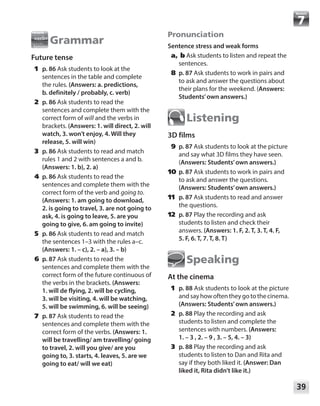
	 1	 p. 8 Ask students to look at the picture
and describe the people in it. Ask
questions such as: How old do you
think the boy/ girl is? or Do you think
they are friends or relatives? Ask
students to look at the picture, read and
tell the names. (Answers: a. girl on the
left: Megan, b. girl on the right: Rita,
c. boy: Dan)
	 2	 p. 8 Play the recording and ask students
to listen and choose the correct words.
(Answers: 1. – 15, 2. – computer
games, 3. – 14, 4. – swimming)
	 3	 p. 8 Ask students to look at the previous
examples and introduce themselves to
a friend. (Answers: Students’own
answers) Monitor the activity, offer
feedback and provide examples if
necessary.
Vocabulary
	 4	 p. 8 Ask students to read the adjectives
and match them with their opposites.
(Answers: 1 – c, 2 – d, 3 – e, 4 – b, 5 – f,
6 – a)
	 5	 p. 8 Ask students to read the words and
choose the odd one out. Tell students to
pay attention to what the things in each
list have/don’t have in common.
(Answers: 1. chemist, 2. mountain,
3. football, 4. snow, 5. knee, 6. sofa)
	 6	 p. 8 Ask students to add one more word
to each group in exercise 5. Write the
possible answers on the blackboard.
(Answers: Students’own answers.)
	 7	 p. 9 Ask students to read the sentences
and choose the correct words.
(Answers: 1. camp, 2. fish, 3. sleep,
4. build, 5. look for)
	 8	 p. 9 Ask students to copy the table in
their notebooks and complete it with
the words in the box and identify the
words which can be used for both
males and females. Answers:
male female
brother sister
father mother
son daughter
uncle aunt
grandad grandmother
husband wife
nephew niece
cousin cousin
	 9	 p. 9 Ask students to read the sentences
and complete them with words from
exercise 8. (Answers: 1. aunt, 2. sister,
3. son, 4. cousin, 5. niece)
	
10	 p. 9 Ask students to read the sentences
and complete them with words from
the box. (Answers: 1. A vet, 2. A
mechanic, 3. An engineer, 4. A
sportsperson, 5. An electrician)
Starter module
(p. 8-10)
4
Module
	11	 p. 9 Ask students to read and match the
jobs in exercise 10 with the places.
(Answers: 1. an architect – an office,
2. a vet – an animal hospital,
3. a mechanic – a car service,
4. an engineer – an office, 5. a
sportsperson – a swimming pool,
6. an electrician – a factory)
Ask students to make sentences using
the words. (Suggested answers:
1. An electrician works in a factory.
2. A sportsperson trains in a swimming
pool. 3. A mechanic repairs cars
at a car service. 4. An engineer works
in an office. 5. An architect works in
an office.)
	12	 p. 9 Ask students to work in pairs and to
ask and answer questions about jobs.
(Answers: Students’own answers.)
Grammar
	 1	 p. 9 Ask students to read the sentences
and choose the correct words. (Answers:
1. Has, 2. is, 3. goes, 4. doesn’t, 5. live,
6. my, 7. are, 8. study, 9. Do)
	2	p. 9 Ask students to read the words in
the box and identify the countable and
uncountable nouns. Remind students
that countable nouns are for things we
can count using numbers and they have
a singular and a plural form – and
uncountable nouns cannot be counted
with numbers and they can refer to
liquids, powders, abstract ideas.
Answers:
Countable nouns Uncountable nouns
apple bread
tomato money
fruit chocolate
grape water
milk
juice
	3	p. 9 Ask students to add more words to
each list. Suggested answers:
Countable
nouns
Uncountable
nouns
orange sugar
banana honey
chair flour
bed rice
wall butter
desk music
book love
notebook advice
schoolbag information
pencil news
flower furniture
tree luggage
	 4	 p. 9 Ask students to look at the picture
and compete the sentences. Tell
students to pay attention and notice
the differences between affirmative and
negative sentences. (Answers: 1. aren’t,
2. isn’t, 3. is, 4. isn’t, 5. are)
	5	p. 9 Ask students to read the sentences
and choose the correct words.
(Answers: 1. go, 2. live, 3. love, 4. likes,
5.‘m getting ready, 6.‘m doing)
	6	p. 10 Ask students to read the
sentences, notice the mistakes and
correct them. (Answers: 1. Dan and
Megan are friends. 2. Rita’s favourite
sport is swimming. 3. Megan lives with
her parents in Reading. 4. Rita doesn’t
like tennis. 5. Dan and Rita don’t go to
the same school. 6. Does Dan like
playing football? 7. Has Megan got any
brothers and sisters? 8. Beth is Dan’s
best friend and his sister too.)
5
Module
	7	p. 10 Ask students to read the
sentences and complete them with the
comparative form of the adjectives in
brackets. Remind students the
differences between long and short
adjectives. (Answers: 1. more difficult,
2. bigger, 3. better, 4. more sociable,
5. lazier, 6. more talkative)
	8	p. 10 Ask students to read the words in
the box and complete the questions.
(Answers: 1. What, 2. How, 3. Where,
4. Who, 5. Why, 6. When)
	9	p. 10 Ask students to read the questions
in exercise 8 again and match them
with the correct answers. (Answers:
1. b), 2. a), 3. f), 4. e), 5. c), 6. d)
	10	 p. 10 Ask students to answer the
questions in exercise 8. (Answers:
Students’own answers.)
	11	 p. 10 Ask students to write questions
using the words given. (Answers: 1. Can
you swim? 2. Does your best friend
like chocolate? 3. Have you got any
pets? 4. Is there a computer in your
bedroom? 5. Are there any good shops
where you live? 6. Can you speak
French?)
	12	 p. 10 Ask students to work in pairs and
to ask and answer the questions in the
previous exercise. (Answers: Students’
own answers.)
	13	 p. 10 Ask students to read and match
the questions with the answers.
(Answers: 1. e), 2. g), 3. f), 4. c), 5. d),
6. b), 7. a)
6
Module
Vocabulary
	1	p. 12 Ask students to look at the
pictures and say what the people are
doing. Tell students to read the words in
the box and match each picture with
the activities. (Answers: Picture 1: play
tennis, Picture 2: do voluntary work,
Picture 3: play computer games,
Picture 4: play an instrument)
	2	p. 12 Play the recording and ask
students to listen and repeat.
	3	p. 12 Ask students to read the
sentences and complete them with
words and phrases in exercise 1.
(Answers: 1. learn, 2. make models,
3. play tennis/ go to the gym, 4. do
voluntary work, 5. go out for a meal,
6.chat online/ play computer games)
	4	p. 12 Play the recording and ask students
to listen to Megan and Dan and find out
Megan’s favourite free-time activity.
(Answer: going to her youth group)
	5	p. 12 Ask students to work in pairs and
to ask and answer the question. Tell
students to use the words in exercise 1,
as well as their own ideas. (Answers:
Students’own answers.)
Free time (p. 11-22)
Module
Reading
	6	p. 12 Ask students to look at the title of
the text and predict what it is about.
(Answer: b)
	7	p. 12 Play the recording and ask
students to listen and identify the
free-time activities the writer talks
about. (Possible answers: relax, music
lesson, do voluntary work, play tennis,
go to a computer class, play an
instrument, go to a youth group, help
at an animal refuge, learn languages,
go out, do a play, go to guitar classes,
basketball club, watch TV.)
	8	p. 13 Ask students to read the text and
choose the correct words. (Answers:
1. imagining, 2. Almost two-thirds,
3. parents and friends, 4. does a lot of
activities, 5. should enjoy their)
	9	p. 13 Ask students to read the words
and match. Tell students to look at the
text in order to check their answers.
(Answers: 1. b), 2. a), 3. e), 4. c), 5. d)
	10	 p. 13 Class vote. Ask students to say if it
is a good idea to learn new things
outside school. Tell students to sustain
their point of view with relevant
reasons and examples. (Answers:
Students’own answers.)
Free time activities (p. 12-17)
1a
1a
7
Module
Grammar
Present tenses
	1	p. 14 Ask students to read the sentences
in the table and find other examples of
present simple in the text on page 13.
(Answers: come, they‘re, don’t relax,
have, has, does, prepares, does, plays,
studies, eats, goes, does this sound,
it’s, do, volunteer, help, want, is, get,
I’m, go, watch, don’t have.)
	2	p. 14 Ask students to read the rule for
when we use present simple and
complete it with the correct words.
(Answer: habits and routines.)
Adverbs of frequency
	3	p.14 Ask students to copy and complete
the table with the frequency adverbs in
the box. (Answers: 1. never,
2. sometimes, 3. always)
	4	p. 14 Ask students to read the sentences
in the table carefully and complete the
rules for the position of adverbs of fre-
quency. (Answers: a. before, b. after)
	5	p. 14 Ask students to read the
sentences and complete them with the
adverbs of frequency and the correct
form of the verbs in brackets. (Answers:
1. usually meets, 2. are sometimes,
3. hardly ever listen, 4. never goes,
5. always drive, 6. often volunteer,
7. sometimes goes)
	6	p. 14 Ask students to work in pairs and
write five questions beginning with
How often. Tell students to ask and
answer the questions. (Answers:
Students’own answers.)
	7	p. 14 Ask students to read the
sentences in the table and choose the
correct words to complete the rule for
when we use the present continuous.
(Answer: actions happening now.)
Time expressions
	8	p. 14 Ask students to copy and
complete the table with time
expressions for the present simple and
the present continuous. Answers:
Present simple Present continuous
usually at the moment
twice a week now
often this week
always
	9	p. 14 Ask students to read the
sentences and complete them with the
correct form of the verbs in brackets.
(Answers: 1. play, 2. does, 3. are
drawing, 4. plays, 5. am chatting,
6. relax, 7. go, 8. am going)
	10	 p. 15 Ask students to read the
sentences and complete them with the
correct form of the verbs in brackets.
(Answers: 1. Is learning/ isn’t studying;
2. doesn’t usually play/ goes; 3. aren’t
doing/ are relaxing; 4. don’t meet/ see)
	11	 p. 15 Ask students to read the text and
choose the correct words. (Answers:
1. are, 2. share, 3. travels, 4. doesn’t
make, 5. has, 6. practises, 7. lives,
8. goes)
	12	 p. 15 Ask students to write questions
using the present simple or the present
continuous. (Answers: 1. What do you
usually do at the weekend? 2. How
often do you watch films? 3. Where do
you usually meet your friends? 4. What
are you doing now? 5. What are you
wearing at the moment? 6. Are you
listening to music now?)
	13	 p. 15 Ask students to work in pairs and
to ask and answer the questions in the
previous exercise. (Answers: Students’
own answers.)
8
Module
Listening
Sport
	14	 p. 15 Ask students to look at the
pictures and answer the questions.
(Possible answers: 1. The sports are
tennis and running. 2. People play
tennis on a tennis court and they run
on a racing track. 3. For tennis you
need a tennis ball and a tennis racket
and for running you need running
shoes. 4. Students’own answers)
	15	 p. 15 Play the recording and ask
students to listen and choose the
correct answers. (Answers: 1. 13,
2. running, 3. always, 4. well,
5. weekend)
	16	 p. 15 Play the recording again and ask
students to listen and decide if the
sentences are true or false. Tell students
to correct the false sentences.
(Answers: 1. False – Ben often goes
running. 2. False – Ben doesn’t play
tennis every day./ Ben goes running
every day. 3. True4. False – Ben goes
running when he feels stressed.
5. False – Ben and his friends usually
talk about any problems.)
Speaking
At home
	1	p. 16 Ask students to look at the picture
and answer the questions. (Answers:
Students’own answers.)
	2	p. 16 Play the recording and ask
students to listen and choose the
correct answers. (Answers: 1. isn’t,
2. tennis, 3. raining)
	3	p. 16 Play the second part of the
recording and ask students to listen and
say which film they decide to watch.
(Answer: Avatar)
	4	p. 16 Play the recording and ask students
to listen again and repeat the dialogue.
	5	p. 16 Ask students to read the dialogue
and order the words. (Answers: 1. Do
you fancy playing a computer game?
2. No, let’s listen to some music instead.
3. Do you fancy listening to my Lady
Gaga CD? 4. Let’s listen to the new
Gorillaz CD instead. 5. OK, good idea.)
	6	p. 17 Ask students what information
they know about the Olympic Games.
Tell them to make a personal project:
students should make a slogan to
promote an Olympic discipline and
invite people to practise it at the
weekend. Ask students to present their
work to the class.
Culture
Famous sporting events
	7	p. 17 Play the recording and ask
students to listen, read and answer the
questions. (Answers: 1. Wimbledon is
a famous tennis championship. It
takes place in London in the last week
of June and the first week of July.
2. Suggested answers: It is surprising
that people eat 112,000 boxes of
strawberries. / It is surprising that
more than 500 million people watch
the competition in 185 different
countries.)
	8	p. 17 Ask students what information
they know about sporting events in
their country. (Answers: Students’own
answers.)
9
Module
Character adjectives (p. 18-21)
1b
1b
Vocabulary
	1	p. 18 Ask students to look at the
pictures and choose the correct
adjectives. (Answers: 1. adventurous,
2. talkative, 3. friendly, 4. generous,
5. energetic, 6. funny, 7. shy, 8. honest)
	2	p. 18 Play the recording and ask
students to listen and repeat the words.
Tell students to pay attention to the
pronunciation of the words.
	3	p. 18 Ask students to read the
sentences and complete them with the
correct adjective in exercise 1.
(Answers: 1. adventurous, 2. friendly,
3. generous, 4. selfish, 5. talkative,
6. confident, 7. funny)
	4	p. 18 Ask students to work in pairs
and decide which of the adjectives in
exercise 1 describes them. Encourage
students to motivate their answers.
Reading
	5	p. 18 Ask students to look at the
pictures and try to guess which
celebrity does each hobby.
	6	p. 18 Play the recording and ask students
to listen and check their answers.
	7	p. 18 Ask students to read the text
again and answer the questions.
(Answers: 1. Robert Pattison plays the
piano and the guitar. 2. Nicole Kidman
is very keen on doing sports and she
often goes skydiving. 3. Ronaldinho’s
hobby is not related to his job: he is
a football player and his hobby is
singing karaoke. 4. Fernando Alonzo
does magic in his free time. 5. Alex
Rodriguez is a top baseball player.)
Grammar
Subject-predicate agreement
	8	p. 19 Ask students to read the
sentences and complete them with the
correct form of the verbs, singular or
plural. (Answers: 1. is, 2. don’t, 3. is,
4. aren’t, 5. wasn’t, 6. isn’t)
	9	p. 19 Ask students to read the
sentences and complete them with the
correct form of the verbs in brackets.
(Answers: 1. order, 2. is, 3. expect,
4. are, 5. is, 6. has, 7. is, 8. lacks)
Writing
A personal profile
	1	p. 20 Play the recording and ask
students to listen, read and answer the
questions. (Answers: 1. Tom goes to
Park Lane Secondary School. Tom’s
hobbies are learning the guitar and
listening to music. 3. Tom likes reggae
and rap. 4. Tom doesn’t go out during
the week because he is usually busy
with homework. 5. At the weekend he
usually meets his friends and they
watch DVDs or play computer games.)
	2	p. 20 Ask students to read the language
focus, translate the words in bold, then
find examples in the text. (Answers:
10
Module
I enjoy talking to them because they
often tell you really interesting stories
about their lives. I love playing
football, although I don’t like watching
sports on TV. I’m usually busy with
homework, so I don’t go out often
during the week.)
	3	p. 20 Ask students to read the
sentences and complete them with so,
because and although. (Answers: 1. so,
2. although, 3. so, 4. because,
5. although)
Progress check
	1	p. 22 Ask students to read and match
to make activities. (Answers: 1. f), 2. b),
3. h), 4. a), 5. d), 6. c), 7. e), 8. g)
	2	p. 22 Ask students to read the sentences
and complete them with the words
in the box. (Answers: 1. generous,
2. cautious, 3. funny, 4. talkative,
5. lazy)
	3	p. 22 Ask students to read and make
sentences using the present simple or
the present continuous. (Answers:
1. Sally uses the computer every day.
2. Jamie is playing a computer game
at the moment. 3. I am not relaxing
now. 4. She doesn’t play the guitar on
Friday. 5. We study English three times
a week. 6. They don’t do sports at the
weekend.)
	4	p. 22 Ask students to read and
complete the question using the
present simple or the present
continuous form of the verbs in
brackets. (Answers: 1. How often do
you go shopping? 2. Are you watching
TV at the moment? 3. What are your
friends doing now? 4. Does your
teacher usually speak English in class?
5. Do you always do your homework in
your bedroom? 6. Are you relaxing
now?)
	5	p. 22 Ask students to read and choose
the correct form of the verb, singular or
plural. (Answers: 1. they are, 2. are,
3. was, 4. are, 5. wants, 6. is)
	6	p. 22 Ask students to read and choose
the correct words. (Answers: 1. don’t
live, 2. go, 3.‘m studying, 4. do I
usually do, 5. go, 6. meeting,
7. drawing, 8. at)
11
Module
Vocabulary
	1	p. 24 Ask students to look at the picture
and try to name the equipment.
(Answers: 1. game console, 2. printer,
3. tablet/ iPad, 4. flatscreen TV,
5. charger, 6. mobile phone, 7. mp3
player, 8. digital camera, 9. memory
stick, 10. laptop)
	2	p. 24 Ask students to look at the picture
again and say what they could do with
the equipment in the picture. (Answers:
take a digital photo – digital camera,
mobile phone, tablet; play a video
game – games console, laptop, tablet,
mobile phone; make a phone call –
mobile phone; scan a photo – printer,
scanner; send an email: laptop, tablet,
mobile phone; store data – memory
stick, laptop; go online – laptop,
tablet, mobile phone; print
a document – printer; charge a mobile
phone – charger; post a comment –
laptop, tablet, mobile phone;
download/ upload a video clip –
laptop, tablet, mobile phone; write
a blog – laptop, tablet, mobile phone;
read an e-book – tablet, laptop,
mobile phone; plug in a memory stick
– laptop, tablet, mobile phone)
	3	p. 24 Play the recording and ask
students to listen and repeat the words.
Tell students to pay attention to the
pronunciation of the words.
	4	p. 24 Ask students to read the sentences
and choose the correct words. (Answers:
1. charge, 2. stores, 3. upload, 4. post,
5. send, 6. print, 7. iPad)
	5	p. 24 Play the recording and ask
students to listen and answer the
question. (Answer: Dan watches TV
four or five hours a week.)
	6	p. 24 Ask students to work in pairs and
to have short dialogues in order to ask
and answer the questions. (Answers:
Students’own answers.)
Reading
	7	p. 25 Ask students to read the
introduction and say what the text is
about. (Answer: b)
	8	p. 25 Play the recording and ask
students to listen, read and say how
many pieces of equipment Sam has in
his room. (Answer: flatscreen TV,
desktop computer, laptop, memory
stick, printer/scanner, computer
games, mobile phone, electric guitar,
mp3 player)
Module
Technology (p. 23-34)
IT activities (p. 24-29)
2a
2a
12
Module
	9	p. 25 Ask students to read the text
again, decide if the sentences are true
or false and correct the false
information. (Answers: 1. False – Sam
watches TV in bed., 2. True, 3. False –
Sam doesn’t buy many games now,
but sometimes he downloads them.,
4. False – He uses the camera on his
phone to take pictures., 5. False – He
plays the electric guitar in a band.,
6. True)
	10	 p. 25 Ask students to find the words in
the text and match them with the
correct definitions. (Answers: 1. e), 2. c),
3. d), 4. a), 5. b)
Grammar
Past simple
	1	p. 26 Ask students to read the sentences
in the table and identify the right forms.
	2	p. 26 Ask students to read the questions
and complete them with was or were.
(Answers: 1. was, 2. were, 3. were,
4. was, 5. were)
	3	p. 26 Ask students to read and match
the answers to the questions in
exercise 2. (Answers: 1. e), 2. d), 3. a),
4. b), 5. c)
	4	p. 26 Ask students to work in pairs
and to ask and answer the questions
in exercise 2. (Answers: Students’own
answers.)
Regular and irregular verbs
	5	p. 26 Ask students to read the
sentences in the table and write short
answers for the questions. (Answers:
1. Yes, he did. 2. Yes, he did. 3. No, he
didn’t.)
	 6	 p. 26 Ask students to copy and
complete the table with the verbs in the
box and to add its past simple form.
Regular Irregular
decide see
realize buy
learn think
	 7	 p. 26 Ask students to look at the text
on p. 25 again and add the verbs to the
table.
Regular Irregular
pass have
watch find
use be
store tell
connect give
transfer get
play buy
download keep
earn make
save send
form take
upload write
plan lose
perform put
listen
	 8	 p. 26 Ask students to read the list of
things and write what Sam did/ didn’t
do. (Answers: He uploaded some
photos., He bought a memory stick.,
He didn’t play a new computer game.,
He downloaded two music files., He
didn’t post comments on his blog.)
13
Module
Pronunciation
Word stress
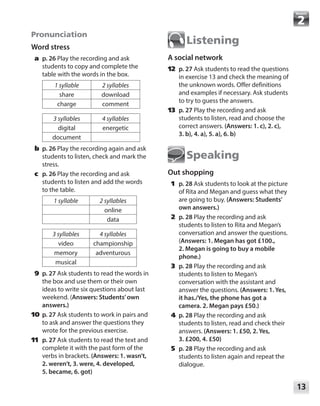
	a	p. 26 Play the recording and ask
students to copy and complete the
table with the words in the box.
1 syllable 2 syllables
share download
charge comment
3 syllables 4 syllables
digital energetic
document
	b	p. 26 Play the recording again and ask
students to listen, check and mark the
stress.
	c	p. 26 Play the recording and ask
students to listen and add the words
to the table.
1 syllable 2 syllables
online
data
3 syllables 4 syllables
video championship
memory adventurous
musical
	 9	 p. 27 Ask students to read the words in
the box and use them or their own
ideas to write six questions about last
weekend. (Answers: Students’own
answers.)
	10	 p. 27 Ask students to work in pairs and
to ask and answer the questions they
wrote for the previous exercise.
	11	 p. 27 Ask students to read the text and
complete it with the past form of the
verbs in brackets. (Answers: 1. wasn’t,
2. weren’t, 3. were, 4. developed,
5. became, 6. got)
Listening
A social network
	12	 p. 27 Ask students to read the questions
in exercise 13 and check the meaning of
the unknown words. Offer definitions
and examples if necessary. Ask students
to try to guess the answers.
	13	 p. 27 Play the recording and ask
students to listen, read and choose the
correct answers. (Answers: 1. c), 2. c),
3. b), 4. a), 5. a), 6. b)
Speaking
Out shopping
	1	p. 28 Ask students to look at the picture
of Rita and Megan and guess what they
are going to buy. (Answers: Students’
own answers.)
	2	p. 28 Play the recording and ask
students to listen to Rita and Megan’s
conversation and answer the questions.
(Answers: 1. Megan has got £100.,
2. Megan is going to buy a mobile
phone.)
	3	p. 28 Play the recording and ask
students to listen to Megan’s
conversation with the assistant and
answer the questions. (Answers: 1. Yes,
it has./Yes, the phone has got a
camera. 2. Megan pays £50.)
	4	p. 28 Play the recording and ask
students to listen, read and check their
answers. (Answers: 1. £50, 2. Yes,
3. £200, 4. £50)
	5	p. 28 Play the recording and ask
students to listen again and repeat the
dialogue.
14
Module
Jobs (p. 30-33)
2b
2b
	6	p. 28 Ask students to order the words to
make questions and answers. (Answers:
1. Can I help you? 2. I’m looking for a
new mobile phone. 3. Can I see that
one? 4. How much is it? 5. That’s
£35.99, please.)
Culture
Famous inventions and inventors
	7	p. 29 Play the recording and ask
students to listen, read and answer the
questions. (Answers: 1. Bell first
invented something when he was just
12. 2. Bell was interested in sound
because his mother became deaf
when he was a child.)
	8	p. 29 Ask students to think about how
people use mobile phones in Romania
and answer the questions. (Answers:
Students’own answers.)
Vocabulary
	1	p. 30 Ask students to look at the
pictures and match them with the jobs
in the box. (Answers: 1. scientist,
2. policewoman, 3. builder,
4. electrician, 5. lawyer, 6. journalist,
7.fireman, 8. actor)
	2	p. 30 Play the recording and ask
students to listen and repeat the words.
Tell students to pay attention to the
pronunciation of the words.
	3	p. 30 Ask students to read the sentences
and complete them with Jobs in
exercise 1. (Answers: 1. doctor,
2. builder, 3. postman, 4. artist,
5. researcher, 6. politician)
	4	p. 30 Ask students to look at the jobs
and find work-related verbs and nouns.
(Answers: electrician → electricity
(noun), postman → post (verb)/ post
(noun), policewoman → police (noun),
journalist → journalism (noun),
researcher → research (noun), actor →
act (verb), lawyer → law (noun),
technician → technology (noun),
fireman → fire (noun), politician →
politics (noun), scientist → science
(noun).
	 5	 p. 30 Ask students to look at the jobs
and put them into five groups.
-man/woman -er -ist
postman researcher artist
policewoman builder scientist
-ian -or
electrician actor
technician
	 6	 p. 30 Class vote. Ask students to vote
and say which jobs are easy/ hard/
dangerous/ fun. Tell students to sustain
their point of view with relevant
reasons and examples. (Answers:
Students’own answers.)
15
Module
Reading
	7	p. 30 Ask students to read the text and
find out how Martin became blind.
(Answer: Martin became blind
because he had a terrible accident
when he was working as a builder.)
	8	p. 30 Play the recording and ask
students to listen, read and answer the
questions. (Answers: 1. Doctors
implanted one of Martin’s teeth in his
eye. 2. The first person Martin saw was
his wife, Gill. 3. Yes, scientists think
they can use the technology for other
blind people.)
Grammar
Past continuous
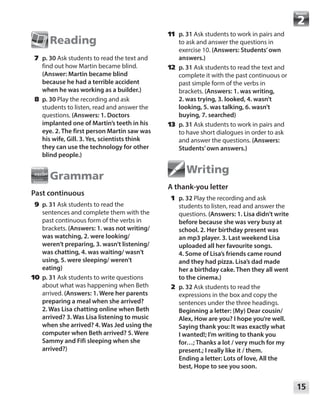
	9	p. 31 Ask students to read the
sentences and complete them with the
past continuous form of the verbs in
brackets. (Answers: 1. was not writing/
was watching, 2. were looking/
weren’t preparing, 3. wasn’t listening/
was chatting, 4. was waiting/ wasn’t
using, 5. were sleeping/ weren’t
eating)
	10	 p. 31 Ask students to write questions
about what was happening when Beth
arrived. (Answers: 1. Were her parents
preparing a meal when she arrived?
2. Was Lisa chatting online when Beth
arrived? 3. Was Lisa listening to music
when she arrived? 4. Was Jed using the
computer when Beth arrived? 5. Were
Sammy and Fifi sleeping when she
arrived?)
	11	 p. 31 Ask students to work in pairs and
to ask and answer the questions in
exercise 10. (Answers: Students’own
answers.)
	12	 p. 31 Ask students to read the text and
complete it with the past continuous or
past simple form of the verbs in
brackets. (Answers: 1. was writing,
2. was trying, 3. looked, 4. wasn’t
looking, 5. was talking, 6. wasn’t
buying, 7. searched)
	13	 p. 31 Ask students to work in pairs and
to have short dialogues in order to ask
and answer the questions. (Answers:
Students’own answers.)
Writing
A thank-you letter
	1	p. 32 Play the recording and ask
students to listen, read and answer the
questions. (Answers: 1. Lisa didn’t write
before because she was very busy at
school. 2. Her birthday present was
an mp3 player. 3. Last weekend Lisa
uploaded all her favourite songs.
4. Some of Lisa’s friends came round
and they had pizza. Lisa’s dad made
her a birthday cake. Then they all went
to the cinema.)
	2	p. 32 Ask students to read the
expressions in the box and copy the
sentences under the three headings.
Beginning a letter: (My) Dear cousin/
Alex, How are you? I hope you’re well.
Saying thank you: It was exactly what
I wanted!; I’m writing to thank you
for…; Thanks a lot / very much for my
present.; I really like it / them.
Ending a letter: Lots of love, All the
best, Hope to see you soon.
16
Module
	3	p. 32 Ask students to order the words to
make sentences. (Answers:
1. I’m writing to thank you for my
birthday present. 2. Thanks a lot for
my digital camera. 3. It was exactly
what I wanted. 4. Hope to see you
soon. 5. Lots of love, Paul.)
Progress check
	1	p. 34 Ask students to read and
complete the phrases with vowels.
(Answers: 1. play a video game, 2. post
a comment, 3. charge a mobile phone,
4. go online, 5. send an email)
	2	p. 34 Ask students to read the
sentences and complete them with the
correct jobs. (Answers: 1. researcher,
2. builder, 3. scientist, 4. journalist,
5. actor)
	3	p. 34 Ask students to read the
sentences and complete them with the
correct form of to be. (Answers: 1. was,
2. were, 3. were/ was, 4. was/ was/ was,
5. was)
	4	p. 34 Ask students to read Rita’s list of
things to do yesterday and write
questions. (Answers: 1. Did Rita send
a text message to Sue? 2. Did Rita chat
online to Mike? 3. Did Rita download
a song? 4. Did Rita play a computer
game? 5. Did Rita post a comment?
6. Did Rita write her blog?)
	5	p. 34 Ask students to look at the list in
exercise 4 again and write answers to
their questions.(Answers: 1. No, she
didn’t. 2. Yes, she did. 3. No, she didn’t.
4. Yes, she did. 5. No, she didn’t. 6. Yes,
she did.)
	6	p. 34 Ask students to write questions
using the past continuous and then
answer the questions so they are true
for them. (Answers: 1. What were you
doing at 10 pm last night? 2. What
were your parents doing at 3pm on
Sunday? 3. Were you and your friend
watching a DVD at 9pm yesterday?
4. Was your friend sleeping at 10am
this morning? 5. What were your
friends doing five minutes ago?)
	7	p. 34 Ask students to read the text and
choose the correct words. (Answers:
1. were, 2. couldn’t, 3. installed,
4. stopped, 5. was travelling,
6. connected, 7. started, 8. use)
17
Module
Module
Vocabulary
	1	p. 36 Play the recording and ask students
to listen and repeat the prepositions.
	2	p. 36 Ask students to decide which
prepositions are opposites and to write
them in pairs. (Answers: under – over,
towards – away from, into – out of, up
– down, across – along, round –
through)
	3	p. 36 Ask students to read the text and
choose the correct words. (Answers:
1. out of, 2. down, 3. up, 4. into,
5. under, 6. over, 7. towards, 8. away
from)
	4	p. 36 Play the recording and ask
students to listen to Dan, Rita and
Megan and find out their superstitions.
(Answers: Dan always walks away from
black cats and he never dives into
a swimming pool first. Rita never
walks under ladders. Megan jumps
over lines in the road, she doesn’t walk
on them.)
	5	p. 36 Ask students to work in pairs and
to have short dialogues in order to ask
and answer the questions. (Answers:
Students’own answers.)
Reading
	6	p. 36 Ask students to look at the words
and say if they relate to text A or B.
(Answers: Students’own answers.)
	7	p. 36 Play the recording and ask
students to listen, read and check their
answers. (Answers: millionaire – A ;
hospital – B ; ant – B ; dive – A)
	8	p. 37 Ask students to read text A again
and say if the sentences are true or
false. (Answers: 1. F, 2. T, 3. F)
	9	p. 37 Ask students to read text B again
and order the events. (Answers: 1-b,
2-e, 3-a, 4-g, 5-d, 6-c, 7-f)
	10	 p. 37 Ask students to find words 1–4
in the texts and then match them with
definitions a–d. (Answers: 1. – c, 2. – b,
3. – d, 4. – a)
Grammar
Past simple vs. past continuous
	1	p. 38 Ask students to look at the
sentences in the table and match them
with timelines a and b. (Answers:
sentence 1 – a; sentence 2 – b.)
Strange
but true! (p. 35-46)
Prepositions (p. 36-41)
3a
3a
18
Module
	2	p. 38 Ask students to read and
complete the rules with past
simple or past continuous. (Answers:
1. Past continuous, 2. Past simple)
	3	p. 38 Ask students to read the text and
choose the correct words. (Answers:
1. went, 2. got, 3. survived, 4. found,
5. was hiding, 6. didn’t recognize)
	4	p. 38 Ask students to read the text
in exercise 3 again and answer the
questions. (Answers: 1. Brennan went
to Scout Camp last summer. 2. When
he went for a walk, he got lost in the
woods. 3. He survived for four days
alone in the woods. 4. When rescuers
found him, he was hiding in a tree.
5. Brennan was hiding because he
didn’t recognize them.)
Pronunciation
Sentence stress
	a	p. 38 Play the recording and ask
students to listen and repeat the
sentences and say which syllables are
stressed. Tell students to pay attention
to the pronunciation of the words/
sentences. (Answers: 1. He was
watching a film. 2. They were listening
to music. 3.He wasn’t hiding in the
woods. 4.Was he talking to David?)
	b	p. 38 Play the recording and ask students
to listen and repeat the sentences.
	5	p. 38 Ask students to look at the
sentences in the table again and answer
the questions. (Answers: 1. He was
running away. 2. The bear attacked.
3. past continuous, 4. past simple)
	6	p. 39 Ask students to read and
complete the sentences with the
correct form of the verbs in brackets
and then rewrite the sentences
changing when and while. (Answers:
1. were playing/ saw – The children
were playing when they saw a snake.
2. were sailing/ was – They were
sailing along the coast when there was
a storm. 3. was flying/ saw – While the
plane was flying over the area, the
pilot saw the explorers. 4. arrived/
were looking – The rescuers were
looking for the lost girl when I arrived.
5. had/ was driving – I was driving
home when I had an accident. 6. met/
was walking – While I was walking in
the park, I met Hannah.)
	7	p. 39 Ask students to read and write
questions with the past simple or past
continuous form of the verbs. (Answers:
1. What were you doing at 5pm
yesterday? 2. What were your friends
doing when you saw them this
morning? 3. What was your friend
doing when the English teacher
arrived today? 4. Did you use
a dictionary while you were doing
your last English homework? 5. What
were you thinking about when the
class started? 6. What did you watch
on DVD last night?)
	8	p. 39 Ask students work in pairs and ask
and answer the questions in exercise 7.
(Answers: Students’own answers.)
Listening
Shark attack!
	9	p. 39 Ask students to look at the
pictures and the words in the box and
guess what the news report is about.
(Answer: Students’own answers.)
	10	 p. 39 Play the recording. Ask students
to listen and check their answers.
19
Module
	11	 p. 39 Play the recording again and ask
the students to say if the sentences are
true or false. Ask students to correct the
false sentences. (Answers: 1. FALSE –
Lydia was bodyboarding when the
shark attacked. 2. FALSE – The shark
was very big – it was 3 metres long.
3. TRUE, 4. FALSE – Lydia hit the shark
on the head with her bodyboard.
5. TRUE, 6. FALSE – Lydia isn’t planning
to swim again at the beach soon.)
	12	 p. 39 Ask students to work in pairs: one
is a reporter, the other one is Lydia. Ask
students to have short dialogues in
order to ask and answer the questions.
(Answers: Students’own answers.)
	13	 p. 39 Personal Project. Ask students to
think of what they might find in a
shark’s stomach. Suggestion: tell
students to use images or drawings for
their project. Ask students to present
their work to the class.
Speaking
Talking with friends
	1	p. 40 Ask students to look at the picture
and the torch Dan is wearing and say if
it is a useful gadget.
	2	p. 40 Play the recording. Ask students to
listen to the first part of Dan, Rita and
Megan’s conversation and answer the
questions.(Answers: 1. The torch is
useful because it works handsfree.,
2. The girls think he looks ridiculous.)
	3	p. 40 Play the recording. Ask students to
listen to Dan’s anecdote and say why his
head torch was useful on the camping
trip. (Answer: Dan’s head torch was
useful on the camping trip because it
helped him and Jamie put their tent
up in five minutes. The head torch also
helped him to see the spiders which
dropped into his spaghetti.)
	5	p. 40 Play the recording. Ask students
to listen and repeat the phrases in the
Functional language box.
	6	p. 40 Ask students to read the
sentences and complete them with the
words in the box. (Answers: 1. fact,
2. imagine, 3. thing, 4. thanks, 5. as,
6. like)
Culture
Famous writers and books
	7	p. 41 Ask students to read the text and
answer the questions. (Answers:
1. Robinson Crusoe is an important
book because many people think it is
the first novel in English. 2. Daniel
Defoe was an English writer and
journalist (who wrote more than 500
books and journals) 3. Alexander
Selkirk was a Scottish sailor who lived
on an island near Chile for four years.)
20
Module
-ed / -ing adjectives (p. 42-45)
3b
3b
Vocabulary
	1	p. 42 Ask students to look at the
pictures and choose the correct word.
(Answers: 1. couple, 2. mountains)
	2	p. 42 Ask students to read and complete
the rules. (Answers: a. –ed, b. –ing )
	3	p. 42 Ask students to copy and complete
the table with the verbs in the box.
verb -ing form -ed form
bore boring bored
surprise surprising surprised
tire tiring tired
excite exciting excited
worry worrying worried
annoy annoying annoyed
interest interesting interested
	4	p. 42 Ask students to read the sentences
and choose the correct words. (Answers:
1. bored/ boring, 2. surprising/
worried, 3. annoyed/ annoying,
4. tired/ interesting, 5. frightened/
frightening)
	5	p. 42 Play the recording. Ask students to
listen, check and repeat.
	6	p. 42 Ask students to read the
sentences and complete them so that
they are true for them. (Answers:
Students’own answers.)
	7	p. 42 Ask students to work in pairs and
read their sentences and compare them
with their partners’answers. (Answers:
Students’own answers.)
Reading
	8	p. 42 Ask students to look at the
pictures and answer the questions.
(Answers: Students’own answers.)
	9	p. 42 Ask students to read the words
and phrases and match them with the
definitions. (Answers: 1. c), 2. a), 3. b),
4. e), 5. d)
	10	 p. 42 Play the recording. Ask students to
listen and read the text and then
answer the questions. (Answers: 1. As
they were driving home they suddenly
got stuck in the snow. 2. They didn’t
use their phones because they weren’t
working so high up. 3. While they were
trying to move the car, they thought
about their four children, aged 8 to 18.
4. On their way home they phoned the
police and then they phoned Sophie.
5. Keith is planning to go back to the
mountains again next year, but
Jennifer doesn’t want to go.)
Grammar
Prepositional verbs
	1	p. 43 Ask students to look at the verbs
in the box and use their dictionary to
check the meaning of any unknown
words.
	2	p. 43 Play the recording. Ask students to
listen and repeat.
21
Module
	3	p. 43 Ask students to read the questions
and complete them with the correct
prepositions. (Answers: 1. to, 2. to, 3. of,
4. with, 5. in, 6. about, 7. about, 8. on)
Pronunciation
Sentence stress
Play the recording. Ask students to listen
and repeat the sentences.
	4	p. 43 Ask students to work in pairs and
to have short dialogues in order to ask
and answer the questions in exercise 3.
(Answers: Students’own answers.)
Phrasal verbs
	1	p. 43 Ask students to look at the phrasal
verbs in the box and use their
dictionary to check the meaning of any
unknown words. Play the recording. Ask
students to listen and repeat.
	2	p. 43 Ask students to rewrite the
sentences using five of the verbs in the
box instead of the words in bold.
(Answers: 1. throw it away, 2. try it on,
3. look for, 4. go with, 5. wear out)
Writing
A description of as accident
	1	p. 44 Ask students to read and listen to
Sam’s description of an accident and
put the pictures in the correct order.
(Answers: 2, 1, 4, 3)
	2	p. 44 Ask students to read the language
focus, translate the words in bold, then
find examples in the text.
	3	p. 44 Ask students to read the
sentences and complete them with
suddenly, meanwhile or then. (Answers:
1. then, 2. suddenly, 3. meanwhile,
4. suddenly, 5. meanwhile)
Progress check
	1	p. 46 Ask students to read the
sentences and complete them with the
words in the box. (Answers: 1. out of,
2. into, 3. across, 4. under, 5. up)
	2	p. 46 Ask students to read the
sentences and complete them with the
correct form of the words in brackets.
(Answers: 1. worried, 2. boring,
3. surprised, 4. interesting, 5. annoyed,
6. annoying)
	3	 p. 46 Ask students to read the
sentences and complete them with the
correct form of the words in brackets.
(Answers: 1. didn’t get up, 2. was
doing, 3. weren’t doing/ saw, 4. didn’t
go, 5. met/ was walking, 6. got lost/
were looking)
	4	p. 46 Ask students to read the
sentences and complete them using
the past simple or the past continuous
form of the verbs in brackets. (Answers:
1. did you go, 2. were you doing, 3. did
you do, 4. was your mother doing/
woke up, 5. were the other students
doing/ arrived)
	5	p. 46 Ask students to read the
sentences and choose the correct verbs.
(Answers: 1. argue with , 2. waiting for,
3. talking to, 4. worries about)
	6	p. 46 Ask students to read the
sentences and complete them with one
of the phrasal verbs in the box.
(Answers: 1. pick out, 2. put my clothes
away, 3. take my jacket off, 4. give it
away, 5. put your coat on, 6. look for)
22
Module
bag
can
glass
jar
Vocabulary
	1	p. 48 Ask students to read the words
in the box and decide which are
containers and which are materials.
(Answers: containers: bag, bottle, box,
can, carton, glass, jar; materials:
aluminium, cardboard, cotton, glass,
metal, paper, plastic, wool.)
	2	p. 48 Play the recording. Ask students to
listen and repeat.
	3	p. 48 Ask students to read the words in
exercise 3 again and match them with
the pictures 1–10. (Answers:
1. aluminium, 2. cardboard box,
3. glass bottle,
4. can, 5. paper, 6. wool, 7. plastic bag,
8. metal box, 9. jar, 10. cotton)
	4	p. 48 Ask students to read and
complete the signs with words in
exercise 1. (Answers: 1. cardboard,
2. paper, 3. plastic, 4. metal, 5. glass,
6. cotton, 7. wool)
	5	p. 48 Play the recording. Ask students to
listen to Will and Izzie and answer the
questions. Answers: 1. Izzie recycles
paper, glass and plastic at school.
2. She recycles every day. 3. She gives
her old clothes to her little sister.
The world
we live in (p. 47-58)
	6	p. 48 Ask students to work in pairs to ask
and answer the questions in exercise 5.
Answers: Students’own answers.
Reading
	7	p.49 Ask students to read the words
and check their meaning. Offer
definitions and examples if necessary.
	8	p. 49 Play the recording. Ask students to
listen, read and match a person with the
words in exercise 7. (Answers: 1. Imran
– reduce, 2. Jake – recycle, reuse;
3. Leanne – refuse)
	9	p. 49 Ask students to read the text
again and decide if the sentences are
true or false. (Answers: 1. True, 2. False,
3. True, 4. False, 5. True)
	10	 p. 49 Ask students to read the text
again and answer the questions.
(Answers: 1. The theme of the
competition is giving tips to save the
planet. 2. Imran wants people to save
electricity and do outdoor activities.
3. Jake wants people to give old
clothes to people who need them and
recycle clothes no one can wear or use
them to clean the house. 4. Leanne
wants people to refuse to buy
products with a lot of plastic.)
Module
Materials and containers (p. 48-53)
4a
4a
23
Module
	11	 p. 49 Ask students to read the words in
the box and translate them into
Romanian. Suggestion: ask students to
make sentences in order to check
comprehension.
Grammar
Present perfect simple
	1	p. 50 Ask students to look at the
sentences in the table and complete
the rules with the words in the box.
(Answers: 1. have, 2. has, 3. –ed,
4. bought)
	2	p. 50 Ask students to look at the
sentences in the table and elicit the
rules. (Answers: Questions are formed
by putting‘have’or‘has’in front of the
subject. - Auxiliary + subject + past
participle Short answers are formed
with the subject (personal pronoun)
and the auxiliary. - Yes + subject +
have/has; No + subject + haven’t/
hasn’t. The negative of present perfect
is formed by adding‘not’after the
auxiliary verb‘have’/’has’. - Subject +
haven’t/hasn’t + past participle.)
	3	p. 50 Ask students to read the
sentences and complete them with the
present perfect forms of the verbs in
brackets. Tell students to look at the
spelling rules on p. 154 to check their
answers. (Answers: 1. have recycled,
2. have opened, 3. has decided, 4. has
tried, 5. have reduced)
	4	p. 50 Ask students to look and write
complete sentences. Tell students to ask
and answer questions using the present
perfect simple. (Answers: 1. Have they
turned off all the lights? Yes, they
have. They have turned off all the
lights. 2. Has she broken the window?
Yes, she has. She has broken the
window. 3. Has he stolen the car? Yes,
he has. He has stolen the car. 4. Has
she passed the exam? Yes, she has. She
has passed the exam. 5. Has the boy
eaten all the chocolate? Yes, he has.
The boy has eaten all the chocolate.
6. Has he thrown away the old toys?
Yes, he has. He has thrown away the
old toys.)
	5	p. 50 Ask students to read the text and
complete it with the present perfect
form of the verbs in brackets. (Answers:
1. has become, 2. have built, 3. has
had, 4. have been, 5. have provided,
6. have used, 7. has fallen)
	6	p. 50 Ask students to read and choose
the correct words. (Answers: 1. haven’t,
2. hasn’t, 3. hasn’t, 4. haven’t,
5. haven’t, 6. has, 7. has, 8. has)
	7	p. 51 Ask students to read the text and
complete it with the present perfect
form of the verbs in brackets. (Answers:
1. hasn’t studied, 2. has created,
3. have been chosen, 4. has promised,
5. have rebuilt, 6. hasn’t finished,
7. haven’t stopped)
	8	p. 51 Ask students to read the
sentences and complete them with for
and since. (Answers: 1. for, 2. since,
3. since, 4. for, 5. since)
Pronunciation
Contractions
	a	Play the recording and ask students to
listen and repeat.
	b	Play the recording and ask students to
listen and say which sentences they
hear. (Answer: 1. b, 2. a)
24
Module
Listening
Eco family
	9	p. 51 Ask students to look at the
newspaper headline and say what the
radio programme is about. (Answers:
Students’own answers.)
	10	 p. 51 Play the recording and ask students
to listen and check their answers.
	11	 p. 51 Play the recording and ask
students to listen and say if the
sentences are true or false. (Answers:
1. True, 2. True, 3. False, 4. False,
5. True, 6. True)
	12	 p. 51 Ask students to remember the
information on the recording and
answer the questions. (Answers: 1. The
Carter family live in the South of
England. 2. They buy their food from
small shops. 3. They give their old
clothes to charity.)
	13	 p. 51 Ask students to talk in pairs and
say which of the Carters’ideas they
think is the best.
Speaking
On a bike ride
	1	p. 52 Tell students that Will, Izzie and
Lou are going on a bike ride. Ask
students to look at the picture and say
what they can see. (Answers: Students’
own answers.)
	2	p. 52 Play the recording and ask
students to listen to the dialogue and
say what Will is looking for. (Answer:
Will is looking for the shop.)
	3	p. 52 Play the recording again and ask
students to listen and complete the
dialogue. (Answers: 1. post office,
2. left, 3. bank)
	4	p. 52 Play the recording again and ask
students to listen and repeat the
dialogue.
	5	p. 52 Ask students to order the words to
make sentences. (Answers: 1. Go
straight on, past the bank. 2. You can’t
miss it. 3. It’s next to the chemist’s.
4. The post office is on your right.
5. How do we get to the post office?)
Culture
Cycling in the UK
	6	p. 53 Play the recording and ask
students to listen and read the text
about cycling in the UK and answer the
questions. (Answers: 1. Couriers ride
bikes in London because they are
quicker than cars in the traffic.
2. Britain celebrates Bike Week to
promote cycling as good for your
health, the environment and your
pocket. 3. They have a lot of different
events around the UK, like cycling
picnics, barbecues and sponsored bike
rides to collect money for charity.)
	7	p. 53 Ask students to read and answer
the questions. Ask students to bring
reasons in order to sustain their point of
view. (Answers: Students’own
answers.)
	8	p. 53 Personal Project. Ask students to
make up a PowerPoint presentation
about a healthy lifestyle / sport / healthy
food. Encourage students to use digital
content (audio, images, movies) and to
present the slides to the class.
25
Module
Endangered animals (p. 54-57)
4b
4b
dolphin
rhino
tiger
turtle
Vocabulary
	1	p. 54 Ask students to read the words in
the box and match them with pictures
1–10. (Answers: 1. elephant, 2. panda,
3. turtle, 4. leopard, 5. snake,
6. dolphin, 7. rhinoceros, 8. orang-
utan, 9. polar bear, 10. tiger)
	2	p. 54 Play the recording and ask
students to listen and repeat.
	3	p. 54 Ask students to read the
sentences and complete them with
words from exercise 1. (Answers:
1. polar bear, 2. dolphin, 3. tiger,
4. rhinoceros, 5. orang-utan)
	4	p. 54 Ask students to copy and
complete the table with the words from
exercise 1.
forest savannah water other
panda elephant dolphin polar
bear
tiger rhinoceros turtle snake
leopard
	5	p. 54 Ask students to work in groups
and ask and answer questions about
the animals in exercise 1. (Answers:
Students’own answers.)
Reading
	6	p. 54 Ask students to read the words in
the box and check their meaning.
Suggestion: ask students to make
sentences in order to check
comprehension.
	7	p. 54 Play the recording and ask
students to listen and say if they would
like to adopt an animal.
	8	p. 54 Ask students to read the text
again and answer the questions.
(Answers: 1. It costs €36 a year to
adopt an animal. 2. The turtles are the
oldest animals in the text. 3. Humans
hunt turtles and orang-utans for meat.
4. African elephants and orang-utans
are losing their natural homes.
5. An elephant’s tusk is made of ivory.)
Grammar
Present perfect continuous
	9	p. 55 Ask students to read the
sentences and put the verbs in brackets
in present perfect continuous.
(Answers: 1. have been calling, 2. have
been working, 3. has been studying, 4.
have been painting, 5. has been
waiting, 6. has been typing)
	10	 p. 55 Ask students to read the
sentences in exercise 9 again and make
them negative. (Answers: 1. I haven’t
been calling you all morning. 2. They
haven’t been working in the basement
since 10 am. 3. Peter hasn’t been
studying for his driving test for
2 hours. 4. We haven’t been painting
the living room all day. She hasn’t
been waiting for the bus for
15 minutes. 6. The secretary hasn’t
been typing letters since this
morning.)
26
Module
	11	 p. 55 Ask students to read and order the
words to make sentences. (Answers:
1. Has he been performing in the show
for the last two months? 2. How long
has Lucy been cleaning the house?
3. Has she been running much
recently? 4. Has Julia been working in
this company for more than five years?
5. How long has she been playing
tennis? 6. What have you been doing
all day?)
Writing
A competition entry
	1	p. 56 Play the recording. Ask students to
listen, read and match the headings 1
– 3 with paragraphs A – C. (Answers:
A. 2, B. 3, C. 1)
	2	p. 56 Ask students to read the
paragraphs and put them in the right
order. (Answers: 2, 3, 1)
Progress check
	1	p. 58 Ask students to look and find nine
words in the wordsearch. (Answers:
bag, wool, jar, glass, cardboard, box,
metal, carton)
	2	p. 58 Ask students to look at the
pictures and identify the animals.
(Answers: 1. panda, 2. rhinoceros,
3. leopard, 4. dolphin, 5. polar bear,
6. orang-utan)
	3	p. 58 Ask students to look at the
information in the table and write
sentences with the present perfect.
(Answers: 1. Kate has recycled plastic
bottles. Edward hasn’t recycled plastic
bottles. 2. Kate hasn’t turned off the
TV. Edward hasn’t turned off the TV.
3. Kate hasn’t thrown away clothes.
Edward has thrown away clothes.
4. Kate has bought local food. Edward
has bought local food. 5. Kate has
become a vegetarian. Edward hasn’t
become a vegetarian.)
	4	p. 58 Ask students to read and
complete the sentences with the
present perfect simple or continuous.
(Answers: 1. has swum, 2. have been
calling, 3. has ridden, 4. have known,
5. has had, 6. have been, 7. has been
eating, 8. have had)
	5	p. 58 Ask students to read the
sentences in exercise 4 again and
rewrite them in the negative form.
(Answers: 1. My brother hasn’t swum
with dolphins in Florida. 2. I haven’t
been calling John for hours and hours.
3. He hasn’t ridden on the backs of
elephants in India. 4. We haven’t
known Julie for ten years. 5. She hasn’t
had a cold for two weeks. 6. I haven’t
been hungry for hours. 7. She hasn’t
been eating chocolate all morning, so
she doesn’t feel sick. 8. We haven’t had
a lot of turtles as pets.)
	6	p. 58 Ask students to read the dialogue
and complete it with the correct form of
the verbs in brackets. (Answers: 1. look,
2. have been looking, 3. have just
gone, 4. turn, 5. --, 6. have you ever
visited, 7. have, 8. did you see, 9. have
been walking)
27
Module
Vocabulary
	1	p. 60 Ask students to look at the
pictures 1 – 4 and match them with the
fundraising ideas in the box. (Answers:
picture 1. sell raffle tickets, picture 2.
wash cars, picture 3. do a sponsored
swim, picture 4. organize a concert)
	2	p. 60 Play the recording and ask
students to listen and repeat. Tell
students to pay attention to the
pronunciation of the words.
	3	p. 60 Ask students to read the text and
complete it with words from exercise 1.
(Answers: 1. badges, 2. sponsored,
3. cars, 4. bring and buy sale,
5. concert, 6. jumble sales, 7. charity)
	4	p. 60 Play the recording and ask
students to listen to Dan and Megan
and find what fundraising idea they
choose for their class. (Answer: Dan
and Megan choose to do a bring and
buy sale.)
	5	p. 60 Ask students to work in pairs and
think of three fundraising ideas to raise
money for a school trip. Encourage
students to use the vocabulary in
exercise 1, as well as their own ideas.
Reading
	6	p. 61 Ask students to look at the titles,
listen and choose the best title for the
text. (Answer: 3)
	7	p. 61 Ask students to read the text
again and decide if the sentences are
true or false and correct the ones which
are false.(Answers: 1. True, 2. False,
3. True, 4. False, 5. False)
	8	p. 61 Ask students to read the text
again and find six things Felicity did to
raise money for the school. (Answers:
she had a big party to launch the
charity, she organized quiz nights and
on-line competitions, she sold cakes,
and she did sponsored walks and
skydives.)
	9	p. 61 Ask students to read the text
again and answer the questions.
(Answers: 1. Felicity spent four months
at the Street Academy School. 2. The
Street Academy School is different to
other schools in Ghana because it
offers free education to children aged
8 – 18 . 3. The new school has very
basic conditions. 4. She wants to raise
£70-80,000. 5. The new windows are in
the shape of triangles and stars.)
Heroes (p. 59-70)
Module
Fundraising ideas (p. 60-65)
5a
5a
28
Module
	10	 p. 61 Ask students to find words 1–5
in the text and match them with
definitions a–e. (Answers: 1. – d), 2. – c),
3. – e), 4. – a), 5. – b)
	11	 p. 61 Ask students to work in pairs and
tell their partners about someone they
know who helps other people.
Grammar
Present perfect simple
vs. present perfect continuous
	1	p. 62 Ask students to read the
sentences in the table and say which
are present perfect simple and which
are present perfect continuous and
explain the difference in meaning.
(Answers: present perfect simple – b),
d); present perfect continuous – a), c)
	2	p. 62 Ask students to read the
sentences a – d in the table and match
them with the uses 1 – 4. (Answers:
a. – 3, b. – 2, c. – 4, d. – 1)
	3	p. 62 Ask students to read the
sentences and choose the correct tense.
(Answers: 1. have been walking, 2. has
visited, 3. has just left, 4. has gone,
5. have taken, 6. has been training)
	4	p. 62 Ask students to read the
sentences and complete them with
present perfect simple or present
perfect continuous. (Answers: 1. has
built, 2. have seen, 3. have been living/
have lived, 4. has organized, 5. has
been writing, 6. haven’t sold)
	5	p. 62 Ask students to write complete
sentences with present perfect simple
or present perfect continuous.
(Answers: 1. My friends have had lots
of barbecues. 2. Julia has been
working in this company for more
than five years. 3. We haven’t drunk
enough water – that’s why we feel
tired. 4. We have been living in London
for six months. 5. He hasn’t bought
a raffle ticket. 6. My mum has raised
£2,000 for charity. 7. We have
organized a jumble sale. 8. It hasn’t
been raining all day.)
	6	p. 62 Ask students to read the
sentences and correct the mistakes.
(Answers: 1. He hasn’t been to Ghana
many times. 2. They have been selling
sandwiches all day. 3. He hasn’t been
playing football for five years.
4. You’ve given lots of money to
charity. 5. He has visited Africa three
or four times. 6. She hasn’t had
a birthday party this year. 7. They have
been living in a foreign country for
two years.)
	7	p. 62 Ask students to read the text and
complete it with the present perfect
simple or present perfect continuous.
(Answers: 1. has raised, 2. has
organized, 3. has bought, 4. has been
making, 5. haven’t even bought,
6. haven’t collected)
	8	p. 63 Ask students to write questions
using present perfect and ever.
(Answers: 1. Have you ever collected
money for charity? 2. Have you ever
learnt to play a musical instrument?
3. Have you ever done a sponsored
swim? 4. Have you ever bought a
charity badge? 5. Have you ever met
a famous person? 6. Have you ever
bought a charity CD?)
	9	p. 63 Ask students to work in pairs and
ask and answer the questions in
exercise 8, using never. (Answers:
1. I have never collected money for
charity. 2. I have never learnt to play
29
Module
a musical instrument. 3. I have never
done a sponsored swim. 4. I have
never bought a charity badge.
5. I have never met a famous person.
6. I have never bought a charity CD.)
	10	 p. 63 Ask students to read the
sentences and fill in the gaps with ever
or never. (Answers: 1. never, 2. ever,
3. ever, 4. never, 5. never, 6. ever)
	11	 p. 63 Ask students to write questions
using‘How long…?’, then give answers
which are true for them. (Answers:
1. How long have you been at this
school? 2. How long have you been
studying English In the UK? 3. How
long have you had your mobile
phone? 4. How long have you been
living in Britain? 5. How long have
they had their dog?)
Pronunciation
Contractions
	 a,	b Play the recording and ask students
to listen and repeat the sentences.
Listening
Charity appeals
	12	 p. 63 Ask students to work in pairs and
write a list of famous charities and what
they do. Suggestion: tell students to
look for information on the internet.
(Answers: Students’own answers.)
	13	 p. 63 Play the recording and ask students
to listen and identify the charities the
speaker talks about. (Answer: Oxfam,
Médecins Sans Frontières, RSPCA)
	14	 p. 63 Play the recording and ask
students to listen and choose the
correct word. (Answers: 1. hungry
people, 2. sick people, 3. animals)
	15	 p. 63 Play the recording and ask
students to listen and say if the
sentences are true or false. (Answers:
1. False - Oxfam wants people to give
book, clothes, CDs or DVDs for their
shops., 2. True, 3. False - A group of
French doctors started MSF., 4. True,
5. True, 6. The RSPCA gets money from
donations made by the public.)
Speaking
A sponsored walk
	1	p. 64 Ask students to look at the picture
and say what Megan is doing. (Answers:
Students’own answers.)
	2	p. 64 Play the recording. Ask students to
listen to the first part of Megan and Mr
Rodmell’s conversation and say why she
is talking to him. (Answer: Megan is
talking to him because she is raising
money for charity.)
	3	p. 64 Play the recording. Ask students
to listen to the second part of the
conversation and choose the correct
words. (Answers: 1. walk, 2. Oxfam,
3. £1, 4. Saturday)
	4	p. 64 Ask students to read and listen
again and check their answers.
(Answers: 1. walk, 2. Oxfam, 3. £1,
4. Saturday)
	5	p. 64 Ask students to listen again and
repeat the dialogue.
	6	p. 64 Ask students to order the words to
make questions and sentences.
(Answers: 1. Would you like to sponsor
me? 2. No, I’m sorry, I haven’t got any
money. 3. I’ll give you £5 a mile.
4. Could you help me, please?
5. OK. I’ll make a call.)
30
Module
Culture
Famous heroes and heroines
	7	p. 65 Play the recording. Ask students to
listen, read and answer the questions.
(Answers: 1. Elisabeth Fry is one of the
most famous women in British history
because all her life she worked to help
the poor, especially poor people who
were in prison. 2. Her husband was
a wealthy banker. 3. She gave the
prisoners’children food and clothes
and she started a school where she
taught mothers to read.)
	8	p. 65 Ask students to think of a famous
Romanian heroine and say why she is
famous. Encourage students to look for
information on the internet and use
their own knowledge.
	8	p. 65 Personal Project - Shadow Day!
Tell students to Go to a relative’s
working place and ’shadow’him / her.
Tell students to get involved in what he
/ she does and at the end of the day
write about their experience. Tell
students to present it to the class.
make and do (p. 66-69)
5b
5b
Vocabulary
	1	p. 66 Ask students to look at the words
in the box and decide if they are used
with make or do.(Answers: make:
money, someone happy, someone
laugh, friends, a decision, a mistake;
do: charity work, nothing, homework,
your best, someone a favour, exercise)
	2	p. 66 Play the recording. Ask students
to listen and repeat.
	3	p. 66 Ask students to look at the
pictures and match them with the
phrases in exercise 1. (Answers: 1. make
a mistake, 2. make someone laugh,
3. do nothing, 4. do an exercise/do
homework, 5. make friends)
	4	p. 66 Ask students to complete the
questions with the correct form of make
or do. (Answers: 1. makes, 2. make,
3. made, 4. do, 5. do, 6. made, 7. do,
8. make)
	5	p. 66 Tell students to work in pairs
and ask and answer the questions
in exercise 4. (Answers: Students’own
answers.)
Reading
	6	p. 66 Tell students to look at the picture
of Selena Gomez and answer the
questions. (Answers: Students’own
answers.)
	7	p. 66 Play the recording. Ask students to
listen and say why Selena Gomez is
famous. (Answer: Selena Gomez is a
famous actress and pop singer and
since 2009 she has been a UNICEF
Goodwill Ambassador.)
	8	p. 67 Ask students to read the text
again and answer the questions.
(Answers: 1. Selena has been famous
for over ten years. 2. She supports
Island Dog and RAISE Hope for Congo.
31
Module
3. She became a UNICEF Goodwill
Ambassador in 2009. 4. She visited
Ghana to visit children who are living
without enough food or clean water.
5. Goodwill Ambassadors make
people aware of the world’s problems
and encourage them to help.)
	9	p. 67 Ask students to work in pairs and
say their opinion about Goodwill
Ambassadors. Tell students to support
their point of view with reasons and
examples.
Grammar
Present perfect continuous vs.
present continuous
	10	 p. 67 Ask students to read the
sentences in the table and say which
are present perfect continuous and
which are present continuous and
explain the difference in meaning.
(Answers: present perfect continuous
– c), d); present continuous – a), b), e)
	11	 p. 67 Ask students to read the sentences
in the table and match them with uses
1–5. (Answers: 1. d), 2. b), 3. c), 4. a),
5. e)
	12	 p. 67 Ask students to read and choose
the correct tense. (Answers: 1. have
been watching, 2. is visiting, 3. has
been hiking, 4. is having, 5. am
writing, 6. has been skiing)
	13	 p. 67 Ask students to read and
complete the sentences with the
present perfect continuous or present
continuous of the verbs in brackets.
(Answers: 1. is crying, 2. has been
crying, 3. has been raining, 4. have
been waiting, 5. is driving)
	14	 p. 67 Ask students to write complete
the sentences with the present perfect
continuous or present continuous.
(Answers: 1. A car alarm is ringing in
the street. 2. Sarah is studying for her
English test on Tuesday. 3. Sandra has
been exercising at the fitness center
for two hours. 4. We have been waiting
for you since 1pm. 5. Jane isn’t coming
for dinner tonight. 6. My sister is
cooking at the moment.)
	15	 p. 67 Ask students to read and
complete the text with the right form of
the verbs in brackets. (Answers:
1. is watching, 2. hasn’t missed,
3. has been, 4. have been living,
5. has been, 6. is coming)
Writing
A magazine article
	1	p. 68 Play the recording and ask
students to listen, read and answer the
question. (Answer: The students did
a sponsored walk.)
	2	p. 68 Ask students to read again and
answer the questions. (Answers:
1. They wanted to help Oxfam because
many of them had pets and they were
all animal lovers. 2. The students
wanted to raise money because they
wanted to do something to help
animals. 3. They did a sponsored walk
because they all enjoyed walking.)
	3	p. 68 Ask students to read the language
focus and complete the rules with so or
because. (Answers: a. so, b. because)
32
Module
	4	p. 68 Ask students to read and join the
sentences with so or because. (Answers:
1. We haven’t got any milk, so I’m
going to the supermarket. 2. I’m going
to buy a raffle ticket because I want to
support that charity. 3. Dave wants to
raise money, so he’s going to do
a sponsored walk. 4. I can’t go to
Sally’s party because we’re going away
his weekend.)
Progress check
	1	p. 70 Ask students to read and match to
make sentences. (Answers: 1. e), 2. d),
3. b), 4. f), 5. a), 6. c)
	2	p. 70 Ask students to read and
complete the sentences with the
correct form of make or do. (Answers: 	
1. done, 2. do, 3. makes, 4. do, 5. do,
6. made, 7. do)
	3	p. 70 Ask students to read and correct
the sentences. (Answers: 1. Beth has
never done a sponsored swim. 2. My
brothers meet lots of famous people.
3. Have you raised money for charity
lately? 4. I haven’t visited India, but I
want to. 5. Have you seen the new
adventure film? 6. Alex has collected
lots of money for charity.)
	4	p. 70 Ask students to read and
complete the sentences with for or
since. (Answers: 1. since, 2. since, 3. for,
4. for, 5. since, 6. for, 7. since, 8. for)
	5	p. 70 Ask students to read and choose
the correct answers. (Answers: 1. a),
2. b), 3. a), 4. b), 5. b), 6. b), 7. b), 8. a)
33
Module
Vocabulary
	1	p. 72 Ask students to read and match
pictures 1–4 with activities in the box.
(Answers: picture 1: pack a suitcase,
picture 2: send postcards, picture 3:
plan a journey, picture 4: meet people)
	2	p. 72 Play the recording and ask
students to listen and repeat.
	3	p. 72 Ask students to read and choose
the correct words. (Answers: 1. arrived,
2. set off, 3. pack, 4. buy, 5. had, 6. met,
7. planning, 8. come back, 9. bought)
	4	p. 72 Play the recording and ask
students to listen to Rita and Dan and
say what souvenirs they have bought.
(Answers: Dan bought a T-shirt in
Rome. Rita bought a baseball hat in
New York.)
	5	p. 72 Tell students to work in pairs and
ask and answer the question. (Answers:
Students’own answers.)
Reading
	6	p. 73 Ask students to read the text and
say in what ways Albert is a typical
teenager and in what ways he is not.
(Answers: Students’own answers.)
	7	p. 73 Play the recording and ask
students to listen and check their
answers. (Answer: Albert is a typical
teenager because he likes reading
science fiction books, he enjoys
playing Dragon Ball and he’s
interested in science. Albert is
different because he has visited more
than 26 countries alone, he’s got blue
hair, he has written a book and he has
been in a wheelchair since he was
eight years old.)
	8	p. 73 Ask students to read the text
again and answer the questions.
(Answers: 1. The World on Wheels is the
book which Albert wrote. 2. Albert has
visited 26 countries. 3. He usually
travels alone. 4. He gets money by
working and doing tricks with his
wheelchair. 5. The advantages to
travelling in a wheelchair are that the
chair eliminates fear and that people
talk to him because they want to meet
a blue-haired boy who travels the
world alone in a chair and so he makes
new friends. 6. He wants to go to
Africa.)
Incredible
journeys (p. 71-82)
Module
Travel (p. 72-77)
6a
6a
34
Module
Grammar
Present perfect simple
vs. past simple
	1	p. 74 Ask students to read the
sentences in the table and say which
are present perfect and which are past
simple. (Answers: present perfect –
a), b); past simple – c), d)
	2	p. 74 Ask students to match the
sentences a–d in the table with uses
1–4. (Answers: 1. – b), 2. – a), 3. – d),
4. – c)
	3	p. 74 Ask students to read and choose
the correct words. (Answers: 1. lived,
2. has visited, 3. set off, 4.‘s had,
5. took, 6.‘s bought)
	4	p. 74 Ask students to write sentences
using the present perfect or the past
simple. (Answers: 1. He lived in Toronto
for a year when he was younger.
2. I went to Hawaii last summer. It was
great. 3. We have never read David
Beckham’s book. 4. Alex hasn’t been to
Los Angeles. He wants to go next year.
5. My mum has gone to Italy. She’s
coming back tomorrow.)
	5	p. 74 Ask students to read and
complete the questions with the
present perfect form of the verb in
brackets. (Answers: 1. Have you ever
bought any souvenirs? 2. Have you
ever visited South America? 3. Have
you ever read Albert Casals’book?
4. Have you ever been to Australia?
5. Have you ever seen the pyramids in
Egypt?)
	6	p. 74 Ask students to read and
complete the questions with the past
simple form of the verb in brackets and
then match them with the questions in
exercise 5. (Answers: a. What did you
buy? - 1, b. Who did you see them
with? – 5, c. How many kangaroos did
you see? – 4, 4. Did you like it? – 3,
5. Which countries did you visit? – 2)
	7	p. 74 Tell students to work in pairs and
ask and answer the questions in
exercise 5 and 6. (Answers: Students’
own answers.)
	8	p. 75 Ask students to read and
complete the dialogue with the correct
form of the verb in brackets. (Answers:
1. Have you read, 2. have read,
3. wrote, 4. read, 5. have seen, 6. Did
you like, 7. was, 8. saw, 9. has made,
10. have never been, 11. have been,
12. went)
Pronunciation
	a, b	 p. 75 Play the recording and ask
students to listen and repeat the words.
Listening
Dream holidays
	9	p. 75 Ask students to look at the
pictures and say what type of holiday
they show. (Answers: Students’own
answers.)
	10	 p. 75 Play the recording and ask
students to listen to the adverts and
order the journeys. (Answers: A, B, C)
	11	 p. 75 Play the recording and ask
students to listen and say if the
sentences are true or false. (Answers:
1. True, 2. False The cruise doesn’t take
you to France. 3. True, 4. True, 5. False
On the family adventure you travel by
private car and jeep. 6. True)
35
Module
	12	 p. 75 Play the recording and ask
students to listen and choose the
correct answers. (Answers: 1. c), 2. c), 3.
b), 4. a), 5. b)
Speaking
At the station
	1	p. 76 Ask students to look at the
pictures and say where Rita and Megan
are. (Answer: They are at the train
station.)
	2	p. 76 Play the recording and ask
students to listen and answer the
questions. (Answers: 1. Rita is at the
station to meet Megan. 2. They will
travel home by bus.)
	3	p. 76 Play the recording and ask
students to listen to the second part of
the conversation and answer the
question. (Answer: The train was 30
minutes late.)
	4	p. 76 Play the recording and ask
students to listen, read and check their
answers. (Answer: 30)
	5	p. 76 Play the recording and ask
students to listen and repeat the
dialogue.
	6	p. 76 Ask students to match questions
1–4 with answers a–d. (Answers: 1. – c),
2. – d), 3. – b), 4. – a)
Culture
Famous journeys
	7	p. 77 Play the recording and ask
students to listen and answer the
questions. (Answers: 1. The first man to
find gold was James W. Marshall. 2. In
1848 California belonged to the Native
Americans. 3. People travelled to
California by ship or on foot. 4. The
gold rush changed California because
the population grew, a railway line
was built and Native Americans lost
their land.)
	8	p. 77 Ask students if they know about a
famous journey in Romania. Encourage
students to use the internet to look for
information.
Vocabulary
	1	p. 78 Ask students to look at the
extreme adjectives in box A and match
them with the adjectives in box B.
(Answers: terrifying – frightening,
amazing – good, enormous – big,
exhausted – tired, delighted – happy,
tiny – small, awful – bad, freezing –
cold, boiling – hot)
	2	p. 78 Play the recording and ask
students to listen, check and repeat.
	3	p. 78 Ask students to write the extreme
adjective for each sentence. (Answers:
1. awful, 2. amazing, 3. exhausted,
4. delighted, 5. boiling, 6. enormous,
7. tiny, 8. freezing)
Extreme adjectives (p. 78-81)
6b
6b
36
Module
	2	p. 79 Ask students to read and match
the modal verbs to their meanings.
(Answers: 1. b), 2. a), 3. e), 4. d), 5. c)
	3	p. 79 Ask students to fill in the gaps
with the correct verbs: may, might,
could, should. (Answers: more than one
answer may be possible: 1. may,
2. could, 3. should, 4. might, 5. may)
	4	p. 79 Ask students to read the
sentences 1–5 and match them with
deductions a–e. (Answers: 1. – c, 2. – d,
3. – e, 4. – a, 5. – b)
	5	p. 79 Ask students to look and complete
with the correct modal verb. Answers:
(more than one answer may be
possible: 1. should, 2. might, 3. may/
may, 4. should, 5. could, 6. might)
	6	p. 79 Ask students to work in pairs and
to ask and answer questions about a
friend using modal verbs. (Answers:
Students’own answers.)
Writing
A description of a journey
	1	p. 80 Play the recording and ask
students to listen and answer the
question. (Answer: Kate is in
Washington DC.)
	2	p. 80 Ask students to read the email
again and order the events. (Answers:
d, a, c, f, e, b.)
	3	p. 80 Ask students to look at the
Language focus and complete the rules
below with the words in bold.
(Answers: a. first , b. then, next, after
that, c. finally)
	4	p. 80 Ask students to read and choose
the correct words. (Answers: 1. first,
2. then, 3. next, 4. after that, 5. finally)
	4	p. 78 Ask students to read and choose
the correct word. (Answers:
1. exhausted, 2. amazing, 3. freezing,
4. delighted, 5. tiny, 6. terrifying,
7. awful, 8. enormous)
Reading
	5	p. 78 Ask students to look at the picture
and the title of the text and say what
the text is about.
	6	p. 78 Play the recording and ask
students to listen, read and check their
answer.
	7	p. 78 Ask students to read the text
again and answer the questions.
(Answers: 1. Mike celebrated his 17th
birthday in the middle of the Indian
Ocean. 2. Mike set the world record for
the youngest person to sail around the
world solo. 3. The name of his yacht
was totallymoney.com. 4. The waves in
the South Pacific were 50ft high.
5. Mike stopped in the Canary Islands
to repair his auto-pilot. 6. When he
returned home Mike wanted some
steak and chips.)
Grammar
Expressing possibility
and probability
	1	p. 79 Ask students to rephrase the
sentences using the modal verbs in
brackets. (Answers: 1. She might
phone later. 2. I should be at home by
6 o’clock. 3. I may not go out this
evening. 4. She should be here soon.
5. They could tell the truth. 6. He may
apply for this new job.)
37
Module
Progress check
	1	p. 82 Ask students to read the
sentences and complete them with the
words in the box. (Answers: 1. suitcase,
2. souvenir, 3. postcards, 4. journey,
5. adventures, 6. home)
	2	p. 82 Ask students to read and match
adjectives 1–6 with extreme adjectives
a–f. (Answers: 1. – b), 2. – e), 3. – f),
4. – c), 5. – d), 6. – a)
	3	p. 82 Ask students to complete the
sentences with the present perfect or
past simple form of the verbs in
brackets. (Answers: 1. have you ever
been/ went, 2. have you known/ met,
3. have you ever read/ didn’t like,
4. have you sent/ sent, 5. have you
lived/ bought, 6. has your brother
gone/ set off)
	4	p. 82 Ask students to read and choose
the correct word. (Answers: 1. c), 2. b),
3. b), 4. c), 5. b), 6. a)
	5	p. 82 Ask students to complete the
sentences with the present perfect or
past simple form of the verbs in
brackets. (Answers: 1. has lived,
2. went, 3. haven’t been, 4. did you
buy, 5. haven’t seen, 6. haven’t
packed)
	6	p. 82 Ask students to read and fill in the
gaps with the correct verbs: may, might,
could, should. (Answers: (more than
one answer may be possible) 1. might,
2. could, 3. may, 4. might, 5. might,
6. should)
38
Module
Vocabulary
	1	p. 84 Ask students to look at the words
in the box and say which of them could
be used to describe the pictures.
(Answers: picture 1: win an award (film
star), picture 2: film a scene (director,
stuntman/woman, special effects,
script), picture 3: screen)
	2	p. 84 Play the recording and ask
students to listen and repeat.
	3	p. 84 Ask students to copy and complete
the table with words from exercise 1.
people verbs related
to films
other film
words
stuntman/
woman
win an
award
script
film star release a
film
special
effects
producer film a scene plot
soundtrack
screen
	4	p. 84 Ask students to complete the
sentences with the correct form of the
words in exercise 1. (Answers: 1. script,
2. soundtrack, 3. stars/ award,
4. stuntman, 5. special effects)
	5	p. 84 Play the recording and ask students
to listen and match the speakers with
the films. (Answers: 1. b), 2. a), 3. c)
	6	p. 84 Ask students to work in groups of
three and to ask and answer the
questions in the previous exercise.
(Answers: Students’own answers.)
Reading
	7	p. 84 Play the recording and ask students
to listen, read and match predictions 1–5
with the paragraphs A–E. (Answers:
1. – A, 2. – E, 3. – C, 4. – B, 5. – D)
	8	p. 85 Ask students to read again and
choose the correct answers. (Answers:
1. – b), 2. – a), 3. – c), 4. – a), 5. – a)
	9	p. 85 Ask students to read again and
find words in the text. (Answers:
1. classics, 2. audiences, 3. smells,
4. realistic, 5. entertainment)
	10	 p. 85 Class vote. Ask students to vote
and say which paragraph is more
interesting. Tell students to sustain their
point of view with relevant reasons and
examples. (Answers: Students’own
answers.)
On Screen (p. 83-94)
Module
Films (p. 84-89)
7a
7a
39
Module
Grammar
Future tense
	1	p. 86 Ask students to look at the
sentences in the table and complete
the rules. (Answers: a. predictions,
b. definitely / probably, c. verb)
	2	p. 86 Ask students to read the
sentences and complete them with the
correct form of will and the verbs in
brackets. (Answers: 1. will direct, 2. will
watch, 3. won’t enjoy, 4. Will they
release, 5. will win)
	3	p. 86 Ask students to read and match
rules 1 and 2 with sentences a and b.
(Answers: 1. b), 2. a)
	4	p. 86 Ask students to read the
sentences and complete them with the
correct form of the verb and going to.
(Answers: 1. am going to download,
2. is going to travel, 3. are not going to
ask, 4. is going to leave, 5. are you
going to give, 6. am going to invite)
	5	p. 86 Ask students to read and match
the sentences 1–3 with the rules a–c.
(Answers: 1. – c), 2. – a), 3. – b)
	6	p. 87 Ask students to read the
sentences and complete them with the
correct form of the future continuous of
the verbs in the brackets. (Answers:
1. will de flying, 2. will be cycling,
3. will be visiting, 4. will be watching,
5. will be swimming, 6. will be seeing)
	7	p. 87 Ask students to read the
sentences and complete them with the
correct form of the verbs. (Answers: 1.
will be travelling/ am travelling/ going
to travel, 2. will you give/ are you
going to, 3. starts, 4. leaves, 5. are we
going to eat/ will we eat)
Pronunciation
Sentence stress and weak forms
	a, b Ask students to listen and repeat the
sentences.
	8	p. 87 Ask students to work in pairs and
to ask and answer the questions about
their plans for the weekend. (Answers:
Students’own answers.)
Listening
3D films
	9	p. 87 Ask students to look at the picture
and say what 3D films they have seen.
(Answers: Students’own answers.)
	10	 p. 87 Ask students to work in pairs and
to ask and answer the questions.
(Answers: Students’own answers.)
	11	 p. 87 Ask students to read and answer
the questions.
	12	 p. 87 Play the recording and ask
students to listen and check their
answers. (Answers: 1. F, 2. T, 3. T, 4. F,
5. F, 6. T, 7. T, 8. T)
Speaking
At the cinema
	1	p. 88 Ask students to look at the picture
andsayhowoftentheygotothecinema.
(Answers: Students’own answers.)
	2	p. 88 Play the recording and ask
students to listen and complete the
sentences with numbers. (Answers: 	
1. – 3 , 2. – 9 , 3. – 5, 4. – 3)
	3	p. 88 Play the recording and ask
students to listen to Dan and Rita and
say if they both liked it. (Answer: Dan
liked it, Rita didn’t like it.)
40
Module
	4	p. 88 Play the recording and ask
students to listen, read and check their
answer.
	5	p. 88 Play the recording and ask students
to listen and repeat the dialogue.
	6	p. 88 Ask students to order the words in
the box from best to worst. (Answer:
brilliant, very interesting, OK, a bit
boring, rubbish.)
Culture
Famous films and film-makers
	7	p. 89 Play the recording and ask
students to listen and answer the
questions. (Answers: 1. Hitchcock was
a famous director. He is famous for his
suspense and mystery films. 2. No, he
didn’t win any Oscars. 3. He won a Life
Achievement award from the
American Film Institute. 4. Hitchcock
made a short appearance in all of his
films from 1938 onwards.)
Suffixes (p. 90-93)
7b
7b
Vocabulary
	1	p. 90 Ask students to copy and complete
the table with the verbs in the box.
verbs nouns
equip equipment
predict prediction
advertise advertisement
educate education
enjoy enjoyment
possess possession
argue argument
decorate decoration
connect connection
excite excitement
inform information
compete competition
	2	p. 90 Play the recording and ask
students to listen and repeat.
	3	p. 90 Ask students to read the
sentences and complete them with
nouns from exercise 1. (Answers:
1. equipment, 2. connection,
3. education, 4. information,
5. enjoyment)
	4	p. 90 Ask students to read the questions
and complete them with nouns from
exercise 1. (Answers: 1. advertisement,
2. decorations, 3. argument,
4. equipment)
	5	p. 90 Ask students to work in pairs and
to have short dialogues in order to ask
and answer the questions in exercise 4.
(Answers: Students’own answers.)
Reading
	6	p. 90 Ask students to read, look at the
title and choose the correct word.
(Answers: 1. teenagers, 2. new actors)
41
Module
	7	p. 90 Ask students to read the text and
check their answers.
	8	p. 90 Ask students to read the text and
say if the sentences are true or false.
(Answers: 1. False – Fresh Films first
organised the competition in 2002.,
2. True, 3. True, 4. False – Fresh Films
has produced over 80 films and shown
films at over 20 festivals.)
Grammar
First conditional
	9	p. 91 Ask students to look at the rules
and find examples of conditional
sentences in the text.
	10	 p. 91 Ask students to read and choose
the correct words. (Answers: 1. will
choose, 2. don’t take, 3. have, 4. finish,
5. will you do, 6. has)
	11	 p. 91 Ask students to write first
conditional sentences and questions.
(Answers: 1. If we go to the cinema
tonight, will Sarah come with us?
2. If I go to bed late, I will be tired
tomorrow. 3. Will they miss the train if
they don’t leave before 6pm? 4. If they
study a lot, they won’t fail the exam.
5. You will see lots of film stars at the
ceremony if you are lucky.)
	12	 p. 91 Ask students to read the text and
complete it with the correct form of the
verbs in brackets. (Answers: 1. pass,
2. pass, 3. will go, 4. go, 5. will get,
6. get, 7.will earn, 8. earn, 9. will be,
10. will feel, 11. am, 12. don’t start,
13. won’t pass, 14. will happen)
	13	 p. 91 Ask students to read the
sentences and complete them with
their own ideas. (Answers: Students’
own answers.)
	14	 p. 91 Ask students to work in pairs
and to have short dialogues in order
to ask and answer the questions
in exercise 13.
Writing
A film review
	1	p. 92 Play the recording and ask
students to listen, read and answer the
question. (Avatar is one of the writer’s
favourite films.)
	2	p. 92 Ask students to read the review
again and match the descriptions to the
paragraphs. (Answers: 1. D, 2. C, 3. A,
4. B)
	3	p. 92 Ask students to look and translate
the words into their language.
	4	p. 92 Ask students to order the words to
make sentences. (Answers: 1. I thought
the script was very funny. 2. It is
a romantic comedy, but it really makes
you think. 3. I think the plot was the
best thing about the film. 4. I would
recommend it to everyone. 5. In my
opinion.
42
Module
Progress check
	1	p. 94 Ask students to read the
sentences and complete them with the
words in the box. (Answers: 1. screen,
2. script, 3. awards, 4. plot,
5. soundtrack, 6. special effects)
	2	p. 94 Ask students to read the
sentences and complete them with the
correct form of the words in brackets.
(Answers: 1. argument, 2. information,
3. advertisement, 4. development,
5. suggestion, 6. excitement)
	3	p. 94 Ask students to read the
sentences and complete them with the
correct form of will. (Answers: 1. will
live, 2. won’t win, 3. will make, 4. will
film, 5. will he write, 6. won’t buy)
	4	p. 94 Ask students to order the words to
make sentences and questions.
(Answers: 1. It’s going to be hot today.
2. Are they going to fly to England?
3. I’m not going to go out tonight.
4. What are you going to do next
weekend? 5. Where are you going to
stay on holiday? 6. He is not going to
study Chinese.)
	5	p. 94 Ask students to read and choose
the correct words. (Answers: 1. will you
say/ ask, 2. have/ will buy, 3. won’t be/
don’t pass, 4. don’t leave/ will be,
5. will you go/ are, 6. will phone/
remember)
	6	p. 94 Ask students to put the verbs in
brackets into the future simple or the
future continuous. (Answers: 1. will
phone, 2. will be seeing, 3. will ask,
4. will probably buy, 5. will be
watching, 6. will be eating)
43
Module
Vocabulary
	1	p. 96 Ask students to look and match six
of the phrases to the pictures.
(Answers: picture 1: bring a present,
picture 2: point at someone, picture 3:
take off your shoes, picture 4: shake
hands, picture 5: click your fingers,
picture 6: be rude)
	2	p. 96 Play the recording and ask
students to listen and repeat.
	3	p. 96 Ask students which of the actions
in exercise 1 they have done today.
(Answers: Students’own answers.)
	4	p. 96 Ask students to read and choose
the correct words. (Answers: 1. was late,
2. take off my shoes, 3. shook hands
with, 4. told a joke, 5. arrived early,
6. interrupt their conversation, 7. click
your fingers at, 8. jumped the queue)
	5	p. 96 Play the recording and ask
students to listen and say who Dan has
shaken hands with. (Answer: Dan has
shaken hands with the Prime Minister.)
	6	p. 96 Ask students to work in pairs and
say if they have ever shaken hands with
someone famous. (Answers: Students’
own answers.)
Reading
	7	p. 97 Play the recording and ask
students to listen, read and match the
headings 1–4 with the paragraphs A–D.
(Answers: 1. D, 2. B, 3. C, 4. A)
	8	p. 97 Ask students to read the text and
answer the questions. (Answers:
1. When you meet someone for the
first time in the UK you should shake
hands. 2. It is a good idea to take
a present in the UK. 3. In China it is
acceptable to burp. 4. No, you can’t
interrupt a conversation in the USA.)
	9	p. 97 Ask students to work in pairs and
say if they know other cultural rules.
(Answers: Students’own answers.)
	10	 p. 97 Personal project. Ask students to
follow the instructions in order to write
a piece of news about changing trends
in English dining. Ask students to
present their work to the class.
Good friends
(p. 95-106)
Module
Making friends (p. 96-101)
8a
8a
44
Module
Grammar
Obligation, necessity
and prohibition
	1	p. 98 Ask students to read the sentences
in the table and complete the rules.
(Answers: a. obligation , b. necessity,
c. prohibition)
	2	p. 98 Ask students to read and choose
the correct words. (Answers: 1. must,
2. mustn’t, 3. mustn’t, 4. must, 5. must,
6. mustn’t)
	3	p. 98 Ask students to read and complete
the dialogue using must, have to, don’t
have to or mustn’t. (Answers: 1. must,
2. mustn’t, 3. have to, 4. mustn’t,
5. have to, 6. don’t have to)
	4	p. 98 Play the recording and ask
students to listen, check and repeat.
	5	p. 98 Ask students to look at the question
in the table and say if we use have to or
must to ask questions about obligations.
(Answer:Yes, we use have to or must to
ask questions about obligations.)
	6	p. 98 Ask students to write questions
using have to. (Answers: 1. Do you
have to be home before midnight?,
2. Do you have to do your homework
tonight?, 3. Does your dad have to get
up early on Saturday mornings?, 4. Do
visitors have to bring presents in your
country?, 5. Do you have to take off
your shoes at home?)
	7	p. 99 Ask students to read the text and
choose the correct words. (Answers:
1. don’t have to, 2. mustn’t, 3. has to,
4. must, 5. must, 6. doesn’t have to,
7. mustn’t, 8. must)
	8	p. 99 Ask students to work in pairs and
ask and answer the question in exercise 6.
(Answers: Students’own answers.)
Listening
My gang
	9	p. 99 Play the recording and ask
students to listen and choose the
correct words. (Answers: 1. a group of
friends, 2. lots of different friends)
	10	 p. 99 Play the recording again and ask
students to listen and choose the
correct answers. (Answers: 1. a), 2. c),
3. a), 4. c), 5. b), 6. a), 7. c), 8. c)
Speaking
A party
	1	p. 100 Ask students to answer the
questions. (Answers: Students’own
answers.)
	2	p. 100 Play the recording and ask
students to listen and answer the
question. (Answer: Dan went to Peter’s
birthday party.)
	3	p. 100 Play the recording and ask
students to listen and answer the
questions. (Answers: 1. Dan met a girl
called Greta. 2. She’s Norwegian.
3. She is friendly and funny.)
	4	p. 100 Play the recording again and ask
students to listen and check their
answers.
	5	p. 100 Play the recording again and ask
students to listen and repeat the dialogue.
	6	p. 100 Ask students to look at the sen-
tences and say if they describe person-
ality (P), appearance (A) or hobbies (H)?
(Answers: 1. P, 2. A, 3. H, 4. A, 5. P)
	7	p. 100 Ask students to write a short
entry on the class blog, describing their
birthday party. Tell students to add
pictures.
45
Module
Culture
Famous friendships
	8	p. 101 Play the recording and ask
students to listen and answer the
questions. (Answers: 1. He was a famous
adventurer and a hot-air balloonist.
2. Royce was a brilliant engineer.
3.The first Rolls-Royce cost £395.)
	9	p. 101 Ask students if they know
famous friendships in Romania.
Encourage students to use the internet
in order to look for information.
Verb and noun collocations (p. 102-105)
8b
8b
Vocabulary
	1	p. 102 Ask students to match the verbs
in the box with the pictures. (Answers:
1. give presents/ receive presents,
2. have an argument, 3. give advice/
receive advice, 4. spend money)
	2	p. 102 Play the recording and ask
students to listen and repeat.
	3	p. 102 Ask students to read and choose
the correct word. (Answers: 1. time
with/ fun, 2. advice, 3. the truth,
4. money, 5. lie/ argument, 6. present)
	4	p. 102 Ask students to read and
complete the sentences with verbs
from exercise 1. (Answers: 1. have,
2. tell, 3. spend, 4. receive, 5. have)
Reading
	5	p. 102 Ask students to read and listen to
the questionnaire and choose the best
title. (Answer: c)
	6	p. 102 Play the recording. Ask students
to read the questionnaire and choose
the best answers for them. Tell students
to work in small groups and compare
their answers.
Grammar
Time adverbs
	1	p. 103 Ask students to complete the
sentences with the words in the box.
(Answers: 1. soon, 2. Eventually,
3. before, 4. formerly, 5. previously)
	2	p. 103 Ask students to read and choose
the correct time expression. (Answers:
1. before, 2. as soon as, 3. since,
4. before, 5. previously)
Time clauses
	3	p. 103 Ask students to look at the table
above and identify the time expressions
which introduce time clauses. (Answer:
when, as soon as, before, once)
	4	p. 103 Ask students to read and identify
the main clause and the time clause in
each sentence. (Answers: 1. time clause
→While you are dusting the furniture, /
you can listen to music. → main clause,
2. main clause → I will tell her about this
/ as soon as I see her. → time clause,
3. time clause → Before you go to bed, /
brush your teeth. → main clause,
4. main clause →Tom will stay at school
/ until his grandma comes to pick him
up. → time clause, 5. time clause → As
soon as the door opened, Jim saw the
lovely picture. → main clause)
46
Module
	5	p. 103 Ask students to read the
sentences and put the verbs in brackets
into the correct tense. (Answers:
1. gets, 2. leave, 3. visit, 4. finish/ will
give, 5. are, 6. see, 7. finish, 8. fixes)
Writing
A formal letter
	1	p. 104 Play the recording and ask
students to listen, read and answer the
questions. (Answers: 1. Damien is
writing to Young Achievers. 2. He is
writing to them to nominate his friend
Jemima Downside for a Young
Achievers award. 3. Dear Sir/Madam,
Although, However, Furthermore,
In addition, Yours faithfully.)
	2	p. 104 Ask students to read the text
and find reasons why Damien thinks
Jemima should be given the Young
Achievers Award. (Answers: Students’
own answers.)
	3	p. 104 Ask students to read the
sentences in the table and complete
the rules. (Answers: a. although /
however, b. furthermore / in addition)
	4	p. 104 Ask students to rewrite the
sentences using the words in brackets.
(Answers: 1. Although Tom is a bit
eccentric, he’s very approachable.
2. Fiona is very thoughtful. However,
she’s not very reliable. 3. My sister is
really good at sport. Furthermore,
she’s very clever. 4. John can speak
five languages. In addition, he’s now
learning Arabic.)
Progress check
	1	p. 106 Ask students to complete the
sentences with the correct form of the
verbs in the box. (Answers: 1. shake,
2. bring, 3. takes off, 4. tell, 5. click,
6. point)
	2	p. 106 Ask students to match verbs 1–5
with nouns a–e. (Answers: 1. – c),
2. – e), 3. – d), 4. – b), 5. – a)
	3	p. 106 Ask students to choose the
correct words. (Answers: 1. must,
2. doesn’t have to, 3. mustn’t / have to,
4. don’t have to, 5. have to)
	4	p. 106 Ask students to rearrange the
words and write the sentences. (Answers:
1.We must mend the roof. 2. I have to
do the washing up this evening. 3.They
must leave the country today. 4.You
don’t have to buy so much food. 5.You
mustn’t talk so loudly. 6.They have to
finish their homework now.)
	5	p. 106 Ask students to choose the
correct answers. (Answers: 1. a), 2. a),
3. a), 4. a), 5. a), 6. c)
47
Module
Let’s have fun! (p. 107)
Sketch 1
	1	p. 107 Play the recording and ask students to listen and answer the questions. (Answers:
1. Amy is from Norwich. 2. Jupiter has got three rings. 3. Amy has gut the most points.)
	2	p. 107 Ask students to read, listen and check their answers.
	3	p. 107 Ask students to work in groups and follow the instructions to practise and perform
the sketch.
47
48
Module
Writing guide (p. 112-127)
Writing guide 1
A personal profile
Language focus: joining ideas
	1	p. 112 Ask students to read and
complete the sentences with because,
so or although. (Answers: 1. although,
2. so, 3. because, 4. although,
5. because, 6. although)
	2	p. 112 Ask students to read and
complete the profile. (Answers:
1. although, 2. so, 3. because,
4. because, 5. so, 6. so, 7.although)
	3	p. 112 Ask students to read and answer
the questions. (Answers: 1. The two
girls like talking about music, films
and clothes. 2. Katie is good at maths,
art and music. 3. At the moment she is
painting trees and flowers on the walls
of her room. 4. Katie gets jealous of
Naomi when she wins at table tennis.)
Writing guide 2
A thank-you letter
Language focus: an informal letter
	1	p. 114 Ask students to read and match
the beginnings with the endings.
(Answers: 1. j), 2. b), 3. h), 4. i), 5. g),
6. f), 7. e), 8. a), 9. d), 10. c)
	2	p. 114 Ask students to read and
complete the letter. (Answers: 2. I’ve
got some amazing photos of the
party. 3. And thank you for the
presents. 4. The T-shirt is really cool
too. 5. How do you always choose
exactly the right present? 6. School’s
OK at the moment. 7. How is
everything with you? 8. Say hi to
Adam and give my love to your
parents.)
	3	p. 114 Ask students to read and answer
the questions. (Answers: 1. Alice went
to Ben’s house because he had a party.
2. Alice gave Ben sunglasses and a
T-shirt. 3. Ben’s new teacher teaches
maths.)
Writing guide 3
A description of an accident
Language focus: time expressions
	1	p. 116 Ask students to complete the
sentences with suddenly, meanwhile
or then. (Answers: 1. meanwhile,
2. then, 3. then, 4. suddenly,
5. meanwhile, 6. suddenly)
	2	p. 116 Ask students to read and
complete the text
with suddenly, meanwhile or then.
(Answers: 1. suddenly, 2. then,
3. meanwhile, 4. then, 5. suddenly,
6. then, 7. then, 8. meanwhile)
49
	3	p. 116 Ask students to read and answer
the questions. (Answers: 1. Finn and his
friends were playing volleyball at the
beach. 2. Finn hurt his foot when he
stood on a piece of glass. 3. Jude tried
to get the glass out of Finn’s foot.
4. Finn’s cousin, Sam, took him to the
hospital.)
Writing guide 4
A competition entry
Language focus: organizing ideas
	1	p. 118 Ask students to write the
sentences in order to make a paragraph
and use Firstly, Then, and Finally.
(Answers: 2. Firstly we read about their
problem in school. 3. Then we had
a competition to get some money
and we sent the money to the animal
protection organization. 4. Finally,
we adopted an elephant and gave it
a name.)
	2	p. 118 Ask students to read the
competition entry and circle the correct
words. (Answers: 1. Firstly, 2. Then,
3. Finally)
	3	p. 118 Ask students to read the
competition entry and match the
beginnings to the endings. (Answers: 	
1. e), 2. f), 3. b), 4. a), 5. d), 6. c)
Writing guide 5
A magazine article
Language focus: so and because
	1	p. 120 Ask students to match the pairs
of sentences and join them
with so or because. (Answers: 2. There
was a lot of rubbish on the beach so
our class spent a day cleaning it.	
3. I can’t do the sponsored swim on
Saturday because I’m going away this
weekend. 4. They enjoy cooking so
they want to help in the kitchens.
5. We’re going to have a raffle because
it’s a good way of raising money.
6. We wanted to raise some money
so we had a jumble sale.)
	2	p. 120 Ask students to complete the
article with so or because. (Answers:
1. because, 2. so, 3. because,
4. because)
	3	p. 120 Ask students to read and answer
the questions. (Answers: 1. Riverside
School has raised £1500 for WaterAid.
2. The school organized jumble sales,
concerts, pet shows sponsored walks
and washed cars. 3. Luke Wise raised
£1500 after he washed 300 cars.)
Writing guide 6
A description of a journey
Language focus: linkers
	1	p. 122 Ask students to complete the
text with the words in the box.
(Answers: 1. First, 2. Then, 3. After
that, 4. Next, 5. finally)
	2	p. 122 Ask students to read the email
and order the events. (Answers: 	
a) 5, b) 3, c) 2, d) 1, e) 4)
50
	3	p. 122 Ask students to write the five
events in exercise 2 in one paragraph
using the linkers first, then, next, after
that and finally. (Answers: 1. First we
had breakfast at the station. 2. Then
we got on the train to Penzance.
3. Next we got a bus to Land’s End.
4. After that we flew to St Mary’s.
5. Finally we got a boat to St Martin’s.)
Writing guide 7
A film review
Language focus: giving opinion
	1	p. 124 Ask students to match 1–6 with
a–f. (Answers: 1. d), 2. b), 3. f), 4. e),
5. c), 6. a)
	2	p. 124 Ask students to complete the
film review with the words in the box.
(Answers: 1. science-fiction, 2. director,
3. stars, 4. story, 5. home,
6. government, 7. cry,
8. communication, 9. recommend,
10. teenagers)
	3	p. 124 Ask students to read and answer
the questions. (Answers: 1. The film E.T.
came out in 1982. 2. The main actor in
the film is Henry Thomas. 3. E.T. is
short for extra-terrestrial. 4. The film
got an Academy Award for the music.
5. The film is about communication.
– b)
Writing guide 8
A formal letter
Language focus: linkers of addition
and contrast
	1	p. 126 Ask students to rewrite the
sentences using the words in brackets.
(Answers: 1. Although I am very
interested in languages, I want to be
a scientist. 2. I am very happy at my
school. However, I would like to
experience school in another country.
3. I am keen on drama. Furthermore,
I have had big parts in two school
plays. 4. I have studied some Japanese
on my own at home. In addition,
I am now going to a Japanese evening
class. 5. I am friendly and outgoing
and I like meeting people from
different cultures.)
	2	p. 126 Ask students to read and circle
the correct words. (Answers:
1. Although, 2. Furthermore,
3. However, 4. In addition)
	3	p. 126 Play the recording and ask
students to listen and check their
answers.
	4	p. 126 Ask students to read and answer
the questions. (Answers: 1. The
exchange programme is for secondary
schools. 2. Students will be away from
their country for a year. 3. The
programme helps students with travel
costs. 4. The students will pay for the
trips at the end of the study year.)
51
Module
The Big Cheese Festival
	1	p. 133 Ask students to read and answer
the questions. (Answers: 1. The Big
Cheese festival celebrates the history,
heritage and culture of Caerphilly,
a town situated at about seven miles
north of Cardiff. 2. It takes place in the
last weekend in July. 3. People can
enjoy delicious cheese, live music and
medieval re-enactments. 4. The most
popular contest is the Great Cheese
Race. 5. Other activities include
re-enactment displays, toe-tapping
blues, folk music from leading Welsh
and local bands, folk dancing,
educational activities, street
entertainers, an animal marquee,
along with falconry displays,
have-a-go archery and living historical
encampments.)
Mardi Gras
	1	p. 135 Ask students to read and choose
the best answer for each question: true
(T), false (F). (Answers: 1. T, 2. T, 3. F,
4. F, 5. T, 6. F)
Bonfire night
	1	p. 137 Ask students to read and match
the two sentence halves. (Answers:
1. b), 2. c), 3. e), 4. a), 5. f), 6. h), 7. g),
8. d)
Kwanzaa
	1	p. 139 Ask students to read and choose
the right answer. (Answers: 1. b), 2. a),
3. b), 4. b), 5. b)
Flag Day
	1	p. 141 Ask students to read and identify
what the design stands for. (Answers:
1. The blue field on which the stars sit
represents justice and perseverance.
2. Fifty stars – each star represents one
of the states of the Union – a new
constellation just as constellations in
the night sky that stand forever. 3. Red
stripes represent valour, courage and
hardiness. 4. White stripes represent
innocence and purity.)
Trooping the Colour
	1	p. 143 Ask students to read and mark
the sentences as Right (R), Wrong (W)
or Doesn’t Say (DS). (Answers: 1. T, 2. F,
3. F, 4. F, 5. DS, 6. DS)
Celebrations
					around
							the world (p. 132-143)
52
Module
Final Revision 1 (p. 144-145)
	1	p. 144 Ask students to read the clues and complete the crossword.
Across: 2. tired, 4. making, 8. worrying, 9. bored, 12. interesting, 14. chat, 15. send,
16. annoying
Down: 1. stick, 3. round, 5. across, 6. funny, 7. frightening, 10. excited, 11. adventurous,
13. generous
	1	p. 145 Ask students to read and choose the correct words. Answers: 1. is, 2. do you know,
3. was, 4. were, 5. playing, 6. studied, 7. was working, 8. invented, 9. built, 10. created,
11. didn’t make, 12. works, 13. live, 14. has, 15. gave , 16. came)
	2	p. 145 Ask students to read and correct the sentences. (Answers: 1. He has just finished
chatting online. 2. I’ve been learning French for five years. 3. What were you doing on
Saturday night? 4. Were you watching TV at 9pm last night? 5. How long have you been
living here? 6. I was having dinner when he arrived.)
	3	p. 145 Ask students to order the words to make questions. (Answers: 1. Do you like
playing computer games? 2. What were you doing at 8pm last night? 3. Are you
relaxing at the moment? 4. Did your parents buy anything yesterday? 5. Does your
English teacher usually speak? 6. Are you doing a sport now?)
	4	p. 145 Ask students to complete the sentences with the phrasal verbs. (Answers: 1. came
out, 2. took off, 3. went on, 4. make out, 5. took up)
	5	p. 145 Ask students to read and choose the correct modal verb. (Answers: 1. could,
2. might, 3. have to, 4. should, 5. mustn’t)
	6	p. 145 Ask students to read and choose the subject that agrees with the predicate.
(Answers: 1. a) 2. a) 3. a) 4. a) 5. a)
53
Module
Final Revision 2 (p. 146-147)
p. 146 Ask students to read and fill in the gaps with the right words. (Answers: sight, Reef,
coastline, sponsored, raffle tickets, sweets, makes, do, exercise, postcard, souvenirs, take,
freezing, frightening, exhausted)
	1	p. 147 Ask students to read and choose the correct words. (Answers: 1. have you ever
heard, 2. live, 3. is, 4. are, 5. have known, 6. for, 7. weren’t able, 8. became, 9. has been,
10. since, 11. became, 12. rises)
	2	p. 147 Ask students to read and correct the sentences. (Answers: 1. My dad has been
worked here for twenty years. 2. How long do it taken you to get to school. 3. My sister
have lived in China since two years. 4. I were tidying my room when the doorbell ring.
5. I’ve bought a new laptop last month. It has been very cheap.)
	3	p. 147 Ask students to order the words to make questions. (Answers: 1. How long have
you had your mobile phone? 2. Have you ever ben to Paris? 3. Did you buy any clothes
last weekend? 4. Have you eaten any chocolate today? 5. Has your mum got a lot of
friends? 6. What is your favourite place in Spain?)
	4	p. 147 Ask students to write sentences using the present continuous, present perfect
simple or continuous, past simple or continuous. (Answers: 1. Nicky was watching a DVD
when her friend arrived. 2. I am looking for my friends now. 3. He hasn’t left yet.
4. Maggie hasn’t been swimming since 8 o’clock. 5. They haven’t met for two years.
6. While they were swimming they saw a shark.)
54
Module
Final Revision 3 (p. 148-149)
p. 148 Play the game. (Answers: advice, award, advertisement, band, conversation, effects,
festival, impatient, illegal, joke, lie, lyrics, plot, script, soundtrack, tour, truth, unhappy,
unfriendly.)
	1	p. 149 Ask students to read and choose the correct words. (Answers: 1. watch, 2. has,
3. will, 4. is, 5. has to, 6. were watching, 7. wrote, 8. he’ll ask, 9. use, 10. is going to,
11. will, 12. sold, 13. must)
	2	p. 149 Ask students to read and correct the sentences. (Answers: 1. I’ll meet you at the
cinema at 7pm. 2. If you work hard, you’ll pass your exams. 3. They aren’t going to go
on holiday next summer. 4. If my friend tells me a lie, I will be very unhappy.
5. The phonograph was invented by Thomas Edison.)
	3	p. 149 Ask students to write questions. (Answers: 1. What are you doing tonight?,
2. Will cinemas change a lot in the future?, 3. What will you do if you have an argument
with your best friend?, 4. When were you born?, 5. Do you have to be home before
midnight?)
	4	p. 149 Ask students to put the verb in brackets into the correct tense. (Answers: 1. visit,
2. are, 3. finish, 4. fixes, 5. finish / will give, 6. see)
	5	p. 149 Ask students to complete the following sentences with must, mustn’t, or a suitable
form of have to. (Answers: 1. have to, 2. have to, 3. must, 4. mustn’t, 5. don’t have to)
55
Module
Let’s have fun! (p. 150)
Sketch 2
	1	p. 150 Play the recording and ask students to listen and say if the sentences are true
or false. (Answers: 1. F - James has got a new mobile phone., 2. T, 3. T, 4. T)
	2	p. 150 Play the recording and ask students to check their answers.
	3	p. 150 Ask students to work in groups of four to practise and perform the sketch.
55
56
Contents
Starter module (p. 8-10)  . . . . . . . . . . . . .  3
Module 1 – Free time
(p. 11-22)  . . . . . . . . . . . . . . . . . . . . . . . . . . . . . . .  6
Free time activities (p. 12-17)  . . . . . . . . . .  6
Character adjectives (p. 18-21)  . . . . . . . . .  9
Module 1 – Progress Check (p. 22) . . . . . 10
Module 2 – Technology
(p. 23-34)  . . . . . . . . . . . . . . . . . . . . . . . . . . . . . .  11
IT activities (p. 24-29)  . . . . . . . . . . . . . . . . . .  11
Jobs (p. 30-33)  . . . . . . . . . . . . . . . . . . . . . . .  14
Module 2 – Progress Check (p. 34) . . . . . 16
Module 3 – Strange but true!
(p. 35-46)  . . . . . . . . . . . . . . . . . . . . . . . . . . . . . .  17
Prepositions (p. 36-41)  . . . . . . . . . . . . . . . . .  17
-ed / -ing adjectives (p. 42-45)  . . . . . . . . .  20
Module 3 – Progress Check (p. 46) . . . . . 21
Module 4 – The world we live in
(p. 47-58)  . . . . . . . . . . . . . . . . . . . . . . . . . . . . . .  22
Materials and containers (p. 48-53)  . . . .  22
Endangered animals (p. 54-57)  . . . . . . . .  25
Module 4 – Progress Check (p. 58) . . . . . 26
Module 5 – Heroes
(p. 59-70)  . . . . . . . . . . . . . . . . . . . . . . . . . . . . . .  27
Foundraising ideas (p. 60-65)  . . . . . . . . . .  27
make and do (p. 66-69)  . . . . . . . . . . . . . . .  30
Module 5 – Progress Check (p. 70) . . . . . 32
Module 6 – Incredible journeys
(p. 71-82)  . . . . . . . . . . . . . . . . . . . . . . . . . . . . . .  33
Travel (p. 72-77)  . . . . . . . . . . . . . . . . . . . . . . .  33
Extreme adjectives (p. 78-81)  . . . . . . . . .  35
Module 6 – Progress Check (p. 82) . . . . . 37
Module 7 – On screen
(p. 83-94)  . . . . . . . . . . . . . . . . . . . . . . . . . . . . . .  38
Films (p. 84-89)  . . . . . . . . . . . . . . . . . . . . . . . .  38
Suffixes (p. 90-93)  . . . . . . . . . . . . . . . . . . . .  40
Module 7 – Progress Check (p. 94) . . . . . 42
Module 8 – Good friends
(p. 95-106) . . . . . . . . . . . . . . . . . . . . . . . . . . . . . 43
Making friends (p. 96-101)  . . . . . . . . . . . . .  43
Verb and noun collocations
(p. 96-101)  . . . . . . . . . . . . . . . . . . . . . . . . . . .  45
Module 8 – Progress Check (p. 106)  . . .  46
Let’s have fun! Sketch 1 (p. 107)  . . .  47
Writing guide (p. 112-127)  . . . . . . . . . .  48
Celebrations around
the world (p. 132-143)  . . . . . . . . . . . . .  51
Final Revision 1 (p. 144-145) . . . . . . .  52
Final Revision 2 (p. 146-147)  . . . . . .  53
Final Revision 3 (p. 148-149)  . . . . . .  54
Let’s have fun! Sketch 2 (p. 150)  . . .  55
Ghidul profesorului
Limba modernă 1
Engleză. Clasa a VII-a
Oana Băjenaru Laura Stanciu
Barabaș Valentina

Ghid-engleza-VII-L1.pdf

  • 1.
    Ghidul profesorului Limba modernă1 Engleză. Clasa a VII-a Oana Băjenaru Laura Stanciu Barabaș Valentina
  • 2.
    ENGLEZĂ Ghidul profesorului clasa aVII-a L1 Laura Stanciu Valentina Barabaș Oana Băjenaru
  • 3.
  • 4.
    3 Module Introductions 1 p.8 Ask students to look at the picture and describe the people in it. Ask questions such as: How old do you think the boy/ girl is? or Do you think they are friends or relatives? Ask students to look at the picture, read and tell the names. (Answers: a. girl on the left: Megan, b. girl on the right: Rita, c. boy: Dan) 2 p. 8 Play the recording and ask students to listen and choose the correct words. (Answers: 1. – 15, 2. – computer games, 3. – 14, 4. – swimming) 3 p. 8 Ask students to look at the previous examples and introduce themselves to a friend. (Answers: Students’own answers) Monitor the activity, offer feedback and provide examples if necessary. Vocabulary 4 p. 8 Ask students to read the adjectives and match them with their opposites. (Answers: 1 – c, 2 – d, 3 – e, 4 – b, 5 – f, 6 – a) 5 p. 8 Ask students to read the words and choose the odd one out. Tell students to pay attention to what the things in each list have/don’t have in common. (Answers: 1. chemist, 2. mountain, 3. football, 4. snow, 5. knee, 6. sofa) 6 p. 8 Ask students to add one more word to each group in exercise 5. Write the possible answers on the blackboard. (Answers: Students’own answers.) 7 p. 9 Ask students to read the sentences and choose the correct words. (Answers: 1. camp, 2. fish, 3. sleep, 4. build, 5. look for) 8 p. 9 Ask students to copy the table in their notebooks and complete it with the words in the box and identify the words which can be used for both males and females. Answers: male female brother sister father mother son daughter uncle aunt grandad grandmother husband wife nephew niece cousin cousin 9 p. 9 Ask students to read the sentences and complete them with words from exercise 8. (Answers: 1. aunt, 2. sister, 3. son, 4. cousin, 5. niece) 10 p. 9 Ask students to read the sentences and complete them with words from the box. (Answers: 1. A vet, 2. A mechanic, 3. An engineer, 4. A sportsperson, 5. An electrician) Starter module (p. 8-10)
  • 5.
    4 Module 11 p. 9Ask students to read and match the jobs in exercise 10 with the places. (Answers: 1. an architect – an office, 2. a vet – an animal hospital, 3. a mechanic – a car service, 4. an engineer – an office, 5. a sportsperson – a swimming pool, 6. an electrician – a factory) Ask students to make sentences using the words. (Suggested answers: 1. An electrician works in a factory. 2. A sportsperson trains in a swimming pool. 3. A mechanic repairs cars at a car service. 4. An engineer works in an office. 5. An architect works in an office.) 12 p. 9 Ask students to work in pairs and to ask and answer questions about jobs. (Answers: Students’own answers.) Grammar 1 p. 9 Ask students to read the sentences and choose the correct words. (Answers: 1. Has, 2. is, 3. goes, 4. doesn’t, 5. live, 6. my, 7. are, 8. study, 9. Do) 2 p. 9 Ask students to read the words in the box and identify the countable and uncountable nouns. Remind students that countable nouns are for things we can count using numbers and they have a singular and a plural form – and uncountable nouns cannot be counted with numbers and they can refer to liquids, powders, abstract ideas. Answers: Countable nouns Uncountable nouns apple bread tomato money fruit chocolate grape water milk juice 3 p. 9 Ask students to add more words to each list. Suggested answers: Countable nouns Uncountable nouns orange sugar banana honey chair flour bed rice wall butter desk music book love notebook advice schoolbag information pencil news flower furniture tree luggage 4 p. 9 Ask students to look at the picture and compete the sentences. Tell students to pay attention and notice the differences between affirmative and negative sentences. (Answers: 1. aren’t, 2. isn’t, 3. is, 4. isn’t, 5. are) 5 p. 9 Ask students to read the sentences and choose the correct words. (Answers: 1. go, 2. live, 3. love, 4. likes, 5.‘m getting ready, 6.‘m doing) 6 p. 10 Ask students to read the sentences, notice the mistakes and correct them. (Answers: 1. Dan and Megan are friends. 2. Rita’s favourite sport is swimming. 3. Megan lives with her parents in Reading. 4. Rita doesn’t like tennis. 5. Dan and Rita don’t go to the same school. 6. Does Dan like playing football? 7. Has Megan got any brothers and sisters? 8. Beth is Dan’s best friend and his sister too.)
  • 6.
    5 Module 7 p. 10 Askstudents to read the sentences and complete them with the comparative form of the adjectives in brackets. Remind students the differences between long and short adjectives. (Answers: 1. more difficult, 2. bigger, 3. better, 4. more sociable, 5. lazier, 6. more talkative) 8 p. 10 Ask students to read the words in the box and complete the questions. (Answers: 1. What, 2. How, 3. Where, 4. Who, 5. Why, 6. When) 9 p. 10 Ask students to read the questions in exercise 8 again and match them with the correct answers. (Answers: 1. b), 2. a), 3. f), 4. e), 5. c), 6. d) 10 p. 10 Ask students to answer the questions in exercise 8. (Answers: Students’own answers.) 11 p. 10 Ask students to write questions using the words given. (Answers: 1. Can you swim? 2. Does your best friend like chocolate? 3. Have you got any pets? 4. Is there a computer in your bedroom? 5. Are there any good shops where you live? 6. Can you speak French?) 12 p. 10 Ask students to work in pairs and to ask and answer the questions in the previous exercise. (Answers: Students’ own answers.) 13 p. 10 Ask students to read and match the questions with the answers. (Answers: 1. e), 2. g), 3. f), 4. c), 5. d), 6. b), 7. a)
  • 7.
    6 Module Vocabulary 1 p. 12 Askstudents to look at the pictures and say what the people are doing. Tell students to read the words in the box and match each picture with the activities. (Answers: Picture 1: play tennis, Picture 2: do voluntary work, Picture 3: play computer games, Picture 4: play an instrument) 2 p. 12 Play the recording and ask students to listen and repeat. 3 p. 12 Ask students to read the sentences and complete them with words and phrases in exercise 1. (Answers: 1. learn, 2. make models, 3. play tennis/ go to the gym, 4. do voluntary work, 5. go out for a meal, 6.chat online/ play computer games) 4 p. 12 Play the recording and ask students to listen to Megan and Dan and find out Megan’s favourite free-time activity. (Answer: going to her youth group) 5 p. 12 Ask students to work in pairs and to ask and answer the question. Tell students to use the words in exercise 1, as well as their own ideas. (Answers: Students’own answers.) Free time (p. 11-22) Module Reading 6 p. 12 Ask students to look at the title of the text and predict what it is about. (Answer: b) 7 p. 12 Play the recording and ask students to listen and identify the free-time activities the writer talks about. (Possible answers: relax, music lesson, do voluntary work, play tennis, go to a computer class, play an instrument, go to a youth group, help at an animal refuge, learn languages, go out, do a play, go to guitar classes, basketball club, watch TV.) 8 p. 13 Ask students to read the text and choose the correct words. (Answers: 1. imagining, 2. Almost two-thirds, 3. parents and friends, 4. does a lot of activities, 5. should enjoy their) 9 p. 13 Ask students to read the words and match. Tell students to look at the text in order to check their answers. (Answers: 1. b), 2. a), 3. e), 4. c), 5. d) 10 p. 13 Class vote. Ask students to say if it is a good idea to learn new things outside school. Tell students to sustain their point of view with relevant reasons and examples. (Answers: Students’own answers.) Free time activities (p. 12-17) 1a 1a
  • 8.
    7 Module Grammar Present tenses 1 p. 14Ask students to read the sentences in the table and find other examples of present simple in the text on page 13. (Answers: come, they‘re, don’t relax, have, has, does, prepares, does, plays, studies, eats, goes, does this sound, it’s, do, volunteer, help, want, is, get, I’m, go, watch, don’t have.) 2 p. 14 Ask students to read the rule for when we use present simple and complete it with the correct words. (Answer: habits and routines.) Adverbs of frequency 3 p.14 Ask students to copy and complete the table with the frequency adverbs in the box. (Answers: 1. never, 2. sometimes, 3. always) 4 p. 14 Ask students to read the sentences in the table carefully and complete the rules for the position of adverbs of fre- quency. (Answers: a. before, b. after) 5 p. 14 Ask students to read the sentences and complete them with the adverbs of frequency and the correct form of the verbs in brackets. (Answers: 1. usually meets, 2. are sometimes, 3. hardly ever listen, 4. never goes, 5. always drive, 6. often volunteer, 7. sometimes goes) 6 p. 14 Ask students to work in pairs and write five questions beginning with How often. Tell students to ask and answer the questions. (Answers: Students’own answers.) 7 p. 14 Ask students to read the sentences in the table and choose the correct words to complete the rule for when we use the present continuous. (Answer: actions happening now.) Time expressions 8 p. 14 Ask students to copy and complete the table with time expressions for the present simple and the present continuous. Answers: Present simple Present continuous usually at the moment twice a week now often this week always 9 p. 14 Ask students to read the sentences and complete them with the correct form of the verbs in brackets. (Answers: 1. play, 2. does, 3. are drawing, 4. plays, 5. am chatting, 6. relax, 7. go, 8. am going) 10 p. 15 Ask students to read the sentences and complete them with the correct form of the verbs in brackets. (Answers: 1. Is learning/ isn’t studying; 2. doesn’t usually play/ goes; 3. aren’t doing/ are relaxing; 4. don’t meet/ see) 11 p. 15 Ask students to read the text and choose the correct words. (Answers: 1. are, 2. share, 3. travels, 4. doesn’t make, 5. has, 6. practises, 7. lives, 8. goes) 12 p. 15 Ask students to write questions using the present simple or the present continuous. (Answers: 1. What do you usually do at the weekend? 2. How often do you watch films? 3. Where do you usually meet your friends? 4. What are you doing now? 5. What are you wearing at the moment? 6. Are you listening to music now?) 13 p. 15 Ask students to work in pairs and to ask and answer the questions in the previous exercise. (Answers: Students’ own answers.)
  • 9.
    8 Module Listening Sport 14 p. 15Ask students to look at the pictures and answer the questions. (Possible answers: 1. The sports are tennis and running. 2. People play tennis on a tennis court and they run on a racing track. 3. For tennis you need a tennis ball and a tennis racket and for running you need running shoes. 4. Students’own answers) 15 p. 15 Play the recording and ask students to listen and choose the correct answers. (Answers: 1. 13, 2. running, 3. always, 4. well, 5. weekend) 16 p. 15 Play the recording again and ask students to listen and decide if the sentences are true or false. Tell students to correct the false sentences. (Answers: 1. False – Ben often goes running. 2. False – Ben doesn’t play tennis every day./ Ben goes running every day. 3. True4. False – Ben goes running when he feels stressed. 5. False – Ben and his friends usually talk about any problems.) Speaking At home 1 p. 16 Ask students to look at the picture and answer the questions. (Answers: Students’own answers.) 2 p. 16 Play the recording and ask students to listen and choose the correct answers. (Answers: 1. isn’t, 2. tennis, 3. raining) 3 p. 16 Play the second part of the recording and ask students to listen and say which film they decide to watch. (Answer: Avatar) 4 p. 16 Play the recording and ask students to listen again and repeat the dialogue. 5 p. 16 Ask students to read the dialogue and order the words. (Answers: 1. Do you fancy playing a computer game? 2. No, let’s listen to some music instead. 3. Do you fancy listening to my Lady Gaga CD? 4. Let’s listen to the new Gorillaz CD instead. 5. OK, good idea.) 6 p. 17 Ask students what information they know about the Olympic Games. Tell them to make a personal project: students should make a slogan to promote an Olympic discipline and invite people to practise it at the weekend. Ask students to present their work to the class. Culture Famous sporting events 7 p. 17 Play the recording and ask students to listen, read and answer the questions. (Answers: 1. Wimbledon is a famous tennis championship. It takes place in London in the last week of June and the first week of July. 2. Suggested answers: It is surprising that people eat 112,000 boxes of strawberries. / It is surprising that more than 500 million people watch the competition in 185 different countries.) 8 p. 17 Ask students what information they know about sporting events in their country. (Answers: Students’own answers.)
  • 10.
    9 Module Character adjectives (p.18-21) 1b 1b Vocabulary 1 p. 18 Ask students to look at the pictures and choose the correct adjectives. (Answers: 1. adventurous, 2. talkative, 3. friendly, 4. generous, 5. energetic, 6. funny, 7. shy, 8. honest) 2 p. 18 Play the recording and ask students to listen and repeat the words. Tell students to pay attention to the pronunciation of the words. 3 p. 18 Ask students to read the sentences and complete them with the correct adjective in exercise 1. (Answers: 1. adventurous, 2. friendly, 3. generous, 4. selfish, 5. talkative, 6. confident, 7. funny) 4 p. 18 Ask students to work in pairs and decide which of the adjectives in exercise 1 describes them. Encourage students to motivate their answers. Reading 5 p. 18 Ask students to look at the pictures and try to guess which celebrity does each hobby. 6 p. 18 Play the recording and ask students to listen and check their answers. 7 p. 18 Ask students to read the text again and answer the questions. (Answers: 1. Robert Pattison plays the piano and the guitar. 2. Nicole Kidman is very keen on doing sports and she often goes skydiving. 3. Ronaldinho’s hobby is not related to his job: he is a football player and his hobby is singing karaoke. 4. Fernando Alonzo does magic in his free time. 5. Alex Rodriguez is a top baseball player.) Grammar Subject-predicate agreement 8 p. 19 Ask students to read the sentences and complete them with the correct form of the verbs, singular or plural. (Answers: 1. is, 2. don’t, 3. is, 4. aren’t, 5. wasn’t, 6. isn’t) 9 p. 19 Ask students to read the sentences and complete them with the correct form of the verbs in brackets. (Answers: 1. order, 2. is, 3. expect, 4. are, 5. is, 6. has, 7. is, 8. lacks) Writing A personal profile 1 p. 20 Play the recording and ask students to listen, read and answer the questions. (Answers: 1. Tom goes to Park Lane Secondary School. Tom’s hobbies are learning the guitar and listening to music. 3. Tom likes reggae and rap. 4. Tom doesn’t go out during the week because he is usually busy with homework. 5. At the weekend he usually meets his friends and they watch DVDs or play computer games.) 2 p. 20 Ask students to read the language focus, translate the words in bold, then find examples in the text. (Answers:
  • 11.
    10 Module I enjoy talkingto them because they often tell you really interesting stories about their lives. I love playing football, although I don’t like watching sports on TV. I’m usually busy with homework, so I don’t go out often during the week.) 3 p. 20 Ask students to read the sentences and complete them with so, because and although. (Answers: 1. so, 2. although, 3. so, 4. because, 5. although) Progress check 1 p. 22 Ask students to read and match to make activities. (Answers: 1. f), 2. b), 3. h), 4. a), 5. d), 6. c), 7. e), 8. g) 2 p. 22 Ask students to read the sentences and complete them with the words in the box. (Answers: 1. generous, 2. cautious, 3. funny, 4. talkative, 5. lazy) 3 p. 22 Ask students to read and make sentences using the present simple or the present continuous. (Answers: 1. Sally uses the computer every day. 2. Jamie is playing a computer game at the moment. 3. I am not relaxing now. 4. She doesn’t play the guitar on Friday. 5. We study English three times a week. 6. They don’t do sports at the weekend.) 4 p. 22 Ask students to read and complete the question using the present simple or the present continuous form of the verbs in brackets. (Answers: 1. How often do you go shopping? 2. Are you watching TV at the moment? 3. What are your friends doing now? 4. Does your teacher usually speak English in class? 5. Do you always do your homework in your bedroom? 6. Are you relaxing now?) 5 p. 22 Ask students to read and choose the correct form of the verb, singular or plural. (Answers: 1. they are, 2. are, 3. was, 4. are, 5. wants, 6. is) 6 p. 22 Ask students to read and choose the correct words. (Answers: 1. don’t live, 2. go, 3.‘m studying, 4. do I usually do, 5. go, 6. meeting, 7. drawing, 8. at)
  • 12.
    11 Module Vocabulary 1 p. 24 Askstudents to look at the picture and try to name the equipment. (Answers: 1. game console, 2. printer, 3. tablet/ iPad, 4. flatscreen TV, 5. charger, 6. mobile phone, 7. mp3 player, 8. digital camera, 9. memory stick, 10. laptop) 2 p. 24 Ask students to look at the picture again and say what they could do with the equipment in the picture. (Answers: take a digital photo – digital camera, mobile phone, tablet; play a video game – games console, laptop, tablet, mobile phone; make a phone call – mobile phone; scan a photo – printer, scanner; send an email: laptop, tablet, mobile phone; store data – memory stick, laptop; go online – laptop, tablet, mobile phone; print a document – printer; charge a mobile phone – charger; post a comment – laptop, tablet, mobile phone; download/ upload a video clip – laptop, tablet, mobile phone; write a blog – laptop, tablet, mobile phone; read an e-book – tablet, laptop, mobile phone; plug in a memory stick – laptop, tablet, mobile phone) 3 p. 24 Play the recording and ask students to listen and repeat the words. Tell students to pay attention to the pronunciation of the words. 4 p. 24 Ask students to read the sentences and choose the correct words. (Answers: 1. charge, 2. stores, 3. upload, 4. post, 5. send, 6. print, 7. iPad) 5 p. 24 Play the recording and ask students to listen and answer the question. (Answer: Dan watches TV four or five hours a week.) 6 p. 24 Ask students to work in pairs and to have short dialogues in order to ask and answer the questions. (Answers: Students’own answers.) Reading 7 p. 25 Ask students to read the introduction and say what the text is about. (Answer: b) 8 p. 25 Play the recording and ask students to listen, read and say how many pieces of equipment Sam has in his room. (Answer: flatscreen TV, desktop computer, laptop, memory stick, printer/scanner, computer games, mobile phone, electric guitar, mp3 player) Module Technology (p. 23-34) IT activities (p. 24-29) 2a 2a
  • 13.
    12 Module 9 p. 25 Askstudents to read the text again, decide if the sentences are true or false and correct the false information. (Answers: 1. False – Sam watches TV in bed., 2. True, 3. False – Sam doesn’t buy many games now, but sometimes he downloads them., 4. False – He uses the camera on his phone to take pictures., 5. False – He plays the electric guitar in a band., 6. True) 10 p. 25 Ask students to find the words in the text and match them with the correct definitions. (Answers: 1. e), 2. c), 3. d), 4. a), 5. b) Grammar Past simple 1 p. 26 Ask students to read the sentences in the table and identify the right forms. 2 p. 26 Ask students to read the questions and complete them with was or were. (Answers: 1. was, 2. were, 3. were, 4. was, 5. were) 3 p. 26 Ask students to read and match the answers to the questions in exercise 2. (Answers: 1. e), 2. d), 3. a), 4. b), 5. c) 4 p. 26 Ask students to work in pairs and to ask and answer the questions in exercise 2. (Answers: Students’own answers.) Regular and irregular verbs 5 p. 26 Ask students to read the sentences in the table and write short answers for the questions. (Answers: 1. Yes, he did. 2. Yes, he did. 3. No, he didn’t.) 6 p. 26 Ask students to copy and complete the table with the verbs in the box and to add its past simple form. Regular Irregular decide see realize buy learn think 7 p. 26 Ask students to look at the text on p. 25 again and add the verbs to the table. Regular Irregular pass have watch find use be store tell connect give transfer get play buy download keep earn make save send form take upload write plan lose perform put listen 8 p. 26 Ask students to read the list of things and write what Sam did/ didn’t do. (Answers: He uploaded some photos., He bought a memory stick., He didn’t play a new computer game., He downloaded two music files., He didn’t post comments on his blog.)
  • 14.
    13 Module Pronunciation Word stress a p. 26Play the recording and ask students to copy and complete the table with the words in the box. 1 syllable 2 syllables share download charge comment 3 syllables 4 syllables digital energetic document b p. 26 Play the recording again and ask students to listen, check and mark the stress. c p. 26 Play the recording and ask students to listen and add the words to the table. 1 syllable 2 syllables online data 3 syllables 4 syllables video championship memory adventurous musical 9 p. 27 Ask students to read the words in the box and use them or their own ideas to write six questions about last weekend. (Answers: Students’own answers.) 10 p. 27 Ask students to work in pairs and to ask and answer the questions they wrote for the previous exercise. 11 p. 27 Ask students to read the text and complete it with the past form of the verbs in brackets. (Answers: 1. wasn’t, 2. weren’t, 3. were, 4. developed, 5. became, 6. got) Listening A social network 12 p. 27 Ask students to read the questions in exercise 13 and check the meaning of the unknown words. Offer definitions and examples if necessary. Ask students to try to guess the answers. 13 p. 27 Play the recording and ask students to listen, read and choose the correct answers. (Answers: 1. c), 2. c), 3. b), 4. a), 5. a), 6. b) Speaking Out shopping 1 p. 28 Ask students to look at the picture of Rita and Megan and guess what they are going to buy. (Answers: Students’ own answers.) 2 p. 28 Play the recording and ask students to listen to Rita and Megan’s conversation and answer the questions. (Answers: 1. Megan has got £100., 2. Megan is going to buy a mobile phone.) 3 p. 28 Play the recording and ask students to listen to Megan’s conversation with the assistant and answer the questions. (Answers: 1. Yes, it has./Yes, the phone has got a camera. 2. Megan pays £50.) 4 p. 28 Play the recording and ask students to listen, read and check their answers. (Answers: 1. £50, 2. Yes, 3. £200, 4. £50) 5 p. 28 Play the recording and ask students to listen again and repeat the dialogue.
  • 15.
    14 Module Jobs (p. 30-33) 2b 2b 6 p.28 Ask students to order the words to make questions and answers. (Answers: 1. Can I help you? 2. I’m looking for a new mobile phone. 3. Can I see that one? 4. How much is it? 5. That’s £35.99, please.) Culture Famous inventions and inventors 7 p. 29 Play the recording and ask students to listen, read and answer the questions. (Answers: 1. Bell first invented something when he was just 12. 2. Bell was interested in sound because his mother became deaf when he was a child.) 8 p. 29 Ask students to think about how people use mobile phones in Romania and answer the questions. (Answers: Students’own answers.) Vocabulary 1 p. 30 Ask students to look at the pictures and match them with the jobs in the box. (Answers: 1. scientist, 2. policewoman, 3. builder, 4. electrician, 5. lawyer, 6. journalist, 7.fireman, 8. actor) 2 p. 30 Play the recording and ask students to listen and repeat the words. Tell students to pay attention to the pronunciation of the words. 3 p. 30 Ask students to read the sentences and complete them with Jobs in exercise 1. (Answers: 1. doctor, 2. builder, 3. postman, 4. artist, 5. researcher, 6. politician) 4 p. 30 Ask students to look at the jobs and find work-related verbs and nouns. (Answers: electrician → electricity (noun), postman → post (verb)/ post (noun), policewoman → police (noun), journalist → journalism (noun), researcher → research (noun), actor → act (verb), lawyer → law (noun), technician → technology (noun), fireman → fire (noun), politician → politics (noun), scientist → science (noun). 5 p. 30 Ask students to look at the jobs and put them into five groups. -man/woman -er -ist postman researcher artist policewoman builder scientist -ian -or electrician actor technician 6 p. 30 Class vote. Ask students to vote and say which jobs are easy/ hard/ dangerous/ fun. Tell students to sustain their point of view with relevant reasons and examples. (Answers: Students’own answers.)
  • 16.
    15 Module Reading 7 p. 30 Askstudents to read the text and find out how Martin became blind. (Answer: Martin became blind because he had a terrible accident when he was working as a builder.) 8 p. 30 Play the recording and ask students to listen, read and answer the questions. (Answers: 1. Doctors implanted one of Martin’s teeth in his eye. 2. The first person Martin saw was his wife, Gill. 3. Yes, scientists think they can use the technology for other blind people.) Grammar Past continuous 9 p. 31 Ask students to read the sentences and complete them with the past continuous form of the verbs in brackets. (Answers: 1. was not writing/ was watching, 2. were looking/ weren’t preparing, 3. wasn’t listening/ was chatting, 4. was waiting/ wasn’t using, 5. were sleeping/ weren’t eating) 10 p. 31 Ask students to write questions about what was happening when Beth arrived. (Answers: 1. Were her parents preparing a meal when she arrived? 2. Was Lisa chatting online when Beth arrived? 3. Was Lisa listening to music when she arrived? 4. Was Jed using the computer when Beth arrived? 5. Were Sammy and Fifi sleeping when she arrived?) 11 p. 31 Ask students to work in pairs and to ask and answer the questions in exercise 10. (Answers: Students’own answers.) 12 p. 31 Ask students to read the text and complete it with the past continuous or past simple form of the verbs in brackets. (Answers: 1. was writing, 2. was trying, 3. looked, 4. wasn’t looking, 5. was talking, 6. wasn’t buying, 7. searched) 13 p. 31 Ask students to work in pairs and to have short dialogues in order to ask and answer the questions. (Answers: Students’own answers.) Writing A thank-you letter 1 p. 32 Play the recording and ask students to listen, read and answer the questions. (Answers: 1. Lisa didn’t write before because she was very busy at school. 2. Her birthday present was an mp3 player. 3. Last weekend Lisa uploaded all her favourite songs. 4. Some of Lisa’s friends came round and they had pizza. Lisa’s dad made her a birthday cake. Then they all went to the cinema.) 2 p. 32 Ask students to read the expressions in the box and copy the sentences under the three headings. Beginning a letter: (My) Dear cousin/ Alex, How are you? I hope you’re well. Saying thank you: It was exactly what I wanted!; I’m writing to thank you for…; Thanks a lot / very much for my present.; I really like it / them. Ending a letter: Lots of love, All the best, Hope to see you soon.
  • 17.
    16 Module 3 p. 32 Askstudents to order the words to make sentences. (Answers: 1. I’m writing to thank you for my birthday present. 2. Thanks a lot for my digital camera. 3. It was exactly what I wanted. 4. Hope to see you soon. 5. Lots of love, Paul.) Progress check 1 p. 34 Ask students to read and complete the phrases with vowels. (Answers: 1. play a video game, 2. post a comment, 3. charge a mobile phone, 4. go online, 5. send an email) 2 p. 34 Ask students to read the sentences and complete them with the correct jobs. (Answers: 1. researcher, 2. builder, 3. scientist, 4. journalist, 5. actor) 3 p. 34 Ask students to read the sentences and complete them with the correct form of to be. (Answers: 1. was, 2. were, 3. were/ was, 4. was/ was/ was, 5. was) 4 p. 34 Ask students to read Rita’s list of things to do yesterday and write questions. (Answers: 1. Did Rita send a text message to Sue? 2. Did Rita chat online to Mike? 3. Did Rita download a song? 4. Did Rita play a computer game? 5. Did Rita post a comment? 6. Did Rita write her blog?) 5 p. 34 Ask students to look at the list in exercise 4 again and write answers to their questions.(Answers: 1. No, she didn’t. 2. Yes, she did. 3. No, she didn’t. 4. Yes, she did. 5. No, she didn’t. 6. Yes, she did.) 6 p. 34 Ask students to write questions using the past continuous and then answer the questions so they are true for them. (Answers: 1. What were you doing at 10 pm last night? 2. What were your parents doing at 3pm on Sunday? 3. Were you and your friend watching a DVD at 9pm yesterday? 4. Was your friend sleeping at 10am this morning? 5. What were your friends doing five minutes ago?) 7 p. 34 Ask students to read the text and choose the correct words. (Answers: 1. were, 2. couldn’t, 3. installed, 4. stopped, 5. was travelling, 6. connected, 7. started, 8. use)
  • 18.
    17 Module Module Vocabulary 1 p. 36 Playthe recording and ask students to listen and repeat the prepositions. 2 p. 36 Ask students to decide which prepositions are opposites and to write them in pairs. (Answers: under – over, towards – away from, into – out of, up – down, across – along, round – through) 3 p. 36 Ask students to read the text and choose the correct words. (Answers: 1. out of, 2. down, 3. up, 4. into, 5. under, 6. over, 7. towards, 8. away from) 4 p. 36 Play the recording and ask students to listen to Dan, Rita and Megan and find out their superstitions. (Answers: Dan always walks away from black cats and he never dives into a swimming pool first. Rita never walks under ladders. Megan jumps over lines in the road, she doesn’t walk on them.) 5 p. 36 Ask students to work in pairs and to have short dialogues in order to ask and answer the questions. (Answers: Students’own answers.) Reading 6 p. 36 Ask students to look at the words and say if they relate to text A or B. (Answers: Students’own answers.) 7 p. 36 Play the recording and ask students to listen, read and check their answers. (Answers: millionaire – A ; hospital – B ; ant – B ; dive – A) 8 p. 37 Ask students to read text A again and say if the sentences are true or false. (Answers: 1. F, 2. T, 3. F) 9 p. 37 Ask students to read text B again and order the events. (Answers: 1-b, 2-e, 3-a, 4-g, 5-d, 6-c, 7-f) 10 p. 37 Ask students to find words 1–4 in the texts and then match them with definitions a–d. (Answers: 1. – c, 2. – b, 3. – d, 4. – a) Grammar Past simple vs. past continuous 1 p. 38 Ask students to look at the sentences in the table and match them with timelines a and b. (Answers: sentence 1 – a; sentence 2 – b.) Strange but true! (p. 35-46) Prepositions (p. 36-41) 3a 3a
  • 19.
    18 Module 2 p. 38 Askstudents to read and complete the rules with past simple or past continuous. (Answers: 1. Past continuous, 2. Past simple) 3 p. 38 Ask students to read the text and choose the correct words. (Answers: 1. went, 2. got, 3. survived, 4. found, 5. was hiding, 6. didn’t recognize) 4 p. 38 Ask students to read the text in exercise 3 again and answer the questions. (Answers: 1. Brennan went to Scout Camp last summer. 2. When he went for a walk, he got lost in the woods. 3. He survived for four days alone in the woods. 4. When rescuers found him, he was hiding in a tree. 5. Brennan was hiding because he didn’t recognize them.) Pronunciation Sentence stress a p. 38 Play the recording and ask students to listen and repeat the sentences and say which syllables are stressed. Tell students to pay attention to the pronunciation of the words/ sentences. (Answers: 1. He was watching a film. 2. They were listening to music. 3.He wasn’t hiding in the woods. 4.Was he talking to David?) b p. 38 Play the recording and ask students to listen and repeat the sentences. 5 p. 38 Ask students to look at the sentences in the table again and answer the questions. (Answers: 1. He was running away. 2. The bear attacked. 3. past continuous, 4. past simple) 6 p. 39 Ask students to read and complete the sentences with the correct form of the verbs in brackets and then rewrite the sentences changing when and while. (Answers: 1. were playing/ saw – The children were playing when they saw a snake. 2. were sailing/ was – They were sailing along the coast when there was a storm. 3. was flying/ saw – While the plane was flying over the area, the pilot saw the explorers. 4. arrived/ were looking – The rescuers were looking for the lost girl when I arrived. 5. had/ was driving – I was driving home when I had an accident. 6. met/ was walking – While I was walking in the park, I met Hannah.) 7 p. 39 Ask students to read and write questions with the past simple or past continuous form of the verbs. (Answers: 1. What were you doing at 5pm yesterday? 2. What were your friends doing when you saw them this morning? 3. What was your friend doing when the English teacher arrived today? 4. Did you use a dictionary while you were doing your last English homework? 5. What were you thinking about when the class started? 6. What did you watch on DVD last night?) 8 p. 39 Ask students work in pairs and ask and answer the questions in exercise 7. (Answers: Students’own answers.) Listening Shark attack! 9 p. 39 Ask students to look at the pictures and the words in the box and guess what the news report is about. (Answer: Students’own answers.) 10 p. 39 Play the recording. Ask students to listen and check their answers.
  • 20.
    19 Module 11 p. 39Play the recording again and ask the students to say if the sentences are true or false. Ask students to correct the false sentences. (Answers: 1. FALSE – Lydia was bodyboarding when the shark attacked. 2. FALSE – The shark was very big – it was 3 metres long. 3. TRUE, 4. FALSE – Lydia hit the shark on the head with her bodyboard. 5. TRUE, 6. FALSE – Lydia isn’t planning to swim again at the beach soon.) 12 p. 39 Ask students to work in pairs: one is a reporter, the other one is Lydia. Ask students to have short dialogues in order to ask and answer the questions. (Answers: Students’own answers.) 13 p. 39 Personal Project. Ask students to think of what they might find in a shark’s stomach. Suggestion: tell students to use images or drawings for their project. Ask students to present their work to the class. Speaking Talking with friends 1 p. 40 Ask students to look at the picture and the torch Dan is wearing and say if it is a useful gadget. 2 p. 40 Play the recording. Ask students to listen to the first part of Dan, Rita and Megan’s conversation and answer the questions.(Answers: 1. The torch is useful because it works handsfree., 2. The girls think he looks ridiculous.) 3 p. 40 Play the recording. Ask students to listen to Dan’s anecdote and say why his head torch was useful on the camping trip. (Answer: Dan’s head torch was useful on the camping trip because it helped him and Jamie put their tent up in five minutes. The head torch also helped him to see the spiders which dropped into his spaghetti.) 5 p. 40 Play the recording. Ask students to listen and repeat the phrases in the Functional language box. 6 p. 40 Ask students to read the sentences and complete them with the words in the box. (Answers: 1. fact, 2. imagine, 3. thing, 4. thanks, 5. as, 6. like) Culture Famous writers and books 7 p. 41 Ask students to read the text and answer the questions. (Answers: 1. Robinson Crusoe is an important book because many people think it is the first novel in English. 2. Daniel Defoe was an English writer and journalist (who wrote more than 500 books and journals) 3. Alexander Selkirk was a Scottish sailor who lived on an island near Chile for four years.)
  • 21.
    20 Module -ed / -ingadjectives (p. 42-45) 3b 3b Vocabulary 1 p. 42 Ask students to look at the pictures and choose the correct word. (Answers: 1. couple, 2. mountains) 2 p. 42 Ask students to read and complete the rules. (Answers: a. –ed, b. –ing ) 3 p. 42 Ask students to copy and complete the table with the verbs in the box. verb -ing form -ed form bore boring bored surprise surprising surprised tire tiring tired excite exciting excited worry worrying worried annoy annoying annoyed interest interesting interested 4 p. 42 Ask students to read the sentences and choose the correct words. (Answers: 1. bored/ boring, 2. surprising/ worried, 3. annoyed/ annoying, 4. tired/ interesting, 5. frightened/ frightening) 5 p. 42 Play the recording. Ask students to listen, check and repeat. 6 p. 42 Ask students to read the sentences and complete them so that they are true for them. (Answers: Students’own answers.) 7 p. 42 Ask students to work in pairs and read their sentences and compare them with their partners’answers. (Answers: Students’own answers.) Reading 8 p. 42 Ask students to look at the pictures and answer the questions. (Answers: Students’own answers.) 9 p. 42 Ask students to read the words and phrases and match them with the definitions. (Answers: 1. c), 2. a), 3. b), 4. e), 5. d) 10 p. 42 Play the recording. Ask students to listen and read the text and then answer the questions. (Answers: 1. As they were driving home they suddenly got stuck in the snow. 2. They didn’t use their phones because they weren’t working so high up. 3. While they were trying to move the car, they thought about their four children, aged 8 to 18. 4. On their way home they phoned the police and then they phoned Sophie. 5. Keith is planning to go back to the mountains again next year, but Jennifer doesn’t want to go.) Grammar Prepositional verbs 1 p. 43 Ask students to look at the verbs in the box and use their dictionary to check the meaning of any unknown words. 2 p. 43 Play the recording. Ask students to listen and repeat.
  • 22.
    21 Module 3 p. 43 Askstudents to read the questions and complete them with the correct prepositions. (Answers: 1. to, 2. to, 3. of, 4. with, 5. in, 6. about, 7. about, 8. on) Pronunciation Sentence stress Play the recording. Ask students to listen and repeat the sentences. 4 p. 43 Ask students to work in pairs and to have short dialogues in order to ask and answer the questions in exercise 3. (Answers: Students’own answers.) Phrasal verbs 1 p. 43 Ask students to look at the phrasal verbs in the box and use their dictionary to check the meaning of any unknown words. Play the recording. Ask students to listen and repeat. 2 p. 43 Ask students to rewrite the sentences using five of the verbs in the box instead of the words in bold. (Answers: 1. throw it away, 2. try it on, 3. look for, 4. go with, 5. wear out) Writing A description of as accident 1 p. 44 Ask students to read and listen to Sam’s description of an accident and put the pictures in the correct order. (Answers: 2, 1, 4, 3) 2 p. 44 Ask students to read the language focus, translate the words in bold, then find examples in the text. 3 p. 44 Ask students to read the sentences and complete them with suddenly, meanwhile or then. (Answers: 1. then, 2. suddenly, 3. meanwhile, 4. suddenly, 5. meanwhile) Progress check 1 p. 46 Ask students to read the sentences and complete them with the words in the box. (Answers: 1. out of, 2. into, 3. across, 4. under, 5. up) 2 p. 46 Ask students to read the sentences and complete them with the correct form of the words in brackets. (Answers: 1. worried, 2. boring, 3. surprised, 4. interesting, 5. annoyed, 6. annoying) 3 p. 46 Ask students to read the sentences and complete them with the correct form of the words in brackets. (Answers: 1. didn’t get up, 2. was doing, 3. weren’t doing/ saw, 4. didn’t go, 5. met/ was walking, 6. got lost/ were looking) 4 p. 46 Ask students to read the sentences and complete them using the past simple or the past continuous form of the verbs in brackets. (Answers: 1. did you go, 2. were you doing, 3. did you do, 4. was your mother doing/ woke up, 5. were the other students doing/ arrived) 5 p. 46 Ask students to read the sentences and choose the correct verbs. (Answers: 1. argue with , 2. waiting for, 3. talking to, 4. worries about) 6 p. 46 Ask students to read the sentences and complete them with one of the phrasal verbs in the box. (Answers: 1. pick out, 2. put my clothes away, 3. take my jacket off, 4. give it away, 5. put your coat on, 6. look for)
  • 23.
    22 Module bag can glass jar Vocabulary 1 p. 48 Askstudents to read the words in the box and decide which are containers and which are materials. (Answers: containers: bag, bottle, box, can, carton, glass, jar; materials: aluminium, cardboard, cotton, glass, metal, paper, plastic, wool.) 2 p. 48 Play the recording. Ask students to listen and repeat. 3 p. 48 Ask students to read the words in exercise 3 again and match them with the pictures 1–10. (Answers: 1. aluminium, 2. cardboard box, 3. glass bottle, 4. can, 5. paper, 6. wool, 7. plastic bag, 8. metal box, 9. jar, 10. cotton) 4 p. 48 Ask students to read and complete the signs with words in exercise 1. (Answers: 1. cardboard, 2. paper, 3. plastic, 4. metal, 5. glass, 6. cotton, 7. wool) 5 p. 48 Play the recording. Ask students to listen to Will and Izzie and answer the questions. Answers: 1. Izzie recycles paper, glass and plastic at school. 2. She recycles every day. 3. She gives her old clothes to her little sister. The world we live in (p. 47-58) 6 p. 48 Ask students to work in pairs to ask and answer the questions in exercise 5. Answers: Students’own answers. Reading 7 p.49 Ask students to read the words and check their meaning. Offer definitions and examples if necessary. 8 p. 49 Play the recording. Ask students to listen, read and match a person with the words in exercise 7. (Answers: 1. Imran – reduce, 2. Jake – recycle, reuse; 3. Leanne – refuse) 9 p. 49 Ask students to read the text again and decide if the sentences are true or false. (Answers: 1. True, 2. False, 3. True, 4. False, 5. True) 10 p. 49 Ask students to read the text again and answer the questions. (Answers: 1. The theme of the competition is giving tips to save the planet. 2. Imran wants people to save electricity and do outdoor activities. 3. Jake wants people to give old clothes to people who need them and recycle clothes no one can wear or use them to clean the house. 4. Leanne wants people to refuse to buy products with a lot of plastic.) Module Materials and containers (p. 48-53) 4a 4a
  • 24.
    23 Module 11 p. 49Ask students to read the words in the box and translate them into Romanian. Suggestion: ask students to make sentences in order to check comprehension. Grammar Present perfect simple 1 p. 50 Ask students to look at the sentences in the table and complete the rules with the words in the box. (Answers: 1. have, 2. has, 3. –ed, 4. bought) 2 p. 50 Ask students to look at the sentences in the table and elicit the rules. (Answers: Questions are formed by putting‘have’or‘has’in front of the subject. - Auxiliary + subject + past participle Short answers are formed with the subject (personal pronoun) and the auxiliary. - Yes + subject + have/has; No + subject + haven’t/ hasn’t. The negative of present perfect is formed by adding‘not’after the auxiliary verb‘have’/’has’. - Subject + haven’t/hasn’t + past participle.) 3 p. 50 Ask students to read the sentences and complete them with the present perfect forms of the verbs in brackets. Tell students to look at the spelling rules on p. 154 to check their answers. (Answers: 1. have recycled, 2. have opened, 3. has decided, 4. has tried, 5. have reduced) 4 p. 50 Ask students to look and write complete sentences. Tell students to ask and answer questions using the present perfect simple. (Answers: 1. Have they turned off all the lights? Yes, they have. They have turned off all the lights. 2. Has she broken the window? Yes, she has. She has broken the window. 3. Has he stolen the car? Yes, he has. He has stolen the car. 4. Has she passed the exam? Yes, she has. She has passed the exam. 5. Has the boy eaten all the chocolate? Yes, he has. The boy has eaten all the chocolate. 6. Has he thrown away the old toys? Yes, he has. He has thrown away the old toys.) 5 p. 50 Ask students to read the text and complete it with the present perfect form of the verbs in brackets. (Answers: 1. has become, 2. have built, 3. has had, 4. have been, 5. have provided, 6. have used, 7. has fallen) 6 p. 50 Ask students to read and choose the correct words. (Answers: 1. haven’t, 2. hasn’t, 3. hasn’t, 4. haven’t, 5. haven’t, 6. has, 7. has, 8. has) 7 p. 51 Ask students to read the text and complete it with the present perfect form of the verbs in brackets. (Answers: 1. hasn’t studied, 2. has created, 3. have been chosen, 4. has promised, 5. have rebuilt, 6. hasn’t finished, 7. haven’t stopped) 8 p. 51 Ask students to read the sentences and complete them with for and since. (Answers: 1. for, 2. since, 3. since, 4. for, 5. since) Pronunciation Contractions a Play the recording and ask students to listen and repeat. b Play the recording and ask students to listen and say which sentences they hear. (Answer: 1. b, 2. a)
  • 25.
    24 Module Listening Eco family 9 p. 51Ask students to look at the newspaper headline and say what the radio programme is about. (Answers: Students’own answers.) 10 p. 51 Play the recording and ask students to listen and check their answers. 11 p. 51 Play the recording and ask students to listen and say if the sentences are true or false. (Answers: 1. True, 2. True, 3. False, 4. False, 5. True, 6. True) 12 p. 51 Ask students to remember the information on the recording and answer the questions. (Answers: 1. The Carter family live in the South of England. 2. They buy their food from small shops. 3. They give their old clothes to charity.) 13 p. 51 Ask students to talk in pairs and say which of the Carters’ideas they think is the best. Speaking On a bike ride 1 p. 52 Tell students that Will, Izzie and Lou are going on a bike ride. Ask students to look at the picture and say what they can see. (Answers: Students’ own answers.) 2 p. 52 Play the recording and ask students to listen to the dialogue and say what Will is looking for. (Answer: Will is looking for the shop.) 3 p. 52 Play the recording again and ask students to listen and complete the dialogue. (Answers: 1. post office, 2. left, 3. bank) 4 p. 52 Play the recording again and ask students to listen and repeat the dialogue. 5 p. 52 Ask students to order the words to make sentences. (Answers: 1. Go straight on, past the bank. 2. You can’t miss it. 3. It’s next to the chemist’s. 4. The post office is on your right. 5. How do we get to the post office?) Culture Cycling in the UK 6 p. 53 Play the recording and ask students to listen and read the text about cycling in the UK and answer the questions. (Answers: 1. Couriers ride bikes in London because they are quicker than cars in the traffic. 2. Britain celebrates Bike Week to promote cycling as good for your health, the environment and your pocket. 3. They have a lot of different events around the UK, like cycling picnics, barbecues and sponsored bike rides to collect money for charity.) 7 p. 53 Ask students to read and answer the questions. Ask students to bring reasons in order to sustain their point of view. (Answers: Students’own answers.) 8 p. 53 Personal Project. Ask students to make up a PowerPoint presentation about a healthy lifestyle / sport / healthy food. Encourage students to use digital content (audio, images, movies) and to present the slides to the class.
  • 26.
    25 Module Endangered animals (p.54-57) 4b 4b dolphin rhino tiger turtle Vocabulary 1 p. 54 Ask students to read the words in the box and match them with pictures 1–10. (Answers: 1. elephant, 2. panda, 3. turtle, 4. leopard, 5. snake, 6. dolphin, 7. rhinoceros, 8. orang- utan, 9. polar bear, 10. tiger) 2 p. 54 Play the recording and ask students to listen and repeat. 3 p. 54 Ask students to read the sentences and complete them with words from exercise 1. (Answers: 1. polar bear, 2. dolphin, 3. tiger, 4. rhinoceros, 5. orang-utan) 4 p. 54 Ask students to copy and complete the table with the words from exercise 1. forest savannah water other panda elephant dolphin polar bear tiger rhinoceros turtle snake leopard 5 p. 54 Ask students to work in groups and ask and answer questions about the animals in exercise 1. (Answers: Students’own answers.) Reading 6 p. 54 Ask students to read the words in the box and check their meaning. Suggestion: ask students to make sentences in order to check comprehension. 7 p. 54 Play the recording and ask students to listen and say if they would like to adopt an animal. 8 p. 54 Ask students to read the text again and answer the questions. (Answers: 1. It costs €36 a year to adopt an animal. 2. The turtles are the oldest animals in the text. 3. Humans hunt turtles and orang-utans for meat. 4. African elephants and orang-utans are losing their natural homes. 5. An elephant’s tusk is made of ivory.) Grammar Present perfect continuous 9 p. 55 Ask students to read the sentences and put the verbs in brackets in present perfect continuous. (Answers: 1. have been calling, 2. have been working, 3. has been studying, 4. have been painting, 5. has been waiting, 6. has been typing) 10 p. 55 Ask students to read the sentences in exercise 9 again and make them negative. (Answers: 1. I haven’t been calling you all morning. 2. They haven’t been working in the basement since 10 am. 3. Peter hasn’t been studying for his driving test for 2 hours. 4. We haven’t been painting the living room all day. She hasn’t been waiting for the bus for 15 minutes. 6. The secretary hasn’t been typing letters since this morning.)
  • 27.
    26 Module 11 p. 55Ask students to read and order the words to make sentences. (Answers: 1. Has he been performing in the show for the last two months? 2. How long has Lucy been cleaning the house? 3. Has she been running much recently? 4. Has Julia been working in this company for more than five years? 5. How long has she been playing tennis? 6. What have you been doing all day?) Writing A competition entry 1 p. 56 Play the recording. Ask students to listen, read and match the headings 1 – 3 with paragraphs A – C. (Answers: A. 2, B. 3, C. 1) 2 p. 56 Ask students to read the paragraphs and put them in the right order. (Answers: 2, 3, 1) Progress check 1 p. 58 Ask students to look and find nine words in the wordsearch. (Answers: bag, wool, jar, glass, cardboard, box, metal, carton) 2 p. 58 Ask students to look at the pictures and identify the animals. (Answers: 1. panda, 2. rhinoceros, 3. leopard, 4. dolphin, 5. polar bear, 6. orang-utan) 3 p. 58 Ask students to look at the information in the table and write sentences with the present perfect. (Answers: 1. Kate has recycled plastic bottles. Edward hasn’t recycled plastic bottles. 2. Kate hasn’t turned off the TV. Edward hasn’t turned off the TV. 3. Kate hasn’t thrown away clothes. Edward has thrown away clothes. 4. Kate has bought local food. Edward has bought local food. 5. Kate has become a vegetarian. Edward hasn’t become a vegetarian.) 4 p. 58 Ask students to read and complete the sentences with the present perfect simple or continuous. (Answers: 1. has swum, 2. have been calling, 3. has ridden, 4. have known, 5. has had, 6. have been, 7. has been eating, 8. have had) 5 p. 58 Ask students to read the sentences in exercise 4 again and rewrite them in the negative form. (Answers: 1. My brother hasn’t swum with dolphins in Florida. 2. I haven’t been calling John for hours and hours. 3. He hasn’t ridden on the backs of elephants in India. 4. We haven’t known Julie for ten years. 5. She hasn’t had a cold for two weeks. 6. I haven’t been hungry for hours. 7. She hasn’t been eating chocolate all morning, so she doesn’t feel sick. 8. We haven’t had a lot of turtles as pets.) 6 p. 58 Ask students to read the dialogue and complete it with the correct form of the verbs in brackets. (Answers: 1. look, 2. have been looking, 3. have just gone, 4. turn, 5. --, 6. have you ever visited, 7. have, 8. did you see, 9. have been walking)
  • 28.
    27 Module Vocabulary 1 p. 60 Askstudents to look at the pictures 1 – 4 and match them with the fundraising ideas in the box. (Answers: picture 1. sell raffle tickets, picture 2. wash cars, picture 3. do a sponsored swim, picture 4. organize a concert) 2 p. 60 Play the recording and ask students to listen and repeat. Tell students to pay attention to the pronunciation of the words. 3 p. 60 Ask students to read the text and complete it with words from exercise 1. (Answers: 1. badges, 2. sponsored, 3. cars, 4. bring and buy sale, 5. concert, 6. jumble sales, 7. charity) 4 p. 60 Play the recording and ask students to listen to Dan and Megan and find what fundraising idea they choose for their class. (Answer: Dan and Megan choose to do a bring and buy sale.) 5 p. 60 Ask students to work in pairs and think of three fundraising ideas to raise money for a school trip. Encourage students to use the vocabulary in exercise 1, as well as their own ideas. Reading 6 p. 61 Ask students to look at the titles, listen and choose the best title for the text. (Answer: 3) 7 p. 61 Ask students to read the text again and decide if the sentences are true or false and correct the ones which are false.(Answers: 1. True, 2. False, 3. True, 4. False, 5. False) 8 p. 61 Ask students to read the text again and find six things Felicity did to raise money for the school. (Answers: she had a big party to launch the charity, she organized quiz nights and on-line competitions, she sold cakes, and she did sponsored walks and skydives.) 9 p. 61 Ask students to read the text again and answer the questions. (Answers: 1. Felicity spent four months at the Street Academy School. 2. The Street Academy School is different to other schools in Ghana because it offers free education to children aged 8 – 18 . 3. The new school has very basic conditions. 4. She wants to raise £70-80,000. 5. The new windows are in the shape of triangles and stars.) Heroes (p. 59-70) Module Fundraising ideas (p. 60-65) 5a 5a
  • 29.
    28 Module 10 p. 61Ask students to find words 1–5 in the text and match them with definitions a–e. (Answers: 1. – d), 2. – c), 3. – e), 4. – a), 5. – b) 11 p. 61 Ask students to work in pairs and tell their partners about someone they know who helps other people. Grammar Present perfect simple vs. present perfect continuous 1 p. 62 Ask students to read the sentences in the table and say which are present perfect simple and which are present perfect continuous and explain the difference in meaning. (Answers: present perfect simple – b), d); present perfect continuous – a), c) 2 p. 62 Ask students to read the sentences a – d in the table and match them with the uses 1 – 4. (Answers: a. – 3, b. – 2, c. – 4, d. – 1) 3 p. 62 Ask students to read the sentences and choose the correct tense. (Answers: 1. have been walking, 2. has visited, 3. has just left, 4. has gone, 5. have taken, 6. has been training) 4 p. 62 Ask students to read the sentences and complete them with present perfect simple or present perfect continuous. (Answers: 1. has built, 2. have seen, 3. have been living/ have lived, 4. has organized, 5. has been writing, 6. haven’t sold) 5 p. 62 Ask students to write complete sentences with present perfect simple or present perfect continuous. (Answers: 1. My friends have had lots of barbecues. 2. Julia has been working in this company for more than five years. 3. We haven’t drunk enough water – that’s why we feel tired. 4. We have been living in London for six months. 5. He hasn’t bought a raffle ticket. 6. My mum has raised £2,000 for charity. 7. We have organized a jumble sale. 8. It hasn’t been raining all day.) 6 p. 62 Ask students to read the sentences and correct the mistakes. (Answers: 1. He hasn’t been to Ghana many times. 2. They have been selling sandwiches all day. 3. He hasn’t been playing football for five years. 4. You’ve given lots of money to charity. 5. He has visited Africa three or four times. 6. She hasn’t had a birthday party this year. 7. They have been living in a foreign country for two years.) 7 p. 62 Ask students to read the text and complete it with the present perfect simple or present perfect continuous. (Answers: 1. has raised, 2. has organized, 3. has bought, 4. has been making, 5. haven’t even bought, 6. haven’t collected) 8 p. 63 Ask students to write questions using present perfect and ever. (Answers: 1. Have you ever collected money for charity? 2. Have you ever learnt to play a musical instrument? 3. Have you ever done a sponsored swim? 4. Have you ever bought a charity badge? 5. Have you ever met a famous person? 6. Have you ever bought a charity CD?) 9 p. 63 Ask students to work in pairs and ask and answer the questions in exercise 8, using never. (Answers: 1. I have never collected money for charity. 2. I have never learnt to play
  • 30.
    29 Module a musical instrument.3. I have never done a sponsored swim. 4. I have never bought a charity badge. 5. I have never met a famous person. 6. I have never bought a charity CD.) 10 p. 63 Ask students to read the sentences and fill in the gaps with ever or never. (Answers: 1. never, 2. ever, 3. ever, 4. never, 5. never, 6. ever) 11 p. 63 Ask students to write questions using‘How long…?’, then give answers which are true for them. (Answers: 1. How long have you been at this school? 2. How long have you been studying English In the UK? 3. How long have you had your mobile phone? 4. How long have you been living in Britain? 5. How long have they had their dog?) Pronunciation Contractions a, b Play the recording and ask students to listen and repeat the sentences. Listening Charity appeals 12 p. 63 Ask students to work in pairs and write a list of famous charities and what they do. Suggestion: tell students to look for information on the internet. (Answers: Students’own answers.) 13 p. 63 Play the recording and ask students to listen and identify the charities the speaker talks about. (Answer: Oxfam, Médecins Sans Frontières, RSPCA) 14 p. 63 Play the recording and ask students to listen and choose the correct word. (Answers: 1. hungry people, 2. sick people, 3. animals) 15 p. 63 Play the recording and ask students to listen and say if the sentences are true or false. (Answers: 1. False - Oxfam wants people to give book, clothes, CDs or DVDs for their shops., 2. True, 3. False - A group of French doctors started MSF., 4. True, 5. True, 6. The RSPCA gets money from donations made by the public.) Speaking A sponsored walk 1 p. 64 Ask students to look at the picture and say what Megan is doing. (Answers: Students’own answers.) 2 p. 64 Play the recording. Ask students to listen to the first part of Megan and Mr Rodmell’s conversation and say why she is talking to him. (Answer: Megan is talking to him because she is raising money for charity.) 3 p. 64 Play the recording. Ask students to listen to the second part of the conversation and choose the correct words. (Answers: 1. walk, 2. Oxfam, 3. £1, 4. Saturday) 4 p. 64 Ask students to read and listen again and check their answers. (Answers: 1. walk, 2. Oxfam, 3. £1, 4. Saturday) 5 p. 64 Ask students to listen again and repeat the dialogue. 6 p. 64 Ask students to order the words to make questions and sentences. (Answers: 1. Would you like to sponsor me? 2. No, I’m sorry, I haven’t got any money. 3. I’ll give you £5 a mile. 4. Could you help me, please? 5. OK. I’ll make a call.)
  • 31.
    30 Module Culture Famous heroes andheroines 7 p. 65 Play the recording. Ask students to listen, read and answer the questions. (Answers: 1. Elisabeth Fry is one of the most famous women in British history because all her life she worked to help the poor, especially poor people who were in prison. 2. Her husband was a wealthy banker. 3. She gave the prisoners’children food and clothes and she started a school where she taught mothers to read.) 8 p. 65 Ask students to think of a famous Romanian heroine and say why she is famous. Encourage students to look for information on the internet and use their own knowledge. 8 p. 65 Personal Project - Shadow Day! Tell students to Go to a relative’s working place and ’shadow’him / her. Tell students to get involved in what he / she does and at the end of the day write about their experience. Tell students to present it to the class. make and do (p. 66-69) 5b 5b Vocabulary 1 p. 66 Ask students to look at the words in the box and decide if they are used with make or do.(Answers: make: money, someone happy, someone laugh, friends, a decision, a mistake; do: charity work, nothing, homework, your best, someone a favour, exercise) 2 p. 66 Play the recording. Ask students to listen and repeat. 3 p. 66 Ask students to look at the pictures and match them with the phrases in exercise 1. (Answers: 1. make a mistake, 2. make someone laugh, 3. do nothing, 4. do an exercise/do homework, 5. make friends) 4 p. 66 Ask students to complete the questions with the correct form of make or do. (Answers: 1. makes, 2. make, 3. made, 4. do, 5. do, 6. made, 7. do, 8. make) 5 p. 66 Tell students to work in pairs and ask and answer the questions in exercise 4. (Answers: Students’own answers.) Reading 6 p. 66 Tell students to look at the picture of Selena Gomez and answer the questions. (Answers: Students’own answers.) 7 p. 66 Play the recording. Ask students to listen and say why Selena Gomez is famous. (Answer: Selena Gomez is a famous actress and pop singer and since 2009 she has been a UNICEF Goodwill Ambassador.) 8 p. 67 Ask students to read the text again and answer the questions. (Answers: 1. Selena has been famous for over ten years. 2. She supports Island Dog and RAISE Hope for Congo.
  • 32.
    31 Module 3. She becamea UNICEF Goodwill Ambassador in 2009. 4. She visited Ghana to visit children who are living without enough food or clean water. 5. Goodwill Ambassadors make people aware of the world’s problems and encourage them to help.) 9 p. 67 Ask students to work in pairs and say their opinion about Goodwill Ambassadors. Tell students to support their point of view with reasons and examples. Grammar Present perfect continuous vs. present continuous 10 p. 67 Ask students to read the sentences in the table and say which are present perfect continuous and which are present continuous and explain the difference in meaning. (Answers: present perfect continuous – c), d); present continuous – a), b), e) 11 p. 67 Ask students to read the sentences in the table and match them with uses 1–5. (Answers: 1. d), 2. b), 3. c), 4. a), 5. e) 12 p. 67 Ask students to read and choose the correct tense. (Answers: 1. have been watching, 2. is visiting, 3. has been hiking, 4. is having, 5. am writing, 6. has been skiing) 13 p. 67 Ask students to read and complete the sentences with the present perfect continuous or present continuous of the verbs in brackets. (Answers: 1. is crying, 2. has been crying, 3. has been raining, 4. have been waiting, 5. is driving) 14 p. 67 Ask students to write complete the sentences with the present perfect continuous or present continuous. (Answers: 1. A car alarm is ringing in the street. 2. Sarah is studying for her English test on Tuesday. 3. Sandra has been exercising at the fitness center for two hours. 4. We have been waiting for you since 1pm. 5. Jane isn’t coming for dinner tonight. 6. My sister is cooking at the moment.) 15 p. 67 Ask students to read and complete the text with the right form of the verbs in brackets. (Answers: 1. is watching, 2. hasn’t missed, 3. has been, 4. have been living, 5. has been, 6. is coming) Writing A magazine article 1 p. 68 Play the recording and ask students to listen, read and answer the question. (Answer: The students did a sponsored walk.) 2 p. 68 Ask students to read again and answer the questions. (Answers: 1. They wanted to help Oxfam because many of them had pets and they were all animal lovers. 2. The students wanted to raise money because they wanted to do something to help animals. 3. They did a sponsored walk because they all enjoyed walking.) 3 p. 68 Ask students to read the language focus and complete the rules with so or because. (Answers: a. so, b. because)
  • 33.
    32 Module 4 p. 68 Askstudents to read and join the sentences with so or because. (Answers: 1. We haven’t got any milk, so I’m going to the supermarket. 2. I’m going to buy a raffle ticket because I want to support that charity. 3. Dave wants to raise money, so he’s going to do a sponsored walk. 4. I can’t go to Sally’s party because we’re going away his weekend.) Progress check 1 p. 70 Ask students to read and match to make sentences. (Answers: 1. e), 2. d), 3. b), 4. f), 5. a), 6. c) 2 p. 70 Ask students to read and complete the sentences with the correct form of make or do. (Answers: 1. done, 2. do, 3. makes, 4. do, 5. do, 6. made, 7. do) 3 p. 70 Ask students to read and correct the sentences. (Answers: 1. Beth has never done a sponsored swim. 2. My brothers meet lots of famous people. 3. Have you raised money for charity lately? 4. I haven’t visited India, but I want to. 5. Have you seen the new adventure film? 6. Alex has collected lots of money for charity.) 4 p. 70 Ask students to read and complete the sentences with for or since. (Answers: 1. since, 2. since, 3. for, 4. for, 5. since, 6. for, 7. since, 8. for) 5 p. 70 Ask students to read and choose the correct answers. (Answers: 1. a), 2. b), 3. a), 4. b), 5. b), 6. b), 7. b), 8. a)
  • 34.
    33 Module Vocabulary 1 p. 72 Askstudents to read and match pictures 1–4 with activities in the box. (Answers: picture 1: pack a suitcase, picture 2: send postcards, picture 3: plan a journey, picture 4: meet people) 2 p. 72 Play the recording and ask students to listen and repeat. 3 p. 72 Ask students to read and choose the correct words. (Answers: 1. arrived, 2. set off, 3. pack, 4. buy, 5. had, 6. met, 7. planning, 8. come back, 9. bought) 4 p. 72 Play the recording and ask students to listen to Rita and Dan and say what souvenirs they have bought. (Answers: Dan bought a T-shirt in Rome. Rita bought a baseball hat in New York.) 5 p. 72 Tell students to work in pairs and ask and answer the question. (Answers: Students’own answers.) Reading 6 p. 73 Ask students to read the text and say in what ways Albert is a typical teenager and in what ways he is not. (Answers: Students’own answers.) 7 p. 73 Play the recording and ask students to listen and check their answers. (Answer: Albert is a typical teenager because he likes reading science fiction books, he enjoys playing Dragon Ball and he’s interested in science. Albert is different because he has visited more than 26 countries alone, he’s got blue hair, he has written a book and he has been in a wheelchair since he was eight years old.) 8 p. 73 Ask students to read the text again and answer the questions. (Answers: 1. The World on Wheels is the book which Albert wrote. 2. Albert has visited 26 countries. 3. He usually travels alone. 4. He gets money by working and doing tricks with his wheelchair. 5. The advantages to travelling in a wheelchair are that the chair eliminates fear and that people talk to him because they want to meet a blue-haired boy who travels the world alone in a chair and so he makes new friends. 6. He wants to go to Africa.) Incredible journeys (p. 71-82) Module Travel (p. 72-77) 6a 6a
  • 35.
    34 Module Grammar Present perfect simple vs.past simple 1 p. 74 Ask students to read the sentences in the table and say which are present perfect and which are past simple. (Answers: present perfect – a), b); past simple – c), d) 2 p. 74 Ask students to match the sentences a–d in the table with uses 1–4. (Answers: 1. – b), 2. – a), 3. – d), 4. – c) 3 p. 74 Ask students to read and choose the correct words. (Answers: 1. lived, 2. has visited, 3. set off, 4.‘s had, 5. took, 6.‘s bought) 4 p. 74 Ask students to write sentences using the present perfect or the past simple. (Answers: 1. He lived in Toronto for a year when he was younger. 2. I went to Hawaii last summer. It was great. 3. We have never read David Beckham’s book. 4. Alex hasn’t been to Los Angeles. He wants to go next year. 5. My mum has gone to Italy. She’s coming back tomorrow.) 5 p. 74 Ask students to read and complete the questions with the present perfect form of the verb in brackets. (Answers: 1. Have you ever bought any souvenirs? 2. Have you ever visited South America? 3. Have you ever read Albert Casals’book? 4. Have you ever been to Australia? 5. Have you ever seen the pyramids in Egypt?) 6 p. 74 Ask students to read and complete the questions with the past simple form of the verb in brackets and then match them with the questions in exercise 5. (Answers: a. What did you buy? - 1, b. Who did you see them with? – 5, c. How many kangaroos did you see? – 4, 4. Did you like it? – 3, 5. Which countries did you visit? – 2) 7 p. 74 Tell students to work in pairs and ask and answer the questions in exercise 5 and 6. (Answers: Students’ own answers.) 8 p. 75 Ask students to read and complete the dialogue with the correct form of the verb in brackets. (Answers: 1. Have you read, 2. have read, 3. wrote, 4. read, 5. have seen, 6. Did you like, 7. was, 8. saw, 9. has made, 10. have never been, 11. have been, 12. went) Pronunciation a, b p. 75 Play the recording and ask students to listen and repeat the words. Listening Dream holidays 9 p. 75 Ask students to look at the pictures and say what type of holiday they show. (Answers: Students’own answers.) 10 p. 75 Play the recording and ask students to listen to the adverts and order the journeys. (Answers: A, B, C) 11 p. 75 Play the recording and ask students to listen and say if the sentences are true or false. (Answers: 1. True, 2. False The cruise doesn’t take you to France. 3. True, 4. True, 5. False On the family adventure you travel by private car and jeep. 6. True)
  • 36.
    35 Module 12 p. 75Play the recording and ask students to listen and choose the correct answers. (Answers: 1. c), 2. c), 3. b), 4. a), 5. b) Speaking At the station 1 p. 76 Ask students to look at the pictures and say where Rita and Megan are. (Answer: They are at the train station.) 2 p. 76 Play the recording and ask students to listen and answer the questions. (Answers: 1. Rita is at the station to meet Megan. 2. They will travel home by bus.) 3 p. 76 Play the recording and ask students to listen to the second part of the conversation and answer the question. (Answer: The train was 30 minutes late.) 4 p. 76 Play the recording and ask students to listen, read and check their answers. (Answer: 30) 5 p. 76 Play the recording and ask students to listen and repeat the dialogue. 6 p. 76 Ask students to match questions 1–4 with answers a–d. (Answers: 1. – c), 2. – d), 3. – b), 4. – a) Culture Famous journeys 7 p. 77 Play the recording and ask students to listen and answer the questions. (Answers: 1. The first man to find gold was James W. Marshall. 2. In 1848 California belonged to the Native Americans. 3. People travelled to California by ship or on foot. 4. The gold rush changed California because the population grew, a railway line was built and Native Americans lost their land.) 8 p. 77 Ask students if they know about a famous journey in Romania. Encourage students to use the internet to look for information. Vocabulary 1 p. 78 Ask students to look at the extreme adjectives in box A and match them with the adjectives in box B. (Answers: terrifying – frightening, amazing – good, enormous – big, exhausted – tired, delighted – happy, tiny – small, awful – bad, freezing – cold, boiling – hot) 2 p. 78 Play the recording and ask students to listen, check and repeat. 3 p. 78 Ask students to write the extreme adjective for each sentence. (Answers: 1. awful, 2. amazing, 3. exhausted, 4. delighted, 5. boiling, 6. enormous, 7. tiny, 8. freezing) Extreme adjectives (p. 78-81) 6b 6b
  • 37.
    36 Module 2 p. 79 Askstudents to read and match the modal verbs to their meanings. (Answers: 1. b), 2. a), 3. e), 4. d), 5. c) 3 p. 79 Ask students to fill in the gaps with the correct verbs: may, might, could, should. (Answers: more than one answer may be possible: 1. may, 2. could, 3. should, 4. might, 5. may) 4 p. 79 Ask students to read the sentences 1–5 and match them with deductions a–e. (Answers: 1. – c, 2. – d, 3. – e, 4. – a, 5. – b) 5 p. 79 Ask students to look and complete with the correct modal verb. Answers: (more than one answer may be possible: 1. should, 2. might, 3. may/ may, 4. should, 5. could, 6. might) 6 p. 79 Ask students to work in pairs and to ask and answer questions about a friend using modal verbs. (Answers: Students’own answers.) Writing A description of a journey 1 p. 80 Play the recording and ask students to listen and answer the question. (Answer: Kate is in Washington DC.) 2 p. 80 Ask students to read the email again and order the events. (Answers: d, a, c, f, e, b.) 3 p. 80 Ask students to look at the Language focus and complete the rules below with the words in bold. (Answers: a. first , b. then, next, after that, c. finally) 4 p. 80 Ask students to read and choose the correct words. (Answers: 1. first, 2. then, 3. next, 4. after that, 5. finally) 4 p. 78 Ask students to read and choose the correct word. (Answers: 1. exhausted, 2. amazing, 3. freezing, 4. delighted, 5. tiny, 6. terrifying, 7. awful, 8. enormous) Reading 5 p. 78 Ask students to look at the picture and the title of the text and say what the text is about. 6 p. 78 Play the recording and ask students to listen, read and check their answer. 7 p. 78 Ask students to read the text again and answer the questions. (Answers: 1. Mike celebrated his 17th birthday in the middle of the Indian Ocean. 2. Mike set the world record for the youngest person to sail around the world solo. 3. The name of his yacht was totallymoney.com. 4. The waves in the South Pacific were 50ft high. 5. Mike stopped in the Canary Islands to repair his auto-pilot. 6. When he returned home Mike wanted some steak and chips.) Grammar Expressing possibility and probability 1 p. 79 Ask students to rephrase the sentences using the modal verbs in brackets. (Answers: 1. She might phone later. 2. I should be at home by 6 o’clock. 3. I may not go out this evening. 4. She should be here soon. 5. They could tell the truth. 6. He may apply for this new job.)
  • 38.
    37 Module Progress check 1 p. 82Ask students to read the sentences and complete them with the words in the box. (Answers: 1. suitcase, 2. souvenir, 3. postcards, 4. journey, 5. adventures, 6. home) 2 p. 82 Ask students to read and match adjectives 1–6 with extreme adjectives a–f. (Answers: 1. – b), 2. – e), 3. – f), 4. – c), 5. – d), 6. – a) 3 p. 82 Ask students to complete the sentences with the present perfect or past simple form of the verbs in brackets. (Answers: 1. have you ever been/ went, 2. have you known/ met, 3. have you ever read/ didn’t like, 4. have you sent/ sent, 5. have you lived/ bought, 6. has your brother gone/ set off) 4 p. 82 Ask students to read and choose the correct word. (Answers: 1. c), 2. b), 3. b), 4. c), 5. b), 6. a) 5 p. 82 Ask students to complete the sentences with the present perfect or past simple form of the verbs in brackets. (Answers: 1. has lived, 2. went, 3. haven’t been, 4. did you buy, 5. haven’t seen, 6. haven’t packed) 6 p. 82 Ask students to read and fill in the gaps with the correct verbs: may, might, could, should. (Answers: (more than one answer may be possible) 1. might, 2. could, 3. may, 4. might, 5. might, 6. should)
  • 39.
    38 Module Vocabulary 1 p. 84 Askstudents to look at the words in the box and say which of them could be used to describe the pictures. (Answers: picture 1: win an award (film star), picture 2: film a scene (director, stuntman/woman, special effects, script), picture 3: screen) 2 p. 84 Play the recording and ask students to listen and repeat. 3 p. 84 Ask students to copy and complete the table with words from exercise 1. people verbs related to films other film words stuntman/ woman win an award script film star release a film special effects producer film a scene plot soundtrack screen 4 p. 84 Ask students to complete the sentences with the correct form of the words in exercise 1. (Answers: 1. script, 2. soundtrack, 3. stars/ award, 4. stuntman, 5. special effects) 5 p. 84 Play the recording and ask students to listen and match the speakers with the films. (Answers: 1. b), 2. a), 3. c) 6 p. 84 Ask students to work in groups of three and to ask and answer the questions in the previous exercise. (Answers: Students’own answers.) Reading 7 p. 84 Play the recording and ask students to listen, read and match predictions 1–5 with the paragraphs A–E. (Answers: 1. – A, 2. – E, 3. – C, 4. – B, 5. – D) 8 p. 85 Ask students to read again and choose the correct answers. (Answers: 1. – b), 2. – a), 3. – c), 4. – a), 5. – a) 9 p. 85 Ask students to read again and find words in the text. (Answers: 1. classics, 2. audiences, 3. smells, 4. realistic, 5. entertainment) 10 p. 85 Class vote. Ask students to vote and say which paragraph is more interesting. Tell students to sustain their point of view with relevant reasons and examples. (Answers: Students’own answers.) On Screen (p. 83-94) Module Films (p. 84-89) 7a 7a
  • 40.
    39 Module Grammar Future tense 1 p. 86Ask students to look at the sentences in the table and complete the rules. (Answers: a. predictions, b. definitely / probably, c. verb) 2 p. 86 Ask students to read the sentences and complete them with the correct form of will and the verbs in brackets. (Answers: 1. will direct, 2. will watch, 3. won’t enjoy, 4. Will they release, 5. will win) 3 p. 86 Ask students to read and match rules 1 and 2 with sentences a and b. (Answers: 1. b), 2. a) 4 p. 86 Ask students to read the sentences and complete them with the correct form of the verb and going to. (Answers: 1. am going to download, 2. is going to travel, 3. are not going to ask, 4. is going to leave, 5. are you going to give, 6. am going to invite) 5 p. 86 Ask students to read and match the sentences 1–3 with the rules a–c. (Answers: 1. – c), 2. – a), 3. – b) 6 p. 87 Ask students to read the sentences and complete them with the correct form of the future continuous of the verbs in the brackets. (Answers: 1. will de flying, 2. will be cycling, 3. will be visiting, 4. will be watching, 5. will be swimming, 6. will be seeing) 7 p. 87 Ask students to read the sentences and complete them with the correct form of the verbs. (Answers: 1. will be travelling/ am travelling/ going to travel, 2. will you give/ are you going to, 3. starts, 4. leaves, 5. are we going to eat/ will we eat) Pronunciation Sentence stress and weak forms a, b Ask students to listen and repeat the sentences. 8 p. 87 Ask students to work in pairs and to ask and answer the questions about their plans for the weekend. (Answers: Students’own answers.) Listening 3D films 9 p. 87 Ask students to look at the picture and say what 3D films they have seen. (Answers: Students’own answers.) 10 p. 87 Ask students to work in pairs and to ask and answer the questions. (Answers: Students’own answers.) 11 p. 87 Ask students to read and answer the questions. 12 p. 87 Play the recording and ask students to listen and check their answers. (Answers: 1. F, 2. T, 3. T, 4. F, 5. F, 6. T, 7. T, 8. T) Speaking At the cinema 1 p. 88 Ask students to look at the picture andsayhowoftentheygotothecinema. (Answers: Students’own answers.) 2 p. 88 Play the recording and ask students to listen and complete the sentences with numbers. (Answers: 1. – 3 , 2. – 9 , 3. – 5, 4. – 3) 3 p. 88 Play the recording and ask students to listen to Dan and Rita and say if they both liked it. (Answer: Dan liked it, Rita didn’t like it.)
  • 41.
    40 Module 4 p. 88 Playthe recording and ask students to listen, read and check their answer. 5 p. 88 Play the recording and ask students to listen and repeat the dialogue. 6 p. 88 Ask students to order the words in the box from best to worst. (Answer: brilliant, very interesting, OK, a bit boring, rubbish.) Culture Famous films and film-makers 7 p. 89 Play the recording and ask students to listen and answer the questions. (Answers: 1. Hitchcock was a famous director. He is famous for his suspense and mystery films. 2. No, he didn’t win any Oscars. 3. He won a Life Achievement award from the American Film Institute. 4. Hitchcock made a short appearance in all of his films from 1938 onwards.) Suffixes (p. 90-93) 7b 7b Vocabulary 1 p. 90 Ask students to copy and complete the table with the verbs in the box. verbs nouns equip equipment predict prediction advertise advertisement educate education enjoy enjoyment possess possession argue argument decorate decoration connect connection excite excitement inform information compete competition 2 p. 90 Play the recording and ask students to listen and repeat. 3 p. 90 Ask students to read the sentences and complete them with nouns from exercise 1. (Answers: 1. equipment, 2. connection, 3. education, 4. information, 5. enjoyment) 4 p. 90 Ask students to read the questions and complete them with nouns from exercise 1. (Answers: 1. advertisement, 2. decorations, 3. argument, 4. equipment) 5 p. 90 Ask students to work in pairs and to have short dialogues in order to ask and answer the questions in exercise 4. (Answers: Students’own answers.) Reading 6 p. 90 Ask students to read, look at the title and choose the correct word. (Answers: 1. teenagers, 2. new actors)
  • 42.
    41 Module 7 p. 90 Askstudents to read the text and check their answers. 8 p. 90 Ask students to read the text and say if the sentences are true or false. (Answers: 1. False – Fresh Films first organised the competition in 2002., 2. True, 3. True, 4. False – Fresh Films has produced over 80 films and shown films at over 20 festivals.) Grammar First conditional 9 p. 91 Ask students to look at the rules and find examples of conditional sentences in the text. 10 p. 91 Ask students to read and choose the correct words. (Answers: 1. will choose, 2. don’t take, 3. have, 4. finish, 5. will you do, 6. has) 11 p. 91 Ask students to write first conditional sentences and questions. (Answers: 1. If we go to the cinema tonight, will Sarah come with us? 2. If I go to bed late, I will be tired tomorrow. 3. Will they miss the train if they don’t leave before 6pm? 4. If they study a lot, they won’t fail the exam. 5. You will see lots of film stars at the ceremony if you are lucky.) 12 p. 91 Ask students to read the text and complete it with the correct form of the verbs in brackets. (Answers: 1. pass, 2. pass, 3. will go, 4. go, 5. will get, 6. get, 7.will earn, 8. earn, 9. will be, 10. will feel, 11. am, 12. don’t start, 13. won’t pass, 14. will happen) 13 p. 91 Ask students to read the sentences and complete them with their own ideas. (Answers: Students’ own answers.) 14 p. 91 Ask students to work in pairs and to have short dialogues in order to ask and answer the questions in exercise 13. Writing A film review 1 p. 92 Play the recording and ask students to listen, read and answer the question. (Avatar is one of the writer’s favourite films.) 2 p. 92 Ask students to read the review again and match the descriptions to the paragraphs. (Answers: 1. D, 2. C, 3. A, 4. B) 3 p. 92 Ask students to look and translate the words into their language. 4 p. 92 Ask students to order the words to make sentences. (Answers: 1. I thought the script was very funny. 2. It is a romantic comedy, but it really makes you think. 3. I think the plot was the best thing about the film. 4. I would recommend it to everyone. 5. In my opinion.
  • 43.
    42 Module Progress check 1 p. 94Ask students to read the sentences and complete them with the words in the box. (Answers: 1. screen, 2. script, 3. awards, 4. plot, 5. soundtrack, 6. special effects) 2 p. 94 Ask students to read the sentences and complete them with the correct form of the words in brackets. (Answers: 1. argument, 2. information, 3. advertisement, 4. development, 5. suggestion, 6. excitement) 3 p. 94 Ask students to read the sentences and complete them with the correct form of will. (Answers: 1. will live, 2. won’t win, 3. will make, 4. will film, 5. will he write, 6. won’t buy) 4 p. 94 Ask students to order the words to make sentences and questions. (Answers: 1. It’s going to be hot today. 2. Are they going to fly to England? 3. I’m not going to go out tonight. 4. What are you going to do next weekend? 5. Where are you going to stay on holiday? 6. He is not going to study Chinese.) 5 p. 94 Ask students to read and choose the correct words. (Answers: 1. will you say/ ask, 2. have/ will buy, 3. won’t be/ don’t pass, 4. don’t leave/ will be, 5. will you go/ are, 6. will phone/ remember) 6 p. 94 Ask students to put the verbs in brackets into the future simple or the future continuous. (Answers: 1. will phone, 2. will be seeing, 3. will ask, 4. will probably buy, 5. will be watching, 6. will be eating)
  • 44.
    43 Module Vocabulary 1 p. 96 Askstudents to look and match six of the phrases to the pictures. (Answers: picture 1: bring a present, picture 2: point at someone, picture 3: take off your shoes, picture 4: shake hands, picture 5: click your fingers, picture 6: be rude) 2 p. 96 Play the recording and ask students to listen and repeat. 3 p. 96 Ask students which of the actions in exercise 1 they have done today. (Answers: Students’own answers.) 4 p. 96 Ask students to read and choose the correct words. (Answers: 1. was late, 2. take off my shoes, 3. shook hands with, 4. told a joke, 5. arrived early, 6. interrupt their conversation, 7. click your fingers at, 8. jumped the queue) 5 p. 96 Play the recording and ask students to listen and say who Dan has shaken hands with. (Answer: Dan has shaken hands with the Prime Minister.) 6 p. 96 Ask students to work in pairs and say if they have ever shaken hands with someone famous. (Answers: Students’ own answers.) Reading 7 p. 97 Play the recording and ask students to listen, read and match the headings 1–4 with the paragraphs A–D. (Answers: 1. D, 2. B, 3. C, 4. A) 8 p. 97 Ask students to read the text and answer the questions. (Answers: 1. When you meet someone for the first time in the UK you should shake hands. 2. It is a good idea to take a present in the UK. 3. In China it is acceptable to burp. 4. No, you can’t interrupt a conversation in the USA.) 9 p. 97 Ask students to work in pairs and say if they know other cultural rules. (Answers: Students’own answers.) 10 p. 97 Personal project. Ask students to follow the instructions in order to write a piece of news about changing trends in English dining. Ask students to present their work to the class. Good friends (p. 95-106) Module Making friends (p. 96-101) 8a 8a
  • 45.
    44 Module Grammar Obligation, necessity and prohibition 1 p.98 Ask students to read the sentences in the table and complete the rules. (Answers: a. obligation , b. necessity, c. prohibition) 2 p. 98 Ask students to read and choose the correct words. (Answers: 1. must, 2. mustn’t, 3. mustn’t, 4. must, 5. must, 6. mustn’t) 3 p. 98 Ask students to read and complete the dialogue using must, have to, don’t have to or mustn’t. (Answers: 1. must, 2. mustn’t, 3. have to, 4. mustn’t, 5. have to, 6. don’t have to) 4 p. 98 Play the recording and ask students to listen, check and repeat. 5 p. 98 Ask students to look at the question in the table and say if we use have to or must to ask questions about obligations. (Answer:Yes, we use have to or must to ask questions about obligations.) 6 p. 98 Ask students to write questions using have to. (Answers: 1. Do you have to be home before midnight?, 2. Do you have to do your homework tonight?, 3. Does your dad have to get up early on Saturday mornings?, 4. Do visitors have to bring presents in your country?, 5. Do you have to take off your shoes at home?) 7 p. 99 Ask students to read the text and choose the correct words. (Answers: 1. don’t have to, 2. mustn’t, 3. has to, 4. must, 5. must, 6. doesn’t have to, 7. mustn’t, 8. must) 8 p. 99 Ask students to work in pairs and ask and answer the question in exercise 6. (Answers: Students’own answers.) Listening My gang 9 p. 99 Play the recording and ask students to listen and choose the correct words. (Answers: 1. a group of friends, 2. lots of different friends) 10 p. 99 Play the recording again and ask students to listen and choose the correct answers. (Answers: 1. a), 2. c), 3. a), 4. c), 5. b), 6. a), 7. c), 8. c) Speaking A party 1 p. 100 Ask students to answer the questions. (Answers: Students’own answers.) 2 p. 100 Play the recording and ask students to listen and answer the question. (Answer: Dan went to Peter’s birthday party.) 3 p. 100 Play the recording and ask students to listen and answer the questions. (Answers: 1. Dan met a girl called Greta. 2. She’s Norwegian. 3. She is friendly and funny.) 4 p. 100 Play the recording again and ask students to listen and check their answers. 5 p. 100 Play the recording again and ask students to listen and repeat the dialogue. 6 p. 100 Ask students to look at the sen- tences and say if they describe person- ality (P), appearance (A) or hobbies (H)? (Answers: 1. P, 2. A, 3. H, 4. A, 5. P) 7 p. 100 Ask students to write a short entry on the class blog, describing their birthday party. Tell students to add pictures.
  • 46.
    45 Module Culture Famous friendships 8 p. 101Play the recording and ask students to listen and answer the questions. (Answers: 1. He was a famous adventurer and a hot-air balloonist. 2. Royce was a brilliant engineer. 3.The first Rolls-Royce cost £395.) 9 p. 101 Ask students if they know famous friendships in Romania. Encourage students to use the internet in order to look for information. Verb and noun collocations (p. 102-105) 8b 8b Vocabulary 1 p. 102 Ask students to match the verbs in the box with the pictures. (Answers: 1. give presents/ receive presents, 2. have an argument, 3. give advice/ receive advice, 4. spend money) 2 p. 102 Play the recording and ask students to listen and repeat. 3 p. 102 Ask students to read and choose the correct word. (Answers: 1. time with/ fun, 2. advice, 3. the truth, 4. money, 5. lie/ argument, 6. present) 4 p. 102 Ask students to read and complete the sentences with verbs from exercise 1. (Answers: 1. have, 2. tell, 3. spend, 4. receive, 5. have) Reading 5 p. 102 Ask students to read and listen to the questionnaire and choose the best title. (Answer: c) 6 p. 102 Play the recording. Ask students to read the questionnaire and choose the best answers for them. Tell students to work in small groups and compare their answers. Grammar Time adverbs 1 p. 103 Ask students to complete the sentences with the words in the box. (Answers: 1. soon, 2. Eventually, 3. before, 4. formerly, 5. previously) 2 p. 103 Ask students to read and choose the correct time expression. (Answers: 1. before, 2. as soon as, 3. since, 4. before, 5. previously) Time clauses 3 p. 103 Ask students to look at the table above and identify the time expressions which introduce time clauses. (Answer: when, as soon as, before, once) 4 p. 103 Ask students to read and identify the main clause and the time clause in each sentence. (Answers: 1. time clause →While you are dusting the furniture, / you can listen to music. → main clause, 2. main clause → I will tell her about this / as soon as I see her. → time clause, 3. time clause → Before you go to bed, / brush your teeth. → main clause, 4. main clause →Tom will stay at school / until his grandma comes to pick him up. → time clause, 5. time clause → As soon as the door opened, Jim saw the lovely picture. → main clause)
  • 47.
    46 Module 5 p. 103 Askstudents to read the sentences and put the verbs in brackets into the correct tense. (Answers: 1. gets, 2. leave, 3. visit, 4. finish/ will give, 5. are, 6. see, 7. finish, 8. fixes) Writing A formal letter 1 p. 104 Play the recording and ask students to listen, read and answer the questions. (Answers: 1. Damien is writing to Young Achievers. 2. He is writing to them to nominate his friend Jemima Downside for a Young Achievers award. 3. Dear Sir/Madam, Although, However, Furthermore, In addition, Yours faithfully.) 2 p. 104 Ask students to read the text and find reasons why Damien thinks Jemima should be given the Young Achievers Award. (Answers: Students’ own answers.) 3 p. 104 Ask students to read the sentences in the table and complete the rules. (Answers: a. although / however, b. furthermore / in addition) 4 p. 104 Ask students to rewrite the sentences using the words in brackets. (Answers: 1. Although Tom is a bit eccentric, he’s very approachable. 2. Fiona is very thoughtful. However, she’s not very reliable. 3. My sister is really good at sport. Furthermore, she’s very clever. 4. John can speak five languages. In addition, he’s now learning Arabic.) Progress check 1 p. 106 Ask students to complete the sentences with the correct form of the verbs in the box. (Answers: 1. shake, 2. bring, 3. takes off, 4. tell, 5. click, 6. point) 2 p. 106 Ask students to match verbs 1–5 with nouns a–e. (Answers: 1. – c), 2. – e), 3. – d), 4. – b), 5. – a) 3 p. 106 Ask students to choose the correct words. (Answers: 1. must, 2. doesn’t have to, 3. mustn’t / have to, 4. don’t have to, 5. have to) 4 p. 106 Ask students to rearrange the words and write the sentences. (Answers: 1.We must mend the roof. 2. I have to do the washing up this evening. 3.They must leave the country today. 4.You don’t have to buy so much food. 5.You mustn’t talk so loudly. 6.They have to finish their homework now.) 5 p. 106 Ask students to choose the correct answers. (Answers: 1. a), 2. a), 3. a), 4. a), 5. a), 6. c)
  • 48.
    47 Module Let’s have fun!(p. 107) Sketch 1 1 p. 107 Play the recording and ask students to listen and answer the questions. (Answers: 1. Amy is from Norwich. 2. Jupiter has got three rings. 3. Amy has gut the most points.) 2 p. 107 Ask students to read, listen and check their answers. 3 p. 107 Ask students to work in groups and follow the instructions to practise and perform the sketch. 47
  • 49.
    48 Module Writing guide (p.112-127) Writing guide 1 A personal profile Language focus: joining ideas 1 p. 112 Ask students to read and complete the sentences with because, so or although. (Answers: 1. although, 2. so, 3. because, 4. although, 5. because, 6. although) 2 p. 112 Ask students to read and complete the profile. (Answers: 1. although, 2. so, 3. because, 4. because, 5. so, 6. so, 7.although) 3 p. 112 Ask students to read and answer the questions. (Answers: 1. The two girls like talking about music, films and clothes. 2. Katie is good at maths, art and music. 3. At the moment she is painting trees and flowers on the walls of her room. 4. Katie gets jealous of Naomi when she wins at table tennis.) Writing guide 2 A thank-you letter Language focus: an informal letter 1 p. 114 Ask students to read and match the beginnings with the endings. (Answers: 1. j), 2. b), 3. h), 4. i), 5. g), 6. f), 7. e), 8. a), 9. d), 10. c) 2 p. 114 Ask students to read and complete the letter. (Answers: 2. I’ve got some amazing photos of the party. 3. And thank you for the presents. 4. The T-shirt is really cool too. 5. How do you always choose exactly the right present? 6. School’s OK at the moment. 7. How is everything with you? 8. Say hi to Adam and give my love to your parents.) 3 p. 114 Ask students to read and answer the questions. (Answers: 1. Alice went to Ben’s house because he had a party. 2. Alice gave Ben sunglasses and a T-shirt. 3. Ben’s new teacher teaches maths.) Writing guide 3 A description of an accident Language focus: time expressions 1 p. 116 Ask students to complete the sentences with suddenly, meanwhile or then. (Answers: 1. meanwhile, 2. then, 3. then, 4. suddenly, 5. meanwhile, 6. suddenly) 2 p. 116 Ask students to read and complete the text with suddenly, meanwhile or then. (Answers: 1. suddenly, 2. then, 3. meanwhile, 4. then, 5. suddenly, 6. then, 7. then, 8. meanwhile)
  • 50.
    49 3 p. 116 Askstudents to read and answer the questions. (Answers: 1. Finn and his friends were playing volleyball at the beach. 2. Finn hurt his foot when he stood on a piece of glass. 3. Jude tried to get the glass out of Finn’s foot. 4. Finn’s cousin, Sam, took him to the hospital.) Writing guide 4 A competition entry Language focus: organizing ideas 1 p. 118 Ask students to write the sentences in order to make a paragraph and use Firstly, Then, and Finally. (Answers: 2. Firstly we read about their problem in school. 3. Then we had a competition to get some money and we sent the money to the animal protection organization. 4. Finally, we adopted an elephant and gave it a name.) 2 p. 118 Ask students to read the competition entry and circle the correct words. (Answers: 1. Firstly, 2. Then, 3. Finally) 3 p. 118 Ask students to read the competition entry and match the beginnings to the endings. (Answers: 1. e), 2. f), 3. b), 4. a), 5. d), 6. c) Writing guide 5 A magazine article Language focus: so and because 1 p. 120 Ask students to match the pairs of sentences and join them with so or because. (Answers: 2. There was a lot of rubbish on the beach so our class spent a day cleaning it. 3. I can’t do the sponsored swim on Saturday because I’m going away this weekend. 4. They enjoy cooking so they want to help in the kitchens. 5. We’re going to have a raffle because it’s a good way of raising money. 6. We wanted to raise some money so we had a jumble sale.) 2 p. 120 Ask students to complete the article with so or because. (Answers: 1. because, 2. so, 3. because, 4. because) 3 p. 120 Ask students to read and answer the questions. (Answers: 1. Riverside School has raised £1500 for WaterAid. 2. The school organized jumble sales, concerts, pet shows sponsored walks and washed cars. 3. Luke Wise raised £1500 after he washed 300 cars.) Writing guide 6 A description of a journey Language focus: linkers 1 p. 122 Ask students to complete the text with the words in the box. (Answers: 1. First, 2. Then, 3. After that, 4. Next, 5. finally) 2 p. 122 Ask students to read the email and order the events. (Answers: a) 5, b) 3, c) 2, d) 1, e) 4)
  • 51.
    50 3 p. 122 Askstudents to write the five events in exercise 2 in one paragraph using the linkers first, then, next, after that and finally. (Answers: 1. First we had breakfast at the station. 2. Then we got on the train to Penzance. 3. Next we got a bus to Land’s End. 4. After that we flew to St Mary’s. 5. Finally we got a boat to St Martin’s.) Writing guide 7 A film review Language focus: giving opinion 1 p. 124 Ask students to match 1–6 with a–f. (Answers: 1. d), 2. b), 3. f), 4. e), 5. c), 6. a) 2 p. 124 Ask students to complete the film review with the words in the box. (Answers: 1. science-fiction, 2. director, 3. stars, 4. story, 5. home, 6. government, 7. cry, 8. communication, 9. recommend, 10. teenagers) 3 p. 124 Ask students to read and answer the questions. (Answers: 1. The film E.T. came out in 1982. 2. The main actor in the film is Henry Thomas. 3. E.T. is short for extra-terrestrial. 4. The film got an Academy Award for the music. 5. The film is about communication. – b) Writing guide 8 A formal letter Language focus: linkers of addition and contrast 1 p. 126 Ask students to rewrite the sentences using the words in brackets. (Answers: 1. Although I am very interested in languages, I want to be a scientist. 2. I am very happy at my school. However, I would like to experience school in another country. 3. I am keen on drama. Furthermore, I have had big parts in two school plays. 4. I have studied some Japanese on my own at home. In addition, I am now going to a Japanese evening class. 5. I am friendly and outgoing and I like meeting people from different cultures.) 2 p. 126 Ask students to read and circle the correct words. (Answers: 1. Although, 2. Furthermore, 3. However, 4. In addition) 3 p. 126 Play the recording and ask students to listen and check their answers. 4 p. 126 Ask students to read and answer the questions. (Answers: 1. The exchange programme is for secondary schools. 2. Students will be away from their country for a year. 3. The programme helps students with travel costs. 4. The students will pay for the trips at the end of the study year.)
  • 52.
    51 Module The Big CheeseFestival 1 p. 133 Ask students to read and answer the questions. (Answers: 1. The Big Cheese festival celebrates the history, heritage and culture of Caerphilly, a town situated at about seven miles north of Cardiff. 2. It takes place in the last weekend in July. 3. People can enjoy delicious cheese, live music and medieval re-enactments. 4. The most popular contest is the Great Cheese Race. 5. Other activities include re-enactment displays, toe-tapping blues, folk music from leading Welsh and local bands, folk dancing, educational activities, street entertainers, an animal marquee, along with falconry displays, have-a-go archery and living historical encampments.) Mardi Gras 1 p. 135 Ask students to read and choose the best answer for each question: true (T), false (F). (Answers: 1. T, 2. T, 3. F, 4. F, 5. T, 6. F) Bonfire night 1 p. 137 Ask students to read and match the two sentence halves. (Answers: 1. b), 2. c), 3. e), 4. a), 5. f), 6. h), 7. g), 8. d) Kwanzaa 1 p. 139 Ask students to read and choose the right answer. (Answers: 1. b), 2. a), 3. b), 4. b), 5. b) Flag Day 1 p. 141 Ask students to read and identify what the design stands for. (Answers: 1. The blue field on which the stars sit represents justice and perseverance. 2. Fifty stars – each star represents one of the states of the Union – a new constellation just as constellations in the night sky that stand forever. 3. Red stripes represent valour, courage and hardiness. 4. White stripes represent innocence and purity.) Trooping the Colour 1 p. 143 Ask students to read and mark the sentences as Right (R), Wrong (W) or Doesn’t Say (DS). (Answers: 1. T, 2. F, 3. F, 4. F, 5. DS, 6. DS) Celebrations around the world (p. 132-143)
  • 53.
    52 Module Final Revision 1(p. 144-145) 1 p. 144 Ask students to read the clues and complete the crossword. Across: 2. tired, 4. making, 8. worrying, 9. bored, 12. interesting, 14. chat, 15. send, 16. annoying Down: 1. stick, 3. round, 5. across, 6. funny, 7. frightening, 10. excited, 11. adventurous, 13. generous 1 p. 145 Ask students to read and choose the correct words. Answers: 1. is, 2. do you know, 3. was, 4. were, 5. playing, 6. studied, 7. was working, 8. invented, 9. built, 10. created, 11. didn’t make, 12. works, 13. live, 14. has, 15. gave , 16. came) 2 p. 145 Ask students to read and correct the sentences. (Answers: 1. He has just finished chatting online. 2. I’ve been learning French for five years. 3. What were you doing on Saturday night? 4. Were you watching TV at 9pm last night? 5. How long have you been living here? 6. I was having dinner when he arrived.) 3 p. 145 Ask students to order the words to make questions. (Answers: 1. Do you like playing computer games? 2. What were you doing at 8pm last night? 3. Are you relaxing at the moment? 4. Did your parents buy anything yesterday? 5. Does your English teacher usually speak? 6. Are you doing a sport now?) 4 p. 145 Ask students to complete the sentences with the phrasal verbs. (Answers: 1. came out, 2. took off, 3. went on, 4. make out, 5. took up) 5 p. 145 Ask students to read and choose the correct modal verb. (Answers: 1. could, 2. might, 3. have to, 4. should, 5. mustn’t) 6 p. 145 Ask students to read and choose the subject that agrees with the predicate. (Answers: 1. a) 2. a) 3. a) 4. a) 5. a)
  • 54.
    53 Module Final Revision 2(p. 146-147) p. 146 Ask students to read and fill in the gaps with the right words. (Answers: sight, Reef, coastline, sponsored, raffle tickets, sweets, makes, do, exercise, postcard, souvenirs, take, freezing, frightening, exhausted) 1 p. 147 Ask students to read and choose the correct words. (Answers: 1. have you ever heard, 2. live, 3. is, 4. are, 5. have known, 6. for, 7. weren’t able, 8. became, 9. has been, 10. since, 11. became, 12. rises) 2 p. 147 Ask students to read and correct the sentences. (Answers: 1. My dad has been worked here for twenty years. 2. How long do it taken you to get to school. 3. My sister have lived in China since two years. 4. I were tidying my room when the doorbell ring. 5. I’ve bought a new laptop last month. It has been very cheap.) 3 p. 147 Ask students to order the words to make questions. (Answers: 1. How long have you had your mobile phone? 2. Have you ever ben to Paris? 3. Did you buy any clothes last weekend? 4. Have you eaten any chocolate today? 5. Has your mum got a lot of friends? 6. What is your favourite place in Spain?) 4 p. 147 Ask students to write sentences using the present continuous, present perfect simple or continuous, past simple or continuous. (Answers: 1. Nicky was watching a DVD when her friend arrived. 2. I am looking for my friends now. 3. He hasn’t left yet. 4. Maggie hasn’t been swimming since 8 o’clock. 5. They haven’t met for two years. 6. While they were swimming they saw a shark.)
  • 55.
    54 Module Final Revision 3(p. 148-149) p. 148 Play the game. (Answers: advice, award, advertisement, band, conversation, effects, festival, impatient, illegal, joke, lie, lyrics, plot, script, soundtrack, tour, truth, unhappy, unfriendly.) 1 p. 149 Ask students to read and choose the correct words. (Answers: 1. watch, 2. has, 3. will, 4. is, 5. has to, 6. were watching, 7. wrote, 8. he’ll ask, 9. use, 10. is going to, 11. will, 12. sold, 13. must) 2 p. 149 Ask students to read and correct the sentences. (Answers: 1. I’ll meet you at the cinema at 7pm. 2. If you work hard, you’ll pass your exams. 3. They aren’t going to go on holiday next summer. 4. If my friend tells me a lie, I will be very unhappy. 5. The phonograph was invented by Thomas Edison.) 3 p. 149 Ask students to write questions. (Answers: 1. What are you doing tonight?, 2. Will cinemas change a lot in the future?, 3. What will you do if you have an argument with your best friend?, 4. When were you born?, 5. Do you have to be home before midnight?) 4 p. 149 Ask students to put the verb in brackets into the correct tense. (Answers: 1. visit, 2. are, 3. finish, 4. fixes, 5. finish / will give, 6. see) 5 p. 149 Ask students to complete the following sentences with must, mustn’t, or a suitable form of have to. (Answers: 1. have to, 2. have to, 3. must, 4. mustn’t, 5. don’t have to)
  • 56.
    55 Module Let’s have fun!(p. 150) Sketch 2 1 p. 150 Play the recording and ask students to listen and say if the sentences are true or false. (Answers: 1. F - James has got a new mobile phone., 2. T, 3. T, 4. T) 2 p. 150 Play the recording and ask students to check their answers. 3 p. 150 Ask students to work in groups of four to practise and perform the sketch. 55
  • 57.
    56 Contents Starter module (p.8-10) . . . . . . . . . . . . . 3 Module 1 – Free time (p. 11-22) . . . . . . . . . . . . . . . . . . . . . . . . . . . . . . . 6 Free time activities (p. 12-17) . . . . . . . . . . 6 Character adjectives (p. 18-21) . . . . . . . . . 9 Module 1 – Progress Check (p. 22) . . . . . 10 Module 2 – Technology (p. 23-34) . . . . . . . . . . . . . . . . . . . . . . . . . . . . . . 11 IT activities (p. 24-29) . . . . . . . . . . . . . . . . . . 11 Jobs (p. 30-33) . . . . . . . . . . . . . . . . . . . . . . . 14 Module 2 – Progress Check (p. 34) . . . . . 16 Module 3 – Strange but true! (p. 35-46) . . . . . . . . . . . . . . . . . . . . . . . . . . . . . . 17 Prepositions (p. 36-41) . . . . . . . . . . . . . . . . . 17 -ed / -ing adjectives (p. 42-45) . . . . . . . . . 20 Module 3 – Progress Check (p. 46) . . . . . 21 Module 4 – The world we live in (p. 47-58) . . . . . . . . . . . . . . . . . . . . . . . . . . . . . . 22 Materials and containers (p. 48-53) . . . . 22 Endangered animals (p. 54-57) . . . . . . . . 25 Module 4 – Progress Check (p. 58) . . . . . 26 Module 5 – Heroes (p. 59-70) . . . . . . . . . . . . . . . . . . . . . . . . . . . . . . 27 Foundraising ideas (p. 60-65) . . . . . . . . . . 27 make and do (p. 66-69) . . . . . . . . . . . . . . . 30 Module 5 – Progress Check (p. 70) . . . . . 32 Module 6 – Incredible journeys (p. 71-82) . . . . . . . . . . . . . . . . . . . . . . . . . . . . . . 33 Travel (p. 72-77) . . . . . . . . . . . . . . . . . . . . . . . 33 Extreme adjectives (p. 78-81) . . . . . . . . . 35 Module 6 – Progress Check (p. 82) . . . . . 37 Module 7 – On screen (p. 83-94) . . . . . . . . . . . . . . . . . . . . . . . . . . . . . . 38 Films (p. 84-89) . . . . . . . . . . . . . . . . . . . . . . . . 38 Suffixes (p. 90-93) . . . . . . . . . . . . . . . . . . . . 40 Module 7 – Progress Check (p. 94) . . . . . 42 Module 8 – Good friends (p. 95-106) . . . . . . . . . . . . . . . . . . . . . . . . . . . . . 43 Making friends (p. 96-101) . . . . . . . . . . . . . 43 Verb and noun collocations (p. 96-101) . . . . . . . . . . . . . . . . . . . . . . . . . . . 45 Module 8 – Progress Check (p. 106) . . . 46 Let’s have fun! Sketch 1 (p. 107) . . . 47 Writing guide (p. 112-127) . . . . . . . . . . 48 Celebrations around the world (p. 132-143) . . . . . . . . . . . . . 51 Final Revision 1 (p. 144-145) . . . . . . . 52 Final Revision 2 (p. 146-147) . . . . . . 53 Final Revision 3 (p. 148-149) . . . . . . 54 Let’s have fun! Sketch 2 (p. 150) . . . 55
  • 58.
    Ghidul profesorului Limba modernă1 Engleză. Clasa a VII-a Oana Băjenaru Laura Stanciu Barabaș Valentina