Governance Assessment Methods and,
       Applications of Governance Data in Policy-
                   Making Workshop

      Good Governance for Medicines programme


                            Mohamed Ramzy
             WHO Regional Office for the Eastern Mediterranean

                                    1-4 June 2009
                                     Cairo Egypt


Essential Medicines and Pharmaceutical Policies
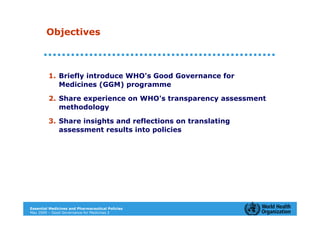
Objectives


         1. Briefly introduce WHO's Good Governance for
            Medicines (GGM) programme

         2. Share experience on WHO's transparency assessment
            methodology

         3. Share insights and reflections on translating
            assessment results into policies


Essential Medicines and Pharmaceutical Policies
May 2009 – Good Governance for Medicines 2
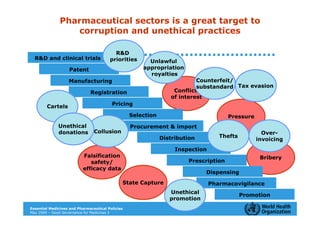
Pharmaceutical sectors is a great target to
                   corruption and unethical practices

                                          R&D
  R&D and clinical trials               priorities      Unlawful
                   Patent                             appropriation
                                                        royalties
                   Manufacturing                                          Counterfeit/
                                                                          substandard Tax evasion
                              Registration                        Conflict
                                                                 of interest
        Cartels                          Pricing

                                                  Selection                           Pressure
              Unethical                           Procurement & import
              donations         Collusion                                                          Over-
                                                              Distribution         Thefts
                                                                                                 invoicing
                                                                   Inspection
                          Falsification                                                           Bribery
                             safety/                                   Prescription
                          efficacy data
                                                                             Dispensing
                                              State Capture                     Pharmacovigilance
                                                                 Unethical
                                                                                            Promotion
                                                                 promotion
Essential Medicines and Pharmaceutical Policies
May 2009 – Good Governance for Medicines 3
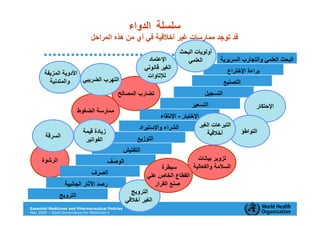
‫ﺳﻠﺴﻠﺔ اﻟﺪواء‬
                              ‫ﻗﺪ ﺗﻮﺟﺪ ﻣﻤﺎرﺳﺎت ﻏﻴﺮ أﺧﻼﻗﻴﺔ ﻓﻲ أي ﻣﻦ هﺬﻩ اﻟﻤﺮاﺣﻞ‬
                                                                           ‫أوﻟﻮﻳﺎت اﻟﺒﺤﺚ‬
                                                             ‫اﻹﻋﺘﻤﺎد‬          ‫اﻟﻌﻠﻤﻲ‬            ‫اﻟﺒﺤﺚ اﻟﻌﻠﻤﻲ واﻟﺘﺠﺎرب اﻟﺴﺮﻳﺮﻳﺔ‬
                                                            ‫اﻟﻐﻴﺮ ﻗﺎﻧﻮﻧﻲ‬                            ‫ﺑﺮاءة اﻹﺧﺘﺮاع‬
       ‫اﻷدوﻳﺔ اﻟﻤﺰﻳﻔﺔ‬                                        ‫ﻟﻺﺗﺎوات‬
         ‫واﻟﻤﺘﺪﻧﻴﺔ‬    ‫اﻟﺘﻬﺮب اﻟﻀﺮﻳﺒﻲ‬                                                               ‫اﻟﺘﺼﻨﻴﻊ‬
                                            ‫ﺗﻀﺎرب اﻟﻤﺼﺎﻟﺢ‬                                ‫اﻟﺘﺴﺠﻴﻞ‬
                                                                                ‫اﻟﺘﺴﻌﻴﺮ‬                            ‫اﻹﺣﺘﻜﺎر‬
                         ‫ﻣﻤﺎرﺳﺔ اﻟﻀﻐﻮط‬
                                                                   ‫اﻹﺧﺘﻴﺎر - اﻹﻧﺘﻘﺎء‬
                                                        ‫اﻟﺸﺮاء واﻹﺳﺘﻴﺮاد‬               ‫اﻟﺘﺒﺮﻋﺎت اﻟﻐﻴﺮ‬
                           ‫زﻳﺎدة ﻗﻴﻤﺔ‬                                                     ‫أﺧﻼﻗﻴﺔ‬             ‫اﻟﺘﻮاﻃﺆ‬
       ‫اﻟﺴﺮﻗﺔ‬                                          ‫اﻟﺘﻮزﻳﻊ‬
                            ‫اﻟﻔﻮاﺗﻴﺮ‬
                                                  ‫اﻟﺘﻔﺘﻴﺶ‬
      ‫اﻟﺮﺷﻮة‬                            ‫اﻟﻮﺻﻒ‬                                      ‫ﺗﺰوﻳﺮ ﺑﻴﺎﻧﺎت‬
                                                                 ‫ﺳﻴﻄﺮة‬           ‫اﻟﺴﻼﻣﺔ واﻟﻔﻌﺎﻟﻴﺔ‬
                               ‫اﻟﺼﺮف‬                      ‫اﻟﻘﻄﺎع اﻟﺨﺎص ﻋﻠﻲ‬
                 ‫رﺻﺪ اﻵﺛﺎر اﻟﺠﺎﻧﺒﻴﺔ‬                           ‫ﺻﻨﻊ اﻟﻘﺮار‬
                                                    ‫اﻟﺘﺮوﻳﺞ‬
               ‫اﻟﺘﺮوﻳﺞ‬
                                                  ‫اﻟﻐﻴﺮ أﺧﻼﻗﻲ‬
‫‪Essential Medicines and Pharmaceutical Policies‬‬
‫4 ‪May 2009 – Good Governance for Medicines‬‬
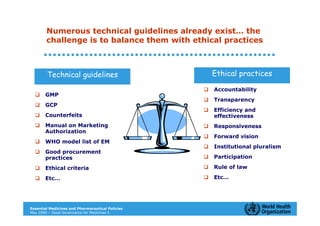
Numerous technical guidelines already exist… the
        challenge is to balance them with ethical practices


        Technical guidelines                      Ethical practices

                                                  Accountability
       GMP
                                                  Transparency
       GCP
                                                  Efficiency and
       Counterfeits                               effectiveness
       Manual on Marketing                        Responsiveness
       Authorization
                                                  Forward vision
       WHO model list of EM
                                                  Institutional pluralism
       Good procurement
       practices                                  Participation

       Ethical criteria                           Rule of law

       Etc…                                       Etc…


Essential Medicines and Pharmaceutical Policies
May 2009 – Good Governance for Medicines 5
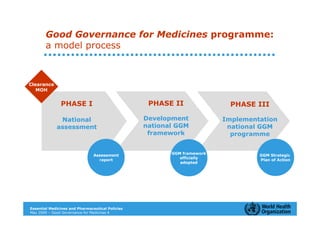
Good Governance for Medicines programme:
       a model process


Clearance
   MOH


               PHASE I                             PHASE II                PHASE III

              National                            Development            Implementation
             assessment                           national GGM            national GGM
                                                   framework               programme


                                Assessment               GGM framework            GGM Strategic
                                  report                    officially            Plan of Action
                                                            adopted


Essential Medicines and Pharmaceutical Policies
May 2009 – Good Governance for Medicines 6
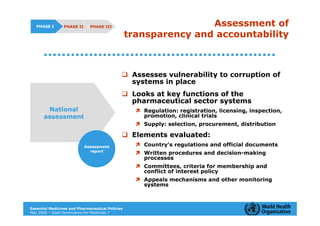
PHASE I       PHASE II     PHASE III                           Assessment of
                                                  transparency and accountability


                                                   Assesses vulnerability to corruption of
                                                   systems in place
                                                   Looks at key functions of the
                                                   pharmaceutical sector systems
       National                                       Regulation: registration, licensing, inspection,
      assessment                                      promotion, clinical trials
                                                      Supply: selection, procurement, distribution

                                                   Elements evaluated:
                            Assessment                Country's regulations and official documents
                              report
                                                      Written procedures and decision-making
                                                      processes
                                                      Committees, criteria for membership and
                                                      conflict of interest policy
                                                      Appeals mechanisms and other monitoring
                                                      systems


Essential Medicines and Pharmaceutical Policies
May 2009 – Good Governance for Medicines 7
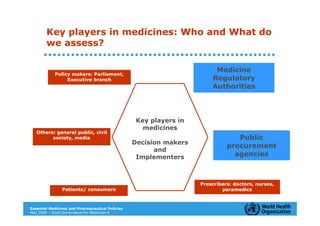
Key players in medicines: Who and What do
        we assess?

                                                                          Medicine
                                                                      Regulators: DRAs,
            Policy makers: Parliament,
                 Executive branch                                        Regulatory
                                                                    police, court, customs
                                                                        Authorities


                                                   Key players in
                                                     medicines
   Others: general public, civil                                             Medicines suppliers:
         society, media                                                           Public
                                                                               manufacturers,
                                                  Decision makers
                                                                              procurement
                                                                           importers, procurement
                                                        and                 agencies, distributors,
                                                   Implementers                 agencies
                                                                                 dispensers


                                                                    Prescribers: doctors, nurses,
                Patients/ consumers                                         paramedics


Essential Medicines and Pharmaceutical Policies
May 2009 – Good Governance for Medicines 8
PHASE I       PHASE II     PHASE III
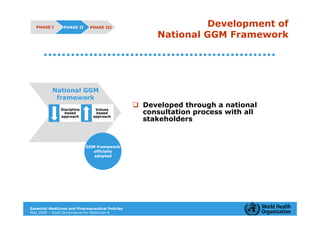
                                                              Development of
                                                     National GGM Framework


           National GGM
            framework
                                                  Developed through a national
               Discipline        Values
                 based           based            consultation process with all
               approach         approach
                                                  stakeholders


                            GGM framework
                               officially
                               adopted


Essential Medicines and Pharmaceutical Policies
May 2009 – Good Governance for Medicines 9
PHASE I   PHASE II   PHASE III


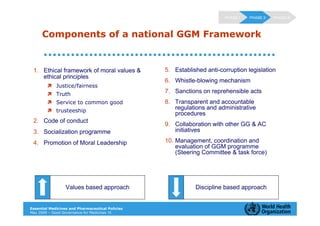
      Components of a national GGM Framework


 1. Ethical framework of moral values &           5. Established anti-corruption legislation
    ethical principles
                                                  6. Whistle-blowing mechanism
             Justice/fairness
             Truth
                                                  7. Sanctions on reprehensible acts
             Service to common good               8. Transparent and accountable
             trusteeship
                                                     regulations and administrative
                                                     procedures
 2. Code of conduct
                                                  9. Collaboration with other GG & AC
 3. Socialization programme                          initiatives

 4. Promotion of Moral Leadership                 10. Management, coordination and
                                                      evaluation of GGM programme
                                                      (Steering Committee & task force)


                  Values based approach                      Discipline based approach


Essential Medicines and Pharmaceutical Policies
May 2009 – Good Governance for Medicines 10
PHASE I       PHASE II     PHASE III                       Implementation of
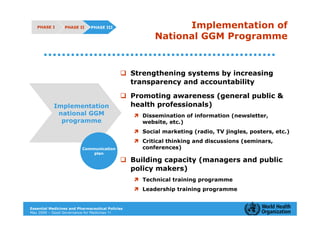
                                                        National GGM Programme


                                                  Strengthening systems by increasing
                                                  transparency and accountability

                                                  Promoting awareness (general public &
            Implementation                        health professionals)
             national GGM                           Dissemination of information (newsletter,
              programme                             website, etc.)
                                                    Social marketing (radio, TV jingles, posters, etc.)
                                                    Critical thinking and discussions (seminars,
                          Communication             conferences)
                              plan
                                                  Building capacity (managers and public
                                                  policy makers)
                                                    Technical training programme
                                                    Leadership training programme


Essential Medicines and Pharmaceutical Policies
May 2009 – Good Governance for Medicines 11
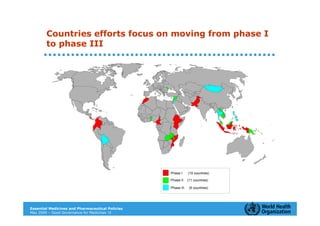
Countries efforts focus on moving from phase I
        to phase III


                                                  Phase I     (10 countries)

                                                  Phase II    (11 countries)

                                                  Phase III    (5 countries)


Essential Medicines and Pharmaceutical Policies
May 2009 – Good Governance for Medicines 12
Objectives of transparency assessment
        study


                                           Provide countries picture of level of
                                           transparency and vulnerability to
                                           corruption of 8 functions:
                                                  Regulation: registration, licensing,
                                                  inspection, promotion, clinical trials
                                                  Supply: selection, procurement, distribution

                                           Recommendations to increase
                                           transparency and accountability in
                                           pharmaceutical public sector

                                           Initiate establishment of GGM
                                           programme in countries

Essential Medicines and Pharmaceutical Policies
May 2009 – Good Governance for Medicines 13
Assumption


             The more transparent any system is, the less vulnerable
             to corruption it will be
                   Presence of publicly available and easily accessible
                   documents = sign of transparency     reduces vulnerability
                   to corruption (and vice versa)
                   Awareness about their existence suggest they have been
                   disseminated and used on practice


Essential Medicines and Pharmaceutical Policies
May 2009 – Good Governance for Medicines 14
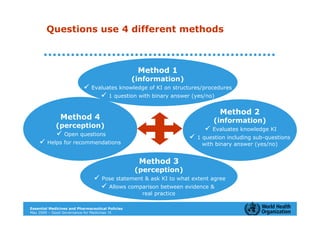
Questions use 4 different methods


                                                   Method 1
                                                  (information)
                               Evaluates knowledge of KI on structures/procedures
                                       1 question with binary answer (yes/no)


                                                                                Method 2
               Method 4                                                     (information)
             (perception)                                                   Evaluates knowledge KI
                 Open questions
                                                                      1 question including sub-questions
        Helps for recommendations                                       with binary answer (yes/no)


                                                   Method 3
                                                  (perception)
                                    Pose statement & ask KI to what extent agree
                                        Allows comparison between evidence &
                                                   real practice

Essential Medicines and Pharmaceutical Policies
May 2009 – Good Governance for Medicines 15
Rating indicators method 1


             1 question with binary answer: Yes or No
                   Yes (existence of document) = 1     low vulnerability to corruption
                   No (document does not exists) = 0     high vulnerability to corruption
                   Transcribe 1 or 0 on consolidation sheet

             Use interpretation guidelines in the manual for
             each indicator

             Transcribe score calculated (0 or 1) on scoring
             sheets

             Needs to be supported by evidence


Essential Medicines and Pharmaceutical Policies
May 2009 – Good Governance for Medicines 16
Rating indicators method 2


             Each question has several criteria
             Binary answer for each criteria
             On questionnaire calculate scoring for each
             answer
                   Disregard all invalid answers (D.K., N.A.)
                   Score = total "yes"/total valid answers
                   If more than half are D.K. or N.A.   disregard whole
                   question for this KI

             Transcribe score calculated (between 0 and 1) on
             score sheet


Essential Medicines and Pharmaceutical Policies
May 2009 – Good Governance for Medicines 17
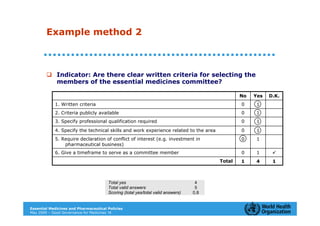
Example method 2


              Indicator: Are there clear written criteria for selecting the
              members of the essential medicines committee?

                                                                                                No   Yes   D.K.
              1. Written criteria                                                               0     1
              2. Criteria publicly available                                                    0     1
              3. Specify professional qualification required                                    0     1
              4. Specify the technical skills and work experience related to the area           0     1
              5. Require declaration of conflict of interest (e.g. investment in                0     1
                  pharmaceutical business)
              6. Give a timeframe to serve as a committee member                                0     1
                                                                                        Total   1    4      1


                                       Total yes                                  4
                                       Total valid answers                        5
                                       Scoring (total yes/total valid answers)   0.8
           
Essential Medicines and Pharmaceutical Policies
May 2009 – Good Governance for Medicines 18
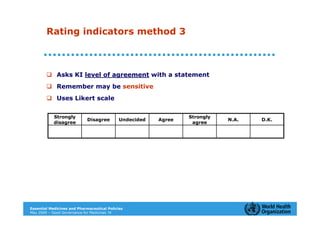
Rating indicators method 3


             Asks KI level of agreement with a statement
             Remember may be sensitive
             Uses Likert scale

            Strongly                                             Strongly
                             Disagree        Undecided   Agree              N.A.   D.K.
            disagree                                              agree


Essential Medicines and Pharmaceutical Policies
May 2009 – Good Governance for Medicines 19
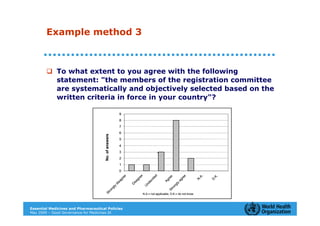
Example method 3


             To what extent to you agree with the following
             statement: "the members of the registration committee
             are systematically and objectively selected based on the
             written criteria in force in your country"?

                                                          9
                                                          8
                                                          7
                                                          6
                                      No. of answers


                                                          5
                                                          4
                                                          3
                                                                                        1
                                                          2
                                                          1
                                                          0
                                                                                   ed
                                                                    e


                                                                                                                       .


                                                                                                                              .
                                                                                                           e
                                                           ee


                                                                                                e


                                                                                                                   .A


                                                                                                                            .K
                                                                    re


                                                                                                         re
                                                                                              re
                                                                                id
                                                           gr


                                                                                                                   N


                                                                                                                           D
                                                                  ag


                                                                                                       ag
                                                                                            Ag
                                                                             ec
                                                         sa


                                                                is


                                                                                                    ly
                                                                          nd
                                                       di


                                                                D


                                                                                                  ng
                                                                         U
                                              ly


                                                                                                ro
                                            ng


                                                                                              St
                                          ro
                                       St


                                                                         N.A.= not applicable; D.K.= do not know


Essential Medicines and Pharmaceutical Policies
May 2009 – Good Governance for Medicines 20
Rating indicators method 4


             Open questions                       mainly for narrative report
             Brings additional information useful for
             recommendations


Essential Medicines and Pharmaceutical Policies
May 2009 – Good Governance for Medicines 21
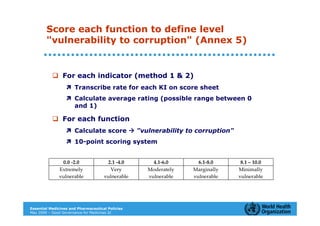
Score each function to define level
           "vulnerability to corruption" (Annex 5)


                For each indicator (method 1 & 2)
                      Transcribe rate for each KI on score sheet
                      Calculate average rating (possible range between 0
                      and 1)

                For each function
                      Calculate score              "vulnerability to corruption"
                      10-point scoring system


               0.0 ‐2.0               2.1 ‐4.0          4.1‐6.0       6.1‐8.0       8.1 – 10.0 
              Extremely                Very           Moderately    Marginally     Minimally 
              vulnerable             vulnerable       vulnerable    vulnerable     vulnerable 


Essential Medicines and Pharmaceutical Policies
May 2009 – Good Governance for Medicines 22
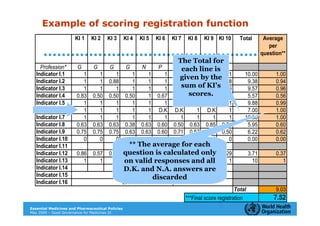
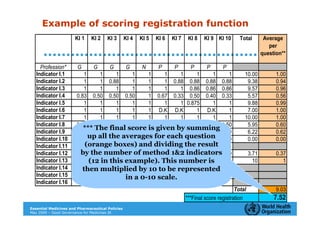
Example of scoring registration function
                      KI 1     KI 2    KI 3       KI 4   KI 5   KI 6   KI 7    KI 8   KI 9 KI 10       Total         Average
                                                                                                                       per
                                                                                                                    question**
                                                                         The Total for
     Profession*        G       G       G         G       N      P     P each line is P
                                                                             P    P
   Indicator I.1          1       1        1         1      1      1
                                                                          given by the 1
                                                                          1     1    1                   10.00            1.00
   Indicator I.2          1       1     0.88         1      1      1   0.88 0.88 0.88 0.88                9.38            0.94
   Indicator I.3          1       1        1         1      1      1
                                                                          sum of KI's
                                                                          1 0.86 0.86 0.86                9.57            0.96
   Indicator I.4       0.83    0.50     0.50      0.50      1   0.67   0.33 scores. 0.33
                                                                             0.50 0.40                    5.57            0.56
   Indicator I.5          1       1        1         1      1      1      1 0.875         1      1        9.88            0.99
   Indicator I.6          1       1        1         1      1    D.K   D.K      1      D.K       1        7.00            1.00
   Indicator I.7          1       1        1         1      1      1      1     1         1      1       10.00            1.00
   Indicator I.8       0.63    0.63     0.63      0.38   0.63   0.60   0.50 0.63       0.85   0.50        5.95            0.60
   Indicator I.9       0.75    0.75     0.75      0.63   0.63   0.60   0.71 0.57       0.33   0.50        6.22            0.62
   Indicator I.10         0       0        0         0      0      0      0     0         0      0        0.00            0.00
   Indicator I.11                        ** The average for each
   Indicator I.12      0.86 0.57 0.29 question is calculated only 0.29
                                       0.57 0.29          0 0.25 0.60 0                                      3.71         0.37
   Indicator I.13         1    1    1 on1valid responses and all
                                                  1       1      1  1 1 1                                      10            1
   Indicator I.14                     D.K. and N.A. answers are
   Indicator I.15                     see text in narrative report
                                                    discarded
   Indicator I.16                              see text in narrative report
                                                                                                     Total                9.03
                                                                              ***Final score registration                7.52
Essential Medicines and Pharmaceutical Policies
May 2009 – Good Governance for Medicines 23
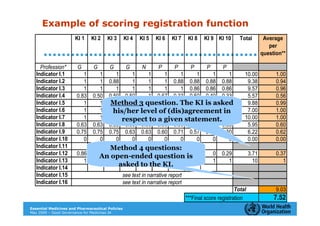
Example of scoring registration function
                      KI 1     KI 2    KI 3       KI 4   KI 5   KI 6   KI 7    KI 8   KI 9 KI 10       Total         Average
                                                                                                                       per
                                                                                                                    question**

     Profession*        G       G       G         G       N      P      P       P      P       P
   Indicator I.1          1       1        1    1    1    1    1     1   1    1                          10.00            1.00
   Indicator I.2          1       1     0.88    1    1    1 0.88 0.88 0.88 0.88                           9.38            0.94
   Indicator I.3          1       1        1    1    1    1    1 0.86 0.86 0.86                           9.57            0.96
   Indicator I.4       0.83    0.50     0.50 0.50    1 0.67 0.33 0.50 0.40 0.33                           5.57            0.56
   Indicator I.5          1       1     Method 3 question. The KI is 1
                                           1    1    1    1    1 0.875   asked1                           9.88            0.99
   Indicator I.6          1       1       his/her level of (dis)agreement in
                                           1    1    1 D.K D.K       1 D.K    1                           7.00            1.00
   Indicator I.7          1       1        1 respect 1 a given statement. 1
                                                1    to 1      1     1   1                               10.00            1.00
   Indicator I.8       0.63    0.63     0.63 0.38 0.63 0.60 0.50 0.63 0.85 0.50                           5.95            0.60
   Indicator I.9       0.75    0.75     0.75 0.63 0.63 0.60 0.71 0.57 0.33 0.50                           6.22            0.62
   Indicator I.10         0       0        0    0    0    0    0     0   0    0                           0.00            0.00
   Indicator I.11                 Method 4 questions:
   Indicator I.12      0.86 0.57 0.29 0.57 0.29 question is
                                                  0 0.25 0.60                              0   0.29          3.71         0.37
                               An open-ended
   Indicator I.13         1    1    1    1    1   1    1    1                              1      1            10            1
   Indicator I.14
                                     asked to the KI.
   Indicator I.15                             see text in narrative report
   Indicator I.16                             see text in narrative report
                                                                                                     Total                9.03
                                                                              ***Final score registration                7.52
Essential Medicines and Pharmaceutical Policies
May 2009 – Good Governance for Medicines 24
Example of scoring registration function
                      KI 1     KI 2    KI 3       KI 4   KI 5   KI 6   KI 7    KI 8   KI 9 KI 10       Total         Average
                                                                                                                       per
                                                                                                                    question**

     Profession*        G       G       G         G       N      P      P       P      P       P
   Indicator I.1          1    1     1    1   1     1    1     1   1                             1       10.00            1.00
   Indicator I.2          1    1 0.88     1   1     1 0.88 0.88 0.88                          0.88        9.38            0.94
   Indicator I.3          1    1     1    1   1     1    1 0.86 0.86                          0.86        9.57            0.96
   Indicator I.4       0.83 0.50 0.50 0.50    1 0.67 0.33 0.50 0.40                           0.33        5.57            0.56
   Indicator I.5          1    1     1    1   1     1    1 0.875   1                             1        9.88            0.99
   Indicator I.6          1    1     1    1   1 D.K D.K        1 D.K                             1        7.00            1.00
   Indicator I.7          1    1     1    1   1     1    1     1   1                             1       10.00            1.00
   Indicator I.8       0.63 0.63 0.63 0.38 0.63 0.60 0.50 0.63 0.85                           0.50        5.95            0.60
                          *** The final score is given by summing
   Indicator I.9       0.75 0.75 0.75 0.63 0.63 0.60 0.71 0.57 0.33                           0.50        6.22            0.62
   Indicator I.10         0 up all the averages for0each question
                               0     0    0   0          0     0   0                             0        0.00            0.00
   Indicator I.11          (orange boxes) and dividing the result
   Indicator I.12      0.86 the number of 0.29
                         by 0.57 0.29 0.57 method 1&2 indicators0.29
                                                       0 0.25 0.60 0                                         3.71         0.37
   Indicator I.13         1 (12 1 this example). This number is
                                in 1      1     1      1      1  1 1 1                                         10            1
   Indicator I.14         then multiplied by 10 to be represented
   Indicator I.15                     see text0-10 scale.
                                       in a in narrative report
   Indicator I.16                             see text in narrative report
                                                                                                     Total                9.03
                                                                              ***Final score registration                7.52
Essential Medicines and Pharmaceutical Policies
May 2009 – Good Governance for Medicines 25
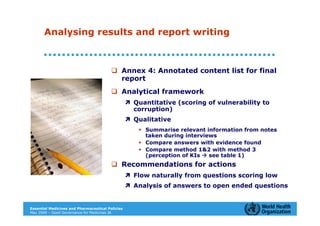
Analysing results and report writing


                                              Annex 4: Annotated content list for final
                                              report
                                              Analytical framework
                                                  Quantitative (scoring of vulnerability to
                                                  corruption)
                                                  Qualitative
                                                     Summarise relevant information from notes
                                                     taken during interviews
                                                     Compare answers with evidence found
                                                     Compare method 1&2 with method 3
                                                     (perception of KIs   see table 1)
                                              Recommendations for actions
                                                  Flow naturally from questions scoring low
                                                  Analysis of answers to open ended questions


Essential Medicines and Pharmaceutical Policies
May 2009 – Good Governance for Medicines 26
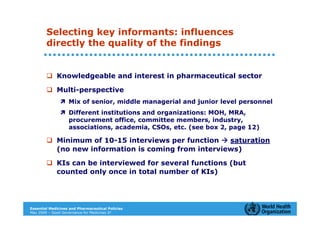
Selecting key informants: influences
        directly the quality of the findings


             Knowledgeable and interest in pharmaceutical sector

             Multi-perspective
                   Mix of senior, middle managerial and junior level personnel
                   Different institutions and organizations: MOH, MRA,
                   procurement office, committee members, industry,
                   associations, academia, CSOs, etc. (see box 2, page 12)

             Minimum of 10-15 interviews per function   saturation
             (no new information is coming from interviews)

             KIs can be interviewed for several functions (but
             counted only once in total number of KIs)


Essential Medicines and Pharmaceutical Policies
May 2009 – Good Governance for Medicines 27
For more information …


        Visit

        www.who.int/medicines/ggm


        Or contact

        emp@emro.who.int

        ramzym@emro.who.int


Essential Medicines and Pharmaceutical Policies
May 2009 – Good Governance for Medicines 28

Good Governance for Medicines programme

  • 1.
    Governance Assessment Methodsand, Applications of Governance Data in Policy- Making Workshop Good Governance for Medicines programme Mohamed Ramzy WHO Regional Office for the Eastern Mediterranean 1-4 June 2009 Cairo Egypt Essential Medicines and Pharmaceutical Policies
  • 2.
    Objectives 1. Briefly introduce WHO's Good Governance for Medicines (GGM) programme 2. Share experience on WHO's transparency assessment methodology 3. Share insights and reflections on translating assessment results into policies Essential Medicines and Pharmaceutical Policies May 2009 – Good Governance for Medicines 2
  • 3.
    Pharmaceutical sectors isa great target to corruption and unethical practices R&D R&D and clinical trials priorities Unlawful Patent appropriation royalties Manufacturing Counterfeit/ substandard Tax evasion Registration Conflict of interest Cartels Pricing Selection Pressure Unethical Procurement & import donations Collusion Over- Distribution Thefts invoicing Inspection Falsification Bribery safety/ Prescription efficacy data Dispensing State Capture Pharmacovigilance Unethical Promotion promotion Essential Medicines and Pharmaceutical Policies May 2009 – Good Governance for Medicines 3
  • 4.
    ‫ﺳﻠﺴﻠﺔ اﻟﺪواء‬ ‫ﻗﺪ ﺗﻮﺟﺪ ﻣﻤﺎرﺳﺎت ﻏﻴﺮ أﺧﻼﻗﻴﺔ ﻓﻲ أي ﻣﻦ هﺬﻩ اﻟﻤﺮاﺣﻞ‬ ‫أوﻟﻮﻳﺎت اﻟﺒﺤﺚ‬ ‫اﻹﻋﺘﻤﺎد‬ ‫اﻟﻌﻠﻤﻲ‬ ‫اﻟﺒﺤﺚ اﻟﻌﻠﻤﻲ واﻟﺘﺠﺎرب اﻟﺴﺮﻳﺮﻳﺔ‬ ‫اﻟﻐﻴﺮ ﻗﺎﻧﻮﻧﻲ‬ ‫ﺑﺮاءة اﻹﺧﺘﺮاع‬ ‫اﻷدوﻳﺔ اﻟﻤﺰﻳﻔﺔ‬ ‫ﻟﻺﺗﺎوات‬ ‫واﻟﻤﺘﺪﻧﻴﺔ‬ ‫اﻟﺘﻬﺮب اﻟﻀﺮﻳﺒﻲ‬ ‫اﻟﺘﺼﻨﻴﻊ‬ ‫ﺗﻀﺎرب اﻟﻤﺼﺎﻟﺢ‬ ‫اﻟﺘﺴﺠﻴﻞ‬ ‫اﻟﺘﺴﻌﻴﺮ‬ ‫اﻹﺣﺘﻜﺎر‬ ‫ﻣﻤﺎرﺳﺔ اﻟﻀﻐﻮط‬ ‫اﻹﺧﺘﻴﺎر - اﻹﻧﺘﻘﺎء‬ ‫اﻟﺸﺮاء واﻹﺳﺘﻴﺮاد‬ ‫اﻟﺘﺒﺮﻋﺎت اﻟﻐﻴﺮ‬ ‫زﻳﺎدة ﻗﻴﻤﺔ‬ ‫أﺧﻼﻗﻴﺔ‬ ‫اﻟﺘﻮاﻃﺆ‬ ‫اﻟﺴﺮﻗﺔ‬ ‫اﻟﺘﻮزﻳﻊ‬ ‫اﻟﻔﻮاﺗﻴﺮ‬ ‫اﻟﺘﻔﺘﻴﺶ‬ ‫اﻟﺮﺷﻮة‬ ‫اﻟﻮﺻﻒ‬ ‫ﺗﺰوﻳﺮ ﺑﻴﺎﻧﺎت‬ ‫ﺳﻴﻄﺮة‬ ‫اﻟﺴﻼﻣﺔ واﻟﻔﻌﺎﻟﻴﺔ‬ ‫اﻟﺼﺮف‬ ‫اﻟﻘﻄﺎع اﻟﺨﺎص ﻋﻠﻲ‬ ‫رﺻﺪ اﻵﺛﺎر اﻟﺠﺎﻧﺒﻴﺔ‬ ‫ﺻﻨﻊ اﻟﻘﺮار‬ ‫اﻟﺘﺮوﻳﺞ‬ ‫اﻟﺘﺮوﻳﺞ‬ ‫اﻟﻐﻴﺮ أﺧﻼﻗﻲ‬ ‫‪Essential Medicines and Pharmaceutical Policies‬‬ ‫4 ‪May 2009 – Good Governance for Medicines‬‬
  • 5.
    Numerous technical guidelinesalready exist… the challenge is to balance them with ethical practices Technical guidelines Ethical practices Accountability GMP Transparency GCP Efficiency and Counterfeits effectiveness Manual on Marketing Responsiveness Authorization Forward vision WHO model list of EM Institutional pluralism Good procurement practices Participation Ethical criteria Rule of law Etc… Etc… Essential Medicines and Pharmaceutical Policies May 2009 – Good Governance for Medicines 5
  • 6.
    Good Governance forMedicines programme: a model process Clearance MOH PHASE I PHASE II PHASE III National Development Implementation assessment national GGM national GGM framework programme Assessment GGM framework GGM Strategic report officially Plan of Action adopted Essential Medicines and Pharmaceutical Policies May 2009 – Good Governance for Medicines 6
  • 7.
    PHASE I PHASE II PHASE III Assessment of transparency and accountability Assesses vulnerability to corruption of systems in place Looks at key functions of the pharmaceutical sector systems National Regulation: registration, licensing, inspection, assessment promotion, clinical trials Supply: selection, procurement, distribution Elements evaluated: Assessment Country's regulations and official documents report Written procedures and decision-making processes Committees, criteria for membership and conflict of interest policy Appeals mechanisms and other monitoring systems Essential Medicines and Pharmaceutical Policies May 2009 – Good Governance for Medicines 7
  • 8.
    Key players inmedicines: Who and What do we assess? Medicine Regulators: DRAs, Policy makers: Parliament, Executive branch Regulatory police, court, customs Authorities Key players in medicines Others: general public, civil Medicines suppliers: society, media Public manufacturers, Decision makers procurement importers, procurement and agencies, distributors, Implementers agencies dispensers Prescribers: doctors, nurses, Patients/ consumers paramedics Essential Medicines and Pharmaceutical Policies May 2009 – Good Governance for Medicines 8
  • 9.
    PHASE I PHASE II PHASE III Development of National GGM Framework National GGM framework Developed through a national Discipline Values based based consultation process with all approach approach stakeholders GGM framework officially adopted Essential Medicines and Pharmaceutical Policies May 2009 – Good Governance for Medicines 9
  • 10.
    PHASE I PHASE II PHASE III Components of a national GGM Framework 1. Ethical framework of moral values & 5. Established anti-corruption legislation ethical principles 6. Whistle-blowing mechanism Justice/fairness Truth 7. Sanctions on reprehensible acts Service to common good 8. Transparent and accountable trusteeship regulations and administrative procedures 2. Code of conduct 9. Collaboration with other GG & AC 3. Socialization programme initiatives 4. Promotion of Moral Leadership 10. Management, coordination and evaluation of GGM programme (Steering Committee & task force) Values based approach Discipline based approach Essential Medicines and Pharmaceutical Policies May 2009 – Good Governance for Medicines 10
  • 11.
    PHASE I PHASE II PHASE III Implementation of National GGM Programme Strengthening systems by increasing transparency and accountability Promoting awareness (general public & Implementation health professionals) national GGM Dissemination of information (newsletter, programme website, etc.) Social marketing (radio, TV jingles, posters, etc.) Critical thinking and discussions (seminars, Communication conferences) plan Building capacity (managers and public policy makers) Technical training programme Leadership training programme Essential Medicines and Pharmaceutical Policies May 2009 – Good Governance for Medicines 11
  • 12.
    Countries efforts focuson moving from phase I to phase III Phase I (10 countries) Phase II (11 countries) Phase III (5 countries) Essential Medicines and Pharmaceutical Policies May 2009 – Good Governance for Medicines 12
  • 13.
    Objectives of transparencyassessment study Provide countries picture of level of transparency and vulnerability to corruption of 8 functions: Regulation: registration, licensing, inspection, promotion, clinical trials Supply: selection, procurement, distribution Recommendations to increase transparency and accountability in pharmaceutical public sector Initiate establishment of GGM programme in countries Essential Medicines and Pharmaceutical Policies May 2009 – Good Governance for Medicines 13
  • 14.
    Assumption The more transparent any system is, the less vulnerable to corruption it will be Presence of publicly available and easily accessible documents = sign of transparency reduces vulnerability to corruption (and vice versa) Awareness about their existence suggest they have been disseminated and used on practice Essential Medicines and Pharmaceutical Policies May 2009 – Good Governance for Medicines 14
  • 15.
    Questions use 4different methods Method 1 (information) Evaluates knowledge of KI on structures/procedures 1 question with binary answer (yes/no) Method 2 Method 4 (information) (perception) Evaluates knowledge KI Open questions 1 question including sub-questions Helps for recommendations with binary answer (yes/no) Method 3 (perception) Pose statement & ask KI to what extent agree Allows comparison between evidence & real practice Essential Medicines and Pharmaceutical Policies May 2009 – Good Governance for Medicines 15
  • 16.
    Rating indicators method1 1 question with binary answer: Yes or No Yes (existence of document) = 1 low vulnerability to corruption No (document does not exists) = 0 high vulnerability to corruption Transcribe 1 or 0 on consolidation sheet Use interpretation guidelines in the manual for each indicator Transcribe score calculated (0 or 1) on scoring sheets Needs to be supported by evidence Essential Medicines and Pharmaceutical Policies May 2009 – Good Governance for Medicines 16
  • 17.
    Rating indicators method2 Each question has several criteria Binary answer for each criteria On questionnaire calculate scoring for each answer Disregard all invalid answers (D.K., N.A.) Score = total "yes"/total valid answers If more than half are D.K. or N.A. disregard whole question for this KI Transcribe score calculated (between 0 and 1) on score sheet Essential Medicines and Pharmaceutical Policies May 2009 – Good Governance for Medicines 17
  • 18.
    Example method 2 Indicator: Are there clear written criteria for selecting the members of the essential medicines committee? No Yes D.K. 1. Written criteria 0 1 2. Criteria publicly available 0 1 3. Specify professional qualification required 0 1 4. Specify the technical skills and work experience related to the area 0 1 5. Require declaration of conflict of interest (e.g. investment in 0 1 pharmaceutical business) 6. Give a timeframe to serve as a committee member 0 1 Total 1 4 1 Total yes 4 Total valid answers 5 Scoring (total yes/total valid answers) 0.8   Essential Medicines and Pharmaceutical Policies May 2009 – Good Governance for Medicines 18
  • 19.
    Rating indicators method3 Asks KI level of agreement with a statement Remember may be sensitive Uses Likert scale Strongly Strongly Disagree Undecided Agree N.A. D.K. disagree agree   Essential Medicines and Pharmaceutical Policies May 2009 – Good Governance for Medicines 19
  • 20.
    Example method 3 To what extent to you agree with the following statement: "the members of the registration committee are systematically and objectively selected based on the written criteria in force in your country"? 9 8 7 6 No. of answers 5 4 3 1 2 1 0 ed e . . e ee e .A .K re re re id gr N D ag ag Ag ec sa is ly nd di D ng U ly ro ng St ro St N.A.= not applicable; D.K.= do not know Essential Medicines and Pharmaceutical Policies May 2009 – Good Governance for Medicines 20
  • 21.
    Rating indicators method4 Open questions mainly for narrative report Brings additional information useful for recommendations Essential Medicines and Pharmaceutical Policies May 2009 – Good Governance for Medicines 21
  • 22.
    Score each functionto define level "vulnerability to corruption" (Annex 5) For each indicator (method 1 & 2) Transcribe rate for each KI on score sheet Calculate average rating (possible range between 0 and 1) For each function Calculate score "vulnerability to corruption" 10-point scoring system 0.0 ‐2.0  2.1 ‐4.0  4.1‐6.0  6.1‐8.0  8.1 – 10.0  Extremely  Very   Moderately  Marginally  Minimally  vulnerable  vulnerable  vulnerable  vulnerable  vulnerable    Essential Medicines and Pharmaceutical Policies May 2009 – Good Governance for Medicines 22
  • 23.
    Example of scoringregistration function KI 1 KI 2 KI 3 KI 4 KI 5 KI 6 KI 7 KI 8 KI 9 KI 10 Total Average per question** The Total for Profession* G G G G N P P each line is P P P Indicator I.1 1 1 1 1 1 1 given by the 1 1 1 1 10.00 1.00 Indicator I.2 1 1 0.88 1 1 1 0.88 0.88 0.88 0.88 9.38 0.94 Indicator I.3 1 1 1 1 1 1 sum of KI's 1 0.86 0.86 0.86 9.57 0.96 Indicator I.4 0.83 0.50 0.50 0.50 1 0.67 0.33 scores. 0.33 0.50 0.40 5.57 0.56 Indicator I.5 1 1 1 1 1 1 1 0.875 1 1 9.88 0.99 Indicator I.6 1 1 1 1 1 D.K D.K 1 D.K 1 7.00 1.00 Indicator I.7 1 1 1 1 1 1 1 1 1 1 10.00 1.00 Indicator I.8 0.63 0.63 0.63 0.38 0.63 0.60 0.50 0.63 0.85 0.50 5.95 0.60 Indicator I.9 0.75 0.75 0.75 0.63 0.63 0.60 0.71 0.57 0.33 0.50 6.22 0.62 Indicator I.10 0 0 0 0 0 0 0 0 0 0 0.00 0.00 Indicator I.11 ** The average for each Indicator I.12 0.86 0.57 0.29 question is calculated only 0.29 0.57 0.29 0 0.25 0.60 0 3.71 0.37 Indicator I.13 1 1 1 on1valid responses and all 1 1 1 1 1 1 10 1 Indicator I.14 D.K. and N.A. answers are Indicator I.15 see text in narrative report discarded Indicator I.16 see text in narrative report Total 9.03 ***Final score registration 7.52 Essential Medicines and Pharmaceutical Policies May 2009 – Good Governance for Medicines 23
  • 24.
    Example of scoringregistration function KI 1 KI 2 KI 3 KI 4 KI 5 KI 6 KI 7 KI 8 KI 9 KI 10 Total Average per question** Profession* G G G G N P P P P P Indicator I.1 1 1 1 1 1 1 1 1 1 1 10.00 1.00 Indicator I.2 1 1 0.88 1 1 1 0.88 0.88 0.88 0.88 9.38 0.94 Indicator I.3 1 1 1 1 1 1 1 0.86 0.86 0.86 9.57 0.96 Indicator I.4 0.83 0.50 0.50 0.50 1 0.67 0.33 0.50 0.40 0.33 5.57 0.56 Indicator I.5 1 1 Method 3 question. The KI is 1 1 1 1 1 1 0.875 asked1 9.88 0.99 Indicator I.6 1 1 his/her level of (dis)agreement in 1 1 1 D.K D.K 1 D.K 1 7.00 1.00 Indicator I.7 1 1 1 respect 1 a given statement. 1 1 to 1 1 1 1 10.00 1.00 Indicator I.8 0.63 0.63 0.63 0.38 0.63 0.60 0.50 0.63 0.85 0.50 5.95 0.60 Indicator I.9 0.75 0.75 0.75 0.63 0.63 0.60 0.71 0.57 0.33 0.50 6.22 0.62 Indicator I.10 0 0 0 0 0 0 0 0 0 0 0.00 0.00 Indicator I.11 Method 4 questions: Indicator I.12 0.86 0.57 0.29 0.57 0.29 question is 0 0.25 0.60 0 0.29 3.71 0.37 An open-ended Indicator I.13 1 1 1 1 1 1 1 1 1 1 10 1 Indicator I.14 asked to the KI. Indicator I.15 see text in narrative report Indicator I.16 see text in narrative report Total 9.03 ***Final score registration 7.52 Essential Medicines and Pharmaceutical Policies May 2009 – Good Governance for Medicines 24
  • 25.
    Example of scoringregistration function KI 1 KI 2 KI 3 KI 4 KI 5 KI 6 KI 7 KI 8 KI 9 KI 10 Total Average per question** Profession* G G G G N P P P P P Indicator I.1 1 1 1 1 1 1 1 1 1 1 10.00 1.00 Indicator I.2 1 1 0.88 1 1 1 0.88 0.88 0.88 0.88 9.38 0.94 Indicator I.3 1 1 1 1 1 1 1 0.86 0.86 0.86 9.57 0.96 Indicator I.4 0.83 0.50 0.50 0.50 1 0.67 0.33 0.50 0.40 0.33 5.57 0.56 Indicator I.5 1 1 1 1 1 1 1 0.875 1 1 9.88 0.99 Indicator I.6 1 1 1 1 1 D.K D.K 1 D.K 1 7.00 1.00 Indicator I.7 1 1 1 1 1 1 1 1 1 1 10.00 1.00 Indicator I.8 0.63 0.63 0.63 0.38 0.63 0.60 0.50 0.63 0.85 0.50 5.95 0.60 *** The final score is given by summing Indicator I.9 0.75 0.75 0.75 0.63 0.63 0.60 0.71 0.57 0.33 0.50 6.22 0.62 Indicator I.10 0 up all the averages for0each question 0 0 0 0 0 0 0 0 0.00 0.00 Indicator I.11 (orange boxes) and dividing the result Indicator I.12 0.86 the number of 0.29 by 0.57 0.29 0.57 method 1&2 indicators0.29 0 0.25 0.60 0 3.71 0.37 Indicator I.13 1 (12 1 this example). This number is in 1 1 1 1 1 1 1 1 10 1 Indicator I.14 then multiplied by 10 to be represented Indicator I.15 see text0-10 scale. in a in narrative report Indicator I.16 see text in narrative report Total 9.03 ***Final score registration 7.52 Essential Medicines and Pharmaceutical Policies May 2009 – Good Governance for Medicines 25
  • 26.
    Analysing results andreport writing Annex 4: Annotated content list for final report Analytical framework Quantitative (scoring of vulnerability to corruption) Qualitative Summarise relevant information from notes taken during interviews Compare answers with evidence found Compare method 1&2 with method 3 (perception of KIs see table 1) Recommendations for actions Flow naturally from questions scoring low Analysis of answers to open ended questions Essential Medicines and Pharmaceutical Policies May 2009 – Good Governance for Medicines 26
  • 27.
    Selecting key informants:influences directly the quality of the findings Knowledgeable and interest in pharmaceutical sector Multi-perspective Mix of senior, middle managerial and junior level personnel Different institutions and organizations: MOH, MRA, procurement office, committee members, industry, associations, academia, CSOs, etc. (see box 2, page 12) Minimum of 10-15 interviews per function saturation (no new information is coming from interviews) KIs can be interviewed for several functions (but counted only once in total number of KIs) Essential Medicines and Pharmaceutical Policies May 2009 – Good Governance for Medicines 27
  • 28.
    For more information… Visit www.who.int/medicines/ggm Or contact emp@emro.who.int ramzym@emro.who.int Essential Medicines and Pharmaceutical Policies May 2009 – Good Governance for Medicines 28