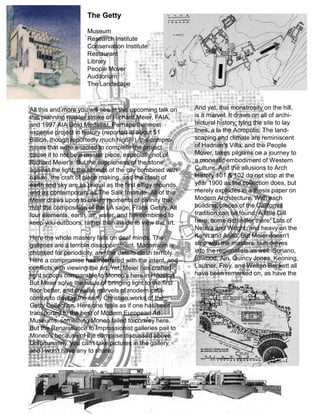
The Getty
Museum
Research Institute
Conservation Institute
Restaurant
Library
People Mover
Auditorium
The Landscape
All this and more you will see at this upcoming talk on
this planning master stroke of Richard Meier, FAIA,
and 1997 AIA Gold Medallist. Perhaps the most
expense project in history (reported at about $1
Billion, though reportedly much higher), the compro-
mises that were enacted to complete the project,
cause it to not be a master piece, especially not of
Richard Meier's. But the suppleness of the stone
against the light, the sounds of the city combined with
nature, the craft of place making, and the clash of
earth and sky are as primal as the first effigy mounds,
and as contemporary as The Salk Institute. All of this
Meier draws upon to create moments of divinity that
rival the composition of the LA sage, Frank Gehry. All
four elements, earth, air, water, and fire combined to
keep you outdoors, rather than inside to view the art.
Here the whole mastery falls on deaf minds. The
galleries are a terrible disappointment. Modernism is
chunked for periodicity, and the details clash terribly.
Here a compromise has interfered with the intent, and
conflicts with viewing the art. Yet, Meier has crafted
light scoops comparable to Moneo's here in Houston.
But Meier solve the issue of bringing light to the first
floor better, and creates marvels of modern cata-
combs to display the early Christian works of the
Getty Collection. Here one feels as if one has been
transported to the best of Modern European Art
Museums, something Moneo failed to convey here.
But the Renaissance to Impressionist galleries pail to
Moneo's because of the comprise discussed above.
Unfortunately, you can't take pictures in the gallery,
and I won't have any to share.
And yet, this monstrosity on the hill,
is a marvel. It draws on all of archi-
tectural history, tying the site to lay
lines, a la the Acropolis; The land-
scaping and climate are reminiscent
of Hadrian's Villa; and the People
Mover, takes pilgrims on a journey to
a monastic embodiment of Western
Culture. And the allusions to Arch
History 101 & 102 do not stop at the
year 1900 as the collection does, but
merely explodes in a thesis paper on
Modern Architecture. With each
building, pieces of the California
tradition can be found: A little Gill
here; some Schindler there; Lots of
Neutra and Wright; and heavy on the
Kahn and Aalto. But Meier doesn't
stop with the masters, butt delves
into the regionalists as well: Soriano,
Ellwood, Ain, Quincy Jones, Keoning,
Lautner, Frey, and Welton Beckett all
have been remarked on, as have the
Bay Area Modernist: Warren Callister,
Anshen and Allen, Wurster, Hawell
Hamilton Harris, among others. Other
masters of the last 30 years or so may
also be found hidden in the details:
Portman, Weese, Pei, Johnson, and
Saarinen. It is unfortunate, not to find a
representation of the Craftsman Style
here, but that may have been overdoing
it.
The complex is a true marvel, and I hope
that you will be able to attend this lunch. I
must appologize ahead of time, that my
slides may not do the project justice. It
may be the new city on the hill that the
Pilgrims were searching for, or it may be
just another commercial theme park, only
time will tell.

Getty 2

  • 1.
    The Getty Museum Research Institute ConservationInstitute Restaurant Library People Mover Auditorium The Landscape All this and more you will see at this upcoming talk on this planning master stroke of Richard Meier, FAIA, and 1997 AIA Gold Medallist. Perhaps the most expense project in history (reported at about $1 Billion, though reportedly much higher), the compro- mises that were enacted to complete the project, cause it to not be a master piece, especially not of Richard Meier's. But the suppleness of the stone against the light, the sounds of the city combined with nature, the craft of place making, and the clash of earth and sky are as primal as the first effigy mounds, and as contemporary as The Salk Institute. All of this Meier draws upon to create moments of divinity that rival the composition of the LA sage, Frank Gehry. All four elements, earth, air, water, and fire combined to keep you outdoors, rather than inside to view the art. Here the whole mastery falls on deaf minds. The galleries are a terrible disappointment. Modernism is chunked for periodicity, and the details clash terribly. Here a compromise has interfered with the intent, and conflicts with viewing the art. Yet, Meier has crafted light scoops comparable to Moneo's here in Houston. But Meier solve the issue of bringing light to the first floor better, and creates marvels of modern cata- combs to display the early Christian works of the Getty Collection. Here one feels as if one has been transported to the best of Modern European Art Museums, something Moneo failed to convey here. But the Renaissance to Impressionist galleries pail to Moneo's because of the comprise discussed above. Unfortunately, you can't take pictures in the gallery, and I won't have any to share. And yet, this monstrosity on the hill, is a marvel. It draws on all of archi- tectural history, tying the site to lay lines, a la the Acropolis; The land- scaping and climate are reminiscent of Hadrian's Villa; and the People Mover, takes pilgrims on a journey to a monastic embodiment of Western Culture. And the allusions to Arch History 101 & 102 do not stop at the year 1900 as the collection does, but merely explodes in a thesis paper on Modern Architecture. With each building, pieces of the California tradition can be found: A little Gill here; some Schindler there; Lots of Neutra and Wright; and heavy on the Kahn and Aalto. But Meier doesn't stop with the masters, butt delves into the regionalists as well: Soriano, Ellwood, Ain, Quincy Jones, Keoning, Lautner, Frey, and Welton Beckett all have been remarked on, as have the
  • 2.
    Bay Area Modernist:Warren Callister, Anshen and Allen, Wurster, Hawell Hamilton Harris, among others. Other masters of the last 30 years or so may also be found hidden in the details: Portman, Weese, Pei, Johnson, and Saarinen. It is unfortunate, not to find a representation of the Craftsman Style here, but that may have been overdoing it. The complex is a true marvel, and I hope that you will be able to attend this lunch. I must appologize ahead of time, that my slides may not do the project justice. It may be the new city on the hill that the Pilgrims were searching for, or it may be just another commercial theme park, only time will tell.