GET 201
GET 201
APPLIED ELECTRICITY
Course Objective
1. GET 201 Gives students a general introduction to electrical and
computer engineering basics
2. Gives students a background understanding in areas such as Circuit
theory, Field theory and Instrumentation.
3. At the end of the course students should have good understanding
of AC and DC circuits, AC and DC bridges, and E and M Fields.
Course Content
1. Charges, Current
2. Electric Fields
3. Magnetic Fields
4. B – H Curve
5. Transducers
6. RL Circuits
7. RC Circuits
8. RLC Circuits
9. AC and DC Bridges
ElectrIc CIrcuIt
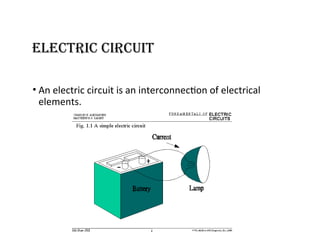
• An electric circuit is an interconnection of electrical
elements.
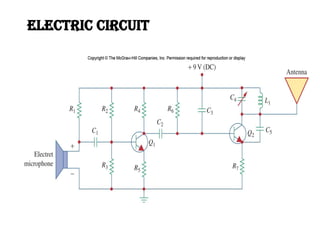
Electric CircuIt
Systems of UNITS
• When taking measurements, we must use
units to quantify values
• We use the International Systems of Units
(SI for short)
GATION & REFLECTION
OF PLANE WAVES
CHAPTER 10
& REFLECTION OF PLANE WAVES
MAGNETIC FIELDS FOR PLANE WAVE
N LOSSY DIELECTRICS – IMPERFECT DIELECTRICS
N LOSSLESS (PERFECT) DIELECTRICS
N FREE SPACE
N CONDUCTORS
HE POYNTING VECTOR
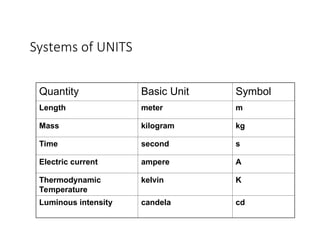
Systems of UNITS
Quantity Basic Unit Symbol
Length meter m
Mass kilogram kg
Time second s
Electric current ampere A
Thermodynamic
Temperature
kelvin K
Luminous intensity candela cd
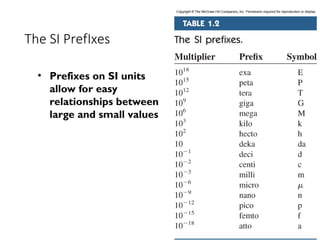
The SI PrefIxes
• Prefixes on SI units
allow for easy
relationships between
large and small values
Charge
Charge: Is a property of certain elementary particles
of an element (electron and protons). This property
causes these elements behave in a certain way.
Electrons are said to be negatively charged while
protons are positively charged. Electrons are
primarily responsible for the flow of current in
conductors.
Charge II
•Charge is a basic SI unit, measured in Coulombs
(C)
•Charge of single electron is 1.602*10-19
C
•One Coulomb is quite large, 6.24*1018
electrons.
Charge
•In the lab, one typically sees (pC, nC, or
μC)
•Charge is always multiple of electron
charge
•Charge cannot be created or destroyed,
only transferred.
Electric Current
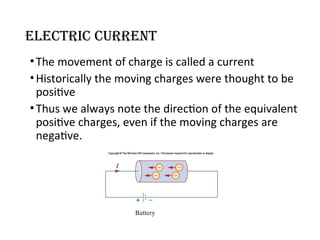
•The movement of charge is called a current
•Historically the moving charges were thought to be
positive
•Thus we always note the direction of the equivalent
positive charges, even if the moving charges are
negative.
Electric Current
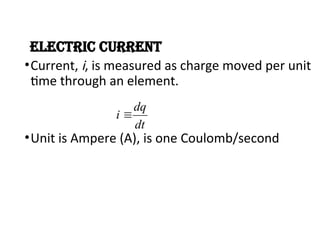
•Current, i, is measured as charge moved per unit
time through an element.
•Unit is Ampere (A), is one Coulomb/second
dt
dq
i 
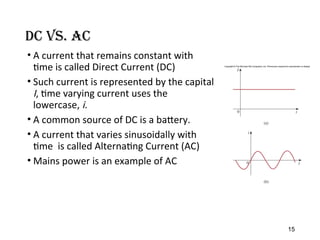
DC vs. AC
• A current that remains constant with
time is called Direct Current (DC)
• Such current is represented by the capital
I, time varying current uses the
lowercase, i.
• A common source of DC is a battery.
• A current that varies sinusoidally with
time is called Alternating Current (AC)
• Mains power is an example of AC
15
DirectIon of current
•The sign of the current indicates the direction
in which the charge is moving with reference
to the direction of interest we define.
•We need not use the direction that the charge
moves in as our reference, and often have no
choice in the matter.
16
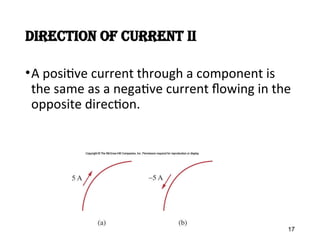
DirectIon of Current II
•A positive current through a component is
the same as a negative current flowing in the
opposite direction.
17
Voltage
•Electrons move when there is a
difference in charge between two
locations.
•This difference is expressed at the
potential difference, or voltage (V).
•It is always expressed with
reference to two locations
18
Voltage II
•It is equal to the energy needed to
move a unit charge between the
locations.
•Positive charge moving from a
higher potential to a lower yields
energy.
•Moving from negative to positive
requires energy.
19
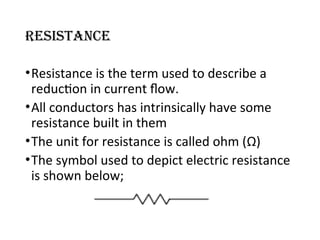
Resistance
•Resistance is the term used to describe a
reduction in current flow.
•All conductors has intrinsically have some
resistance built in them
•The unit for resistance is called ohm (Ω)
•The symbol used to depict electric resistance
is shown below;
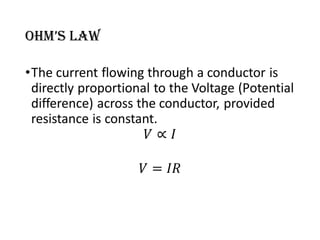
Ohm’s Law
Power
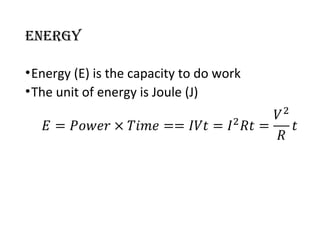
Energy
•Energy (E) is the capacity to do work
•The unit of energy is Joule (J)
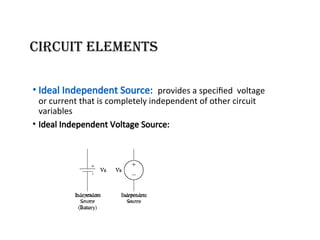
CIrcuIt Elements
• Ideal Independent Source: provides a specified voltage
or current that is completely independent of other circuit
variables
• Ideal Independent Voltage Source:
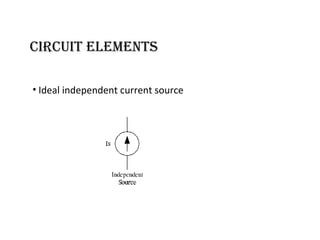
CIrcuIt Elements
• Ideal independent current source
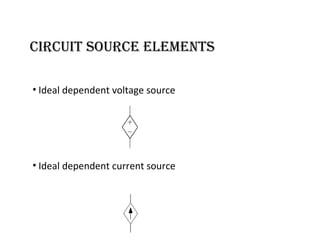
CIrcuIt SOURCE Elements
• Ideal dependent voltage source
• Ideal dependent current source
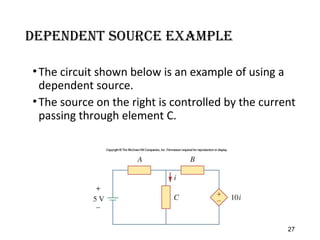
Dependent Source example
•The circuit shown below is an example of using a
dependent source.
•The source on the right is controlled by the current
passing through element C.
27
GET 201 L1 engineering drawing 200L..ppt

GET 201 L1 engineering drawing 200L..ppt

  • 1.
  • 2.
    Course Objective 1. GET201 Gives students a general introduction to electrical and computer engineering basics 2. Gives students a background understanding in areas such as Circuit theory, Field theory and Instrumentation. 3. At the end of the course students should have good understanding of AC and DC circuits, AC and DC bridges, and E and M Fields.
  • 3.
    Course Content 1. Charges,Current 2. Electric Fields 3. Magnetic Fields 4. B – H Curve 5. Transducers 6. RL Circuits 7. RC Circuits 8. RLC Circuits 9. AC and DC Bridges
  • 4.
    ElectrIc CIrcuIt • Anelectric circuit is an interconnection of electrical elements.
  • 5.
  • 6.
    Systems of UNITS •When taking measurements, we must use units to quantify values • We use the International Systems of Units (SI for short) GATION & REFLECTION OF PLANE WAVES CHAPTER 10 & REFLECTION OF PLANE WAVES MAGNETIC FIELDS FOR PLANE WAVE N LOSSY DIELECTRICS – IMPERFECT DIELECTRICS N LOSSLESS (PERFECT) DIELECTRICS N FREE SPACE N CONDUCTORS HE POYNTING VECTOR
  • 7.
    Systems of UNITS QuantityBasic Unit Symbol Length meter m Mass kilogram kg Time second s Electric current ampere A Thermodynamic Temperature kelvin K Luminous intensity candela cd
  • 8.
    The SI PrefIxes •Prefixes on SI units allow for easy relationships between large and small values
  • 9.
    Charge Charge: Is aproperty of certain elementary particles of an element (electron and protons). This property causes these elements behave in a certain way. Electrons are said to be negatively charged while protons are positively charged. Electrons are primarily responsible for the flow of current in conductors.
  • 10.
    Charge II •Charge isa basic SI unit, measured in Coulombs (C) •Charge of single electron is 1.602*10-19 C •One Coulomb is quite large, 6.24*1018 electrons.
  • 11.
    Charge •In the lab,one typically sees (pC, nC, or μC) •Charge is always multiple of electron charge •Charge cannot be created or destroyed, only transferred.
  • 13.
    Electric Current •The movementof charge is called a current •Historically the moving charges were thought to be positive •Thus we always note the direction of the equivalent positive charges, even if the moving charges are negative.
  • 14.
    Electric Current •Current, i,is measured as charge moved per unit time through an element. •Unit is Ampere (A), is one Coulomb/second dt dq i 
  • 15.
    DC vs. AC •A current that remains constant with time is called Direct Current (DC) • Such current is represented by the capital I, time varying current uses the lowercase, i. • A common source of DC is a battery. • A current that varies sinusoidally with time is called Alternating Current (AC) • Mains power is an example of AC 15
  • 16.
    DirectIon of current •Thesign of the current indicates the direction in which the charge is moving with reference to the direction of interest we define. •We need not use the direction that the charge moves in as our reference, and often have no choice in the matter. 16
  • 17.
    DirectIon of CurrentII •A positive current through a component is the same as a negative current flowing in the opposite direction. 17
  • 18.
    Voltage •Electrons move whenthere is a difference in charge between two locations. •This difference is expressed at the potential difference, or voltage (V). •It is always expressed with reference to two locations 18
  • 19.
    Voltage II •It isequal to the energy needed to move a unit charge between the locations. •Positive charge moving from a higher potential to a lower yields energy. •Moving from negative to positive requires energy. 19
  • 20.
    Resistance •Resistance is theterm used to describe a reduction in current flow. •All conductors has intrinsically have some resistance built in them •The unit for resistance is called ohm (Ω) •The symbol used to depict electric resistance is shown below;
  • 21.
  • 22.
  • 23.
    Energy •Energy (E) isthe capacity to do work •The unit of energy is Joule (J)
  • 24.
    CIrcuIt Elements • IdealIndependent Source: provides a specified voltage or current that is completely independent of other circuit variables • Ideal Independent Voltage Source:
  • 25.
    CIrcuIt Elements • Idealindependent current source
  • 26.
    CIrcuIt SOURCE Elements •Ideal dependent voltage source • Ideal dependent current source
  • 27.
    Dependent Source example •Thecircuit shown below is an example of using a dependent source. •The source on the right is controlled by the current passing through element C. 27