On March 8, 2010 my mother died.

           She was German.

Little did I know when I was growing up in
  Scotland how many German Christmas
traditions she brought with her to her new
               adopted country.
Advent
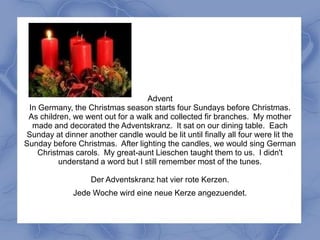
 In Germany, the Christmas season starts four Sundays before Christmas.
 As children, we went out for a walk and collected fir branches. My mother
  made and decorated the Adventskranz. It sat on our dining table. Each
Sunday at dinner another candle would be lit until finally all four were lit the
Sunday before Christmas. After lighting the candles, we would sing German
    Christmas carols. My great-aunt Lieschen taught them to us. I didn't
          understand a word but I still remember most of the tunes.

                   Der Adventskranz hat vier rote Kerzen.
              Jede Woche wird eine neue Kerze angezuendet.
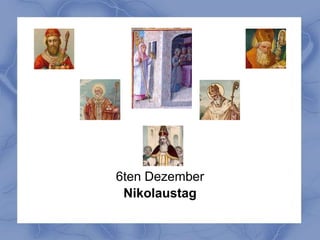
6ten Dezember
 Nikolaustag
On the evening of December 5, our house was a shoe-polishing workshop! All the shoes
 were polished. I suspect my parents made the most of this!!!! St Nicolaus would not be
    impressed and we would not be left any goodies if the shoes were not gleaming.
        A pair of nicely polished shoes would be left outside our bedroom door.
     On December 6 when we woke up the shoes would be filled with nuts and fruit.
                        My Scottish school friends were jealous.
                          Nothing for them until Christmas Day.

 “Am 6. Dezember feiert man in Deutschland den Nikolaustag. Kinder stellen ihre Schuhe
  vor die Türe. Sie möchten, daß der Nikolaus sie mit Nüsse und Obst füllt. Nikolaus wird
 von einem Helfer begleitet, dem Knecht Ruprecht. Er hat eine Rute für die bösen Kinder
und einen Sack voller kleiner Geschenke für die lieben Kinder. Aus einem großen Buch liest
      er ihnen vor, was sie für gute und böse Dinge getan haben, und er verteilt kleine
Geschenke. Meistens aber bekommt jeder etwas.” http://www.derweg.org/mwbrauch/weihnach.htm
Der Weihnachtsmarkt

       ~ in Deutschland ~
               und
~ in meine neue Heimat, Kanada ~
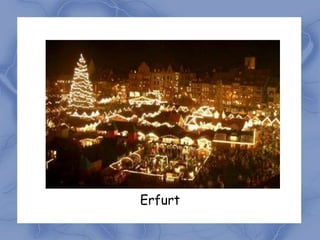
Erfurt
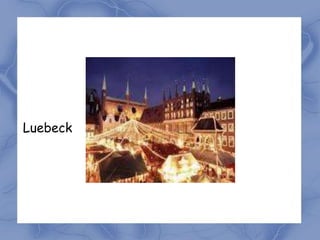
Luebeck
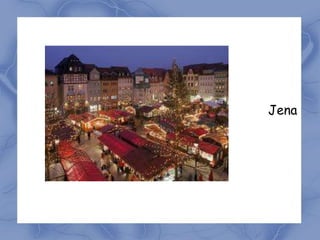
Jena
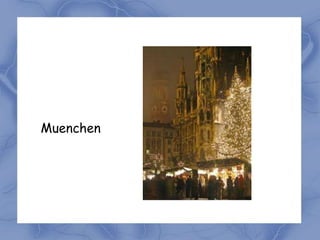
Muenchen
During Advent the historic cores of most major German cities and many
           smaller towns light up with holiday decorations.

The Christmas market tradition (Christkindlmarkt or Weihnachtsmarkt)
                  dates back to the 15th century.

The market is usually located on the city's central square and commonly
    features a nativity scene; bigger cities might have a stage for
                  traditional musicians and dancers.

    You will find handcrafted gifts and Christmas decorations. Your
 olifactory senses will be tempted by a mouthwatering array of grilled
sausages (Bockwurst oder Wuertschen) and meats, fried fish filets on a
 fresh bread rolls (Backfisch) and a great variety of specialty sweets,
                      confections and baked goods.

 Christmas markets are a treat for all the senses - beautiful to behold,
delicious scents wafting through the air and a feast for the taste buds.
I did not experience a Christmas market as a
                    child.

                   BUT

         Here I am in the Kootenays,
  with a growing resident German-speaking
                 population

      And just look at what we have!!!
In Silverton BC
      2011
German customs have followed me!
In 2010, my children, who have never been to Germany, and I
    had the opportunity to volunteer at a Christmas Market.

                       In the Kootenays!

  We have an increasing number of German-speaking New
Canadians from Austria, Germany and Switzerland in our area.
 Add their nostalgia for the Christmas of their childhood to the
                    Canadian “can-do” attitude
and the result is a community-wide sharing of German customs
                              at our
              Weihnachtsmarkt in den Kootenays
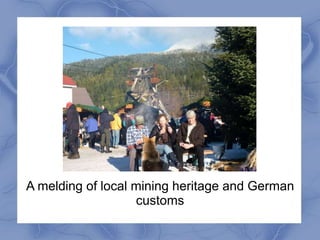
A melding of local mining heritage and German
                   customs
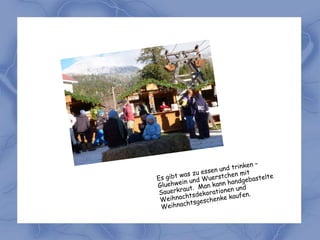
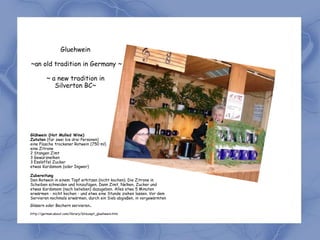
Gluehwein

~an old tradition in Germany ~

         ~ a new tradition in
            Silverton BC~


Glühwein (Hot Mulled Wine)
Zutaten (für zwei bis drei Personen)
eine Flasche trockener Rotwein (750 ml)
eine Zitrone
2 Stangen Zimt
3 Gewürznelken
3 Esslöffel Zucker
etwas Kardamom (oder Ingwer)

Zubereitung
Den Rotwein in einem Topf erhitzen (nicht kochen). Die Zitrone in
Scheiben schneiden und hinzufügen. Dann Zimt, Nelken, Zucker und
etwas Kardamom (nach belieben) dazugeben. Alles etwa 5 Minuten
erwärmen - nicht kochen - und etwa eine Stunde ziehen lassen. Vor dem
Servieren nochmals erwärmen, durch ein Sieb abgießen, in vorgewärmten
Gläsern oder Bechern servieren      .
http://german.about.com/library/blrezept_gluehwein.htm
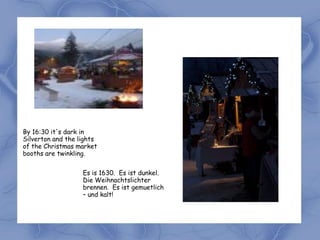
By 16:30 it's dark in
Silverton and the lights
of the Christmas market
booths are twinkling.


                   Es is 1630. Es ist dunkel.
                   Die Weihnachtslichter
                   brennen. Es ist gemuetlich
                   – und kalt!
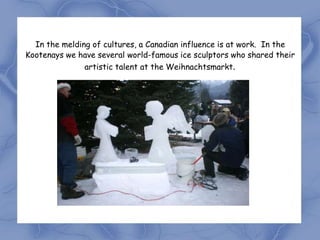
In the melding of cultures, a Canadian influence is at work. In the
Kootenays we have several world-famous ice sculptors who shared their
               artistic talent at the Weihnachtsmarkt.
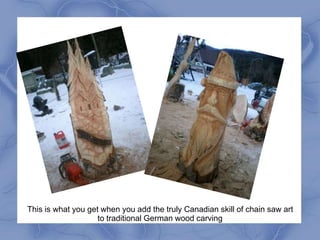
This is what you get when you add the truly Canadian skill of chain saw art
                    to traditional German wood carving
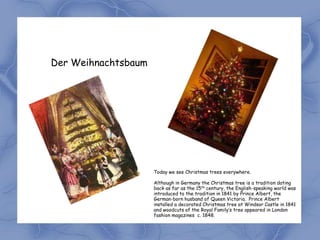
Der Weihnachtsbaum


                     Today we see Christmas trees everywhere.

                     Although in Germany the Christmas tree is a tradition dating
                     back as far as the 15th century, the English-speaking world was
                     introduced to the tradition in 1841 by Prince Albert, the
                     German-born husband of Queen Victoria. Prince Albert
                     installed a decorated Christmas tree at Windsor Castle in 1841
                     and woodcuts of the Royal Family’s tree appeared in London
                     fashion magazines c. 1848.
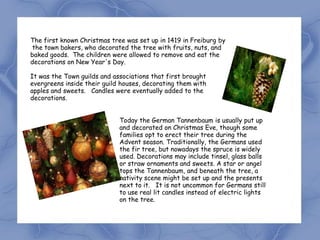
The first known Christmas tree was set up in 1419 in Freiburg by
the town bakers, who decorated the tree with fruits, nuts, and
baked goods. The children were allowed to remove and eat the
decorations on New Year's Day.

It was the Town guilds and associations that first brought
evergreens inside their guild houses, decorating them with
apples and sweets. Candles were eventually added to the
decorations.


                             Today the German Tannenbaum is usually put up
                             and decorated on Christmas Eve, though some
                             families opt to erect their tree during the
                             Advent season. Traditionally, the Germans used
                             the fir tree, but nowadays the spruce is widely
                             used. Decorations may include tinsel, glass balls
                             or straw ornaments and sweets. A star or angel
                             tops the Tannenbaum, and beneath the tree, a
                             nativity scene might be set up and the presents
                             next to it. It is not uncommon for Germans still
                             to use real lit candles instead of electric lights
                             on the tree.
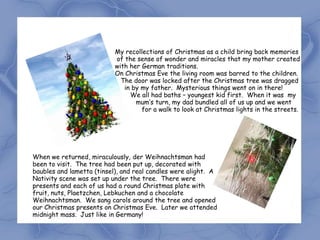
My recollections of Christmas as a child bring back memories
                           of the sense of wonder and miracles that my mother created
                           with her German traditions.
                           On Christmas Eve the living room was barred to the children.
                             The door was locked after the Christmas tree was dragged
                              in by my father. Mysterious things went on in there!
                                We all had baths – youngest kid first. When it was my
                                  mum’s turn, my dad bundled all of us up and we went
                                    for a walk to look at Christmas lights in the streets.


When we returned, miraculously, der Weihnachtsman had
been to visit. The tree had been put up, decorated with
baubles and lametta (tinsel), and real candles were alight. A
Nativity scene was set up under the tree. There were
presents and each of us had a round Christmas plate with
fruit, nuts, Plaetzchen, Lebkuchen and a chocolate
Weihnachtsman. We sang carols around the tree and opened
our Christmas presents on Christmas Eve. Later we attended
midnight mass. Just like in Germany!
O Tannenbaum, o Tannenbaum,                               O Christmas tree, o Christmas tree
wie treu sind deine Blätter!                              How loyal are your leaves/needles!
Du grünst nicht nur                                       You're green not only
 zur Sommerzeit,                                           in the summertime,
Nein auch im Winter, wenn es schneit.                     No, also in winter when it snows.
O Tannenbaum, o Tannenbaum,                               O Christmas tree, o Christmas tree
wie treu sind deine Blätter!                              How loyal are your leaves/needles!

O Tannenbaum, o Tannenbaum!                               O Christmas tree, o Christmas tree
Du kannst mir sehr gefallen!                              You can please me very much!
Wie oft hat nicht zur Weihnachtszeit                      How often has not at Christmastime
Ein Baum von dir mich hoch erfreut!                       A tree like you given me such joy!
O Tannenbaum, o Tannenbaum!                               O Christmas tree, o Christmas tree,
Du kannst mir sehr gefallen!                              You can please me very much!

O Tannenbaum, o Tannenbaum!                               O Christmas tree, o Christmas tree
Dein Kleid will mich                                      Your dress wants to
 was lehren:                                               teach me something:
Die Hoffnung und Beständigkeit                            Your hope and durability
Gibt Trost und Kraft                                      Provide comfort and strength
 zu jeder Zeit.                                            at any time.
O Tannenbaum, o Tannenbaum!                               O Christmas tree, o Christmas tree,
Das soll dein Kleid                                       That's what your dress should
 mich lehren.                                              teach me.


                                 http://german.about.com/library/blotannenb.html
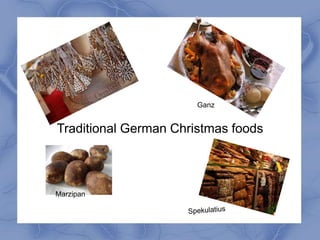
Ganz


Traditional German Christmas foods


Marzipan
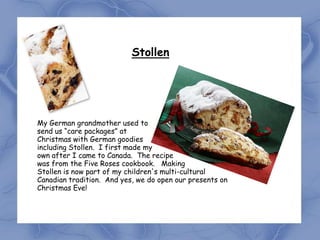
Stollen


My German grandmother used to
send us “care packages” at           .
Christmas with German goodies
including Stollen. I first made my
own after I came to Canada. The recipe
was from the Five Roses cookbook. Making
Stollen is now part of my children's multi-cultural
Canadian tradition. And yes, we do open our presents on
Christmas Eve!
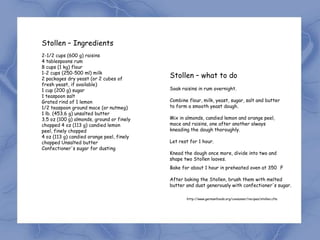
Stollen – Ingredients
2-1/2 cups (600 g) raisins
4 tablespoons rum
8 cups (1 kg) flour
1-2 cups (250-500 ml) milk
2 packages dry yeast (or 2 cubes of
                                           Stollen – what to do
fresh yeast, if available)
1 cup (200 g) sugar                        Soak raisins in rum overnight.
1 teaspoon salt
Grated rind of 1 lemon                     Combine flour, milk, yeast, sugar, salt and butter
1/2 teaspoon ground mace (or nutmeg)       to form a smooth yeast dough.
1 lb. (453.6 g) unsalted butter
3.5 oz (100 g) almonds, ground or finely   Mix in almonds, candied lemon and orange peel,
chopped 4 oz (113 g) candied lemon         mace and raisins, one after another always
peel, finely chopped                       kneading the dough thoroughly.
4 oz (113 g) candied orange peel, finely
chopped Unsalted butter                    Let rest for 1 hour.
Confectioner's sugar for dusting
                                           Knead the dough once more, divide into two and
                                           shape two Stollen loaves.
                                           Bake for about 1 hour in preheated oven at 350 F

                                           After baking the Stollen, brush them with melted
                                           butter and dust generously with confectioner's sugar.

                                                  http://www.germanfoods.org/consumer/recipes/stollen.cfm
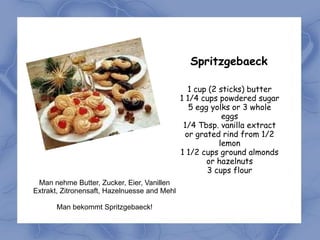
Spritzgebaeck

                                                 1 cup (2 sticks) butter
                                              1 1/4 cups powdered sugar
                                                 5 egg yolks or 3 whole
                                                           eggs
                                               1/4 Tbsp. vanilla extract
                                                or grated rind from 1/2
                                                          lemon
                                              1 1/2 cups ground almonds
                                                      or hazelnuts
                                                      3 cups flour
 Man nehme Butter, Zucker, Eier, Vanillen
Extrakt, Zitronensaft, Hazelnuesse and Mehl

       Man bekommt Spritzgebaeck!
On the evening of Christmas Eve, we traditionally had trout or some
other sea food. Meat was not allowed.

Our traditional Christmas Day fare was

                          Spargelsuppe

           roast goose with a prune/breadcrumb stuffing
   red cabbage (made with lemon juice, cloves and peppercorns,
                  and sugar – just like Grandma’s)
                             Spaeztle
          other miscellaneous vegetables –at least three

                     Schwarzwaldkirschtorte
                     Waldmeister (Dr. Oetker)
German   cultural connections 3

German cultural connections 3

  • 2.
    On March 8,2010 my mother died. She was German. Little did I know when I was growing up in Scotland how many German Christmas traditions she brought with her to her new adopted country.
  • 3.
    Advent In Germany,the Christmas season starts four Sundays before Christmas. As children, we went out for a walk and collected fir branches. My mother made and decorated the Adventskranz. It sat on our dining table. Each Sunday at dinner another candle would be lit until finally all four were lit the Sunday before Christmas. After lighting the candles, we would sing German Christmas carols. My great-aunt Lieschen taught them to us. I didn't understand a word but I still remember most of the tunes. Der Adventskranz hat vier rote Kerzen. Jede Woche wird eine neue Kerze angezuendet.
  • 4.
  • 5.
    On the eveningof December 5, our house was a shoe-polishing workshop! All the shoes were polished. I suspect my parents made the most of this!!!! St Nicolaus would not be impressed and we would not be left any goodies if the shoes were not gleaming. A pair of nicely polished shoes would be left outside our bedroom door. On December 6 when we woke up the shoes would be filled with nuts and fruit. My Scottish school friends were jealous. Nothing for them until Christmas Day. “Am 6. Dezember feiert man in Deutschland den Nikolaustag. Kinder stellen ihre Schuhe vor die Türe. Sie möchten, daß der Nikolaus sie mit Nüsse und Obst füllt. Nikolaus wird von einem Helfer begleitet, dem Knecht Ruprecht. Er hat eine Rute für die bösen Kinder und einen Sack voller kleiner Geschenke für die lieben Kinder. Aus einem großen Buch liest er ihnen vor, was sie für gute und böse Dinge getan haben, und er verteilt kleine Geschenke. Meistens aber bekommt jeder etwas.” http://www.derweg.org/mwbrauch/weihnach.htm
  • 6.
    Der Weihnachtsmarkt ~ in Deutschland ~ und ~ in meine neue Heimat, Kanada ~
  • 7.
  • 8.
  • 9.
  • 10.
  • 11.
    During Advent thehistoric cores of most major German cities and many smaller towns light up with holiday decorations. The Christmas market tradition (Christkindlmarkt or Weihnachtsmarkt) dates back to the 15th century. The market is usually located on the city's central square and commonly features a nativity scene; bigger cities might have a stage for traditional musicians and dancers. You will find handcrafted gifts and Christmas decorations. Your olifactory senses will be tempted by a mouthwatering array of grilled sausages (Bockwurst oder Wuertschen) and meats, fried fish filets on a fresh bread rolls (Backfisch) and a great variety of specialty sweets, confections and baked goods. Christmas markets are a treat for all the senses - beautiful to behold, delicious scents wafting through the air and a feast for the taste buds.
  • 12.
    I did notexperience a Christmas market as a child. BUT Here I am in the Kootenays, with a growing resident German-speaking population And just look at what we have!!!
  • 13.
  • 14.
    German customs havefollowed me! In 2010, my children, who have never been to Germany, and I had the opportunity to volunteer at a Christmas Market. In the Kootenays! We have an increasing number of German-speaking New Canadians from Austria, Germany and Switzerland in our area. Add their nostalgia for the Christmas of their childhood to the Canadian “can-do” attitude and the result is a community-wide sharing of German customs at our Weihnachtsmarkt in den Kootenays
  • 15.
    A melding oflocal mining heritage and German customs
  • 17.
    Gluehwein ~an old traditionin Germany ~ ~ a new tradition in Silverton BC~ Glühwein (Hot Mulled Wine) Zutaten (für zwei bis drei Personen) eine Flasche trockener Rotwein (750 ml) eine Zitrone 2 Stangen Zimt 3 Gewürznelken 3 Esslöffel Zucker etwas Kardamom (oder Ingwer) Zubereitung Den Rotwein in einem Topf erhitzen (nicht kochen). Die Zitrone in Scheiben schneiden und hinzufügen. Dann Zimt, Nelken, Zucker und etwas Kardamom (nach belieben) dazugeben. Alles etwa 5 Minuten erwärmen - nicht kochen - und etwa eine Stunde ziehen lassen. Vor dem Servieren nochmals erwärmen, durch ein Sieb abgießen, in vorgewärmten Gläsern oder Bechern servieren . http://german.about.com/library/blrezept_gluehwein.htm
  • 18.
    By 16:30 it'sdark in Silverton and the lights of the Christmas market booths are twinkling. Es is 1630. Es ist dunkel. Die Weihnachtslichter brennen. Es ist gemuetlich – und kalt!
  • 19.
    In the meldingof cultures, a Canadian influence is at work. In the Kootenays we have several world-famous ice sculptors who shared their artistic talent at the Weihnachtsmarkt.
  • 20.
    This is whatyou get when you add the truly Canadian skill of chain saw art to traditional German wood carving
  • 21.
    Der Weihnachtsbaum Today we see Christmas trees everywhere. Although in Germany the Christmas tree is a tradition dating back as far as the 15th century, the English-speaking world was introduced to the tradition in 1841 by Prince Albert, the German-born husband of Queen Victoria. Prince Albert installed a decorated Christmas tree at Windsor Castle in 1841 and woodcuts of the Royal Family’s tree appeared in London fashion magazines c. 1848.
  • 22.
    The first knownChristmas tree was set up in 1419 in Freiburg by the town bakers, who decorated the tree with fruits, nuts, and baked goods. The children were allowed to remove and eat the decorations on New Year's Day. It was the Town guilds and associations that first brought evergreens inside their guild houses, decorating them with apples and sweets. Candles were eventually added to the decorations. Today the German Tannenbaum is usually put up and decorated on Christmas Eve, though some families opt to erect their tree during the Advent season. Traditionally, the Germans used the fir tree, but nowadays the spruce is widely used. Decorations may include tinsel, glass balls or straw ornaments and sweets. A star or angel tops the Tannenbaum, and beneath the tree, a nativity scene might be set up and the presents next to it. It is not uncommon for Germans still to use real lit candles instead of electric lights on the tree.
  • 23.
    My recollections ofChristmas as a child bring back memories of the sense of wonder and miracles that my mother created with her German traditions. On Christmas Eve the living room was barred to the children. The door was locked after the Christmas tree was dragged in by my father. Mysterious things went on in there! We all had baths – youngest kid first. When it was my mum’s turn, my dad bundled all of us up and we went for a walk to look at Christmas lights in the streets. When we returned, miraculously, der Weihnachtsman had been to visit. The tree had been put up, decorated with baubles and lametta (tinsel), and real candles were alight. A Nativity scene was set up under the tree. There were presents and each of us had a round Christmas plate with fruit, nuts, Plaetzchen, Lebkuchen and a chocolate Weihnachtsman. We sang carols around the tree and opened our Christmas presents on Christmas Eve. Later we attended midnight mass. Just like in Germany!
  • 24.
    O Tannenbaum, oTannenbaum, O Christmas tree, o Christmas tree wie treu sind deine Blätter! How loyal are your leaves/needles! Du grünst nicht nur You're green not only zur Sommerzeit, in the summertime, Nein auch im Winter, wenn es schneit. No, also in winter when it snows. O Tannenbaum, o Tannenbaum, O Christmas tree, o Christmas tree wie treu sind deine Blätter! How loyal are your leaves/needles! O Tannenbaum, o Tannenbaum! O Christmas tree, o Christmas tree Du kannst mir sehr gefallen! You can please me very much! Wie oft hat nicht zur Weihnachtszeit How often has not at Christmastime Ein Baum von dir mich hoch erfreut! A tree like you given me such joy! O Tannenbaum, o Tannenbaum! O Christmas tree, o Christmas tree, Du kannst mir sehr gefallen! You can please me very much! O Tannenbaum, o Tannenbaum! O Christmas tree, o Christmas tree Dein Kleid will mich Your dress wants to was lehren: teach me something: Die Hoffnung und Beständigkeit Your hope and durability Gibt Trost und Kraft Provide comfort and strength zu jeder Zeit. at any time. O Tannenbaum, o Tannenbaum! O Christmas tree, o Christmas tree, Das soll dein Kleid That's what your dress should mich lehren. teach me. http://german.about.com/library/blotannenb.html
  • 25.
  • 26.
    Stollen My German grandmotherused to send us “care packages” at . Christmas with German goodies including Stollen. I first made my own after I came to Canada. The recipe was from the Five Roses cookbook. Making Stollen is now part of my children's multi-cultural Canadian tradition. And yes, we do open our presents on Christmas Eve!
  • 27.
    Stollen – Ingredients 2-1/2cups (600 g) raisins 4 tablespoons rum 8 cups (1 kg) flour 1-2 cups (250-500 ml) milk 2 packages dry yeast (or 2 cubes of Stollen – what to do fresh yeast, if available) 1 cup (200 g) sugar Soak raisins in rum overnight. 1 teaspoon salt Grated rind of 1 lemon Combine flour, milk, yeast, sugar, salt and butter 1/2 teaspoon ground mace (or nutmeg) to form a smooth yeast dough. 1 lb. (453.6 g) unsalted butter 3.5 oz (100 g) almonds, ground or finely Mix in almonds, candied lemon and orange peel, chopped 4 oz (113 g) candied lemon mace and raisins, one after another always peel, finely chopped kneading the dough thoroughly. 4 oz (113 g) candied orange peel, finely chopped Unsalted butter Let rest for 1 hour. Confectioner's sugar for dusting Knead the dough once more, divide into two and shape two Stollen loaves. Bake for about 1 hour in preheated oven at 350 F After baking the Stollen, brush them with melted butter and dust generously with confectioner's sugar. http://www.germanfoods.org/consumer/recipes/stollen.cfm
  • 28.
    Spritzgebaeck 1 cup (2 sticks) butter 1 1/4 cups powdered sugar 5 egg yolks or 3 whole eggs 1/4 Tbsp. vanilla extract or grated rind from 1/2 lemon 1 1/2 cups ground almonds or hazelnuts 3 cups flour Man nehme Butter, Zucker, Eier, Vanillen Extrakt, Zitronensaft, Hazelnuesse and Mehl Man bekommt Spritzgebaeck!
  • 29.
    On the eveningof Christmas Eve, we traditionally had trout or some other sea food. Meat was not allowed. Our traditional Christmas Day fare was Spargelsuppe roast goose with a prune/breadcrumb stuffing red cabbage (made with lemon juice, cloves and peppercorns, and sugar – just like Grandma’s) Spaeztle other miscellaneous vegetables –at least three Schwarzwaldkirschtorte Waldmeister (Dr. Oetker)