Geospatial Application Development Using Python Programming Galety
Geospatial Application Development Using Python Programming Galety
Geospatial Application Development Using Python Programming Galety
Geospatial Application Development Using Python Programming Galety
Geospatial Application Development Using Python Programming Galety
1.
Geospatial Application DevelopmentUsing Python
Programming Galety download
https://ebookbell.com/product/geospatial-application-development-
using-python-programming-galety-58212682
Explore and download more ebooks at ebookbell.com
2.
Here are somerecommended products that we believe you will be
interested in. You can click the link to download.
Geospatial Application Development Using Python Programming Galety
Mohammad Igi Global
https://ebookbell.com/product/geospatial-application-development-
using-python-programming-galety-mohammad-igi-global-58531542
Python Geospatial Development Learn To Build Sophisticated Mapping
Applications From Scratch Using Python Tools For Geospatial
Development Second Edition Westra
https://ebookbell.com/product/python-geospatial-development-learn-to-
build-sophisticated-mapping-applications-from-scratch-using-python-
tools-for-geospatial-development-second-edition-westra-20632874
Geospatial Technology Application In Water Resources Management 1st Ed
2020 Hassane Jarar Oulidi
https://ebookbell.com/product/geospatial-technology-application-in-
water-resources-management-1st-ed-2020-hassane-jarar-oulidi-10798400
Soil Health And Environmental Sustainability Application Of Geospatial
Technology Pravat Kumar Shit
https://ebookbell.com/product/soil-health-and-environmental-
sustainability-application-of-geospatial-technology-pravat-kumar-
shit-46872924
3.
Advancements In UrbanEnvironmental Studies Application Of Geospatial
Technology And Artificial Intelligence In Urban Studies Atiqur Rahman
https://ebookbell.com/product/advancements-in-urban-environmental-
studies-application-of-geospatial-technology-and-artificial-
intelligence-in-urban-studies-atiqur-rahman-49192628
Geospatial Applications For Climate Adaptation Planning Diana Mitsova
https://ebookbell.com/product/geospatial-applications-for-climate-
adaptation-planning-diana-mitsova-32737360
Geospatial Applications For Natural Resources Management First Edition
Singh
https://ebookbell.com/product/geospatial-applications-for-natural-
resources-management-first-edition-singh-7033326
Geospatial Data Science A Handson Approach For Building Geospatial
Applications Using Linked Data Technologies Manolis Koubarakis
https://ebookbell.com/product/geospatial-data-science-a-handson-
approach-for-building-geospatial-applications-using-linked-data-
technologies-manolis-koubarakis-56484228
Case Studies In Geospatial Applications To Groundwater Resources
Pravat Kumar Shit
https://ebookbell.com/product/case-studies-in-geospatial-applications-
to-groundwater-resources-pravat-kumar-shit-47210886
5.
Geospatial Application
Development Using
PythonProgramming
Mohammad Gouse Galety
Samarkand International University of Technology,
Uzbekistan
Arul Kumar Natarajan
Samarkand International University of Technology,
Uzbekistan
Tesfaye Fufa Gedefa
Space Science and Geospatial Institute, Ethiopia
Tsegaye Demsis Lemma
Space Science and Geospatial Institute, Ethiopia
A volume in the Advances in
Geospatial Technologies (AGT)
Book Series
Table of Contents
Foreword..............................................................................................................xv
Preface.
...............................................................................................................xvii
Chapter 1
Introduction to Geospatial Data and Python Programming ...................................1
D. Shanmugapriyaa, Coimbatore Institute of Technology, India
M. Sujithra, Coimbatore Institute of Technology, India
B. Senthilkumar, Kumaraguru College of Technology, India
V. Sachin Kumar, Coimbatore Institute of Technology, India
Ram Sanjai, Coimbatore Institute of Technology, India
Chapter 2
Python Programming for Geospatial Applications: Web Mapping, Interactive
Visualization, and Beyond ...................................................................................39
Deepthi Das, Christ University, India
Arul Kumar Natarajan, Samarkand International University of
Technology, Uzbekistan
Chapter 3
Python-Powered Remote Sensing Data ...............................................................62
Aamir Raza, University of Agriculture, Faisalabad, Pakistan
Sheraz Maqbool, University of Agriculture, Faisalabad, Pakistan
Muhammad Safdar, University of Agriculture, Faisalabad, Pakistan
Hasnain Ali, University of Agriculture, Faisalabad, Pakistan
Ikram Ullah, Yangzhou University, China
Ali Akbar, Liaoning University, Shenyang, China
Avery Williams, University of North Texas, USA
Mohammed Saleh Al Ansari, University of Bahrain, Bahrain
Mubashir Ahmed, University of Agriculture, Faisalabad, Pakistan
Awn Abbas, University of Agriculture, Faisalabad, Pakistan
Abdul Malik, University of Agriculture, Faisalabad, Pakistan
10.
Chapter 4
Towards SpatialData Visualization With Python: Unveiling Geographic
Patterns and Trends ..............................................................................................94
Soressa Beyene Lemu, Bule Hora University, Ethiopia
Desalegn Aweke Wako, Bule Hora University, Ethiopia
Tesfaye Fufa, Space Science and Geospatial Institute, Ethiopia
Mohammad Gouse Galety, Samarkand International University of
Technology, Uzbekistan
Chapter 5
Spatial Data Visualization With Python: Techniques, Tools, and Real-World
Applications .......................................................................................................123
M. Shreenithi, Coimbatore Institute of Technology, India
M. Sujithra, Coimbatore Institute of Technology, India
B. Senthilkumar, Kumaraguru College of Technology, India
D. Shanmugapriyaa, Coimbatore Institute of Technology, India
T. Rizanuma, Coimbatore Institute of Technology, India
Chapter 6
Exploring Vector and Raster Data Formats for Geospatial Visualization With
Python ................................................................................................................163
Marsel Sonu M., Christ University, India
Deepthi Das, Christ University, India
Arul Kumar Natarajan, Samarkand International University of
Technology, Uzbekistan
Manimaran A., VIT-AP University, India
Chapter 7
Geospatial Data Visualization With Folium ......................................................187
K. G. Suma, VIT-AP University, India
Gurram Sunitha, Mohan Babu University, India
J. Avanija, Mohan Babu University, India
Mohammad Gouse Galety, Samarkand International University of
Technology, Uzbekistan
Chinthapatla Pranay Varna, Sree Vidyanikethan Engineering College,
India
11.
Chapter 8
Applying GeospatialData to Choose the Optimal Route During the Road
Design Stage ......................................................................................................209
Ehyaudin Musema Ahmed, Debre Birhan University, Ethiopia
Mohammed Nuru Mohammed, Debre Birhan University, Ethiopia
Mohammad Gouse Galety, Samarkand International University of
Technology, Uzbekistan
Chapter 9
Python Library for Road Network Analysis in the Case of Debre Berhan City 274
Tesfaye Fufa Gedefa, Space Science and Geospatial Institute, Ethiopia
Tsegaye D. Lemma, Space Science and Geospatial Institute, Ethiopia
Wondwossen Mindahun Eshetu, Space Science and Geospatial Institute,
Ethiopia
Mohammad Gouse Galety, Samarkand International University of
Technology, Uzbekistan
Chapter 10
Impacts of Climate Changes on Traffic Flows Using Geospatial Data
Analysis: Shifting the Traffic Flow to the Next Level .......................................292
Jimbo Henri Claver, Samarkand International University of Science and
Technology, Uzbekistan
Nagueu Djambong Lionel Perin, University of Yaounde, Cameroon
Bouetou Thomas, University of Yaounde, Cameroon
Tchoua Paul, University of Ngoundere, Cameroon
Chapter 11
Deep Learning Approach to Estimate the Maize Yield Prediction Using Data
From Cameroon: Shifting the Maize Yield Production to the Next Level ........308
Jimbo Henri Claver, Samarkand International University of Science and
Tecchnology, Uzbekistan
Nagueu Djambong Lionel Perin, University of Yaounde, Cameroon
Bouetou Thomas, University of Yaounde, Cameroon
Tchoua Paul, University of Ngoundere, Cambodia
Compilation of References ..............................................................................321
About the Contributors ...................................................................................335
Index ..................................................................................................................342
12.
Detailed Table ofContents
Foreword.............................................................................................................. xv
Preface.
...............................................................................................................xvii
Chapter 1
Introduction to Geospatial Data and Python Programming ...................................1
D. Shanmugapriyaa, Coimbatore Institute of Technology, India
M. Sujithra, Coimbatore Institute of Technology, India
B. Senthilkumar, Kumaraguru College of Technology, India
V. Sachin Kumar, Coimbatore Institute of Technology, India
Ram Sanjai, Coimbatore Institute of Technology, India
Utilising geographical linkages, predictive modelling, and problem-solving
techniques, geospatial analysis is an essential discipline in many businesses. This
chapterexploresthedeepmeaningofgeographicaldataandhowmachinelearningcan
benefitfromit.Geospatialdata,derivedfromsourcessuchasGPSdevicesandsatellite
pictures, serves as the basis for comprehending infrastructure, topography, weather,
andpopulationdynamics.Crowdsourcedinformationandopendataprojectsenhance
thedatasetavailableforresearch.Byaddressingissueslikedimensionalityreduction
and missing data, spatial data preparation ensures the quality and diversity of data
sources. Geospatial analysis is improved for a variety of applications using machine
learning algorithms, which include supervised, unsupervised, and reinforcement
learning techniques. Temporal dynamics, as examined by methods such as ARIMA
andLSTMnetworks,trackvariationswithinregions.Ethicalconsiderations,efficient
data visualization, and data fusion techniques all contribute to thorough.
Chapter 2
Python Programming for Geospatial Applications: Web Mapping, Interactive
Visualization, and Beyond ...................................................................................39
Deepthi Das, Christ University, India
Arul Kumar Natarajan, Samarkand International University of
Technology, Uzbekistan
13.
Geospatial solutions representa pivotal toolset for analyzing, interpreting, and
visualizingspatialdataacrossdiversedomains,facilitatinginformeddecision-making
and fostering innovation. This book chapter provides a comprehensive overview of
geospatial solutions, emphasizing their critical role in addressing spatially explicit
challengesanddrivingefficiency,productivity,andinnovationacrossvarioussectors.
Furthermore, it explores the integration of Python programming in geospatial
applications, highlighting its versatility and extensive ecosystem of libraries and
tools tailored for spatial data analysis and visualization. The fundamentals of web
mappingarediscussedindepth,elucidatingspatialrepresentation,technologies,and
tools commonly employed in web mapping applications. Also, the chapter explores
Python’s role in retrieving geospatial data with Python, visualization methods, and
interactive web mapping.
Chapter 3
Python-Powered Remote Sensing Data ...............................................................62
Aamir Raza, University of Agriculture, Faisalabad, Pakistan
Sheraz Maqbool, University of Agriculture, Faisalabad, Pakistan
Muhammad Safdar, University of Agriculture, Faisalabad, Pakistan
Hasnain Ali, University of Agriculture, Faisalabad, Pakistan
Ikram Ullah, Yangzhou University, China
Ali Akbar, Liaoning University, Shenyang, China
Avery Williams, University of North Texas, USA
Mohammed Saleh Al Ansari, University of Bahrain, Bahrain
Mubashir Ahmed, University of Agriculture, Faisalabad, Pakistan
Awn Abbas, University of Agriculture, Faisalabad, Pakistan
Abdul Malik, University of Agriculture, Faisalabad, Pakistan
Remote sensing is a crucial technique in environmental and spatial investigations,
and Python is a popular programming language for analyzing this data. This chapter
provides a comprehensive guide to using Python for remote sensing data analysis,
covering various data types, attributes, and practical implementations. It introduces
Python and its data processing libraries, discusses preprocessing operations like
data conversion and import, geometric rectification, and radiometric correction, and
covers image enhancement techniques like edge detection, contrast enhancement,
and filtering. It also covers image analysis techniques like band mathematics,
indices, classification, and segmentation. The chapter also covers exporting data and
generating visualization maps and charts. Python’s application in remote sensing
data analysis is illustrated through case studies.
14.
Chapter 4
Towards SpatialData Visualization With Python: Unveiling Geographic
Patterns and Trends ..............................................................................................94
Soressa Beyene Lemu, Bule Hora University, Ethiopia
Desalegn Aweke Wako, Bule Hora University, Ethiopia
Tesfaye Fufa, Space Science and Geospatial Institute, Ethiopia
Mohammad Gouse Galety, Samarkand International University of
Technology, Uzbekistan
This chapter aims to explore the power of Python in spatial data visualization.
Spatial data visualization is the process of representing spatial information visually,
enabling one to explore and communicate patterns, distributions, and relationships
within the data. An informative spatial data visualization with Python effectively
represents and communicates spatial information using visual elements, enabling
users togaininsights andmakeinformed decisionsrelatedto geospatial data.Python
provides many sets of libraries and tools for handling and visualizing geospatial data
to enhance understanding, facilitate exploration, and present geographic patterns
and relationships clearly and intuitively. The chapter demonstrates the capabilities
of Python for spatial data visualization by showcasing various techniques, spatial
data formats, and tools with Geopandas, Matplotlib, Plotly, and Folium libraries.
Examples and code snippets are provided for the readers to gain solid knowledge
about spatial data visualization using Python.
Chapter 5
Spatial Data Visualization With Python: Techniques, Tools, and Real-World
Applications .......................................................................................................123
M. Shreenithi, Coimbatore Institute of Technology, India
M. Sujithra, Coimbatore Institute of Technology, India
B. Senthilkumar, Kumaraguru College of Technology, India
D. Shanmugapriyaa, Coimbatore Institute of Technology, India
T. Rizanuma, Coimbatore Institute of Technology, India
The field of spatial data visualization in Python is propelled by the significance
of data science and geospatial analysis. Python is pivotal in providing a flexible
toolkit for visualizing intricate spatial data. This guide explores the fundamentals,
techniques,andpracticalapplicationsofspatialdatavisualization,tracingitshistorical
roots alongside the ascent of data science and geospatial analytics. Examining
libraries like Matplotlib, Geopandas, Folium, and Plotly, the guide equips readers
with essential tools for geospatial data visualization in diverse fields, including
urban planning, environmental science, and healthcare. Emphasizing dynamic and
interactive visualizations, it explores spatial data’s pivotal role in space exploration,
virtual and augmented reality, satellite navigation, industry accuracy, and pandemic
response.AfocusliesonintegratingIPgeolocationforenhancedmarketingaccuracy,
15.
security, and compliance,showcasing how geospatial visualization improves public
experiences in navigation, weather forecasting, public safety, healthcare.
Chapter 6
Exploring Vector and Raster Data Formats for Geospatial Visualization With
Python ................................................................................................................163
Marsel Sonu M., Christ University, India
Deepthi Das, Christ University, India
Arul Kumar Natarajan, Samarkand International University of
Technology, Uzbekistan
Manimaran A., VIT-AP University, India
The chapter uses Python to explore vector and raster data formats within geospatial
visualization. It highlights their pivotal role across diverse environmental science,
urbanplanning,andnaturalresourcemanagementdomains.Anuancedcomprehension
oftheseformatsisdeemedessentialforproficientgeospatialvisualizationinPython,
as they facilitate the storage and manipulation of spatial data. Vector data formats
accurately represent points, lines, and polygons within a coordinate system. In
contrast, raster data formats are tailored to depict continuous surfaces or grids of
data. An array of libraries and tools are outlined for exploring and visualizing these
geospatial data formats in Python, each serving distinct functionalities ranging from
datamanipulationtovisualization.Thechaptersystematicallyintroducestheconcept
of geospatial visualization, elucidates the disparities and application scenarios of
vector and raster data formats, and subsequently elucidates various Python libraries
and tools conducive to geospatial data manipulation and visualization.
Chapter 7
Geospatial Data Visualization With Folium ......................................................187
K. G. Suma, VIT-AP University, India
Gurram Sunitha, Mohan Babu University, India
J. Avanija, Mohan Babu University, India
Mohammad Gouse Galety, Samarkand International University of
Technology, Uzbekistan
Chinthapatla Pranay Varna, Sree Vidyanikethan Engineering College,
India
Geospatial data visualization is a powerful tool for understanding and analyzing
spatialpatternsandrelationships.Thischapterdivesintotheworldofgeospatialdata
visualization using Folium geospatial Python library. It discloses the significance
and versatility of Folium for creating dynamic and accessible maps. This chapter
provideshands-onexperienceofgeospatialdatavisualizationusingPythongeospatial
library Folium. This chapter provides practical examples. Readers will gain insights
into the power of Folium for creating interactive and visually compelling maps.
Thereby, making geospatial data accessible and engaging
16.
Chapter 8
Applying GeospatialData to Choose the Optimal Route During the Road
Design Stage ......................................................................................................209
Ehyaudin Musema Ahmed, Debre Birhan University, Ethiopia
Mohammed Nuru Mohammed, Debre Birhan University, Ethiopia
Mohammad Gouse Galety, Samarkand International University of
Technology, Uzbekistan
Thischapteraddressesthechallengeofroadrouteselectionbyemployingasystematic
geospatial data integration approach during the design phase. The methodology
revolves around the acquisition and analysis of datasets, such as satellite imagery,
DEMs, GIS, and other important data sets. Leveraging Python programming, the
chapterendeavorstodevelopatailoredgeospatialframeworkforoptimizingroadroute
selection,withafocusonevaluatingsocio-economic,engineeringandenvironmental
impactsandaligningwithsustainabilityobjectives.Resultinginarobustmethodology
determiningoptimalalignmentsbasedonterrain,environmental,andsocioeconomic
factors using MCA. The chapter extend to providing data-driven recommendations
for the development of resilient infrastructure, ensuring that road design aligns with
sustainability principles to foster economic prosperity, environmental conservation,
and societal well-being a paradigm shift in road expansion strategies.
Chapter 9
Python Library for Road Network Analysis in the Case of Debre Berhan City 274
Tesfaye Fufa Gedefa, Space Science and Geospatial Institute, Ethiopia
Tsegaye D. Lemma, Space Science and Geospatial Institute, Ethiopia
Wondwossen Mindahun Eshetu, Space Science and Geospatial Institute,
Ethiopia
Mohammad Gouse Galety, Samarkand International University of
Technology, Uzbekistan
This study employs the Python library for road network analysis in the Debre Berhan
Metropolitan City, focusing on determining the best route, shortest path, road types,
length in km, and speed limit in km/h. Geopandas is utilized to visualize the road
network data, enabling the calculation of the shortest path and extraction of road
type and speed limit information. Network analysis libraries like,folium, NetworkX
convert the data into a graph representation, using algorithms like Dijkstra’s or A*
to find the shortest path based on distance or travel time. Geopandas then overlays
road segments on a map, highlighting the shortest path and indicating road type,
length, and speed limit, offering a robust framework for assessing and optimizing
the road network in urban areas and contributing to the effective management and
enhancement of transportation infrastructure.
17.
Chapter 10
Impacts ofClimate Changes on Traffic Flows Using Geospatial Data
Analysis: Shifting the Traffic Flow to the Next Level .......................................292
Jimbo Henri Claver, Samarkand International University of Science and
Technology, Uzbekistan
Nagueu Djambong Lionel Perin, University of Yaounde, Cameroon
Bouetou Thomas, University of Yaounde, Cameroon
Tchoua Paul, University of Ngoundere, Cameroon
Thischapterexploresthecomplexinterplaybetweenclimatechangeandtheaccuracy
of traffic flow predictions, focusing on the crucial use of geospatial data analysis.
The potential effects of extreme weather events, such as heavy precipitation, storms,
and heat waves, on traffic patterns should be considered to improve the robustness of
traffic management systems. In this study, the authors demonstrate the effectiveness
of geospatial data analysis in considering climatic and environmental variables to
improve the accuracy of traffic flow forecasts. By integrating data into predictive
models,weprovidetangibleevidenceoftheimpactsofclimatechangeonurbantraffic
patterns.Theresultsobtainedfromdataandsimulationsonmachinelearningmodels
such as Lasso regression, random forest, XGboost and LTSM gave us very good
results. prediction performance on the random forest with a correlation coefficient
of 0.94; an RMSE of 265 and a MAE of 279 thus demonstrating its effectiveness
for predicting traffic flow.
Chapter 11
Deep Learning Approach to Estimate the Maize Yield Prediction Using Data
From Cameroon: Shifting the Maize Yield Production to the Next Level ........308
Jimbo Henri Claver, Samarkand International University of Science and
Tecchnology, Uzbekistan
Nagueu Djambong Lionel Perin, University of Yaounde, Cameroon
Bouetou Thomas, University of Yaounde, Cameroon
Tchoua Paul, University of Ngoundere, Cambodia
CorncultivationplaysacrucialroleintheCameroon’sfoodproduction,providingan
importantsourceoffoodandincomeformanyfarmers.However,climaticvariability
and unstable agricultural conditions can have a significant impact on the yield of
agricultural products in general and that of maize in particular; accurately predicting
these yields in different regions of Cameroon remains a difficult process due to the
uncertainevolutionofclimaticdata..Thisiswheredeeplearningcomesin,apowerful
approach to analyzing large amounts of data and generating predictive models. This
study aims to estimate maize yield forecasts in Cameroon using geospatial climate
data parameters such as temperature, precipitation, wind speed and sun exposure as
well as agricultural data. The study results, based on performance evaluations of o
GRU model, have 24751 in 200 epochs for GRU, a mean absolute percentage error
18.
(MAPE) of 237%,and a root mean square error (RMSE) of 518 for GRU, which
demonstratestheeffectivenessofthedeeplearningapproachinpredictingcornyield.
Compilation of References ..............................................................................321
About the Contributors ...................................................................................335
Index ..................................................................................................................342
19.
Foreword
In today’s rapidlyevolving technological landscape, the fusion of geospatial data
analysiswithPythonprogramminghasemergedasapowerfultoolset,revolutionizing
how we understand, interpret, and interact with our world. “Geospatial Application
Development Using Python Programming” navigates this dynamic intersection,
offering readers a comprehensive journey into geospatial applications empowered
by Python.
Asoursocietiesbecomeincreasinglyinterconnectedanddata-driven,harnessing
the potential of geospatial data has become indispensable across various industries
and disciplines. From urban planning and environmental monitoring to agriculture
and transportation logistics, the insights derived from geospatial analysis facilitate
informed decision-making and drive innovation and sustainable development.
Thisbookisaguidingbeaconfornovicelearnersandseasonedpractitionersalike,
offering a structured approach to mastering the essential concepts and techniques
of geospatial application development using Python. Through a carefully curated
collection of chapters, readers embark on a progressive expedition, starting with
fundamental principles and gradually advancing toward cutting-edge applications
and methodologies.
Each chapter within this compendium represents the boundless possibilities that
emerge when the precision of geospatial data meets the flexibility and scalability of
Python programming. From spatial data visualization and remote sensing to deep
learning-drivenpredictiveanalytics,thediversearrayoftopicscoveredhereinreflects
the multifaceted nature of geospatial applications and the versatility of Python as
a programming language.
Moreover,thisbooktranscendsmeretheoreticaldiscourse,providingreaderswith
practical insights and hands-on examples that empower them to translate knowledge
into action. Whether individuals are GIS professionals seeking to enhance their skill
set,aspiringdevelopersventuringintotheworldofgeospatialtechnology,oracademic
researchers exploring new frontiers, Geospatial Application Development Using
Python Programming is an indispensable companion on this exhilarating journey.
xv
Preface
In an eramarked by the relentless march of technological progress, the unique
synergy between geospatial data analysis and Python programming is a testament
tothetransformativepowerofinterdisciplinarycollaboration.Ourbook,Geospatial
Application Development Using Python Programming, is a pioneering effort that
exploresandilluminatesthissymbioticrelationship.Itoffersreadersacomprehensive
roadmap uniquely tailored to navigate the complexities of geospatial applications
in the modern world.
The subject matter of this book transcends traditional disciplinary boundaries,
encompassing the realms of geography, data science, computer programming,
and beyond. At its core, it delves into the art and science of leveraging Python
programming to manipulate, visualize, and analyze geospatial data, unlocking many
opportunities for innovation and insight.
In today’s interconnected world, the relevance of geospatial technology extends
far beyond the confines of academic discourse. From urban planning and disaster
management to environmental conservation and precision agriculture, geospatial
analysis applications are theoretical concepts and practical tools that permeate
virtually every aspect of our daily lives. By providing readers with the requisite
knowledge and skills to harness the power of Python programming in this context,
our book equips them to confront the challenges and capitalize on the opportunities
of the digital age.
The target audience for this book is diverse and inclusive, encompassing a
broad spectrum of individuals with varying levels of expertise and experience. GIS
professionals seeking to enhance their technical proficiency, aspiring developers
looking to expand their skill set, academic researchers exploring new avenues of
inquiry, and students embarking on their educational journey will find value in the
insights and resources offered within these pages.
Each chapter submission in this volume represents a valuable contribution to
the collective understanding of geospatial application development using Python
programming.Letusbrieflydelveintotheimportanceandrelevanceofeachchapter:
xvii
22.
Preface
1. IntroductiontoGeospatialDataandPythonProgramming:Thisfoundational
chapter providesa comprehensive overview of geospatial data analysis and
Python programming concepts and techniques. Laying the groundwork for
subsequent discussions serves as a springboard for deeper exploration into
the subject matter.
2. Python Programming for Geospatial Applications: Web Mapping,
Interactive Visualization, and Beyond: Building upon the foundational
knowledge established in the preceding chapter, this chapter delves into the
practical applications of Python programming for geospatial analysis. From
web mapping to interactive visualization, readers gain insights into the diverse
tools and techniques available.
3. Python-Powered Remote Sensing Data: Remote sensing is a cornerstone of
geospatial analysis, providing invaluable insights into our environment from a
distance. This chapter explores how Python programming can be leveraged to
process, analyze, and interpret remote sensing data, enabling readers to extract
meaningful information from satellite imagery and other sources.
4. Towards Spatial Data Visualization with Python: Unveiling Geographic
Patterns and Trends: Visualization is a powerful tool for understanding
complex geospatial data. This chapter delves into the principles and techniques
of spatial data visualization using Python, equipping readers with the skills to
unveil geographic patterns and trends hidden within their datasets.
5. SpatialDataVisualizationwithPython:Techniques,Tools,andReal-World
Applications: Building upon the foundations laid in the previous chapter,
this chapter explores advanced techniques and methodologies for spatial data
visualizationusingPython.Fromstaticmapstodynamicvisualizations,readers
gain insights into the diverse array of visualization tools and libraries in the
Python ecosystem.
6. Exploring Vector and Raster Data Formats for Geospatial Visualization
with Python: Data formats play a crucial role in geospatial analysis, shaping
how we store, access, and manipulate spatial data. This chapter provides
readers with a comprehensive overview of vector and raster data formats,
equipping them with the knowledge to work with different types of geospatial
data effectively.
7. Geospatial Data Visualization with Folium: Folium is a powerful Python
library for interactive geospatial data visualization. This chapter explores
how Folium can be leveraged to create dynamic, interactive maps for web-
based applications, enabling readers to harness the full potential of geospatial
visualization in their projects.
8. Applying Geospatial Data to Choose the Best Route During the Road
Design Stage: Transportation infrastructure is critical in shaping the urban
xviii
23.
Preface
landscape. This chapterexplores how geospatial data analysis can be applied
to optimize route selection during the road design stage, thereby improving
efficiency and safety in transportation planning.
9. Python Library for Road Network Analysis In the case of Debre Berhan
City: Building upon the principles established in the preceding chapter, this
chapter focuses on a specific case study: road network analysis in the city
of Debre Berhan. By examining real-world applications of geospatial data
analysis, readers gain insights into the practical implications of their newfound
knowledge.
10. Impacts of Climate Changes on Traffic Flows Using Geospatial Data
Analysis: Shifting the Traffic Flow to the Next Level: Climate change poses
significantchallengestotransportationinfrastructureandunpredictabletraffic
flows and patterns. This chapter explores how geospatial data analysis can be
used to understand and mitigate the impacts of climate change on traffic flows,
thereby improving resilience and adaptability in transportation planning.
11. Deep Learning Approach to Estimate the Maize Yield Prediction using
Data from Cameroon: Shifting the Maize Yield Production to the Next
Level:Deeplearningrepresentsacutting-edgeapproachtogeospatialanalysis,
offering unparalleled insights into complex phenomena. This chapter explores
how deep learning techniques can be applied to predict maize yield using data
fromCameroon,highlightingthetransformativepotentialofadvancedanalytics
in agriculture.
Inconclusion,GeospatialApplicationDevelopmentUsingPythonProgramming
represents a seminal contribution to geospatial technology and data science. By
providing readers with a comprehensive overview of the principles, techniques, and
applications of geospatial analysis using Python programming, this book equips
them to confront the challenges and capitalize on the opportunities of the digital age.
As the boundaries between geography, data science, and computer programming
continue to blur, the insights and resources offered within these pages will serve as
an indispensable guide for navigating the complexities of the modern world.
Let this book serve as a compass as individuals embark on their journey into the
fascinatingworldofgeospatialapplicationdevelopmentusingPythonprogramming.
Mohammad Gouse Galety
Samarkand International University of Technology, Uzbekistan
Arul Kumar Natarajan
Samarkand International University of Technology, Uzbekistan
xix
24.
Preface
Tesfaye Fufa Gedefa
EthiopianSpace Science and Geospatial Institute (SSGI), Ethiopia
Tsegaye Demsis Lemma
Ethiopian Space Science and Geospatial Institute (SSGI), Ethiopia
xx
2
Introduction to GeospatialData and Python Programming
GETTING STARTED WITH GEOSPATIAL DATA AND PYTHON
The advent of the digital age has ushered in an era where vast amounts of data are
at our fingertips, providing unprecedented opportunities to unravel intricate patterns
within our surroundings. In this data-rich landscape, geospatial data emerges as a
cornerstone, offering a unique lens through which we can understand and interpret
the world. This introduction sets the stage for our exploration into the realms of
geospatial data analysis, focusing on its definition, characteristics, and the role
of Python as a powerful tool in this dynamic field. In today’s era of data-driven
decision making, integrating geospatial data analysis into powerful programming
languages
is essential. This article aims to provide a comprehensive understanding
of the interaction between Python and geospatial data, illuminating the reasons for
Python’s prominence, the nuances, and practical applications of geospatial data
through real case studies.
Understanding Geospatial Data
Geospatial data refers to information that holds a geographic or spatial component,
linking it to specific locations on Earth. It encapsulates a diverse array of data
types, ranging from the simple coordinates of a point to complex spatial patterns
and relationships. The unique characteristic of geospatial data lies in its ability
to provide context to information, adding a spatial dimension that is crucial for
understanding relationships, distributions, and patterns. Geospatial data contains
different types of data that are categorized into different types. Vector data, which
includes points, lines, and polygons, is ideal for representing discrete objects such
as roads and administrative boundaries. Raster data, represented as a cell grid, is
suitable for continuous phenomena such as elevation and satellite images. This
section provides a foundation and guides readers through the basic structures that
define geospatial data.
In exploring the sources of spatial data, this text examines satellite imagery,
GPS data, and remote. sensing technologies. Understanding the provenance of data
allows researchers to assess its reliability and accuracy. In addition, we highlight
the various applications of geospatial information, from urban planning and disaster
management to agriculture and epidemiology. This research lays the foundation for
identifyingthebroadimpactofgeospatialinformationindecision-makingprocesses.
Why Python for Geospatial Analysis
Python is a high-level, interpreted programming language known for its simplicity,
readability, and versatility. Created by Guido van Rossum and first released in 1991,
27.
3
Introduction to GeospatialData and Python Programming
Python has grown to become one of the most popular programming languages
globally. Its design philosophy emphasizes code readability and ease of use, making
it an excellent choice for beginners and experienced
developersalike.Pythonischosenforgeospatialdataanalysisduetoitssimplicity,
versatility, and powerful libraries. Its clear syntax makes it beginner-friendly, while
libraries like GDAL/OGR, NumPy, and Matplotlib offer robust tools for reading,
processing, and visualizing geospatial data. Python’s active community ensures
continuous support and improvement. Its integration with GIS tools, cross-platform
compatibility, and role in data science contribute to its popularity, making Python
an ideal language for both beginners and professionals in geospatial analysis.
• Clear and Readable Syntax: Python’s syntax is designed to be clear and
readable, resembling plain English. This readability not only makes it easier
for developers to write code but also enhances collaboration and code
maintenance.
• Interpreted and Interactive: Python is an interpreted language, allowing
developers to run code line by line, making it interactive and facilitating rapid
development and debugging. This feature contributes to Python’s popularity
in various fields, from web development to data science.
• Extensive Standard Library: Python comes with a comprehensive standard
library that includes modules and packages for various tasks. This extensive
library simplifies many common programming tasks, providing developers
with pre-built functionality to save time and effort.
Figure 1. Logo of Python language
28.
4
Introduction to GeospatialData and Python Programming
• Community Support: Python has a large and active community of developers,
contributing to an abundance of resources, documentation, and third-party
libraries. The supportive community is a key factor in Python’s continuous
growth and adaptation to emerging technologies.
• Cross-Platform Compatibility: Python is a cross-platform language, meaning
that code written in Python can run on different operating systems without
modification. This portability enhances the flexibility of Python applications
and facilitates collaboration across diverse environments.
• Versatility in Application: Python is a general-purpose language that can
be used for a wide range of applications. From web development (Django,
Flask) to data analysis (Pandas, NumPy), machine learning (TensorFlow,
PyTorch), and scientific computing, Python has become a go-to language in
various domains.
• Dynamically Typed and Object-Oriented: Python is dynamically typed,
allowing for flexibility in variable assignment. It also supports object-oriented
programming principles, enabling developers to create reusable and modular
code with classes and objects.
• Rapid Development: The simplicity and readability of Python, combined
with its extensive libraries, contribute to rapid development. Python’s focus
on code simplicity and expressiveness makes it an ideal choice for both small
scripts and large-scale projects.
EXPLORING GEOSPATIAL DATA TYPES AND SOURCES
Inthevastlandscapeofgeospatialdata,theintricaciesofEarth’sfeaturesarecaptured
through various data types, each offering a unique perspective on our surroundings.
Among these, Vector Data and Raster Data stand as pillars, shaping the foundation
of geospatial analysis and interpretation.
Types Of Geospatial Data
Geospatial data, often referred to as spatial data, brings a unique perspective to
information by incorporating spatial context, allowing us to analyse and visualize
datawithinitsgeographicalframework.Thisdimensionisfundamentalinaddressing
questionsrelatedtolocation,proximity,andspatialrelationships,providingaholistic
understanding of our surroundings.
29.
5
Introduction to GeospatialData and Python Programming
Vector Data
Vector data, a cornerstone in geospatial analysis, represents the world through
points, lines, and polygons. This type of data excels in capturing discrete features
with precision, making it indispensable for representing structures, boundaries, and
intricate urban layouts. As we explore vector data, we uncover its applications in
urban planning, cadastral mapping, and network analysis.
Raster Data
In contrast, raster data organizes information into a grid of cells, each holding a
value representing a specific attribute. This format is well-suited for continuous
phenomena, enabling the detailed representation of satellite imagery, elevation
models,andlandcoverinformation.Rasterdatafindsapplicationsinremotesensing,
terrain analysis, and climate modelling, offering insights into broad and continuous
geographic patterns.
Data Sources
Alargecollectionofdata,thatdirectlyorindirectlyreferencesaspecificgeographical
area or location, collected in different ways from many sources is called geospatial
Figure 2. Classification of spatial datatypes
30.
6
Introduction to GeospatialData and Python Programming
data. Data such as census, satellite images, weather, mobile phones, photographs,
social media, and others can all be included as sources. Drawing features on a map
is enabled by accurate information found in geospatial data such as latitude and
longitude. It can be used in GIS data analysis and mapping.
1. Satellite Imagery:
Satelliteimageryisaprimarysourceofgeospatialdata,capturinghigh-resolution
images of the Earth’s surface from orbiting satellites. These images offer valuable
insights into land cover, changes over time, and can be used for applications such
as environmental monitoring, agriculture, and urban planning. Organizations like
NASA and commercial satellite providers contribute to the wealth of satellite
imagery available.
2. Aerial Photography:
Aerial photography involves capturing images from aircraft flying at various
altitudes.Thesehigh-resolutionimagesprovidedetailedviewsoftheEarth’ssurface,
contributing to applications like urban planning, cartography, and disaster response.
Aerial surveys are often conducted for specific projects or areas of interest.
3. Global Positioning System (GPS):
Figure 3. Sources of Spatial Data
31.
7
Introduction to GeospatialData and Python Programming
GPS is a fundamental technology for collecting precise location data. By
triangulating signals from satellites, GPS receivers determine accurate geographic
coordinates. This data source is widely used in navigation, mapping, and location-
based services. GPS data is generated by devices ranging from smartphones to
specialized GPS receivers.
4. OpenStreetMap (OSM):
OpenStreetMap is a collaborative mapping project where volunteers contribute
geospatialdatatocreateafree,editablemapoftheworld.OSMincludesinformation
about roads, buildings, land use, and more. The data is accessible for various
applications and is particularly valuable in regions where authoritative mapping
data may be limited.
5. Sensor Networks:
Sensor networks, such as weather stations, environmental monitoring stations,
and IoT devices, generate real-time geospatial data. These sources contribute to
weather forecasting, climate studies, and the monitoring of air and water quality.
Sensor data is crucial for understanding dynamic environmental conditions.
6. Geospatial Databases:
Geospatialdatabaseshouseavarietyofstructuredgeospatialdata.Thesedatabases
can be managed by organizations, research institutions, or governments and may
includeinformationaboutinfrastructure,demographics,andnaturalresources.They
serve as centralized repositories for spatial data.
Common Formats
Geospatial data can be stored in many formats. Choosing right format for geospatial
data has significant impact in geospatial data processing. Selecting the right format
make sures that data can be read, shared, analysed accurately and efficiently across
various platforms.
Geojson
It supports various geometric types like Point, Line String, Polygon, MultiPoint,
Multiline String, and Mult Polygon. it also allows feature collections, which is a
combination of these geometry types along with its associated properties. Many
32.
8
Introduction to GeospatialData and Python Programming
popular mapping libraries and platforms like Leaflet, map box and open Layers
supports Godson making it easy to integrate with various mapping tools. To save a
Godson file with the file extension “.godson” in Python. It is a simple and effective
way to represent complex geographic information systems.
Shapefile
An Esri vector data storage format called a shapefile is used to store the coordinates,
characteristics, and form of geographical features. It has a single feature class
and is kept as a collection of connected files. Shapefile is primarily made up of
multiple files. There are three primary files, a .dB file for attribute data, .shx file
for indexing, and .she file containing the geographic data.Numerous GIS platforms
and applications use Shapefiles.
A shapefile can only have two gigabytes of storage for each of its component
files. As a result, the only files that are likely to be very large are.dbf and.shp files,
which have a limit of 2 GB each.
KML
KeyholeMarkupLanguage(KML)isanXMLnotationisusedtoexpressgeographic
annotationandvisualizationintwo-dimensionandthree-dimensionalEarthbrowsers
and maps. With the help of KML files, users may add unique map overlays to Google
Earth that include a variety of features like points, lines, and polygons. This makes
it possible to see the data in a more individualized and detailed way.
Applications And Significance of Geospatial Data
Geospatial data plays a pivotal role in a multitude of applications across various
industries, shaping decision-making processes, improving resource management,
and enhancing our understanding of the world. The significance of geospatial data
lies in its ability to provide spatial context to information, enabling informed actions
based on geographic relationships. Here, we explore some key applications and the
broader significance of geospatial data:
1. Urban Planning and Development:
Application: Geospatial data assists urban planners in designing sustainable and
efficient cities. It helps analyse infrastructure needs, plan transportation networks,
allocate land use, and optimize urban spaces.
33.
9
Introduction to GeospatialData and Python Programming
Significance: By understanding the spatial relationships between buildings,
roads, and public spaces, urban planners can create cities that are more resilient,
environmentally friendly, and conducive to a high quality of life.
2. Environmental Monitoring and Conservation:
Application: Geospatial data is essential for monitoring environmental changes,
tracking deforestation, analysing land cover, and assessing the impact of climate
change on ecosystems
Significance: It enables scientists and conservationists to identify areas at risk,
implement conservation measures, and track the effectiveness of environmental
protection initiatives.
3. Disaster Management and Response:
Application: Geospatial data aids in disaster risk assessment, early warning
systems, and post-disaster response by mapping affected areas, assessing damage,
and planning rescue operations.
Significance: Timely access to accurate spatial information helps emergency
respondersanddecision-makersallocateresourceseffectively,minimizingtheimpact
of natural disasters on communities.
4. Precision Agriculture:
Figure 4. Applications of spatial data
34.
10
Introduction to GeospatialData and Python Programming
Application: Geospatial data is used in precision agriculture for optimizing
crop management, monitoring soil health, and implementing efficient irrigation
and fertilization practices.
Significance: Farmers can make data-driven decisions, enhancing crop yields,
reducing resource use, and minimizing environmental impact through targeted and
efficient farming practices.
5. Navigation and Location-Based Services:
Application:Geospatialdataisthebackboneofnavigationsystemsandlocation-
based services, facilitating accurate mapping, route planning, and real-time location
information.
Significance:Itenablesseamlessnavigationforindividuals,logisticsoptimization
for businesses, and the development of location-aware applications, transforming
the way people and goods move.
6. Health Planning and Epidemiology:
Application: Geospatial data is used to analyse the spread of diseases, identify
high-riskareas,andplanhealthcareresources.Itplaysacrucialroleinepidemiological
studies.
Significance: By understanding the spatial distribution of health-related data,
public health officials can respond more effectively to disease outbreaks, allocate
resources strategically, and implement targeted interventions.
BACKGROUND STUDY
In the realm of geospatial analysis, a comprehensive background study serves as
the bedrock for understanding the complexities and nuances of working with spatial
data. This section aims to provide an overview of key concepts, methodologies, and
challenges associated with geospatial data analysis.
Data Preprocessing Techniques
Data preprocessing is a critical phase in the geospatial analysis pipeline, involving
various techniques to enhance the quality and usability of spatial data.
35.
11
Introduction to GeospatialData and Python Programming
Cleaning, Transforming, Normalizing, And Handling Missing Values
Cleaning: Involves identifying and rectifying errors, outliers, and inconsistencies
in geospatial datasets, ensuring data integrity and reliability.
Transforming: Converts raw data into a suitable format for analysis, often
involving coordinate system transformations or data aggregation.
Normalizing: Adjusts data scales to a common reference, facilitating fair
comparisons and preventing biases in spatial analyses.
Handling Missing Values: Addresses the challenge of incomplete data by
employing methods like imputation or interpolation to estimate missing values
based on existing information.
Preparing Geographic Data For Analysis
Geographic Data Formatting: Focuses on organizing and structuring geospatial
data,ensuringitadherestospecificstandardsandformatssuchasGodson,Shapefile,
or KML.
Geocoding:Involvesconvertinglocationdescriptionsintogeographiccoordinates,
allowing for spatial analysis based on textual information.
TopologicalDataStructuring:Maintainsspatialrelationshipsandconnectivity
information, facilitating accurate analyses that rely on geometric and topological
relationships.
Addressing Typical Problems In Geospatial Analysis
ScaleandResolutionIssues:Considerschallengesrelatedtothescaleandresolution
of geospatial data, ensuring that the chosen level of detail aligns with the objectives
of the analysis.
Data Integration Challenges: Involves addressing issues related to integrating
diverse datasets from different sources, ensuring consistency and coherence in the
combined spatial information.
Temporal Aspects: Incorporates temporal considerations in geospatial analysis,
recognizing the dynamic nature of many spatial phenomena over time.
Spatial Analysis Methods And Algorithms
Spatial analysis is the core of deriving meaningful insights from geospatial data,
involving various methods and algorithms tailored to different analytical objectives.
36.
12
Introduction to GeospatialData and Python Programming
PointPatternAnalysis:SpatialPointPatternAnalysis:Examinesthedistribution
and clustering of points in geographic space, providing insights into the underlying
processes or phenomena.
Density-Based Approaches: Identify areas of high or low point concentrations,
helping to uncover spatial patterns or anomalies.
Spatial Autocorrelation: Global and Local Spatial Autocorrelation: Assesses
the degree of similarity or dissimilarity between spatial units, identifying clusters
or spatial trends in the data.
Moran’s I and Geary’s C Indices: Quantify spatial autocorrelation, offering
statistical measures to evaluate the spatial distribution of attributes.
GeospatialModelling:SpatialRegression:Incorporatesspatialdependenciesinto
regressionmodels,allowingforamorerealisticrepresentationofspatialrelationships.
Agent-BasedModelling:Simulatesindividualagentsinageographicenvironment,
providing a dynamic framework for understanding spatial phenomena.
BASICS OF PYTHON PROGRAMMING
FOR GEOSPATIAL ANALYSIS
Understanding Python’s role in geospatial analysis requires a grasp of fundamental
programmingconcepts.Thissectionunfoldsacrosstwokeydimensions:anexploration
of Python’s syntax and an introduction to essential data structures.
Overview Of Python Programming
Python’s strength lies in its syntax, defining the language’s signature style. In
this section, we delve into the fundamental aspects of Python’s syntax, covering
variable assignments, control structures, and essential programming constructs.
This understanding of basic syntax forms the cornerstone of effective geospatial
programming, ensuring clarity and precision in the manipulation of spatial data.
Basic Syntax
Python’s syntax is designed for readability and simplicity. Understanding the basic
syntax is crucial for writing clear and effective code in geospatial analysis and other
programming tasks.
Variables and Data Types:
name = “john”
age = 25
37.
13
Introduction to GeospatialData and Python Programming
height = 1.75
is_adult = true
In Python, variables can be created without explicitly declaring their data type.
The interpreter dynamically assigns data types based on the assigned value.
Indentation and Code Blocks:
if age > 18:
print(name + ” is an adult.”)
else:
print(name + ” is a minor.”)
Indentation is a fundamental aspect of Python syntax. Instead of using braces {}
or keywords like end to denote code blocks, Python uses indentation.
Conditional Statements:
if age > 21:
print(name + ” can legally drink.”)
elif age == 21:
print(name + ” just reached the legal drinking age.”)
else:
print(name + ” is underage.”)
Python uses if, elif (else if), and else for conditional statements. The colon (:)
indicates the start of a block, and indentation determines the scope.
Loops:
# Functions
def greet_person(name):
print(“Hello, ” + name + “!”)
# Call the function
greet_person(“Alice”)
Python supports for and while loops. Again, indentation is crucial for defining
the loop body.
Functions:
coordinates = [4.5, 3.2]
city_names = [“New York”, “Paris”, “Tokyo”]
mixed_data = [1, “apple”, True, 3.14]
38.
14
Introduction to GeospatialData and Python Programming
Functions are defined using the def keyword, and parameters are specified in
parentheses. The function body is indented.
Data Structures
Lists:
# Tuples
point = (4.5, 3.2)
color_rgb = (255, 0, 0)
A list is a versatile and mutable data structure that can hold elements of different
data types.
Tuples:
# Dictionaries
attributes = {”name”: “City Park”, “type”: “Public”}
Tuplesarelikelistsbutareimmutable,meaningtheirelementscannotbechanged
after creation.
Sets:
# Strings
name = “Alice”
greeting = “Hello, ” + name + “!”
Setsareunorderedcollectionsofuniqueelements,usefulfortaskslikeeliminating
duplicate values.
Dictionaries:
import geopandas as gpd
# GeoDataFrame
gdf = gpd.read_file(“path/to/shapefile.shp”)
# Accessing geometry column
geometry_series = gdf.geometry
Dictionaries are collections of key-value pairs, providing a way to associate data
with descriptive labels.
Strings:
39.
15
Introduction to GeospatialData and Python Programming
from osgeo import gdal
# Open a raster dataset
dataset = gdal.Open(“path/to/raster.tif”)
# Access raster properties
print(“Raster Size:”, dataset.RasterXSize, “x”, dataset.
RasterYSize)
While not a traditional data structure, strings are fundamental for handling text
data, and they support various operations.
These data structures are building blocks for more complex data manipulation in
geospatial analysis. For instance, in GeoPandas, the GeoDataFrame is a specialized
datastructurethatcombinesthetabularstructureofaPandasDataFramewithspatial
information represented by a geometry column.
Key Libraries and Modules for Geospatial Analysis in Python
In the vast landscape of geospatial analysis, Python is empowered by a suite of key
libraries and modules that elevate its capabilities. This section unravels the essence
of these tools, offering insights into their functionalities and applications within
geospatial data analysis.
Introduction to GDAL Library
Geospatial Data Abstraction Library (GDAL) is a free and open-source library for
working with raster and vector geospatial data. It provides a unified interface for
reading and writing geospatial data in a variety of formats, as well as performing
variousgeospatialoperationssuchasreprojection,resampling,andformatconversion.
Figure 5. GDAL
40.
16
Introduction to GeospatialData and Python Programming
• Data format support: GDAL supports a wide range of geospatial data formats,
including popular ones such as GeoTIFF, Shapefile, JPEG, and PNG.
• Data transformation: GDAL allows users to perform various geospatial data
transformations, such as reprojection, resampling, and format conversion.
This is essential for ensuring data compatibility and consistency in geospatial
analysis.
• Data access: GDAL provides functions for reading and writing geospatial
data, making it a valuable tool for data extraction, manipulation, and export.
This is especially useful for working with remote sensing data, satellite
imagery, and more.
• Geometric operations: GDAL provides functionality for performing
geometric operations on geospatial data, such as clipping and mosaicking.
This allows users to extract specific regions of interest from datasets or
combine multiple datasets into one.
Understanding Geopandas Functionality
GeoPandas is a Python library that extends the Pandas Data Frame to provide
support for geospatial data. It provides a few features for working with geospatial
data, including:
• Data structures: GeoPandas introduces two new data structures, GeoSeries
and Geodata Frame, which are extensions of pandas Series and Data Frame.
Geometries and GeoDataFrame objects can store geometric data, such as
points, lines, and polygons, alongside attribute data.
• Data I/O: GeoPandas provides convenient methods for reading and writing
geospatial data in a variety of formats, including Shapefile, GeoJSON, and
GeoPackage.
• Data exploration and analysis: GeoPandas provides methods for exploring
and analyzing geospatial data, such as head(), tail(), sample(), and plot().
Figure 6. Geopandas
41.
17
Introduction to GeospatialData and Python Programming
It also supports a wide range of geometric operations, such as buffering,
dissolving, intersection, union, and difference.
• Spatial indexing: GeoPandas can leverage spatial indexing to improve the
performance of spatial queries on large datasets.
• Spatial joins: GeoPandas supports spatial joins between GeoDataFrames,
which are useful for aggregating attribute data from one dataset to another.
GeoPandas is a powerful tool for geospatial data analysis in Python. It is used
by a wide range of users, including GIS professionals, researchers, and developers.
Applications of GeoPandas
GeoPandas is used in a wide range of applications, including:
• Geographic Information Systems (GIS): GeoPandas is a popular tool for
developing and using GIS applications in Python.
• Geospatial research: GeoPandas is used by researchers in a variety of fields,
such as geography, urban planning, and environmental science.
• Web mapping: GeoPandas can be used to develop interactive web maps and
other geospatial visualization applications.
• Business intelligence: GeoPandas can be used to analyse geospatial data
for business intelligence purposes, such as identifying market trends and
assessing risk.
Exploring Fiona’s Capabilities
Fiona,ageospatialdataprocessinglibrary,specializesintheseamlesstransferofdata
to and from GIS formats such as GeoPackage and Shapefile. It simplifies real-world
data handling with support for diverse GIS formats, compressed and in-memory
virtual file systems, and storage locations including hard drives and cloud storage.
Fiona, comprising Python modules and a command line interface, prioritizes code
readability and productivity.
The library depends on GDAL but differs in its approach. Fiona’s inclusion of
plugins linking to libgdal adds installation complexity, especially when compared
to binary distributions available on the Python Package Index. Users seeking more
optional format drivers may find Anaconda and conda-forge to be advantageous
installation methods.
Installationfromsourceispossibleusingpipwiththe--no-binaryoption,allowing
users to specify GDAL settings through the GDAL_CONFIG environment variable.
Fiona 2.0 requires Python 3.7 or later and GDAL 3.2 or later. (Fiorini et al., 2016)
42.
18
Introduction to GeospatialData and Python Programming
Some unique features of Fiona:
• Specialization in GIS Formats: Fiona excels in handling GIS formats,
specifically GeoPackage and Shapefile. Its specialization makes it a go-to
tool for tasks related to geospatial data interchange.
• Clean and Readable Code: Fiona is designed with a focus on simplicity and
readability, making it accessible to users with varying levels of expertise. Its
clean code structure enhances the overall user experience.
• Pythonic Interface and Integration: With a Pythonic interface, Fiona
seamlessly integrates into Python workflows. This integration extends
to working well with GeoPandas, providing a cohesive environment for
geospatial data analysis within the Python ecosystem.
• Flexibility in Installation: Fiona offers flexibility in installation methods,
allowing users to choose between binary distributions for ease of installation
or opt for source installation for more control over settings and compatibility.
• Real-World Data Handling: Fiona stands out in its ability to handle real-
world data effectively. It supports multi-layered GIS formats, operates with
compressed and in-memory virtual file systems, and accommodates data
stored in various locations, including hard drives and cloud storage.
BASIC GEOSPATIAL OPERATIONS IN PYTHON
Geospatial operations in Python provide essential tools for spatial data manipulation
and analysis. This section explores fundamental techniques, including coordinate
transformations, spatial indexing, geocoding, and raster manipulation. By
understanding these basic geospatial operations, practitioners can harness Python’s
capabilities for efficient geographical data processing and visualization. The
discussion encompasses practical applications and code examples, showcasing the
versatility of Python in handling spatial data.
43.
19
Introduction to GeospatialData and Python Programming
Coordinate Reference Systems (CRS)
Coordinate Reference Systems (CRS) are essential for accurately representing and
analyzinggeospatialdataontheEarth’ssurface.ExplanationofhowCRSdefinesthe
coordinatesystemusedtorepresentgeographicfeatures,includinglatitude,longitude,
and elevation.Importance of CRS in ensuring compatibility and consistency when
working with geospatial datasets.
Common CRS Systems:
• Overview of commonly used CRS systems such as WGS84 (EPSG:4326),
Universal Transverse Mercator (UTM), and State Plane Coordinate System
(SPCS).
• Discussion of the characteristics and applications of each CRS system,
including their advantages and limitations.
CRS Transformation:
• Explanation of CRS transformation, which involves converting coordinates
from one CRS to another.
• Introduction to Python libraries like pyproj or geopandas for performing CRS
transformations.
• Practical examples demonstrating how to transform coordinates between
different CRS to ensure spatial data alignment.
Figure 7. (Coordinate Reference Systems)
44.
20
Introduction to GeospatialData and Python Programming
Handling CRS in Geospatial Data:
• Guidance on how to assign, change, and check CRS information for geospatial
datasets using Python.
• Explanation of methods for setting CRS metadata within geospatial data files
(e.g., Shapefiles, GeoJSON) and GeoDataFrames.
Geometric Operations
Point, Line, and Polygon Geometries:
• Definition and illustration of basic geometric shapes used in geospatial data
representation, including points, lines, and polygons.
• Explanation of how these geometries is defined by their coordinates and
topology.
Geometric Operations with Shapely:
Figure 8. (Geometric Operations)
45.
21
Introduction to GeospatialData and Python Programming
• Introduction to the Shapely library, which provides efficient and flexible tools
for performing geometric operations in Python.
• Overview of common geometric operations supported by Shapely, such as
buffering, intersection, union, difference, and simplification.
• Practical examples demonstrating how to use Shapely to manipulate and
analyse geometric objects. (Huang et al., 2010)
Geometric Manipulations:
• Explanation of various geometric manipulations that can be performed
using Shapely, including centroid calculation, convex hull construction, and
boundary determination.
• Demonstration of how these manipulations can be applied to solve real-world
geospatial problems.
Visualization of Geometric Operations:
• Guidance on visualizing geometric operations using Matplotlib or other
plotting libraries.
• Examples of creating visualizations to illustrate the results of geometric
operations, aiding in data interpretation and analysis.
Attribute Joins And Spatial Queries
Joining Geospatial Data:
• Explanation of attribute joins, which involve combining geospatial datasets
based on common attribute values.
• Overview of different types of joins, including inner joins, outer joins, and
left/right joins.
• Practical examples demonstrating how to perform attribute joins using Python
libraries like GeoPandas.
Spatial Queries:
• Introduction to spatial queries, which involve retrieving geospatial data based
on their spatial relationships.
• Explanation of common spatial query operations, such as finding points
within polygons, identifying intersecting geometries, and determining nearest
neighbours.
46.
22
Introduction to GeospatialData and Python Programming
• Illustrative examples showcasing how spatial queries can be used to extract
meaningful insights from geospatial datasets.
Performing Spatial Queries in Python:
• Step-by-step instructions on executing spatial queries using Python libraries
like GeoPandas or SQLite/Spatialite.
• Discussion of the syntax and methods for performing spatial queries,
including spatial indexing for improved query performance.
Optimizing Spatial Queries:
• Tips and best practices for optimizing spatial queries to enhance efficiency
and reduce computational overhead.
• Guidance on implementing spatial indexing techniques to accelerate query
processing and improve overall performance.
• Examples demonstrating the impact of optimization strategies on query
execution time and resource utilization.
GEOSPATIAL DATA VISUALIZATION IN PYTHON
Geospatial data visualization is a crucial aspect of understanding and interpreting
spatialpatterns.Python,withitsrichecosystemoflibraries,offerspowerfultoolsfor
creatingcompellingandinformativevisualizationsofgeospatialdata.Inthissection,
we will explore various techniques and libraries for geospatial data visualization
in Python.
Python Visualization For Geospatial Data
Geospatial data, also known as spatial data, refers to information that contains a
geographic component, typically represented by latitude and longitude coordinates.
This type of data has a wide range of applications in various fields, including urban
planning,environmentalresearch,agriculture,transportation,andmore.Visualizing
geospatial data effectively allows for insights into spatial patterns, trends, and
relationships.
47.
23
Introduction to GeospatialData and Python Programming
Common Types Of Geospatial Data Visualizations
There are many different types of geospatial data visualizations, each with its own
strengths and weaknesses. Some of the most common types of geospatial data
visualizations include:
• Choropleth maps: Choropleth maps use colour variations to represent data
associated with different geographic regions. They are often used to show
population density, income distribution, or other quantitative data.
• Point symbol maps: Point symbol maps use symbols to represent individual
data points. They are often used to show the locations of businesses, crime
incidents, or other point-based data.
• Line maps: Line maps use lines to connect data points. They are often used to
show transportation routes, migration patterns, or other linear data.
• Heatmaps: Heatmaps use colour gradients to represent the intensity of data
over an area. They are often used to show environmental data, such as air
pollution levels or temperature distribution.
Benefits Of Using Python For Geospatial Data Visualization
There are several benefits to using Python for geospatial data visualization:
• Powerful and versatile language: Python is a powerful and versatile
programming language that can be used to create a wide variety of
visualizations, from simple maps to complex animations.
• Rich ecosystem of libraries: Python has a large and active community of
developers who have created a wide variety of libraries for geospatial data
visualization. This means that there are a variety of tools available to choose
from, depending on your specific needs.
• Maturity and stability: Python is a mature and stable language that is well-
supported by the developer community. This means that you can be confident
that the libraries you use will be reliable and up-to-date.
Matplotlib For Geospatial Data Visualization
Matplotlib, a versatile plotting library for Python, can be employed to create a
variety of visualizations, including maps. Despite not being specifically designed
for geospatial data, Matplotlib’s adaptability and flexibility make it a popular choice
for generating basic maps and simple geospatial visualizations.
48.
24
Introduction to GeospatialData and Python Programming
import geopandas as gpd
import matplotlib.pyplot as plt
data = gpd.read_file(‘data.csv’)
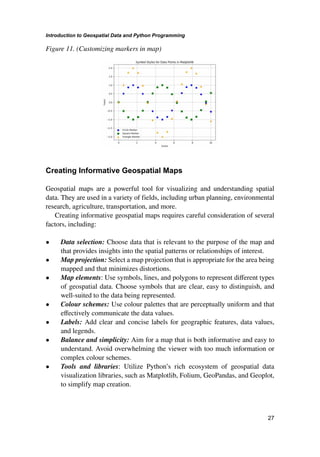
fig, ax = plt.subplots()
data.plot(ax=ax)
ax.set_title(‘Geospatial Data Map’)
ax.set_xlabel(‘Longitude’)
ax.set_ylabel(‘Latitude’)
plt.show()
• Plotting points, lines, and polygons: Matplotlib can plot individual data
points, connecting lines, and polygons representing geographic areas. This
enables the visualization of various geospatial data types, including point
distribution, road networks, and administrative boundaries.
• Customizing map appearance: Matplotlib offers a range of options for
customizing the appearance of maps, including colour palettes, symbol
styles, and line properties. This allows users to create visually appealing and
informative maps tailored to their specific needs.
• Integration with Geoplanids: Matplotlib can be used in conjunction with
Geoplanids, a Python library that extends Pandas to support geospatial
data. This integration allows for seamless manipulation and visualization of
geospatial data within the Matplotlib framework.
Enhancing Data Representation With Matplotlib
Matplotlib,aversatileplottinglibraryforPython,goesbeyondbasicdatavisualization
and offers a range of features to enhance the representation of data, making it more
informative, visually appealing, and tailored to specific needs.
Customizing Plot Appearance
import numpy as np
import matplotlib.pyplot as plt
import seaborn as sns
x = np.linspace(0, 10, 100)
y1 = np.sin(x)
y2 = np.cos(x)
colors = sns.color_palette(“husl”, 2)
plt.figure(figsize=(8, 6))
plt.plot(x, y1, label=’Sin Function’, color=colors[0],
49.
25
Introduction to GeospatialData and Python Programming
Matplotlib provides a variety of colour palettes to customize the appearance of
plots. These palettes range from simple colour gradients to perceptually uniform
colour schemes, ensuring that colour variations effectively represent data values.
Output:Ahistogramwithasmoothcolourgradientfrombluetored,representing
the distribution of data values.
Line Properties
import numpy as np
import matplotlib.pyplot as plt
x = np.linspace(0, 10, 100)
y1 = np.sin(x)
y2 = np.cos(x)
plt.figure(figsize=(8, 6))
plt.plot(x, y1, label=’Sin Function’, linewidth=2,
linestyle=’--’, color=’red’)
Matplotlib provides various options for customizing line properties, including
line width, style, and colour. This allows for differentiating between multiple data
series or emphasizing specific trends.
Output: A line plot with two data series, each represented by a distinct line style
(solid and dashed) and colour (blue and green).
Figure 9. (Customizing colour in map)
50.
26
Introduction to GeospatialData and Python Programming
Symbol Styles
import numpy as np
import matplotlib.pyplot as plt
x = np.linspace(0, 10, 20)
y = np.sin(x)
plt.figure(figsize=(8, 6))
plt.scatter(x, y, label=’Circle Marker’, marker=’o’,
color=’blue’, s=50)
plt.scatter(x, -y, label=’Square Marker’, marker=’s’,
color=’green’, s=50)
plt.scatter(x, 2*y, label=’Triangle Marker’, marker=’^’,
color=’orange’, s=50))
Matplotlib offers a variety of symbol styles for plotting individual data points. These
symbolscanrangefromsimplemarkers(circles,squares,triangles)tomoreintricate
shapes, allowing for effective representation of different data types.
Output: A scatter plot with data points represented by red circles (marker=’o’),
each with a slightly transparent appearance (alpha=0.7).
Figure 10. (Customizing lines in map)
51.
27
Introduction to GeospatialData and Python Programming
Creating Informative Geospatial Maps
Geospatial maps are a powerful tool for visualizing and understanding spatial
data. They are used in a variety of fields, including urban planning, environmental
research, agriculture, transportation, and more.
Creating informative geospatial maps requires careful consideration of several
factors, including:
• Data selection: Choose data that is relevant to the purpose of the map and
that provides insights into the spatial patterns or relationships of interest.
• Map projection: Select a map projection that is appropriate for the area being
mapped and that minimizes distortions.
• Map elements: Use symbols, lines, and polygons to represent different types
of geospatial data. Choose symbols that are clear, easy to distinguish, and
well-suited to the data being represented.
• Colour schemes: Use colour palettes that are perceptually uniform and that
effectively communicate the data values.
• Labels: Add clear and concise labels for geographic features, data values,
and legends.
• Balance and simplicity: Aim for a map that is both informative and easy to
understand. Avoid overwhelming the viewer with too much information or
complex colour schemes.
• Tools and libraries: Utilize Python’s rich ecosystem of geospatial data
visualization libraries, such as Matplotlib, Folium, GeoPandas, and Geoplot,
to simplify map creation.
Figure 11. (Customizing markers in map)
52.
28
Introduction to GeospatialData and Python Programming
By following these guidelines, you can create geospatial maps that effectively
communicate insights and inform decisions.
Utilizing Matplotlib For Basic Geospatial Maps
Matplotlib,aversatileplottinglibraryforPython,offersbasicgeospatialvisualization
capabilities, enabling the creation of simple maps and straightforward visualizations
of geospatial data. While it is not as specialized as dedicated geospatial plotting
libraries like Folium or Geoplot, Matplotlib provides a user-friendly and accessible
tool for beginners and those who need to incorporate basic maps into their data
analysis workflow.
Essential Steps for Creating Basic Geospatial Maps with Matplotlib:
• Data Preparation: Ensure the geospatial data is in a structured format, such
as a CSV file containing latitude and longitude coordinates.
• Importing Libraries: Import the necessary libraries, including matplotlib.
pyplot for plotting and geopandas for handling geospatial data.
• Data Loading: Load the geospatial data into a Pandas DataFrame or
GeoDataFrame using the appropriate read_csv or read_file function.
• Map Creation: Create a figure and an axis using plt.subplots() and specify
the projection type if necessary.
• Data Plotting: Plot the geospatial data using the appropriate Matplotlib
functions, such as plot() for point data or pcolor() for raster data.
Customization: Customize the map appearance using Matplotlib’s extensive
customization options, including color palettes, symbol styles, line
properties, labels, and titles. (Koperski et al., 2019)
Adding Annotations And Context To Maps With Matplotlib
Matplotlib’s annotation capabilities extend the visual communication power of
geospatial maps, allowing you to add labels, comments, explanations, and other
visual elements to enhance the clarity, context, and interpretability of the data.
1. Text Annotations for Highlighting Key Points
Text annotations provide a direct way to add labels, comments, or descriptions
to specific locations on the map, drawing attention to important features or patterns.
Efficiently analyze geospatial data by summarizing key locations, identifying
criticalspatialdetails,andhighlightingessentialinformation.Thisconciseapproach
streamlinesdecision-makingprocesses,emphasizingkeyinsightsinthevastlandscape
of geospatial information for effective understanding and strategic applications.
53.
29
Introduction to GeospatialData and Python Programming
2. Colorbars for Interpreting Color-Mapped Plots
Colorbars are essential for interpreting color-mapped plots, such as heatmaps
or choropleth maps, where color variations represent data values. They provide a
visual guide to the color scale, enabling viewers to associate color variations with
specific data ranges.This code demonstrates adding a colorbar to a choropleth map.
The colorbar provides a visual representation of the color scale, enabling viewers
to interpret the variations in data values represented by different colors.
3. Legends for Differentiating Data Series
Figure 12. (Text Annotations in map)
Figure 13. (Colorbar in map)
54.
30
Introduction to GeospatialData and Python Programming
Legends are crucial for distinguishing between multiple data series in line plots,
scatter plots, or other visualizations that combine different data elements. They
provide a key to identify the meaning of each line, symbol, or color.
CASE STUDIES AND EXAMPLES
Introducing diverse case studies and examples, this section illustrates real-world
applications of the discussed concepts. Through practical scenarios, we demonstrate
the effectiveness and versatility of the presented methodologies.
Analyzing Point Of Interest (POI) Data
• Point of Interest (POI) data, encompassing locations like businesses,
landmarks, and attractions, serves as vital information for various sectors,
from urban planning to marketing.
• Diverse sources, including business directories, social media check-ins, and
governmental databases, contribute to the richness of POI datasets.
Data Collection and Preprocessing:
• Explaining the process of acquiring POI data, which involves accessing APIs
like Google Places API or OpenStreetMap, or leveraging existing datasets.
Figure 14. (Legends in map)
30
CHAPTER III.
“STRIKE WHILETHE IRON IS HOT!”
Hugh made up his mind, on the spur of the moment,
that it might be unwise for him to attempt anything at
once. He wanted a little time to think things over, and
lay out some plan of campaign, for Hugh did not, as a
rule, believe in doing things hastily.
Besides, Benjy must have noticed him talking with Tom,
and would immediately jump to the conclusion that it
was a conspiracy between them. The result would be
disastrous for the success of any future missionary
work.
When Benjy came face to face with Hugh, the latter
spoke pleasantly. He noticed that the boy colored up,
and, although he answered the friendly salutation, he
immediately assumed a reckless, indifferent air, and
went along whistling as though he had noticed their
heads together, and would snap his fingers at them.
Hugh found himself wondering whether it could be
conscious guilt that made Benjy fire up so, or simply
boyish indignation over being suspected and watched in
that way.
57.
31
“It’s going tobe some job managing that boy,” the scout
master candidly admitted to himself; but, then,
somehow, he always found additional interest in a task
that tried his patience, and his powers of endurance, for
there could be very little satisfaction in beating an
antagonist who was handicapped.
Hugh was unusually quiet on that evening at the supper
table, a fact his folks may have noticed. But then they
were accustomed to seeing the boy look grave, for
owing to the position he held in the scouts, Hugh often
had to wrestle with matters that did not give most of
the other fellows a moment’s thought.
Later on, Hugh, having gotten his lessons, observed
that he was going over to the home of Professor Marvin,
where there was to be a little meeting of people
interested in town improvement.
The smile that broke over the face of his mother at
hearing him say this so modestly told of the pride she
took in the fact that Hugh, as the assistant scout
master, should be consulted at all when events of
considerable magnitude connected with uplift
movements were being discussed.
It certainly must make any mother’s heart beat with joy
when realizing that her son, though only a boy in years,
had become a factor in town, that he has to be
consulted, and his aid asked whenever there is a
movement on foot looking to bettering conditions of
living in the community.
When Hugh reached the house where Professor Marvin
lived, he found a little company assembled. Besides a
number of the leading ladies identified with the league
58.
32
that had alreadydone so much for the betterment of
the town, there were three pastors present, the mayor
of Oakvale, Doctor Kane, always to be relied on in
things of this sort, and three influential citizens, who like
many other people had begun to despair of any
concerted movement directed to change the wretched
conditions then prevailing.
There had been rambling talk going on. Evidently they
had been waiting for the arrival of Mayor Strunk, whom
Hugh had seen pass in.
Mr. Marvin now opened the meeting, which he said
would be an informal affair.
“We know that every person in Oakvale who has taken
the trouble to pay any attention to the way things are
going,” he began to say, “has been pained by the
conditions prevailing. It is the consensus of opinion that
something must be done, and that immediately, to
better things. The only question that has kept this
movement from crystallizing before has been the lack of
cohesion; no one seemed to be able to present a proper
plan that would unite all the different organizations
interested in the good name of our town. And that is
the object of this meeting to-night. We must all get
together, and put our shoulders to the wheel.”
Mayor Strunk, seeing that most eyes were immediately
directed toward his quarter, got up to say his little piece.
As usual, he was for procrastination. He had attended
several other meetings during the winter just passed
and always advised going slowly, so as not to make any
mistake. The ladies had now become indignant, and
quite out of patience with him.
59.
33
34
So when thesuave politician commenced by saying that
he realized as well as any one the need of something
being done to improve living in Oakvale, and then went
on to repeat the old advice not to be too hasty, because
Rome was not built in a day, and all that sort of thing,
there were quick glances passing around, and one lady
had to be held down by main force, so eager was she to
take the speaker to task, regardless of parliamentary
rules.
Hardly had the mayor finished speaking, than she was
on her feet, with flashing eyes. A ripple of applause
greeted her taking the floor, because those present
understood how fluently Mrs. Beverly could speak when
her heart was full of a subject.
“Mayor Strunk advises delay, and delay,” she broke out
with, indignantly. “I decline to agree with his policy. I
have heard it advocated many times before, and
nothing was ever done. The time to strike is when the
iron is hot! Conditions are daily growing more
unbearable. To-day our fair town has fallen from the
position we once so proudly boasted. There are hidden
snares for the feet of our young men and boys, about
which the police must know. They should be wiped out
pitilessly. There are numberless nuisances that are
painful to the eyes and noses of sensitive people; these
should be rigorously pursued with fines and other
penalties until they are abated. If we have not laws on
the books to cover all these offences let us see to it that
they are immediately placed there. Then there is
another crying evil that should be stopped without
delay. I refer to several dangerous crossings where
accidents have been known to happen, and at any day a
terrible tragedy may stun the community. Listen while I
60.
35
tell you somethingthat by the merest accident I
witnessed myself, and only a few hours ago.”
Then, in graphic language, she went on to describe the
affair at the crossing.
“Those little children were anxious to get home. They
waited all of five minutes, and there was not the first
chance given them to cross over, so stupid and selfish
have the drivers and chauffeurs in Oakvale become,
because the law is not strictly enforced. Then that one
little chit, Anita Burns, bravely started across, eager to
get to where an anxious mother waited for her. I saw a
team of horses towering over her, and my heart literally
stood in my mouth with fear.”
She had everybody intensely interested by this time.
Hugh drew back a little for he feared she might mention
him by name, and he shrank from publicity.
“Just in the nick of time I saw a boy dart forward,”
continued the lady passionately. “He was lost to my
sight for a brief period, and then when I thought I
should faint with fear and suspense, I saw him appear
on the opposite walk, carrying the child, uninjured, in
his arms. He set her down on her feet, waved his hand
to her, and then walked off with several of his scout
chums, just as unconcerned, apparently, as though it
might be nothing unusual; nor was it, my friends, for by
this time we have all become accustomed to hear about
—Hugh Hardin doing valiant things like that.”
She paused, because there was a wild outburst of
cheers.
Hugh was as red as fire.
61.
36
37
“If I hadknown that you saw that little happening, Mrs.
Beverly, and meant to speak of it here, I might not have
come over, though I certainly did want to hear what was
said and done,” Hugh managed to stammer, at which
there was another round of cheers accompanied by
hand clapping.
“That is the best part of it all, Hugh,” said the lady. “The
fellow who can do a clever thing like that and still shrink
from publicity, doubly wins our admiration. But, my
friends, I only mentioned the incident to show you how
at any day there may take place a terrible tragedy at
one of these unprotected crossings, where our innocent
children have to pass over, going to and coming home
from school. Now what shall we do about it? Must we
wait until a fatality comes about before we combine all
forces for good to crush these menaces to our peace
and happiness? I say to you the hour has struck, and
the women of this town are at last determined to sweep
every obstacle out of their way in order to attain their
end.”
Mayor Strunk threw up his hands.
“I surrender, ladies!” he hastened to exclaim, with the
air of a man who knew how to get in out of the wet
when it began raining. “Just as you say, the time for
delay has passed, and from this night forward you can
count on me as being with you, heart and soul. That
little girl, Anita Burns, is my own grandchild, some of
you may remember, and if anything had happened to
her could I ever forgive myself? I guess it needed
something like this to take the scales from my eyes.”
Everybody looked happy when they heard the mayor
say this. Really, it had been his system of
62.
38
39
procrastination that hadkept matters from reaching a
climax long before. No one professed to understand just
why he should have acted as he did, since his position
as mayor carried no salary with it.
Professor Marvin later on called upon Hugh, as
representing the scouts of Oakvale, to outline the idea
he had in mind of having the boys made assistant
police, with authority to wear badges, and power to
order arrests in cases of emergency.
The mayor was somewhat dubious about the propriety
of so radical a proceeding.
“It would be almost revolutionary,” he observed, “but
then we happen to know how well Hugh can be trusted
to keep his troop under strict control, and they have
before this amply proven worthy of the citizens’ full
trust. I shall call a meeting of the town council for to-
morrow night, and as many of you as can, be present;
I’d be glad of your backing when this scheme is
thrashed out there.”
So at last the uplift movement had come to Oakvale,
thanks in part to Hugh Hardin and his fellow scouts.
63.
40
CHAPTER IV.
WAITING FORTHE GOOD NEWS.
“For home protection! That’s the slogan, fellows, Hugh
has given us. We’re going to take our coats off,
figuratively speaking, you understand, and purify the
atmosphere around the place we live in.”
When Billy Worth gave utterance to these rather
boastful remarks he was standing, with a bunch of other
fellows in khaki, near the building where the town
council, as called together by the mayor, was still in
session.
Undoubtedly the fathers of Oakvale were having a warm
discussion, since they had been at it for more than two
hours. Indeed, the scouts had held their meeting in the
room under the church, and made all their
arrangements for carrying out their part of the
programme, if everything went smoothly as they
expected. A goodly number of the energetic lads had
immediately, after the meeting was adjourned, decided
to hurry around to ascertain what had happened at the
council chamber, to which citizens were admitted to the
capacity of the room, but the line was drawn at fellows
under the voting age.
64.
41
“Yes,” Jack Durhamimmediately added, with his
characteristic energy, “Oakvale is going to take its
periodical bath, so to speak. This time we’ll scrub to the
bone, and make an extra clean job of it.”
“The impudent drivers and chauffeurs must be made to
respect the law, if fines and imprisonment will do the
trick!” asserted Dick Ballamy, who, for a wonder,
seemed able to turn his thoughts from fishing to a
subject that was of far more importance.
“Huh! Not only that,” Sam Winter burst out impetuously,
“but those sneaking dives known as ‘speak-easies’ have
got to be squelched. Some people don’t believe any
liquor is being sold in Oakvale just because we’re called
a dry town. That fire the other day proved the
foolishness of that joke, let me tell you, boys.”
“Just what it did!” declared Mark Trowbridge, who often
lisped when he talked, an infirmity that was likely to
follow him through life; “why, I thaw with my own eyeth
two barrelth of bottleth half covered with a blanket, that
had been carried from the cobbler’th thop.”
“Worse than that, even,” asserted Arthur Cameron in
disgust. “I saw a man deliberately lift the cover, take out
a bottle, and drain it there, with a dozen people
standing around and laughing. Shows you how some of
our laws are being made a joke. The police are aware of
what’s going on, too; but they believe the sentiment of
the town has heretofore been against enforcing certain
statutes.”
“Well, they’re going to get a rude shock pretty soon,
believe me,” said Billy. “Half an hour ago the mayor and
Council sent for Chief Andy Wallis. He’s in there with
65.
42
43
them now, listeningto the law being laid down. I reckon
the Chief knows by this time that it’s going to be a clean
town or we get a new head of police. The women have
taken things in hand, and mean to purify the
atmosphere, so that Oakvale boys and girls can breathe
without being contaminated.”
“How fast the news spread all over town this morning,”
observed Walter Osborne, the leader of the Hawk
Patrol, a fine, manly looking fellow well liked by all his
associates of the troop. “Why, my mother says they
were talking of it in every store she visited, and father
added that he was buttonholed half a dozen times by
men who seemed chock full of the subject.”
“Old Doc Kane,” added Sam Winter, “carried the news
wherever he went. He said it was going to be next door
to a millennium for Oakvale, and that when the
movement had exhausted its force he expected to have
his business reduced one-half, because of the improved
sanitary conditions that would prevail. That was one of
the Doc’s little jokes.”
“He’s loaded to the muzzle with ammunition meant to
boost the good cause along,” asserted another scout.
“It’s among the mill people the good doctor does most
of his missionary work. He knows how much a clean
town means to fellows who haven’t comfortable homes
to spend evenings in.”
“Of course, there’s no danger that the members of the
town Council will try to dodge the question again, as
they’ve done so many times?” Jack Durham was saying.
Billy gave a scoffing laugh.
66.
44
“Not much theywill!” he ejaculated; “with that wide-
awake Mrs. Marsh present, backed by a lady who can
strike out from the shoulder like Mrs. Beverly.”
“Besides,” added Walter, “don’t forget what Hugh told us
about the sudden change of front on the part of Mayor
Strunk. He saw a great light when he learned how his
favorite little granddaughter had come near being run
over by a team at that dangerous crossing of the three
roads in town.”
“Then there’s another thing that’s bound to cut some
figure in the decision of the town Council to-night,” said
Billy. “Public sentiment has been aroused, and is at
white heat. It seems as if everything combined to
happen all at once, for this very afternoon old Mr.
Merkle was knocked down by a speeding car that got
away without anybody learning its number. He was
badly hurt, and they took him to the hospital; but we’ve
been told that the brave old chap, nearly eighty-five
years of age, has sent a message of cheer to the ladies
from his bed, telling them that he glories in being a
martyr to the good cause.”
“Every fellow take off his hat to old Mr. Merkle, for he’s
made of the stuff our Revolutionary fathers had in them
when this country dared defy Great Britain,” and as
Walter Osborne said this, each scout raised his
campaign hat with a touch of respect for the grand old
hero lying on his bed of pain, yet able to think of the
reform movement that was sweeping through the town.
“Here comes Hugh now!” called out a fellow on the
outskirts of the group.
67.
45
“And he looksas if he felt satisfied with the way things
were going,” another hastened to say.
The young assistant scout master quickly joined them.
He was besieged by numerous questions. Indeed, so
thick and fast did these come that Hugh laughed and
threw up his hands, as though to shield himself from a
fall of hailstones.
“Hold up, fellows,” he told them; “what do you take me
for? When you send them at me like that it makes me
feel as the street urchin did who crawled into an empty
sugar hogshead, and, seeing the riches around him,
wished for a thousand tongues. Give me a fair chance
and I’ll tell what little I’ve been able to pick up.”
Accordingly they quieted down, though still pressing
around Hugh, and hanging on his every word.
Confidence in their leader is one of the highest
attributes of praise scouts can show; and the members
of Oakvale Troop felt this to the limit in the boy who had
been elected to serve them in that capacity. So often
had Hugh Hardin proved his ability to fill his exalted
position that no one ever dreamed nowadays of
contesting the leadership with him.
“I managed to interview Zack Huffman,” explained
Hugh, “who had been inside, but had to go home to his
family because his wife is sick. He could stop only a
minute or so to talk, but he told me the sentiment was
overwhelmingly in favor of carrying out the whole
sweeping programme. The ladies have got in the
saddle, so he said, and mean to ride at the head of the
procession. You remember Zack is something of a
scholar, and you ought to have heard him tell how they
68.
46
47
expect to beatthe record of Hercules in cleaning the
Augean stables.”
“Hurrah for Zack!” cried one enthusiastic scout, for the
boys were by this time so roused up over matters that
they felt in the mood to cheer anybody and anything
that favored their cause.
“Every now and then,” continued Hugh, “I could hear
applause from above there. I’ve got an idea Mrs.
Beverly was talking. If she was, you can wager not a
single member of the Council will dare vote against the
mayor’s programme after it’s been announced. It’s going
to be carried with a whirl.”
“If it is, we ought to burn a few barrels to celebrate to-
night!” suggested Sam Winter, for such a programme
always pleased him immensely.
“Hold on,” Hugh instantly told him. “We want none of
that sort of thing to-night. For once let’s show that boys
can be dignified. This is no Fourth of July affair. Some of
the church people have even contemplated holding
prayer meetings after the Council adjourns, if everything
seems favorable, for their hearts are right in this uplift
movement. It wouldn’t seem just the right thing for
scouts to be seen running like wild Indians all over
town, and shouting their lungs out. We’ll just go home
in a quiet way, and get ready to commence business on
Monday. Time enough for a jubilee when the ladies
appoint a day for celebrating the victory. Just now we’ve
got work, and plenty of it, ahead of us.”
“Hugh, you’re right!” asserted Arthur Cameron.
“Forget that I said it, Hugh!” begged the impulsive Sam,
abashed by the argument advanced by the scout
69.
48
49
master, because hisbetter sense told him that was the
proper way of looking at it.
“Hey, there comes Chief Wallis out of the Council
chamber!” called a voice, and immediately every fellow
turned his eyes in that direction, anxious to decide for
himself what the appearance of the head of the police
force would indicate.
Chief Wallis walked straight toward them. His face was
inscrutable, but as he reached the group of scouts, with
Hugh at their head, he thrilled the boys by raising a
hand in salute.
“Come in and see me on Monday, Hugh,” the Chief said,
dramatically, “and we’ll fix it up about what sort of
badge you and your fellow Assistant Police can wear.
The women have carried the day, and Oakvale is going
to be purged,” and as he strode on the boys broke into
a series of stirring cheers.
70.
50
CHAPTER V.
OAKVALE’S GREATCLEAN-UP DAY.
According to the universal agreement, every pastor in
Oakvale made some mention in his sermon on the
following Sunday of the new movement that had been
inaugurated by the better elements in the town. They
urged every one of their flocks who wanted to see a
cleaner Oakvale, morally and actually, to back up the
committee.
It was the talk of the day wherever two or more
persons came together, and there were places where
the action of the town Council was either severely
criticized or else condemned. No one need be told that
as a rule these were the dens of vice that had been
insulting the law and flaunting their brazen defiance in
the teeth of the citizens.
Everybody seemed to be waiting with pent-up breath to
see whether things would begin to move immediately
Monday opened up.
By noon on Monday posters began to appear all over
town, signed by the mayor, stating in concise, legal
phrases how from that hour forward the law was going
to be strictly enforced to the letter, and telling all about
71.
51
the plan toenlist the active co-operation of the Boy
Scouts in helping to make a clean town.
After school that afternoon the fellows belonging to
Oakvale Troop to the number of thirty marched to police
headquarters. That three of the boys did not respond to
roll call before marching through the streets, Hugh
ascertained, was because in two instances they were
sick at home with a mild attack of grippe, while the third
boy was evidently kept away because he had an uncle
who was believed to be the worst offender on the list,
so that his folks were hardly in favor of appearing to go
against their own flesh and blood.
But the boys, as they marched the full length of the
main street, were cheered by shoppers and
shopkeepers and clerks, as well as others who crowded
to the doors and windows. For it was well known what
part Hugh and his fellow scouts were going to take in
the redemption of Oakvale. Their previous success in
ridding the town of cluttering rubbish gave people
confidence in their ability to do even greater things.
The Chief had his men lined up in front of the
headquarters. He believed in doing things according to
rule, and meant to receive the scouts as fellow workers
in the good cause.
To hear the speech Chief Wallis made the new Assistant
Police any one would have believed his heart had always
been in the laudable enterprise of trying to clean up the
dives, and protect the dangerous crossings. Perhaps it
had, but the Chief being a politician dared not show his
hand so long as he felt that public sentiment was
against any change of policy. He knew better now. He
had heard the ringing words that fell from Mrs. Beverly’s
72.
52
53
lips, which speech,according to all accounts, eclipsed
any oration ever delivered in the town hall; the Chief
was fully enlisted in the cause.
“We will have official badges made without delay for
each and every member of the Assistant Police,” he told
the listening boys, who interrupted his speech with
frequent cheers. “In the meanwhile, as the posters
issued by His Honor the Mayor state, your regular scout
emblem will be badge enough, and must be respected
everywhere within the limits of this town. Possibly some
people will at first be inclined to treat your show of
authority as a joke, and laugh at any orders you may
issue. After a few of them have been arrested by my
regular officers, and either fined or placed in jail for
some days, they will have their eyes opened.”
Then the Chief went on to explain just what their line of
work would consist of, and where they must draw the
line. Certain duties they could proceed to carry out, but
the regular officers would be used to make most
arrests, especially where there was any danger involved.
“You understand,” he told them, “it is not intended that
the boys operating with this movement are going to
become spies, to find out what their neighbors may be
doing, but we expect you to keep your eyes open to
discover any glaring infraction of the laws, as mentioned
in that poster, and your leader will thereupon report any
such discovery at headquarters, from where it will be
attended to.”
He then earnestly besought them to be on their dignity,
and guard against any unnecessary show of being
conceited, or too proud of their new positions.
73.
54
“Go about yourwork without any display of authority.
People will begin by sneering at you, but if you do your
duty faithfully they will soon come to respect your
badge. Never forget that the best people of the
community are behind you in all you may attempt.
Hugh, we look to you to be a safe guide for your
followers, and the mayor told me to inform you that he
expects every scout to do his part manfully. That’s about
all I have to say to you to-day, though from time to time
I expect to confer with your leader, and lay out new
plans. I salute you all again as members in full standing
of the Police Force of Oakvale.”
Hugh had his plans pretty well laid out, though
everything could not be accomplished at once. He had
selected certain members of the troop for duty at the
dangerous crossings, beginning on the very next
morning. In doing this, Hugh had used much discretion,
for he expected that there would be more or less
trouble, since drivers and chauffeurs had become so
accustomed to having their own way that they would
object strenuously to any interference.
It turned out, however, that Chief Wallis foresaw this
very source of trouble, and had delegated several
officers to stand near by in readiness to arrest the first
driver who failed to pull up when a scout raised his
white-gloved hand as an order for him to do so.
That was a pretty warm day in sections at police
headquarters. Arrests came in quick succession, as
though a regular scheme had been arranged to make
the new order a laughing-stock. But the mayor had a
magistrate ready, and those who were brought in
charged with breaking the traffic rules, as well as in
some cases resisting an officer had heavy fines imposed
74.
55
56
upon them, withthe alternative of several days in the
lockup if they refused to settle.
It was astonishing how quickly the news went around
that the mayor actually meant to stand by the ladies
and the scouts in the crusade. For the first time that
evening in many moons, every questionable and shady
resort about Oakvale was closed as tight as a drum, as
Billy Worth explained it, after a walk about town.
“Why,” he told Hugh, with glistening eyes, “you can see
the fellows who used to spend most of their time in
those places standing on the street corners watching to
see what next is going to happen. They look dazed and
glum, I tell you; yes, and ugly, too, because their
business is going to be all busted up. They’re telling
each other that the way things are starting in it looks
like more than just a joke.”
“‘A new broom sweeps clean!’” quoted Hugh. “I never
doubted but what once the people of this town woke up
it could be done, and in a hurry. The only question is
how long will it last? A whole lot of persons will soon
get tired of the novelty, and public sentiment may swing
around to indifference again. That is what we have to
fear more than anything else. Those bad men will just
wait for things to take a change, and as scouts we’ve
got to see to it that the enthusiasm never dies out.”
After an exciting day, Hugh felt pretty tired that Monday
evening. He had received special reports from all the
scouts who had been on duty. These covered a
multitude of things from difficulties at the crossings
when traffic was held up at such times as the smaller
children were going to and from school, to infractions of
75.
57
the laws ofcleanliness and health persisted in by certain
citizens who ought to have known better.
Hugh carefully read every one of these reports, and
they were numerous, for the boys had been extremely
vigilant, as if to prove their right to be called Auxiliary
Police. Hugh used his own discretion about keeping
some of these reports. A few he smiled at, and made a
mental note to warn the writer that it was not intended
to enter into private property in order to spy around,
but that the complaints must be of such things as
offended the public eye or ear or nose; after which he
tore these up.
The others he carefully filed with a good deal of
satisfaction, to be later on submitted to Chief Wallis,
after copies had been taken for the scout records. On
the whole, Hugh believed the boys had made good that
day, despite all the novelty of the thing, and the
troubles they had met with. As time passed on and
people came more and more to recognize them as a
part of the regular system for carrying out the laws that
were upon the books, much of this friction would die
away, and the wheels of machinery could be expected
to move more smoothly.
Hugh, feeling that he must not neglect his studies on
account of this outside occupation, had just taken out
his books, and was about to settle down to an hour or
so of “grind,” when he heard the doorbell ring.
Then he caught a familiar voice asking if he were at
home. It was Tom Sherwood, stationed that day at the
most dangerous crossing in all Oakvale, and who Hugh
understood, from all accounts, had acquitted himself
splendidly.
76.
58
The sound ofTom’s voice suddenly recalled to Hugh’s
mind the fact that he had promised to help the other. It
had been utterly impossible for Hugh to attempt
anything along the lines he had suggested, concerning
an interview with Benjy Sherwood, for his day had been
crammed full of duties, great and small.
But when Tom burst into his room impetuously Hugh
could see from his face that the other had more bad
news to communicate.
77.
59
CHAPTER VI.
THE PROMISEOF A SCOUT.
“Hello, Tom! Glad to have you drop around to see me!”
was the friendly and cheery salute of the scout master,
as he nodded to the newcomer.
Boys do not usually wait on ceremony when visiting, so
Tom, without bothering to be asked to take a seat,
dropped into an easy-chair.
Like most fellows of his age, Hugh had his room fitted
up in as cozy a fashion as suited his fancy. There were
the customary college flags decorating the walls, and
some well-selected pictures that showed the bent of
Hugh’s mind toward art, a small matter, perhaps, in the
opinion of most people, but of moment with any one
really desirous of knowing the nature of the boy who
lives and sleeps inside those walls.
One thing Hugh had noticed particularly. This was the
exceeding great care his guest took in making sure that
he had properly closed the door after him when
entering the room. As a rule, Tom was inclined to be
more or less careless in this respect, being a breezy sort
of a chap. Hugh guessed that there might be a reason
for this unusual caution, and it so proved.
78.
60
“Hugh, it’s gettingworse all the time!” was the first
remark the newcomer made, and in a low voice, at that,
as if he did not by any chance want to be overheard by
others in the adjoining room.
Hugh could easily guess what those depressing words
meant. If he had entertained any sort of doubt, the sigh
that followed would have dispelled them. Tom was in
deeper trouble than ever, and that active younger
brother of his, Benjy, was undoubtedly the cause.
“What’s Benjy been doing now, Tom?” he asked, in as
soothing a voice as he could summon to his aid.
Tom scratched his head, as though a trifle puzzled to
know just how to begin.
“To tell you the truth, Hugh, I don’t know what he is
after, but he’s doing some mighty queer stunts. I never
knew him to try to steal before.”
“Oh, come, that’s a pretty hard word to use, Tom!”
remonstrated the scout master, trying to appear
unbelieving, although he had felt a little chill on hearing
Tom say what he did.
Poor Tom shook his head as if very downcast.
“You don’t know how much it knocks me to even
suspect such a thing, Hugh,” he presently managed to
say, and there was a plain tremor to his voice, usually
so robust and strong. “In spite of his headstrong ways,
Benjy has always been such a lovable fellow that—well,
I’d go through fire and water for him if I could do him
any good.”
79.
61
62
“I’m sure youwould,” ventured Hugh, consolingly, as
the other boy stopped, to gulp several times, as though
nearly choking with emotion.
“Ever since he started going with the set that trains with
the newcomer in Oakvale, Park Norris,” commenced
Tom, “Benjy seems to have changed ever so much, and
all for the worse. It worries me heaps, and I don’t know
how I’m to get him back again. He seems to listen, with
a curl to his lip, whenever I speak about it, and I’m sure
I try to act the big brother to him, with my arm about
his shoulders.”
“Tell me what’s happened since I saw you last, Tom,”
urged the scout master, desirous of getting at the “meat
in the cocoanut” as quickly as possible, for he had an
hour or so to put in at studying, and, besides, was
pretty tired after a strenuous day.
“I will, Hugh. That was what brought me here to see
you. When we talked matters over before, you promised
to help me.”
“I repeat that promise, Tom. As the temporary head of
the troop, I could do no less; and as your old chum I’d
go far out of my way to give a helping hand to Tom
Sherwood.”
The other heaved a sigh, and his eyes glistened with a
sudden moisture.
“Thank you, Hugh,” he managed to say, half steadily. “I
knew I could depend on you. I wanted to keep these
things from our mother as long as I could. She doesn’t
suspect anything like the truth, for I heard her say only
the other day when Benjy had been rather irritable that
80.
Welcome to ourwebsite – the perfect destination for book lovers and
knowledge seekers. We believe that every book holds a new world,
offering opportunities for learning, discovery, and personal growth.
That’s why we are dedicated to bringing you a diverse collection of
books, ranging from classic literature and specialized publications to
self-development guides and children's books.
More than just a book-buying platform, we strive to be a bridge
connecting you with timeless cultural and intellectual values. With an
elegant, user-friendly interface and a smart search system, you can
quickly find the books that best suit your interests. Additionally,
our special promotions and home delivery services help you save time
and fully enjoy the joy of reading.
Join us on a journey of knowledge exploration, passion nurturing, and
personal growth every day!
ebookbell.com


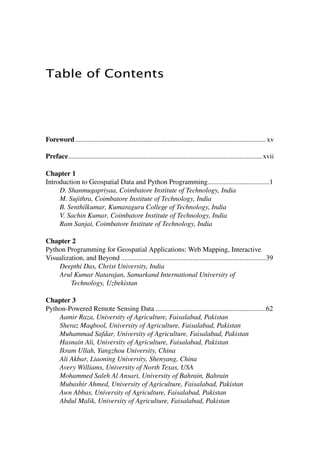








![13
Introduction to Geospatial Data and Python Programming
height = 1.75
is_adult = true
In Python, variables can be created without explicitly declaring their data type.
The interpreter dynamically assigns data types based on the assigned value.
Indentation and Code Blocks:
if age > 18:
print(name + ” is an adult.”)
else:
print(name + ” is a minor.”)
Indentation is a fundamental aspect of Python syntax. Instead of using braces {}
or keywords like end to denote code blocks, Python uses indentation.
Conditional Statements:
if age > 21:
print(name + ” can legally drink.”)
elif age == 21:
print(name + ” just reached the legal drinking age.”)
else:
print(name + ” is underage.”)
Python uses if, elif (else if), and else for conditional statements. The colon (:)
indicates the start of a block, and indentation determines the scope.
Loops:
# Functions
def greet_person(name):
print(“Hello, ” + name + “!”)
# Call the function
greet_person(“Alice”)
Python supports for and while loops. Again, indentation is crucial for defining
the loop body.
Functions:
coordinates = [4.5, 3.2]
city_names = [“New York”, “Paris”, “Tokyo”]
mixed_data = [1, “apple”, True, 3.14]](https://image.slidesharecdn.com/29106341-250523105644-fe12e283/85/Geospatial-Application-Development-Using-Python-Programming-Galety-37-320.jpg)






![24
Introduction to Geospatial Data and Python Programming
import geopandas as gpd
import matplotlib.pyplot as plt
data = gpd.read_file(‘data.csv’)
fig, ax = plt.subplots()
data.plot(ax=ax)
ax.set_title(‘Geospatial Data Map’)
ax.set_xlabel(‘Longitude’)
ax.set_ylabel(‘Latitude’)
plt.show()
• Plotting points, lines, and polygons: Matplotlib can plot individual data
points, connecting lines, and polygons representing geographic areas. This
enables the visualization of various geospatial data types, including point
distribution, road networks, and administrative boundaries.
• Customizing map appearance: Matplotlib offers a range of options for
customizing the appearance of maps, including colour palettes, symbol
styles, and line properties. This allows users to create visually appealing and
informative maps tailored to their specific needs.
• Integration with Geoplanids: Matplotlib can be used in conjunction with
Geoplanids, a Python library that extends Pandas to support geospatial
data. This integration allows for seamless manipulation and visualization of
geospatial data within the Matplotlib framework.
Enhancing Data Representation With Matplotlib
Matplotlib,aversatileplottinglibraryforPython,goesbeyondbasicdatavisualization
and offers a range of features to enhance the representation of data, making it more
informative, visually appealing, and tailored to specific needs.
Customizing Plot Appearance
import numpy as np
import matplotlib.pyplot as plt
import seaborn as sns
x = np.linspace(0, 10, 100)
y1 = np.sin(x)
y2 = np.cos(x)
colors = sns.color_palette(“husl”, 2)
plt.figure(figsize=(8, 6))
plt.plot(x, y1, label=’Sin Function’, color=colors[0],](https://image.slidesharecdn.com/29106341-250523105644-fe12e283/85/Geospatial-Application-Development-Using-Python-Programming-Galety-48-320.jpg)