Geometry
Continued!
Geometry: Its all about the Shapes
The section of math, that deals with:
• Shapes, called Polygons (like we saw on the first line)
• Angles (space between two rays connected by a vertex, or the space
between two side of a shape)
• Lines (continuous collection of points that expand forever)
• Solids (three dimensional shapes, like a box)
Geometry: Its all about the Shapes
The section of math, that deals with:
• Shapes, called Polygons (like we saw on the
first line)
• Angles (space between two rays connected
by a vertex, or the space between two side
of a shape)
• Lines (continuous collection of points that
expand forever)
• Solids (three dimensional shapes, like a box)
Last time we talked
about shapes, or
Polygons and Angles.
We’ll review and then
Geometry: Its all about the Shapes
The section of math, that deals with:
• Shapes, called Polygons (like we saw on the
first line)
• Angles (space between two rays connected
by a vertex, or the space between two side
of a shape)
• Lines (continuous collection of points that
expand forever)
• Solids (three dimensional shapes, like a box)
…. then discuss Lines
and Solids
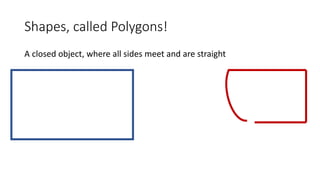
Shapes, called Polygons!
A closed object, where all sides meet and are straight
Shapes, called Polygons!
A closed object, where all sides meet and are straight
This is a
Polygon!
Shapes, called Polygons!
A closed object, where all sides meet and are straight
This is NOT
Angles: the space between two sides of a polygon
The angle is
represented by
an arc, here
colored red
Number of sides= Number of angles
The number of angles in a polygon is equal to the
number of sides
Last time we saw that triangles had 3 sides AND 3
angles
Squares and rectangles had 4 sides and 4 angles
Keeping it Straight:Lines
The section of math, that deals with:
• Shapes, called Polygons (like we saw on the first line)
• Angles (space between two rays connected by a vertex, or the space
between two side of a shape)
• Lines (continuous collection of points that expand forever)
• Solids (three dimensional shapes, like a box)
Line definition
geometry lesson 2.pptx

geometry lesson 2.pptx

  • 1.
  • 2.
    Geometry: Its allabout the Shapes The section of math, that deals with: • Shapes, called Polygons (like we saw on the first line) • Angles (space between two rays connected by a vertex, or the space between two side of a shape) • Lines (continuous collection of points that expand forever) • Solids (three dimensional shapes, like a box)
  • 3.
    Geometry: Its allabout the Shapes The section of math, that deals with: • Shapes, called Polygons (like we saw on the first line) • Angles (space between two rays connected by a vertex, or the space between two side of a shape) • Lines (continuous collection of points that expand forever) • Solids (three dimensional shapes, like a box) Last time we talked about shapes, or Polygons and Angles. We’ll review and then
  • 4.
    Geometry: Its allabout the Shapes The section of math, that deals with: • Shapes, called Polygons (like we saw on the first line) • Angles (space between two rays connected by a vertex, or the space between two side of a shape) • Lines (continuous collection of points that expand forever) • Solids (three dimensional shapes, like a box) …. then discuss Lines and Solids
  • 5.
    Shapes, called Polygons! Aclosed object, where all sides meet and are straight
  • 6.
    Shapes, called Polygons! Aclosed object, where all sides meet and are straight This is a Polygon!
  • 7.
    Shapes, called Polygons! Aclosed object, where all sides meet and are straight This is NOT
  • 8.
    Angles: the spacebetween two sides of a polygon
  • 9.
    Angles: the spacebetween two sides of a polygon The angle is represented by an arc, here colored red
  • 10.
    Number of sides=Number of angles The number of angles in a polygon is equal to the number of sides Last time we saw that triangles had 3 sides AND 3 angles Squares and rectangles had 4 sides and 4 angles
  • 11.
    Keeping it Straight:Lines Thesection of math, that deals with: • Shapes, called Polygons (like we saw on the first line) • Angles (space between two rays connected by a vertex, or the space between two side of a shape) • Lines (continuous collection of points that expand forever) • Solids (three dimensional shapes, like a box)
  • 12.