‫استاد‬:‫طالبی‬ ‫دکتر‬ ‫آقای‬ ‫جناب‬
‫الری‬ ‫احمدی‬ ‫رامین‬
20 November 2014
Computer Vision and Image Understanding 2014
Cem kalyoncu Osen Toygar
Estern mediterranean University Turkey
Ramin Ahmadi Lari GEOMETRIC LEAF CLASSIFICATION 1/20
Introduction
Application
Identification of plant species
Identify species at risk
Ramin Ahmadi Lari GEOMETRIC LEAF CLASSIFICATION 2/20
Introduction
Geometric features are successfully used in leaf classification in the literature Low
dimensionality is the major advantage of geometric features. However, geometric
features can only describe coarse shape of the leaf such as its similarity to a circle.Using
moment invariants and contour-based shape descriptors adds more details to leaf
descriptor. However, they cannot distinguish between leaf margin and noise.
Ramin Ahmadi Lari GEOMETRIC LEAF CLASSIFICATION 3/20
In this resarch…
three methods, namely support vector machines, penalized discriminant analysis and random
forests methods are analyzed. The results demonstrate that random forests method reaches up
to 90% accuracy.
Ramin Ahmadi Lari GEOMETRIC LEAF CLASSIFICATION 4/20
Past Method
Another plant identification system called Leafsnap is proposed in. This paper details a
complete system from acquisition to presenting the results. However, the speed of this system is
a limiting factor as it takes 5.4 s for a single leaf classification.
Another method that works on leaf textures.In this method, Gabor co-ccurrences are used as
features. For classification,this method uses KNN with Jeffery-divergence distance measure. The
reported results display 85% accuracy on a hand selected leaf texture database containing 32
classes. Performingthis algorithm on randomly selected sections of leaves roduces 80% accuracy.
A probabilistic neural network system that works on geometric features is proposed in, which
extracts 12 geometric features from segmented leaf image. The research is performed on 32
kinds of plants with an accuracy of 90%. This method requires user to enter start and end points
of the midrib. Therefore, this method cannot be used for automated classification tasks.
Ramin Ahmadi Lari GEOMETRIC LEAF CLASSIFICATION 5/20
In this paper
we propose a leaf classification system that uses geometric features, Multi-scale Distance
Matrix (MDM) and moment invariants.Moment invariants and MDM cannot distinguish between
leaf margin and noise. In order to solve this issue, we propose five additional features that
describe leaf margins. We have also employed Linear Discriminant Classifier (LDC) for the reason
that it can work with different classes having different importance factor for features.
Compared to the state-of-the-art shape based leaf identification methods, our proposed
method has better performance in terms of accuracy. Additionally, the proposed method
employs LDC which has a lower computational complexity compared to many other classifiers.
Ramin Ahmadi Lari GEOMETRIC LEAF CLASSIFICATION 6/20
2.Proposed method
Our proposed method consists of 3 steps
first step preprocessing step to prepare images using
Segmentation
Nois reduction
contour extraction
Corner detection
The second step
extracts features from the binary images
last step
performs actual classification
Ramin Ahmadi Lari GEOMETRIC LEAF CLASSIFICATION 7/20
2.1. Preprocessing
Segmentation
Data set
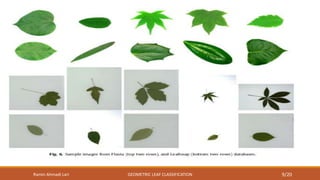
Flavia : employed a simple adaptive threshold segmentation over blue channel (1907scanned images of 32
different plants)
(X,Y)∈ 𝐿𝑒𝑎𝑓 ⟺ blue Ix,y < 𝔼[ 𝑏𝑙𝑢𝑒 I]
Leafsnap : stalk removal (4375 samples containing 132 classes)
Noise removal
with algorithm
contour smoothing operator both to reduce noise and to detect smaller changes along the leaf blade
Ramin Ahmadi Lari GEOMETRIC LEAF CLASSIFICATION 8/20
Ramin Ahmadi Lari GEOMETRIC LEAF CLASSIFICATION 9/20
Ramin Ahmadi Lari GEOMETRIC LEAF CLASSIFICATION 10/20
2.2. Feature extraction
1) moment invariants
2) Convexity
3) perimeter ratio
4) Multiscale distance matrix (MDM)
5) average margin distance
6) margin statistics
Ramin Ahmadi Lari GEOMETRIC LEAF CLASSIFICATION 11/20
2.2.1.Moment invariants
Moment invariants define general shape characteristics of an image and are widely used as
shape features
Ramin Ahmadi Lari GEOMETRIC LEAF CLASSIFICATION 12/20
2.2.2. Convexity
These features contain information about the overall leaf complexity
Ramin Ahmadi Lari GEOMETRIC LEAF CLASSIFICATION 13/20
2.2.3. Perimeter ratio
Perimeter ratio feature is the ratio of the leaf perimeter to the leaf area
Ramin Ahmadi Lari GEOMETRIC LEAF CLASSIFICATION 14/20
2.2.4. Multi-scale distance matrix
Ramin Ahmadi Lari GEOMETRIC LEAF CLASSIFICATION 15/20
2.2. Margin statistics
Ramin Ahmadi Lari GEOMETRIC LEAF CLASSIFICATION 16/20
2.3. Classification
use LDC(Linear Discriminant Classifier) for leaf classification.
LDC is based on normal distribution and closely related to Quadratic Discriminant Classifier (QDC).
The main difference of LDC and QDC is that LDC assumes that the covariance matrices for all lasses
are the same. Although this assumption does not hold in real life scenarios
Common covariance can be calculated as follows:
Ramin Ahmadi Lari GEOMETRIC LEAF CLASSIFICATION 17/20
LDC training
the proposed method performs segmentation, noise removal, contour extraction and corner
detection. Using the data obtained from these steps, feature extraction methods are performed
to extract moment invariants, convexity, perimeter ratio, MDM, average margin distance and
margin statistics features as leaf descriptor. Using these leaf descriptors, an LDC is trained and
used for classification.
Ramin Ahmadi Lari GEOMETRIC LEAF CLASSIFICATION 18/20
Ramin Ahmadi Lari GEOMETRIC LEAF CLASSIFICATION 19/20
4. Conclusion
Compared to the other well-known classification systems, our proposed system has better
performance. Additionally, the proposed method has a comparable computational efficiency
with respect to the state-of-the-art systems.
it is also possible to incorporate texture related parameters to this system to distinguish leaves
that have identical shape but different texture.
Ramin Ahmadi Lari GEOMETRIC LEAF CLASSIFICATION 20/20

Geometric leaf classification

  • 1.
    ‫استاد‬:‫طالبی‬ ‫دکتر‬ ‫آقای‬‫جناب‬ ‫الری‬ ‫احمدی‬ ‫رامین‬
  • 2.
    20 November 2014 ComputerVision and Image Understanding 2014 Cem kalyoncu Osen Toygar Estern mediterranean University Turkey Ramin Ahmadi Lari GEOMETRIC LEAF CLASSIFICATION 1/20
  • 3.
    Introduction Application Identification of plantspecies Identify species at risk Ramin Ahmadi Lari GEOMETRIC LEAF CLASSIFICATION 2/20
  • 4.
    Introduction Geometric features aresuccessfully used in leaf classification in the literature Low dimensionality is the major advantage of geometric features. However, geometric features can only describe coarse shape of the leaf such as its similarity to a circle.Using moment invariants and contour-based shape descriptors adds more details to leaf descriptor. However, they cannot distinguish between leaf margin and noise. Ramin Ahmadi Lari GEOMETRIC LEAF CLASSIFICATION 3/20
  • 5.
    In this resarch… threemethods, namely support vector machines, penalized discriminant analysis and random forests methods are analyzed. The results demonstrate that random forests method reaches up to 90% accuracy. Ramin Ahmadi Lari GEOMETRIC LEAF CLASSIFICATION 4/20
  • 6.
    Past Method Another plantidentification system called Leafsnap is proposed in. This paper details a complete system from acquisition to presenting the results. However, the speed of this system is a limiting factor as it takes 5.4 s for a single leaf classification. Another method that works on leaf textures.In this method, Gabor co-ccurrences are used as features. For classification,this method uses KNN with Jeffery-divergence distance measure. The reported results display 85% accuracy on a hand selected leaf texture database containing 32 classes. Performingthis algorithm on randomly selected sections of leaves roduces 80% accuracy. A probabilistic neural network system that works on geometric features is proposed in, which extracts 12 geometric features from segmented leaf image. The research is performed on 32 kinds of plants with an accuracy of 90%. This method requires user to enter start and end points of the midrib. Therefore, this method cannot be used for automated classification tasks. Ramin Ahmadi Lari GEOMETRIC LEAF CLASSIFICATION 5/20
  • 7.
    In this paper wepropose a leaf classification system that uses geometric features, Multi-scale Distance Matrix (MDM) and moment invariants.Moment invariants and MDM cannot distinguish between leaf margin and noise. In order to solve this issue, we propose five additional features that describe leaf margins. We have also employed Linear Discriminant Classifier (LDC) for the reason that it can work with different classes having different importance factor for features. Compared to the state-of-the-art shape based leaf identification methods, our proposed method has better performance in terms of accuracy. Additionally, the proposed method employs LDC which has a lower computational complexity compared to many other classifiers. Ramin Ahmadi Lari GEOMETRIC LEAF CLASSIFICATION 6/20
  • 8.
    2.Proposed method Our proposedmethod consists of 3 steps first step preprocessing step to prepare images using Segmentation Nois reduction contour extraction Corner detection The second step extracts features from the binary images last step performs actual classification Ramin Ahmadi Lari GEOMETRIC LEAF CLASSIFICATION 7/20
  • 9.
    2.1. Preprocessing Segmentation Data set Flavia: employed a simple adaptive threshold segmentation over blue channel (1907scanned images of 32 different plants) (X,Y)∈ 𝐿𝑒𝑎𝑓 ⟺ blue Ix,y < 𝔼[ 𝑏𝑙𝑢𝑒 I] Leafsnap : stalk removal (4375 samples containing 132 classes) Noise removal with algorithm contour smoothing operator both to reduce noise and to detect smaller changes along the leaf blade Ramin Ahmadi Lari GEOMETRIC LEAF CLASSIFICATION 8/20
  • 10.
    Ramin Ahmadi LariGEOMETRIC LEAF CLASSIFICATION 9/20
  • 11.
    Ramin Ahmadi LariGEOMETRIC LEAF CLASSIFICATION 10/20
  • 12.
    2.2. Feature extraction 1)moment invariants 2) Convexity 3) perimeter ratio 4) Multiscale distance matrix (MDM) 5) average margin distance 6) margin statistics Ramin Ahmadi Lari GEOMETRIC LEAF CLASSIFICATION 11/20
  • 13.
    2.2.1.Moment invariants Moment invariantsdefine general shape characteristics of an image and are widely used as shape features Ramin Ahmadi Lari GEOMETRIC LEAF CLASSIFICATION 12/20
  • 14.
    2.2.2. Convexity These featurescontain information about the overall leaf complexity Ramin Ahmadi Lari GEOMETRIC LEAF CLASSIFICATION 13/20
  • 15.
    2.2.3. Perimeter ratio Perimeterratio feature is the ratio of the leaf perimeter to the leaf area Ramin Ahmadi Lari GEOMETRIC LEAF CLASSIFICATION 14/20
  • 16.
    2.2.4. Multi-scale distancematrix Ramin Ahmadi Lari GEOMETRIC LEAF CLASSIFICATION 15/20
  • 17.
    2.2. Margin statistics RaminAhmadi Lari GEOMETRIC LEAF CLASSIFICATION 16/20
  • 18.
    2.3. Classification use LDC(LinearDiscriminant Classifier) for leaf classification. LDC is based on normal distribution and closely related to Quadratic Discriminant Classifier (QDC). The main difference of LDC and QDC is that LDC assumes that the covariance matrices for all lasses are the same. Although this assumption does not hold in real life scenarios Common covariance can be calculated as follows: Ramin Ahmadi Lari GEOMETRIC LEAF CLASSIFICATION 17/20
  • 19.
    LDC training the proposedmethod performs segmentation, noise removal, contour extraction and corner detection. Using the data obtained from these steps, feature extraction methods are performed to extract moment invariants, convexity, perimeter ratio, MDM, average margin distance and margin statistics features as leaf descriptor. Using these leaf descriptors, an LDC is trained and used for classification. Ramin Ahmadi Lari GEOMETRIC LEAF CLASSIFICATION 18/20
  • 20.
    Ramin Ahmadi LariGEOMETRIC LEAF CLASSIFICATION 19/20
  • 21.
    4. Conclusion Compared tothe other well-known classification systems, our proposed system has better performance. Additionally, the proposed method has a comparable computational efficiency with respect to the state-of-the-art systems. it is also possible to incorporate texture related parameters to this system to distinguish leaves that have identical shape but different texture. Ramin Ahmadi Lari GEOMETRIC LEAF CLASSIFICATION 20/20