leaf desease detection using machine learning.pptx
1.
GOVERNMENT ENGINEERING COLLEGEKUSHALNAGAR
DEPARTMENT OF COMPUTER SCIENCE AND ENGINEERING
PROJECT PRESENTATION FROM:
“PLANT LEAF DISEASES DETECTION ”
PRESENTED BY:
MONISHA RAVI 4GL20CS014
NISHA P J 4GL20CS017
JEEVAN K D 4GL21CS405
ANIL KUMAR C B 4GL21CS416
UNDER THE GUIDANCE OF
ASSIS.PROF. MAHENDRA G
Dept. Of CS & E,
GEC KUSHALNAGAR.
DEPARTMENT OF COMPUTER SCIENCE AND ENGINEERING
2.
Abstract
Introduction
Literature survey
Existing system
Disadvantages
Advantages
System requirements
Block diagram
Result
Conclusion
References
CONTENTS
3.
Due tovarious seasonal condition crops get affected by various
kind of diseases .
The plant disease detection can be done by observing spot of the
leaf of the affected plant.
The method we are adopting to detect the plant leaf disease using
image processing,using convolution neural network.
The django base web application, we used traine convolution
neural network to identify disease present in leaf it consist of 41
classes of different healthy and diseased plant leaves.
Abstract
4.
Introduction
Traditionally identificationof plant disease has relied on human
annotation by visual inspection and the agriculture production cost can
be significantly increased.
Plant disease has long been on of the major threats to food security
because it dramatically reduces the crop yield and quantity of the crop.
Hence in order to solve this problem we have developed the artificial
intelligence based solution and the speed are the to main factor that
will decide success of the automatic plant leaf disease detection and
classification model.
5.
Paper bySaradhambal.G, Dhivya.R, Latha.S, R. Rajesh give
solution to the plant disease with image classification.
In their approach they collect 75 images of different diseased
plant leaves such as Bacterial Blight and more.
There were total of 5 classes that include 4 disease classes and
one normal healthy leaf class. Removal of noise is done with
some image preprocessing and then conversion into lab color
model was done.
Literature survey
6.
Paper named“Plant Leaf Disease Detection and Classification
Based on CNN with LVQ Algorithm” clarifies that they have
used CNN model for the leaf disease classification.
In their methodology they have used a dataset of 500 images
divided into 400 training and remaining 100 testing.
Total classes for classification were 5 including one healthy
class as well. Images size used was quite well that is 512*512.
Literature survey
7.
Plant DiseaseClassification Using Image Segmentation and
SVM Techniques” by K. Elangovan, S. Nalini uses the SVM
for the classification purpose.
In their methodology image was converted into another color
space.
After that image was cropped and with image preprocessing
techniques noise was removed and smoothening was done and
converted into grey scale images.
Literature survey
8.
In developingcountries, farming land can be much larger and
farmers cannot observe each and every plant, every day.
Farmers are unaware of non-native diseases. Consultation of
experts for this might be time consuming & costly.
Also unnecessary use of pesticides might be dangerous for
natural resources such as water, soil, air, food chain etc. as well
as it is expected that there need to be less contamination of
food products with pesticides
Existing system
9.
Farmers cannotafford so much money for persons who visit
the crop for disease prediction.
Speed and accuracy of getting result is delayed.
As the cultivational fields are quite large and have very large
number of plants in that, hence it becomes very difficult for
the human eye to properly detect and classify each and every
plant.
Disadvantages
10.
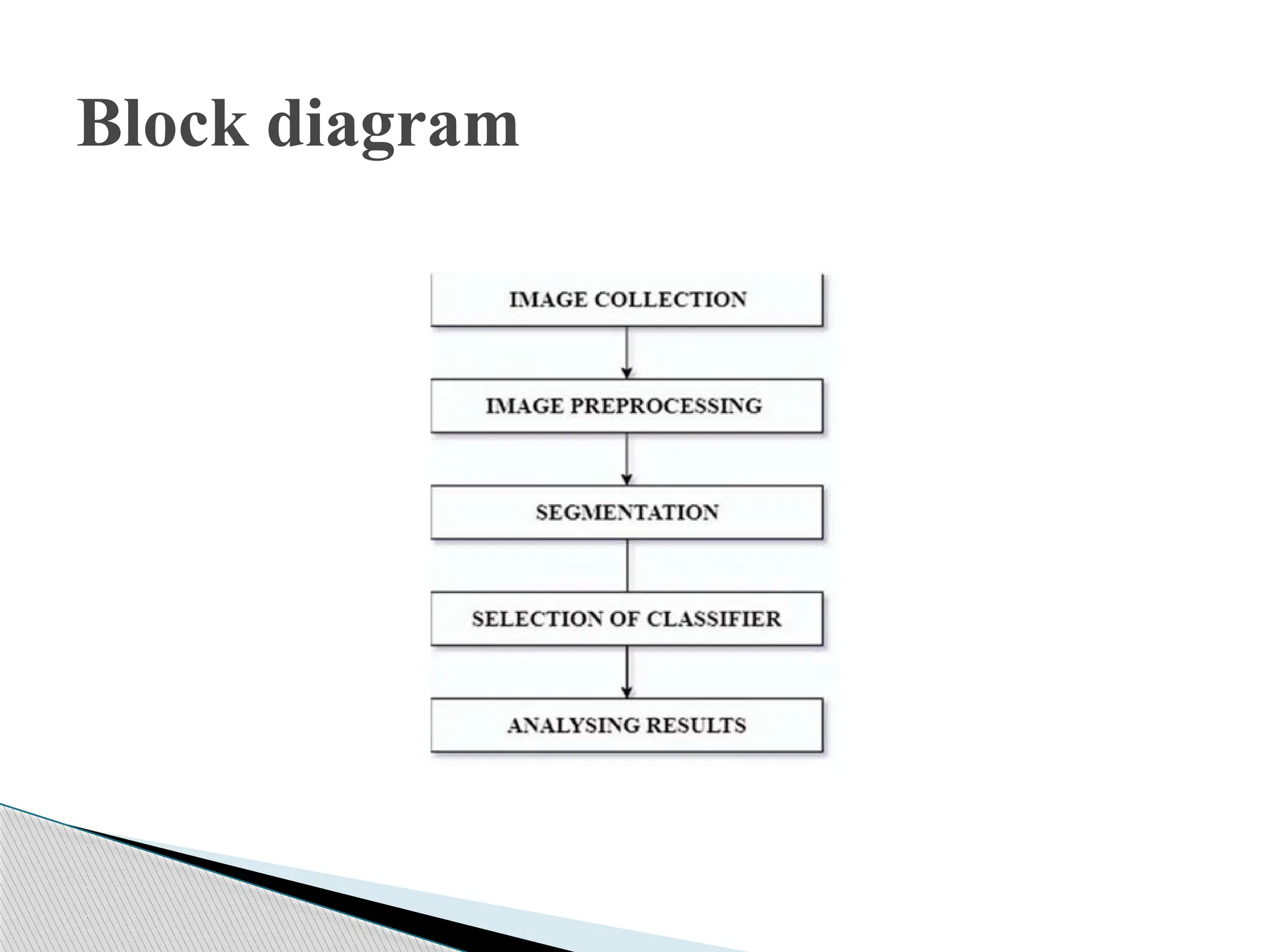
We proposeda model to detect and classify the infected plant
leaves consists of 4 phases.
The phases are
Dataset Collection
Image Preprocessing
Segmentation
Selection of Classifier
Proposed System
11.
Farmer canpredict the diseases so that can use the right
cultivation and fertilizers method. So that they can improve
the product quality and crop yield prediction.
Based on our proposed system we achieved the best model for
prediction of diseases in variety of crops.
Advantages
12.
Software requirements
Pythonprogramming language
Visual studio code editor
Django framework for web application
Hardware requirements
Hard disk: 1Tb
Ram : 4GB
Processor: intel13
GPU : 2GB
System requirements
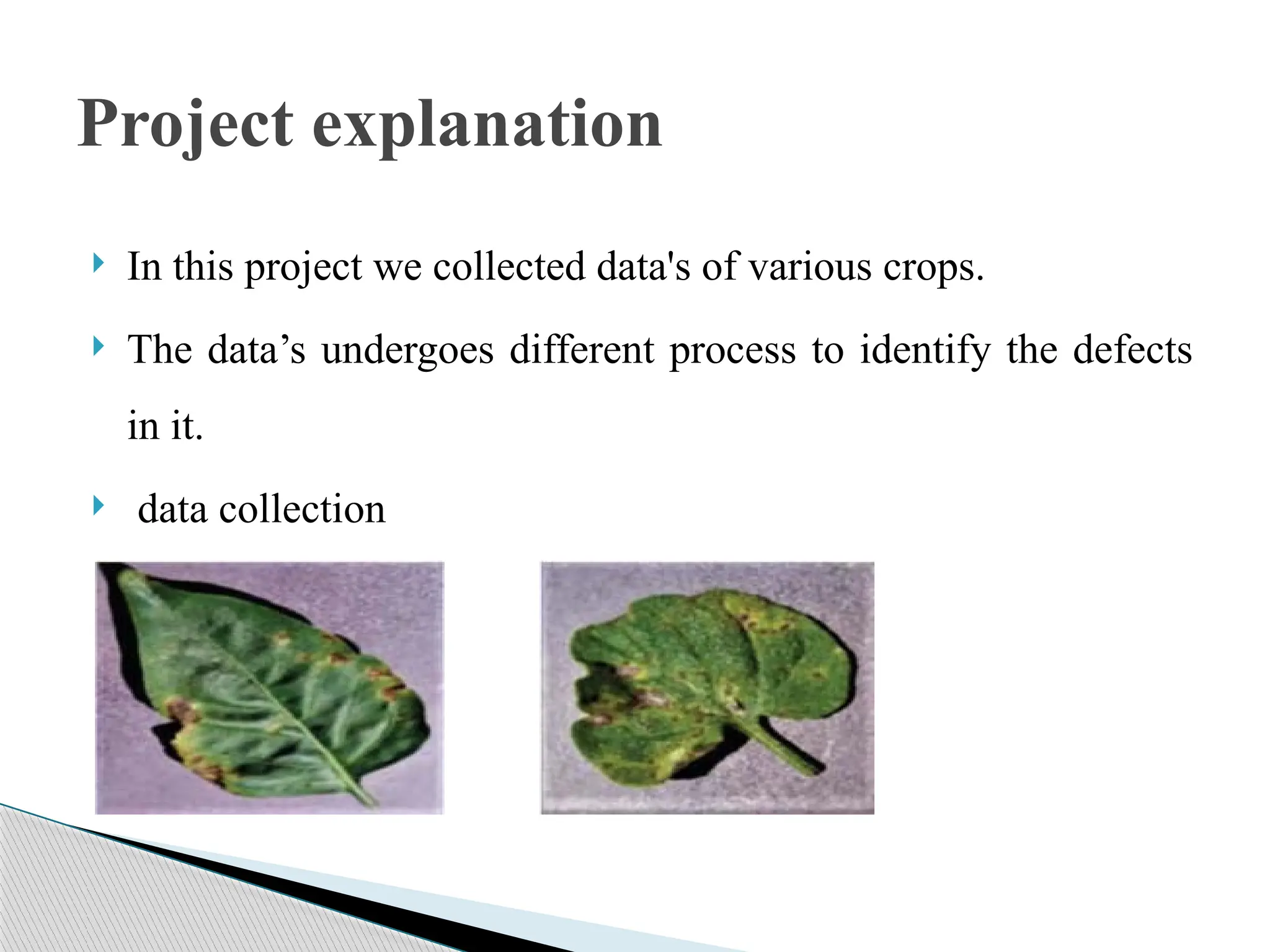
In thisproject we collected data's of various crops.
The data’s undergoes different process to identify the defects
in it.
data collection
Project explanation
15.
In thisstep images are resized to smaller pixel size in order to
speed up the computation.
The noise is removed using some filter technique like
gaussain blur.
After the images are present in RGB format which is not
appropriate for further work as RGB format does not separate
image instantly.
Image processing
16.
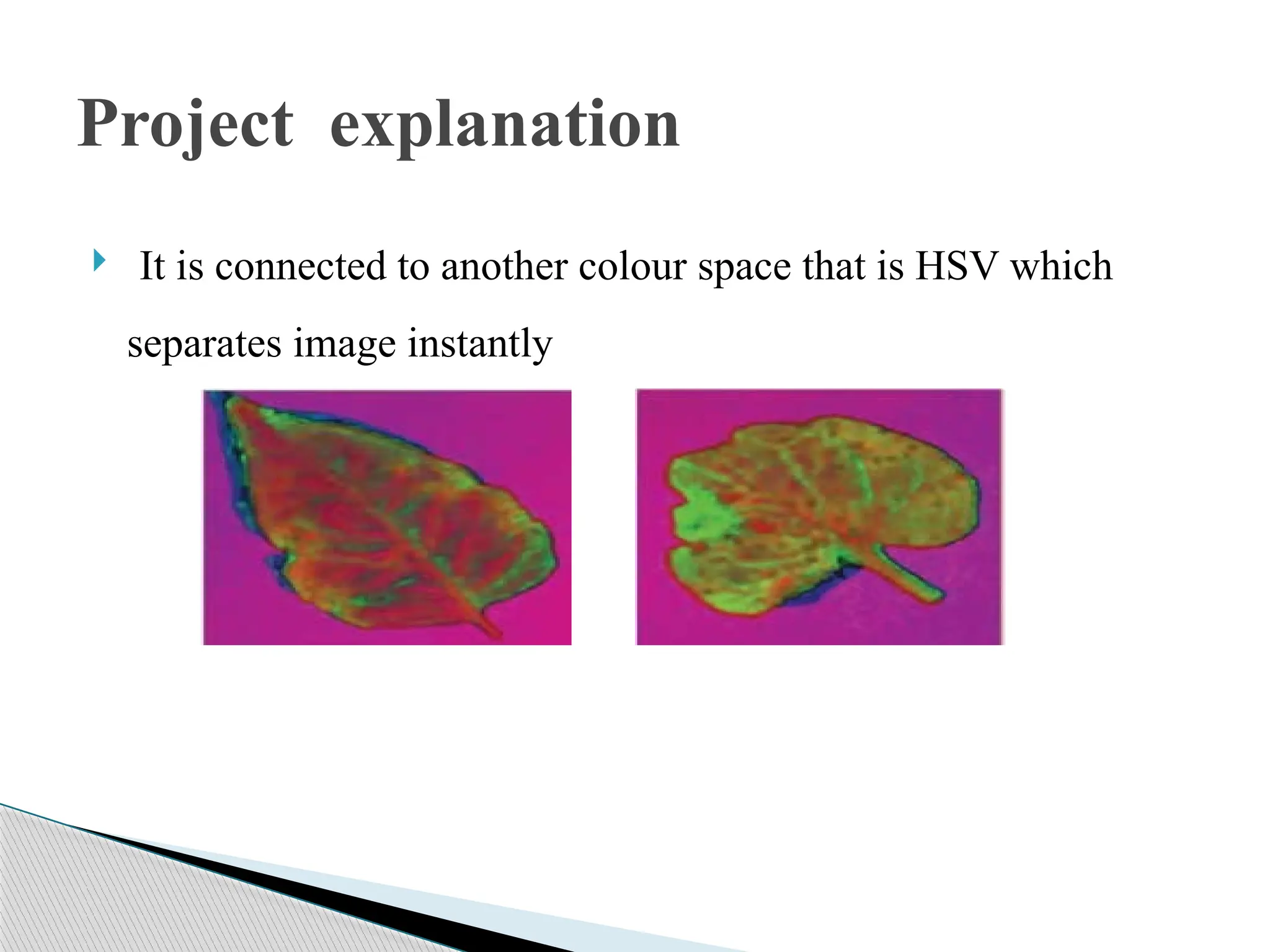
It isconnected to another colour space that is HSV which
separates image instantly
Project explanation
17.
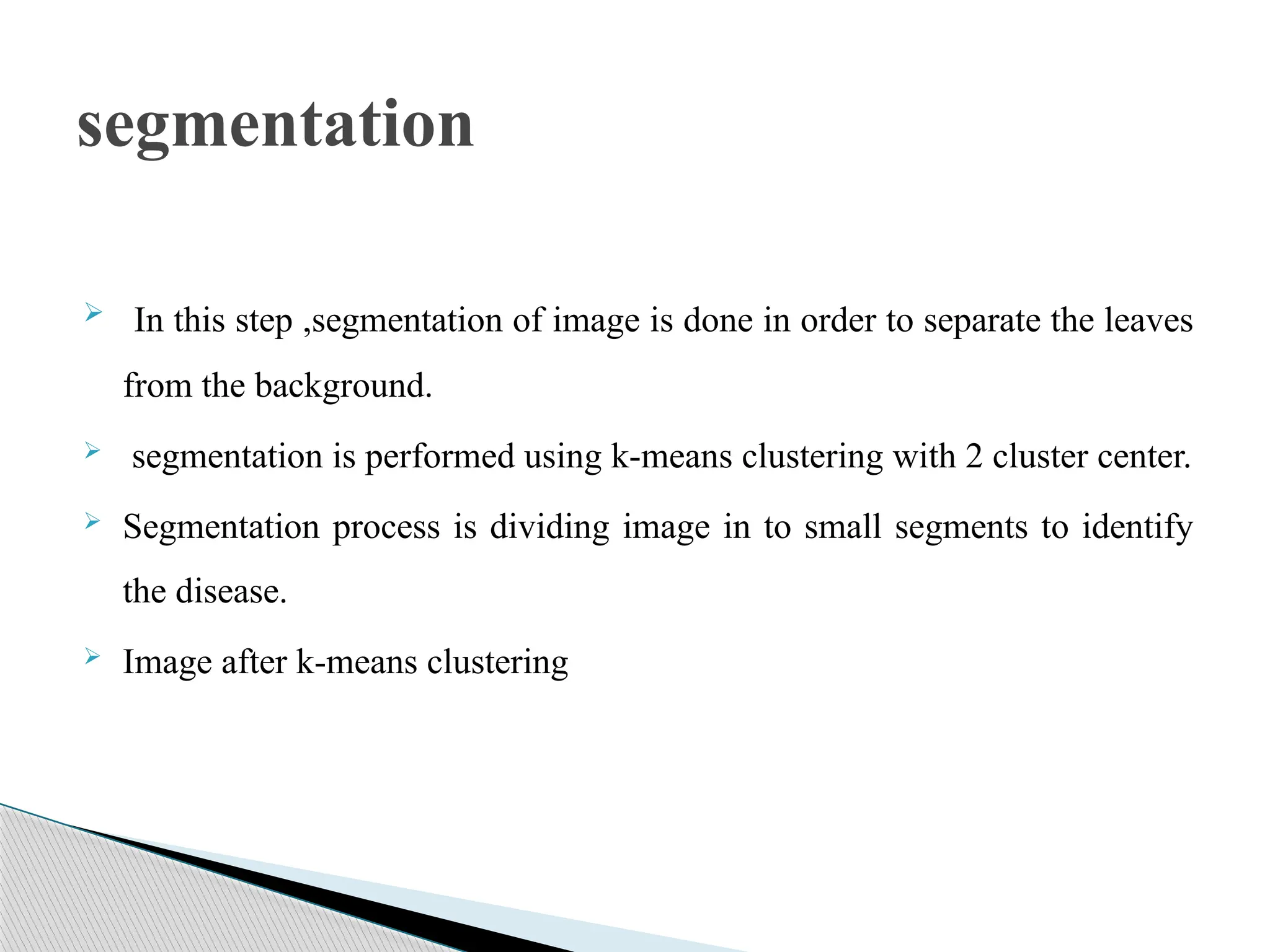
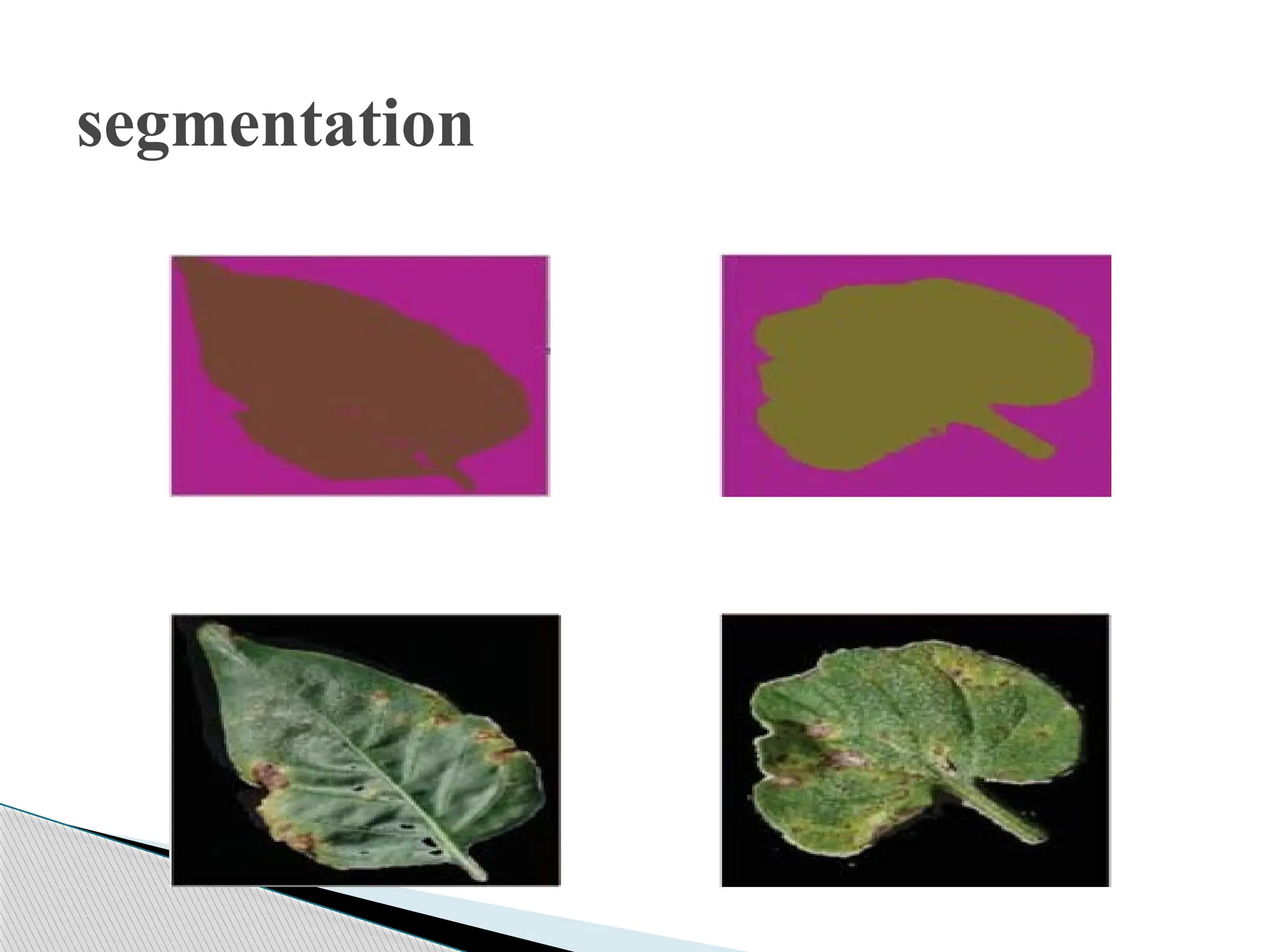
In thisstep ,segmentation of image is done in order to separate the leaves
from the background.
segmentation is performed using k-means clustering with 2 cluster center.
Segmentation process is dividing image in to small segments to identify
the disease.
Image after k-means clustering
segmentation
This isthe classification problem as we have to classify
the type of disease on the leaf of the plant. So, we have
plenty of machine learning as well as deep learning
algorithms that we can apply on this dataset.
Selection of Classifier
20.
Python is aninterpreted high-level
programming language for general-purpose programming.
In python, OpenCV is to be installed.
‘Open source computer vision library' initiated some enthusiast
coders in ‘ 1999' to incorporate Image
Processing into a wide variety of coding languages. It has C++,
C and Python interfaces running on Windows, Linux, Android,
and Mac.
python
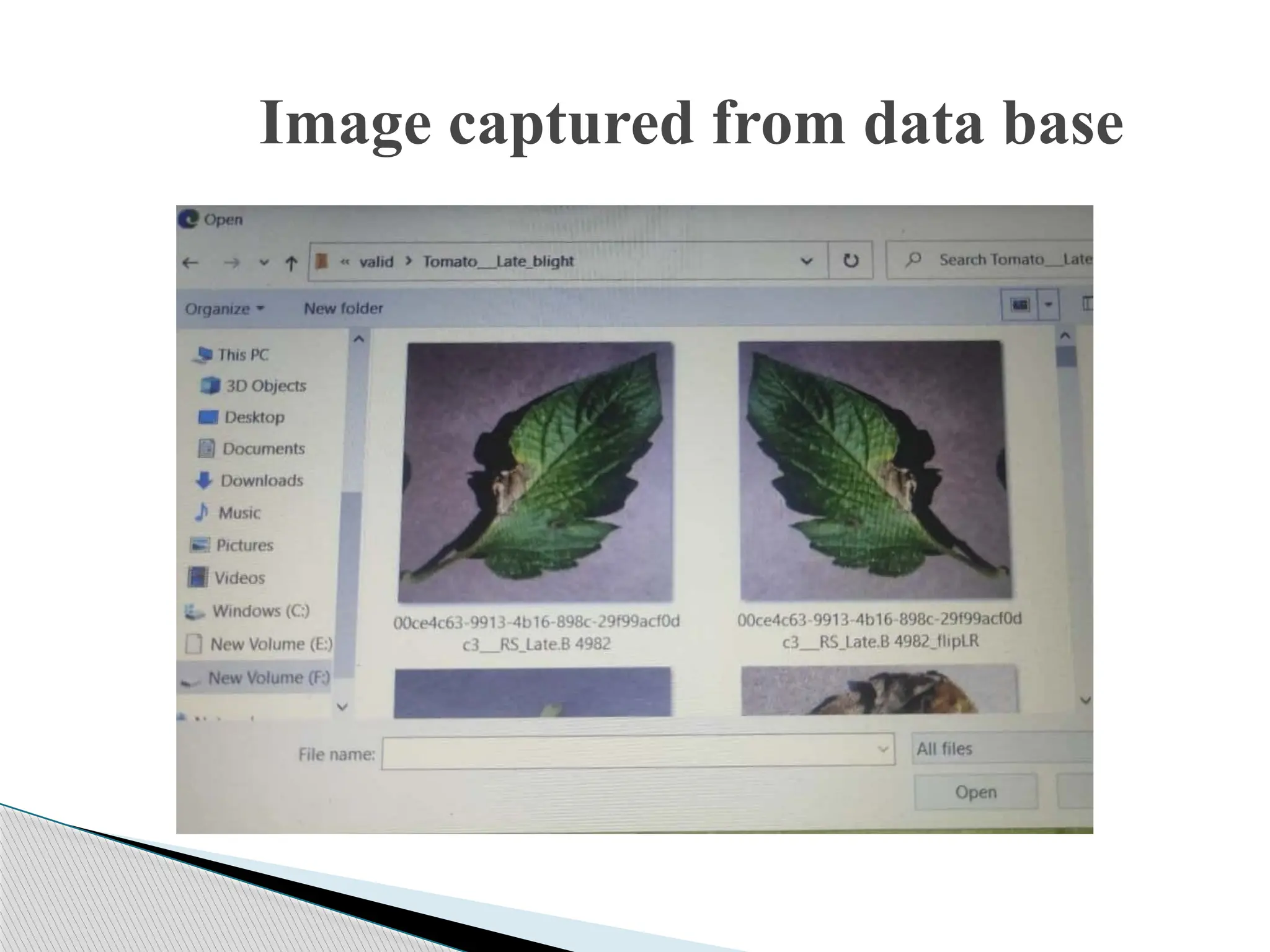
Data basecollected from different websites
Captured image is uploaded to the python server with the help
of visual studio code
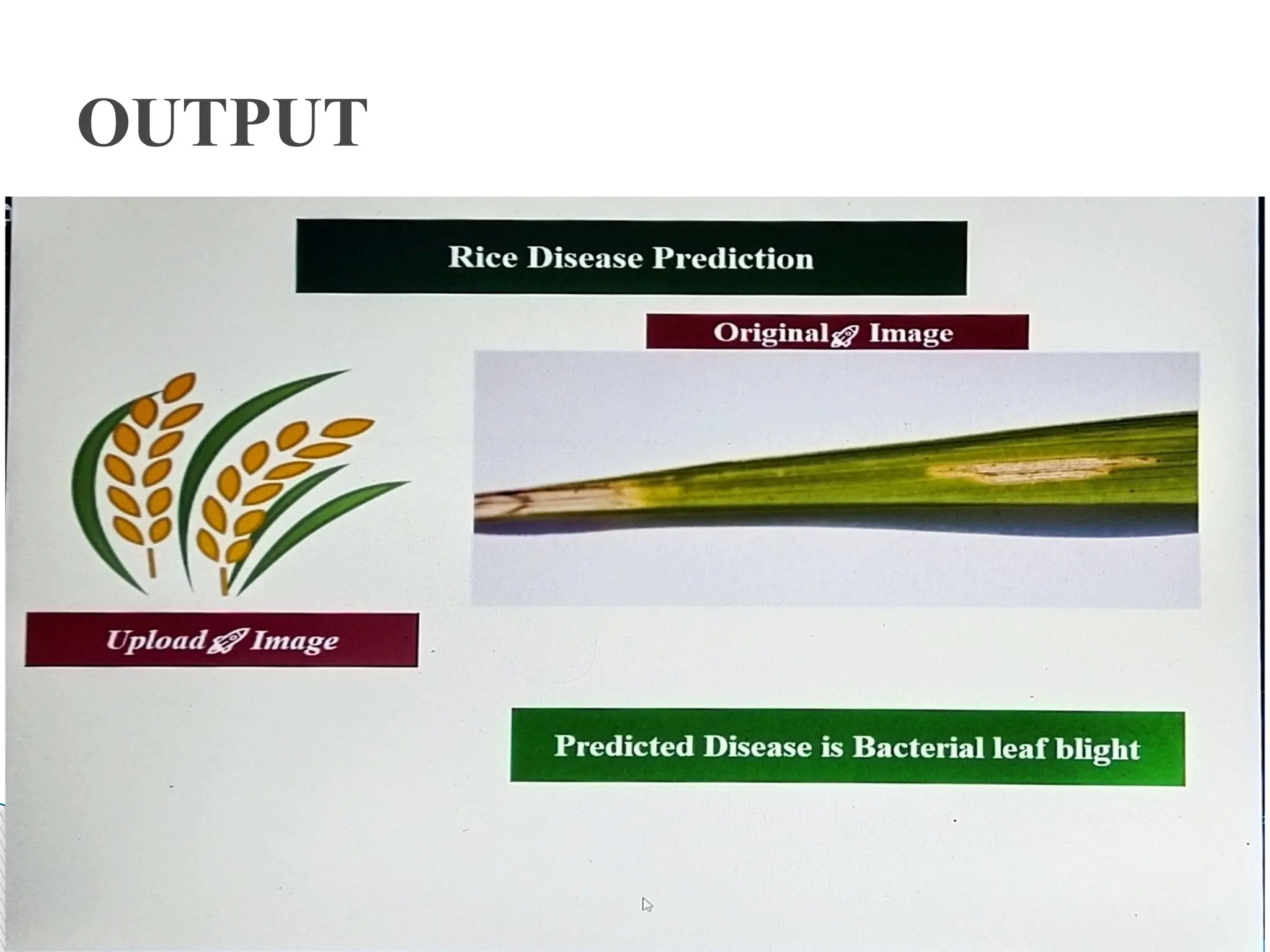
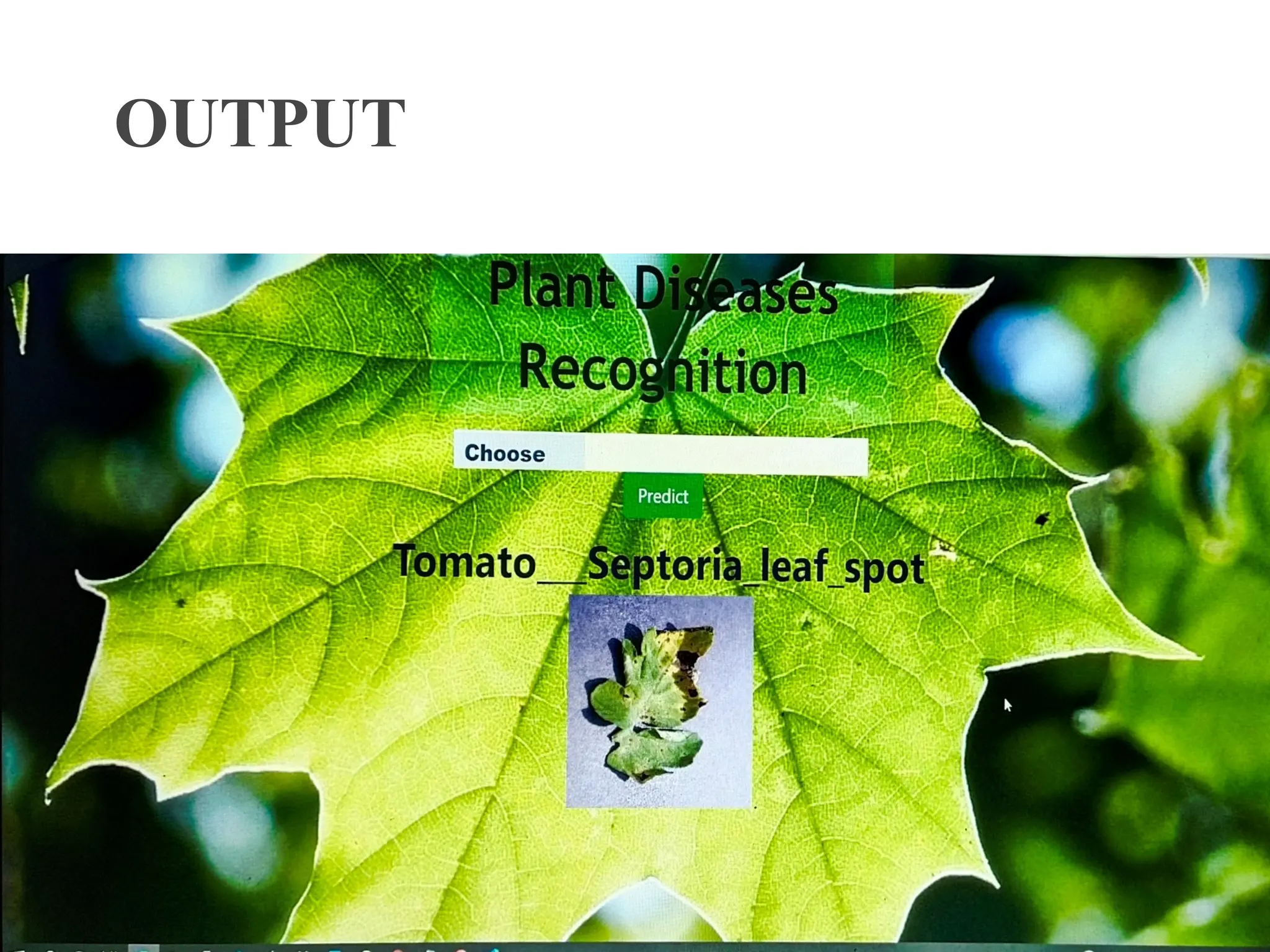
Image undergoes various image processing algorithum to
determine the disease
The determined disease is sent to the interface to show the
output
Result
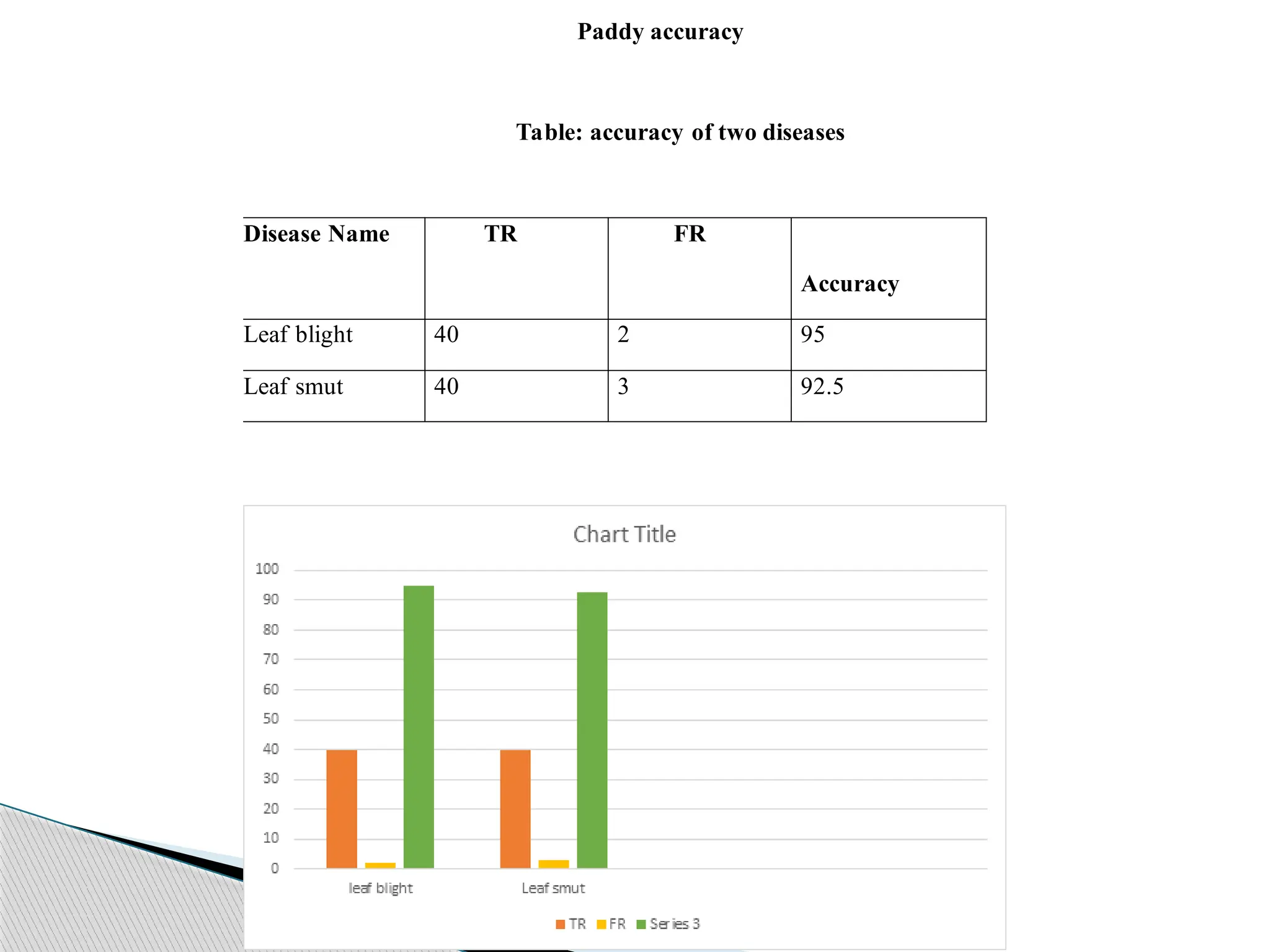
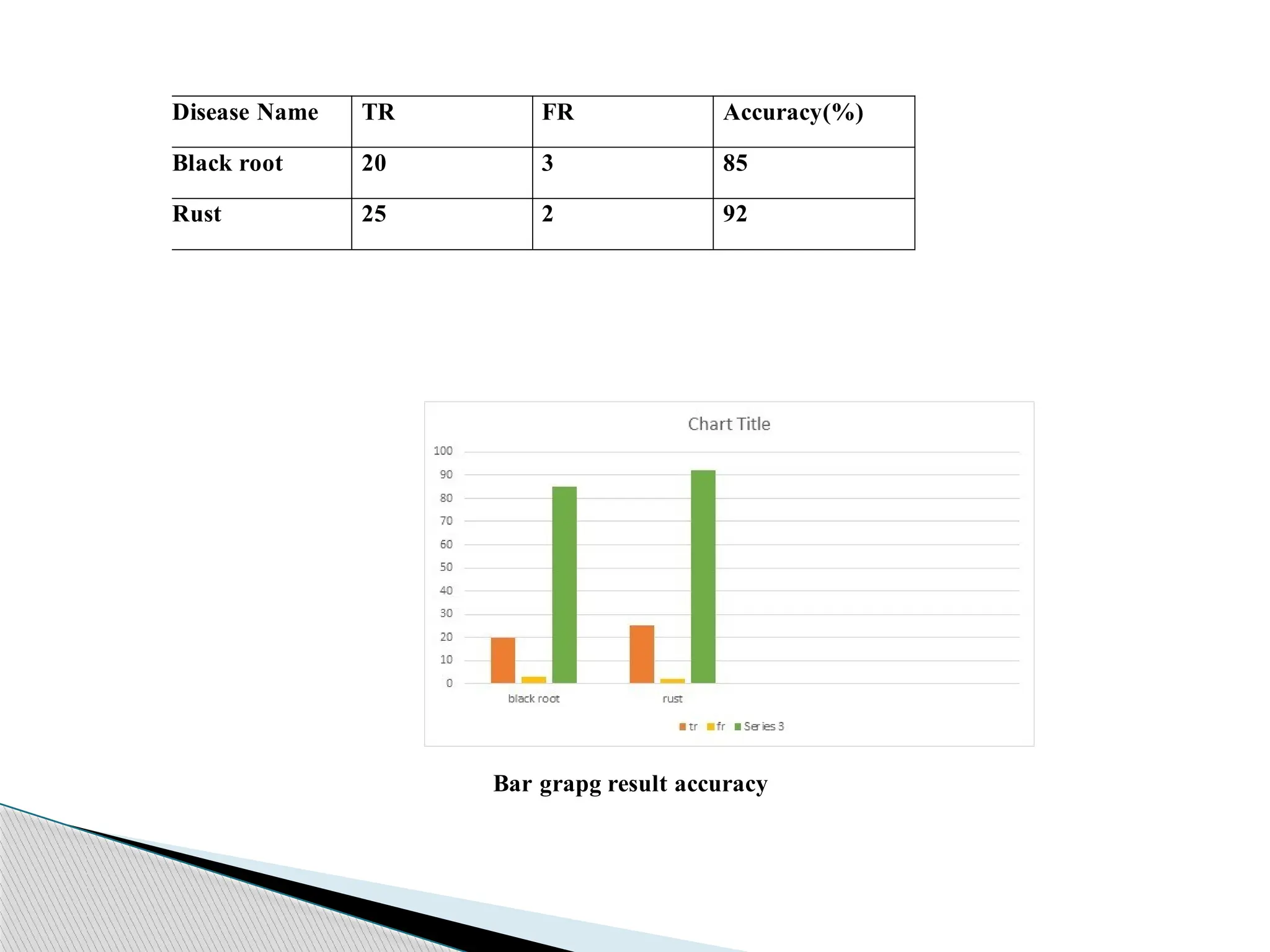
Disease Name TRFR Accuracy(%)
Black root 20 3 85
Rust 25 2 92
Bar grapg result accuracy
28.
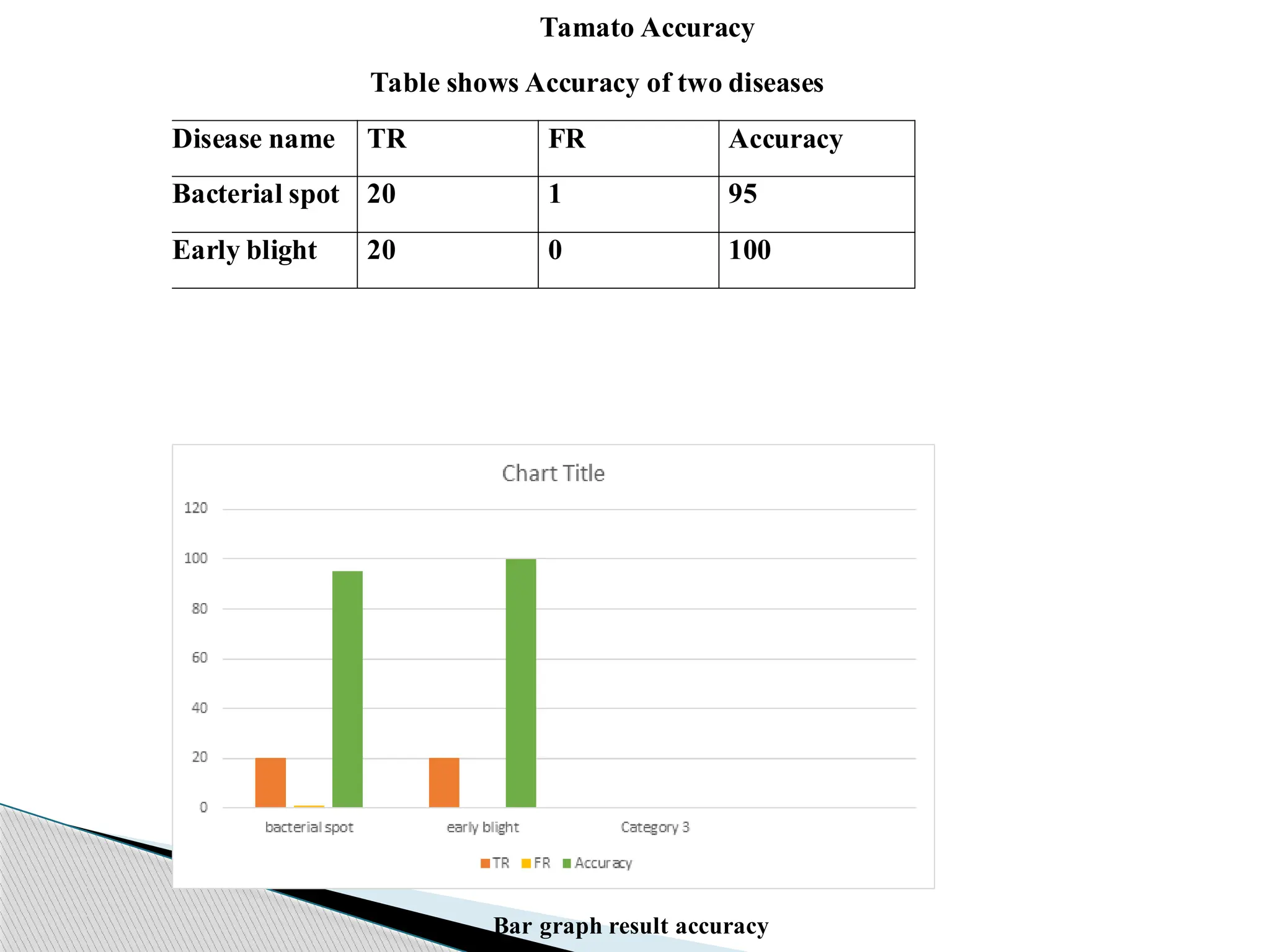
Tamato Accuracy
Table showsAccuracy of two diseases
Disease name TR FR Accuracy
Bacterial spot 20 1 95
Early blight 20 0 100
Bar graph result accuracy
29.
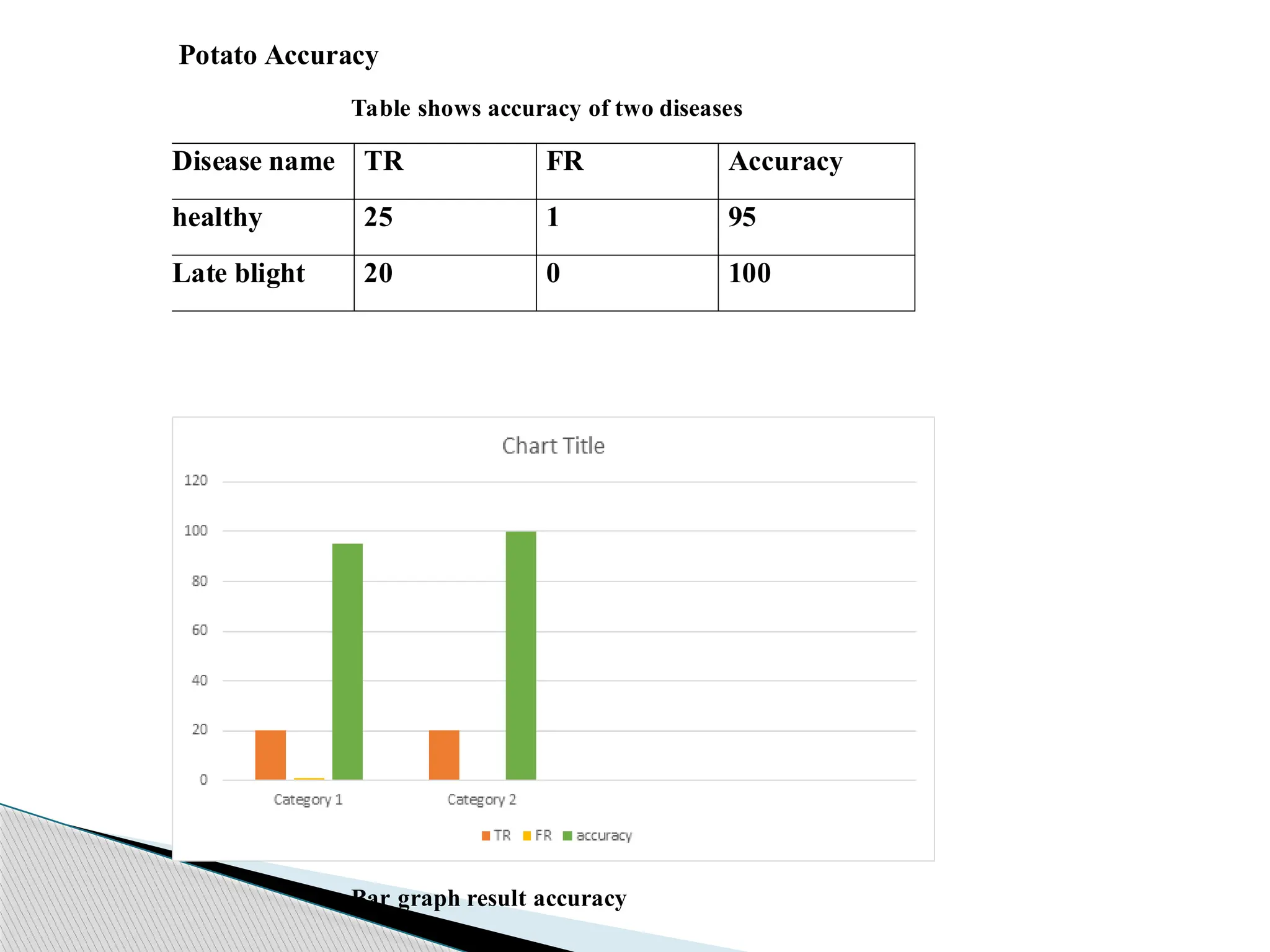
Potato Accuracy
Table showsaccuracy of two diseases
Disease name TR FR Accuracy
healthy 25 1 95
Late blight 20 0 100
Bar graph result accuracy
30.
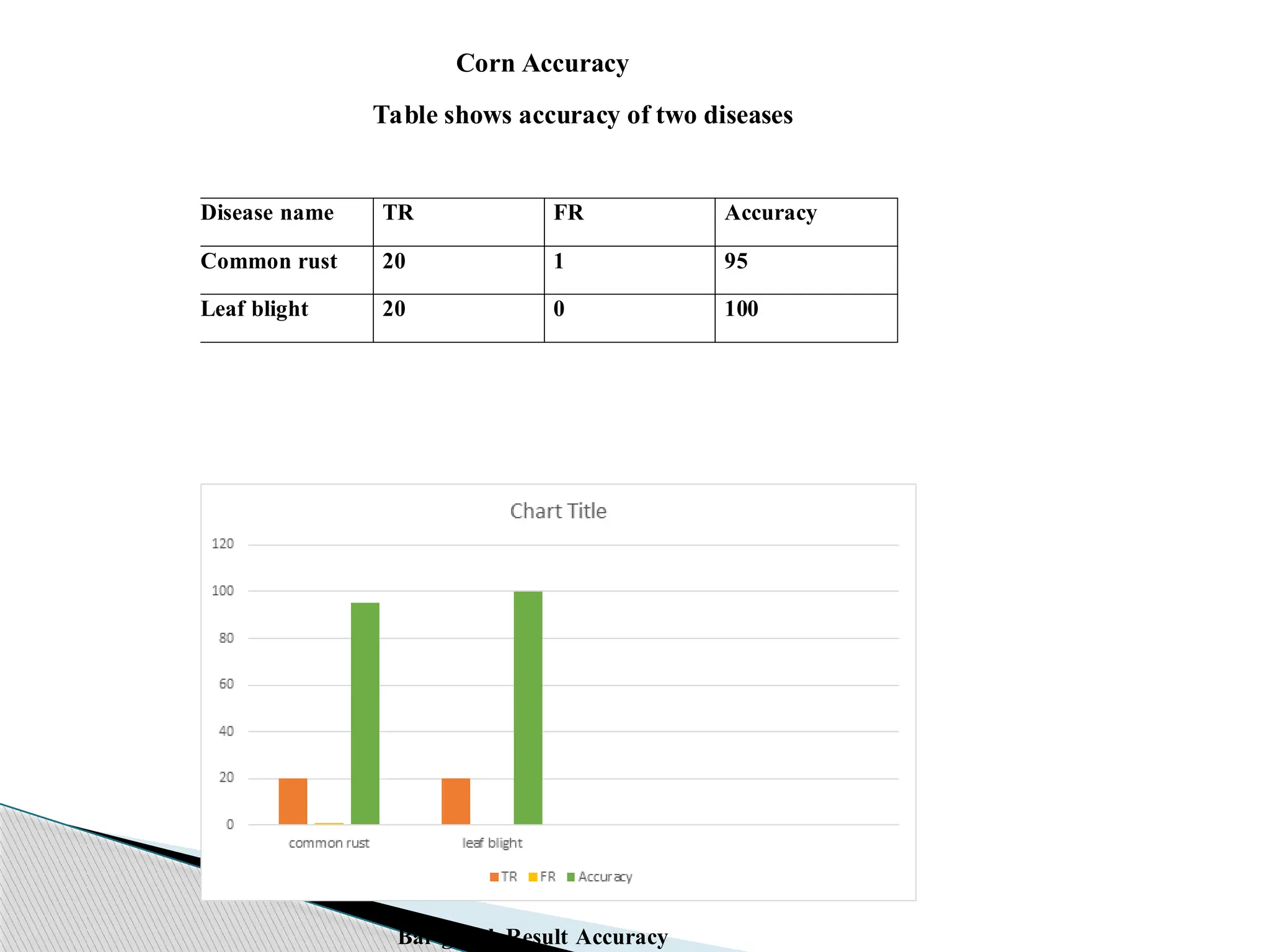
Corn Accuracy
Table showsaccuracy of two diseases
Disease name TR FR Accuracy
Common rust 20 1 95
Leaf blight 20 0 100
Bar graph Result Accuracy
31.
In thispaper, gives accurate artificial intelligence solution for
detecting and classifying different plant leaf disease is
presented which makes use of convolutional neural network
for classification purpose . The presented model used the
dataset that consists of more than 20,000 images with 41 total
classes . The following model can be extended by using even
more large dataset with more categories of diseases and the
accuracy can also be improved by tuning the hyper
parameters.
Conclusion
32.
[1] “PlantDisease Detection And Its Solution Using image Classification” by Saradhambal.G,
Dhivya.R, Latha.S, R.Rajesh in International Journal of Pure and Applied Mathematics Vol.
11 ,no.14, pp. 879- 884, 2018
[2] “Plant Leaf Disease Detection an Classification Based on CNN with LVQ Algorithm” by
Melik Sardogan, Adem Tuncer, Yunus Ozen in 3r International Conference on Computer
Scienc and Engineering, 2018
[3] “Plant Disease Classification Using Image Segmentation and SVM Techniques” by
K.Elangovan, S.Nalini in International Journal of Computational Intelligence Research ISSN
0973-1873 Vol.13 ,no.7, pp.-1821-1828, 2017
[4] Rajneet Kaur , Manjeet Kaur “A Brief Review on Plant Disease Detection using Image
Processing” IJCSMC, Vol. 6, Issue 2, 2017
[
References





![ [1] “Plant Disease Detection And Its Solution Using image Classification” by Saradhambal.G,
Dhivya.R, Latha.S, R.Rajesh in International Journal of Pure and Applied Mathematics Vol.
11 ,no.14, pp. 879- 884, 2018
[2] “Plant Leaf Disease Detection an Classification Based on CNN with LVQ Algorithm” by
Melik Sardogan, Adem Tuncer, Yunus Ozen in 3r International Conference on Computer
Scienc and Engineering, 2018
[3] “Plant Disease Classification Using Image Segmentation and SVM Techniques” by
K.Elangovan, S.Nalini in International Journal of Computational Intelligence Research ISSN
0973-1873 Vol.13 ,no.7, pp.-1821-1828, 2017
[4] Rajneet Kaur , Manjeet Kaur “A Brief Review on Plant Disease Detection using Image
Processing” IJCSMC, Vol. 6, Issue 2, 2017
[
References](https://image.slidesharecdn.com/leafdeseasedetection-250712143019-2bf88c8c/75/leaf-desease-detection-using-machine-learning-pptx-32-2048.jpg)