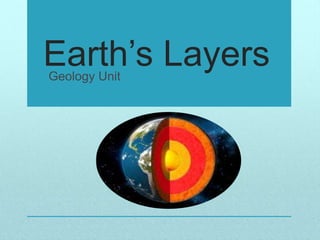
Earth’s Layers
Geology Unit
1. Identify the different layers
of Earth.
2. Describe the layers and
function of Earth’s interior.
3. Explain how heat affects
the composition and transfer of
materials within each layer.
DEFINE…
• Crust
• Continental Crust
• Oceanic Crust
• Mantle
• Lithosphere
• Asthenosphere
• Outer Core
• Inner Core
• Density
• Volume
• Convection Currents
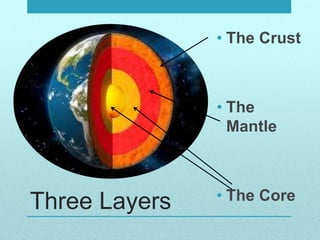
Three Layers
• The Crust
• The
Mantle
• The Core
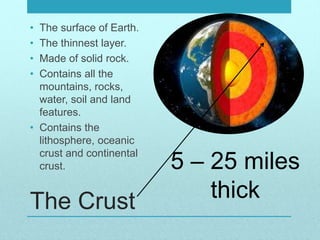
The Crust
• The surface of Earth.
• The thinnest layer.
• Made of solid rock.
• Contains all the
mountains, rocks,
water, soil and land
features.
• Contains the
lithosphere, oceanic
crust and continental
crust. 5 – 25 miles
thick
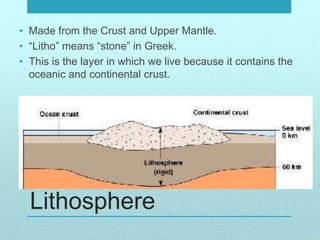
Lithosphere
• Made from the Crust and Upper Mantle.
• “Litho” means “stone” in Greek.
• This is the layer in which we live because it contains the
oceanic and continental crust.
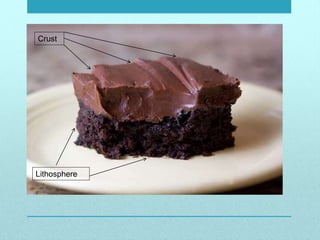
Crust
Lithosphere
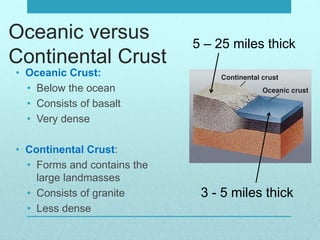
Oceanic versus
Continental Crust
• Oceanic Crust:
• Below the ocean
• Consists of basalt
• Very dense
• Continental Crust:
• Forms and contains the
large landmasses
• Consists of granite
• Less dense
5 – 25 miles thick
3 - 5 miles thick
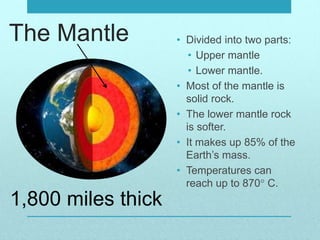
The Mantle • Divided into two parts:
• Upper mantle
• Lower mantle.
• Most of the mantle is
solid rock.
• The lower mantle rock
is softer.
• It makes up 85% of the
Earth’s mass.
• Temperatures can
reach up to 870 C.
1,800 miles thick
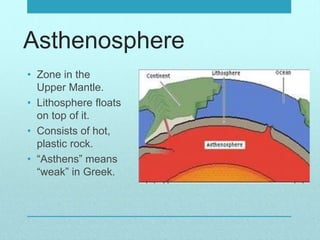
Asthenosphere
• Zone in the
Upper Mantle.
• Lithosphere floats
on top of it.
• Consists of hot,
plastic rock.
• “Asthens” means
“weak” in Greek.
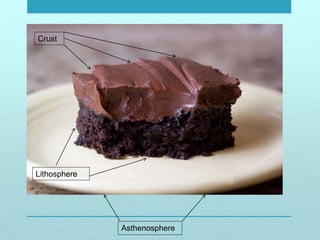
Crust
Lithosphere
Asthenosphere
Transfer of Heat
• Radiation – The transfer of energy through space,
such as the transfer of heat from the Sun.
• Conduction – The transfer of heat within a material
or between two materials that are touching.
• Convection – The transfer of heat by the movement
of currents within a fluid.
•REMEMBER:
• Volume is THE AMOUNT
OF SPACE AN OBJECT
TAKES UP. If a liquid is
heated to a gas, it will take
up more space than
before.
Convection Currents
• Density = Mass
Volume
• What are Convection Currents???
The process of liquid heating and cooling in between the
mantle and outer core of the Earth.
• When a liquid is heated, the particles spread apart. This is
due to the fact that their energy is being converted into kinetic
energy (the energy of movement). Once these molecules
spread out, their volume increases causing their density to
decrease. Therefore, the hot liquid floats to the top and the
cooler water, which has decreased in volume and increased
in density, sinks to the bottom.
• This process occurs, repeatedly, in the mantle due to the heat
from the core and mantle.
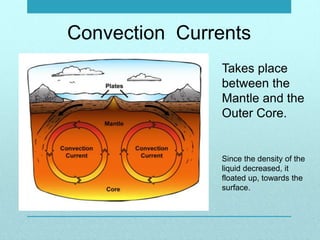
Convection Currents
Takes place
between the
Mantle and the
Outer Core.
Since the density of the
liquid decreased, it
floated up, towards the
surface.
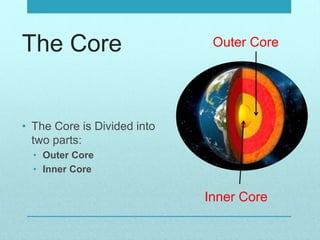
The Core
• The Core is Divided into
two parts:
• Outer Core
• Inner Core
Inner Core
Outer Core
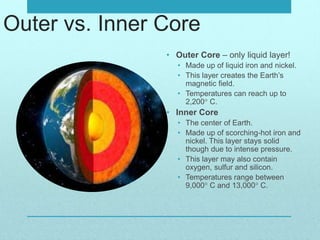
Outer vs. Inner Core
• Outer Core – only liquid layer!
• Made up of liquid iron and nickel.
• This layer creates the Earth’s
magnetic field.
• Temperatures can reach up to
2,200 C.
• Inner Core
• The center of Earth.
• Made up of scorching-hot iron and
nickel. This layer stays solid
though due to intense pressure.
• This layer may also contain
oxygen, sulfur and silicon.
• Temperatures range between
9,000 C and 13,000 C.
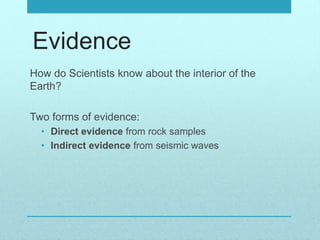
Evidence
How do Scientists know about the interior of the
Earth?
Two forms of evidence:
• Direct evidence from rock samples
• Indirect evidence from seismic waves
Review…
Can you name the
different layers of the
Earth??
Number a piece of
paper 1 -5 and write
the name of each
layer.
4
5
3
2
1
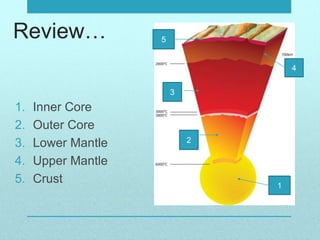
Review…
1. Inner Core
2. Outer Core
3. Lower Mantle
4. Upper Mantle
5. Crust
4
5
3
2
1
Define the following terms:
1. Primordial Heat
2. Radiogenic Heat

Geology Powerpoint Earth Layers.pptx

  • 1.
  • 2.
    1. Identify thedifferent layers of Earth. 2. Describe the layers and function of Earth’s interior. 3. Explain how heat affects the composition and transfer of materials within each layer.
  • 3.
    DEFINE… • Crust • ContinentalCrust • Oceanic Crust • Mantle • Lithosphere • Asthenosphere • Outer Core • Inner Core • Density • Volume • Convection Currents
  • 4.
    Three Layers • TheCrust • The Mantle • The Core
  • 5.
    The Crust • Thesurface of Earth. • The thinnest layer. • Made of solid rock. • Contains all the mountains, rocks, water, soil and land features. • Contains the lithosphere, oceanic crust and continental crust. 5 – 25 miles thick
  • 6.
    Lithosphere • Made fromthe Crust and Upper Mantle. • “Litho” means “stone” in Greek. • This is the layer in which we live because it contains the oceanic and continental crust.
  • 7.
  • 8.
    Oceanic versus Continental Crust •Oceanic Crust: • Below the ocean • Consists of basalt • Very dense • Continental Crust: • Forms and contains the large landmasses • Consists of granite • Less dense 5 – 25 miles thick 3 - 5 miles thick
  • 9.
    The Mantle •Divided into two parts: • Upper mantle • Lower mantle. • Most of the mantle is solid rock. • The lower mantle rock is softer. • It makes up 85% of the Earth’s mass. • Temperatures can reach up to 870 C. 1,800 miles thick
  • 10.
    Asthenosphere • Zone inthe Upper Mantle. • Lithosphere floats on top of it. • Consists of hot, plastic rock. • “Asthens” means “weak” in Greek.
  • 11.
  • 12.
    Transfer of Heat •Radiation – The transfer of energy through space, such as the transfer of heat from the Sun. • Conduction – The transfer of heat within a material or between two materials that are touching. • Convection – The transfer of heat by the movement of currents within a fluid.
  • 13.
    •REMEMBER: • Volume isTHE AMOUNT OF SPACE AN OBJECT TAKES UP. If a liquid is heated to a gas, it will take up more space than before.
  • 14.
    Convection Currents • Density= Mass Volume • What are Convection Currents??? The process of liquid heating and cooling in between the mantle and outer core of the Earth. • When a liquid is heated, the particles spread apart. This is due to the fact that their energy is being converted into kinetic energy (the energy of movement). Once these molecules spread out, their volume increases causing their density to decrease. Therefore, the hot liquid floats to the top and the cooler water, which has decreased in volume and increased in density, sinks to the bottom. • This process occurs, repeatedly, in the mantle due to the heat from the core and mantle.
  • 15.
    Convection Currents Takes place betweenthe Mantle and the Outer Core. Since the density of the liquid decreased, it floated up, towards the surface.
  • 16.
    The Core • TheCore is Divided into two parts: • Outer Core • Inner Core Inner Core Outer Core
  • 17.
    Outer vs. InnerCore • Outer Core – only liquid layer! • Made up of liquid iron and nickel. • This layer creates the Earth’s magnetic field. • Temperatures can reach up to 2,200 C. • Inner Core • The center of Earth. • Made up of scorching-hot iron and nickel. This layer stays solid though due to intense pressure. • This layer may also contain oxygen, sulfur and silicon. • Temperatures range between 9,000 C and 13,000 C.
  • 18.
    Evidence How do Scientistsknow about the interior of the Earth? Two forms of evidence: • Direct evidence from rock samples • Indirect evidence from seismic waves
  • 19.
    Review… Can you namethe different layers of the Earth?? Number a piece of paper 1 -5 and write the name of each layer. 4 5 3 2 1
  • 20.
    Review… 1. Inner Core 2.Outer Core 3. Lower Mantle 4. Upper Mantle 5. Crust 4 5 3 2 1
  • 21.
    Define the followingterms: 1. Primordial Heat 2. Radiogenic Heat