INDUSTRY
NAME – ESHAN KUMAR SINGH
CLASS- X ‘A’
Subject- Geography
ROLL No. – 25
Session- 2024-25
INDUSTRY
NAME – ESHAN KUMAR SINGH
CLASS- X ‘A’
Subject- Geography
ROLL No. – 25
Session- 2024-25
SERIAL NO. CONTENTS TECHER’S
SIGN
1. INTRODUCTION TO INDUSTRIES
2. Industrialization in India
3. Factors affecting the location
4. Agro-based Industries
5. Cotton & Silk Textile Industry
6. Iron and Steel Industry
7. Petrochemical Industries
8. ELECTRONICS INDUSTRIES
INDEX
Introduction to
Industries
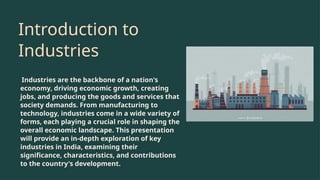
Industries are the backbone of a nation's
economy, driving economic growth, creating
jobs, and producing the goods and services that
society demands. From manufacturing to
technology, industries come in a wide variety of
forms, each playing a crucial role in shaping the
overall economic landscape. This presentation
will provide an in-depth exploration of key
industries in India, examining their
significance, characteristics, and contributions
to the country's development.
Need for Rapid Industrialization in India
India is a rapidly developing country with a large and growing population. Rapid
industrialization is essential to meet the increasing demand for goods and services,
create employment opportunities, and drive economic growth. The country's
abundant natural resources, skilled workforce, and strategic geographic location
make it an attractive destination for investment and industrial development. By
embracing industrialization, India can unlock its full potential, improve living
standards, and solidify its position as a global economic powerhouse.
Poverty Reduction
Industrialization can create
millions of jobs, providing
employment opportunities and
lifting people out of poverty.
Economic Diversification
A diverse industrial base can
reduce reliance on agriculture
and strengthen the country's
overall economic resilience.
Technological Advancement
Industrialization can spur
innovation, leading to the
development of new
technologies and increasing
productivity.
Factors Affecting
Industrial
Location
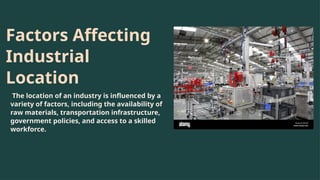
The location of an industry is influenced by a
variety of factors, including the availability of
raw materials, transportation infrastructure,
government policies, and access to a skilled
workforce.
Raw Material Availability
Proximity to Raw Materials
Industries prefer to be
located near their
sources of raw materials
to minimize
transportation costs
and ensure a reliable
supply.
Abundant Resources
The availability of abundant
and high-quality raw
materials is a critical factor
in determining the optimal
location for an industrial
facility.
Cost of Raw Materials
The cost of raw materials,
including extraction,
processing, and
transportation, can
significantly impact the
profitability and
competitiveness of an
industry.
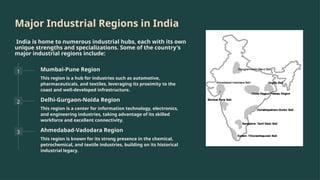
Major Industrial Regions in India
India is home to numerous industrial hubs, each with its own
unique strengths and specializations. Some of the country's
major industrial regions include:
1 Mumbai-Pune Region
This region is a hub for industries such as automotive,
pharmaceuticals, and textiles, leveraging its proximity to the
coast and well-developed infrastructure.
2 Delhi-Gurgaon-Noida Region
This region is a center for information technology, electronics,
and engineering industries, taking advantage of its skilled
workforce and excellent connectivity.
3 Ahmedabad-Vadodara Region
This region is known for its strong presence in the chemical,
petrochemical, and textile industries, building on its historical
industrial legacy.
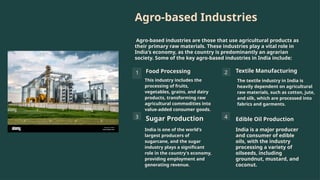
Agro-based Industries
Agro-based industries are those that use agricultural products as
their primary raw materials. These industries play a vital role in
India's economy, as the country is predominantly an agrarian
society. Some of the key agro-based industries in India include:
1 Food Processing
This industry includes the
processing of fruits,
vegetables, grains, and dairy
products, transforming raw
agricultural commodities into
value-added consumer goods.
2 Textile Manufacturing
The textile industry in India is
heavily dependent on agricultural
raw materials, such as cotton, jute,
and silk, which are processed into
fabrics and garments.
3 Sugar Production
India is one of the world's
largest producers of
sugarcane, and the sugar
industry plays a significant
role in the country's economy,
providing employment and
generating revenue.
4 Edible Oil Production
India is a major producer
and consumer of edible
oils, with the industry
processing a variety of
oilseeds, including
groundnut, mustard, and
coconut.
Cotton Textile Industry
The cotton textile industry is a cornerstone of India's industrial
landscape, with a rich history dating back to the Indus Valley
Civilization. This industry has played a pivotal role in the country's
economic development, contributing significantly to exports,
employment, and GDP. Key aspects of the cotton textile industry in
India include:
Weaving Tradition
India has a long-standing
tradition of handloom weaving,
with skilled artisans producing
exquisite fabrics using
traditional techniques.
Technological Advancements
The industry has embraced
modern technologies, including
automated spinning, weaving, and
garment manufacturing, to
improve efficiency and
competitiveness.
Export Potential
Indian cotton textiles are in high
demand globally, with the
country's exports accounting for
a significant share of the global
textile trade.
Sustainability Initiatives
The industry is increasingly
adopting sustainable practices,
such as water conservation,
waste management, and organic
cotton cultivation, to minimize
its environmental impact.
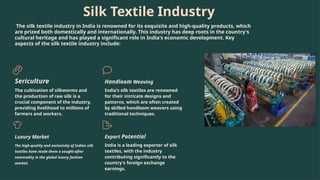
Silk Textile Industry
The silk textile industry in India is renowned for its exquisite and high-quality products, which
are prized both domestically and internationally. This industry has deep roots in the country's
cultural heritage and has played a significant role in India's economic development. Key
aspects of the silk textile industry include:
Sericulture
The cultivation of silkworms and
the production of raw silk is a
crucial component of the industry,
providing livelihood to millions of
farmers and workers.
Handloom Weaving
India's silk textiles are renowned
for their intricate designs and
patterns, which are often created
by skilled handloom weavers using
traditional techniques.
Luxury Market
The high-quality and exclusivity of Indian silk
textiles have made them a sought-after
commodity in the global luxury fashion
market.
Export Potential
India is a leading exporter of silk
textiles, with the industry
contributing significantly to the
country's foreign exchange
earnings.
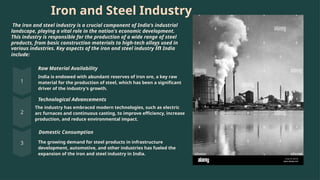
Iron and Steel Industry
The iron and steel industry is a crucial component of India's industrial
landscape, playing a vital role in the nation's economic development.
This industry is responsible for the production of a wide range of steel
products, from basic construction materials to high-tech alloys used in
various industries. Key aspects of the iron and steel industry in India
include:
Raw Material Availability
India is endowed with abundant reserves of iron ore, a key raw
material for the production of steel, which has been a significant
driver of the industry's growth.
Technological Advancements
The industry has embraced modern technologies, such as electric
arc furnaces and continuous casting, to improve efficiency, increase
production, and reduce environmental impact.
Domestic Consumption
The growing demand for steel products in infrastructure
development, automotive, and other industries has fueled the
expansion of the iron and steel industry in India.
Tata Iron and Steel Company
The Tata Iron and Steel Company (TISCO) is a renowned Indian multinational steel company and
a pioneer in the country's iron and steel industry. Established in 1907, TISCO has played a pivotal
role in the industrialization of India and is now a global leader in the production of a wide range
of steel products. Key aspects of TISCO's success include:
Integrated Operations TISCO owns and operates its own mines,
ensuring a stable supply of raw materials
and reducing dependence on external
sources.
Technological Innovation The company has continuously invested in
modernizing its facilities and adopting the
latest technologies to improve efficiency
and product quality.
Diversified Portfolio TISCO produces a diverse range of steel
products, including hot-rolled and cold-
rolled coils, sheets, and tubes, catering to
various industries.
Sustainability Initiatives The company has implemented eco-friendly
practices, such as waste recycling and
energy conservation, to minimize its
environmental impact.
Bhilai Iron and Steel Plant
The Bhilai Iron and Steel Plant, established in 1955, is one of the largest and most technologically advanced steel
plants in India. It is a shining example of the country's industrial prowess and has played a crucial role in the
nation's economic development. Key features of the Bhilai Iron and Steel Plant include:
Production Capacity
The plant has a production
capacity of over 7 million tons of
steel per year, making it one of
the largest steel producers in the
country.
Technological Excellence
The plant utilizes state-of-the-art
technology, including blast
furnaces, basic oxygen furnaces,
and continuous casting
machines, to ensure high
efficiency and product quality.
Infrastructural Development
The plant has a well-developed
infrastructure, including a
dedicated railway network, water
supply, and power generation
facilities, to support its
operations.
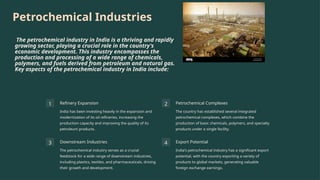
Petrochemical Industries
The petrochemical industry in India is a thriving and rapidly
growing sector, playing a crucial role in the country's
economic development. This industry encompasses the
production and processing of a wide range of chemicals,
polymers, and fuels derived from petroleum and natural gas.
Key aspects of the petrochemical industry in India include:
1 Refinery Expansion
India has been investing heavily in the expansion and
modernization of its oil refineries, increasing the
production capacity and improving the quality of its
petroleum products.
2 Petrochemical Complexes
The country has established several integrated
petrochemical complexes, which combine the
production of basic chemicals, polymers, and specialty
products under a single facility.
3 Downstream Industries
The petrochemical industry serves as a crucial
feedstock for a wide range of downstream industries,
including plastics, textiles, and pharmaceuticals, driving
their growth and development.
4 Export Potential
India's petrochemical industry has a significant export
potential, with the country exporting a variety of
products to global markets, generating valuable
foreign exchange earnings.
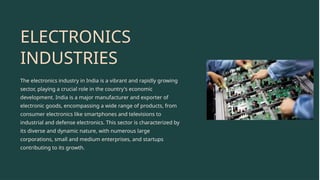
ELECTRONICS
INDUSTRIES
The electronics industry in India is a vibrant and rapidly growing
sector, playing a crucial role in the country's economic
development. India is a major manufacturer and exporter of
electronic goods, encompassing a wide range of products, from
consumer electronics like smartphones and televisions to
industrial and defense electronics. This sector is characterized by
its diverse and dynamic nature, with numerous large
corporations, small and medium enterprises, and startups
contributing to its growth.
THE INDIAN TELEPHONE INDUSTRIES
Early Days
The Indian Telephone
Industries (ITI) was
established in 1948 as a state-
owned company with the
primary aim of manufacturing
telecommunications
equipment for India's
burgeoning post-
independence communication
network. ITI's early years were
marked by rapid growth and
innovation, as it played a vital
role in building the country's
telecommunications
infrastructure.
Expansion and Diversification
Over the decades, ITI
expanded its operations
and diversified into various
areas of electronics
manufacturing, including
mobile phone handsets,
optical fiber cables,
defense electronics, and
power electronics. The
company's focus on
research and development
ensured its
competitiveness in the
ever-evolving electronics
industry.
Challenges and Rejuvenation
In recent years, ITI has
faced challenges from the
growing competition from
private sector players.
However, the company is
undergoing a rejuvenation
process, focusing on
leveraging its expertise in
manufacturing and
technology to create
innovative products and
solutions for the future.
THE BHARAT ELECTRONICS
1
Establishment
Bharat Electronics Limited (BEL),
another major player in India's
electronics industry, was established in
1954 with the vision of developing and
manufacturing electronic systems for
defense and other critical sectors. BEL's
early focus was on the production of
military communication equipment,
radar systems, and other essential
electronic components for the Indian
armed forces.
2
Growth and Expansion
Over time, BEL expanded its product
portfolio to encompass a wide range
of advanced electronic systems,
including avionics, navigation
equipment, weapon systems, and
electro-optical systems. The
company has also ventured into
civilian sectors like broadcasting,
telecommunications, and power
electronics, further solidifying its
position as a leading electronics
manufacturer.
3
Modernization and Innovation
BEL continues to invest heavily in
research and development,
constantly striving to modernize its
production facilities and introduce
new technologies. The company's
commitment to innovation has led
to the development of cutting-
edge electronic systems that meet
the evolving needs of the defense
and other critical sectors.
SPACE TECHNOLOGY
ISRO: A Pioneer
The Indian Space Research
Organisation (ISRO), founded in
1969, has been a driving force
behind India's space program.
ISRO's achievements in space
exploration, satellite technology,
and launch vehicle development
have earned it international
recognition and made India a
major player in the global space
sector.
Satellite Launch Vehicles
ISRO has developed a family of
reliable and cost-effective launch
vehicles, including the Polar
Satellite Launch Vehicle (PSLV)
and the Geosynchronous
Satellite Launch Vehicle (GSLV).
These launch vehicles have
successfully deployed numerous
satellites for various
applications, including
communication, remote sensing,
navigation, and scientific
research.
Space Exploration Missions
ISRO has successfully conducted
ambitious space exploration
missions, including the
Chandrayaan missions to the
Moon and the Mangalyaan
mission to Mars. These missions
have showcased India's
technological prowess and have
contributed to a deeper
understanding of the universe.
CHANDRAYAN
Chandrayaan 1
India's first lunar mission,
Chandrayaan 1, launched
in 2008, successfully
mapped the lunar surface,
confirming the presence of
water ice in permanently
shadowed craters. This
mission marked a
significant milestone in
India's space exploration
program.
Chandrayaan 2
Chandrayaan 2, launched in
2019, aimed to further explore
the Moon's surface and study
its composition and geology.
The mission included an
orbiter, a lander, and a rover,
with the objective of
conducting in-situ scientific
experiments. While the lander
experienced a hard landing,
the orbiter remains
operational, providing
valuable data about the Moon.
Chandrayaan 3
Chandrayaan 3, launched
in 2023, successfully
landed a rover on the
Moon's surface, making
India the fourth country to
achieve this feat. The
mission's success has
further strengthened
India's position as a
leading space power.
SOFTWARE INDUSTRY
1 Rapid Growth
India's software industry has
witnesnx
2 Global Outsourcing Hub
India has emerged as a global
outsourcing hub, providing software
development, IT services, and business
process outsourcing services to
businesses worldwide. The country's
software industry plays a vital role in
the global economy.
3 Innovation and Entrepreneurship
The Indian software industry is
characterized by its entrepreneurial
spirit and its ability to innovate.
Numerous startups and small and
medium enterprises are contributing
to the development of new software
solutions and technologies, driving
the industry's future growth.
4 Key Players
The Indian software industry is home
to several leading global technology
companies, including Infosys, Tata
Consultancy Services (TCS), Wipro,
and HCL Technologies. These
companies provide a wide range of IT
services and solutions, catering to
clients across various industries and
sectors.
BIBLIOGRPHY
Wikipedia
Byjus
Topper.com
Britannica

GEOGRAPHY PROJECT INDUSTRIES 2 25 06 2025

  • 1.
    INDUSTRY NAME – ESHANKUMAR SINGH CLASS- X ‘A’ Subject- Geography ROLL No. – 25 Session- 2024-25 INDUSTRY NAME – ESHAN KUMAR SINGH CLASS- X ‘A’ Subject- Geography ROLL No. – 25 Session- 2024-25
  • 2.
    SERIAL NO. CONTENTSTECHER’S SIGN 1. INTRODUCTION TO INDUSTRIES 2. Industrialization in India 3. Factors affecting the location 4. Agro-based Industries 5. Cotton & Silk Textile Industry 6. Iron and Steel Industry 7. Petrochemical Industries 8. ELECTRONICS INDUSTRIES INDEX
  • 3.
    Introduction to Industries Industries arethe backbone of a nation's economy, driving economic growth, creating jobs, and producing the goods and services that society demands. From manufacturing to technology, industries come in a wide variety of forms, each playing a crucial role in shaping the overall economic landscape. This presentation will provide an in-depth exploration of key industries in India, examining their significance, characteristics, and contributions to the country's development.
  • 4.
    Need for RapidIndustrialization in India India is a rapidly developing country with a large and growing population. Rapid industrialization is essential to meet the increasing demand for goods and services, create employment opportunities, and drive economic growth. The country's abundant natural resources, skilled workforce, and strategic geographic location make it an attractive destination for investment and industrial development. By embracing industrialization, India can unlock its full potential, improve living standards, and solidify its position as a global economic powerhouse. Poverty Reduction Industrialization can create millions of jobs, providing employment opportunities and lifting people out of poverty. Economic Diversification A diverse industrial base can reduce reliance on agriculture and strengthen the country's overall economic resilience. Technological Advancement Industrialization can spur innovation, leading to the development of new technologies and increasing productivity.
  • 5.
    Factors Affecting Industrial Location The locationof an industry is influenced by a variety of factors, including the availability of raw materials, transportation infrastructure, government policies, and access to a skilled workforce.
  • 6.
    Raw Material Availability Proximityto Raw Materials Industries prefer to be located near their sources of raw materials to minimize transportation costs and ensure a reliable supply. Abundant Resources The availability of abundant and high-quality raw materials is a critical factor in determining the optimal location for an industrial facility. Cost of Raw Materials The cost of raw materials, including extraction, processing, and transportation, can significantly impact the profitability and competitiveness of an industry.
  • 7.
    Major Industrial Regionsin India India is home to numerous industrial hubs, each with its own unique strengths and specializations. Some of the country's major industrial regions include: 1 Mumbai-Pune Region This region is a hub for industries such as automotive, pharmaceuticals, and textiles, leveraging its proximity to the coast and well-developed infrastructure. 2 Delhi-Gurgaon-Noida Region This region is a center for information technology, electronics, and engineering industries, taking advantage of its skilled workforce and excellent connectivity. 3 Ahmedabad-Vadodara Region This region is known for its strong presence in the chemical, petrochemical, and textile industries, building on its historical industrial legacy.
  • 8.
    Agro-based Industries Agro-based industriesare those that use agricultural products as their primary raw materials. These industries play a vital role in India's economy, as the country is predominantly an agrarian society. Some of the key agro-based industries in India include: 1 Food Processing This industry includes the processing of fruits, vegetables, grains, and dairy products, transforming raw agricultural commodities into value-added consumer goods. 2 Textile Manufacturing The textile industry in India is heavily dependent on agricultural raw materials, such as cotton, jute, and silk, which are processed into fabrics and garments. 3 Sugar Production India is one of the world's largest producers of sugarcane, and the sugar industry plays a significant role in the country's economy, providing employment and generating revenue. 4 Edible Oil Production India is a major producer and consumer of edible oils, with the industry processing a variety of oilseeds, including groundnut, mustard, and coconut.
  • 9.
    Cotton Textile Industry Thecotton textile industry is a cornerstone of India's industrial landscape, with a rich history dating back to the Indus Valley Civilization. This industry has played a pivotal role in the country's economic development, contributing significantly to exports, employment, and GDP. Key aspects of the cotton textile industry in India include: Weaving Tradition India has a long-standing tradition of handloom weaving, with skilled artisans producing exquisite fabrics using traditional techniques. Technological Advancements The industry has embraced modern technologies, including automated spinning, weaving, and garment manufacturing, to improve efficiency and competitiveness. Export Potential Indian cotton textiles are in high demand globally, with the country's exports accounting for a significant share of the global textile trade. Sustainability Initiatives The industry is increasingly adopting sustainable practices, such as water conservation, waste management, and organic cotton cultivation, to minimize its environmental impact.
  • 10.
    Silk Textile Industry Thesilk textile industry in India is renowned for its exquisite and high-quality products, which are prized both domestically and internationally. This industry has deep roots in the country's cultural heritage and has played a significant role in India's economic development. Key aspects of the silk textile industry include: Sericulture The cultivation of silkworms and the production of raw silk is a crucial component of the industry, providing livelihood to millions of farmers and workers. Handloom Weaving India's silk textiles are renowned for their intricate designs and patterns, which are often created by skilled handloom weavers using traditional techniques. Luxury Market The high-quality and exclusivity of Indian silk textiles have made them a sought-after commodity in the global luxury fashion market. Export Potential India is a leading exporter of silk textiles, with the industry contributing significantly to the country's foreign exchange earnings.
  • 11.
    Iron and SteelIndustry The iron and steel industry is a crucial component of India's industrial landscape, playing a vital role in the nation's economic development. This industry is responsible for the production of a wide range of steel products, from basic construction materials to high-tech alloys used in various industries. Key aspects of the iron and steel industry in India include: Raw Material Availability India is endowed with abundant reserves of iron ore, a key raw material for the production of steel, which has been a significant driver of the industry's growth. Technological Advancements The industry has embraced modern technologies, such as electric arc furnaces and continuous casting, to improve efficiency, increase production, and reduce environmental impact. Domestic Consumption The growing demand for steel products in infrastructure development, automotive, and other industries has fueled the expansion of the iron and steel industry in India.
  • 12.
    Tata Iron andSteel Company The Tata Iron and Steel Company (TISCO) is a renowned Indian multinational steel company and a pioneer in the country's iron and steel industry. Established in 1907, TISCO has played a pivotal role in the industrialization of India and is now a global leader in the production of a wide range of steel products. Key aspects of TISCO's success include: Integrated Operations TISCO owns and operates its own mines, ensuring a stable supply of raw materials and reducing dependence on external sources. Technological Innovation The company has continuously invested in modernizing its facilities and adopting the latest technologies to improve efficiency and product quality. Diversified Portfolio TISCO produces a diverse range of steel products, including hot-rolled and cold- rolled coils, sheets, and tubes, catering to various industries. Sustainability Initiatives The company has implemented eco-friendly practices, such as waste recycling and energy conservation, to minimize its environmental impact.
  • 13.
    Bhilai Iron andSteel Plant The Bhilai Iron and Steel Plant, established in 1955, is one of the largest and most technologically advanced steel plants in India. It is a shining example of the country's industrial prowess and has played a crucial role in the nation's economic development. Key features of the Bhilai Iron and Steel Plant include: Production Capacity The plant has a production capacity of over 7 million tons of steel per year, making it one of the largest steel producers in the country. Technological Excellence The plant utilizes state-of-the-art technology, including blast furnaces, basic oxygen furnaces, and continuous casting machines, to ensure high efficiency and product quality. Infrastructural Development The plant has a well-developed infrastructure, including a dedicated railway network, water supply, and power generation facilities, to support its operations.
  • 14.
    Petrochemical Industries The petrochemicalindustry in India is a thriving and rapidly growing sector, playing a crucial role in the country's economic development. This industry encompasses the production and processing of a wide range of chemicals, polymers, and fuels derived from petroleum and natural gas. Key aspects of the petrochemical industry in India include: 1 Refinery Expansion India has been investing heavily in the expansion and modernization of its oil refineries, increasing the production capacity and improving the quality of its petroleum products. 2 Petrochemical Complexes The country has established several integrated petrochemical complexes, which combine the production of basic chemicals, polymers, and specialty products under a single facility. 3 Downstream Industries The petrochemical industry serves as a crucial feedstock for a wide range of downstream industries, including plastics, textiles, and pharmaceuticals, driving their growth and development. 4 Export Potential India's petrochemical industry has a significant export potential, with the country exporting a variety of products to global markets, generating valuable foreign exchange earnings.
  • 15.
    ELECTRONICS INDUSTRIES The electronics industryin India is a vibrant and rapidly growing sector, playing a crucial role in the country's economic development. India is a major manufacturer and exporter of electronic goods, encompassing a wide range of products, from consumer electronics like smartphones and televisions to industrial and defense electronics. This sector is characterized by its diverse and dynamic nature, with numerous large corporations, small and medium enterprises, and startups contributing to its growth.
  • 16.
    THE INDIAN TELEPHONEINDUSTRIES Early Days The Indian Telephone Industries (ITI) was established in 1948 as a state- owned company with the primary aim of manufacturing telecommunications equipment for India's burgeoning post- independence communication network. ITI's early years were marked by rapid growth and innovation, as it played a vital role in building the country's telecommunications infrastructure. Expansion and Diversification Over the decades, ITI expanded its operations and diversified into various areas of electronics manufacturing, including mobile phone handsets, optical fiber cables, defense electronics, and power electronics. The company's focus on research and development ensured its competitiveness in the ever-evolving electronics industry. Challenges and Rejuvenation In recent years, ITI has faced challenges from the growing competition from private sector players. However, the company is undergoing a rejuvenation process, focusing on leveraging its expertise in manufacturing and technology to create innovative products and solutions for the future.
  • 17.
    THE BHARAT ELECTRONICS 1 Establishment BharatElectronics Limited (BEL), another major player in India's electronics industry, was established in 1954 with the vision of developing and manufacturing electronic systems for defense and other critical sectors. BEL's early focus was on the production of military communication equipment, radar systems, and other essential electronic components for the Indian armed forces. 2 Growth and Expansion Over time, BEL expanded its product portfolio to encompass a wide range of advanced electronic systems, including avionics, navigation equipment, weapon systems, and electro-optical systems. The company has also ventured into civilian sectors like broadcasting, telecommunications, and power electronics, further solidifying its position as a leading electronics manufacturer. 3 Modernization and Innovation BEL continues to invest heavily in research and development, constantly striving to modernize its production facilities and introduce new technologies. The company's commitment to innovation has led to the development of cutting- edge electronic systems that meet the evolving needs of the defense and other critical sectors.
  • 18.
    SPACE TECHNOLOGY ISRO: APioneer The Indian Space Research Organisation (ISRO), founded in 1969, has been a driving force behind India's space program. ISRO's achievements in space exploration, satellite technology, and launch vehicle development have earned it international recognition and made India a major player in the global space sector. Satellite Launch Vehicles ISRO has developed a family of reliable and cost-effective launch vehicles, including the Polar Satellite Launch Vehicle (PSLV) and the Geosynchronous Satellite Launch Vehicle (GSLV). These launch vehicles have successfully deployed numerous satellites for various applications, including communication, remote sensing, navigation, and scientific research. Space Exploration Missions ISRO has successfully conducted ambitious space exploration missions, including the Chandrayaan missions to the Moon and the Mangalyaan mission to Mars. These missions have showcased India's technological prowess and have contributed to a deeper understanding of the universe.
  • 19.
    CHANDRAYAN Chandrayaan 1 India's firstlunar mission, Chandrayaan 1, launched in 2008, successfully mapped the lunar surface, confirming the presence of water ice in permanently shadowed craters. This mission marked a significant milestone in India's space exploration program. Chandrayaan 2 Chandrayaan 2, launched in 2019, aimed to further explore the Moon's surface and study its composition and geology. The mission included an orbiter, a lander, and a rover, with the objective of conducting in-situ scientific experiments. While the lander experienced a hard landing, the orbiter remains operational, providing valuable data about the Moon. Chandrayaan 3 Chandrayaan 3, launched in 2023, successfully landed a rover on the Moon's surface, making India the fourth country to achieve this feat. The mission's success has further strengthened India's position as a leading space power.
  • 20.
    SOFTWARE INDUSTRY 1 RapidGrowth India's software industry has witnesnx 2 Global Outsourcing Hub India has emerged as a global outsourcing hub, providing software development, IT services, and business process outsourcing services to businesses worldwide. The country's software industry plays a vital role in the global economy. 3 Innovation and Entrepreneurship The Indian software industry is characterized by its entrepreneurial spirit and its ability to innovate. Numerous startups and small and medium enterprises are contributing to the development of new software solutions and technologies, driving the industry's future growth. 4 Key Players The Indian software industry is home to several leading global technology companies, including Infosys, Tata Consultancy Services (TCS), Wipro, and HCL Technologies. These companies provide a wide range of IT services and solutions, catering to clients across various industries and sectors.
  • 21.