GeoCENS
  GEOspatial Cyberinfrastructure
   for ENvironmental Sensing

           Dr. Steve Liang
            Assistant Professor
           GeoSensor Web Lab
           University of Calgary
 http://sensorweb.geomatics.ucalgary.ca
Open
Mass Collaboration
    Web 2.0
How mass collaboration changes
        everything?
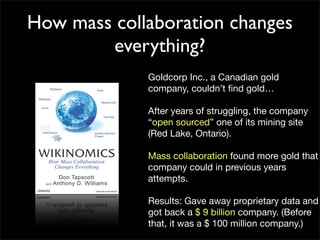
             Goldcorp Inc., a Canadian gold
             company, couldn’t find gold…

             After years of struggling, the company
             “open sourced” one of its mining site
             (Red Lake, Ontario).

             Mass collaboration found more gold that
             company could in previous years
             attempts.

             Results: Gave away proprietary data and
             got back a $ 9 billion company. (Before
             that, it was a $ 100 million company.)
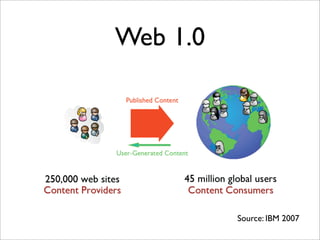
Web 1.0


          Source: IBM 2007
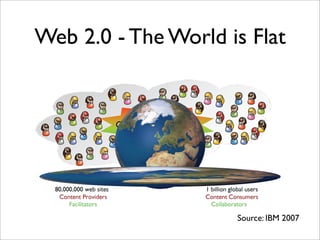
Web 2.0 - The World is Flat


                     Source: IBM 2007
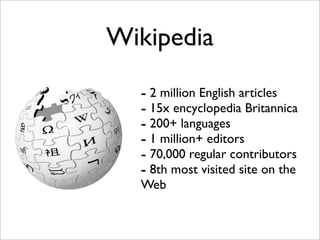
Wikipedia

  - 2 million English articles
  - 15x encyclopedia Britannica
  - 200+ languages
  - 1 million+ editors
  - 70,000 regular contributors
  - 8th most visited site on the
  Web
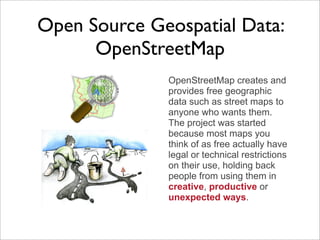
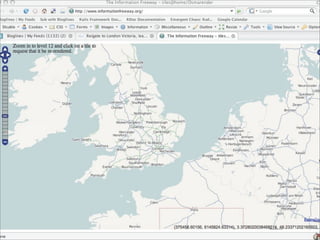
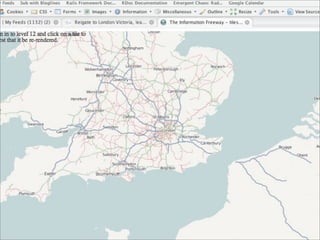
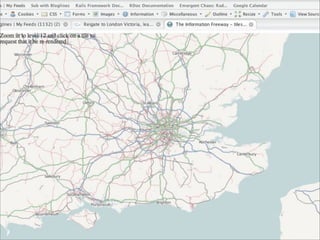
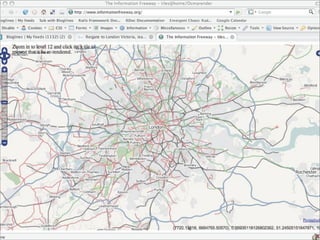
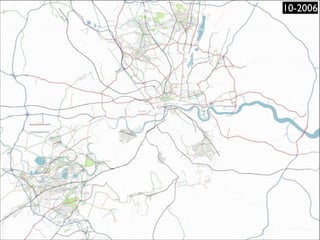
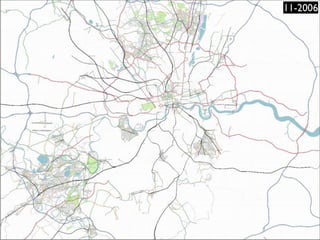
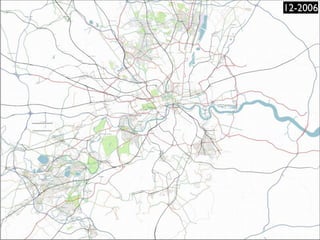
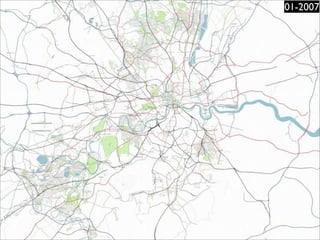
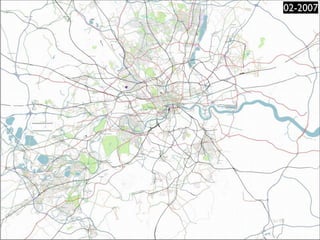
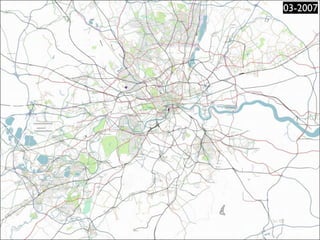
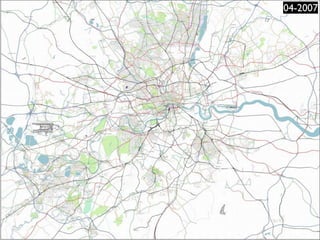
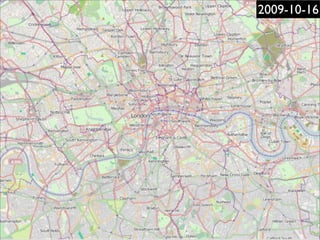
Open Source Geospatial Data:
      OpenStreetMap
              OpenStreetMap creates and
              provides free geographic
              data such as street maps to
              anyone who wants them.
              The project was started
              because most maps you
              think of as free actually have
              legal or technical restrictions
              on their use, holding back
              people from using them in
              creative, productive or
              unexpected ways.
2009-10-16
Sensor
Networks
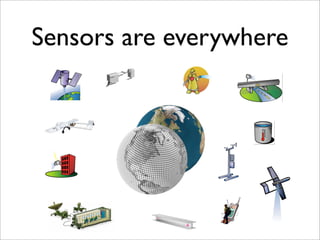
Sensors are everywhere
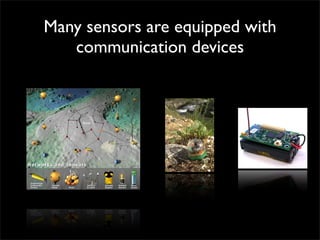
Many sensors are equipped with
   communication devices


  http://www.neptunecanada.ca
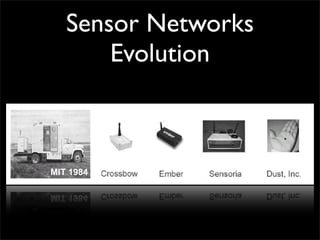
Sensor Networks
       Evolution


MIT 1984
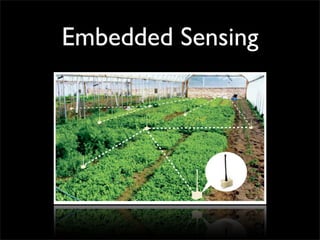
Embedded Sensing
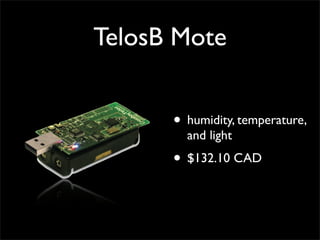
TelosB Mote


      • humidity, temperature,
        and light
      • $132.10 CAD
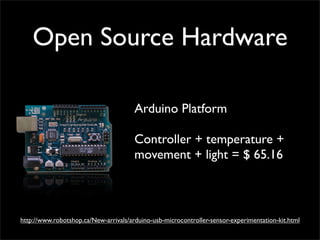
Open Source Hardware

                                       Arduino Platform

                                       Controller + temperature +
                                       movement + light = $ 65.16


http://www.robotshop.ca/New-arrivals/arduino-usb-microcontroller-sensor-experimentation-kit.html
The Macroscope Vision
• The unprecedented amount of sensors will
  allow us to
  • observe the world at very high spatial
    resolution
  • perform these observations continuously
  • collect them in digital form
• They can be considered as intelligent
  computers in the field rather than dumb
  data collectors
Sensor Networks
       to
  Sensor Web
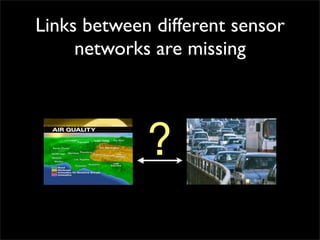
Links between different sensor
     networks are missing


             ?
What if we can remix
  different sensor
   networks for
 unexpected uses?
Innovation in Assembly
        Network Effect

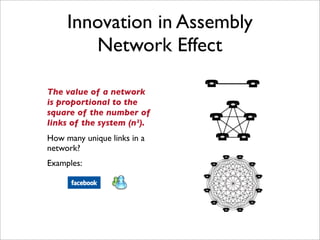
The value of a network
is proportional to the
square of the number of
links of the system (n!).
How many unique links in a
network?
Examples:
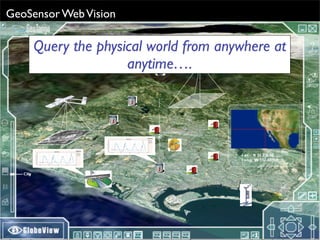
GeoSensor Web Vision

     Query the physical world from anywhere at
                    anytime….
GeoCENS
 GEOspatial Cyberinfrastructure
  for ENvironmental Sensing
GeoCENS Mission Statement


To Enable scientists
• to collaborate on a scale not currently
   possible and ;
• to share and access scientific (sensor)
   data in a way not currently possible.
Function Goals
•   Enable scientists, using an intuitive geographical interface, to
    browse, search for, and access biogeological sensors and data sets

•   Enable sensor/data providers to publish new sensors/data sets
    and make them search-able and access-able

•   Enable users to control sensors when possible

•   Enable users to receive notifications when sensing tasks have
    been completed

•   Enable scientists to build focused, collaborative networks through
    the use of social networking tools

•   Enable users to utilize the CANARIE network to access, transfer
    and share various data sets and collaborate more effectively with
    colleagues around the world
Architectural Goals
• Interoperable
• Scalable
• Extensible
• Rich User Experience
• Performance
• Sustainable
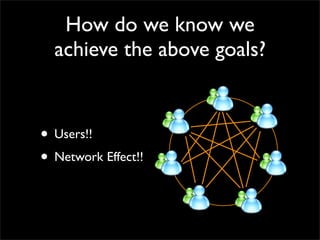
How do we know we
  achieve the above goals?


• Users!!
• Network Effect!!
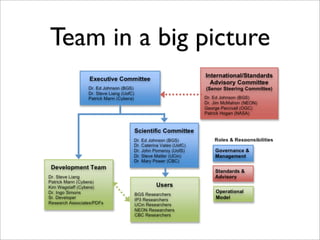
Team in a big picture
GeoCENS
Prototype Demo
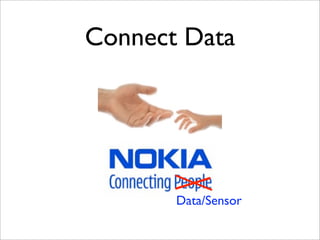
Connect Data


       Data/Sensor
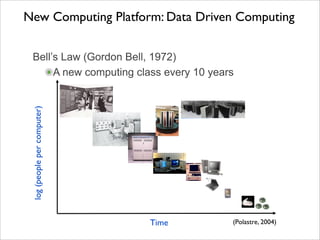
New Computing Platform: Data Driven Computing


 Bell’s Law (Gordon Bell, 1972)
      A new computing class every 10 years
 log (people per computer)


                             Time        (Polastre, 2004)

GeoCENS Presentation

  • 1.
    GeoCENS GEOspatialCyberinfrastructure for ENvironmental Sensing Dr. Steve Liang Assistant Professor GeoSensor Web Lab University of Calgary http://sensorweb.geomatics.ucalgary.ca
  • 2.
  • 3.
    How mass collaborationchanges everything? Goldcorp Inc., a Canadian gold company, couldn’t find gold… After years of struggling, the company “open sourced” one of its mining site (Red Lake, Ontario). Mass collaboration found more gold that company could in previous years attempts. Results: Gave away proprietary data and got back a $ 9 billion company. (Before that, it was a $ 100 million company.)
  • 4.
    Web 1.0 Source: IBM 2007
  • 5.
    Web 2.0 -The World is Flat Source: IBM 2007
  • 6.
    Wikipedia -2 million English articles - 15x encyclopedia Britannica - 200+ languages - 1 million+ editors - 70,000 regular contributors - 8th most visited site on the Web
  • 7.
    Open Source GeospatialData: OpenStreetMap OpenStreetMap creates and provides free geographic data such as street maps to anyone who wants them. The project was started because most maps you think of as free actually have legal or technical restrictions on their use, holding back people from using them in creative, productive or unexpected ways.
  • 19.
  • 20.
  • 21.
  • 22.
    Many sensors areequipped with communication devices http://www.neptunecanada.ca
  • 23.
    Sensor Networks Evolution MIT 1984
  • 24.
  • 25.
    TelosB Mote • humidity, temperature, and light • $132.10 CAD
  • 26.
    Open Source Hardware Arduino Platform Controller + temperature + movement + light = $ 65.16 http://www.robotshop.ca/New-arrivals/arduino-usb-microcontroller-sensor-experimentation-kit.html
  • 27.
    The Macroscope Vision •The unprecedented amount of sensors will allow us to • observe the world at very high spatial resolution • perform these observations continuously • collect them in digital form • They can be considered as intelligent computers in the field rather than dumb data collectors
  • 28.
    Sensor Networks to Sensor Web
  • 29.
    Links between differentsensor networks are missing ?
  • 30.
    What if wecan remix different sensor networks for unexpected uses?
  • 31.
    Innovation in Assembly Network Effect The value of a network is proportional to the square of the number of links of the system (n!). How many unique links in a network? Examples:
  • 32.
    GeoSensor Web Vision Query the physical world from anywhere at anytime….
  • 33.
    GeoCENS GEOspatial Cyberinfrastructure for ENvironmental Sensing
  • 34.
    GeoCENS Mission Statement ToEnable scientists • to collaborate on a scale not currently possible and ; • to share and access scientific (sensor) data in a way not currently possible.
  • 35.
    Function Goals • Enable scientists, using an intuitive geographical interface, to browse, search for, and access biogeological sensors and data sets • Enable sensor/data providers to publish new sensors/data sets and make them search-able and access-able • Enable users to control sensors when possible • Enable users to receive notifications when sensing tasks have been completed • Enable scientists to build focused, collaborative networks through the use of social networking tools • Enable users to utilize the CANARIE network to access, transfer and share various data sets and collaborate more effectively with colleagues around the world
  • 36.
    Architectural Goals • Interoperable •Scalable • Extensible • Rich User Experience • Performance • Sustainable
  • 37.
    How do weknow we achieve the above goals? • Users!! • Network Effect!!
  • 38.
    Team in abig picture
  • 39.
  • 40.
    Connect Data Data/Sensor
  • 41.
    New Computing Platform:Data Driven Computing Bell’s Law (Gordon Bell, 1972) A new computing class every 10 years log (people per computer) Time (Polastre, 2004)