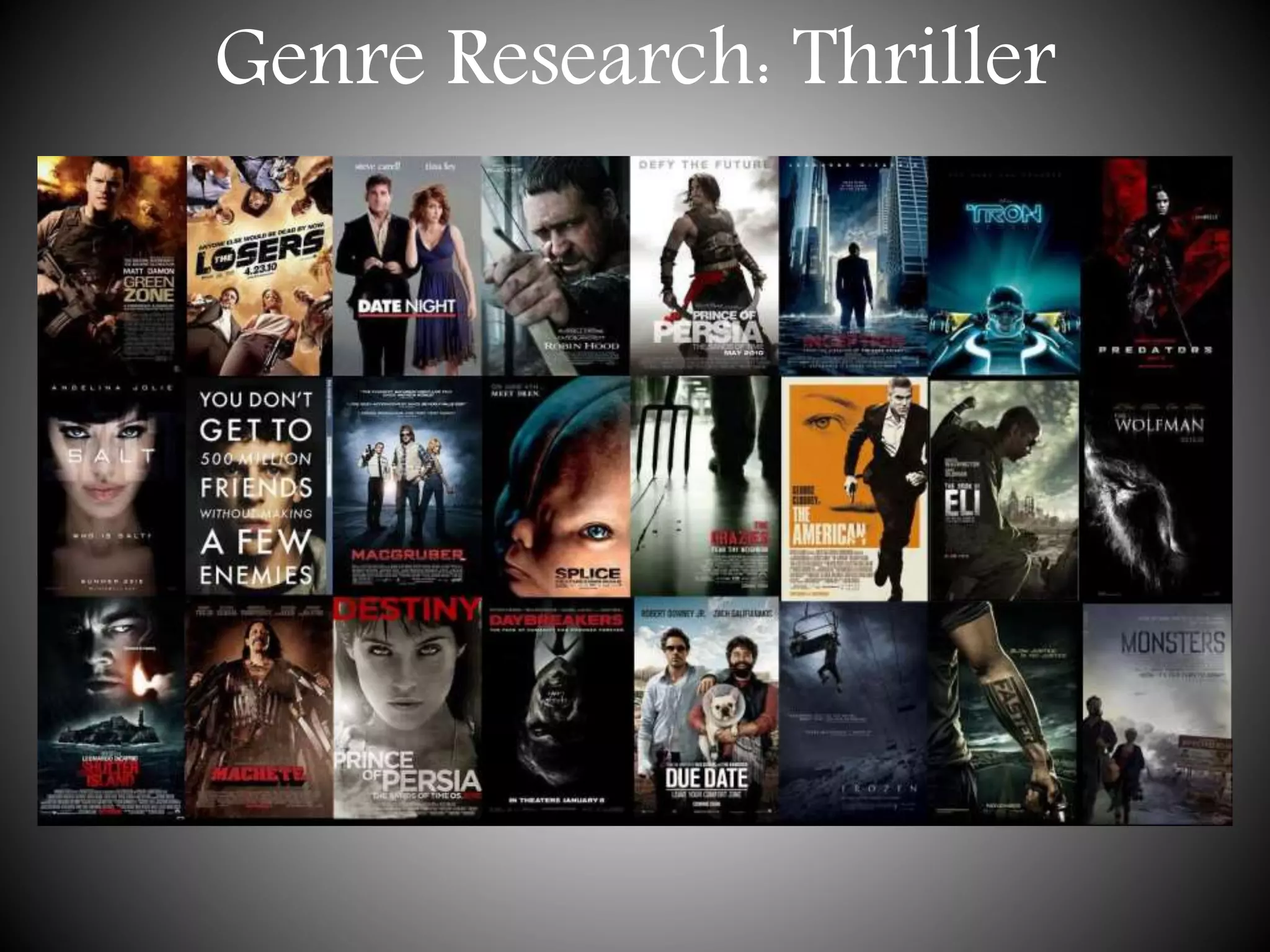
Genre Research: Thriller
History Development
The thriller genre started off in the 1920’s-1930’s when Alfred Hitchcock when he
made his third silent film ‘The lodger’ which was a suspense-filled Jack the ripper
story. He then went on to make his second thriller film ‘Blackmail’ in 1929, and this
being his and Britain's first sound film. Thrillers then began to come more and more
popular and many of them focused on storylines on solving murders and serial killers.
Most of the time people the killers are often close to home. Hitchcock continued to
make more films up until the 60’s which was also no longer black and white. Then
after the 70’s the storylines behind the thrillers became more focused on
psychological issues (such as obsession and paranoia) and also these films included
more explicit murder scenes.
Audience
The target audience for thrillers are usually always 18+. This is because of the
violence and gruesome scenes it contains. It also has many psychological issues
which would be disturbing for the young viewers. The thriller will sometimes be
15+ but that’s if the scenes are not explicit. Thriller films will rarely be open to
watch by anyone under the age of 15. Both men and woman like thrillers I think.
Men like it because of the suspense the way you’re on the edge of your seats and
mystery but also for the action e.g. Violence, car chases. Woman like it because of
the suspense, mystery but also for the typical strong male lead.
Narrative
Thrillers are often based around the genre of crime but it could be based on anything,
with thrillers a lot of hybrids are involved where its two types of genre or a sub genre,
you could have a thriller/horror or a thriller/action so the narrative themes are not as
consistent as it mixed with other genres. In a thriller the narrative is restricted so a lot
of the information is hidden. There is an equilibrium and then the equilibrium is
disrupted and then the equilibrium is restored again. Thriller’s narrative have often a
complex structure, they like to keep the audience guessing on what will happen next
and it has twist and turns. A lot of thrillers have a restricted narrative, questions and
or riddles will be left unanswered until towards the end of the film. Also in narrative
they can put in false clues a ‘McGuffins’, do make the audience think its gone one way
or this certain ‘object’ that was spoken about was important but really it isn’t.
The Different Types of Thrillers
• Comedy thriller: A genre that combines elements of comedy and thrillers, a
combination of humour and suspense or action e.g. Mr and Mrs Smith
• Conspiracy thriller: In which the hero/heroine confronts a large, powerful group
of enemies whose true extent only s/he recognizes e.g. The Chancellor Manuscript
• Crime thriller: This particular genre is a hybrid type of both crime films and
thrillers that offers a suspenseful account of a successful or failed crime or
crimes. These films often focus on the criminal(s) rather than a policeman.
Central topics of these films include serial killers/murders, robberies, chases,
shootouts, heists and double-crosses e.g. Along came a spider
• Erotic thriller: A type of thriller that has an emphasis on eroticism and where a
sexual relationship plays an important role in the plot e.g. Dressed to kill
• Legal thriller: A suspense film in which the major characters are lawyers and
their employees. The system of justice itself is always a major part of these works,
at times almost functioning as one of the characters e.g. silent witness
• Psychological thriller: In which (until the often violent resolution) the conflict
between the main characters is mental and emotional, rather than physical.
Characters, either by accident or their own curiousness, are dragged into a
dangerous conflict or situation that they are not prepared to resolve e.g. Phone
Booth
• Political thriller: In which the hero/heroine must ensure the stability of the
government that employs him e.g. Notorious
Typical Character Types
In thrillers there are several characters which usually are involved in the plot and
narrative, there is almost always a hero type character who is usually a man and they
re store the equilibrium. This person is probably just a normal everyday person who is
‘in the wrong place at the wrong time’ or a police officer. Another word for this is a
Protagonist. Then there is the antagonist (villain) who creates the narrative disruption
and is usually psychotic but extremely clever. Then there is the victim who is usually a
female who is most threatened by the villain and they’re usually not really involved in
the whole crime situation. You also have the donor, the helper, the dispatcher and the
false hero. Not all of these necessarily have to be the main characters or even in it at all
but these are just the usual type of characters that re in the narrative.
Iconography
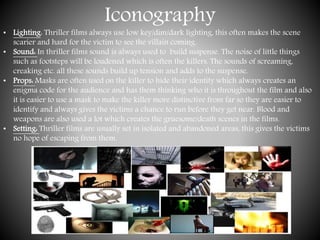
• Lighting: Thriller films always use low key/dim/dark lighting, this often makes the scene
scarier and hard for the victim to see the villain coming.
• Sound: In thriller films sound is always used to build suspense. The noise of little things
such as footsteps will be loudened which is often the killers. The sounds of screaming,
creaking etc. all these sounds build up tension and adds to the suspense.
• Props: Masks are often used on the killer to hide their identity which always creates an
enigma code for the audience and has them thinking who it is throughout the film and also
it is easier to use a mask to make the killer more distinctive from far so they are easier to
identify and always gives the victims a chance to run before they get near. Blood and
weapons are also used a lot which creates the gruesome/death scenes in the films.
• Setting: Thriller films are usually set in isolated and abandoned areas, this gives the victims
no hope of escaping from them.

Genre research; thriller

  • 1.
  • 2.
    History Development The thrillergenre started off in the 1920’s-1930’s when Alfred Hitchcock when he made his third silent film ‘The lodger’ which was a suspense-filled Jack the ripper story. He then went on to make his second thriller film ‘Blackmail’ in 1929, and this being his and Britain's first sound film. Thrillers then began to come more and more popular and many of them focused on storylines on solving murders and serial killers. Most of the time people the killers are often close to home. Hitchcock continued to make more films up until the 60’s which was also no longer black and white. Then after the 70’s the storylines behind the thrillers became more focused on psychological issues (such as obsession and paranoia) and also these films included more explicit murder scenes.
  • 3.
    Audience The target audiencefor thrillers are usually always 18+. This is because of the violence and gruesome scenes it contains. It also has many psychological issues which would be disturbing for the young viewers. The thriller will sometimes be 15+ but that’s if the scenes are not explicit. Thriller films will rarely be open to watch by anyone under the age of 15. Both men and woman like thrillers I think. Men like it because of the suspense the way you’re on the edge of your seats and mystery but also for the action e.g. Violence, car chases. Woman like it because of the suspense, mystery but also for the typical strong male lead.
  • 4.
    Narrative Thrillers are oftenbased around the genre of crime but it could be based on anything, with thrillers a lot of hybrids are involved where its two types of genre or a sub genre, you could have a thriller/horror or a thriller/action so the narrative themes are not as consistent as it mixed with other genres. In a thriller the narrative is restricted so a lot of the information is hidden. There is an equilibrium and then the equilibrium is disrupted and then the equilibrium is restored again. Thriller’s narrative have often a complex structure, they like to keep the audience guessing on what will happen next and it has twist and turns. A lot of thrillers have a restricted narrative, questions and or riddles will be left unanswered until towards the end of the film. Also in narrative they can put in false clues a ‘McGuffins’, do make the audience think its gone one way or this certain ‘object’ that was spoken about was important but really it isn’t.
  • 5.
    The Different Typesof Thrillers • Comedy thriller: A genre that combines elements of comedy and thrillers, a combination of humour and suspense or action e.g. Mr and Mrs Smith • Conspiracy thriller: In which the hero/heroine confronts a large, powerful group of enemies whose true extent only s/he recognizes e.g. The Chancellor Manuscript • Crime thriller: This particular genre is a hybrid type of both crime films and thrillers that offers a suspenseful account of a successful or failed crime or crimes. These films often focus on the criminal(s) rather than a policeman. Central topics of these films include serial killers/murders, robberies, chases, shootouts, heists and double-crosses e.g. Along came a spider • Erotic thriller: A type of thriller that has an emphasis on eroticism and where a sexual relationship plays an important role in the plot e.g. Dressed to kill • Legal thriller: A suspense film in which the major characters are lawyers and their employees. The system of justice itself is always a major part of these works, at times almost functioning as one of the characters e.g. silent witness • Psychological thriller: In which (until the often violent resolution) the conflict between the main characters is mental and emotional, rather than physical. Characters, either by accident or their own curiousness, are dragged into a dangerous conflict or situation that they are not prepared to resolve e.g. Phone Booth • Political thriller: In which the hero/heroine must ensure the stability of the government that employs him e.g. Notorious
  • 6.
    Typical Character Types Inthrillers there are several characters which usually are involved in the plot and narrative, there is almost always a hero type character who is usually a man and they re store the equilibrium. This person is probably just a normal everyday person who is ‘in the wrong place at the wrong time’ or a police officer. Another word for this is a Protagonist. Then there is the antagonist (villain) who creates the narrative disruption and is usually psychotic but extremely clever. Then there is the victim who is usually a female who is most threatened by the villain and they’re usually not really involved in the whole crime situation. You also have the donor, the helper, the dispatcher and the false hero. Not all of these necessarily have to be the main characters or even in it at all but these are just the usual type of characters that re in the narrative.
  • 7.
    Iconography • Lighting: Thrillerfilms always use low key/dim/dark lighting, this often makes the scene scarier and hard for the victim to see the villain coming. • Sound: In thriller films sound is always used to build suspense. The noise of little things such as footsteps will be loudened which is often the killers. The sounds of screaming, creaking etc. all these sounds build up tension and adds to the suspense. • Props: Masks are often used on the killer to hide their identity which always creates an enigma code for the audience and has them thinking who it is throughout the film and also it is easier to use a mask to make the killer more distinctive from far so they are easier to identify and always gives the victims a chance to run before they get near. Blood and weapons are also used a lot which creates the gruesome/death scenes in the films. • Setting: Thriller films are usually set in isolated and abandoned areas, this gives the victims no hope of escaping from them.