Genetics in Sickle Cell
Disease
TABLE OF CONTENTS
1. What Are Genes
2. How Are Genes Related To Sickle Cell Disease
3. Sickle Cell Anaemia
4. Sickle Cell Trait
5. Facts About Sickle Cell Trait
6. Video Watching
7. References
LEARNING OUTCOMES
• By the end of the lesson the learners should be able to:
• Define genes
• Relationship between genes and sickle cell disease
• Define sickle cell trait
• Facts about sickle cell trait
KEY INQUIRY QUESTIONS (KIQS)
• What are genes?
• How are genes linked to sickle cell disease?
• What is sickle cell trait?
• Why is knowing your genotype important
• How does genotype affect family health decisions?
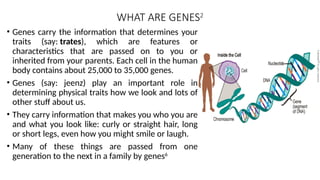
WHAT ARE GENES2
• Genes carry the information that determines your
traits (say: trates), which are features or
characteristics that are passed on to you or
inherited from your parents. Each cell in the human
body contains about 25,000 to 35,000 genes.
• Genes (say: jeenz) play an important role in
determining physical traits how we look and lots of
other stuff about us.
• They carry information that makes you who you are
and what you look like: curly or straight hair, long
or short legs, even how you might smile or laugh.
• Many of these things are passed from one
generation to the next in a family by genes6
HOW ARE GENES RELATED TO SICKLE CELL DISEASE
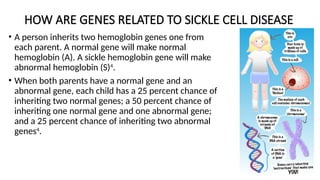
• A person inherits two hemoglobin genes one from
each parent. A normal gene will make normal
hemoglobin (A). A sickle hemoglobin gene will make
abnormal hemoglobin (S)4
.
• When both parents have a normal gene and an
abnormal gene, each child has a 25 percent chance of
inheriting two normal genes; a 50 percent chance of
inheriting one normal gene and one abnormal gene;
and a 25 percent chance of inheriting two abnormal
genes4
.
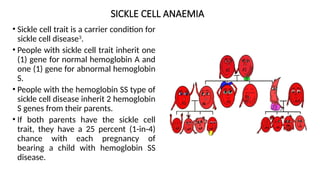
SICKLE CELL ANAEMIA
• Sickle cell trait is a carrier condition for
sickle cell disease3
.
• People with sickle cell trait inherit one
(1) gene for normal hemoglobin A and
one (1) gene for abnormal hemoglobin
S.
• People with the hemoglobin SS type of
sickle cell disease inherit 2 hemoglobin
S genes from their parents.
• If both parents have the sickle cell
trait, they have a 25 percent (1-in-4)
chance with each pregnancy of
bearing a child with hemoglobin SS
disease.
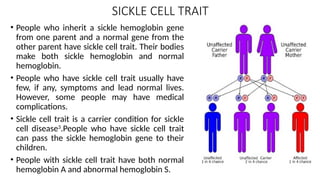
SICKLE CELL TRAIT
• People who inherit a sickle hemoglobin gene
from one parent and a normal gene from the
other parent have sickle cell trait. Their bodies
make both sickle hemoglobin and normal
hemoglobin.
• People who have sickle cell trait usually have
few, if any, symptoms and lead normal lives.
However, some people may have medical
complications.
• Sickle cell trait is a carrier condition for sickle
cell disease3
.People who have sickle cell trait
can pass the sickle hemoglobin gene to their
children.
• People with sickle cell trait have both normal
hemoglobin A and abnormal hemoglobin S.
FACTS ABOUT SICKLE CELL TRAIT
• Sickle cell trait affects about one (1) out of every 12 African Americans.
• Sickle cell trait is inherited from one (1) parent.
• Sickle cell trait provides a ā€œgenetic windowā€ into a family that may be at risk for
having a child with sickle cell disease
• People with sickle cell trait have both normal hemoglobin A and abnormal
hemoglobin S.
• Sickle cell trait can only be found with a blood test.
• It is believed that sickle cell trait first appeared long ago in areas of the world
where people were sick with malaria. Usually, a person with sickle cell trait has
increased protection against malaria.
• Sickle cell trait is not a disease. People with sickle cell trait do not develop
sickle cell disease.
• People rarely have health problems caused by the sickle cell trait except under
certain circumstances.
POINTS TO NOTE
• People with sickle cell disease have red
blood cells that contain mostly hemoglobin S
(sickle hemoglobin).
• These red blood cells can become sickle
(banana) shaped and block normal blood
flow.
• Many of the complications of sickle cell
disease are a result of the blood vessels
getting blocked.
• Sickle cell disease is inherited. The most
common types of sickle cell disease are
hemoglobin SS, hemoglobin SC, and
hemoglobin Sβ thalassemia.
• Red Blood cells flow through the lungs and
collect oxygen. Then the blood travels to the
heart and is pumped to the rest of the body.
• Sickle-shaped red blood cells block small
vessels and eventually the area becomes
damaged
• The hemoglobin level and the hematocrit
are part of a lab test called the complete
blood count (CBC). These levels are
tested to see if a person is anemic.
• A normal hemoglobin level is about 11–
15 g/dL (depending on your age and
gender), and a normal hematocrit is
about 34–42 percent.
• A person with a value that is below
normal is said to be anemic. The anemia
from sickle cell disease cannot be
corrected by taking iron
VIDEO WATCHING
https://360.articulate.com/review/content/63a9c10f-197b-48ee-a73e-
459bed62213d/review
REFERENCES
• St. Jude Children’s Research Hospital. TA K I N G C O N T R O L : Teens with Sickle Cell
Disease. Published online 2021.
• Children J. Genes for Teens with Sickle Cell Disease. 2012;14.
• Comprehensive Sickle Cell Disease Program | Children’s National Health System.
• Accessed September 5, 2024.
https://www.childrensnational.org/get-care/departments/sickle-cell-disease-program/
family-resources
• Red N, Cells B, Cells S. What Is Sickle Cell Anemia ? Other Names for Sickle Cell Anemia. :1-
20.
• Hospital st. JCR. Educator ’ s Guide to Sickle Cell and School.
• Educational Resources for Sickle Cell Disease | St. Jude Care & Treatment. Accessed
• September 8, 2024. https://www.stjude.org/care-treatment/treatment/blood-
disorders/educational-resources.html
Genetics sickle cell power point session 2.pptx

  • 1.
    Genetics in SickleCell Disease
  • 2.
    TABLE OF CONTENTS 1.What Are Genes 2. How Are Genes Related To Sickle Cell Disease 3. Sickle Cell Anaemia 4. Sickle Cell Trait 5. Facts About Sickle Cell Trait 6. Video Watching 7. References
  • 3.
    LEARNING OUTCOMES • Bythe end of the lesson the learners should be able to: • Define genes • Relationship between genes and sickle cell disease • Define sickle cell trait • Facts about sickle cell trait
  • 4.
    KEY INQUIRY QUESTIONS(KIQS) • What are genes? • How are genes linked to sickle cell disease? • What is sickle cell trait? • Why is knowing your genotype important • How does genotype affect family health decisions?
  • 5.
    WHAT ARE GENES2 •Genes carry the information that determines your traits (say: trates), which are features or characteristics that are passed on to you or inherited from your parents. Each cell in the human body contains about 25,000 to 35,000 genes. • Genes (say: jeenz) play an important role in determining physical traits how we look and lots of other stuff about us. • They carry information that makes you who you are and what you look like: curly or straight hair, long or short legs, even how you might smile or laugh. • Many of these things are passed from one generation to the next in a family by genes6
  • 6.
    HOW ARE GENESRELATED TO SICKLE CELL DISEASE • A person inherits two hemoglobin genes one from each parent. A normal gene will make normal hemoglobin (A). A sickle hemoglobin gene will make abnormal hemoglobin (S)4 . • When both parents have a normal gene and an abnormal gene, each child has a 25 percent chance of inheriting two normal genes; a 50 percent chance of inheriting one normal gene and one abnormal gene; and a 25 percent chance of inheriting two abnormal genes4 .
  • 7.
    SICKLE CELL ANAEMIA •Sickle cell trait is a carrier condition for sickle cell disease3 . • People with sickle cell trait inherit one (1) gene for normal hemoglobin A and one (1) gene for abnormal hemoglobin S. • People with the hemoglobin SS type of sickle cell disease inherit 2 hemoglobin S genes from their parents. • If both parents have the sickle cell trait, they have a 25 percent (1-in-4) chance with each pregnancy of bearing a child with hemoglobin SS disease.
  • 8.
    SICKLE CELL TRAIT •People who inherit a sickle hemoglobin gene from one parent and a normal gene from the other parent have sickle cell trait. Their bodies make both sickle hemoglobin and normal hemoglobin. • People who have sickle cell trait usually have few, if any, symptoms and lead normal lives. However, some people may have medical complications. • Sickle cell trait is a carrier condition for sickle cell disease3 .People who have sickle cell trait can pass the sickle hemoglobin gene to their children. • People with sickle cell trait have both normal hemoglobin A and abnormal hemoglobin S.
  • 9.
    FACTS ABOUT SICKLECELL TRAIT • Sickle cell trait affects about one (1) out of every 12 African Americans. • Sickle cell trait is inherited from one (1) parent. • Sickle cell trait provides a ā€œgenetic windowā€ into a family that may be at risk for having a child with sickle cell disease • People with sickle cell trait have both normal hemoglobin A and abnormal hemoglobin S. • Sickle cell trait can only be found with a blood test. • It is believed that sickle cell trait first appeared long ago in areas of the world where people were sick with malaria. Usually, a person with sickle cell trait has increased protection against malaria. • Sickle cell trait is not a disease. People with sickle cell trait do not develop sickle cell disease. • People rarely have health problems caused by the sickle cell trait except under certain circumstances.
  • 10.
    POINTS TO NOTE •People with sickle cell disease have red blood cells that contain mostly hemoglobin S (sickle hemoglobin). • These red blood cells can become sickle (banana) shaped and block normal blood flow. • Many of the complications of sickle cell disease are a result of the blood vessels getting blocked. • Sickle cell disease is inherited. The most common types of sickle cell disease are hemoglobin SS, hemoglobin SC, and hemoglobin Sβ thalassemia. • Red Blood cells flow through the lungs and collect oxygen. Then the blood travels to the heart and is pumped to the rest of the body. • Sickle-shaped red blood cells block small vessels and eventually the area becomes damaged • The hemoglobin level and the hematocrit are part of a lab test called the complete blood count (CBC). These levels are tested to see if a person is anemic. • A normal hemoglobin level is about 11– 15 g/dL (depending on your age and gender), and a normal hematocrit is about 34–42 percent. • A person with a value that is below normal is said to be anemic. The anemia from sickle cell disease cannot be corrected by taking iron
  • 11.
  • 12.
    REFERENCES • St. JudeChildren’s Research Hospital. TA K I N G C O N T R O L : Teens with Sickle Cell Disease. Published online 2021. • Children J. Genes for Teens with Sickle Cell Disease. 2012;14. • Comprehensive Sickle Cell Disease Program | Children’s National Health System. • Accessed September 5, 2024. https://www.childrensnational.org/get-care/departments/sickle-cell-disease-program/ family-resources • Red N, Cells B, Cells S. What Is Sickle Cell Anemia ? Other Names for Sickle Cell Anemia. :1- 20. • Hospital st. JCR. Educator ’ s Guide to Sickle Cell and School. • Educational Resources for Sickle Cell Disease | St. Jude Care & Treatment. Accessed • September 8, 2024. https://www.stjude.org/care-treatment/treatment/blood- disorders/educational-resources.html