Genetics Analysis and Principles 6th Edition
Brooker Test Bank download
https://testbankfan.com/product/genetics-analysis-and-
principles-6th-edition-brooker-test-bank/
Visit testbankfan.com today to download the complete set of
test bank or solution manual
We believe these products will be a great fit for you. Click
the link to download now, or visit testbankfan.com
to discover even more!
Genetics Analysis and Principles 6th Edition Brooker
Solutions Manual
https://testbankfan.com/product/genetics-analysis-and-principles-6th-
edition-brooker-solutions-manual/
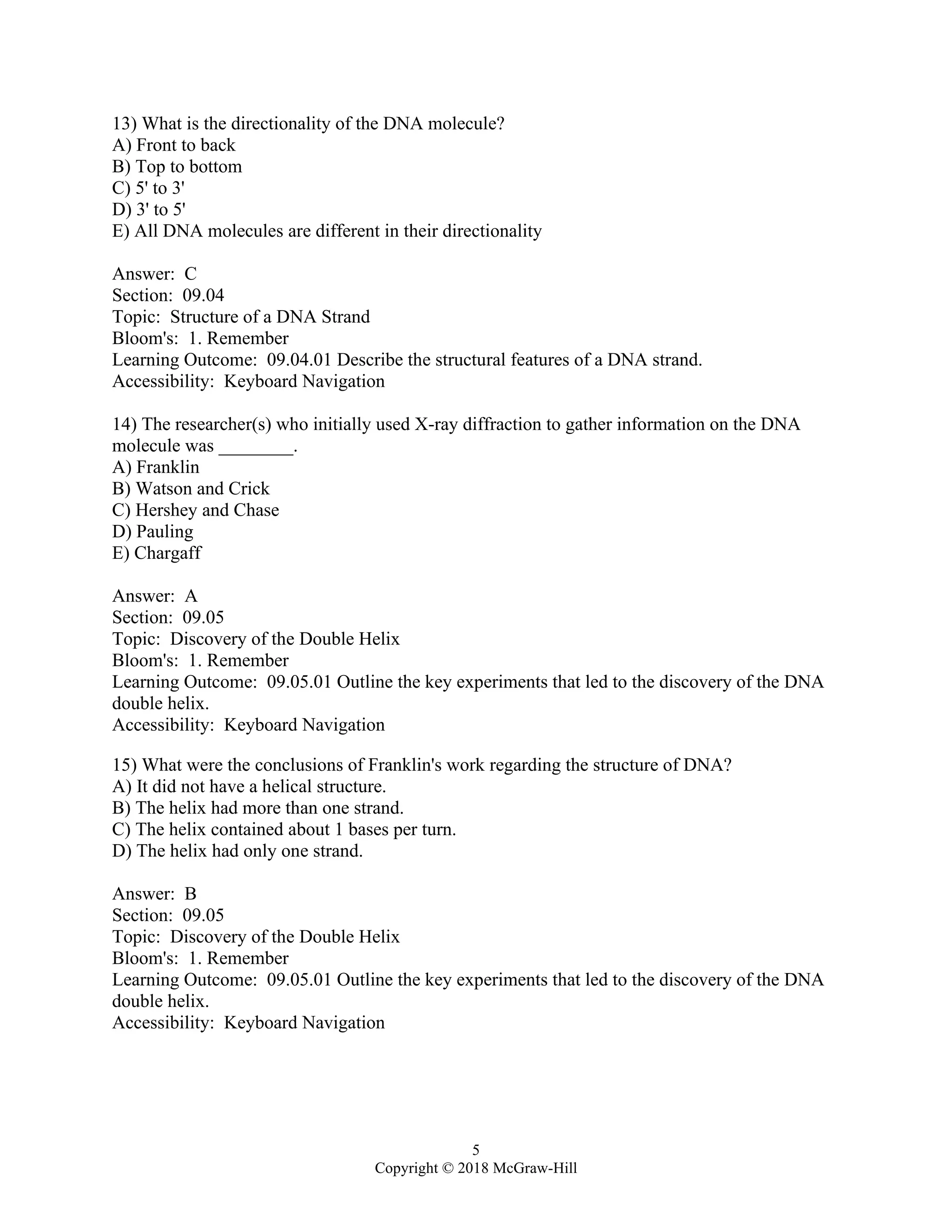
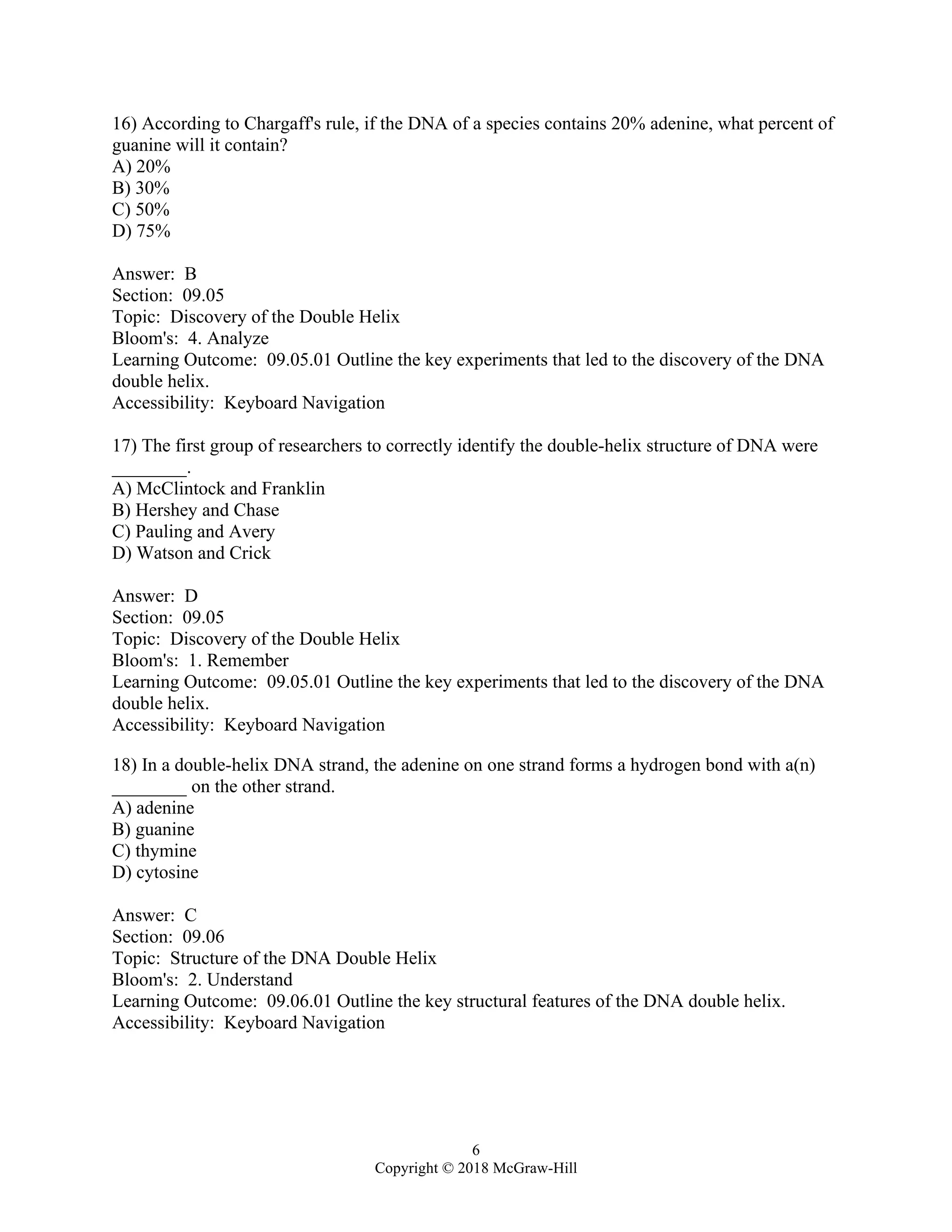
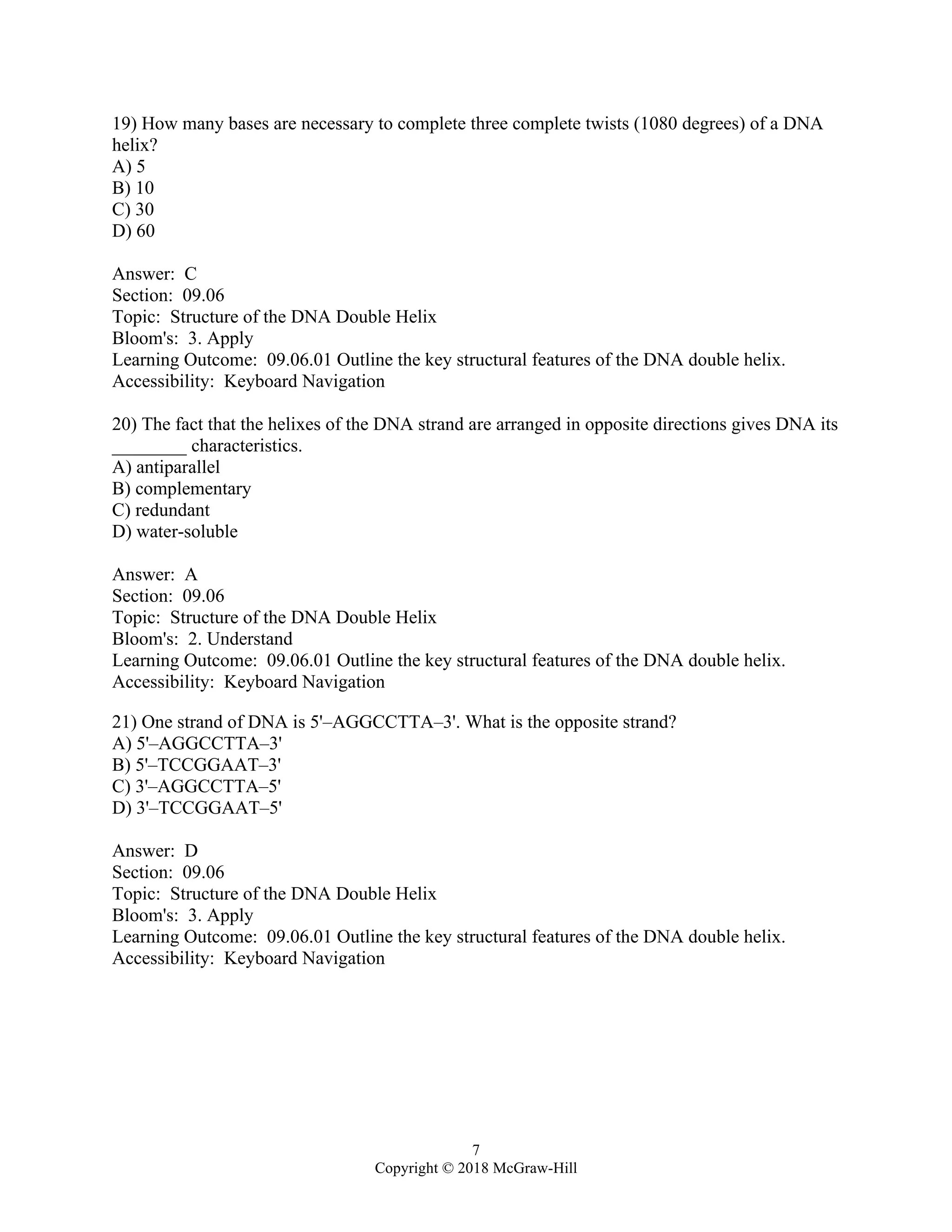
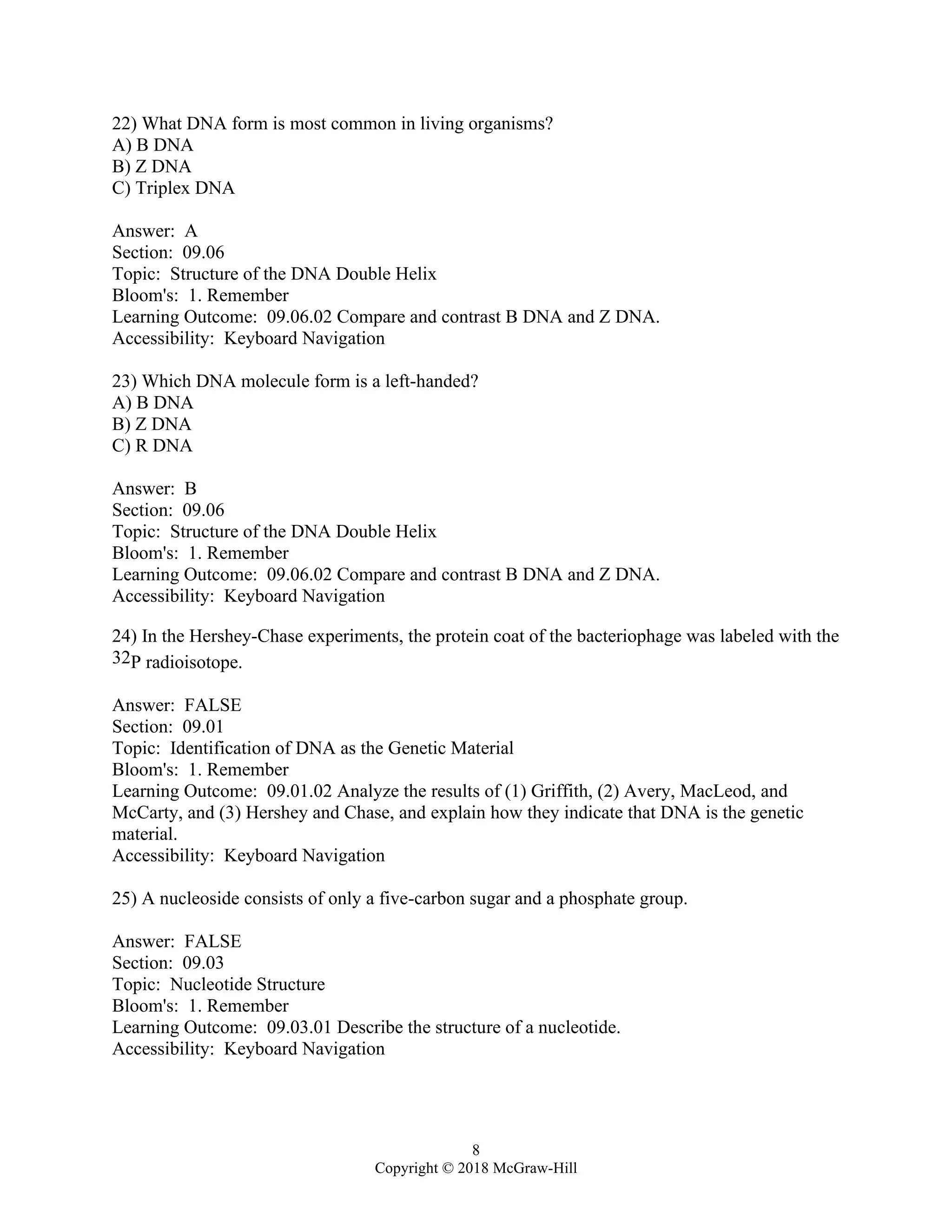
Genetics Analysis and Principles 5th Edition Brooker Test
Bank
https://testbankfan.com/product/genetics-analysis-and-principles-5th-
edition-brooker-test-bank/
Genetics Analysis and Principles 4th Edition Brooker Test
Bank
https://testbankfan.com/product/genetics-analysis-and-principles-4th-
edition-brooker-test-bank/
Essentials of Strategic Management The Quest for
Competitive Advantage 6th Edition Gamble Solutions Manual
https://testbankfan.com/product/essentials-of-strategic-management-
the-quest-for-competitive-advantage-6th-edition-gamble-solutions-
manual/
Exploring Microsoft Office 2013 Volume 2 1st Edition
Poatsy Test Bank
https://testbankfan.com/product/exploring-microsoft-
office-2013-volume-2-1st-edition-poatsy-test-bank/
Mechanics of Materials 9th Edition Goodno Test Bank
https://testbankfan.com/product/mechanics-of-materials-9th-edition-
goodno-test-bank/
Sociology A Down To Earth Approach 12th Edition Henslin
Test Bank
https://testbankfan.com/product/sociology-a-down-to-earth-
approach-12th-edition-henslin-test-bank/
Psychology of Language 5th Edition Carroll Test Bank
https://testbankfan.com/product/psychology-of-language-5th-edition-
carroll-test-bank/
M and B 3 Hybrid 3rd Edition Dean Croushore Solutions
Manual
https://testbankfan.com/product/m-and-b-3-hybrid-3rd-edition-dean-
croushore-solutions-manual/
Electronic Commerce 2010 6th Edition Turban Test Bank
https://testbankfan.com/product/electronic-commerce-2010-6th-edition-
turban-test-bank/
1
Copyright © 2018 McGraw-Hill
Genetics, 6e (Brooker)
Chapter 9 Molecular Structure of DNA and RNA
1) Frederick Griffith is responsible for discovering what process?
A) Replication
B) Transmission
C) Transformation
D) Transduction
Answer: C
Section: 09.01
Topic: Identification of DNA as the Genetic Material
Bloom's: 1. Remember
Learning Outcome: 09.01.02 Analyze the results of (1) Griffith, (2) Avery, MacLeod, and
McCarty, and (3) Hershey and Chase, and explain how they indicate that DNA is the genetic
material.
Accessibility: Keyboard Navigation
2) The fact that the type R and S strains of Streptococcus pneumoniae that Griffith worked with
possessed small differences in capsule structure satisfies which of the following criteria for
genetic material?
A) Transmission
B) Replication
C) Information
D) Variation
Answer: D
Section: 09.01
Topic: Identification of DNA as the Genetic Material
Bloom's: 2. Understand
Learning Outcome: 09.01.01 Describe the four criteria that the genetic material must meet.
Accessibility: Keyboard Navigation
3) The individuals who determined that Griffith's transforming principle was DNA were
________.
A) Hershey and Chase
B) Avery, Macleod, and McCarty
C) Watson and Crick
D) Creighton and McClintock
Answer: B
Section: 09.01
Topic: Identification of DNA as the Genetic Material
Bloom's: 1. Remember
Learning Outcome: 09.01.02 Analyze the results of (1) Griffith, (2) Avery, MacLeod, and
McCarty, and (3) Hershey and Chase, and explain how they indicate that DNA is the genetic
material.
Accessibility: Keyboard Navigation
2
Copyright © 2018 McGraw-Hill
4) These individuals determined that DNA was responsible for the process of transduction in T2
phage.
A) Hershey and Chase
B) Avery, Macleod, and McCarty
C) Watson and Crick
D) Creighton and McClintock
Answer: A
Section: 09.01
Topic: Identification of DNA as the Genetic Material
Bloom's: 1. Remember
Learning Outcome: 09.01.02 Analyze the results of (1) Griffith, (2) Avery, MacLeod, and
McCarty, and (3) Hershey and Chase, and explain how they indicate that DNA is the genetic
material.
Accessibility: Keyboard Navigation
5) What is a characteristic of T2 bacteriophage?
A) It does not require a host cell for replication.
B) The phage attaches to the cell wall of a target eukaryotic cell.
C) The phages injects its DNA into the host cell.
D) The new phages are formed outside the host cell.
Answer: C
Section: 09.01
Topic: Identification of DNA as the Genetic Material
Bloom's: 2. Understand
Learning Outcome: 09.01.02 Analyze the results of (1) Griffith, (2) Avery, MacLeod, and
McCarty, and (3) Hershey and Chase, and explain how they indicate that DNA is the genetic
material.
Accessibility: Keyboard Navigation
6) What was the conclusion of the Hershey-Chase experiments?
A) Their results suggested the presence of a transforming principle.
B) Their results suggested that DNA is a double helix.
C) Their results suggested that A+G=T+C.
D) Their results suggested that the DNA is the genetic material.
Answer: D
Section: 09.01
Topic: Identification of DNA as the Genetic Material
Bloom's: 2. Understand
Learning Outcome: 09.01.02 Analyze the results of (1) Griffith, (2) Avery, MacLeod, and
McCarty, and (3) Hershey and Chase, and explain how they indicate that DNA is the genetic
material.
Accessibility: Keyboard Navigation
3
Copyright © 2018 McGraw-Hill
7) The building blocks of DNA are called ________.
A) amino acids
B) codons
C) nucleotides
D) alleles
Answer: C
Section: 09.02
Topic: Overview of DNA and RNA Structure
Bloom's: 1. Remember
Learning Outcome: 09.02.01 Define nucleic acid.
Accessibility: Keyboard Navigation
8) What is a component of a single nucleotide?
A) A phosphate group
B) A six carbon sugar
C) All five nitrogenous bases
Answer: A
Section: 09.03
Topic: Nucleotide Structure
Bloom's: 2. Understand
Learning Outcome: 09.03.01 Describe the structure of a nucleotide.
Accessibility: Keyboard Navigation
9) How does DNA differ from RNA?
A) RNA uses only purines.
B) RNA uses a different five-carbon sugar.
C) RNA has a contains different sized phosphate groups.
D) RNA has multiple bases attached to the sugar.
Answer: B
Section: 09.03
Topic: Nucleotide Structure
Bloom's: 2. Understand
Learning Outcome: 09.03.02 Compare and contrast the structures of nucleotides found in DNA
and in RNA.
Accessibility: Keyboard Navigation
4
Copyright © 2018 McGraw-Hill
10) Which base is not found in DNA?
A) Cytosine
B) Guanine
C) Thymidine
D) Adenine
E) Uracil
Answer: E
Section: 09.03
Topic: Nucleotide Structure
Bloom's: 1. Remember
Learning Outcome: 09.03.02 Compare and contrast the structures of nucleotides found in DNA
and in RNA.
Accessibility: Keyboard Navigation
11) The backbone of the DNA molecule is formed by ________.
A) peptide bonds
B) ribose sugars
C) nitrogenous bases
D) phosphodiester bonds
Answer: D
Section: 09.04
Topic: Structure of a DNA Strand
Bloom's: 1. Remember
Learning Outcome: 09.04.01 Describe the structural features of a DNA strand.
Accessibility: Keyboard Navigation
12) The individual(s) who used ball and stick models to identify the three-dimensional structure
of proteins was ________.
A) Franklin
B) Watson and Crick
C) Hershey and Chase
D) Pauling
E) Chargaff
Answer: D
Section: 09.05
Topic: Discovery of the Double Helix
Bloom's: 1. Remember
Learning Outcome: 09.05.01 Outline the key experiments that led to the discovery of the DNA
double helix.
Accessibility: Keyboard Navigation
5
Copyright © 2018 McGraw-Hill
13) What is the directionality of the DNA molecule?
A) Front to back
B) Top to bottom
C) 5' to 3'
D) 3' to 5'
E) All DNA molecules are different in their directionality
Answer: C
Section: 09.04
Topic: Structure of a DNA Strand
Bloom's: 1. Remember
Learning Outcome: 09.04.01 Describe the structural features of a DNA strand.
Accessibility: Keyboard Navigation
14) The researcher(s) who initially used X-ray diffraction to gather information on the DNA
molecule was ________.
A) Franklin
B) Watson and Crick
C) Hershey and Chase
D) Pauling
E) Chargaff
Answer: A
Section: 09.05
Topic: Discovery of the Double Helix
Bloom's: 1. Remember
Learning Outcome: 09.05.01 Outline the key experiments that led to the discovery of the DNA
double helix.
Accessibility: Keyboard Navigation
15) What were the conclusions of Franklin's work regarding the structure of DNA?
A) It did not have a helical structure.
B) The helix had more than one strand.
C) The helix contained about 1 bases per turn.
D) The helix had only one strand.
Answer: B
Section: 09.05
Topic: Discovery of the Double Helix
Bloom's: 1. Remember
Learning Outcome: 09.05.01 Outline the key experiments that led to the discovery of the DNA
double helix.
Accessibility: Keyboard Navigation
6
Copyright © 2018 McGraw-Hill
16) According to Chargaff's rule, if the DNA of a species contains 20% adenine, what percent of
guanine will it contain?
A) 20%
B) 30%
C) 50%
D) 75%
Answer: B
Section: 09.05
Topic: Discovery of the Double Helix
Bloom's: 4. Analyze
Learning Outcome: 09.05.01 Outline the key experiments that led to the discovery of the DNA
double helix.
Accessibility: Keyboard Navigation
17) The first group of researchers to correctly identify the double-helix structure of DNA were
________.
A) McClintock and Franklin
B) Hershey and Chase
C) Pauling and Avery
D) Watson and Crick
Answer: D
Section: 09.05
Topic: Discovery of the Double Helix
Bloom's: 1. Remember
Learning Outcome: 09.05.01 Outline the key experiments that led to the discovery of the DNA
double helix.
Accessibility: Keyboard Navigation
18) In a double-helix DNA strand, the adenine on one strand forms a hydrogen bond with a(n)
________ on the other strand.
A) adenine
B) guanine
C) thymine
D) cytosine
Answer: C
Section: 09.06
Topic: Structure of the DNA Double Helix
Bloom's: 2. Understand
Learning Outcome: 09.06.01 Outline the key structural features of the DNA double helix.
Accessibility: Keyboard Navigation
7
Copyright © 2018 McGraw-Hill
19) How many bases are necessary to complete three complete twists (1080 degrees) of a DNA
helix?
A) 5
B) 10
C) 30
D) 60
Answer: C
Section: 09.06
Topic: Structure of the DNA Double Helix
Bloom's: 3. Apply
Learning Outcome: 09.06.01 Outline the key structural features of the DNA double helix.
Accessibility: Keyboard Navigation
20) The fact that the helixes of the DNA strand are arranged in opposite directions gives DNA its
________ characteristics.
A) antiparallel
B) complementary
C) redundant
D) water-soluble
Answer: A
Section: 09.06
Topic: Structure of the DNA Double Helix
Bloom's: 2. Understand
Learning Outcome: 09.06.01 Outline the key structural features of the DNA double helix.
Accessibility: Keyboard Navigation
21) One strand of DNA is 5'–AGGCCTTA–3'. What is the opposite strand?
A) 5'–AGGCCTTA–3'
B) 5'–TCCGGAAT–3'
C) 3'–AGGCCTTA–5'
D) 3'–TCCGGAAT–5'
Answer: D
Section: 09.06
Topic: Structure of the DNA Double Helix
Bloom's: 3. Apply
Learning Outcome: 09.06.01 Outline the key structural features of the DNA double helix.
Accessibility: Keyboard Navigation
8
Copyright © 2018 McGraw-Hill
22) What DNA form is most common in living organisms?
A) B DNA
B) Z DNA
C) Triplex DNA
Answer: A
Section: 09.06
Topic: Structure of the DNA Double Helix
Bloom's: 1. Remember
Learning Outcome: 09.06.02 Compare and contrast B DNA and Z DNA.
Accessibility: Keyboard Navigation
23) Which DNA molecule form is a left-handed?
A) B DNA
B) Z DNA
C) R DNA
Answer: B
Section: 09.06
Topic: Structure of the DNA Double Helix
Bloom's: 1. Remember
Learning Outcome: 09.06.02 Compare and contrast B DNA and Z DNA.
Accessibility: Keyboard Navigation
24) In the Hershey-Chase experiments, the protein coat of the bacteriophage was labeled with the
32P radioisotope.
Answer: FALSE
Section: 09.01
Topic: Identification of DNA as the Genetic Material
Bloom's: 1. Remember
Learning Outcome: 09.01.02 Analyze the results of (1) Griffith, (2) Avery, MacLeod, and
McCarty, and (3) Hershey and Chase, and explain how they indicate that DNA is the genetic
material.
Accessibility: Keyboard Navigation
25) A nucleoside consists of only a five-carbon sugar and a phosphate group.
Answer: FALSE
Section: 09.03
Topic: Nucleotide Structure
Bloom's: 1. Remember
Learning Outcome: 09.03.01 Describe the structure of a nucleotide.
Accessibility: Keyboard Navigation
9
Copyright © 2018 McGraw-Hill
26) B DNA is recognized as a left-handed molecule.
Answer: FALSE
Section: 09.06
Topic: Structure of the DNA Double Helix
Bloom's: 1. Remember
Learning Outcome: 09.06.01 Outline the key structural features of the DNA double helix.
Accessibility: Keyboard Navigation
27) A purine on one strand of the DNA is always paired with a pyrimidine on the other strand.
Answer: TRUE
Section: 09.06
Topic: Structure of the DNA Double Helix
Bloom's: 1. Remember
Learning Outcome: 09.06.01 Outline the key structural features of the DNA double helix.
Accessibility: Keyboard Navigation
28) The helical shape of the DNA contains major and minor grooves, which assist in the
regulating of gene expression.
Answer: TRUE
Section: 09.06
Topic: Structure of the DNA Double Helix
Bloom's: 1. Remember
Learning Outcome: 09.06.01 Outline the key structural features of the DNA double helix.
Accessibility: Keyboard Navigation
29) A DNA strand can be described as antiparallel but uncomplementary.
Answer: FALSE
Section: 09.06
Topic: Structure of the DNA Double Helix
Bloom's: 2. Understand
Learning Outcome: 09.06.01 Outline the key structural features of the DNA double helix.
Accessibility: Keyboard Navigation
10
Copyright © 2018 McGraw-Hill
30) Avery used the enzyme ________ to remove the proteins from the cell extracts.
A) protease
B) DNase
C) RNase
D) All of the answers are correct
Answer: A
Section: 09.01
Topic: Identification of DNA as the Genetic Material
Bloom's: 1. Remember
Learning Outcome: 09.01.02 Analyze the results of (1) Griffith, (2) Avery, MacLeod, and
McCarty, and (3) Hershey and Chase, and explain how they indicate that DNA is the genetic
material.
Accessibility: Keyboard Navigation
31) The ________ was labeled using the radioisotope 32P in the Hershey-Chase experiments.
A) RNA
B) DNA
C) protein
D) carbohydrates
Answer: B
Section: 09.01
Topic: Identification of DNA as the Genetic Material
Bloom's: 1. Remember
Learning Outcome: 09.01.02 Analyze the results of (1) Griffith, (2) Avery, MacLeod, and
McCarty, and (3) Hershey and Chase, and explain how they indicate that DNA is the genetic
material.
Accessibility: Keyboard Navigation
32) Cells are treated with a drug that blocks purine synthesis. Which bases would not be made in
those treated cells?
A) cytosine, thymine, and uracil
B) adenine and guanine
C) adenine and thymine
D) cytosine and guanine
Answer: B
Section: 09.03
Topic: Nucleotide Structure
Bloom's: 3. Apply
Learning Outcome: 09.03.01 Describe the structure of a nucleotide.
Accessibility: Keyboard Navigation
11
Copyright © 2018 McGraw-Hill
33) The pyrimidine bases are ________.
A) cytosine, thymine, and uracil
B) adenine and guanine
C) adenine and thymine
D) cytosine and guanine
Answer: A
Section: 09.03
Topic: Nucleotide Structure
Bloom's: 1. Remember
Learning Outcome: 09.03.01 Describe the structure of a nucleotide.
Accessibility: Keyboard Navigation
34) The idea that the adenine and thymine bases of the DNA interact in some manner was first
proposed by ________.
A) Watson and Crick
B) Franklin
C) Pauling
D) Chargaff
Answer: D
Section: 09.05
Topic: Discovery of the Double Helix
Bloom's: 1. Remember
Learning Outcome: 09.05.01 Outline the key experiments that led to the discovery of the DNA
double helix.
Accessibility: Keyboard Navigation
35) Adenine and thymine form ________ hydrogen bonds between them, while cytosine and
guanine form ________ bonds.
A) 2, 3
B) 3, 4
C) 3, 2
D) 4, 3
Answer: A
Section: 09.06
Topic: Structure of the DNA Double Helix
Bloom's: 1. Remember
Learning Outcome: 09.06.01 Outline the key structural features of the DNA double helix.
Accessibility: Keyboard Navigation
12
Copyright © 2018 McGraw-Hill
36) What is one of the criteria that all genetic material must meet?
A) It does not contain the information necessary to construct the entire organism.
B) It must be passed from offspring to parent.
C) It must be able to be copied.
D) It must have a limited amount of variation.
Answer: C
Section: 09.01
Topic: Identification of DNA as the Genetic Material
Bloom's: 2. Understand
Learning Outcome: 09.01.01 Describe the four criteria that the genetic material must meet.
Accessibility: Keyboard Navigation
37) Which of the following is a correct matching of the researcher with their discovery?
A) Pauling provided information on primary structure in biological molecules.
B) Franklin suggested that DNA was a helix with more than one strand and that there were about
10 bases per turn of the DNA.
C) Watson and Crick collected a large amount of X-ray data on the structure of DNA.
D) Chargaff demonstrated that the adenine and cytosine bases and the uracil and guanine bases
interacted in some manner.
Answer: B
Section: 09.05
Topic: Discovery of the Double Helix
Bloom's: 2. Understand
Learning Outcome: 09.05.01 Outline the key experiments that led to the discovery of the DNA
double helix.
Accessibility: Keyboard Navigation
38) What is the most complex structure DNA can form?
A) Individual nucleotides
B) A folded and bended double helix
C) A single strand of DNA
D) A DNA double helix
Answer: B
Section: 09.02
Topic: Overview of DNA and RNA Structure
Bloom's: 2. Understand
Learning Outcome: 09.02.02 Describe the four levels of complexity of DNA.
Accessibility: Keyboard Navigation
Other documents randomly have
different content
Gloucestershire, if not one of the largest, is certainly one of the
fairest—as, indeed, its name is said to imply: from Glaw, an old
British word signifying “fair”—it is one of the fairest, and it ought to
be one of the most famous, counties of England. Many are its
distinguished worthies: John de Trevisa was Vicar of Berkeley, in
Gloucestershire, and a contemporary with John Wyclif, and, like him,
he had a strong aversion to the practices of the Church of Rome,
and an earnest desire to make the Scriptures known to his
parishioners; and in Nibley, in Gloucestershire, was born, and lived,
William Tyndale, in whose noble heart the great idea sprang up that
Christian Englishmen should read the New Testament in their own
mother-tongue, and who said to a celebrated priest, “If God spares
my life, I will take care that a plough-boy shall know more of the
Scriptures than you do.” The story of the great translator and martyr
is most interesting. Gloucestershire has been famous, too, for its
contributions to the noble army of martyrs, notably, not only James
Baynham, but, in Gloucester, its bishop, John Hooper, was in 1555
burnt to death. In Berkeley the very distinguished physician, and
first promulgator of the doctrine of vaccination, Dr. Edward Jenner,
the son of the vicar, was born; and from the Old Bell, in Gloucester,
went forth the wonderful preacher George Whitefield, to arouse the
sleeping Church in England and America from its lethargy. The
quaint old proverb to which we have already alluded—“As sure as
God is in Gloucestershire”—was very complimentary, but not very
correct; it arose from the amazing ecclesiastical wealth of the
county, which was so rich that it attracted the notice of the papal
court, and four Italian bishops held it in succession for fifty years;
one of these, Giulio de Medici, became Pope Clement VII.,
succeeding Pope Leo X. in the papacy in 1523. This eminent
ecclesiastical fame no doubt originated the proverb; but it acquired a
tone of reality and truth rather from the martyrdom of its bishop
than from the elevation of his predecessor to the papal tiara; rather
from Tyndale, William Sarton, and his brother weaver-martyrs, than
from its costly and magnificent endowments; from Whitefield and
Jenner rather than from its crowd of priests and friars.
Thus Gloucestershire has certainly considerable eminence among
English counties. To other distinguished names must be added that
of Robert Raikes, who must ever be regarded as the founder of
Sabbath-schools. It is not intended by this that there had never been
any attempts made to gather the children on the Sabbath for some
kind of religious instruction—although such attempts were very few,
and a diligent search has probably brought them all [?] under our
knowledge; but the example and the influence of Raikes gave to the
idea the character of a movement; it stirred the whole country, from
the throne itself, the King and Queen, the bishops, and the clergy;
all classes of ministers and laymen became interested in what was
evidently an easy and happy method of seizing upon the multitudes
of lost children who in that day were “perishing for lack of
knowledge.”
Mr. Joseph Stratford, in his Biographical Sketches of the Great and
Good Men in Gloucestershire, and Mr. Alfred Gregory, in his Life of
Robert Raikes—to which works we must confess our obligation for
much of the information contained in this chapter—have both done
honour to the several humbler and more obscure labourers whose
hearts were moved to attempt the work to which Raikes gave a
national importance, and which from his hands, and from his time,
became henceforth a perpetual institution in the Church work of
every denomination of Christian believers and labourers. The Rev.
Joseph Alleine, the author of The Alarm to the Unconverted, an
eminent Nonconformist minister of Taunton, adopted the plan of
gathering the young people together for instruction on the Lord’s
day. Even in Gloucestershire, before Raikes was born, in the village
of Flaxley, on the borders of the Forest of Dean—Flaxley, of which
the poet Bloomfield sings:
“’Mid depths of shade gay sunbeams broke
Through noble Flaxley’s bowers of oak;
Where many a cottage, trim and gay,
Whispered delight through all the way:”
in the old Cistercian Abbey, Mrs. Catharine Boevey, the lady of the
abbey, had one of the earliest and pleasantest Sabbath-schools. Her
monument in Flaxley Church, erected after her death in 1726,
records her “clothing and feeding her indigent neighbours, and
teaching their children, some of whom she entertained at her house,
and examined them herself.” Six of the poor children, it is elsewhere
stated, “by turns dined at her residence on Sundays, and were
afterwards heard say the Catechism.”
We read of a humbler labourer, realising, perhaps, more the idea
of a Sabbath-school teacher, in Bolton, in Lancashire, James Hey, or
“Old Jemmy o’ th’ Hey.” Old Jemmy, Mr. Gregory tells us, employed
the working days of the week in winding bobbins for weavers, and
on Sundays he taught the boys and girls of the neighbourhood to
read. His school assembled twice each Sunday, in the cottage of a
neighbour, and the time of commencing was announced, not by the
ringing of a bell, but by an excellent substitute, an old brass pestle
and mortar. After a while, Mr. Adam Compton, a paper manufacturer
in the neighbourhood, began to supply Jemmy with books, and
subscriptions in money were given him; he was thus enabled to form
three branch establishments, the teachers of which were paid one
shilling each Sunday for their services. Besides these there are
several other instances: in 1763 the Rev. Theophilus Lindsey
established something like a Sunday-school at Catterick, in
Yorkshire; at High Wycombe, in 1769, Miss Hannah Ball, a young
Methodist lady, formed a Sunday-school in her town; and at
Macclesfield that admirable and excellent man, the Rev. David
Simpson, originated a similar plan of usefulness; and, contemporary
with Mr. Raikes, in the old Whitefield Tabernacle, at Dursley, in
Gloucestershire, we find Mr. William King, a woollen card-maker,
attempting the work of teaching on a Sunday, and coming into
Gloucester to take counsel with Mr. Raikes as to the best way of
carrying it forward. Such, scattered over the face of the country, at
great distances, and in no way representing a general plan of useful
labour, were the hints and efforts before the idea took what may be
called an apostolic shape in the person of Robert Raikes.
Notwithstanding the instances we have given, Mr. Raikes must
really be regarded as the founder of Sunday-schools as an extended
organisation. With him they became more than a notion, or a mere
piece of local effort; and his position and profession, and the high
respect in which he was held in the city in which he lived, all alike
enabled him to give publicity to the plan: and before he commenced
this movement, he was known as a philanthropist; indeed, John
Howard himself bears something like the same relation to prison
philanthropy which Raikes bears to Sunday-schools. No one doubts
that Howard was the great apostle of prisons; but it seems that
before he commenced his great prison crusade, Raikes had laboured
diligently to reform the Gloucester gaol. The condition of the
prisoners was most pitiable, and Raikes, nearly twenty years before
he commenced the Sunday-school system, had been working among
them, attempting their material, moral, and spiritual improvement,
by which he had earned for himself the designation of the “Teacher
of the Poor.” Howard visited Raikes in Gloucester, and bears his
testimony to the blessedness and benevolence of his labours in the
prison there; and the gaol appears not unnaturally to have
suggested the idea of the Sunday-school to the benevolent-hearted
man. It was a dreadful state of society. Some idea may be formed of
it from a paragraph in the Gloucester Journal for June, 1783, the
paper of which Raikes was the editor and proprietor: it is mentioned
that no less than sixty-six persons were committed to the Castle in
one week, and Mr. Raikes adds, “The prison is already so full that all
the gaoler’s stock of fetters is occupied, and the smiths are hard at
work casting new ones.” He goes on to say: “The people sent in are
neither disappointed soldiers nor sailors, but chiefly frequenters of
ale-houses and skittle-alleys.” Then, in another paragraph, he goes
on to remark, “The ships about to sail for Botany Bay will carry
about one thousand miserable creatures, who might have lived
perfectly happy in this country had they been early taught good
principles, and to avoid the danger of associating with those who
make sobriety and industry the objects of their ridicule.”
From sentences like these it is easy to see the direction in which
the mind of the good man was moving, before he commenced the
work which has given such a happy and abiding perpetuity to his
name. He gathered the children; the streets were full of noise and
disturbances every Sunday. In a little while, says the Rev. Dr. Glass,
Mr. Raikes found himself surrounded by such a set of little
ragamuffins as would have disgusted other men less zealous to do
good, and less earnest to disseminate comfort, exhortation, and
benefit to all around him, than the founder of Sunday-schools. He
prevented their running about in wild disorder through the streets.
By and by, he arranged that a number of them should meet him at
seven o’clock on the Sunday morning in the cathedral close, when
he and they all went into the cathedral together to an early service.
The increase of the numbers was rapid; Mr. Raikes was looked up to
as the commander-in-chief of this ragged regiment. It is testified
that a change took place and passed over the streets of the old
Gloucester city on the Sunday. A glance at the features of Mr. Raikes
will assure the reader that he was an amiable and gentle man, but
that by no means implies always a weak one. He appears to have
had plenty of strength, self-possession, and knowledge of the world.
He also belonged to, and moved in, good society; and this is not
without its influence. As he told the King, in the course of a long
interview, when the King and Queen sent for him to Windsor, to talk
over his system with him, in order that they might, in some sense,
be his disciples, and adopt and recommend his plan: it was
“botanising in human nature.” “All that I require,” said Raikes, to the
parents of the children, “are clean hands, clean faces, and their hair
combed.” To many who were barefooted, after they had shown some
regularity of attendance, he gave shoes, and others he clothed. Yes,
it was “botanising in human nature;” and very many anecdotes show
what flowers sprang up out of the black soil in the path of the good
man.
All the stories told of Raikes show that the law of kindness was
usually on his lips. A sulky, stubborn girl had resisted all reproofs and
correction, and had refused to ask forgiveness of her mother. In the
presence of the mother, Raikes said to the girl, “Well, if you have no
regard for yourself, I have much for you. You will be ruined and lost
if you do not become a good girl; and if you will not humble
yourself, I must humble myself on your behalf and make a beginning
for you;” and then, with great solemnity, he entreated the mother to
forgive the girl, using such words that he overcame the girl’s pride.
The stubborn creature actually fell on her knees, and begged her
mother’s forgiveness, and never gave Mr. Raikes or her mother
trouble afterwards. It is a very simple anecdote; but it shows the
Divine spirit in the method of the man; and the more closely we
come into a personal knowledge of his character, the more admirable
and lovable it seems. Thus literally true and beautiful are the words
of the hymn:
“Like a lone husbandman, forlorn,
The man of Gloucester went,
Bearing his seeds of precious corn;
And God the blessing sent.
Now, watered long by faith and prayer,
From year to year it grows,
Till heath, and hill, and desert bare,
Do blossom as the rose.”
Mr. Raikes was a Churchman; he was so happy as to have, near to
his own parish of St. Mary-le-Crypt, in Gloucester, an intimate friend,
the Rector of St. Aldate’s—a neighbouring parish in the same city—
the Rev. Thomas Stock, whose monument in the church truly
testifies that “to him, in conjunction with Robert Raikes, Esquire, is
justly attributed the honour of having planned and instituted the first
Sunday-school in the kingdom.” Mr. Stock was but a young man in
1780, for he died in 1803, then only fifty-four years of age; he must
have been, at the time of the first institution of Sunday-schools, a
young man of fine and tender instincts. He appears, simultaneously
with Mr. Raikes’s movement, to have formed a Sunday-school in his
own parish, taking upon himself the superintendence of it, and the
responsibility of such expenses as it involved. But Mr. Stock says, in
a letter written in 1788, “The progress of the institution through the
kingdom is justly attributed to the constant representations which
Mr. Raikes made in his own paper of the benefits which he saw
would probably arise from it.” At the time Mr. Raikes began the work,
he was about forty-four years of age; it was a great thing in that day
to possess a respectable journal, a newspaper of acknowledged
character and influence; to this, very likely, we owe it, in some
considerable measure, that the work in Gloucester became
extensively known and spread, and expanded into a great
movement. But he does not appear to have used the columns of his
newspaper for the purpose of calling attention to the usefulness and
desirability of the work until after it had been in operation about
three years; in 1783 and 1784, very modestly he commends the
system to general adoption.
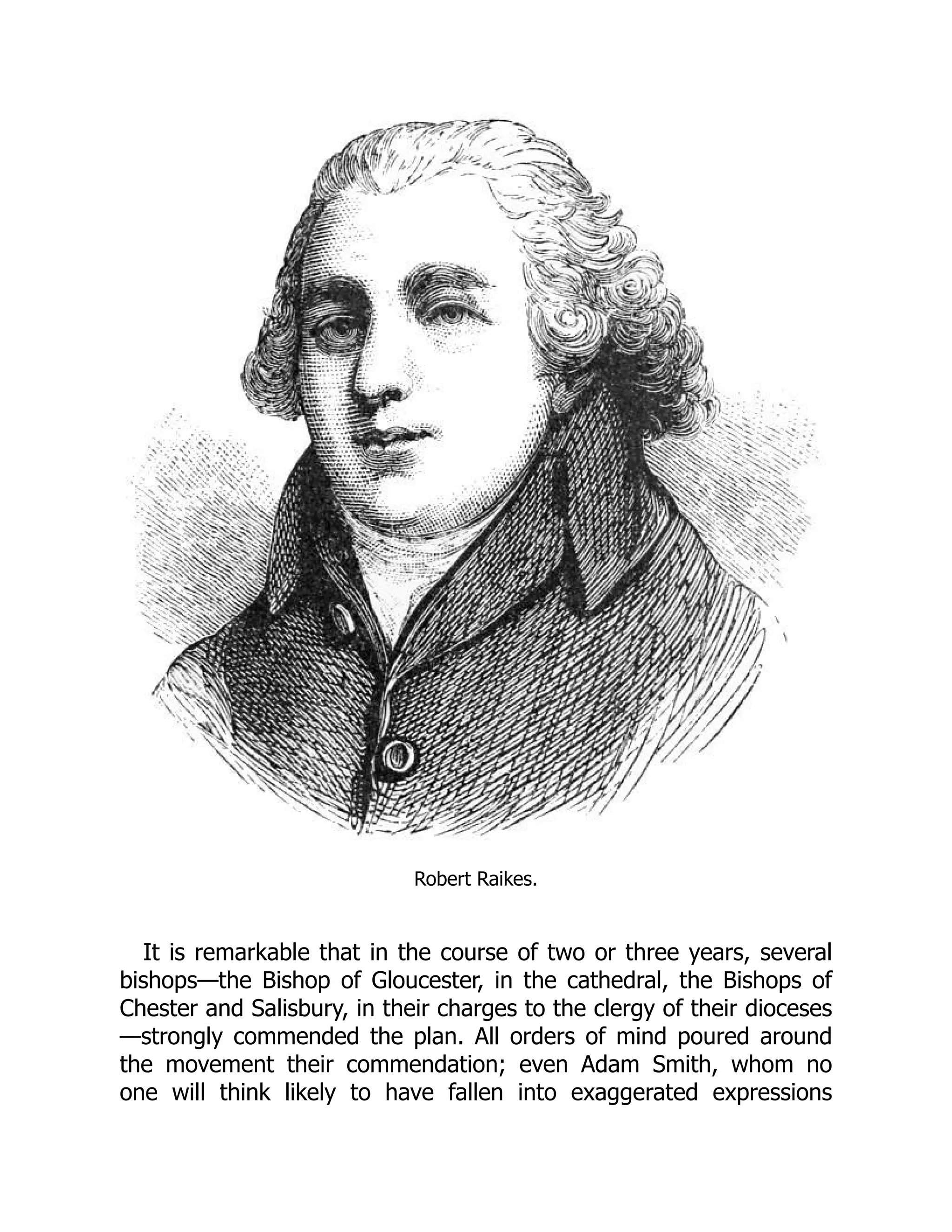
Robert Raikes.
It is remarkable that in the course of two or three years, several
bishops—the Bishop of Gloucester, in the cathedral, the Bishops of
Chester and Salisbury, in their charges to the clergy of their dioceses
—strongly commended the plan. All orders of mind poured around
the movement their commendation; even Adam Smith, whom no
one will think likely to have fallen into exaggerated expressions
where Christian activity is concerned, said, “No plan has promised to
effect a change of manners with equal ease and simplicity, since the
days of the apostles.” The poet Cowper declared that he knew of no
nobler means by which a reformation of the lower classes could be
effected. Some attempts have been made to claim for John Wesley
the honour of inaugurating the Sunday-school system; considering
the intensely practical character of that venerated man, and how
much he was in advance of his times in most of his activities, it is a
wonder that he did not; but his venerable memory has honours,
certainly, in all sufficiency. He wrote his first commendation of
Sunday-schools in the Arminian Magazine of 1784. He says, “I find
these schools spring up wherever I go; perhaps God may have a
deeper end therein than men are aware of; who knows but that
some of these schools may become nurseries for Christians?”
Prophetic as these words are, this is fainter and tardier praise than
we should have expected from him; but in 1787 he writes more
warmly, expresses his belief that these schools will be one great
means of reviving religion throughout the kingdom, and expresses
“wonder that Satan has not sent out some able champion against
them.” In 1788 he says: “I verily think that these schools are one of
the noblest specimens of charity which have been set on foot in
England since the days of William the Conqueror.”
Some estimate may be formed of the rapidity with which the
movement spread, when we find that in this year, 1787, the number
of children taught in Sunday-schools in Manchester alone, on the
testimony of the very eminent John Nichols, the great printer and
anecdotist, was no fewer than five thousand. It was in this year also,
1787, that Mr. Raikes was visiting some relatives in the
neighbourhood of Windsor. He must have attained to the dignity of a
celebrity; nor is this wonderful, when we remember the universal
acceptance with which his great idea of Sunday-schools had been
honoured. The Queen invited him to visit her, and inquired of him,
he says, “by what accident a thought which promised so much
benefit to the lower order of people as the institution of Sunday-
schools, was suggested to his mind?” The visit was a long one; he
spent two hours with the Queen—the King also, we believe, being
present most of the time—not so much in expounding the system,
for that was simple enough, but they were curious as to what he
had observed in the change and improvement of the characters
among whom he worked; and we believe that it was then he told
the King, in the words we have already quoted, that he regarded his
work as a kind of “botanising in human nature;” this was a favourite
phrase of his in describing the work. The result of this visit was, that
the Queen established a Sunday-school in Windsor, and also a school
of industry at Brentford, which the King and Queen occasionally
visited. It may be taken as an illustration of the native modesty of
Mr. Raikes’s own character that he never referred in his paper to this
distinguished notice of royalty.
Do our readers know anything of Mrs. Sarah Trimmer? A hundred
years ago, there was, probably, not a better-known woman in
England; and although her works have long ceased to exercise any
influence, we suppose none, in her time, were more eminently
useful. Pious, devoted, earnestly evangelical, if we speak of her as a
kind of lesser Hannah More, the remark must apply to her
intellectual character rather than to her reputation or her usefulness.
Almost as soon as the Sunday-school idea was announced, she
stepped forward as its most able and intrepid advocate; her
Economy of Charity exercised a large influence, and she published a
number of books, which, at that time, were admirably suited to the
level of the capacity which the Sunday-school teacher desired to
reach; she was also a great favourite with the King and Queen, and
appears to have visited them on the easy terms of friendship. The
intense interest she felt in Sunday-schools is manifest in innumerable
pages of the two volumes which record her life; certainly, she was
often at the ear of the royal pair, to whisper any good and pleasant
thing connected with the progress of her favourite thought. She
repeatedly expresses her obligation to Mr. Raikes; but her biographer
only expresses the simple truth when he says: “To Mr. Raikes, of
Gloucester, the nation is, in the first place, indebted for the happy
idea of collecting the children of the poor together on the Sabbath,
and giving them instruction suited to the sacredness of the day; but,
perhaps, no publication on this subject was of more utility than the
Economy of Charity. The influence of the work was very visible when
it first made its appearance, and proved a source of unspeakable
gratification to the author.”
It is not consistent with the aim of this book to enter at greater
length into the life of Robert Raikes; we have said sufficient to show
that the term which has been applied to him of “founder of Sunday-
schools,” is not misapplied. He was a simple and good man, on
whose heart, as into a fruitful soil, an idea fell, and it became a
realised conviction. Look at his portrait, and instantly there comes to
your mind Cowper’s well-known description of one of his friends,
“An honest man, close-buttoned to the chin,
Broadcloth without, and a warm heart within.”
No words can better describe him—not a tint of fanaticism seems to
shade his character; he had a warm enthusiasm for ends and aims
which commended themselves to his judgment. It is pleasant to
know that, as he lived when the agitation for the abolition of the
slave trade was commencing, he gave to the movement his hearty
blessings and best wishes. At sixty-seven years of age he retired
from business; no doubt a very well-to-do man, for he was the
owner of two freehold estates near Gloucester, and he received an
annuity of three hundred pounds from the Gloucester Journal. He
died at his house in Bell Lane, in the city of Gloucester, where he
had taken up his residence when he retired from active life; he died
suddenly, in his seventy-sixth year, in 1811. Then the family vault in
St. Mary-le-Crypt, which sixty years before had received his father’s
ashes, received the body of the gentle philanthropist. He had kept
up his Sunday-school work and interest to the close; and he left
instructions that his Sunday-school children should be invited to
follow him to the grave, and that each of them should receive a
shilling and a plum cake. On the tablet over the place where he
sleeps an appropriate verse of Scripture well describes him: “When
the ear heard me, then it blessed me; and when the eye saw me, it
gave witness to me: because I delivered the poor that cried, and the
fatherless, and him that had none to help him. The blessing of him
that was ready to perish came upon me: and I caused the widow’s
heart to sing for joy.”
It seems very questionable whether the slightest shade can cross
the memory of this plain, simply useful, and unostentatious man.
And it ought to be said that Anne Raikes, who rests in the same
grave, appears to have been every way the worthy companion of her
husband. She was the daughter of Thomas Trigg, Esq., of Newnham,
in Gloucestershire; the sister of Sir Thomas Trigg and Admiral John
Trigg. They were married in 1767. She shared in all her husband’s
large and charitable intentions, and when he died he left the whole
of his property to her. She survived him seventeen years, and died in
1828, at the age of eighty-five.
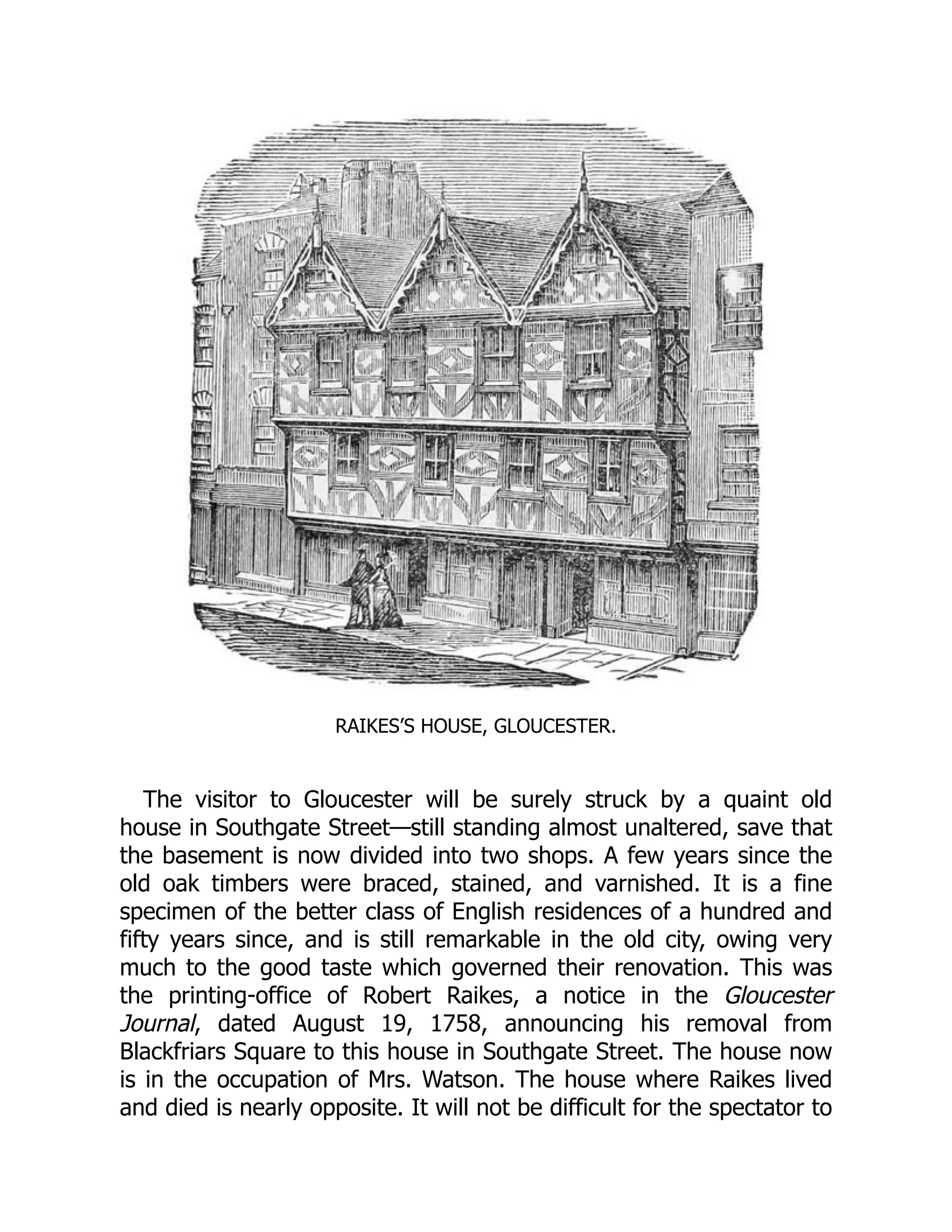
RAIKES’S HOUSE, GLOUCESTER.
The visitor to Gloucester will be surely struck by a quaint old
house in Southgate Street—still standing almost unaltered, save that
the basement is now divided into two shops. A few years since the
old oak timbers were braced, stained, and varnished. It is a fine
specimen of the better class of English residences of a hundred and
fifty years since, and is still remarkable in the old city, owing very
much to the good taste which governed their renovation. This was
the printing-office of Robert Raikes, a notice in the Gloucester
Journal, dated August 19, 1758, announcing his removal from
Blackfriars Square to this house in Southgate Street. The house now
is in the occupation of Mrs. Watson. The house where Raikes lived
and died is nearly opposite. It will not be difficult for the spectator to
realise the pleasant image of the old gentleman, dressed, after the
fashion of the day, in his blue coat with gold buttons, buff waistcoat,
drab kerseymere breeches, white stockings, and low shoes, passing
beneath those ancient gables, and engaged in those various public
and private duties which we have attempted to record. A century
has passed away since then, and the simple lessons the
philanthropist attempted to impart to the young waifs and strays he
gathered about him have expanded into more comprehensive
departments of knowledge. The originator of Sunday-schools would
be astonished were he to step into almost any of those which have
branched out from his leading idea. It is still expanding; it is one of
the most real and intense activities of the Universal Church; but
among the immense crowds of those who, in England and America,
are conducting Sunday-school classes, it is, perhaps, not too much
to say, that in not one is there a more simple and earnest desire to
do good than that which illuminated the life, and lends a sweet and
charming interest to the memory, of Robert Raikes.
CHAPTER XI
THE ROMANTIC STORY OF SILAS TOLD.
Dr. Abel Stevens, in his History of Methodism, says, “I congratulate
myself on the opportunity of reviving the memory of Silas Told;” and
speaks of the little biography in which Silas himself records his
adventures as “a record told with frank and affecting simplicity, in a
style of terse and flowing English Defoe might have envied.”
Such a testimony is well calculated to excite the curiosity of an
interested reader, especially as the two or three incidents mentioned
only serve to whet the appetite for more of the like description. The
little volume to which he refers has been for some years in the
possession of the author of this volume. It is indeed an astonishing
book; its alleged likeness to Defoe’s charmingly various style of
recital of adventures by sea and by land is no exaggeration, whilst
as a piece of real biography it may claim, and quite sustain, a place
side by side with the romantic and adventurous career of John
Newton; but the wild wonderfulness of the story of Silas seems to
leave Newton’s in the shade. Like Newton, Told was also a seer of
visions and a dreamer of dreams, and a believer, in special
providences; and well might he believe in such who was led certainly
along as singular a path as any mortal could tread. The only other
memorial besides his own which has, we believe, been penned of
him—a brief recapitulations-well describes him as honest, simple,
and tender. Silas Told accompanied, in that awful day, numbers of
persons to the gallows, and attempted to console sufferers and
victims in circumstances of most harrowing and tragic solemnity: he
certainly furnished comfortable help and light when no others were
willing or able to sympathise or to help. John Wesley loved him, and
when Silas died he buried him, and says of him in his Journal: “On
the 20th of December, 1778, I buried what was mortal of honest
Silas Told. For many years he attended the malefactors in Newgate
without fee or reward; and I suppose no man, for this hundred
years, has been so successful in that melancholy office. God had
given him peculiar talents for it, and he had amazing success
therein; the greatest part of those whom he attended died in peace,
and many of them in the triumph of faith.” Such was Silas Told.
But before we come to those characteristic circumstances to which
Wesley refers, we must follow him through some of the wild scenes
of his sailor life. He was born in Bristol in 1711; his parents were
respectable and creditable people, but of somewhat faded families.
His grandfather had been an eminent physician in Bunhill Row,
London; his mother was from Exeter. * * *
Silas was educated in the noble foundation school of Edward
Colston in Bristol. The life of this excellent philanthropist was so
remarkable, and in many particulars so like his own, that we cannot
wonder that he stops for some pages in his early story to recite
some of the remarkable phenomena in Colston’s life. Silas’s
childhood was singular, and the stories he tells are especially
noticeable, because in after-life the turn of his character seems to
have been especially real and practical. Thus he tells how, when a
child, wandering with his sister in the King’s Wood, near Bristol, they
lost their way, and were filled with the utmost consternation, when
suddenly, although no house was in view, nor, as they thought, near,
a dog came up behind them, and drove them clear out of the wood
into a path with which they were acquainted; especially it was
remarkable that the dog never barked at them, but when they
looked round about for the dog he was nowhere to be seen.
Careless children out for their own pleasure, they sauntered on their
way again, and again lost their way in the wood—were again
bewildered, and in greater perplexity than before, when, on a
sudden looking up, they saw the same dog making towards them;
they ran from him in fright, but he followed them, drove them out of
the labyrinths, and did not leave them until they could not possibly
lose their way again. Simple Silas says, “I then turned about to look
for the dog, but saw no more of him, although we were now upon
an open common. This was the Lord’s doings, and marvellous in our
eyes.”
When he was twelve years of age, he appears to have been quite
singularly influenced by the reading of the Pilgrim’s Progress; and
late in life, when writing his biography, he briefly, but significantly,
attempts to reproduce the intense enjoyment he received—the book
evidently caught and coloured his whole imagination. At this time,
too, he was very nearly drowned, and while drowning, so far from
having any sense of terror, he had no sense nor idea of the things of
this world, but that it appeared to him he rushingly emerged out of
thick darkness into what appeared to him a glorious city, lustrous
and brilliant, the light of which seemed to illuminate the darkness
through which he had urged his way. It was as if the city had a floor
like glass, and yet he was sure that neither city nor floor had any
substance; also he saw people there; the inhabitants arrayed in
robes of what seemed the finest substance, but flowing from their
necks to their feet; and yet he was sensible too that they had no
material substance; they moved, but did not labour as in walking,
but glided as if carried along by the wind; and he testifies how he
felt a wonderful joy and peace, and he never forgot the impression
through life, although soon recalled to the world in which he was to
sorrow and suffer so much. It is quite easy to see John Bunyan in all
this; but while he was thus pleasantly happy in his visionary or intro-
visionary state, a benevolent and tender-hearted Dutchman, who
had been among some haymakers in a field on the banks of the
river, was striking out after him among the willow-bushes and
sedges of the stream, from whence he was brought, body and soul,
back to the world again. Such are the glimpses of the childhood of
Silas.
Then shortly comes a dismal transition from strange providences
in the wood, and enchanting visions beneath the waves, to the
singularly severe sufferings of a seafaring life. The ships in that day
have left a grim and ugly reputation surviving still. The term “sea-
devil” has often been used as descriptive of the masters of ships in
that time. Silas seems to have sailed under some of the worst
specimens of this order. About the age of fourteen he was bound
apprentice to Captain Moses Lilly, and started for his first voyage
from Bristol to Jamaica. “Here,” he says, “I may date my first
sufferings.” He says the first of his afflictions “was sea-sickness,
which held me till my arrival in Jamaica;” and considering that it was
a voyage of fourteen weeks, it was a fair spell of entertainment from
that pleasant companion. They were short of water, they were put
on short allowance of food, and when having obtained their freight,
while lying in Kingston harbour, their vessel, and seventy-six sail of
ships, many of them very large, but all riding with three anchors
ahead, were all scattered by an astonishing hurricane, and all the
vessels in Port Royal shared the same fate. He tells how the corpses
of the drowned sailors strewed the shores, and how, immediately
after the subsidence of the hurricane, a pestilential sickness swept
away thousands of the natives. “Every morning,” he says, “I have
observed between thirty and forty corpses carried past my window;
being very near death myself, I expected every day to approach with
the messenger of my dissolution.”
During this time he appears to have been lying in a warehouse,
with no person to take care of him except a negro, who every day
brought to him, where he was laid in his hammock, Jesuit’s bark.
“At length,” he says, “my master gave me up, and I wandered up
and down the town, almost parched with the insufferable blaze of
the sun, till I resolved to lay me down and die, as I had neither
money nor friend; accordingly, I fixed upon a dunghill in the east
end of the town of Kingston, and being in such a weak condition, I
pondered much upon Job’s case, and considered mine similar to that
of his; however, I was fully resigned to death, nor had I the slightest
expectation of relief from any quarter; yet the kind providence of
God was over me, and raised me up a friend in an entire stranger. A
London captain coming by was struck with the sordid object, came
up to me, and, in a very compassionate manner, asked me if I was
sensible of any friend upon the island from whom I could obtain
relief; he likewise asked me to whom I belonged. I answered, to
Captain Moses Lilly, and had been cast away in the late hurricane.
This captain appeared to have some knowledge of my master, and,
cursing him for a barbarous villain, told me he would compel him to
take proper care of me. About a quarter of an hour after this, my
master arrived, whom I had not seen before for six weeks, and took
me to a public-house kept by, a Mrs. Hutchinson, and there ordered
me to be taken proper care of. However, he soon quitted the island,
and directed his course for England, leaving me behind at his sick
quarters; and, if it should please God to permit my recovery, I was
commanded to take my passage to England in the Montserrat,
Captain David Jones, a very fatherly, tender-hearted man: this was
the first alleviation of my misery. Now the captain sent his son on
shore, in order to receive me on board. When I came alongside,
Captain Jones, standing on the ship’s gunwale, addressed me after a
very humane and compassionate manner, with expressions to the
following effect: ‘Come, poor child, into the cabin, and you shall
want nothing that the ship affords; go, and my son shall prepare for
you, in the first place, a basin of good egg-flip, and anything else
that maybe conducive to your relief.’ But I, being very bad with my
fever and ague, could neither eat nor drink.”
A very pleasant captain, this seems, to have sailed with; but poor
Silas had very little of his company. However, the good captain and
his boatswain put their experiences together, and the poor boy was
restored to health, and after some singular adventures he reached
Bristol. Arriving there, however, Captain Lilly transferred him to a
Captain Timothy Tucker, of whom Silas bears the pleasing testimony,
“A greater villain, I firmly believe, never existed, although at home
he assumed the character and temper of a saint.” The wretch
actually stole a white woman from her own country to sell her to the
black prince of Bonny, on the African coast. They had not been long
at sea before this delightful person gave Silas a taste of his temper.
Thinking the boy had taken too much bread from the cask, he went
to the cabin and brought back with him his large horsewhip, “and
exercised it,” says Silas, “about my body in so unmerciful a manner,
that not only the clothes on my back were cut to pieces, but every
sailor declared they could see my bones; and then he threw me all
along the deck, and jumped many times upon the pit of my
stomach, in order to endanger my life; and had not the people laid
hold of my two legs, and thrown me under the windlass, after the
manner they throw dead cats or dogs, he would have ended his
despotic cruelty in murder.” This free and easy mode of recreation
was much indulged in by seafaring officers in that time, but this
Tucker appears to have been really what Silas calls him, “a blood-
thirsty devil;” and stories of murder, and the incredible cruelties of
the slave-trade lend their horrible fascination to the narrative of Silas
Told. How would it be possible to work the commerce of the slave-
trade without such characters as this Tucker, who presents much
more the appearance of a lawless pirate than of the noble character
we call a sailor?
Those readers who would like to follow poor Silas through the
entire details of his miseries on ship-board, his hairbreadth escapes
from peril and shipwreck, must read them in Silas’s own book, if
they can find it; but we may attempt to give some little account of
his wreck upon the American coast, in New England. Few stories can
be more charming than the picture he gives of his wanderings with
his companions after their escape from the wreck, not because he
and they were destitute, and all but naked, but because of the
pleasant glimpses we have of the simple, hospitable, home life in
those beautiful old New England days—hospitality of the most
romantic and free-handed description.
We will select two pictures, as illustrating something of the
character of New England settlements in those very early days of
their history. Silas and his companions were cast on shore, and had
found refuge in a tavern seven miles from the beach; he had no
clothing; but the landlord of the tavern gave him a pair of red
breeches, the last he had after supplying the rest. Silas goes on:
“Ebenezer Allen, Governor of the island, and who dwelt about six
miles from the tavern, hearing of our distress, made all possible
haste to relieve us; and when he arrived at the tavern, accompanied
by his two eldest sons, he took Captain Seaborn, his black servant,
Joseph and myself through partiality, and escorted us home to his
own house. Between eleven and twelve at night we reached the
Governor’s mansion, all of us ashamed to be seen; we would fain
have hid ourselves in any dark hole or corner, as it was a truly
magnificent building, with wings on each side thereof, but, to our
astonishment, we were received into the great parlour, where were
sitting by the fireside two fine, portly ladies, attending the spit,
which was burdened with a very heavy quarter of house-lamb.
Observing a large mahogany table to be spread with a fine damask
cloth, and every knife, fork, and plate to be laid in a genteel mode, I
was apprehensive that it was intended for the entertainment of
some persons of note or distinction, or, at least, for a family supper.
In a short time the joint was taken up, and laid on the table, yet
nobody sat down to eat; and as we were almost hid in one corner of
the room, the ladies turned round and said, ‘Poor men, why don’t
you come to supper?’ I replied, ‘Madam, we had no idea it was
prepared for us.’ The ladies then entreated us to eat without any
fear of them, assuring us that it was prepared for none others; and
none of us having eaten anything for near six and thirty hours
before, we picked the bones of the whole quarter, to which we had
plenty of rich old cider to drink: after supper we went to bed, and
enjoyed so profound a sleep that the next morning it was difficult for
the old gentleman to awake us. The following day I became the
partaker of several second-hand garments, and, as I was happily
possessed of a little learning, it caused me to be more abundantly
caressed by the whole family, and therefore I fared sumptuously
every day.
“This unexpected change of circumstances and diet I undoubtedly
experienced in a very uncommon manner; but as I was strictly
trained up a Churchman, I could not support the idea of a Dissenter,
although, God knows, I had well-nigh by this time dissented from all
that is truly good. This proved a bar to my promotion, and my strong
propensity to sail for England to see my mother prevented my
acceptance of the greatest offer I ever received in my life before; for
when the day came that we were to quit the island, and to cross the
sound over to a town called Sandwich, on the main continent, the
young esquire took me apart from my associates, and earnestly
entreated me to tarry with them, saying that if I would accede to
their proposals nothing should be lacking to render my situation
equivalent to the rest of the family. As there were very few white
men on the island, I was fixed upon, if willing, to espouse one of the
Governor’s daughters. I had been informed that the Governor was
immensely rich, having on the island two thousand head of cattle
and twenty thousand sheep, and every acre of land thereon
belonging to himself. However, I could not be prevailed upon to
accept the offer; therefore the Governor furnished us with forty
shillings each, and gave us a pass over to the town of Sandwich.”
Such passages as this show the severe experiences through which
Silas passed; they illustrate the education he was receiving for that
life of singular earnestness and tenderness which was to close and
crown his career; but we have made the extract here for the
purpose of giving some idea of that cheerful, hospitable, home life of
New England in those then almost wild regions which are now
covered with the population of towns.
Here is another instance, which occurred at Hanover, in the United
States, through which district Silas and his companions appear to
have been wending their way, seeking a return to England. “One
Sunday, as my companions and self were crossing the churchyard at
the time of Divine service, a well-dressed gentleman came out of the
church and said, ‘Gentlemen, we do not suffer any person in this
country to travel on the Lord’s day.’ We gave him to understand that
it was necessity which constrained us to walk that way, as we had all
been shipwrecked on St. Martin’s [Martha’s (?)] Vineyard, and were
journeying to Boston. The gentleman was still dissatisfied, but
quitted our company and went into church. When we had gone a
little farther, a large white house proved the object of our attention.
The door being wide open, we reasonably imagined it was not in an
Welcome to our website – the perfect destination for book lovers and
knowledge seekers. We believe that every book holds a new world,
offering opportunities for learning, discovery, and personal growth.
That’s why we are dedicated to bringing you a diverse collection of
books, ranging from classic literature and specialized publications to
self-development guides and children's books.
More than just a book-buying platform, we strive to be a bridge
connecting you with timeless cultural and intellectual values. With an
elegant, user-friendly interface and a smart search system, you can
quickly find the books that best suit your interests. Additionally,
our special promotions and home delivery services help you save time
and fully enjoy the joy of reading.
Join us on a journey of knowledge exploration, passion nurturing, and
personal growth every day!
testbankfan.com


Genetics Analysis and Principles 6th Edition Brooker Test Bank

  • 1.
    Genetics Analysis andPrinciples 6th Edition Brooker Test Bank download https://testbankfan.com/product/genetics-analysis-and- principles-6th-edition-brooker-test-bank/ Visit testbankfan.com today to download the complete set of test bank or solution manual
  • 2.
    We believe theseproducts will be a great fit for you. Click the link to download now, or visit testbankfan.com to discover even more! Genetics Analysis and Principles 6th Edition Brooker Solutions Manual https://testbankfan.com/product/genetics-analysis-and-principles-6th- edition-brooker-solutions-manual/ Genetics Analysis and Principles 5th Edition Brooker Test Bank https://testbankfan.com/product/genetics-analysis-and-principles-5th- edition-brooker-test-bank/ Genetics Analysis and Principles 4th Edition Brooker Test Bank https://testbankfan.com/product/genetics-analysis-and-principles-4th- edition-brooker-test-bank/ Essentials of Strategic Management The Quest for Competitive Advantage 6th Edition Gamble Solutions Manual https://testbankfan.com/product/essentials-of-strategic-management- the-quest-for-competitive-advantage-6th-edition-gamble-solutions- manual/
  • 3.
    Exploring Microsoft Office2013 Volume 2 1st Edition Poatsy Test Bank https://testbankfan.com/product/exploring-microsoft- office-2013-volume-2-1st-edition-poatsy-test-bank/ Mechanics of Materials 9th Edition Goodno Test Bank https://testbankfan.com/product/mechanics-of-materials-9th-edition- goodno-test-bank/ Sociology A Down To Earth Approach 12th Edition Henslin Test Bank https://testbankfan.com/product/sociology-a-down-to-earth- approach-12th-edition-henslin-test-bank/ Psychology of Language 5th Edition Carroll Test Bank https://testbankfan.com/product/psychology-of-language-5th-edition- carroll-test-bank/ M and B 3 Hybrid 3rd Edition Dean Croushore Solutions Manual https://testbankfan.com/product/m-and-b-3-hybrid-3rd-edition-dean- croushore-solutions-manual/
  • 4.
    Electronic Commerce 20106th Edition Turban Test Bank https://testbankfan.com/product/electronic-commerce-2010-6th-edition- turban-test-bank/
  • 5.
    1 Copyright © 2018McGraw-Hill Genetics, 6e (Brooker) Chapter 9 Molecular Structure of DNA and RNA 1) Frederick Griffith is responsible for discovering what process? A) Replication B) Transmission C) Transformation D) Transduction Answer: C Section: 09.01 Topic: Identification of DNA as the Genetic Material Bloom's: 1. Remember Learning Outcome: 09.01.02 Analyze the results of (1) Griffith, (2) Avery, MacLeod, and McCarty, and (3) Hershey and Chase, and explain how they indicate that DNA is the genetic material. Accessibility: Keyboard Navigation 2) The fact that the type R and S strains of Streptococcus pneumoniae that Griffith worked with possessed small differences in capsule structure satisfies which of the following criteria for genetic material? A) Transmission B) Replication C) Information D) Variation Answer: D Section: 09.01 Topic: Identification of DNA as the Genetic Material Bloom's: 2. Understand Learning Outcome: 09.01.01 Describe the four criteria that the genetic material must meet. Accessibility: Keyboard Navigation 3) The individuals who determined that Griffith's transforming principle was DNA were ________. A) Hershey and Chase B) Avery, Macleod, and McCarty C) Watson and Crick D) Creighton and McClintock Answer: B Section: 09.01 Topic: Identification of DNA as the Genetic Material Bloom's: 1. Remember Learning Outcome: 09.01.02 Analyze the results of (1) Griffith, (2) Avery, MacLeod, and McCarty, and (3) Hershey and Chase, and explain how they indicate that DNA is the genetic material. Accessibility: Keyboard Navigation
  • 6.
    2 Copyright © 2018McGraw-Hill 4) These individuals determined that DNA was responsible for the process of transduction in T2 phage. A) Hershey and Chase B) Avery, Macleod, and McCarty C) Watson and Crick D) Creighton and McClintock Answer: A Section: 09.01 Topic: Identification of DNA as the Genetic Material Bloom's: 1. Remember Learning Outcome: 09.01.02 Analyze the results of (1) Griffith, (2) Avery, MacLeod, and McCarty, and (3) Hershey and Chase, and explain how they indicate that DNA is the genetic material. Accessibility: Keyboard Navigation 5) What is a characteristic of T2 bacteriophage? A) It does not require a host cell for replication. B) The phage attaches to the cell wall of a target eukaryotic cell. C) The phages injects its DNA into the host cell. D) The new phages are formed outside the host cell. Answer: C Section: 09.01 Topic: Identification of DNA as the Genetic Material Bloom's: 2. Understand Learning Outcome: 09.01.02 Analyze the results of (1) Griffith, (2) Avery, MacLeod, and McCarty, and (3) Hershey and Chase, and explain how they indicate that DNA is the genetic material. Accessibility: Keyboard Navigation 6) What was the conclusion of the Hershey-Chase experiments? A) Their results suggested the presence of a transforming principle. B) Their results suggested that DNA is a double helix. C) Their results suggested that A+G=T+C. D) Their results suggested that the DNA is the genetic material. Answer: D Section: 09.01 Topic: Identification of DNA as the Genetic Material Bloom's: 2. Understand Learning Outcome: 09.01.02 Analyze the results of (1) Griffith, (2) Avery, MacLeod, and McCarty, and (3) Hershey and Chase, and explain how they indicate that DNA is the genetic material. Accessibility: Keyboard Navigation
  • 7.
    3 Copyright © 2018McGraw-Hill 7) The building blocks of DNA are called ________. A) amino acids B) codons C) nucleotides D) alleles Answer: C Section: 09.02 Topic: Overview of DNA and RNA Structure Bloom's: 1. Remember Learning Outcome: 09.02.01 Define nucleic acid. Accessibility: Keyboard Navigation 8) What is a component of a single nucleotide? A) A phosphate group B) A six carbon sugar C) All five nitrogenous bases Answer: A Section: 09.03 Topic: Nucleotide Structure Bloom's: 2. Understand Learning Outcome: 09.03.01 Describe the structure of a nucleotide. Accessibility: Keyboard Navigation 9) How does DNA differ from RNA? A) RNA uses only purines. B) RNA uses a different five-carbon sugar. C) RNA has a contains different sized phosphate groups. D) RNA has multiple bases attached to the sugar. Answer: B Section: 09.03 Topic: Nucleotide Structure Bloom's: 2. Understand Learning Outcome: 09.03.02 Compare and contrast the structures of nucleotides found in DNA and in RNA. Accessibility: Keyboard Navigation
  • 8.
    4 Copyright © 2018McGraw-Hill 10) Which base is not found in DNA? A) Cytosine B) Guanine C) Thymidine D) Adenine E) Uracil Answer: E Section: 09.03 Topic: Nucleotide Structure Bloom's: 1. Remember Learning Outcome: 09.03.02 Compare and contrast the structures of nucleotides found in DNA and in RNA. Accessibility: Keyboard Navigation 11) The backbone of the DNA molecule is formed by ________. A) peptide bonds B) ribose sugars C) nitrogenous bases D) phosphodiester bonds Answer: D Section: 09.04 Topic: Structure of a DNA Strand Bloom's: 1. Remember Learning Outcome: 09.04.01 Describe the structural features of a DNA strand. Accessibility: Keyboard Navigation 12) The individual(s) who used ball and stick models to identify the three-dimensional structure of proteins was ________. A) Franklin B) Watson and Crick C) Hershey and Chase D) Pauling E) Chargaff Answer: D Section: 09.05 Topic: Discovery of the Double Helix Bloom's: 1. Remember Learning Outcome: 09.05.01 Outline the key experiments that led to the discovery of the DNA double helix. Accessibility: Keyboard Navigation
  • 9.
    5 Copyright © 2018McGraw-Hill 13) What is the directionality of the DNA molecule? A) Front to back B) Top to bottom C) 5' to 3' D) 3' to 5' E) All DNA molecules are different in their directionality Answer: C Section: 09.04 Topic: Structure of a DNA Strand Bloom's: 1. Remember Learning Outcome: 09.04.01 Describe the structural features of a DNA strand. Accessibility: Keyboard Navigation 14) The researcher(s) who initially used X-ray diffraction to gather information on the DNA molecule was ________. A) Franklin B) Watson and Crick C) Hershey and Chase D) Pauling E) Chargaff Answer: A Section: 09.05 Topic: Discovery of the Double Helix Bloom's: 1. Remember Learning Outcome: 09.05.01 Outline the key experiments that led to the discovery of the DNA double helix. Accessibility: Keyboard Navigation 15) What were the conclusions of Franklin's work regarding the structure of DNA? A) It did not have a helical structure. B) The helix had more than one strand. C) The helix contained about 1 bases per turn. D) The helix had only one strand. Answer: B Section: 09.05 Topic: Discovery of the Double Helix Bloom's: 1. Remember Learning Outcome: 09.05.01 Outline the key experiments that led to the discovery of the DNA double helix. Accessibility: Keyboard Navigation
  • 10.
    6 Copyright © 2018McGraw-Hill 16) According to Chargaff's rule, if the DNA of a species contains 20% adenine, what percent of guanine will it contain? A) 20% B) 30% C) 50% D) 75% Answer: B Section: 09.05 Topic: Discovery of the Double Helix Bloom's: 4. Analyze Learning Outcome: 09.05.01 Outline the key experiments that led to the discovery of the DNA double helix. Accessibility: Keyboard Navigation 17) The first group of researchers to correctly identify the double-helix structure of DNA were ________. A) McClintock and Franklin B) Hershey and Chase C) Pauling and Avery D) Watson and Crick Answer: D Section: 09.05 Topic: Discovery of the Double Helix Bloom's: 1. Remember Learning Outcome: 09.05.01 Outline the key experiments that led to the discovery of the DNA double helix. Accessibility: Keyboard Navigation 18) In a double-helix DNA strand, the adenine on one strand forms a hydrogen bond with a(n) ________ on the other strand. A) adenine B) guanine C) thymine D) cytosine Answer: C Section: 09.06 Topic: Structure of the DNA Double Helix Bloom's: 2. Understand Learning Outcome: 09.06.01 Outline the key structural features of the DNA double helix. Accessibility: Keyboard Navigation
  • 11.
    7 Copyright © 2018McGraw-Hill 19) How many bases are necessary to complete three complete twists (1080 degrees) of a DNA helix? A) 5 B) 10 C) 30 D) 60 Answer: C Section: 09.06 Topic: Structure of the DNA Double Helix Bloom's: 3. Apply Learning Outcome: 09.06.01 Outline the key structural features of the DNA double helix. Accessibility: Keyboard Navigation 20) The fact that the helixes of the DNA strand are arranged in opposite directions gives DNA its ________ characteristics. A) antiparallel B) complementary C) redundant D) water-soluble Answer: A Section: 09.06 Topic: Structure of the DNA Double Helix Bloom's: 2. Understand Learning Outcome: 09.06.01 Outline the key structural features of the DNA double helix. Accessibility: Keyboard Navigation 21) One strand of DNA is 5'–AGGCCTTA–3'. What is the opposite strand? A) 5'–AGGCCTTA–3' B) 5'–TCCGGAAT–3' C) 3'–AGGCCTTA–5' D) 3'–TCCGGAAT–5' Answer: D Section: 09.06 Topic: Structure of the DNA Double Helix Bloom's: 3. Apply Learning Outcome: 09.06.01 Outline the key structural features of the DNA double helix. Accessibility: Keyboard Navigation
  • 12.
    8 Copyright © 2018McGraw-Hill 22) What DNA form is most common in living organisms? A) B DNA B) Z DNA C) Triplex DNA Answer: A Section: 09.06 Topic: Structure of the DNA Double Helix Bloom's: 1. Remember Learning Outcome: 09.06.02 Compare and contrast B DNA and Z DNA. Accessibility: Keyboard Navigation 23) Which DNA molecule form is a left-handed? A) B DNA B) Z DNA C) R DNA Answer: B Section: 09.06 Topic: Structure of the DNA Double Helix Bloom's: 1. Remember Learning Outcome: 09.06.02 Compare and contrast B DNA and Z DNA. Accessibility: Keyboard Navigation 24) In the Hershey-Chase experiments, the protein coat of the bacteriophage was labeled with the 32P radioisotope. Answer: FALSE Section: 09.01 Topic: Identification of DNA as the Genetic Material Bloom's: 1. Remember Learning Outcome: 09.01.02 Analyze the results of (1) Griffith, (2) Avery, MacLeod, and McCarty, and (3) Hershey and Chase, and explain how they indicate that DNA is the genetic material. Accessibility: Keyboard Navigation 25) A nucleoside consists of only a five-carbon sugar and a phosphate group. Answer: FALSE Section: 09.03 Topic: Nucleotide Structure Bloom's: 1. Remember Learning Outcome: 09.03.01 Describe the structure of a nucleotide. Accessibility: Keyboard Navigation
  • 13.
    9 Copyright © 2018McGraw-Hill 26) B DNA is recognized as a left-handed molecule. Answer: FALSE Section: 09.06 Topic: Structure of the DNA Double Helix Bloom's: 1. Remember Learning Outcome: 09.06.01 Outline the key structural features of the DNA double helix. Accessibility: Keyboard Navigation 27) A purine on one strand of the DNA is always paired with a pyrimidine on the other strand. Answer: TRUE Section: 09.06 Topic: Structure of the DNA Double Helix Bloom's: 1. Remember Learning Outcome: 09.06.01 Outline the key structural features of the DNA double helix. Accessibility: Keyboard Navigation 28) The helical shape of the DNA contains major and minor grooves, which assist in the regulating of gene expression. Answer: TRUE Section: 09.06 Topic: Structure of the DNA Double Helix Bloom's: 1. Remember Learning Outcome: 09.06.01 Outline the key structural features of the DNA double helix. Accessibility: Keyboard Navigation 29) A DNA strand can be described as antiparallel but uncomplementary. Answer: FALSE Section: 09.06 Topic: Structure of the DNA Double Helix Bloom's: 2. Understand Learning Outcome: 09.06.01 Outline the key structural features of the DNA double helix. Accessibility: Keyboard Navigation
  • 14.
    10 Copyright © 2018McGraw-Hill 30) Avery used the enzyme ________ to remove the proteins from the cell extracts. A) protease B) DNase C) RNase D) All of the answers are correct Answer: A Section: 09.01 Topic: Identification of DNA as the Genetic Material Bloom's: 1. Remember Learning Outcome: 09.01.02 Analyze the results of (1) Griffith, (2) Avery, MacLeod, and McCarty, and (3) Hershey and Chase, and explain how they indicate that DNA is the genetic material. Accessibility: Keyboard Navigation 31) The ________ was labeled using the radioisotope 32P in the Hershey-Chase experiments. A) RNA B) DNA C) protein D) carbohydrates Answer: B Section: 09.01 Topic: Identification of DNA as the Genetic Material Bloom's: 1. Remember Learning Outcome: 09.01.02 Analyze the results of (1) Griffith, (2) Avery, MacLeod, and McCarty, and (3) Hershey and Chase, and explain how they indicate that DNA is the genetic material. Accessibility: Keyboard Navigation 32) Cells are treated with a drug that blocks purine synthesis. Which bases would not be made in those treated cells? A) cytosine, thymine, and uracil B) adenine and guanine C) adenine and thymine D) cytosine and guanine Answer: B Section: 09.03 Topic: Nucleotide Structure Bloom's: 3. Apply Learning Outcome: 09.03.01 Describe the structure of a nucleotide. Accessibility: Keyboard Navigation
  • 15.
    11 Copyright © 2018McGraw-Hill 33) The pyrimidine bases are ________. A) cytosine, thymine, and uracil B) adenine and guanine C) adenine and thymine D) cytosine and guanine Answer: A Section: 09.03 Topic: Nucleotide Structure Bloom's: 1. Remember Learning Outcome: 09.03.01 Describe the structure of a nucleotide. Accessibility: Keyboard Navigation 34) The idea that the adenine and thymine bases of the DNA interact in some manner was first proposed by ________. A) Watson and Crick B) Franklin C) Pauling D) Chargaff Answer: D Section: 09.05 Topic: Discovery of the Double Helix Bloom's: 1. Remember Learning Outcome: 09.05.01 Outline the key experiments that led to the discovery of the DNA double helix. Accessibility: Keyboard Navigation 35) Adenine and thymine form ________ hydrogen bonds between them, while cytosine and guanine form ________ bonds. A) 2, 3 B) 3, 4 C) 3, 2 D) 4, 3 Answer: A Section: 09.06 Topic: Structure of the DNA Double Helix Bloom's: 1. Remember Learning Outcome: 09.06.01 Outline the key structural features of the DNA double helix. Accessibility: Keyboard Navigation
  • 16.
    12 Copyright © 2018McGraw-Hill 36) What is one of the criteria that all genetic material must meet? A) It does not contain the information necessary to construct the entire organism. B) It must be passed from offspring to parent. C) It must be able to be copied. D) It must have a limited amount of variation. Answer: C Section: 09.01 Topic: Identification of DNA as the Genetic Material Bloom's: 2. Understand Learning Outcome: 09.01.01 Describe the four criteria that the genetic material must meet. Accessibility: Keyboard Navigation 37) Which of the following is a correct matching of the researcher with their discovery? A) Pauling provided information on primary structure in biological molecules. B) Franklin suggested that DNA was a helix with more than one strand and that there were about 10 bases per turn of the DNA. C) Watson and Crick collected a large amount of X-ray data on the structure of DNA. D) Chargaff demonstrated that the adenine and cytosine bases and the uracil and guanine bases interacted in some manner. Answer: B Section: 09.05 Topic: Discovery of the Double Helix Bloom's: 2. Understand Learning Outcome: 09.05.01 Outline the key experiments that led to the discovery of the DNA double helix. Accessibility: Keyboard Navigation 38) What is the most complex structure DNA can form? A) Individual nucleotides B) A folded and bended double helix C) A single strand of DNA D) A DNA double helix Answer: B Section: 09.02 Topic: Overview of DNA and RNA Structure Bloom's: 2. Understand Learning Outcome: 09.02.02 Describe the four levels of complexity of DNA. Accessibility: Keyboard Navigation
  • 17.
    Other documents randomlyhave different content
  • 18.
    Gloucestershire, if notone of the largest, is certainly one of the fairest—as, indeed, its name is said to imply: from Glaw, an old British word signifying “fair”—it is one of the fairest, and it ought to be one of the most famous, counties of England. Many are its distinguished worthies: John de Trevisa was Vicar of Berkeley, in Gloucestershire, and a contemporary with John Wyclif, and, like him, he had a strong aversion to the practices of the Church of Rome, and an earnest desire to make the Scriptures known to his parishioners; and in Nibley, in Gloucestershire, was born, and lived, William Tyndale, in whose noble heart the great idea sprang up that Christian Englishmen should read the New Testament in their own mother-tongue, and who said to a celebrated priest, “If God spares my life, I will take care that a plough-boy shall know more of the Scriptures than you do.” The story of the great translator and martyr is most interesting. Gloucestershire has been famous, too, for its contributions to the noble army of martyrs, notably, not only James Baynham, but, in Gloucester, its bishop, John Hooper, was in 1555 burnt to death. In Berkeley the very distinguished physician, and first promulgator of the doctrine of vaccination, Dr. Edward Jenner, the son of the vicar, was born; and from the Old Bell, in Gloucester, went forth the wonderful preacher George Whitefield, to arouse the sleeping Church in England and America from its lethargy. The quaint old proverb to which we have already alluded—“As sure as God is in Gloucestershire”—was very complimentary, but not very correct; it arose from the amazing ecclesiastical wealth of the county, which was so rich that it attracted the notice of the papal court, and four Italian bishops held it in succession for fifty years; one of these, Giulio de Medici, became Pope Clement VII., succeeding Pope Leo X. in the papacy in 1523. This eminent ecclesiastical fame no doubt originated the proverb; but it acquired a tone of reality and truth rather from the martyrdom of its bishop than from the elevation of his predecessor to the papal tiara; rather from Tyndale, William Sarton, and his brother weaver-martyrs, than from its costly and magnificent endowments; from Whitefield and Jenner rather than from its crowd of priests and friars.
  • 19.
    Thus Gloucestershire hascertainly considerable eminence among English counties. To other distinguished names must be added that of Robert Raikes, who must ever be regarded as the founder of Sabbath-schools. It is not intended by this that there had never been any attempts made to gather the children on the Sabbath for some kind of religious instruction—although such attempts were very few, and a diligent search has probably brought them all [?] under our knowledge; but the example and the influence of Raikes gave to the idea the character of a movement; it stirred the whole country, from the throne itself, the King and Queen, the bishops, and the clergy; all classes of ministers and laymen became interested in what was evidently an easy and happy method of seizing upon the multitudes of lost children who in that day were “perishing for lack of knowledge.” Mr. Joseph Stratford, in his Biographical Sketches of the Great and Good Men in Gloucestershire, and Mr. Alfred Gregory, in his Life of Robert Raikes—to which works we must confess our obligation for much of the information contained in this chapter—have both done honour to the several humbler and more obscure labourers whose hearts were moved to attempt the work to which Raikes gave a national importance, and which from his hands, and from his time, became henceforth a perpetual institution in the Church work of every denomination of Christian believers and labourers. The Rev. Joseph Alleine, the author of The Alarm to the Unconverted, an eminent Nonconformist minister of Taunton, adopted the plan of gathering the young people together for instruction on the Lord’s day. Even in Gloucestershire, before Raikes was born, in the village of Flaxley, on the borders of the Forest of Dean—Flaxley, of which the poet Bloomfield sings: “’Mid depths of shade gay sunbeams broke Through noble Flaxley’s bowers of oak; Where many a cottage, trim and gay, Whispered delight through all the way:”
  • 20.
    in the oldCistercian Abbey, Mrs. Catharine Boevey, the lady of the abbey, had one of the earliest and pleasantest Sabbath-schools. Her monument in Flaxley Church, erected after her death in 1726, records her “clothing and feeding her indigent neighbours, and teaching their children, some of whom she entertained at her house, and examined them herself.” Six of the poor children, it is elsewhere stated, “by turns dined at her residence on Sundays, and were afterwards heard say the Catechism.” We read of a humbler labourer, realising, perhaps, more the idea of a Sabbath-school teacher, in Bolton, in Lancashire, James Hey, or “Old Jemmy o’ th’ Hey.” Old Jemmy, Mr. Gregory tells us, employed the working days of the week in winding bobbins for weavers, and on Sundays he taught the boys and girls of the neighbourhood to read. His school assembled twice each Sunday, in the cottage of a neighbour, and the time of commencing was announced, not by the ringing of a bell, but by an excellent substitute, an old brass pestle and mortar. After a while, Mr. Adam Compton, a paper manufacturer in the neighbourhood, began to supply Jemmy with books, and subscriptions in money were given him; he was thus enabled to form three branch establishments, the teachers of which were paid one shilling each Sunday for their services. Besides these there are several other instances: in 1763 the Rev. Theophilus Lindsey established something like a Sunday-school at Catterick, in Yorkshire; at High Wycombe, in 1769, Miss Hannah Ball, a young Methodist lady, formed a Sunday-school in her town; and at Macclesfield that admirable and excellent man, the Rev. David Simpson, originated a similar plan of usefulness; and, contemporary with Mr. Raikes, in the old Whitefield Tabernacle, at Dursley, in Gloucestershire, we find Mr. William King, a woollen card-maker, attempting the work of teaching on a Sunday, and coming into Gloucester to take counsel with Mr. Raikes as to the best way of carrying it forward. Such, scattered over the face of the country, at great distances, and in no way representing a general plan of useful labour, were the hints and efforts before the idea took what may be called an apostolic shape in the person of Robert Raikes.
  • 21.
    Notwithstanding the instanceswe have given, Mr. Raikes must really be regarded as the founder of Sunday-schools as an extended organisation. With him they became more than a notion, or a mere piece of local effort; and his position and profession, and the high respect in which he was held in the city in which he lived, all alike enabled him to give publicity to the plan: and before he commenced this movement, he was known as a philanthropist; indeed, John Howard himself bears something like the same relation to prison philanthropy which Raikes bears to Sunday-schools. No one doubts that Howard was the great apostle of prisons; but it seems that before he commenced his great prison crusade, Raikes had laboured diligently to reform the Gloucester gaol. The condition of the prisoners was most pitiable, and Raikes, nearly twenty years before he commenced the Sunday-school system, had been working among them, attempting their material, moral, and spiritual improvement, by which he had earned for himself the designation of the “Teacher of the Poor.” Howard visited Raikes in Gloucester, and bears his testimony to the blessedness and benevolence of his labours in the prison there; and the gaol appears not unnaturally to have suggested the idea of the Sunday-school to the benevolent-hearted man. It was a dreadful state of society. Some idea may be formed of it from a paragraph in the Gloucester Journal for June, 1783, the paper of which Raikes was the editor and proprietor: it is mentioned that no less than sixty-six persons were committed to the Castle in one week, and Mr. Raikes adds, “The prison is already so full that all the gaoler’s stock of fetters is occupied, and the smiths are hard at work casting new ones.” He goes on to say: “The people sent in are neither disappointed soldiers nor sailors, but chiefly frequenters of ale-houses and skittle-alleys.” Then, in another paragraph, he goes on to remark, “The ships about to sail for Botany Bay will carry about one thousand miserable creatures, who might have lived perfectly happy in this country had they been early taught good principles, and to avoid the danger of associating with those who make sobriety and industry the objects of their ridicule.”
  • 22.
    From sentences likethese it is easy to see the direction in which the mind of the good man was moving, before he commenced the work which has given such a happy and abiding perpetuity to his name. He gathered the children; the streets were full of noise and disturbances every Sunday. In a little while, says the Rev. Dr. Glass, Mr. Raikes found himself surrounded by such a set of little ragamuffins as would have disgusted other men less zealous to do good, and less earnest to disseminate comfort, exhortation, and benefit to all around him, than the founder of Sunday-schools. He prevented their running about in wild disorder through the streets. By and by, he arranged that a number of them should meet him at seven o’clock on the Sunday morning in the cathedral close, when he and they all went into the cathedral together to an early service. The increase of the numbers was rapid; Mr. Raikes was looked up to as the commander-in-chief of this ragged regiment. It is testified that a change took place and passed over the streets of the old Gloucester city on the Sunday. A glance at the features of Mr. Raikes will assure the reader that he was an amiable and gentle man, but that by no means implies always a weak one. He appears to have had plenty of strength, self-possession, and knowledge of the world. He also belonged to, and moved in, good society; and this is not without its influence. As he told the King, in the course of a long interview, when the King and Queen sent for him to Windsor, to talk over his system with him, in order that they might, in some sense, be his disciples, and adopt and recommend his plan: it was “botanising in human nature.” “All that I require,” said Raikes, to the parents of the children, “are clean hands, clean faces, and their hair combed.” To many who were barefooted, after they had shown some regularity of attendance, he gave shoes, and others he clothed. Yes, it was “botanising in human nature;” and very many anecdotes show what flowers sprang up out of the black soil in the path of the good man. All the stories told of Raikes show that the law of kindness was usually on his lips. A sulky, stubborn girl had resisted all reproofs and correction, and had refused to ask forgiveness of her mother. In the
  • 23.
    presence of themother, Raikes said to the girl, “Well, if you have no regard for yourself, I have much for you. You will be ruined and lost if you do not become a good girl; and if you will not humble yourself, I must humble myself on your behalf and make a beginning for you;” and then, with great solemnity, he entreated the mother to forgive the girl, using such words that he overcame the girl’s pride. The stubborn creature actually fell on her knees, and begged her mother’s forgiveness, and never gave Mr. Raikes or her mother trouble afterwards. It is a very simple anecdote; but it shows the Divine spirit in the method of the man; and the more closely we come into a personal knowledge of his character, the more admirable and lovable it seems. Thus literally true and beautiful are the words of the hymn: “Like a lone husbandman, forlorn, The man of Gloucester went, Bearing his seeds of precious corn; And God the blessing sent. Now, watered long by faith and prayer, From year to year it grows, Till heath, and hill, and desert bare, Do blossom as the rose.” Mr. Raikes was a Churchman; he was so happy as to have, near to his own parish of St. Mary-le-Crypt, in Gloucester, an intimate friend, the Rector of St. Aldate’s—a neighbouring parish in the same city— the Rev. Thomas Stock, whose monument in the church truly testifies that “to him, in conjunction with Robert Raikes, Esquire, is justly attributed the honour of having planned and instituted the first Sunday-school in the kingdom.” Mr. Stock was but a young man in 1780, for he died in 1803, then only fifty-four years of age; he must have been, at the time of the first institution of Sunday-schools, a young man of fine and tender instincts. He appears, simultaneously with Mr. Raikes’s movement, to have formed a Sunday-school in his own parish, taking upon himself the superintendence of it, and the responsibility of such expenses as it involved. But Mr. Stock says, in
  • 24.
    a letter writtenin 1788, “The progress of the institution through the kingdom is justly attributed to the constant representations which Mr. Raikes made in his own paper of the benefits which he saw would probably arise from it.” At the time Mr. Raikes began the work, he was about forty-four years of age; it was a great thing in that day to possess a respectable journal, a newspaper of acknowledged character and influence; to this, very likely, we owe it, in some considerable measure, that the work in Gloucester became extensively known and spread, and expanded into a great movement. But he does not appear to have used the columns of his newspaper for the purpose of calling attention to the usefulness and desirability of the work until after it had been in operation about three years; in 1783 and 1784, very modestly he commends the system to general adoption.
  • 25.
    Robert Raikes. It isremarkable that in the course of two or three years, several bishops—the Bishop of Gloucester, in the cathedral, the Bishops of Chester and Salisbury, in their charges to the clergy of their dioceses —strongly commended the plan. All orders of mind poured around the movement their commendation; even Adam Smith, whom no one will think likely to have fallen into exaggerated expressions
  • 26.
    where Christian activityis concerned, said, “No plan has promised to effect a change of manners with equal ease and simplicity, since the days of the apostles.” The poet Cowper declared that he knew of no nobler means by which a reformation of the lower classes could be effected. Some attempts have been made to claim for John Wesley the honour of inaugurating the Sunday-school system; considering the intensely practical character of that venerated man, and how much he was in advance of his times in most of his activities, it is a wonder that he did not; but his venerable memory has honours, certainly, in all sufficiency. He wrote his first commendation of Sunday-schools in the Arminian Magazine of 1784. He says, “I find these schools spring up wherever I go; perhaps God may have a deeper end therein than men are aware of; who knows but that some of these schools may become nurseries for Christians?” Prophetic as these words are, this is fainter and tardier praise than we should have expected from him; but in 1787 he writes more warmly, expresses his belief that these schools will be one great means of reviving religion throughout the kingdom, and expresses “wonder that Satan has not sent out some able champion against them.” In 1788 he says: “I verily think that these schools are one of the noblest specimens of charity which have been set on foot in England since the days of William the Conqueror.” Some estimate may be formed of the rapidity with which the movement spread, when we find that in this year, 1787, the number of children taught in Sunday-schools in Manchester alone, on the testimony of the very eminent John Nichols, the great printer and anecdotist, was no fewer than five thousand. It was in this year also, 1787, that Mr. Raikes was visiting some relatives in the neighbourhood of Windsor. He must have attained to the dignity of a celebrity; nor is this wonderful, when we remember the universal acceptance with which his great idea of Sunday-schools had been honoured. The Queen invited him to visit her, and inquired of him, he says, “by what accident a thought which promised so much benefit to the lower order of people as the institution of Sunday- schools, was suggested to his mind?” The visit was a long one; he
  • 27.
    spent two hourswith the Queen—the King also, we believe, being present most of the time—not so much in expounding the system, for that was simple enough, but they were curious as to what he had observed in the change and improvement of the characters among whom he worked; and we believe that it was then he told the King, in the words we have already quoted, that he regarded his work as a kind of “botanising in human nature;” this was a favourite phrase of his in describing the work. The result of this visit was, that the Queen established a Sunday-school in Windsor, and also a school of industry at Brentford, which the King and Queen occasionally visited. It may be taken as an illustration of the native modesty of Mr. Raikes’s own character that he never referred in his paper to this distinguished notice of royalty. Do our readers know anything of Mrs. Sarah Trimmer? A hundred years ago, there was, probably, not a better-known woman in England; and although her works have long ceased to exercise any influence, we suppose none, in her time, were more eminently useful. Pious, devoted, earnestly evangelical, if we speak of her as a kind of lesser Hannah More, the remark must apply to her intellectual character rather than to her reputation or her usefulness. Almost as soon as the Sunday-school idea was announced, she stepped forward as its most able and intrepid advocate; her Economy of Charity exercised a large influence, and she published a number of books, which, at that time, were admirably suited to the level of the capacity which the Sunday-school teacher desired to reach; she was also a great favourite with the King and Queen, and appears to have visited them on the easy terms of friendship. The intense interest she felt in Sunday-schools is manifest in innumerable pages of the two volumes which record her life; certainly, she was often at the ear of the royal pair, to whisper any good and pleasant thing connected with the progress of her favourite thought. She repeatedly expresses her obligation to Mr. Raikes; but her biographer only expresses the simple truth when he says: “To Mr. Raikes, of Gloucester, the nation is, in the first place, indebted for the happy idea of collecting the children of the poor together on the Sabbath,
  • 28.
    and giving theminstruction suited to the sacredness of the day; but, perhaps, no publication on this subject was of more utility than the Economy of Charity. The influence of the work was very visible when it first made its appearance, and proved a source of unspeakable gratification to the author.” It is not consistent with the aim of this book to enter at greater length into the life of Robert Raikes; we have said sufficient to show that the term which has been applied to him of “founder of Sunday- schools,” is not misapplied. He was a simple and good man, on whose heart, as into a fruitful soil, an idea fell, and it became a realised conviction. Look at his portrait, and instantly there comes to your mind Cowper’s well-known description of one of his friends, “An honest man, close-buttoned to the chin, Broadcloth without, and a warm heart within.” No words can better describe him—not a tint of fanaticism seems to shade his character; he had a warm enthusiasm for ends and aims which commended themselves to his judgment. It is pleasant to know that, as he lived when the agitation for the abolition of the slave trade was commencing, he gave to the movement his hearty blessings and best wishes. At sixty-seven years of age he retired from business; no doubt a very well-to-do man, for he was the owner of two freehold estates near Gloucester, and he received an annuity of three hundred pounds from the Gloucester Journal. He died at his house in Bell Lane, in the city of Gloucester, where he had taken up his residence when he retired from active life; he died suddenly, in his seventy-sixth year, in 1811. Then the family vault in St. Mary-le-Crypt, which sixty years before had received his father’s ashes, received the body of the gentle philanthropist. He had kept up his Sunday-school work and interest to the close; and he left instructions that his Sunday-school children should be invited to follow him to the grave, and that each of them should receive a shilling and a plum cake. On the tablet over the place where he sleeps an appropriate verse of Scripture well describes him: “When
  • 29.
    the ear heardme, then it blessed me; and when the eye saw me, it gave witness to me: because I delivered the poor that cried, and the fatherless, and him that had none to help him. The blessing of him that was ready to perish came upon me: and I caused the widow’s heart to sing for joy.” It seems very questionable whether the slightest shade can cross the memory of this plain, simply useful, and unostentatious man. And it ought to be said that Anne Raikes, who rests in the same grave, appears to have been every way the worthy companion of her husband. She was the daughter of Thomas Trigg, Esq., of Newnham, in Gloucestershire; the sister of Sir Thomas Trigg and Admiral John Trigg. They were married in 1767. She shared in all her husband’s large and charitable intentions, and when he died he left the whole of his property to her. She survived him seventeen years, and died in 1828, at the age of eighty-five.
  • 30.
    RAIKES’S HOUSE, GLOUCESTER. Thevisitor to Gloucester will be surely struck by a quaint old house in Southgate Street—still standing almost unaltered, save that the basement is now divided into two shops. A few years since the old oak timbers were braced, stained, and varnished. It is a fine specimen of the better class of English residences of a hundred and fifty years since, and is still remarkable in the old city, owing very much to the good taste which governed their renovation. This was the printing-office of Robert Raikes, a notice in the Gloucester Journal, dated August 19, 1758, announcing his removal from Blackfriars Square to this house in Southgate Street. The house now is in the occupation of Mrs. Watson. The house where Raikes lived and died is nearly opposite. It will not be difficult for the spectator to
  • 31.
    realise the pleasantimage of the old gentleman, dressed, after the fashion of the day, in his blue coat with gold buttons, buff waistcoat, drab kerseymere breeches, white stockings, and low shoes, passing beneath those ancient gables, and engaged in those various public and private duties which we have attempted to record. A century has passed away since then, and the simple lessons the philanthropist attempted to impart to the young waifs and strays he gathered about him have expanded into more comprehensive departments of knowledge. The originator of Sunday-schools would be astonished were he to step into almost any of those which have branched out from his leading idea. It is still expanding; it is one of the most real and intense activities of the Universal Church; but among the immense crowds of those who, in England and America, are conducting Sunday-school classes, it is, perhaps, not too much to say, that in not one is there a more simple and earnest desire to do good than that which illuminated the life, and lends a sweet and charming interest to the memory, of Robert Raikes.
  • 33.
    CHAPTER XI THE ROMANTICSTORY OF SILAS TOLD. Dr. Abel Stevens, in his History of Methodism, says, “I congratulate myself on the opportunity of reviving the memory of Silas Told;” and speaks of the little biography in which Silas himself records his adventures as “a record told with frank and affecting simplicity, in a style of terse and flowing English Defoe might have envied.” Such a testimony is well calculated to excite the curiosity of an interested reader, especially as the two or three incidents mentioned only serve to whet the appetite for more of the like description. The little volume to which he refers has been for some years in the possession of the author of this volume. It is indeed an astonishing book; its alleged likeness to Defoe’s charmingly various style of recital of adventures by sea and by land is no exaggeration, whilst as a piece of real biography it may claim, and quite sustain, a place side by side with the romantic and adventurous career of John Newton; but the wild wonderfulness of the story of Silas seems to leave Newton’s in the shade. Like Newton, Told was also a seer of visions and a dreamer of dreams, and a believer, in special providences; and well might he believe in such who was led certainly along as singular a path as any mortal could tread. The only other memorial besides his own which has, we believe, been penned of him—a brief recapitulations-well describes him as honest, simple, and tender. Silas Told accompanied, in that awful day, numbers of persons to the gallows, and attempted to console sufferers and victims in circumstances of most harrowing and tragic solemnity: he
  • 34.
    certainly furnished comfortablehelp and light when no others were willing or able to sympathise or to help. John Wesley loved him, and when Silas died he buried him, and says of him in his Journal: “On the 20th of December, 1778, I buried what was mortal of honest Silas Told. For many years he attended the malefactors in Newgate without fee or reward; and I suppose no man, for this hundred years, has been so successful in that melancholy office. God had given him peculiar talents for it, and he had amazing success therein; the greatest part of those whom he attended died in peace, and many of them in the triumph of faith.” Such was Silas Told. But before we come to those characteristic circumstances to which Wesley refers, we must follow him through some of the wild scenes of his sailor life. He was born in Bristol in 1711; his parents were respectable and creditable people, but of somewhat faded families. His grandfather had been an eminent physician in Bunhill Row, London; his mother was from Exeter. * * * Silas was educated in the noble foundation school of Edward Colston in Bristol. The life of this excellent philanthropist was so remarkable, and in many particulars so like his own, that we cannot wonder that he stops for some pages in his early story to recite some of the remarkable phenomena in Colston’s life. Silas’s childhood was singular, and the stories he tells are especially noticeable, because in after-life the turn of his character seems to have been especially real and practical. Thus he tells how, when a child, wandering with his sister in the King’s Wood, near Bristol, they lost their way, and were filled with the utmost consternation, when suddenly, although no house was in view, nor, as they thought, near, a dog came up behind them, and drove them clear out of the wood into a path with which they were acquainted; especially it was remarkable that the dog never barked at them, but when they looked round about for the dog he was nowhere to be seen. Careless children out for their own pleasure, they sauntered on their way again, and again lost their way in the wood—were again bewildered, and in greater perplexity than before, when, on a sudden looking up, they saw the same dog making towards them;
  • 35.
    they ran fromhim in fright, but he followed them, drove them out of the labyrinths, and did not leave them until they could not possibly lose their way again. Simple Silas says, “I then turned about to look for the dog, but saw no more of him, although we were now upon an open common. This was the Lord’s doings, and marvellous in our eyes.” When he was twelve years of age, he appears to have been quite singularly influenced by the reading of the Pilgrim’s Progress; and late in life, when writing his biography, he briefly, but significantly, attempts to reproduce the intense enjoyment he received—the book evidently caught and coloured his whole imagination. At this time, too, he was very nearly drowned, and while drowning, so far from having any sense of terror, he had no sense nor idea of the things of this world, but that it appeared to him he rushingly emerged out of thick darkness into what appeared to him a glorious city, lustrous and brilliant, the light of which seemed to illuminate the darkness through which he had urged his way. It was as if the city had a floor like glass, and yet he was sure that neither city nor floor had any substance; also he saw people there; the inhabitants arrayed in robes of what seemed the finest substance, but flowing from their necks to their feet; and yet he was sensible too that they had no material substance; they moved, but did not labour as in walking, but glided as if carried along by the wind; and he testifies how he felt a wonderful joy and peace, and he never forgot the impression through life, although soon recalled to the world in which he was to sorrow and suffer so much. It is quite easy to see John Bunyan in all this; but while he was thus pleasantly happy in his visionary or intro- visionary state, a benevolent and tender-hearted Dutchman, who had been among some haymakers in a field on the banks of the river, was striking out after him among the willow-bushes and sedges of the stream, from whence he was brought, body and soul, back to the world again. Such are the glimpses of the childhood of Silas. Then shortly comes a dismal transition from strange providences in the wood, and enchanting visions beneath the waves, to the
  • 36.
    singularly severe sufferingsof a seafaring life. The ships in that day have left a grim and ugly reputation surviving still. The term “sea- devil” has often been used as descriptive of the masters of ships in that time. Silas seems to have sailed under some of the worst specimens of this order. About the age of fourteen he was bound apprentice to Captain Moses Lilly, and started for his first voyage from Bristol to Jamaica. “Here,” he says, “I may date my first sufferings.” He says the first of his afflictions “was sea-sickness, which held me till my arrival in Jamaica;” and considering that it was a voyage of fourteen weeks, it was a fair spell of entertainment from that pleasant companion. They were short of water, they were put on short allowance of food, and when having obtained their freight, while lying in Kingston harbour, their vessel, and seventy-six sail of ships, many of them very large, but all riding with three anchors ahead, were all scattered by an astonishing hurricane, and all the vessels in Port Royal shared the same fate. He tells how the corpses of the drowned sailors strewed the shores, and how, immediately after the subsidence of the hurricane, a pestilential sickness swept away thousands of the natives. “Every morning,” he says, “I have observed between thirty and forty corpses carried past my window; being very near death myself, I expected every day to approach with the messenger of my dissolution.” During this time he appears to have been lying in a warehouse, with no person to take care of him except a negro, who every day brought to him, where he was laid in his hammock, Jesuit’s bark. “At length,” he says, “my master gave me up, and I wandered up and down the town, almost parched with the insufferable blaze of the sun, till I resolved to lay me down and die, as I had neither money nor friend; accordingly, I fixed upon a dunghill in the east end of the town of Kingston, and being in such a weak condition, I pondered much upon Job’s case, and considered mine similar to that of his; however, I was fully resigned to death, nor had I the slightest expectation of relief from any quarter; yet the kind providence of God was over me, and raised me up a friend in an entire stranger. A London captain coming by was struck with the sordid object, came
  • 37.
    up to me,and, in a very compassionate manner, asked me if I was sensible of any friend upon the island from whom I could obtain relief; he likewise asked me to whom I belonged. I answered, to Captain Moses Lilly, and had been cast away in the late hurricane. This captain appeared to have some knowledge of my master, and, cursing him for a barbarous villain, told me he would compel him to take proper care of me. About a quarter of an hour after this, my master arrived, whom I had not seen before for six weeks, and took me to a public-house kept by, a Mrs. Hutchinson, and there ordered me to be taken proper care of. However, he soon quitted the island, and directed his course for England, leaving me behind at his sick quarters; and, if it should please God to permit my recovery, I was commanded to take my passage to England in the Montserrat, Captain David Jones, a very fatherly, tender-hearted man: this was the first alleviation of my misery. Now the captain sent his son on shore, in order to receive me on board. When I came alongside, Captain Jones, standing on the ship’s gunwale, addressed me after a very humane and compassionate manner, with expressions to the following effect: ‘Come, poor child, into the cabin, and you shall want nothing that the ship affords; go, and my son shall prepare for you, in the first place, a basin of good egg-flip, and anything else that maybe conducive to your relief.’ But I, being very bad with my fever and ague, could neither eat nor drink.” A very pleasant captain, this seems, to have sailed with; but poor Silas had very little of his company. However, the good captain and his boatswain put their experiences together, and the poor boy was restored to health, and after some singular adventures he reached Bristol. Arriving there, however, Captain Lilly transferred him to a Captain Timothy Tucker, of whom Silas bears the pleasing testimony, “A greater villain, I firmly believe, never existed, although at home he assumed the character and temper of a saint.” The wretch actually stole a white woman from her own country to sell her to the black prince of Bonny, on the African coast. They had not been long at sea before this delightful person gave Silas a taste of his temper. Thinking the boy had taken too much bread from the cask, he went
  • 38.
    to the cabinand brought back with him his large horsewhip, “and exercised it,” says Silas, “about my body in so unmerciful a manner, that not only the clothes on my back were cut to pieces, but every sailor declared they could see my bones; and then he threw me all along the deck, and jumped many times upon the pit of my stomach, in order to endanger my life; and had not the people laid hold of my two legs, and thrown me under the windlass, after the manner they throw dead cats or dogs, he would have ended his despotic cruelty in murder.” This free and easy mode of recreation was much indulged in by seafaring officers in that time, but this Tucker appears to have been really what Silas calls him, “a blood- thirsty devil;” and stories of murder, and the incredible cruelties of the slave-trade lend their horrible fascination to the narrative of Silas Told. How would it be possible to work the commerce of the slave- trade without such characters as this Tucker, who presents much more the appearance of a lawless pirate than of the noble character we call a sailor? Those readers who would like to follow poor Silas through the entire details of his miseries on ship-board, his hairbreadth escapes from peril and shipwreck, must read them in Silas’s own book, if they can find it; but we may attempt to give some little account of his wreck upon the American coast, in New England. Few stories can be more charming than the picture he gives of his wanderings with his companions after their escape from the wreck, not because he and they were destitute, and all but naked, but because of the pleasant glimpses we have of the simple, hospitable, home life in those beautiful old New England days—hospitality of the most romantic and free-handed description. We will select two pictures, as illustrating something of the character of New England settlements in those very early days of their history. Silas and his companions were cast on shore, and had found refuge in a tavern seven miles from the beach; he had no clothing; but the landlord of the tavern gave him a pair of red breeches, the last he had after supplying the rest. Silas goes on: “Ebenezer Allen, Governor of the island, and who dwelt about six
  • 39.
    miles from thetavern, hearing of our distress, made all possible haste to relieve us; and when he arrived at the tavern, accompanied by his two eldest sons, he took Captain Seaborn, his black servant, Joseph and myself through partiality, and escorted us home to his own house. Between eleven and twelve at night we reached the Governor’s mansion, all of us ashamed to be seen; we would fain have hid ourselves in any dark hole or corner, as it was a truly magnificent building, with wings on each side thereof, but, to our astonishment, we were received into the great parlour, where were sitting by the fireside two fine, portly ladies, attending the spit, which was burdened with a very heavy quarter of house-lamb. Observing a large mahogany table to be spread with a fine damask cloth, and every knife, fork, and plate to be laid in a genteel mode, I was apprehensive that it was intended for the entertainment of some persons of note or distinction, or, at least, for a family supper. In a short time the joint was taken up, and laid on the table, yet nobody sat down to eat; and as we were almost hid in one corner of the room, the ladies turned round and said, ‘Poor men, why don’t you come to supper?’ I replied, ‘Madam, we had no idea it was prepared for us.’ The ladies then entreated us to eat without any fear of them, assuring us that it was prepared for none others; and none of us having eaten anything for near six and thirty hours before, we picked the bones of the whole quarter, to which we had plenty of rich old cider to drink: after supper we went to bed, and enjoyed so profound a sleep that the next morning it was difficult for the old gentleman to awake us. The following day I became the partaker of several second-hand garments, and, as I was happily possessed of a little learning, it caused me to be more abundantly caressed by the whole family, and therefore I fared sumptuously every day. “This unexpected change of circumstances and diet I undoubtedly experienced in a very uncommon manner; but as I was strictly trained up a Churchman, I could not support the idea of a Dissenter, although, God knows, I had well-nigh by this time dissented from all that is truly good. This proved a bar to my promotion, and my strong
  • 40.
    propensity to sailfor England to see my mother prevented my acceptance of the greatest offer I ever received in my life before; for when the day came that we were to quit the island, and to cross the sound over to a town called Sandwich, on the main continent, the young esquire took me apart from my associates, and earnestly entreated me to tarry with them, saying that if I would accede to their proposals nothing should be lacking to render my situation equivalent to the rest of the family. As there were very few white men on the island, I was fixed upon, if willing, to espouse one of the Governor’s daughters. I had been informed that the Governor was immensely rich, having on the island two thousand head of cattle and twenty thousand sheep, and every acre of land thereon belonging to himself. However, I could not be prevailed upon to accept the offer; therefore the Governor furnished us with forty shillings each, and gave us a pass over to the town of Sandwich.” Such passages as this show the severe experiences through which Silas passed; they illustrate the education he was receiving for that life of singular earnestness and tenderness which was to close and crown his career; but we have made the extract here for the purpose of giving some idea of that cheerful, hospitable, home life of New England in those then almost wild regions which are now covered with the population of towns. Here is another instance, which occurred at Hanover, in the United States, through which district Silas and his companions appear to have been wending their way, seeking a return to England. “One Sunday, as my companions and self were crossing the churchyard at the time of Divine service, a well-dressed gentleman came out of the church and said, ‘Gentlemen, we do not suffer any person in this country to travel on the Lord’s day.’ We gave him to understand that it was necessity which constrained us to walk that way, as we had all been shipwrecked on St. Martin’s [Martha’s (?)] Vineyard, and were journeying to Boston. The gentleman was still dissatisfied, but quitted our company and went into church. When we had gone a little farther, a large white house proved the object of our attention. The door being wide open, we reasonably imagined it was not in an
  • 41.
    Welcome to ourwebsite – the perfect destination for book lovers and knowledge seekers. We believe that every book holds a new world, offering opportunities for learning, discovery, and personal growth. That’s why we are dedicated to bringing you a diverse collection of books, ranging from classic literature and specialized publications to self-development guides and children's books. More than just a book-buying platform, we strive to be a bridge connecting you with timeless cultural and intellectual values. With an elegant, user-friendly interface and a smart search system, you can quickly find the books that best suit your interests. Additionally, our special promotions and home delivery services help you save time and fully enjoy the joy of reading. Join us on a journey of knowledge exploration, passion nurturing, and personal growth every day! testbankfan.com