Visit https://testbankdeal.com todownload the full version and
browse more test banks or solution manuals
Principles of Life 2nd Edition Hillis Test Bank
_____ Press the link below to begin your download _____
https://testbankdeal.com/product/principles-of-life-2nd-
edition-hillis-test-bank/
Access testbankdeal.com now to download high-quality
test banks or solution manuals
2.
Here are somerecommended products for you. Click the link to
download, or explore more at testbankdeal.com
Essentials of Life Span Development 2nd Edition Santrock
Test Bank
https://testbankdeal.com/product/essentials-of-life-span-
development-2nd-edition-santrock-test-bank/
Principles of Macroeconomics 2nd Edition Coppock Test Bank
https://testbankdeal.com/product/principles-of-macroeconomics-2nd-
edition-coppock-test-bank/
Principles of Microeconomics 2nd Edition Mateer Test Bank
https://testbankdeal.com/product/principles-of-microeconomics-2nd-
edition-mateer-test-bank/
Personal Finance 8th Edition Keown Solutions Manual
https://testbankdeal.com/product/personal-finance-8th-edition-keown-
solutions-manual/
3.
Fundamentals of MultinationalFinance 6th Edition Moffett
Solutions Manual
https://testbankdeal.com/product/fundamentals-of-multinational-
finance-6th-edition-moffett-solutions-manual/
Employment Law for Business 9th Edition Bennett-Alexander
Test Bank
https://testbankdeal.com/product/employment-law-for-business-9th-
edition-bennett-alexander-test-bank/
Global Business Today 3rd Edition Hill Test Bank
https://testbankdeal.com/product/global-business-today-3rd-edition-
hill-test-bank/
Economics 10th Edition Boyes Test Bank
https://testbankdeal.com/product/economics-10th-edition-boyes-test-
bank/
Quantitative Methods For Decision Makers 5th Edition
Wisniewski Solutions Manual
https://testbankdeal.com/product/quantitative-methods-for-decision-
makers-5th-edition-wisniewski-solutions-manual/
4.
Contemporary Logistics 10thEdition Murphy Test Bank
https://testbankdeal.com/product/contemporary-logistics-10th-edition-
murphy-test-bank/
5.
Page 1
1. Inthe 1920s, a dye was developed that binds to DNA and stains nuclei in direct
proportion to the amount of DNA present in the cells. The resulting experiments
A) provided circumstantial evidence that DNA is the genetic material.
B) demonstrated that DNA is the genetic material.
C) demonstrated that all species have the same amount of nuclear DNA.
D) demonstrated that diploid and haploid cells cannot have differing amounts of DNA.
E) confirmed that DNA is an important component of mitochondria and chloroplasts.
2. Which statement about infection of E. coli cells by bacteriophage T2 is true?
A) Proteins are the only phage components that enter the infected cell.
B) Both proteins and nucleic acids enter the cell.
C) Only protein from the infecting phage can be detected in progeny phage.
D) Nucleic acids, but not protein, enter the cell.
E) More than one phage particle is required to produce infection.
3. Which molecule(s) function(s) to transfer information from one generation to the next in
eukaryotes?
A) DNA
B) mRNA
C) tRNA
D) Proteins
E) Lipids
4. Early transformation experiments demonstrated that adding DNA from bacterium strain
B to bacterium strain A could
A) produce bacterium strain C.
B) produce bacterium strain A.
C) produce bacterium strain B.
D) produce an equal mixture of strain A and strain B.
E) kill bacterium strain A.
5. Chargaff's rule states that
A) DNA must be replicated before a cell can divide.
B) viruses enter cells without their protein coat.
C) only protein from the infecting phage can also be detected in progeny phage.
D) only nucleic acids enter the cell during infection.
E) the amount of cytosine equals the amount of guanine.
6.
Page 2
6. Therules formulated by Erwin Chargaff state that
A) A = T and G = C in any molecule of DNA.
B) A = C and G = T in any molecule of DNA.
C) A = G and C = T in any molecule of DNA.
D) A = U and G = C in any molecule of RNA.
E) DNA and RNA are made up of the same four nitrogenous bases.
7. An alien DNA-like molecule is isolated from the frozen remains of a life form found
beneath the Martian polar ice caps. In this sample, for every base designated Q, there is
twice that amount of base R; for every base Z, there is twice that amount of base S. If
the molecule contains 33.33 percent R, what percentage of Z would you expect to find?
A) 6 percent
B) 12 percent
C) 24 percent
D) 16.67 percent
E) 54.66 percent
8. X-ray crystallography experiments carried out by _______ helped determine the
structure of the DNA molecule.
A) Edwin Chargaff
B) Rosalind Franklin
C) James D. Watson
D) Francis Crick
E) Friedrich Miescher
9. The primary information source used by Watson and Crick to determine the structure of
DNA was
A) electron micrographs of individual DNA molecules.
B) light micrographs of bacteriophage particles.
C) light micrographs of individual bacterial chromosomes.
D) nuclear magnetic resonance analysis of DNA.
E) X-ray crystallography of double-stranded DNA.
10. If a double-stranded DNA molecule contains 30 percent T, it must contain _______
percent G.
A) 20
B) 30
C) 40
D) 50
E) 60
7.
Page 3
11. Purinesinclude
A) cytosine, uracil, and thymine.
B) adenine and cytosine.
C) adenine and thymine.
D) cytosine and thymine.
E) adenine and guanine.
12. A deoxyribonucleoside is a
A) deoxyribose plus a nitrogenous base.
B) sugar and a phosphate.
C) deoxyribose plus a nitrogenous base and a phosphate.
D) ribose plus a nitrogenous base.
E) nitrogenous base bonded at the 5 end to a sugar–phosphate backbone.
13. The DNA isolated from a newly discovered virus is found to be 32 percent A, 18
percent C, 18 percent G, and 32 percent T. The base composition of the complementary
DNA would be _______ percent A, _______ percent C, _______ percent G, and
_______ percent T.
A) 32; 17; 32; 19
B) 19; 32; 17; 32
C) 17; 32; 32; 19
D) 25; 25; 25; 25
E) 32; 18; 18; 32
14. The strands that make up DNA are antiparallel. This means that
A) one strand is positively charged, and the other is negatively charged.
B) the base pairings create unequal spacing between the two DNA strands.
C) the 5-to-3 direction of one strand runs opposite to the 5-to-3 direction of the
other strand.
D) the twisting of the DNA molecule has shifted the two strands.
E) purines bond with purines and pyrimidines bond with pyrimidines.
15. Which statement about base pairing is false?
A) Purines pair with purines, and pyrimidines pair with pyrimidines.
B) In DNA, T pairs with A.
C) Complementary base pairing plays a role in DNA replication.
D) In DNA, C pairs with G.
E) The base pairs are of equal length.
8.
Page 4
16. Whatphysical characteristic of DNA is affected by the pairing of purines with
pyrimidines?
A) Its length
B) Its width
C) Its parallel nature
D) Its antiparallel nature
E) Its helix length
17. Recall that two hydrogen bonds bind A and T, but three hydrogen bonds bind G and C.
Because the stability of DNA is affected by the number of hydrogen bonds, with more
bonds promoting more stability, which double-stranded DNA molecule would likely
have the greatest stability?
A) A molecule with 20 percent A
B) A molecule with 26 percent G
C) A molecule with 32 percent C
D) A molecule with 38 percent T
E) More information is required to answer this question.
18. If a mutation changes a G to an A on one strand of a DNA molecule, with a
corresponding change in its complement, which property will most likely be affected?
A) The width of the DNA molecule
B) The length of the DNA molecule
C) The nature of protein–DNA interactions
D) The number of purines in the double-stranded molecule
E) All of the above are equally likely.
19. Which molecular model best describes the structure of the DNA molecule?
A) Single-stranded, with varying shapes
B) Straight and antiparallel
C) Triple-stranded, with varying shapes
D) Helical, double-stranded, and parallel
E) Helical, double-stranded, and antiparallel
20. Double-stranded DNA looks like a ladder that has been twisted into a helix, or spiral.
The side supports of the ladder are
A) individual nitrogenous bases.
B) alternating bases and sugars.
C) alternating bases and phosphate groups.
D) alternating sugars and phosphates.
E) alternating bases, sugars, and phosphates.
9.
Page 5
21. Double-strandedDNA looks like a ladder that has been twisted into a helix, or spiral.
The rungs of the ladder are
A) individual nitrogenous bases.
B) pairs of bases.
C) alternating bases and phosphate groups.
D) alternating sugars and bases.
E) alternating bases, sugars, and phosphates.
22. Who first suggested a mode of replication for DNA?
A) Erwin Chargaff
B) Hershey and Chase
C) Rosalind Franklin
D) Watson and Crick
E) Gregor Mendel
23. Which statement about the molecular architecture of the standard configuration of DNA
is false?
A) The two strands run in opposite directions.
B) The molecule's twist is left-handed.
C) The molecule is a double-stranded helix.
D) It has a uniform diameter.
E) The helix has major and minor grooves.
24. What accounts for the uniform diameter of the DNA molecule?
A) The two sides of the molecule are held together by hydrogen bonds.
B) The alternating sugar and phosphate backbone coils around the outside of the helix.
C) One side of the molecule has an unconnected 5 phosphate group, and the opposite
end has an unconnected 3 hydroxyl group.
D) The 3 carbon of one deoxyribose and the 5 carbon of another deoxyribose bond
together.
E) A purine always bonds with a pyrimidine.
25. Which feature of the Watson and Crick model of DNA structure explains its ability to
function in replication and gene expression?
A) Each strand contains all the information present in the double helix.
B) There are structural and functional similarities between DNA and RNA.
C) The double helix is right-handed, not left-handed.
D) DNA replication does not require enzyme catalysts.
E) Bases are exposed in the major groove of the double helix.
10.
Page 6
26. Thecharacteristic of DNA that allows it to make an exact copy of itself is
A) its sugar–phosphate backbone.
B) its complementary base pairing.
C) the phosphodiester bonding of the helices.
D) the twisting of the molecule to form an helix.
E) its antiparallel strands.
27. The antiparallel relationship of the two strands of DNA refers to the
A) twisted configuration of the strands.
B) alternative branching pattern of the strands.
C) alignment of the strands, such that one strand starts with a 3 carbon and the other
starts with a 5 carbon.
D) view at one end of the molecule—one strand has an A wherever the other has a T,
and one has a G wherever the other has a C.
E) the different number of bonds between A and T versus G and C.
28. Although DNA is made up of only four different bases, it can encode the information
necessary to specify the workings of an entire organism. It can do this because DNA
A) molecules are extremely long.
B) molecules are found in the nucleus.
C) is transcribed into RNA and then into proteins with specific functions.
D) is eventually translated into proteins, which are made up of 20 different amino
acids.
E) uses the sugar deoxyribose.
29. Which element is not found in DNA?
A) Carbon
B) Oxygen
C) Nitrogen
D) Hydrogen
E) Sulfur
11.
Page 7
30. Thestructure of DNA explains which three major properties of genes?
A) They contain genetic information, direct the synthesis of proteins, and are
contained in the cell nucleus.
B) They contain nitrogenous bases, direct the synthesis of RNA, and are contained in
the cell nucleus.
C) They replicate exactly, are contained in the cell nucleus, and direct the synthesis of
cellular proteins.
D) They contain genetic information, can replicate exactly, and are susceptible to
stable mutations.
E) They encode the organism's phenotype, are passed on from one generation to the
next, and contain nitrogenous bases.
31. The nitrogenous bases (and the two strands of the DNA double helix) are held together
by
A) weak van der Waals forces.
B) covalent bonds.
C) hydrogen bonds.
D) phosphate bonds.
E) All of the above
32. DNA is held together in a double helix by the force of
A) the twist.
B) covalent bonds.
C) ionic bonds.
D) ionic interactions.
E) hydrogen bonds.
33. A strand of DNA with the sequence 5-ATTCCG-3 would have a complementary strand
with the sequence
A) 5-TAAGGC-3.
B) 5-ATTCCG-3.
C) 5-ACCTTA-3.
D) 5-CGGAAT-3.
E) 5-GCCTTA-3.
12.
Page 8
34. Supposea new type of replicating molecule (TNA) is found. At the end of TNA
replication, two TNA molecules are produced, each one consisting of a parental TNA
strand and a new TNA strand. This is an example of
A) semiconservative replication.
B) conservative replication.
C) dispersive replication.
D) fission.
E) the transforming principle.
35. During eukaryotic DNA replication
A) one template strand must be degraded to allow the other strand to be copied.
B) the template strands must separate so that both can be copied.
C) the template strands come back together after passing the replication fork.
D) origins of replication can give rise to multiple replication forks.
E) two replication forks diverge from each origin but one always lags behind the
other.
36. Which statement about the semiconservative replication of DNA is true?
A) Each of the original strands acts as a template for a new strand.
B) Only one of the original strands acts as a template for a new strand.
C) It involves the complete separation of the original strands, the synthesis of new
strands, and the reassembly of double-stranded molecules.
D) The intact double-stranded molecule is used as a template.
E) RNA is used as a template for DNA.
37. In DNA replication, each newly made strand is
A) identical in DNA sequence to the strand from which it was copied.
B) an incomplete copy of one of the parental strands.
C) oriented in the same 3-to-5 direction as the strand from which it was copied.
D) complementary in sequence to the strand from which it was copied.
E) a hybrid molecule consisting of both ribo- and deoxyribonucleotides.
38. Pyrophosphate is a
A) building block for DNA synthesis.
B) by-product of DNA synthesis.
C) precursor to DNA synthesis.
D) radioactive phosphate used in nucleic acid metabolism.
E) link between sugar molecules.
13.
Page 9
39. Theenergy necessary for making a DNA molecule comes directly from
A) sugar.
B) ATP.
C) the formation of phosphate ions.
D) NADPH.
E) NADH.
40. In a growing DNA strand, each monomer is added to which carbon of the deoxyribose?
A) 1
B) 2
C) 3
D) 4
E) 5
41. A deoxyribonucleotide is a
A) deoxyribose plus a nitrogenous base.
B) sugar and a phosphate.
C) nitrogenous base bonded at the 5 end to a sugar–phosphate backbone.
D) ribose plus a nitrogenous base.
E) deoxyribose plus a nitrogenous base and a phosphate group.
42. In what way does DNA replication differ in eukaryotes versus prokaryotes?
A) In eukaryotes, synthesis of the new DNA strand is from 3 to 5, whereas in
prokaryotes it is from 5 to 3.
B) In eukaryotes, synthesis of the new DNA strand is from 5 to 3, whereas in
prokaryotes it is from 3 to 5.
C) There are many origins of replication in each eukaryotic chromosome and only one
in bacterial DNA.
D) In eukaryotes, synthesis of the new DNA strand is from 5 to 3, whereas in
prokaryotes it is random.
E) Okazaki fragments are produced in eukaryotic DNA replication but not in
prokaryotic DNA replication.
43. The molecules that function to replicate DNA in the cell are
A) DNA nucleoside triphosphates.
B) DNA polymerases.
C) nucleoside polymerases.
D) DNAses.
E) ribonucleases.
14.
Page 10
44. DNApolymerase lengthens a polynucleotide strand by
A) building short DNA fragments and linking them together.
B) adding lost DNA sequences to the 3 end.
C) linking purines with pyrimidines.
D) threading the existing DNA through a replication complex.
E) covalently linking new nucleotides to a previously existing strand.
45. Why is RNA incorporated into the DNA molecule during DNA replication?
A) DNA polymerases can only add on to an existing strand.
B) RNA primase is able to use DNA as a template.
C) RNA primase must be incorporated into the holoenzyme complex.
D) DNA polymerase first synthesizes RNA.
E) RNA serves as the template for DNA synthesis.
46. What local effect would an RNA synthesis inhibitor have on DNA replication?
A) Primase would not be able to add bases to the DNA.
B) Primase would not be able to use DNA as a template.
C) Primase would be blocked from joining the holoenzyme complex.
D) Primase would not be able to provide primers for DNA polymerases.
E) There would be no effect on DNA replication.
47. The primer used for DNA replication
A) is a short strand of RNA added to the 5 end of the template strand.
B) is needed only once on a leading strand.
C) remains on the DNA after replication.
D) ensures that there will be a free 5 end to which nucleotides can be added.
E) is added to only one of the two template strands.
48. Which statement about a eukaryotic DNA replication primer is true?
A) It is a short strand of RNA added to the 3 end of the leading strand.
B) It is needed only once on a lagging strand.
C) It remains on the DNA after replication.
D) It ensures that there will be a free 5 end to which nucleotides can be added.
E) It is added to only one of the two template strands.
15.
Page 11
49. Whichevent does not occur during DNA replication?
A) Unwinding of the parent double helix
B) Formation of short pieces that are connected by DNA ligase
C) Complementary base pairing
D) Use of a primer
E) Polymerization in the 3-to-5 direction
50. In eukaryotes, Okazaki fragments are about _______ base pairs long.
A) 5–10
B) 100–200
C) 500–1,000
D) 1,000–2,000
E) 10,000–20,000
51. Fragments like those now called Okazaki fragments might have been hypothesized even
before they were discovered by Reiji Okazaki because
A) DNA replicates in the 3-to-5 direction.
B) single-stranded 5-to-3 DNA appears behind DNA polymerase.
C) DNA nucleotides are added to the 5 end of the primer on the lagging strand.
D) RNA primase places short RNA primer sequences along the DNA molecule.
E) DNA polymerase I can connect short segments.
52. Which statement about Okazaki fragments is true?
A) They occur because DNA polymerase operates in only one direction along a strand
of DNA.
B) They act as a primer that initiates DNA replication.
C) If they did not exist, the ends of chromosomes would get shorter with every
replication.
D) It they did not exist, bases would pair with their complementary bases.
E) They reduce the mutation rate during DNA replication.
53. Individual cells do not survive for the entire lifetime of an organism because
A) the enzyme telomerase is readily destroyed by the environment, resulting in cell
death.
B) DNA replication is subject to errors that cause cell death.
C) Okazaki fragments disrupt protein synthesis, resulting in cell death.
D) the repeating telomeric sequence of TTAGGG interferes with normal DNA
replication and leads to cell death.
E) the removal of the RNA primer following DNA replication leads to a shortening of
the chromosome and eventual cell death.
16.
Page 12
54. Theenzyme DNA ligase is required continuously during DNA replication because
A) fragments of the leading strand must be joined together.
B) fragments of the lagging strand must be joined together.
C) the parental strands must be joined back together.
D) 3-deoxynucleoside triphosphates must be converted to 5-deoxynucleoside
triphosphates.
E) the complex of proteins that work together at the replication fork must be
prevented from falling apart.
55. In DNA replication, the processive nature of DNA polymerase
A) increases the number of nucleotides that can be polymerized per enzymatic cycle.
B) holds open the two strands of the DNA molecule for access to the bonds.
C) allows it to jump from one DNA strand to another.
D) temporarily holds the nucleotides together until phosphodiester bonds can form.
E) unwinds the double helix to allow the DNA polymerase to bind.
56. The role of DNA ligase in DNA replication is to
A) add more nucleotides to the growing strand, one at a time.
B) open up the two DNA strands to expose template strands.
C) ligate base to sugar to phosphate in a nucleotide.
D) bond Okazaki fragments to one another.
E) remove incorrectly paired bases.
57. What prevents the DNA repair system from “repairing” telomeres?
A) Telomerase is bound to telomeres, and thus blocks the repair system from binding
to telomeres.
B) Telomerase catalyzes reactions that interfere with the repair system.
C) DNA polymerase blocks the repair system from accessing the telomere DNA.
D) Telomeres are at the end of the chromosome, and DNA is replicated in only one
direction.
E) Protective proteins bind to telomeres, and therefore the repair system does not
recognize telomeres as breaks.
58. The stem cells in your intestinal walls divide frequently. Therefore, these cells are likely
to
A) have high levels of telomerase.
B) have very low levels of telomerase.
C) undergo the polymerase chain reaction.
D) lack DNA polymerase.
E) lack Okazaki fragments.
17.
Page 13
59. Aresearch laboratory uses a cancer cell line that has undergone thousands of cell cycle
divisions in the laboratory without any change in the length of its chromosomes. The
cancer cell line is therefore likely to express
A) high levels of RNA polymerase.
B) very low levels of telomerase.
C) high levels of telomerase.
D) DNA polymerases with high fidelity.
E) high levels of ligase activity.
60. In eukaryotes, the error rate of incorrect bases following proofreading and mismatch
repair is approximately one in _______ per cell cycle.
A) 10
B) 10–3
C) 10–5
D) 10–10
E) 10–15
61. The fidelity of eukaryotic DNA replication is astounding. During DNA synthesis, the
frequency of errors is about 1 incorrect base in _______ nucleotides inserted.
A) 1,000
B) 5,000
C) 10,000
D) 50,000
E) 100,000
62. You are studying DNA replication using a strain of yeast whose DNA polymerase is
reported to have an error rate of 10–6
bases per cell cycle. However, your analyses of
DNA sequences after DNA replication indicate that the error rate is closer to 10–10
.
What may explain your results?
A) The yeast expresses high levels of DNA ligase.
B) The yeast has a mismatch repair system.
C) RNA polymerase has high fidelity.
D) The DNA polymerase can tolerate high temperatures.
E) The DNA polymerase is processive.
18.
Page 14
63. WithoutDNA repair, the error rate of DNA polymerase is about one for every hundred
thousand bases replicated. If an organism has a haploid genome of 2 billion base pairs,
how many mutations are likely to occur each time a diploid cell replicates its DNA?
A) 20
B) 40
C) 80
D) 20,000
E) 40,000
64. Which type of DNA repair system can repair errors in single-stranded DNA?
A) Excision
B) Mismatch
C) Proofreading
D) Telomerase
E) No existing system
65. What is the correct order for the following events in excision repair of DNA?
(1) DNA polymerase I adds correct bases by 5 to 3 replication.
(2) Damaged bases are recognized.
(3) DNA ligase seals the new strand to existing DNA.
(4) Part of a single strand is excised.
A) 1, 2, 3, 4
B) 2, 1, 3, 4
C) 2, 4, 1, 3
D) 3, 4, 2, 1
E) 4, 2, 3, 1
66. The polymerase chain reaction
A) is a method for sequencing DNA.
B) is used to transcribe specific genes.
C) amplifies specific DNA sequences.
D) does not require DNA replication primers.
E) uses a DNA polymerase that denatures at 55°C and above.
67. The first repair of mistakes during DNA replication is made by
A) the mismatch repair system.
B) DNA polymerase.
C) excision repair.
D) SOS repair.
E) post-replication repair.
19.
Page 15
68. InPCR, _______ results in single-stranded DNA template molecules.
A) heat
B) a high salt concentration
C) DNA polymerase
D) an exonuclease
E) a primer
69. Under ideal conditions, each round of replication in PCR results in
A) one more double-stranded DNA molecule.
B) two more double-stranded DNA molecules.
C) a doubling of the existing number of DNA molecules.
D) a tripling of the existing number of DNA molecules.
E) no change in the number of DNA molecules.
70. Starting with a single double-stranded DNA molecule, _______ double-stranded DNA
molecules will exist after five rounds of PCR (assuming that the PCR works perfectly).
A) 5
B) 10
C) 16
D) 32
E) 1,024
71. DNA production during PCR can be calculated by the rule of 2n
, where n equals the
number of rounds of amplification. Approximately how many rounds of PCR are
required to produce a billion DNA molecules from a single molecule, assuming that the
PCR works perfectly?
A) 10
B) 20
C) 30
D) 100
E) 1,000
72. A single hair is found at the scene of a crime. Which technology would you use first to
determine if the hair could have come from a certain suspect?
A) PCR
B) DNA sequencing
C) Fragment cloning
D) Probing
E) Antisense RNA
20.
Page 16
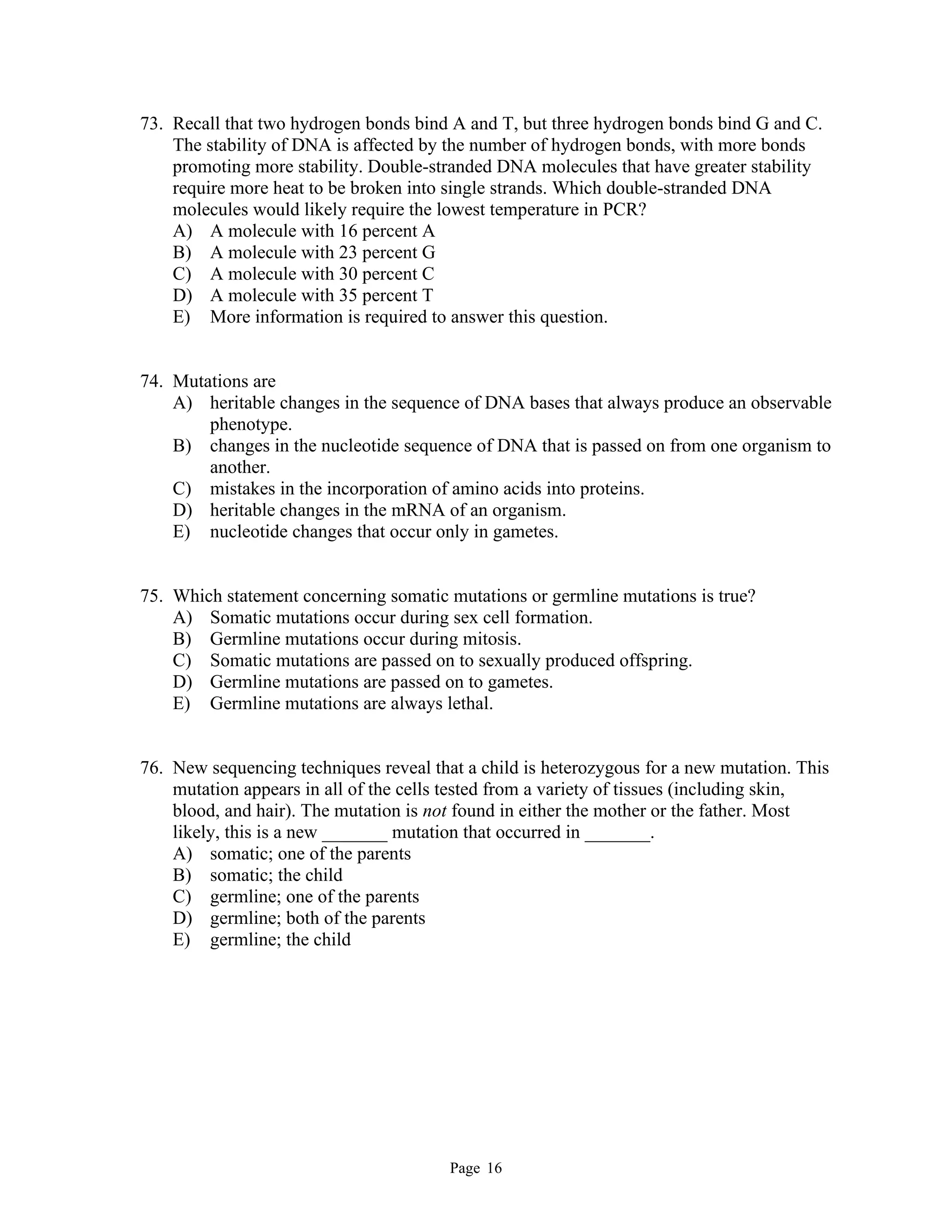
73. Recallthat two hydrogen bonds bind A and T, but three hydrogen bonds bind G and C.
The stability of DNA is affected by the number of hydrogen bonds, with more bonds
promoting more stability. Double-stranded DNA molecules that have greater stability
require more heat to be broken into single strands. Which double-stranded DNA
molecules would likely require the lowest temperature in PCR?
A) A molecule with 16 percent A
B) A molecule with 23 percent G
C) A molecule with 30 percent C
D) A molecule with 35 percent T
E) More information is required to answer this question.
74. Mutations are
A) heritable changes in the sequence of DNA bases that always produce an observable
phenotype.
B) changes in the nucleotide sequence of DNA that is passed on from one organism to
another.
C) mistakes in the incorporation of amino acids into proteins.
D) heritable changes in the mRNA of an organism.
E) nucleotide changes that occur only in gametes.
75. Which statement concerning somatic mutations or germline mutations is true?
A) Somatic mutations occur during sex cell formation.
B) Germline mutations occur during mitosis.
C) Somatic mutations are passed on to sexually produced offspring.
D) Germline mutations are passed on to gametes.
E) Germline mutations are always lethal.
76. New sequencing techniques reveal that a child is heterozygous for a new mutation. This
mutation appears in all of the cells tested from a variety of tissues (including skin,
blood, and hair). The mutation is not found in either the mother or the father. Most
likely, this is a new _______ mutation that occurred in _______.
A) somatic; one of the parents
B) somatic; the child
C) germline; one of the parents
D) germline; both of the parents
E) germline; the child
21.
Page 17
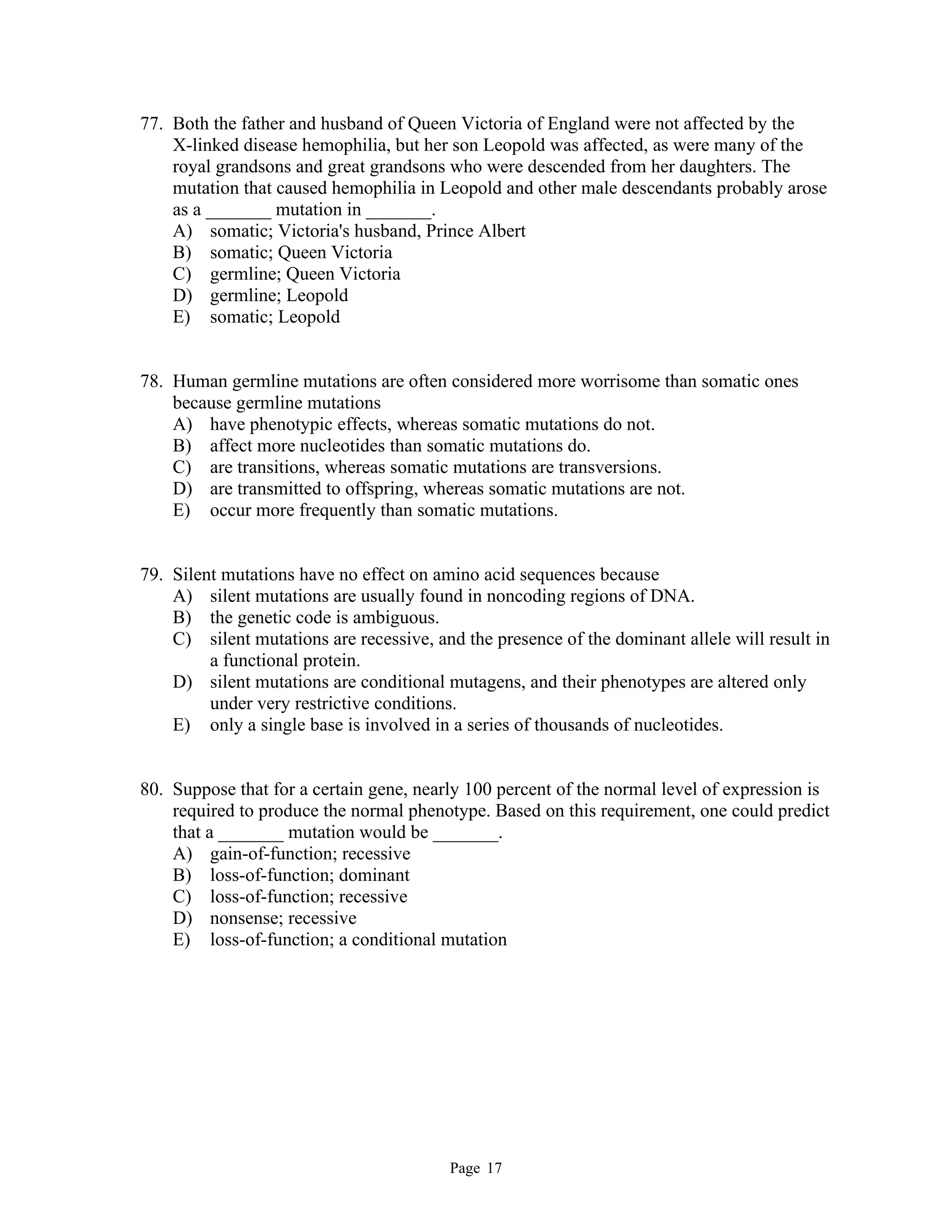
77. Boththe father and husband of Queen Victoria of England were not affected by the
X-linked disease hemophilia, but her son Leopold was affected, as were many of the
royal grandsons and great grandsons who were descended from her daughters. The
mutation that caused hemophilia in Leopold and other male descendants probably arose
as a _______ mutation in _______.
A) somatic; Victoria's husband, Prince Albert
B) somatic; Queen Victoria
C) germline; Queen Victoria
D) germline; Leopold
E) somatic; Leopold
78. Human germline mutations are often considered more worrisome than somatic ones
because germline mutations
A) have phenotypic effects, whereas somatic mutations do not.
B) affect more nucleotides than somatic mutations do.
C) are transitions, whereas somatic mutations are transversions.
D) are transmitted to offspring, whereas somatic mutations are not.
E) occur more frequently than somatic mutations.
79. Silent mutations have no effect on amino acid sequences because
A) silent mutations are usually found in noncoding regions of DNA.
B) the genetic code is ambiguous.
C) silent mutations are recessive, and the presence of the dominant allele will result in
a functional protein.
D) silent mutations are conditional mutagens, and their phenotypes are altered only
under very restrictive conditions.
E) only a single base is involved in a series of thousands of nucleotides.
80. Suppose that for a certain gene, nearly 100 percent of the normal level of expression is
required to produce the normal phenotype. Based on this requirement, one could predict
that a _______ mutation would be _______.
A) gain-of-function; recessive
B) loss-of-function; dominant
C) loss-of-function; recessive
D) nonsense; recessive
E) loss-of-function; a conditional mutation
22.
Page 18
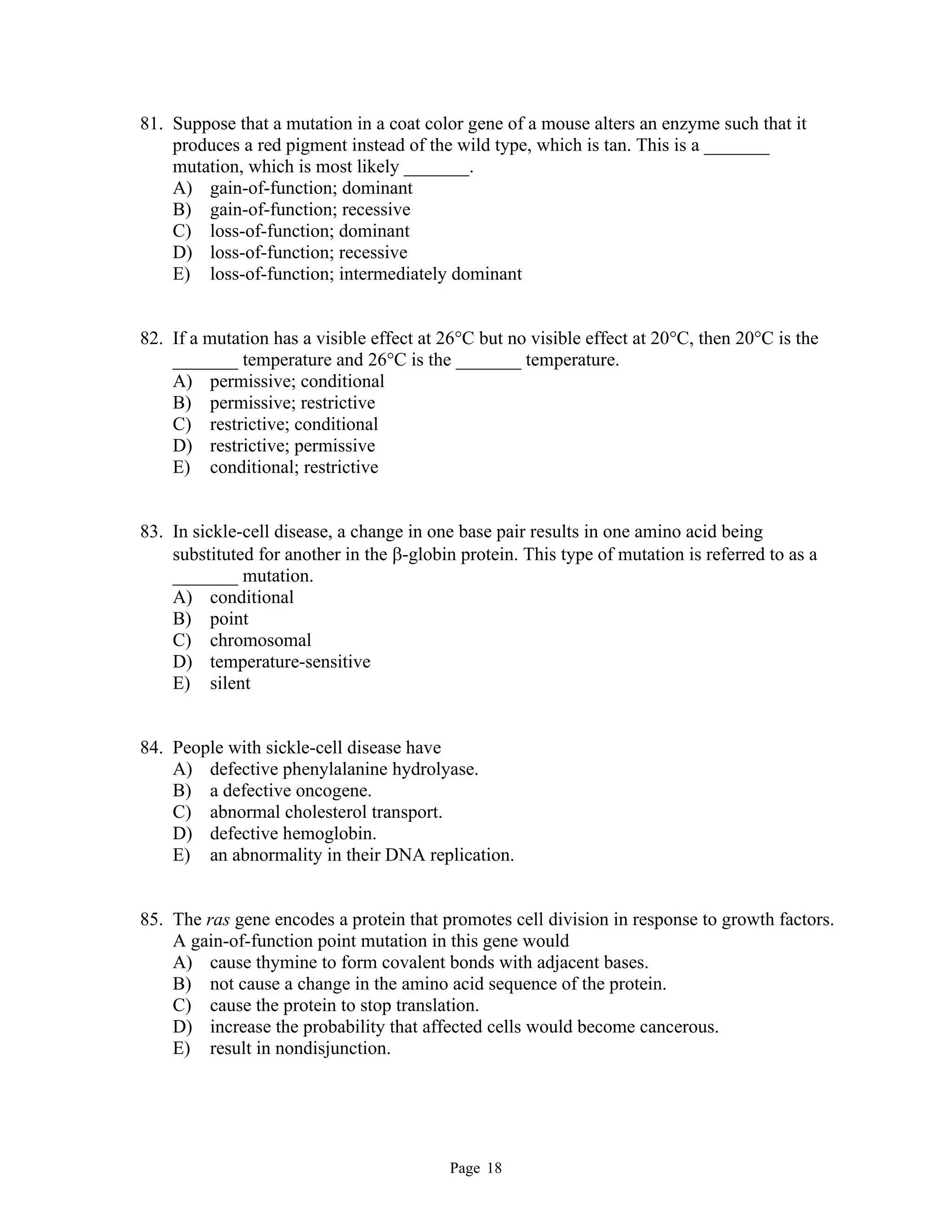
81. Supposethat a mutation in a coat color gene of a mouse alters an enzyme such that it
produces a red pigment instead of the wild type, which is tan. This is a _______
mutation, which is most likely _______.
A) gain-of-function; dominant
B) gain-of-function; recessive
C) loss-of-function; dominant
D) loss-of-function; recessive
E) loss-of-function; intermediately dominant
82. If a mutation has a visible effect at 26°C but no visible effect at 20°C, then 20°C is the
_______ temperature and 26°C is the _______ temperature.
A) permissive; conditional
B) permissive; restrictive
C) restrictive; conditional
D) restrictive; permissive
E) conditional; restrictive
83. In sickle-cell disease, a change in one base pair results in one amino acid being
substituted for another in the -globin protein. This type of mutation is referred to as a
_______ mutation.
A) conditional
B) point
C) chromosomal
D) temperature-sensitive
E) silent
84. People with sickle-cell disease have
A) defective phenylalanine hydrolyase.
B) a defective oncogene.
C) abnormal cholesterol transport.
D) defective hemoglobin.
E) an abnormality in their DNA replication.
85. The ras gene encodes a protein that promotes cell division in response to growth factors.
A gain-of-function point mutation in this gene would
A) cause thymine to form covalent bonds with adjacent bases.
B) not cause a change in the amino acid sequence of the protein.
C) cause the protein to stop translation.
D) increase the probability that affected cells would become cancerous.
E) result in nondisjunction.
23.
Page 19
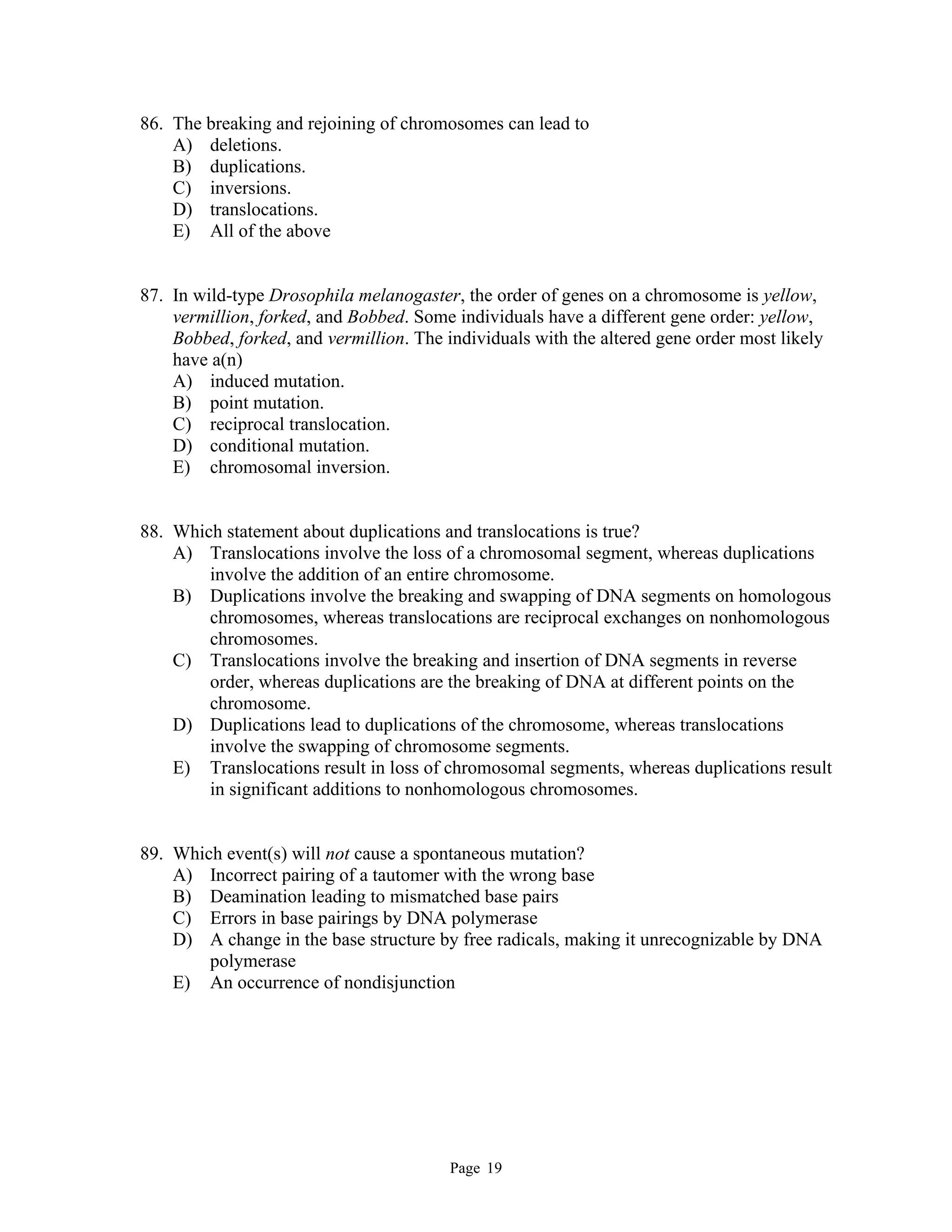
86. Thebreaking and rejoining of chromosomes can lead to
A) deletions.
B) duplications.
C) inversions.
D) translocations.
E) All of the above
87. In wild-type Drosophila melanogaster, the order of genes on a chromosome is yellow,
vermillion, forked, and Bobbed. Some individuals have a different gene order: yellow,
Bobbed, forked, and vermillion. The individuals with the altered gene order most likely
have a(n)
A) induced mutation.
B) point mutation.
C) reciprocal translocation.
D) conditional mutation.
E) chromosomal inversion.
88. Which statement about duplications and translocations is true?
A) Translocations involve the loss of a chromosomal segment, whereas duplications
involve the addition of an entire chromosome.
B) Duplications involve the breaking and swapping of DNA segments on homologous
chromosomes, whereas translocations are reciprocal exchanges on nonhomologous
chromosomes.
C) Translocations involve the breaking and insertion of DNA segments in reverse
order, whereas duplications are the breaking of DNA at different points on the
chromosome.
D) Duplications lead to duplications of the chromosome, whereas translocations
involve the swapping of chromosome segments.
E) Translocations result in loss of chromosomal segments, whereas duplications result
in significant additions to nonhomologous chromosomes.
89. Which event(s) will not cause a spontaneous mutation?
A) Incorrect pairing of a tautomer with the wrong base
B) Deamination leading to mismatched base pairs
C) Errors in base pairings by DNA polymerase
D) A change in the base structure by free radicals, making it unrecognizable by DNA
polymerase
E) An occurrence of nondisjunction
24.
Page 20
90. Benzopyrene,a component of cigarette smoke, can induce DNA mutations by
A) converting cytosine to uracil by deamination.
B) converting an amino group on cytosine into a keto group.
C) adding a chemical to guanine, making it unavailable for base pairing.
D) changing bases to forms that are unrecognizable by DNA polymerase.
E) breaking the sugar–phosphate backbone of DNA.
91. Damage to DNA can be caused by _______ absorbed by thymine in DNA, causing
interbase covalent bonds.
A) X-ray radiation
B) cosmic radiation
C) ultraviolet radiation
D) free radicals
E) cigarette smoke
92. Mutational “hot spots” often occur when a methyl group has been added to
A) adenine.
B) cytosine.
C) guanine.
D) thymine.
E) uracil.
93. A medical researcher finds a high incidence of covalent bonds between thymine and
other nucleotides in the DNA of skin cells of a patient. The most likely cause is
A) exposure to cigarette smoke.
B) a defective DNA polymerase.
C) nitrous oxide exposure.
D) exposure to UV radiation.
E) unknown; these bonds likely formed spontaneously.
94. A virus that infects bacteria is called a _______.
95. The nitrogenous bases classified as purines are _______ and _______.
96. The nitrogenous bases classified as pyrimidines are _______ and _______.
97. According to Chargaff's rule, if the quantity of C in a double-stranded molecule of DNA
is 22 percent, then the quantity of T will be _______ percent.
25.
Page 21
98. Adouble-stranded molecule of DNA is composed of _______ percent purines.
99. The basic units of DNA and RNA molecules are the _______.
100. Watson and Crick created three-dimensional representations of the possible molecular
structure of DNA in order to determine its actual structure. This process is called
_______.
101. The X-ray crystallographs prepared by _______ in the 1950s were essential for the
discovery of the structure of the DNA molecule.
102. The purines take up (more/less) _______ space in the center of a DNA molecule than
the pyrimidines do.
103. Because the DNA molecule is continuous, the information of each nucleotide pair must
lie in the _______ sequence of the nitrogenous bases.
104. The region of DNA where replication begins is called the _______.
105. The mechanism by which each strand of parental DNA acts as a template for a new
strand is called _______ replication.
106. If a sequence of one strand of DNA is 5-ATGATGT-3, the complementary strand must
be _______. (Use 5-to-3 orientation.)
107. The fragments of RNA and DNA found on the lagging strand of DNA before RNA
removal and ligation are called _______.
108. DNA polymerases catalyze many polymerizations each time they bind to a DNA
molecule. Therefore, DNA polymerases are said to be _______.
109. The repetitive sequences at the end of many chromosomes are called _______.
26.
Page 22
110. Anenzyme that is found in 90 percent of human cancers and may be responsible for the
continuous division of cancer cells is _______.
111. An enzyme that catalyzes the addition of any lost telomere sequences is _______.
112. The _______ function of DNA polymerase reduces the number of mistakes by the
square of the frequency of the error rate.
113. An automated process that makes multiple copies of short regions of DNA in a test tube
is called the _______.
114. Four rounds of PCR will result in _______ molecules of DNA from a single molecule.
115. Starting from one double-stranded DNA molecule, 128 DNA molecules can be
generated via _______ rounds of PCR (assuming that the process is 100 percent
efficient).
116. The gene order for one chromosome is A, B, C, D, E. A homologous chromosome has
the gene order A, D, C, B, E. These chromosomes differ by a(n) _______.
117. Mutations that exhibit the altered phenotype under certain restrictive conditions are
referred to as _______ mutations.
118. Silent mutations have no effect on amino acid sequences because they are usually found
in _______ regions of the DNA.
119. The ras gene normally functions to promote the cell cycle. If a gain-of-function
missense mutation occurs in the ras gene, the mutated ras protein will _______
(inhibit/promote) the cell cycle.
27.
Page 23
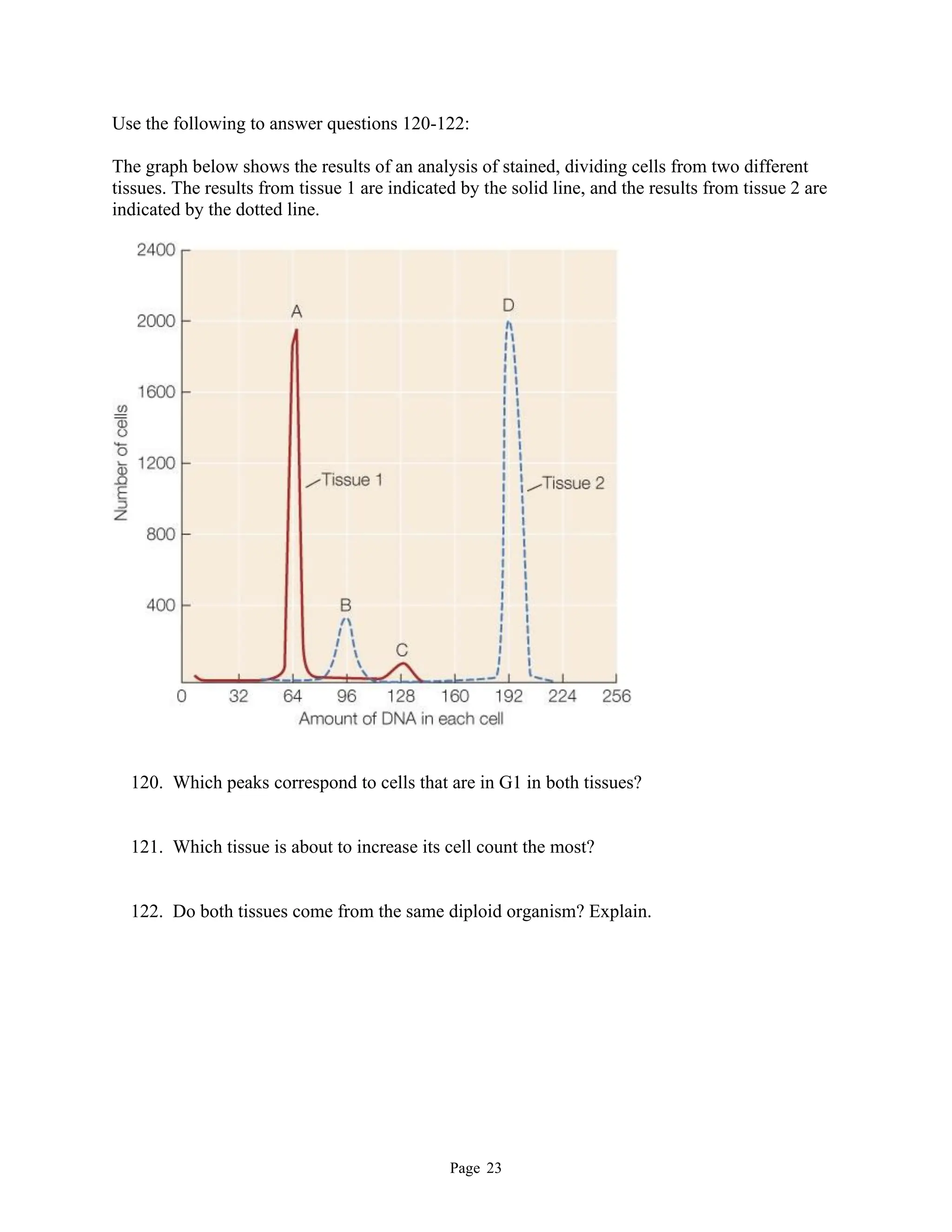
Use thefollowing to answer questions 120-122:
The graph below shows the results of an analysis of stained, dividing cells from two different
tissues. The results from tissue 1 are indicated by the solid line, and the results from tissue 2 are
indicated by the dotted line.
120. Which peaks correspond to cells that are in G1 in both tissues?
121. Which tissue is about to increase its cell count the most?
122. Do both tissues come from the same diploid organism? Explain.
28.
Page 24
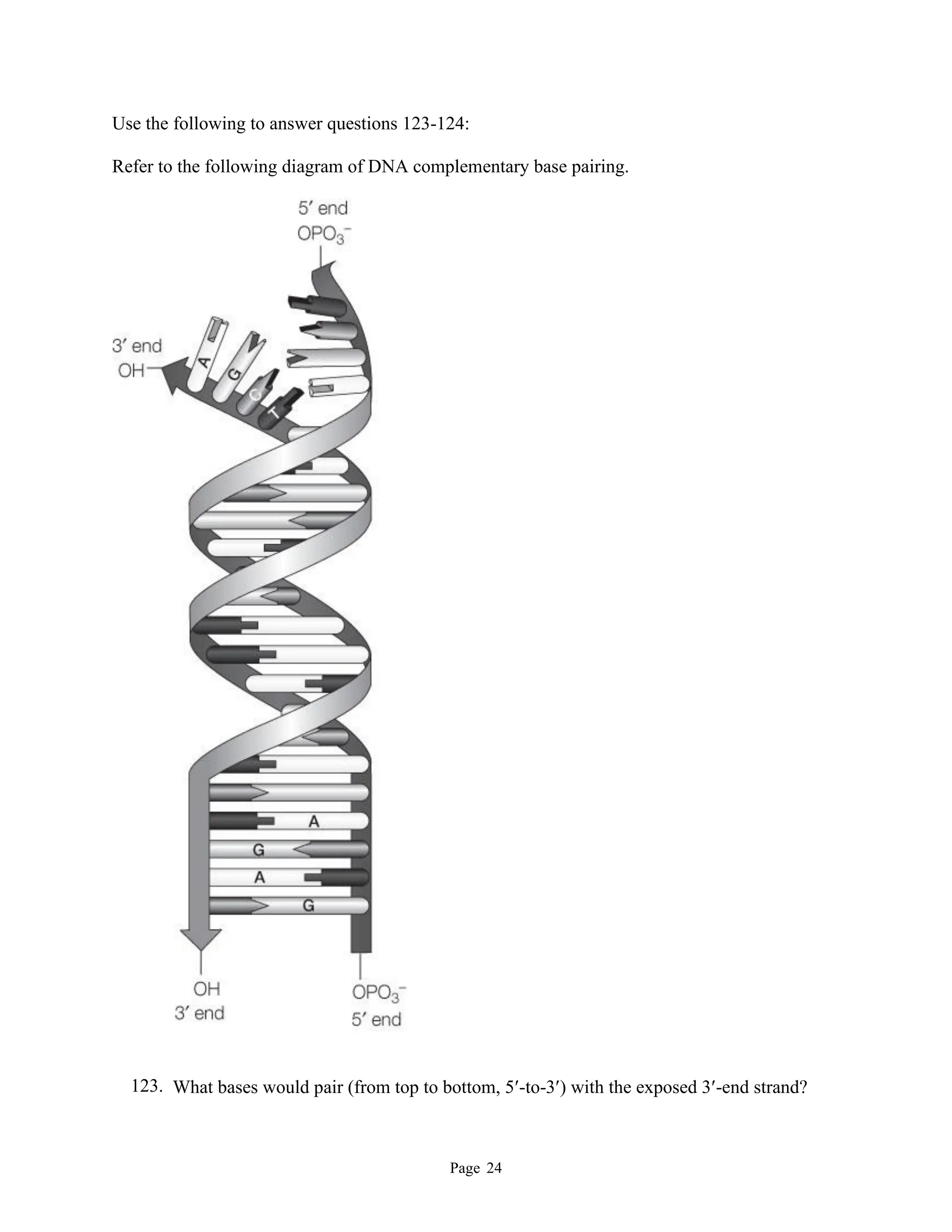
Use thefollowing to answer questions 123-124:
Refer to the following diagram of DNA complementary base pairing.
123. What bases would pair (from top to bottom, 5-to-3) with the exposed 3-end strand?
29.
Page 25
124. Ifone more “T” nucleotide were to be added to the unzipped end of this DNA molecule,
which base would it join to?
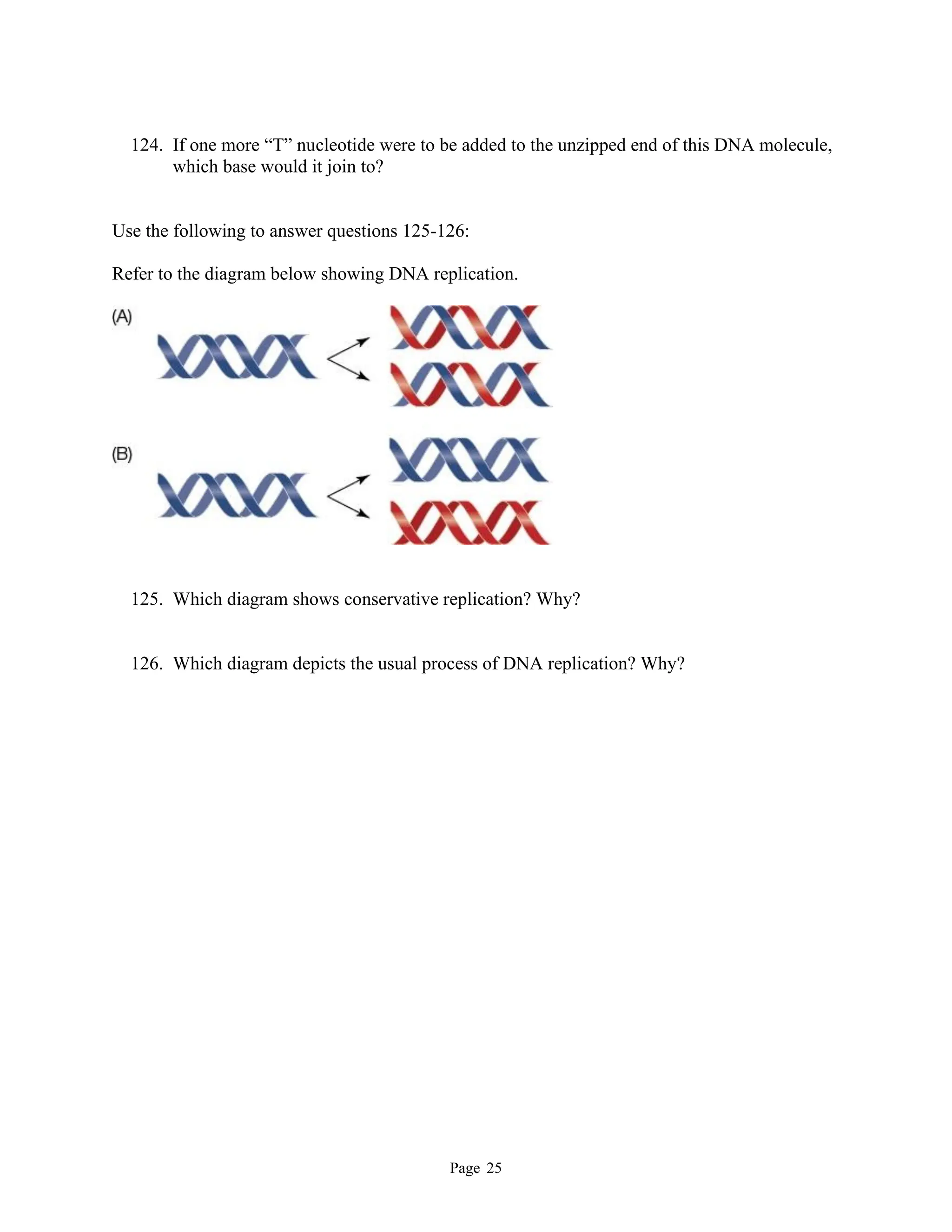
Use the following to answer questions 125-126:
Refer to the diagram below showing DNA replication.
125. Which diagram shows conservative replication? Why?
126. Which diagram depicts the usual process of DNA replication? Why?
30.
Page 26
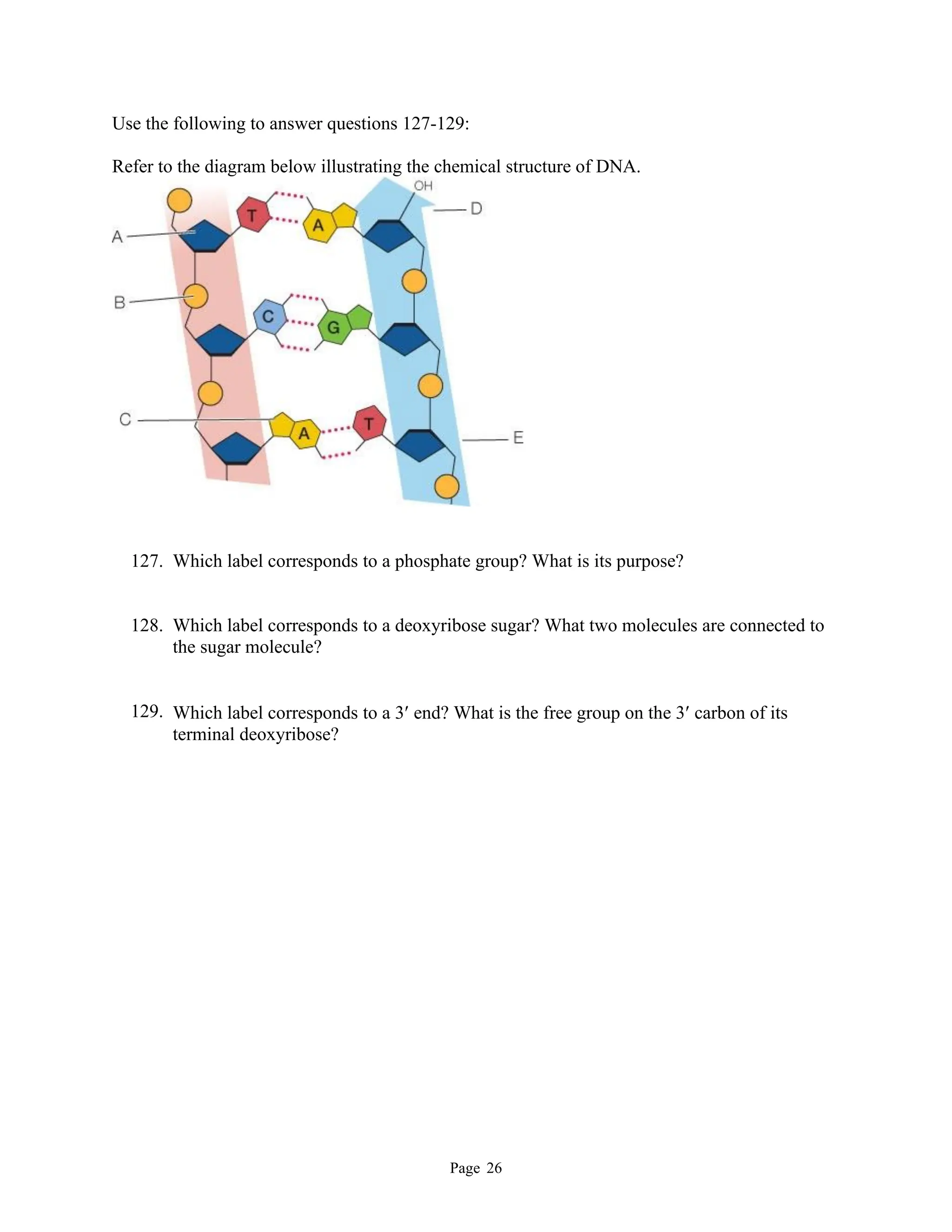
Use thefollowing to answer questions 127-129:
Refer to the diagram below illustrating the chemical structure of DNA.
127. Which label corresponds to a phosphate group? What is its purpose?
128. Which label corresponds to a deoxyribose sugar? What two molecules are connected to
the sugar molecule?
129. Which label corresponds to a 3 end? What is the free group on the 3 carbon of its
terminal deoxyribose?
31.
Page 27
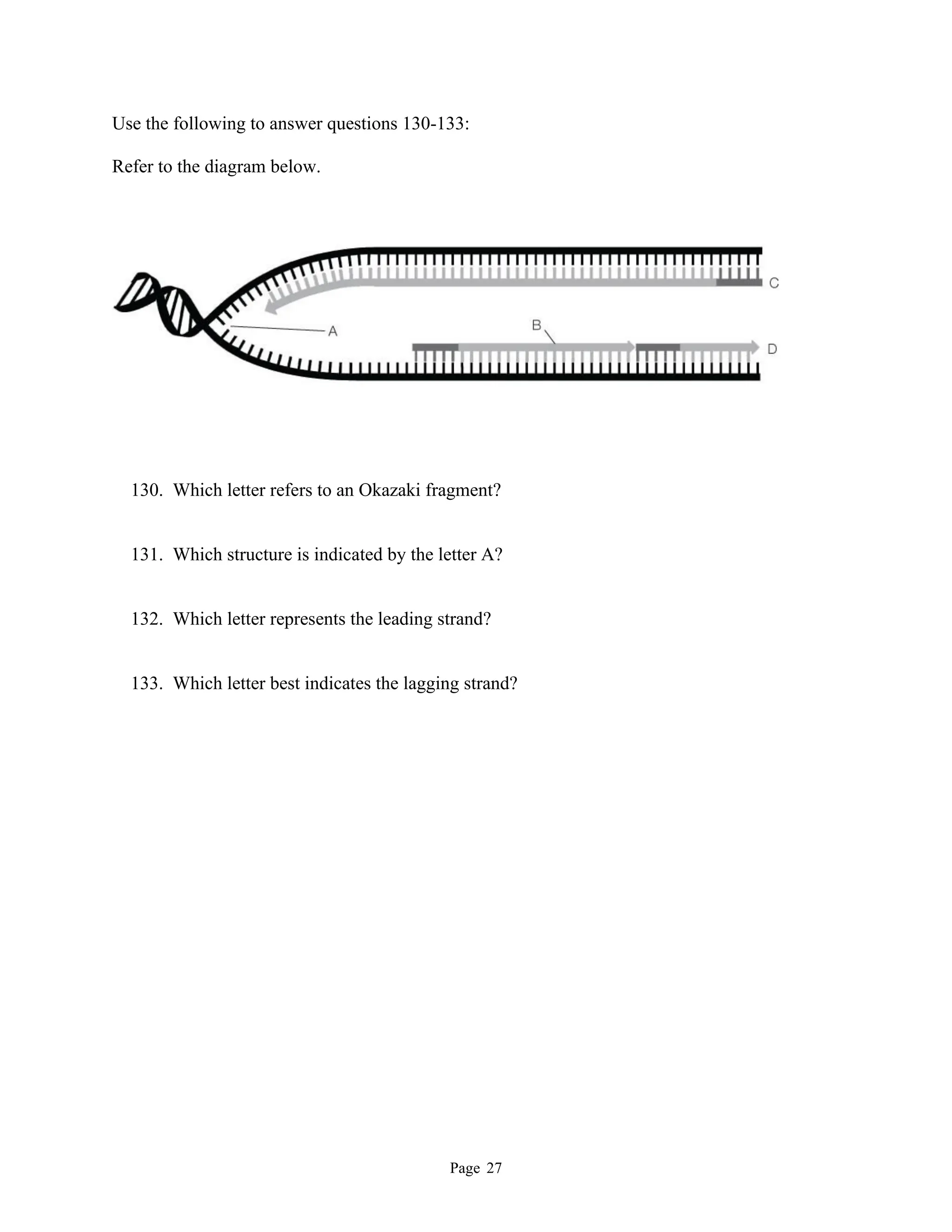
Use thefollowing to answer questions 130-133:
Refer to the diagram below.
130. Which letter refers to an Okazaki fragment?
131. Which structure is indicated by the letter A?
132. Which letter represents the leading strand?
133. Which letter best indicates the lagging strand?
32.
Page 28
Use thefollowing to answer questions 134-137:
The diagram below shows the effect on three-dimensional shape of two different mutations (A
and B) on the same sequence of DNA for an enzyme. The hypothetical organism has three main
targets of enzyme action.
134. Which mutation resulted in a functional enzyme?
135. Enzyme A has experienced which type of mutation?
136. Three different mutations can affect the functionality of proteins. Which mutation is not
illustrated in the figure?
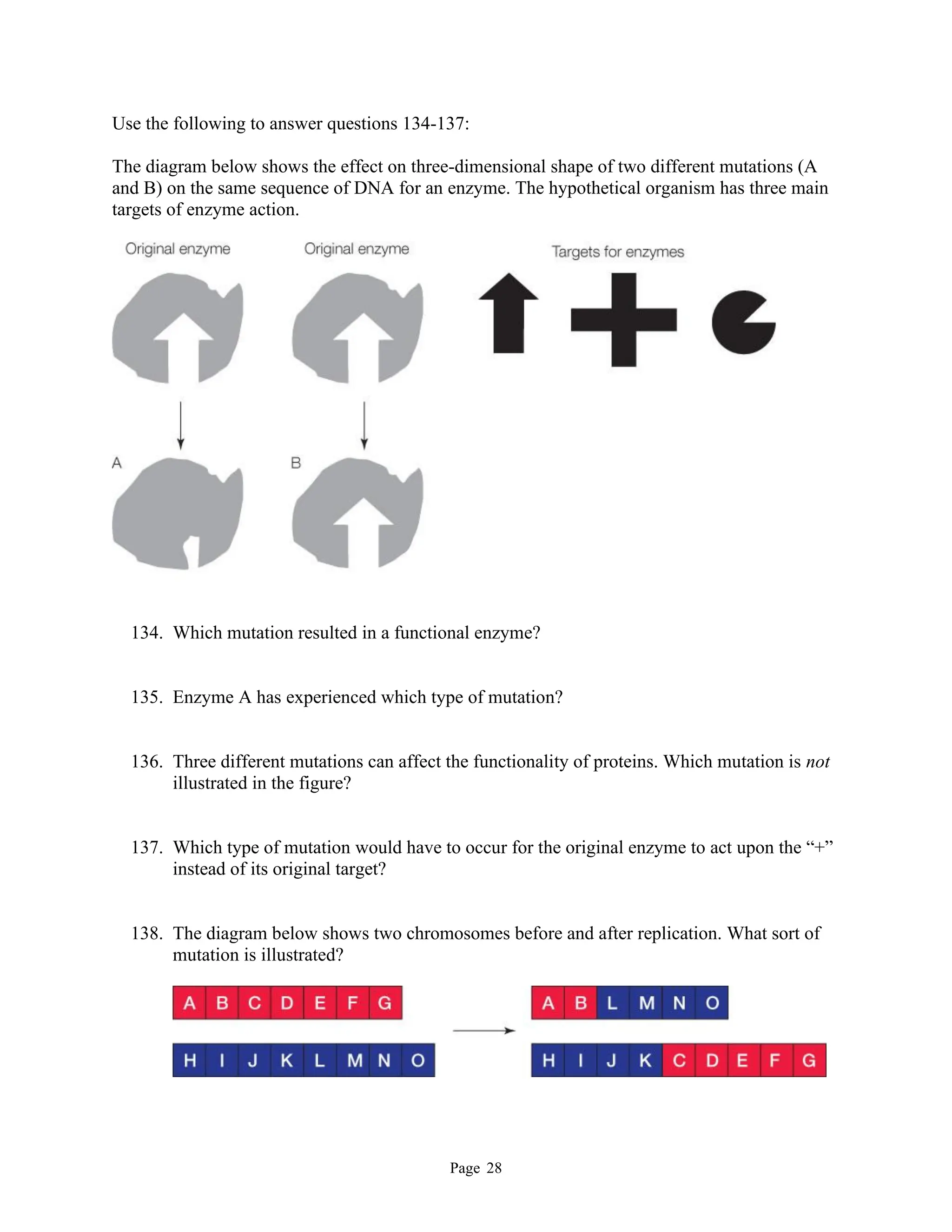
137. Which type of mutation would have to occur for the original enzyme to act upon the “+”
instead of its original target?
138. The diagram below shows two chromosomes before and after replication. What sort of
mutation is illustrated?
33.
Page 29
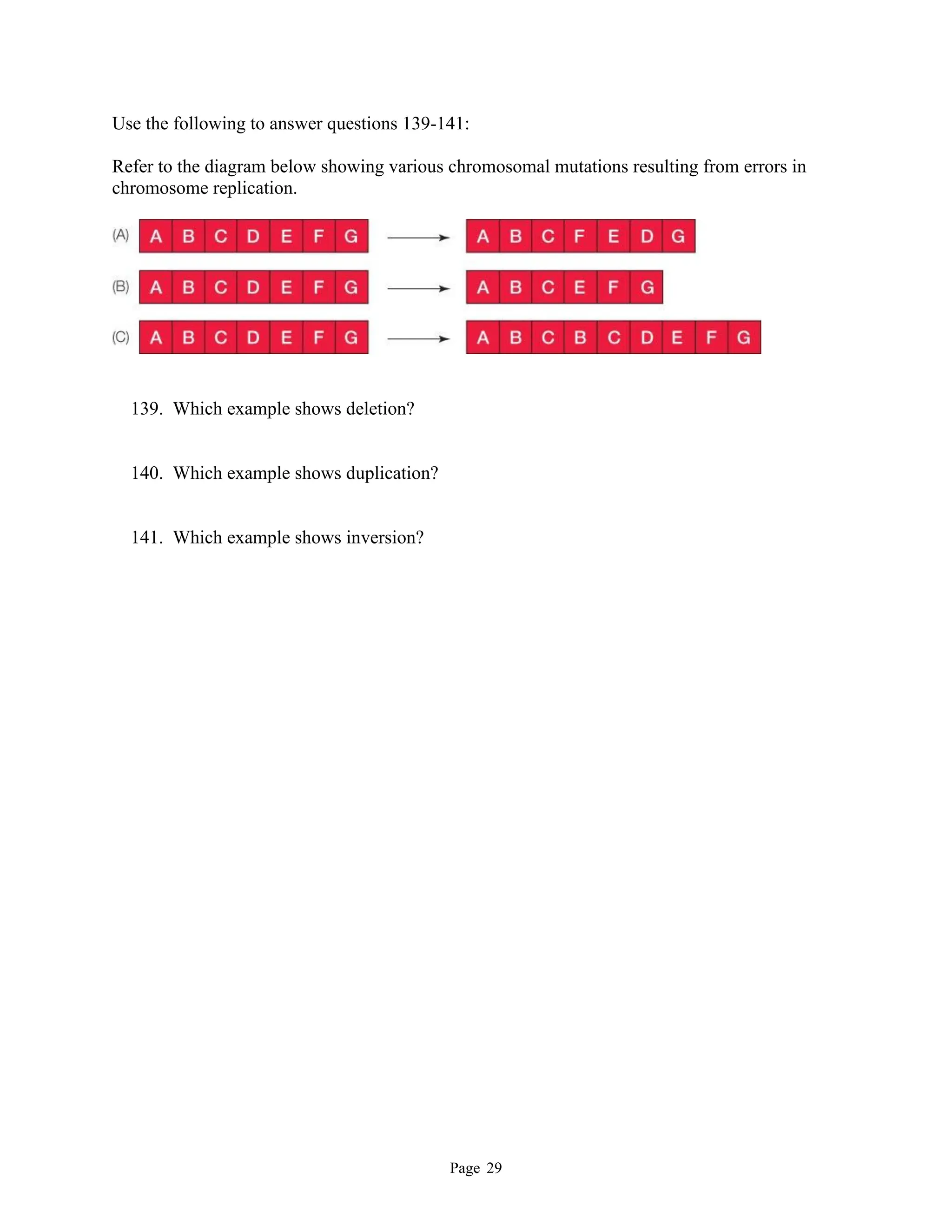
Use thefollowing to answer questions 139-141:
Refer to the diagram below showing various chromosomal mutations resulting from errors in
chromosome replication.
139. Which example shows deletion?
140. Which example shows duplication?
141. Which example shows inversion?
34.
Page 30
Answer Key
1.A
2. D
3. A
4. C
5. E
6. A
7. D
8. B
9. E
10. A
11. E
12. A
13. E
14. C
15. A
16. B
17. C
18. C
19. E
20. D
21. B
22. D
23. B
24. E
25. A
26. B
27. C
28. A
29. E
30. D
31. C
32. E
33. D
34. A
35. B
36. A
37. D
38. B
39. C
40. C
41. E
42. C
43. B
44. E
Christobelle endured much,ere she set forth with her father from
Fairlee. She bore her parting interview with Spottiswoode with great
intrepidity; but she wept at her mother's obdurate determination not
to see her before she quitted the parental roof. Sir John Wetheral
soothed her as she gazed upon the lake, till it vanished from her
aching sight: and he prophesied that her trial would not be
lengthened beyond her power to endure it. He spoke kindly and well
to her overpowered spirit, of the sorrows which must accompany a
progress through life, and of the consolation which attended a
patient and praying spirit. He did not consider it right to allow
Spottiswoode to accompany them, as her mother evinced such
decided repugnance to the match; but at Brierly, Christobelle might
enjoy her lover's society in peace; and he would accompany his lady
to Wetheral as soon as she expressed a wish to set forth on the long
journey. New scenes, new faces, and a new set of ideas would, he
hoped, drive gloomy fancies from her mind, and bring comfort to all
parties. She was on her road to Isabel, and with her and Boscawen
she must enjoy the calm pleasures of domestic happiness. They
would lead her to agreeable thoughts, and Spottiswoode would
speedily add his society to the enjoyments of Brierly.
Such was Sir John Wetheral's reasoning, and its effects were
apparent upon Christobelle's spirits. She gradually recovered
cheerfulness under his indulgent soothings, and she could even
admire the changing scenery which varied their route to Edinburgh.
Mr. Boscawen was true to his appointment; they found him at the
place of rendezvous, ready to conduct Christobelle to the county of
her birth, and induct her once more into the domicile which had
sheltered her so kindly years before.
Mr. Boscawen was surprised at her growth, and wondered at the girl
who had glided into womanhood so rapidly. He thought her features
bore a strong resemblance to her unfortunate sister Clara; but he
politely assured her, her manner was entirely her own. She was no
longer, he said, "the gay little half-grown girl, who had delighted to
nurse her nephew under the mulberry tree at Brierly. She must be
looked upon in a very different phase; and he feared the quiet
37.
haunts of Brierlywould ring with the charms of the beautiful Miss
Wetheral. He was pleased to think she possessed a protector whose
claims would at once put an end to the fearful contention of furious
rivals." Christobelle's blushes were the only answers she could give
to the agreeable remarks of Mr. Boscawen.
Sir John Wetheral's absence would not be of long continuance,
therefore Christobelle did not sorrow much as she bade him adieu.
She prayed him to speak of her to her mother, and to express her
deepest regret at having incurred her displeasure. She prayed for
her pardon, and that they might meet again in reconciliation. She
looked to her forgiveness with anxious desire, with a fervent and
unceasing hope. She embraced her dear father, and bade him
remember her kindly, affectionately, to the friend she had left at
Fairlee, and then she gave her hand to Mr. Boscawen.
38.
CHAPTER XXVIII.
How delightedlydid the eye of Christobelle rest upon the matronly
form of Isabel! She was clasped in her arms, as she descended the
steps of the chaise at Brierly.
"Well, I never saw such a beautiful creature in my life! My dear
Christobelle, who would have thought you would turn out so very
pretty? My dear Mr. Boscawen, were you not surprised at
Christobelle's beauty, when you first saw her?"
"I was not so overcome at your sister's handsome face, as I am
astonished at Isabel's neglect of her long-absent husband," replied
Mr. Boscawen, smiling. Isabel flew towards him.
"I can't think how I came to be so wicked; but, indeed, it was the
sight of my sister's face. My dear Boscawen, I have so longed for
your return, and so have the children! I was obliged to tell the dear
things papa was gone a long way off, for some cakes and their
pretty aunt, or they would not have been comforted. I did not know
what hour you would arrive, therefore I was wise enough not to say
a word to them about it."
"They shall be summoned after dinner, Isabel. We are hungry
travellers now, and a meal will be most gratefully welcomed."
"My love, ring the bell, and order it in now, if you please, while I
escort my sister to her room. Follow me, dear Christobelle. Well, I
declare I never saw such a change in a human being! You are tall
and handsome, and have such beautiful ringlets! I shall certainly
39.
have ringlets too.I can't fancy you are the little, jumping Chrystal,
who was dressed out so fine at my wedding, five or six years ago.
Well—and don't you think I am changed?"
Isabel was changed. Her sylph-like figure had swelled into a stout
form: her waist had increased materially in breadth, and her dress
was rather disordered.
"The children are so playful, Chrystal, that my collars have always a
ragged appearance; and corsets of any kind are so very painful,
because I am getting large, that I never wear them. Boscawen,
though, does not mind my appearance: he is not particular. He
allows me to do just what I like, and I am so happy! Ah! do you
remember my geography days, Chrystal? How I detested that
dreadful map of the world! I am determined my little Bell shall be
happy and ignorant, as I was before her. She is called Bell after you,
dear—not your long name, but simply Bell. I hope she will be as
pretty as you; but what does it signify? Who can be happier than I
am, with my broad waist and rumpled collars?"
The moment the servants had withdrawn, after dessert was placed
upon the table, Isabel continued her happy prattle.
"I have so much to tell you, of one kind or the other, dear Bell, that I
don't know where to begin. What shall I tell first, my dear
Boscawen? Oh! Bell, such things are whispered of Julia!—I don't
believe a word of them—not one word. However, you will find Anna
Maria more French than ever, for the Count de Nolis has been
staying every Christmas at Hatton, and Félicé does lay on the rouge
terribly. It's quite amusing to hear Tom Pynsent boast of his wife's
bloom, when it's rouge all the time. I think I wrote you word, that
odd Mrs. Hancock had a paralytic stroke some time ago?"
"No, indeed, Isabel, I never heard of it."
"Didn't you? Oh! it's the case, I assure you—her mouth is all on one
side. Poor Miss Tabitha is not dead yet, Bell: I don't think she means
to die at all; and Mrs. Ward writes word, she finds fault with every
thing, poor soul, that is said or done. Shall I ring for the darlings, my
40.
dear Boscawen? Iam sure Chrystal is dying to see her little boy,
whom she nursed so carefully. Ring the bell twice, my love, and the
little wild things will soon rush in."
"Do not give Tom wine, Isabel; I have a dislike to children taking
wine so early in life."
"No, my dear Boscawen, certainly not. I think, with you, that wine is
very improper for children—but little Tom has such a winning way of
coaxing his poor mother!"
The children soon burst into the room, and ran bounding round the
table. Isabel was all triumphant pleasure. "Now, Charles—my dear
Charles, go quietly to papa, and ask him how he does, and whether
the cakes are come from merry Scotland. Ah, ha, Charley goes for
his cakes. Tom, my beauty, come to mamma; and Bell, go to your
aunt—your new aunt, and admire her pretty hair."
Christobelle endeavoured to attract her little fat niece to her side,
but she hid her face in Isabel's lap.
"Oh, Bell, I'm ashamed of you!—your pretty aunt, too—oh, fie! My
dear Tommy, don't touch mamma's glass. No, no wine, Tommy—
papa says no. A few strawberries, my dear little boy, and a biscuit,
but no wine."
Tommy, however, advanced his mother's wineglass to his lips,
watching her countenance with a cunning glance.
"Now, my little, good Tommy, mamma will be angry, very angry, if
you do what she tells you not to do. Bell, my love, go to your aunt,
like a good girl."
Isabel took some pains to persuade her little girl to raise her head,
but her appeals were useless. In the mean time, Tommy had silently
quaffed the remainder of the contents of her glass. Mr. Boscawen
rose, and took him from Isabel's knee.
"My dear Boscawen, what are you going to do with Tommy? he is
very good with me, my love."
41.
"I am goingto banish him, Isabel, for disobedience."
"Oh, my dear Boscawen, it was the least little drop of wine in the
world! it was scarcely a teaspoonful—pray don't punish Tommy for
that little drop, my love."
"The disobedience was the same in the action, Isabel. I shall send
him into the nursery. I shall take him there myself."
Isabel's eyes suffused, as Mr. Boscawen left the dining-room with the
crying recreant Tommy. She turned to her sister.
"Oh! Chrystal, was it not severe to carry away that dear child, for
one drop of wine only?"
"Boscawen was quite right, my dear Isabel."
"Do you really think so? Do you really think he was right to banish
the darling child, when it was such a pretty, coaxing trick? Did you
see his little, cunning, dear eyes?"
"Boscawen justly thinks, Isabel, that cunning habits and
disobedience will increase, if it is not checked."
"Oh! I hope it won't increase—dear child—I should be sorry to see
him grow sly." Mr. Boscawen returned. "My love, did Tommy cry?
Was he very much hurt—poor dear? Did you leave him crying?"
"My dear Isabel, you have brought this upon him, by not checking
disobedience in the first instance. You have allowed the child twice
to steal your wine."
"My dear Boscawen—steal! indeed, that sounds dreadful! I hope my
children will never steal! It was indeed my fault! Poor, dear child!—I
dare say he is crying dreadfully now. Let me beg for my child,
Boscawen."
"Let him remain where he is, Isabel: he has been very naughty."
"But I have taught him to steal, and I ought to suffer for him, dear
Boscawen. Let me go to my child, my love!" The tears stood in
Isabel's eyes, and Boscawen was still under their influence. He
42.
soothed his ladyas fondly as when in earlier days she wept for the
drooping ostrich feather.
"My dear Isabel, when we retire into the drawing-room, your child
shall come down again. Don't weep, my love. I cannot wonder at
your fondness, but he was very naughty. Wait a few moments,
Isabel, and the child shall join us in the drawing-room. Don't let me
see you weep—stay, I will bring him down to you."
Isabel smiled, and little Tommy was restored to her arms, as he
entered the drawing-room. Mr. Boscawen felt he had acted unwisely
by his child; but how could he resist Isabel in tears? Things were
totally changed at Brierly. A tear from the bright blue eye of Isabel
melted Boscawen's best resolves, and operated against the
excellence of his own system of education. Isabel held the reins of
government in her hands. She never argued with her husband—she
never offered a word of opposition to his wishes—but she ruled by
submission, and won his acquiescence by her tears and gentle self-
upbraidings. Fortunately, her children possessed her own sweet
disposition, which defied indulgence, or they might have suffered
through Isabel's inability to check their budding faults. As it was,
they loved her too well to persist in offending a parent so devoted;
and it must have proved a very serious offence, ere the light-hearted
Isabel could lament conduct which was ever palliated by her
affectionate heart. She was indeed the happiest of wives and
mothers.
Mr. Boscawen and Christobelle resumed their occupations
instinctively, as if years had not intervened since they last walked
and read together at Brierly. Isabel was delighted.
"Ah, there you go again!—read, read, talk, talk, all day long. I like to
hear you argue, when I have time to devote to you both; but the
children require so much attention, and the dear little things love to
be with me so often, that dear Boscawen has been a great deal
alone, haven't you, Boscawen? It is such a pleasure to have you
here, Chrystal—my poor, dear husband won't have to endure my
ignorance."
43.
"Who says myIsabel is ignorant?" said Mr. Boscawen, patting his
lady's shoulder affectionately.
"Yes, dear Boscawen, I am very ignorant, and very unfit for you; but
I do very well to play with the darlings, and superintend every thing
but their education—that you will do, except for poor little Bell: let
her be happy and ignorant, Boscawen. If she is half as happy as her
mother, she will not require knowledge—only her husband and
children. I never wish for any thing beyond you and them." Isabel
cast an upward and affectionate look at Boscawen, who bent his
long figure to kiss his laughing wife.
Mr. Boscawen told Christobelle he had engaged to take her for a day
or two to Hatton. The Pynsents were very anxious to see her, and
Mrs. Pynsent had made it a point with him to bring the "tall, gawky,
good-looking girl" to her, as soon as she had rested a few days at
Brierly. The Charles Spottiswoodes, also, were wishing to see her
again, to contemplate the improvement which five years must have
effected in her appearance. The name of Spottiswoode brought
blushes into the face of Christobelle.
"My dear Bell," exclaimed Isabel, with laughing delight, "how droll it
is to think you have a lover; when I saw you last, you were such a
bit of a girl! Sir John Spottiswoode is just the man I would have
chosen for you—just the very person I should have singled out—is
he not, Boscawen?—just the sort of man, with curling dark hair and
high forehead, that you ought to like, dear Chrystal!"
"I had not dark curling hair, Isabel?" said Boscawen, smiling—"I had
not a high forehead, had I?"
"My dear Boscawen, your hair was always dreadfully wiry, and I
thought you very plain, but I liked you for all that, you know."
"Then why ought Chrystal to choose and love such things, my
Isabel?"
"Ah! I dare say I am talking nonsense again," cried the humble
Isabel, "for I should really recommend no one who does not
resemble you, dear Boscawen. I should advise every woman to wait
44.
till they couldfind a kind, dear man, like yourself, and then they
would not care about wiry hair, or...." Isabel hesitated and coloured.
"Say on, Isabel." Mr. Boscawen looked amused.
"I was going to say, they would not mind great long legs. Don't be
angry, my love, with me."
Mr. Boscawen laughed. "You see, Isabel, the triumph of good sense
over mere personal advantages. You cannot be ignorant, since you
chose me in spite of my deficiencies. I hope all your young
acquaintance may exhibit your indifference to mere good looks. Miss
Wetheral, when shall we visit Hatton? Isabel, will you join the
party?"
"I wish I could drive over with you, my love; but Charly is cutting a
double-tooth, and I think little Bell is not quite well. I think I cannot
leave my little ones two days, Boscawen!"
"Then Chrystal and myself will depart to-morrow for Hatton," said
Boscawen, smiling, with gratified feelings, at his wife's love of her
home and her little ones.
"Yes, Bell will amuse you, dear Boscawen, and you will not miss me.
You can talk away upon history and the arts and sciences, and enjoy
the novelty of a clever companion, for once. I am only fit to nurse
my children."
"You are only fit to be a very excellent creature, and to be my dear
little roundabout wife," exclaimed Boscawen; and Isabel looked so
happy! It was delightful to witness the joyous expression which
revelled in her looks, whenever she spoke with her husband and
children. It was such a contrast to the Isabel whom Christobelle
remembered, low-spirited, in her dressing-room at Wetheral, pining
over "Burnet's Reformation!" It was such a contrast to the Isabel
who watched in alarm the fond, but searching, glance of her
excellent, elderly husband!—Christobelle told her so, when they
were alone. She laughed.
45.
"I remember, Bell,how frightened I used to be, and there was no
cause for it! Boscawen was always kind, only I was so unwilling to
receive improvement, and then I fancied his anxiety was annoying.
When Miss Tabitha left Brierly, every thing was comfortable to me;
for then, you know, there was no one to point out my faults. But,
Chrystal, tell me now all about John Spottiswoode. Boscawen told
me not to be curious, but I am very curious. I want to know how it
all began, and why mamma is so foolish about Lord Farnborough."
Christobelle recapitulated her story to Isabel, who wondered, and
was pleased, and wept, by turns, as her sister recounted all her
sufferings. She clasped her arms round Christobelle.
"Never mind, Chrystal, never mind; and every thing will end as it
should do. Every body knows mamma's matches have turned out
shockingly; and John Spottiswoode is so loved by all his relations, so
good to his mother and sister, that you are fortunate in attracting
him; but you are so very handsome, dear Chrystal, you would attract
every one, high and low. People are now scandalizing poor Julia, and
pointing at her and Colonel Neville; but I will never believe that Julia
would do wrong, though I dare say she is very unhappy, poor dear
girl."
"What does Boscawen think, Isabel?"
"Oh, Boscawen never thought that match would answer. He did not
like the Dowager's manners and character; and he said to me, at
Julia's wedding, that if my sister fell from her high estate, the two
mothers would answer for it hereafter. He said, too, that Julia was
the victim of two machinating Machiavels. Of course, he meant
mamma and the Dowager. Lord Selgrave was always disliked as a
cruel, disagreeable boy, I hear; so he would have made you a sad
husband, in spite of being Earl of Farnborough, and a trumpery Duke
in expectancy."
Isabel's remarks only corroborated the observations of Spottiswoode,
and Christobelle believed herself indeed saved from ruin, though she
paid a severe penalty for her escape, in the angry prohibition of her
46.
mother's disappointed views.Her present pain, she felt assured, was
far more bearable than the misery of an unhappy matrimony; and
she was grateful beyond expression to know that she was given to a
man, so loved and so well appreciated as Spottiswoode was, among
her nearest friends. Their approbation must be balm to her heart;
and, when her mother heard how all lips concurred to praise him,
would she continue her ungenerous dislike to her presence? Would
she persist in holding back her consent, and still pertinaciously
revenge upon her head her dismissal of a man so little respected as
Lord Farnborough? Christobelle hoped not in fear and trembling; she
would hope. As her dear father observed, she had a right to hope
that her prayers would be heard and answered, if she persevered in
the path of principle.
Christobelle's spirits were considerably improved, by viewing the
happy lot of Isabel, in the enjoyment of those tranquil domestic
scenes which were so adapted to her taste and nature. In Mr.
Boscawen, she met the highly-informed mind which imparted
knowledge with a flow so gentle, that it did not startle or confound
the listening neophite. His was a mind which fertilized as it stole
along, improving all, and delighting every ear, but the ear of Isabel.
To her the stream of his intellect flowed by, without a wish to
understand, or kindle under its influence, one spark of sympathetic
fire. Yet she gloried in her husband, and their life was peaceful and
happy.
It is temper which creates the bliss of home, or disturbs its comfort.
It is not in the collision of intellect, that domestic peace loves to
nestle. Her home is in the forbearing nature—in the yielding spirit—
in the calm pleasures of a mild disposition, anxious to give and
receive happiness. In the sweet humility of Isabel, and in the
indulgent forbearance of Boscawen, peace dwelt undisturbed by rival
animosity; and she did not suffer those alarms which chase her timid
presence from the hearth of the contentious, and from the bosom of
the envious. Such was the blessed comfort and true charm of Brierly.
47.
Isabel was allbustle and kindness, as her husband and sister
prepared to depart for Hatton. "Had dear Boscawen forgotten his
shaving-apparatus?—his tooth-brush? Was he sure he had his eye-
glass? She hoped they would return very soon; but, at any rate, till
they made their appearance again, she should live in the nursery.
Dear Boscawen was to be sure and remember every thing that was
said of Chrystal, for she was sure every one would admire her pretty
face; and Chrystal was particularly to be amused with Tom Pynsent's
remarks upon Anna Maria's borrowed bloom. Where was Charly and
Bell? They had begged to ride as far as the Lodges, and she would
put on her hat and meet them."
Isabel ran off to the nursery, and returned with her three children.
Tommy was a soldier, and a drum was appended to his neck. Charly
had a new fiddle in his hand, and little Bell was sorted with a
trumpet, that she might approach as nearly as possible to her
brother's style of amusements. Isabel placed them in the carriage.
"Now, Charly and Tommy, don't make a great noise; and don't
snatch your sister's trumpet from her, my loves. Papa will put you
out at the Lodge, and mamma will be ready to take you. Charly,
don't squeeze your aunt's pretty dress; and, Bell, my love, don't
push back your bonnet—I don't like to see little girls push back their
bonnet. Chrystal, give my love to every body, and say I could not
leave the little ones; I should have done nothing but think of them.
My dear Boscawen, come back very soon; and, Chrystal, don't stay
long."
"Any thing more, Isabel?" demanded Boscawen. "Any thing about
curled heads and high foreheads?"
"Ah, you are laughing at me, now, wicked man! I believe I talk a
great deal of nonsense, but little Bell will not have her mother's
infirmities, I hope."
"I hope she will possess all of them," replied Boscawen, "and only
inherit half her mother's sweet temper. She will then have enough to
raise my pride."
48.
Isabel laughed gaily,and blushed at her husband's energetic speech;
but she kissed her hand, with such a happy expression of
countenance, as they drove from the door! How pleasing was the
sight, and how it tended to raise the spirits of Christobelle!
The children did not make more noise than usual, as they drove to
the Lodge; and little Bell only lost her trumpet and her temper once,
during the transit. They were then deposited with the Lodge-keeper
till their mamma should join them, and Mr. Boscawen proceeded on
his journey. They stopped to change horses at Bridgnorth, and, as
they remained some minutes at the Crown, Christobelle remembered
the appearance of Thompson, at her first visit there, and the cause
of her sudden recal home. It was after the luckless elopement of
Clara, that she was hurried to Wetheral, to be the companion of her
mother, under circumstances most annoying to herself, connected
with the very marriage she had promoted so anxiously. Christobelle
was now herself the object of her anger, for declining to enter into
an engagement, hateful to her heart and principles! How and when
would her mother's soul be divested of its ambitious worldly
anxieties?
Christobelle's reception at Hatton was gratifying to her feelings in
the highest degree. She was surrounded by affectionate greetings
and congratulations. Mrs. Pynsent wrung her hand with kind
violence.
"Hollo, Miss Bell, so we have got you back again, and I won't ask
where Sir Jacky is, because and because. Got your blushes still, Miss
Bell! So much the better—and I'll be bound you have brought back
your good heart. No, not your heart, but your good temper. Here,
Bobby, come and look at our new beauty. I tell you what, Miss Bell,
you are a finer girl than any of your sisters; not even that
unfortunate, poor Lady Kerrison came up to you in good looks."
"Come, come, I'll match my little wife with the best of you,"
exclaimed Tom, more good-humoured, more red-faced than ever.
"I'll match my little wife's bloom even against the handsome 'Bell.'
Bell's fine colour comes and fades away again in an instant; but
49.
Anna Maria's cherrycheeks are everlasting. Look at them!" Tom
Pynsent dragged his laughing wife before Christobelle.
"Ay, ay," replied Mrs. Pynsent, winking her eye, "we know Anna
Maria's bloom is the right sort—renewable at pleasure. Look at
Bobby, screwing up his eyes.—What's the matter, Bobby?"
Mr. Pynsent never did, and never could appear to advantage, under
the ridicule which his lady's address always threw around him; but
he did not observe the de haut en bas manner, or else long custom
had taken away all feeling upon the extraordinary nature of her
remarks. Probably he had long felt assured the evil was
irremediable. His own manner was very courteous, but Mr. Pynsent
was not a man of many words. He surrendered all speech quietly
into the hands of his lady, and contented himself with silently
listening to the remarks of others, without adventuring his own. Mr.
Pynsent took no notice of her question.
"What's the matter, Bobby?" repeated Mrs. Pynsent. "Can't you
admire Miss Bell, without screwing up your poor old pair of greys?
It's a fair face to look upon, isn't it, after gazing upon poor Sal. Miss
Bell, poor Sally Hancock is in a precious pickle."
"I heard of it from Isabel."
"You never saw such a poor thing!—all over with Sal, Miss Bell; but
the poor creature is so cast down! She has a room here now, to be
amused by the children, and watch their antics; and, luckily, you
know, she can't speak plain, to put bad words in their mouths. Poor
Sally! I could not let her remain at Lea, in that state; and I think she
is very comfortable here with the children and Bobby."
"Where are the children? Where is Tom, and where is Moll and Bab?"
asked Tom Pynsent. "Bell must see the children—Bell will want to
see the children—I thought I heard them screaming just now,
somewhere."
"They were fighting over a brush just now in the second hall,"
replied his mother, "and they nearly killed the baby. I expected the
50.
poor little thingwould have got a broken head in the scuffle, but he
fought like a fury, and sent his fist into Moll's eye."
"They do fight dreadfully," observed Anna Maria.
"Let them alone, I won't have them checked," cried their
grandmother; "when they have had thumps enough, they will be
quiet. Moll is worse than the baby; but their spirits are so high, I
won't have them cowed."
"Bell," said Tom Pynsent, with a tone and look of honest pride, "you
have pretty scamps for your relations. Tom rides a Shetland after the
hounds, and Moll runs up a tree like a young squirrel. Bab and the
baby are improving, too, by their example. Tally ho! I hear them!" he
ran to the door, and opened it. "Tally ho, there! Tom and Moll, bring
the litter this way!"
The four children burst into the drawing-room like a pack of hounds,
and the baby, a stout child of a year old toddling in, he fell down,
and the others ran over him. Tom Pynsent caught up the sturdy boy.
"Don't give tongue, you young rascal, but fight 'em, Bill—here,
double your fists at them all."
The child mechanically closed his little fists, and his father placed
him before Miss Bab.
"Battle her well, Bill, rattle her."
The child, who had not yet cast his cap, dealt a blow at his sister,
which Miss Bab returned by knocking him down. The child did not
attempt to cry at the blow, but, rising from the floor, he again
doubled his infantine fists for the battle. Tom Pynsent was delighted.
"Well done, Bill, well done, my sharp lad! Come, that's enough at a
time! Live to fight another day, Bill!"
"Come to your granny, my sharpshooter," cried Mrs. Pynsent; "I have
something in my pocket for stout-hearted men!"
Billy toddled to his grandmother, who drew a box of sugarplums
from her capacious pocket, and rewarded his prowess by a shower
51.
of sweets. Tomand Moll were likewise engaged in a controversy,
which threatened to end in an engagement. They were quarrelling
over Christobelle's parasol, Moll demanding it to walk with, and be a
lady, like aunt Bell, while Tom insisted upon shouldering it like a
bayonet, as the Count de Nolis had taught him. The dispute ran very
high.
"Tom, dear, don't let the children fight," said Anna Maria, as she
examined the make and material of her sister's silk pelisse, "they
have been fighting all day."
"Aunt Bell, mayn't I have it?" screamed little Moll, as she struggled
with her brother for the possession of the parasol.
"I will have it first!" roared Tom, dragging the handle from her grasp.
Mr. Boscawen extricated the parasol from their hands, and kept
possession of it during their stay in the drawing-room, but no one
else attempted to release Christobelle's property from the struggle.
Tom Pynsent called their attention from their defeat.
"Now, Tom, catch papa if you can, and show your aunt whether your
legs are as stout as your lungs. Moll! Bab! Bill! now for it!"
The drawing-room became a scene of dreadful confusion. Tom
Pynsent, delighted to show off his children, and always the foremost
to give them pleasure, threaded the mazes of the tables and chairs,
while the little ones raced screaming and hallooing after him. Mr.
Boscawen sought a retreat from their deafening shouts by quitting
the room, and even Anna Maria half closed her eyes, as she assured
her sister they made really more noise that day than ever, in
compliment, she supposed, to her arrival. Mrs. Pynsent sat with the
box of sugarplums on her lap, enjoying the din of voices, and
inciting them forward, by clapping her hands and exclaiming:
—"Hurrah, my lads and lasses, catch him! Round the chair, Bill!—
down you go—up again—well done, my hearty! Halloo there, Moll!
Bab, you be hanged!" Mr. Pynsent looked overpowered, but he said
nothing.
52.
Such were thesports of Hatton. The commotion continued till both
parties, the chaser and the chased, became wearied with their
exertions, and then the children wished to go and ride their rocking-
horses. Mrs. Pynsent loaded them with sweetmeats and good
advice, as she dismissed each from her presence.
"I say, you young Tommy, don't suck your fingers, but look to that
poor morsel of a Bill, and don't run over him. If he falls, pick him up,
and wipe his nose, like a little gentleman. Here, my Moll in the wad,
look at your torn frock, and don't thump Bab upon the back so hard.
Never mind, Bab, here's six sugarplums for that thump, and you
must give it Moll well, to-morrow. What, Bill, old boy! you must have
sugarplums, too, must you? There then, and toddle after them, my
sharpshooter. Go all of you to old aunt Hancock."
When the children were gone, Christobelle had time to give her
attention to Anna Maria. The elegance of Miss Wetheral had in a
great degree lost its tone, but Mrs. Tom Pynsent was fashionably
French still in her dress and appearance. Rouging very highly gave
an unnatural brilliance to her eyes, and her figure had become
enlarged, though not in the same proportion with Isabel:
Christobelle thought her handsome and striking, but she was not the
pale, still, and interestingly elegant woman, who had volunteered
her affections to the stout, good-looking, red-faced Tom Pynsent.
Many might have considered Anna Maria improved by the change
which had gradually taken place in her appearance; but Christobelle
had admired her so greatly in her more youthful days, that her eye
could not reconcile itself to her present style. There was, she
thought, something too garish in the deeply-rouged cheek and
glittering eye of her sister.
Her affection for her husband was quite unchanged: she still spoke
of him with powerful affection, and dilated upon his unvaried
kindness and good temper with vivacity. During Christobelle's long
absence, Tom had never changed towards her in indulgence and
interest. Mrs. Pynsent was all that could be desired in a mother-in-
law, for her warm heart never fancied she could do enough for those
53.
she loved; andpoor Mr. Pynsent was in nobody's way. Anna Maria
doted upon her children, and she confessed herself to be "the
happiest woman in the world, when the children did not fight, but
they certainly did fight furiously, and Tom and his mother
encouraged it."
Christobelle asked after the health of Félicé.
"Oh, Félicé is very well, but she cannot comprehend a word of
English, stupid girl, and I am losing my French. Every body borrows
Félicé, and she travels all round the county before any public
meeting takes place. Félicé is always borrowed by Pen Spottiswoode
before the races, and, when she appears, you would declare her
clothes were cut out by the Lidham cook, instead of Félicé. Pen
never dressed well, you know, Bell."
"Miss Bell," cried Mrs. Pynsent, from a distant corner of the drawing-
room, "have you heard any tidings from Bedinfield? because there is
a rod in pickle for somebody in that quarter. Your poor sister has
made a sorry concern of that grand match, which was to her so
desirable. Not much better a business than Lady Kerrison's! Report is
saying the deuce and all of poor Miss Julia and that colonel. That
dowager never was liked by any one, for her acquaintance was
always a blight upon the poor soul who made it."
Christobelle asked if her sister had been in Shropshire, since their
removal into Scotland.
"No, my dear; Lady Ennismore has never suffered her son to bring
your sister into Shropshire, since her return to England. She has her
own reasons for it. I know what I could call her, only I have
promised Sally Hancock never to use large words, now her own
mouth is stopped, poor thing! If your sister elopes with that
moustache fellow, it will be the fault of those who married her to
such a poor creature as my lord."
"Have you heard any thing in particular about Julia, my dear Anna
Maria?" asked Christobelle, in a low voice.
54.
"Reports only," washer reply, "but they begin to assume a form.
There are very strange reports about Colonel Neville, but we do not
hear from Julia; she has never written to me since I went to the
altar with her, and I was tired with writing unanswered letters. Papa
told us when he returned with you from Bedinfield, that it was vain
to hope she would ever be withdrawn from the dowager; and if she
did discover treachery, it would only make her wretched, without a
hope of escape. Lord Ennismore is devoted to his mother, and Julia
would suffer, he thought, by any complaints on her side. We hear
Lord Ennismore is in a poor way, but we know nothing: Julia might
as well be in another hemisphere, since we neither meet nor
correspond. How miserably Clara and Julia have been in their choice,
Bell! I cannot be too thankful I won my dear Tom at last."
"I say, Miss Bell," cried Mrs. Pynsent from her corner, where she sat
knitting, "I say, Miss Bell, when does Sir Jacky return to us?" Anna
Maria smiled at her sister's confusion. Christobelle hesitated for a
moment to reply.
"Miss Bell, Sir Jacky is a great favourite of mine, and I want to hear
a little about him. Come here, Miss Bell, come nearer to me, I want
to ask a question."
Christobelle approached Mrs. Pynsent, amused at the idea of her
intended jokes, which could not offend, since only Anna Maria was
now present. The two gentlemen had sought for Mr. Boscawen when
the children dispersed. She, therefore, seated herself near her.
"What have you to say to me, Mrs. Pynsent, that is not kind and
pleasant at all times?"
"I have this to say," she replied, with a seriousness foreign to her
usual manner, "I have to say, that, much as I liked you as a girl, I
love you far better than ever, now, because you had the sense to
refuse a young coroneted rascal some time ago, and choose a man
who will be a jewel to you. You showed sense and spirit in refusing
to be manœuvred into wickedness, to lead the abominable life which
two of your sisters have been doomed to suffer; and you showed a
55.
right woman's warmheart, in taking a man whom I like and respect
next to my own Tom for comeliness and godliness. When a young
woman marries such a tight lad as Jacky Spottiswoode, she knows
she will be happy to the day of her death, and be respected among
her friends. Now, Miss Bell, what do you say to that?"
Christobelle said nothing. Tears filled her eyes, and spoke volumes
for her. She was affected with the idea that all her friends, except
one, approved the connexion she was about to form. Mrs. Pynsent's
remarks affected her still more, because they were spoken with
unusual quietness of manner and phrase, and her words ever came
from the fountain of her heart in all truth and sincerity. She spoke,
too, the sentiments of those around her; Christobelle judged so, by
Mrs. Pynsent assuring her of the respect of her friends. It was a
deep gratification to think her attachment was sanctioned by those
she loved and honoured; and it was a grateful pride to feel assured
the finger of scorn or ridicule had never pointed observations
offensive to the high character of her beloved Spottiswoode. Was it
to be wondered at that she sat silent by the side of Mrs. Pynsent,
enjoying feelings too blessed for utterance? She saw her agitation,
and forbore to notice it; but Mrs. Pynsent was not wanting in real
delicacy to those who did not offend her notions of right; and to
Christobelle she had ever shown peculiar kindness. She addressed
her daughter.
"I say, Anna Maria, we'll have old Sally Hancock to spend the
evening with us, to compliment Miss Bell. It's all over with Sal now,
so she won't shock the company. You need not be afraid of Sally
Hancock any more, for she can't speak, if she was dying for it. I can
see her poor eyes glare up sometimes; you won't mind Sally
Hancock. She likes to watch the children, and when they don't pull
her crutch from her, they are great friends. Moll and Bab often
imitate her walk, but Sally Hancock only laughs at them."
"I wish the children would not fight so much," remarked Anna Maria.
"Fiddle diddle! my Tom fought Pen Spottiswoode like a dragon when
he was their age, and he is all the better for it. I don't like to keep
56.
down their spirits.How would our little Moll climb the sycamore, if
she hadn't a fearless spirit? Well, look at Bobby, between those two
great monsters upon the lawn! Boscawen looks such a long animal,
compared with Bobby. Don't you think Bobby is worn into half a
goose, Miss Bell? He looks trussed for the spit."
"I think Mr. Pynsent looking very well—better than your letters
insinuated, Mrs. Pynsent."
"Poor Bobby! no, he's nothing better than half a goose now; but
Sally Hancock and myself remember him a smart lad. There goes the
half-hour bell!"
"Come, then, Bell, we will depart, for my toilette is a long affair,"
said her sister, rising.
"I say," called Mrs. Pynsent, as they left the room, "I say, Anna
Maria, don't let Bell into the secrets of the prison-house."
"Oh! Bell knows all about that!" replied the laughing Anna Maria.
"Tom is the only person who does not know my secret. Every body
knows I only rouge to please Tom."
57.
CHAPTER XXIX.
Hatton wasby no means so agreeable a séjour to Christobelle as in
former days. The Pynsents were never happy without the four unruly
children constantly in their sight; and their amusements were the
chief subjects under consideration. The children scrambled over the
table to snatch at the dessert; they were admitted in the drawing-
room at all hours, and in every phase of dirt and fighting; they were
to drag heavy weights round the room at pleasure, and every one
made themselves a party in their quarrels.
Mrs. Pynsent generally advocated the part of the baby, whom she
designated "that proper divil of a Bill," with a hearty vehemence
which increased the uproar and confusion; while her son, with
stentorian voice, argued in favour of the girls. Anna Maria rarely
interfered in the alarum which occurred. She sat smiling at the fray,
only her distress was occasionally awakened by the length and
frequency of the battles, and her taste was offended at intervals, by
the disagreeable abbreviation of their names. She "wished her Mary
could be called by her right name, and not Moll. She would give any
thing they would call the baby Willy, instead of that horrid 'Bill;' and
as to Bab, it was a shocking word; but Bab she would be called for
ever. Barbara was too long a word for her mother and Tom to
pronounce. Sometimes she fancied their noise must be disagreeable
to their guests, but Tom loved to have the little things round him."
The Pynsents were, therefore, the happiest people possible in
themselves; but it was extremely disagreeable. Every body must
think Hatton a very disagreeable place to stay at now; and
58.
Christobelle was gladto escape with Mr. Boscawen the following day
to Lidham. She had little difficulty in privately persuading him to
curtail their intended stay at Hatton, and proceed to the
Spottiswoodes. He, as well as Christobelle, felt the utter
hopelessness of procuring a peaceful moment, where every thought
and feeling was absorbed in four remarkably noisy children. How
very different to the Hatton of other days, when she enjoyed the
society of her sister undisturbed, and spent there such happy hours
of her life! It was there, too, she met first the man whom she hoped
to make happy for long years of futurity.
Christobelle thought they should never be allowed to enter the
carriage when it drew up to the door. The children were delighted to
get in and out, and Tom particularly amused himself with putting up
the steps and throwing them down again with as much noise as the
leather would allow. Tom Pynsent detained Christobelle in the hall,
to enable her to enjoy a scene which he considered most delectable;
and Mrs. Pynsent uttered exclamations of delight, as she watched
the baby trying with all its might to imitate his companions.
"I say, Tom, do look at that divil of a Bill, trying to clamber into the
carriage; did you ever see such a young dog? Moll, put Bill into the
carriage. Let my sharpshooter take his turn. Moll, you'll break his
leg!"
The "sharpshooter" was handed into the carriage by the butler, for
"Moll" could not lift the scrambling child, and they all began jumping
upon the seat till a battle commenced, through the instrumentality of
Bab, who had pulled Tom's hair rather too roughly. The screams of
Tom were echoed by the baby; and Bab cried violently at her own
ferocity. Tom Pynsent and their grandmother both spoke at once, in
their loudest key.
"Halloo there, you young ones. Bill, what are you at, all of you?
Hand out that young dog," cried Mrs. Pynsent.
"What the devil are you all roaring at? Moll, what's the matter?"
called out Tom Pynsent.
59.
"Pa, Bab pulledTom's hair!" screamed Miss Mary, alias Moll; Mrs.
Pynsent's words now became confounded with those of her son.
"What the devil!—don't fight there, you rascals!—Hand out Bill,
James; they'll kill that poor Bill.—Here, Tom, never mind your hair:
bring some cakes here, Dick, to stop this row.—Hand out that Bill
thing, Thomas, he's on his head.—They're murdering Bill!"
"I declare my children will fight themselves to death," said Anna
Maria, who took no part in the affair, "I am sure they will kill each
other. Tom, dear, don't let the children fight so."
Mr. Boscawen took advantage of the moment when the carriage was
emptied of its noisy contents, and hurried Christobelle into it. She
was too willing to quit the uproar of Hatton not to rejoice at his
polite movement, and both were glad to remain silent for some time
after they had quitted its grounds.
"I fancied," said Mr. Boscawen, after a long pause, "that Isabel
spoiled her children, till I have now compared them with their
cousins. I shall remain satisfied in future that they are not more
vivacious than healthy children should be."
"It is altogether a different form of government at Brierly. You are
monarch, though an indulgent one; but it is a frightful democracy at
Hatton."
"I shall keep my young ones out of the infection," he observed; "for
though Mary and Barbara may have hearts as kindly affectioned as
their grandmother, those manners are deplorable. I should be sorry
to see my little Bell become coarse and loud in her way of speaking."
"What could be the cause of the Miss Wycherlys imbibing such
manners, in the first instance?" asked Christobelle.
"Old Wycherly was a broker," replied Boscawen; "and he retired to
Lidham with an immense fortune, and a young wife whose
connections were far superior to his own. Mrs. Wycherly did not live
many years, and the daughters were allowed to educate themselves,
and to act, in every respect, as seemed good in their own eyes.
60.
They were alwaysthe subject of conversation; and, though they
never were suspected of any thing more reprehensible than extreme
wildness, their conduct subjected them to many extraordinary
scenes, and much objectionable remark. Captain Hancock drank, I
believe, to drown care, and Mrs. Hancock was infinitely the worst of
the two. How the young ladies learned their swearing propensities, I
cannot tell; but I have heard that their brother Wycherly led them
into very exceptionable society in his youthful days. They were an
extraordinary trio. No one, however, spoke ill of them."
"They had great good nature, I suppose."
"They had great wealth, Bell, or they never could have held any
position in society. Four hundred thousand pounds drew the first
gentlemen in the county to Lidham."
Christobelle chatted till the Lidham woods rose in sight, and then
she became silent. Every thing connected with the name of
Spottiswoode held a powerful interest in her heart, and concentrated
her thoughts upon himself. She had heard from him once since her
arrival at Brierly, and then he spoke so cheerlessly of her mother's
spirits, that he lingered to assist and console her father. He knew, he
said, that he was giving her pleasure by attending upon her father,
and he hoped so much from his assiduities! Dear Spottiswoode, how
much more sanguinely than herself did he expect a change in her
mother's sentiments!
As the carriage drove through the lodges, a gentleman on horseback
galloped towards them. "Here comes Charles full of news," said
Boscawen; "and he is riding fast, I suppose, to carry it fresh into
Shrewsbury. A little news is a passport among one's neighbours."
Christobelle bent forward to observe Charles Spottiswoode; but no, it
was not Charles Spottiswoode. Her heart beat thickly, and her eyes
strained to gaze. She knew the horseman from afar: she knew the
air, the figure, and the style of riding, well. Was her lover winging his
way to her?—was he thinking of Brierly, and one there who loved
him better than herself? Christobelle caught her brother's hand.
61.
"Boscawen, it isnot him, it is John Spottiswoode! what brings him so
soon from Fairlee?"
"God bless me!" cried Boscawen, "it is indeed our friend from the
north, and I must stop him, or he will never condescend to look at
us." He put his head out of the carriage-window, and waved his
hand: Sir John Spottiswoode heeded not the movement. He was
riding rapidly by, and would have passed with a slight inclination of
the head, had not Christobelle caught his eye. His handsome face
glowed with surprise and delight, while her own feelings, so very
suddenly called into action, completely took away her powers of
speech. She could only hold out her hand, as he checked his horse,
and wheeled round to the window, but it was pressed so fondly—
and he looked so bright and happy!
"Why, Spottiswoode, what fair lady are you scampering after, that
you nearly passed by us?" exclaimed Boscawen, shaking him by the
hand.
"Never mind, I am going to turn back with you. Indeed, I was
galloping to Shrewsbury, to get upon the coach for Brierly. I only
arrived this morning."
"My mother, Spottiswoode," uttered Christobelle, in alarm—"how is
my mother?"
"On her road to Wetheral, by short stages; I am but their avant
courier, Chrystal. I have brought a letter for you. You will now,
perhaps, offer me a seat in your carriage to Brierly, when you return.
My brother said nothing about your visit—do they expect you?"
"No, I am making a tour with my young sister—but let us reach
Lidham before we enter into particulars."
The carriage moved on, and Spottiswoode rode by its side. How
unexpected was this meeting, and how busy were Christobelle's
thoughts, conjecturing upon the motive of her mother's early
journey! If it had but a happy reference towards herself, how would
her cup of joy be filled! but, no, her mother never forgave an
offence like hers!
62.
Christobelle was preparedto meet astonishment at Lidham, as she
had found it every where else, since her return into Shropshire, and
she was not deceived. Mrs. Charles Spottiswoode held her from her
at arm's length, as she examined her person and growth.
"My dear little Bell, is this really and truly yourself? I have heard of
you from persons whom I did not consider altogether unprejudiced
in their accounts; but, indeed, I now see it with my own eyes! John,
you have not said half enough of this creature. I recognise her eyes
—those large eyes—but these ringlets—that figure—no, John, upon
my honour, you did not do her justice!"
Spottiswoode stood by Christobelle, and his eyes flashed a proud
satisfaction at the remarks of his sister-in-law.
"But, Charles, Charles," she continued, "tell me if you could
recognise Bell Wetheral in this grand creature! tell me if it is not a
vision, for I cannot think I really see the prim little Bell, always
poring over books, and diving out of her father's study with a little
shock head, like my terrier Tarter!"
"Yes, I recognise Miss Wetheral," answered Mr. Spottiswoode, "for I
see the same expression of good-humour, and the same fine outline,
which gave such promise of what we behold. Miss Wetheral, you are
most welcome to Lidham."
"By the Lord Harry!" cried Mr. Wycherly, emerging from his own
room in spectacles, "here's a posse comitatus! Well, I'm come to
welcome the new filly myself. How d'ye do, Miss Wetheral?—how
d'ye do, ma'am? God help us, how the young people grow! They run
us down, Mr. Boscawen! You are come to stay a week—a month with
us, I hope? Come in, come in, all of you!" They entered the sitting-
room, and the conversation was general for a short time, till Mrs.
Spottiswoode suddenly turned to Christobelle.
"My dear Bell, I know what your anxiety must be, to hear of those
whom John has left behind. I see, by the expression of those large
eyes, that you are longing to hear news of Fairlee. Come with me,
and I give John alone leave to follow us. We will adjourn into the
63.
library. I canquite understand your feelings. John, you may follow us
with your letters."
Mrs. Spottiswoode led Christobelle into the library, and there she
again embraced her. The first reception, she said, belonged to Miss
Wetheral, but now she embraced her future relation—the bride of
her excellent John—the brother beloved by all! She was embracing
now the future Lady Spottiswoode. Christobelle returned her
embrace with fervent pleasure. She said her heart rejoiced in the
congratulations of her friends, and in the language of praise which
always accompanied the mention of Spottiswoode's name. She only
hoped—and she expressed the hope with tears—that her mother
would in time see Spottiswoode with the eyes of all who knew his
great worth; that she would in time receive him as a dear son, and
remove the only impediment to her happiness, by extending the
hand of friendship towards him, and her pardon towards herself.
Mrs. Spottiswoode hoped all things.
"My dear Chrystal—which, by the by, is a prettier designation than
Bell—there is bitter in every cup. Rest happy in the knowledge that
Lady Wetheral's offended feelings proceed from disappointed views,
and not from unworthiness in the object. It must always be painful
to displease a parent, but it cannot, in this particular case, strike
deep into your happiness. Your excellent father long wished for the
match—he confessed it to John. Come in!" A gentle tap at the door
was heard, and Spottiswoode entered.
"You allowed me to follow you—am I welcome now?"
"Ever welcome, wherever you appear, John; and most welcome to
Chrystal and myself," said Mrs. Spottiswoode; "I will leave you while
you read your letters together. I shall allow you a quarter of an hour,
to acquaint yourself with their contents, Chrystal."
"One hour, Pen—only one little sixty-five minutes!" cried
Spottiswoode, beseechingly.
"Indeed, you shall not monopolize my guest an hour, John. Do as
you please at Brierly—but I will only relinquish Chrystal a quarter of
64.
an hour fromthis moment."
"Chrystal!" said Spottiswoode, as the door closed upon his sister
—"Chrystal!"
Christobelle beheld her lover's arms extended. Away with every
feeling but unfeigned joy to behold him again. She flew towards him,
to be clasped to his dear, warm heart! "And now," she said, when
their spirits had become somewhat tranquil, "tell me of my father,
and tell me of my mother. Are they on the road?"
She listened with trembling eagerness to his reply. Spottiswoode had
not seen Lady Wetheral since Christobelle quitted Fairlee. She could
not be persuaded to leave her room, or resume the direction of the
establishment. Sir John Wetheral suffered greatly from her
determined resolution to avoid the man on whom he had bestowed
his daughter; and he felt deeply, also, the privation of domestic
comfort. It was that privation which kept Spottiswoode at Fairlee—
he was anxious to be useful to the father who mourned her
daughter's absence, and felt alone, in his own house.
Spottiswoode knew Christobelle would wish him to stay and solace
her father—and he did stay; but his thoughts were chained to
Brierly, while he lingered at Lochleven. He had never trusted himself
to visit places where they had roamed together. He had not once
dared to seat himself on the rocky bench, or walk the terrace by
moonlight. He had sat constantly reading in the window which
witnessed their first confession of attachment, and he numbered the
days which lagged heavily between him and his rest. He had been
three weeks absent from all he loved.
How Christobelle dwelt upon the words which fell from
Spottiswoode's lips! She could not sorrow for her mother's harshness
while he was near her. She only felt the calm of his presence, and
the absence of every regret. But she should weep when she was
alone again! She should suffer when she had time to reflect upon
every thing—but not at that moment, for the arm of Spottiswoode
encircled her, and she was too happy to reflect.
65.
Christobelle received noletter from Lady Wetheral, but her father
wrote to her of all he suffered; and he said, his happiest moments
were passed in contemplating her prospects. His Chrystal was given
to a man who would value the blessing conferred upon him. She
would be the wife of a good man—a wife as happy as Isabel, or as
Anna Maria proved to be—a wife whose hopes were anchored upon
high principle and religious feeling, and who, therefore, would not be
called upon to endure the undying torments of self-reproach.
He could not allow himself to think upon Clara—but she had been
removed early from her strife. What Julia's destiny would be, he
could not venture to assert. She was a banished child to him. They
were to begin their journey the day after Spottiswoode quitted
Fairlee, but the passage would be very slowly made, as her mother
could not endure travelling long—her nerves were worse than ever.
Her father urged her to be at Wetheral to receive them. If her other
parent would not see her, Wetheral was large enough to contain
them apart, but he could not live without her, and she must not
disappoint him of her presence. Her father concluded his epistle with
a thousand parental blessings and cares for her future comforts.
Spottiswoode watched Christobelle as she read. "Is it a letter of
comfort, my Chrystal?" he asked, as she finished its perusal. "Yes, I
think so, by those large eyes, as Pen calls them. It is a letter of
comfort, is it not, dearest Chrystal?"
Christobelle placed it silently into his hands, and she now watched
Spottiswoode as he read. She saw the deepened red upon his cheek,
as he lingered over her father's commendation, and his eye met her
own.
"Every word of it is true, Spottiswoode," she observed.
"You are a partial, dear creature, Chrystal; but I will try to deserve
his opinion so kindly expressed."
Mrs. Spottiswoode entered. "Three minutes past the quarter, John,
and every one is impatient to see Chrystal again. Papa says she is as
beautiful as his celebrated colt, which is the height of his
66.
commendation. I amjealous, too, myself of your society. You must
return with me, good people." She led them forth.
Christobelle conferred with Boscawen upon the contents of her
father's letter. Since he wished her to be at Wetheral when he
arrived, she thought she had better not return to Brierly. They might
travel more rapidly than was anticipated. Lady Wetheral might feel
more equal to the journey than she imagined, and Christobelle might
be at Brierly the moment they reached Wetheral. She felt she would
prefer returning to Wetheral from Lidham; and Isabel would
understand the circumstances, which left her no power to act
otherwise. She would return to Brierly at a future time.
"Do as you please, my dear Chrystal: I think you are right in your
decision. Your trunks shall be forwarded to Wetheral, and I will see
you safely there to-morrow."
"Oh, nonsense, nonsense!" said Mrs. Spottiswoode. "Mr. Boscawen,
you are an excellent guardian, but I cannot think your scheme a
good one. Leave Chrystal with us: we are only three miles from
Wetheral, and I will drive her over every day, to make preparations.
If Sir John Wetheral should arrive unexpectedly, she will be there in
twenty minutes—Chrystal shall not remain alone in that enormous
place!"
Much consultation took place, and it was decided, at last, that
Christobelle should accept Mrs. Spottiswoode's invitation, and remain
at Lidham: Mr. Boscawen consequently changed his own plans, and
determined to return immediately to Brierly. The horses were yet at
Lidham, and they should take him back to Shrewsbury.
"Now what extreme folly, my dear Mr. Boscawen! You intended to
stay here with Chrystal: why not allow us still the pleasure of your
company?" Mrs. Spottiswoode would not hear of his departure.
"Charles, persuade Mr. Boscawen to remain at Lidham!"
But Mr. Boscawen was resolved to return to Isabel: "he was in
attendance upon Christobelle when he left his home; and now that
charge was removed, he must return to Brierly and Isabel. He
67.
should acquaint herwith Christobelle's movements, and he felt
obliged by their wish to detain him, but he never left Isabel unless a
momentous care devolved upon him, such as watching over the
personal safety of his attractive sister Bell, or a child's tooth to be
extracted. He should return now in time for Isabel's tea."
Excellent Boscawen! How fortunate was Isabel in securing a man so
devoted to her comforts, and so loth to be absent from her. Her
father was indeed right when he said Boscawen's age was the only
objection he could urge against him.
And Christobelle was left at Lidham with the Spottiswoodes—the
Miss Wycherly of other days, when Julia was her bosom-friend, and
the Charles Spottiswoode with whom she suffered so long and
despairingly, till Julia's bold confession ended the painful suspense
on both sides! She was also wedded in heart to the elder brother,
and their renewed acquaintance sprung at once into friendship at
the very moment of its renewal.
But where was Julia, who used to gladden her friends' heart so
often? Where was the confidante of Penelope Wycherly, who used to
fly to Lidham, to console and assist her friend in adversity, caused by
her own transgressions? Where was that sprightly, affectionate
creature? Alas! she was lost to her friends, and her voice had ceased
to be heard among them! More than five years had elapsed since
Julia's marriage, and from that hour she had never seen Lidham, or
its inmates; she had not even noticed the nuptials of its mistress.
What a change must have come over Julia!
It was a day of exquisite enjoyment at Lidham. Mrs. Spottiswoode
loved to look at Christobelle, for she said she was strangely like
Julia, and her heart bounded towards her as to an old and dear
friend. Spottiswoode was also at her side, and there were no noisy
children to break the tranquillity of her enjoyment by their
unwelcome mirth. How could she be otherwise than most happy?
What evil could reach her, while those she loved were near, and she
could listen to the voice of her beloved one? None!
68.
Mrs. Spottiswoode engagedthe following morning to drive
Christobelle to Wetheral, and the ladies agreed to remain quietly in
the house with their work, till the hour arrived for their airing. It was
then that Mrs. Spottiswoode opened her heart, and told Christobelle
all her fears respecting Julia's happiness. She heard only reports like
the rest of the world; but they were reports which filled her with
uneasiness and apprehension. She felt assured her friend had been
sacrificed, and she was equally certain the Dowager-countess had
been the mental vampire which clung to Julia, and destroyed her
peace, by interfering with and withholding her correspondence. Sir
John Wetheral had suspected as much at Bedinfield himself—she
knew it was not Julia's nature to forget her friends—she would never
credit the assertion, let who would insinuate it.
Reports breathed suspicion on her fame, with regard to Colonel
Neville; but she would stake her existence that, however Julia's taste
must have turned disgusted from her wretched lord, she was pure as
unsunned snow. Any one who dared to question her friend's purity
of mind before her, would rouse the blood of all the Wycherlys in her
veins. Charles did not like the subject ever brought forward in her
presence, because she felt keenly every remark which touched upon
her friend's miserable fate; but now the gentlemen were out of the
way, she could unfold her fears to Christobelle.
"If ever there was a wretch in the form of mortal, Chrystal," she
continued, "it is that wicked dowager; and we shall live to see it
confirmed in the case of my poor Julia, the friend of my youth,
whom I loved so dearly. I told Charles she was going to woe, when
she was led like a lamb to the slaughter! Oh, Julia should not have
married Lord Ennismore, Chrystal!"
Mrs. Spottiswoode became affected as she dwelt upon the scenes of
the past; and she detailed to Christobelle many incidents which had
escaped her young observation. It was delightful to Christobelle to
hear her talk of Julia, and her eyes often bore testimony to the
sympathy she felt in the narration of their long friendship, and the
events of their earliest days. The hall-door bell pealed its sounds as
69.
they wept andtalked. Mrs. Spottiswoode was surprised and
annoyed; she breathed hastily upon her hands, and applied them to
her eyes.
"How very disagreeably early some people are calling; and our eyes,
Chrystal, are quite unfit to be seen! I must draw down the blinds. I
really cannot receive any one with such a pair of eyes and such a
heavy heart, comfortably."
The door was thrown open, but no name was announced. A female
figure, however, appeared, and approached slowly and unsteadily
towards Mrs. Spottiswoode. She spoke in tones which startled her
ear and heart.
"I am come to try my friend's truth; for she told me that in evil
report, or in good report, in weal or woe, here I should find rest!"
Mrs. Spottiswoode stood motionless.
"Julia!" she faintly uttered—"is this Julia's voice!"
"It is Julia, Penelope! I am come to seek my promised home, for
elsewhere there is none!"
"Welcome, a thousand welcomes!" cried Mrs. Spottiswoode,
springing towards Lady Ennismore, and clasping her to her heart
with a straining pressure—"oh! welcome, whatever event may have
brought my lost Julia home!"
"Home!" replied Lady Ennismore—"home! Have I been obliged to
return from whence I came, to find a home!" Lady Ennismore
shuddered as she spoke, and fell senseless in the still close embrace
of her friend.
"Chrystal!" cried Mrs. Spottiswoode, "bolt the door: let no one enter
this room!"
Miss Wetheral obeyed in silence, and she then assisted Mrs.
Spottiswoode in conveying her sister to the sofa, where she
remained extended till her consciousness gradually returned. Mrs.
Spottiswoode trembled, but her powers of thought were clear and
70.
Welcome to ourwebsite – the perfect destination for book lovers and
knowledge seekers. We believe that every book holds a new world,
offering opportunities for learning, discovery, and personal growth.
That’s why we are dedicated to bringing you a diverse collection of
books, ranging from classic literature and specialized publications to
self-development guides and children's books.
More than just a book-buying platform, we strive to be a bridge
connecting you with timeless cultural and intellectual values. With an
elegant, user-friendly interface and a smart search system, you can
quickly find the books that best suit your interests. Additionally,
our special promotions and home delivery services help you save time
and fully enjoy the joy of reading.
Join us on a journey of knowledge exploration, passion nurturing, and
personal growth every day!
testbankdeal.com