bertjan@openvalue.eu
Making sensible software design decisions
Bert Jan Schrijver
@bjschrijver
Generic or specific?
Bert Jan Schrijver
L e t ’ s m e e t
@bjschrijver
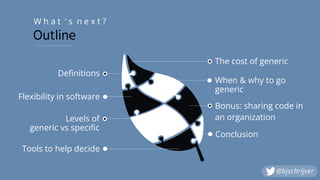
Levels of
generic vs specific
Tools to help decide
Flexibility in software
Definitions
When & why to go
generic
Bonus: sharing code in
an organization
Conclusion
Outline
W h a t ‘ s n e x t ?
The cost of generic
@bjschrijver
What is software design?
Design vs architecture
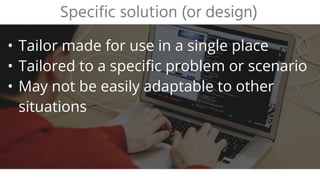
• Tailor made for use in a single place
• Tailored to a specific problem or scenario
• May not be easily adaptable to other
situations
Specific solution (or design)
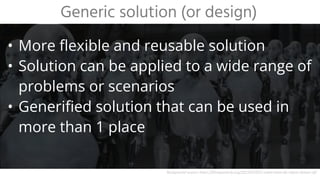
• More flexible and reusable solution
• Solution can be applied to a wide range of
problems or scenarios
• Generified solution that can be used in
more than 1 place
Generic solution (or design)
Background source: https://filmquarterly.org/2012/07/02/i-robot-what-do-robots-dream-of/
• Breaking a system or problem into
smaller parts that are easier to
understand
• Example: Google search
Hierarchical decomposition
Background source: DALL·E
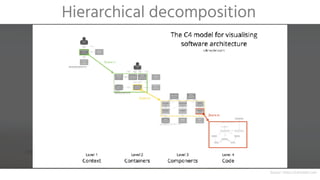
Hierarchical decomposition
Source: https://c4model.com
• Kind and degree of interdependence
between building blocks of software
• Measure of how closely connected two
components are
• Usually contrasted with cohesion
(low coupling -> high cohesion)
Coupling
Background source: DALL·E
• Inheritance
• Messages or events
• Temporal
• Data types
• Data
• Code / API (binary or source)
Types of coupling
Background source: DALL·E
Be careful with coupling!
Generic solution = coupling!
The risk of DRY
Duplicated code doesn’t hurt
until you need to change it.
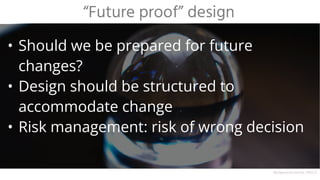
• Should we be prepared for future
changes?
• Design should be structured to
accommodate change
• Risk management: risk of wrong decision
“Future proof” design
Background source: DALL·E
About flexibility in software…
“Highly specific code is often preferable
to sophisticated configuration”
- Stefan Tilkov
When are we going to talk
about generic vs specific?
Background source: https://7216-presscdn-0-76-pagely.netdna-ssl.com/wp-content/uploads/2011/12/confused-man-single-good-men.jpg
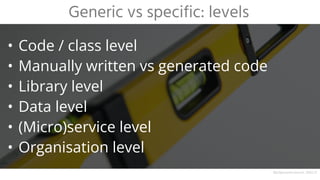
• Code / class level
• Manually written vs generated code
• Library level
• Data level
• (Micro)service level
• Organisation level
Generic vs specific: levels
Background source: DALL·E
Generic or specific?
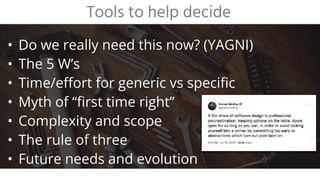
• Do we really need this now? (YAGNI)
• The 5 W’s
• Time/effort for generic vs specific
• Myth of “first time right”
• Complexity and scope
• The rule of three
• Future needs and evolution
Tools to help decide
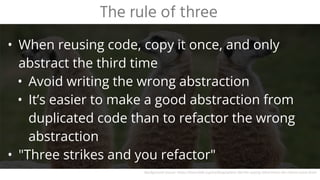
• When reusing code, copy it once, and only
abstract the third time
• Avoid writing the wrong abstraction
• It’s easier to make a good abstraction from
duplicated code than to refactor the wrong
abstraction
• "Three strikes and you refactor"
The rule of three
Background source: https://learntalk.org/en/blog/where-did-the-saying-third-times-the-charm-come-from
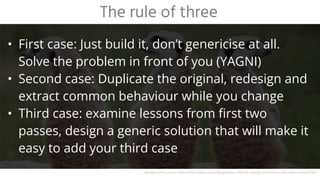
• First case: Just build it, don’t genericise at all.
Solve the problem in front of you (YAGNI)
• Second case: Duplicate the original, redesign and
extract common behaviour while you change
• Third case: examine lessons from first two
passes, design a generic solution that will make it
easy to add your third case
The rule of three
Background source: https://learntalk.org/en/blog/where-did-the-saying-third-times-the-charm-come-from
• Pass 1: YAGNI / rule of three: as simple and specific as
possible
• Pass 2: based on solution domain knowledge:
is a generic solution less work?
• Pass 3: based on problem domain knowledge:
is the easiest solution actually correct?
• Pass 4: looking at customer behaviour or other non
technical considerations, does this change your decision?
Design heuristics
Background source: DALL·E
• Concept from Domain Driven Design
• Tool to help decide for generic vs specific
• But more about building yourself or not
• Subdomains (from perspective of custom software
development):
• Core domain
• Supporting subdomain
• Generic subdomain
Strategic design
Background source: GR Stocks on Unsplash
• Organizations design systems that mirror
their own communication structure
• Don’t force a solution that goes against
the organisation structure
• Be careful to go generic when teams don’t
want to work together
Conway’s law
Background source: DALL·E
Conway’s law in action
Background source: DALL·E
• Another rule of three: building reusable
components is 3x as difficult as single use
• The price you pay is coupling
• Both on code level and people/team level
(communication overhead)
The cost of a generic solution
Background source: DALL·E
What if you get it wrong?
Photo: Dave Lehl
• Efficiency gains of a generic solution are
typically clear, but how about:
• Onboarding new people
• Readability
• Coupling
The cost of abstractions
Background source: Héctor J. Rivas on Unsplash
• Writing bad abstractions
• Writing unnecessary reusable code
• Introducing unnecessary coupling
• Maintaining bad abstractions
• Hard to see
• Hard to understand
• Hard to extend
The cost of abstractions
Background source: Héctor J. Rivas on Unsplash
When / why to go generic
• ”We’ve always done it like this”


• “We don’t want to depend on libraries”
• “We need to be future proof”
• Because the product owner wants it
• Because the architect wants it
Bad reasons to go generic
• Rule of three checks out
• You’re pretty sure you’re going to need it
almost everywhere
• A library that lots of teams will use
• Complex logic or skills that only a couple of
people have
• Gains are bigger than cost
Valid reasons to go generic
• Think back about the layers in hierarchical
decomposition of a system
• Code vs component vs service
• Are the considerations for generic vs specific the
same on every level?
• Risk when getting it wrong is higher when the level
is higher
• Don’t confuse generification with standardization!
Generic vs specific in different scopes
Background source: Fernando Gomez on Unsplash
Why specific is often faster
Code golf
Advent of code
Exception handling
Website code re-use
47
Generic solutions on organization level
• Sharing code efficiently at scale is hard
• Sharing code at scale means:
• Multiple modules that share code
• Multiple team members
• High rate of change
• Little to no loss of individual productivity
Sharing code within an organization
Source: https://medium.com/@jeffwhelpley/the-problem-with-shared-code-124a20fc3d3b
• Challenges:
• Refactoring
• Versioning
• Reviewing
• Builds and codebase size - monorepo?
Sharing code within an organization
Source: https://medium.com/@jeffwhelpley/the-problem-with-shared-code-124a20fc3d3b
• Monorepo: 1 large repository for a group of
projects (possible all projects)
• Good: easy to make changes across projects
• Bad: dependencies & build times
Monorepositories
Background source: DALL·E
• Discovery: what code / libraries exist?
• Distribution: binary or source dependency?
• Import: well defined API’s or chaos?
• Versioning, upgrades and lifecycle
management
• Who maintains it?
• Possible approach: inner source culture
Considerations on sharing code in an org
Source: https://medium.com/@jeffwhelpley/the-problem-with-shared-code-124a20fc3d3b, background source: Klara Kulikova on Unsplash
Summary
• Consider:
• YAGNI / Rule of three / 5 W’s
• Cost of generic
• Scope / level
• Conway’s law
• Organization
Generic or specific?
It depends.
A program that works perfectly but is
impossible to change will become
useless.
A program that does not work but is easy
to change will become and remain useful
continuously.
Source: Clean Architecture, Robert C. Martin
NOW GO KICK SOME ASS!
Questions?
@bjschrijver
Thanks for your time.
Got feedback? Tweet it!
All pictures belong
to their respective
authors
@bjschrijver

Generic or specific? Making sensible software design decisions

  • 1.
    bertjan@openvalue.eu Making sensible softwaredesign decisions Bert Jan Schrijver @bjschrijver Generic or specific?
  • 2.
    Bert Jan Schrijver Le t ’ s m e e t @bjschrijver
  • 3.
    Levels of generic vsspecific Tools to help decide Flexibility in software Definitions When & why to go generic Bonus: sharing code in an organization Conclusion Outline W h a t ‘ s n e x t ? The cost of generic @bjschrijver
  • 4.
  • 5.
  • 6.
    • Tailor madefor use in a single place • Tailored to a specific problem or scenario • May not be easily adaptable to other situations Specific solution (or design)
  • 7.
    • More flexibleand reusable solution • Solution can be applied to a wide range of problems or scenarios • Generified solution that can be used in more than 1 place Generic solution (or design) Background source: https://filmquarterly.org/2012/07/02/i-robot-what-do-robots-dream-of/
  • 8.
    • Breaking asystem or problem into smaller parts that are easier to understand • Example: Google search Hierarchical decomposition Background source: DALL·E
  • 9.
  • 10.
    • Kind anddegree of interdependence between building blocks of software • Measure of how closely connected two components are • Usually contrasted with cohesion (low coupling -> high cohesion) Coupling Background source: DALL·E
  • 11.
    • Inheritance • Messagesor events • Temporal • Data types • Data • Code / API (binary or source) Types of coupling Background source: DALL·E
  • 12.
    Be careful withcoupling!
  • 13.
  • 14.
  • 15.
    Duplicated code doesn’thurt until you need to change it.
  • 16.
    • Should webe prepared for future changes? • Design should be structured to accommodate change • Risk management: risk of wrong decision “Future proof” design Background source: DALL·E
  • 17.
  • 18.
    “Highly specific codeis often preferable to sophisticated configuration” - Stefan Tilkov
  • 19.
    When are wegoing to talk about generic vs specific? Background source: https://7216-presscdn-0-76-pagely.netdna-ssl.com/wp-content/uploads/2011/12/confused-man-single-good-men.jpg
  • 20.
    • Code /class level • Manually written vs generated code • Library level • Data level • (Micro)service level • Organisation level Generic vs specific: levels Background source: DALL·E
  • 21.
  • 22.
    • Do wereally need this now? (YAGNI) • The 5 W’s • Time/effort for generic vs specific • Myth of “first time right” • Complexity and scope • The rule of three • Future needs and evolution Tools to help decide
  • 23.
    • When reusingcode, copy it once, and only abstract the third time • Avoid writing the wrong abstraction • It’s easier to make a good abstraction from duplicated code than to refactor the wrong abstraction • "Three strikes and you refactor" The rule of three Background source: https://learntalk.org/en/blog/where-did-the-saying-third-times-the-charm-come-from
  • 24.
    • First case:Just build it, don’t genericise at all. Solve the problem in front of you (YAGNI) • Second case: Duplicate the original, redesign and extract common behaviour while you change • Third case: examine lessons from first two passes, design a generic solution that will make it easy to add your third case The rule of three Background source: https://learntalk.org/en/blog/where-did-the-saying-third-times-the-charm-come-from
  • 25.
    • Pass 1:YAGNI / rule of three: as simple and specific as possible • Pass 2: based on solution domain knowledge: is a generic solution less work? • Pass 3: based on problem domain knowledge: is the easiest solution actually correct? • Pass 4: looking at customer behaviour or other non technical considerations, does this change your decision? Design heuristics Background source: DALL·E
  • 26.
    • Concept fromDomain Driven Design • Tool to help decide for generic vs specific • But more about building yourself or not • Subdomains (from perspective of custom software development): • Core domain • Supporting subdomain • Generic subdomain Strategic design Background source: GR Stocks on Unsplash
  • 27.
    • Organizations designsystems that mirror their own communication structure • Don’t force a solution that goes against the organisation structure • Be careful to go generic when teams don’t want to work together Conway’s law Background source: DALL·E
  • 28.
    Conway’s law inaction Background source: DALL·E
  • 29.
    • Another ruleof three: building reusable components is 3x as difficult as single use • The price you pay is coupling • Both on code level and people/team level (communication overhead) The cost of a generic solution Background source: DALL·E
  • 30.
    What if youget it wrong? Photo: Dave Lehl
  • 31.
    • Efficiency gainsof a generic solution are typically clear, but how about: • Onboarding new people • Readability • Coupling The cost of abstractions Background source: Héctor J. Rivas on Unsplash
  • 32.
    • Writing badabstractions • Writing unnecessary reusable code • Introducing unnecessary coupling • Maintaining bad abstractions • Hard to see • Hard to understand • Hard to extend The cost of abstractions Background source: Héctor J. Rivas on Unsplash
  • 33.
    When / whyto go generic
  • 34.
    • ”We’ve alwaysdone it like this” • “We don’t want to depend on libraries” • “We need to be future proof” • Because the product owner wants it • Because the architect wants it Bad reasons to go generic
  • 35.
    • Rule ofthree checks out • You’re pretty sure you’re going to need it almost everywhere • A library that lots of teams will use • Complex logic or skills that only a couple of people have • Gains are bigger than cost Valid reasons to go generic
  • 36.
    • Think backabout the layers in hierarchical decomposition of a system • Code vs component vs service • Are the considerations for generic vs specific the same on every level? • Risk when getting it wrong is higher when the level is higher • Don’t confuse generification with standardization! Generic vs specific in different scopes Background source: Fernando Gomez on Unsplash
  • 37.
    Why specific isoften faster
  • 38.
  • 39.
  • 44.
  • 46.
  • 47.
  • 48.
    Generic solutions onorganization level
  • 49.
    • Sharing codeefficiently at scale is hard • Sharing code at scale means: • Multiple modules that share code • Multiple team members • High rate of change • Little to no loss of individual productivity Sharing code within an organization Source: https://medium.com/@jeffwhelpley/the-problem-with-shared-code-124a20fc3d3b
  • 50.
    • Challenges: • Refactoring •Versioning • Reviewing • Builds and codebase size - monorepo? Sharing code within an organization Source: https://medium.com/@jeffwhelpley/the-problem-with-shared-code-124a20fc3d3b
  • 51.
    • Monorepo: 1large repository for a group of projects (possible all projects) • Good: easy to make changes across projects • Bad: dependencies & build times Monorepositories Background source: DALL·E
  • 52.
    • Discovery: whatcode / libraries exist? • Distribution: binary or source dependency? • Import: well defined API’s or chaos? • Versioning, upgrades and lifecycle management • Who maintains it? • Possible approach: inner source culture Considerations on sharing code in an org Source: https://medium.com/@jeffwhelpley/the-problem-with-shared-code-124a20fc3d3b, background source: Klara Kulikova on Unsplash
  • 53.
  • 54.
    • Consider: • YAGNI/ Rule of three / 5 W’s • Cost of generic • Scope / level • Conway’s law • Organization Generic or specific?
  • 55.
  • 56.
    A program thatworks perfectly but is impossible to change will become useless. A program that does not work but is easy to change will become and remain useful continuously. Source: Clean Architecture, Robert C. Martin
  • 58.
    NOW GO KICKSOME ASS!
  • 59.
  • 60.
    Thanks for yourtime. Got feedback? Tweet it! All pictures belong to their respective authors @bjschrijver