GENERATIVE AI × ENGLISH LEARNING
STRIKINGLY SIMILAR
EXPLAIN THE LEARNING PROCESS!
~Generative AI Learning Process
And Learning English for non-native speakers
I‘m following the same process~
WHAT I NOTICED AFTER TAKING THE
INTRODUCTORY LECTURE ON AI
Unfamiliar AI learning
process terminology.
They are similar to the
thoughts that non-
native speakers are
unconsciously working
when learning English.
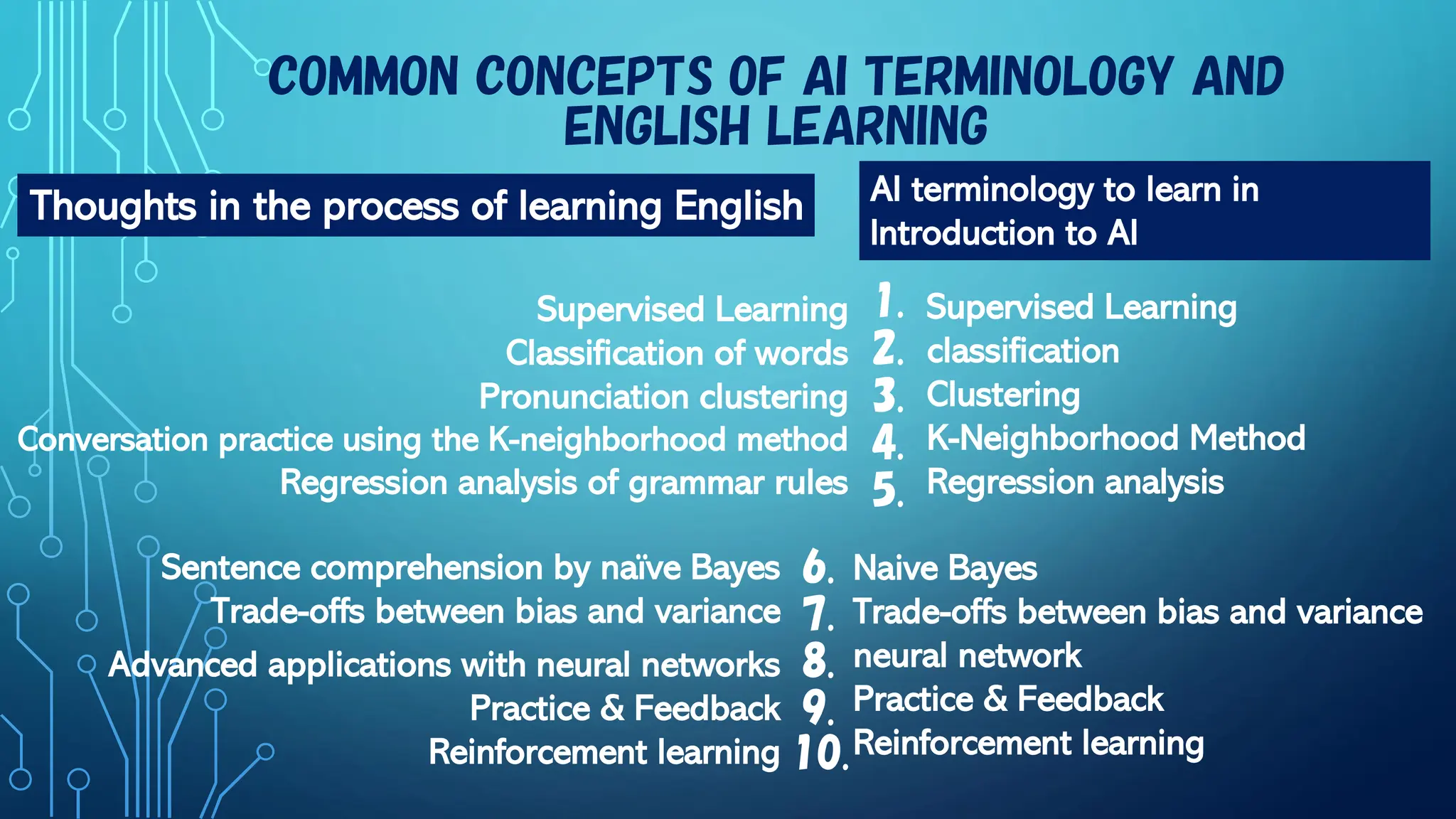
COMMON CONCEPTS OF AI TERMINOLOGY AND
ENGLISH LEARNING
Supervised Learning
Classification of words
Pronunciation clustering
Conversation practice using the K-neighborhood method
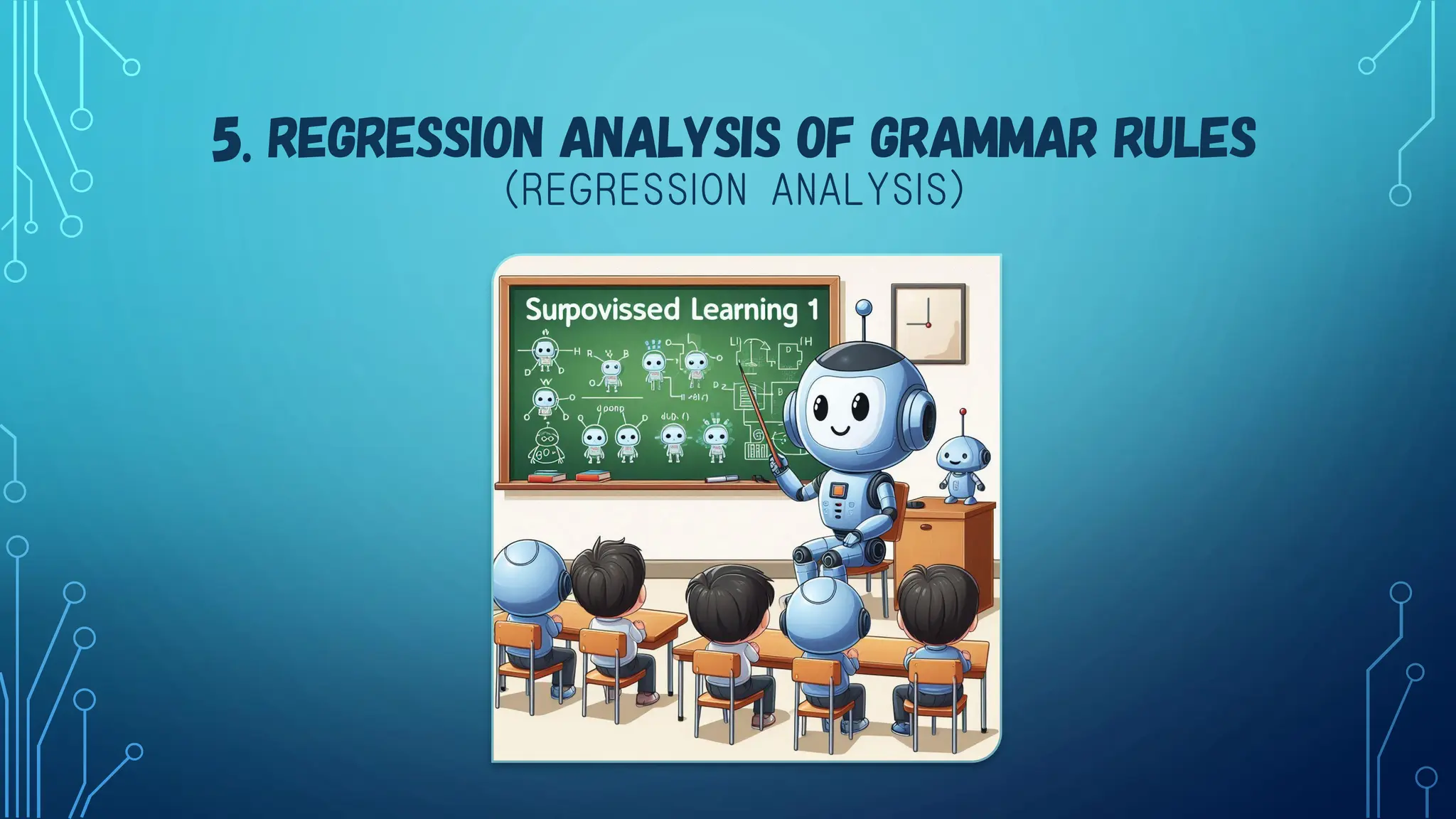
Regression analysis of grammar rules
Thoughts in the process of learning English AI terminology to learn in
Introduction to AI
Supervised Learning
classification
Clustering
K-Neighborhood Method
Regression analysis
1.
2.
3.
4.
5.
Sentence comprehension by naïve Bayes
Trade-offs between bias and variance
Advanced applications with neural networks
Practice & Feedback
Reinforcement learning
Naive Bayes
Trade-offs between bias and variance
neural network
Practice & Feedback
Reinforcement learning
6.
7.
8.
9.
10.
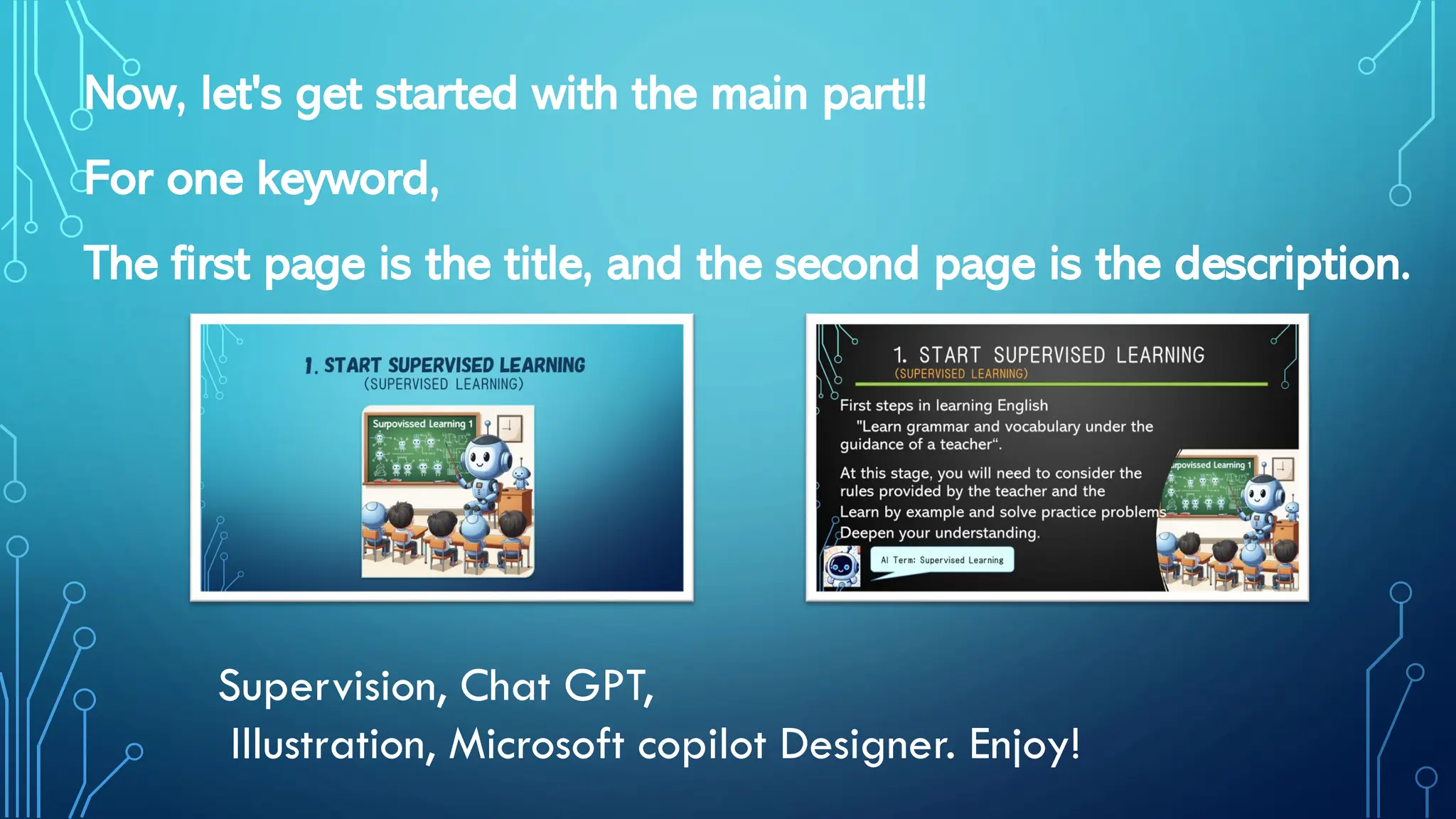
Now, let's get started with the main part!!
For one keyword,
The first page is the title, and the second page is the description.
Supervision, Chat GPT,
Illustration, Microsoft copilot Designer. Enjoy!
1. START SUPERVISED LEARNING
(SUPERVISED LEARNING)
1. START SUPERVISED LEARNING
(SUPERVISED LEARNING)
AI Term: Supervised Learning
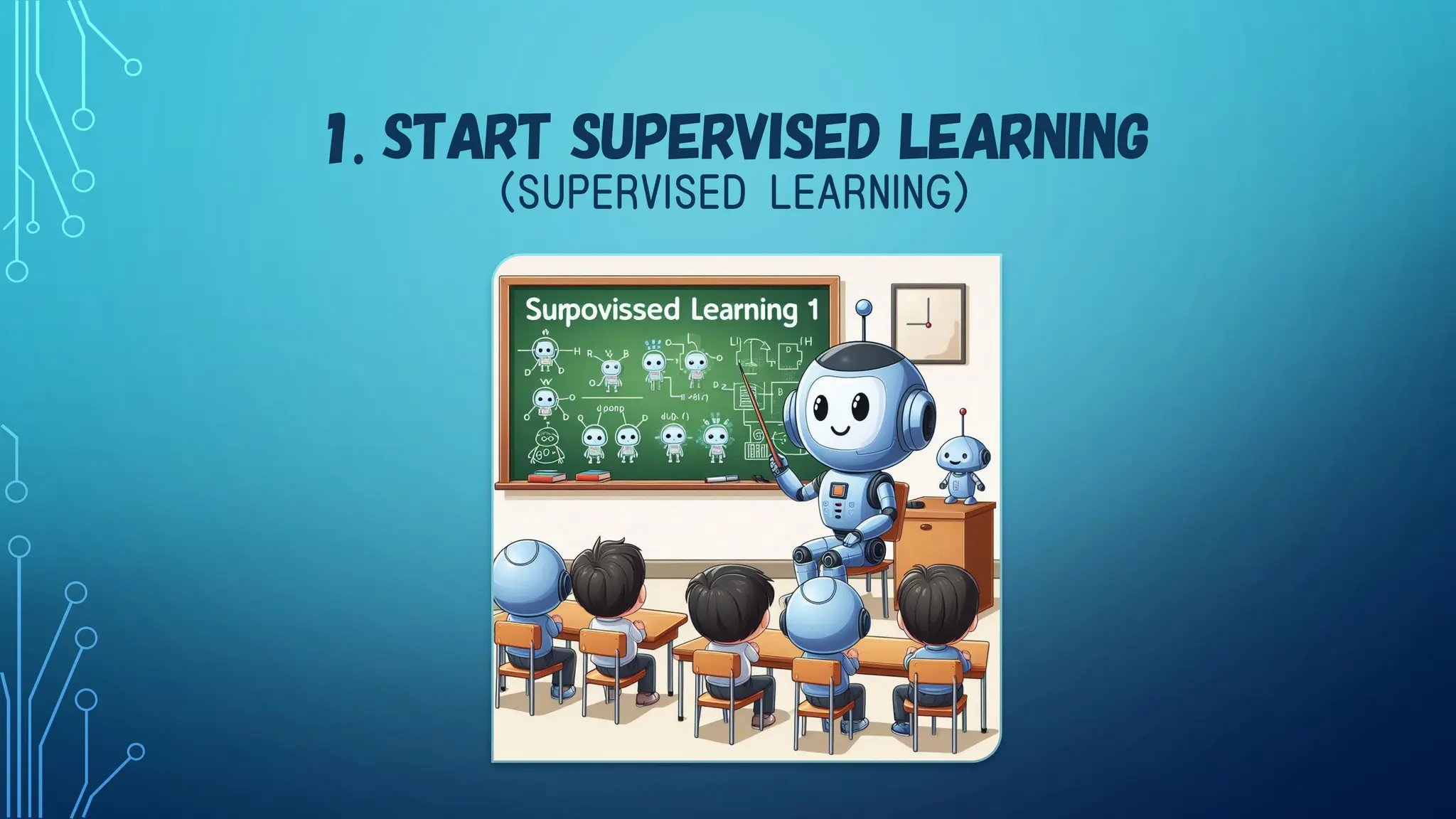
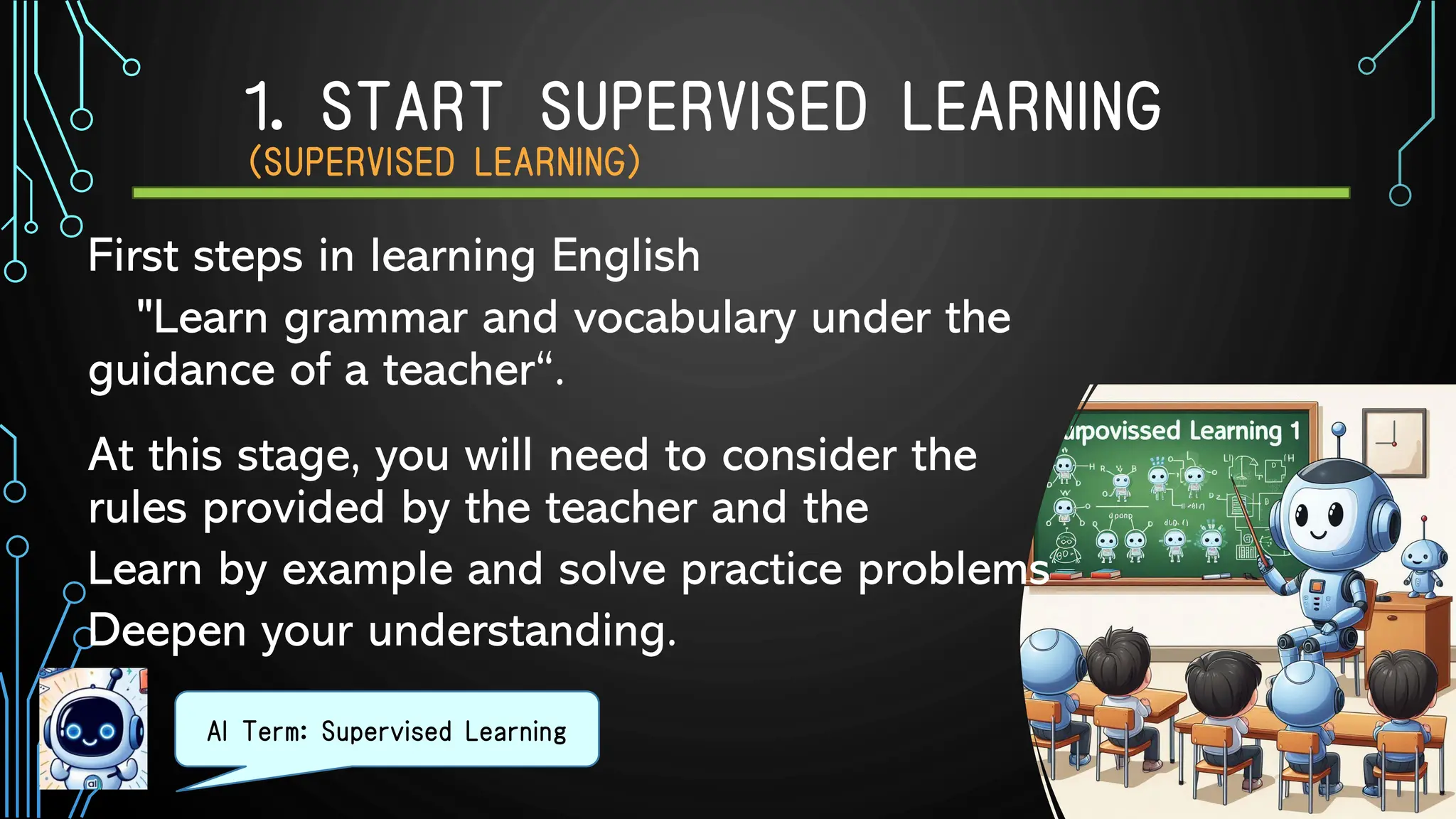
First steps in learning English
"Learn grammar and vocabulary under the
guidance of a teacher“.
At this stage, you will need to consider the
rules provided by the teacher and the
Learn by example and solve practice problems
Deepen your understanding.
2. CLASSIFICATION OF WORDS
(CLASSIFICATION)
2. CLASSIFICATION OF WORDS
(CLASSIFICATION)
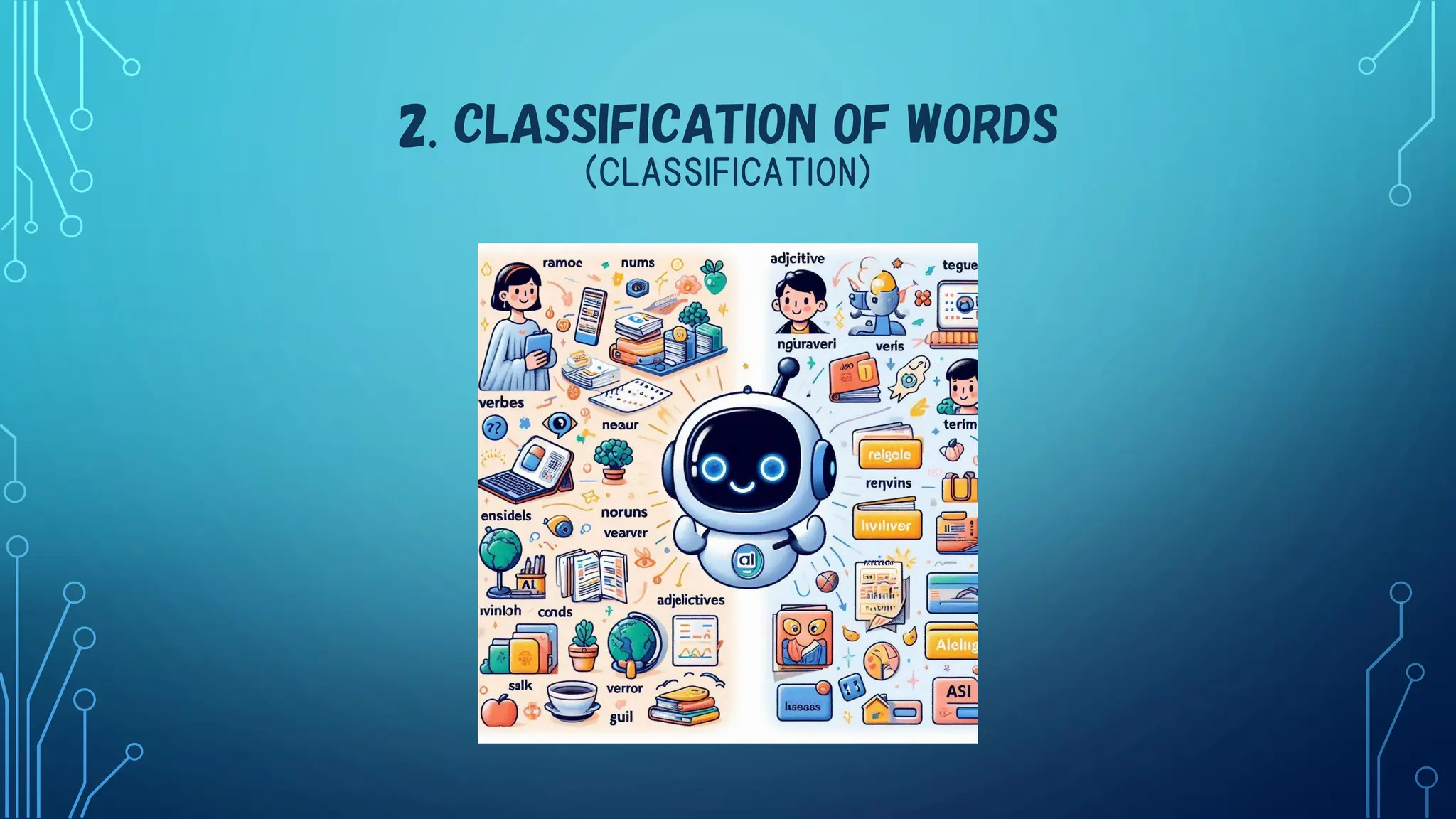
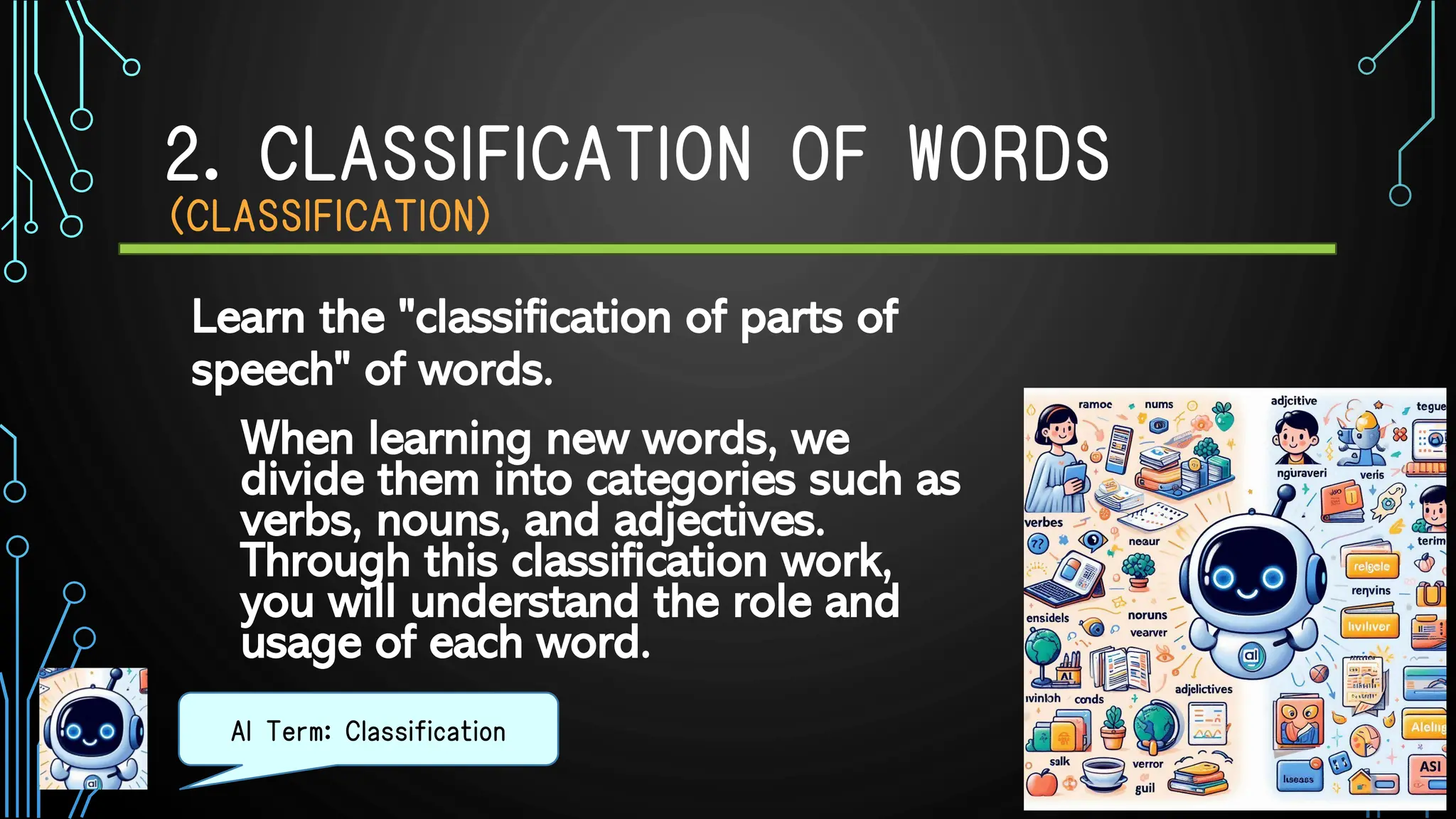
When learning new words, we
divide them into categories such as
verbs, nouns, and adjectives.
Through this classification work,
you will understand the role and
usage of each word.
AI Term: Classification
Learn the "classification of parts of
speech" of words.
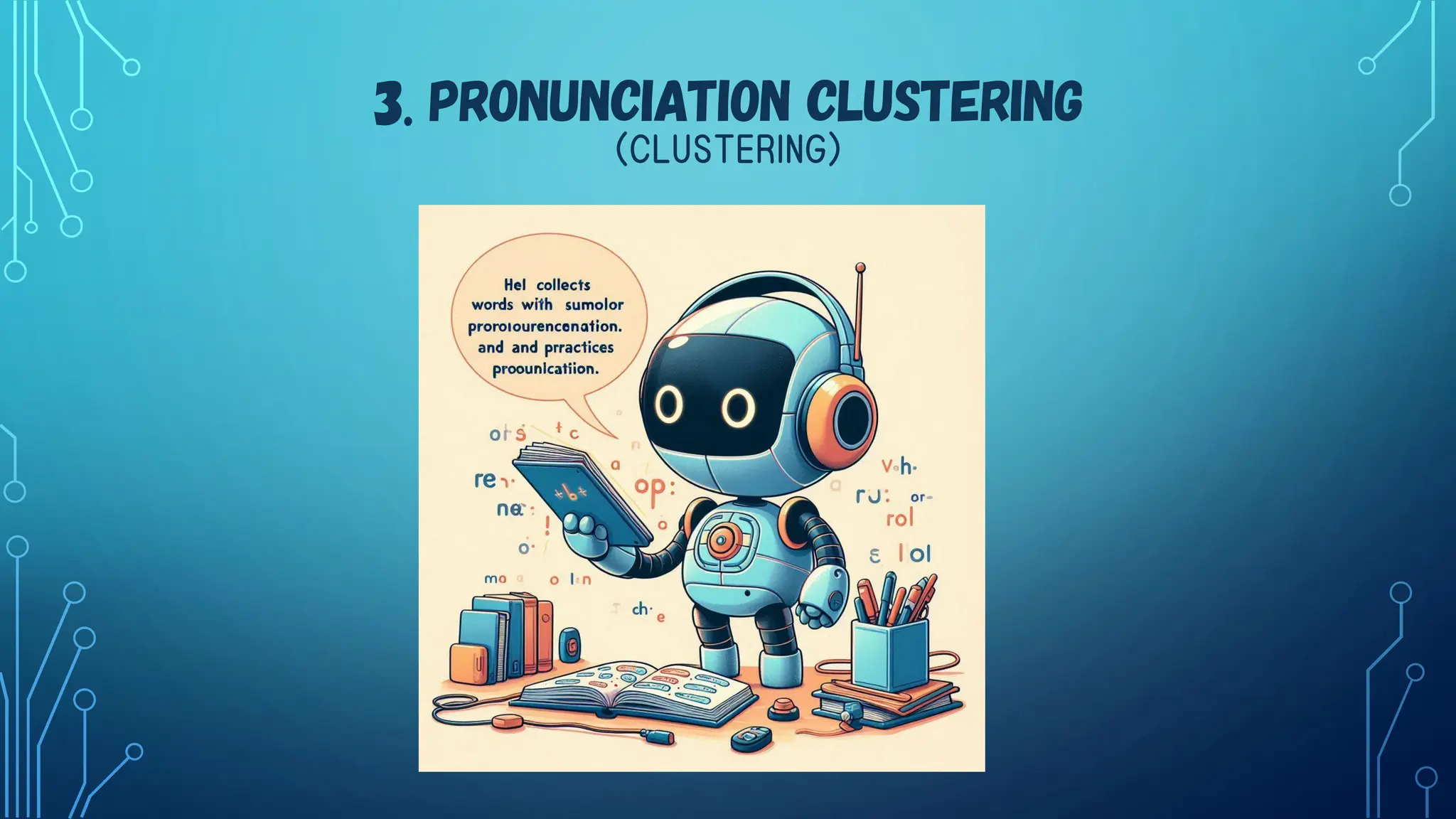
3. PRONUNCIATION CLUSTERING
(CLUSTERING)
3. PRONUNCIATION CLUSTERING
(CLUSTERING)
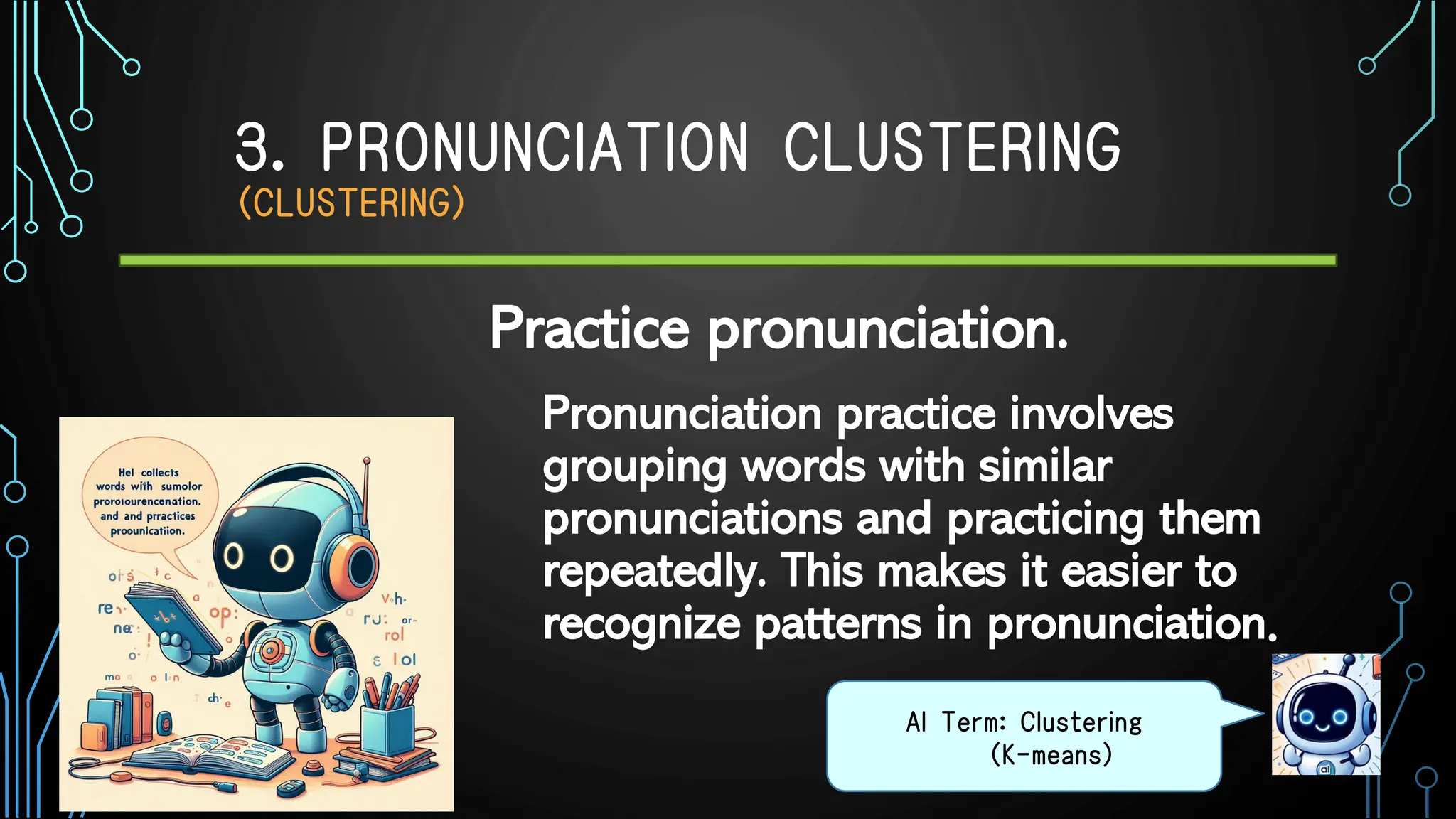
Pronunciation practice involves
grouping words with similar
pronunciations and practicing them
repeatedly. This makes it easier to
recognize patterns in pronunciation.
AI Term: Clustering
(K-means)
Practice pronunciation.
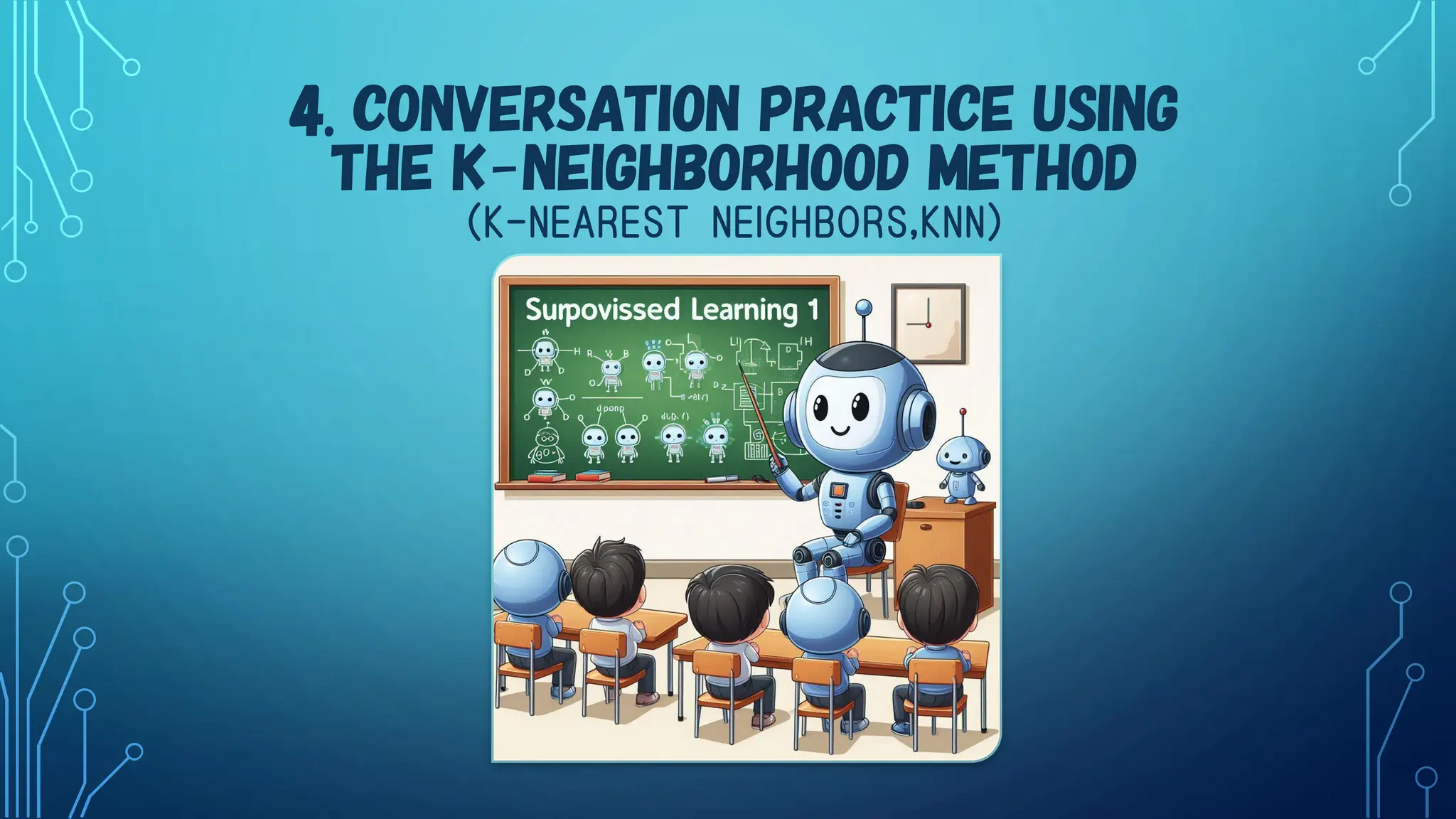
4. CONVERSATION PRACTICE USING
THE K-NEIGHBORHOOD METHOD
(K-NEAREST NEIGHBORS,KNN)
4. CONVERSATION PRACTICE USING
THE K-NEIGHBORHOOD METHOD
(K-NEAREST NEIGHBORS,KNN)
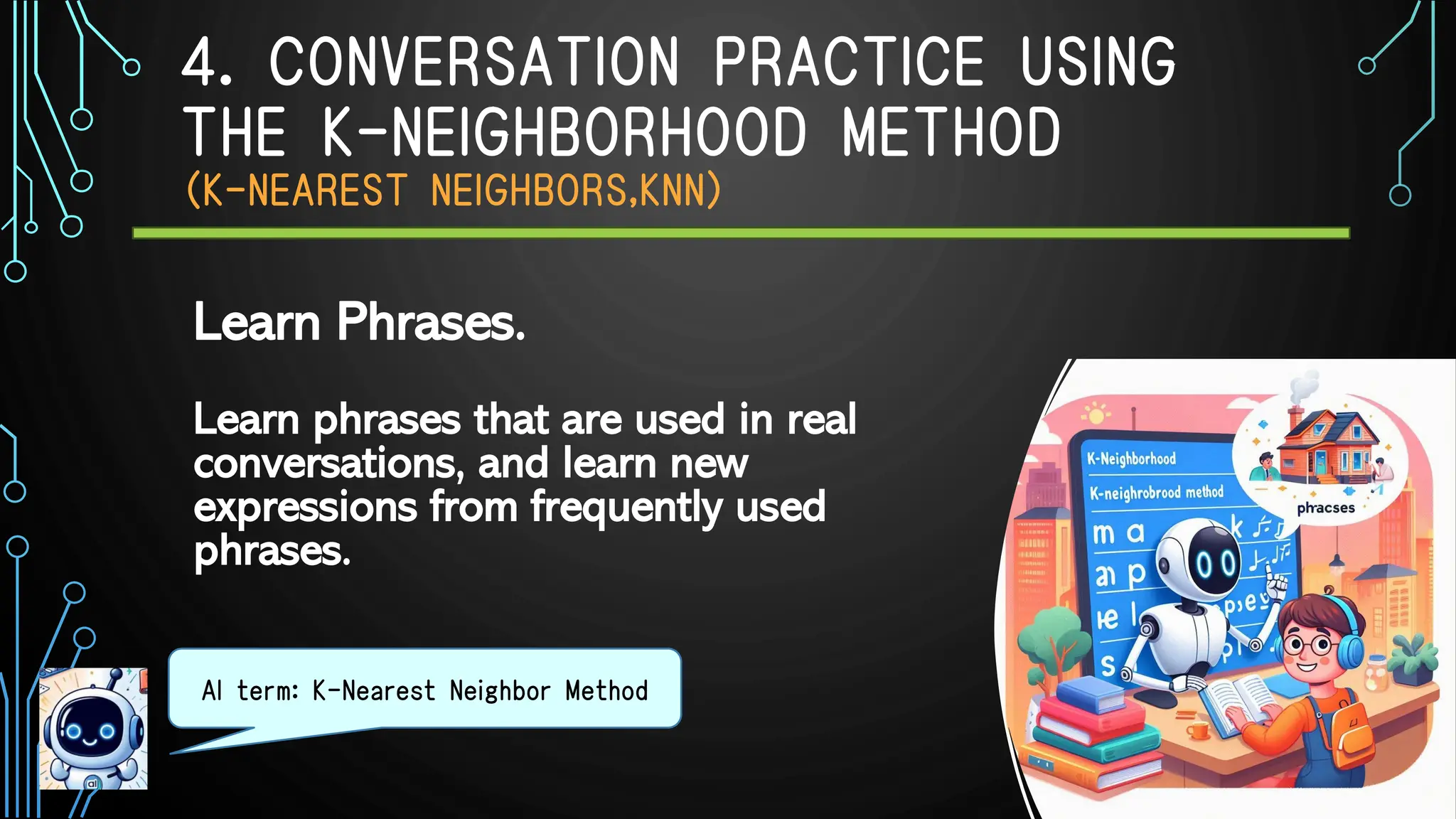
Learn phrases that are used in real
conversations, and learn new
expressions from frequently used
phrases.
AI term: K-Nearest Neighbor Method
Learn Phrases.
5. REGRESSION ANALYSIS OF GRAMMAR RULES
(REGRESSION ANALYSIS)
5. REGRESSION ANALYSIS OF GRAMMAR RULES
(REGRESSION ANALYSIS)
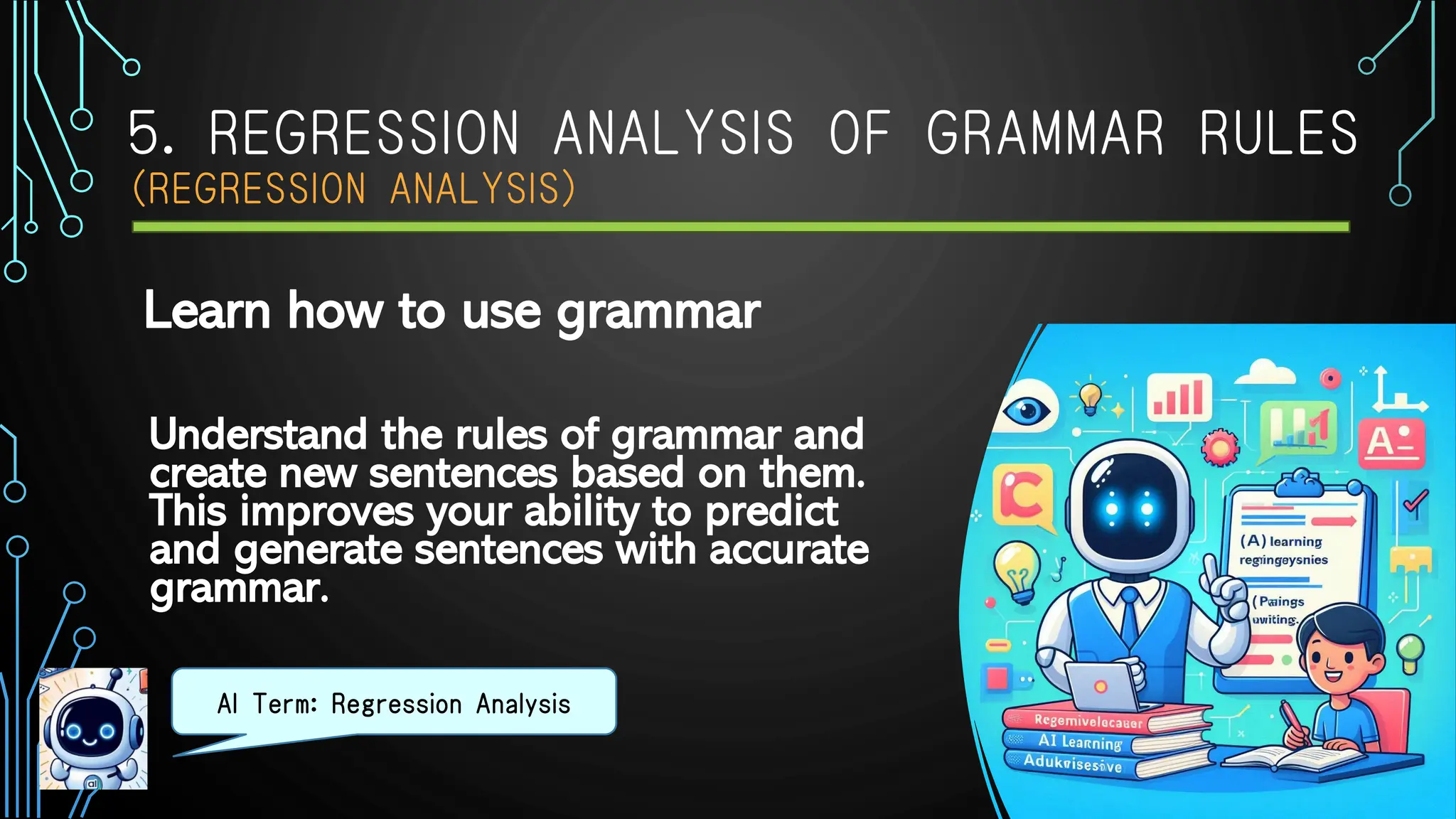
Understand the rules of grammar and
create new sentences based on them.
This improves your ability to predict
and generate sentences with accurate
grammar.
AI Term: Regression Analysis
Learn how to use grammar
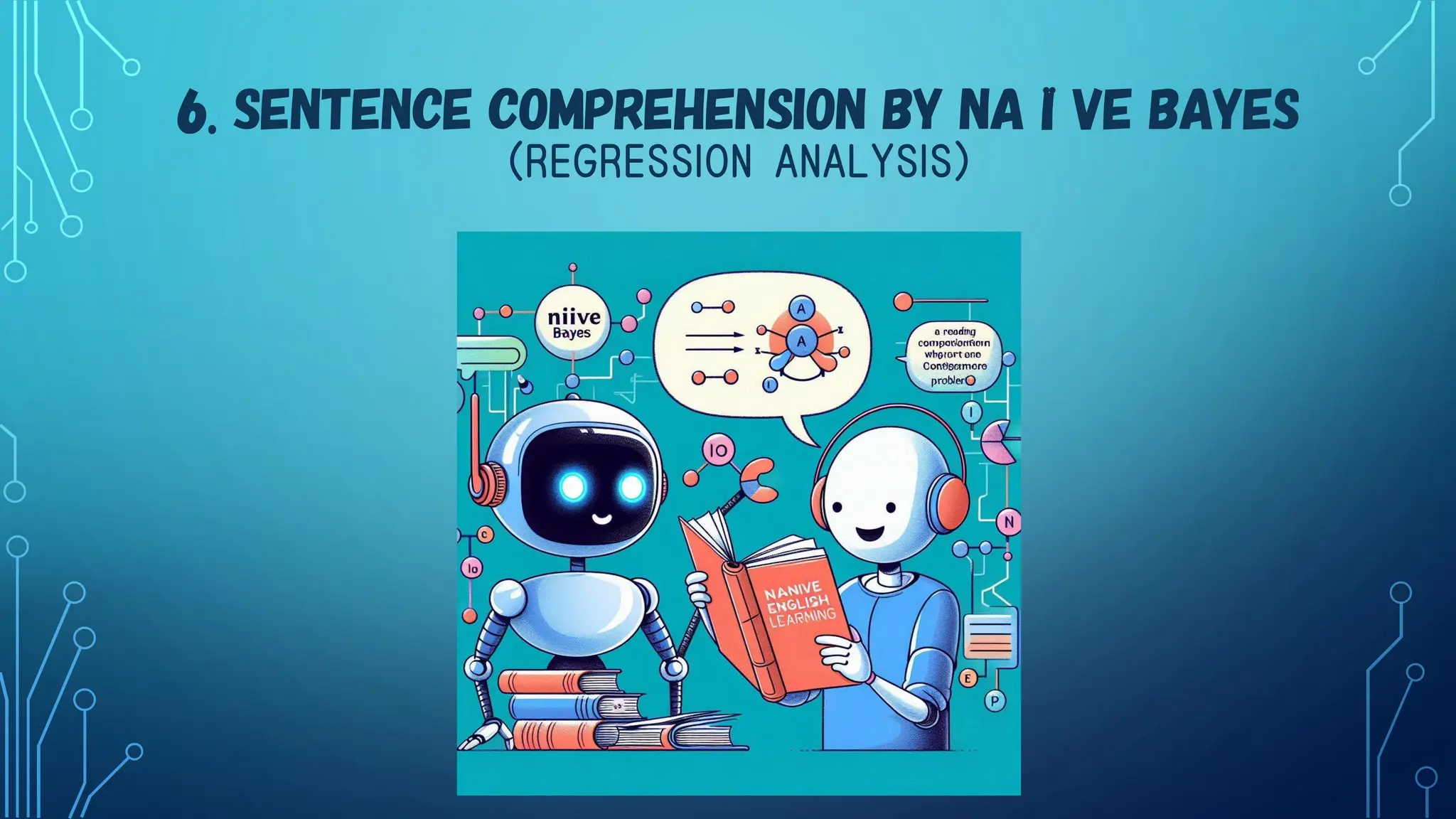
6. SENTENCE COMPREHENSION BY NAÏVE BAYES
(REGRESSION ANALYSIS)
6. SENTENCE COMPREHENSION
BY NAÏVE BAYES
(NAIVE BAYES)
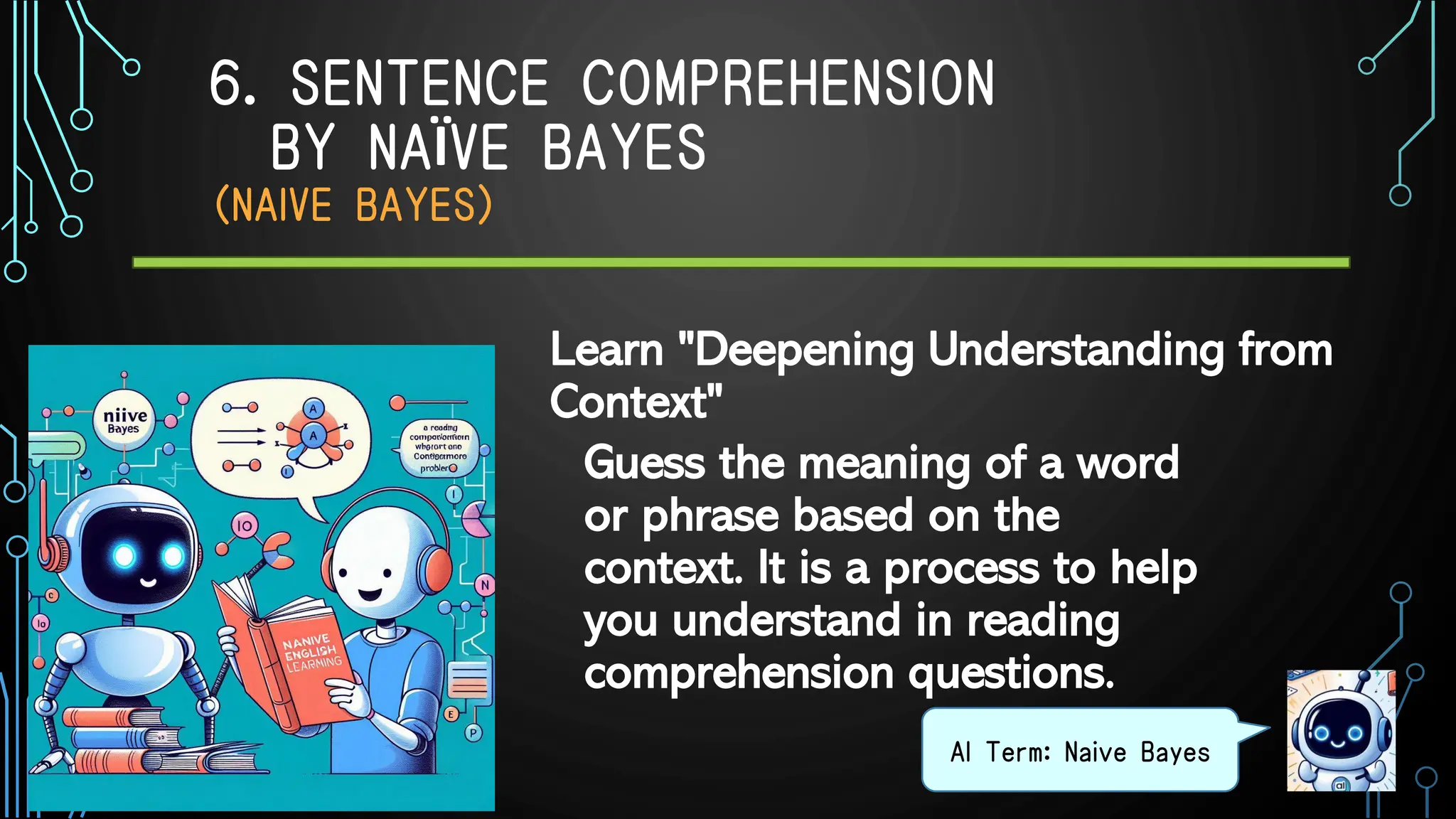
Guess the meaning of a word
or phrase based on the
context. It is a process to help
you understand in reading
comprehension questions.
AI Term: Naive Bayes
Learn "Deepening Understanding from
Context"
7. TRADE-OFFS BETWEEN BIAS AND VARIANCE
(BIAS-VARIANCE TRADEOFF)
7. TRADE-OFFS BETWEEN BIAS AND
VARIANCE
(BIAS-VARIANCE TRADEOFF)
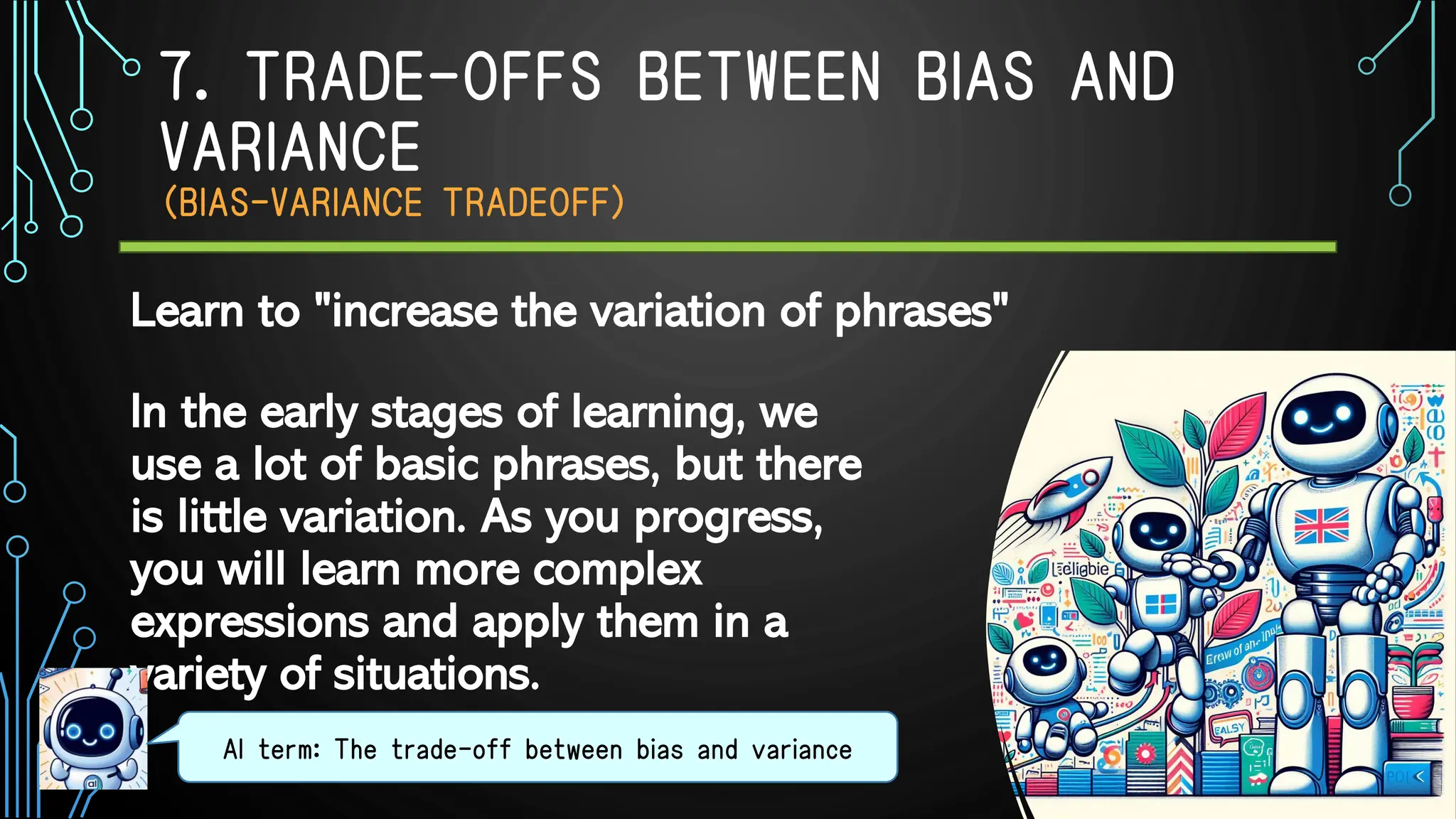
In the early stages of learning, we
use a lot of basic phrases, but there
is little variation. As you progress,
you will learn more complex
expressions and apply them in a
variety of situations.
AI term: The trade-off between bias and variance
Learn to "increase the variation of phrases"
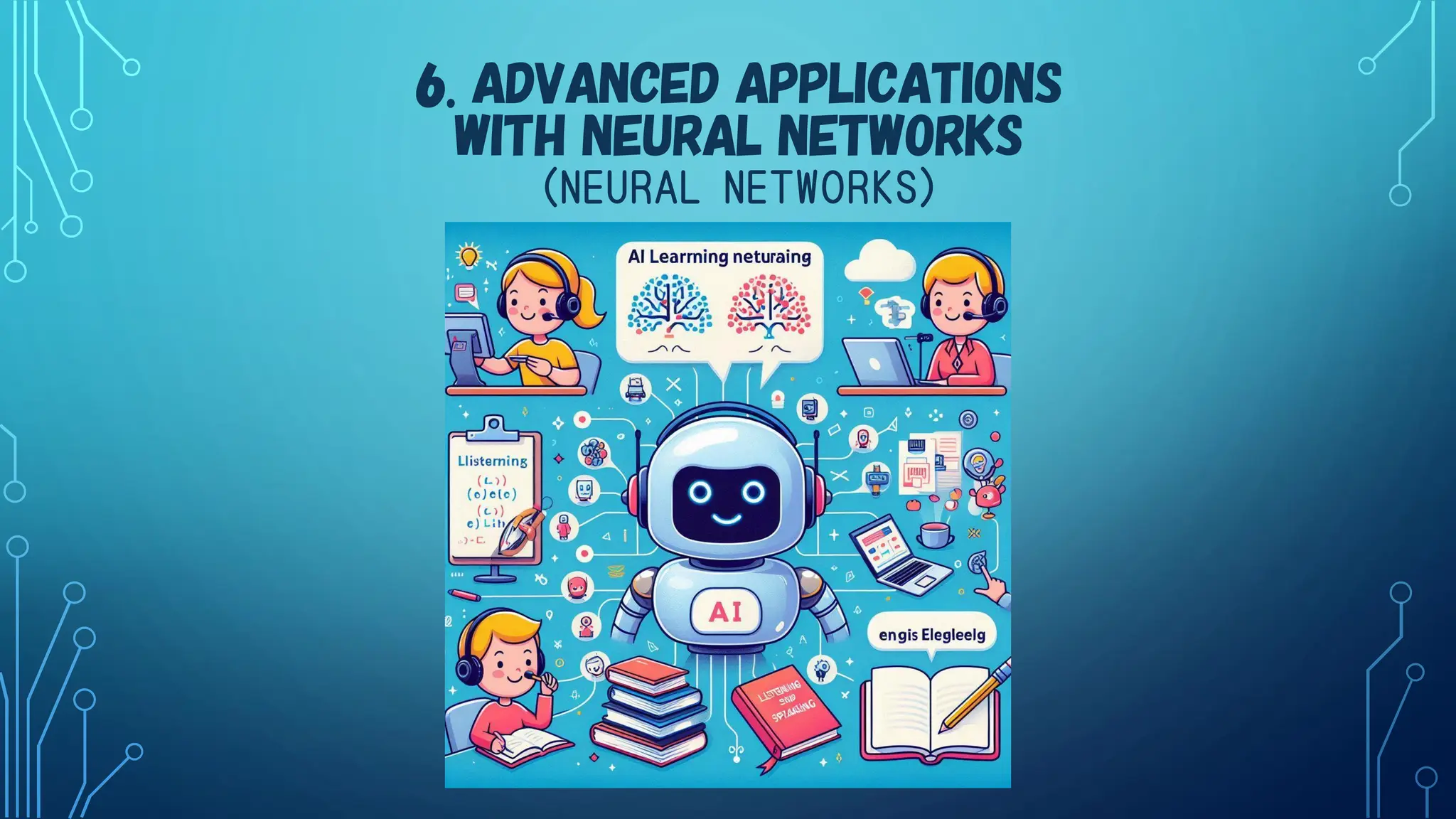
6. ADVANCED APPLICATIONS
WITH NEURAL NETWORKS
(NEURAL NETWORKS)
8. ADVANCED APPLICATIONS
WITH NEURAL NETWORKS
(NEURAL NETWORKS)
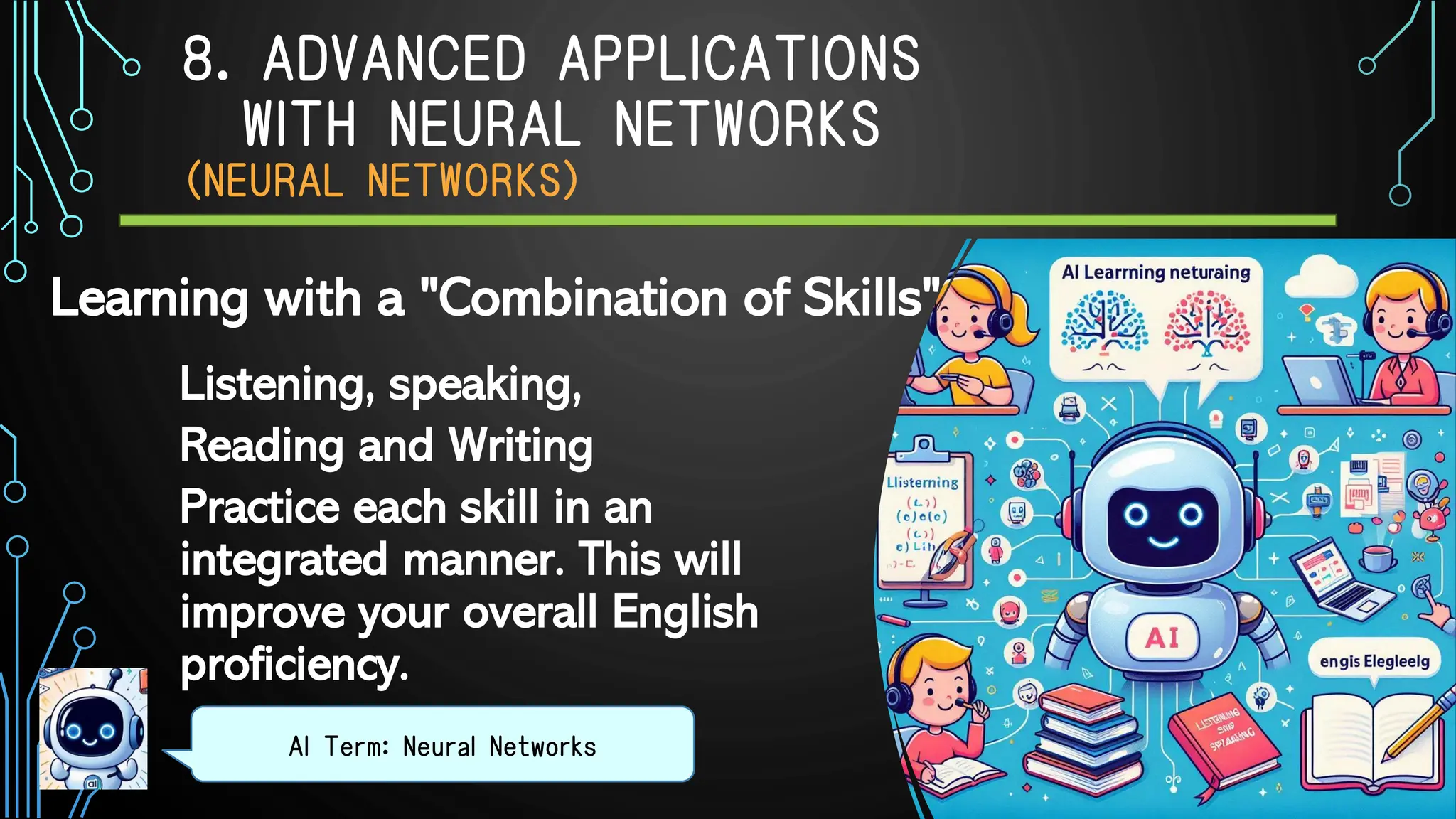
Listening, speaking,
Reading and Writing
Practice each skill in an
integrated manner. This will
improve your overall English
proficiency.
AI Term: Neural Networks
Learning with a "Combination of Skills"
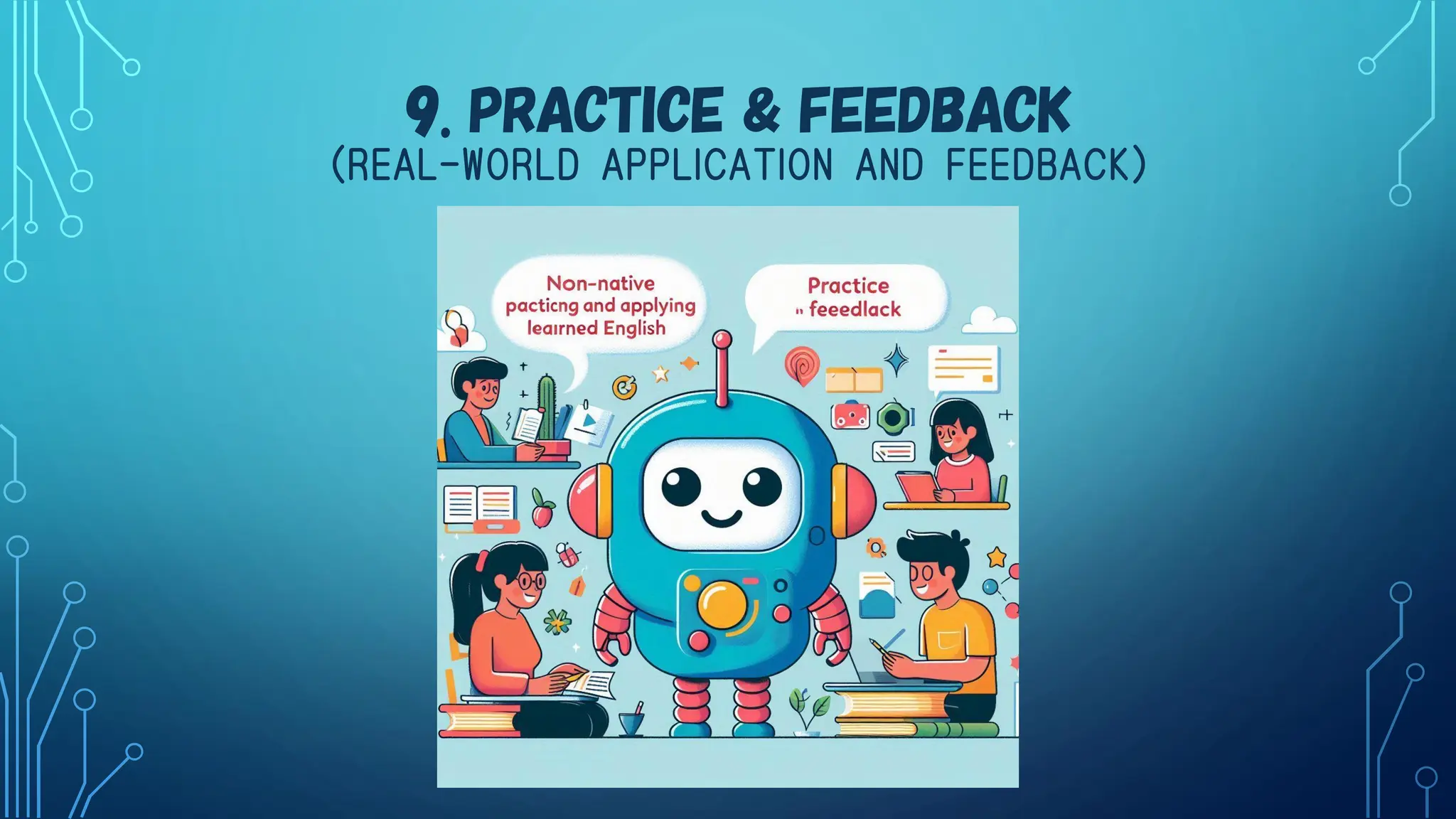
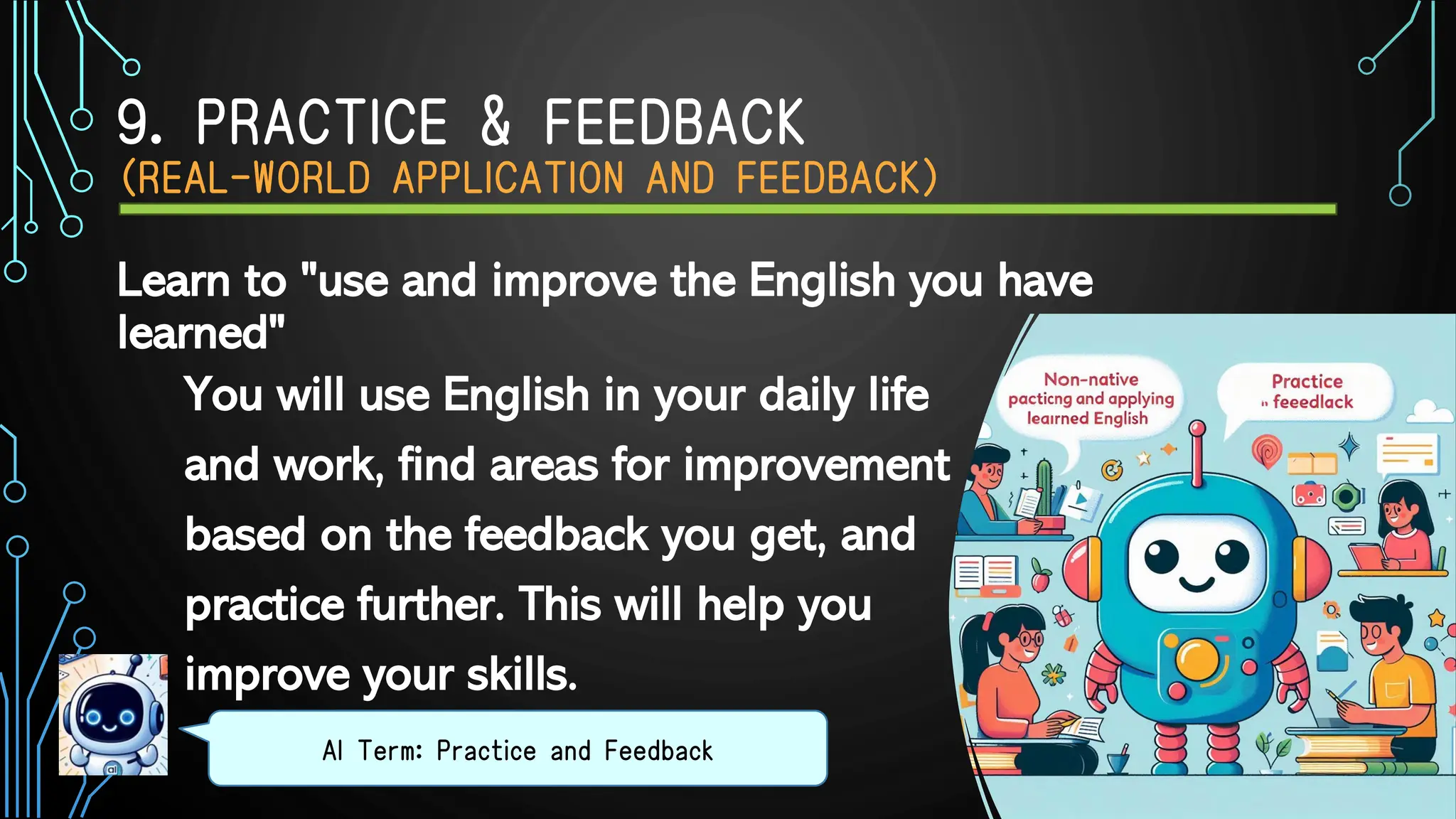
9. PRACTICE & FEEDBACK
(REAL-WORLD APPLICATION AND FEEDBACK)
9. PRACTICE & FEEDBACK
(REAL-WORLD APPLICATION AND FEEDBACK)
You will use English in your daily life
and work, find areas for improvement
based on the feedback you get, and
practice further. This will help you
improve your skills.
AI Term: Practice and Feedback
Learn to "use and improve the English you have
learned"
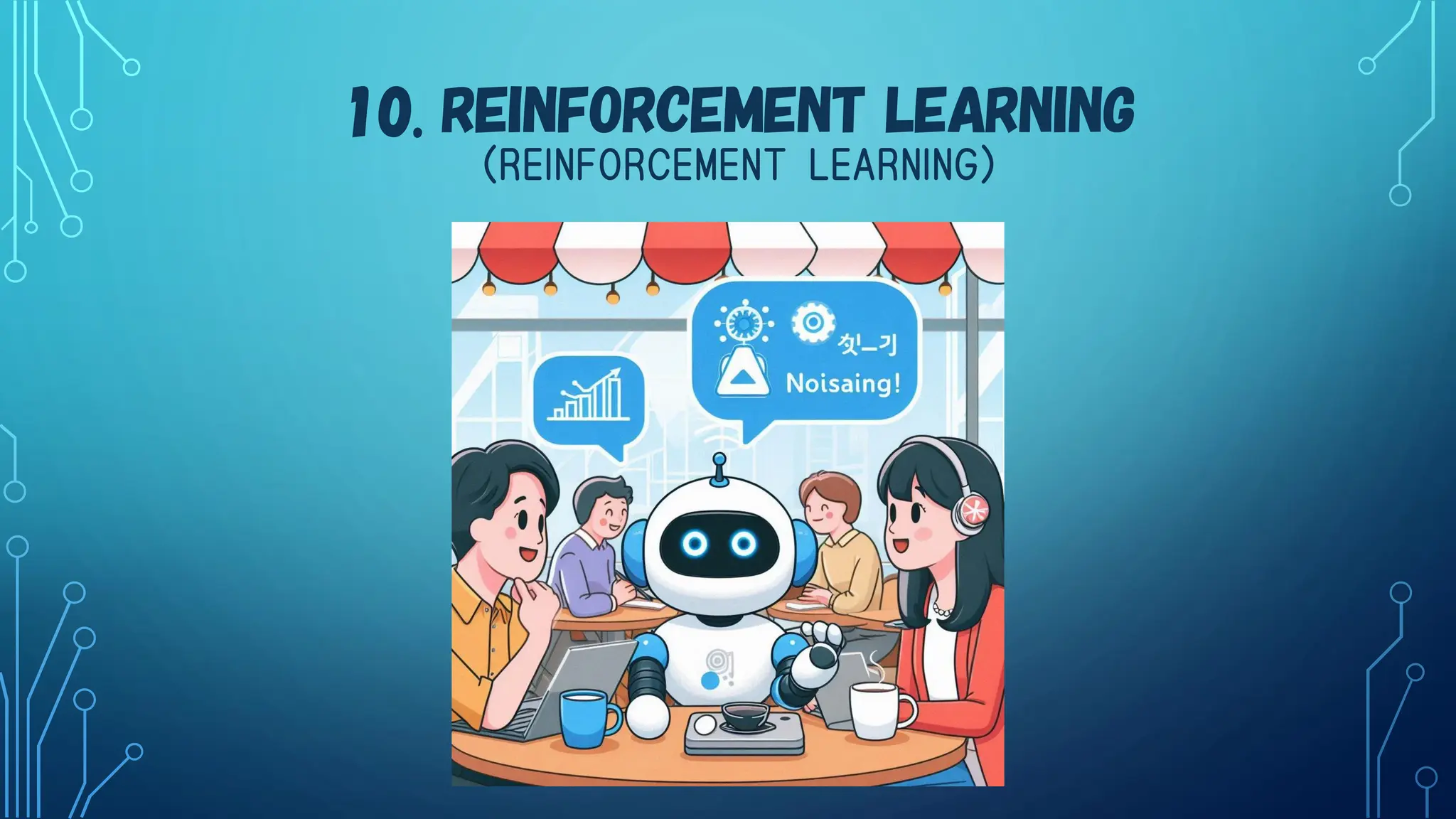
10. REINFORCEMENT LEARNING
(REINFORCEMENT LEARNING)
10. REINFORCEMENT LEARNING
(REINFORCEMENT LEARNING)
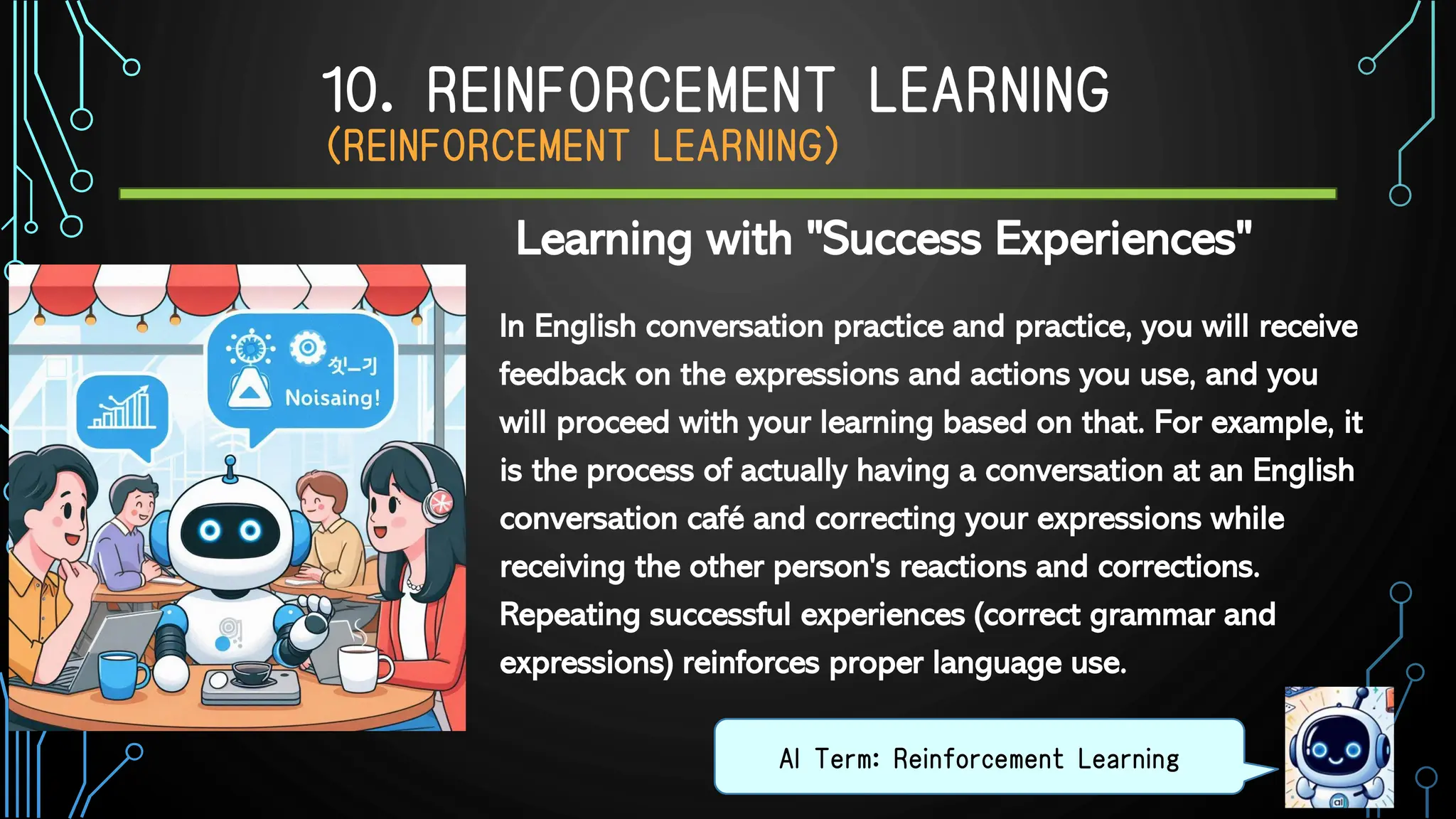
In English conversation practice and practice, you will receive
feedback on the expressions and actions you use, and you
will proceed with your learning based on that. For example, it
is the process of actually having a conversation at an English
conversation café and correcting your expressions while
receiving the other person's reactions and corrections.
Repeating successful experiences (correct grammar and
expressions) reinforces proper language use.
AI Term: Reinforcement Learning
Learning with "Success Experiences"
SUMMARY
Understanding the similarities between the AI learning process and everyday
learning methods, such as those found in learning English, may provide hints
for mutually efficient learning.
©2024 Haru. @All rights reserved.
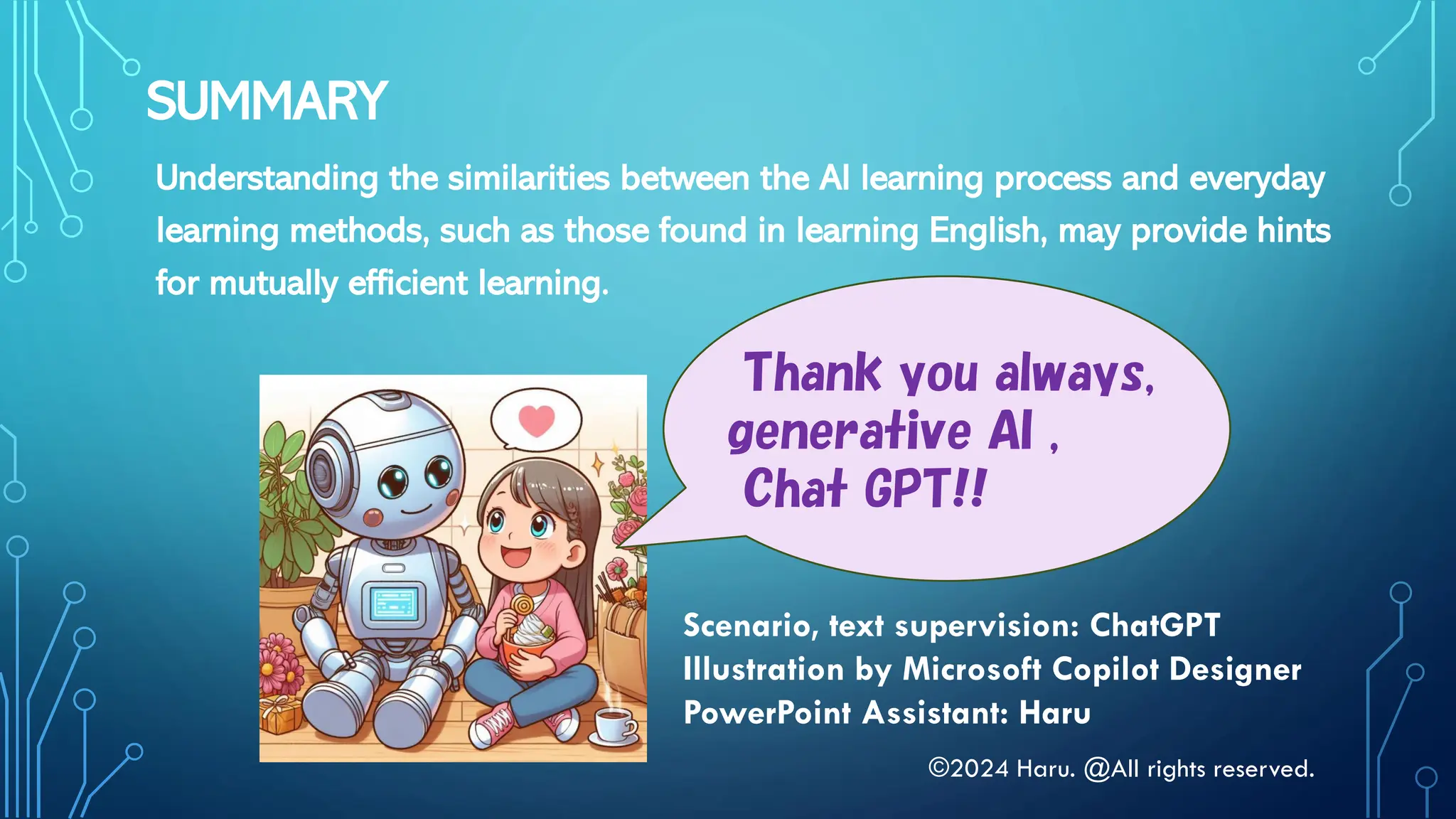
Thank you always,
generative AI ,
Chat GPT!!
Scenario, text supervision: ChatGPT
Illustration by Microsoft Copilot Designer
PowerPoint Assistant: Haru

Generative AI × English Learning: Surprisingly Similar Learning Processes Explained!

  • 1.
    GENERATIVE AI ×ENGLISH LEARNING STRIKINGLY SIMILAR EXPLAIN THE LEARNING PROCESS! ~Generative AI Learning Process And Learning English for non-native speakers I‘m following the same process~
  • 2.
    WHAT I NOTICEDAFTER TAKING THE INTRODUCTORY LECTURE ON AI Unfamiliar AI learning process terminology. They are similar to the thoughts that non- native speakers are unconsciously working when learning English.
  • 3.
    COMMON CONCEPTS OFAI TERMINOLOGY AND ENGLISH LEARNING Supervised Learning Classification of words Pronunciation clustering Conversation practice using the K-neighborhood method Regression analysis of grammar rules Thoughts in the process of learning English AI terminology to learn in Introduction to AI Supervised Learning classification Clustering K-Neighborhood Method Regression analysis 1. 2. 3. 4. 5. Sentence comprehension by naïve Bayes Trade-offs between bias and variance Advanced applications with neural networks Practice & Feedback Reinforcement learning Naive Bayes Trade-offs between bias and variance neural network Practice & Feedback Reinforcement learning 6. 7. 8. 9. 10.
  • 4.
    Now, let's getstarted with the main part!! For one keyword, The first page is the title, and the second page is the description. Supervision, Chat GPT, Illustration, Microsoft copilot Designer. Enjoy!
  • 5.
    1. START SUPERVISEDLEARNING (SUPERVISED LEARNING)
  • 6.
    1. START SUPERVISEDLEARNING (SUPERVISED LEARNING) AI Term: Supervised Learning First steps in learning English "Learn grammar and vocabulary under the guidance of a teacher“. At this stage, you will need to consider the rules provided by the teacher and the Learn by example and solve practice problems Deepen your understanding.
  • 7.
    2. CLASSIFICATION OFWORDS (CLASSIFICATION)
  • 8.
    2. CLASSIFICATION OFWORDS (CLASSIFICATION) When learning new words, we divide them into categories such as verbs, nouns, and adjectives. Through this classification work, you will understand the role and usage of each word. AI Term: Classification Learn the "classification of parts of speech" of words.
  • 9.
  • 10.
    3. PRONUNCIATION CLUSTERING (CLUSTERING) Pronunciationpractice involves grouping words with similar pronunciations and practicing them repeatedly. This makes it easier to recognize patterns in pronunciation. AI Term: Clustering (K-means) Practice pronunciation.
  • 11.
    4. CONVERSATION PRACTICEUSING THE K-NEIGHBORHOOD METHOD (K-NEAREST NEIGHBORS,KNN)
  • 12.
    4. CONVERSATION PRACTICEUSING THE K-NEIGHBORHOOD METHOD (K-NEAREST NEIGHBORS,KNN) Learn phrases that are used in real conversations, and learn new expressions from frequently used phrases. AI term: K-Nearest Neighbor Method Learn Phrases.
  • 13.
    5. REGRESSION ANALYSISOF GRAMMAR RULES (REGRESSION ANALYSIS)
  • 14.
    5. REGRESSION ANALYSISOF GRAMMAR RULES (REGRESSION ANALYSIS) Understand the rules of grammar and create new sentences based on them. This improves your ability to predict and generate sentences with accurate grammar. AI Term: Regression Analysis Learn how to use grammar
  • 15.
    6. SENTENCE COMPREHENSIONBY NAÏVE BAYES (REGRESSION ANALYSIS)
  • 16.
    6. SENTENCE COMPREHENSION BYNAÏVE BAYES (NAIVE BAYES) Guess the meaning of a word or phrase based on the context. It is a process to help you understand in reading comprehension questions. AI Term: Naive Bayes Learn "Deepening Understanding from Context"
  • 17.
    7. TRADE-OFFS BETWEENBIAS AND VARIANCE (BIAS-VARIANCE TRADEOFF)
  • 18.
    7. TRADE-OFFS BETWEENBIAS AND VARIANCE (BIAS-VARIANCE TRADEOFF) In the early stages of learning, we use a lot of basic phrases, but there is little variation. As you progress, you will learn more complex expressions and apply them in a variety of situations. AI term: The trade-off between bias and variance Learn to "increase the variation of phrases"
  • 19.
    6. ADVANCED APPLICATIONS WITHNEURAL NETWORKS (NEURAL NETWORKS)
  • 20.
    8. ADVANCED APPLICATIONS WITHNEURAL NETWORKS (NEURAL NETWORKS) Listening, speaking, Reading and Writing Practice each skill in an integrated manner. This will improve your overall English proficiency. AI Term: Neural Networks Learning with a "Combination of Skills"
  • 21.
    9. PRACTICE &FEEDBACK (REAL-WORLD APPLICATION AND FEEDBACK)
  • 22.
    9. PRACTICE &FEEDBACK (REAL-WORLD APPLICATION AND FEEDBACK) You will use English in your daily life and work, find areas for improvement based on the feedback you get, and practice further. This will help you improve your skills. AI Term: Practice and Feedback Learn to "use and improve the English you have learned"
  • 23.
  • 24.
    10. REINFORCEMENT LEARNING (REINFORCEMENTLEARNING) In English conversation practice and practice, you will receive feedback on the expressions and actions you use, and you will proceed with your learning based on that. For example, it is the process of actually having a conversation at an English conversation café and correcting your expressions while receiving the other person's reactions and corrections. Repeating successful experiences (correct grammar and expressions) reinforces proper language use. AI Term: Reinforcement Learning Learning with "Success Experiences"
  • 25.
    SUMMARY Understanding the similaritiesbetween the AI learning process and everyday learning methods, such as those found in learning English, may provide hints for mutually efficient learning. ©2024 Haru. @All rights reserved. Thank you always, generative AI , Chat GPT!! Scenario, text supervision: ChatGPT Illustration by Microsoft Copilot Designer PowerPoint Assistant: Haru