Generation Of Cdna Libraries Methods And Protocols 1st Edition Shaoyao Ying
1.
Generation Of CdnaLibraries Methods And
Protocols 1st Edition Shaoyao Ying download
https://ebookbell.com/product/generation-of-cdna-libraries-
methods-and-protocols-1st-edition-shaoyao-ying-933060
Explore and download more ebooks at ebookbell.com
2.
Here are somerecommended products that we believe you will be
interested in. You can click the link to download.
Generation Of Cdna Libraries Methods And Protocols 1st Edition Shaoyao
Ying Auth
https://ebookbell.com/product/generation-of-cdna-libraries-methods-
and-protocols-1st-edition-shaoyao-ying-auth-4635002
Generation Of Surfaces Kinematic Geometry Of Surface Machining S P
Radzevich
https://ebookbell.com/product/generation-of-surfaces-kinematic-
geometry-of-surface-machining-s-p-radzevich-4731938
Generation Of Multivariate Hermite Interpolating Polynomials 1st
Edition Santiago Alves Tavares
https://ebookbell.com/product/generation-of-multivariate-hermite-
interpolating-polynomials-1st-edition-santiago-alves-tavares-887336
Generation Of Energy From Municipal Solid Waste Circular Economy And
Sustainability 2024th Edition Abdelkader Anouzla Salah Souabi
https://ebookbell.com/product/generation-of-energy-from-municipal-
solid-waste-circular-economy-and-sustainability-2024th-edition-
abdelkader-anouzla-salah-souabi-202654200
3.
Generation Of SwineGonzo Papers Vol 2 Hunter S Thompson
https://ebookbell.com/product/generation-of-swine-gonzo-papers-
vol-2-hunter-s-thompson-47625074
Generation Of Wealth The Rise Of Control Data And How It Inspired An
Era Of Innovation And Investment In The Upper Midwest 1st Edition
Donald M Hall
https://ebookbell.com/product/generation-of-wealth-the-rise-of-
control-data-and-how-it-inspired-an-era-of-innovation-and-investment-
in-the-upper-midwest-1st-edition-donald-m-hall-4685614
Generation Of Swine Tales Of Shame And Degradation In The 80s Hunter S
Thompson
https://ebookbell.com/product/generation-of-swine-tales-of-shame-and-
degradation-in-the-80s-hunter-s-thompson-11328468
Generation Of Animals History Of Animals I Parts Of Animals I
Aristotle
https://ebookbell.com/product/generation-of-animals-history-of-
animals-i-parts-of-animals-i-aristotle-49139690
A Generation Of Excellence 1st Edition Craig Brown
https://ebookbell.com/product/a-generation-of-excellence-1st-edition-
craig-brown-51589070
5.
HUMANA PRESS
Methods inMolecular BiologyTM
Edited by
Shao-Yao Ying
Generation of
cDNA Libraries
HUMANA PRESS
Methods in Molecular BiologyTM
VOLUME 221
Methods and Protocols
Edited by
Shao-Yao Ying
Generation of
cDNA Libraries
Methods and Protocols
2 Ying
in thesomatic cells of a specific organism can be expressed as a transcript,
many DNA sequences are not transcribed. These segments of DNA are the
coding exons and the noncoding introns. Basically, the genetic information
is stored as a strand of a DNA molecule consisting of four bases: adenine,
thymine, guanine, and cytosine. A second complementary strand of DNA can
be formed by DNA polymerase. Polymerases, enzymes that function in DNA
replication and RNA transcription, synthesize a nucleic acid from the genetic
information encoded by the template strand. The polymerases are unique
because they take direction from another nucleic acid template, which is either
DNA or RNA. During the formation of a second strand of DNA, bases are
generated according to the Watson–Crick base-pairing pattern. That is to
say, every cytosine is replaced by a guanine, every guanine by a cytosine,
every adenine by a thymine, and every thymine by an adenine. In this way,
information in DNA is correctly transcribed into RNA.
1.2. Probe Hybridization
Another unique feature of the base pair complementarity is probe hybridiza-
tion. The findings of Gillespie and Spiegelman (1) that viral genomic DNA and
RNA in infected cells showed a base pair complementarity opened an avenue for
specific hybridization between a gene and its transcript as a DNA–RNA hybrid.
Subsequently, the DNA–DNA or DNA–RNA hybrids have been employed in a
large number of powerful techniques for the identification and manipulation of
the geneitic information stored in DNA and used by the cell via RNA. Usually,
a labeled-probe nucleic acid is hybridized with a target nucleic acid. After
removal of any unreacted probe, the remaining labeled probe is identified and
the intensity of the labeling of the hybrid duplex is determined. As a result, the
regions of complementarity between the probe and the target nucleotides are
detected (2). Frequently, the number of targets is quite low, perhaps only a few
copies. In such cases, amplification techniques are performed to produce large
numbers of copies of the target, thus increasing the amount of hybrid duplex
and the observed signal. In addition, immobilization of the target on a surface,
such as a nitrocellulose or nylon filter and many other solid-phase materials,
is used to solve the competitive equilibrium problem. Thus, nucleic acid
sequences can be quantified by molecular hybridization using complementary
nucleic acids as probes, with complementarity as the essential feature for
hybridization.
1.3. Polymerases Are Essential for DNA Synthesis
Polymerases that use RNA as a template to form a complementary DNA
are RNA-direct DNA polymerases (3,4). One of these enzymes is reverse
transcriptase, usually observed as a part of the viral particle, during the life
CH01,1-12,12pgs 01/03/03, 7:31 PM
2
8.
Complementary DNA Libraries3
cycle of retroviruses and other retrotransposable elements. Purified reverse trans-
criptase is used to generate complementary DNA from polyadenylated mRNAs;
therefore, double-stranded DNA molecules can be formed from the single-
stranded RNA templates. The synthesis of DNA on an RNA template mediated
by the enzyme reverse transcriptase is known as reverse transcription (5).
1.4. A Primer is Required for Reverse Transcription
Although polymerases copy genetic information from one nucleotide into
another, including copying a mRNA to generate a complementary DNA strand
in the presence of reverse transcriptase, they do need a “start signal” to tell
them where to begin making the complementary copy. The short piece of
DNA that is annealed to the template and serves as a signal to initiate the
copying process is the primer (6). The primer is annealed to the template by
basepairing so that its 3′-terminus possesses a free 3′-OH group and chain
growth is exclusively from 5′ end to the 3′ end for polymerization. Wherever
such as primer–template pair is found, DNA polymerase will begin adding
bases to the primer to create a complementary copy of the template.
1.5. Formation of cDNA
Generally, the cDNA of cells can be formed according to the following
steps:
1. Isolation of the mRNA template: The source mRNAs can be enriched by increas-
ing the abundance of specific classes of rare mRNAs via one of the following
approaches: (1) antibody precipitation of the protein of interest that is synthesized
in cell lines, (2) increasing the concentrations of relevant RNAs by drug-induced
overexpression of genes of interest, and (3) inhibition of protein synthesis by
inhibitors, resulting in extended transcription of the early genes of mammalian
DNA virus.
The integrity of the mRNA is essential for the quality of cDNA generation.
The size of mRNAs isolated should range from 500 bp to 8.0 kb, and the sequence
should retain the capability of synthesizing the polypeptide of interest in vitro,
such as in cell-free reticulocytes. When fractionated by electrophoresis and
stained with ethidium bromide, a good preparation of mRNA should appear as
a smear from 500 bp to 8 kb.
2. A short oligo(dT) primer is bound to the poly(A) of each mRNA at the 3′ end.
3. The mRNA is transcribed by reverse transcriptase (the primer is needed to initiate
DNA synthesis) to form the first strand of DNA, usually in the presence of a
reagent to denature any regions of the secondary structure. RNAse is used to
prevent RNA degradation.
4. DNA–RNA hybids are formed.
5. The RNA is nicked by treatment with RNAse H to generate the free 3′-OH
groups.
CH01,1-12,12pgs 01/03/03, 7:31 PM
3
9.
4 Ying
6. DNApolymerase I is added to digest the RNA, using the RNA fragments as
primers, and replace the RNA with DNA. In some cases, a primer–adapter
method is carried out as follows: (1) terminal transferase is added to the first
strand cDNA [add (dC) to provide free 3′ hydroxyl groups]; (2) the tail of
hybrided cDNA with oligo(dG) serves as the primer.
7. Double-stranded cDNA is formed.
1.6. PCR
Another important development in generating DNA from mRNA is the
enzymatic amplification of DNA by a technique known as polymerase chain
reaction (PCR). The technique was originally reported by Saike et al. (7), who
employed a heat-stable DNA polymerase–Taq polymerase with two primers
that are complementary to DNA sequences at the 3′ ends of the region of
the DNA to be amplified. The oligonucleotides serve as primers to which
nucleotides are added during the subsequent replication steps. Because a DNA
strand can only add nucleotides at the 3′ hydroxyl terminus of an existing
strand, a strand of DNA that provides the necessary 3′-OH terminus, in this
case, is also called a primer. All DNA polymerases require a template and
a primer.
The PCR is well established as the default method for DNA and RNA
analysis. More robust formats have been introduced, improved thermal cyclers
developed, and new labeling and detection methods developed. Because
gene expression profiling relies on mRNA extraction from defined types and
numbers of cells, in some cases the use of small number of cells or even a few
cells is necessary. In this situation, the PCR technique has been used to allow
synthesis of cDNAs from a small amount of mRNA (8,9). Other techniques
of amplifying mRNA have been developed (10). For instance, the cDNA can
be generated by mRNA extracted and amplified by poly(A) reverse transverse
transcription and PCR.
2. Definitions
2.1. Complementary DNA
If a chromosome is defined as a supercoiled, linear DNA molecule consisting
of numerous transcribable segments as genes (specific segments of DNA that
code for a specific protein), the complementary DNA (cDNA) can be defined as
the transcriptionally active segment of a DNA molecule that shows the base pair
complementarity between the gene and its transcribed and processed mRNA
molecules—the transcript. To define it differently, cDNAs are complementary
DNA copies of mRNA that are generated by the enzyme—reverse transcriptase.
In contrast to genomic DNA, the extra, nontranscribed DNAs in a genome are
removed by this process because DNA polymerase activity depends on the
CH01,1-12,12pgs 01/03/03, 7:31 PM
4
10.
Complementary DNA Libraries5
presence of an RNA template. As a result, the cDNA represents only the 3%
of the genomic DNA in human cells that are transcriptionally active genes.
Consequently, the generation of cDNA is a powerful tool for examining cell-
and tissue-specific gene expression. Not only are cDNAs the expressed genes
of a cell at a specific time with a specific function, they are also the faithful
and stable double-strand DNA copies of transcribable portions of mRNA. This
occurs because they are prepared from a population of RNA in which any
intervening sequences (i.e., introns) have been previously removed. Therefore,
cDNAs commonly contain an uninterrupted sequence encoding the gene
product. For this reason, cDNA reflects both expressible RNA and gene
products (polypeptide or proteins).
2.2. Complementary DNA Libraries
A molecular library is defined as a collection of various molecules that
can be screened for individual species that show specific properties. Different
libraries are developed for different purposes. For example, genomic libraries
(raw DNA sequences harvested from an organism’s chromosomes) represent
the entire genomic DNA sequence of an organism. This type of library is
typically not expressed. Complementary DNA libraries are composed of
processed nucleic acid sequences harvested from the RNA pools of cells or
tissues and represent all of the cDNA sequence prepared at a certain time for
genes expressed in certain cells or tissues. This type of library is derived from
DNA copies of messenger RNA (mRNA) (generated by reverse transcriptase),
which are interspersed throughout a gene and are arranged contiguously within
DNA. Messenger RNA libraries represent the transcript expressed at a certain
time of certain cells or tissues. With recombinant DNA technologies (11,12),
genetic sequences of interest can be recombined with a replication-competent
DNA vector, such as plasmid or bacteriophage, or built in a form of primer-
binding sites. The libraries can be amplified by PCR, thereby generating
combinatorial libraries. Other methods of amplification of DNA libraries have
also been developed (13–15). Analogously, polypeptide or protein libraries are
collections of gene products of cells or tissues.
2.3. Why cDNA Libraries?
Complementary DNA libraries are preferable to mRNA libraries for the
following reasons:
1. cDNA can represent the gene that is expressed as mRNA in a specific tissue
or specific cells at a specific time; therefore, the mRNAs in two different types
of cell or the same type of cell with different treatments may vary because the
expression of genes varies.
CH01,1-12,12pgs 01/03/03, 7:31 PM
5
11.
6 Ying
2. cDNAlibraries usually provide reading frames encoded within the DNA insert
after the noncoding intervening sequences are removed; therefore, cDNA reflects
both a mRNA transcript and a protein translation product. cDNAs can be used as
probes for screening the mRNA transcript as well as in the rapid identification of
amino acid sequences of polypeptides or proteins. Because there are no introns in
a cDNA molecule, they are frequently used in protein synthesis in vitro.
3. The protein-encoding mRNA may not be present in all cells showing the specific
protein because the mRNA is easily degraded and the protein formed in the cell
could be present as a stable form from an earlier expression of the mRNA.
4. Because different numbers of copies of different mRNAs are present in a cell
(low, middle, and high abundance), a desirable characteristic of cDNA libraries
is that they increase the number of the less abundant species and reduce the
relative number of high and middle abundant species. By manipulating the rate of
strand reannealing in a denatured cDNA preparation, the high and middle
abundance species of mRNA can be removed. The resulting cDNA generated is
representative of the rarer species. Other modifications can be used to achieve the
enrichment of cell-, tissue-, or stage-specific mRNA species in the preparation
of cDNA libraries.
5. Messenger RNA are difficult to maintain, clone, and amplify; therefore, they
are converted to more stable cDNA, which is less susceptible than mRNA to
degradation by contaminating molecules.
For the above-mentioned reasons, cDNA libraries are preferred over mRNA
libraries for genetic manipulations.
3. Conventional vs Novel Strategies for cDNA Generation
The conventional method of the generation of cDNA is based on the isolation
of clones after transformation of bacteria or bacteriophages with an enriched but
impure population of cDNA molecules ligated to a vector (16–18). This method
is good for abundant mRNA such as globin, immunoglobin, and ovalbumin.
About 30% of mRNAs in cells, which are present at less than 14 copies per cell,
cannot be identified with this method. After transcription of RNA into cDNA,
the cDNA is digested by restriction endonucleases at specific sequence sites to
form fragments of different size. Same-length DNA fragments from any cDNA
species that contains at least two restriction sites are produced. Then, a second
specific cleavage with a restriction endonuclease capable of cleaving the desired
sequence at an internal site is performed.After separation from the contaminants,
the subfragments of the desired sequence may be joined using DNA ligase to
reconstitute the original sequence. The purified fragment can then be recombined
with a cloning vector and transformed into a suitable host strain.
Polymerase chain reaction is commonly used in recent approaches to
generating cDNA libraries, which are randomly primed and amplified from
a small amount of DNA (12,19). As a result, the use of PCR simplifies and
CH01,1-12,12pgs 01/03/03, 7:31 PM
6
12.
Complementary DNA Libraries7
improves the method of cDNA generation. To facilitate the formation of cDNAs
from rare mRNAs, modifications of 3′ and 5′ ends of the DNA strand with a
primer were adapted (8,9). To avoid multiple purification or precipitation steps
in the conventional method of cDNA library preparation, paramagenetic beads
or other types of immobilization methods were developed (20).
Subsequently, strategies that included a means of reducing the number of
clones in a cDNA library in order to detect rare transcripts, a process known as
normalization, were introduced (21). Because the quality of the cDNA library
generated is dependent on the quality of the mRNA, efforts were made to
maintain the integrity or to amplify the copies of mRNAs to provide pure,
undegraded, enriched mRNAs for generation of cDNA libraries. Another
recently developed method of increasing mRNA copies is the use of amplified
antisense RNA (aRNA) (22). For the purpose of cloning and screening libraries
efficiently, numerous vectors that are compatible with cDNA synthesis have
been developed (23). Another goal is the generation of full-length cDNA
libraries. The method of amplification of DNA end regions has been effective
(24). In this approach, a small stretch of a known DNA sequence, a gene-
specific primer at one end, and a universal primer at the other end, is used to
form the flanking unknown sequence region (25). Inverse PCR, a method that
amplifies the flanking unknown sequence by using two gene-specific primers
to reduce nonspecific amplification, generates full-length cDNA libraries
(26). Recently, a method coupling the prevention of mRNA degradation and
thermocycling amplification was developed to generate full-length cDNA
libraries (27).
4. Different Methods in Generating cDNA Libraries
Generation of cDNAs has been previously reported, using the method
described by Sambrook et al. (28). This method involves the tedious procedures
of reverse transcription, restriction, adaptor ligation, and vector cloning.
The resulting cDNA libraries usually are incomplete because although the
method is good for highly abundant mRNAs, rare species of mRNAs cannot
be transcribed, particularly when the starting material is limited. Subsequently,
a random priming polymerase chain reaction reverse transcription PCR
(RT-PCR) was introduced to construct normalized cDNA libraries (21).
Although complete cDNA libraries can be fully amplified with this method,
the use of random-primer amplification greatly reduces the integrity of the
cDNA sequence because the normalized cDNA library usually loses part of
the end sequences during cloning into a vector; this kind of low integrity may
introduce significant difficulty in sequence analysis. Furthermore, the random
amplification procedure also increases nonspecific contamination of primer
dimers, resulting in false-positive sequences in the cDNA library.
CH01,1-12,12pgs 01/03/03, 7:31 PM
7
13.
8 Ying
Subsequently, thegeneration of aRNA was developed to increase transcrip-
tional copies of specific mRNAs from limited amounts of cDNAs. In this method,
an oligo(dT) primer is coupled to a T7 RNA polymerase promoter sequence
[oligo(dT)-promoter] during reverse transcription (RT), and the single copy
mRNA can be amplified up to 2000-fold by aRNA amplification (22). This
method was used for the characterization of the expression pattern of certain gene
transcripts in cells (29). Using this method, 50–75% of total intracellular mRNA
was recovered from a single neuron (22,29), suggesting that the prevention
of mRNA degradation is necessary for the generation of complete full-length
libraries. However, using this method for identification of rare mRNAs from a
single cell still results in low completeness of the cDNA library (29).
Recently, a novel technology has been developed to clone complete cDNA
libraries from as few as 20 cells, called single-cell cDNA library amplification
(see the flowchart in Chapter 9). In this method, a fast, simple, and specific
means for generating a complete full-length cDNA library from single cells
is provided. This approach combines the amplification of aRNAs from single
cells and in-cell RT-PCR from mRNA (22,29,30). First, during the initial
reverse transcription of intracellular mRNAs, an oligo(dT)-promoter primer is
introduced as a recognition site for subsequent transcription of newly reverse-
transcribed cDNAs. These cDNAs are further tailed with a polynucleotide;
now, the polynucleotide and the promoter primer of these cDNAs form binding
templates for specific PCR amplification. After one round of reverse trans-
cription, transcription, and PCR, a single copy of mRNA can be multiplied
2 × 10⁹-fold. Coupling this method with a cell fixation and permeabilization
step, the complete full-length cDNA library can be directly generated from
a few single cells, avoiding mRNA degradation. Therefore, cell-specific full-
length cDNA libraries are prepared.
In addition, preparations of single cells from histological slides for gene
analysis were recently reported. In this method, single cells of a tissue specimen
can be obtained from histological tissue sections that were routinely formalin-
fixed and paraffin-embedded (31). Briefly, the prepared tissue is shielded with
a transparent film, and stained cells are identified and microdissected with a
laser microbeam. In this way, a clear-cut gap is formed around the selected
area and the dissected cells are adhered to the film; then, the specimen is
directly delivered to a common microfuge tube containing the extraction buffer.
Subsequently, studies of gene analysis or identification of expressed genes of
a small number of specific cells can be performed by RT-PCR. This method
has been used for the isolation of a single cell from archival colon adenocarci-
noma, with subsequent detection of point mutations within codon 12 of
c-Ki-ras2 mRNA after RT-PCR (32). This method is highly precise, avoids
contamination, and is easy to apply. To take advantage of the above-described
CH01,1-12,12pgs 01/03/03, 7:31 PM
8
14.
Complementary DNA Libraries9
features, complete full-length cDNA libraries from epithelial cells of three
prostate cancer patients were generated (27). The libraries so generated
showed a gene expression pattern similar to that observed in human prostate
cancer cell lines. This technique provides better resolution than most other
methods for the analysis of cell-specific gene expression and its relation to
the disease.
5. Quality of cDNA Libraries
The quantity of mRNA usually is assessed by the final product, the cDNA
library generated. Because a large amount of mRNA libraries can be generated
by the RNA-PCR method, a few tests to ascertain the quality of mRNAs can
be performed. First and foremost, the mRNA libraries are fractionated by
electrophoresis in a 1% formaldehyde–agarose gel with ethidium bromide. A
uniform smearing pattern of the product, viewed under ultraviolet (UV) light,
indicates that good quality of mRNAs is achieved. In most cases, the size of
RNAs should range from 500 bp to 8 kp (see Chapter 11).
Subsequently, Northern blot analysis is performed to ascertain certain genes
of interest that are eluted at the right position. A variety of internal standards
can be used. Routinely, we use probes for GAPDH and β-actin, Rb, and p16
or p21 to identify the housekeeping, abundant, and rare species of mRNAs,
respectively (see Chapter 16). In situations in which the gene of interest is
larger than 8 kb, the probe of a cytoplasmic protein such as PTPL1, a widely
distributed cytoplasmic protein tyrosine phosphatase with a size of 9.4 kb (33),
can be used. In some cases, a ribosomal RNA marker, as a negative control,
is added to ensure that no contamination with rRNAs occurs in the mRNA
library preparation. The quality of cDNA libraries can be assessed by Northern
blot analysis (see Chapter 16), polymerase chain reaction coupled reverse
transcription (RT-PCR) (34), differential display (35), subtractive hybridization
(see Chapter 21), subtractive cloning (see Chapter 22), RNA microarray, and
cDNA cloning (see Chapter 13).
To assay the quality of mRNA generated, a pretest or control test array of
the selected Genechips can be used. These tests arrays are designed to optimize
the labeling and hybridization conditions and determine the linear dynamic
range of gene expression levels, but, most of all, to also assess differential gene
expression of known abundant and rare genes. Therefore, the quality of the
mRNA preparations can be determined.
6. Potential Applications
The most common application of mRNA/cDNA libraries is the identification
of genes of interest. They are also used for other mRNA/cDNA manipulations
to determine differentially expressed gene levels associated with structural and
CH01,1-12,12pgs 01/03/03, 7:31 PM
9
15.
10 Ying
functional changesthat are of high relevance to disease controls or pathways
of specific molecule modulations. In the past, one rate-limiting step in this
type of study is the lack of high-quality human mRNA generated from limited
and heterogenous pathological specimens. The RNA-PCR method and other
methods for generating high-quality mRNAs will solve this problem. Coupled
with microarray technologies and microdissected single cells, mRNA/cDNA
libraries so generated can be used to monitor a large number of genes and
provide a powerful tool for assessing differential mRNA expression levels for
the identification of disease-associated genes. With the antisense knockout
techniques, double-stranded mRNA silencing of posttranscriptional gene
expression, and a newly developed cDNA–mRNA hybrid interference of gene
expression, the function of an overexpressed genes can be examined.
After generation of stage-specific cDNA libraries, one may examine other
genes of interests and determine whether these genes are differentially
expressed. Altered gene expression of certain molecules and their related
receptors may shed light on the developmental, physiological, and pathological
significance of these molecules. In addition, one can examine differential gene
expression of other genes in the presence and absence of the gene of interest
by modulating the levels of each gene of interest. In this manner, each marker,
growth factor and/or its receptors, or genes associated with a physiological or
pathological phenomenon could be thoroughly monitored for altered levels of
expression. For instance, aberrations of gene expression may be found to be
crucial to the development of an organ or a certain protein or its associated
isoforms. Such proteins may be essential for cell invasion, migration, and
angiogenesis. Obviously, these molecules will be important potential targets
for the development of new therapies. This approach may ultimately contribute
to specific drug design or therapy for regulation of the expression of those
genes responsible for prostatic cancer. Another potential approach is to couple
the generation of full-length mRNA/cDNA libraries with transcriptional
inference of a specific gene for identification of functional significance of
an overexpressed gene. The remaining challenge is to develop a system to
overexpress the downregulated genes as well as to determine their functional
significance in an in vivo system.
References
1. Gillespie, D. and Spiegelman, S. (1965) A quantitative assay for DNA–RNA
hybrids with DNA immobilized on a memrane. J. Mol. Biol. 12, 829–842.
2. Kessler, C. (1992) Non-radioactive analysis of biomolecules, in Nonisotopic DNA
Probe Techniques (Kricka, L., ed.), Academic, San Diego, CA, pp. 29–92.
3. Temin, H. M. and Mizutani, S. (1970) RNA-dependent DNA polymerase in virions
of Rous sacroma virus. Nature 226, 1211–1213.
CH01,1-12,12pgs 01/03/03, 7:31 PM
10
16.
Complementary DNA Libraries11
4. Baltimore D. (1970) RNA-dependent DNA polymerase in virions of RNA tumour
viruses. Nature 226, 1209–1211.
5. Kohlstaedt, L. A., Wang, J., Friedman, J. M., Rice, P.A., and Steitz, T.A. (1992)
Crystal structure at 3.5 A resolution of HIV-1 reverse transcriptase complexed
with an inhibitor. Science 256, 1783–1790.
6. Kornbert, A. and Baker, T. A. DNA Replication, 2nd ed., WH Freeman, New
York, pp. 106–109.
7. Saiki, R. K., Bugawan, T. L., Horn, G. T., Mullis, K. B., and Erlich, H. A. (1986)
Analysis of enzymatically amplified beta-globin and HLA-DQ alpha DNA with
allele-specific oligonucleotide probes. Nature 324, 163–166.
8. Forhman, M. A., Dush, M. K., and Martin, G. R. (1988) Rapid production of full-
length cDNAs from rare transcripts by amplification using a single gene-specific
oligonucleotide primer. Proc. Natl. Acad. Sci. USA 85, 8998–9002.
9. Ohara, O., Dorit, R. L., and Gilbert, W. (1989) One-sided polymerase
chain reaction: the amplification of cDNA. Proc. Natl. Acad. Sci. USA 86,
5673–5677.
10. Bashirdes, S. and Lovett, M. (2001) cDNA detection and analysis. Curr. Opin.
Chem. Biol. 5, 15–20.
11. Lawn, R. M., Fritsch, E. F., Parker, R. C., Blake, G., and Maniatis, T. (1978) The
isolation and characterization of linked delta- and beta-globin genes from a cloned
library of human DNA. Cell 15, 1157–1174.
12. Mullis, K., Faloona, F., Scharf, S., Saiki, R., Horn, G., and Erlich, H. (1986)
Specific enzymatic amplification of DNA in vitro: the polymerase chain reaction.
Cold Spring Harb. Symp. Quant. Biol. 51, 263–273.
13. Barany, F. (1991) Genetic disease detection and DNA amplification using cloned
thermostable ligase. Proc. Natl. Acad. Sci. USA 88, 189–193.
14. Breaker, R. R. and Joyce, G. F. (1994) Emergence of a replicating species
from an in vitro RNA evolution reaction. Proc. Natl. Acad. Sci. USA 91,
6093–6097.
15. Walker, G. T., Fraiser, M. S., Schram, J. L., Little, M. C., Nadeau, J. G., and
Malinowski, D. P. (1992) Strand displacement amplification—an isothermal, in
vitro DNA amplification technique. Nucleic Acids Res. 20, 1691–1696.
16. Ullrich, A., Shine, J., Chirgwin, J., Pictet, R., Tischer, E., Rutter, W. J., et al. (1977)
Rat insulin genes: construction of plasmids containing the coding sequences.
Science 196, 1313–1319.
17. Seeburg, P. H., Shine, J., Martial, J. A., Baxter, J. D., and Goodman, H. M. (1977)
Nucleotide sequence and amplification in bacteria of structural gene for rat growth
hormone. Nature 270, 486–494.
18. Goodman, H. M., Seeburg, P. H., Shine, J., Martial, J. A., and Baxter, J. D. (1979)
Specific Eukaryotic Genes: Structure, Organization, Function, Proc. Alfred Benzon
Symp., p. 179.
19. Saiki, R. K., Gelfand, D. H., Stofgfel, S., Scharf, S. J., Hinguchi, R., Horn, G.T., et al.
(1988) Primed-directed enzymatic acmplification of DNA with a thermostable
DNA polymerase. Science 239, 487–491.
CH01,1-12,12pgs 01/03/03, 7:31 PM
11
17.
12 Ying
20. Lambert,K. N. and Williamson, V. M. (1993) cDNA library construction from
small amounts of RNA using paramagenetoc beads and PCR. Nucleic Acids Res.
21, 775–776.
21. Patanjali, S. R., Parimoo, S., and Weissman, S. M. (1911) Construction of a uniform-
abundance (normalized) cDNA library. Proc. Natl. Acad. Sci. USA 88, 1943–1947.
22. Eberwine, J., Yeh, H., Miyashiro, K., Cao, Y., Nair, S., Finnell, R., et al. (1992)
Analysis of gene expression in single live neurons. Proc. Natl. Acad. Sci. USA
89, 3010–3014.
23. Short, J. M., Fernandez, J. M., Sorge, J. A., and Huse, W. D. (1988). Lambda
bacteriophage lambda expression vector with in vivo excision properties. Nucleic
Acids Res. 16, 7583–7600.
24. Huang S. H., Jong, A. Y., Yang, W., and Holcenberg, J. (1993) Amplification of
gene ends from gene libraries by PCR with single-sided specificity. Methods Mol.
Biol. 15, 357–363.
25. Huang, S. H., Hu, Y. Y., Wu, C. H., and Holcenbert, J. (1990) A simple method
for idrect cloning cDNA sequence that flanks a region of known sequence from
total RNA by applying the inverse polymerase chain reaction. Nucleic Acids
Res. 18, 1922.
26. Ochman, H., Gerber, A. S., and Hartl, D. J. (1988) Genetic applications of an
inverse polymerase chain reaction. Genetics 120, 621–625.
27. Lin, S. L., Chuong, C. M., Widelitz, R. B., and Ying, S. Y. (1999) In vivo analysis
of cancerous gene expression by RNA-polymerase chain reaction. Nucleic Acids
Res. 27, 4585–4589.
28. Sambrook, J., Fritsch, E. F., and Maniatis, T. (1989) Molecular Cloning, 2nd ed.,
Cold Spring Harbor Laboratory, Cold Spring Harbor, NY, pp. 8.11–8.35.
29. Crino, P. B., Trajanowski, J. Q., Dichter, M.A., and Eberwine, J. (1996) Embryonic
neuronal markers in tuberous sclerosis: single-cell molecular pathology. Proc.
Natl. Acad. Sci. USA 93, 14,152–14,157.
30. O’Dell, D. M., Raghupathi, P., Crino, P. B., Morrison, B., Eberwine, J. H., and
McIntosh, T. K. (1998) Amplification of mRNAs from single, fixed, TUNEL
positive cells. BioTechniques 25, 566–570.
31. Becker, I., Becker, K. F., Rohrl, M. H., and Hofler, H. (1997) Leser-assisted
preparation of single cells from stained histological slides fro gene analysis.
Histochem. Cell. Biol. 108, 447–451.
32. Schutze, K. and Lahr, G. (1998) Identification of expressed genes by laser-mediated
manipulation of single cells. Nat. Biotechnol. 16, 737–742.
33. Saras, J., Claesson-Welsh, L., Heldin, C. H., and Gonez, L. J. (1994) Cloning
and characterization of PTPL1, a protein tyrosine phosphatase with similarities to
cytoskeletal-associated proteins. J. Biol. Chem. 269, 24,082–24,089.
34. Ghosh, S., Gifford, A. M., Riviere, L. R., Tempst, P., Nolan, G. P., and Baltimore,
D. (1990). Cloning of the p50 DNA binding subunit of NF-kappa B: homology to
rel and dorsal. Cell 62, 1019–1929.
35. Liang, P. and Pardee, A. B. (1992). Differential display of eukaryotic messenger
RNA by means of the polymerase chain reaction. Science 259, 967–997.
CH01,1-12,12pgs 01/03/03, 7:31 PM
12
14 Zhang
newly synthesizedcDNA. Through a so-called “template switch” process,
this oligonucleotide will serve as a continuing template for the RT. Thus,
the reverse complement adaptor sequence can be easily incorporated into the
3′ end of the newly synthesized first strand of cDNA, which is at the beginning
of the new cDNA (see Fig. 1). CapFinding obligates the addition of the
adaptor in a Cap-dependent manner, resulting in adaptor attachment to full-
length cDNA clones only. Therefore, because there is no additional enzymatic
modification of the cDNAs after reverse transcription, this results in a simplified
method with improved overall efficiency.
This protocol also utilizes biotin–streptavidin interactions to facilitate
the elimination of excessive adaptors before carrying out PCR (see Fig. 1).
The importance of adaptor elimination has been documented since the initial
description of RACE (1). The presence of extra adaptors is detrimental to the
following PCR reaction because their sequence or complement sequence is
present in ALL cDNAs in the reaction mixture, resulting in heavy background
amplification and failure to amplify the specific product if not removed.
2. Materials
1. 5X Reverse transcription buffer: 250 mMTris-HCl pH 8.3 (at 45°C), 30 mM MgCl2,
10 mM MnCl2, 50 mM dithiothreitol, 1 mg/mL bovine serum albumin (BSA).
2. Biotin-labeled primer Ptotal (biotin-labeled primers can be ordered from Invitro-
gen). The sequences of Ptotal and the following primers are listed in Fig. 2.
3. CapFinder adaptor.
4. RNasin (Promega Biotech).
5. dNTPs: 10 mM solutions (PL-Biochemicals/Pharmacia or Roche).
6. SuperScript II RNase H– Reverse Transcriptase (Invitrogen/Life Technologies).
7. Streptavidin MagneSphere Particles and MagneSphere Magnetic Separation
Stand (components of PolyATract mRNA Isolation System from Promega).
8. TE: 10 mM Tris-HCl (pH 7.5), 1 mM EDTA.
9. PCR cocktail: hot start polymerase systems are recommended (e.g., Stratagene
Hercules, or Roche Expand™ High Fidelity). Assemble the PCR cocktail accord-
ing to the manufacturer’s instructions. One should also use the extension
temperature specified. For simplicity, 72°C is used in the following methods.
10. Gene specific primer 1 (GSP1), GSP2, and Po and Pi primers for 3′-RACE or reverse
gene specific primer 1 (RGSP1), RGSP2, and Uo and Ui primers for 5′-RACE.
3. Methods
3.1. Reverse Transcription to Generate cDNA Templates
(see Notes 1–7)
1. Assemble reverse transcription components on ice: 4 µL of 5X reverse transcrip-
tion buffer, 2 µL of dNTPs, 1 µL of CapFinder adaptor (10 µM), and 0.25 µL
(10 U) of RNasin.
CH02,13-24,12pgs 01/03/03, 7:32 PM
14
20.
RACE 15
Fig. 1.Schematic representation of RACE. (A) Reverse transcription, template
switch, and incorporation of adaptor sequences at the 3′ end of the first strand of
cDNA. Biotin-labeled primer Ptotal is used to initiate reverse transcription through
hybridization of the poly(dT) tract with the mRNA polyA tail. After reaching the
5′ end of the mRNA, oligo(dC) is added by the reverse transcriptase in a Cap-dependent
manner. Then, through template switching via base pairing between the oligo(dC) and
the oligo(dG) at the end of CapFinder Adaptor, the reverse complementary sequence
of the CapFinder oligo is incorporated to the first strand of the cDNA. The dotted
line indicates mRNA, the solid line indicates cDNA, and the rectangle indicates the
primer. The brace indicates the known region. (B) 5′-RACE. The first round of PCR
uses primer Uo and RGSP1 (reverse gene-specific primer 1); the second round uses
Ui and RGSP2. GSP-Hyb is also within the known region; it can be used to confirm
the authenticity of the RACE product. (C) 3′-RACE. Similar to 5′-RACE, but note
that GSP1 and GSP2 are in the same sequences as the gene, whereas the Po and Pi
are the reverse complement.
CH02,13-24,12pgs 01/03/03, 7:32 PM
15
21.
16 Zhang
2. Heat1 µg of polyA+ RNA and 10 pmol Ptotal primer in 11.75 µL of water at 80°C
for 3 min, cool rapidly on ice, and spin for 5 s in a microcentrifuge. Combine
with the components from step 1.
3. Add 1 µL (200 U) of SuperScript II reverse transcriptase to the above mixture
and incubate for 5 min at room temperature, 30 min at 42°C, 30 min at 45°C,
and 10 min at 50°C.
4. Incubate at 70°C for 15 min to inactivate the reverse transcriptase. Add in
magnetic streptavidin beads; use about five times the binding capacity required
to complex the amount of biotinylated primer used. Wash with TE at 50°C three
times to eliminate the free CapFinder adaptors.
5. Dilute the reaction mixture to 0.5 mL with TE and store at 4°C (cDNA pool).
3.2. Amplification of the cDNA (see Notes 8–13)
3.2.1. First Round
1. Add an aliquot (1 µL) of the cDNA pool (resuspend well) and primers (25 pmol
each of GSP1 and Po for 3′-RACE, or RGSP1 and Uo for 5′-RACE) to 50 µL of
PCR cocktail in a 0.5-mL PCR tube.
2. Heat the mixture in the thermal cycler at 95°C for 5 min to denature the first-
strand products and the streptavidin; add 2.5 U Taq polymerase and mix well
(hot start). Incubate at appropriate annealing temperature for 2 min. Extend the
cDNAs at 72°C for 40 min. It is not necessary to keep the magnetic streptavidin
Fig. 2. Primer sequences and their relationship. GSPs or RGSPs are not included.
The CapFinder sequence was selected from the Yersinia pestis Genome sequence.
BLASTN search results using it can be retrieved with request ID (RID) 1009985097-
16592-24994. Ptotal is biotin labeled at the 5′ end. This is a “lock-docking” degenerate
primer that actually consists of three primers with different (A, G, or C) nucleotides at
its 3′ end. Its RID is 1009987520-16411-27741.
CH02,13-24,12pgs 01/03/03, 7:32 PM
16
22.
RACE 17
beads resuspendedduring these incubations because the biotin should not interact
with the denatured streptavidin. It has been reported that styrene beads are
smaller, stay without agitation in solution, and are potentially better (3). The
respective performances have not been compared in the author’s hands.
3. Carry out 30 cycles of amplification using a step program (94°C, 1 min; 52–68°C,
1 min; 72°C, 3 min), followed by a 15-min final extension at 72°C. Cool to room
temperature. The extension time at 72°C needs to be adjusted according to the
length of the product expected and the speed of the polymerase used.
3.2.2. Second Round (If Necessary)
1. Dilute 1 µL of the amplification products from the first round into 20 µL of TE.
2. Amplify 1 µL of the diluted material with primers GSP2 and Pi for 3′-RACE, or
RGSP2 and Ui for 5′-RACE, using the first-round procedure, but eliminate the
initial 2-min annealing step and the 72°C, 40-min extension step.
3.3. Safe and Easy Cloning Protocol (see Note 14)
1. Insert preparation: select a pair of restriction enzymes for which you can
synthesize half-sites appended to PCR primers that can be chewed back to form
appropriate overhangs, as shown for HindIII and EcoRI in Fig. 3. For example,
add “TTA” to the 5′ end of Pi and add “GCTA” to the 5′ end of GSP2. Carry
out PCR as usual.
2. After PCR, clean up using Qiagen PCR cleanup spin columns.
Fig. 3. A safe and easy cloning method. Details are described in Subheading 3.3.
CH02,13-24,12pgs 01/03/03, 7:32 PM
17
23.
18 Zhang
3. Onice, add the selected dNTP(s) (e.g., dTTP) to a final concentration of 0.2 mM,
1/10 vol of 10X T4 DNA polymerase buffer, and 1–2 U T4 DNA polymerase.
4. Incubate at 12°C for 15 min and then 75°C for 10 min to heat inactivate the T4
DNA polymerase. (Optional: gel-isolate DNA fragment of interest, depending
on degree of success of PCR amplification.)
5. Vector preparation: digest vector (e.g., pGem-7ZF (Promega)) using the selected
enzymes (e.g., HindIII and EcoRI) under optimal conditions, in a volume of
10 µL.
6. Add a 10-µL mixture containing the selected dNTP(s) (e.g., dATP) at a final
concentration of 0.4 mM, 1 µL of the restriction buffer used for digestion, 0.5 µL
Klenow, and 0.25 µL Sequenase.
7. Incubate at 37°C for 15 min and then 75°C for 10 min to heat inactivate the
polymerases.
8. Gel-isolate the linearized vector fragment.
9. For ligation, use equal molar amounts of vector and insert.
Other manipulations of RACE PCR products are discussed in Note 15.
4. Notes
1. PolyA RNA is preferentially used for reverse transcription to decrease back-
ground, although total RNA can be used as well. An important factor in the gen-
eration of full-length cDNAs concerns the stringency of the reverse transcription
reaction. Reverse transcription reactions were historically carried out at relatively
low temperatures (37–42°C) using a vast excess of primer (approximately one-
half the mass of the mRNA). Under these low-stringency conditions, a stretch of
A residues as short as six to eight nucleotides will suffice as a binding site for
an oligo(dT)-tailed primer. This may result in cDNA synthesis being initiated at
sites upstream of the polyA tail, leading to truncation of the desired amplifica-
tion product. One should be suspicious that this has occurred if a canonical
polyadenylation signal sequence is not found near the 3′ end of the cDNAs
generated. This low-stringency problem can be minimized by controlling
two parameters: primer concentration and reaction temperature. The primer
concentration can be reduced dramatically without decreasing the amount of
cDNA synthesized significantly and will begin to bind preferentially to the
longest A-rich stretches present (i.e., the polyA tail). The recommended quantity
in Subheading 3.1. represents a good starting point. It can be reduced fivefold
further if significant truncation is observed.
2. The efficiency of cDNA extension is important, especially for 5′-RACE. In the
described protocol, the incubation temperature is raised slowly to encourage
reverse transcription to proceed through regions of difficult secondary structure.
Synthesis of cDNAs at elevated temperatures should diminish the amount of
secondary structure encountered in GC-rich regions of the mRNA. Because the
half-life of reverse transcriptase rapidly decreases as the incubation temperature
increases, the reaction cannot be carried out at elevated temperatures in its
CH02,13-24,12pgs 01/03/03, 7:32 PM
18
24.
RACE 19
entirety. Alternatively,the problem of difficult secondary structure (and non-
specific reverse transcription) can be approached using heat-stable reverse
transcriptases, which are now available from several suppliers (Perkin-Elmer-
Cetus, Amersham, Epicentre Technologies, and others). Like PCR reactions, the
stringency of reverse transcription can be controlled by adjusting the temperature
at which the primer is annealed to the mRNA. Optimal temperature depends
on the specific reaction buffer and reverse transcriptase used and should be
determined empirically, but will usually be in the range 48–56°C for a primer
terminated by a 17-nt oligo(dT).
3. In addition to synthesis of cDNAs at elevated temperature, there are several
other approaches that encourage cDNA extension. First, use clean, intact RNA.
Second, select a gene-specific primer for reverse transcription (GSP-RT) that is
close to the 5′ end within the known sequences, thus minimizing difficult regions.
A random hexamer (50 ng) can also be used to create a universal 5′-end cDNA
pool. If using random hexamers, then a room-temperature 10-min incubation
period is needed after mixing everything together.
4. The successfulness of 5′-RACE relies on the incorporation of the CapFinder
Adaptor sequence at the beginning of the cDNA. As mentioned, this step depends
on the addition of extra oligo(dC) at the end of the first strand of cDNA. It
has been shown that the Mn2+ ion in the reverse transcription buffer greatly
increases the percentage of oligo(dC) added to the end of the first strands of
cDNAs (5).
5. The presence of excess Ptotal and CapFinder adaptors during amplification will
be detrimental to the reaction. Virtually all of the cDNA produced will contain
the primer Ptotal at the 3′ end and (hopefully) the CapFinder sequence at the
5′ end. The physical presence of both primers will cause heavy background and
failure of RACE. This phenomenon has been described even in the original RACE
article (1). Here, a semisolid-phase cDNA synthesizing protocol is adapted to
deal with this problem. The primer Ptotal is biotin labeled, and after the reverse
transcription reaction, streptavidin beads are used to separate to the cDNAs from
unincorporated CapFinder adaptors.
6. The following discusses some issues regarding potential problems with the
reverse transcription steps.
a. Damaged RNA: Electrophorese RNA in a 1% formaldehyde minigel and
examine the integrity of the 18S and 28S ribosomal bands. Discard the RNA
preparation if ribosomal bands are not sharp.
b. Contaminants: Ensure that the RNA preparation is free of agents that inhibit
reverse transcription (e.g., lithium chloride and sodium dodecyl sulfate) (6).
c. Bad reagents: To monitor reverse transcription of the RNA, add 20 µCi
of 32p-dCTP to the reaction, separate the newly created cDNAs using gel
electrophoresis, wrap the gel in Saran Wrap™, and expose it to X-ray film.
Accurate estimates of cDNA size can best be determined using alkaline
agarose gels, but a simple 1% agarose minigel will suffice to confirm that
reverse transcription took place and that cDNAs of reasonable length were
CH02,13-24,12pgs 01/03/03, 7:32 PM
19
25.
20 Zhang
generated. Notethat adding 32p-dCTP to the reverse transcription reaction
results in the detection of cDNAs synthesized both through the specific
priming of mRNA and through RNA self-priming. When a gene-specific
primer is used to prime transcription (5′-end RACE) or when total RNA is
used as a template, the majority of the labeled cDNA will actually have been
generated from RNA self-priming. To monitor extension of the primer used
for reverse transcription, label the primer using T4 DNA kinase and 32p-γATP
prior to reverse transcription. A much longer exposure time will be required
to detect the labeled primer-extension products than when 32p-dCTP is added
to the reaction.
7. To monitor reverse transcription of the gene of interest, one may attempt to
amplify an internal fragment of the gene containing a region derived from two or
more exons, if sufficient sequence information is available.
8. For 3′-end amplification, it is important to add the Taq polymerase after heating
the mixture to a temperature above the Tm of the primers (“hot-start” PCR).
Addition of the enzyme prior to this point allows one “cycle” to take place at
room temperature, promoting the synthesis of nonspecific background products
dependent on low-stringency interactions.
9. An annealing temperature close to the effective Tm of the primers should be used.
Computer programs to assist in the selection of primers are widely available
and should be used. An extension time of 1-min/kb expected product should
be allowed during the amplification cycles. If the expected length of product is
unknown, try 3–4 min initially.
10. Very little substrate is required for the PCR reaction. One microgram of polyA+
RNA typically contains approx 5 × 10⁷ copies of each low-abundance transcript.
The PCR reaction described here works optimally when 103–105 templates (of
the desired cDNA) are present in the starting mixture; therefore, as little as
0.002% of the reverse transcription mixture suffices for the PCR reaction! The
addition of too much starting material to the amplification reaction will lead
to production of large amounts of nonspecific product and should be avoided.
The RACE technique is particularly sensitive to this problem, as every cDNA
in the mixture, desired and undesired, contains a binding site for the Pi and
Po primers.
11. It was found empirically that allowing extra extension time (40 min) during the
first amplification round (when the second strand of cDNA is created) sometimes
resulted in increased yields of the specific product relative to background
amplification and, in particular, increased the yields of long cDNAs versus
short cDNAs when specific cDNA ends of multiple lengths were present (1).
Prior treatment of cDNA templates with RNA hydrolysis or a combination of
RNase H and RNase A infrequently improves the efficiency of amplification
of specific cDNAs.
12. Some potential amplification problems are as follows:
a. No product: If no products are observed for the first set of amplifications after
30 cycles, add fresh Taq polymerase and carry out an additional 15 rounds of
CH02,13-24,12pgs 01/03/03, 7:32 PM
20
26.
RACE 21
amplification (extraenzyme is not necessary if the entire set of 45 cycles is
carried out without interruption at cycle 30). Product is always observed after
a total of 45 cycles if efficient amplification is taking place. If no product is
observed, carry out a PCR reaction using control templates and primers to
ensure the integrity of the reagents.
b. Smeared product from the bottom of the gel to the loading well: There are too
many cycles or too much starting material.
c. Nonspecific amplification, but no specific amplification: Check sequence of
cDNA and primers. If all are correct, examine primers (using computer program)
for secondary structure and self-annealing problems. Consider ordering new
primers. Determine whether too much template is being added or if the choice
of annealing temperatures could be improved.Alternatively, secondary structure
in the template may block amplification. Consider adding formamide (7) or
7aza-GTP (in a 1⬊3 ratio with dGTP) to the reaction to assist polymeriza-
tion. 7aza-GTP can also be added to the reverse transcription reaction.
d. Inappropriate templates: To determine whether the amplification products
observed are being generated from cDNA or whether they derive from residual
genomic DNA or contaminating plasmids, pretreat an aliquot of the RNA
with RNase A.
13. The following describes the analysis of the quality of the RACE PCR products:
a. The production of specific partial cDNAs by the RACE protocol is assessed
using Southern blot hybridization analysis. After the second set of amplifica-
tion cycles, the first- and second-set reaction products are electrophoresed in
a 1% agarose gel, stained with ethidium bromide, denatured, and transferred
to a nylon membrane. After hybridization with a labeled oligomer or gene
fragment derived from a region contained within the amplified fragment
(e.g., GSP-Hyb in Fig. 1B or 1C), gene-specific partial cDNA ends should
be detected easily. Yields of the desired product relative to nonspecific
amplified cDNA in the first-round products should vary from <1% of the ampli-
fied material to nearly 100%, depending largely on the stringency of the
amplification reaction, the amplification efficiency of the specific cDNA end,
and the relative abundance of the specific transcript within the mRNA source.
In the second set of amplification cycles, approx 100% of the cDNA detected
by ethidium bromide staining should represent specific product. If specific
hybridization is not observed, then troubleshooting steps should be initiated.
b. Information gained from this analysis should be used to optimize the RT
procedure. If low yields of specific product are observed because nonspecific
products are being amplified efficiently, then annealing temperatures can be
raised gradually (approx 2°C at a time) and sequentially in each stage of the
procedure until nonspecific products are no longer observed. Alternatively,
some investigators have reported success using the “touchdown PCR” pro-
cedure to optimize the annealing temperature without trial and error (8).
Optimizing the annealing temperature is also recommended if multiple species
of specific products are observed, which could indicate that truncation of
CH02,13-24,12pgs 01/03/03, 7:32 PM
21
27.
22 Zhang
specific productsis occurring. If multiple species of specific products are
observed after the reverse transcription and amplification reactions have
been fully optimized, then the possibility should be entertained that alternate
splicing or promoter use is occurring.
c. Look for TATA, CCAAT, and initiator element (Inr) sites at or around the
candidate transcription site in the genomic DNA sequence if it is available.
One should usually be able to find either TATA or an Inr.
14. Cloning of RACE products like any other PCR products.
a. Option 1: To clone the cDNA ends directly from the amplification reaction (or
after gel purification, which is recommended), ligate an aliquot of the products
to plasmid vector encoding a one-nucleotide 3′ overhang consisting of a “T”
on both strands. Such vector DNA is available commercially (Invitrogen’s
“TA Kit”) or can be easily and inexpensively prepared (e.g., ref. 9).
b. Option 2: A safer and very effective approach is to modify the ends of the
primers to allow the creation of overhanging ends using T4 DNA polymerase
to chew back a few nucleotides from the amplified product in a controlled
manner and Klenow enzyme (or Sequenase) to fill in partially restriction-
enzyme-digested overhanging ends on the vector, as shown in Fig. 3 and
discussed in Subheading 3.4. (adapted from refs. 10 and 11).
This approach has many advantages. It eliminates the possibility that
the restriction enzymes chosen for the cloning step will cleave the cDNA
end in the unknown region. In addition, vector dephosphorylation is not
required because vector self-ligation is no longer possible, insert kinasing (and
polishing) is not necessary, and insert multimerization and fusion clones are
not observed. Overall, the procedure is more reliable than “TA” cloning.
15. Other manipulation of RACE PCR products:
a. Sequencing: RACE products can be sequenced directly on a population level
using a variety of protocols, including cycle sequencing, from the end at
which the gene-specific primers are located. Note that 3′-RACE products
cannot be sequenced on a population level using the Pi primer at the unknown
end, because individual cDNAs contain different numbers of A residues
in their polyA tails and, as a consequence, the sequencing ladder falls
out of register after reading through the tail. Using the set of primers
TTTTTTTTTTTTTTTTTA/G/C, 3′-end products can be sequenced from their
unknown end. The non-T nucleotide at the 3′ end of the primer forces the
appropriate primer to bind to the inner end of the polyA tail (12). The other
two primers do not participate in the sequencing reaction. Individual cDNA
ends, once cloned into a plasmid vector, can be sequenced from either end
using gene-specific or vector primers.
b. Hybridization probes: RACE products are generally pure enough that they
can be used as probes for RNA and DNA blot analyses. It should be kept in
mind that small amounts of contaminating nonspecific cDNAs will always
CH02,13-24,12pgs 01/03/03, 7:32 PM
22
28.
RACE 23
be present.It is also possible to include a T7 RNA polymerase promoter in
one or both primer sequences and to use the RACE products with in vitro
transcription reactions to produce RNA probes. Primers encoding the T7
RNA polymerase promoter sequence do not appear to function as amplifica-
tion primers as efficiently as the others listed in Fig. 2 (personal observa-
tion). Therefore, the T7 RNA polymerase promoter sequence should not be
incorporated into RACE primers as a general rule.
c. Construction of full-length cDNAs: It is possible to use the RACE protocol
to create overlapping 5′ and 3′ cDNA ends that can later, through judicious
choice of restriction enzyme sites, be joined together through subcloning to
form a full-length cDNA. It is also possible to use the sequence information
gained from acquisition of the 5′ and 3′ cDNA ends to make new primers
representing the extreme 5′ and 3′ ends of the cDNA and to employ them to
amplify a de novo copy of a full-length cDNA directly from the cDNA pool.
Despite the added expense of making two more primers, there are several
reasons why the second approach is preferred. First, a relatively high error
rate can be associated with the PCR conditions for which efficient RACE
amplification takes place (depending on the conditions used) and numerous
clones may have to be sequenced to identify one without mutations. In
contrast, two specific primers from the extreme ends of the cDNA can be
used under less efficient but low-error-rate conditions (13) for a minimum of
cycles to amplify a new cDNA that is likely to be free of mutations. Second,
convenient restriction sites are often not available, making the subcloning
project difficult. Third, by using the second approach, the synthetic polyA tail
(if present) can be removed from the 5′ end of the cDNA. Homopolymer tails
appended to the 5′ ends of cDNAs have, in some cases, been reported to inhibit
translation. Finally, if alternate promoters, splicing, and polyadenylation
signal sequences are being used and result in multiple 5′ and 3′ ends, it is
possible that one might join two cDNA halves that are never actually found
together in vivo. Employing primers from the extreme ends of the cDNA as
described confirms that the resulting amplified cDNA represents a mRNA
actually present in the starting population.
Acknowledgments
The author thanks Dr. Michael A. Frohman for the title of the chapter and
critical comments, and Dr. James B. Bliska, Dr. Gloria Viboud, and Michelle
B. Ryndak for editorial suggestions. Portions of this chapter have been adapted
and reprinted by permission of the publisher from “Using Rapid Amplification
of cDNA Ends (RACE) to Obtain Full-Length cDNAs” by Yue Zhang and
Michael A. Frohman in cDNA Library Protocols (Cowell, I. and Austin, C.,
eds.), pp. 61–87, copyright 1997 by Humana Press, Totowa, NJ.
CH02,13-24,12pgs 01/03/03, 7:32 PM
23
29.
24 Zhang
References
1. Frohman,M. A., Dush, M. K., and Martin, G. R. (1988) Rapid production of
full-length cDNAs from rare transcripts: amplification using a single gene-specific
oligonucleotide primer. Proc. Natl. Acad. Sci. USA 85(23), 8998–9002.
2. Zhang, Y. and Frohman, M. A. (1997) Using rapid amplification of cDNA ends
(RACE) to obtain full-length cDNAs, in Methods in Molecular Biology (Cowell,
I. G. and Austin, C. A., eds.), Vol. 69, pp. 61–87. Humana, Totowa, NJ.
3. Schramm, G., Bruchhaus, I., and Roeder, T. (2000) A simple and reliable 5′-RACE
approach. Nucleic Acids Res. 28(22), E96.
4. Clontech Laboratories. (1996) CapFinder™ PCR cDNA Library Construction Kit.
Clontechniques 11, 1.
5. Schmidt, W. M. and Mueller, M. W. (1999) CapSelect: a highly sensitive method
for 5′ CAP-dependent enrichment of full-length cDNA in PCR-mediated analysis
of mRNAs. Nucleic Acids Res. 27(21), e31.
6. Sambrook, J., Fritsch, E. F., and Maniatis, T. (1989) Molecular Cloning:
A Laboratory Manual, Cold Spring Harbor Laboratory, Cold Spring Harbor, NY.
7. Sarkar, G., Kapelner, S., and Sommer, S. S. (1990) Formamide can dramatically
improve the specificity of PCR. Nucleic Acids Res. 18(24), 7465.
8. Don, R. H., Cox, P. T., Wainwright, B. J., Baker, K., and Mattick, J. S. (1991).
“Touchdown” PCR to circumvent spurious priming during gene amplification.
Nucleic Acids Res. 19(14), 4008.
9. Mead, D. A., Pey, N. K., Herrnstadt, C., Marcil, R. A., and Smith, L. M. (1991)
A universal method for the direct cloning of PCR amplified nucleic acid. Bio/
Technology 9(7), 657–663.
10. Stoker, A. W. (1990) Cloning of PCR products after defined cohesive termini are
created with T4 DNA polymerase. Nucleic Acids Res. 18(14), 4290.
11. Iwahana, H., Mizusawa, N., Ii, S., Yoshimoto, K., and Itakura, M. (1994) An end-
trimming method to amplify adjacent cDNA fragments by PCR. Biotechniques
16(1), 94–98.
12. Thweatt, R., Goldstein, S., and Shmookler Reis, R. J. (1990) A universal primer
mixture for sequence determination at the 3′ ends of cDNAs. Anal. Biochem.
190(2), 314–316.
13. Eckert, K.A. and Kunkel, T.A. (1990) High fidelity DNA synthesis by the Thermus
aquaticus DNA polymerase. Nucleic Acids Res. 18(13), 3739–3744.
CH02,13-24,12pgs 01/03/03, 7:32 PM
24
26 Wang andJones
The method described in this chapter to generate solid-phase cDNA libraries
is illustrated in Fig. 1. Briefly, mRNA is purified from crude lysate of small
tissue samples by annealing to the oligo(dT)25 site on the paramagnetic beads.
A magnetic particle concentrator (MPC) is used to attract the beads to the
side of the reaction tube and enables rapid changes of buffers and solutions.
First-strand cDNA is synthesized on beads primed by the oligo(dT)25 tail. The
uncoupled oligo(dT) sites are removed by T4 DNA polymerase treatment. The
first-strand cDNA is then G-tailed by terminal transferase and second-strand
cDNA is synthesized using an oligo(dC) primer in a PCR reaction. The first-
strand cDNA on beads can be isolated and reused as template for RT-PCR.
Fig. 1. Solid-phase generation of cDNA from sample mRNA and cDNA
amplification.
CH03,25-32,8pgs 01/03/03, 7:32 PM
26
32.
cDNA Generation onParamagnetic Beads 27
The double-stranded cDNA is then amplified and cloned to construct a cDNA
library (see Note 3).
2. Materials
1. Dynabeads oligo(dT)25 (product no. 610.02, Dynal Inc.) and MPC (Dynal).
Store at 4°C.
2. Diethyl pyrocarbonate (DEPC)-treated water. Use to prepare all solutions for
mRNA isolation and first-strand cDNA synthesis.
3. Lysis/binding buffer: 100 mM Tris-HCl (pH 8.0), 500 mM LiCl, 10 mM EDTA
(pH 8.0), 1% sodium dodecyl sulfate (SDS), 5 mM dithiothreitol (DTT). Store
at 4°C.
4. Washing buffer A: 10 mM Tris-HCl (pH 8.0), 0.15 M LiCl, 1 mM EDTA, 0.1%
lithium dodecyl sulfate (LiDS). Store at 4°C.
5. Washing buffer B: 10 mM Tris-HCl (pH 8.0), 0.15 M LiCl, 1 mM EDTA. Store
at 4°C.
6. Superscript II reverse transcriptase (200 U/µL) (Life Technologies). Store
at –20°C.
7. 5X First-strand buffer: 250 mM Tris-HCl (pH 8.3), 375 mM KCl, 15 mM MgCl2.
Store at –20°C.
8. Reverse transcriptase mix: 4 µL of 5X first-strand buffer, 2 µL of 0.1 M DTT,
0.5 µL RNasin (40 U/µL), 1 µL of 10 mM dNTPs (Promega), and 11.5 µL
DEPC-treated water; prepare just before use.
9. Storage buffer: 10 mM Tris-HCl (pH 8.0).
10. T4 DNA polymerase (5 U/µL) (Gibco-BRL). Store at –20°C.
11. 5X T4 DNA polymerase buffer: 165 mM Tris-acetate (pH 7.9), 330 mM
Na-acetate, 50 mM Mg-acetate, 2.5 mM DTT, 0.5 mg/mL bovine serum albumin
(BSA). Store at –20°C.
12. T4 DNA polymerase reaction mix: 4 µL of 5X T4 DNA polymerase buffer, 1 µL
T4 DNA polymerase, and 15 µL DEPC-treated water, prepare just before use.
13. 0.5 M EDTA (pH 8.0).
14. Terminal deoxynucleotidyl transferase (TdT, 20 U/µL) (Gibco-BRL). Store
at –20°C.
15. 5X Tailing buffer: 500 mM cacodylate buffer (pH 7.2), 10 mM CoCl2, 1 mM
DTT. Store at –20°C.
16. Tailing reaction mix: 4 µL of 5X tailing buffer, 5 µL of 20 µM dGTP (Promega),
1 µL of TdT, and 10 µL of DEPC-treated water; prepare just before use.
17. Taq DNA polymerase (5.5 U/µL) (Biotech International). Store at –20°C.
18. 10X PCR reaction buffer: 67 mM Tris-HCl (pH 8.8), 16.6 mM (NH4)2SO4, 0.45%
Triton X-100. Store at –20°C.
19. PCR primers: 10 pM of NotI-dC (5′-dCTCTCTATAGTCGAC14-3′) and SalI-dT
(5′-dCTCTGCGGCCGCT17-3′).
20. PCR reaction mix: 5 µL of 10X PCR buffer, 1 µL of Taq DNA polymerase, 2.5 µL
each of NotI-dC and SalI-dT primer, 2 µL of 25 mM MgCl2, 2 µL of 10 mM
dNTPs, 35 µL of water; prepare just before use.
CH03,25-32,8pgs 01/03/03, 7:32 PM
27
33.
28 Wang andJones
3. Methods
3.1. mRNA Isolation Using Paramagnetic Beads
Plant root tissue was used as starting material for this protocol. However,
other plant tissues, animal tissues, cultured cells, or extract of cytoplasmic
contents from single cells can also be used as starting material. Upon collection,
they must be stored at –80°C as quickly as possible. All manipulations must
be carried out in an RNase-free environment.
1. Transfer 250 µL of Dynabeads oligo-(dT)25 from stock suspension to an RNA-
free tube placed in a MPC and remove the supernatant by pipetting.
2. Wash the beads once by resuspending in 200 µL lysis/binding buffer.
3. Grind 100 mg of frozen plant root tissue in liquid nitrogen.
4. Transfer the frozen powder to a 1.5-mL Eppendorf tube containing 1 mL
lysis/binding buffer. Vortex the tube for 1–2 min to obtain complete lysis.
5. Centrifuge the lysate at 20,800g for 30 s.
6. Remove the lysis/binding buffer from the beads placed in the MPC. Transfer the
supernatant of the lysate to the washed beads.
7. Resuspend the beads by pipetting and anneal the mRNA to the beads by rotating
for 3–5 min at room temperature.
8. Place the tube in the MPC to settle the beads and discard the supernatant.
9. Wash the beads twice by resuspending in 500 µL washing buffer A at room
temperature.
10. Repeat the washing step twice with 500 µL washing buffer B (see Note 4).
3.2. First-Strand cDNA Synthesis on Paramagnetic Beads
The isolated mRNA bound to Dynabeads can be directly used as a template
in reverse transcription. Alternatively, the mRNA can be eluted from the beads
and store at –80°C until use.
1. Wash the mRNA on beads once with 1X first-strand buffer. Discard the superna-
tant using the MPC.
2. Resuspend the beads in 19 µL of reverse transcriptase mix solution and heat
to 42°C for 2 min.
3. Add 1 µL of Superscript II reverse transcriptase to the reaction tube and mix
thoroughly.
4. Incubate the reaction tube at 42°C for 60 min.
5. Stop the reaction by heating at 70°C for 15 min.
6. Denature the mRNA–cDNA hybridization by heating up to 92°C for 2 min.
7. Immediately transfer the reaction tube into the MPC; discard the supernatant
containing mRNA.
8. Add 20 µL of storage buffer into the tube. The first-strand cDNA is now attached
to the beads.
CH03,25-32,8pgs 01/03/03, 7:32 PM
28
34.
cDNA Generation onParamagnetic Beads 29
3.3.Tailing of the First-Strand cDNA
To synthesis second-strand cDNA for further cDNA library construction,
the first-strand cDNA is tailed with oligo-(dG) to create the binding site for
NotI-dC primer. The free oligo-(dT) sites on the beads are removed by T4 DNA
polymerase prior to tailing (see Note 5).
1. Remove the buffer from the first-strand cDNA on beads using the MPC.
2. Add the 20 µL T4 DNA polymerase reaction mix to the tube and incubate at
37°C for 10 min.
3. Stop the reaction by adding 1 µL of 0.5 M EDTA.
4. Wash the cDNA on beads twice with 100 µL of 1X tailing buffer.
5. Remove the supernatant using the MPC and add 20 µL of tailing reaction mix.
6. Incubate the reaction at 37°C for 30 min.
7. Stop the reaction by adding 1 µL of 0.5 M EDTA.
3.4. Second-Strand cDNA Synthesis and cDNA Amplification
The second-strand cDNA is synthesised on the beads. The first-strand cDNA
linked to the beads is isolated using the MPC by denaturing the double-stranded
cDNA and can be reused as template in second-strand cDNA generation or
PCR amplification.
1. Wash the dG-tailed first-strand cDNA on beads twice with 1X PCR reaction
buffer.
2. Remove the buffer and add 50 µL of the PCR reaction mix.
3. Create second-strand cDNA by one cycle of PCR: 94°C for 2 min, 52°C for
2 min, and 72°C for 3 min.
4. Denature the double-stranded cDNA at 94°C for 2 min.
5. Immediately place the reaction tube into the MPC. Transfer the supernatant to
another PCR tube.
6. Continue the PCR amplification: 30–35 cycles of 94°C for 30 s, 52°C for 30 s,
72°C for 3 min, followed by 1 cycle of 72°C for 10 min.
7. The first-strand cDNA on beads can be kept in the storage buffer and reused.
8. The amplified cDNA can be purified and directly cloned into a TA vector to
generate a small library of thousands of primary transformants. Alternatively,
the two restriction sites (NotI and SalI) at the 5′/3′ end of the cDNA can be used
to clone the cDNA into a vector (see Note 6).
4. Notes
1. The protocol of mRNA isolation using Dynabeads is recommended for direct,
high-purity, and intact poly(A+) RNA isolation from small amount of starting
materials.A specific amount of tissue, such as 100 mg of plant tissue or 20–50 mg
of animal tissue, should be used for each isolation using 250 µL of beads, because
CH03,25-32,8pgs 01/03/03, 7:32 PM
29
35.
30 Wang andJones
an excess of tissue will reduce the mRNA yield and purity. For mRNA isolation
and cDNA generation at the single-cell level, the amount of beads can be scaled
down to 20–50 µL. We have used 20 µL of beads to capture the mRNA from
extracts of cytoplasmic contents from single giant cells induced by root-knot
nematodes in tomato root and generated first-strand cDNA on beads to detect
different transcripts in giant cells (4). However, cDNA generated on beads from
a single cell may not be suitable for constructing a full cDNA library. Large
variations in PCR amplification can occur when the PCR template amount
falls below a certain threshold copy number (2). This effect, termed “Monte
Carlo,” will directly decrease the reproducibility of cDNA amplification and the
representation of the cDNA library constructed from single cells.
2. To carry out large-scale mRNA isolation, the beads can be reused up to four
times to reduce preparation costs. After the first round of mRNA isolation, the
mRNA bound on beads can be eluted from the beads by adding 10–20 µL of
elution buffer (2 mM EDTA [pH 8.0]), keeping it at 65°C for 2 min. Immediately
place the tube into the MPC and transfer the supernatant containing the mRNA
to another tube. Resuspend the beads in 200 µL of reconditioning buffer
(0.1 M NaOH), keep at 65°C for 2 min, and repeat the reconditioning step once.
Wash the beads three times with storage solution (250 mM Tris-HCl [pH 8.0],
20 mM EDTA, 0.1% Tween-20, 0.02% sodium azide). The beads are then ready
for another mRNA isolation. To avoid any cross contamination, reuse of the
reconditioned beads for different tissue or cell samples is not recommended.
3. This protocol normally results in very pure mRNA with traces of ribosomal
RNA. DNA contamination might be found for some cell types and tissues. For
critical applications such as cDNA library construction, trace rRNA and DNA
contamination should be avoided by carrying out an extra round of mRNA
purification with the same protocol.
4. For all steps of changing the solution, the beads must be washed thoroughly
and the supernatant removed properly by pipetting to eliminate any residue of
reagents, such as salts, detergent, and enzymes, from the previous step.
5. It is necessary to conduct T4 DNA polymerase treatment on the first-strand
cDNA on beads to remove the uncoupled oligo-(dT) sites on the beads. The
terminal transferase can also tail the residual oligo-(dT) sites with oligo-(dG).
These short oligo-(dT)-(dG) fragments may interfere in the following PCR
amplification by competing for the primer binding sites.
6. The majority of the cloned cDNA in the cDNA library is relatively small-size
fragments (<300 bp). This reflects selective amplification and cloning of smaller
cDNAs, and this is a common limitation of all PCR-based cDNA libraries.
However, the presence of full length cDNA can be confirmed by amplifying
specific transcripts using first-strand cDNA on beads as PCR template with gene-
specific primers, and full-length cDNA is always obtained. Size fractionation of
the amplified cDNA before the cloning step should lead to increased insert sizes
and thus provide more sequence information of the translated regions.
CH03,25-32,8pgs 01/03/03, 7:32 PM
30
36.
cDNA Generation onParamagnetic Beads 31
References
1. Raineri, I., Moroni, C., and Senn, H. P. (1991) Improved efficiency for single-sided
PCR by creating a reusable pool of first-strand cDNA coupled to a solid phase.
Nucleic Acids Res. 19, 4010.
2. Karrer, E. E., Lincoln, J. E., Hogenhout, S., Benett, A. B., Bostock, R. M.,
Martineau, B., et al. (1995) In situ isolation of mRNA from individual plant
cells—creation of cell-specific cDNA libraries. Proc. Natl. Acad. Sci. USA 92,
3814–3818.
3. Schütze, K. and Lahr, G. (1998) Identification of expressed genes by laser-mediated
manipulation of single cells. Nat. Biotech. 16, 737–742.
4. Wang, Z., Potter, R. H., and Jones, M. G. K. (2001) A novel approach to extract
and analyse cytoplasmic contents from individual giant cells in tomato roots
induced by Meloidogyne javanica. Int. J. Nematol. 11, 219–225.
5. Lambert, K. N. and Williamson, V. M. (2000) cDNA library construction using
streptavidin-paramagnetic beads and PCR, in The Nucleic Acid Protocols Hand-
book (Rapley, R., ed), Humana, Totowa, NJ, pp. 289–294.
6. Lambert, K. N. and Williamson, V. M. (1993) cDNA library construction from
small amounts of RNA using paramagnetic beads and PCR. Nucleic Acids Res.
21, 775–776.
7. Heinrich, T., Washer, S., Marshall, J., Jones, M. G. K., and Potter, R. H. (1997)
Subtractive hybridisation of cDNA from small amounts of plant tissue. Mol.
Biotech. 8, 8–12.
8. Sharma, P., Lönneburg, A., and Stougaard, P. (1993) PCR-based construction of
subtractive cDNA library using magnetic beads. BioTechniques 15, 610–611.
9. Rodriguez, I. R., Mazuruk, K., Schoen, T. J., and Chader, G. J. (1994) Structural
analysis of the human hydroxyindole-o-methyltransferase gene. J. Biol. Chem.
269, 31,969–31,977.
10. Bachem, C. W. B., Ommen, R. J. F. J., and Visser, R. G. F. (1998) Transcript
imaging with cDNA-AFLP: a step-by-step protocol. Plant Mol. Biol. Rep. 16,
157–173.
CH03,25-32,8pgs 01/03/03, 7:32 PM
31
37.
32 Wang andJones
CH03,25-32,8pgs 01/03/03, 7:32 PM
32
34 Chen
of cDNAsin a library is brought to a narrow range and the chance to identify
a rare species is increased.
The procedures described here are based on a method developed by Sasaki et
al. (11). They have reported a normalization procedure in which a cDNA library
is constricted following removal of abundant mRNA species by sequential
cycles of self-hybridization between a whole mRNA population and its cor-
responding cDNA immobilized on beads. This method involves relatively
simple manipulations. It has been shown not only to achieve a reasonable
normalization but, at the same time, to also conserve the original length
of clones. Therefore, a cDNA library generated by this method has a high
possibility to yield cDNAs with a full-length open reading frame and can be
used for expression cloning. Another potential use of this method is for cloning
of the genes differentially expressed in specific tissues or cell types or the
genes differentially expressed in response to a treatment. This method has been
verified by constructing a normalized cDNA library from the human brain.
Abundant mRNA species such as those for cytochrome-c oxidase subunit III
and NADH dehyrogenase subunit 2 were reduced approx 25-fold, whereas rare
mRNA such as one for prohibitin was enriched eightfold in the normalized
cDNA library when compared to a normal cDNA library (17).
2. Materials
Because RNA is vulnerable for degradation, it has to be handled with
extreme care. A RNase-free environment should be set up (18). Gloves should
be worn at all times. Plasticware should be autoclaved. All glassware used for
isolation of RNA is treated with 0.02% diethyl pyrocarbonate (DEPC)-treated
water and autoclaved before use. Aerosol-resistant pipet tips are recommended.
All the buffers are stored at 4°C unless indicated.
2.1. Isolation of Total Cellular RNA
1. DEPC-treated water: Add DEPC (diethylpyrocarbonate) to 0.02% (v/v) and mix.
Stand overnight at 37°C and then autoclave. Store at room temperature.
2. Trizol reagent (Invitrogen, cat. no. 15596026).
3. RNas-free DNase I (10 U/µL) (Invitrogen, cat. no. 18068015). Store at –20°C.
4. 10X DNas I buffer: 200 mM Tris-HCl (pH 8.3), 500 mM KCl, 20 mM MgCl2.
Store at –20°C.
5. Phenol⬊choloroform⬊isoamyl alcohol (25⬊24⬊1): purchased from Fisher (cat.
no. BP1752I-400).
6. RNase inhibitor (20 U/µL): purchased from Promega (cat. no. N2511). Store
at –20°C.
CH04,33-40,8pgs 01/03/03, 7:33 PM
34
40.
Construction of aNormalized cDNA Library 35
2.2. Preparation of mRNA
1. Oligotex suspension (Qiagen, cat. no. 79000). Keep at room temperature.
2. Buffer A: 20 mM Tris-HCl (pH 7.5), 1 M NaCl, 2 mM EDTA, 0.2% sodium
dodecyl sulfate (SDS).
3. Washing buffer: 10 mM Tris-HCl (pH 7.5), 150 mM NaCl, 1 mM EDTA.
4. Elution buffer: 5 mM Tris-HCl (pH 7.5).
2.3. Conversion of mRNA to cDNA on Latex Beads
1. Buffer B: 50 mM Tris-HCl (pH 8.3), 10 mM MgCl2, 100 mM KCl.
2. Buffer C: 50 mM Tris-HCl (pH 8.3), 3 mM MgCl2, 75 mM KCl.
3. Reverse transcriptase Superscript II (Invitrogen, cat. no. 18064-022). Store
at –20°C.
4. TE buffer: 10 mM Tris-HCl (pH 7.5), 1 mM EDTA. Store at room temperature.
5. dNTP mix (Promega, cat. no. U1330 or U1242). Store at –20°C.
6. [α-32P]-dCTP (specific activity ~3000 Ci/mmol) (Amersham, cat. no. PB10205).
Store at –20°C.
2.4. mRNA–cDNA Self-Hybridization
1. Oligo (dT) primer with XhoI and KpnI sites: 5′-GAA GAA GAA CTC GAG
GGT ACC TTT TTT TTT TTT TTT-3′.
2. Oligo(dA) (25–30 mer): synthesized as custom oligonucleotide.
3. Hybridization buffer: 10 mM Tris-HCl (pH 7.5), 1 mM EDTA, 100 mM NaCl.
2.5. Construction of cDNA Libraries
1. Reverse transcriptase Superscript II (Invitrogen, cat. no. 18064-022). Store
at –20°C.
2. Escherichia coli RNase H (2 U/µL) (Invitrogen, cat no. 18021-071). Store
at –20°C.
3. E. coli DNA polymerase I (10 U/µL) (Invitrogen, cat. no. 18010025). Store
at –20°C.
4. E. coli DNA ligase (10 U/µL) (Invitrogen, cat. no. 18052019). Store at –20°C.
5. β-NAD (Fisher, cat. no. BP2532). Store at –20°C.
6. T4 DNA polymerase (Invitrogen, cat. no. 18005017). Store at –20°C.
7. Sephacryl s-400 column (Promega, cat. no. V3181).
8. EcoRI-NotI-BamHI adapter: synthesized as custom oligonucleotide or purchased
from Takara (cat. no. TAK 4510).
3. Methods
3.1. Isolation of Total Cellular RNA
1. Lyse monolayer cells by adding 3.0 mL of Trizol Reagent to 1 of the 100-mm cell
culture dishes. Pipet cell lysate up and down several times (see Note 1).
CH04,33-40,8pgs 01/03/03, 7:33 PM
35
41.
36 Chen
2. Incubatefor 5 min at room temperature.
3. Add 0.2 mL of chloroform per 1 mL of Trizol. Shake tube vigorously by hand
for 15 s and incubate 3 min at room temperature.
4. Centrifuge at 12,000g for 15 min at 4°C.
5. Transfer the colorless upper aqueous phase to a new tube and add 0.5 mL of
isopropanol per 1 mL of Trizol used to precipitate RNA.
6. After incubating for 10 min at room temperature, centrifuge the sample at
12,000g for 10 min at 4°C.
7. Wash the RNA pellet with 75% ethanol. Use more than 1 mL of 75% ethanol per
1 mL of Trizol used (see Note 2).
8. Briefly air-dry the RNA pellet for 5–10 min at room temperature and dissolve
RNA to 1 µg/µL in DEPC-treated water (see Note 3). Store RNA solution
at –80°C.
9. Treat the total RNA with RNase-free DNase I:
250 µL of total RNA (250 µg, 1 µg/µL);
50 µL of 10X DNas I buffer (200 mM Tris-HCl 8.3, 500 mM KCl, 20 mM
MgCl2);
2 µL of RNase inhibitor (20 U/µL);
2.5 µL of DNase I (10 U/µL);
195.5 µL of H2O.
Mix well and incubate at room temperature for 15 min (see Note 4).
10. Terminate the reaction by adding 2.5 µL of 500 mM EDTA and extract with
500 µL of phenol⬊choloroform⬊isoamyl alchohol (25⬊24⬊1). Transfer the
supernatant and precipitate RNA with 50 µL of 3 M sodium acetate (pH 5.5)
and 1 mL of 100% ethanol. Dissolve RNA to 1 µg/µL in DEPC-treated water
and store at –80°C.
3.2. Isolation of Poly(A+) mRNA
Isolation of poly(A+) mRNA is accomplished with Oligotex beads that are
covalently linked to oligo(dT)30. Refer to the manual from the manufacturer
for the details.
1. Warm up Oligotex suspension at 37°C before use. Heat elution buffer to 70°C.
2. To 250 µg total RNA, add 250 µL buffer A and 25 µL Oligotex suspension. Mix
the contents thoroughly by pipetting.
3. Incubate the sample for 3 min at 70°C in a water bath to disrupt the secondary
structure of the RNA.
4. Place the sample at room temperature for 10 min to allow hybridization between
the oligo(dT)30 of the Oligotex bead and the poly(A) tail of the mRNA.
5. Pellet the Oligotex⬊mRNA complex by centrifugation for 2 min at
14,000–18,000g and carefully remove the supernatant by pipetting. (Save the
supernatant until certain that satisfactory binding and elution of poly(A+) mRNA
has occurred.)
CH04,33-40,8pgs 01/03/03, 7:33 PM
36
42.
Construction of aNormalized cDNA Library 37
6. Resuspend the Oligotex⬊mRNA pellet in 1 mL washing buffer by vortex or
pipetting.
7. Pellet the Oligotex⬊mRNA complex by centrifugation for 2 min at
14,000–18,000g and carefully remove the supernatant with a pipet.
8. Repeat steps 6 and 7 once.
9. Add 20–100 µL of hot (70°C) elution buffer. Pipet up and down three or four
times to resuspend the resin and centrifuge for 2 min at 14,000–18,000g. Care-
fully transfer the supernatant, which contains the eluted poly(A+) mRNA, to
another RNase-free tube (see Note 5).
10. For maximal yield, add another 20–100 µL of elution buffer to the Oligotex
pellet and combine the eluates.
Approximately 5–10 µg of poly(A+) mRNA are yielded from 250 µg of
total RNA.
3.3. Conversion of mRNA to cDNA on Latex Beads
1. Mix 20 µg poly(A)+ RNA with 2.5 mg Oligotex beads in 250 µL buffer B.
Incubate at 37°C for 20 min.
2. Centrifuge at 15,000g for 10 min at room temperature.
3. Resuspend beads in 250 µL of buffer C.
4. Set up reverse transcription in a 500-µL reaction:
50 mM Tris-HCl (pH 8.3);
3 mM MgCl2;
75 mM KCl;
1 mM of dNTP (dATP, dCTP, dGTP, dTTP);
10 mM dithiothreitol (DTT);
300 U RNase inhibitor;
2000 U Superscript II.
Incubate 90 min at 45°C.
5. Wash beads two times with TE.
6. Heat for 3 min at 95°C to remove RNA.
7. Spin and resuspend beads in TE.
8. Store at 4°C.
9. Monitor cDNA synthesis with 0.5 µL of [α-32P]-dCTP (10 µCi/µL) in the 10-µL
reaction and count bead-associated radioactivities.
3.4. mRNA–cDNA Self-Hybridization (see Note 6)
1. Suspend 2.5 mg cDNA–Oligotex beads in 90 µL of TE containing 100 µg of
oligo(dA) (25–30 mer). Heat 5 min at 70°C.
2. Add 10 µL of 5 M NaCl and incubate for 10 min at 37°C to mask free oligo(dT)
residues on beads.
3. After centrifugation, the beads are incubated with 2 µg of poly(A)+ RNA in
200 µL hybridization buffer. Incubate 15 min at 55°C with occasional agitation.
CH04,33-40,8pgs 01/03/03, 7:33 PM
37
43.
38 Chen
4. Removethe beads by centrifugation (15,000g) for 10 min.
5. The supernatant fraction is subjected to a second cycle of hybridization. Repeat
hybridization (steps 1–4) three times using regenerated cDNA–Oligotex beads
(see step 7). After four cycles of hybridization and subtraction, approx 2–4% of
the input poly(A) RNA are left in the supernatant fraction.
6. Treat the supernatant with equal volume of phenol⬊chloroform. RNA is precipi-
tated with ethanol, air-dried, dissolved with H2O, and stored in –20°C; it can be
used for construction of cDNA libraries.
7. Regeneration of cDNA–Oligotex beads:
a. Resuspend the beads in 200 µL of TE.
b. Heat 5 min at 70°C and then chill on ice.
c. Wash two times with TE and resuspend with TE.
3.5. Construction and Characterization
of Normalized cDNA Libraries
1. Anneal poly(A)+ RNA to the oligo(dT) primer with XhoI and KpnI sites by
adding 0.5 µg of the primer, the normalized mRNA, and DEPC-treated water
to 10 µL into an autoclaved RNase-free 1.5-mL microcentrifuge tube. Heat the
mixture to 70°C for 10 min and quickly chill on ice. Collect the contents of the
tube by brief centrifugation.
2. Synthesize the first strand of cDNA with Superscript II in a 20-µL reaction
volume.
50 mM Tris-HCl (pH 8.3);
75 mM KCl;
3 mM MgCl2;
10 mM DTT;
500 µM each dATP, dCTP, dGTP, dTTP;
200 U Superscript II.
Mix gently and incubate at 45°C for 1 h. Place the tube on ice.
3. Synthesize second strand by adding the following reagents directly to the first-
strand reaction mixture:
5 µL of 1 M Tris-HCl (pH 6.9) (final 50 mM);
4.5 µL of 1 M MgCl2 (final 5 mM);
12 µL of 1 M KCl (final 100 mM);
3.3 µL of 1 M DTT (final 5 mM);
1.2 µL of 1 M (NH4)2SO4 (final 10 mM);
1.2 µL of 10 mM β-NAD+ (final 0.1 mM);
6 µL of 5 mM dNTP (final 0.33 mM each);
93.5 µL H2O;
1 µL of 2 U/µL E. coli RNase H (final 2 U);
1 µL of 10 U/µL E. coli DNA ligase (final 10 U);
4 µL of 10 U/µL E. coli DNA polymerase I (final 40 U).
CH04,33-40,8pgs 01/03/03, 7:33 PM
38
44.
Construction of aNormalized cDNA Library 39
Mix gently and incubate at 16°C for 2–4 h. Then, add 10 U of T4 DNA
polymerase and incubate at 16°C for 5 min. Place reaction on ice and add 10 µL
of 0.5 M EDTA. The product is blunt-ended, double-stranded cDNA.
4. Purify cDNA by phenol⬊chloroform extraction and ethanol precipitation.
5. Ligate to EcoRI-NotI-BamHI adapters.
6. Purify DNA with Sephacryl s-400 column.
7. Clone cDNA to λgt10 vector via EcoRI site or to λZAPII vector via EcoRI/XhoI
sites.
8. Normalization of cDNA species can be confirmed by DNA sequencing of
randomly picked clones from the library or by plague hybridization.
4. Notes
1. For isolation of RNA from suspension-cultured cells or from tissues, refer to
the Trizol Reagent instruction from the manufacturer. Samples can be stored in
Trizol solution at –80°C for at least 1 mo.
2. RNA pellet can be stored at –20°C for 1 yr at this step.
3. Do not dry completely because it would result in low solubility. When dissolving
RNA, incubation at 55°C for 10 min helps dissolution.
4. It is important not to exceed the 15-min incubation time or the room-temperature
incubation. Higher temperatures and longer times could lead to Mg2+-dependent
hydrolysis of RNA.
5. The volume of elution buffer used depends on the expected or desired concentra-
tion of poly(A+) mRNA. Ensure that elution buffer does not cool significantly
during handling.
6. Normalization efficiency can be controlled by changing the number of hybridiza-
tion cycles and the molar ratio of cDNA on the beads to mRNA in solution. When
mRNA source is limited and, at the same time, a great degree of normalization
needs to be achieved, DNA inserts in a phage λ cDNA library can be transcribed
in vitro by T3 RNA polymerase, and the resulting transcripts can be used for
hybridization with the cDNA–Oligotex beads (see ref. 17).
References
1. Lander, E. S., Linton, L. M., Birren, B., Nusbaum, C., Zody, M. C., et al. (2001)
Initial sequencing and analysis of the human genome. Nature 409, 860–921.
2. Venter, J. C., Adams, M. D., Myers, E. W., Li, P. W., Mural, R. J., et al. (2001) The
sequence of the human genome. Science 291, 1304–1351.
3. Patanjali, S. R., Parimoo, S., and Weissman, S. M. (1991) Construction of a
uniform-abundance (normalized) cDNA library. Proc. Natl. Acad. Sci. USA 88,
1943–1947.
4. Davidson, E. H. and Britten, R. J. (1979) Regulation of gene expression: possible
role of repetitive sequences. Science 204, 1052–1059.
CH04,33-40,8pgs 01/03/03, 7:33 PM
39
45.
40 Chen
5. Bishop,J. O., Morton, J. G., Rosbash, M., and Richardson, M. (1974) Three
abundance classes in HeLa cell messenger RNA. Nature 250, 199–204.
6. Adams, M. D., Dubnick, M., Kerlavage, A. R., Moreno, R., Kelley, J. M.,
Utterback, T. R., et al. (1992) Sequence identification of 2,375 human brain genes.
Nature 355, 632–634.
7. Bonaldo, M. F., Lennon, G., and Soares, M. B. (1996) Normalization and subtrac-
tion: two approaches to facilitate gene discovery. Genome Res. 6, 791–806.
8. Hillier, L. D., Lennon, G., Becker, M., Bonaldo, M. F., Chiapelli, B., et al. (1996)
Generation and analysis of 280,000 human expressed sequence tags. Genome
Res. 6, 807–828.
9. Soares, M. B., Bonaldo, M. F., Jelene, P., Su, L., Lawton, L., and Efstratiadis,
A. (1994) Construction and characterization of a normalized cDNA library. Proc.
Natl. Acad. Sci. USA 91, 9228–9232.
10. Ko, M. S. (1990) An “equalized cDNA library” by the reassociation of short
double-stranded cDNAs. Nucleic Acids Res. 18, 5705–5711.
11. Sasaki, Y. F., Ayusawa, D., and Oishi, M. (1994) Construction of a normalized
cDNA library by introduction of a semi-solid mRNA–cDNA hybridization system.
Nucleic Acids Res. 22, 987–992.
12. Diatchenko, L., Lau, Y. F., Campbell, A. P., Chenchik, A., Moqadam, F., et al.
(1996) Suppression subtractive hybridization: a method for generating dif-
ferentially regulated or tissue-specific cDNA probes and libraries. Proc. Natl.
Acad. Sci. USA 93, 6025–6030.
13. Neto, E. D., Harrop, R., Correa-Oliveira, R., Wilson, R. A., Pena, S. D., and Simp-
son, A. J. (1997) Minilibraries constructed from cDNA generated by arbitrarily
primed RT-PCR: an alternative to normalized libraries for the generation of ESTs
from nanogram quantities of mRNA. Gene 186, 135–142.
14. Poustka,A. J., Herwig, R., Krause,A., Hennig, S., Meier-Ewert, S., and Lehrach, H.
(1999) Toward the gene catalogue of sea urchin development: the construction and
analysis of an unfertilized egg cDNA library highly normalized by oligonucleotide
fingerprinting. Genomics 59, 122–133.
15. Weissman, S. M. (1987) Molecular genetic techniques for mapping the human
genome. Mol. Biol. Med. 4, 133–143.
16. Galau, G. A., Klein, W. H., Britten, R. J., and Davidson, E. H. (1977) Significance
of rare mRNA sequences in liver. Arch. Biochem. Biophys. 179, 584–599.
17. Sasaki, Y. F., Iwasaki, T., Kobayashi, H., Tsuji, S., Ayusawa, D., and Oishi, M.
(1994) Construction of an equalized cDNA library from human brain by semi-solid
self-hybridization system. DNA Res. 1, 91–96.
18. Sambrook, J., Fritsch, E. F., and Maniatis, T. (1989) Molecular Cloning:
A Laboratory Manual, 2nd ed., Cold Spring Harbor Laboratory, Cold Spring
Harbor, NY.
CH04,33-40,8pgs 01/03/03, 7:33 PM
40
42 Matz etal.
originating from a gene-specific primer that often limits the power of the
RACE, so we presently switched back to using the good old two-step nested
PCR to eliminate this problem.
Second, the design of adapters and adapter-specific primers evokes so-called
PCR-suppression effect, or PS effect, to prohibit amplification of molecules
that do not contain annealing site for a gene-specific primer (11). The PCR-
suppression technology is based on the observation that molecules flanked by
inverted terminal repeats at least 40 bases long are amplified very inefficiently
when the single primer used for amplification corresponds to the distal half
of the repeat (10,12) or when a long primer corresponding to the whole
repeat sequence is used in low concentration (13). The reason for this is the
equilibrium between productive PCR primer annealing and nonproductive
self-annealing of the fragment’s complementary ends, which arises within
each PCR cycle at the primer annealing stage and, in the above two cases, is
markedly shifted toward self-annealing (11).
The third principle is step-out PCR (4). In our protocol, this trick is applied
during the second stage of amplification. It consists in substituting the adapter-
specific primer used during the first stage for another long primer of which
only the 3′-half corresponds to the adapter, specifically, to its distal half. In the
resulting product, the nonmatching 5′ portion of the new primer sequence is
added to the distal end of the original adapter. This situation can be viewed as
shifting of the primer annealing site to the outside of the original amplicon,
hence the name “step-out.” Although this procedure seems to be the contrary
of nested PCR, it is, in fact, analogous to it when primer systems evoking the
PS effect are concerned: It increases the length of inverted terminal repeats
carried by the nonspecifically amplified molecules, which suppresses their
amplification even further.
The protocol described here assumes simultaneous RACEs for 3′ and 5′
flanks, starting from a known fragment of cDNA sequence 500–1000 bases
long. This situation is the most common in PCR-based gene hunting. The
logistics and schematic protocol of this experiment are outlined in Fig. 1,
typical results in Fig. 2. As depicted there, in this case the four gene-specific
primers can be designed to allow amplification of the positive control (a part of
the known fragment) at the first RACE stage, along with nested PCR required
at the second RACE stage. If the known fragment is longer than 1000 bases,
the RACE primers should be designed to keep 5′ and 3′ nested steps (see Fig. 1
for the definition of the term “nested step”) within the recommended limits.
This may dictate the need to design two additional gene-specific primers (one
for each RACE direction) for amplification of positive controls. These addi-
CH05,41-50,10pgs 01/03/03, 7:33 PM
42
48.
RACE Using Suppression/Step-OutPCR 43
Fig. 1. RACE logistics and scheme of the protocol. The sequences of the adapter-
specific primers are pattern coded in accordance with Fig. 3.
CH05,41-50,10pgs 01/03/03, 7:33 PM
43
49.
44 Matz etal.
tional primers should produce amplicons 300–500 base pairs long when used
with their correspondent first-stage RACE primers (5-1 and 3-1 in Fig. 1).
2. Materials
1. cDNA (amplified or nonamplified; see Note 1) synthesized according to one of
the two methods described in Chapter 10.
2. cDNA dilution buffer: 10 mM Tris-HCl (pH 8.0), 10 ng/µL yeast tRNA (see
Note 2).
3. Long-and-Accurate PCR enzyme mix with provided buffer (Advantage2 poly-
merase mix from Clontech, LA-PCR from Takara, Expand Taq by Boehringer
or equivalent).
4. dNTP mix, 10 mM each.
5. Oligonucleotides: see Fig. 3 and Notes 3 and 4.
6. Agarose gel (1%) containing ethidium bromide.
Fig. 2. Typical example of RACE results. In this experiment, 3′ and 5′ flanks of
cDNA coding for cadherin-related protein expressed in central nervous system of
sea hare Aplysia californica were obtained. The template was the amplified cDNA
prepared from six identified neurons (metacerebral cells), according to method A (see
Chapter 10). Lane M: 1-kb DNA ladder (Promega); lane 1(+): positive control from
the first step. Three lanes correspond to each RACE direction: 1, first step; 2, second
step; 2(–), negative control from the second step.
CH05,41-50,10pgs 01/03/03, 7:33 PM
44
50.
RACE Using Suppression/Step-OutPCR 45
3. Methods
3.1. First Stage of RACE
1. Prepare the template by diluting the aliquot of nonamplified cDNA fivefold in the
cDNA dilution buffer. If the use of amplified cDNA is feasible, dilute the aliquot
of the product of cDNA amplification 50-fold in the cDNA dilution buffer.
2. Prepare three PCR mixtures, corresponding to 3′-RACE, 5′-RACE, and positive
control. These mixtures will differ only in primers, so a master mixture without
primers can be prepared: 6 µL of 10X PCR buffer (provided with the polymerase
mixture), 1.5 µL of dNTP mix (10 mM of each), 3 µL of diluted cDNA template,
polymerase mixture sufficient for 60 µL of PCR (see manufacturer’s recom-
mendations), and H2O to 57 µL. Dispense the master mix into three tubes (18 µL
to each tube); label the tubes. Add the following primers to the tubes (see Fig. 1
for locations of primer annealing sites):
a. For 5′-RACE, 1 µL of 2 µM 5prox primer and 1 µL of 2 µM fragment-specific
primer 5-1.
b. For 3′-RACE, 1 µL of 2 µM 3prox primer and 1 µL of 2 µM fragment-specific
primer 3-1.
c. For positive control, 1 µL of 2 µM primer 5-1 and 1 µL of 2 µM primer 3-1.
Note that the final concentration of primers is 0.1 µM.
3. Perform cycling: For block-controlled thermocyclers, 94°C for 40 s (annealing
temperature of the weakest gene-specific primer; see Note 4), 1 min – 72°C 2 min
30 s; for thermocyclers with tube-controlled temperature or simulated tube
control, 95°C 10 s – [•••] 30 s – 72°C for 2 min 30 s. Perform as many cycles
as required to amplify the known fragment from the particular cDNA. If this
Fig. 3. Legend to primer sequences.
CH05,41-50,10pgs 01/03/03, 7:34 PM
45
51.
46 Matz etal.
value is unknown, do 22 cycles. Check 3 µL of the products on a 1% agarose
gel, keeping the PCR tube at room temperature while the electrophoresis runs. If
none of the tubes contains detectable product, put the tubes back into the thermal
cycler and do five more cycles. If the products are barely visible, do only three
more cycles. Repeat the checks on agarose gel and adding cycles according to
these guidelines until the products in all three tubes are readily detectable on
an agarose gel with standard EtBr staining. However, the total number of cycles
should not be more than 40 (see Note 5).
3.2. Second Stage of RACE
1. Prepare the templates for second stage RACEs by diluting the product of the first
stages 50-fold in cDNA dilution buffer.
2. Prepare four PCR mixtures, corresponding to nested/step-out 3′-RACE, nested/
step-out 5′-RACE, and two negative controls, one for each RACE direction. A
master mix for the four samples includes 8 µL of 10X PCR buffer (provided
with the polymerase mixture), 2 µL of dNTP mix (10 mM of each), 4 µL
of 2 µM primer Udist, polymerase mixture sufficient for 80 µL of PCR (see
manufacturer’s recommendations), and H2O to 76 µL. Dispense the master
mix into two tubes, 38 µL to each. To one tube, add 2 µL of diluted first-stage
3′-RACE; to the other add 2 µL of diluted first-stage 5′-RACE. Dispense each of
the two mixtures into two tubes, 19 µL to each. One of these resulting mixtures
will contain the Udist primer alone and will serve as a negative control; to the
other, add 1 µL of 2 µM nested gene-specific primer corresponding to the RACE
direction (3-2 for 3′ RACE and 5-2 for 5′ RACE). Perform cycling using the
same program as described for the first stage, but with the fewer number of
cycles. The number of cycles before the first check on agarose gel should be 12.
After that, add more cycles if necessary using the above-described guidelines;
the only difference is that the maximum allowed number of cycles in this case
is 20 instead of 40 (see Note 6).
3. Examine the RACE results on agarose gel. Load the products of the first stage
side-by-side with corresponding second-stage products and negative controls
from the second stage, achieve a good resolution, and analyze the image.
Normally, the products of RACE, especially if the flanks to be obtained are
longer than 1000 basepairs, exhibit multiple bands of different sizes, of which
some may be nonspecific (see Note 7). A specific band is the one that does not
appear in the negative control (see Note 8); it also may correspond to a band
in the product of the first stage that is longer by the size of the nested step (see
Fig. 1 for the term definition). The latter cannot be expected if the second-stage
amplification took more than 15 cycles. When the product of RACE turns out to
be complex, we recommend picking the specific bands out of the agarose gel,
reamplifying them, and cloning one by one (see Note 9). Otherwise, the whole
second-stage product can be cloned using any vector system suitable for cloning
PCR products (such as the pGEM-T vector system from Promega), following
the manufacturer’s protocol.
CH05,41-50,10pgs 01/03/03, 7:34 PM
46
52.
RACE Using Suppression/Step-OutPCR 47
4. Notes
1. Rapid amplification of cDNA ends can be performed either starting from ampli-
fied cDNA (obtained according to method A or B (see Chapter 10), or from raw
nonamplified cDNA. In the case of method A, this raw cDNA is the ligation
mixture of double-stranded cDNA with a pseudo-double-stranded adaptor,
whereas in the case of method B, it is the first-strand synthesis reaction mixture.
Using amplified cDNA is highly recommended for short transcripts (total length
less than 1500 bases), as there is much less background amplification. For longer
transcripts, the farthest 5′ flank may be underrepresented in the amplified cDNA,
so the use of raw nonamplified cDNA is recommended.
2. Complementary DNA dilution buffer contains yeast transfer RNA to stabilize
the DNA in low concentration. The diluted samples can be stored at –20°C for
several months.
3. Adaptor-specific primers (Fig. 3) are designed to work on cDNAs synthesized
with methods A and B (see Chapter 10). Note that the primer 5prox is different
for these two methods due to the different 5′ flanking adapter sequence. The
adapter-specific primers should be purified to the highest degree by high pressure
liquid chromatography (HPLC) or polyacrylamide gel electrophoresis.
4. Gene-specific primers should be designed following the five simple guidelines:
a. The 3′-terminal base should be A or T.
b. The five 3′-terminal bases should include no more than two G’s or C’s.
c. The four 3′-terminal bases should not find a perfect match within the primer
being designed and within primers that are going to be used in PCR with this
primer (adapter-specific primers and another gene-specific primer to amplify
positive control, if applicable).
d. The length of the primer should be at least 20 bases.
e. The annealing temperature of the primer should be equal or higher than 60°C;
calculated by the formula 4(G+C) + 2(A+T) + 3.
In RACE amplification reactions, the annealing should be set to the lowest of
the temperatures calculated for the participating gene-specific primers using
this formula.
5. If during the first stage of RACE the product in the positive control is not
seen after 38–40 cycles, the gene-specific primers were poorly designed or
synthesized or the particular cDNA sample does not contain the target transcript.
If the positive control shows a well-detectable band and the RACEs are empty
even at five to eight cycles more than the cycle number required to amplify the
positive control, the problem may be the poor quality of adapter-specific primers
(5prox and 3prox) or the unsuccessful cDNA synthesis.
6. If no bands discriminating the experimental samples from negative controls are
detected after 20 PCR cycles during second stage of RACE, this means either
that the first-stage amplification did not work properly or something is wrong
with the nested gene-specific primers. Note that although adding more cycles
may eventually produce some bands, these, most probably, would not correspond
to the transcript of interest.
CH05,41-50,10pgs 01/03/03, 7:34 PM
47
53.
48 Matz etal.
7. It is very common for specific RACE products to appear as several bands (“RACE
ladders”). In 5′-RACE, this is explained by partial degradation of the original
mRNA or falloffs of the reverse transcriptase during first-strand synthesis. In
3′-RACE, multiple bands correspond to the sites of nonspecific annealing of
oligo(dT)-containing primer within the mRNA rather than at the poly(A) tract.
In addition to these artifactual sources, there may be natural causes of “RACE
ladders” such as the presence of multiple splice forms or the presence of high-
similarity repeats within the target transcript to which the gene-specific primers
anneal.
8. The negative control may show some product of amplification, especially when
the number of cycles performed during the second stage of RACE approaches
20. This product looks like a condensed smear with fragment lengths from 4 to
8 kb and represents the longest cDNA fragments that were present in the sample.
Fragments that long are affected the least of all by the PCR-suppression effect
and have a chance to be amplified to the detectable concentration, especially in
the absence of amplification of the target product.
9. To pick the band out of agarose gel, stab the gel in the middle of the band with a
pipetman tip (cut the tip to make an opening approximately 1 mm wide). Avoid
exposing the gel to ultraviolet for prolonged periods of time. Squeeze the piece
of agarose out of the tip into 20 µL of Milli-Q water and either leave it overnight
at 4°C or incubate it at 55°C for 1 h; then, take 1 µL of the liquid to reamplify
the band using the same primers, controls, program, and cycle number as at the
second stage of RACE.
References
1. Yu, Y. P., Lin, F., Dhir, R., Krill, D., Becich, M. J., and Luo, J. H. (2001) Linear
amplification of gene-specific cDNA ends to isolate full-length of a cDNA. Anal.
Biochem. 292, 297–301.
2. Tellier, R., Bukh, J., Emerson, S. U., and Purcell, R. H. (1996) Amplification of
the full-length hepatitis A virus genome by long reverse transcription–PCR and
transcription of infectious RNA directly from the amplicon. Proc. Natl. Acad.
Sci. USA 93, 4370–4373.
3. Shi, X. Z. and Kaminskyj, S. G. W. (2000) 5′ RACE by tailing a general template-
switching oligonucleotide. Biotechniques 29, 1192.
4. Matz, M., Shagin, D., Bogdanova, E., Britanova, O., Lukyanov, S., Diatchenko, L.,
and Chenchik,A. (1999)Amplification of cDNA ends based on template-switching
effect and step-out PCR. Nucleic Acids Res. 27, 1558–1560.
5. Kruger, M., Beger, C., Welch, P. J., Barber, J. R., and Wong-Staal, F. (2001)
C-SPACE (cleavage-specific amplification of cDNA ends): a novel method of
ribozyme-mediated gene identification. Nucleic Acids Res. 29, U44–U50.
6. Koehler, D. R., Tellier, R., Hu, J., and Post, M. (1999) System for PCR identifica-
tion of cDNA ends (SPICE). Biotechniques 27, 46.
7. Huang, S. H., Hu, Y. Y., Wu, C. H., and Holcenberg, J. (1990) A simple method
for direct cloning cDNA sequence that flanks a region of known sequence from
CH05,41-50,10pgs 01/03/03, 7:34 PM
48
54.
RACE Using Suppression/Step-OutPCR 49
total RNA by applying the inverse polymerase chain-reaction. Nucleic Acids Res.
18, 1922–1922.
8. Frohman, M. A., Dush, M. K., and Martin, G. R. (1988) Rapid production of full-
length cDNAs from rare transcripts—amplification using a single gene-specific
oligonucleotide primer. Proc. Natl. Acad. Sci. USA 85, 8998–9002.
9. Eyal, Y., Neumann, H., Or, E., and Frydman, A. (1999) Inverse single-strand
RACE: an adapter-independent method of 5′ RACE. Biotechniques 27, 656.
10. Chenchik, A., Diachenko, L., Moqadam, F., Tarabykin, V., Lukyanov, S., and
Siebert, P. D. (1996) Full-length cDNA cloning and determination of mRNA 5′ and
3′ ends by amplification of adaptor-ligated cDNA. Biotechniques 21, 526–534.
11. Lukyanov, K. A., Gurskaya, N. G., Bogdanova, E. A., and Lukyanov, S. A. (1999)
Selective suppression of polymerase chain reaction. Bioorg. Khim. 25, 163–170.
12. Siebert, P. D., Chenchik, A., Kellogg, D. E., Lukyanov, K. A., and Lukyanov, S. A.
(1995) An improved PCR method for walking in uncloned genomic DNA. Nucleic
Acids Res. 23, 1087–1088.
13. Shagin, D. A., Lukyanov, K. A., Vagner, L. L., and Matz, M. V. (1999) Regulation
of average length of complex PCR product. Nucleic Acids Res. 27, e23.
CH05,41-50,10pgs 01/03/03, 7:34 PM
49
“Weak! Weak! Why,it requires all the energy and shrewdness the
combined force can bring to bear upon her to keep her within
bounds, doesn’t it, Mary?”
“And we don’t always do it then,” was the bantering reply.
“No, we do not,” was the emphatic agreement. “Neither Mammy,
Charles, Eleanor, Jean, Hadyn, you, nor I can feel sure that we have
settled her vaulting ambitions at once and for all time. Is your candy
ready for me yet?—Don’t need me? Very well, I’ll keep at this job,
then; it’s a co-operative job, and the hardest part of it is to hold
down my rival. There, those boxes are all packed, and now, Madame
busy-body, I’m ready to listen. No, you are not going to tie bows
while you talk, it gives you too great an advantage. Look right
straight into my eyes, and while you confess your desires to
transgress you shall keep up a sub-conscious train of thought along
this line: ‘This is my second daughter, Constance Blairsdale Carruth.
She is past nineteen years of age. She weighs one hundred and
eighteen pounds. She still possesses all her faculties unimpaired. Is
endowed (I hope!) with the average degree of intelligence and
common sense. She has never been ill a day in her life (whistle and
knock wood when you think that), and she is taking mighty good
care of the health she enjoys. She has been at work four years
transmuting syrups and sugars into dollars and cents, in which
undertaking she has met with rather amazing success, and is going
to meet with even greater. Her plan is to make one dear, blessed
little mother quite independent, and—please God—(these words
were spoken in a mere whisper)—she will compass it. Now, are you
going to let her do all this quite untrammeled, or are you going to
worry her by suggesting all manner of wild plans for doing things for
yourself?”
Constance had risen from her chair while speaking, and dropped
upon her knees before her mother to clasp her arms about her waist
and look into the face she loved best on earth. The girl’s expression
was half grave, half merry, though wholly sweet and winning.
57.
Mrs. Carruth tookthe upraised face in both her hands, bent toward
it, rested her lips upon the soft, silky hair, and said gently:
“Dear heart, dear heart; my dauntless little daughter. Yes, you are
doing all and far more than you have said, and that is exactly the
reason I wish to contribute my share. Can’t you see, dear, that I feel
such a dull, dull drone in this busy hive?”
“Dull?—when you keep the hive in such running order that we never
even suspect where the machinery which runs it is located. Dull?—
when you keep our home as charming in every detail as it was when
you had ample means at your command to conduct it. Dull?—when
you are here every moment as its sweet and gracious head to make
it such a home as few know in this northern world, where homes for
the most part mean simply a roof to cover one, and under which
food is served three times daily. Mother, can’t you see and feel what
you are doing for us girls? How you are surrounding us with an
atmosphere so beautiful, so exceptional in these days of hurry and
bustle that its influence must bide with us all our days and remain a
dear memory all our lives? We may leave it sooner or later, other
duties may call us away, but nothing, nothing can ever deprive us of
all this—” Constance raised one arm to sweep it comprehensively
over the room in which they sat and all-embracingly beyond. “So
please let all rest as it is. Let Nonnie work away at college, and later
—” here a merry twinkle filled the girl’s eyes—“let her, well, let her
take up the co-ed plan, if she likes. Things seem shaping that way if
the signs can be trusted. Let me boil a way to fame and fortune. Let
Jean—if Fate so decrees—though by the same token I’ve a notion
she won’t, follow in Nonnie’s footsteps. Alack! Jean’s energies do not
point toward the campus of —— college. I misdoubt,” and Constance
smiled. Then, turning serious again, she resumed: “Will you promise
me something?”
“Will you first listen to my little plan?” was her mother’s counter
question.
58.
“Yes, I’ll listen.”
“Youknow how I delight in fancy work, dear, and there is such a
field for embroidery and other kinds I do so well. The Woman’s
Exchange, you know.”
“You may do all you want to—yards, pounds, dozens, heaps—
however it is described—but you must do it for our home, not other
people’s. I’ll tell you what you may do, all against the coming climax,
for it is coming, you mark my words: You begin right now and make
dozens of the daintiest pieces of underwear imaginable—”
“Oh, Constance!” cried Mrs. Carruth, reproachfully, the softest rose
creeping into her cheeks.
“Can’t help it!” protested Constance. “I know that co-ed plan will
develop. My heart! Do you think I’m blind as a bat? When a man
bids a girl good-bye at a railway station and helps her on board the
smoking-car instead of the Pullman, and neither of them knows the
difference—well. You just wait till spring, my lady. It is a case of ‘I
smell a mouse, I feel him in the air,’ etc., get busy, Mumsey, get
busy. The entire winter won’t be too long, I tell you; for when that
explosion takes place it will be with a bang, you mark my words.”
“Connie, Connie, this is dreadful!”
“May be,” answered Constance, wagging her head dubiously; “but
I’m afraid we must resign ourselves to it. Mercy only knows how she
will come home at Thanksgiving. I believe he is to meet her. I’m
prepared for a box car or even a flat car. Yes, it is dreadful, you are
quite right. Wonder how it will affect me if I ever succumb? But take
my advice, get busy, Mumsey, and, dear, remember this—” Swiftly
the tone changed from the jesting one to the tenderest as the girl
rested her head upon her mother’s shoulder: “You represent home
to us girls. Without you it would be the harp without its strings, the
organ without its pipes. It would disintegrate. Keep it for us. Try to
feel that you are doing far more in our busy hive by just being our
59.
Queen Bee thanyou ever could by going abroad in the land to
gather the honey. Let us do that, and remember this—I read it not
long ago and I’ll never forget it:—
“‘The beautiful gracious mother,
Wherever she places her chair,
In the kitchen (this one) or the parlor,
The center of home is there.’
“Ready for me in there, Mary? Mother is perishing for occupation,
and I’ve scolded her as much as I dare,” and, with a tender kiss
upon her mother’s cheek, the girl ran swiftly into the next room.
60.
CHAPTER V—Mammy MakesInvestigations.
“Bress de Lord, we ain’t got ter run no counter on Thanksgiving
Day!” was Mammy’s fervent exclamation, as she rose from her bed
on the Monday preceding Thanksgiving Day. Hurrying across the
room she opened the draughts in the little stove, for Charles’
rheumatic twinges must not be aggravated by the sudden chill of
rising from a warm bed to dress in a cold room. The fire had been
carefully covered the night before, and now, replenished by a few
shovelfuls of coal, and a vigorous shake of the revolving grate, was
soon snapping and roaring right comfortably. The rattling had served
more than one end, as had the clatter made by putting on the fresh
fuel. Although Mammy had no idea of permitting her spouse to
contract a cold from dressing in a cold room, she, on the other hand,
saw no reason why he should indulge in over-many morning winks
after she, herself, had risen and begun the duties of the day.
“Eh? Um, yas, Honey,” came in somnolent tones from the billows of
feathers in which Charles’ shiny bald pate, with its fringe of snowy
wool, was nearly buried. Mammy could not abide the new-fangled
hair mattresses, but clung tenaciously to her bygone ideas of “real
downright comfort fer a body dat’s clar beat out when de day’s
done. No, sir-ee! Don’t talk ter me ob dese hyar ha’r mattresses. I
ain’t got a mite er use fer ’em needer has Charles, if I ses-so. Give
me de suah ’nough fedders wid de down on ’em; none ob yo’ hawse
ha’r stuffed bags. De fedders fits wherever dey teches, ’an snugs up
mighty soft on de achy spots, but dose highfalutin’ h’ar mattresses,
—well, dey jest lak dese hyar Norf folks we meet up wid: ef yo’ kin
fit dem, well an’ good, yo’s all right, but does yo’ t’ink dey’s gwine
ter try fer ter fit yo’? Go ’long, chile.”
Consequently the bed, which stood in the bedroom of the little
cottage in which Mammy and Charles lived, boasted a feather bed,
61.
the like ofwhich for downiness and size was rarely seen. It had been
made by Mammy herself of the downiest of feathers, plucked by her
own hand from the downiest of her own geese, hatched under her
own critical eyes when she was a young woman on her old master’s
plantation. It had taken many geese, many days, much drying and
curing to achieve such a triumph; and the “baid” was Mammy’s most
cherished possession. The airings, sunnings, beatings and
renovatings to which it had been subjected during the years she had
owned it would have totally wrecked any less perfect article of
household economy; but it had survived all, and each morning, after
its prescribed hours of airing, was “spread up” into a most imposing
mound, covered with a “croshey” spread, made by the sanctified
hands of “ol’ Miss” (Mrs. Carruth’s mother), and still further adorned
by “piller shams,” made by “Miss Jinny” herself.
More than one of Mrs. Carruth’s guests had been conducted through
Mammy’s cottage by its proud inmate, and the “baid” and its
coverings displayed with justifiable pride.
“Yas, wake up!” commanded Mammy, making her own toilet with
despatch. “We’s got a pile o’ wo’k ter do terday, an’ I’se gotter see
dat dose no count nigger gals what’s a-pertendin’ ter do Miss Jinny’s
wo’k now-a-days gits a move on ’em. Dey pesters me mightily,
dough I ain’t let ’em ’spect it, I tells yo’. Ef I did dey’d jes nachelly
climb right ober de house an’ ebery las’ pusson in it. But I knows
how ter han’le ’em ef Miss Jinny don’t. She t’ink she gwine do it jes
lak she useter back yonder on her Pa’s plantation, but it don’ do up
hyar. Trouble is wid dese hyar Norf niggers dey ain’ know dey is
niggers, and dey gits mighty mix in dey minds twell somebody come
along and tells ’em jest ’zackly what dey is, an’ whar dey b’longs at.
I done tol’ dem two in yonder, an’ I reckon dey’s learnt a heap since
I done took ’em in han’. Yas, I does. Dey don’ come a-splurgin’ an’ a-
splutterin’ roun’ me no mo’ wid dey, ‘Dis hyar ain’ ma juty. I ain’
’gaged fer ter do dat wuk.’ My Lawd! I come pretty nigh bustin’ dat
Lilly May’s haid las’ week when I tell her ter do sumpin’ an’ she say
dat ter me. She foun’ out what her juty was, an’ she ain’t fergit it
62.
again, I tellyo’. Now come ’long down, Charles, I gwine have
brekfus ready befo’ yo’ get yo’ wool breshed,” and off hurried the old
woman to begin the routine of her more than busy day.
The clock was striking five when Charles came slowly down the
stairs and entered the immaculate kitchen. The past three years
have dealt kindly with the old couple in spite of their incessant
labors. Mammy has not changed in the least. Charles is a trifle more
bent, perhaps, but the three years have certainly not detracted from
the old man’s appearance, nor have they robbed him of any
strength. Indeed, he seems in better health and physical condition
than upon the day he celebrated his golden wedding. Mammy has
made up for the lost years by caring for him as she would have
cared for a child.
The business which they started in the Arcade has flourished and
prospered beyond their wildest hopes. Charles still holds the
honorary position of “Janitor-in-Chief” at the Arcade, a sinecure in
every sense of the word excepting one; he keeps the acting janitor
up to the high mark in the performance of his duties, greatly to Mr.
Porter’s amusement. He also keeps the dapper mulatto youth, who
now serves at the lunch counter headed due north. To that young
man Charles is “Mr. Devon,” of the firm of “Blairsdale & Devon.”
At the cottage Mammy still cooks, bakes, preserves and concocts
with all her wonderful skill, assisted by a little colored girl, the eldest
of those whom Jean impressed upon Mammy’s wedding day.
Oh, Mammy is a most important personage these days.
Breakfast over in the little cottage, and it was a breakfast fit for a
king, Mammy began issuing her orders like a general, and Charles
lived only to obey.
“Now hike in dar an’ git de furnace a-goin’ good, an’ den go ’long ter
de gre’t house an’ have it good an’ warm befo’ dem chillern wakes
up. I cyant have em’ ketchin’ cold, an’ de mawnin’s right snappy,”
63.
she said, asdish-towel in hand she looked out of her kitchen door at
the glistening world, for a heavy hoar frost covered lawn and foliage,
prophesying a storm before many days.
“Here, put on yo’ coat! What’s de use ob my rubbin’ yo’ shoulder wid
linnimint ef yo’ gwine right spang out dis here warm kitchen inter de
chill ob de mawnin’ widout wroppin’ up? Laws-a-massy, it tek mos’
de whole endurin’ time ter keep you from doin’ foolishnesses, I clar
it do.”
Charles chuckled delightedly. It was, on the whole, rather flattering
to be so cherished and looked after as he had been during the last
three years. Poor old soul, those he had spent alone had been
barren enough of care or comforts.
“You needn’t ter snort dat-a-way,” protested his dominating wife. “I’s
only jes’ a-watchin’ out fer my own sake. I’se got a sight ter do
’sides nussin’ rheumatics an’ tekin’ keer sick folks wid a misery in dey
backs.”
“Honey, yo’s a wonder. Yas, yo’ is,” was Charles’ parting rejoinder, as
he toddled off to the duties, which to him, as well as to Mammy,
were labors of love. Before many minutes had passed the little candy
kitchen was snug and warm for its mistress, and then the old man
made his way to the “gre’t house,” as he and Mammy, true to earlier
customs, always called the home which sheltered their white folks.
Mammy had already finished her own household tasks and met him
at the door. Together they entered the silent house, their key making
not the slightest sound, lest they disturb the sleeping inmates. The
maids now in Mrs. Carruth’s service did not sleep in the house, but
came at seven each morning, and woe betide the tardy one! Mammy
was always on hand, and her greeting was governed by the moment
of the said damsel’s arrival. There were a few duties, however, which
Mammy would permit no other than herself to perform. She must
see that the breakfast table was properly laid, the breakfast under
way and the rooms dusted, aired and warmed before she stole softly
64.
upstairs to callher “chillern.” Then she turned all over to her dusky
satellites, and at once became grand high potentate and autocrat.
It was a few minutes past seven when she entered Mrs. Carruth’s
room with a cheery “Mawnin’, honey. ’Spose ef I lets yo’ sleep any
longer yo’ gwine give me sumpin’ I ain’t cravin’ fer ter git. Cyant fer
de life er me see why yo’ boun’ ter git up dese mawnin’s. Why won’
yo’ let me bring up yo’ tray, honey?” said the good old soul, moving
softly about the room, raising the window shades and turning on the
valve of the radiator.
“Because I have all I can do as it is to keep you and the girls from
spoiling me completely,” returned Mrs. Carruth, as she rose from her
bed and stepped into the adjoining bathroom, where Mammy
already had her bath prepared.
“Well, it’s de biggest job we-all ever is tackled,” insisted the old
woman, as she placed a chair before the dressing table and took
from the closet the garments Mrs. Carruth would need for the day.
Since sunnier times had come to this home Mammy had fallen back
into old habits. The “chillern,” as she called Eleanor, Constance and
Jean, were called before their mother was awakened, but “Miss
Jinny” claimed her undivided attention, and it would have nearly
broken Mammy’s loving old heart had Mrs. Carruth denied her this
privilege, so long made impossible by the strenuous days and
manifold duties following upon the misfortunes which succeeded Mr.
Carruth’s death.
The delight of Mammy’s life was to assist at her “Miss Jinny’s” toilet,
as she had done in her mistress’ girlhood days—to brush and
arrange the still abundant hair, and to hand her a fresh handkerchief
and say, as she had said to the young girl years ago:
“Gawd bless yo’, honey! Yo’ is as sweet as de roses dis mawnin’.”
When all was completed to her satisfaction, and Mrs. Carruth was
about to leave the room, Mammy remarked, with well-assumed
65.
indifference:
“I ’spose datLilly done got Miss Nonnie’s room all fix jes right, but I
reckons I better cas’ ma eyes ober it; cyant trus’ dese girls wid no
’sponserbility, nohow.”
“I think everything is in perfect order, Mammy, but I dare say you
will feel happier if you give those little touches which you alone can
give. Eleanor will recognize them and be happier because you gave
them. It will be a joy to us all to have her back again, won’t it,
although she has not been away so very long after all.”
“No’m, she ain’t. How long she gwine be wid us dis time?”
“Not quite a week, Mammy. She will reach here this afternoon and
must leave us early Saturday; Thanksgiving holidays are short ones.
We shall have her longer at Christmas, then we will count the days
till Easter, and after that to June, when we will have her for a long,
long holiday, and college days will be ended.”
“M’m-u’m,” nodded Mammy, drawing the coverings from the bed and
laying them carefully over chairs to air. “Spec she’ll find dat trip
down from up yonder mighty tiresome. Trabblin’ all alone is sort of
frazzlin’.”
“She is hardly likely to travel alone. Mammy. So many of her college
mates will be journeying the same way, and even if they were not,
she will be pretty sure to meet Mr. Forbes; he was obliged to run up
to Springfield on Saturday and expects to return to-day. They may
meet on the same train.”
Mammy was looking out of the window. It would have made very
little difference had she been facing Mrs. Carruth. Her face was
absolutely inscrutable, as she answered:
“’Spec dat would save Miss Nonnie a heap ob trouble. Yas’m, mebbe
dey will meet up wid one anoder.”
66.
Mrs. Carruth wentupon her way to the breakfast room. Mammy had
learned all she wished to know.
At four o’clock that afternoon Miss Jean Carruth was perched upon
her point of vantage, from which every object approaching her home
could be descried. It was not a particularly easy point to reach, but
that only added to its attraction; nobody else was likely to choose it.
Nearly everyone sought the terrace, the piazza, or the upper
windows in preference to the stable roof, even though the stable
roof boasted a delightful assortment of gables and dormer windows,
to say nothing of a broad gutter, around which one could prance at
the imminent risk of a header to the ground, at least twelve feet
below. In the golden haze of that mellow November afternoon, for
autumn lingered late this year, Jean sat curled up in her corner, her
chin resting in her palms, and her wonderful eyes fixed upon the
road leading up the hill to her home. It was in reality more street
than road, but was nearly always mentioned as the “hill road,” owing
to its contrast to the broader highway from which it branched and
zig-zagged up the hill to the more sparsely settled section of
Riveredge. The watcher commanded all its length. Presently the
shining eyes lighted up with a queer, half-delighted, half-defiant
expression. Far down the road a vehicle was approaching; it was one
of the railroad station surreys, and in it were seated two people,
besides the driver: two people quite oblivious to all the rest of the
world, if one could judge by their absorbing interest in each other,
for the keen eyes watching them could discern this, even from their
owner’s distance from the surrey.
“Um.” The utterance might be interpreted almost any way. Then,
“Now, I dare say, we’ve got to have him here all this evening, and all
to-morrow, and all the next day, and all every day; and I don’t want
him around every single minute. My goodness, it was bad enough
before Nonnie left for —— College; we never could get a single word
in edgeways. I wonder if he’s going to board here? I used to like him
when he just came to see us all, but now he’s tickled to death if
everybody’s engaged when he shows up; everybody but Nonnie. I
67.
reckon I’ve gotto take things in hand. Nonnie’s only twenty-one,
and he’s, he’s? I do believe he’s about forty-one, though I never
could get him to tell. But it doesn’t make any difference! He’s too old
for Nonnie, and I’m not going to let him have her,” was the emphatic
conclusion to this monologue, as Jean scrambled to her feet and
gave a defiant nod toward the vehicle, which had just drawn up in
front of the carriage block. At that moment Mrs. Carruth and
Constance hurried down the steps to greet the new arrivals.
Evidently the welcome accorded the masculine member of the party
aroused a keen sense of resentment in Jean, and some manner of
outlet for her feelings became imperative. Physical exercise was her
usual safety-valve, and in this instance she chose one which had on
former occasions proved effective, and more than once brought
Mammy to the verge of nervous prostration, and the dire prophecy
that “sooner or later dat chile gwine brek her neck.” As before
stated, the gutter was wide, it was also a stoutly constructed one of
galvanized iron, but it had not been designed for a promenade,
much less a running track for athletic training. Nevertheless, it had
to serve as one this time, for Jean started running around it as
though bent upon its destruction, or her own. It came near proving
her own, for just as Homer Forbes was placing a couple of suit cases
upon the piazza he chanced to catch sight of the prancing
demoiselle, and with a shout of: “Great Josephus! Are you courting
sudden death?” made a wild dash for the stable.
With a defiant skip, Jean made for the other side at top speed, lost
her balance, slipped, and the next second was hanging suspended
by her arms between earth and sky. Had she not been lithe as a cat
she never could have saved herself. Forbes was nearly petrified.
“Hang on! Confound it, what took you up there, anyway?” he cried,
with no little asperity, as the others hurried across the lawn to the
trapeze performer’s rescue.
“My feet took me up and my hands are keeping me here. Stand from
under! I’m going to drop.”
68.
“Drop nothing!” wasthe very un-savant like retort. “You’ll break both
your legs. Hold on till I can get up there,” and the would-be rescuer
darted within the stable.
How she managed it no one could quite grasp, but there was a
flutter of skirts, a swing, and Jean was in a little heap upon the soft
turf. Springing lightly to her feet and dusting the grass from her
palms, she said:
“Hello, Nonnie! I got him out of the way long enough to hug you
without having him watch how it’s done. Reckon he’ll learn soon
enough without me to teach him. Come on into the house, quick.
He’ll find out that I’m not killed when he looks out of the window.”
If Mrs. Carruth seemed resigned, Constance quite convulsed and
Eleanor unduly rosy, Jean seemed oblivious of those facts.
69.
CHAPTER VI—Thanksgiving.
With thehappier outlook resulting from Constance’s success in her
candy-making, it had been deemed advisable to send Jean to the
private school from which Eleanor had graduated. Consequently, that
autumn Jean had been enrolled among its pupils, and her place in
the public school at which she and Constance had been pupils knew
her no more, and Jean was much divided in her mind as to whether
she was made happier or otherwise by the change. In the old school
were many friends whom she loved dearly, and whom she missed
out of her daily life. In the new one was her boon companion, Amy
Fletcher, and also a number of the girls whom she constantly met in
the homes of her mother’s friends. But Jean was a loyal little soul,
and her interest in her fellow-beings a lively one. She could hardly
have been her mother’s daughter otherwise. Naturally in the public
school were many children from the less well-to-do families of
Riveredge, and not a few from those in very straitened
circumstances. Among the latter were three girls very near Jean’s
own age. They were sisters, and were ambitious to complete the
grammar school course, in order to fit themselves for some
employment. There were other children older and other children
younger; in fact, there seemed to be no end to the children in the
Hodgeson family, a new one arriving upon the scene with the
punctuality of clockwork. This fact had always disturbed Jean
greatly.
“If there only would come an end to the Hodgesons,” she lamented
to her mother. “The trouble is, we no sooner get settled down and
think we’ve reached the end than we have to begin all over again.
Those babies keep things terribly stirred up. Don’t you think you
could make Mrs. Hodgeson understand that she could get on with
fewer of them, Mother? You see, the clothes never do hold out, and
as for that last baby carriage you managed to get for her, why, it’s
70.
just a wreckalready. The other day, when I went by there on my
way to the Irving School, I saw Billy Hodgeson riding the newest and
the next newest, and the third newest in it, and the third newest
had a puppy in his arms. No carriage could stand all that, could it?”
“I’m afraid not, dear. Perhaps we had better ask some other friends
if they have a carriage they no longer need.”
“Oh, no, don’t! Please, don’t! If you do, Mrs. Hodgeson will think
she’s got to get a brand new baby to put into it, for the old babies
wouldn’t match, you know. No, please, don’t.”
“Very well; we must let them get on with the old ones, both babies
and carriage, I see,” Mrs. Carruth answered, much amused.
“Yes, I really would; but here is something that’s bothering me,” and
Jean snuggled close into the encircling arms of the big chair in which
she and her mother sat for this twilight hour conference.
“What are they going to do when Thanksgiving Day comes? No
turkey on earth would be big enough to go ’round, even if they could
buy one, which I don’t believe they can. I was talking to Mrs.
Hodgeson about it just the other day, and she said she was afeered
her man couldna buy one nohow this year; they was so terrible
intortionate in the prices,” concluded Jean, lapsing unconsciously
into the slipshod Mrs. Hodgeson’s vernacular.
“I think she must have meant extortionate,” corrected Mrs. Carruth.
“Perhaps she did; I don’t know. But I’ll bet five cents they won’t
have a thing when the day comes around, and I think that’s awful.”
“We are sending out a number of baskets from the church, and I
have asked that one be sent to the Hodgesons,” was Mrs. Carruth’s
hopeful reply. It was not welcomed as she anticipated.
71.
“That won’t doa bit of good,” answered Jean, with a dubious shake
of her copper-tinted head. “Not a single bit, for when Mrs. Hodgeson
said she reckoned they’d have to get along without a turkey I said
right off that I thought I could manage one all right, ’cause you
could get one sent to her. My, but she got mad! And she told me she
guessed she could get along without no charity turkey; that
Hodgeson always had managed to fill up the young ones somehow,
and if he couldn’t do it on turkey this year he could do it on salt
pork. Ugh! Wouldn’t that be awful? Why, Mammy won’t have salt
pork near her except for seasoning use, as she calls it. No, we’ve got
to do something else for those everlasting Hodgesons.”
Mrs. Carruth thought the term well applied, even though she did not
say so; they were everlasting. But she was hardly prepared for
Jean’s solution of the problem with which she had seen fit to burden
her youthful shoulders.
Mrs. Carruth’s Thanksgiving guests were Hadyn Stuyvesant and
Homer Forbes. Her table was laid for six, and a pretty table it was,
suggestive in its decorations of the day. According to her Southern
traditions, the meal was ordered for two o’clock instead of the more
fashionable hour favored by her Northern friends. Her guests had
arrived, and Charles, the very personification of the old family
servitor, had just announced with all the elegance and mannerism of
which he was capable:
“De Madam is sarved.”
Upon this day Mammy had taken affairs strictly into her own hands.
No one except herself should prepare her Miss Jinny’s Thanksgiving
dinner. The other servants might assist Charles in serving it, but the
actual preparation and cooking must be done by her own faithful
hands. Consequently all the marketing for this occasion had been
personally looked to by Mammy and Charles. In their chariot of
state, drawn by Baltie, they had driven to South Riveredge, selected
every article, and carried it home in their own baskets. Once that
72.
lordly turkey hadbeen scientifically poked and pinched by her and
met with approval, she was not going to let it out of her sight “an’
have no secon’-rater sont up to de house instid.” Mammy had small
faith in Northern tradesmen. So to her cabin all had been sent, there
to be prepared and cooked by her on “de fines’ range in de worl’!” as
she confidently believed her own to be, and truly it was a wondrous
feast which now stood ready for Charles’ serving, the two maids to
dart like shuttles between Mammy’s cabin and the great house.
It was Hadyn Stuyvesant who with graceful bow offered his arm to
Mrs. Carruth, while Homer Forbes turned to the two girls. As she
rose to accept Hadyn’s arm Mrs. Carruth paused a moment, doubt
and indecision in her eyes, and asked:
“Where is Jean?”
“She left the room just a short time ago, mother. Shall I call her?”
asked Constance.
“Yes, do, dear. We will wait just a moment for you.”
Constance left the room, to return in two minutes with consternation
written upon her face.
“Where is she and what—?” asked Mrs. Carruth, resignation to any
possibility descending upon her.
“She has just come in, mother, and—and—” the words ended in a
laugh as Constance collapsed upon a chair.
“What is it, Connie?” demanded Eleanor. “What has Jean done
now?”
“Where’s my little sister?” asked Hadyn. “You can’t make me believe
she has broken all the laws of the Medes and Persians.”
73.
“No, not thoseold fogies, but, oh, dear, what do you suppose she
has done?—invited, sans ceremony, Victoria Regina, Mary Stuart,
and Adelaide Elizabeth Hodgeson to dine with her!”
“Constance! Never!” cried Mrs. Carruth.
“She has. They are up in her room this very minute putting the
finishing touches to their very unique toilets.”
“Go get ’em. Fetch ’em on. We’ll entertain ’em right royally! I know
that National bird is a bouncer, and big enough to feed a dozen
Hodgesons as well as all present,” was Hadyn’s laughing command.
“Oh, Hadyn, we can’t,” protested Eleanor, whose dignity and sense
of propriety were continually receiving slight jars from this friend of
the household.
“Why not? It will be the experience of their lives—an education by
practical illustration of manners polite. How can you hesitate,
Eleanor? I thought you were a strong advocate of settlement work,
and here you are overlooking an opportunity sent to your very door.
Who was it I heard talking about ‘neglected opportunities’ not long
since? A most edifying dissertation, if I recollect aright, too.”
“I second the motion. Such a zest to a meal may never again be
offered. Yes, Mrs. Carruth, you’ve got it to do. It is clearly a duty
brought to your door,” added Homer Forbes. “Moreover, it will give
me a wonderful opportunity to pursue my psychological studies.
Didn’t know I was knee-deep in them, did you, Eleanor? Fact,
however. Human emotions as the direct result of unsuspected
mental suggestion, etc. Bring on your subjects, Constance.”
“I give in. Do as you’ve a mind to, you incorrigible children, only
bear this in mind—you are not to tease those girls and make them
miserable. Jean has made one wild break, but there shall be no
more if I can prevent it. Since she has brought them here, and you
74.
will dine withthem, so be it; but you are not to tease them, you
madcap men,” was Mrs. Carruth’s final dictum.
“Not a tease, not a smile out of order,” agreed Hadyn, though his
twinkling eyes half belied his words.
“You just watch us entertain ’em,” insisted Homer.
“I’ll watch, you may be sure of that,” laughed Mrs. Carruth. “Now fly,
Connie, and summon our unexpected guests.”
We will pass over the oysters, which were disposed of as never
before oysters had been, and the soup, which disappeared audibly.
That dinner was a genuine Southern one, and no item was lacking.
At length arrived the critical moment when the bird of national fame
should have appeared, but—didn’t. There was a long, ominous delay.
Charles bustled and fussed about, one eye upon his mistress, the
other upon the pantry. No one noticed that Jean’s conversational
powers, never mediocre, were now phenomenal. She talked
incessantly and as rapidly as a talking machine, albeit her listeners
seemed to offer small encouragement for such a ceaseless flow of
language. They sat with their eyes fastened to their plates—plates
which would require very little scraping before washing. To and from
pantry and dining room vibrated Charles. The vegetables, relishes,
jellies—in short, everything to be served with the turkey—was placed
in tempting array upon the sideboard; but still no sign of the festive
bird itself, and Charles’ perturbation was increasing by the second.
As on many another occasion it was Mammy who supplied the
climax. At this crucial moment she appeared in the doorway of the
pantry, her eyes blazing, her face a thundercloud, as she
stammered:
“Miss Jin-n-n-ninny! M-m-iss Jinny! Please, ma’am, fergive me fer
’trudin’ in ’pon yo’ when yo’ is entertainin’; but ’tain’t lak dey was
strangers, dey’s all ob de family, so to speak, ma’am” (Mammy was
too excited to notice that the cheeks of two individuals seated at
75.
that board hadturned a rosy, rosy pink), “an’ I jes’ natchelly got to
speak ma min’ or bus’—”
“Why, Mammy, what has happened?” interrupted Mrs. Carruth, quite
aware that Mammy managed to find mares’ nests when others were
unable to do so, but surprised by this one, nevertheless. Mammy did
not often overstep the lines set by convention; but on this occasion
she certainly seemed tottery.
“De bird! De tuckey! It’s gone! It’s done been stole right out ob ma
wamin oven yonder. I done had it all cook to a tu’n, an’ set up in ma
oven fer ter keep it jes’ ter de true livin’ p’int ob sarvin’, an den I run
inter Miss Connie’s kitchen fer ter git some ob dem little frilly papers
I need fer its laigs, an—an’ it mus’ ’a’ been stole whilst I was in dar,
er else de very debbil hisself done fly away wid it right from unner
ma nose, kase I ain’t been outer dat kitchen one single minnit since
—not one!” emphasized Mammy, with a wag of her turbaned head,
her talking machine running down simply because her breath had
given out.
If poor Mammy had needed anything to further outrage her feelings
and put a climax to her very real distress, the roar which at that
instant arose from two masculine throats would have been more
than enough; but when Homer Forbes turned a reproachful face
toward her and asked, “Mammy Blairsdale, do you mean to tell me
that our goose—”
“No, sah! No, sah! de tuckey!” corrected Mammy instantly.
“Well, then, our turkey is cooked—”
“Cooked! Cooked! Ef it was only de cookin’ dat pestered me I
wouldn’t be pestered,” was Mammy’s Hibernian reply. “It’s done
been stole, sah! Clean, cl’ar stole out ob ma kitchen.”
“Let’s go find the thief, Forbes!” cried Hadyn, casting his napkin upon
the table and springing to his feet. “Come on. Mammy, whom do you
76.
suspect? Which wayshall we run? What must we do with him when
we overhaul him?”
“Oh, yo’ jes’ a-projeckin, I knows dat all right, but I tells you dat bird
ain’ got no ekal in dis town. I done supervise his p’ints masef, an’
he’s de best to be had. If yo’ wants to know who I thinks is got him,
I thinks it’s a man what done stop at ma door when I was a-stuffin’
dat tucky early dis mawnin’. He was a tromp, an’ he ax me fer
somethin’ ter eat. I ain’t ginnerly got no use fer tromps, but dis hyer
was de Thanksgivin’ mawnin’, an’ seem lak I couldn’t turn him away
hungry.”
“We’ll find him! Come on, Forbes! Where’s that stout walking-stick,
Mrs. Carruth? Bring along the wheelbarrow for the remains, Charles
—of the turkey, I mean.”
Haydn was making for the door, Forbes hard upon his heels, when
Jean darted to her mother’s side to draw her head toward her and
whisper something into the listening ear. Jean’s guests sat like
graven images. Constance and Eleanor were ready to shriek at the
absurdity of the situation.
“Hadyn, Homer, come back! Mammy, send in the quail pie and all the
other good things you’ve prepared; we shall not starve. Ladies and
gentlemen, circumstances render explanations somewhat
embarrassing at this moment. Don’t be distressed, Mammy. On with
the feast, Charles.
“Why? what? where? who?” were the words which rattled about Mrs.
Carruth’s ears.
Mammy gave one glance at Jean, who had returned to her seat. She
had not been in this family sixty-eight years without arrogating a few
prerogatives. Then, but for Mrs. Carruth’s upraised hand, Etna would
have broken forth. But Jean knew her hour of reckoning would come
later. Her conversational powers seemed to have suffered a reaction.
Her chair was next Hadyn’s. As he returned to his place he bent low,
77.
slipped his armabout the subdued little figure, and asked in a tone
which it would have been hard to resist:
“Little Sister, what did you do with that turkey?”
“Rolled it in a big towel, put it in a basket, and carried it to the
Hodgesons’ with mother’s Thanksgiving compliments, when I went
after the girls. They wouldn’t eat a charity turkey, but a compliment
turkey was different,” was whispered back in a voice suspiciously
charged with tears.
“I call you a trump!” Then in a lower tone he turned to Constance,
who sat at the other side, and said: “Who gives himself with his gift,
serves three.”
78.
CHAPTER VII—Expansion.
The shortThanksgiving holiday ended, Eleanor returned to college
and Jean to school, found Constance busier than ever in her kitchen,
for the holiday season was her hardest time, and this year promised
to be an exceptional one. An extra supply of candy must be made
for the booth in the Arcade, as well as for those who sold her
candies on commission in other towns. Then, too, an unusual
number of private orders had already come in. These all meant
incessant work for Constance and Mary Willing.
The first week in December she entered the kitchen where Mary was
just cutting into squares great masses of chocolate caramels. She
had been hard at work all the morning, and her face was flushed
from her exertions.
“Oh, I’m afraid you are nearly done up,” cried Constance, contritely.
“You have been working so hard ever since eight o’clock, and it is
now past eleven. I am so sorry to leave all this work to you while I
do the easy part.”
“Do you call it easy work to write about two dozen letters, keep
track of all the orders which are pouring in now, and run accounts
straight?—to say nothing of ordering our supplies. I don’t, and I’m
thanking my lucky stars that I can do my share of the work with a
big spoon instead of a pen,” was Mary’s cheerful reply, as she raised
her arm to push back from her forehead an unruly lock of hair which
fell across her eyes.
“Let me,” said Constance quickly, lifting the soft strand into place.
“You are all sticky, and when one’s hands are sticky that is the time
for hair to grow rampant and one’s nose to itch! I’ve been there too
many times myself not to know all about it, I tell you. But that isn’t
79.
what I camedownstairs to say! Do you know that this pile of letters
has set me thinking, Mary? If things go on at this rate you and I can
never in the world handle the business. Why, it has taken me the
whole morning to look after the letters and acknowledge the orders
which came by the early mail. I haven’t been able to do one single
stroke in here, and now I have got to go down to South Riveredge.
Charles told Mammy that we ought to have more space there for our
goods, and he wished I would see Mr. Porter about it at once. He
thinks we ought to rent one of the other spaces for the Christmas
season, anyway, and have someone there to attend to it. What do
you think? And do you know of someone we could get? You see
Christmas is only three weeks off, and whatever we do we’ve got to
do at once.”
As Constance talked she wielded a big knife and helped briskly. Mary
did not answer at once; her pretty forehead wore a perplexed
pucker. At length she said:
“I know a girl who could take charge of it I think, although I don’t
know whether you’d like her or not.”
Constance smiled as she answered: “Suppose you tell me who she
is, then maybe I can tell you whether I like her or not.”
“It’s Kitty Sniffins. We used to go to school together.”
“I don’t know her at all, so I’m a poor judge of her qualifications, am
I not? But if you think she is the sort of girl we would like to have
there, I am sure she needs no other recommendation, Mary. What is
her address?”
“Her brother is an insurance agent down on State Street. You might
see him. They moved not long ago, and I don’t know where they live
now.”
“Oh——,” exclaimed Constance, light beginning to dawn upon her.
She had not heard the name Sniffins since the year in which she
80.
began her candy-making,as the result of the burning of their home,
and the name had not figured very pleasantly in the experience of
that October, or the months which followed. Still, the sister might
prove very unlike the brother, and just now time was precious. If she
was to act upon Charles’ suggestion she must act immediately.
“I think I’ll drop her a note in care of her brother; I don’t like to go
to his office. She can call here,” said Constance.
Mary glanced up quickly to ask:
“Is there any reason, Miss Constance, why you would prefer
someone else?” for something in Constance’s tone made her surmise
that for some reason which she failed to comprehend Kitty Sniffins
did not meet with her young employer’s approval.
“If I have one it is too silly to put into words,” laughed Constance,
“so I will not let it influence me. I dare say Kitty Sniffins is a right
nice girl and will sell enough candy to make me open my eyes. At all
events, I’ll have a pow-wow with her. But before she can sell candy
or anything else she must have a place to sell it in, and it’s up to me
to scuttle off to the Arcade as fast as I can go. And, by the way,
you’ve got to have more help here, Mary. Yes, you have. You need
not shake your head. As matters are shaping I shall have to give
every moment of my time to the business of this great and glorious
enterprise. Now whom shall I get? What is Fanny doing this fall? She
left school in the spring, didn’t she?”
“Yes. She is helping mother sew, but——” and an eager light sprang
into Mary’s eyes. Fanny Willing was a younger sister, a rather
delicate girl, who was growing more delicate from the hours spent at
work in the close rooms of her home, and running a heavy, old-
fashioned sewing machine. She was a plain, quiet little thing, very
unlike her striking-looking older sister, and as such had not found
favor in her mother’s eyes. In her younger days Mrs. Willing had
boasted a certain style of beauty, and with it had contrived to win a
81.
husband whom shefelt would elevate her to a higher social plane,
but her hopes had never been realized. Probably every family has a
black sheep; Jim Willing had figured as that unenviable figure in his.
It was the old story of the son born after his parents had been
married a number of years, and several older sisters were waiting to
spoil him; plenty of money to fling about, a wild college career of
two years, marriage with a pretty housemaid and—disinheritance. It
had required only twenty-three years to bring it all to pass, and the
next twenty-three completed the evil. At forty-six Jim Willing looked
like a man of fifty-six—so can dissipation and moral degeneration set
their seal upon their victims. Gentle blood? What had it done for
him? Very little, because he had permitted it to become hopelessly
contaminated. And his children?—they were working out the
problem of heredity; paying the penalties of an earlier generation;
demonstrating the commandment which says, “unto the third and
fourth generation.” A cruel, relentless one, but not to be lightly
broken.
In Mary was one illustration of it; Fanny another. Each was to “drie
her weird,” as the Scotch say.
“Do you think your mother can spare her?”
“I’m sure she can. The fact is, Fanny has been trying to get some
work in one of the shops in South Riveredge. Sewing doesn’t agree
with her, somehow; she seems to grow thinner every day; she ain’t
—isn’t, I mean—very strong, you see.”
“Will you send word to her, Mary? I think this sort of work will be
better for her than the sewing, and we’ll talk about the salary when
she comes over.”
“She’ll be a mighty lucky girl just to get here, salary or no salary!”
was Mary’s positive reply. “If you don’t mind I’ll run down home this
afternoon and tell her to come early to-morrow morning. I’ll have all
this batch made, and the rest can wait until the morning; we’ve got
82.
a good lotahead already.” Mary’s eagerness manifested itself in her
every action, and Constance nodded a cheerful approval as she laid
down her big knife and turned to leave the kitchen.
“Go ahead, partner, but I must be off now.”
“So the business is expanding?” exclaimed Mr. Porter, heartily, when
Constance had explained to him her wish to rent an arch for her
Christmas trade. “Good! I knew it would. Couldn’t possibly help it
with such candy as that to back it up. But mind, you are not to
forget my Christmas order in all your bustle and hurry for other
people. Twenty pounds——”
“What!” cried Constance, aghast at the recklessness of her oldest
customer.
“Now, that will do, young lady. Will you please answer me this! Why
must I always be looked upon as a mild sort of lunatic when I give
you an order? ’Twas ever thus! Why, you hooted my first order, and
you have kept on hooting every single one since. I wonder I haven’t
transferred my patronage long since. Trouble is you realize where
you have me cornered. You know I can’t duplicate those candies
anywhere. Now come along with me and let us arrange for the new
quarters which are to replace the outgrown ones, and—mark my
word—this business will never again contract to the old space. This
is where my business acumen shows itself. Once I’ve got you into
the bigger stand, and the rent into my coffers, I mean to keep you
there, even if I have to get out and drum up the extra trade to meet
the extra outlay. Co-operation.”
Constance was too accustomed to this good friend’s nonsense to see
anything but the deepest interest for her welfare underlying it. She
knew that, with all his seeming badinage, he was looking further
ahead than she, with her still limited experience, even after four
years in her little business world, could look, for her’s, while
exceptional for her years and sex, could never match that of this
83.
man of thegreat, active business world. But if Mr. Porter was far-
seeing in some directions, in others he was short-sighted, and his
range of vision was to be broadened by one who dwelt in a far
humbler walk of life—Mammy Blairsdale.
Upon this particular morning Mammy had elected to drive in state to
South Riveredge, ostensibly to cast a critical eye over the Blairsdale-
Devon Lunch Counter, but in reality to convey to it a very special
dainty for her pet customer—Hadyn Stuyvesant.
In addition to a few hundred other side issues to her business,
Mammy had raised poultry during the previous summer, and,
curiously enough, to every chick hatched out, there had pecked
themselves into the world about four roosters, until poor Mammy
began to believe her setting eggs must have had a spell cast upon
them. As the summer advanced such an array of lordly, strutting,
squawking young cocks never dominated a poultry yard, and the
sequel was inevitable. When they arrived at the crowing age the
neighbors arose in revolt! Such a vociferous, discordant collection of
birds had never fought and crowed themselves into public notice.
Mammy became almost distracted, and was at her wits’ end until a
diplomatic move struck her: those roosters should win not only fame
for themselves, but for their owner also; and not long afterward first
one neighbor then another was mollified and highly flattered to
receive a fine daintily broiled, fried, or roasted young bird, cooked as
only Mammy knew how to cook a fowl, garnished as only Mammy
knew how to garnish, and accompanied by a respectful note, not
written by Mammy, but by Jean, somewhat in this strain:
“Will Mrs. —— please accept this dish with the most respectful
compliments of Mammy Blairsdale, who hopes this noisy rooster will
never disturb her any more?”
Oh, “sop to Cerberus!” Could diplomacy go further?
84.
It was oneof the most vociferous of her flock which now lay upon
his lordly back, his legs pathetically turned to the skies, his fighting
and his squaking days ended forever, that reposed in Mammy’s
warming can, to be transferred to Charles’ warming oven, there to
await Hadyn’s arrival.
As Constance and Mr. Porter drew near the lunch counter, Mammy
was giving very explicit directions to Charles. Constance and Mr.
Porter were too occupied to be aware of her presence; not she of
theirs, however.
Mr. Porter conducted Constance to the arch next but one to that in
which the lunch counter stood, only separated from it by the cigar
stand.
“Now here is a space which you can have as well as not, and it is
close enough to Charles for him to cast an eye over it from time to
time.”
“And may I rent it for one month?” asked Constance.
“Better rent it for one year,” urged Mr. Porter. “It’s in a mighty good
location.”
“And I call it a mighty po’ location,” broke in an emphatic voice. “A
mighty po’ one, and no kynd ob a place fo’ one ob ma chillen fer to
be at. Gobblin men-folks hyar at de lunch stan’; smokin’ men-folks at
de nex’ one; an’ we kin bress Gawd ef we don’t fin’ oursefs wid
guzzlin men-folks on yonder at de tother side befo’ long.”
“Now, now! Hold on, Mammy! Go slow,” broke in Mr. Porter,
laughingly. “You know the Arcade doesn’t stand for that sort of
thing. Don’t hit us so hard.”
“How I gwine know what it boun’ ter stan’ fer if it lak ter stan’ fer
lettin’ dat chile rint a counter nex’ door to a segar stan’?” snapped
85.
Welcome to ourwebsite – the perfect destination for book lovers and
knowledge seekers. We believe that every book holds a new world,
offering opportunities for learning, discovery, and personal growth.
That’s why we are dedicated to bringing you a diverse collection of
books, ranging from classic literature and specialized publications to
self-development guides and children's books.
More than just a book-buying platform, we strive to be a bridge
connecting you with timeless cultural and intellectual values. With an
elegant, user-friendly interface and a smart search system, you can
quickly find the books that best suit your interests. Additionally,
our special promotions and home delivery services help you save time
and fully enjoy the joy of reading.
Join us on a journey of knowledge exploration, passion nurturing, and
personal growth every day!
ebookbell.com





![4 Ying
6. DNA polymerase I is added to digest the RNA, using the RNA fragments as
primers, and replace the RNA with DNA. In some cases, a primer–adapter
method is carried out as follows: (1) terminal transferase is added to the first
strand cDNA [add (dC) to provide free 3′ hydroxyl groups]; (2) the tail of
hybrided cDNA with oligo(dG) serves as the primer.
7. Double-stranded cDNA is formed.
1.6. PCR
Another important development in generating DNA from mRNA is the
enzymatic amplification of DNA by a technique known as polymerase chain
reaction (PCR). The technique was originally reported by Saike et al. (7), who
employed a heat-stable DNA polymerase–Taq polymerase with two primers
that are complementary to DNA sequences at the 3′ ends of the region of
the DNA to be amplified. The oligonucleotides serve as primers to which
nucleotides are added during the subsequent replication steps. Because a DNA
strand can only add nucleotides at the 3′ hydroxyl terminus of an existing
strand, a strand of DNA that provides the necessary 3′-OH terminus, in this
case, is also called a primer. All DNA polymerases require a template and
a primer.
The PCR is well established as the default method for DNA and RNA
analysis. More robust formats have been introduced, improved thermal cyclers
developed, and new labeling and detection methods developed. Because
gene expression profiling relies on mRNA extraction from defined types and
numbers of cells, in some cases the use of small number of cells or even a few
cells is necessary. In this situation, the PCR technique has been used to allow
synthesis of cDNAs from a small amount of mRNA (8,9). Other techniques
of amplifying mRNA have been developed (10). For instance, the cDNA can
be generated by mRNA extracted and amplified by poly(A) reverse transverse
transcription and PCR.
2. Definitions
2.1. Complementary DNA
If a chromosome is defined as a supercoiled, linear DNA molecule consisting
of numerous transcribable segments as genes (specific segments of DNA that
code for a specific protein), the complementary DNA (cDNA) can be defined as
the transcriptionally active segment of a DNA molecule that shows the base pair
complementarity between the gene and its transcribed and processed mRNA
molecules—the transcript. To define it differently, cDNAs are complementary
DNA copies of mRNA that are generated by the enzyme—reverse transcriptase.
In contrast to genomic DNA, the extra, nontranscribed DNAs in a genome are
removed by this process because DNA polymerase activity depends on the
CH01,1-12,12pgs 01/03/03, 7:31 PM
4](https://image.slidesharecdn.com/466530-250520173627-85cbe6bb/75/Generation-Of-Cdna-Libraries-Methods-And-Protocols-1st-Edition-Shaoyao-Ying-9-2048.jpg)
![8 Ying
Subsequently, the generation of aRNA was developed to increase transcrip-
tional copies of specific mRNAs from limited amounts of cDNAs. In this method,
an oligo(dT) primer is coupled to a T7 RNA polymerase promoter sequence
[oligo(dT)-promoter] during reverse transcription (RT), and the single copy
mRNA can be amplified up to 2000-fold by aRNA amplification (22). This
method was used for the characterization of the expression pattern of certain gene
transcripts in cells (29). Using this method, 50–75% of total intracellular mRNA
was recovered from a single neuron (22,29), suggesting that the prevention
of mRNA degradation is necessary for the generation of complete full-length
libraries. However, using this method for identification of rare mRNAs from a
single cell still results in low completeness of the cDNA library (29).
Recently, a novel technology has been developed to clone complete cDNA
libraries from as few as 20 cells, called single-cell cDNA library amplification
(see the flowchart in Chapter 9). In this method, a fast, simple, and specific
means for generating a complete full-length cDNA library from single cells
is provided. This approach combines the amplification of aRNAs from single
cells and in-cell RT-PCR from mRNA (22,29,30). First, during the initial
reverse transcription of intracellular mRNAs, an oligo(dT)-promoter primer is
introduced as a recognition site for subsequent transcription of newly reverse-
transcribed cDNAs. These cDNAs are further tailed with a polynucleotide;
now, the polynucleotide and the promoter primer of these cDNAs form binding
templates for specific PCR amplification. After one round of reverse trans-
cription, transcription, and PCR, a single copy of mRNA can be multiplied
2 × 10⁹-fold. Coupling this method with a cell fixation and permeabilization
step, the complete full-length cDNA library can be directly generated from
a few single cells, avoiding mRNA degradation. Therefore, cell-specific full-
length cDNA libraries are prepared.
In addition, preparations of single cells from histological slides for gene
analysis were recently reported. In this method, single cells of a tissue specimen
can be obtained from histological tissue sections that were routinely formalin-
fixed and paraffin-embedded (31). Briefly, the prepared tissue is shielded with
a transparent film, and stained cells are identified and microdissected with a
laser microbeam. In this way, a clear-cut gap is formed around the selected
area and the dissected cells are adhered to the film; then, the specimen is
directly delivered to a common microfuge tube containing the extraction buffer.
Subsequently, studies of gene analysis or identification of expressed genes of
a small number of specific cells can be performed by RT-PCR. This method
has been used for the isolation of a single cell from archival colon adenocarci-
noma, with subsequent detection of point mutations within codon 12 of
c-Ki-ras2 mRNA after RT-PCR (32). This method is highly precise, avoids
contamination, and is easy to apply. To take advantage of the above-described
CH01,1-12,12pgs 01/03/03, 7:31 PM
8](https://image.slidesharecdn.com/466530-250520173627-85cbe6bb/75/Generation-Of-Cdna-Libraries-Methods-And-Protocols-1st-Edition-Shaoyao-Ying-13-2048.jpg)
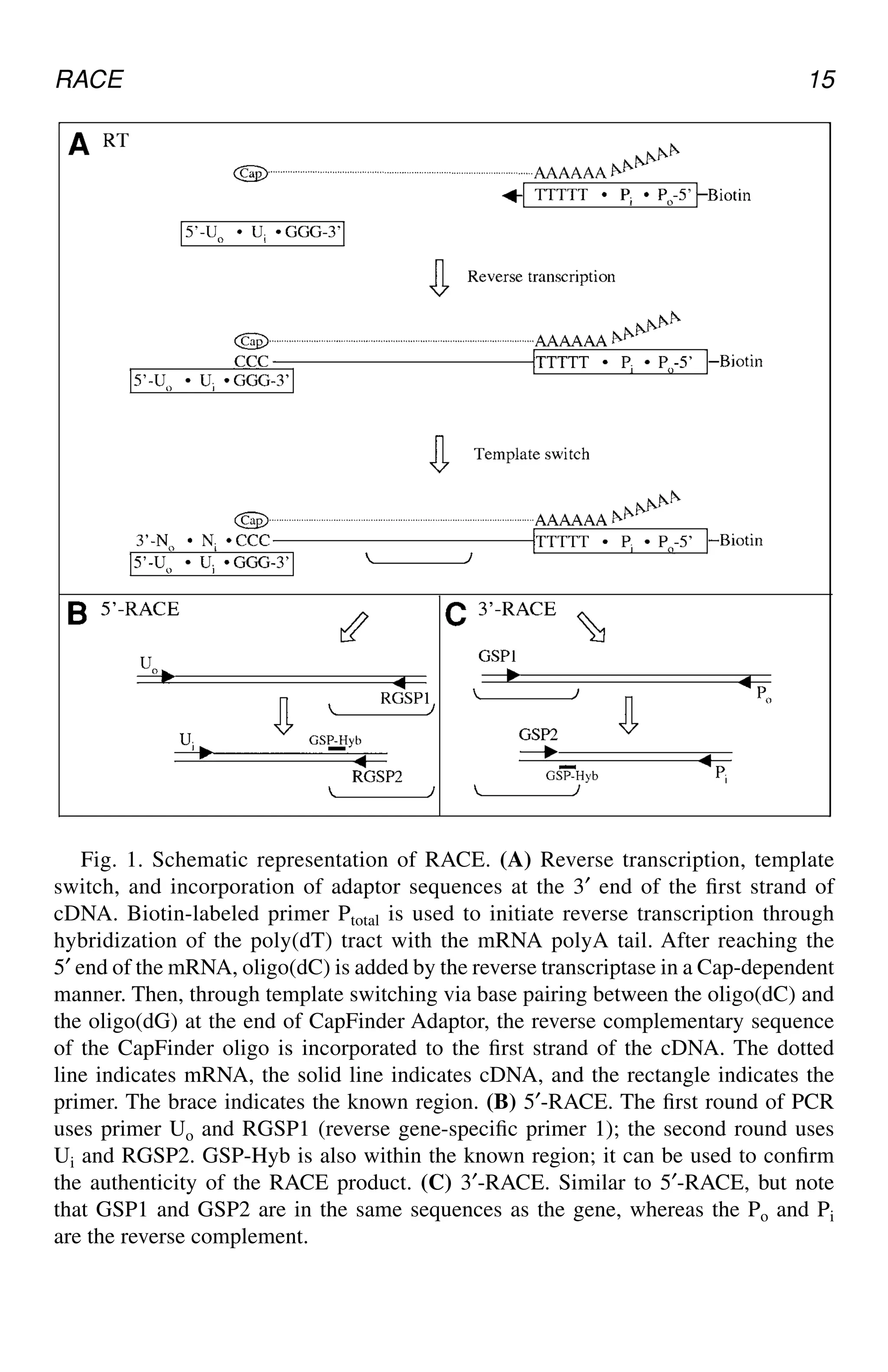
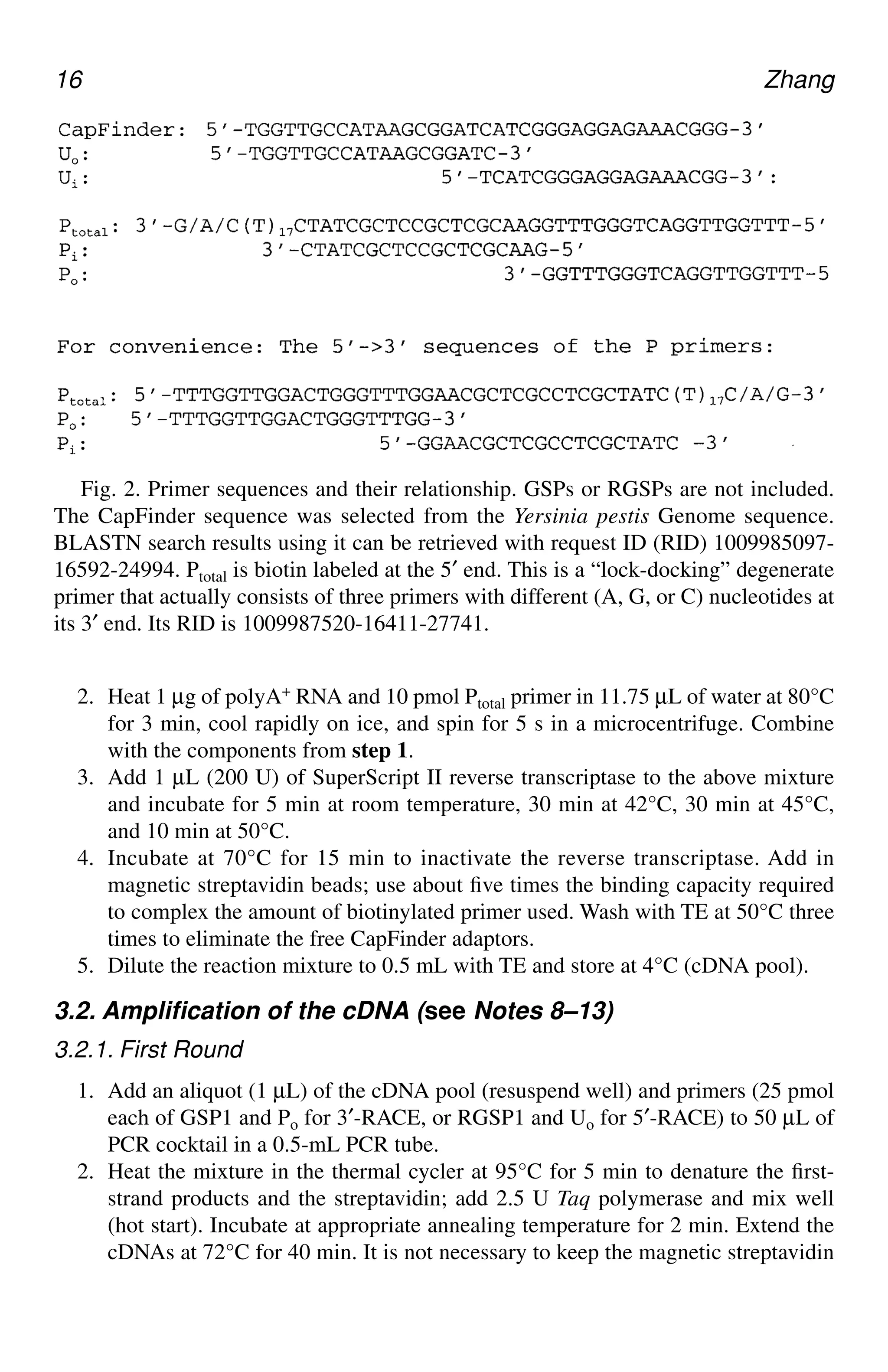
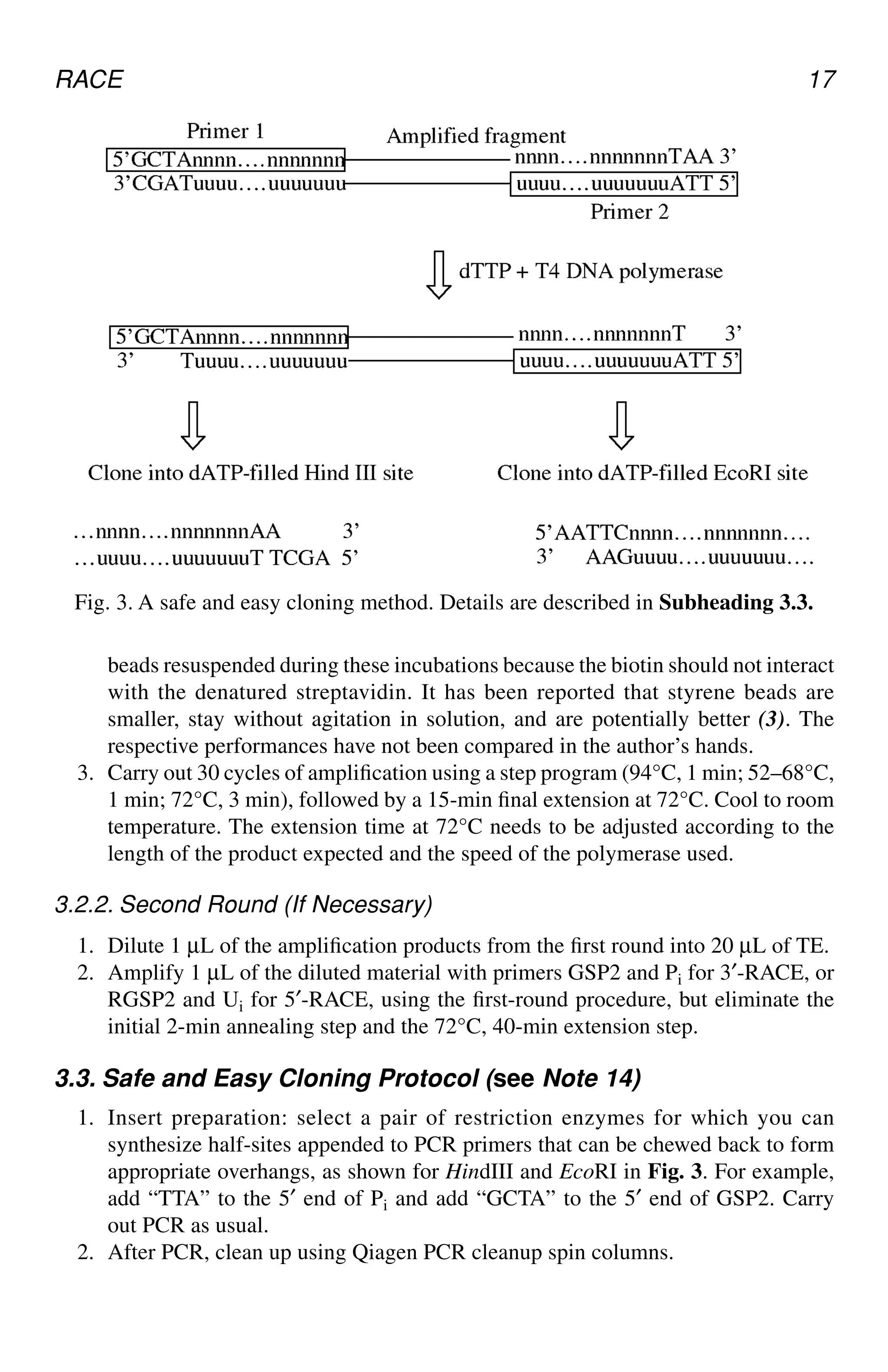
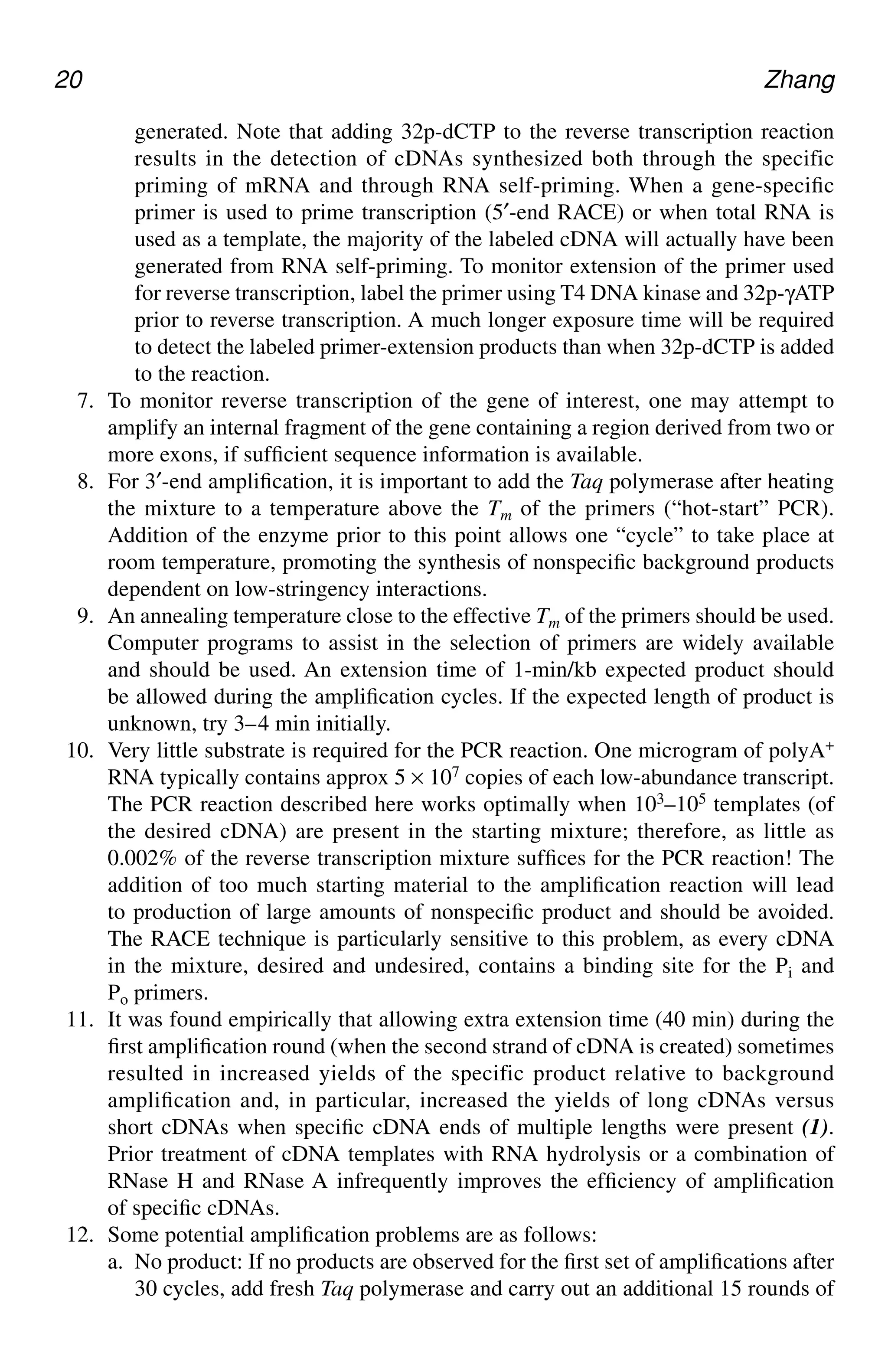
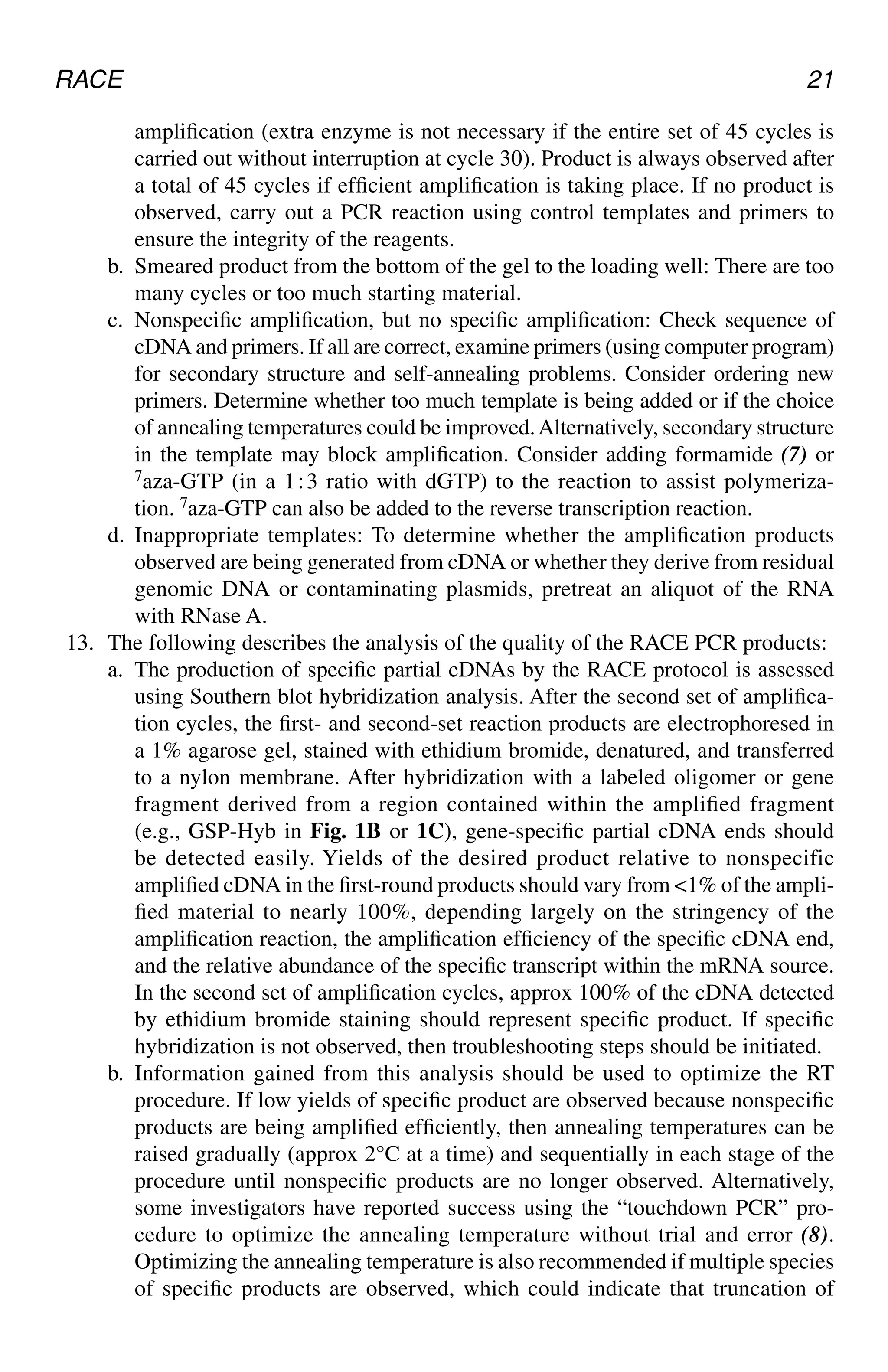
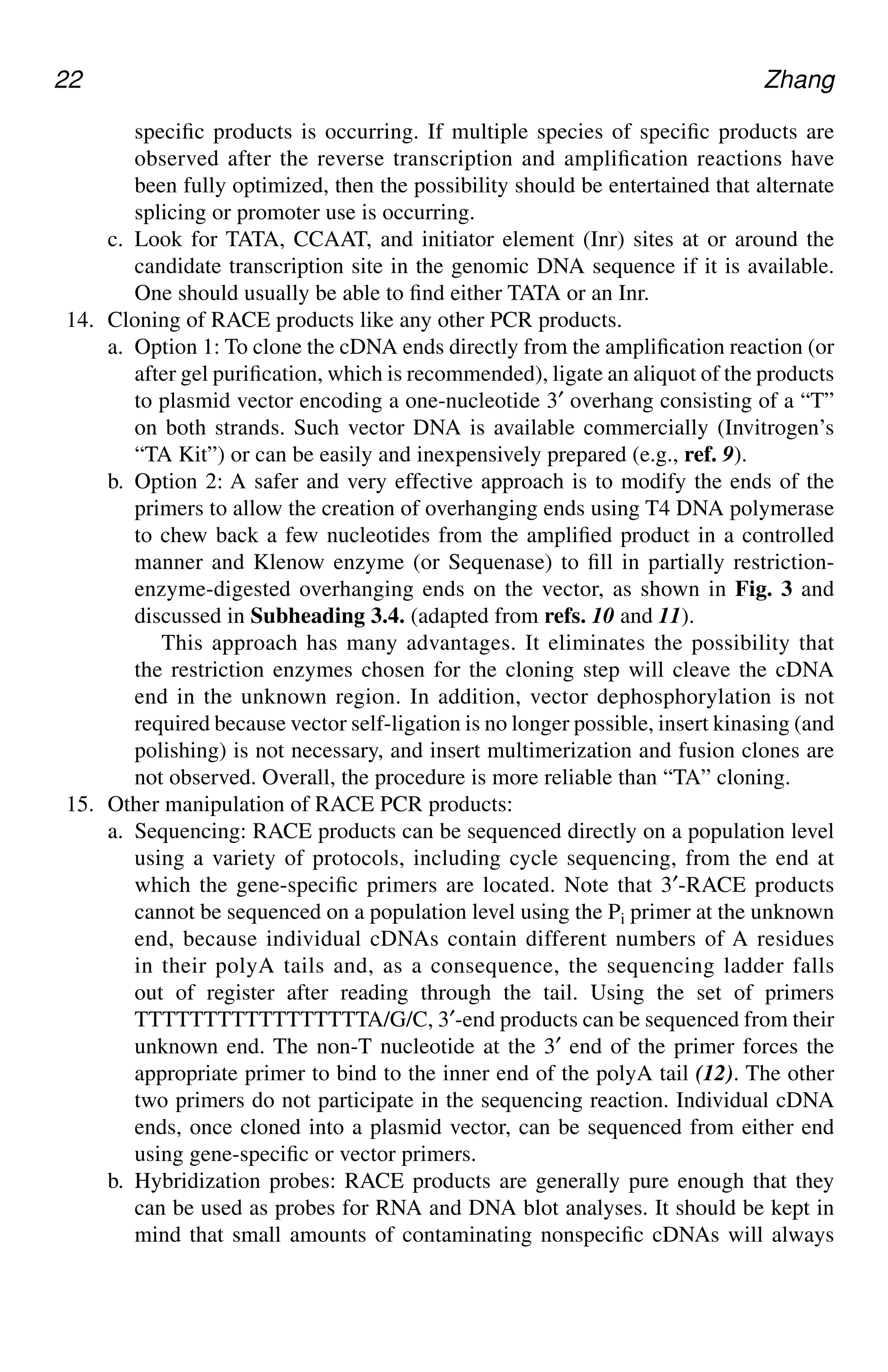
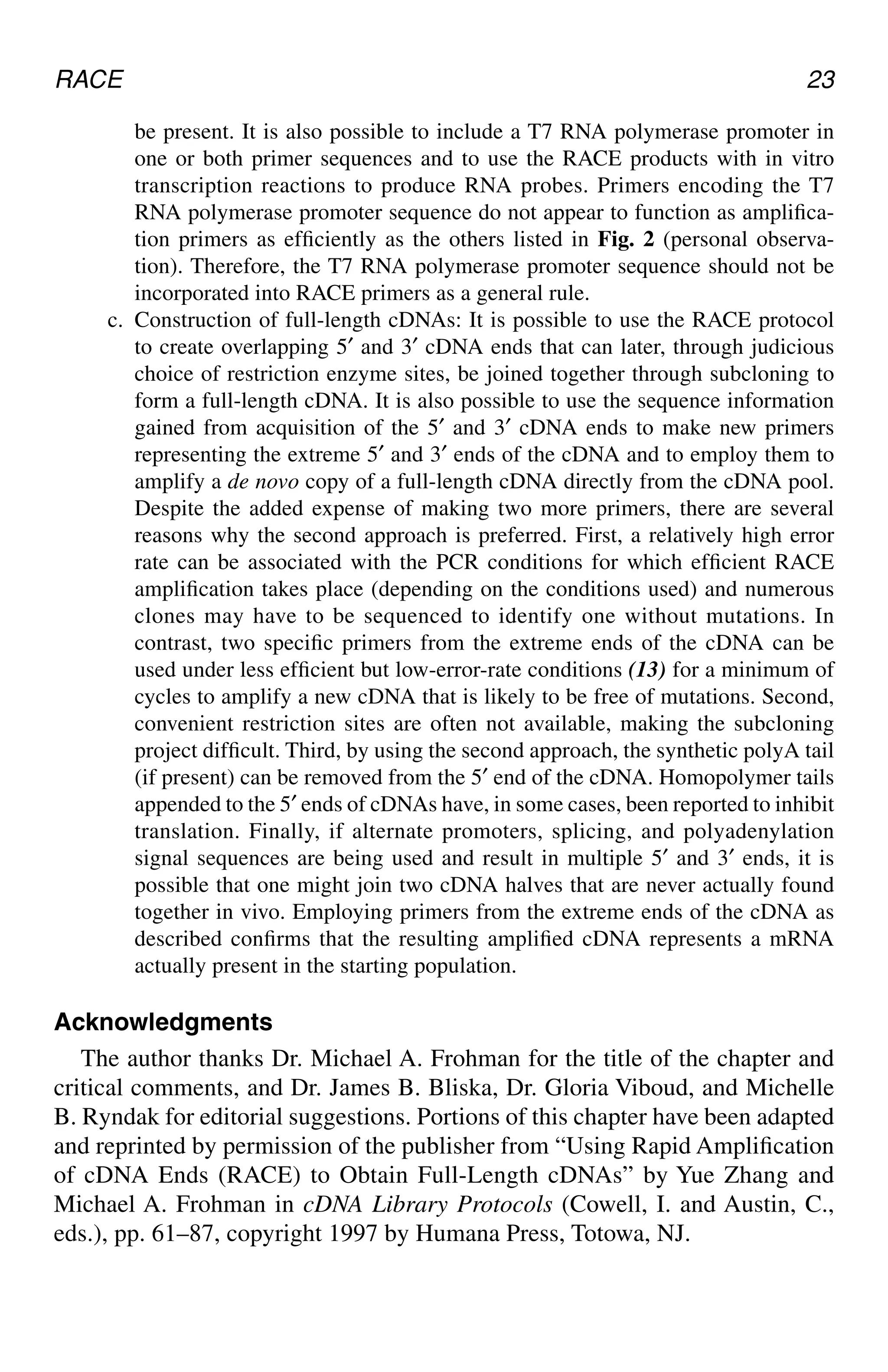
![cDNA Generation on Paramagnetic Beads 25
25
From: Methods in Molecular Biology, vol. 221: Generation of cDNA Libraries: Methods and Protocols
Edited by: S.-Y.Ying © Humana Press Inc., Totowa, NJ
3
cDNA Generation on Paramagnetic Beads
Zhaohui Wang and Michael G. K. Jones
1. Introduction
Synthesis of complementary DNA (cDNA) by reverse transcription (RT) is
a key step in investigating specific gene expression of a single transcript by
RT-PCR (polymerase chain reaction) or to study the more complex profiles
of gene expression in a biological sample using cDNA library or other
techniques. Solid-phase generation of cDNA (1), based on immobilization
of the synthesized cDNA on paramagnetic beads and the magnetic-bead
separation technology, is a very useful method for studying gene expression
particularly when handling limited amounts of starting materials (see Note 1).
Using this method, analysis of gene expression can be carried out at a single-
cell level (2–4). This is not possible using conventional techniques of mRNA
isolation and cDNA cloning.
There are two standard methods for adapting magnetic beads to the synthesis
of cDNA. One method is to covalently link an oligo(dT) tail directly to the
paramagnetic beads, and this oligo(dT) tail can be used to capture poly(A)+
RNA (messenger RNA [mRNA]) and prime the RT reaction. Alternatively,
an oligonucleotide arm can be inserted between the oligo(dT) site and the
beads, and the oligonucleotide arm can serve as a 3′-end priming site in the sub-
sequent PCR amplification (5). Both methods share the benefits of isolation of
mRNA and RT directly on beads, which simplifies the experimental process and
minimizes DNA contamination (see Note 2). The cDNA synthesized on beads
can be used directly in downstream molecular processes, such as construction
of cDNA libraries (6), subtractive libraries (7,8), 5′-RACE (9) and cDNA-
amplified fragment length polymorphism (cDNA–AFLP) analysis (10).
CH03,25-32,8pgs 01/03/03, 7:32 PM
25](https://image.slidesharecdn.com/466530-250520173627-85cbe6bb/75/Generation-Of-Cdna-Libraries-Methods-And-Protocols-1st-Edition-Shaoyao-Ying-30-2048.jpg)
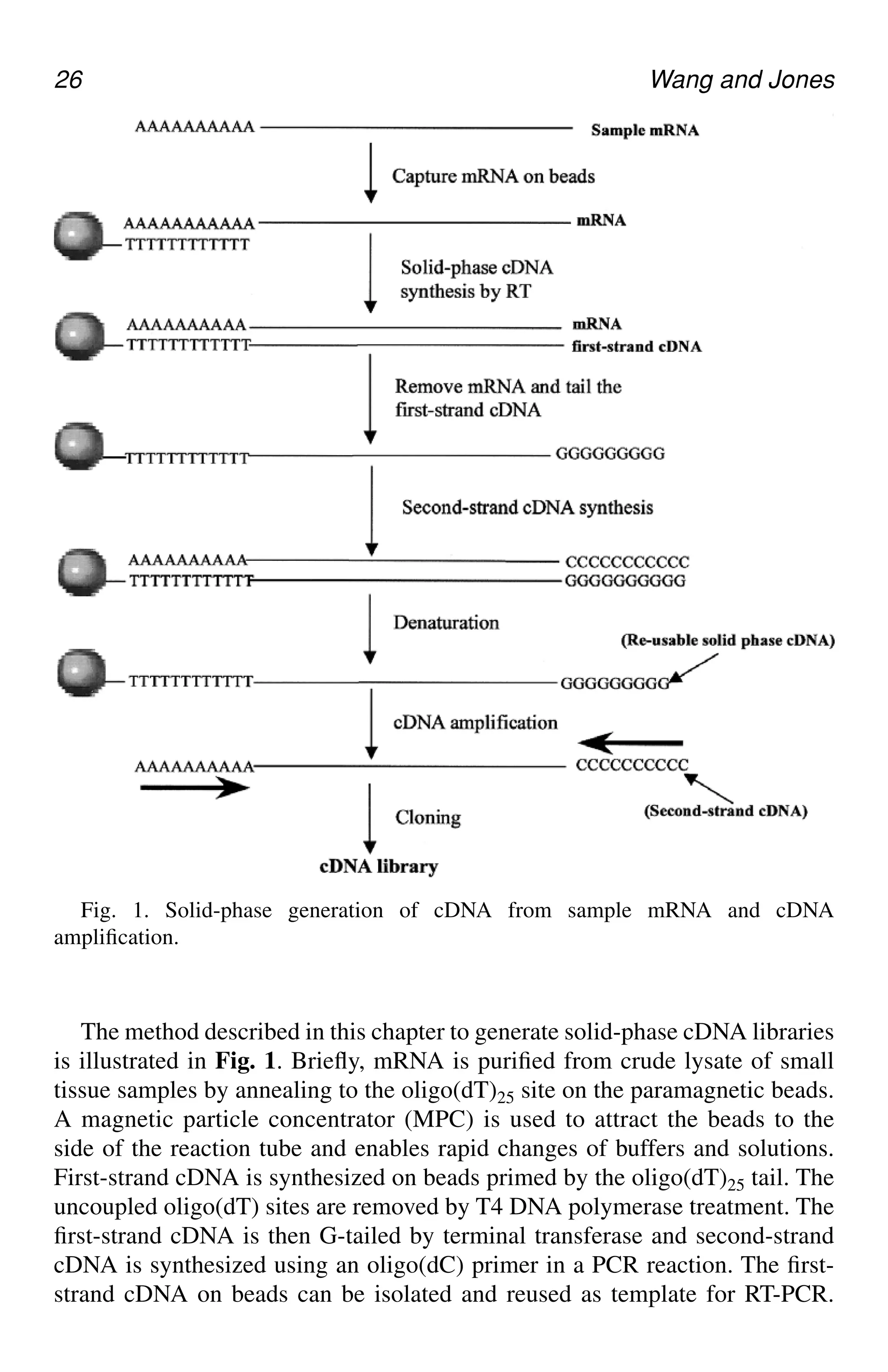
![30 Wang and Jones
an excess of tissue will reduce the mRNA yield and purity. For mRNA isolation
and cDNA generation at the single-cell level, the amount of beads can be scaled
down to 20–50 µL. We have used 20 µL of beads to capture the mRNA from
extracts of cytoplasmic contents from single giant cells induced by root-knot
nematodes in tomato root and generated first-strand cDNA on beads to detect
different transcripts in giant cells (4). However, cDNA generated on beads from
a single cell may not be suitable for constructing a full cDNA library. Large
variations in PCR amplification can occur when the PCR template amount
falls below a certain threshold copy number (2). This effect, termed “Monte
Carlo,” will directly decrease the reproducibility of cDNA amplification and the
representation of the cDNA library constructed from single cells.
2. To carry out large-scale mRNA isolation, the beads can be reused up to four
times to reduce preparation costs. After the first round of mRNA isolation, the
mRNA bound on beads can be eluted from the beads by adding 10–20 µL of
elution buffer (2 mM EDTA [pH 8.0]), keeping it at 65°C for 2 min. Immediately
place the tube into the MPC and transfer the supernatant containing the mRNA
to another tube. Resuspend the beads in 200 µL of reconditioning buffer
(0.1 M NaOH), keep at 65°C for 2 min, and repeat the reconditioning step once.
Wash the beads three times with storage solution (250 mM Tris-HCl [pH 8.0],
20 mM EDTA, 0.1% Tween-20, 0.02% sodium azide). The beads are then ready
for another mRNA isolation. To avoid any cross contamination, reuse of the
reconditioned beads for different tissue or cell samples is not recommended.
3. This protocol normally results in very pure mRNA with traces of ribosomal
RNA. DNA contamination might be found for some cell types and tissues. For
critical applications such as cDNA library construction, trace rRNA and DNA
contamination should be avoided by carrying out an extra round of mRNA
purification with the same protocol.
4. For all steps of changing the solution, the beads must be washed thoroughly
and the supernatant removed properly by pipetting to eliminate any residue of
reagents, such as salts, detergent, and enzymes, from the previous step.
5. It is necessary to conduct T4 DNA polymerase treatment on the first-strand
cDNA on beads to remove the uncoupled oligo-(dT) sites on the beads. The
terminal transferase can also tail the residual oligo-(dT) sites with oligo-(dG).
These short oligo-(dT)-(dG) fragments may interfere in the following PCR
amplification by competing for the primer binding sites.
6. The majority of the cloned cDNA in the cDNA library is relatively small-size
fragments (<300 bp). This reflects selective amplification and cloning of smaller
cDNAs, and this is a common limitation of all PCR-based cDNA libraries.
However, the presence of full length cDNA can be confirmed by amplifying
specific transcripts using first-strand cDNA on beads as PCR template with gene-
specific primers, and full-length cDNA is always obtained. Size fractionation of
the amplified cDNA before the cloning step should lead to increased insert sizes
and thus provide more sequence information of the translated regions.
CH03,25-32,8pgs 01/03/03, 7:32 PM
30](https://image.slidesharecdn.com/466530-250520173627-85cbe6bb/75/Generation-Of-Cdna-Libraries-Methods-And-Protocols-1st-Edition-Shaoyao-Ying-35-2048.jpg)

![Construction of a Normalized cDNA Library 35
2.2. Preparation of mRNA
1. Oligotex suspension (Qiagen, cat. no. 79000). Keep at room temperature.
2. Buffer A: 20 mM Tris-HCl (pH 7.5), 1 M NaCl, 2 mM EDTA, 0.2% sodium
dodecyl sulfate (SDS).
3. Washing buffer: 10 mM Tris-HCl (pH 7.5), 150 mM NaCl, 1 mM EDTA.
4. Elution buffer: 5 mM Tris-HCl (pH 7.5).
2.3. Conversion of mRNA to cDNA on Latex Beads
1. Buffer B: 50 mM Tris-HCl (pH 8.3), 10 mM MgCl2, 100 mM KCl.
2. Buffer C: 50 mM Tris-HCl (pH 8.3), 3 mM MgCl2, 75 mM KCl.
3. Reverse transcriptase Superscript II (Invitrogen, cat. no. 18064-022). Store
at –20°C.
4. TE buffer: 10 mM Tris-HCl (pH 7.5), 1 mM EDTA. Store at room temperature.
5. dNTP mix (Promega, cat. no. U1330 or U1242). Store at –20°C.
6. [α-32P]-dCTP (specific activity ~3000 Ci/mmol) (Amersham, cat. no. PB10205).
Store at –20°C.
2.4. mRNA–cDNA Self-Hybridization
1. Oligo (dT) primer with XhoI and KpnI sites: 5′-GAA GAA GAA CTC GAG
GGT ACC TTT TTT TTT TTT TTT-3′.
2. Oligo(dA) (25–30 mer): synthesized as custom oligonucleotide.
3. Hybridization buffer: 10 mM Tris-HCl (pH 7.5), 1 mM EDTA, 100 mM NaCl.
2.5. Construction of cDNA Libraries
1. Reverse transcriptase Superscript II (Invitrogen, cat. no. 18064-022). Store
at –20°C.
2. Escherichia coli RNase H (2 U/µL) (Invitrogen, cat no. 18021-071). Store
at –20°C.
3. E. coli DNA polymerase I (10 U/µL) (Invitrogen, cat. no. 18010025). Store
at –20°C.
4. E. coli DNA ligase (10 U/µL) (Invitrogen, cat. no. 18052019). Store at –20°C.
5. β-NAD (Fisher, cat. no. BP2532). Store at –20°C.
6. T4 DNA polymerase (Invitrogen, cat. no. 18005017). Store at –20°C.
7. Sephacryl s-400 column (Promega, cat. no. V3181).
8. EcoRI-NotI-BamHI adapter: synthesized as custom oligonucleotide or purchased
from Takara (cat. no. TAK 4510).
3. Methods
3.1. Isolation of Total Cellular RNA
1. Lyse monolayer cells by adding 3.0 mL of Trizol Reagent to 1 of the 100-mm cell
culture dishes. Pipet cell lysate up and down several times (see Note 1).
CH04,33-40,8pgs 01/03/03, 7:33 PM
35](https://image.slidesharecdn.com/466530-250520173627-85cbe6bb/75/Generation-Of-Cdna-Libraries-Methods-And-Protocols-1st-Edition-Shaoyao-Ying-40-2048.jpg)
![Construction of a Normalized cDNA Library 37
6. Resuspend the Oligotex⬊mRNA pellet in 1 mL washing buffer by vortex or
pipetting.
7. Pellet the Oligotex⬊mRNA complex by centrifugation for 2 min at
14,000–18,000g and carefully remove the supernatant with a pipet.
8. Repeat steps 6 and 7 once.
9. Add 20–100 µL of hot (70°C) elution buffer. Pipet up and down three or four
times to resuspend the resin and centrifuge for 2 min at 14,000–18,000g. Care-
fully transfer the supernatant, which contains the eluted poly(A+) mRNA, to
another RNase-free tube (see Note 5).
10. For maximal yield, add another 20–100 µL of elution buffer to the Oligotex
pellet and combine the eluates.
Approximately 5–10 µg of poly(A+) mRNA are yielded from 250 µg of
total RNA.
3.3. Conversion of mRNA to cDNA on Latex Beads
1. Mix 20 µg poly(A)+ RNA with 2.5 mg Oligotex beads in 250 µL buffer B.
Incubate at 37°C for 20 min.
2. Centrifuge at 15,000g for 10 min at room temperature.
3. Resuspend beads in 250 µL of buffer C.
4. Set up reverse transcription in a 500-µL reaction:
50 mM Tris-HCl (pH 8.3);
3 mM MgCl2;
75 mM KCl;
1 mM of dNTP (dATP, dCTP, dGTP, dTTP);
10 mM dithiothreitol (DTT);
300 U RNase inhibitor;
2000 U Superscript II.
Incubate 90 min at 45°C.
5. Wash beads two times with TE.
6. Heat for 3 min at 95°C to remove RNA.
7. Spin and resuspend beads in TE.
8. Store at 4°C.
9. Monitor cDNA synthesis with 0.5 µL of [α-32P]-dCTP (10 µCi/µL) in the 10-µL
reaction and count bead-associated radioactivities.
3.4. mRNA–cDNA Self-Hybridization (see Note 6)
1. Suspend 2.5 mg cDNA–Oligotex beads in 90 µL of TE containing 100 µg of
oligo(dA) (25–30 mer). Heat 5 min at 70°C.
2. Add 10 µL of 5 M NaCl and incubate for 10 min at 37°C to mask free oligo(dT)
residues on beads.
3. After centrifugation, the beads are incubated with 2 µg of poly(A)+ RNA in
200 µL hybridization buffer. Incubate 15 min at 55°C with occasional agitation.
CH04,33-40,8pgs 01/03/03, 7:33 PM
37](https://image.slidesharecdn.com/466530-250520173627-85cbe6bb/75/Generation-Of-Cdna-Libraries-Methods-And-Protocols-1st-Edition-Shaoyao-Ying-42-2048.jpg)
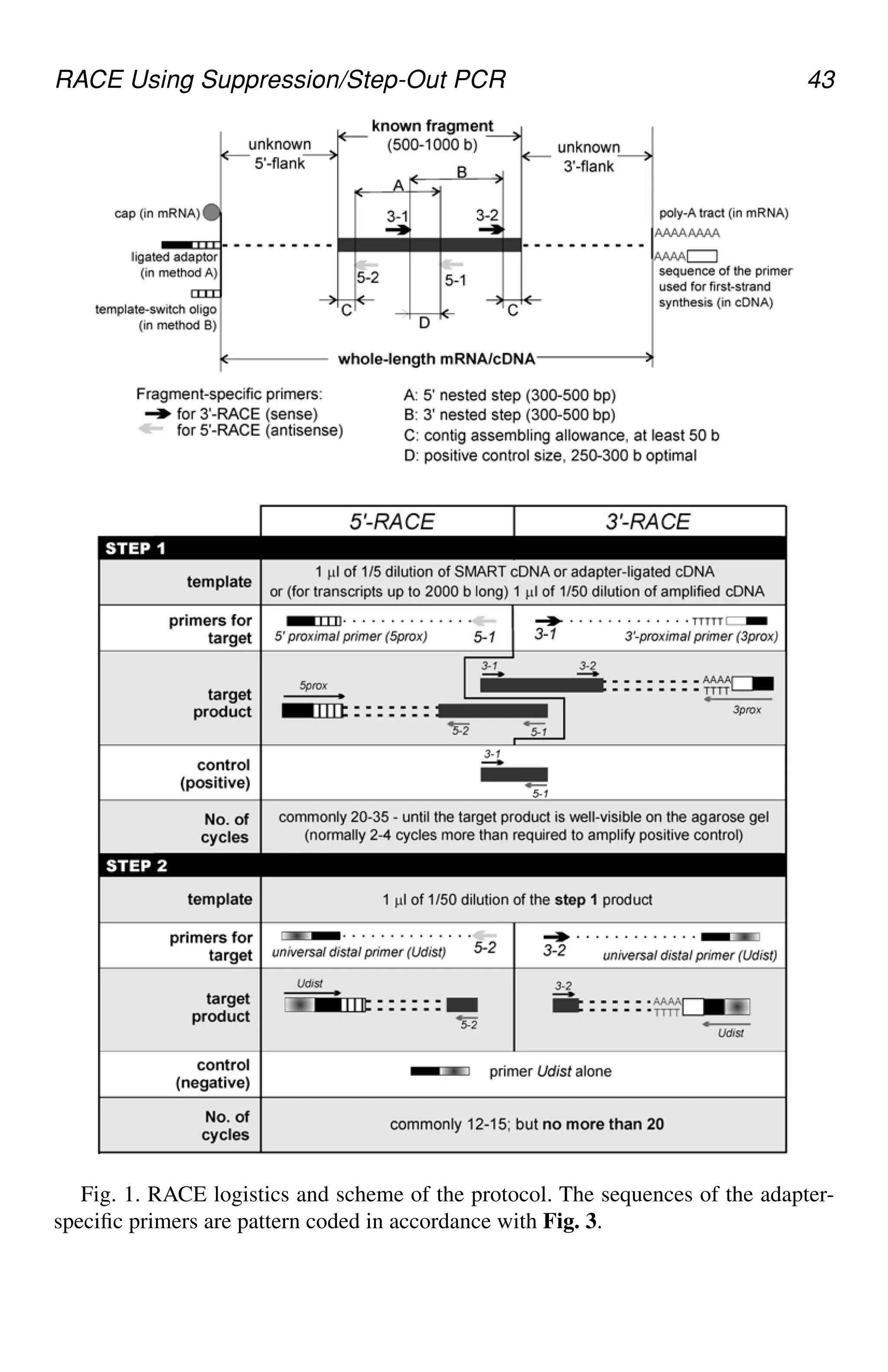
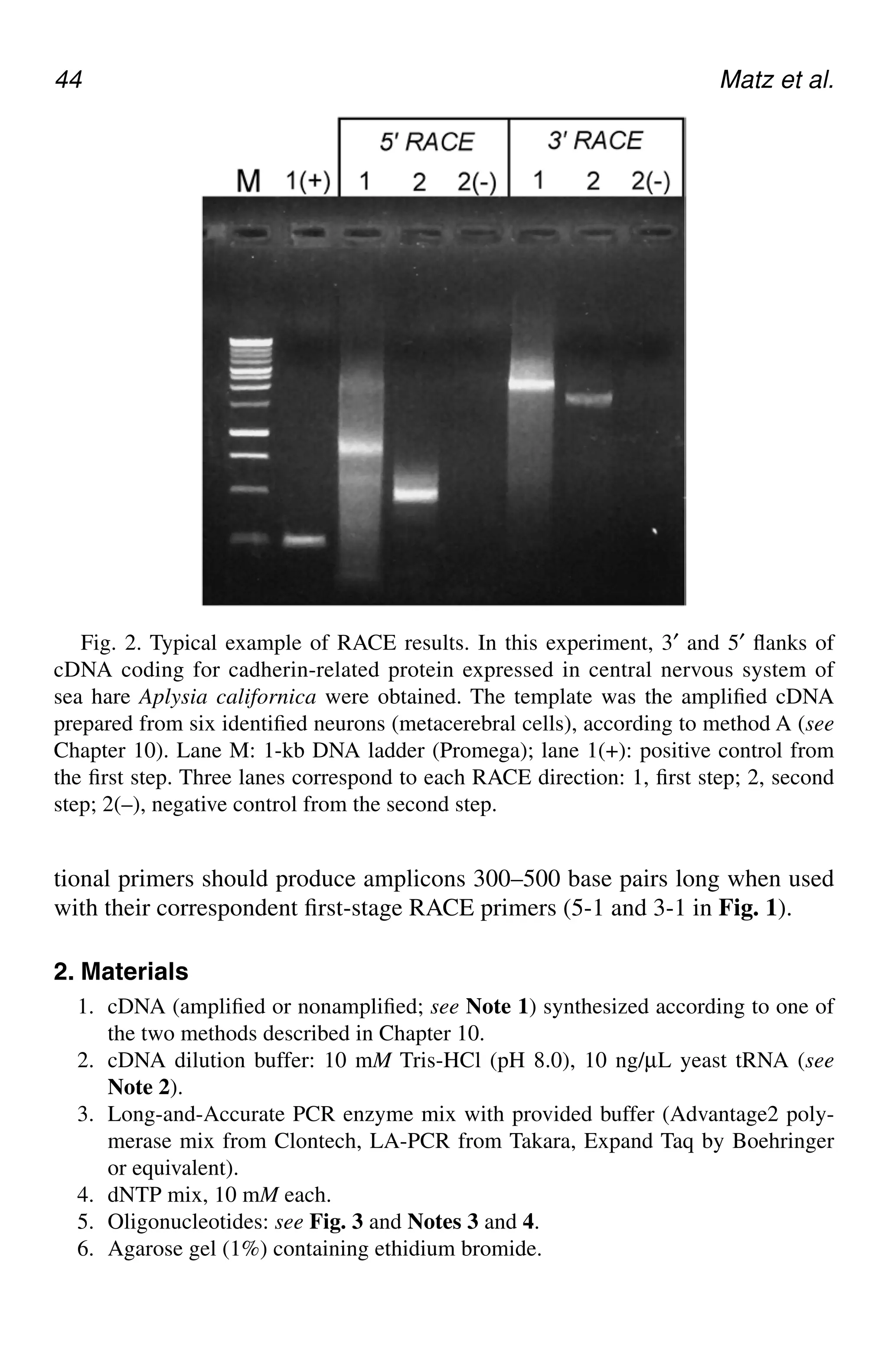
![RACE Using Suppression/Step-Out PCR 45
3. Methods
3.1. First Stage of RACE
1. Prepare the template by diluting the aliquot of nonamplified cDNA fivefold in the
cDNA dilution buffer. If the use of amplified cDNA is feasible, dilute the aliquot
of the product of cDNA amplification 50-fold in the cDNA dilution buffer.
2. Prepare three PCR mixtures, corresponding to 3′-RACE, 5′-RACE, and positive
control. These mixtures will differ only in primers, so a master mixture without
primers can be prepared: 6 µL of 10X PCR buffer (provided with the polymerase
mixture), 1.5 µL of dNTP mix (10 mM of each), 3 µL of diluted cDNA template,
polymerase mixture sufficient for 60 µL of PCR (see manufacturer’s recom-
mendations), and H2O to 57 µL. Dispense the master mix into three tubes (18 µL
to each tube); label the tubes. Add the following primers to the tubes (see Fig. 1
for locations of primer annealing sites):
a. For 5′-RACE, 1 µL of 2 µM 5prox primer and 1 µL of 2 µM fragment-specific
primer 5-1.
b. For 3′-RACE, 1 µL of 2 µM 3prox primer and 1 µL of 2 µM fragment-specific
primer 3-1.
c. For positive control, 1 µL of 2 µM primer 5-1 and 1 µL of 2 µM primer 3-1.
Note that the final concentration of primers is 0.1 µM.
3. Perform cycling: For block-controlled thermocyclers, 94°C for 40 s (annealing
temperature of the weakest gene-specific primer; see Note 4), 1 min – 72°C 2 min
30 s; for thermocyclers with tube-controlled temperature or simulated tube
control, 95°C 10 s – [•••] 30 s – 72°C for 2 min 30 s. Perform as many cycles
as required to amplify the known fragment from the particular cDNA. If this
Fig. 3. Legend to primer sequences.
CH05,41-50,10pgs 01/03/03, 7:34 PM
45](https://image.slidesharecdn.com/466530-250520173627-85cbe6bb/75/Generation-Of-Cdna-Libraries-Methods-And-Protocols-1st-Edition-Shaoyao-Ying-50-2048.jpg)