1
WI Group, University College London, hossein.rahmani.22@ucl.ac.uk
2
DECIDE, University of Southern California, naghiaei@usc.edu
3
Abin's Lab, Shahid Beheshti University, mahdi.dehghan551@gmail.com
4
IRLab, University of Amsterdam, m.aliannejadi@uva.nl
Experiments on Generalizability of User-oriented Fairness
in Recommender Systems
UCL AI Center
Hossein A. (Saeed) Rahmani1
, Mohammadmehdi Naghiaei2
, Mehdi Dehghan3
, Mohammad Aliannejadi4
Shahid Beheshti
University
DEFirst Reading Group
Mila x Vector Institute
23 March, 2023
2
DEFirst '23 | Mila x Vector Institute | Generalizability of User-oriented Fairness in Recommender Systems
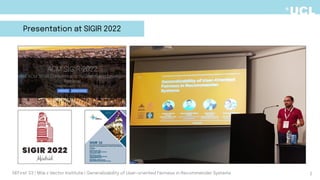
Presentation at SIGIR 2022
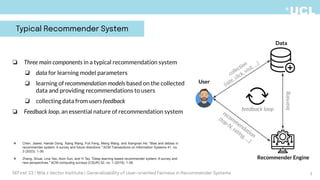
collection
(rate, click, visit, …)
learning
Recommender Engine
Data
User
recommendation
(top-N, rating, …)
❏ Three main components in a typical recommendation system
❏ data for learning model parameters
❏ learning of recommendation models based on the collected
data and providing recommendations to users
❏ collecting data from users feedback
❏ Feedback loop, an essential nature of recommendation system
❖ Chen, Jiawei, Hande Dong, Xiang Wang, Fuli Feng, Meng Wang, and Xiangnan He. "Bias and debias in
recommender system: A survey and future directions." ACM Transactions on Information Systems 41, no.
3 (2023): 1-39.
❖ Zhang, Shuai, Lina Yao, Aixin Sun, and Yi Tay. "Deep learning based recommender system: A survey and
new perspectives." ACM computing surveys (CSUR) 52, no. 1 (2019): 1-38.
feedback loop
Typical Recommender System
3
DEFirst '23 | Mila x Vector Institute | Generalizability of User-oriented Fairness in Recommender Systems
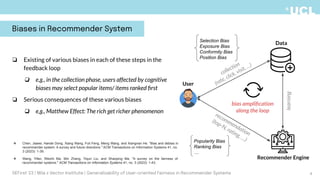
❏ Existing of various biases in each of these steps in the
feedback loop
❏ e.g., in the collection phase, users affected by cognitive
biases may select popular items/ items ranked first
❏ Serious consequences of these various biases
❏ e.g., Matthew Effect: The rich get richer phenomenon
collection
(rate, click, visit, …)
learning
Recommender Engine
Data
User
recommendation
(top-N, rating, …)
bias amplification
along the loop
Selection Bias
Exposure Bias
Conformity Bias
Position Bias
Popularity Bias
Ranking Bias
…
Biases in Recommender System
4
❖ Chen, Jiawei, Hande Dong, Xiang Wang, Fuli Feng, Meng Wang, and Xiangnan He. "Bias and debias in
recommender system: A survey and future directions." ACM Transactions on Information Systems 41, no.
3 (2023): 1-39.
❖ Wang, Yifan, Weizhi Ma, Min Zhang, Yiqun Liu, and Shaoping Ma. "A survey on the fairness of
recommender systems." ACM Transactions on Information Systems 41, no. 3 (2023): 1-43.
DEFirst '23 | Mila x Vector Institute | Generalizability of User-oriented Fairness in Recommender Systems
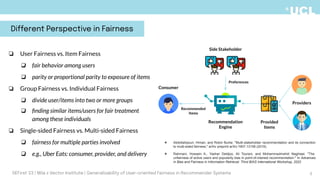
❏ User Fairness vs. Item Fairness
❏ fair behavior among users
❏ parity or proportional parity to exposure of items
❏ Group Fairness vs. Individual Fairness
❏ divide user/items into two or more groups
❏ finding similar items/users for fair treatment
among these individuals
❏ Single-sided Fairness vs. Multi-sided Fairness
❏ fairness for multiple parties involved
❏ e.g., Uber Eats: consumer, provider, and delivery
Consumer
Providers
Provided
Items
Recommendation
Engine
Recommended
Items
Side Stakeholder
Preferences
❖ Abdollahpouri, Himan, and Robin Burke. "Multi-stakeholder recommendation and its connection
to multi-sided fairness." arXiv preprint arXiv:1907.13158 (2019).
❖ Rahmani, Hossein A., Yashar Deldjoo, Ali Tourani, and Mohammadmehdi Naghiaei. "The
unfairness of active users and popularity bias in point-of-interest recommendation." In Advances
in Bias and Fairness in Information Retrieval: Third BIAS International Workshop, 2022
Different Perspective in Fairness
5
DEFirst '23 | Mila x Vector Institute | Generalizability of User-oriented Fairness in Recommender Systems
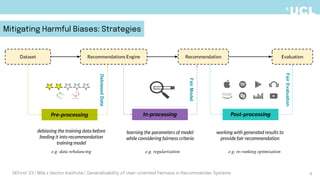
Pre-processing In-processing Post-processing
e.g. data rebalancing e.g. regularization e.g. re-ranking optimisation
6
debiasing the training data before
feeding it into recommendation
training model
learning the parameters of model
while considering fairness criteria
working with generated results to
provide fair recommendation
Mitigating Harmful Biases: Strategies
DEFirst '23 | Mila x Vector Institute | Generalizability of User-oriented Fairness in Recommender Systems
Dataset Recommendations Engine Recommendation Evaluation
Debiased
Data
Fair
Model
Fair
Evaluation
7
Main Research Question!
How generalizable are the proposed systems with respect
to different aspects of a recommendation system?
DEFirst '23 | Mila x Vector Institute | Generalizability of User-oriented Fairness in Recommender Systems
By The WISE Lab (Web Intelligent Systems and Economics) at Rutgers
University (https:/
/wise.cs.rutgers.edu/)
Li, Yunqi, Hanxiong Chen, Zuohui Fu, Yingqiang Ge, and Yongfeng Zhang.
"User-oriented fairness in recommendation." In Proceedings of the Web
Conference, 2021
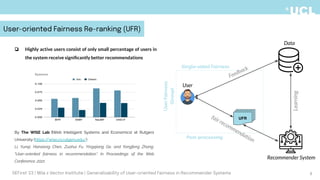
Feedback
fair recommendation
Learning
Recommender System
Data
User
UFR
Post-processing
User
Fairness
(Group)
Single-sided Fairness
8
User-oriented Fairness Re-ranking (UFR)
DEFirst '23 | Mila x Vector Institute | Generalizability of User-oriented Fairness in Recommender Systems
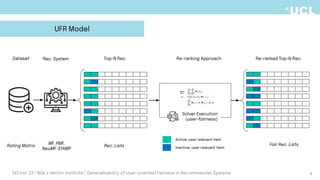
❏ Highly active users consist of only small percentage of users in
the system receive significantly better recommendations
Dataset Rec. System Top-N Rec.
MF, PMF,
NeuMF, STAMP
Rating Matrix Rec. Lists
Solver Execution
(user-fairness)
Active-user relevant item
Inactive-user relevant item
Re-ranked Top-N Rec.
Fair Rec. Lists
Re-ranking Approach
UFR Model
DEFirst '23 | Mila x Vector Institute | Generalizability of User-oriented Fairness in Recommender Systems 9
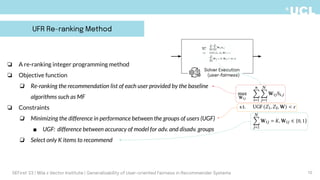
❏ A re-ranking integer programming method
❏ Objective function
❏ Re-ranking the recommendation list of each user provided by the baseline
algorithms such as MF
❏ Constraints
❏ Minimizing the difference in performance between the groups of users (UGF)
■ UGF: difference between accuracy of model for adv. and disadv. groups
❏ Select only K items to recommend
UFR Re-ranking Method
Solver Execution
(user-fairness)
10
DEFirst '23 | Mila x Vector Institute | Generalizability of User-oriented Fairness in Recommender Systems
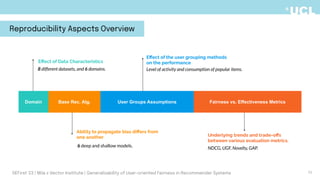
Reproducibility Aspects Overview
Effect of Data Characteristics
8 different datasets, and 6 domains.
Ability to propagate bias differs from
one another
6 deep and shallow models.
Effect of the user grouping methods
on the performance
Level of activity and consumption of popular items.
Underlying trends and trade-offs
between various evaluation metrics.
NDCG, UGF, Novelty, GAP.
Domain Base Rec. Alg. User Groups Assumptions Fairness vs. Effectiveness Metrics
11
DEFirst '23 | Mila x Vector Institute | Generalizability of User-oriented Fairness in Recommender Systems
Dataset Users Items Interactions Sparsity Feedback Domain
MovieLens 943 1,349 99,287 92.19% Explicit Movie
Epinion 2,677 2,060 103,567 98.12% Explicit Opinion
LastFM 1,797 1,507 62,376 97.69% Implicit Music
BookCrossing 1,136 1,019 20,522 98.22% Explicit Book
Amazon Toy 2,170 1,733 32,852 99.12% Explicit eCommerce
Amazon Office 2,448 1,596 36,841 99.05% Explicit eCommerce
Gowalla 1,130 1,189 66,245 95.06% Implicit POI
Foursquare 1,568 1,461 42,678 98.13% Implicit POI
12
DEFirst '23 | Mila x Vector Institute | Generalizability of User-oriented Fairness in Recommender Systems
Datasets and Domains
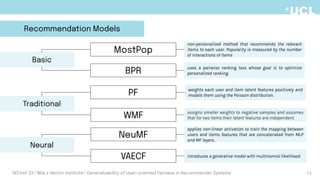
weights each user and item latent features positively and
models them using the Poisson distribution.
assigns smaller weights to negative samples and assumes
that for two items their latent features are independent.
applies non-linear activation to train the mapping between
users and items features that are concatenated from MLP
and MF layers.
introduces a generative model with multinomial likelihood
Traditional
PF
WMF
NeuMF
VAECF
Neural
MostPop
DEFirst '23 | Mila x Vector Institute | Generalizability of User-oriented Fairness in Recommender Systems
Recommendation Models
BPR
Basic
uses a pairwise ranking loss whose goal is to optimize
personalized ranking.
non-personalized method that recommends the relevant
items to each user. Popularity is measured by the number
of interactions of items
13
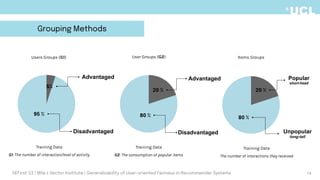
Advantaged
Disadvantaged
95 %
5%
Users Groups (G1)
80 %
20 %
Advantaged
Disadvantaged
User Groups (G2)
Training Data
G1: The number of interaction/level of activity
Training Data
G2: The consumption of popular items
Grouping Methods
80 %
20 %
Popular
short-head
Unpopular
long-tail
Items Groups
Training Data
The number of interactions they received
DEFirst '23 | Mila x Vector Institute | Generalizability of User-oriented Fairness in Recommender Systems 14
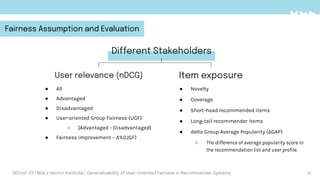
Different Stakeholders
User relevance (nDCG) Item exposure
● All
● Advantaged
● Disadvantaged
● User-oriented Group Fairness (UGF)
○ |Advantaged - Disadvantaged|
● Fairness improvement – Δ%(UGF)
15
● Novelty
● Coverage
● Short-head recommended items
● Long-tail recommender items
● delta Group Average Popularity (ΔGAP)
○ The difference of average popularity score in
the recommendation list and user profile.
DEFirst '23 | Mila x Vector Institute | Generalizability of User-oriented Fairness in Recommender Systems
Fairness Assumption and Evaluation
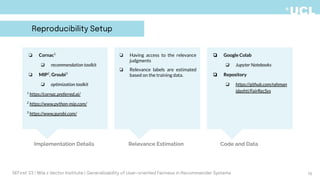
❏ Google Colab
❏ Jupyter Notebooks
❏ Repository
❏ https://github.com/rahman
idashti/FairRecSys
❏ Cornac1
❏ recommendation toolkit
❏ MIP2
, Groubi3
❏ optimization toolkit
1
https://cornac.preferred.ai/
2
https://www.python-mip.com/
3
https://www.gurobi.com/
❏ Having access to the relevance
judgments
❏ Relevance labels are estimated
based on the training data.
Relevance Estimation
Implementation Details Code and Data
16
DEFirst '23 | Mila x Vector Institute | Generalizability of User-oriented Fairness in Recommender Systems
Reproducibility Setup
17
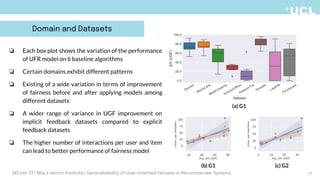
❏ Each box plot shows the variation of the performance
of UFR model on 6 baseline algorithms
❏ Certain domains exhibit different patterns
❏ Existing of a wide variation in terms of improvement
of fairness before and after applying models among
different datasets
❏ A wider range of variance in UGF improvement on
implicit feedback datasets compared to explicit
feedback datasets
❏ The higher number of interactions per user and item
can lead to better performance of fairness model
DEFirst '23 | Mila x Vector Institute | Generalizability of User-oriented Fairness in Recommender Systems
Domain and Datasets
(a) G1
(b) G1 (c) G2
18
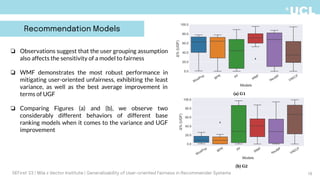
❏ Observations suggest that the user grouping assumption
also affects the sensitivity of a model to fairness
❏ WMF demonstrates the most robust performance in
mitigating user-oriented unfairness, exhibiting the least
variance, as well as the best average improvement in
terms of UGF
❏ Comparing Figures (a) and (b), we observe two
considerably different behaviors of different base
ranking models when it comes to the variance and UGF
improvement
DEFirst '23 | Mila x Vector Institute | Generalizability of User-oriented Fairness in Recommender Systems
Recommendation Models
19
DEFirst '23 | Mila x Vector Institute | Generalizability of User-oriented Fairness in Recommender Systems
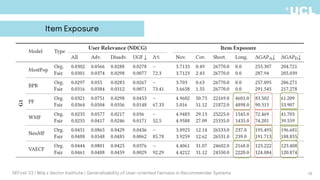
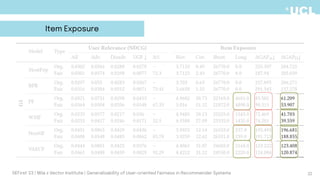
Item Exposure
20
DEFirst '23 | Mila x Vector Institute | Generalizability of User-oriented Fairness in Recommender Systems
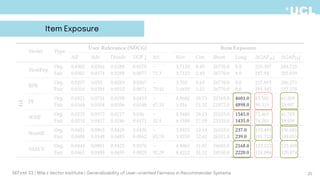
Item Exposure
21
DEFirst '23 | Mila x Vector Institute | Generalizability of User-oriented Fairness in Recommender Systems
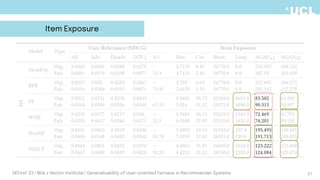
Item Exposure
22
DEFirst '23 | Mila x Vector Institute | Generalizability of User-oriented Fairness in Recommender Systems
Item Exposure
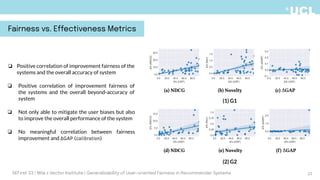
Fairness vs. Effectiveness Metrics
23
❏ Positive correlation of improvement fairness of the
systems and the overall accuracy of system
❏ Positive correlation of improvement fairness of
the systems and the overall beyond-accuracy of
system
❏ Not only able to mitigate the user biases but also
to improve the overall performance of the system
❏ No meaningful correlation between fairness
improvement and ΔGAP (calibration)
(2) G2
(1) G1
DEFirst '23 | Mila x Vector Institute | Generalizability of User-oriented Fairness in Recommender Systems
DEFirst '23 | Mila x Vector Institute | Generalizability of User-oriented Fairness in Recommender Systems 24
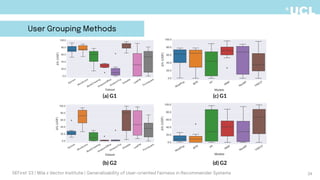
(a) G1
(b) G2
(c) G1
(d) G2
User Grouping Methods
❏ Our experiment on reproducing UFR using 6 base recommendation algorithms shows that UFR is
algorithm agnostic. In other words, it will improve fairness regardless of the baseline recommendation
algorithm but to a different extent.
❏ We found that the user grouping method is one of the most important aspects of the user fairness
algorithm since it directly affects our interpretation of an algorithm’s fair behavior.
❏ We believe that our experiments and shared supplementary resources open opportunities in both
reproducibility and evaluation in this area.
❏ Exploring other methodologies for mitigating unfairness that can show less dependency on the data
distribution and domain properties should be explored in this area.
25
DEFirst '23 | Mila x Vector Institute | Generalizability of User-oriented Fairness in Recommender Systems
Conclusion
Hossein A. (Saeed) Rahmani
UCL AI Center
University College London
London, United Kingdom
hossein.rahmani.22@ucl.ac.uk
@srahmanidashti
rahmanidashti.github.io
Any questions?
https://github.com/rahmanidashti/FairRecSys
Thank you! ;)
DEFirst Reading Group
Mila x Vector Institute
23 March, 2023

GeneralizibilityFairness - DEFirst Reading Group

  • 1.
    1 WI Group, UniversityCollege London, hossein.rahmani.22@ucl.ac.uk 2 DECIDE, University of Southern California, naghiaei@usc.edu 3 Abin's Lab, Shahid Beheshti University, mahdi.dehghan551@gmail.com 4 IRLab, University of Amsterdam, m.aliannejadi@uva.nl Experiments on Generalizability of User-oriented Fairness in Recommender Systems UCL AI Center Hossein A. (Saeed) Rahmani1 , Mohammadmehdi Naghiaei2 , Mehdi Dehghan3 , Mohammad Aliannejadi4 Shahid Beheshti University DEFirst Reading Group Mila x Vector Institute 23 March, 2023
  • 2.
    2 DEFirst '23 |Mila x Vector Institute | Generalizability of User-oriented Fairness in Recommender Systems Presentation at SIGIR 2022
  • 3.
    collection (rate, click, visit,…) learning Recommender Engine Data User recommendation (top-N, rating, …) ❏ Three main components in a typical recommendation system ❏ data for learning model parameters ❏ learning of recommendation models based on the collected data and providing recommendations to users ❏ collecting data from users feedback ❏ Feedback loop, an essential nature of recommendation system ❖ Chen, Jiawei, Hande Dong, Xiang Wang, Fuli Feng, Meng Wang, and Xiangnan He. "Bias and debias in recommender system: A survey and future directions." ACM Transactions on Information Systems 41, no. 3 (2023): 1-39. ❖ Zhang, Shuai, Lina Yao, Aixin Sun, and Yi Tay. "Deep learning based recommender system: A survey and new perspectives." ACM computing surveys (CSUR) 52, no. 1 (2019): 1-38. feedback loop Typical Recommender System 3 DEFirst '23 | Mila x Vector Institute | Generalizability of User-oriented Fairness in Recommender Systems
  • 4.
    ❏ Existing ofvarious biases in each of these steps in the feedback loop ❏ e.g., in the collection phase, users affected by cognitive biases may select popular items/ items ranked first ❏ Serious consequences of these various biases ❏ e.g., Matthew Effect: The rich get richer phenomenon collection (rate, click, visit, …) learning Recommender Engine Data User recommendation (top-N, rating, …) bias amplification along the loop Selection Bias Exposure Bias Conformity Bias Position Bias Popularity Bias Ranking Bias … Biases in Recommender System 4 ❖ Chen, Jiawei, Hande Dong, Xiang Wang, Fuli Feng, Meng Wang, and Xiangnan He. "Bias and debias in recommender system: A survey and future directions." ACM Transactions on Information Systems 41, no. 3 (2023): 1-39. ❖ Wang, Yifan, Weizhi Ma, Min Zhang, Yiqun Liu, and Shaoping Ma. "A survey on the fairness of recommender systems." ACM Transactions on Information Systems 41, no. 3 (2023): 1-43. DEFirst '23 | Mila x Vector Institute | Generalizability of User-oriented Fairness in Recommender Systems
  • 5.
    ❏ User Fairnessvs. Item Fairness ❏ fair behavior among users ❏ parity or proportional parity to exposure of items ❏ Group Fairness vs. Individual Fairness ❏ divide user/items into two or more groups ❏ finding similar items/users for fair treatment among these individuals ❏ Single-sided Fairness vs. Multi-sided Fairness ❏ fairness for multiple parties involved ❏ e.g., Uber Eats: consumer, provider, and delivery Consumer Providers Provided Items Recommendation Engine Recommended Items Side Stakeholder Preferences ❖ Abdollahpouri, Himan, and Robin Burke. "Multi-stakeholder recommendation and its connection to multi-sided fairness." arXiv preprint arXiv:1907.13158 (2019). ❖ Rahmani, Hossein A., Yashar Deldjoo, Ali Tourani, and Mohammadmehdi Naghiaei. "The unfairness of active users and popularity bias in point-of-interest recommendation." In Advances in Bias and Fairness in Information Retrieval: Third BIAS International Workshop, 2022 Different Perspective in Fairness 5 DEFirst '23 | Mila x Vector Institute | Generalizability of User-oriented Fairness in Recommender Systems
  • 6.
    Pre-processing In-processing Post-processing e.g.data rebalancing e.g. regularization e.g. re-ranking optimisation 6 debiasing the training data before feeding it into recommendation training model learning the parameters of model while considering fairness criteria working with generated results to provide fair recommendation Mitigating Harmful Biases: Strategies DEFirst '23 | Mila x Vector Institute | Generalizability of User-oriented Fairness in Recommender Systems Dataset Recommendations Engine Recommendation Evaluation Debiased Data Fair Model Fair Evaluation
  • 7.
    7 Main Research Question! Howgeneralizable are the proposed systems with respect to different aspects of a recommendation system? DEFirst '23 | Mila x Vector Institute | Generalizability of User-oriented Fairness in Recommender Systems
  • 8.
    By The WISELab (Web Intelligent Systems and Economics) at Rutgers University (https:/ /wise.cs.rutgers.edu/) Li, Yunqi, Hanxiong Chen, Zuohui Fu, Yingqiang Ge, and Yongfeng Zhang. "User-oriented fairness in recommendation." In Proceedings of the Web Conference, 2021 Feedback fair recommendation Learning Recommender System Data User UFR Post-processing User Fairness (Group) Single-sided Fairness 8 User-oriented Fairness Re-ranking (UFR) DEFirst '23 | Mila x Vector Institute | Generalizability of User-oriented Fairness in Recommender Systems ❏ Highly active users consist of only small percentage of users in the system receive significantly better recommendations
  • 9.
    Dataset Rec. SystemTop-N Rec. MF, PMF, NeuMF, STAMP Rating Matrix Rec. Lists Solver Execution (user-fairness) Active-user relevant item Inactive-user relevant item Re-ranked Top-N Rec. Fair Rec. Lists Re-ranking Approach UFR Model DEFirst '23 | Mila x Vector Institute | Generalizability of User-oriented Fairness in Recommender Systems 9
  • 10.
    ❏ A re-rankinginteger programming method ❏ Objective function ❏ Re-ranking the recommendation list of each user provided by the baseline algorithms such as MF ❏ Constraints ❏ Minimizing the difference in performance between the groups of users (UGF) ■ UGF: difference between accuracy of model for adv. and disadv. groups ❏ Select only K items to recommend UFR Re-ranking Method Solver Execution (user-fairness) 10 DEFirst '23 | Mila x Vector Institute | Generalizability of User-oriented Fairness in Recommender Systems
  • 11.
    Reproducibility Aspects Overview Effectof Data Characteristics 8 different datasets, and 6 domains. Ability to propagate bias differs from one another 6 deep and shallow models. Effect of the user grouping methods on the performance Level of activity and consumption of popular items. Underlying trends and trade-offs between various evaluation metrics. NDCG, UGF, Novelty, GAP. Domain Base Rec. Alg. User Groups Assumptions Fairness vs. Effectiveness Metrics 11 DEFirst '23 | Mila x Vector Institute | Generalizability of User-oriented Fairness in Recommender Systems
  • 12.
    Dataset Users ItemsInteractions Sparsity Feedback Domain MovieLens 943 1,349 99,287 92.19% Explicit Movie Epinion 2,677 2,060 103,567 98.12% Explicit Opinion LastFM 1,797 1,507 62,376 97.69% Implicit Music BookCrossing 1,136 1,019 20,522 98.22% Explicit Book Amazon Toy 2,170 1,733 32,852 99.12% Explicit eCommerce Amazon Office 2,448 1,596 36,841 99.05% Explicit eCommerce Gowalla 1,130 1,189 66,245 95.06% Implicit POI Foursquare 1,568 1,461 42,678 98.13% Implicit POI 12 DEFirst '23 | Mila x Vector Institute | Generalizability of User-oriented Fairness in Recommender Systems Datasets and Domains
  • 13.
    weights each userand item latent features positively and models them using the Poisson distribution. assigns smaller weights to negative samples and assumes that for two items their latent features are independent. applies non-linear activation to train the mapping between users and items features that are concatenated from MLP and MF layers. introduces a generative model with multinomial likelihood Traditional PF WMF NeuMF VAECF Neural MostPop DEFirst '23 | Mila x Vector Institute | Generalizability of User-oriented Fairness in Recommender Systems Recommendation Models BPR Basic uses a pairwise ranking loss whose goal is to optimize personalized ranking. non-personalized method that recommends the relevant items to each user. Popularity is measured by the number of interactions of items 13
  • 14.
    Advantaged Disadvantaged 95 % 5% Users Groups(G1) 80 % 20 % Advantaged Disadvantaged User Groups (G2) Training Data G1: The number of interaction/level of activity Training Data G2: The consumption of popular items Grouping Methods 80 % 20 % Popular short-head Unpopular long-tail Items Groups Training Data The number of interactions they received DEFirst '23 | Mila x Vector Institute | Generalizability of User-oriented Fairness in Recommender Systems 14
  • 15.
    Different Stakeholders User relevance(nDCG) Item exposure ● All ● Advantaged ● Disadvantaged ● User-oriented Group Fairness (UGF) ○ |Advantaged - Disadvantaged| ● Fairness improvement – Δ%(UGF) 15 ● Novelty ● Coverage ● Short-head recommended items ● Long-tail recommender items ● delta Group Average Popularity (ΔGAP) ○ The difference of average popularity score in the recommendation list and user profile. DEFirst '23 | Mila x Vector Institute | Generalizability of User-oriented Fairness in Recommender Systems Fairness Assumption and Evaluation
  • 16.
    ❏ Google Colab ❏Jupyter Notebooks ❏ Repository ❏ https://github.com/rahman idashti/FairRecSys ❏ Cornac1 ❏ recommendation toolkit ❏ MIP2 , Groubi3 ❏ optimization toolkit 1 https://cornac.preferred.ai/ 2 https://www.python-mip.com/ 3 https://www.gurobi.com/ ❏ Having access to the relevance judgments ❏ Relevance labels are estimated based on the training data. Relevance Estimation Implementation Details Code and Data 16 DEFirst '23 | Mila x Vector Institute | Generalizability of User-oriented Fairness in Recommender Systems Reproducibility Setup
  • 17.
    17 ❏ Each boxplot shows the variation of the performance of UFR model on 6 baseline algorithms ❏ Certain domains exhibit different patterns ❏ Existing of a wide variation in terms of improvement of fairness before and after applying models among different datasets ❏ A wider range of variance in UGF improvement on implicit feedback datasets compared to explicit feedback datasets ❏ The higher number of interactions per user and item can lead to better performance of fairness model DEFirst '23 | Mila x Vector Institute | Generalizability of User-oriented Fairness in Recommender Systems Domain and Datasets (a) G1 (b) G1 (c) G2
  • 18.
    18 ❏ Observations suggestthat the user grouping assumption also affects the sensitivity of a model to fairness ❏ WMF demonstrates the most robust performance in mitigating user-oriented unfairness, exhibiting the least variance, as well as the best average improvement in terms of UGF ❏ Comparing Figures (a) and (b), we observe two considerably different behaviors of different base ranking models when it comes to the variance and UGF improvement DEFirst '23 | Mila x Vector Institute | Generalizability of User-oriented Fairness in Recommender Systems Recommendation Models
  • 19.
    19 DEFirst '23 |Mila x Vector Institute | Generalizability of User-oriented Fairness in Recommender Systems Item Exposure
  • 20.
    20 DEFirst '23 |Mila x Vector Institute | Generalizability of User-oriented Fairness in Recommender Systems Item Exposure
  • 21.
    21 DEFirst '23 |Mila x Vector Institute | Generalizability of User-oriented Fairness in Recommender Systems Item Exposure
  • 22.
    22 DEFirst '23 |Mila x Vector Institute | Generalizability of User-oriented Fairness in Recommender Systems Item Exposure
  • 23.
    Fairness vs. EffectivenessMetrics 23 ❏ Positive correlation of improvement fairness of the systems and the overall accuracy of system ❏ Positive correlation of improvement fairness of the systems and the overall beyond-accuracy of system ❏ Not only able to mitigate the user biases but also to improve the overall performance of the system ❏ No meaningful correlation between fairness improvement and ΔGAP (calibration) (2) G2 (1) G1 DEFirst '23 | Mila x Vector Institute | Generalizability of User-oriented Fairness in Recommender Systems
  • 24.
    DEFirst '23 |Mila x Vector Institute | Generalizability of User-oriented Fairness in Recommender Systems 24 (a) G1 (b) G2 (c) G1 (d) G2 User Grouping Methods
  • 25.
    ❏ Our experimenton reproducing UFR using 6 base recommendation algorithms shows that UFR is algorithm agnostic. In other words, it will improve fairness regardless of the baseline recommendation algorithm but to a different extent. ❏ We found that the user grouping method is one of the most important aspects of the user fairness algorithm since it directly affects our interpretation of an algorithm’s fair behavior. ❏ We believe that our experiments and shared supplementary resources open opportunities in both reproducibility and evaluation in this area. ❏ Exploring other methodologies for mitigating unfairness that can show less dependency on the data distribution and domain properties should be explored in this area. 25 DEFirst '23 | Mila x Vector Institute | Generalizability of User-oriented Fairness in Recommender Systems Conclusion
  • 26.
    Hossein A. (Saeed)Rahmani UCL AI Center University College London London, United Kingdom hossein.rahmani.22@ucl.ac.uk @srahmanidashti rahmanidashti.github.io Any questions? https://github.com/rahmanidashti/FairRecSys Thank you! ;) DEFirst Reading Group Mila x Vector Institute 23 March, 2023