

A Short Introduction to Tromsø and the University of Tromsø
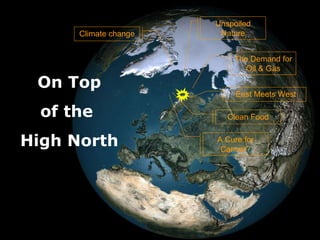
On Top of the  High North Climate change East Meets West The Demand for Oil & Gas Unspoiled Nature Clean Food A Cure for Cancer?
Tromsø in a Nutshell Situated at  69°40′58″N 18°56′34″E Founded 1794 Nicknames: “ Paris of the North” “ Gateway to the Arctic” Population: 67.000 (urban area) The 8th largest city in Norway Area 2.558 km2  The largest urban municipality of Norway 40 .000 m2 per person
 
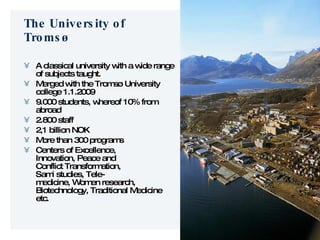
The University of Tromsø A classical university with a wide range of subjects taught. Merged with the Tromsø University college 1.1.2009 9.000 students, whereof 10% from abroad 2.800 staff 2,1 billion NOK More than 300 programs Centers of Excellence,  Innovation, Peace and Conflict Transformation, Sami studies, Tele- medicine, Women research, Biotechnology, Traditional Medicine etc.
The University of Tromsø aims to be an academic institution of high international standing and with a special commitment to developing the North, combining quality and relevance, cutting-edge research and a wide range of educational opportunities The University of Tromsø aims to be at the international forefront in research and education pertaining to the Northern region.  Particular emphasis shall be given to research in fields where the university has a comparative advantage due to its geographical location.  Aims & Commitments
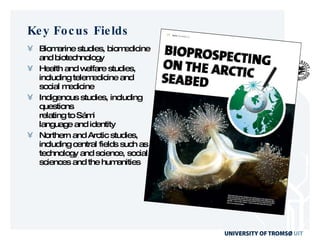
Key Focus Fields Biomarine studies, biomedicine  and biotechnology Health and welfare studies, including telemedicine and social medicine Indigenous studies, including questions relating to Sámi language and identity Northern and Arctic studies, including central fields such as technology and science, social sciences and the humanities
English taught Master Programs Human Rights Practice Law of the Sea English Linguistics Indigenous Studies Peace and Conflict Transformation Theoretical Linguistics Visual Cultural Studies Business Creation and Entrepreneurship Telemedicine and E-health Biology (Department of biology) Chemistry Computer Science Geology Physics Biomedicine
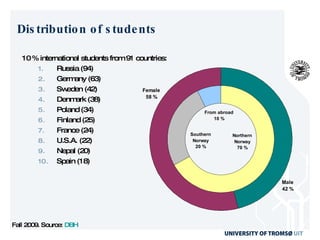
Distribution of students 10 % international students from 91 countries: Russia (94) Germany (63) Sweden (42) Denmark (38) Poland (34) Finland (25) France (24) U.S.A. (22) Nepal (20) Spain (18) Fall 2009. Source:  DBH
1968 - 2008
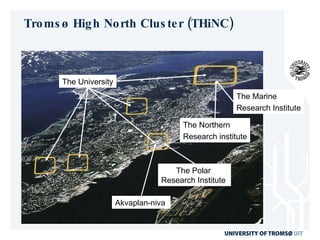
Tromsø High North Cluster (THiNC) The University The Northern  Research institute The Marine  Research Institute The Polar  Research Institute  Akvaplan-niva
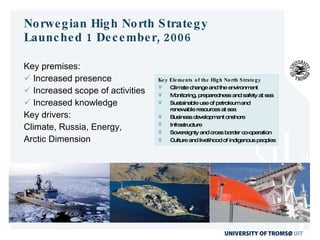
Norwegian High North Strategy Launched 1 December, 2006 Key premises: Increased presence Increased scope of activities Increased knowledge Key drivers: Climate, Russia, Energy, Arctic Dimension Key Elements of the High North Strategy Climate change and the environment  Monitoring, preparedness and safety at sea  Sustainable use of petroleum and renewable resources at sea Business development onshore Infrastructure Sovereignty and cross border co-operation Culture and livelihood of indigenous peoples
The role of Tromsø in the High North Strategy Major provider of knowledge:  The Arctic and its role in climate change Ice and it’s impact on climate Oceanography in polar regions Safe and secure operations in the Arctic  Relationship with Russia Fisheries and fish farming Marine bioprospecting Indigenous peoples Arctic governance and international laws in the Arctic Arctic technology Telemedicine  Etc..
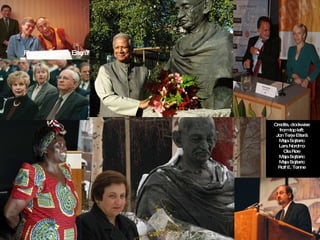
Credits, clockwise from top left: Jon Terje Eiterå Maja Sojtaric Lars Nordmo Ola Røe Maja Sojtaric Maja Sojtaric Rolf E. Tønne Photo: Jon Terje Eiterå
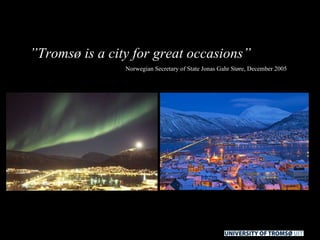
” Tromsø is a city for great occasions”   Norwegian Secretary of State Jonas Gahr Støre, December 2005

General Introduction

  • 1.
    A Short Introductionto Tromsø and the University of Tromsø
  • 2.
    On Top ofthe High North Climate change East Meets West The Demand for Oil & Gas Unspoiled Nature Clean Food A Cure for Cancer?
  • 3.
    Tromsø in aNutshell Situated at 69°40′58″N 18°56′34″E Founded 1794 Nicknames: “ Paris of the North” “ Gateway to the Arctic” Population: 67.000 (urban area) The 8th largest city in Norway Area 2.558 km2 The largest urban municipality of Norway 40 .000 m2 per person
  • 4.
  • 5.
    The University ofTromsø A classical university with a wide range of subjects taught. Merged with the Tromsø University college 1.1.2009 9.000 students, whereof 10% from abroad 2.800 staff 2,1 billion NOK More than 300 programs Centers of Excellence, Innovation, Peace and Conflict Transformation, Sami studies, Tele- medicine, Women research, Biotechnology, Traditional Medicine etc.
  • 6.
    The University ofTromsø aims to be an academic institution of high international standing and with a special commitment to developing the North, combining quality and relevance, cutting-edge research and a wide range of educational opportunities The University of Tromsø aims to be at the international forefront in research and education pertaining to the Northern region. Particular emphasis shall be given to research in fields where the university has a comparative advantage due to its geographical location. Aims & Commitments
  • 7.
    Key Focus FieldsBiomarine studies, biomedicine and biotechnology Health and welfare studies, including telemedicine and social medicine Indigenous studies, including questions relating to Sámi language and identity Northern and Arctic studies, including central fields such as technology and science, social sciences and the humanities
  • 8.
    English taught MasterPrograms Human Rights Practice Law of the Sea English Linguistics Indigenous Studies Peace and Conflict Transformation Theoretical Linguistics Visual Cultural Studies Business Creation and Entrepreneurship Telemedicine and E-health Biology (Department of biology) Chemistry Computer Science Geology Physics Biomedicine
  • 9.
    Distribution of students10 % international students from 91 countries: Russia (94) Germany (63) Sweden (42) Denmark (38) Poland (34) Finland (25) France (24) U.S.A. (22) Nepal (20) Spain (18) Fall 2009. Source: DBH
  • 10.
  • 11.
    Tromsø High NorthCluster (THiNC) The University The Northern Research institute The Marine Research Institute The Polar Research Institute Akvaplan-niva
  • 12.
    Norwegian High NorthStrategy Launched 1 December, 2006 Key premises: Increased presence Increased scope of activities Increased knowledge Key drivers: Climate, Russia, Energy, Arctic Dimension Key Elements of the High North Strategy Climate change and the environment Monitoring, preparedness and safety at sea Sustainable use of petroleum and renewable resources at sea Business development onshore Infrastructure Sovereignty and cross border co-operation Culture and livelihood of indigenous peoples
  • 13.
    The role ofTromsø in the High North Strategy Major provider of knowledge: The Arctic and its role in climate change Ice and it’s impact on climate Oceanography in polar regions Safe and secure operations in the Arctic Relationship with Russia Fisheries and fish farming Marine bioprospecting Indigenous peoples Arctic governance and international laws in the Arctic Arctic technology Telemedicine Etc..
  • 14.
    Credits, clockwise fromtop left: Jon Terje Eiterå Maja Sojtaric Lars Nordmo Ola Røe Maja Sojtaric Maja Sojtaric Rolf E. Tønne Photo: Jon Terje Eiterå
  • 15.
    ” Tromsø isa city for great occasions” Norwegian Secretary of State Jonas Gahr Støre, December 2005

Editor's Notes

  • #2 Dear students. It is a pleasure to welcome you to the University of Tromsø and to the Arctic. You and our other intn students make up 10% of our students. I’m glad to take this opportunity to give you a brief overview of this university and our surroundings. It’s actually a threefold welcome: to the north, to the city of Tromsø and in particular to the University of Tromsø – probably the best university in the whole world.